Single mode fiber
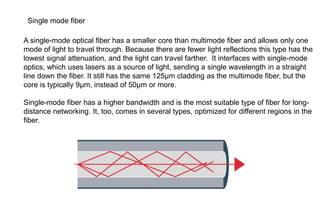
A single-mode optical fiber has a smaller core than multimode fiber and allows only one
mode of light to travel through. Because there are fewer light reflections this type has the
lowest signal attenuation, and the light can travel farther. It interfaces with single-mode
optics, which uses lasers as a source of light, sending a single wavelength in a straight
line down the fiber. It still has the same 125µm cladding as the multimode fiber, but the
core is typically 9µm, instead of 50µm or more.
Single-mode fiber has a higher bandwidth and is the most suitable type of fiber for long-
distance networking. It, too, comes in several types, optimized for different regions in the
fiber.

Single mode fiber.pptx

  • 1.
    Single mode fiber Asingle-mode optical fiber has a smaller core than multimode fiber and allows only one mode of light to travel through. Because there are fewer light reflections this type has the lowest signal attenuation, and the light can travel farther. It interfaces with single-mode optics, which uses lasers as a source of light, sending a single wavelength in a straight line down the fiber. It still has the same 125µm cladding as the multimode fiber, but the core is typically 9µm, instead of 50µm or more. Single-mode fiber has a higher bandwidth and is the most suitable type of fiber for long- distance networking. It, too, comes in several types, optimized for different regions in the fiber.