Single Leg Stance & Tandem Standing
Roll no. 5 – Darshini Venkatesh
SINGLE LEG STANCE TEST
The single leg stance test is used to assess static postural and balance
control .
Balance assessments like SLS test are a valuable clinical tool for
monitoring neurological and musculoskeletal status as well as for
managing fall risk
METHOD
performed with eyes open and hands on the hips
Client must stand unassisted on one leg timed from the time the other foot
touches the ground again
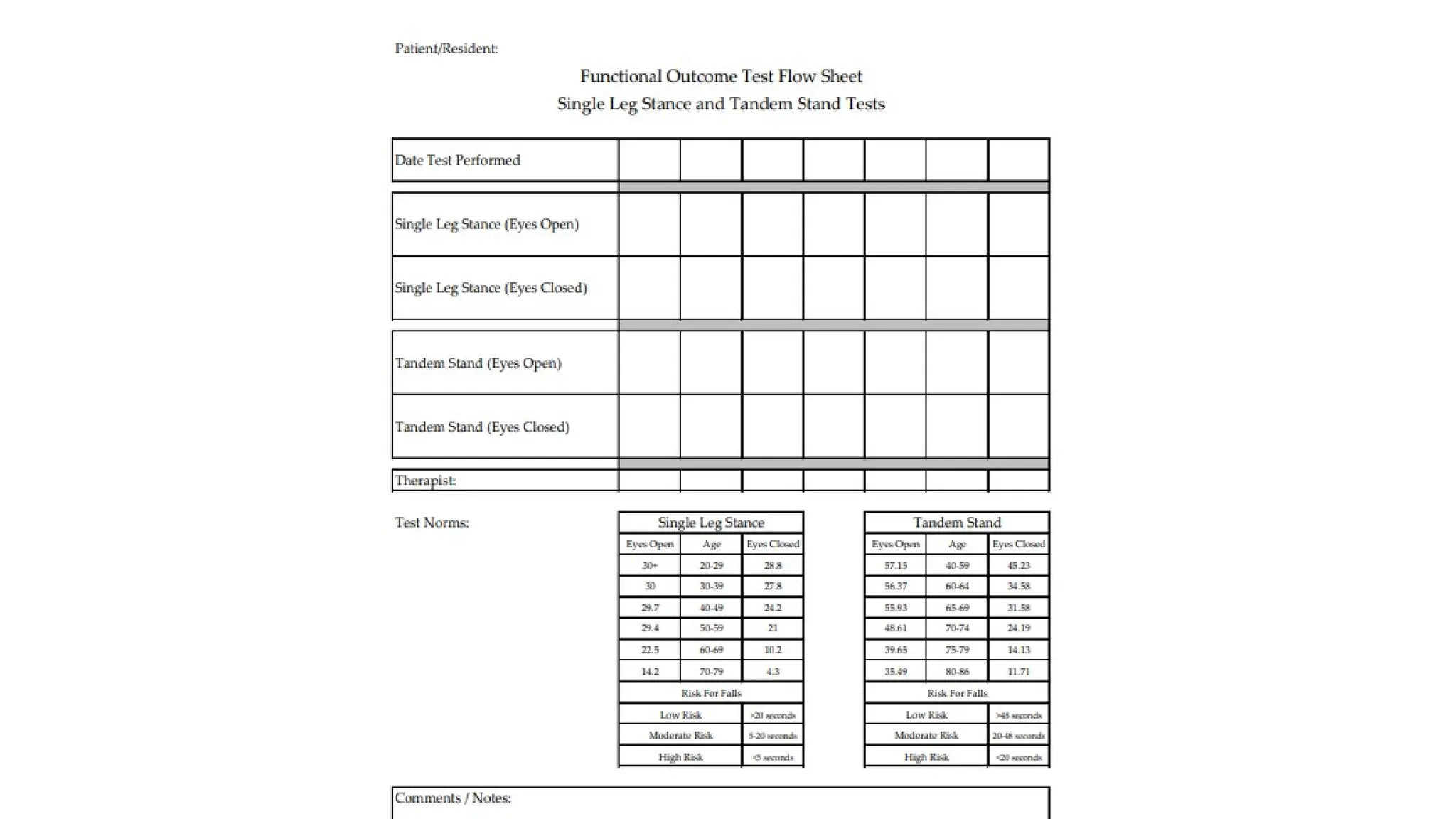
If unable to stand for 5 seconds client at greater risk of injury from fall.
Clinical Implications
Ability to control anticipatory postural adjustments (APAs) prior to lifting
one leg while standing in unsupported equilibrium represents a complex
motor task that is significantly impaired by eg
Neurological conditions like multiple sclerosis, Parkinson’s
disease, Alzheimer’s disease, and dementia stroke, traumatic brain injury
General geriatric population
Lower extremity pathology like knee osteoarthritis (OA), one of the most
common chronic health conditions, is associated with significant
impairment and disability, and predominantly affects the elderly population
TANDEM STANDING
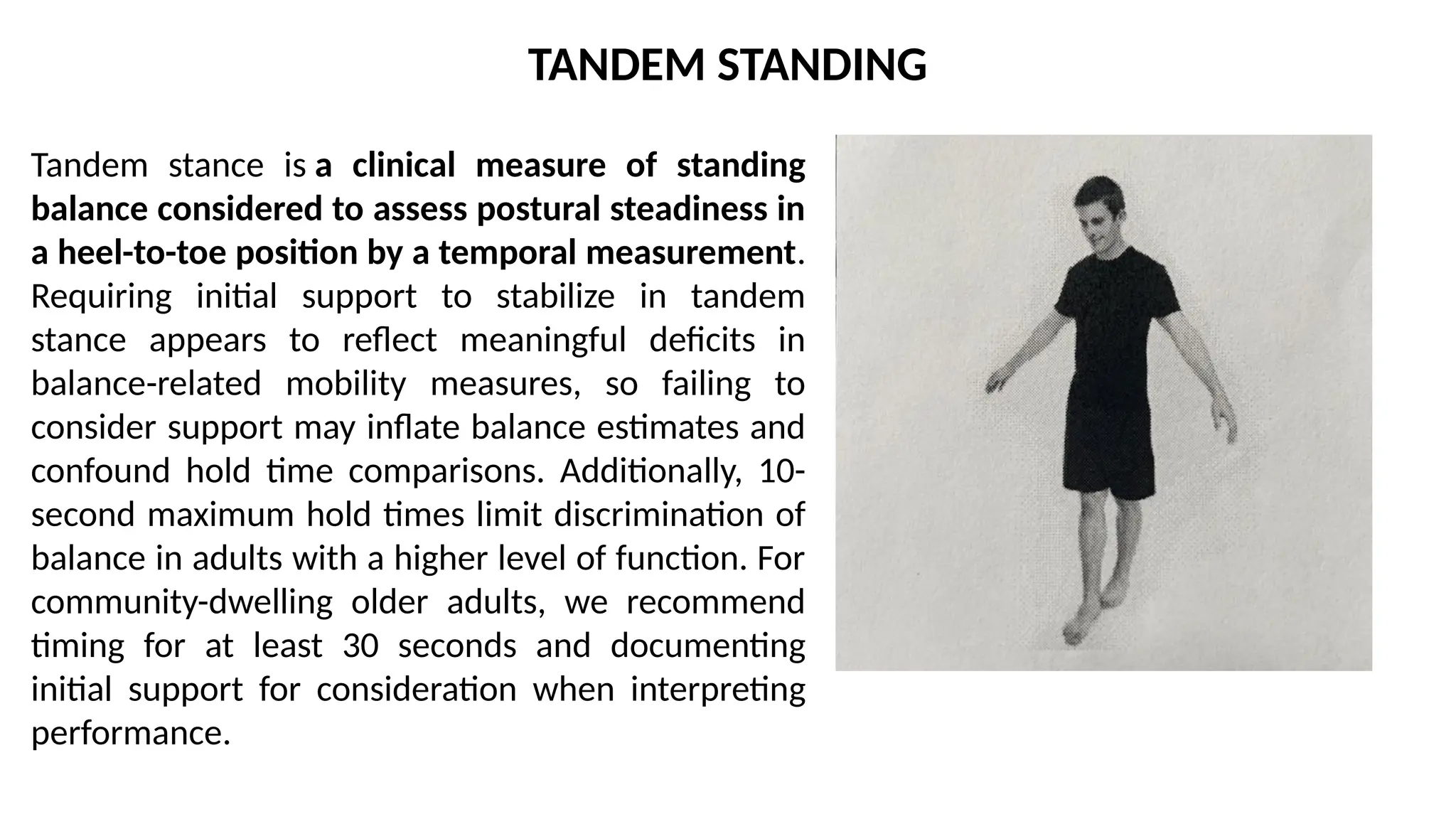
Tandem stance is a clinical measure of standing
balance considered to assess postural steadiness in
a heel-to-toe position by a temporal measurement.
Requiring initial support to stabilize in tandem
stance appears to reflect meaningful deficits in
balance-related mobility measures, so failing to
consider support may inflate balance estimates and
confound hold time comparisons. Additionally, 10-
second maximum hold times limit discrimination of
balance in adults with a higher level of function. For
community-dwelling older adults, we recommend
timing for at least 30 seconds and documenting
initial support for consideration when interpreting
performance.
- Single Leg Stance & Tandem Standing.pptx

- Single Leg Stance & Tandem Standing.pptx

  • 1.
    Single Leg Stance& Tandem Standing Roll no. 5 – Darshini Venkatesh
  • 2.
    SINGLE LEG STANCETEST The single leg stance test is used to assess static postural and balance control . Balance assessments like SLS test are a valuable clinical tool for monitoring neurological and musculoskeletal status as well as for managing fall risk METHOD performed with eyes open and hands on the hips Client must stand unassisted on one leg timed from the time the other foot touches the ground again If unable to stand for 5 seconds client at greater risk of injury from fall. Clinical Implications Ability to control anticipatory postural adjustments (APAs) prior to lifting one leg while standing in unsupported equilibrium represents a complex motor task that is significantly impaired by eg Neurological conditions like multiple sclerosis, Parkinson’s disease, Alzheimer’s disease, and dementia stroke, traumatic brain injury General geriatric population Lower extremity pathology like knee osteoarthritis (OA), one of the most common chronic health conditions, is associated with significant impairment and disability, and predominantly affects the elderly population
  • 3.
    TANDEM STANDING Tandem stanceis a clinical measure of standing balance considered to assess postural steadiness in a heel-to-toe position by a temporal measurement. Requiring initial support to stabilize in tandem stance appears to reflect meaningful deficits in balance-related mobility measures, so failing to consider support may inflate balance estimates and confound hold time comparisons. Additionally, 10- second maximum hold times limit discrimination of balance in adults with a higher level of function. For community-dwelling older adults, we recommend timing for at least 30 seconds and documenting initial support for consideration when interpreting performance.