12 Tenses
Theories and Examples
Sources: Slidesgo.com
Cre: Đăng Khoa
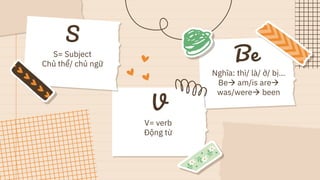
Be
Nghĩa: thì/ là/ ở/ bị...
Be am/is are
was/were been
S
S= Subject
Chủ thể/ chủ ngữ
V
V= verb
Động từ
Note!
S-V là một câu trúc hoàn chỉnh của
một câu, một mệnh đề.
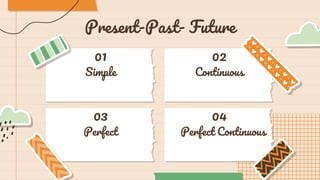
Present-Past- Future
Simple Continuous
Perfect Perfect Continuous
01
03
02
04
Simple
01
Simple Present
Simple Past
Simple Future
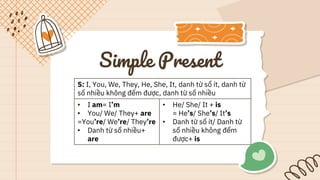
Simple Present
S: I, You, We, They, He, She, It, danh từ số ít, danh từ
số nhiều không đếm được, danh từ số nhiều
• I am= I’m
• You/ We/ They+ are
=You’re/ We’re/ They’re
• Danh từ số nhiều+
are
• He/ She/ It + is
= He’s/ She’s/ It’s
• Danh từ số ít/ Danh từ
số nhiều không đếm
được+ is
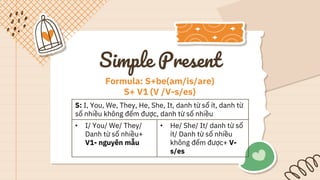
Simple Present
S: I, You, We, They, He, She, It, danh từ số ít, danh từ
số nhiều không đếm được, danh từ số nhiều
• I/ You/ We/ They/
Danh từ số nhiều+
V1- nguyên mẫu
• He/ She/ It/ danh từ số
ít/ Danh từ số nhiều
không đếm được+ V-
s/es
Formula: S+be(am/is/are)
S+ V1 (V /V-s/es)
Simple Present
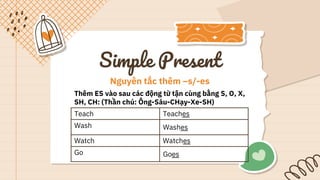
Nguyên tắc thêm –s/-es
Thêm ES vào sau các động từ tận cùng bằng S, O, X,
SH, CH: (Thần chú: Ông-Sáu-CHạy-Xe-SH)
Teach Teaches
Wash Washes
Watch Watches
Go Goes
Simple Present
Nguyên tắc thêm –s/-es
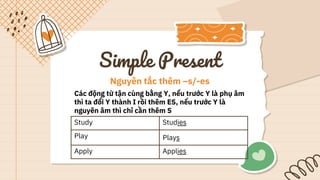
Các động từ tận cùng bằng Y, nếu trước Y là phụ âm
thì ta đổi Y thành I rồi thêm ES, nếu trước Y là
nguyên âm thì chỉ cần thêm S
Study Studies
Play Plays
Apply Applies
Simple Present
Nguyên tắc thêm –s/-es
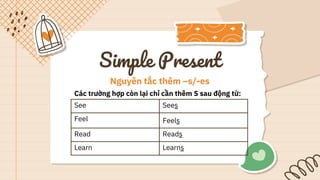
Các trường hợp còn lại chỉ cần thêm S sau động từ:
See Sees
Feel Feels
Read Reads
Learn Learns
Simple Present
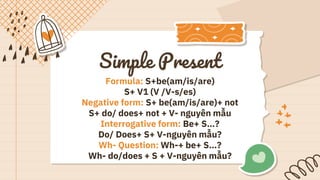
Formula: S+be(am/is/are)
S+ V1 (V /V-s/es)
Negative form: S+ be(am/is/are)+ not
S+ do/ does+ not + V- nguyên mẫu
Interrogative form: Be+ S…?
Do/ Does+ S+ V-nguyên mẫu?
Wh- Question: Wh-+ be+ S…?
Wh- do/does + S + V-nguyên mẫu?
Simple Present
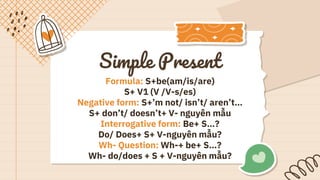
Formula: S+be(am/is/are)
S+ V1 (V /V-s/es)
Negative form: S+’m not/ isn’t/ aren’t…
S+ don’t/ doesn’t+ V- nguyên mẫu
Interrogative form: Be+ S…?
Do/ Does+ S+ V-nguyên mẫu?
Wh- Question: Wh-+ be+ S…?
Wh- do/does + S + V-nguyên mẫu?
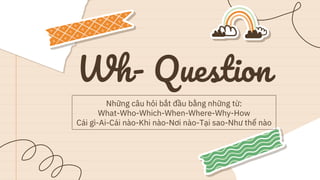
Wh- Question
Những câu hỏi bắt đầu bằng những từ:
What-Who-Which-When-Where-Why-How
Cái gì-Ai-Cái nào-Khi nào-Nơi nào-Tại sao-Như thế nào
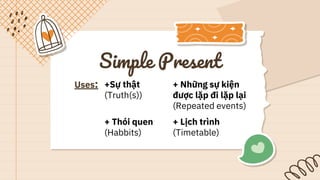
Simple Present
Uses: +Sự thật
(Truth(s))
+ Những sự kiện
được lặp đi lặp lại
(Repeated events)
+ Thói quen
(Habbits)
+ Lịch trình
(Timetable)
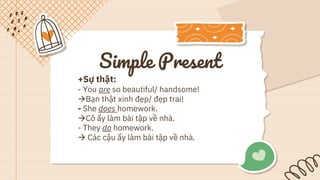
Simple Present
+Sự thật:
- You are so beautiful/ handsome!
Bạn thật xinh đẹp/ đẹp trai!
- She does homework.
Cô ấy làm bài tập về nhà.
- They do homework.
 Các cậu ấy làm bài tập về nhà.
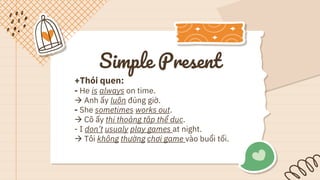
Simple Present
+Thói quen:
- He is always on time.
 Anh ấy luôn đúng giờ.
- She sometimes works out.
 Cô ấy thi thoảng tập thể dục.
- I don’t usualy play games at night.
 Tôi không thường chơi game vào buổi tối.
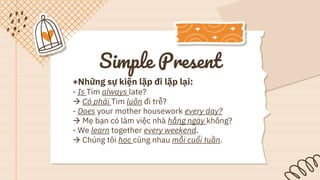
Simple Present
+Những sự kiện lặp đi lặp lại:
- Is Tim always late?
 Có phải Tim luôn đi trễ?
- Does your mother housework every day?
 Mẹ bạn có làm việc nhà hằng ngày không?
- We learn together every weekend.
 Chúng tôi học cùng nhau mỗi cuối tuần.
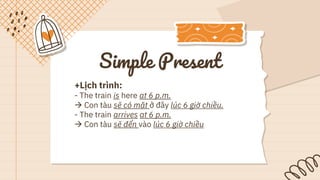
Simple Present
+Lịch trình:
- The train is here at 6 p.m.
 Con tàu sẽ có mặt ở đây lúc 6 giờ chiều.
- The train arrives at 6 p.m.
 Con tàu sẽ đến vào lúc 6 giờ chiều
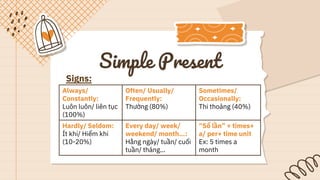
Simple Present
Always/
Constantly:
Luôn luôn/ liên tục
(100%)
Often/ Usually/
Frequently:
Thường (80%)
Sometimes/
Occasionally:
Thi thoảng (40%)
Hardly/ Seldom:
Ít khi/ Hiếm khi
(10-20%)
Every day/ week/
weekend/ month…:
Hằng ngày/ tuần/ cuối
tuần/ tháng…
“Số lần” + times+
a/ per+ time unit
Ex: 5 times a
month
Signs:
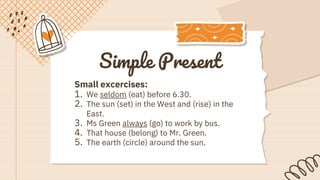
Simple Present
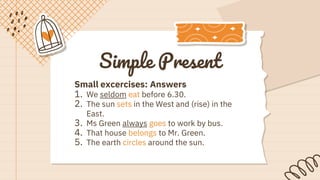
Small excercises:
1. We seldom (eat) before 6.30.
2. The sun (set) in the West and (rise) in the
East.
3. Ms Green always (go) to work by bus.
4. That house (belong) to Mr. Green.
5. The earth (circle) around the sun.
Simple Present
Small excercises: Answers
1. We seldom eat before 6.30.
2. The sun sets in the West and (rise) in the
East.
3. Ms Green always goes to work by bus.
4. That house belongs to Mr. Green.
5. The earth circles around the sun.
Bài Tập
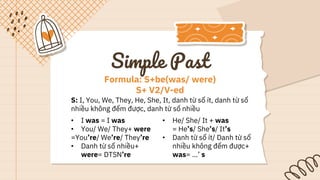
S: I, You, We, They, He, She, It, danh từ số ít, danh từ số
nhiều không đếm được, danh từ số nhiều
• I was = I was
• You/ We/ They+ were
=You’re/ We’re/ They’re
• Danh từ số nhiều+
were= DTSN’re
• He/ She/ It + was
= He’s/ She’s/ It’s
• Danh từ số ít/ Danh từ số
nhiều không đếm được+
was= …’ s
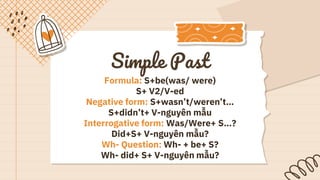
Formula: S+be(was/ were)
S+ V2/V-ed
Simple Past
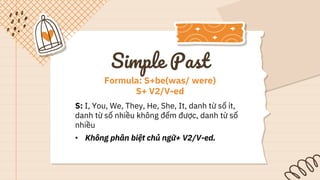
S: I, You, We, They, He, She, It, danh từ số ít,
danh từ số nhiều không đếm được, danh từ số
nhiều
• Không phân biệt chủ ngữ+ V2/V-ed.
Formula: S+be(was/ were)
S+ V2/V-ed
Simple Past
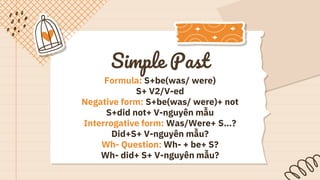
Simple Past
Formula: S+be(was/ were)
S+ V2/V-ed
Negative form: S+be(was/ were)+ not
S+did not+ V-nguyên mẫu
Interrogative form: Was/Were+ S…?
Did+S+ V-nguyên mẫu?
Wh- Question: Wh- + be+ S?
Wh- did+ S+ V-nguyên mẫu?
Simple Past
Formula: S+be(was/ were)
S+ V2/V-ed
Negative form: S+wasn’t/weren’t…
S+didn’t+ V-nguyên mẫu
Interrogative form: Was/Were+ S…?
Did+S+ V-nguyên mẫu?
Wh- Question: Wh- + be+ S?
Wh- did+ S+ V-nguyên mẫu?
Simple Past
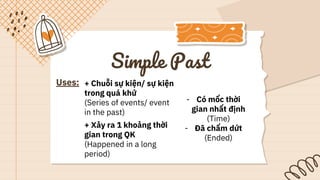
+ Chuỗi sự kiện/ sự kiện
trong quá khứ
(Series of events/ event
in the past)
- Có mốc thời
gian nhất định
(Time)
- Đã chấm dứt
(Ended)
+ Xảy ra 1 khoảng thời
gian trong QK
(Happened in a long
period)
Uses:
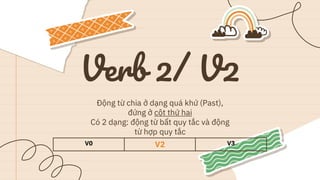
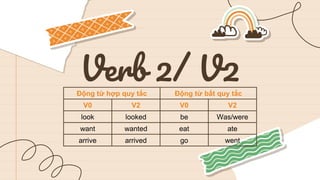
Verb 2/ V2
Động từ chia ở dạng quá khứ (Past),
đứng ở cột thứ hai
Có 2 dạng: động từ bất quy tắc và động
từ hợp quy tắc
V0 V2 V3
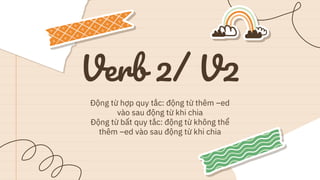
Verb 2/ V2
Động từ hợp quy tắc: động từ thêm –ed
vào sau động từ khi chia
Động từ bất quy tắc: động từ không thể
thêm –ed vào sau động từ khi chia
Verb 2/ V2
Động từ hợp quy tắc Động từ bất quy tắc
V0 V2 V0 V2
look looked be Was/were
want wanted eat ate
arrive arrived go went
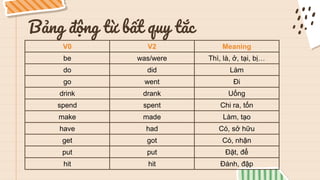
Bảng động từ bất quy tắc
V0 V2 Meaning
be was/were Thì, là, ở, tại, bị…
do did Làm
go went Đi
drink drank Uống
spend spent Chi ra, tốn
make made Làm, tạo
have had Có, sở hữu
get got Có, nhận
put put Đặt, để
hit hit Đánh, đập
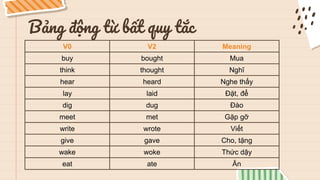
Bảng động từ bất quy tắc
V0 V2 Meaning
buy bought Mua
think thought Nghĩ
hear heard Nghe thấy
lay laid Đặt, để
dig dug Đào
meet met Gặp gỡ
write wrote Viết
give gave Cho, tặng
wake woke Thức dậy
eat ate Ăn
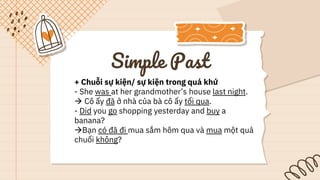
Simple Past
+ Chuỗi sự kiện/ sự kiện trong quá khứ
- She was at her grandmother’s house last night.
 Cô ấy đã ở nhà của bà cô ấy tối qua.
- Did you go shopping yesterday and buy a
banana?
Bạn có đã đi mua sắm hôm qua và mua một quả
chuối không?
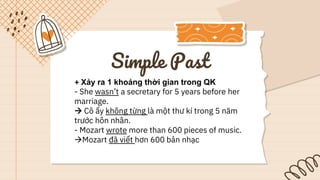
Simple Past
+ Xảy ra 1 khoảng thời gian trong QK
- She wasn’t a secretary for 5 years before her
marriage.
 Cô ấy không từng là một thư kí trong 5 năm
trước hôn nhân.
- Mozart wrote more than 600 pieces of music.
Mozart đã viết hơn 600 bản nhạc
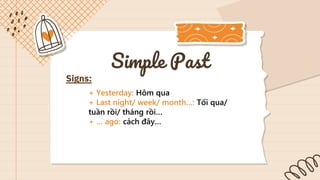
Simple Past
Signs:
+ Yesterday: Hôm qua
+ Last night/ week/ month…: Tối qua/
tuần rồi/ tháng rồi…
+ … ago: cách đây…
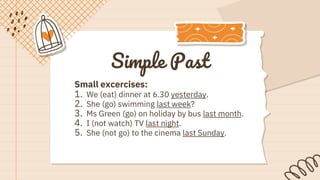
Simple Past
Small excercises:
1. We (eat) dinner at 6.30 yesterday.
2. She (go) swimming last week?
3. Ms Green (go) on holiday by bus last month.
4. I (not watch) TV last night.
5. She (not go) to the cinema last Sunday.
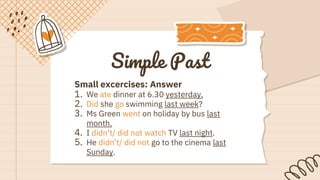
Simple Past
Small excercises: Answer
1. We ate dinner at 6.30 yesterday.
2. Did she go swimming last week?
3. Ms Green went on holiday by bus last
month.
4. I didn’t/ did not watch TV last night.
5. He didn’t/ did not go to the cinema last
Sunday.
Bài Tập
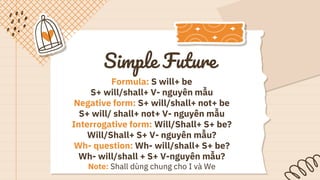
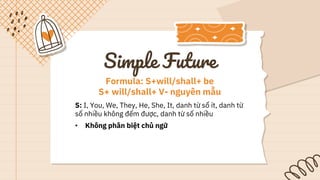
Simple Future
Formula: S+will/shall+ be
S+ will/shall+ V- nguyên mẫu
S: I, You, We, They, He, She, It, danh từ số ít, danh từ
số nhiều không đếm được, danh từ số nhiều
• Không phân biệt chủ ngữ
Simple Future
Formula: S will+ be
S+ will/shall+ V- nguyên mẫu
Negative form: S+ will/shall+ not+ be
S+ will/ shall+ not+ V- nguyên mẫu
Interrogative form: Will/Shall+ S+ be?
Will/Shall+ S+ V- nguyên mẫu?
Wh- question: Wh- will/shall+ S+ be?
Wh- will/shall + S+ V-nguyên mẫu?
Note: Shall dùng chung cho I và We
Simple Future
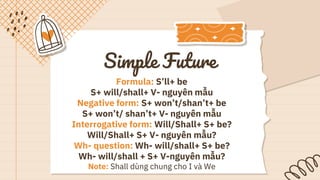
Formula: S’ll+ be
S+ will/shall+ V- nguyên mẫu
Negative form: S+ won’t/shan’t+ be
S+ won’t/ shan’t+ V- nguyên mẫu
Interrogative form: Will/Shall+ S+ be?
Will/Shall+ S+ V- nguyên mẫu?
Wh- question: Wh- will/shall+ S+ be?
Wh- will/shall + S+ V-nguyên mẫu?
Note: Shall dùng chung cho I và We
Simple Future
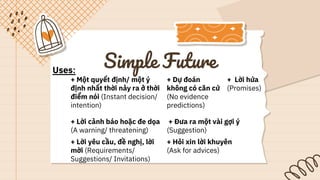
+ Một quyết định/ một ý
định nhất thời nảy ra ở thời
điểm nói (Instant decision/
intention)
+ Dự đoán
không có căn cứ
(No evidence
predictions)
+ Lời hứa
(Promises)
+ Lời cảnh báo hoặc đe dọa
(A warning/ threatening)
+ Đưa ra một vài gợi ý
(Suggestion)
+ Lời yêu cầu, đề nghị, lời
mời (Requirements/
Suggestions/ Invitations)
+ Hỏi xin lời khuyên
(Ask for advices)
Uses:
Simple Future
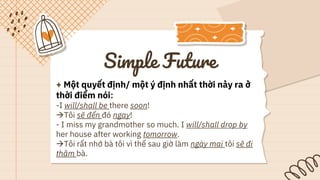
+ Một quyết định/ một ý định nhất thời nảy ra ở
thời điểm nói:
-I will/shall be there soon!
Tôi sẽ đến đó ngay!
- I miss my grandmother so much. I will/shall drop by
her house after working tomorrow.
Tôi rất nhớ bà tôi vì thế sau giờ làm ngày mai tôi sẽ đi
thăm bà.
Simple Future
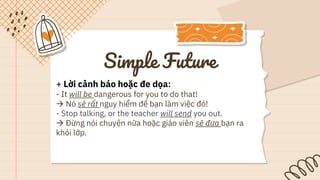
+ Lời cảnh báo hoặc đe dọa:
- It will be dangerous for you to do that!
 Nó sẽ rất nguy hiểm để bạn làm việc đó!
- Stop talking, or the teacher will send you out.
 Đừng nói chuyện nữa hoặc giáo viên sẽ đưa bạn ra
khỏi lớp.
Simple Future
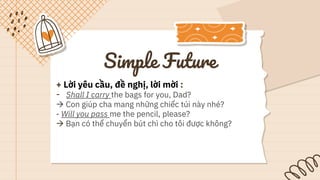
+ Lời yêu cầu, đề nghị, lời mời :
- Shall I carry the bags for you, Dad?
 Con giúp cha mang những chiếc túi này nhé?
- Will you pass me the pencil, please?
 Bạn có thể chuyển bút chì cho tôi được không?
Simple Future
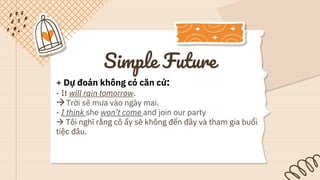
+ Dự đoán không có căn cứ:
- It will rain tomorrow.
Trời sẽ mưa vào ngày mai.
- I think she won’t come and join our party
 Tôi nghĩ rằng cô ấy sẽ không đến đây và tham gia buổi
tiệc đâu.
Simple Future
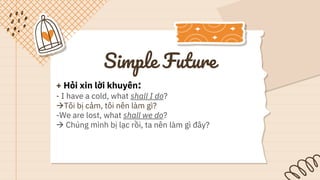
+ Hỏi xin lời khuyên:
- I have a cold, what shall I do?
Tôi bị cảm, tôi nên làm gì?
-We are lost, what shall we do?
 Chúng mình bị lạc rồi, ta nên làm gì đây?
Simple Future
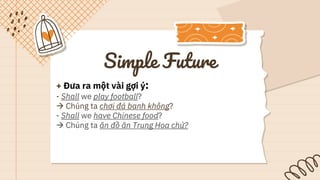
+ Đưa ra một vài gợi ý:
- Shall we play football?
 Chúng ta chơi đá banh không?
- Shall we have Chinese food?
 Chúng ta ăn đồ ăn Trung Hoa chứ?
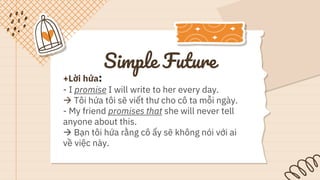
Simple Future
+Lời hứa:
- I promise I will write to her every day.
 Tôi hứa tôi sẽ viết thư cho cô ta mỗi ngày.
- My friend promises that she will never tell
anyone about this.
 Bạn tôi hứa rằng cô ấy sẽ không nói với ai
về việc này.
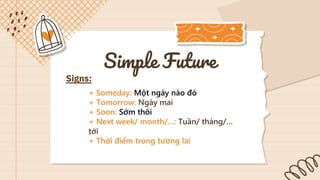
Simple Future
Signs:
+ Someday: Một ngày nào đó
+ Tomorrow: Ngày mai
+ Soon: Sớm thôi
+ Next week/ month/…: Tuần/ tháng/…
tới
+ Thời điểm trong tương lai
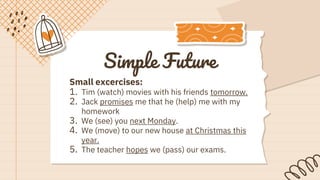
Simple Future
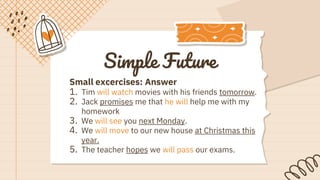
Small excercises:
1. Tim (watch) movies with his friends tomorrow.
2. Jack promises me that he (help) me with my
homework
3. We (see) you next Monday.
4. We (move) to our new house at Christmas this
year.
5. The teacher hopes we (pass) our exams.
Simple Future
Small excercises: Answer
1. Tim will watch movies with his friends tomorrow.
2. Jack promises me that he will help me with my
homework
3. We will see you next Monday.
4. We will move to our new house at Christmas this
year.
5. The teacher hopes we will pass our exams.
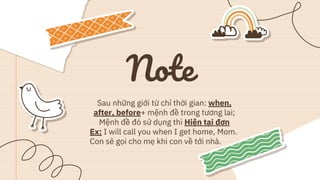
Note
Sau những giới từ chỉ thời gian: when,
after, before+ mệnh đề trong tương lai;
Mệnh đề đó sử dụng thì Hiện tại đơn
Ex: I will call you when I get home, Mom.
Con sẽ gọi cho mẹ khi con về tới nhà.
Bài Tập
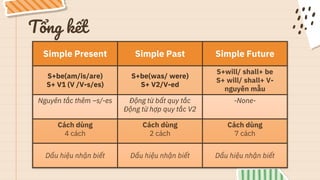
Tổng kết
Simple Present Simple Past Simple Future
S+be(am/is/are)
S+ V1 (V /V-s/es)
S+be(was/ were)
S+ V2/V-ed
S+will/ shall+ be
S+ will/ shall+ V-
nguyên mẫu
Nguyên tắc thêm –s/-es Động từ bất quy tắc
Động từ hợp quy tắc V2
-None-
Cách dùng
4 cách
Cách dùng
2 cách
Cách dùng
7 cách
Dấu hiệu nhận biết Dấu hiệu nhận biết Dấu hiệu nhận biết

Simple- Tenses.pptx

  • 1.
    12 Tenses Theories andExamples Sources: Slidesgo.com Cre: Đăng Khoa
  • 2.
    Be Nghĩa: thì/ là/ở/ bị... Be am/is are was/were been S S= Subject Chủ thể/ chủ ngữ V V= verb Động từ
  • 3.
    Note! S-V là mộtcâu trúc hoàn chỉnh của một câu, một mệnh đề.
  • 4.
    Present-Past- Future Simple Continuous PerfectPerfect Continuous 01 03 02 04
  • 5.
  • 6.
    Simple Present S: I,You, We, They, He, She, It, danh từ số ít, danh từ số nhiều không đếm được, danh từ số nhiều • I am= I’m • You/ We/ They+ are =You’re/ We’re/ They’re • Danh từ số nhiều+ are • He/ She/ It + is = He’s/ She’s/ It’s • Danh từ số ít/ Danh từ số nhiều không đếm được+ is
  • 7.
    Simple Present S: I,You, We, They, He, She, It, danh từ số ít, danh từ số nhiều không đếm được, danh từ số nhiều • I/ You/ We/ They/ Danh từ số nhiều+ V1- nguyên mẫu • He/ She/ It/ danh từ số ít/ Danh từ số nhiều không đếm được+ V- s/es Formula: S+be(am/is/are) S+ V1 (V /V-s/es)
  • 8.
    Simple Present Nguyên tắcthêm –s/-es Thêm ES vào sau các động từ tận cùng bằng S, O, X, SH, CH: (Thần chú: Ông-Sáu-CHạy-Xe-SH) Teach Teaches Wash Washes Watch Watches Go Goes
  • 9.
    Simple Present Nguyên tắcthêm –s/-es Các động từ tận cùng bằng Y, nếu trước Y là phụ âm thì ta đổi Y thành I rồi thêm ES, nếu trước Y là nguyên âm thì chỉ cần thêm S Study Studies Play Plays Apply Applies
  • 10.
    Simple Present Nguyên tắcthêm –s/-es Các trường hợp còn lại chỉ cần thêm S sau động từ: See Sees Feel Feels Read Reads Learn Learns
  • 11.
    Simple Present Formula: S+be(am/is/are) S+V1 (V /V-s/es) Negative form: S+ be(am/is/are)+ not S+ do/ does+ not + V- nguyên mẫu Interrogative form: Be+ S…? Do/ Does+ S+ V-nguyên mẫu? Wh- Question: Wh-+ be+ S…? Wh- do/does + S + V-nguyên mẫu?
  • 12.
    Simple Present Formula: S+be(am/is/are) S+V1 (V /V-s/es) Negative form: S+’m not/ isn’t/ aren’t… S+ don’t/ doesn’t+ V- nguyên mẫu Interrogative form: Be+ S…? Do/ Does+ S+ V-nguyên mẫu? Wh- Question: Wh-+ be+ S…? Wh- do/does + S + V-nguyên mẫu?
  • 13.
    Wh- Question Những câuhỏi bắt đầu bằng những từ: What-Who-Which-When-Where-Why-How Cái gì-Ai-Cái nào-Khi nào-Nơi nào-Tại sao-Như thế nào
  • 14.
    Simple Present Uses: +Sựthật (Truth(s)) + Những sự kiện được lặp đi lặp lại (Repeated events) + Thói quen (Habbits) + Lịch trình (Timetable)
  • 15.
    Simple Present +Sự thật: -You are so beautiful/ handsome! Bạn thật xinh đẹp/ đẹp trai! - She does homework. Cô ấy làm bài tập về nhà. - They do homework.  Các cậu ấy làm bài tập về nhà.
  • 16.
    Simple Present +Thói quen: -He is always on time.  Anh ấy luôn đúng giờ. - She sometimes works out.  Cô ấy thi thoảng tập thể dục. - I don’t usualy play games at night.  Tôi không thường chơi game vào buổi tối.
  • 17.
    Simple Present +Những sựkiện lặp đi lặp lại: - Is Tim always late?  Có phải Tim luôn đi trễ? - Does your mother housework every day?  Mẹ bạn có làm việc nhà hằng ngày không? - We learn together every weekend.  Chúng tôi học cùng nhau mỗi cuối tuần.
  • 18.
    Simple Present +Lịch trình: -The train is here at 6 p.m.  Con tàu sẽ có mặt ở đây lúc 6 giờ chiều. - The train arrives at 6 p.m.  Con tàu sẽ đến vào lúc 6 giờ chiều
  • 19.
    Simple Present Always/ Constantly: Luôn luôn/liên tục (100%) Often/ Usually/ Frequently: Thường (80%) Sometimes/ Occasionally: Thi thoảng (40%) Hardly/ Seldom: Ít khi/ Hiếm khi (10-20%) Every day/ week/ weekend/ month…: Hằng ngày/ tuần/ cuối tuần/ tháng… “Số lần” + times+ a/ per+ time unit Ex: 5 times a month Signs:
  • 20.
    Simple Present Small excercises: 1.We seldom (eat) before 6.30. 2. The sun (set) in the West and (rise) in the East. 3. Ms Green always (go) to work by bus. 4. That house (belong) to Mr. Green. 5. The earth (circle) around the sun.
  • 21.
    Simple Present Small excercises:Answers 1. We seldom eat before 6.30. 2. The sun sets in the West and (rise) in the East. 3. Ms Green always goes to work by bus. 4. That house belongs to Mr. Green. 5. The earth circles around the sun.
  • 22.
  • 23.
    S: I, You,We, They, He, She, It, danh từ số ít, danh từ số nhiều không đếm được, danh từ số nhiều • I was = I was • You/ We/ They+ were =You’re/ We’re/ They’re • Danh từ số nhiều+ were= DTSN’re • He/ She/ It + was = He’s/ She’s/ It’s • Danh từ số ít/ Danh từ số nhiều không đếm được+ was= …’ s Formula: S+be(was/ were) S+ V2/V-ed Simple Past
  • 24.
    S: I, You,We, They, He, She, It, danh từ số ít, danh từ số nhiều không đếm được, danh từ số nhiều • Không phân biệt chủ ngữ+ V2/V-ed. Formula: S+be(was/ were) S+ V2/V-ed Simple Past
  • 25.
    Simple Past Formula: S+be(was/were) S+ V2/V-ed Negative form: S+be(was/ were)+ not S+did not+ V-nguyên mẫu Interrogative form: Was/Were+ S…? Did+S+ V-nguyên mẫu? Wh- Question: Wh- + be+ S? Wh- did+ S+ V-nguyên mẫu?
  • 26.
    Simple Past Formula: S+be(was/were) S+ V2/V-ed Negative form: S+wasn’t/weren’t… S+didn’t+ V-nguyên mẫu Interrogative form: Was/Were+ S…? Did+S+ V-nguyên mẫu? Wh- Question: Wh- + be+ S? Wh- did+ S+ V-nguyên mẫu?
  • 27.
    Simple Past + Chuỗisự kiện/ sự kiện trong quá khứ (Series of events/ event in the past) - Có mốc thời gian nhất định (Time) - Đã chấm dứt (Ended) + Xảy ra 1 khoảng thời gian trong QK (Happened in a long period) Uses:
  • 28.
    Verb 2/ V2 Độngtừ chia ở dạng quá khứ (Past), đứng ở cột thứ hai Có 2 dạng: động từ bất quy tắc và động từ hợp quy tắc V0 V2 V3
  • 29.
    Verb 2/ V2 Độngtừ hợp quy tắc: động từ thêm –ed vào sau động từ khi chia Động từ bất quy tắc: động từ không thể thêm –ed vào sau động từ khi chia
  • 30.
    Verb 2/ V2 Độngtừ hợp quy tắc Động từ bất quy tắc V0 V2 V0 V2 look looked be Was/were want wanted eat ate arrive arrived go went
  • 31.
    Bảng động từbất quy tắc V0 V2 Meaning be was/were Thì, là, ở, tại, bị… do did Làm go went Đi drink drank Uống spend spent Chi ra, tốn make made Làm, tạo have had Có, sở hữu get got Có, nhận put put Đặt, để hit hit Đánh, đập
  • 32.
    Bảng động từbất quy tắc V0 V2 Meaning buy bought Mua think thought Nghĩ hear heard Nghe thấy lay laid Đặt, để dig dug Đào meet met Gặp gỡ write wrote Viết give gave Cho, tặng wake woke Thức dậy eat ate Ăn
  • 33.
    Simple Past + Chuỗisự kiện/ sự kiện trong quá khứ - She was at her grandmother’s house last night.  Cô ấy đã ở nhà của bà cô ấy tối qua. - Did you go shopping yesterday and buy a banana? Bạn có đã đi mua sắm hôm qua và mua một quả chuối không?
  • 34.
    Simple Past + Xảyra 1 khoảng thời gian trong QK - She wasn’t a secretary for 5 years before her marriage.  Cô ấy không từng là một thư kí trong 5 năm trước hôn nhân. - Mozart wrote more than 600 pieces of music. Mozart đã viết hơn 600 bản nhạc
  • 35.
    Simple Past Signs: + Yesterday:Hôm qua + Last night/ week/ month…: Tối qua/ tuần rồi/ tháng rồi… + … ago: cách đây…
  • 36.
    Simple Past Small excercises: 1.We (eat) dinner at 6.30 yesterday. 2. She (go) swimming last week? 3. Ms Green (go) on holiday by bus last month. 4. I (not watch) TV last night. 5. She (not go) to the cinema last Sunday.
  • 37.
    Simple Past Small excercises:Answer 1. We ate dinner at 6.30 yesterday. 2. Did she go swimming last week? 3. Ms Green went on holiday by bus last month. 4. I didn’t/ did not watch TV last night. 5. He didn’t/ did not go to the cinema last Sunday.
  • 38.
  • 39.
    Simple Future Formula: S+will/shall+be S+ will/shall+ V- nguyên mẫu S: I, You, We, They, He, She, It, danh từ số ít, danh từ số nhiều không đếm được, danh từ số nhiều • Không phân biệt chủ ngữ
  • 40.
    Simple Future Formula: Swill+ be S+ will/shall+ V- nguyên mẫu Negative form: S+ will/shall+ not+ be S+ will/ shall+ not+ V- nguyên mẫu Interrogative form: Will/Shall+ S+ be? Will/Shall+ S+ V- nguyên mẫu? Wh- question: Wh- will/shall+ S+ be? Wh- will/shall + S+ V-nguyên mẫu? Note: Shall dùng chung cho I và We
  • 41.
    Simple Future Formula: S’ll+be S+ will/shall+ V- nguyên mẫu Negative form: S+ won’t/shan’t+ be S+ won’t/ shan’t+ V- nguyên mẫu Interrogative form: Will/Shall+ S+ be? Will/Shall+ S+ V- nguyên mẫu? Wh- question: Wh- will/shall+ S+ be? Wh- will/shall + S+ V-nguyên mẫu? Note: Shall dùng chung cho I và We
  • 42.
    Simple Future + Mộtquyết định/ một ý định nhất thời nảy ra ở thời điểm nói (Instant decision/ intention) + Dự đoán không có căn cứ (No evidence predictions) + Lời hứa (Promises) + Lời cảnh báo hoặc đe dọa (A warning/ threatening) + Đưa ra một vài gợi ý (Suggestion) + Lời yêu cầu, đề nghị, lời mời (Requirements/ Suggestions/ Invitations) + Hỏi xin lời khuyên (Ask for advices) Uses:
  • 43.
    Simple Future + Mộtquyết định/ một ý định nhất thời nảy ra ở thời điểm nói: -I will/shall be there soon! Tôi sẽ đến đó ngay! - I miss my grandmother so much. I will/shall drop by her house after working tomorrow. Tôi rất nhớ bà tôi vì thế sau giờ làm ngày mai tôi sẽ đi thăm bà.
  • 44.
    Simple Future + Lờicảnh báo hoặc đe dọa: - It will be dangerous for you to do that!  Nó sẽ rất nguy hiểm để bạn làm việc đó! - Stop talking, or the teacher will send you out.  Đừng nói chuyện nữa hoặc giáo viên sẽ đưa bạn ra khỏi lớp.
  • 45.
    Simple Future + Lờiyêu cầu, đề nghị, lời mời : - Shall I carry the bags for you, Dad?  Con giúp cha mang những chiếc túi này nhé? - Will you pass me the pencil, please?  Bạn có thể chuyển bút chì cho tôi được không?
  • 46.
    Simple Future + Dựđoán không có căn cứ: - It will rain tomorrow. Trời sẽ mưa vào ngày mai. - I think she won’t come and join our party  Tôi nghĩ rằng cô ấy sẽ không đến đây và tham gia buổi tiệc đâu.
  • 47.
    Simple Future + Hỏixin lời khuyên: - I have a cold, what shall I do? Tôi bị cảm, tôi nên làm gì? -We are lost, what shall we do?  Chúng mình bị lạc rồi, ta nên làm gì đây?
  • 48.
    Simple Future + Đưara một vài gợi ý: - Shall we play football?  Chúng ta chơi đá banh không? - Shall we have Chinese food?  Chúng ta ăn đồ ăn Trung Hoa chứ?
  • 49.
    Simple Future +Lời hứa: -I promise I will write to her every day.  Tôi hứa tôi sẽ viết thư cho cô ta mỗi ngày. - My friend promises that she will never tell anyone about this.  Bạn tôi hứa rằng cô ấy sẽ không nói với ai về việc này.
  • 50.
    Simple Future Signs: + Someday:Một ngày nào đó + Tomorrow: Ngày mai + Soon: Sớm thôi + Next week/ month/…: Tuần/ tháng/… tới + Thời điểm trong tương lai
  • 51.
    Simple Future Small excercises: 1.Tim (watch) movies with his friends tomorrow. 2. Jack promises me that he (help) me with my homework 3. We (see) you next Monday. 4. We (move) to our new house at Christmas this year. 5. The teacher hopes we (pass) our exams.
  • 52.
    Simple Future Small excercises:Answer 1. Tim will watch movies with his friends tomorrow. 2. Jack promises me that he will help me with my homework 3. We will see you next Monday. 4. We will move to our new house at Christmas this year. 5. The teacher hopes we will pass our exams.
  • 53.
    Note Sau những giớitừ chỉ thời gian: when, after, before+ mệnh đề trong tương lai; Mệnh đề đó sử dụng thì Hiện tại đơn Ex: I will call you when I get home, Mom. Con sẽ gọi cho mẹ khi con về tới nhà.
  • 54.
  • 55.
    Tổng kết Simple PresentSimple Past Simple Future S+be(am/is/are) S+ V1 (V /V-s/es) S+be(was/ were) S+ V2/V-ed S+will/ shall+ be S+ will/ shall+ V- nguyên mẫu Nguyên tắc thêm –s/-es Động từ bất quy tắc Động từ hợp quy tắc V2 -None- Cách dùng 4 cách Cách dùng 2 cách Cách dùng 7 cách Dấu hiệu nhận biết Dấu hiệu nhận biết Dấu hiệu nhận biết