Short-Term Study Abroad Travel and change of place impart new vigor to the mind -Seneca Information regarding orientation and re-entry logistics for short-term programs
What is short-term study abroad? Any program less than 8 weeks in duration  January Term (J-term), summer 55.4% of 2006-07 study abroad participants (up from 52.8% of 2005-06) went on a short-term program* Allows for maximum flexibility and  affordability for a busy student on a tight budget  *Open Doors Report 2008, Institute of International Education
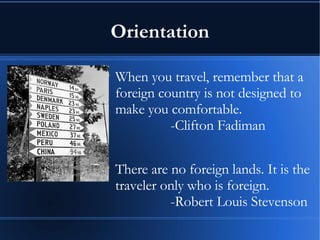
Orientation When you travel, remember that a foreign country is not designed to make you comfortable.  -Clifton Fadiman There are no foreign lands. It is the traveler only who is foreign. -Robert Louis Stevenson
Back to Basics Do you have a  passport ? http://travel.state.gov/passport > Apply ASAP (4-6 week processing time) > Requires: Application, proof of  citizenship, ID, Two 2 x 2” photos, fee Do you need a  visa ? http://travel.state.gov/travel/ > Provides information on visa requirements  on country-by-country basis
Health & Safety Insurance > Check with your current  provider to see if your  coverage applies overseas > May be available through  your program > Self-purchased plans: Travel  Guard, Travelex, AIG, CSA  Travel
Study Abroad is No Vacation Check with CDC and US State Department for travel/health warnings http://www.cdc.gov/  and  http://travel.state.gov/ Educational programs are not tourist agencies; program directors are not tour guides What are your educational and personal expectations for the program? Short-term means you have less time to get involved with and adapted to the local culture Less time online, more time face-to-face Be proactive in engaging people and seeking opportunities
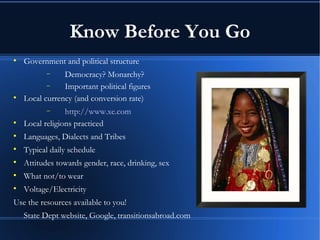
Know Before You Go Government and political structure Democracy? Monarchy?  Important political figures Local currency (and conversion rate) http:// www.xe.com Local religions practiced Languages, Dialects and Tribes Typical daily schedule Attitudes towards gender, race, drinking, sex What not/to wear Voltage/Electricity Use the resources available to you!  State Dept website, Google, transitionsabroad.com
In-Country
Reverse Culture Shock Coming home can be the hardest part. Why? You have had a life-changing experience, but expect things at home have stayed the same Disparity between idealized expectations and reality Inability to re-engage in home community Four stages of reverse culture shock:  Disengagement Initial euphoria Irritability and hostility Readjustment and adaptation http://www.studentsabroad.com/reentrycultureshock.html
Stages of Shock Disengagement You prepare to leave your host country and remove yourself physically and psychologically from the community Initial Euphoria Happy to see family & friends again; ready to tell them about your experience Irritability & Hostility Realize that others have changed and that friends expect you to merge back into culture and don’t want to hear your stories Negative feelings towards US culture; reverse ‘homesickness’ Readjustment Life is more routine; culture is more comfortable  Time to incorporate time abroad into your future
Incorporating Your Experience Abroad into Your Experience at Home Get involved with multicultural groups/organizations on campus and in the local community Host an ‘international dinner’ with food from your host country Present at student symposia or cross-cultural forums Enter writing/photo contests Take language courses to maintain skills Plan to travel again!
Resume Building Study abroad can show future employers: That you can adapt to new situations That you are comfortable working with people from diverse backgrounds That you have language/research/service learning experience Be Specific (List program/university, as well as specific projects you completed) Example (from www.skidmore.edu) Study Abroad, Institute for the International Education of Students  La Plata, Argentina (1/1999-5/1999)   Completed course work in Latin American culture and society.  Demonstrated willingness to take risks through enrollment in Spanish-speaking curriculum.  Gained fluency in Spanish.  Examined the effect of birth control on population growth in Argentina as an independent research project .
Returning Abroad Work Dave’s ESL Café ( www.eslcafe.com ) CIEE ( www.ciee.org ) or BUNAC ( www.bunac.org ) Study Long-term (semester or year) program Graduate studies (www. gradschools .com/international-programs.html) Volunteer Cross-Cultural Solutions ( www.crossculturalsolutions.org/ ) Religious or service learning organizations in your community
The World is in Your Hands Travel is fatal to prejudice, bigotry and narrow-mindedness, and many of our people need it sorely on these accounts. Broad, wholesome, charitable views of men and things can not be acquired by vegetating in one little corner of the earth all one's lifetime.  -Mark Twain

Short-Term Study Abroad

  • 1.
    Short-Term Study AbroadTravel and change of place impart new vigor to the mind -Seneca Information regarding orientation and re-entry logistics for short-term programs
  • 2.
    What is short-termstudy abroad? Any program less than 8 weeks in duration January Term (J-term), summer 55.4% of 2006-07 study abroad participants (up from 52.8% of 2005-06) went on a short-term program* Allows for maximum flexibility and affordability for a busy student on a tight budget *Open Doors Report 2008, Institute of International Education
  • 3.
    Orientation When youtravel, remember that a foreign country is not designed to make you comfortable. -Clifton Fadiman There are no foreign lands. It is the traveler only who is foreign. -Robert Louis Stevenson
  • 4.
    Back to BasicsDo you have a passport ? http://travel.state.gov/passport > Apply ASAP (4-6 week processing time) > Requires: Application, proof of citizenship, ID, Two 2 x 2” photos, fee Do you need a visa ? http://travel.state.gov/travel/ > Provides information on visa requirements on country-by-country basis
  • 5.
    Health & SafetyInsurance > Check with your current provider to see if your coverage applies overseas > May be available through your program > Self-purchased plans: Travel Guard, Travelex, AIG, CSA Travel
  • 6.
    Study Abroad isNo Vacation Check with CDC and US State Department for travel/health warnings http://www.cdc.gov/ and http://travel.state.gov/ Educational programs are not tourist agencies; program directors are not tour guides What are your educational and personal expectations for the program? Short-term means you have less time to get involved with and adapted to the local culture Less time online, more time face-to-face Be proactive in engaging people and seeking opportunities
  • 7.
    Know Before YouGo Government and political structure Democracy? Monarchy? Important political figures Local currency (and conversion rate) http:// www.xe.com Local religions practiced Languages, Dialects and Tribes Typical daily schedule Attitudes towards gender, race, drinking, sex What not/to wear Voltage/Electricity Use the resources available to you! State Dept website, Google, transitionsabroad.com
  • 8.
  • 9.
    Reverse Culture ShockComing home can be the hardest part. Why? You have had a life-changing experience, but expect things at home have stayed the same Disparity between idealized expectations and reality Inability to re-engage in home community Four stages of reverse culture shock: Disengagement Initial euphoria Irritability and hostility Readjustment and adaptation http://www.studentsabroad.com/reentrycultureshock.html
  • 10.
    Stages of ShockDisengagement You prepare to leave your host country and remove yourself physically and psychologically from the community Initial Euphoria Happy to see family & friends again; ready to tell them about your experience Irritability & Hostility Realize that others have changed and that friends expect you to merge back into culture and don’t want to hear your stories Negative feelings towards US culture; reverse ‘homesickness’ Readjustment Life is more routine; culture is more comfortable Time to incorporate time abroad into your future
  • 11.
    Incorporating Your ExperienceAbroad into Your Experience at Home Get involved with multicultural groups/organizations on campus and in the local community Host an ‘international dinner’ with food from your host country Present at student symposia or cross-cultural forums Enter writing/photo contests Take language courses to maintain skills Plan to travel again!
  • 12.
    Resume Building Studyabroad can show future employers: That you can adapt to new situations That you are comfortable working with people from diverse backgrounds That you have language/research/service learning experience Be Specific (List program/university, as well as specific projects you completed) Example (from www.skidmore.edu) Study Abroad, Institute for the International Education of Students La Plata, Argentina (1/1999-5/1999) Completed course work in Latin American culture and society. Demonstrated willingness to take risks through enrollment in Spanish-speaking curriculum. Gained fluency in Spanish. Examined the effect of birth control on population growth in Argentina as an independent research project .
  • 13.
    Returning Abroad WorkDave’s ESL Café ( www.eslcafe.com ) CIEE ( www.ciee.org ) or BUNAC ( www.bunac.org ) Study Long-term (semester or year) program Graduate studies (www. gradschools .com/international-programs.html) Volunteer Cross-Cultural Solutions ( www.crossculturalsolutions.org/ ) Religious or service learning organizations in your community
  • 14.
    The World isin Your Hands Travel is fatal to prejudice, bigotry and narrow-mindedness, and many of our people need it sorely on these accounts. Broad, wholesome, charitable views of men and things can not be acquired by vegetating in one little corner of the earth all one's lifetime. -Mark Twain