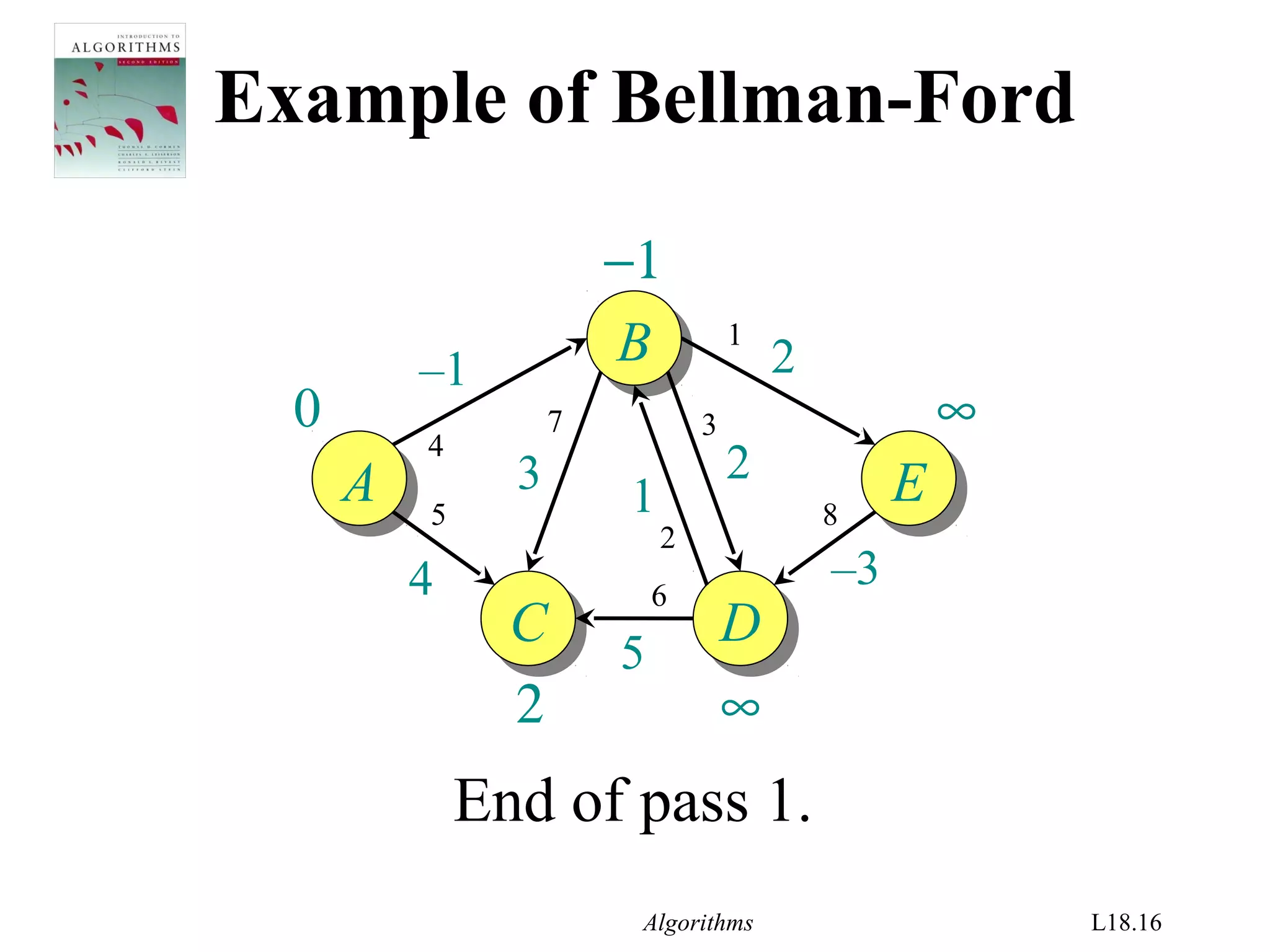
Algorithms L18.1
LECTURE 18
Shortest Paths II
• Bellman-Ford algorithm
• Linear programming and
difference constraints
• VLSI layout compaction
Algorithms
Algorithms L18.2
Negative-weight cycles
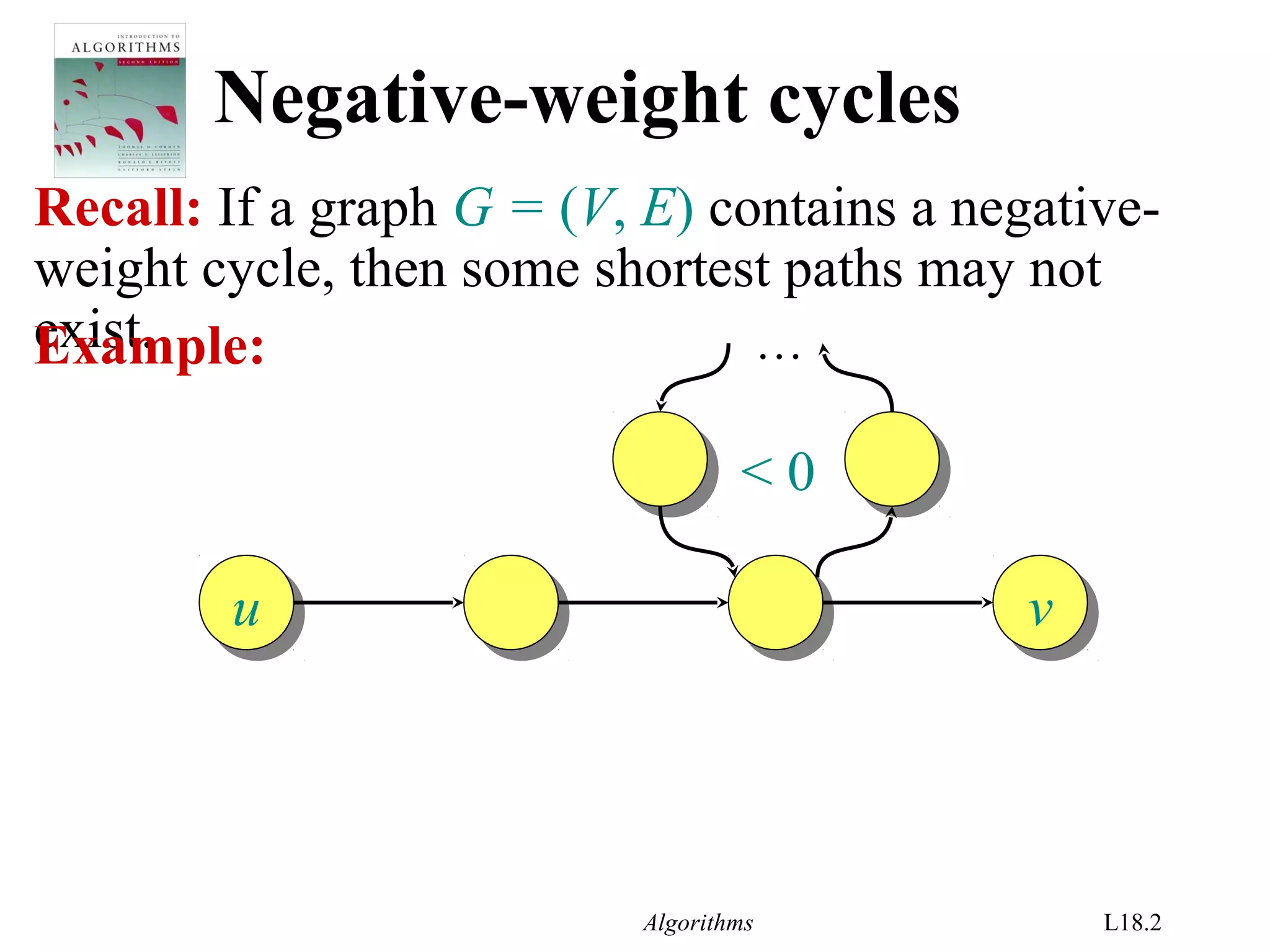
Recall: If a graph G = (V, E) contains a negative-
weight cycle, then some shortest paths may not
exist.Example:
uu vv
…
< 0
Algorithms L18.3
Negative-weight cycles
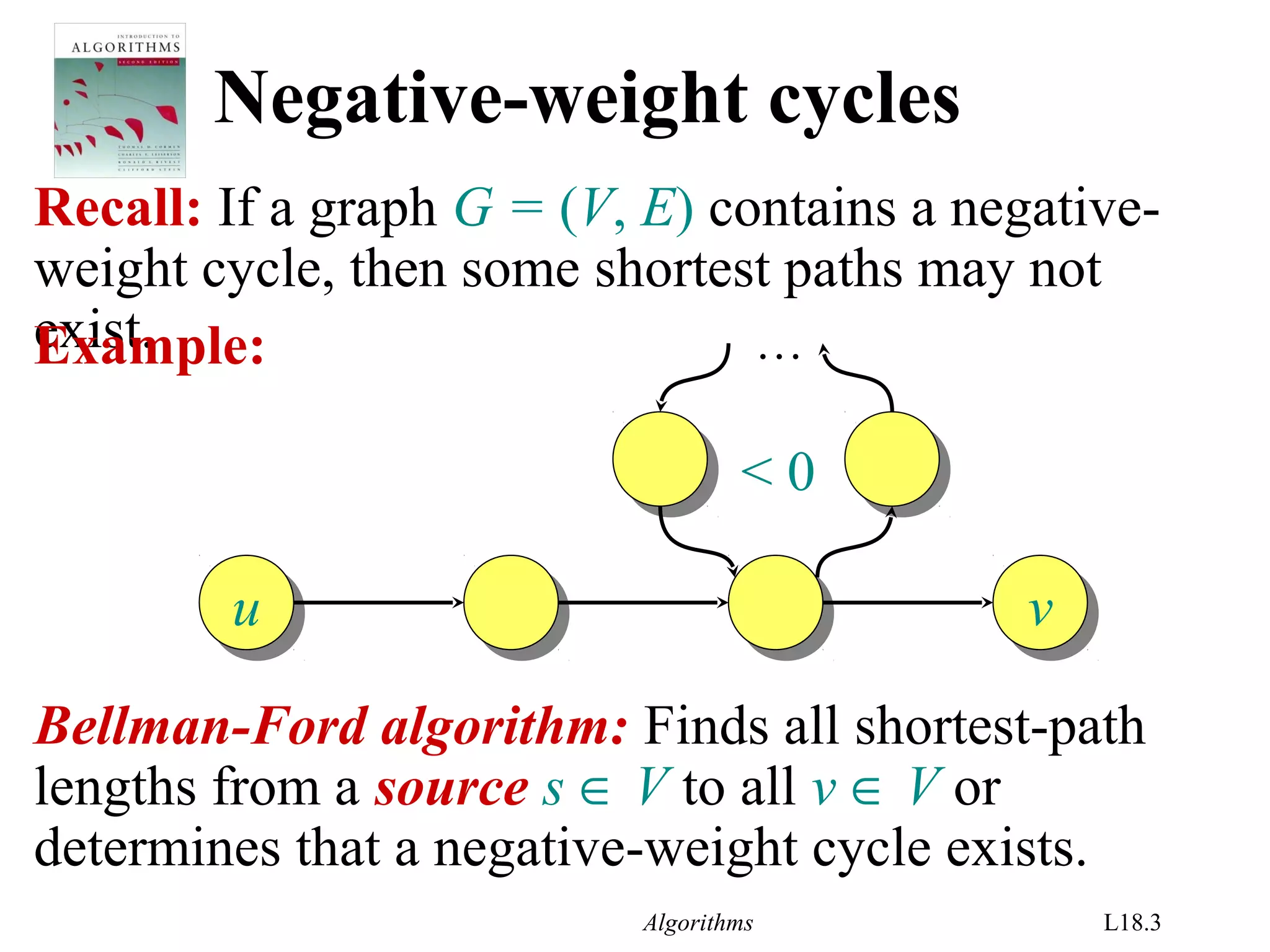
Recall: If a graph G = (V, E) contains a negative-
weight cycle, then some shortest paths may not
exist.Example:
uu vv
…
< 0
Bellman-Ford algorithm: Finds all shortest-path
lengths from a source s ∈ V to all v ∈ V or
determines that a negative-weight cycle exists.
Algorithms L18.4
Bellman-Ford algorithm
d[s] ← 0
for each v ∈ V – {s}
do d[v] ← ∞
for i ← 1 to |V| – 1
do for each edge (u, v) ∈ E
do if d[v] > d[u] + w(u, v)
then d[v] ← d[u] + w(u, v)
for each edge (u, v) ∈ E
do if d[v] > d[u] + w(u, v)
then report that a negative-weight cycle exists
initialization
At the end, d[v] = δ(s, v), if no negative-weight cycles.
Time = O(VE).
relaxation
step
Algorithms L18.5
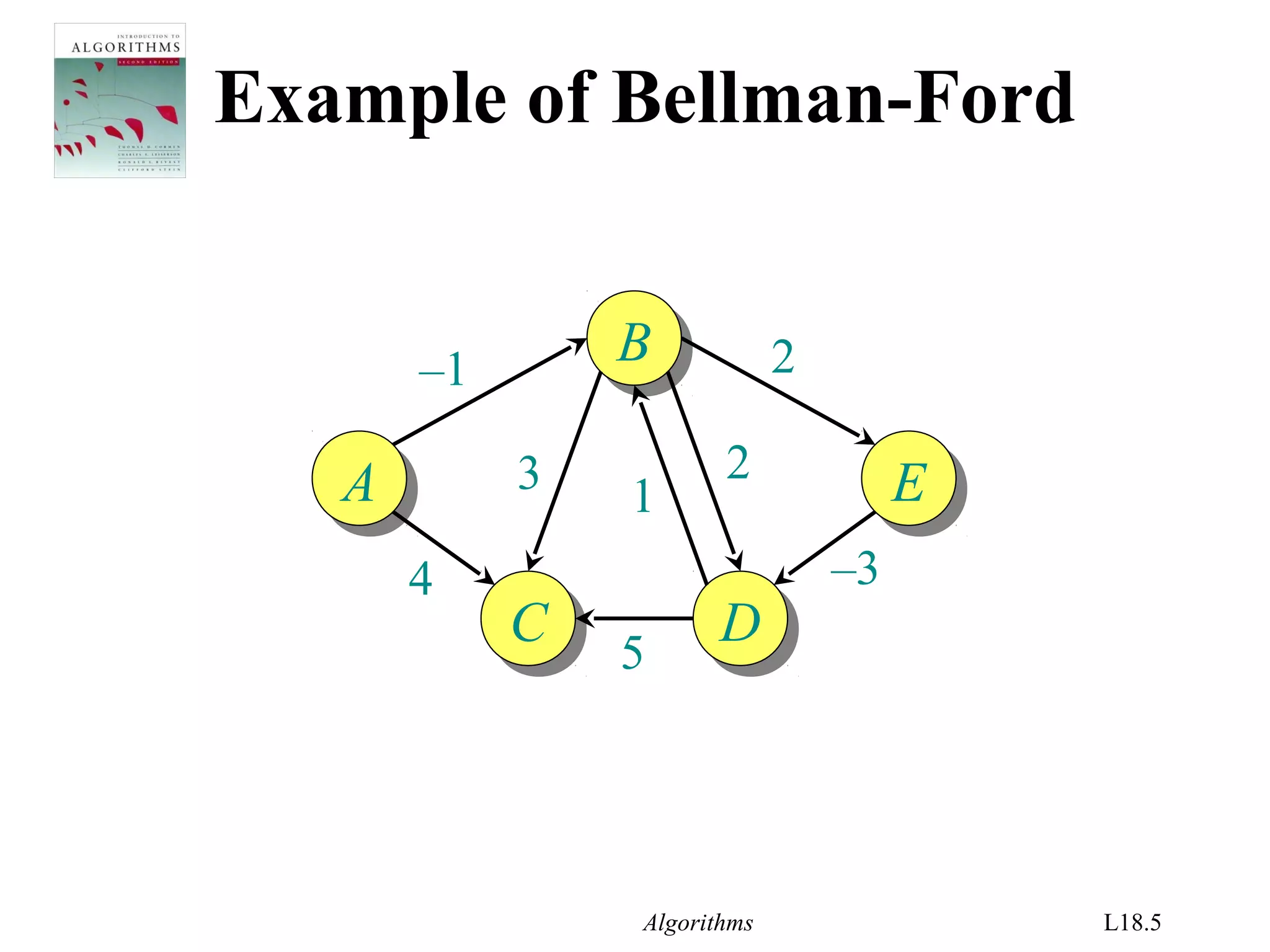
Example of Bellman-Ford
AA
BB
EE
CC DD
–1
4
1
2
–3
2
5
3
Algorithms L18.6
Example of Bellman-Ford
AA
BB
EE
CC DD
–1
4
1
2
–3
2
5
3
∞
0 ∞
∞ ∞
Initialization.
Algorithms L18.7
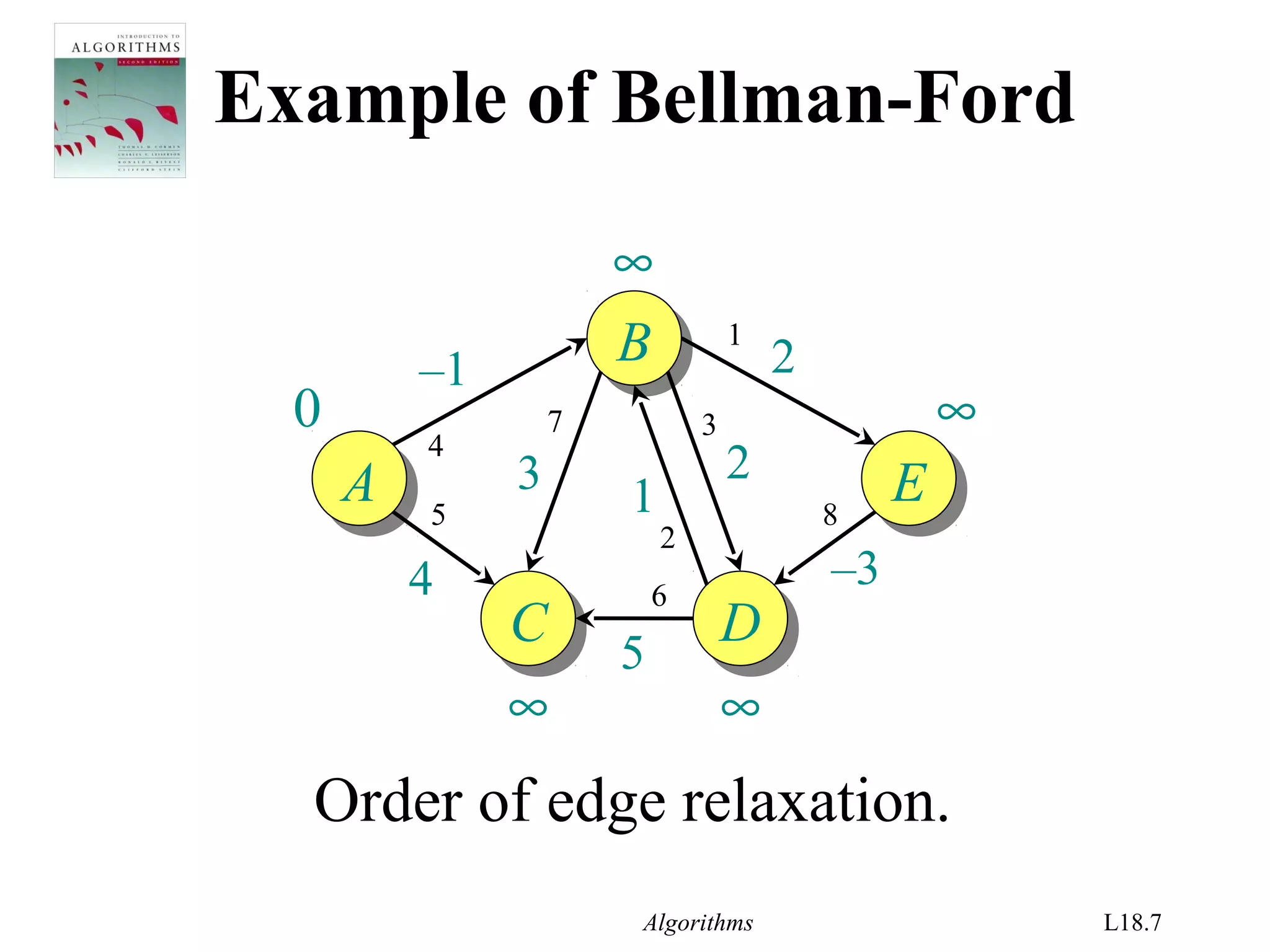
Example of Bellman-Ford
AA
BB
EE
CC DD
–1
4
1
2
–3
2
5
3
∞
0 ∞
∞ ∞
1
2
3
4
5
7
8
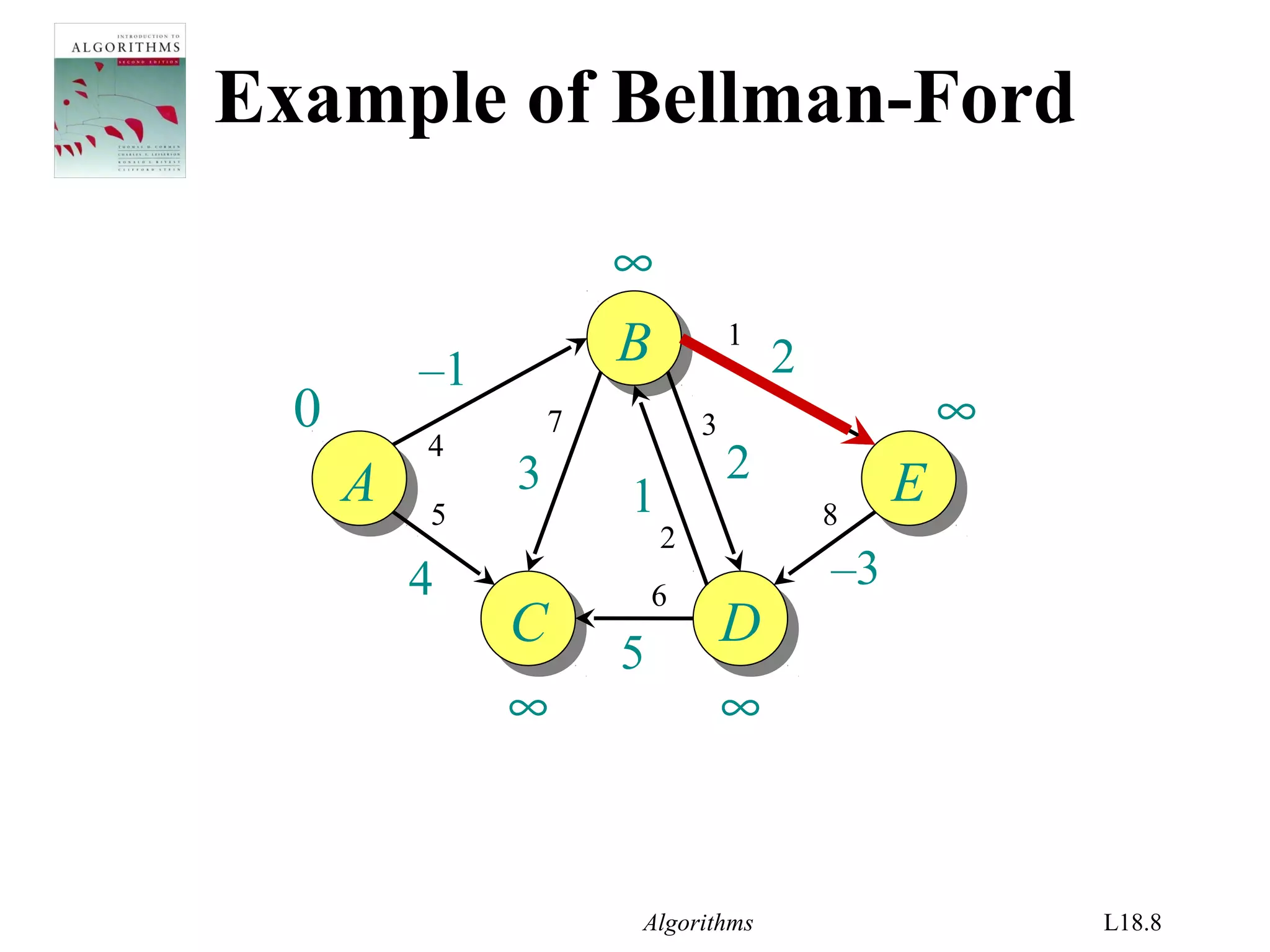
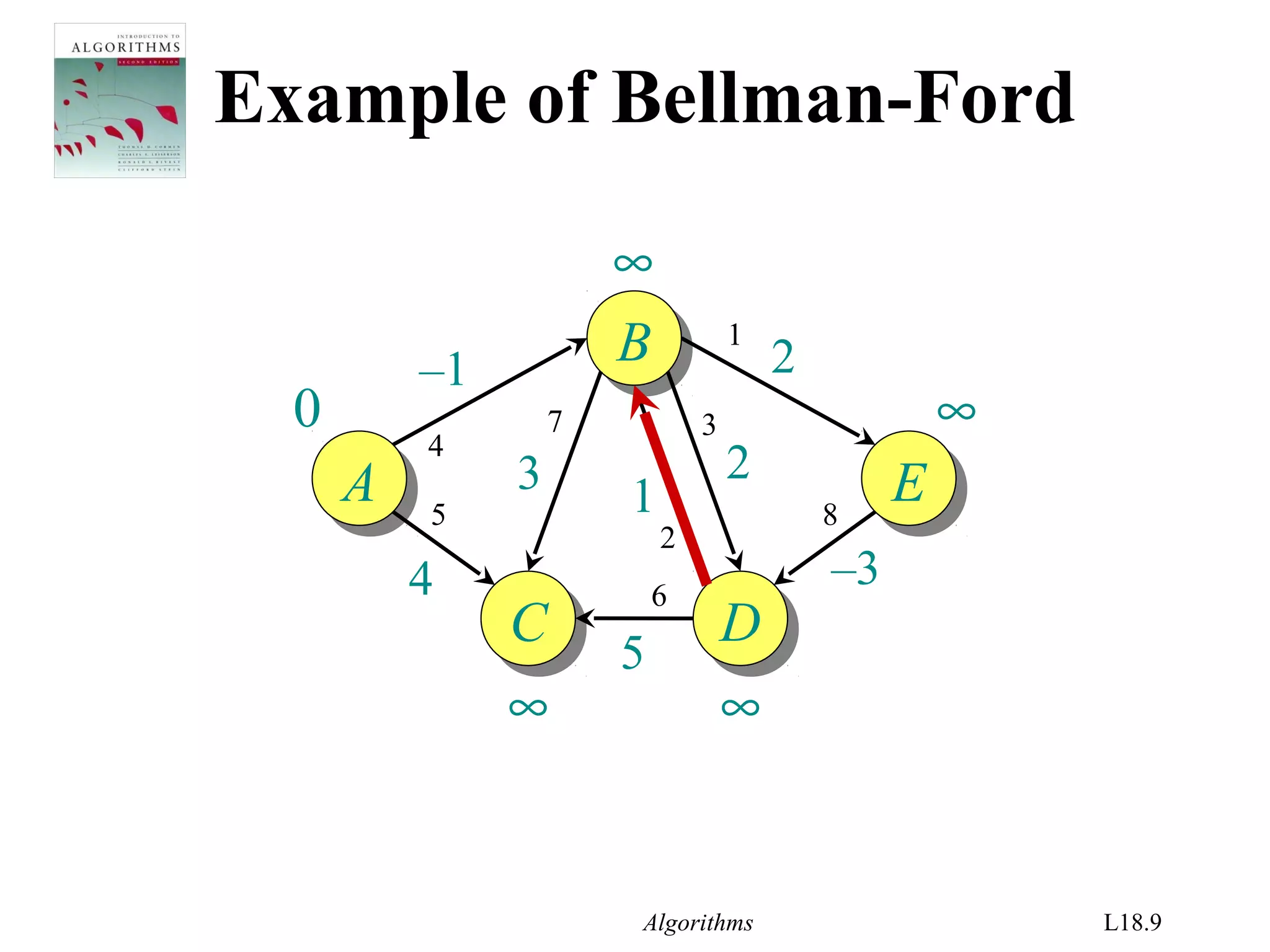
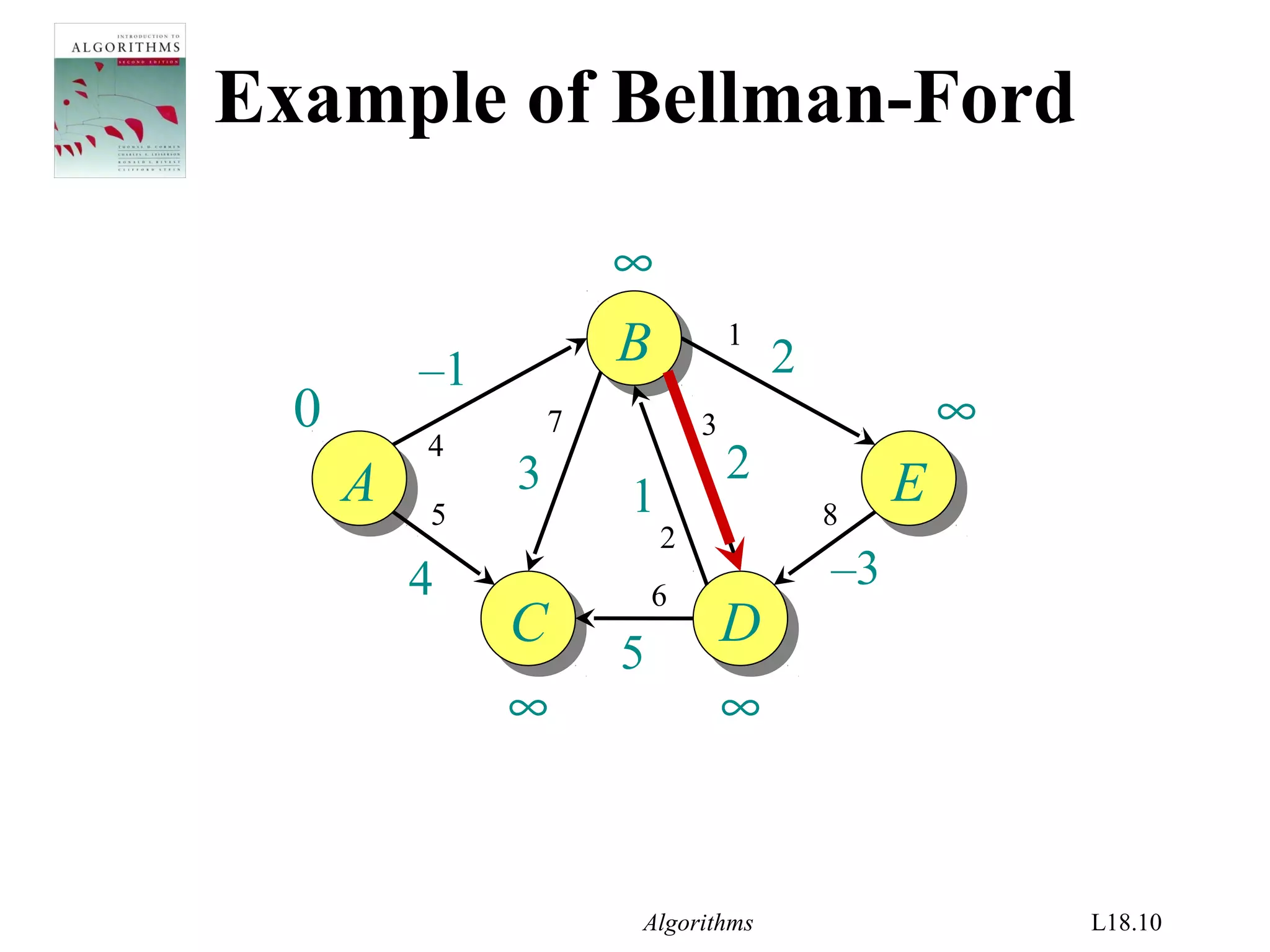
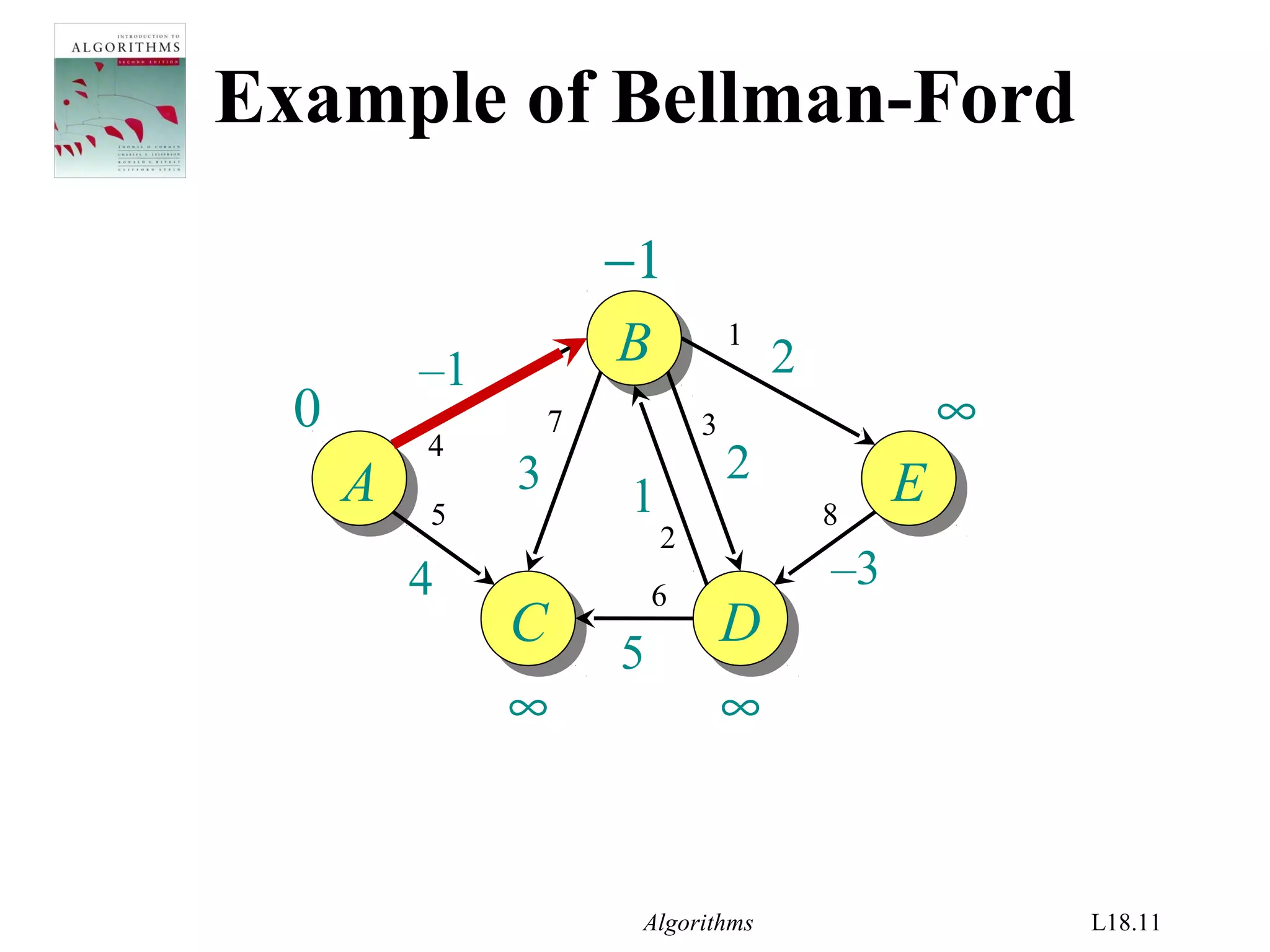
Order of edge relaxation.
6
Algorithms L18.8
Example of Bellman-Ford
AA
BB
EE
CC DD
–1
4
1
2
–3
2
5
3
∞
0 ∞
∞ ∞
1
2
3
4
5
7
8
6
Algorithms L18.9
Example of Bellman-Ford
AA
BB
EE
CC DD
–1
4
1
2
–3
2
5
3
∞
0 ∞
∞ ∞
1
2
3
4
5
7
8
6
Algorithms L18.10
Example of Bellman-Ford
AA
BB
EE
CC DD
–1
4
1
2
–3
2
5
3
∞
0 ∞
∞ ∞
1
2
3
4
5
7
8
6
Algorithms L18.11
∞−1
Example of Bellman-Ford
AA
BB
EE
CC DD
–1
4
1
2
–3
2
5
3
0 ∞
∞ ∞
1
2
3
4
5
7
8
6
Algorithms L18.12
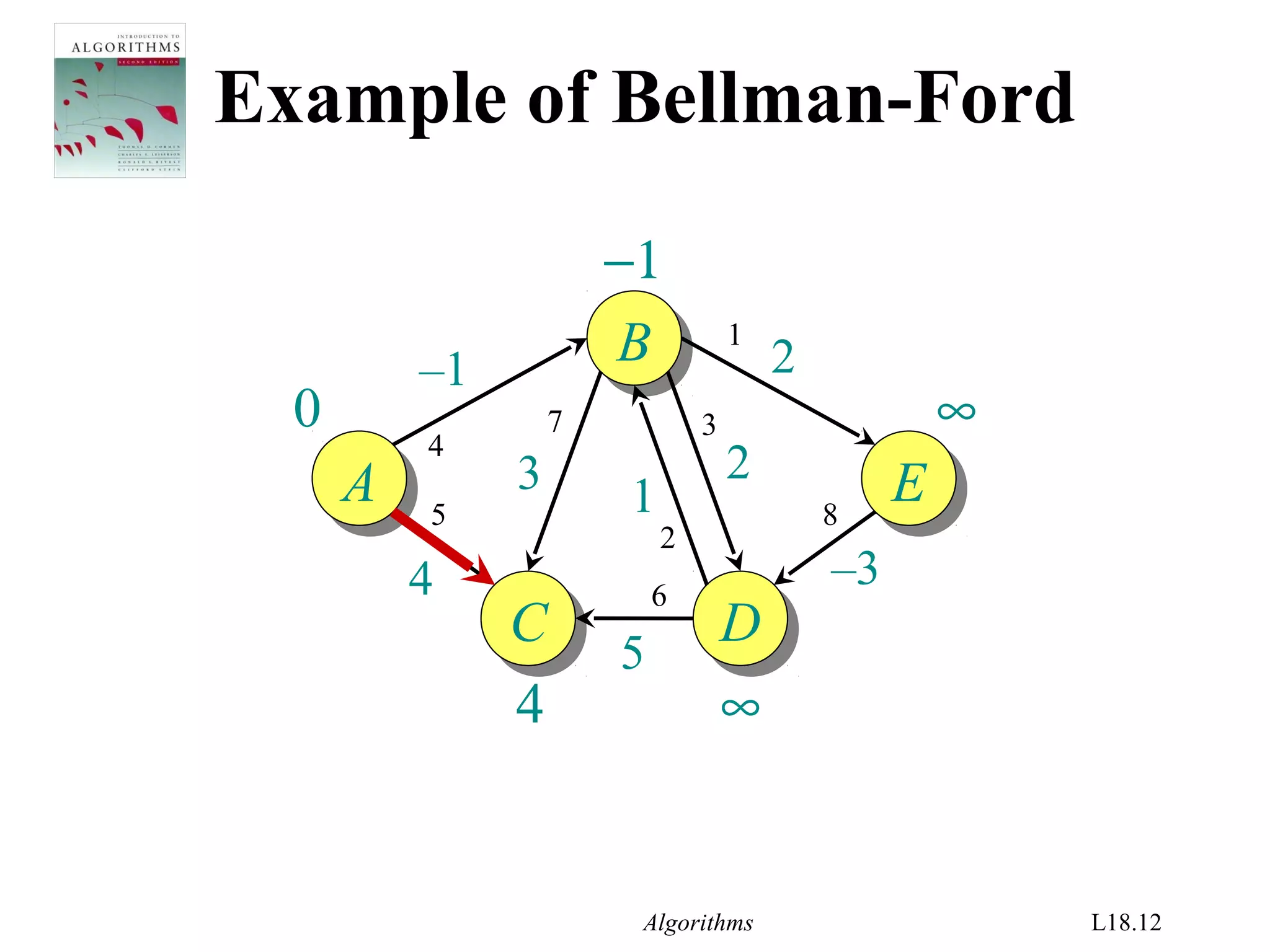
∞4
−1
Example of Bellman-Ford
AA
BB
EE
CC DD
–1
4
1
2
–3
2
5
3
0 ∞
∞
1
2
3
4
5
7
8
6
Algorithms L18.13
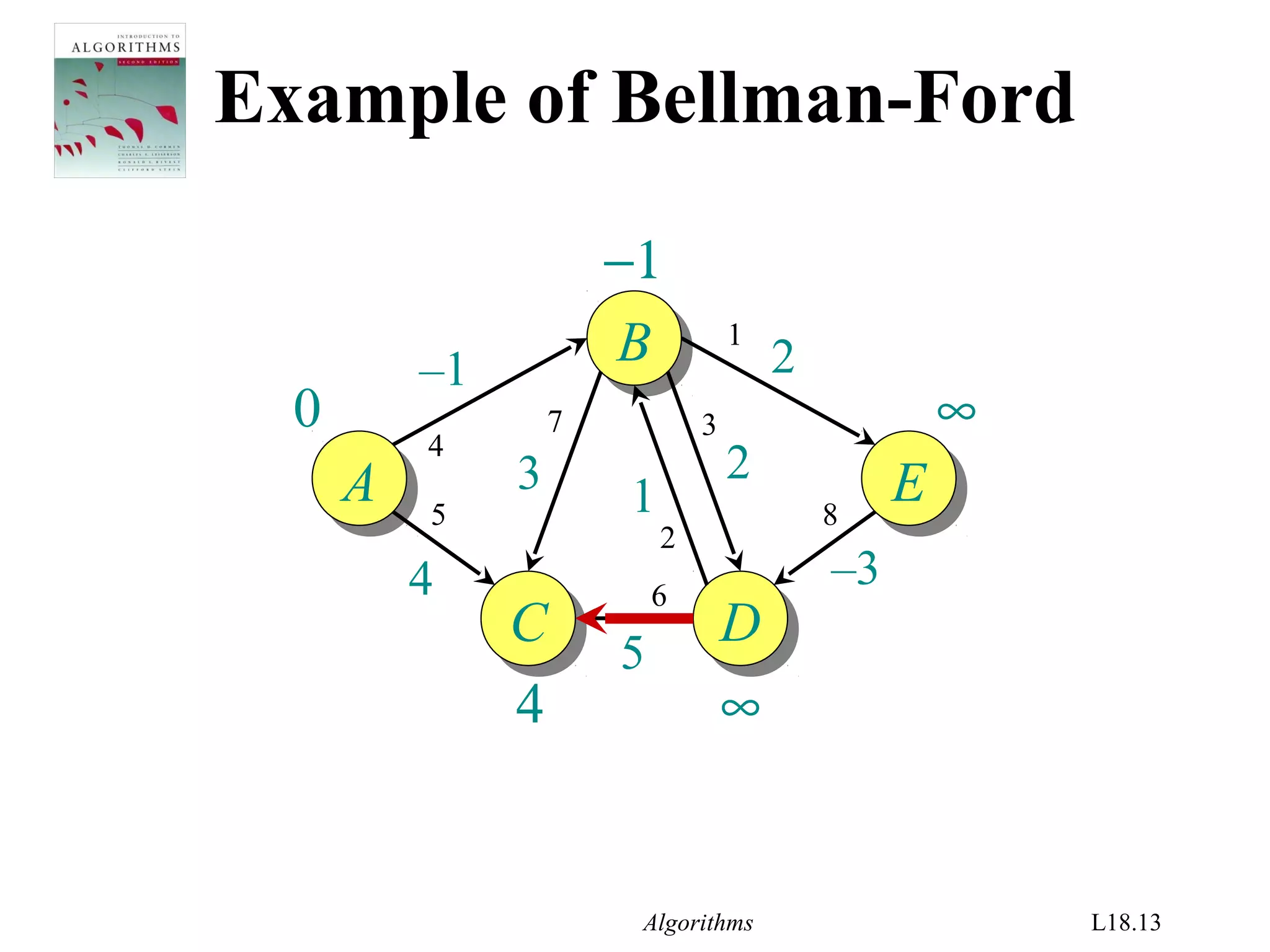
4
−1
Example of Bellman-Ford
AA
BB
EE
CC DD
–1
4
1
2
–3
2
5
3
0 ∞
∞
1
2
3
4
5
7
8
6
Algorithms L18.14
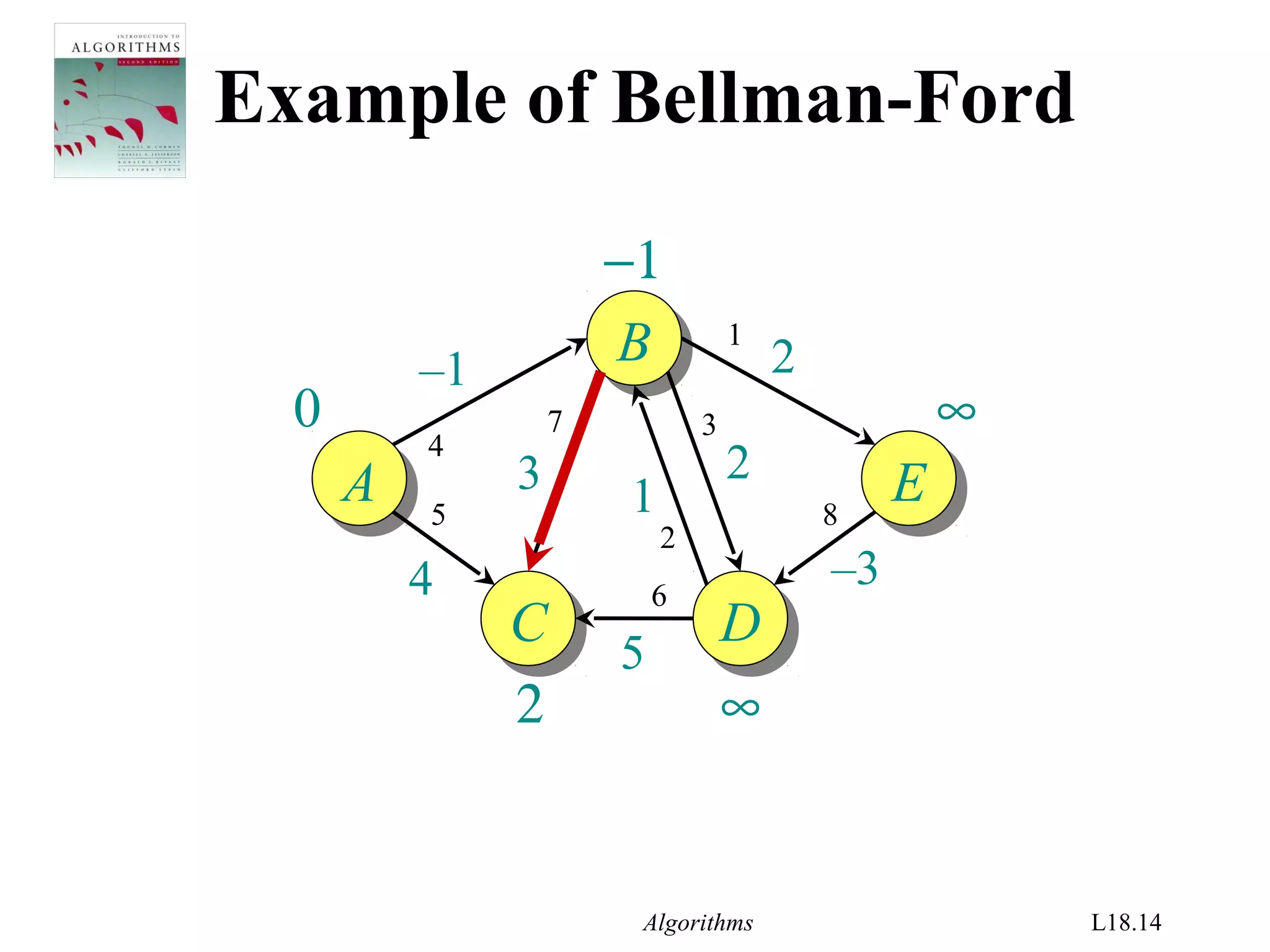
42
−1
Example of Bellman-Ford
AA
BB
EE
CC DD
–1
4
1
2
–3
2
5
3
0 ∞
∞
1
2
3
4
5
7
8
6
Algorithms L18.15
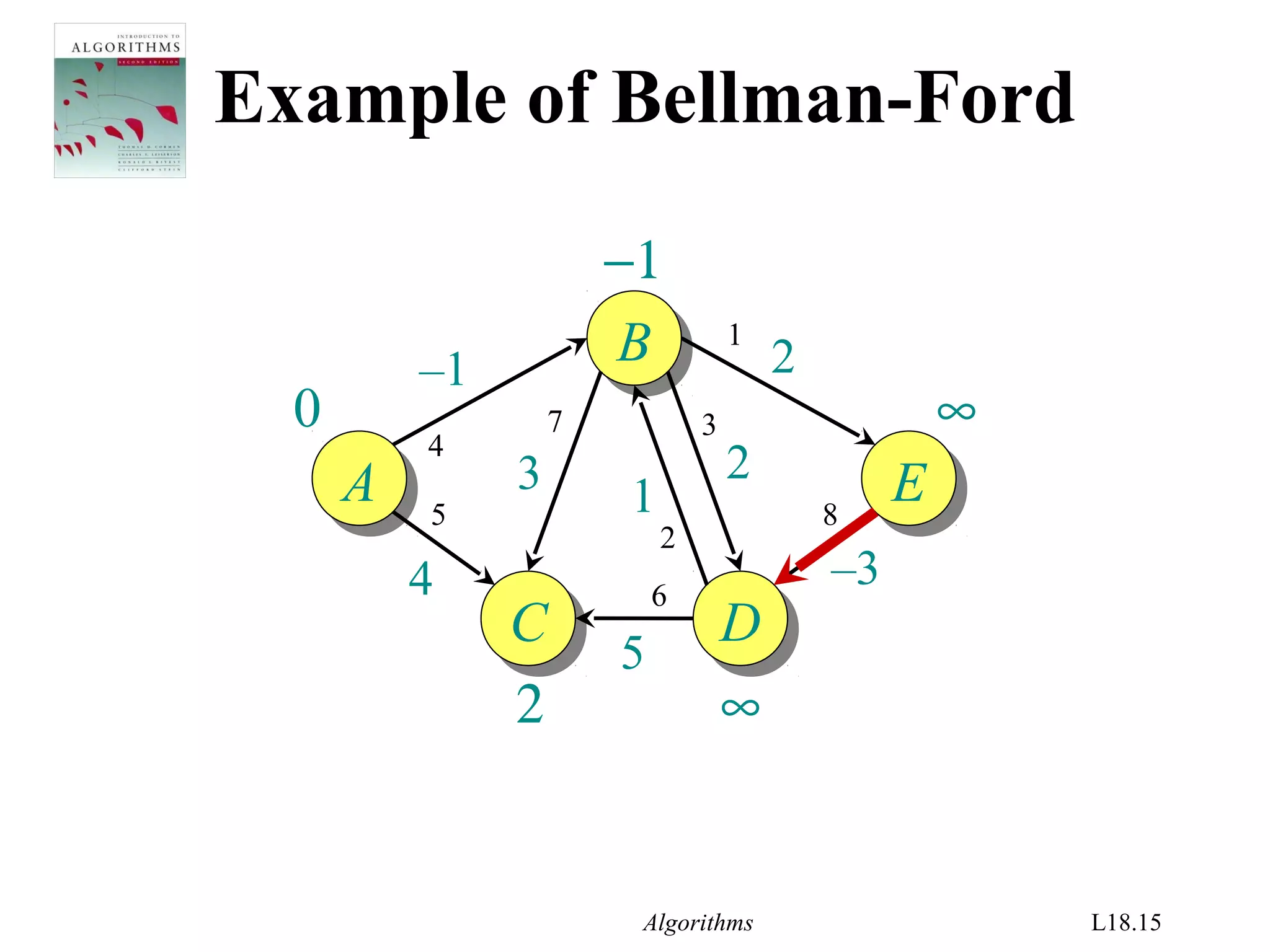
2
−1
Example of Bellman-Ford
AA
BB
EE
CC DD
–1
4
1
2
–3
2
5
3
0 ∞
∞
1
2
3
4
5
7
8
6
Algorithms L18.16
2
−1
Example of Bellman-Ford
AA
BB
EE
CC DD
–1
4
1
2
–3
2
5
3
0 ∞
∞
1
2
3
4
5
7
8
End of pass 1.
6
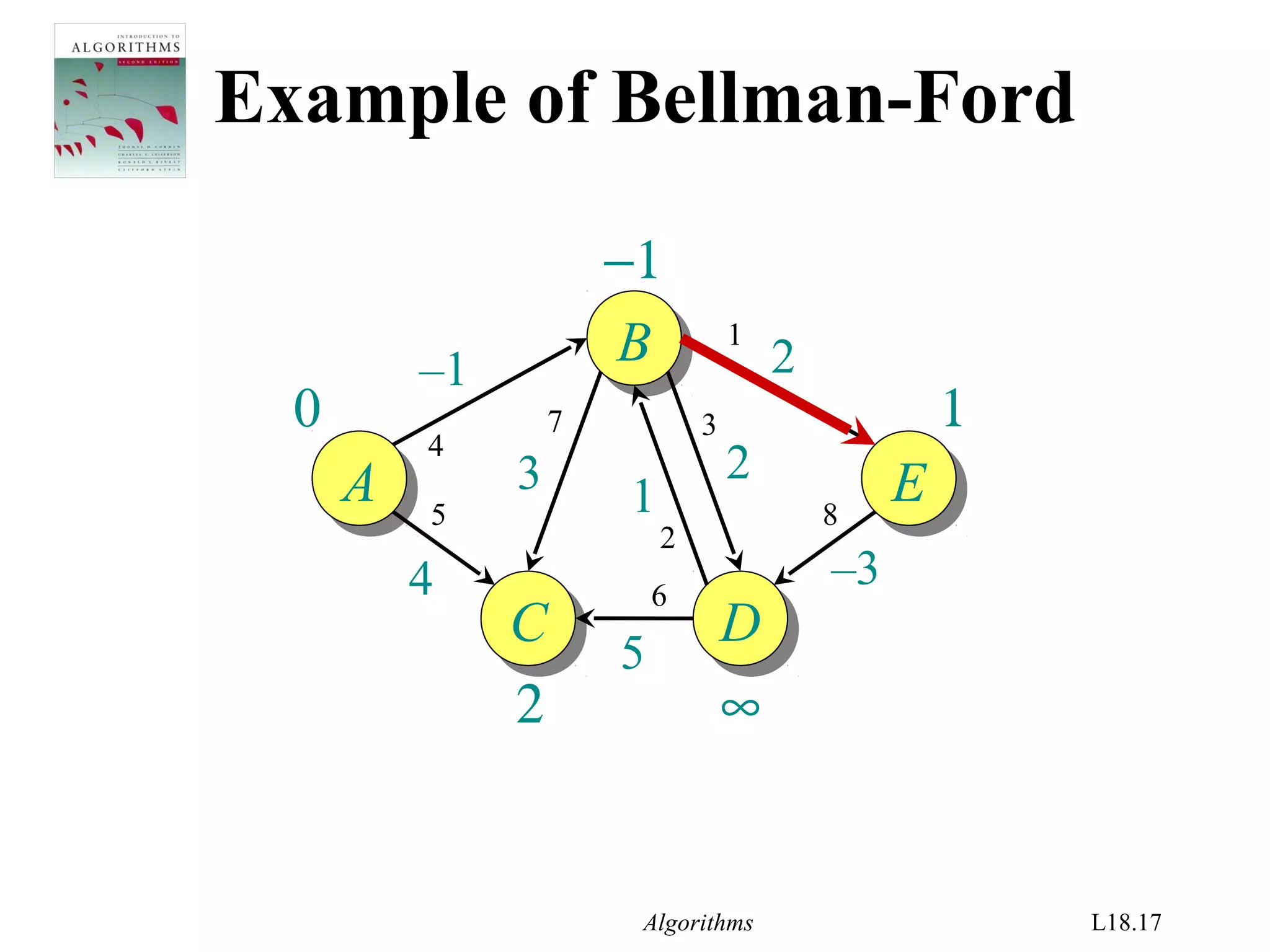
Algorithms L18.17
∞1
2
−1
Example of Bellman-Ford
AA
BB
EE
CC DD
–1
4
1
2
–3
2
5
3
0
∞
1
2
3
4
5
7
8
6
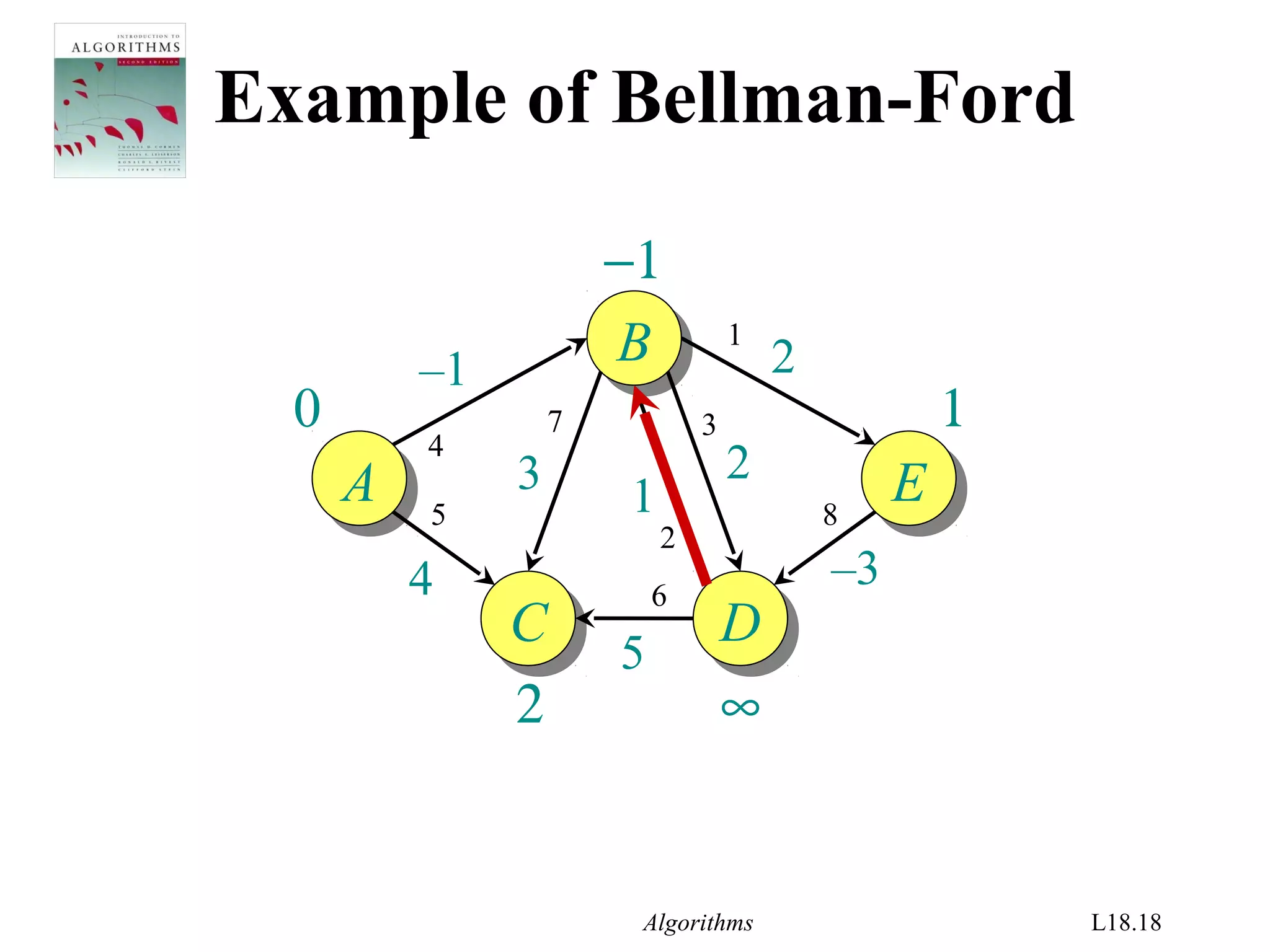
Algorithms L18.18
1
2
−1
Example of Bellman-Ford
AA
BB
EE
CC DD
–1
4
1
2
–3
2
5
3
0
∞
1
2
3
4
5
7
8
6
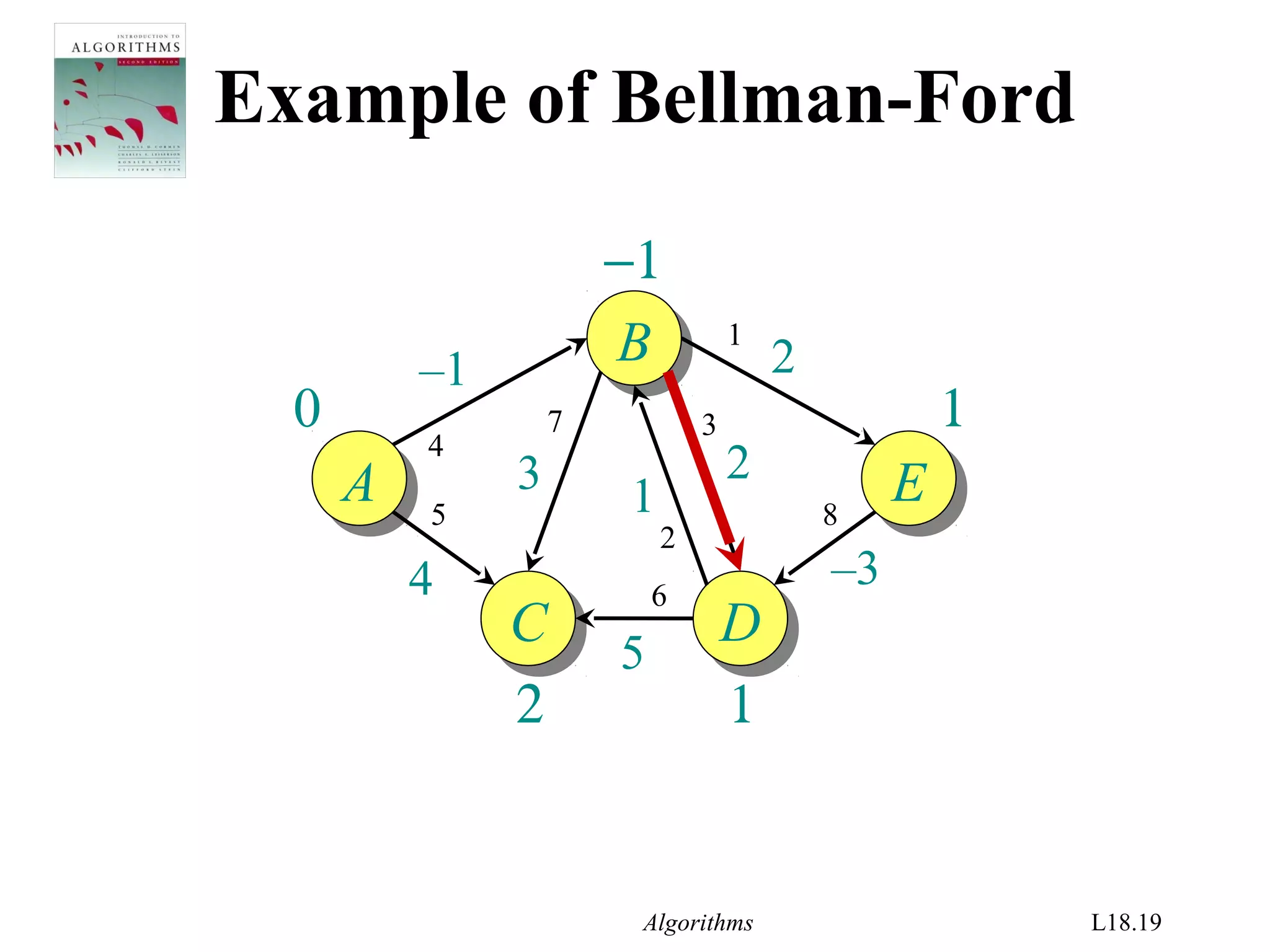
Algorithms L18.19
∞1
1
2
−1
Example of Bellman-Ford
AA
BB
EE
CC DD
–1
4
1
2
–3
2
5
3
0
1
2
3
4
5
7
8
6
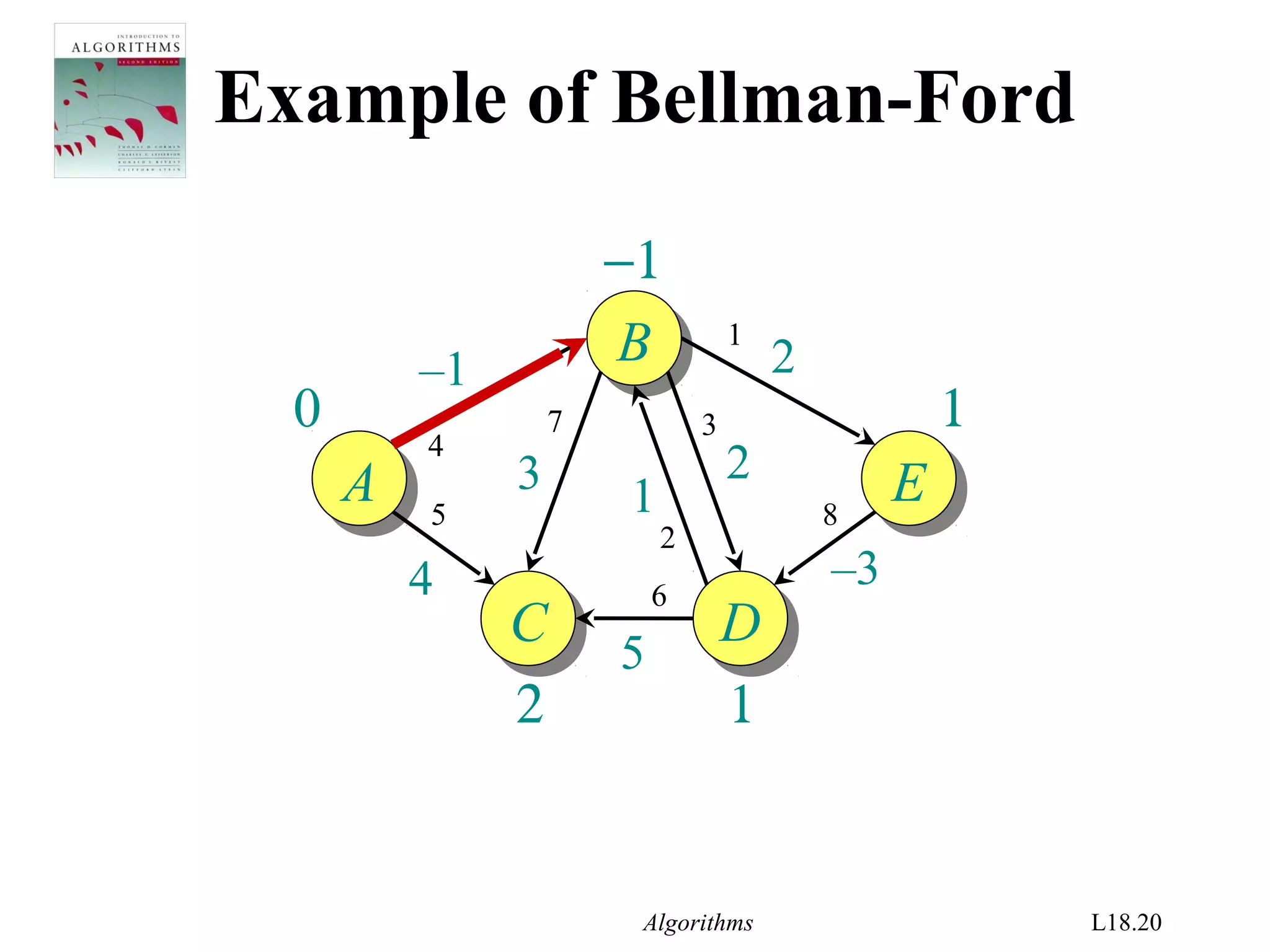
Algorithms L18.20
1
1
2
−1
Example of Bellman-Ford
AA
BB
EE
CC DD
–1
4
1
2
–3
2
5
3
0
1
2
3
4
5
7
8
6
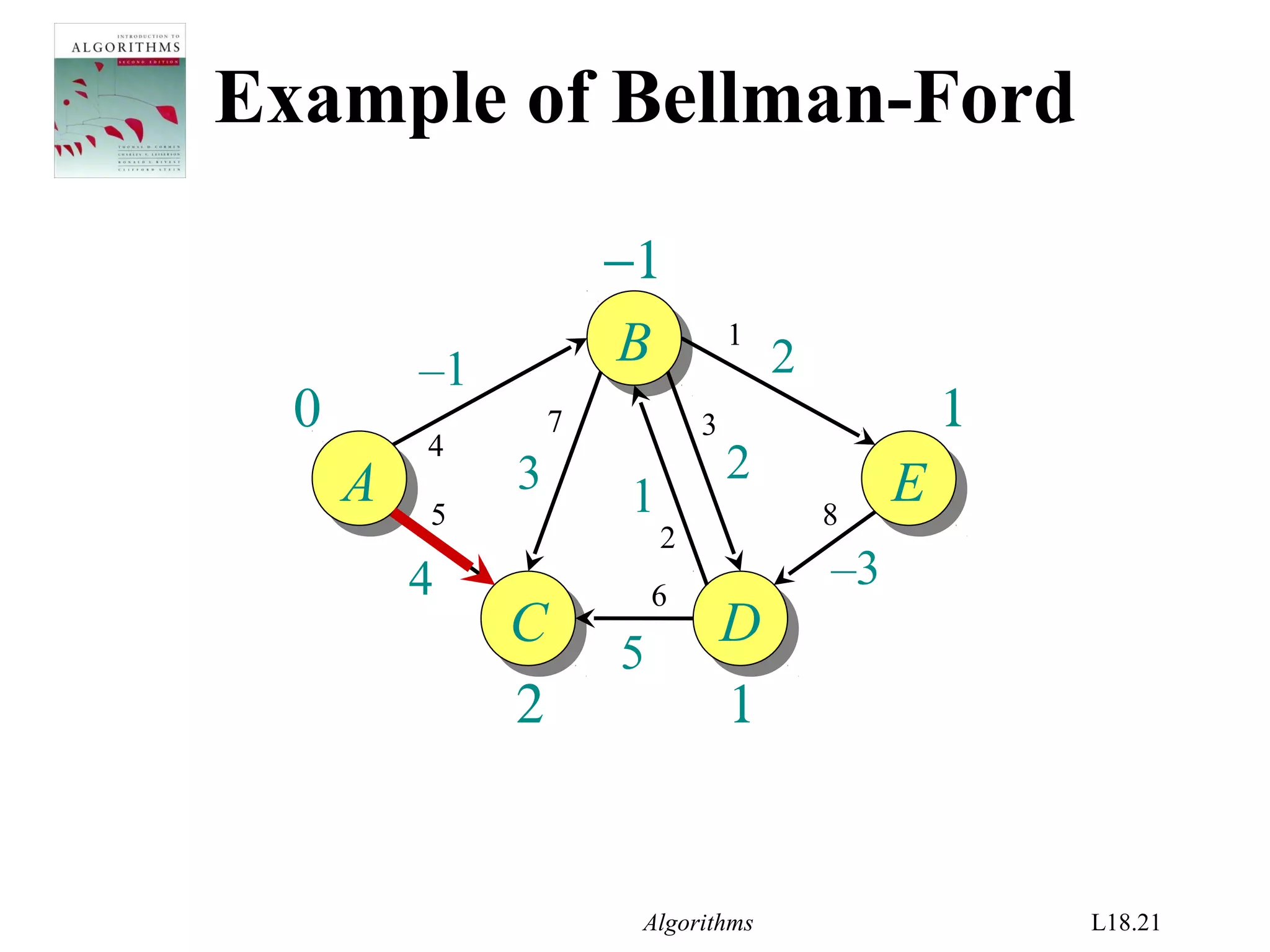
Algorithms L18.21
1
1
2
−1
Example of Bellman-Ford
AA
BB
EE
CC DD
–1
4
1
2
–3
2
5
3
0
1
2
3
4
5
7
8
6
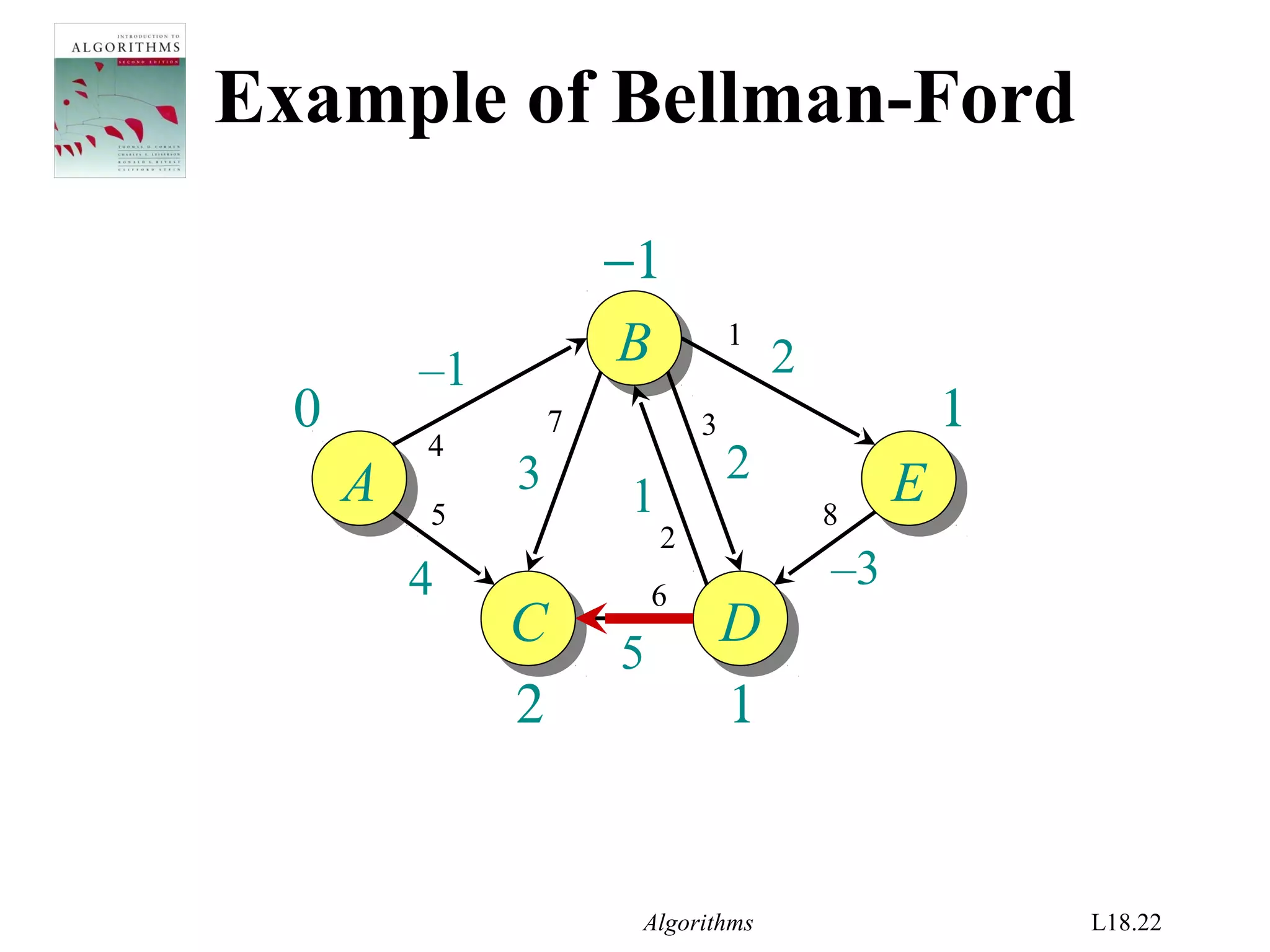
Algorithms L18.22
1
1
2
−1
Example of Bellman-Ford
AA
BB
EE
CC DD
–1
4
1
2
–3
2
5
3
0
1
2
3
4
5
7
8
6
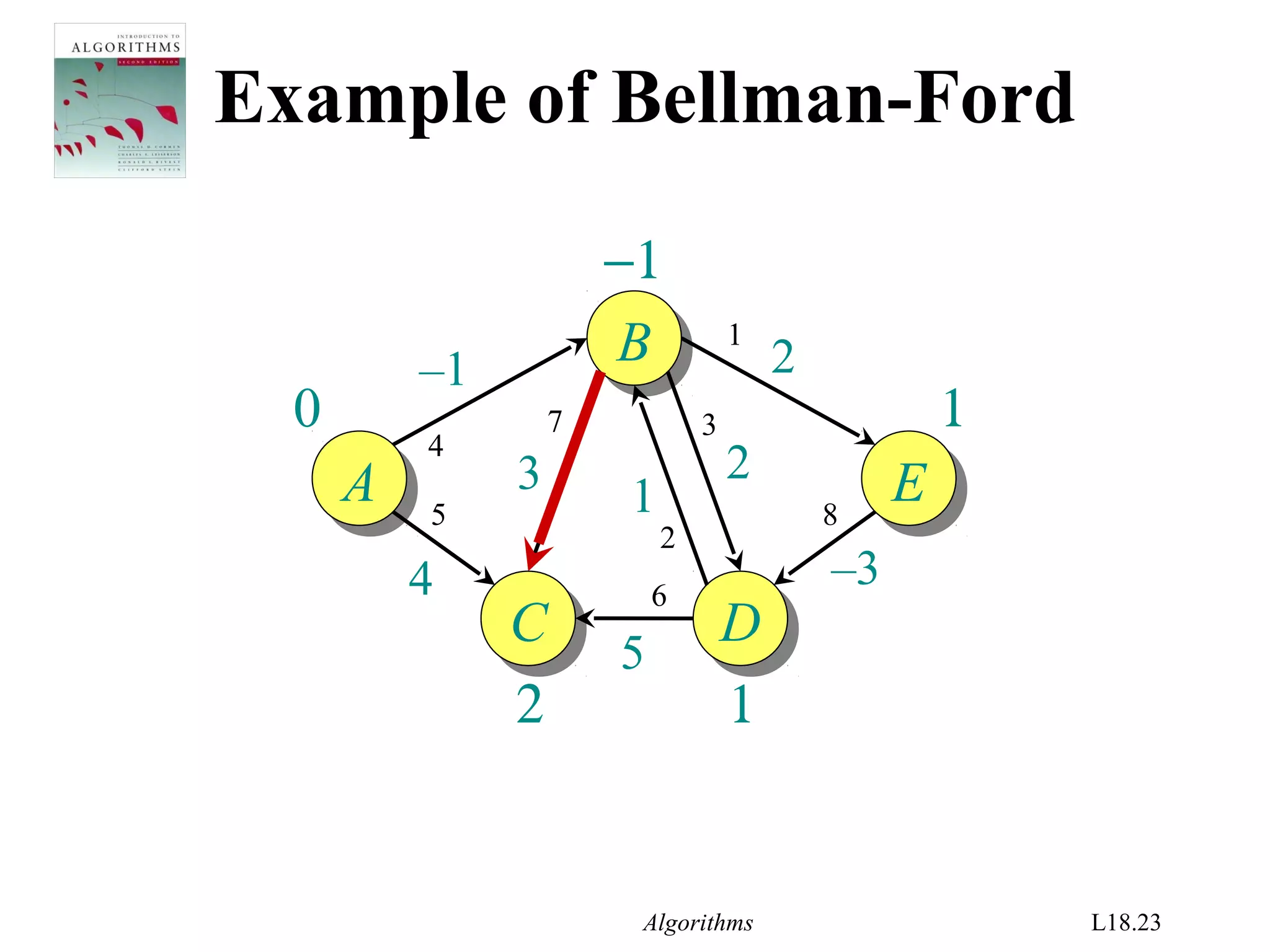
Algorithms L18.23
1
1
2
−1
Example of Bellman-Ford
AA
BB
EE
CC DD
–1
4
1
2
–3
2
5
3
0
1
2
3
4
5
7
8
6
Algorithms L18.24
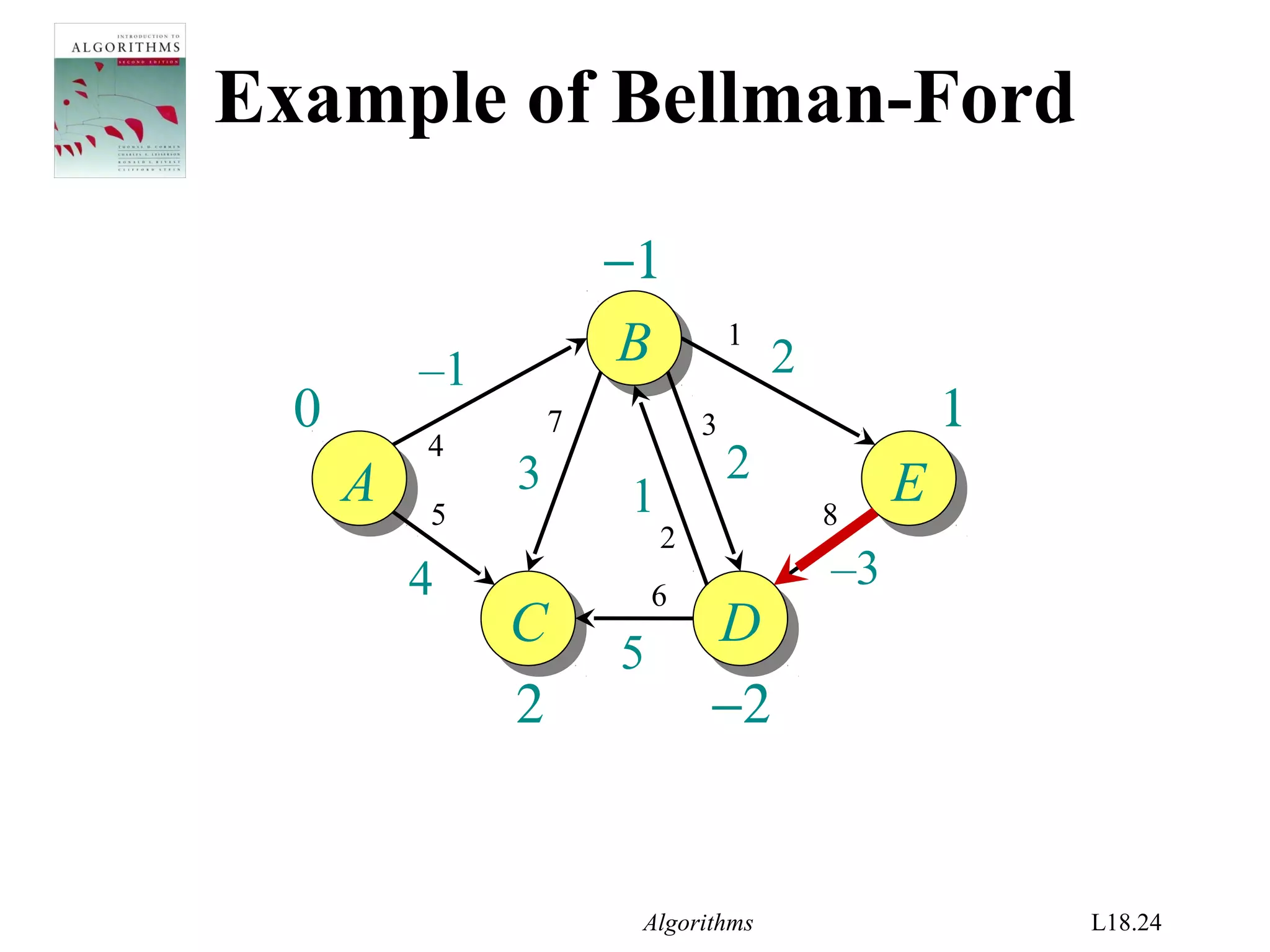
1−2
1
2
−1
Example of Bellman-Ford
AA
BB
EE
CC DD
–1
4
1
2
–3
2
5
3
0
1
2
3
4
5
7
8
6
Algorithms L18.25
−2
1
2
−1
Example of Bellman-Ford
AA
BB
EE
CC DD
–1
4
1
2
–3
2
5
3
0
1
2
3
4
5
7
8
6
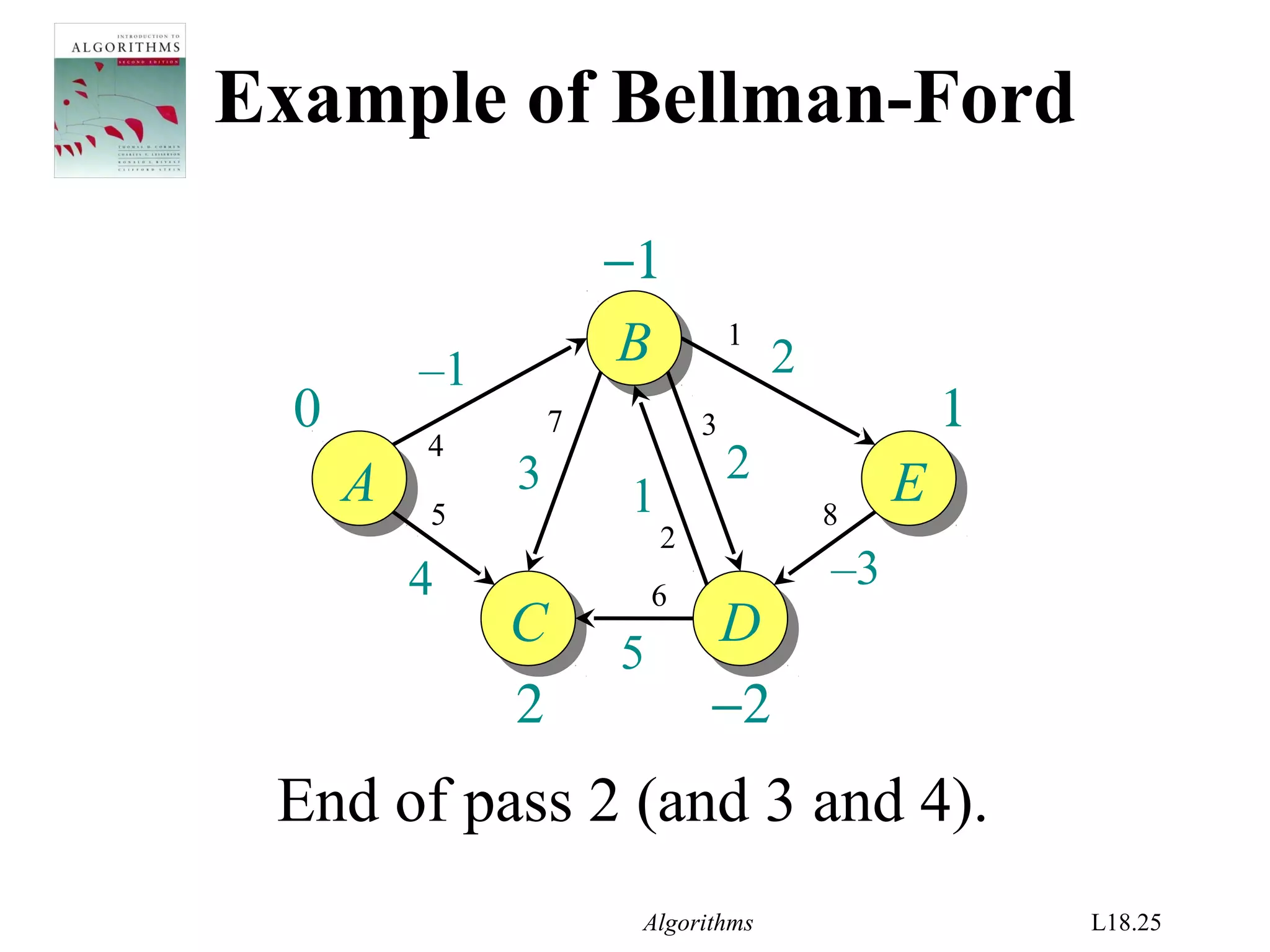
End of pass 2 (and 3 and 4).
Algorithms L18.26
Correctness
Theorem. If G = (V, E) contains no negative-
weight cycles, then after the Bellman-Ford
algorithm executes, d[v] = δ(s, v) for all v ∈ V.
Algorithms L18.27
Correctness
Theorem. If G = (V, E) contains no negative-
weight cycles, then after the Bellman-Ford
algorithm executes, d[v] = δ(s, v) for all v ∈ V.
Proof. Let v ∈ V be any vertex, and consider a shortest
path p from s to v with the minimum number of edges.
v1
v1
v2
v2
v3
v3 vk
vk
v0
v0
…
s
v
p:
Since p is a shortest path, we have
δ(s, vi) = δ(s, vi–1) + w(vi–1, vi) .
Algorithms L18.28
Correctness (continued)
v1
v1
v2
v2
v3
v3 vk
vk
v0
v0
…
s
v
p:
Initially, d[v0] = 0 = δ(s, v0), and d[v0] is unchanged by
subsequent relaxations (because of the lemma from
Lecture 14 that d[v] ≥ δ(s, v)).
• After 1 pass through E, we have d[v1] = δ(s, v1).
• After 2 passes through E, we have d[v2] = δ(s, v2).

• After k passes through E, we have d[vk] = δ(s, vk).
Since G contains no negative-weight cycles, p is simple.
Longest simple path has ≤ |V| – 1 edges.
Algorithms L18.29
Detection of negative-weight
cycles
Corollary. If a value d[v] fails to converge after
|V| – 1 passes, there exists a negative-weight
cycle in G reachable from s.
Algorithms L18.30
Linear programming
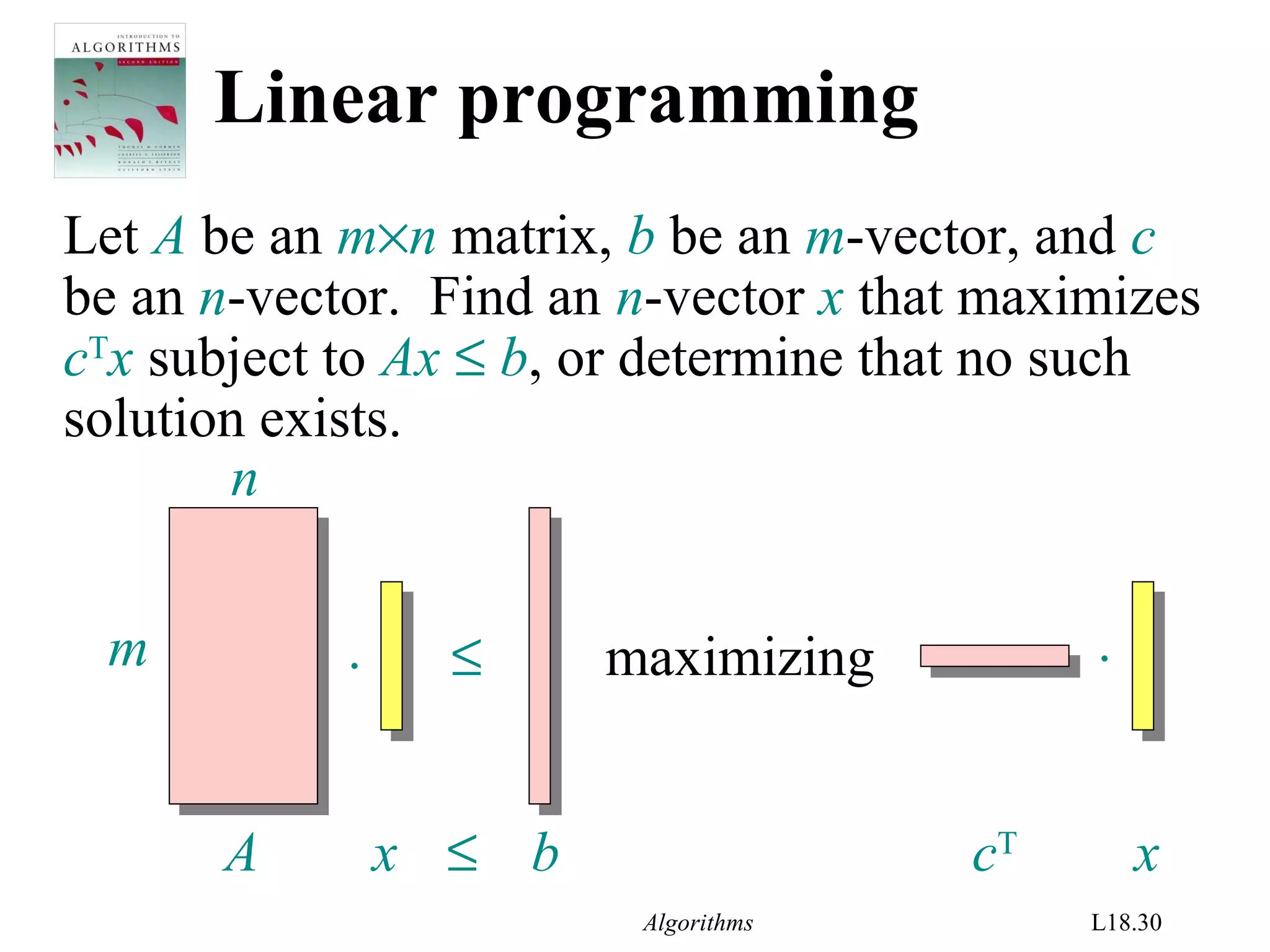
Let A be an m×n matrix, b be an m-vector, and c
be an n-vector. Find an n-vector x that maximizes
cT
x subject to Ax ≤ b, or determine that no such
solution exists.
. ≤ .maximizingm
n
A x ≤ b cT
x
Algorithms L18.31
Linear-programming
algorithms
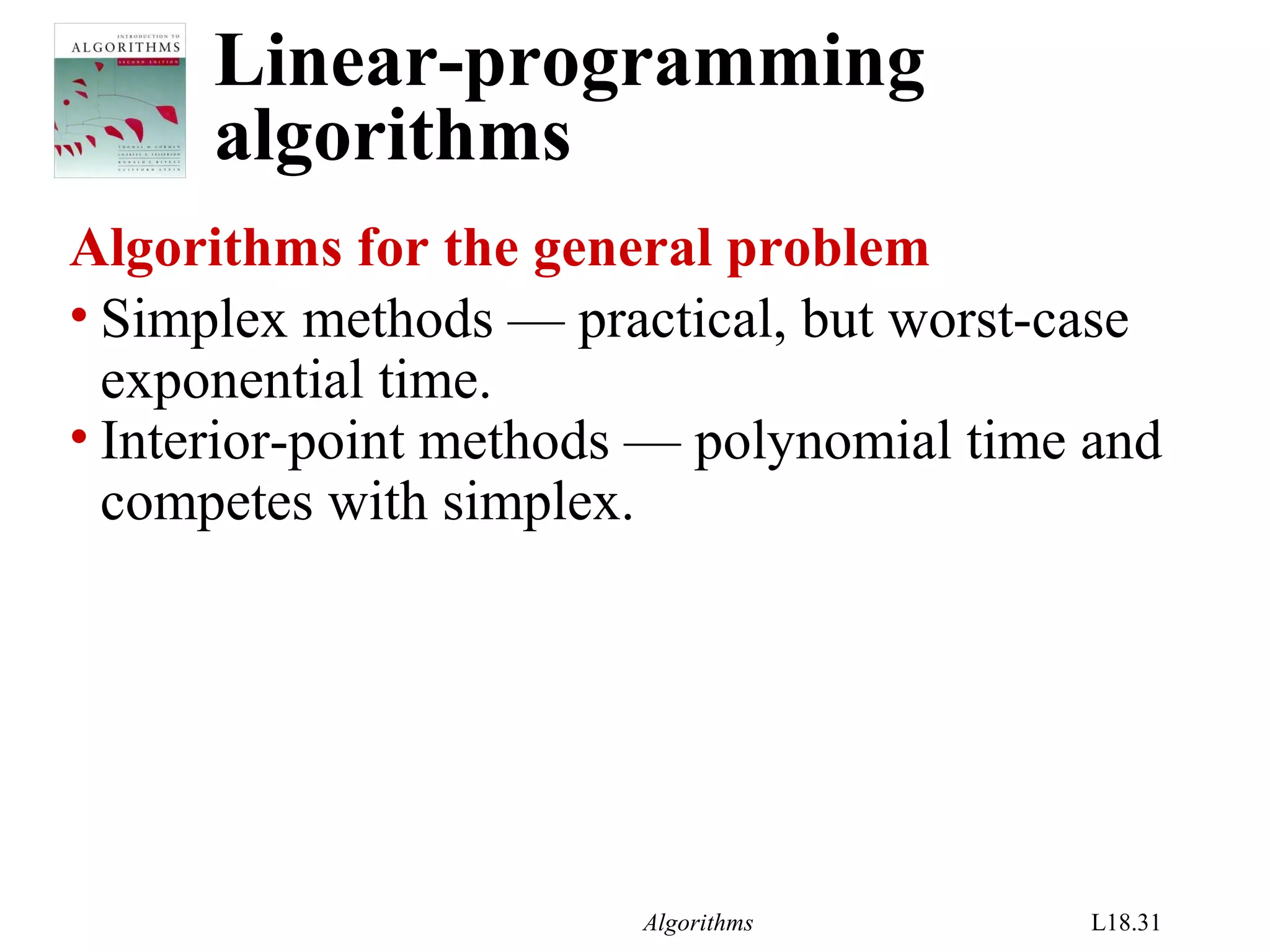
Algorithms for the general problem
• Simplex methods — practical, but worst-case
exponential time.
• Interior-point methods — polynomial time and
competes with simplex.
Algorithms L18.32
Linear-programming
algorithms
Algorithms for the general problem
• Simplex methods — practical, but worst-case
exponential time.
• Interior-point methods — polynomial time and
competes with simplex.
Feasibility problem: No optimization criterion.
Just find x such that Ax ≤ b.
• In general, just as hard as ordinary LP.
Algorithms L18.33
Solving a system of difference
constraints
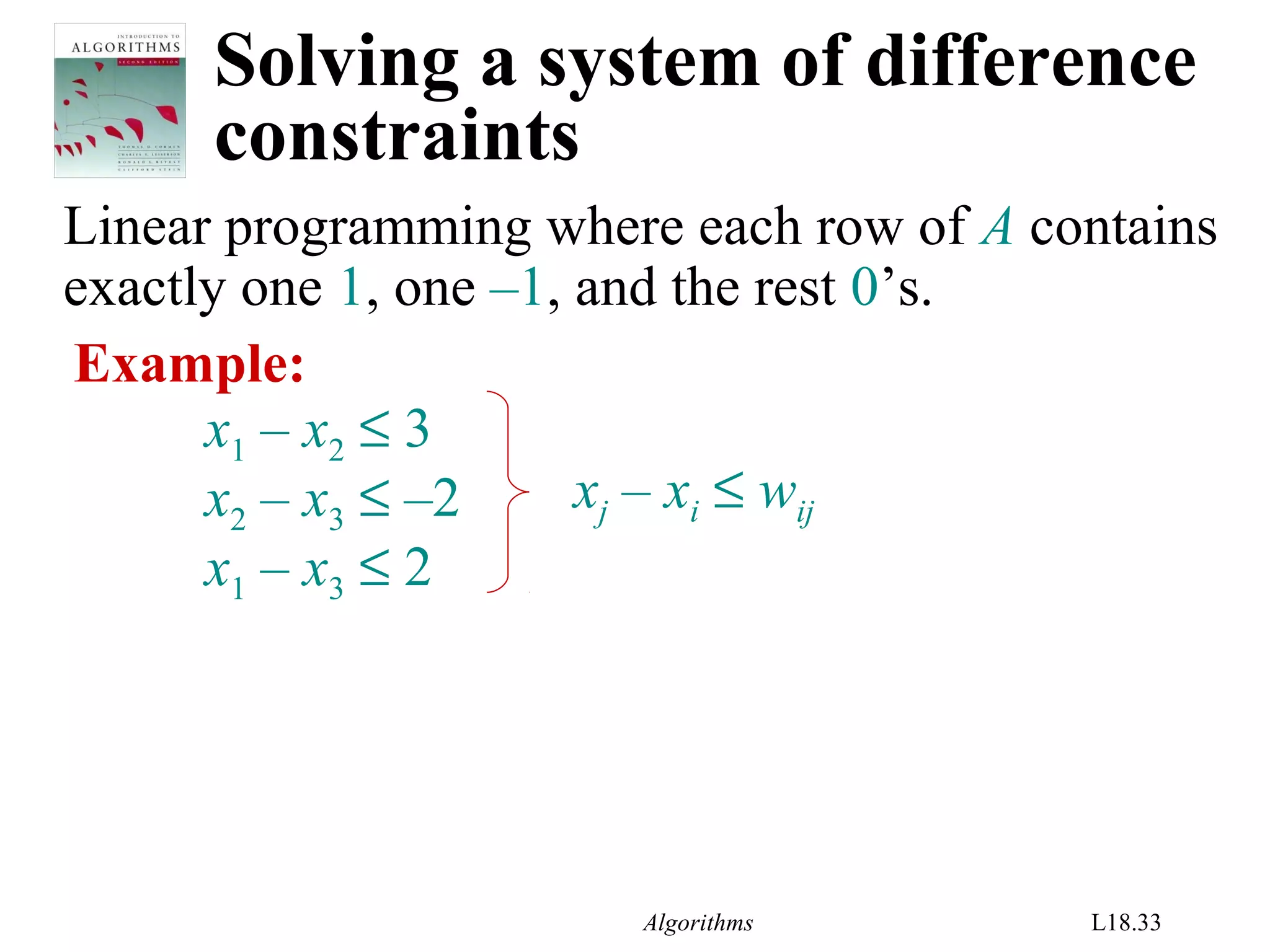
Linear programming where each row of A contains
exactly one 1, one –1, and the rest 0’s.
Example:
x1 – x2 ≤ 3
x2 – x3 ≤ –2
x1 – x3 ≤ 2
xj – xi ≤ wij
Algorithms L18.34
Solving a system of difference
constraints
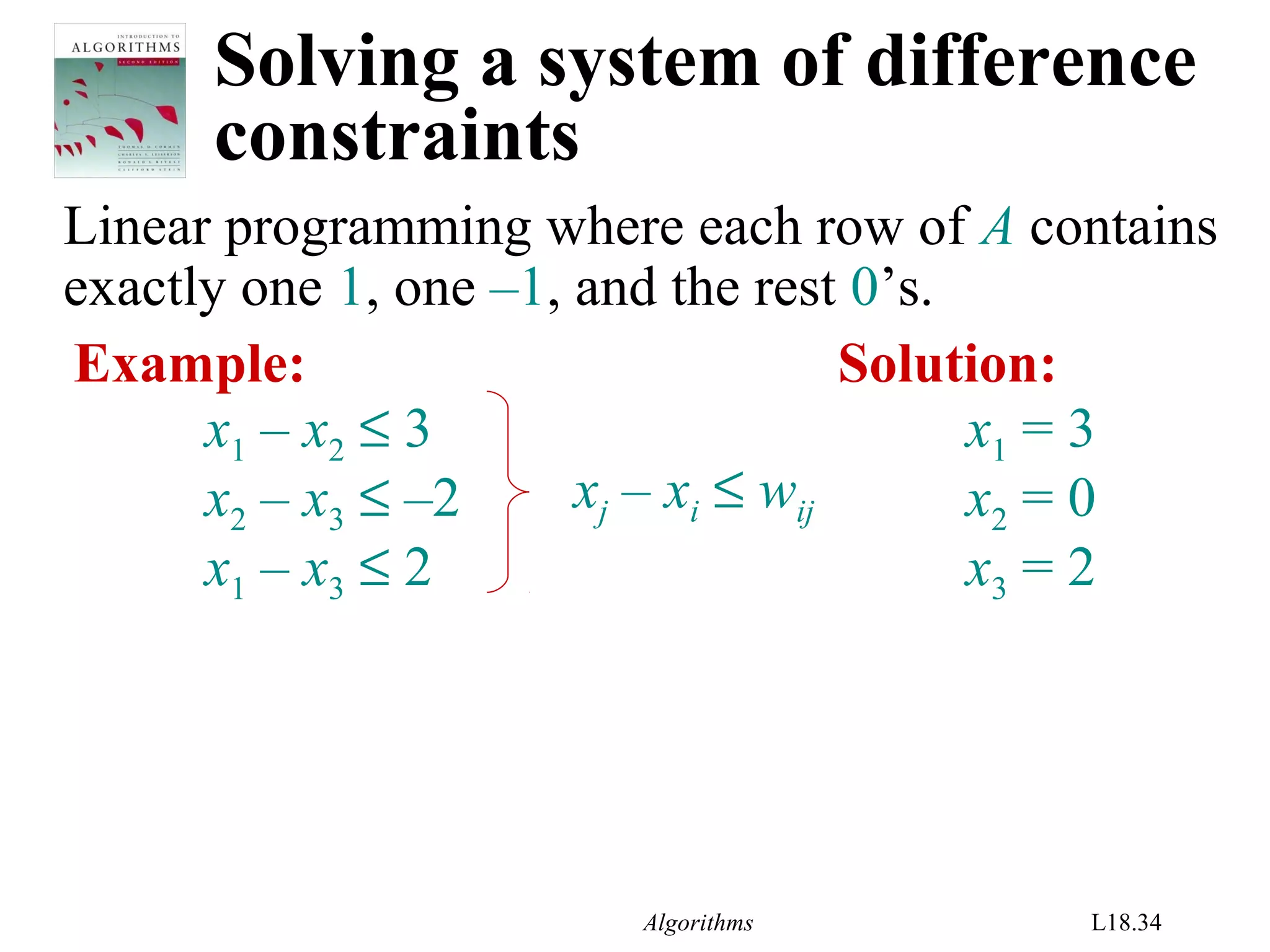
Linear programming where each row of A contains
exactly one 1, one –1, and the rest 0’s.
Example:
x1 – x2 ≤ 3
x2 – x3 ≤ –2
x1 – x3 ≤ 2
xj – xi ≤ wij
Solution:
x1 = 3
x2 = 0
x3 = 2
Algorithms L18.35
Solving a system of difference
constraints
Linear programming where each row of A contains
exactly one 1, one –1, and the rest 0’s.
Example:
x1 – x2 ≤ 3
x2 – x3 ≤ –2
x1 – x3 ≤ 2
xj – xi ≤ wij
Solution:
x1 = 3
x2 = 0
x3 = 2
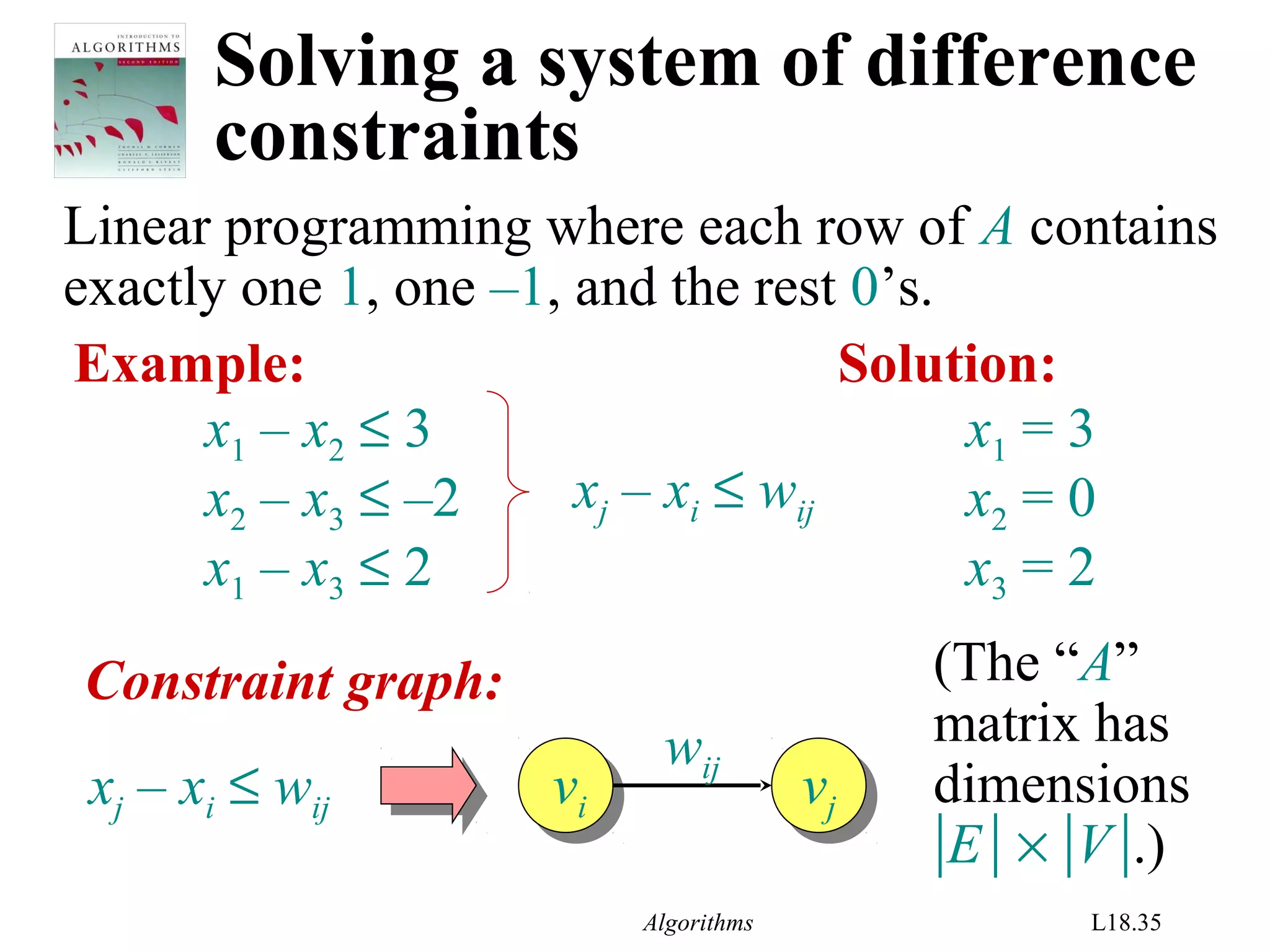
Constraint graph:
vj
vjvi
vixj – xi ≤ wij
wij
(The “A”
matrix has
dimensions
|E| × |V|.)
Algorithms L18.36
Unsatisfiable constraints
Theorem. If the constraint graph contains
a negative-weight cycle, then the system of
differences is unsatisfiable.
Algorithms L18.37
Unsatisfiable constraints
Theorem. If the constraint graph contains
a negative-weight cycle, then the system of
differences is unsatisfiable.
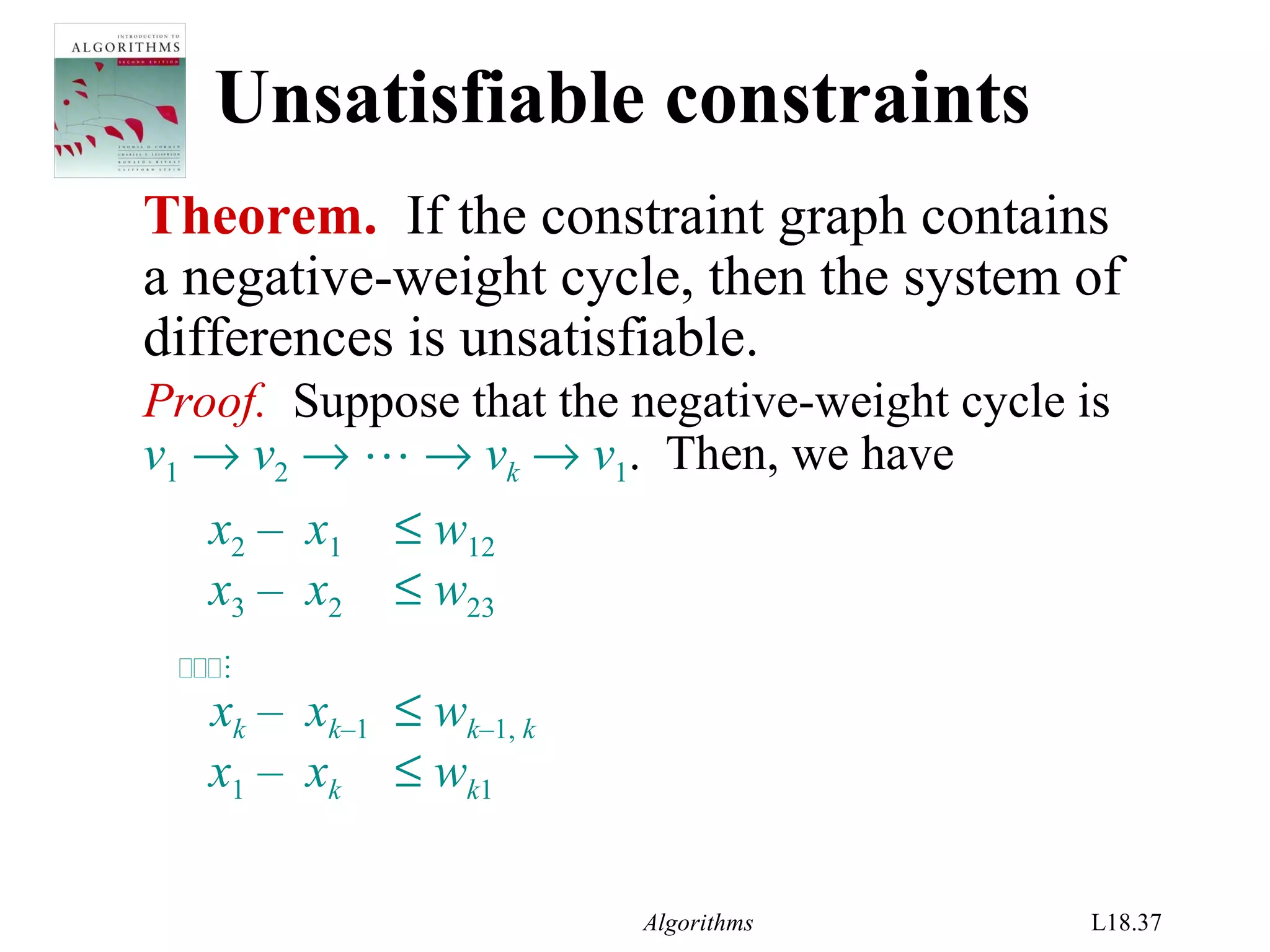
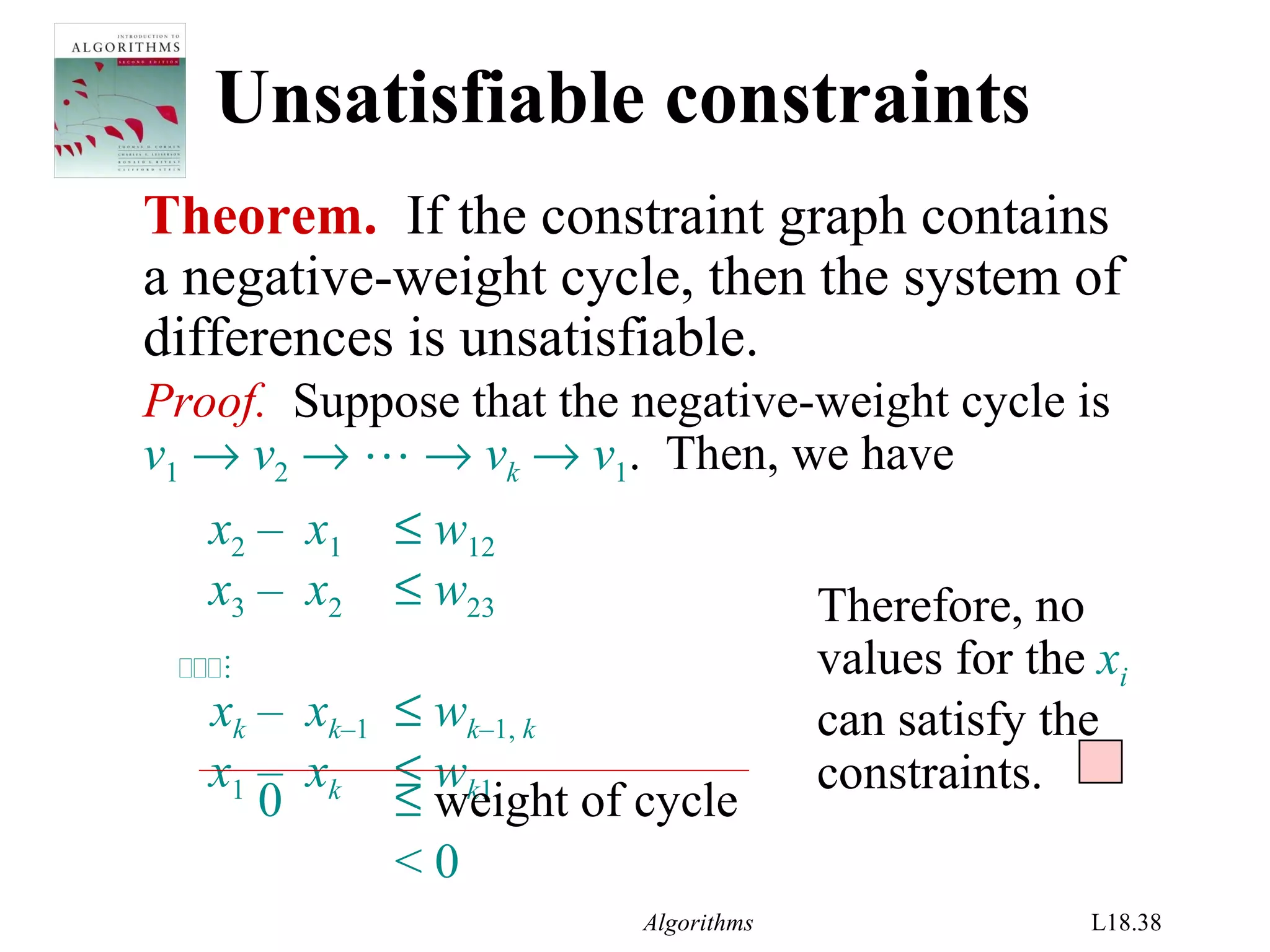
Proof. Suppose that the negative-weight cycle is
v1 → v2 →  → vk → v1. Then, we have
x2 – x1 ≤ w12
x3 – x2 ≤ w23

xk – xk–1 ≤ wk–1, k
x1 – xk ≤ wk1
Algorithms L18.38
Unsatisfiable constraints
Theorem. If the constraint graph contains
a negative-weight cycle, then the system of
differences is unsatisfiable.
Proof. Suppose that the negative-weight cycle is
v1 → v2 →  → vk → v1. Then, we have
x2 – x1 ≤ w12
x3 – x2 ≤ w23

xk – xk–1 ≤ wk–1, k
x1 – xk ≤ wk1
Therefore, no
values for the xi
can satisfy the
constraints.
0 ≤ weight of cycle
< 0
Algorithms L18.39
Satisfying the constraints
Theorem. Suppose no negative-weight cycle
exists in the constraint graph. Then, the
constraints are satisfiable.
Algorithms L18.40
Satisfying the constraints
Theorem. Suppose no negative-weight cycle
exists in the constraint graph. Then, the
constraints are satisfiable.
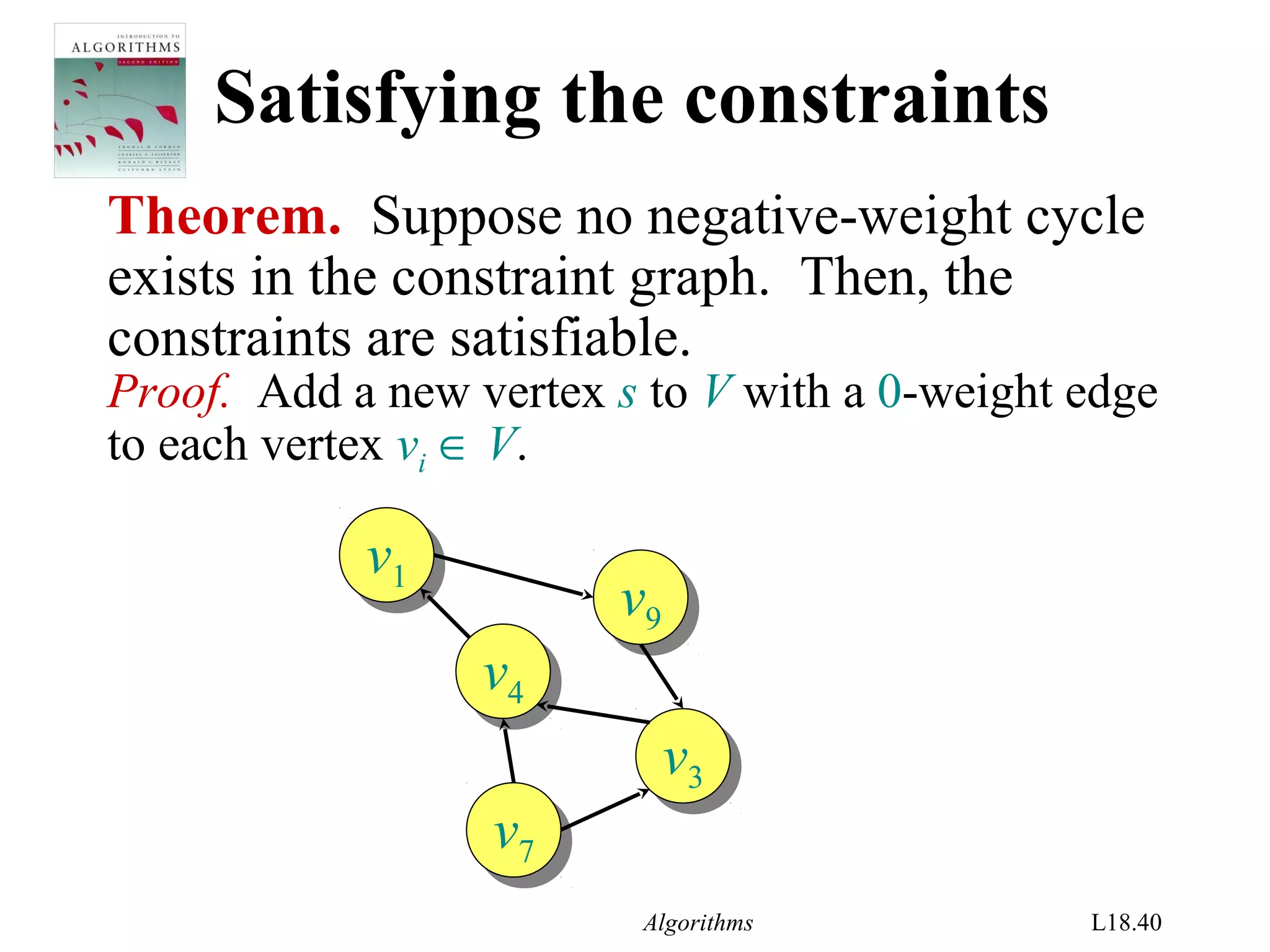
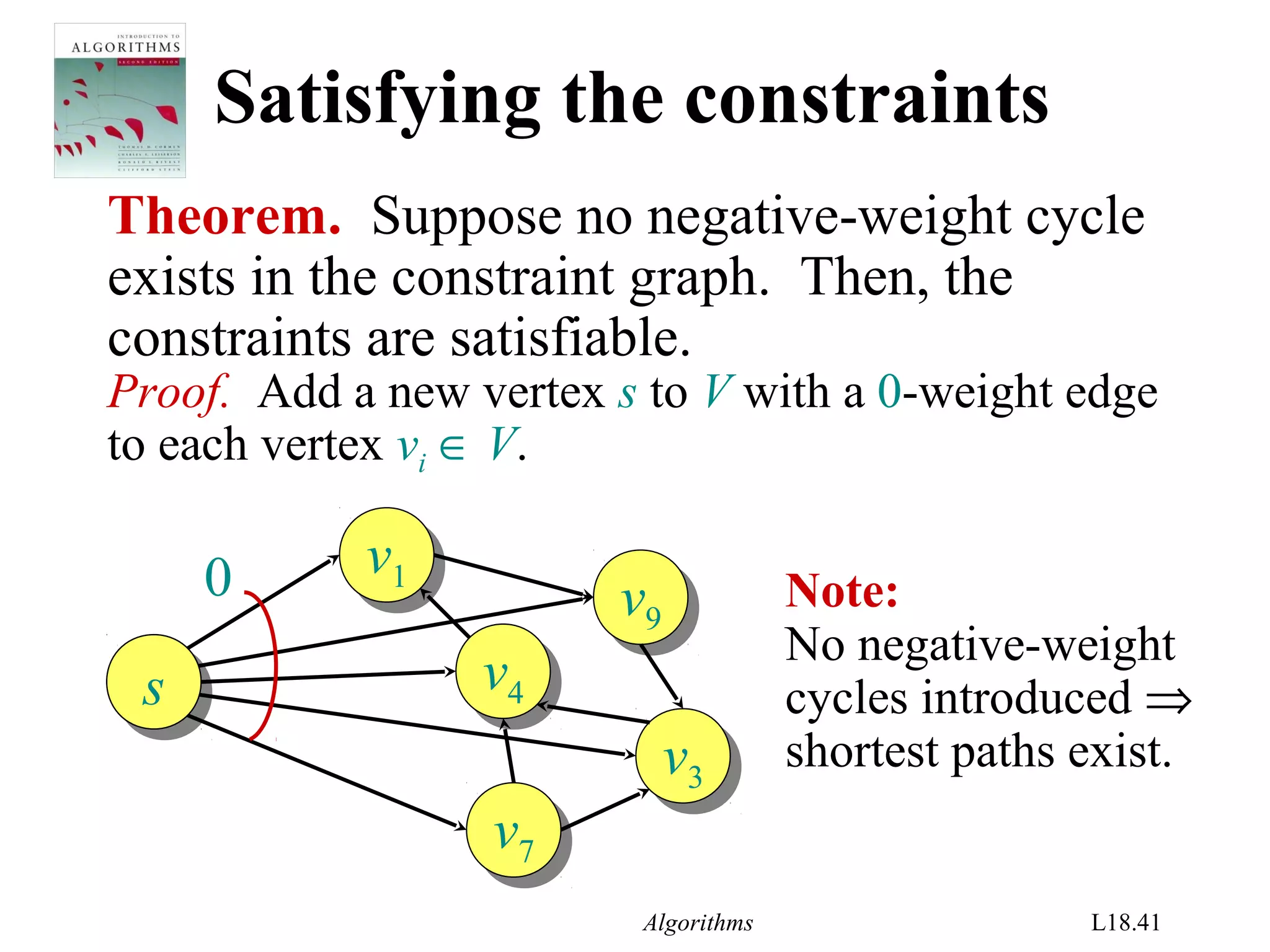
Proof. Add a new vertex s to V with a 0-weight edge
to each vertex vi ∈ V.
v1
v1
v4
v4
v7
v7
v9
v9
v3
v3
Algorithms L18.41
Satisfying the constraints
Theorem. Suppose no negative-weight cycle
exists in the constraint graph. Then, the
constraints are satisfiable.
Proof. Add a new vertex s to V with a 0-weight edge
to each vertex vi ∈ V.
v1
v1
v4
v4
v7
v7
v9
v9
v3
v3
s
0 Note:
No negative-weight
cycles introduced ⇒
shortest paths exist.
Algorithms L18.42
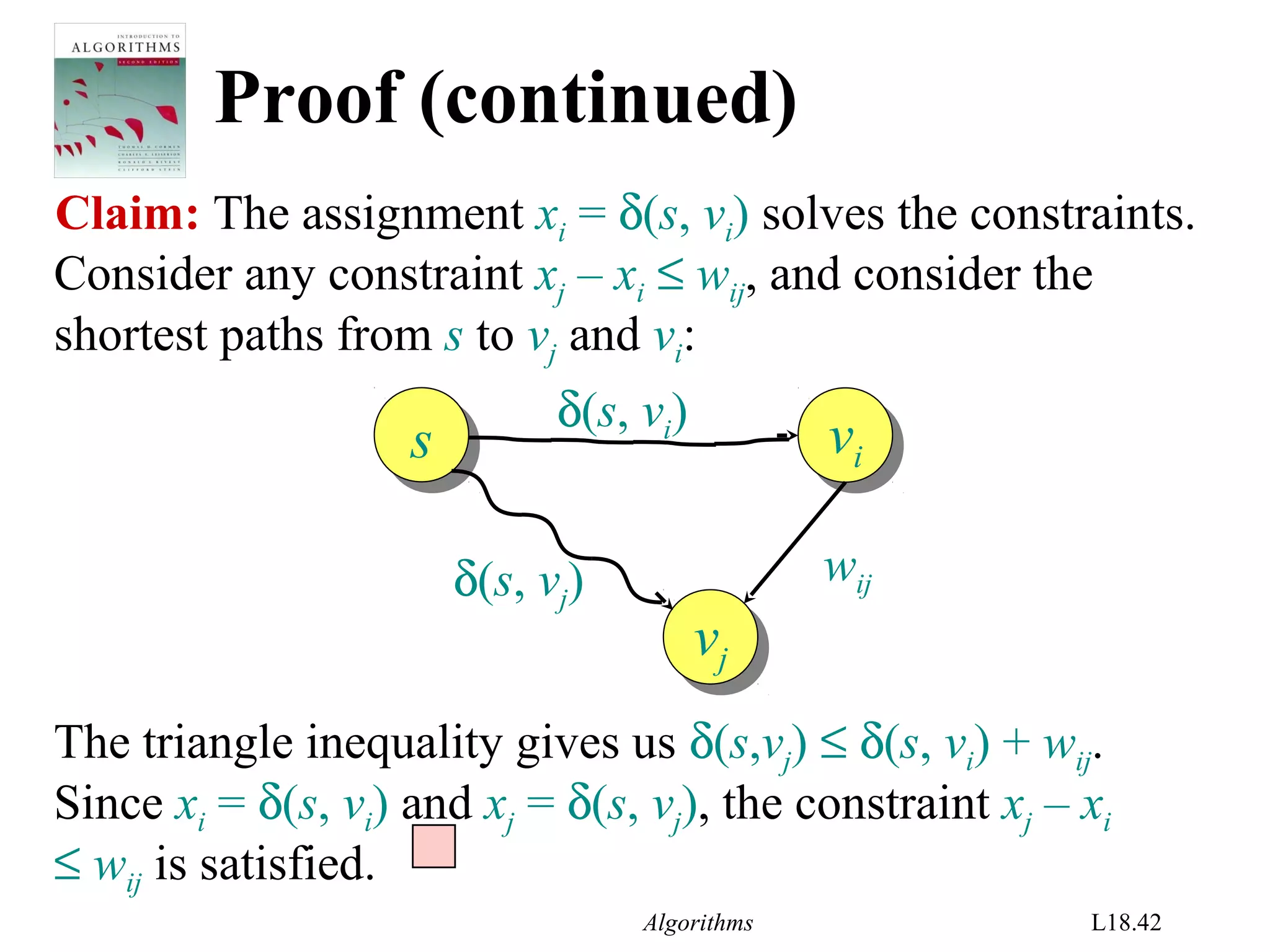
The triangle inequality gives us δ(s,vj) ≤ δ(s, vi) + wij.
Since xi = δ(s, vi) and xj = δ(s, vj), the constraint xj – xi
≤ wij is satisfied.
Proof (continued)
Claim: The assignment xi = δ(s, vi) solves the constraints.
ss
vj
vj
vi
vi
δ(s, vi)
δ(s, vj) wij
Consider any constraint xj – xi ≤ wij, and consider the
shortest paths from s to vj and vi:
Algorithms L18.43
Bellman-Ford and linear
programming
Corollary. The Bellman-Ford algorithm can
solve a system of m difference constraints on n
variables in O(mn) time.
Single-source shortest paths is a simple LP
problem.
In fact, Bellman-Ford maximizes x1 + x2 +  + xn
subject to the constraints xj – xi ≤ wij and xi ≤ 0
(exercise).
Bellman-Ford also minimizes maxi{xi} – mini{xi}
(exercise).
Algorithms L18.44
Application to VLSI layout
compaction
Integrated
-circuit
features:
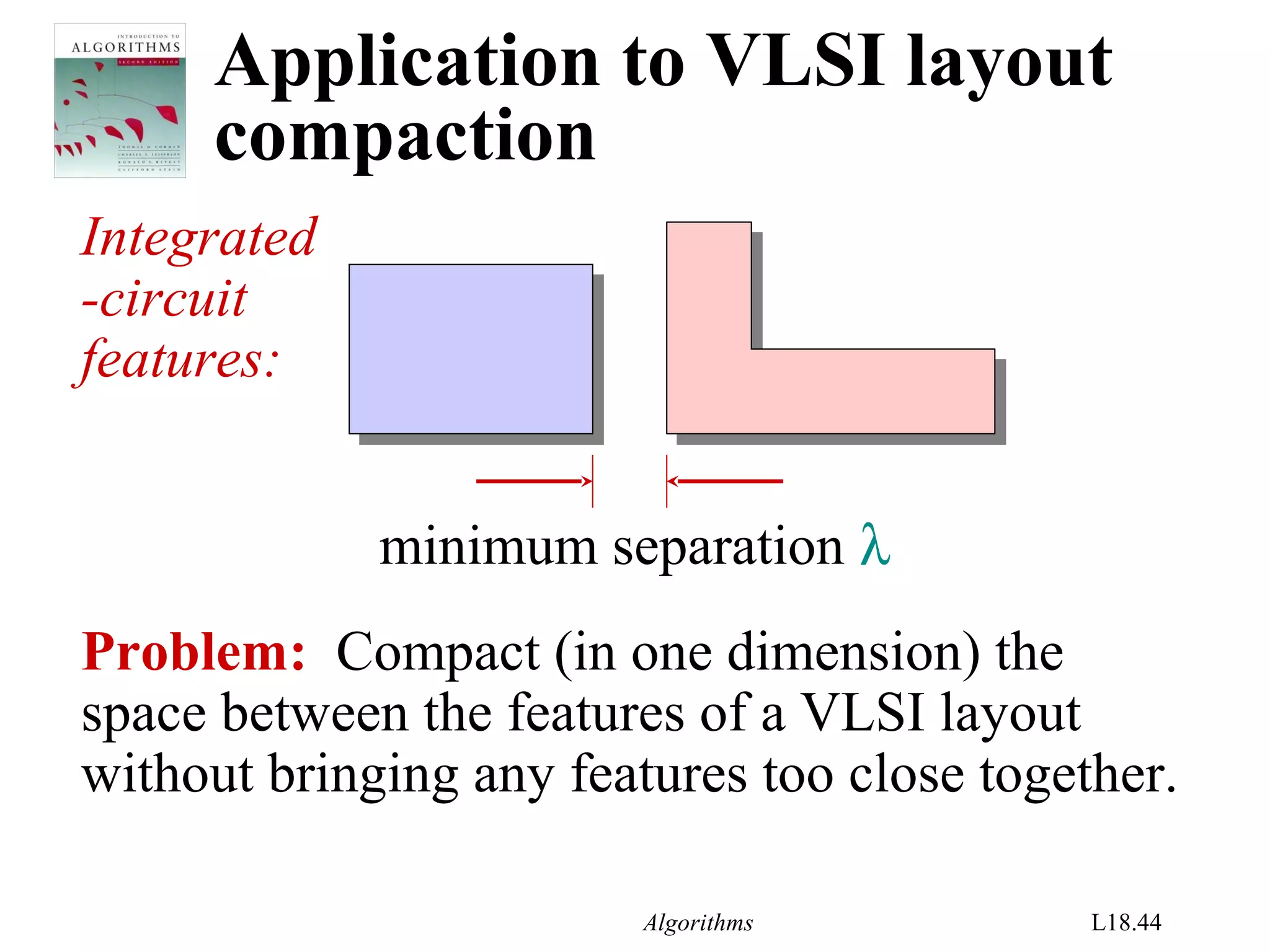
Problem: Compact (in one dimension) the
space between the features of a VLSI layout
without bringing any features too close together.
minimum separation λ
Algorithms L18.45
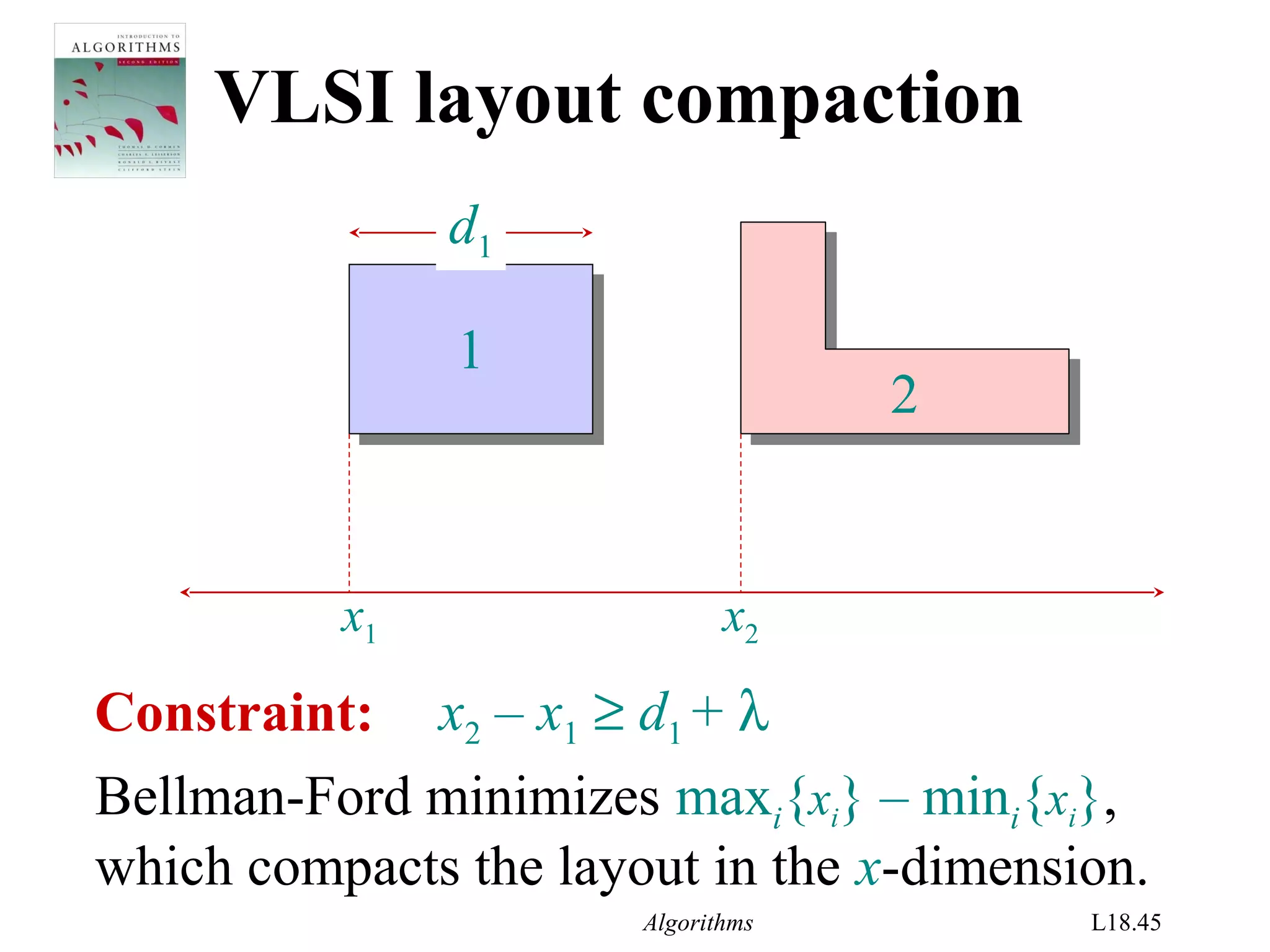
VLSI layout compaction
11
x1 x2
2
d1
Constraint: x2 – x1 ≥ d1 + λ
Bellman-Ford minimizes maxi{xi} – mini{xi},
which compacts the layout in the x-dimension.

Bellman Ford's Algorithm

  • 1.
    Algorithms L18.1 LECTURE 18 ShortestPaths II • Bellman-Ford algorithm • Linear programming and difference constraints • VLSI layout compaction Algorithms
  • 2.
    Algorithms L18.2 Negative-weight cycles Recall:If a graph G = (V, E) contains a negative- weight cycle, then some shortest paths may not exist.Example: uu vv … < 0
  • 3.
    Algorithms L18.3 Negative-weight cycles Recall:If a graph G = (V, E) contains a negative- weight cycle, then some shortest paths may not exist.Example: uu vv … < 0 Bellman-Ford algorithm: Finds all shortest-path lengths from a source s ∈ V to all v ∈ V or determines that a negative-weight cycle exists.
  • 4.
    Algorithms L18.4 Bellman-Ford algorithm d[s]← 0 for each v ∈ V – {s} do d[v] ← ∞ for i ← 1 to |V| – 1 do for each edge (u, v) ∈ E do if d[v] > d[u] + w(u, v) then d[v] ← d[u] + w(u, v) for each edge (u, v) ∈ E do if d[v] > d[u] + w(u, v) then report that a negative-weight cycle exists initialization At the end, d[v] = δ(s, v), if no negative-weight cycles. Time = O(VE). relaxation step
  • 5.
    Algorithms L18.5 Example ofBellman-Ford AA BB EE CC DD –1 4 1 2 –3 2 5 3
  • 6.
    Algorithms L18.6 Example ofBellman-Ford AA BB EE CC DD –1 4 1 2 –3 2 5 3 ∞ 0 ∞ ∞ ∞ Initialization.
  • 7.
    Algorithms L18.7 Example ofBellman-Ford AA BB EE CC DD –1 4 1 2 –3 2 5 3 ∞ 0 ∞ ∞ ∞ 1 2 3 4 5 7 8 Order of edge relaxation. 6
  • 8.
    Algorithms L18.8 Example ofBellman-Ford AA BB EE CC DD –1 4 1 2 –3 2 5 3 ∞ 0 ∞ ∞ ∞ 1 2 3 4 5 7 8 6
  • 9.
    Algorithms L18.9 Example ofBellman-Ford AA BB EE CC DD –1 4 1 2 –3 2 5 3 ∞ 0 ∞ ∞ ∞ 1 2 3 4 5 7 8 6
  • 10.
    Algorithms L18.10 Example ofBellman-Ford AA BB EE CC DD –1 4 1 2 –3 2 5 3 ∞ 0 ∞ ∞ ∞ 1 2 3 4 5 7 8 6
  • 11.
    Algorithms L18.11 ∞−1 Example ofBellman-Ford AA BB EE CC DD –1 4 1 2 –3 2 5 3 0 ∞ ∞ ∞ 1 2 3 4 5 7 8 6
  • 12.
    Algorithms L18.12 ∞4 −1 Example ofBellman-Ford AA BB EE CC DD –1 4 1 2 –3 2 5 3 0 ∞ ∞ 1 2 3 4 5 7 8 6
  • 13.
    Algorithms L18.13 4 −1 Example ofBellman-Ford AA BB EE CC DD –1 4 1 2 –3 2 5 3 0 ∞ ∞ 1 2 3 4 5 7 8 6
  • 14.
    Algorithms L18.14 42 −1 Example ofBellman-Ford AA BB EE CC DD –1 4 1 2 –3 2 5 3 0 ∞ ∞ 1 2 3 4 5 7 8 6
  • 15.
    Algorithms L18.15 2 −1 Example ofBellman-Ford AA BB EE CC DD –1 4 1 2 –3 2 5 3 0 ∞ ∞ 1 2 3 4 5 7 8 6
  • 16.
    Algorithms L18.16 2 −1 Example ofBellman-Ford AA BB EE CC DD –1 4 1 2 –3 2 5 3 0 ∞ ∞ 1 2 3 4 5 7 8 End of pass 1. 6
  • 17.
    Algorithms L18.17 ∞1 2 −1 Example ofBellman-Ford AA BB EE CC DD –1 4 1 2 –3 2 5 3 0 ∞ 1 2 3 4 5 7 8 6
  • 18.
    Algorithms L18.18 1 2 −1 Example ofBellman-Ford AA BB EE CC DD –1 4 1 2 –3 2 5 3 0 ∞ 1 2 3 4 5 7 8 6
  • 19.
    Algorithms L18.19 ∞1 1 2 −1 Example ofBellman-Ford AA BB EE CC DD –1 4 1 2 –3 2 5 3 0 1 2 3 4 5 7 8 6
  • 20.
    Algorithms L18.20 1 1 2 −1 Example ofBellman-Ford AA BB EE CC DD –1 4 1 2 –3 2 5 3 0 1 2 3 4 5 7 8 6
  • 21.
    Algorithms L18.21 1 1 2 −1 Example ofBellman-Ford AA BB EE CC DD –1 4 1 2 –3 2 5 3 0 1 2 3 4 5 7 8 6
  • 22.
    Algorithms L18.22 1 1 2 −1 Example ofBellman-Ford AA BB EE CC DD –1 4 1 2 –3 2 5 3 0 1 2 3 4 5 7 8 6
  • 23.
    Algorithms L18.23 1 1 2 −1 Example ofBellman-Ford AA BB EE CC DD –1 4 1 2 –3 2 5 3 0 1 2 3 4 5 7 8 6
  • 24.
    Algorithms L18.24 1−2 1 2 −1 Example ofBellman-Ford AA BB EE CC DD –1 4 1 2 –3 2 5 3 0 1 2 3 4 5 7 8 6
  • 25.
    Algorithms L18.25 −2 1 2 −1 Example ofBellman-Ford AA BB EE CC DD –1 4 1 2 –3 2 5 3 0 1 2 3 4 5 7 8 6 End of pass 2 (and 3 and 4).
  • 26.
    Algorithms L18.26 Correctness Theorem. IfG = (V, E) contains no negative- weight cycles, then after the Bellman-Ford algorithm executes, d[v] = δ(s, v) for all v ∈ V.
  • 27.
    Algorithms L18.27 Correctness Theorem. IfG = (V, E) contains no negative- weight cycles, then after the Bellman-Ford algorithm executes, d[v] = δ(s, v) for all v ∈ V. Proof. Let v ∈ V be any vertex, and consider a shortest path p from s to v with the minimum number of edges. v1 v1 v2 v2 v3 v3 vk vk v0 v0 … s v p: Since p is a shortest path, we have δ(s, vi) = δ(s, vi–1) + w(vi–1, vi) .
  • 28.
    Algorithms L18.28 Correctness (continued) v1 v1 v2 v2 v3 v3vk vk v0 v0 … s v p: Initially, d[v0] = 0 = δ(s, v0), and d[v0] is unchanged by subsequent relaxations (because of the lemma from Lecture 14 that d[v] ≥ δ(s, v)). • After 1 pass through E, we have d[v1] = δ(s, v1). • After 2 passes through E, we have d[v2] = δ(s, v2).  • After k passes through E, we have d[vk] = δ(s, vk). Since G contains no negative-weight cycles, p is simple. Longest simple path has ≤ |V| – 1 edges.
  • 29.
    Algorithms L18.29 Detection ofnegative-weight cycles Corollary. If a value d[v] fails to converge after |V| – 1 passes, there exists a negative-weight cycle in G reachable from s.
  • 30.
    Algorithms L18.30 Linear programming LetA be an m×n matrix, b be an m-vector, and c be an n-vector. Find an n-vector x that maximizes cT x subject to Ax ≤ b, or determine that no such solution exists. . ≤ .maximizingm n A x ≤ b cT x
  • 31.
    Algorithms L18.31 Linear-programming algorithms Algorithms forthe general problem • Simplex methods — practical, but worst-case exponential time. • Interior-point methods — polynomial time and competes with simplex.
  • 32.
    Algorithms L18.32 Linear-programming algorithms Algorithms forthe general problem • Simplex methods — practical, but worst-case exponential time. • Interior-point methods — polynomial time and competes with simplex. Feasibility problem: No optimization criterion. Just find x such that Ax ≤ b. • In general, just as hard as ordinary LP.
  • 33.
    Algorithms L18.33 Solving asystem of difference constraints Linear programming where each row of A contains exactly one 1, one –1, and the rest 0’s. Example: x1 – x2 ≤ 3 x2 – x3 ≤ –2 x1 – x3 ≤ 2 xj – xi ≤ wij
  • 34.
    Algorithms L18.34 Solving asystem of difference constraints Linear programming where each row of A contains exactly one 1, one –1, and the rest 0’s. Example: x1 – x2 ≤ 3 x2 – x3 ≤ –2 x1 – x3 ≤ 2 xj – xi ≤ wij Solution: x1 = 3 x2 = 0 x3 = 2
  • 35.
    Algorithms L18.35 Solving asystem of difference constraints Linear programming where each row of A contains exactly one 1, one –1, and the rest 0’s. Example: x1 – x2 ≤ 3 x2 – x3 ≤ –2 x1 – x3 ≤ 2 xj – xi ≤ wij Solution: x1 = 3 x2 = 0 x3 = 2 Constraint graph: vj vjvi vixj – xi ≤ wij wij (The “A” matrix has dimensions |E| × |V|.)
  • 36.
    Algorithms L18.36 Unsatisfiable constraints Theorem.If the constraint graph contains a negative-weight cycle, then the system of differences is unsatisfiable.
  • 37.
    Algorithms L18.37 Unsatisfiable constraints Theorem.If the constraint graph contains a negative-weight cycle, then the system of differences is unsatisfiable. Proof. Suppose that the negative-weight cycle is v1 → v2 →  → vk → v1. Then, we have x2 – x1 ≤ w12 x3 – x2 ≤ w23  xk – xk–1 ≤ wk–1, k x1 – xk ≤ wk1
  • 38.
    Algorithms L18.38 Unsatisfiable constraints Theorem.If the constraint graph contains a negative-weight cycle, then the system of differences is unsatisfiable. Proof. Suppose that the negative-weight cycle is v1 → v2 →  → vk → v1. Then, we have x2 – x1 ≤ w12 x3 – x2 ≤ w23  xk – xk–1 ≤ wk–1, k x1 – xk ≤ wk1 Therefore, no values for the xi can satisfy the constraints. 0 ≤ weight of cycle < 0
  • 39.
    Algorithms L18.39 Satisfying theconstraints Theorem. Suppose no negative-weight cycle exists in the constraint graph. Then, the constraints are satisfiable.
  • 40.
    Algorithms L18.40 Satisfying theconstraints Theorem. Suppose no negative-weight cycle exists in the constraint graph. Then, the constraints are satisfiable. Proof. Add a new vertex s to V with a 0-weight edge to each vertex vi ∈ V. v1 v1 v4 v4 v7 v7 v9 v9 v3 v3
  • 41.
    Algorithms L18.41 Satisfying theconstraints Theorem. Suppose no negative-weight cycle exists in the constraint graph. Then, the constraints are satisfiable. Proof. Add a new vertex s to V with a 0-weight edge to each vertex vi ∈ V. v1 v1 v4 v4 v7 v7 v9 v9 v3 v3 s 0 Note: No negative-weight cycles introduced ⇒ shortest paths exist.
  • 42.
    Algorithms L18.42 The triangleinequality gives us δ(s,vj) ≤ δ(s, vi) + wij. Since xi = δ(s, vi) and xj = δ(s, vj), the constraint xj – xi ≤ wij is satisfied. Proof (continued) Claim: The assignment xi = δ(s, vi) solves the constraints. ss vj vj vi vi δ(s, vi) δ(s, vj) wij Consider any constraint xj – xi ≤ wij, and consider the shortest paths from s to vj and vi:
  • 43.
    Algorithms L18.43 Bellman-Ford andlinear programming Corollary. The Bellman-Ford algorithm can solve a system of m difference constraints on n variables in O(mn) time. Single-source shortest paths is a simple LP problem. In fact, Bellman-Ford maximizes x1 + x2 +  + xn subject to the constraints xj – xi ≤ wij and xi ≤ 0 (exercise). Bellman-Ford also minimizes maxi{xi} – mini{xi} (exercise).
  • 44.
    Algorithms L18.44 Application toVLSI layout compaction Integrated -circuit features: Problem: Compact (in one dimension) the space between the features of a VLSI layout without bringing any features too close together. minimum separation λ
  • 45.
    Algorithms L18.45 VLSI layoutcompaction 11 x1 x2 2 d1 Constraint: x2 – x1 ≥ d1 + λ Bellman-Ford minimizes maxi{xi} – mini{xi}, which compacts the layout in the x-dimension.