THE SHORT HISTORY OF SHORT FILMS
ADVANCED PORTFOLIO
https://sofy.tv/blog/short-history-short-films/
The original material
SUMMARY
• The short films truly have a fascinating history, today most of the film enthusiasts
don’t really know that much about the subject. While this is a sad reflection of
how neglected short movies have been over the past 50 years, this is actually
something that makes the subject all the more interesting.
THE BIRTH OF CINEMA: AMERICA
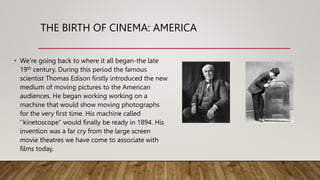
• We’re going back to where it all began-the late
19th century. During this period the famous
scientist Thomas Edison firstly introduced the new
medium of moving pictures to the American
audiences. He began working working on a
machine that would show moving photographs
for the very first time. His machine called
‘’kinetoscope’’ would finally be ready in 1894. His
invention was a far cry from the large screen
movie theatres we have come to associate with
films today.
THE BIRTH OF CINEMA: EUROPE
• Meanwhile, in Europe two brothers Auguste and
Louis Lumiere were working on another
cinematic format. Their approach was to use a
projector to display film sequences on a screen
so that instead of one, lots of people could watch
it at once. The Lumiere Brothers are considered
to be the first who have shown the real power of
cinema on audiences. Although there’s no
evidence that this story happened, it’s said that
their 1895 film ‘’The Arrival of a Train’’ premiere,
the viewers were so scared of a train coming
towards them that they started running from the
movie theatre while screaming.
DEVELOPMENT
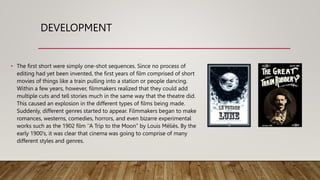
• The first short were simply one-shot sequences. Since no process of
editing had yet been invented, the first years of film comprised of short
movies of things like a train pulling into a station or people dancing.
Within a few years, however, filmmakers realized that they could add
multiple cuts and tell stories much in the same way that the theatre did.
This caused an explosion in the different types of films being made.
Suddenly, different genres started to appear. Filmmakers began to make
romances, westerns, comedies, horrors, and even bizarre experimental
works such as the 1902 film ‘’A Trip to the Moon’’ by Louis Méliès. By the
early 1900’s, it was clear that cinema was going to comprise of many
different styles and genres.
THE FIRST LONG FILM
• In a couple of years the length of movies
transformed from 1-2 minutes to around 20
minutes. But the biggest development was the
premiere of a 1915 film ‘’The Birth of a Nation’’ by
D. W. Griffiths which had a running time of over 3
hours. The success of this film was a real game
changer. Film running times leap up into the 1
hour plus very within a decade or so after its
release. Despite short films enjoying their golden
period during the 1910’s and early 1920’s, the
writing was already on the wall.
THE GOLDEN ERA FOR SHORT FILMS: 1910’S
• During the 1910’s and 1920’s, Charlie
Chaplin was claimed to be the most
famous man alive. Hi short comedy films
like ‘’Laughing Gas’’ (1914) or ‘’The
Champion’’ (1915) made him the first
international star. It was the 1910’s that
really made movies one of the worlds most
loved and revered hobbies. Audiences
throughout the US and Europe were able
to see movies in converted theatres and
even the kinds of traveling circuses.
THE 1920’S AND THE BEGINNING OF THE DECLINE
• It was that during the 1920’s and early 1930’s, short
films began to decline. Despite this, there were still
lots of short films being made. One genre that
flourished, and continues to florist up until this
very day is the cartoon. Disney films, in particular,
would help keep mainstream shorts alive. During
WW2, short films underwent something of a revival
thanks to their use as a propaganda tool. Famous
A-list Hollywood directors like Frank Capra were
drafted in to make such films for the war
department.
EXPERIMENTAL FILMS
• Another area where shorts would flourish
was experimental film. Due to the limited
appeal of such films, it was often hard to
find the money to make lengthy
experimental films. The golden era of
short films is considered to be the 1960’s
with Andy Warhol as the most famous
presenter of this genre.
MTV AND THE REBIRTH OF THE SHORT FILMS
• The explosion of Music Television during the
1980’s saw money pouring back into short films.
It wasn’t long before acts like Michael Jackson
were employing the services of A-list Hollywood
directors to shoot their short films. This not only
helped to shine a light on short films but also
brought a great deal of artistry back to them as
well. Suddenly, directors were proud to call
themselves short filmmakers once more.
PRESENT TIME
• Increasingly, international festivals and award
ceremonies began to include awards for short
films. At the same time, inexpensive cameras came
on the market meaning that just about anyone
could make a short film. By the year 2010,
filmmakers had even begun using smartphones to
make short films as well. Today, 10’s of millions of
shorts get made each year. While most might only
have a limited appeal, technology has made short
filmmakers out of us all. It seems almost inevitable
that short films are going to become mainstream
once again.

Short films.pptx

  • 1.
    THE SHORT HISTORYOF SHORT FILMS ADVANCED PORTFOLIO https://sofy.tv/blog/short-history-short-films/ The original material
  • 2.
    SUMMARY • The shortfilms truly have a fascinating history, today most of the film enthusiasts don’t really know that much about the subject. While this is a sad reflection of how neglected short movies have been over the past 50 years, this is actually something that makes the subject all the more interesting.
  • 3.
    THE BIRTH OFCINEMA: AMERICA • We’re going back to where it all began-the late 19th century. During this period the famous scientist Thomas Edison firstly introduced the new medium of moving pictures to the American audiences. He began working working on a machine that would show moving photographs for the very first time. His machine called ‘’kinetoscope’’ would finally be ready in 1894. His invention was a far cry from the large screen movie theatres we have come to associate with films today.
  • 4.
    THE BIRTH OFCINEMA: EUROPE • Meanwhile, in Europe two brothers Auguste and Louis Lumiere were working on another cinematic format. Their approach was to use a projector to display film sequences on a screen so that instead of one, lots of people could watch it at once. The Lumiere Brothers are considered to be the first who have shown the real power of cinema on audiences. Although there’s no evidence that this story happened, it’s said that their 1895 film ‘’The Arrival of a Train’’ premiere, the viewers were so scared of a train coming towards them that they started running from the movie theatre while screaming.
  • 5.
    DEVELOPMENT • The firstshort were simply one-shot sequences. Since no process of editing had yet been invented, the first years of film comprised of short movies of things like a train pulling into a station or people dancing. Within a few years, however, filmmakers realized that they could add multiple cuts and tell stories much in the same way that the theatre did. This caused an explosion in the different types of films being made. Suddenly, different genres started to appear. Filmmakers began to make romances, westerns, comedies, horrors, and even bizarre experimental works such as the 1902 film ‘’A Trip to the Moon’’ by Louis Méliès. By the early 1900’s, it was clear that cinema was going to comprise of many different styles and genres.
  • 6.
    THE FIRST LONGFILM • In a couple of years the length of movies transformed from 1-2 minutes to around 20 minutes. But the biggest development was the premiere of a 1915 film ‘’The Birth of a Nation’’ by D. W. Griffiths which had a running time of over 3 hours. The success of this film was a real game changer. Film running times leap up into the 1 hour plus very within a decade or so after its release. Despite short films enjoying their golden period during the 1910’s and early 1920’s, the writing was already on the wall.
  • 7.
    THE GOLDEN ERAFOR SHORT FILMS: 1910’S • During the 1910’s and 1920’s, Charlie Chaplin was claimed to be the most famous man alive. Hi short comedy films like ‘’Laughing Gas’’ (1914) or ‘’The Champion’’ (1915) made him the first international star. It was the 1910’s that really made movies one of the worlds most loved and revered hobbies. Audiences throughout the US and Europe were able to see movies in converted theatres and even the kinds of traveling circuses.
  • 8.
    THE 1920’S ANDTHE BEGINNING OF THE DECLINE • It was that during the 1920’s and early 1930’s, short films began to decline. Despite this, there were still lots of short films being made. One genre that flourished, and continues to florist up until this very day is the cartoon. Disney films, in particular, would help keep mainstream shorts alive. During WW2, short films underwent something of a revival thanks to their use as a propaganda tool. Famous A-list Hollywood directors like Frank Capra were drafted in to make such films for the war department.
  • 9.
    EXPERIMENTAL FILMS • Anotherarea where shorts would flourish was experimental film. Due to the limited appeal of such films, it was often hard to find the money to make lengthy experimental films. The golden era of short films is considered to be the 1960’s with Andy Warhol as the most famous presenter of this genre.
  • 10.
    MTV AND THEREBIRTH OF THE SHORT FILMS • The explosion of Music Television during the 1980’s saw money pouring back into short films. It wasn’t long before acts like Michael Jackson were employing the services of A-list Hollywood directors to shoot their short films. This not only helped to shine a light on short films but also brought a great deal of artistry back to them as well. Suddenly, directors were proud to call themselves short filmmakers once more.
  • 11.
    PRESENT TIME • Increasingly,international festivals and award ceremonies began to include awards for short films. At the same time, inexpensive cameras came on the market meaning that just about anyone could make a short film. By the year 2010, filmmakers had even begun using smartphones to make short films as well. Today, 10’s of millions of shorts get made each year. While most might only have a limited appeal, technology has made short filmmakers out of us all. It seems almost inevitable that short films are going to become mainstream once again.