Shoes4U
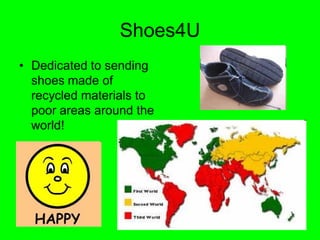
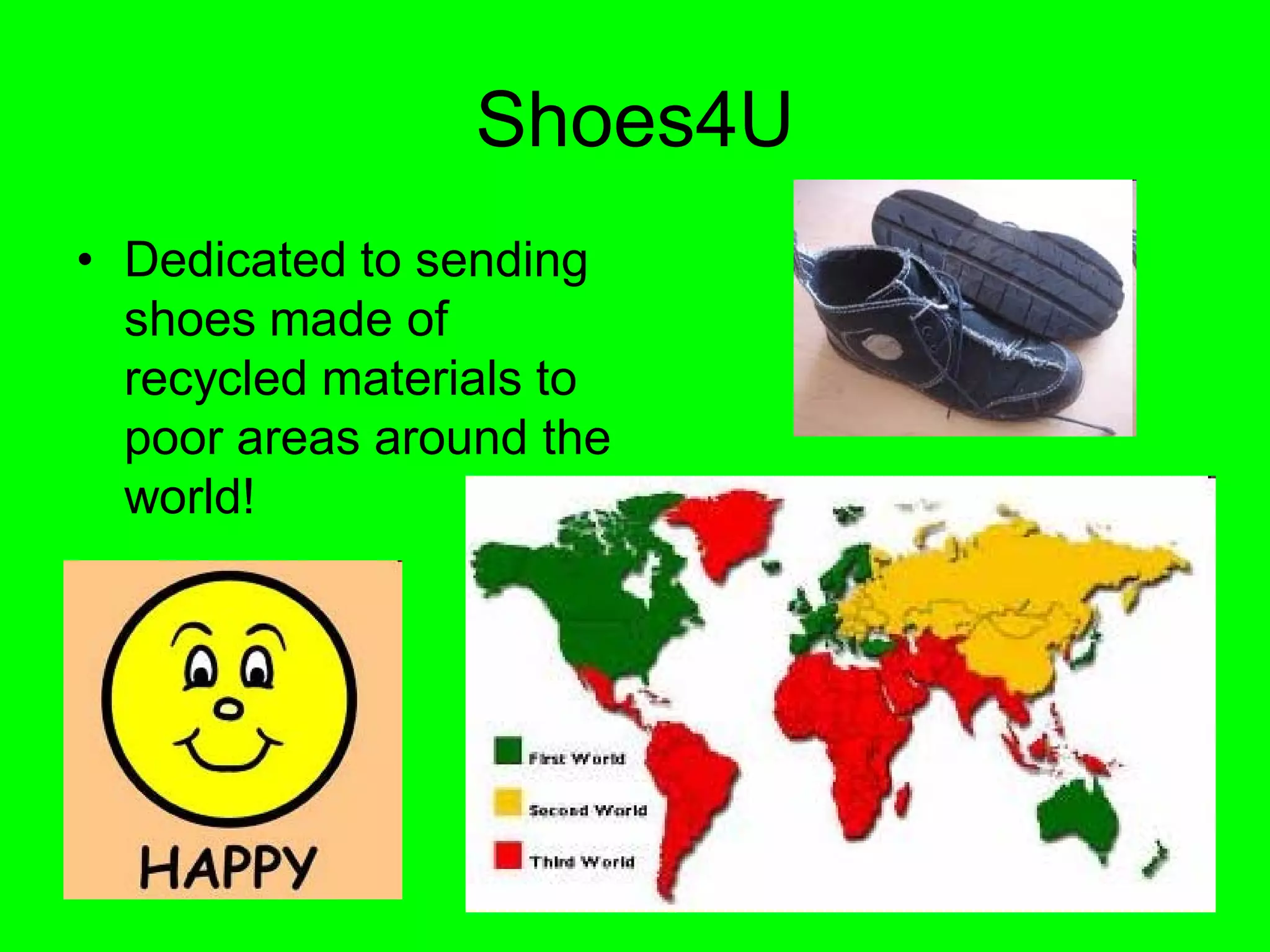
• Dedicated to sending
  shoes made of
  recycled materials to
  poor areas around the
  world!
Materials


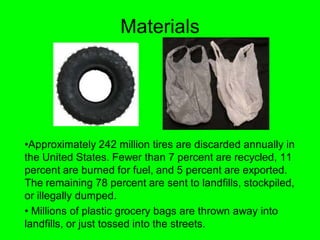
•Approximately 242 million tires are discarded annually in
the United States. Fewer than 7 percent are recycled, 11
percent are burned for fuel, and 5 percent are exported.
The remaining 78 percent are sent to landfills, stockpiled,
or illegally dumped.
• Millions of plastic grocery bags are thrown away into
landfills, or just tossed into the streets.
Reason
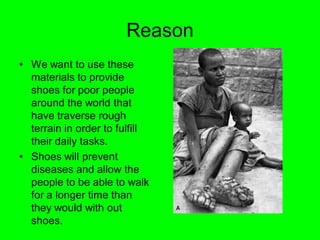
• We want to use these
  materials to provide
  shoes for poor people
  around the world that
  have traverse rough
  terrain in order to fulfill
  their daily tasks.
• Shoes will prevent
  diseases and allow the
  people to be able to walk
  for a longer time than
  they would with out
  shoes.
Build-Up
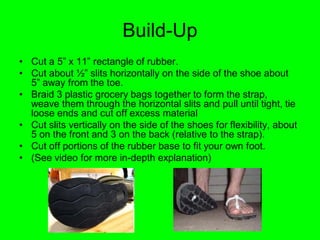
• Cut a 5” x 11” rectangle of rubber.
• Cut about ½” slits horizontally on the side of the shoe about
  5” away from the toe.
• Braid 3 plastic grocery bags together to form the strap,
  weave them through the horizontal slits and pull until tight, tie
  loose ends and cut off excess material
• Cut slits vertically on the side of the shoes for flexibility, about
  5 on the front and 3 on the back (relative to the strap).
• Cut off portions of the rubber base to fit your own foot.
• (See video for more in-depth explanation)
Why tires?
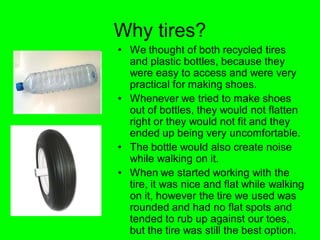
• We thought of both recycled tires
  and plastic bottles, because they
  were easy to access and were very
  practical for making shoes.
• Whenever we tried to make shoes
  out of bottles, they would not flatten
  right or they would not fit and they
  ended up being very uncomfortable.
• The bottle would also create noise
  while walking on it.
• When we started working with the
  tire, it was nice and flat while walking
  on it, however the tire we used was
  rounded and had no flat spots and
  tended to rub up against our toes,
  but the tire was still the best option.
Bibliography
•   "The Biocycle Guide to Maximum Recycling." The Biocycle Guide to
         Maximum Recycling. Ed. The Staff of Biocycle, Journal of Waste
         Recycling. Emmaus, PA: JG, 1993. 212-15. Print.
•   Centers for Disease Control and Prevention. "CDC - Schistosomiasis."
         Centers for Disease Control and Prevention. 2 Nov. 2010. Web. 03
         Feb. 2011. <http://www.cdc.gov/parasites/schistosomiasis/>.
•   Gale Group, Inc. "Podoconiosis - Definition of Podoconiosis in the Medical
         Dictionary - by the Free Online Medical Dictionary, Thesaurus and
         Encyclopedia." Medical Dictionary.
•   Shoes4Schools. "Why It Is Extremely Important to Get Shoes To Africa… «
         Shoes4schools’s Blog." Shoes4Schools’s Blog. Web. 03 Feb. 2011.
         <http://shoes4schools.wordpress.com/2008/12/28/why-it-is-extremely-
         important-to-get-shoes-to-africa/>.
•   "YES, Inc. - Shoes for Africa." YES Inc | Shoes for Africa | Humanitarian
         Relief Organization. Web. 03 Feb. 2011.
         <http://www.yesshoesinc.org/shoes_africa.htm>.

Shoes4 u

  • 1.
    Shoes4U • Dedicated tosending shoes made of recycled materials to poor areas around the world!
  • 2.
    Materials •Approximately 242 milliontires are discarded annually in the United States. Fewer than 7 percent are recycled, 11 percent are burned for fuel, and 5 percent are exported. The remaining 78 percent are sent to landfills, stockpiled, or illegally dumped. • Millions of plastic grocery bags are thrown away into landfills, or just tossed into the streets.
  • 3.
    Reason • We wantto use these materials to provide shoes for poor people around the world that have traverse rough terrain in order to fulfill their daily tasks. • Shoes will prevent diseases and allow the people to be able to walk for a longer time than they would with out shoes.
  • 4.
    Build-Up • Cut a5” x 11” rectangle of rubber. • Cut about ½” slits horizontally on the side of the shoe about 5” away from the toe. • Braid 3 plastic grocery bags together to form the strap, weave them through the horizontal slits and pull until tight, tie loose ends and cut off excess material • Cut slits vertically on the side of the shoes for flexibility, about 5 on the front and 3 on the back (relative to the strap). • Cut off portions of the rubber base to fit your own foot. • (See video for more in-depth explanation)
  • 5.
    Why tires? • Wethought of both recycled tires and plastic bottles, because they were easy to access and were very practical for making shoes. • Whenever we tried to make shoes out of bottles, they would not flatten right or they would not fit and they ended up being very uncomfortable. • The bottle would also create noise while walking on it. • When we started working with the tire, it was nice and flat while walking on it, however the tire we used was rounded and had no flat spots and tended to rub up against our toes, but the tire was still the best option.
  • 6.
    Bibliography • "The Biocycle Guide to Maximum Recycling." The Biocycle Guide to Maximum Recycling. Ed. The Staff of Biocycle, Journal of Waste Recycling. Emmaus, PA: JG, 1993. 212-15. Print. • Centers for Disease Control and Prevention. "CDC - Schistosomiasis." Centers for Disease Control and Prevention. 2 Nov. 2010. Web. 03 Feb. 2011. <http://www.cdc.gov/parasites/schistosomiasis/>. • Gale Group, Inc. "Podoconiosis - Definition of Podoconiosis in the Medical Dictionary - by the Free Online Medical Dictionary, Thesaurus and Encyclopedia." Medical Dictionary. • Shoes4Schools. "Why It Is Extremely Important to Get Shoes To Africa… « Shoes4schools’s Blog." Shoes4Schools’s Blog. Web. 03 Feb. 2011. <http://shoes4schools.wordpress.com/2008/12/28/why-it-is-extremely- important-to-get-shoes-to-africa/>. • "YES, Inc. - Shoes for Africa." YES Inc | Shoes for Africa | Humanitarian Relief Organization. Web. 03 Feb. 2011. <http://www.yesshoesinc.org/shoes_africa.htm>.