Preparing a Proof of Claim in an Era of Bulk Mortgage
Purchases and Foreclosure: Playing Sherlock “Homes”
Presented by J. Felicia LeRay, Esq.
Brief Outline
• Introduction
• What is a Proof of Claim (“PoC”)
• Why we can’t file a PoC after a foreclosure has
taken place
• Red Flags- warning signs that the property has
been foreclosed
• Research Tips
• Creating a complete record of foreclosure
• Notation of BMS
WHAT EXACTLY IS A PROOF
OF CLAIM?
Back to Basics: What Does Rule 3001 of the
Federal Rules of Bankruptcy Procedure Require?
What is a PoC?
Federal Rules of Bankruptcy Procedure Rule 3001
• A proof of claim is a written statement setting forth a creditor's
claim.
• A proof of claim shall be executed by the creditor or the
creditor's authorized agent except as provided in Rules 3004
and 3005.
• If a security interest in property of the debtor is claimed, the
proof of claim shall be accompanied by evidence that the
security interest has been perfected (i.e. the security
instrument, note, endorsements, allonges, and assignments).
• A proof of claim executed and filed in accordance with these
rules shall constitute prima facie evidence of the validity
and amount of the claim.
What other rules govern PoCs?
• Local rules
• Case law
• Administrative orders
• General orders
• Published guidelines
• Best practices
• United States Bankruptcy
Court Northern District of
Georgia BLR 3001-1
RESULTS AND PENALTIES FOR
FILING AND SUBMITTING “BAD
CLAIMS”
So what’s the big deal? Why can’t we file a PoC
after a home has been foreclosed?
Submitting a PoC After Foreclosure has taken place
• Submission of a invalid claim
• Objections to PoCs
• Increased scrutiny by United
States Trustees and Chapter
13 Trustees
• Unnecessary Litigation
• Creates the perception that we
are inept & unorganized
• Damages professional
reputation
• Sanctions
• Waste of time, money, and
resources
SIGNS THAT A PROPERTY
HAS BEEN FORECLOSED
Looking for Red Flags
Foreclosure Clues
• Often times, there are clues that a property has been
foreclosed prior to us receiving the referral.
• Typical clues include:
1. Failure of the debtor to treat our client in the plan.
2. Failure to list our client in the schedules.
3. A statement that the property has been foreclosed
in the Statement of Financial Affairs (“SOFA”).
4. REO insurance premiums on the escrow inquiry
screen.
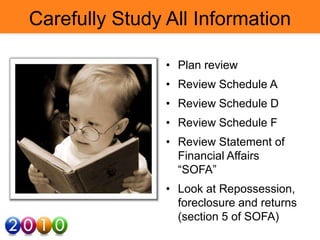
Carefully Study All Information
• Plan review
• Review Schedule A
• Review Schedule D
• Review Schedule F
• Review Statement of
Financial Affairs
“SOFA”
• Look at Repossession,
foreclosure and returns
(section 5 of SOFA)
RESEARCH TIPS
Hunting Down Foreclosures…..
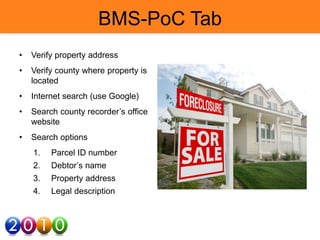
BMS-PoC Tab
• Verify property address
• Verify county where property is
located
• Internet search (use Google)
• Search county recorder’s office
website
• Search options
1. Parcel ID number
2. Debtor’s name
3. Property address
4. Legal description
CREATING A COMPLETE
RECORD OF THE
FORECLOSURE
Correspondence With the County Clerk
Investigate the Following Information
• Has a foreclosure sale
taken place?
• What is the date of
foreclosure sale?
• What was sale price?
(helps for deficiency
judgments)
• Who is the current
owner?
• What is the book number
and page number for
Deed of Sale?
Wrap it up!
• Sometimes, debtors are wrong. Don’t rely
exclusively on information containing in
SOFA. A bankruptcy filing may have stopped
a pending sale.
• Be extra careful with pro se debtors.
• After verify that foreclosure has taken place,
provide the client with the information that
you have discovered and let the CLIENT
make a determination of whether to seek a
deficiency claim.
Keys to Success & Practice Tips
• Be alert to the possibility
that the lender has
foreclosed
• Look diligently for clues
• Don’t make any
assumptions
• Verify information
• Create a complete record
of the foreclosure
• Notate BMS
The End

Sherlock Homes

  • 1.
    Preparing a Proofof Claim in an Era of Bulk Mortgage Purchases and Foreclosure: Playing Sherlock “Homes” Presented by J. Felicia LeRay, Esq.
  • 2.
    Brief Outline • Introduction •What is a Proof of Claim (“PoC”) • Why we can’t file a PoC after a foreclosure has taken place • Red Flags- warning signs that the property has been foreclosed • Research Tips • Creating a complete record of foreclosure • Notation of BMS
  • 3.
    WHAT EXACTLY ISA PROOF OF CLAIM? Back to Basics: What Does Rule 3001 of the Federal Rules of Bankruptcy Procedure Require?
  • 4.
    What is aPoC? Federal Rules of Bankruptcy Procedure Rule 3001 • A proof of claim is a written statement setting forth a creditor's claim. • A proof of claim shall be executed by the creditor or the creditor's authorized agent except as provided in Rules 3004 and 3005. • If a security interest in property of the debtor is claimed, the proof of claim shall be accompanied by evidence that the security interest has been perfected (i.e. the security instrument, note, endorsements, allonges, and assignments). • A proof of claim executed and filed in accordance with these rules shall constitute prima facie evidence of the validity and amount of the claim.
  • 5.
    What other rulesgovern PoCs? • Local rules • Case law • Administrative orders • General orders • Published guidelines • Best practices • United States Bankruptcy Court Northern District of Georgia BLR 3001-1
  • 6.
    RESULTS AND PENALTIESFOR FILING AND SUBMITTING “BAD CLAIMS” So what’s the big deal? Why can’t we file a PoC after a home has been foreclosed?
  • 7.
    Submitting a PoCAfter Foreclosure has taken place • Submission of a invalid claim • Objections to PoCs • Increased scrutiny by United States Trustees and Chapter 13 Trustees • Unnecessary Litigation • Creates the perception that we are inept & unorganized • Damages professional reputation • Sanctions • Waste of time, money, and resources
  • 8.
    SIGNS THAT APROPERTY HAS BEEN FORECLOSED Looking for Red Flags
  • 9.
    Foreclosure Clues • Oftentimes, there are clues that a property has been foreclosed prior to us receiving the referral. • Typical clues include: 1. Failure of the debtor to treat our client in the plan. 2. Failure to list our client in the schedules. 3. A statement that the property has been foreclosed in the Statement of Financial Affairs (“SOFA”). 4. REO insurance premiums on the escrow inquiry screen.
  • 10.
    Carefully Study AllInformation • Plan review • Review Schedule A • Review Schedule D • Review Schedule F • Review Statement of Financial Affairs “SOFA” • Look at Repossession, foreclosure and returns (section 5 of SOFA)
  • 11.
    RESEARCH TIPS Hunting DownForeclosures…..
  • 12.
    BMS-PoC Tab • Verifyproperty address • Verify county where property is located • Internet search (use Google) • Search county recorder’s office website • Search options 1. Parcel ID number 2. Debtor’s name 3. Property address 4. Legal description
  • 13.
    CREATING A COMPLETE RECORDOF THE FORECLOSURE Correspondence With the County Clerk
  • 14.
    Investigate the FollowingInformation • Has a foreclosure sale taken place? • What is the date of foreclosure sale? • What was sale price? (helps for deficiency judgments) • Who is the current owner? • What is the book number and page number for Deed of Sale?
  • 15.
    Wrap it up! •Sometimes, debtors are wrong. Don’t rely exclusively on information containing in SOFA. A bankruptcy filing may have stopped a pending sale. • Be extra careful with pro se debtors. • After verify that foreclosure has taken place, provide the client with the information that you have discovered and let the CLIENT make a determination of whether to seek a deficiency claim.
  • 16.
    Keys to Success& Practice Tips • Be alert to the possibility that the lender has foreclosed • Look diligently for clues • Don’t make any assumptions • Verify information • Create a complete record of the foreclosure • Notate BMS
  • 17.