Shaping a brighter
Future:
  Advancements in Health IT


     February 16-18, 2012 | Philadelphia, PA
                                               1
Understanding Health IT and how it relates to you

•   What does Health IT mean to you?

•   Do you know what an EMR is?

•   How do you see Health IT playing a role in your personal life?

•   How do you see it affecting your business, if at all?

•   How do you feel overall about the health care system?

•   What opportunities do you foresee taking place with technology in health care?

•   Are there any particular advancements you would like to see?


                                                                                     2
Despite the current U.S health care investment of over $1.7 trillion
annually, Americans are still plagued by quality care concerns
•       Per capita health care expenditure in the United States far outstrips expenditure in other nations,
        yet Americans suffer from the burden of chronic disease at a higher rate than their counterparts in
        other nations
•       Most providers lack the information systems necessary to:
          – Coordinate a patient’s care with other providers and share needed information
          – Monitor compliance with prevention and disease-management guidelines
          – Measure and improve performance
•       Incentives within the U.S. health care system are misaligned, contributing to the high costs of care


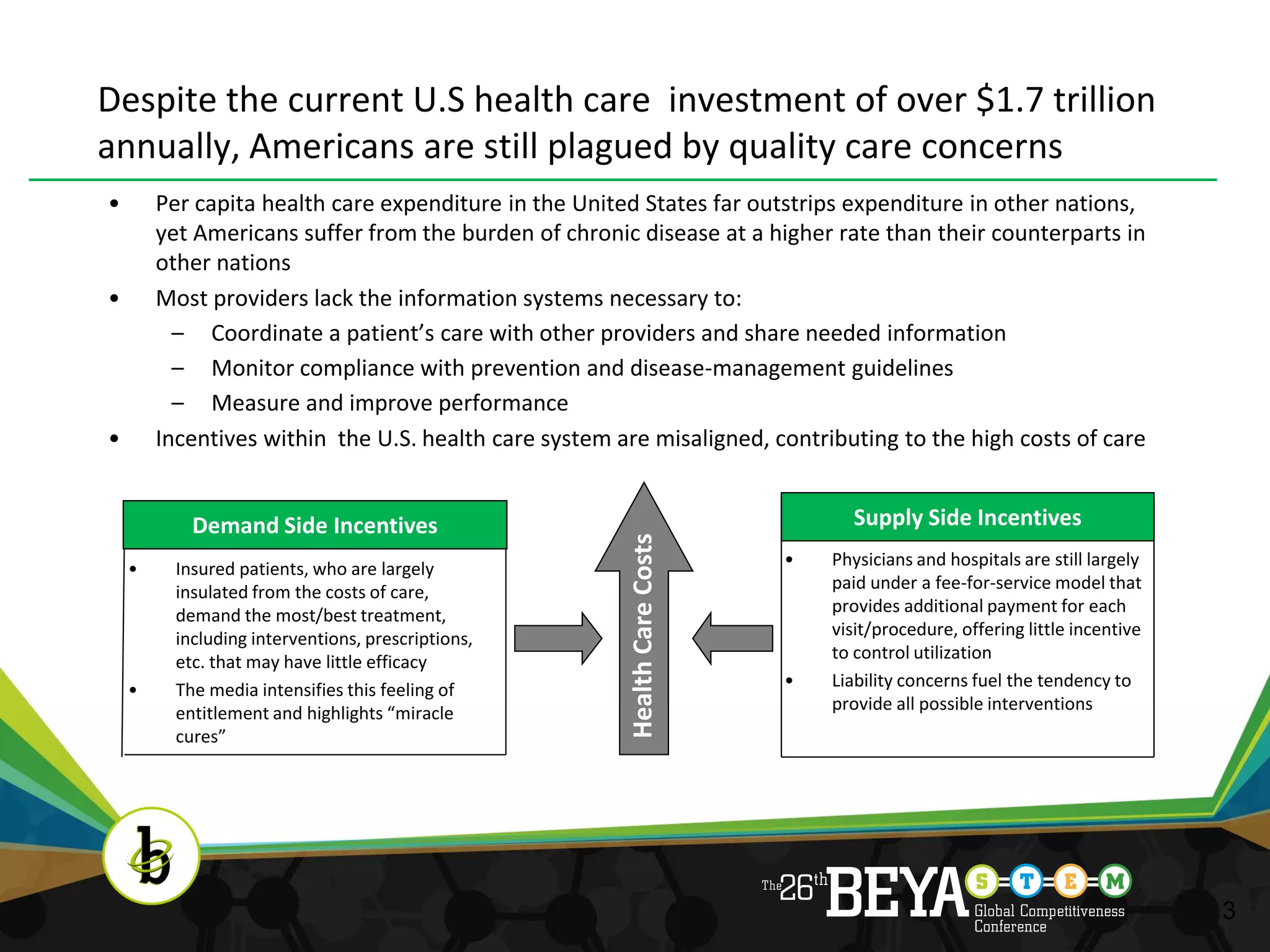
            Demand Side Incentives                                               Supply Side Incentives


                                                       Health Care Costs
    •     Insured patients, who are largely                                •   Physicians and hospitals are still largely
          insulated from the costs of care,                                    paid under a fee-for-service model that
          demand the most/best treatment,                                      provides additional payment for each
          including interventions, prescriptions,                              visit/procedure, offering little incentive
          etc. that may have little efficacy                                   to control utilization
    •     The media intensifies this feeling of                            •   Liability concerns fuel the tendency to
          entitlement and highlights “miracle                                  provide all possible interventions
          cures”


                                                                                                                            3
Over the last 10 years, recent and aggressive legislation has helped
guide the development of Health IT in an effort to improve health care
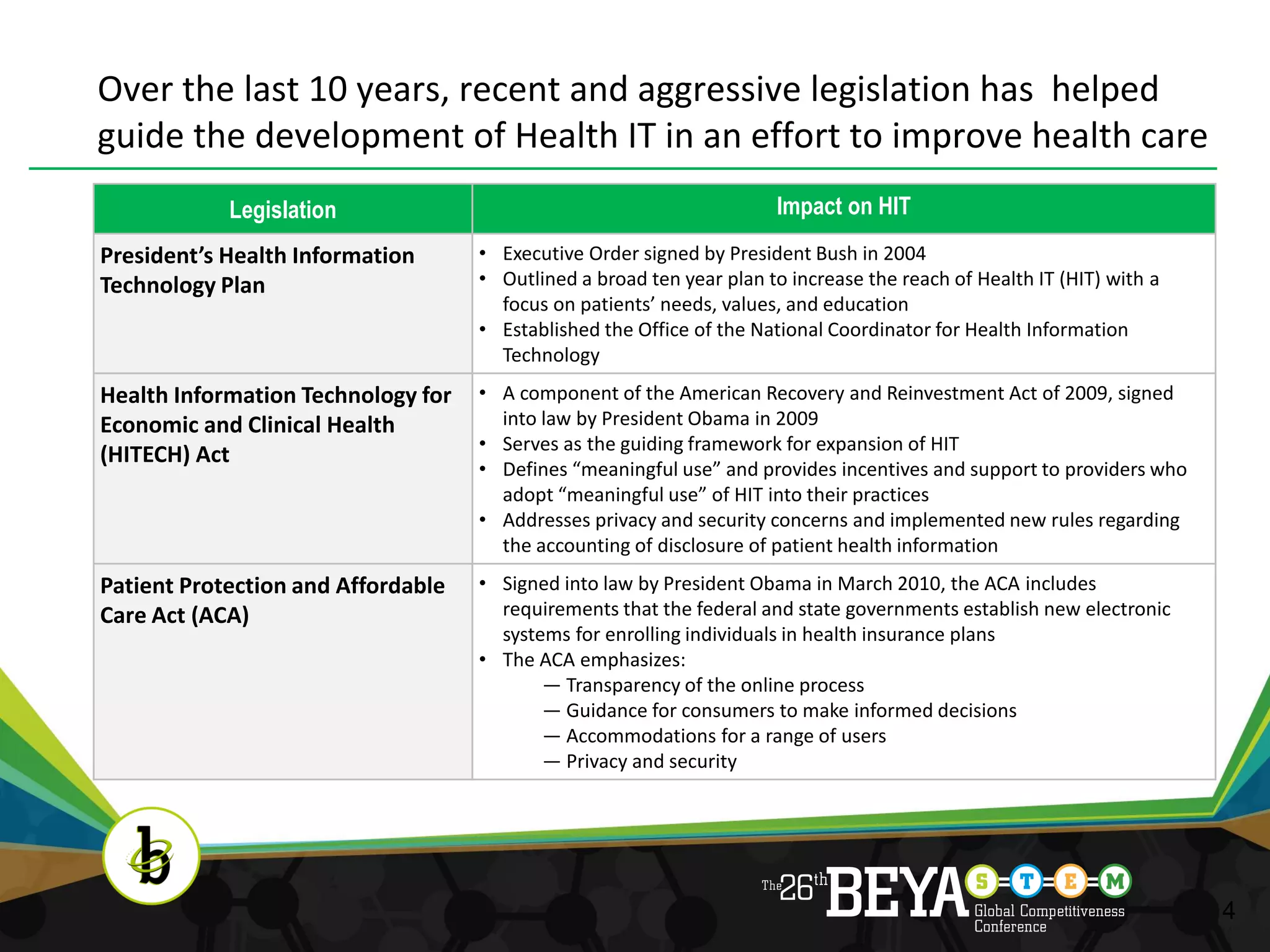
            Legislation                                                Impact on HIT
President’s Health Information      • Executive Order signed by President Bush in 2004
Technology Plan                     • Outlined a broad ten year plan to increase the reach of Health IT (HIT) with a
                                      focus on patients’ needs, values, and education
                                    • Established the Office of the National Coordinator for Health Information
                                      Technology
Health Information Technology for   • A component of the American Recovery and Reinvestment Act of 2009, signed
Economic and Clinical Health          into law by President Obama in 2009
                                    • Serves as the guiding framework for expansion of HIT
(HITECH) Act
                                    • Defines “meaningful use” and provides incentives and support to providers who
                                      adopt “meaningful use” of HIT into their practices
                                    • Addresses privacy and security concerns and implemented new rules regarding
                                      the accounting of disclosure of patient health information
Patient Protection and Affordable   • Signed into law by President Obama in March 2010, the ACA includes
Care Act (ACA)                        requirements that the federal and state governments establish new electronic
                                      systems for enrolling individuals in health insurance plans
                                    • The ACA emphasizes:
                                           — Transparency of the online process
                                           — Guidance for consumers to make informed decisions
                                           — Accommodations for a range of users
                                           — Privacy and security


                                                                                                                       4
By adopting Health IT solutions, standards, and best practices,
health care providers will be able to offer superior care

•    Health IT is the comprehensive management of health information across computerized systems
     and its secure exchange between consumers, providers, government and quality entities, and
     insurers and includes:
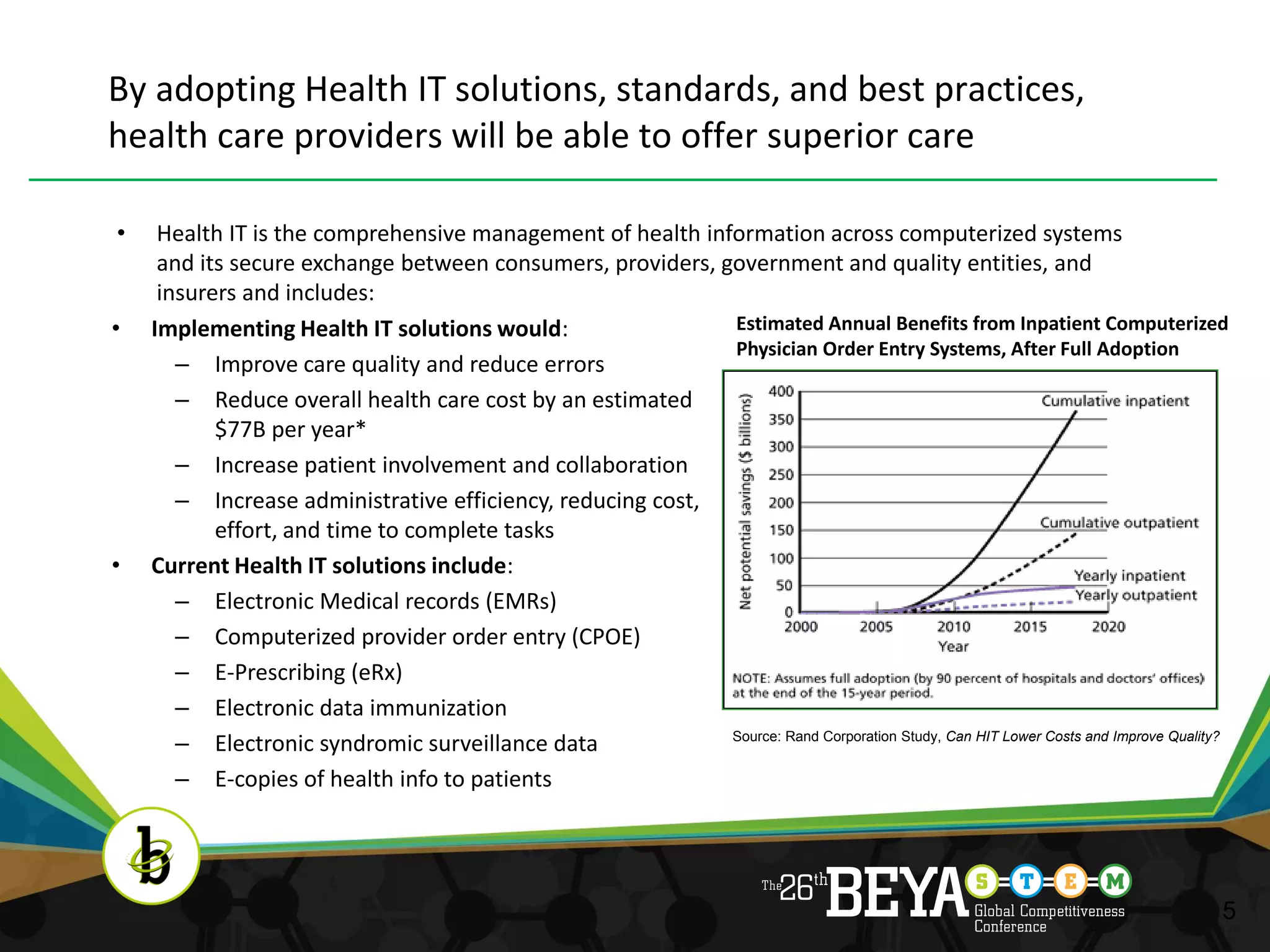
•   Implementing Health IT solutions would:                 Estimated Annual Benefits from Inpatient Computerized
                                                            Physician Order Entry Systems, After Full Adoption
       – Improve care quality and reduce errors
       – Reduce overall health care cost by an estimated
           $77B per year*
       – Increase patient involvement and collaboration
       – Increase administrative efficiency, reducing cost,
           effort, and time to complete tasks
•   Current Health IT solutions include:
       – Electronic Medical records (EMRs)
       – Computerized provider order entry (CPOE)
       – E-Prescribing (eRx)
       – Electronic data immunization
       – Electronic syndromic surveillance data             Source: Rand Corporation Study, Can HIT Lower Costs and Improve Quality?


       – E-copies of health info to patients


                                                                                                                                   5
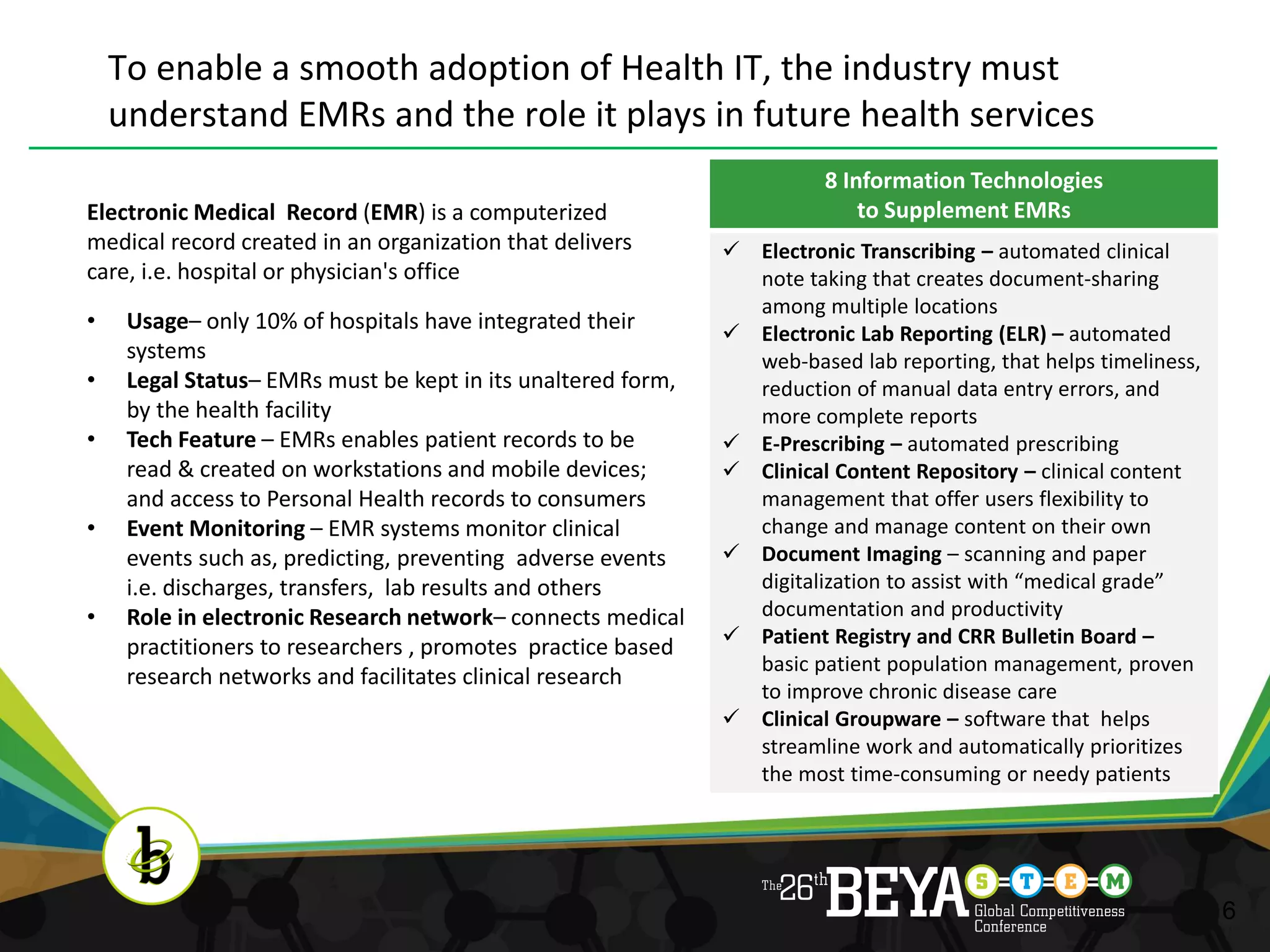
To enable a smooth adoption of Health IT, the industry must
    understand EMRs and the role it plays in future health services
                                                                        8 Information Technologies
Electronic Medical Record (EMR) is a computerized                           to Supplement EMRs
medical record created in an organization that delivers        Electronic Transcribing – automated clinical
care, i.e. hospital or physician's office                       note taking that creates document-sharing
                                                                among multiple locations
•    Usage– only 10% of hospitals have integrated their        Electronic Lab Reporting (ELR) – automated
     systems                                                    web-based lab reporting, that helps timeliness,
•    Legal Status– EMRs must be kept in its unaltered form,     reduction of manual data entry errors, and
     by the health facility                                     more complete reports
•    Tech Feature – EMRs enables patient records to be         E-Prescribing – automated prescribing
     read & created on workstations and mobile devices;        Clinical Content Repository – clinical content
     and access to Personal Health records to consumers         management that offer users flexibility to
•    Event Monitoring – EMR systems monitor clinical            change and manage content on their own
     events such as, predicting, preventing adverse events     Document Imaging – scanning and paper
     i.e. discharges, transfers, lab results and others         digitalization to assist with “medical grade”
•    Role in electronic Research network– connects medical      documentation and productivity
     practitioners to researchers , promotes practice based    Patient Registry and CRR Bulletin Board –
                                                                basic patient population management, proven
     research networks and facilitates clinical research
                                                                to improve chronic disease care
                                                               Clinical Groupware – software that helps
                                                                streamline work and automatically prioritizes
                                                                the most time-consuming or needy patients


                                                                                                                  6
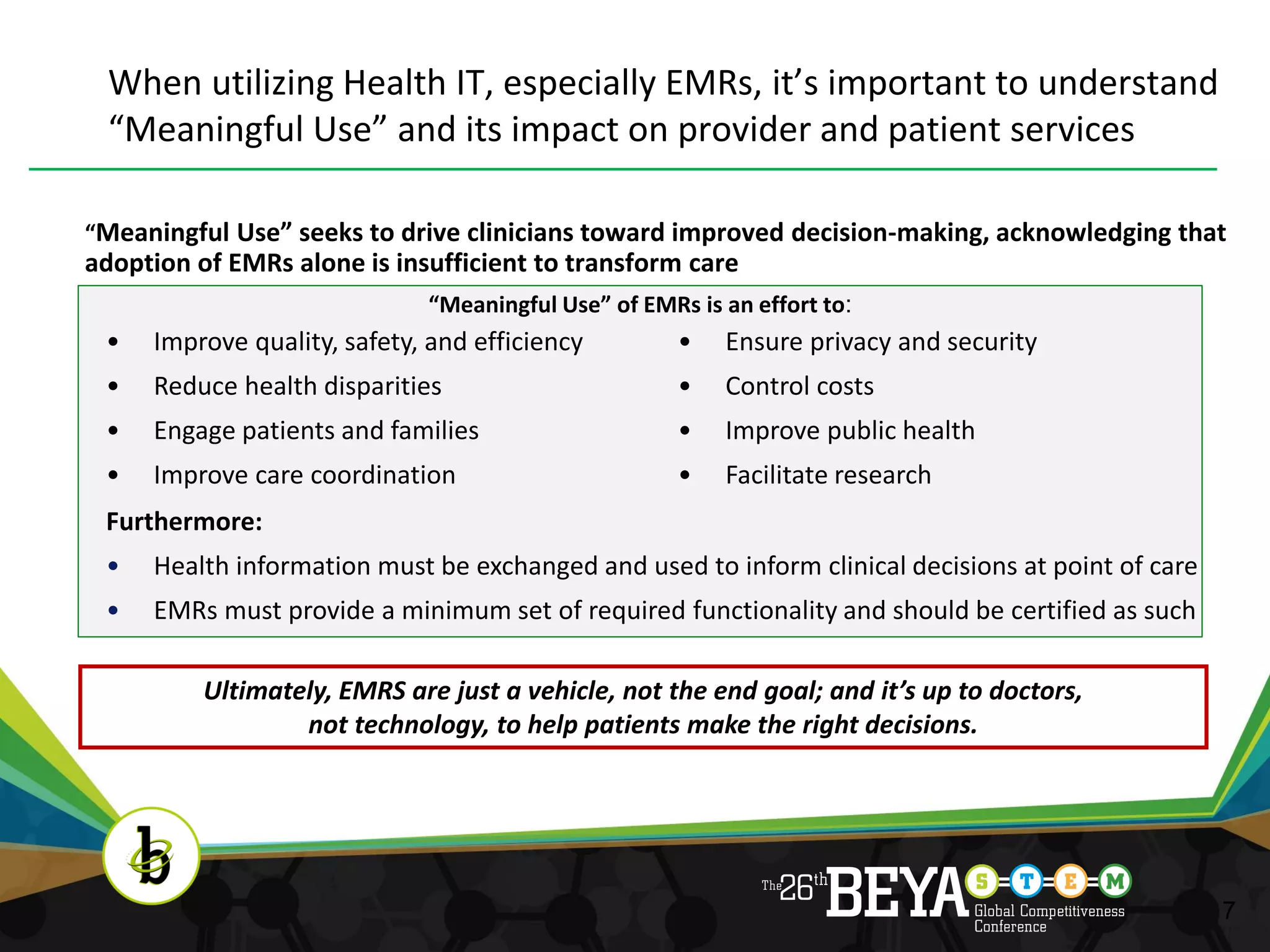
When utilizing Health IT, especially EMRs, it’s important to understand
 “Meaningful Use” and its impact on provider and patient services

“Meaningful Use” seeks to drive clinicians toward improved decision-making, acknowledging that
adoption of EMRs alone is insufficient to transform care
                             “Meaningful Use” of EMRs is an effort to:
 •   Improve quality, safety, and efficiency         •   Ensure privacy and security
 •   Reduce health disparities                       •   Control costs
 •   Engage patients and families                    •   Improve public health
 •   Improve care coordination                       •   Facilitate research
 Furthermore:
 •   Health information must be exchanged and used to inform clinical decisions at point of care
 •   EMRs must provide a minimum set of required functionality and should be certified as such

          Ultimately, EMRS are just a vehicle, not the end goal; and it’s up to doctors,
                  not technology, to help patients make the right decisions.


                                                                                                   7
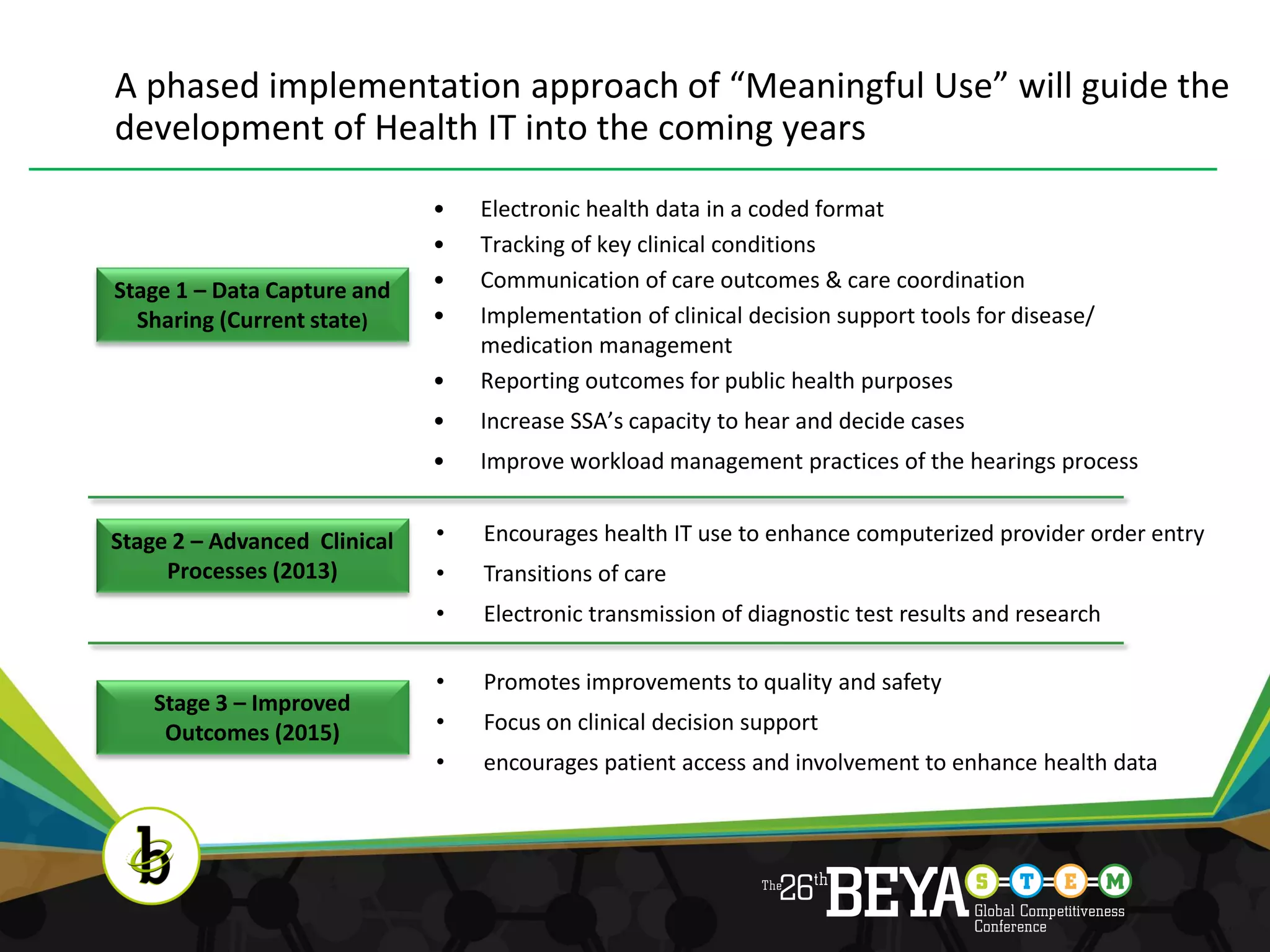
A phased implementation approach of “Meaningful Use” will guide the
development of Health IT into the coming years
                              •   Electronic health data in a coded format
                              •   Tracking of key clinical conditions
Stage 1 – Data Capture and    •   Communication of care outcomes & care coordination
  Sharing (Current state)     •   Implementation of clinical decision support tools for disease/
                                  medication management
                              •   Reporting outcomes for public health purposes
                              •   Increase SSA’s capacity to hear and decide cases
                              •   Improve workload management practices of the hearings process


Stage 2 – Advanced Clinical   •   Encourages health IT use to enhance computerized provider order entry
     Processes (2013)         •   Transitions of care
                              •   Electronic transmission of diagnostic test results and research

                              •   Promotes improvements to quality and safety
    Stage 3 – Improved
     Outcomes (2015)          •   Focus on clinical decision support
                              •   encourages patient access and involvement to enhance health data
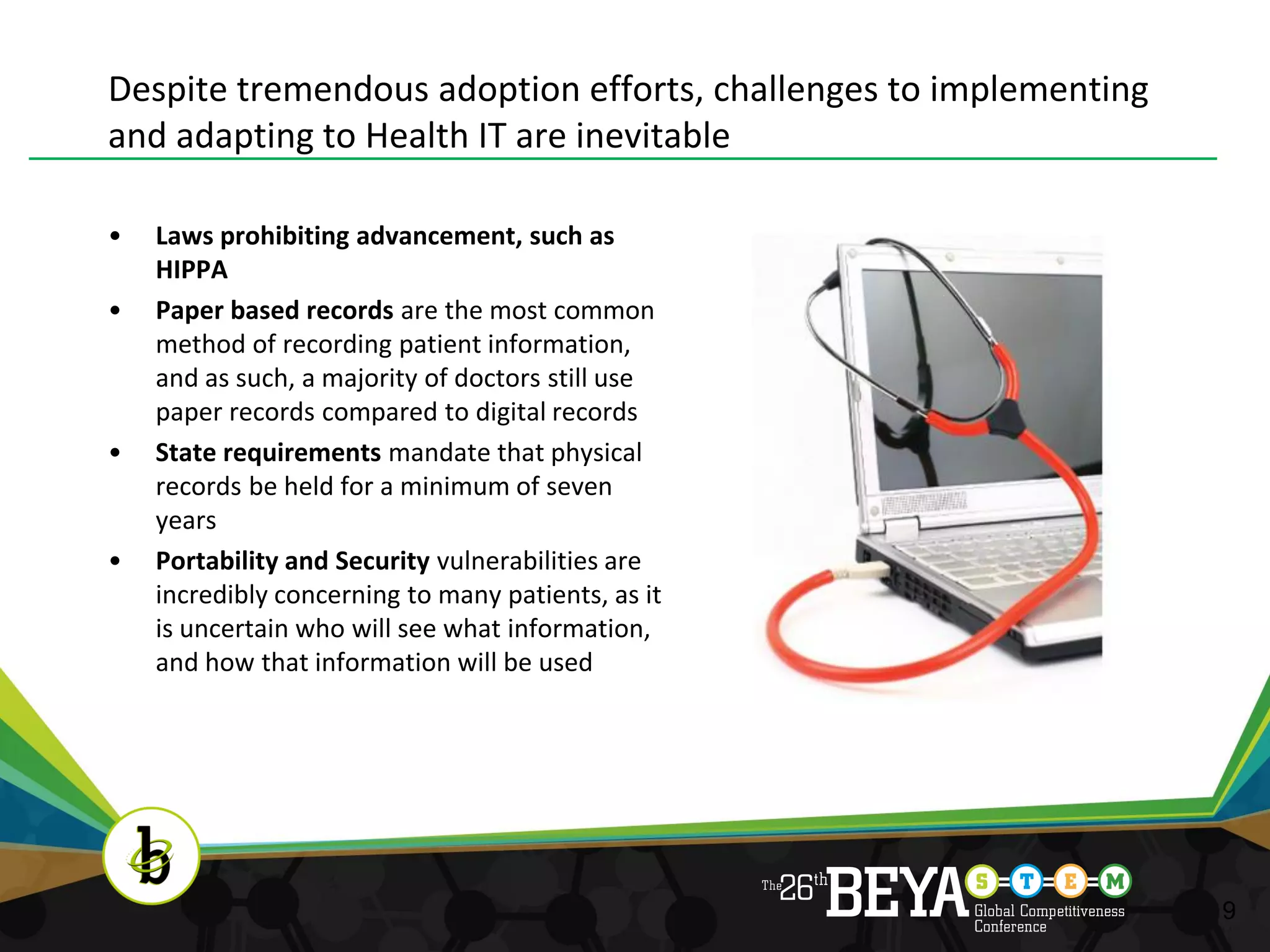
Despite tremendous adoption efforts, challenges to implementing
and adapting to Health IT are inevitable

•   Laws prohibiting advancement, such as
    HIPPA
•   Paper based records are the most common
    method of recording patient information,
    and as such, a majority of doctors still use
    paper records compared to digital records
•   State requirements mandate that physical
    records be held for a minimum of seven
    years
•   Portability and Security vulnerabilities are
    incredibly concerning to many patients, as it
    is uncertain who will see what information,
    and how that information will be used


                                                                  9
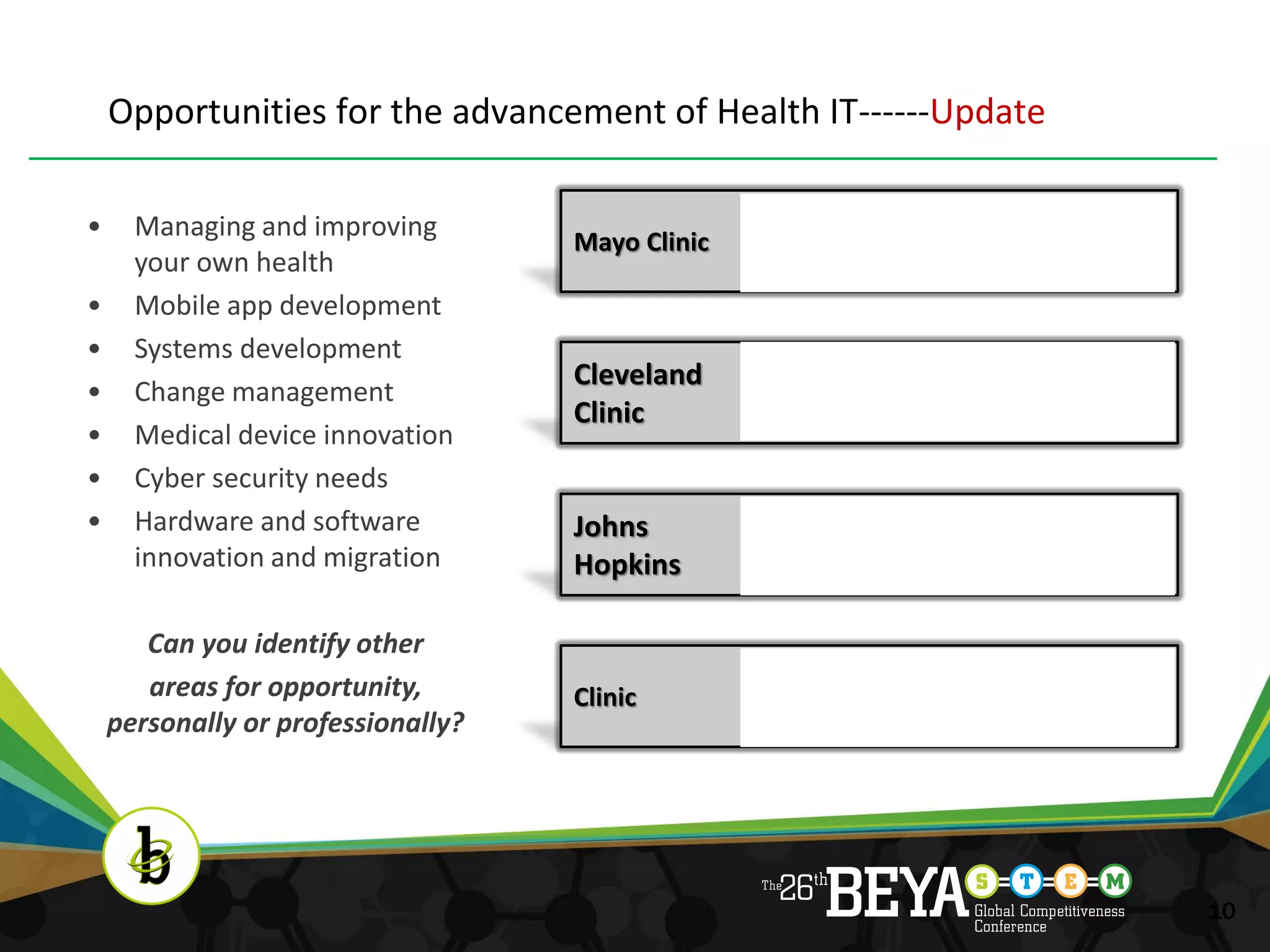
Opportunities for the advancement of Health IT------Update

•     Managing and improving
                                    Mayo Clinic
      your own health
•     Mobile app development
•     Systems development
                                    Cleveland
•     Change management
                                    Clinic
•     Medical device innovation
•     Cyber security needs
•     Hardware and software         Johns
      innovation and migration      Hopkins

       Can you identify other
       areas for opportunity,       Clinic
    personally or professionally?


                                                                 10
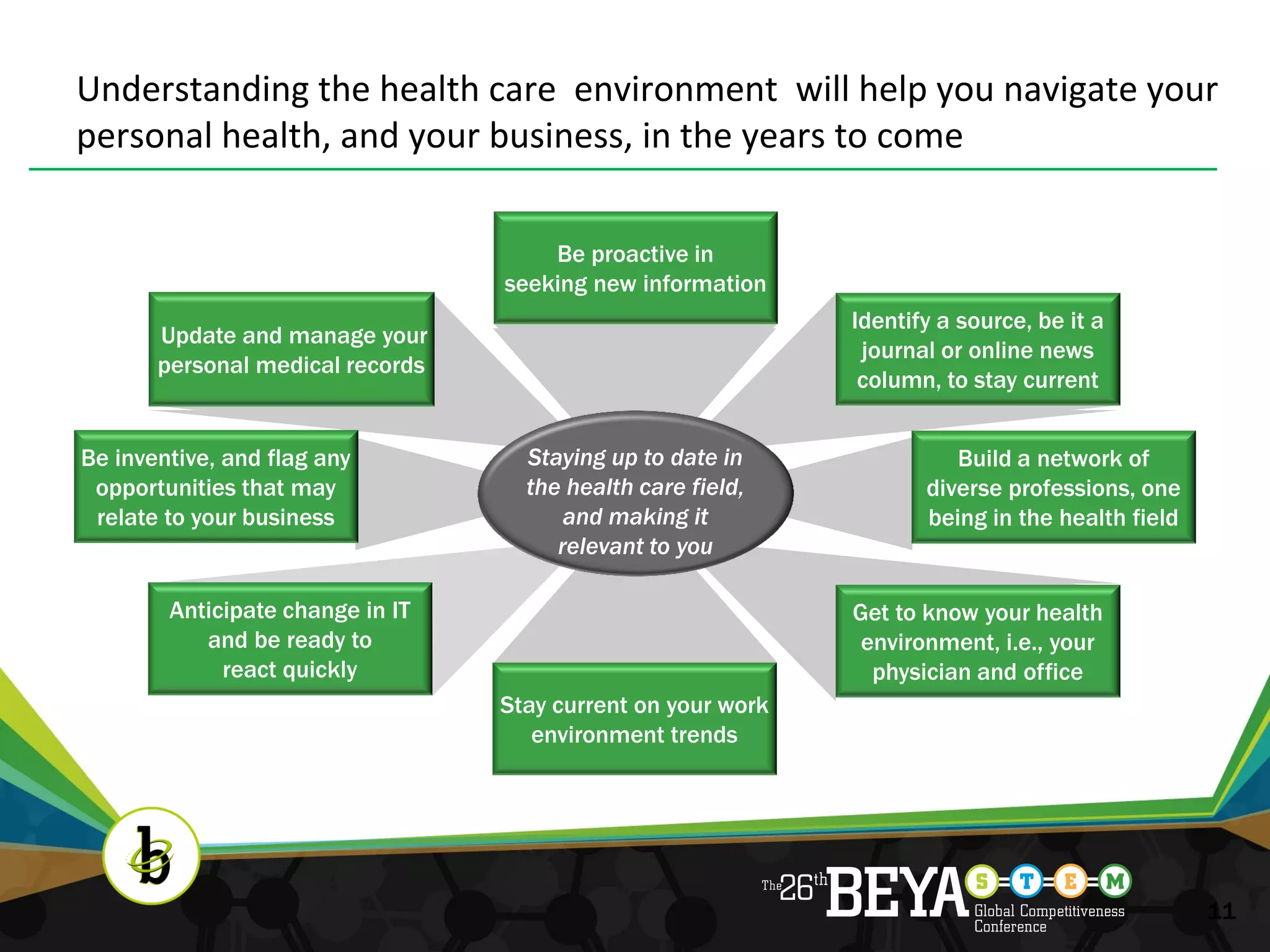
Understanding the health care environment will help you navigate your
personal health, and your business, in the years to come

                                      Be proactive in
                                  seeking new information
                                                              Identify a source, be it a
       Update and manage your
                                                               journal or online news
       personal medical records
                                                               column, to stay current


Be inventive, and flag any          Staying up to date in               Build a network of
 opportunities that may             the health care field,           diverse professions, one
 relate to your business                and making it                being in the health field
                                       relevant to you

        Anticipate change in IT                               Get to know your health
           and be ready to                                     environment, i.e., your
             react quickly                                      physician and office
                                  Stay current on your work
                                     environment trends


                                                                                                 11
Questions and Contact Information
                     Kristine Martin Anderson
                               Vice President

                         Booz Allen Hamilton Inc.
                              1101 Wootton Pkwy
                             Rockville, MD 20852
                               Tel (240) 314-5790
                      anderson_kristine@bah.com


                            Chris Foster
                               Principal

                          Booz Allen Hamilton Inc.
                           8283 Greensboro Drive
                                 Mclean, VA 22102
                                Tel (703) 377-0870
                            foster_chris@bah.com


                                                     12
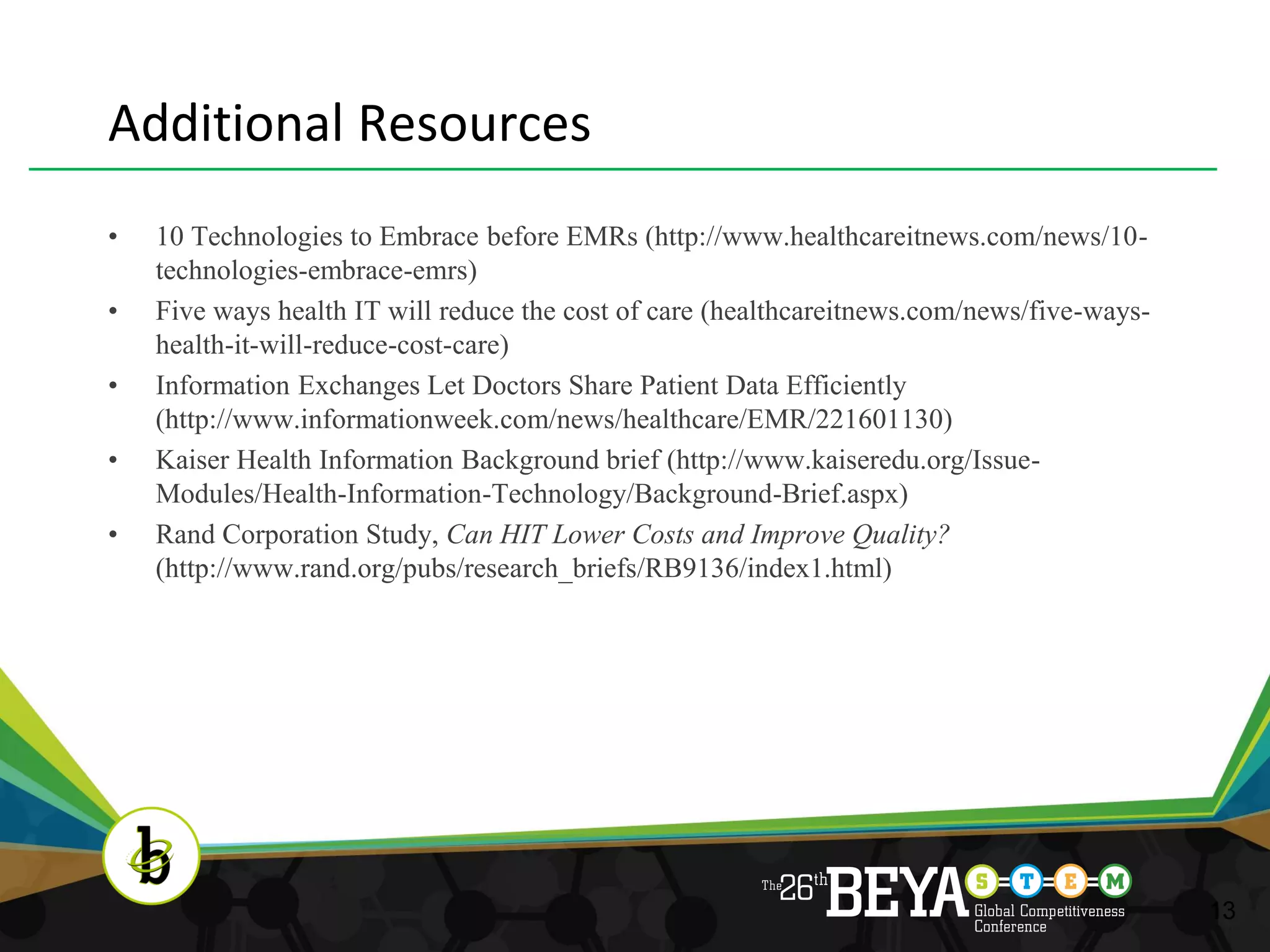
Additional Resources
•   10 Technologies to Embrace before EMRs (http://www.healthcareitnews.com/news/10-
    technologies-embrace-emrs)
•   Five ways health IT will reduce the cost of care (healthcareitnews.com/news/five-ways-
    health-it-will-reduce-cost-care)
•   Information Exchanges Let Doctors Share Patient Data Efficiently
    (http://www.informationweek.com/news/healthcare/EMR/221601130)
•   Kaiser Health Information Background brief (http://www.kaiseredu.org/Issue-
    Modules/Health-Information-Technology/Background-Brief.aspx)
•   Rand Corporation Study, Can HIT Lower Costs and Improve Quality?
    (http://www.rand.org/pubs/research_briefs/RB9136/index1.html)


                                                                                             13

Shaping a brighter future advancements in health it ccg submission

  • 1.
    Shaping a brighter Future: Advancements in Health IT February 16-18, 2012 | Philadelphia, PA 1
  • 2.
    Understanding Health ITand how it relates to you • What does Health IT mean to you? • Do you know what an EMR is? • How do you see Health IT playing a role in your personal life? • How do you see it affecting your business, if at all? • How do you feel overall about the health care system? • What opportunities do you foresee taking place with technology in health care? • Are there any particular advancements you would like to see? 2
  • 3.
    Despite the currentU.S health care investment of over $1.7 trillion annually, Americans are still plagued by quality care concerns • Per capita health care expenditure in the United States far outstrips expenditure in other nations, yet Americans suffer from the burden of chronic disease at a higher rate than their counterparts in other nations • Most providers lack the information systems necessary to: – Coordinate a patient’s care with other providers and share needed information – Monitor compliance with prevention and disease-management guidelines – Measure and improve performance • Incentives within the U.S. health care system are misaligned, contributing to the high costs of care Demand Side Incentives Supply Side Incentives Health Care Costs • Insured patients, who are largely • Physicians and hospitals are still largely insulated from the costs of care, paid under a fee-for-service model that demand the most/best treatment, provides additional payment for each including interventions, prescriptions, visit/procedure, offering little incentive etc. that may have little efficacy to control utilization • The media intensifies this feeling of • Liability concerns fuel the tendency to entitlement and highlights “miracle provide all possible interventions cures” 3
  • 4.
    Over the last10 years, recent and aggressive legislation has helped guide the development of Health IT in an effort to improve health care Legislation Impact on HIT President’s Health Information • Executive Order signed by President Bush in 2004 Technology Plan • Outlined a broad ten year plan to increase the reach of Health IT (HIT) with a focus on patients’ needs, values, and education • Established the Office of the National Coordinator for Health Information Technology Health Information Technology for • A component of the American Recovery and Reinvestment Act of 2009, signed Economic and Clinical Health into law by President Obama in 2009 • Serves as the guiding framework for expansion of HIT (HITECH) Act • Defines “meaningful use” and provides incentives and support to providers who adopt “meaningful use” of HIT into their practices • Addresses privacy and security concerns and implemented new rules regarding the accounting of disclosure of patient health information Patient Protection and Affordable • Signed into law by President Obama in March 2010, the ACA includes Care Act (ACA) requirements that the federal and state governments establish new electronic systems for enrolling individuals in health insurance plans • The ACA emphasizes: — Transparency of the online process — Guidance for consumers to make informed decisions — Accommodations for a range of users — Privacy and security 4
  • 5.
    By adopting HealthIT solutions, standards, and best practices, health care providers will be able to offer superior care • Health IT is the comprehensive management of health information across computerized systems and its secure exchange between consumers, providers, government and quality entities, and insurers and includes: • Implementing Health IT solutions would: Estimated Annual Benefits from Inpatient Computerized Physician Order Entry Systems, After Full Adoption – Improve care quality and reduce errors – Reduce overall health care cost by an estimated $77B per year* – Increase patient involvement and collaboration – Increase administrative efficiency, reducing cost, effort, and time to complete tasks • Current Health IT solutions include: – Electronic Medical records (EMRs) – Computerized provider order entry (CPOE) – E-Prescribing (eRx) – Electronic data immunization – Electronic syndromic surveillance data Source: Rand Corporation Study, Can HIT Lower Costs and Improve Quality? – E-copies of health info to patients 5
  • 6.
    To enable asmooth adoption of Health IT, the industry must understand EMRs and the role it plays in future health services 8 Information Technologies Electronic Medical Record (EMR) is a computerized to Supplement EMRs medical record created in an organization that delivers  Electronic Transcribing – automated clinical care, i.e. hospital or physician's office note taking that creates document-sharing among multiple locations • Usage– only 10% of hospitals have integrated their  Electronic Lab Reporting (ELR) – automated systems web-based lab reporting, that helps timeliness, • Legal Status– EMRs must be kept in its unaltered form, reduction of manual data entry errors, and by the health facility more complete reports • Tech Feature – EMRs enables patient records to be  E-Prescribing – automated prescribing read & created on workstations and mobile devices;  Clinical Content Repository – clinical content and access to Personal Health records to consumers management that offer users flexibility to • Event Monitoring – EMR systems monitor clinical change and manage content on their own events such as, predicting, preventing adverse events  Document Imaging – scanning and paper i.e. discharges, transfers, lab results and others digitalization to assist with “medical grade” • Role in electronic Research network– connects medical documentation and productivity practitioners to researchers , promotes practice based  Patient Registry and CRR Bulletin Board – basic patient population management, proven research networks and facilitates clinical research to improve chronic disease care  Clinical Groupware – software that helps streamline work and automatically prioritizes the most time-consuming or needy patients 6
  • 7.
    When utilizing HealthIT, especially EMRs, it’s important to understand “Meaningful Use” and its impact on provider and patient services “Meaningful Use” seeks to drive clinicians toward improved decision-making, acknowledging that adoption of EMRs alone is insufficient to transform care “Meaningful Use” of EMRs is an effort to: • Improve quality, safety, and efficiency • Ensure privacy and security • Reduce health disparities • Control costs • Engage patients and families • Improve public health • Improve care coordination • Facilitate research Furthermore: • Health information must be exchanged and used to inform clinical decisions at point of care • EMRs must provide a minimum set of required functionality and should be certified as such Ultimately, EMRS are just a vehicle, not the end goal; and it’s up to doctors, not technology, to help patients make the right decisions. 7
  • 8.
    A phased implementationapproach of “Meaningful Use” will guide the development of Health IT into the coming years • Electronic health data in a coded format • Tracking of key clinical conditions Stage 1 – Data Capture and • Communication of care outcomes & care coordination Sharing (Current state) • Implementation of clinical decision support tools for disease/ medication management • Reporting outcomes for public health purposes • Increase SSA’s capacity to hear and decide cases • Improve workload management practices of the hearings process Stage 2 – Advanced Clinical • Encourages health IT use to enhance computerized provider order entry Processes (2013) • Transitions of care • Electronic transmission of diagnostic test results and research • Promotes improvements to quality and safety Stage 3 – Improved Outcomes (2015) • Focus on clinical decision support • encourages patient access and involvement to enhance health data
  • 9.
    Despite tremendous adoptionefforts, challenges to implementing and adapting to Health IT are inevitable • Laws prohibiting advancement, such as HIPPA • Paper based records are the most common method of recording patient information, and as such, a majority of doctors still use paper records compared to digital records • State requirements mandate that physical records be held for a minimum of seven years • Portability and Security vulnerabilities are incredibly concerning to many patients, as it is uncertain who will see what information, and how that information will be used 9
  • 10.
    Opportunities for theadvancement of Health IT------Update • Managing and improving Mayo Clinic your own health • Mobile app development • Systems development Cleveland • Change management Clinic • Medical device innovation • Cyber security needs • Hardware and software Johns innovation and migration Hopkins Can you identify other areas for opportunity, Clinic personally or professionally? 10
  • 11.
    Understanding the healthcare environment will help you navigate your personal health, and your business, in the years to come Be proactive in seeking new information Identify a source, be it a Update and manage your journal or online news personal medical records column, to stay current Be inventive, and flag any Staying up to date in Build a network of opportunities that may the health care field, diverse professions, one relate to your business and making it being in the health field relevant to you Anticipate change in IT Get to know your health and be ready to environment, i.e., your react quickly physician and office Stay current on your work environment trends 11
  • 12.
    Questions and ContactInformation Kristine Martin Anderson Vice President Booz Allen Hamilton Inc. 1101 Wootton Pkwy Rockville, MD 20852 Tel (240) 314-5790 anderson_kristine@bah.com Chris Foster Principal Booz Allen Hamilton Inc. 8283 Greensboro Drive Mclean, VA 22102 Tel (703) 377-0870 foster_chris@bah.com 12
  • 13.
    Additional Resources • 10 Technologies to Embrace before EMRs (http://www.healthcareitnews.com/news/10- technologies-embrace-emrs) • Five ways health IT will reduce the cost of care (healthcareitnews.com/news/five-ways- health-it-will-reduce-cost-care) • Information Exchanges Let Doctors Share Patient Data Efficiently (http://www.informationweek.com/news/healthcare/EMR/221601130) • Kaiser Health Information Background brief (http://www.kaiseredu.org/Issue- Modules/Health-Information-Technology/Background-Brief.aspx) • Rand Corporation Study, Can HIT Lower Costs and Improve Quality? (http://www.rand.org/pubs/research_briefs/RB9136/index1.html) 13