Collaborating for
the Future:
Creating a Long-term
Strategic Framework
for Health and Social
Care Workforce ‘
PLEASE ADD HEE LOGO
• To work with our partners to create a long-term strategic framework for the health and social care workforce
to ensure we have the right numbers, skills, values and behaviours to deliver world leading services and
continued high standards of care. For the first time ever, the framework will include regulated professionals
working in adult social care, like nurses, social workers and occupational therapists.
• We will look at the key drivers of workforce demand and supply over the longer term and consider how
they may impact upon the required shape of the future workforce (in its broadest sense) to help identify the
main strategic choices facing us, develop a shared and explicit set of planning assumptions and identify the
actions required at all levels across social care and health using all our system levers.
• This will require us to work closely with partners from all levels and sectors, so that together we can build a
shared set of explicit assumptions and goals that will provide a clear framework within which more
detailed workforce plans can be developed and delivered at national and local level, and for different
pathways and professions, resulting in better care and better work for all.
• Achieving the required level of expertise and professional training can take more than a decade in our health
and social care system. It can take up to fifteen years to train a consultant, and typically three years for a
nurse or social worker to qualify, so investment in the workforce must reflect our ambitions for tomorrow
as well as the needs for today, with a focus on ‘foresight’ rather than ‘forecasting’.
Aims of the work
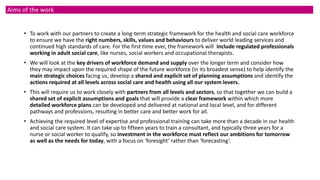
Establishing the workforce requirement is harder over time and becomes increasingly strategic:
The ‘Cone of Uncertainty’
DEGREE
OF
PRECISION
Vision:
• Shape and skills of
workforce
5 yrs 10 yrs 15 yrs 20 yrs
Very specific:
• Numbers
• Roles
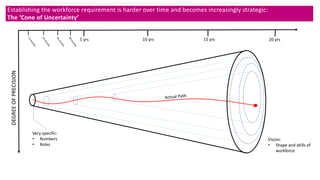
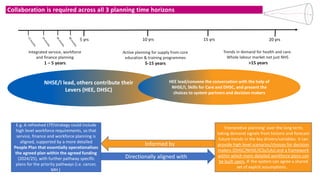
Informed by
5 yrs 10 yrs 15 yrs 20 yrs
Integrated service, workforce
and finance planning
1 – 5 years
Trends in demand for health and care.
Whole labour market not just NHS
>15 years
Active planning for supply from core
education & training programmes
5-15 years
E.g. A refreshed LTP/strategy could include
high level workforce requirements, so that
service, finance and workforce planning is
aligned, supported by a more detailed
People Plan that essentially operationalises
the agreed plan within the agreed funding
(2024/25), with further pathway specific
plans for the priority pathways (i.e. cancer,
MH )
'Interpretive planning' over the long term,
taking demand signals from historic and forecast
future trends in the key drivers/variables. It can
provide high level scenarios/choices for decision
makers (DHSC/NHSE/ICSs/LAs) and a framework
within which more detailed workforce plans can
be built upon, IF the system can agree a shared
set of explcit assumptions.
Directionally aligned with
Collaboration is required across all 3 planning time horizons
NHSE/I lead, others contribute their
Levers (HEE, DHSC)
HEE lead/convene the conversation with the help of
NHSE/I, Skills for Care and DHSC, and present the
choices to system partners and decision makers
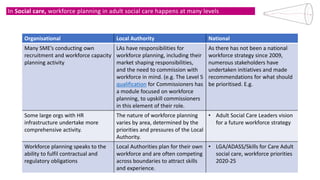
Organisational Local Authority National
Many SME’s conducting own
recruitment and workforce capacity
planning activity
LAs have responsibilities for
workforce planning, including their
market shaping responsibilities,
and the need to commission with
workforce in mind. (e.g. The Level 5
qualification for Commissioners has
a module focused on workforce
planning, to upskill commissioners
in this element of their role.
As there has not been a national
workforce strategy since 2009,
numerous stakeholders have
undertaken initiatives and made
recommendations for what should
be prioritised. E.g.
Some large orgs with HR
infrastructure undertake more
comprehensive activity.
The nature of workforce planning
varies by area, determined by the
priorities and pressures of the Local
Authority.
• Adult Social Care Leaders vision
for a future workforce strategy
Workforce planning speaks to the
ability to fulfil contractual and
regulatory obligations
Local Authorities plan for their own
workforce and are often competing
across boundaries to attract skills
and experience.
• LGA/ADASS/Skills for Care Adult
social care, workforce priorities
2020-25
In Social care, workforce planning in adult social care happens at many levels
@NHS_HealthEdEng
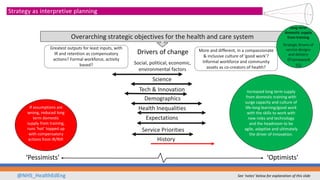
Strategy as interpretive planning
Increased long term supply
from domestic training with
surge capacity and culture of
life-long learning/good work
with the skills to work with
new roles and technology
and the headroom to be
agile, adaptive and ultimately
the driver of innovation.
Overarching strategic objectives for the health and care system
Greatest outputs for least inputs, with
IR and retention as compensatory
actions? Formal workforce, activity
based?
More and different, in a compassionate
& inclusive culture of ‘good work’?
Informal workforce and community
assets as co-creators of health?
‘Pessimists’ ‘Optimists’
If assumptions are
wrong, reduced long
term domestic
supply from training,
runs ‘hot’ topped up
with compensatory
actions from IR/RtP.
Drivers of change
Science
Tech & Innovation
Demographics
Health Inequalities
Expectations
Service Priorities
Social, political, economic,
environmental factors
History
Long term
domestic supply
from training
Strategic drivers of
service designs
and delivery
(Framework
15)
See ‘notes’ below for explanation of this slide
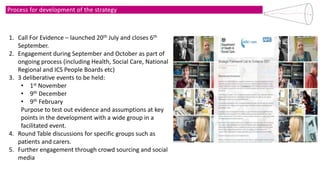
Process for development of the strategy
1. Call For Evidence – launched 20th July and closes 6th
September.
2. Engagement during September and October as part of
ongoing process (including Health, Social Care, National
Regional and ICS People Boards etc)
3. 3 deliberative events to be held:
• 1st November
• 9th December
• 9th February
Purpose to test out evidence and assumptions at key
points in the development with a wide group in a
facilitated event.
4. Round Table discussions for specific groups such as
patients and carers.
5. Further engagement through crowd sourcing and social
media
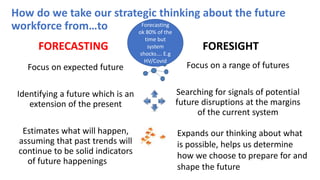
How do we take our strategic thinking about the future
workforce from…to
FORECASTING
Focus on expected future
Identifying a future which is an
extension of the present
Estimates what will happen,
assuming that past trends will
continue to be solid indicators
of future happenings
Focus on a range of futures
Searching for signals of potential
future disruptions at the margins
of the current system
FORESIGHT
Expands our thinking about what
is possible, helps us determine
how we choose to prepare for and
shape the future
Forecasting
ok 80% of the
time but
system
shocks…. E.g
HV/Covid
Knowledge,
Experience
Evidence
Thoughts
Concepts
Assumptions
Call for
Evidence
Survey
Thought
Leader
Round
Table
Analyst Review
of Evidence
Call for
Evidence
Analysis
Starting
Proposition
External
Challenge
Event 1 Event 2 Event 3
Final
Report
Further Research
August September October December Jan 2022 April 2022
November
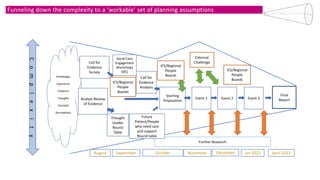
Funneling down the complexity to a ‘workable’ set of planning assumptions
Social Care
Engagement
Workshops
(SfC)
Future
Patient/People
who need care
and support
Round table
C
o
m
p
l
e
x
i
t
y
ICS/Regional
People
Boards
ICS/Regional
People
Boards
ICS/Regional
People
Boards

SF Core slide deck for web 9 slides.pptx

  • 1.
    Collaborating for the Future: Creatinga Long-term Strategic Framework for Health and Social Care Workforce ‘ PLEASE ADD HEE LOGO
  • 2.
    • To workwith our partners to create a long-term strategic framework for the health and social care workforce to ensure we have the right numbers, skills, values and behaviours to deliver world leading services and continued high standards of care. For the first time ever, the framework will include regulated professionals working in adult social care, like nurses, social workers and occupational therapists. • We will look at the key drivers of workforce demand and supply over the longer term and consider how they may impact upon the required shape of the future workforce (in its broadest sense) to help identify the main strategic choices facing us, develop a shared and explicit set of planning assumptions and identify the actions required at all levels across social care and health using all our system levers. • This will require us to work closely with partners from all levels and sectors, so that together we can build a shared set of explicit assumptions and goals that will provide a clear framework within which more detailed workforce plans can be developed and delivered at national and local level, and for different pathways and professions, resulting in better care and better work for all. • Achieving the required level of expertise and professional training can take more than a decade in our health and social care system. It can take up to fifteen years to train a consultant, and typically three years for a nurse or social worker to qualify, so investment in the workforce must reflect our ambitions for tomorrow as well as the needs for today, with a focus on ‘foresight’ rather than ‘forecasting’. Aims of the work
  • 3.
    Establishing the workforcerequirement is harder over time and becomes increasingly strategic: The ‘Cone of Uncertainty’ DEGREE OF PRECISION Vision: • Shape and skills of workforce 5 yrs 10 yrs 15 yrs 20 yrs Very specific: • Numbers • Roles
  • 4.
    Informed by 5 yrs10 yrs 15 yrs 20 yrs Integrated service, workforce and finance planning 1 – 5 years Trends in demand for health and care. Whole labour market not just NHS >15 years Active planning for supply from core education & training programmes 5-15 years E.g. A refreshed LTP/strategy could include high level workforce requirements, so that service, finance and workforce planning is aligned, supported by a more detailed People Plan that essentially operationalises the agreed plan within the agreed funding (2024/25), with further pathway specific plans for the priority pathways (i.e. cancer, MH ) 'Interpretive planning' over the long term, taking demand signals from historic and forecast future trends in the key drivers/variables. It can provide high level scenarios/choices for decision makers (DHSC/NHSE/ICSs/LAs) and a framework within which more detailed workforce plans can be built upon, IF the system can agree a shared set of explcit assumptions. Directionally aligned with Collaboration is required across all 3 planning time horizons NHSE/I lead, others contribute their Levers (HEE, DHSC) HEE lead/convene the conversation with the help of NHSE/I, Skills for Care and DHSC, and present the choices to system partners and decision makers
  • 5.
    Organisational Local AuthorityNational Many SME’s conducting own recruitment and workforce capacity planning activity LAs have responsibilities for workforce planning, including their market shaping responsibilities, and the need to commission with workforce in mind. (e.g. The Level 5 qualification for Commissioners has a module focused on workforce planning, to upskill commissioners in this element of their role. As there has not been a national workforce strategy since 2009, numerous stakeholders have undertaken initiatives and made recommendations for what should be prioritised. E.g. Some large orgs with HR infrastructure undertake more comprehensive activity. The nature of workforce planning varies by area, determined by the priorities and pressures of the Local Authority. • Adult Social Care Leaders vision for a future workforce strategy Workforce planning speaks to the ability to fulfil contractual and regulatory obligations Local Authorities plan for their own workforce and are often competing across boundaries to attract skills and experience. • LGA/ADASS/Skills for Care Adult social care, workforce priorities 2020-25 In Social care, workforce planning in adult social care happens at many levels
  • 6.
    @NHS_HealthEdEng Strategy as interpretiveplanning Increased long term supply from domestic training with surge capacity and culture of life-long learning/good work with the skills to work with new roles and technology and the headroom to be agile, adaptive and ultimately the driver of innovation. Overarching strategic objectives for the health and care system Greatest outputs for least inputs, with IR and retention as compensatory actions? Formal workforce, activity based? More and different, in a compassionate & inclusive culture of ‘good work’? Informal workforce and community assets as co-creators of health? ‘Pessimists’ ‘Optimists’ If assumptions are wrong, reduced long term domestic supply from training, runs ‘hot’ topped up with compensatory actions from IR/RtP. Drivers of change Science Tech & Innovation Demographics Health Inequalities Expectations Service Priorities Social, political, economic, environmental factors History Long term domestic supply from training Strategic drivers of service designs and delivery (Framework 15) See ‘notes’ below for explanation of this slide
  • 7.
    Process for developmentof the strategy 1. Call For Evidence – launched 20th July and closes 6th September. 2. Engagement during September and October as part of ongoing process (including Health, Social Care, National Regional and ICS People Boards etc) 3. 3 deliberative events to be held: • 1st November • 9th December • 9th February Purpose to test out evidence and assumptions at key points in the development with a wide group in a facilitated event. 4. Round Table discussions for specific groups such as patients and carers. 5. Further engagement through crowd sourcing and social media
  • 8.
    How do wetake our strategic thinking about the future workforce from…to FORECASTING Focus on expected future Identifying a future which is an extension of the present Estimates what will happen, assuming that past trends will continue to be solid indicators of future happenings Focus on a range of futures Searching for signals of potential future disruptions at the margins of the current system FORESIGHT Expands our thinking about what is possible, helps us determine how we choose to prepare for and shape the future Forecasting ok 80% of the time but system shocks…. E.g HV/Covid
  • 9.
    Knowledge, Experience Evidence Thoughts Concepts Assumptions Call for Evidence Survey Thought Leader Round Table Analyst Review ofEvidence Call for Evidence Analysis Starting Proposition External Challenge Event 1 Event 2 Event 3 Final Report Further Research August September October December Jan 2022 April 2022 November Funneling down the complexity to a ‘workable’ set of planning assumptions Social Care Engagement Workshops (SfC) Future Patient/People who need care and support Round table C o m p l e x i t y ICS/Regional People Boards ICS/Regional People Boards ICS/Regional People Boards

Editor's Notes

  • #2 NB: This is a slide-deck from which to draw a presentation tailored for a particular audience and/or purpose. It is not intended that all these slides would be used together in a presentation. When building a slide presentation please make a copy of this deck and then alter – DO NOT DELETE ANY SLIDES FROM THIS MASTER DECK
  • #6 Adult Social Care
  • #7 NB: The aim of this slide is to set out the different extremes of how we might with the system to operate – from maximum efficiency (greatest outputs for the least outputs) through to a culture of ‘good work’ – defined by the health Foundation as ‘ensuring employees have a balance between their work and their personal lives, allowing them to spend valuable time relaxing and seeing friends and family’ as well as allowing ‘staff to gain skills and chances for progression … and potentially increase their incomes and career prospects. This can help to promote social mobility and reduce the socio-economic inequalities that are linked to negative health outcomes ‘
  • #8 Call for evidence was Launched 20th July 2021 and scheduled to close 6th September 2021, with a joint letter sent out through national communication routes. Engagement with Regional People Boards and ICS People Boards, led by regions in September and October. Invitation to be sent out to individuals or regions on 6th September for invite to first deliberative virtual event on 1st November Following each deliberative event, there will be a slide set of the outcomes of the event to take back to ICS and Regional People Boards for information, checking assumptions and to ask for input to the next event. Representation for regions will be X number of invites each, excluding NHSE/I RDs who will be invited nationally and we will need to make sure there is some linking between our work in regions and who goes to the events, for regions to determine.