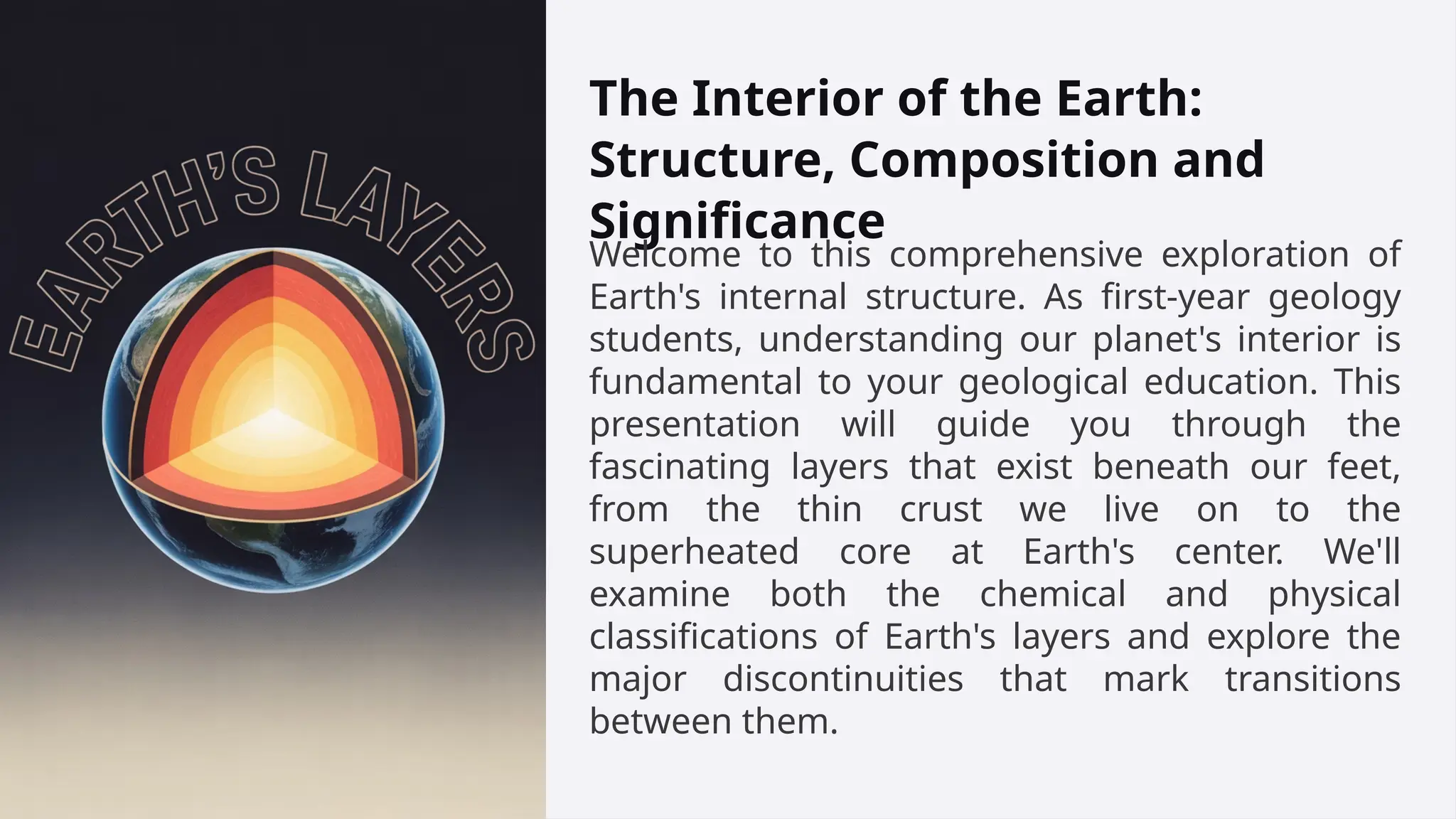
The Interior of the Earth:
Structure, Composition and
Significance
Welcome to this comprehensive exploration of
Earth's internal structure. As first-year geology
students, understanding our planet's interior is
fundamental to your geological education. This
presentation will guide you through the
fascinating layers that exist beneath our feet,
from the thin crust we live on to the
superheated core at Earth's center. We'll
examine both the chemical and physical
classifications of Earth's layers and explore the
major discontinuities that mark transitions
between them.
Course Overview and Learning Objectives
By the end of this presentation, you will be able to:
• Identify and describe the main layers of Earth's interior based on both chemical
composition and physical properties
• Explain the characteristics of the crust, mantle, and core
• Recognize major discontinuities between Earth's layers
• Understand how seismic waves help us study Earth's interior
Programme B.Sc.
Subject Geology/Earth Science
Semester First
Session No. 3 (Unit-1)
Topic Interior of the Earth
Created By Dr. Pramoda G, M.Sc., Ph.D.
Assistant Professor,
Department of Geology,
Govt. Science College, Chitradurga.
Introduction to Earth's Interior
Our planet Earth has a layered internal structure
that has evolved over its 4.5-billion-year history.
How Do We Study Earth's Interior?
• Seismic waves from earthquakes that travel through Earth's interior
• Laboratory experiments simulating high pressure and temperature
conditions
• Study of meteorite compositions
• Analyses of volcanic rocks that originate from different depths
• Gravitational and magnetic field measurements
• Heat flow measurements from Earth's interior to surface
These methods have revealed that our planet consists of concentric
layers with distinct properties, much like the layers of an onion. The
structure reflects both Earth's formation history and ongoing dynamic
processes.
Seismic waves are our
primary tools for
understanding Earth's
interior. P-waves (primary
or pressure waves) can
travel through solids,
liquids, and gases, while S-
waves (secondary or shear
waves) can only travel
through solids. By
analyzing how these waves
travel through Earth,
scientists have mapped its
internal structure.
Two Ways to Classify Earth's Layers
Chemical Classification
Based on chemical composition and mineralogy
• Crust (silica-rich outer layer)
• Mantle (silicon, oxygen,
magnesium, and iron)
• Core (primarily iron and nickel)
This classification reflects
the differentiation of
materials during Earth's
formation, with heavier
elements sinking toward the
center and lighter elements
rising toward the surface.
Physical Classification
Based on mechanical properties and behavior
• Lithosphere (rigid outer layer)
• Asthenosphere (plastic, flowing layer)
• Mesosphere (lower mantle)
• Outer Core (liquid)
• Inner Core (solid)
This classification is particularly
important for understanding
plate tectonics and how Earth's
layers interact mechanically.
The chemical composition-based divisions while noting important physical characteristics within
each layer. These two classification systems complement each other and together provide a
comprehensive understanding of Earth's internal structure.
Earth's Interior: Chemical Classification Overview
0.5%
Crust Volume
Crust makes up less than 1% of
Earth's total volume, with an
average thickness of just 30-70 km
for continental crust and 5-10 km
for oceanic crust.
84%
Mantle Volume
The mantle is the largest layer by
volume, extending from below the
crust to a depth of approximately
2,900 km, consisting mostly of silicate
rocks rich in magnesium and iron.
15%
Core Volume
Though smaller in volume than the
mantle, the core contains about 32%
of Earth's mass due to its high density,
extending from 2,900 km to the center
of Earth at 6,371 km.
The distinct chemical composition of each layer reflects the process of planetary differentiation, where denser
materials sank toward the center while lighter materials rose toward the surface during Earth's early formation
about 4.5 billion years ago.
Earth's Interior: Physical Classification Overview
1 Lithosphere (0-100 km)
Includes the crust and uppermost solid mantle. This rigid
layer is broken into tectonic plates that move across
Earth's surface.
2 Asthenosphere (100-410 km)
Part of the upper mantle that flows plastically. The low
viscosity of this layer allows tectonic plates to move.
Contains the Low Velocity Zone where seismic waves
slow down.
3 Mesosphere/Lower Mantle (410-2,900 km)
More rigid than the asthenosphere despite higher
temperatures, due to extreme pressure. Includes the
transition zone (410-660 km) where minerals transform
to denser structures.
4 Outer Core (2,900-5,150 km)
Liquid iron-nickel alloy that generates Earth's magnetic field
through its motion.
5 Inner Core (5,150-6,371 km)
Solid iron-nickel sphere despite extremely high temperatures,
due to immense pressure.
The Earth's Crust: Our Planetary Home
The crust is the outermost solid layer of Earth, forming the
"skin" of our planet. Though it represents less than 1% of
Earth's volume, it's incredibly important as the layer where
we live and where most geological processes we can
directly observe occur.
Types of Crust
Earth has two fundamentally different types of crust:
Continental Crust
• Thickness: 30-70 km (thicker under mountains)
• Composition: Felsic (granite-rich)
• Density: ~2.7 g/cm³
• Age: Up to 4 billion years old
Oceanic Crust
• Thickness: 5-10 km
• Composition: Mafic (basalt-rich)
• Density: ~3.0 g/cm³
• Age: Usually less than 200 million years
Crust Chemical Composition
The crust is dominated by a few key elements:
• Oxygen (O) - ~46%
• Silicon (Si) - ~28%
• Aluminum (Al) - ~8%
• Iron (Fe), Calcium (Ca), Sodium (Na), Potassium (K), and
Magnesium (Mg) in smaller amounts
These elements combine to form silicate minerals
like quartz, feldspar, mica, and pyroxenes, which are
the building blocks of most crustal rocks.
Crustal Rocks and Their Classification
Igneous Rocks
Formed by the solidification of magma
or lava. Examples include granite
(continental crust) and basalt (oceanic
crust). These rocks form when molten
material cools and crystallizes, either
slowly beneath the surface (plutonic)
or quickly at the surface (volcanic).
Sedimentary Rocks
Formed by the deposition, compaction,
and cementation of weathered rock
fragments, minerals, and organic
matter. Examples include sandstone,
limestone, and shale. These rocks
often contain fossils and preserve
Earth's historical record.
Metamorphic Rocks
Formed when existing rocks are subjected
to high heat, pressure, or chemically
active fluids, causing mineralogical and
textural changes. Examples include gneiss
(from granite) and marble (from
limestone). These rocks tell stories of
mountain-building and other tectonic
processes.
The crust contains all three rock types in various proportions. Continental crust is dominated by granitic (igneous) rocks and their
metamorphic equivalents, while oceanic crust consists primarily of basaltic (igneous) rocks. Sedimentary rocks form a relatively thin
veneer over much of the continental crust. Understanding these rock types is essential for interpreting Earth's geological history
and processes.
The Mohorovičić Discontinuity: Boundary Between Crust and Mantle
Discovery and Significance
In 1909, Croatian seismologist Andrija
Mohorovičić discovered a significant boundary
between the crust and mantle by studying
earthquake waves. This boundary is now known
as the "Mohorovičić Discontinuity" or simply the
"Moho."
Key Characteristics
• Represents a sharp increase in seismic wave velocity
• P-wave velocities jump from ~6-7 km/s to ~8 km/s
• Located at different depths: ~5-10 km beneath oceans
and ~35-70 km beneath continents
• Represents a compositional change from crustal rocks
to ultramafic mantle rocks
The Moho is one of the most significant discontinuities in Earth's interior and represents the transition from relatively
low-density, silica-rich crustal rocks to denser, magnesium and iron-rich mantle rocks.
Scientists have long dreamed of drilling to the Moho to directly sample mantle rocks, a project known as "Project
Mohole." Though this has not yet been achieved due to technological limitations, certain areas where tectonic
processes have exposed mantle rocks at the surface provide opportunities to study mantle material directly.
The Mantle: Earth's Largest Layer
The mantle is the thick, rocky layer located between
the crust and the core. It makes up about 84% of
Earth's volume and extends from the base of the
crust (Moho) to a depth of approximately 2,900 km.
Basic Characteristics
• Thickness: ~2,885 km
• State: Solid but capable of plastic flow
• Temperature: Ranges from ~500°C near the crust
to ~4,000°C near the core
• Composition: Primarily peridotite (olivine-rich ultramafic rock)
• Behavior: Convects very slowly (cm/year) due to
heat from the core
The mantle's composition is dominated by silicate
minerals rich in magnesium, iron, and silicon. The
primary rock type is peridotite, which consists mainly
of the minerals olivine, orthopyroxene,
clinopyroxene, and garnet or spinel at different
depths.
Despite being solid, the mantle's high
temperature allows it to flow very slowly
over geological time scales. This slow
convection is the driving force behind plate
tectonics, causing the plates of the
lithosphere to move across Earth's surface.
The movement within the mantle
resembles the motion of a thick, viscous
liquid even though the material is
technically solid.
Subdivisions of the Mantle
1
Upper Mantle (35-410 km)
2
Transition Zone (410-660 km)
3
Lower Mantle (660-2,900 km)
Upper Mantle (35-410 km)
The upper mantle extends from the base of
the crust to approximately 410 km depth. It
includes:
• Lithospheric mantle: The rigid uppermost
portion that forms part of the tectonic plates
• Asthenosphere: A ductile, partially molten
zone that allows plates to move
• Low Velocity Zone (LVZ): An area where
seismic waves slow down due to partial
melting
The upper mantle is composed primarily of
peridotite containing olivine, pyroxene, and
garnet or spinel.
Transition Zone (410-660 km)
This zone features significant mineral
phase transitions:
• At 410 km: Olivine transforms to wadsleyite
• At 520 km: Wadsleyite transforms to ringwoodite
• At 660 km: Ringwoodite breaks down to
bridgmanite and ferropericlase
These transformations are detected as seismic
discontinuities and represent rearrangements of
mineral structures under increasing pressure
rather than changes in chemical composition.
Lower Mantle (660-2,900 km)
Also called the mesosphere, the lower mantle:
• Consists primarily of bridgmanite (previously
called silicate perovskite) and ferropericlase
• Is more homogeneous than the upper mantle
• Experiences very high pressure and
temperature conditions
• Convects more slowly than the upper mantle
The lower mantle extends to the core-mantle
boundary (CMB), also known as the Gutenberg
Discontinuity.
The Asthenosphere: Earth's Plastic Layer
Key Characteristics of the Asthenosphere
The asthenosphere is a critical layer within the upper mantle that
plays a fundamental role in plate tectonics and the dynamics of our
planet.
• Depth range: Approximately 100-410 km beneath Earth's surface
• Physical state: Solid rock that behaves plastically due to high temperature
• Temperature: 1300-1500°C, near the melting point of mantle rocks
• Partial melting: Contains about 1-2% molten material along grain boundaries
• Viscosity: Much lower than the lithosphere above it
• Seismic signature: Contains the Low Velocity Zone (LVZ) where seismic
waves travel more slowly
The asthenosphere's plastic nature allows the rigid tectonic
plates of the lithosphere to slide across it. Without this
"lubricating" layer, plate tectonics as we know it would not be
possible. The asthenosphere also serves as the source region
for most of Earth's magma, particularly at mid-ocean ridges
where decompression melting occurs.
Mantle Convection: Earth's Internal Engine
The mantle, though solid, flows extremely slowly due to temperature differences
between its upper and lower portions. This process, called mantle convection,
drives plate tectonics and is fundamental to many geological processes on Earth.
How Mantle Convection Works
• Heat source: Radioactive decay within the mantle and heat from the core
• Mechanism: Hotter, less dense material rises; cooler, denser material sinks
• Speed: Very slow movement (centimeters per year)
• Pattern: Complex 3D flow with both large and small convection cells
This slow churning of the mantle has been ongoing for billions of years and has significantly influenced Earth's
geological evolution, including the arrangement of continents and oceans over time.
Effects of Mantle Convection
• Drives plate tectonics: Provides the force needed to move lithospheric plates
• Creates mid-ocean ridges: Where plates diverge and new crust forms
• Powers subduction zones: Where one plate sinks beneath another
• Forms mantle plumes: Columns of hot material rising from deep in the mantle
• Influences volcanism: Particularly hotspot volcanoes like those in Hawaii
The Core: Earth's Metal Heart
At the center of our planet lies the core, a massive sphere of
metal extending from a depth of approximately 2,900 km to
the center of Earth at 6,371 km. Despite making up only
about 15% of Earth's volume, the core contains nearly 32% of
Earth's total mass due to its high density.
Composition and Characteristics
• Primary composition: Iron (Fe) with approximately 5-10%
Nickel (Ni)
• Minor components: Small amounts of lighter elements
(sulfur, silicon, oxygen, etc.)
• Temperature: Ranges from ~4,000°C to perhaps 6,000°C
at the center
• Pressure: Up to 3.6 million atmospheres (360 GPa)
at Earth's center
• Discovery: Inferred by Richard Oldham in 1906
based on seismic wave behavior
Evidence for the Core's Composition
While we cannot directly sample the core, scientists
have determined its composition through several lines
of evidence:
• Earth's overall density requires a dense metal center
• Iron meteorites (remnants of planetary cores) provide compositional clues
• Magnetic field generation requires a conductive, fluid layer
• Seismic wave behavior through the core
• High-pressure laboratory experiments simulating core conditions
The Outer and Inner Core
Outer Core
• Depth: 2,900-5,150 km
• State: Liquid iron-nickel alloy
• Temperature: ~4,000-5,000°C
• Thickness: ~2,250 km
• Density: 9.9-12.2 g/cm³
S-waves cannot pass through this
layer, proving its liquid state. The
flowing liquid metal generates
Earth's magnetic field through
the geodynamo effect.
• Density: 12.6-13.0 g/cm³
Magnetic Field Generation
The movement of electrically conductive fluid
iron in the outer core creates electrical
currents, which generate Earth's magnetic
field. This field extends into space and shields
us from harmful solar radiation.
• Earth rotation influences flow patterns
• Convection driven by heat loss to mantle
• Field occasionally reverses polarity
Inner Core
• Depth: 5,150-6,371 km
• State: Solid iron-nickel alloy
• Temperature: ~5,000-6,000°C
• Radius: ~1,220 km
Despite higher temperatures than the outer
core, the inner core remains solid due to
extreme pressure. It rotates slightly faster
than the rest of Earth (superrotation).
The boundary between the outer and inner core, discovered by Danish seismologist Inge Lehmann in 1936, is known
as the Lehmann Discontinuity. This boundary marks where pressure becomes so intense that iron crystallizes into a
solid despite the extreme temperature. The inner core continues to grow slowly as the Earth cools, with the solid inner
core estimated to be relatively young in geological terms—perhaps only 1-1.5 billion years old.
Seismic Waves: Our Window into Earth's Interior
Types of Seismic Waves
Seismic waves generated by earthquakes are our primary
tool for studying Earth's interior. They act like a global-scale
sonogram, revealing the structure of our planet.
P-Waves (Primary)
• Compression waves that push and pull material
• Fastest seismic waves (~6-14 km/s)
• Can travel through solids, liquids, and gases
• Speed changes at boundaries between layers
S-Waves (Secondary)
• Shear waves that move material side-to-side
• Slower than P-waves (~3.5-7.5 km/s)
• Can only travel through solids
• Absence in outer core proves it's liquid
By analyzing how these waves travel through Earth,
seismologists have identified key boundaries and
properties of Earth's layers. The existence of the "shadow
zone" where certain waves don't appear provided crucial
evidence for the liquid outer core.
Major Discontinuities in Earth's Interior
1
Mohorovičić Discontinuity (Moho)
The boundary between the crust and mantle. Discovered by
Andrija Mohorovičić in 1909.
• Depth: ~5-10 km beneath oceans, ~35-70 km beneath continents
• Seismic signature: P-wave velocity jumps from ~6-7 km/s to ~8 km/s
• Represents change from crustal rocks to ultramafic mantle rocks
2 410 km Discontinuity
Within the mantle's transition zone. Marks where
olivine transforms to the higher-pressure mineral
wadsleyite.
• Seismic signature: Sudden increase in wave velocities
• Same chemical composition, different crystal structure
• Important boundary in mantle dynamics
3
660 km Discontinuity
The lower boundary of the mantle's transition zone. Marks where
ringwoodite breaks down to bridgmanite and ferropericlase.
• Significant barrier to mantle convection
• May temporarily trap subducting slabs
• Represents major change in mantle flow behavior
4 Gutenberg Discontinuity
The boundary between the mantle and outer core. Discovered by Beno
Gutenberg in 1914.
• Depth: ~2,900 km
• Seismic signature: P-waves dramatically slow down, S-waves cannot pass
• Major compositional change from silicate rocks to iron-nickel alloy
5
Lehmann Discontinuity
The boundary between the outer and inner core. Discovered
by Inge Lehmann in 1936.
• Depth: ~5,150 km
• Seismic signature: Sudden increase in P-wave velocity
• Represents phase change from liquid to solid iron
These discontinuities represent either compositional changes or phase transitions of minerals under increasing
pressure and temperature. They are critical for understanding Earth's internal structure and dynamics.
Earth's Magnetic Field: The Core's Protective Shield
The Geodynamo
Earth's magnetic field is generated by a process
called the geodynamo, which occurs in the outer
core:
• Earth's rotation influences the flow of liquid iron in the outer core
• Temperature differences create convection currents in the conductive fluid
• These movements generate electrical currents
• The electrical currents produce a magnetic field
• The field extends beyond Earth into space, forming the magnetosphere
Importance of Earth's Magnetic Field
• Shields Earth from harmful solar radiation and cosmic rays
• Prevents solar wind from stripping away our atmosphere
• Helps some animals navigate (magnetoreception)
• Creates aurora displays (Northern/Southern Lights)
• Has protected Earth's habitability over geological time
Practical Applications of Understanding Earth's Interior
Earthquake Hazard Assessment
Understanding Earth's structure helps seismologists predict how seismic waves will propagate during
earthquakes. This knowledge is crucial for developing building codes, emergency response plans,
and early warning systems. In India, where significant portions of the country lie in seismically active
zones, this information is vital for protecting millions of people living in vulnerable areas.
Volcanic Activity Prediction
Knowledge of mantle properties and magma generation processes helps volcanologists monitor and
forecast volcanic eruptions. For countries in the Ring of Fire and other volcanically active regions, this
understanding saves lives and reduces economic impact from volcanic disasters. India's only active
volcano, Barren Island in the Andaman Sea, is monitored using principles derived from our
understanding of Earth's interior.
Resource Exploration
The study of Earth's interior guides exploration for minerals, fossil fuels, and geothermal
energy. Seismic techniques developed to study Earth's deep structure are adapted to locate
resources at shallower depths. In India, these methods support the discovery and development
of natural resources that fuel economic growth, including the major oil fields in Bombay High
and coal deposits in eastern India.
Climate Change Research
Understanding mantle convection and core processes helps climate scientists model Earth's
long-term thermal evolution and its effects on surface conditions. This knowledge provides
context for current climate change and insights into Earth's future habitability. For India, facing
significant climate change impacts including monsoon shifts and sea level rise, this research
has particular relevance.
Summary and Key Takeaways
Earth's Layered Structure
Our planet is organized into concentric layers with distinct properties:
Crust
The thin outer layer where we live, divided into continental
(30-70 km thick, granitic) and oceanic (5-10 km thick,
basaltic) types.
Mantle
The largest layer by volume (84%), extending from the
Moho to 2,900 km depth, composed primarily of silicate
minerals rich in magnesium and iron.
Core
The metallic center of Earth, divided into a liquid outer
core (2,900-5,150 km) that generates our magnetic field
and a solid inner core (5,150-6,371 km).
These layers are separated by major discontinuities that
represent either compositional changes or phase transitions
in minerals under increasing pressure and temperature.
Final Thoughts
As future geologists, your understanding of Earth's
interior will form the foundation for studying virtually
all geological processes. The structure and dynamics of
our planet's interior influence everything from plate
tectonics and mountain building to volcanism and
mineral formation.
In your future studies, you'll explore how these internal
processes have shaped India's diverse geological features,
from the relatively young Himalayan mountains to the ancient
rocks of the Dharwar Craton in southern India. The
knowledge you've gained about Earth's interior will help you
interpret these features and contribute to our evolving
understanding of this dynamic planet.
References
1. Press, F., & Siever, R. (2001). Understanding Earth (4th Edition). W.H. Freeman and
Company.
2. Tarbuck, E. J., Lutgens, F. K., & Tasa, D. (2016). Earth: An Introduction to Physical
Geology (12th Edition). Pearson Education.
3. Skinner, B. J., Porter, S. C., & Park, J. (2004). The Blue Planet: An Introduction to Earth
System Science (2nd Edition). Wiley.
4. Nelson, S. A. (2015). Structure of the Earth and the Origin of Magmas. Tulane
University.Retrieved from: http://www.tulane.edu/~sanelson/eens212/earths_interior.htm
5. Chapin, F. S., Matson, P. A., & Vitousek, P. M. (2011). Principles of Terrestrial Ecosystem
Ecology. Springer.
6. Odum, E. P., & Barrett, G. W. (2005). Fundamentals of Ecology (5th Edition). Brooks/Cole.
7. Smith, R. L., & Smith, T. M. (2015). Elements of Ecology (9th Edition). Pearson Education.
8. Chorley, R. J., Schumm, S. A., & Sugden, D. E. (1984). Geomorphology. Methuen & Co
Ltd.

Session_3_The-Interior-of-the-Earth.pptx

  • 1.
    The Interior ofthe Earth: Structure, Composition and Significance Welcome to this comprehensive exploration of Earth's internal structure. As first-year geology students, understanding our planet's interior is fundamental to your geological education. This presentation will guide you through the fascinating layers that exist beneath our feet, from the thin crust we live on to the superheated core at Earth's center. We'll examine both the chemical and physical classifications of Earth's layers and explore the major discontinuities that mark transitions between them.
  • 2.
    Course Overview andLearning Objectives By the end of this presentation, you will be able to: • Identify and describe the main layers of Earth's interior based on both chemical composition and physical properties • Explain the characteristics of the crust, mantle, and core • Recognize major discontinuities between Earth's layers • Understand how seismic waves help us study Earth's interior Programme B.Sc. Subject Geology/Earth Science Semester First Session No. 3 (Unit-1) Topic Interior of the Earth Created By Dr. Pramoda G, M.Sc., Ph.D. Assistant Professor, Department of Geology, Govt. Science College, Chitradurga.
  • 3.
    Introduction to Earth'sInterior Our planet Earth has a layered internal structure that has evolved over its 4.5-billion-year history. How Do We Study Earth's Interior? • Seismic waves from earthquakes that travel through Earth's interior • Laboratory experiments simulating high pressure and temperature conditions • Study of meteorite compositions • Analyses of volcanic rocks that originate from different depths • Gravitational and magnetic field measurements • Heat flow measurements from Earth's interior to surface These methods have revealed that our planet consists of concentric layers with distinct properties, much like the layers of an onion. The structure reflects both Earth's formation history and ongoing dynamic processes. Seismic waves are our primary tools for understanding Earth's interior. P-waves (primary or pressure waves) can travel through solids, liquids, and gases, while S- waves (secondary or shear waves) can only travel through solids. By analyzing how these waves travel through Earth, scientists have mapped its internal structure.
  • 4.
    Two Ways toClassify Earth's Layers Chemical Classification Based on chemical composition and mineralogy • Crust (silica-rich outer layer) • Mantle (silicon, oxygen, magnesium, and iron) • Core (primarily iron and nickel) This classification reflects the differentiation of materials during Earth's formation, with heavier elements sinking toward the center and lighter elements rising toward the surface. Physical Classification Based on mechanical properties and behavior • Lithosphere (rigid outer layer) • Asthenosphere (plastic, flowing layer) • Mesosphere (lower mantle) • Outer Core (liquid) • Inner Core (solid) This classification is particularly important for understanding plate tectonics and how Earth's layers interact mechanically. The chemical composition-based divisions while noting important physical characteristics within each layer. These two classification systems complement each other and together provide a comprehensive understanding of Earth's internal structure.
  • 5.
    Earth's Interior: ChemicalClassification Overview 0.5% Crust Volume Crust makes up less than 1% of Earth's total volume, with an average thickness of just 30-70 km for continental crust and 5-10 km for oceanic crust. 84% Mantle Volume The mantle is the largest layer by volume, extending from below the crust to a depth of approximately 2,900 km, consisting mostly of silicate rocks rich in magnesium and iron. 15% Core Volume Though smaller in volume than the mantle, the core contains about 32% of Earth's mass due to its high density, extending from 2,900 km to the center of Earth at 6,371 km. The distinct chemical composition of each layer reflects the process of planetary differentiation, where denser materials sank toward the center while lighter materials rose toward the surface during Earth's early formation about 4.5 billion years ago.
  • 6.
    Earth's Interior: PhysicalClassification Overview 1 Lithosphere (0-100 km) Includes the crust and uppermost solid mantle. This rigid layer is broken into tectonic plates that move across Earth's surface. 2 Asthenosphere (100-410 km) Part of the upper mantle that flows plastically. The low viscosity of this layer allows tectonic plates to move. Contains the Low Velocity Zone where seismic waves slow down. 3 Mesosphere/Lower Mantle (410-2,900 km) More rigid than the asthenosphere despite higher temperatures, due to extreme pressure. Includes the transition zone (410-660 km) where minerals transform to denser structures. 4 Outer Core (2,900-5,150 km) Liquid iron-nickel alloy that generates Earth's magnetic field through its motion. 5 Inner Core (5,150-6,371 km) Solid iron-nickel sphere despite extremely high temperatures, due to immense pressure.
  • 7.
    The Earth's Crust:Our Planetary Home The crust is the outermost solid layer of Earth, forming the "skin" of our planet. Though it represents less than 1% of Earth's volume, it's incredibly important as the layer where we live and where most geological processes we can directly observe occur. Types of Crust Earth has two fundamentally different types of crust: Continental Crust • Thickness: 30-70 km (thicker under mountains) • Composition: Felsic (granite-rich) • Density: ~2.7 g/cm³ • Age: Up to 4 billion years old Oceanic Crust • Thickness: 5-10 km • Composition: Mafic (basalt-rich) • Density: ~3.0 g/cm³ • Age: Usually less than 200 million years Crust Chemical Composition The crust is dominated by a few key elements: • Oxygen (O) - ~46% • Silicon (Si) - ~28% • Aluminum (Al) - ~8% • Iron (Fe), Calcium (Ca), Sodium (Na), Potassium (K), and Magnesium (Mg) in smaller amounts These elements combine to form silicate minerals like quartz, feldspar, mica, and pyroxenes, which are the building blocks of most crustal rocks.
  • 8.
    Crustal Rocks andTheir Classification Igneous Rocks Formed by the solidification of magma or lava. Examples include granite (continental crust) and basalt (oceanic crust). These rocks form when molten material cools and crystallizes, either slowly beneath the surface (plutonic) or quickly at the surface (volcanic). Sedimentary Rocks Formed by the deposition, compaction, and cementation of weathered rock fragments, minerals, and organic matter. Examples include sandstone, limestone, and shale. These rocks often contain fossils and preserve Earth's historical record. Metamorphic Rocks Formed when existing rocks are subjected to high heat, pressure, or chemically active fluids, causing mineralogical and textural changes. Examples include gneiss (from granite) and marble (from limestone). These rocks tell stories of mountain-building and other tectonic processes. The crust contains all three rock types in various proportions. Continental crust is dominated by granitic (igneous) rocks and their metamorphic equivalents, while oceanic crust consists primarily of basaltic (igneous) rocks. Sedimentary rocks form a relatively thin veneer over much of the continental crust. Understanding these rock types is essential for interpreting Earth's geological history and processes.
  • 9.
    The Mohorovičić Discontinuity:Boundary Between Crust and Mantle Discovery and Significance In 1909, Croatian seismologist Andrija Mohorovičić discovered a significant boundary between the crust and mantle by studying earthquake waves. This boundary is now known as the "Mohorovičić Discontinuity" or simply the "Moho." Key Characteristics • Represents a sharp increase in seismic wave velocity • P-wave velocities jump from ~6-7 km/s to ~8 km/s • Located at different depths: ~5-10 km beneath oceans and ~35-70 km beneath continents • Represents a compositional change from crustal rocks to ultramafic mantle rocks The Moho is one of the most significant discontinuities in Earth's interior and represents the transition from relatively low-density, silica-rich crustal rocks to denser, magnesium and iron-rich mantle rocks. Scientists have long dreamed of drilling to the Moho to directly sample mantle rocks, a project known as "Project Mohole." Though this has not yet been achieved due to technological limitations, certain areas where tectonic processes have exposed mantle rocks at the surface provide opportunities to study mantle material directly.
  • 10.
    The Mantle: Earth'sLargest Layer The mantle is the thick, rocky layer located between the crust and the core. It makes up about 84% of Earth's volume and extends from the base of the crust (Moho) to a depth of approximately 2,900 km. Basic Characteristics • Thickness: ~2,885 km • State: Solid but capable of plastic flow • Temperature: Ranges from ~500°C near the crust to ~4,000°C near the core • Composition: Primarily peridotite (olivine-rich ultramafic rock) • Behavior: Convects very slowly (cm/year) due to heat from the core The mantle's composition is dominated by silicate minerals rich in magnesium, iron, and silicon. The primary rock type is peridotite, which consists mainly of the minerals olivine, orthopyroxene, clinopyroxene, and garnet or spinel at different depths. Despite being solid, the mantle's high temperature allows it to flow very slowly over geological time scales. This slow convection is the driving force behind plate tectonics, causing the plates of the lithosphere to move across Earth's surface. The movement within the mantle resembles the motion of a thick, viscous liquid even though the material is technically solid.
  • 11.
    Subdivisions of theMantle 1 Upper Mantle (35-410 km) 2 Transition Zone (410-660 km) 3 Lower Mantle (660-2,900 km) Upper Mantle (35-410 km) The upper mantle extends from the base of the crust to approximately 410 km depth. It includes: • Lithospheric mantle: The rigid uppermost portion that forms part of the tectonic plates • Asthenosphere: A ductile, partially molten zone that allows plates to move • Low Velocity Zone (LVZ): An area where seismic waves slow down due to partial melting The upper mantle is composed primarily of peridotite containing olivine, pyroxene, and garnet or spinel. Transition Zone (410-660 km) This zone features significant mineral phase transitions: • At 410 km: Olivine transforms to wadsleyite • At 520 km: Wadsleyite transforms to ringwoodite • At 660 km: Ringwoodite breaks down to bridgmanite and ferropericlase These transformations are detected as seismic discontinuities and represent rearrangements of mineral structures under increasing pressure rather than changes in chemical composition. Lower Mantle (660-2,900 km) Also called the mesosphere, the lower mantle: • Consists primarily of bridgmanite (previously called silicate perovskite) and ferropericlase • Is more homogeneous than the upper mantle • Experiences very high pressure and temperature conditions • Convects more slowly than the upper mantle The lower mantle extends to the core-mantle boundary (CMB), also known as the Gutenberg Discontinuity.
  • 12.
    The Asthenosphere: Earth'sPlastic Layer Key Characteristics of the Asthenosphere The asthenosphere is a critical layer within the upper mantle that plays a fundamental role in plate tectonics and the dynamics of our planet. • Depth range: Approximately 100-410 km beneath Earth's surface • Physical state: Solid rock that behaves plastically due to high temperature • Temperature: 1300-1500°C, near the melting point of mantle rocks • Partial melting: Contains about 1-2% molten material along grain boundaries • Viscosity: Much lower than the lithosphere above it • Seismic signature: Contains the Low Velocity Zone (LVZ) where seismic waves travel more slowly The asthenosphere's plastic nature allows the rigid tectonic plates of the lithosphere to slide across it. Without this "lubricating" layer, plate tectonics as we know it would not be possible. The asthenosphere also serves as the source region for most of Earth's magma, particularly at mid-ocean ridges where decompression melting occurs.
  • 13.
    Mantle Convection: Earth'sInternal Engine The mantle, though solid, flows extremely slowly due to temperature differences between its upper and lower portions. This process, called mantle convection, drives plate tectonics and is fundamental to many geological processes on Earth. How Mantle Convection Works • Heat source: Radioactive decay within the mantle and heat from the core • Mechanism: Hotter, less dense material rises; cooler, denser material sinks • Speed: Very slow movement (centimeters per year) • Pattern: Complex 3D flow with both large and small convection cells This slow churning of the mantle has been ongoing for billions of years and has significantly influenced Earth's geological evolution, including the arrangement of continents and oceans over time. Effects of Mantle Convection • Drives plate tectonics: Provides the force needed to move lithospheric plates • Creates mid-ocean ridges: Where plates diverge and new crust forms • Powers subduction zones: Where one plate sinks beneath another • Forms mantle plumes: Columns of hot material rising from deep in the mantle • Influences volcanism: Particularly hotspot volcanoes like those in Hawaii
  • 14.
    The Core: Earth'sMetal Heart At the center of our planet lies the core, a massive sphere of metal extending from a depth of approximately 2,900 km to the center of Earth at 6,371 km. Despite making up only about 15% of Earth's volume, the core contains nearly 32% of Earth's total mass due to its high density. Composition and Characteristics • Primary composition: Iron (Fe) with approximately 5-10% Nickel (Ni) • Minor components: Small amounts of lighter elements (sulfur, silicon, oxygen, etc.) • Temperature: Ranges from ~4,000°C to perhaps 6,000°C at the center • Pressure: Up to 3.6 million atmospheres (360 GPa) at Earth's center • Discovery: Inferred by Richard Oldham in 1906 based on seismic wave behavior Evidence for the Core's Composition While we cannot directly sample the core, scientists have determined its composition through several lines of evidence: • Earth's overall density requires a dense metal center • Iron meteorites (remnants of planetary cores) provide compositional clues • Magnetic field generation requires a conductive, fluid layer • Seismic wave behavior through the core • High-pressure laboratory experiments simulating core conditions
  • 15.
    The Outer andInner Core Outer Core • Depth: 2,900-5,150 km • State: Liquid iron-nickel alloy • Temperature: ~4,000-5,000°C • Thickness: ~2,250 km • Density: 9.9-12.2 g/cm³ S-waves cannot pass through this layer, proving its liquid state. The flowing liquid metal generates Earth's magnetic field through the geodynamo effect. • Density: 12.6-13.0 g/cm³ Magnetic Field Generation The movement of electrically conductive fluid iron in the outer core creates electrical currents, which generate Earth's magnetic field. This field extends into space and shields us from harmful solar radiation. • Earth rotation influences flow patterns • Convection driven by heat loss to mantle • Field occasionally reverses polarity Inner Core • Depth: 5,150-6,371 km • State: Solid iron-nickel alloy • Temperature: ~5,000-6,000°C • Radius: ~1,220 km Despite higher temperatures than the outer core, the inner core remains solid due to extreme pressure. It rotates slightly faster than the rest of Earth (superrotation). The boundary between the outer and inner core, discovered by Danish seismologist Inge Lehmann in 1936, is known as the Lehmann Discontinuity. This boundary marks where pressure becomes so intense that iron crystallizes into a solid despite the extreme temperature. The inner core continues to grow slowly as the Earth cools, with the solid inner core estimated to be relatively young in geological terms—perhaps only 1-1.5 billion years old.
  • 16.
    Seismic Waves: OurWindow into Earth's Interior Types of Seismic Waves Seismic waves generated by earthquakes are our primary tool for studying Earth's interior. They act like a global-scale sonogram, revealing the structure of our planet. P-Waves (Primary) • Compression waves that push and pull material • Fastest seismic waves (~6-14 km/s) • Can travel through solids, liquids, and gases • Speed changes at boundaries between layers S-Waves (Secondary) • Shear waves that move material side-to-side • Slower than P-waves (~3.5-7.5 km/s) • Can only travel through solids • Absence in outer core proves it's liquid By analyzing how these waves travel through Earth, seismologists have identified key boundaries and properties of Earth's layers. The existence of the "shadow zone" where certain waves don't appear provided crucial evidence for the liquid outer core.
  • 17.
    Major Discontinuities inEarth's Interior 1 Mohorovičić Discontinuity (Moho) The boundary between the crust and mantle. Discovered by Andrija Mohorovičić in 1909. • Depth: ~5-10 km beneath oceans, ~35-70 km beneath continents • Seismic signature: P-wave velocity jumps from ~6-7 km/s to ~8 km/s • Represents change from crustal rocks to ultramafic mantle rocks 2 410 km Discontinuity Within the mantle's transition zone. Marks where olivine transforms to the higher-pressure mineral wadsleyite. • Seismic signature: Sudden increase in wave velocities • Same chemical composition, different crystal structure • Important boundary in mantle dynamics 3 660 km Discontinuity The lower boundary of the mantle's transition zone. Marks where ringwoodite breaks down to bridgmanite and ferropericlase. • Significant barrier to mantle convection • May temporarily trap subducting slabs • Represents major change in mantle flow behavior 4 Gutenberg Discontinuity The boundary between the mantle and outer core. Discovered by Beno Gutenberg in 1914. • Depth: ~2,900 km • Seismic signature: P-waves dramatically slow down, S-waves cannot pass • Major compositional change from silicate rocks to iron-nickel alloy 5 Lehmann Discontinuity The boundary between the outer and inner core. Discovered by Inge Lehmann in 1936. • Depth: ~5,150 km • Seismic signature: Sudden increase in P-wave velocity • Represents phase change from liquid to solid iron These discontinuities represent either compositional changes or phase transitions of minerals under increasing pressure and temperature. They are critical for understanding Earth's internal structure and dynamics.
  • 18.
    Earth's Magnetic Field:The Core's Protective Shield The Geodynamo Earth's magnetic field is generated by a process called the geodynamo, which occurs in the outer core: • Earth's rotation influences the flow of liquid iron in the outer core • Temperature differences create convection currents in the conductive fluid • These movements generate electrical currents • The electrical currents produce a magnetic field • The field extends beyond Earth into space, forming the magnetosphere Importance of Earth's Magnetic Field • Shields Earth from harmful solar radiation and cosmic rays • Prevents solar wind from stripping away our atmosphere • Helps some animals navigate (magnetoreception) • Creates aurora displays (Northern/Southern Lights) • Has protected Earth's habitability over geological time
  • 19.
    Practical Applications ofUnderstanding Earth's Interior Earthquake Hazard Assessment Understanding Earth's structure helps seismologists predict how seismic waves will propagate during earthquakes. This knowledge is crucial for developing building codes, emergency response plans, and early warning systems. In India, where significant portions of the country lie in seismically active zones, this information is vital for protecting millions of people living in vulnerable areas. Volcanic Activity Prediction Knowledge of mantle properties and magma generation processes helps volcanologists monitor and forecast volcanic eruptions. For countries in the Ring of Fire and other volcanically active regions, this understanding saves lives and reduces economic impact from volcanic disasters. India's only active volcano, Barren Island in the Andaman Sea, is monitored using principles derived from our understanding of Earth's interior. Resource Exploration The study of Earth's interior guides exploration for minerals, fossil fuels, and geothermal energy. Seismic techniques developed to study Earth's deep structure are adapted to locate resources at shallower depths. In India, these methods support the discovery and development of natural resources that fuel economic growth, including the major oil fields in Bombay High and coal deposits in eastern India. Climate Change Research Understanding mantle convection and core processes helps climate scientists model Earth's long-term thermal evolution and its effects on surface conditions. This knowledge provides context for current climate change and insights into Earth's future habitability. For India, facing significant climate change impacts including monsoon shifts and sea level rise, this research has particular relevance.
  • 20.
    Summary and KeyTakeaways Earth's Layered Structure Our planet is organized into concentric layers with distinct properties: Crust The thin outer layer where we live, divided into continental (30-70 km thick, granitic) and oceanic (5-10 km thick, basaltic) types. Mantle The largest layer by volume (84%), extending from the Moho to 2,900 km depth, composed primarily of silicate minerals rich in magnesium and iron. Core The metallic center of Earth, divided into a liquid outer core (2,900-5,150 km) that generates our magnetic field and a solid inner core (5,150-6,371 km). These layers are separated by major discontinuities that represent either compositional changes or phase transitions in minerals under increasing pressure and temperature. Final Thoughts As future geologists, your understanding of Earth's interior will form the foundation for studying virtually all geological processes. The structure and dynamics of our planet's interior influence everything from plate tectonics and mountain building to volcanism and mineral formation. In your future studies, you'll explore how these internal processes have shaped India's diverse geological features, from the relatively young Himalayan mountains to the ancient rocks of the Dharwar Craton in southern India. The knowledge you've gained about Earth's interior will help you interpret these features and contribute to our evolving understanding of this dynamic planet.
  • 21.
    References 1. Press, F.,& Siever, R. (2001). Understanding Earth (4th Edition). W.H. Freeman and Company. 2. Tarbuck, E. J., Lutgens, F. K., & Tasa, D. (2016). Earth: An Introduction to Physical Geology (12th Edition). Pearson Education. 3. Skinner, B. J., Porter, S. C., & Park, J. (2004). The Blue Planet: An Introduction to Earth System Science (2nd Edition). Wiley. 4. Nelson, S. A. (2015). Structure of the Earth and the Origin of Magmas. Tulane University.Retrieved from: http://www.tulane.edu/~sanelson/eens212/earths_interior.htm 5. Chapin, F. S., Matson, P. A., & Vitousek, P. M. (2011). Principles of Terrestrial Ecosystem Ecology. Springer. 6. Odum, E. P., & Barrett, G. W. (2005). Fundamentals of Ecology (5th Edition). Brooks/Cole. 7. Smith, R. L., & Smith, T. M. (2015). Elements of Ecology (9th Edition). Pearson Education. 8. Chorley, R. J., Schumm, S. A., & Sugden, D. E. (1984). Geomorphology. Methuen & Co Ltd.