Presented By:
PRAMODA G
Faculty In geology
Introduction
History of Dams
Types of Dam
Parts of a Dam
Failure of a Dam
Criteria for Dam site selection
Geological Investigation
Conclusion
Reference
Dam is a solid barrier constructed at a suitable location across
a river or stream valley for impounding huge volume of water
for multipurpose.
Dams are constructed for following multipurpose :
It helps to produce electricity
For Irrigation purpose
To store Water for various purpose
To flood control
To River channelization
To develop fisheries
To control Silt & Debris
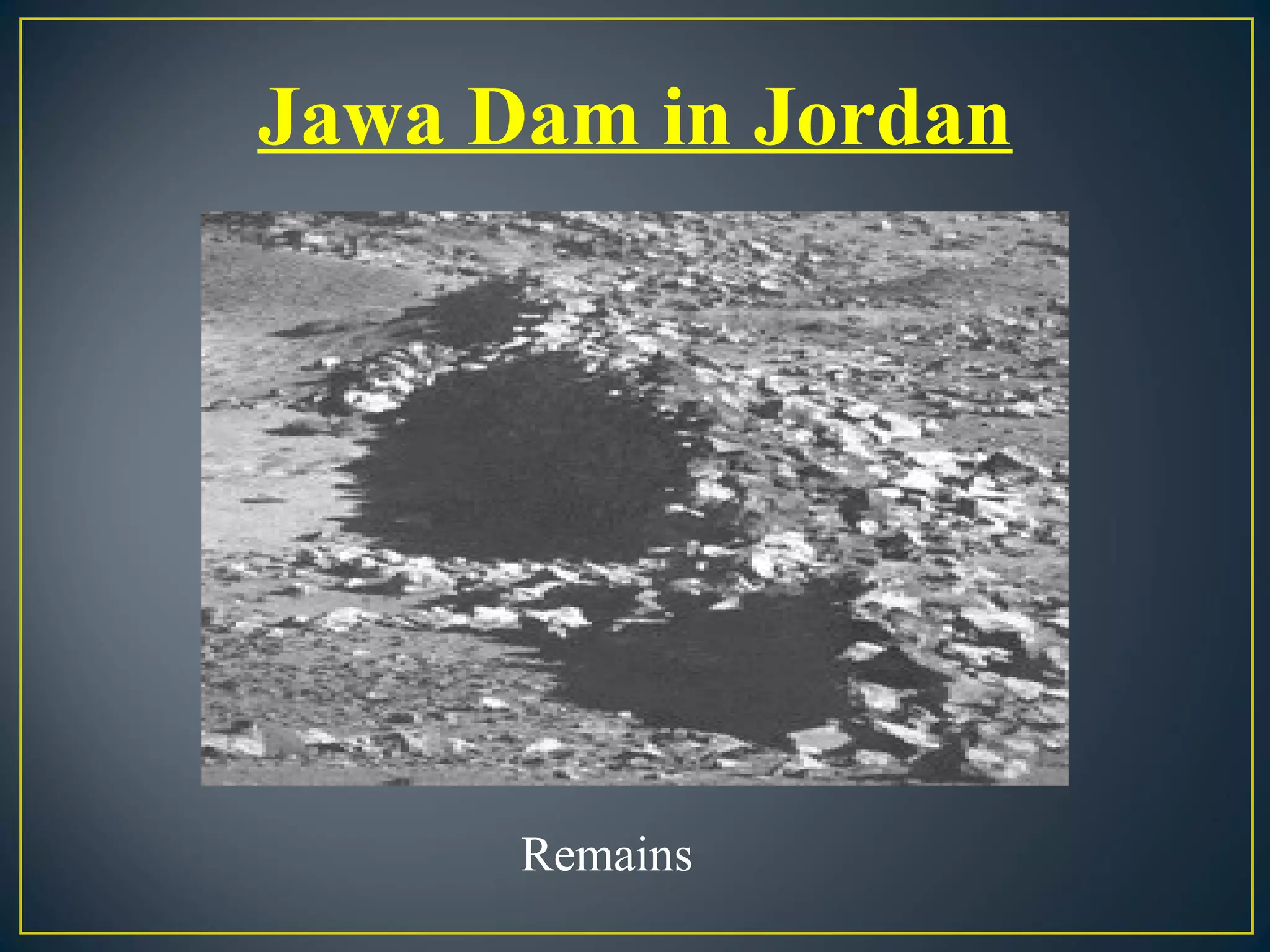
The Earliest known dam is the Jawa Dam in Jordan, (62 mi).
This gravity dam the structure is dated to 3000 BC
The mid-late 3rd century BC, an intricate water-management
system within Dholavira in modern day India, was built. The
system included 16 reservoirs, dams and various channels for
collecting water and storing it.
The Kallanai Dam is constructed, over 300 m across the main
stream of the Kaveri river in Tamil Nadu. It is considered as
one of the oldest water-diversion structures in the world, which
is still in use. It was built in 2nd Century.
Jawa Dam in Jordan
Remains
Based on – Design & Materials
Concrete Dams
Gravity Dams
Buttress Dams
Arch Dams
Embarkment Dams
Earth fill
Rock fill
Composite Dams
Gravity Dams:
These dams are heavy
and massive wall-like
structures of concrete in
which the whole weight
acts vertically downwards
Reservoir
Force
As the entire load is transmitted on the small area of foundation, such
dams are constructed where rocks are strong and stable.
• Bhakra Nangal Dam is
the highest Concrete
Gravity dam in Asia
and Second Highest in
the world.
• Bhakra Nangal Dam in
Himachal Pradesh
• The construction of
this project was started
in the year 1948 and
was completed in 1963
.
• It is 740 ft. high above the deepest foundation as straight concrete
dam being more than three times the height of Qutab Minar.
• Length at top 518.16 m (1700 feet); Width at base 190.5 m (625
feet), and at the top is 9.14 m (30 feet)
KRS Dam is the
Concrete Gravity dam
The dam is across
Kaveri River in Mandya
District near Mysore in
Karnataka state, India
The construction of this
project was started in
the year 1924 and was
completed in 1932
• Buttress Dam – Is a
gravity dam reinforced by
structural supports
• Buttress - a support that
transmits a force from a
roof or wall to another
supporting structure
This type of structure can be considered even if the foundation
rocks are little weaker
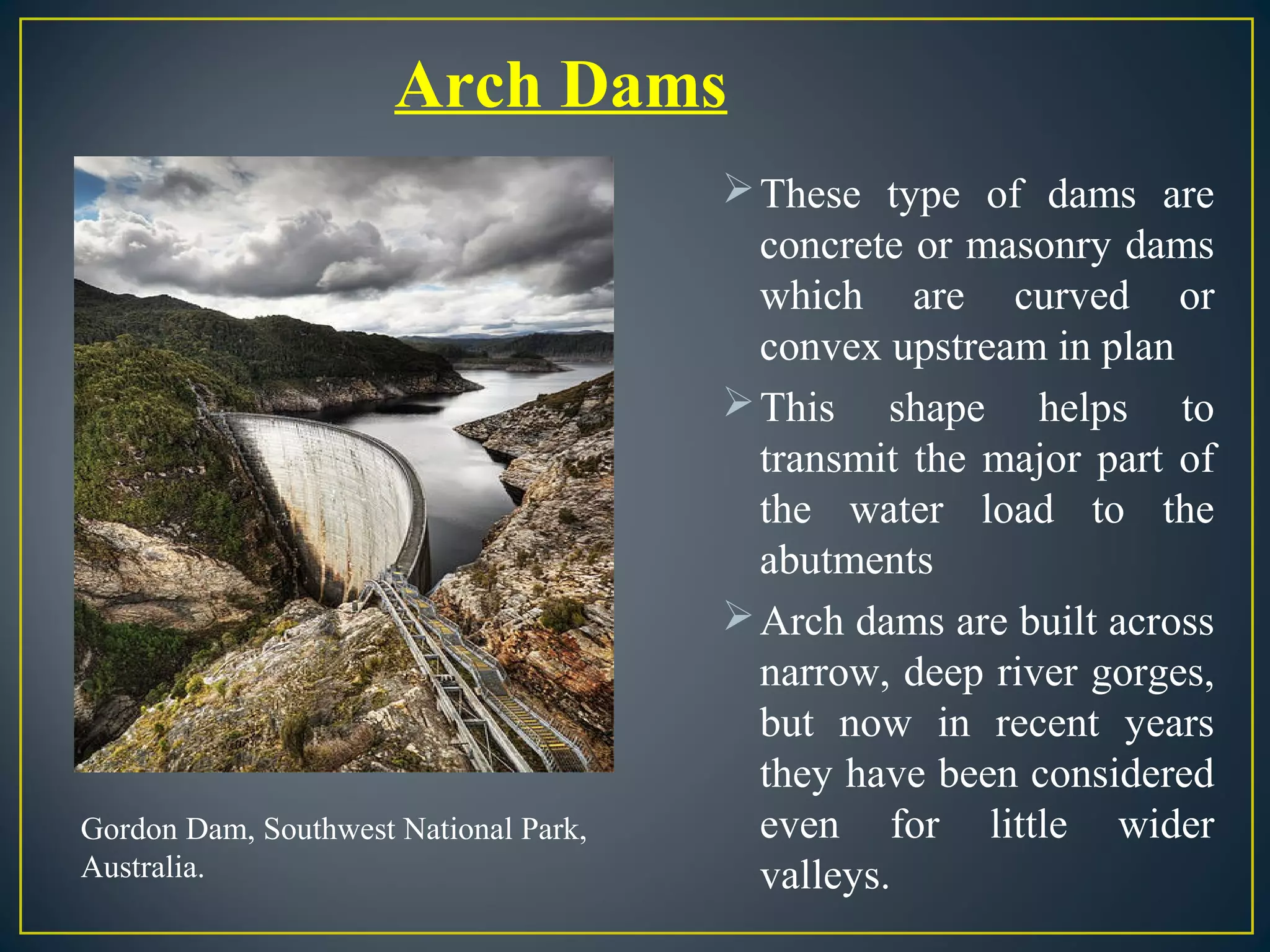
These type of dams are
concrete or masonry dams
which are curved or
convex upstream in plan
This shape helps to
transmit the major part of
the water load to the
abutments
Arch dams are built across
narrow, deep river gorges,
but now in recent years
they have been considered
even for little wider
valleys.
Arch Dams
Gordon Dam, Southwest National Park,
Australia.
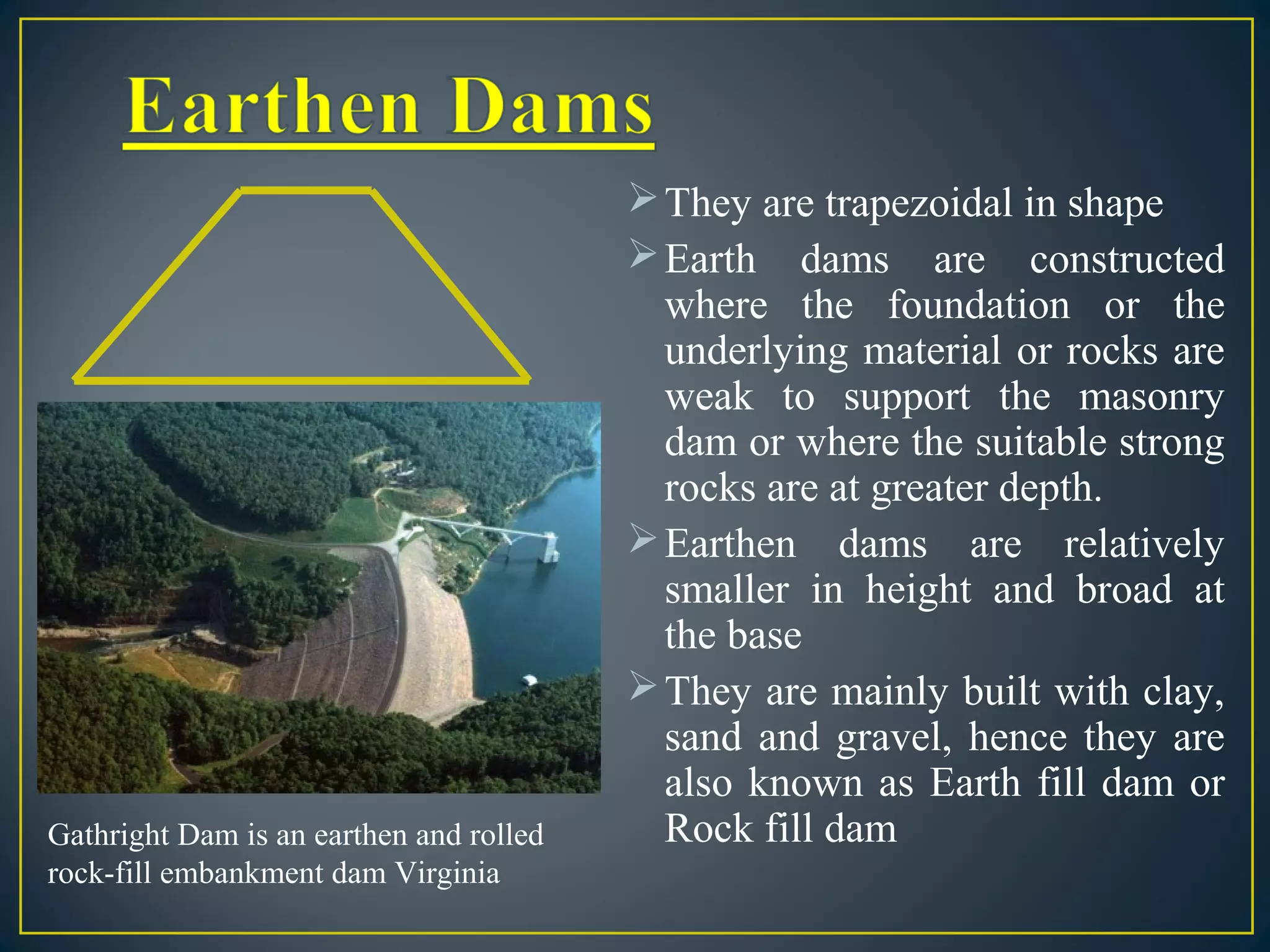
They are trapezoidal in shape
Earth dams are constructed
where the foundation or the
underlying material or rocks are
weak to support the masonry
dam or where the suitable strong
rocks are at greater depth.
Earthen dams are relatively
smaller in height and broad at
the base
They are mainly built with clay,
sand and gravel, hence they are
also known as Earth fill dam or
Rock fill damGathright Dam is an earthen and rolled
rock-fill embankment dam Virginia
Composite Dams
Composite dams are
combinations of one or more
dam types. Most often a
large section of a dam will be
either an embankment or
gravity dam, with the section
responsible for power
generation being a buttress or
arch.
Ujjani Dam, also known as
Composite dams the state of
Maharashtra in India
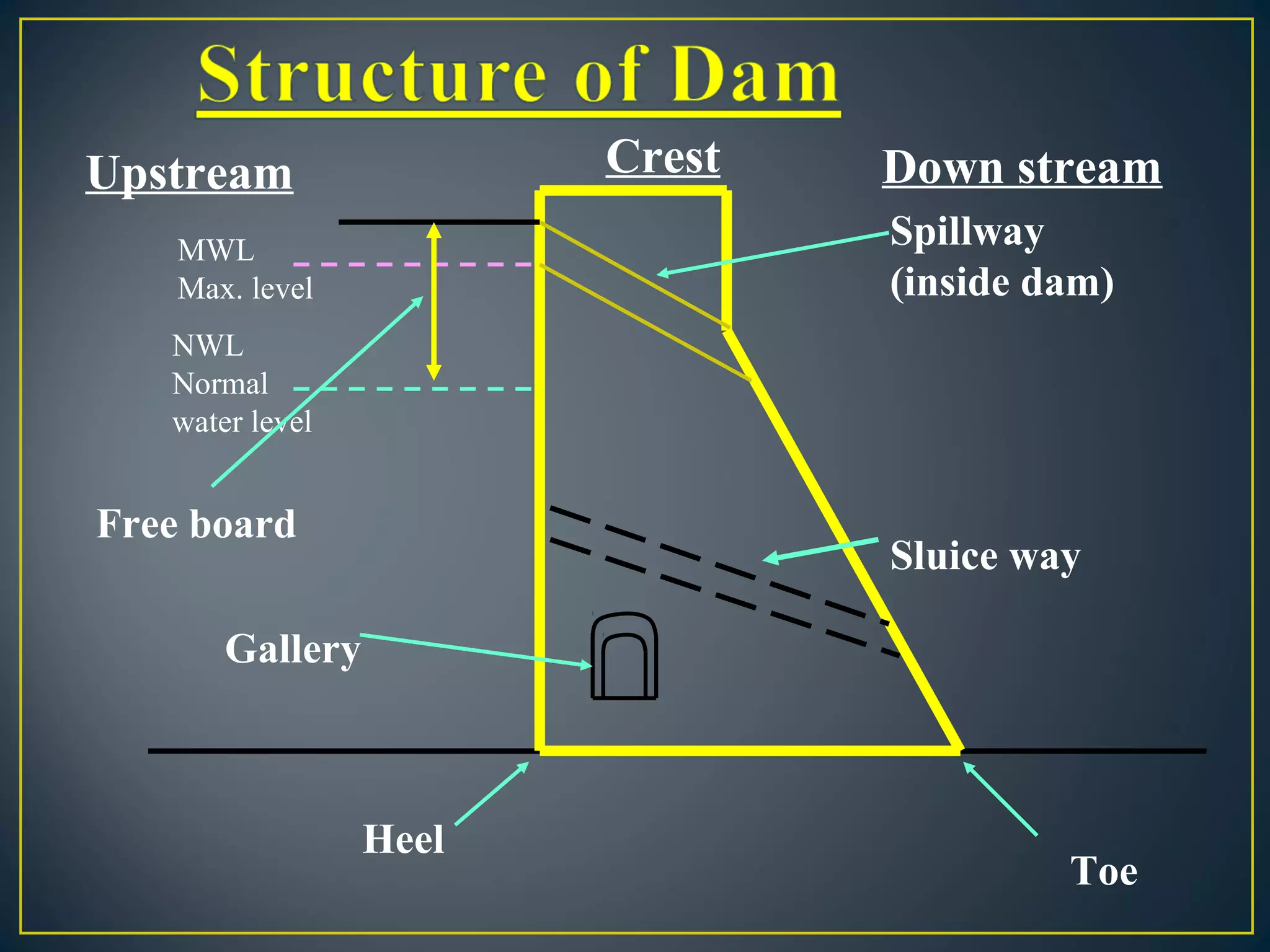
Heel
Gallery
Toe
Spillway
(inside dam)
Crest
NWL
Normal
water level
MWL
Max. level
Free board
Sluice way
Upstream Down stream
Heel: contact with the ground on the upstream side
Toe: contact on the downstream side
Abutment: Sides of the valley on which the structure of the dam rest
Galleries: small rooms like structure left within the dam for
checking operations.
Diversion tunnel: Tunnels are constructed for diverting water
before the construction of dam. This helps in keeping the river bed
dry.
Spillways: It is the arrangement near the top to release the excess
water of the reservoir to downstream side
Sluice way: An opening in the dam near the ground level, which is
St. Francis Dam California in 1928 two divergent Rock types
curved Gravity Dam.
Foundation (F) Argillaceous Conglomerate F
Mica schist
Lafe yette Dam in California-settle down -weight is more than
the bearing capacity of unconsolidated sedimentary rocks.
W>P
Hale’s bar Dam in U.S.A built up on cavernous & soluble
carbonate rocks needed 5000T cement ,11000 barrels of
asphalt
Jerome reservoir of Idaho and Hondo reservoir of Mexico
abandoned for leakage
Lake Gleno Dam in Italy- Multiple Arch gravity Dam –Slide
down because Heavy Rain
Mooria dam in Gujarat, More height so slide down – rain storm
(Flood season)
Austin dam U.S in 1911, slide down because cracks develop
and finally slide down.?
 Rocks which are round are good at resisting static & dynamic forces
 Valley slope or Abutment slope is Stable in keeping the Reservoir
full
 Dam foundation should be safe from sliding in Gravity Dams
 Foundation rocks should be one Geological unit to avoid Modulus
elasticity variations.
 Foundations of the Dam should be done using Reservoir rocks and
also the wall should be constructed using the same rock to make the
dam water tight
 The Rocks & Dam structure should have Resistance to solution,
Erosion and Decomposition to prevent Drying, Wetting & Freezing
 Reservoir drainage area with Rocks & over burden has Resistance to
erosion and silt contribution to reservoir area.
 In Arch dam the topography & structure features of rock & abutment
should be stable to prevent thrust pressure.
 Geologic & topography or favorable for spill ways.
 Location of construction material should be derived from near by
areas.
 The Dam site should be Seismically stable.
 Minerals potential reserves in upstream reservoir area leads to
commercial mining.
 Environmental Hazards
 Various benefits are to be considered by Dam construction
 The site should have enough capacity to hold water for desired
number of years.
Geological investigation
The area should be natural valley preferably ending in narrow
gorge
The topographical location should be chosen according to our
requirements.
The rock structure on which the dam will be constructed should
be strong enough to sustain the weight of dam and water stored in
it and should be waterproof.
The flow of water where dam is constructed should be sufficient
enough to fill the reservoir.
While designing the dam, the engineers should see that there is
minimum human displacement.
Dams are constructed for various purposes and very
useful to mankind.
It helps to produce electricity, prevent flood control ,
river can be channelized , control of silt and debris
transport
Reservoir are useful to store large volume of water,
channelized for Irrigation and power production etc…
Reference:
 Engineering and General Geology by Parbin
Singh , Page no (522-539) Publisher, S. K. Kataria &
Sons, 2009
A Text Book of Geology by PK Mukherjee
Page (378-408) Publisher, Libraries Unlimited,7 edition
Website
http://en.wikipedia.org/wiki/Dam
http://members.optusnet.com.au/~engineeringgeologist/page25
http://beengineeringinfo.blogspot.in/2012/04/types-of-dams-
introduction-and.html
Dams

Dams

  • 1.
  • 2.
    Introduction History of Dams Typesof Dam Parts of a Dam Failure of a Dam Criteria for Dam site selection Geological Investigation Conclusion Reference
  • 3.
    Dam is asolid barrier constructed at a suitable location across a river or stream valley for impounding huge volume of water for multipurpose. Dams are constructed for following multipurpose : It helps to produce electricity For Irrigation purpose To store Water for various purpose To flood control To River channelization To develop fisheries To control Silt & Debris
  • 4.
    The Earliest knowndam is the Jawa Dam in Jordan, (62 mi). This gravity dam the structure is dated to 3000 BC The mid-late 3rd century BC, an intricate water-management system within Dholavira in modern day India, was built. The system included 16 reservoirs, dams and various channels for collecting water and storing it. The Kallanai Dam is constructed, over 300 m across the main stream of the Kaveri river in Tamil Nadu. It is considered as one of the oldest water-diversion structures in the world, which is still in use. It was built in 2nd Century.
  • 5.
    Jawa Dam inJordan Remains
  • 7.
    Based on –Design & Materials Concrete Dams Gravity Dams Buttress Dams Arch Dams Embarkment Dams Earth fill Rock fill Composite Dams
  • 8.
    Gravity Dams: These damsare heavy and massive wall-like structures of concrete in which the whole weight acts vertically downwards Reservoir Force As the entire load is transmitted on the small area of foundation, such dams are constructed where rocks are strong and stable.
  • 9.
    • Bhakra NangalDam is the highest Concrete Gravity dam in Asia and Second Highest in the world. • Bhakra Nangal Dam in Himachal Pradesh • The construction of this project was started in the year 1948 and was completed in 1963 . • It is 740 ft. high above the deepest foundation as straight concrete dam being more than three times the height of Qutab Minar. • Length at top 518.16 m (1700 feet); Width at base 190.5 m (625 feet), and at the top is 9.14 m (30 feet)
  • 10.
    KRS Dam isthe Concrete Gravity dam The dam is across Kaveri River in Mandya District near Mysore in Karnataka state, India The construction of this project was started in the year 1924 and was completed in 1932
  • 11.
    • Buttress Dam– Is a gravity dam reinforced by structural supports • Buttress - a support that transmits a force from a roof or wall to another supporting structure This type of structure can be considered even if the foundation rocks are little weaker
  • 12.
    These type ofdams are concrete or masonry dams which are curved or convex upstream in plan This shape helps to transmit the major part of the water load to the abutments Arch dams are built across narrow, deep river gorges, but now in recent years they have been considered even for little wider valleys. Arch Dams Gordon Dam, Southwest National Park, Australia.
  • 13.
    They are trapezoidalin shape Earth dams are constructed where the foundation or the underlying material or rocks are weak to support the masonry dam or where the suitable strong rocks are at greater depth. Earthen dams are relatively smaller in height and broad at the base They are mainly built with clay, sand and gravel, hence they are also known as Earth fill dam or Rock fill damGathright Dam is an earthen and rolled rock-fill embankment dam Virginia
  • 14.
    Composite Dams Composite damsare combinations of one or more dam types. Most often a large section of a dam will be either an embankment or gravity dam, with the section responsible for power generation being a buttress or arch. Ujjani Dam, also known as Composite dams the state of Maharashtra in India
  • 15.
  • 16.
    Heel: contact withthe ground on the upstream side Toe: contact on the downstream side Abutment: Sides of the valley on which the structure of the dam rest Galleries: small rooms like structure left within the dam for checking operations. Diversion tunnel: Tunnels are constructed for diverting water before the construction of dam. This helps in keeping the river bed dry. Spillways: It is the arrangement near the top to release the excess water of the reservoir to downstream side Sluice way: An opening in the dam near the ground level, which is
  • 17.
    St. Francis DamCalifornia in 1928 two divergent Rock types curved Gravity Dam. Foundation (F) Argillaceous Conglomerate F Mica schist Lafe yette Dam in California-settle down -weight is more than the bearing capacity of unconsolidated sedimentary rocks. W>P Hale’s bar Dam in U.S.A built up on cavernous & soluble carbonate rocks needed 5000T cement ,11000 barrels of asphalt Jerome reservoir of Idaho and Hondo reservoir of Mexico abandoned for leakage
  • 18.
    Lake Gleno Damin Italy- Multiple Arch gravity Dam –Slide down because Heavy Rain Mooria dam in Gujarat, More height so slide down – rain storm (Flood season) Austin dam U.S in 1911, slide down because cracks develop and finally slide down.?
  • 19.
     Rocks whichare round are good at resisting static & dynamic forces  Valley slope or Abutment slope is Stable in keeping the Reservoir full  Dam foundation should be safe from sliding in Gravity Dams  Foundation rocks should be one Geological unit to avoid Modulus elasticity variations.  Foundations of the Dam should be done using Reservoir rocks and also the wall should be constructed using the same rock to make the dam water tight  The Rocks & Dam structure should have Resistance to solution, Erosion and Decomposition to prevent Drying, Wetting & Freezing  Reservoir drainage area with Rocks & over burden has Resistance to erosion and silt contribution to reservoir area.
  • 20.
     In Archdam the topography & structure features of rock & abutment should be stable to prevent thrust pressure.  Geologic & topography or favorable for spill ways.  Location of construction material should be derived from near by areas.  The Dam site should be Seismically stable.  Minerals potential reserves in upstream reservoir area leads to commercial mining.  Environmental Hazards  Various benefits are to be considered by Dam construction  The site should have enough capacity to hold water for desired number of years.
  • 21.
    Geological investigation The areashould be natural valley preferably ending in narrow gorge The topographical location should be chosen according to our requirements. The rock structure on which the dam will be constructed should be strong enough to sustain the weight of dam and water stored in it and should be waterproof. The flow of water where dam is constructed should be sufficient enough to fill the reservoir. While designing the dam, the engineers should see that there is minimum human displacement.
  • 22.
    Dams are constructedfor various purposes and very useful to mankind. It helps to produce electricity, prevent flood control , river can be channelized , control of silt and debris transport Reservoir are useful to store large volume of water, channelized for Irrigation and power production etc…
  • 23.
    Reference:  Engineering andGeneral Geology by Parbin Singh , Page no (522-539) Publisher, S. K. Kataria & Sons, 2009 A Text Book of Geology by PK Mukherjee Page (378-408) Publisher, Libraries Unlimited,7 edition Website http://en.wikipedia.org/wiki/Dam http://members.optusnet.com.au/~engineeringgeologist/page25 http://beengineeringinfo.blogspot.in/2012/04/types-of-dams- introduction-and.html