INTERNATIONAL FOOD POLICY RESEARCH INSTITUTE
Overview of Extension Reforms in
South Asia- Historical Trends and
Recent Developments
Regional Workshop on Extension Reforms in
South Asia
New Delhi, India. February 17-18, 2015
Suresh Babu and P. K. Joshi
Presentation Outline
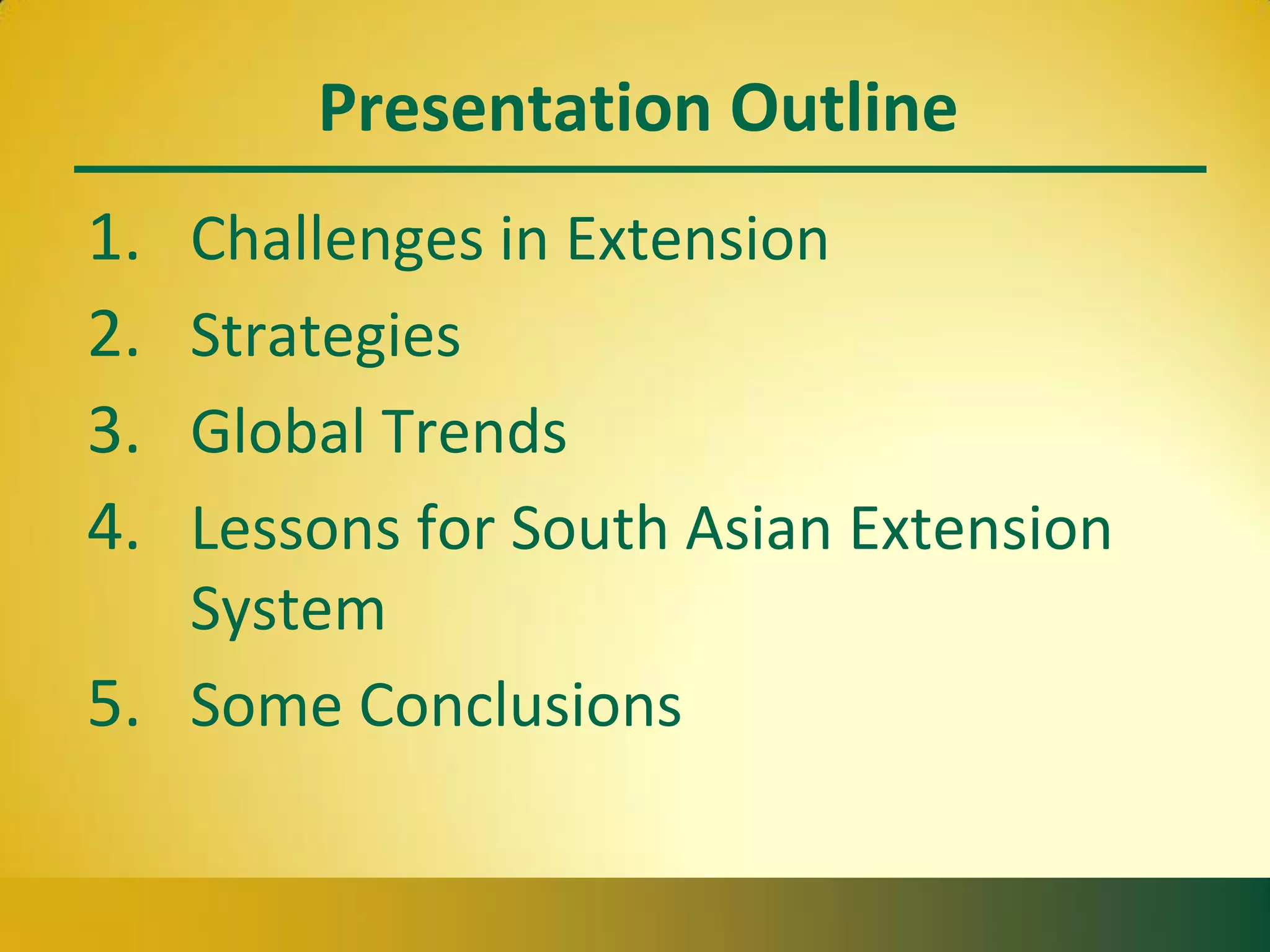
1. Challenges in Extension
2. Strategies
3. Global Trends
4. Lessons for South Asian Extension
System
5. Some Conclusions
Provision and financing of extension
• Why reform?
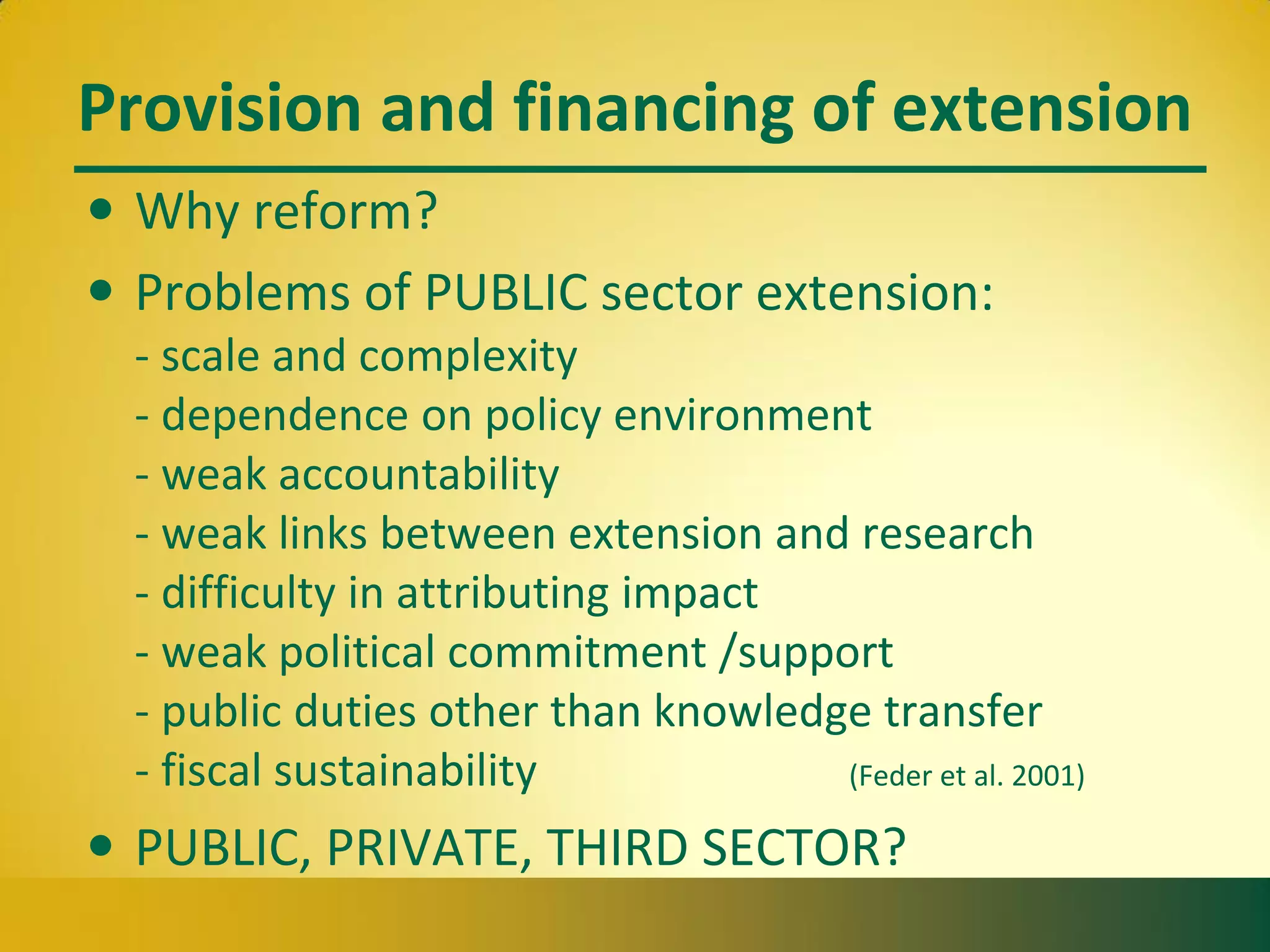
• Problems of PUBLIC sector extension:
- scale and complexity
- dependence on policy environment
- weak accountability
- weak links between extension and research
- difficulty in attributing impact
- weak political commitment /support
- public duties other than knowledge transfer
- fiscal sustainability (Feder et al. 2001)
• PUBLIC, PRIVATE, THIRD SECTOR?
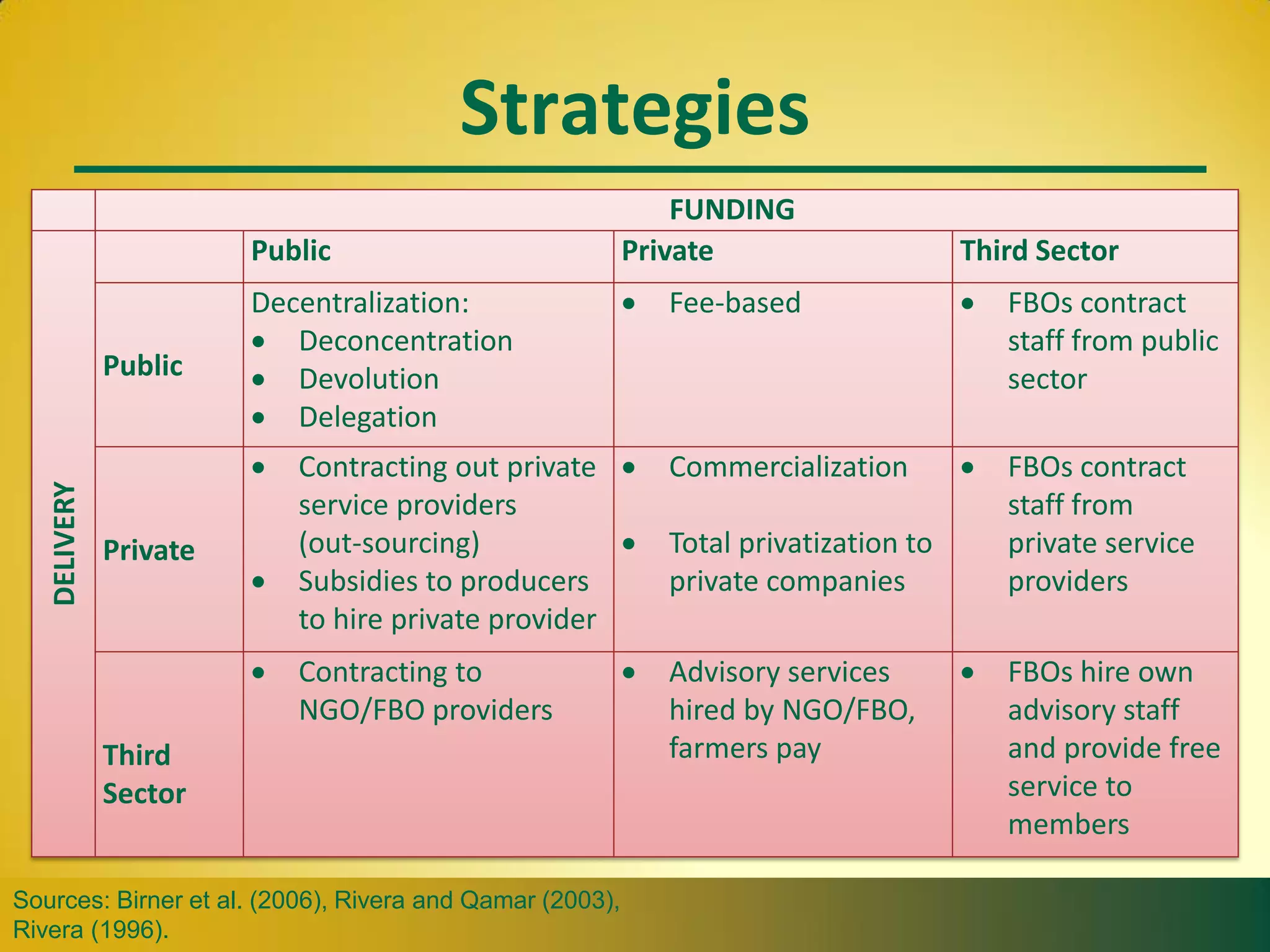
FUNDING
DELIVERY
Public Private Third Sector
Public
Decentralization:
 Deconcentration
 Devolution
 Delegation
 Fee-based  FBOs contract
staff from public
sector
Private
 Contracting out private
service providers
(out-sourcing)
 Subsidies to producers
to hire private provider
 Commercialization
 Total privatization to
private companies
 FBOs contract
staff from
private service
providers
Third
Sector
 Contracting to
NGO/FBO providers
 Advisory services
hired by NGO/FBO,
farmers pay
 FBOs hire own
advisory staff
and provide free
service to
members
Strategies
Sources: Birner et al. (2006), Rivera and Qamar (2003),
Rivera (1996).
Global Trends Examined
1. Decentralization
2. Broadened Extension Function
3. Privatization
4. Participatory/Demand-driven
5. ICT Use
1. Decentralization
• Admin to local level
• More accountability
• Need to build capacity
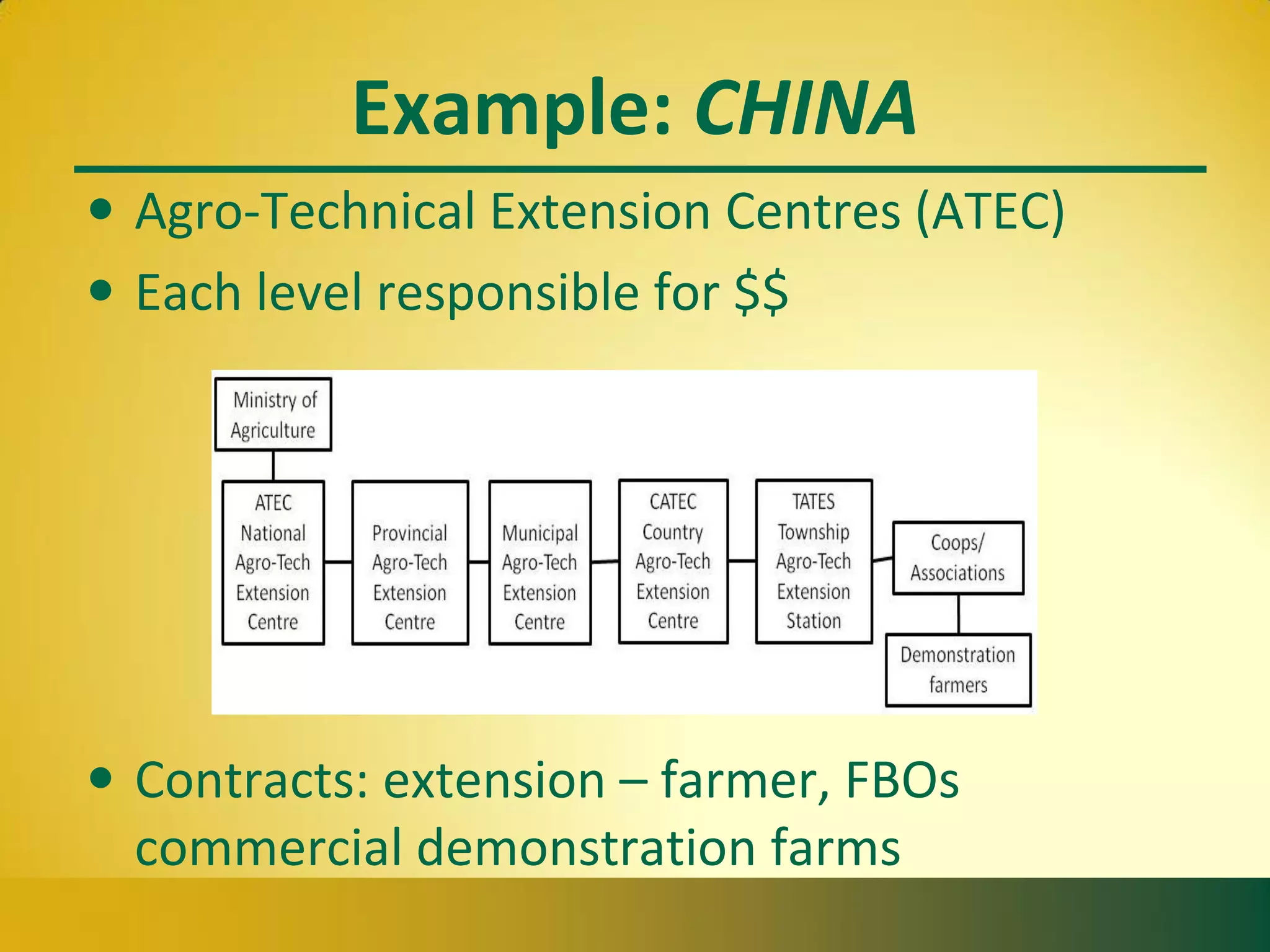
Example: CHINA
• Agro-Technical Extension Centres (ATEC)
• Each level responsible for $$
• Contracts: extension – farmer, FBOs
commercial demonstration farms
2. Broadened Extension Function
• PREVIOUSLY:
•Transfer of Technology
•Cereal crop production
• NOW:
•Post-harvest: storage, handling,
marketing
•Facilitation, capacity building
•Rural Development – Climate change,
nutrition
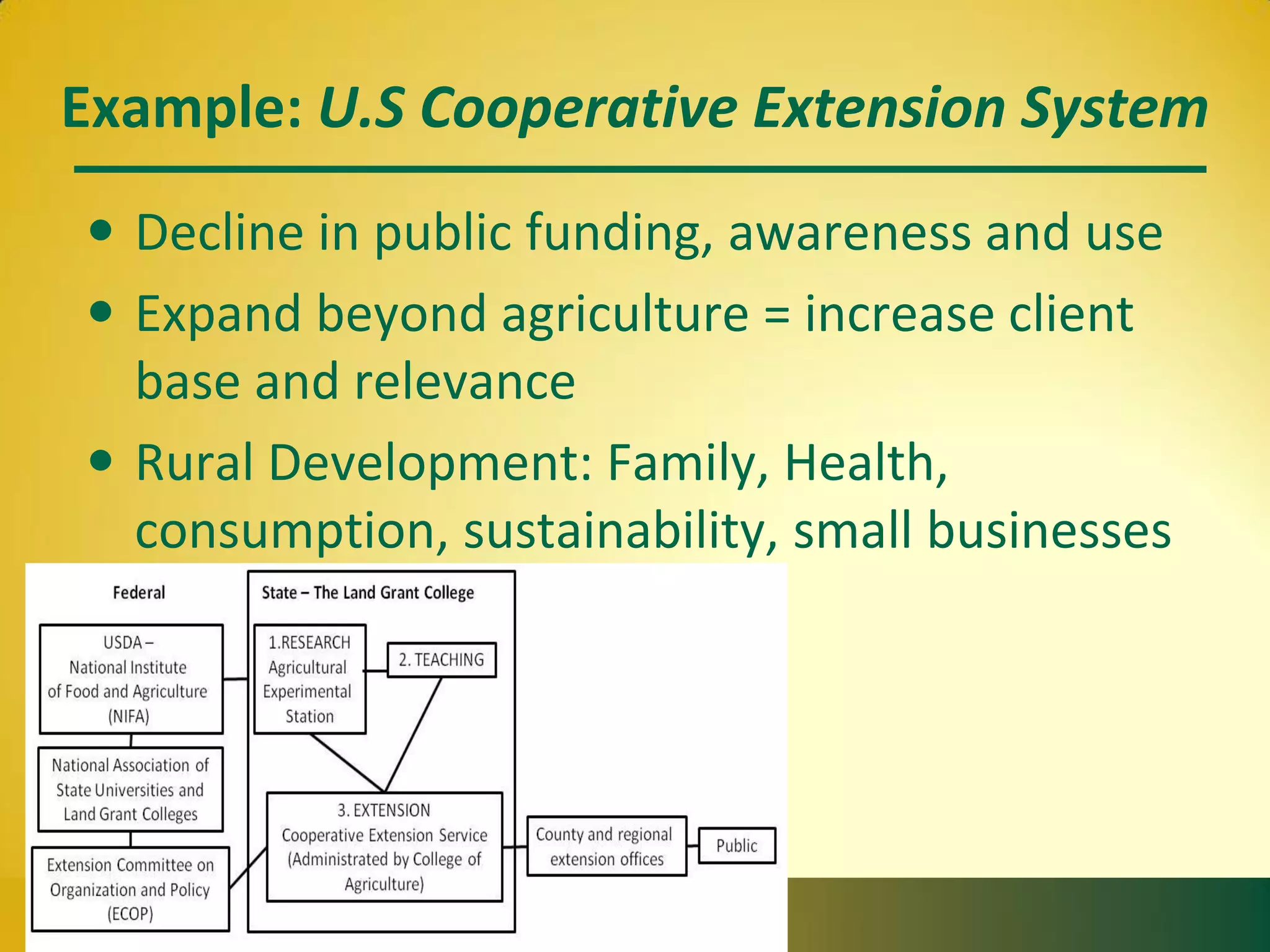
Example: U.S Cooperative Extension System
• Decline in public funding, awareness and use
• Expand beyond agriculture = increase client
base and relevance
• Rural Development: Family, Health,
consumption, sustainability, small businesses
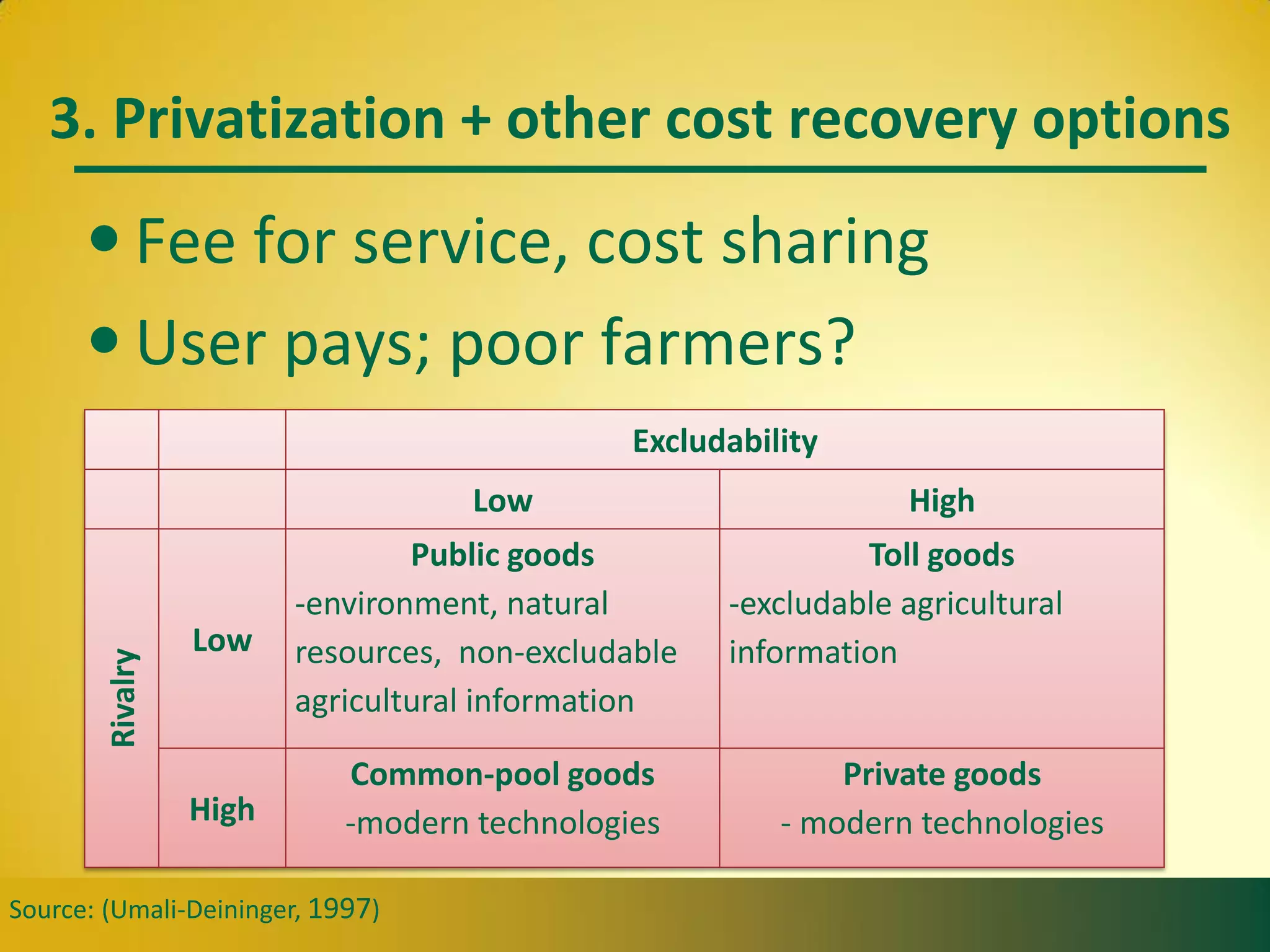
3. Privatization + other cost recovery options
• Fee for service, cost sharing
• User pays; poor farmers?
Excludability
Low High
Rivalry
Low
Public goods
-environment, natural
resources, non-excludable
agricultural information
Toll goods
-excludable agricultural
information
High
Common-pool goods
-modern technologies
Private goods
- modern technologies
Source: (Umali-Deininger, 1997)
Example: The Netherlands
• Fully privatized from 1990: DLV Plant
WHY? Difference btw govt policy – farmer
interest, reduce cost
• More competition, client orientation
• BUT remote farmers, minor crops ignored,
weakened links
• Ministry of Ag: public good programs
e.g. Nutrient Management Support Service
4. Demand-driven / Participatory
approaches
• Consultative process – communities,
ecosystems
• Participatory, bottom up
• Problem Driven –Water, Nutrition,
climate change
• = accountability, empowerment
• Extension = facilitation, capacity
building (takes TIME)
Example: Landcare AUSTRALIA
• 4500 community groups, 1 in 3 farms
• Address land degradation issues,
natural resource management
• Partnership:
Funds = Central, Action = Community
• “Self-help” supported by
coordinators
5. ICT Use
• Connecting famers directly
• Emerging trend in developing
countries
• Allows new actors and entities to
play their role
• Also brings in problems
Example: JAPAN
• Highly connected through ICT
• Lower transaction cost, increase
efficiency
• Extension Information Network System
(EI-NET) links all levels
• National Case Information of Extension
Activities Database
• Local networks for farmers
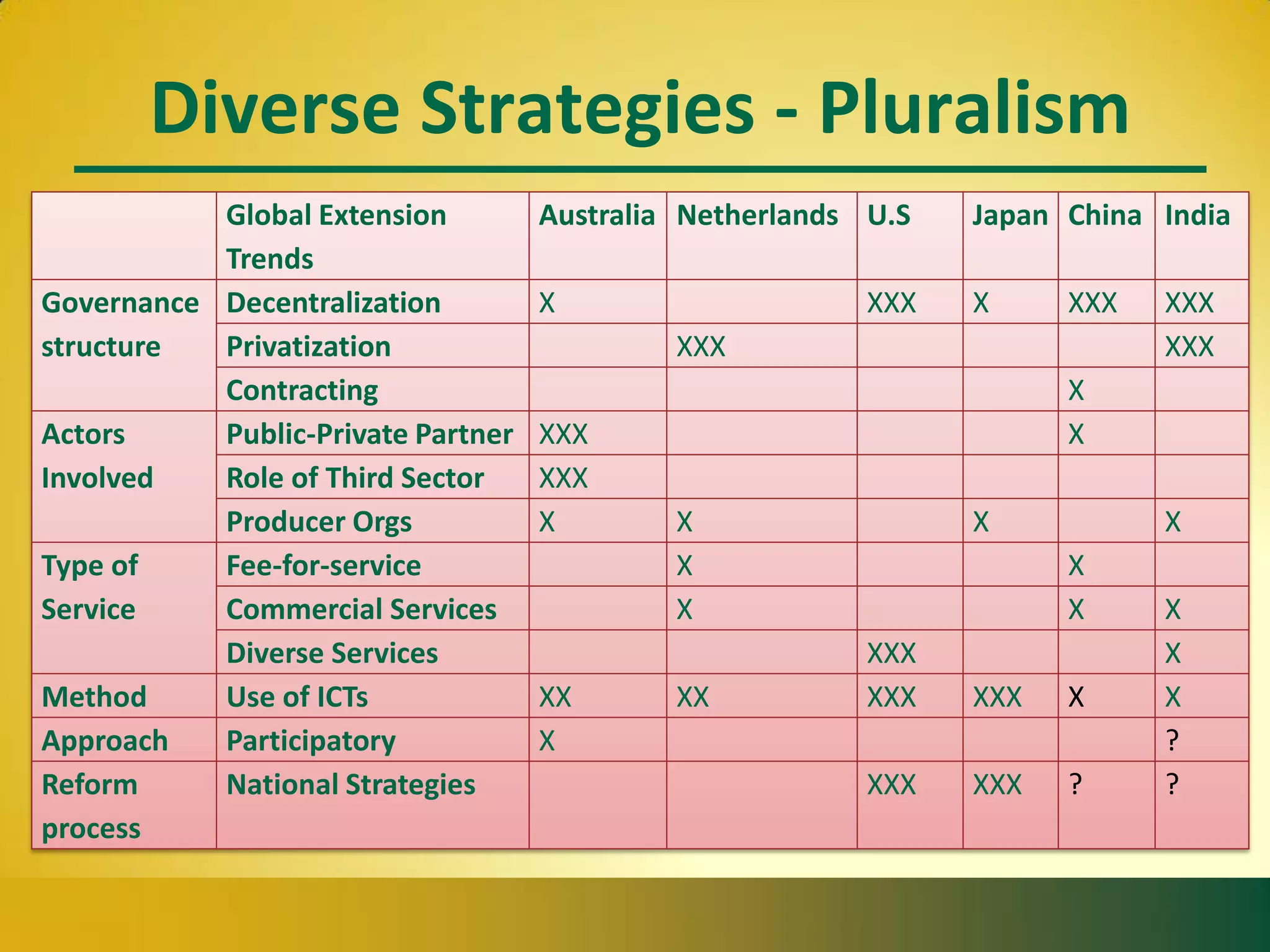
Diverse Strategies - Pluralism
Global Extension
Trends
Australia Netherlands U.S Japan China India
Governance
structure
Decentralization X XXX X XXX XXX
Privatization XXX XXX
Contracting X
Actors
Involved
Public-Private Partner XXX X
Role of Third Sector XXX
Producer Orgs X X X X
Type of
Service
Fee-for-service X X
Commercial Services X X X
Diverse Services XXX X
Method Use of ICTs XX XX XXX XXX X X
Approach Participatory X ?
Reform
process
National Strategies XXX XXX ? ?
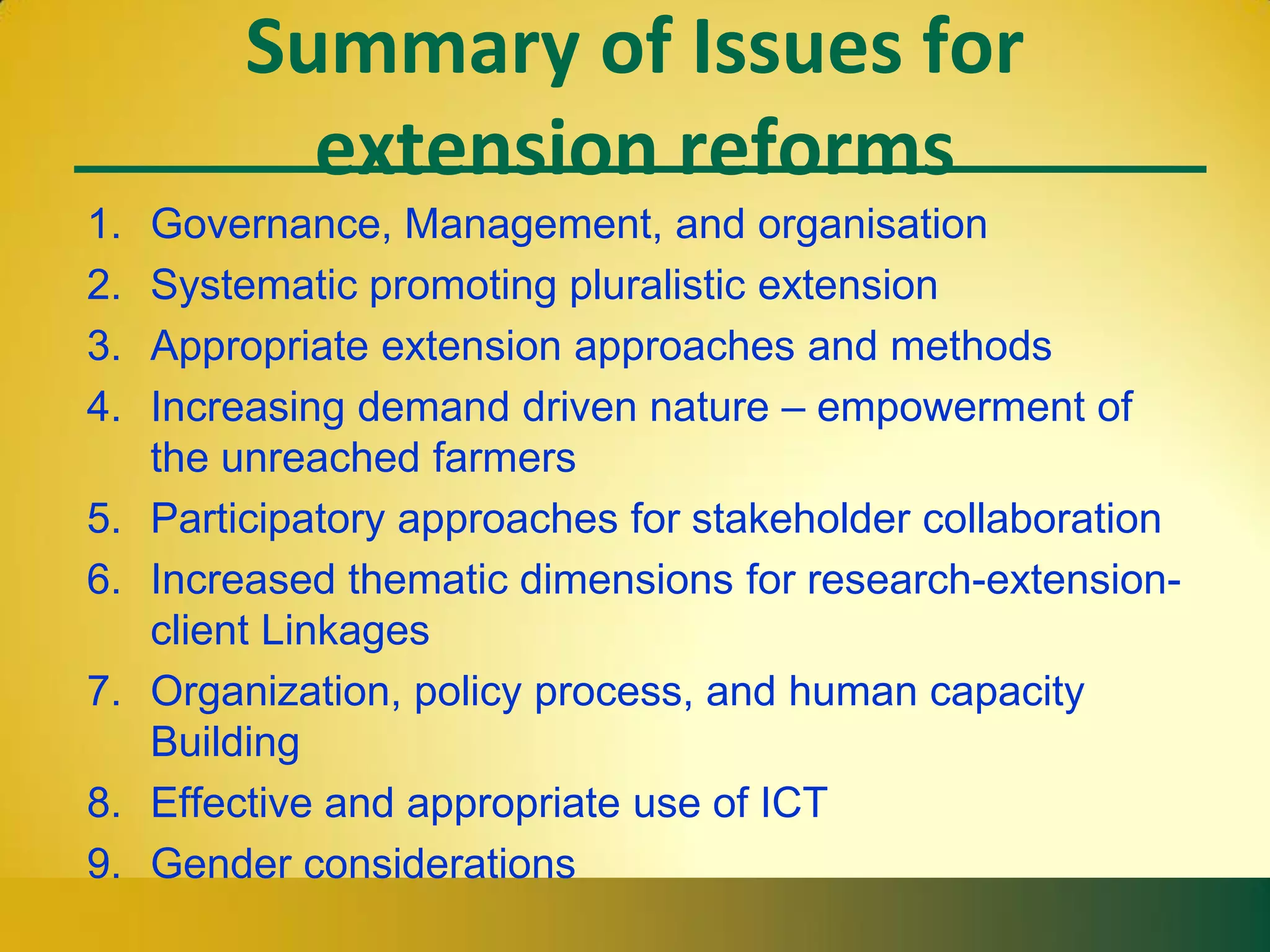
Summary of Issues for
extension reforms
1. Governance, Management, and organisation
2. Systematic promoting pluralistic extension
3. Appropriate extension approaches and methods
4. Increasing demand driven nature – empowerment of
the unreached farmers
5. Participatory approaches for stakeholder collaboration
6. Increased thematic dimensions for research-extension-
client Linkages
7. Organization, policy process, and human capacity
Building
8. Effective and appropriate use of ICT
9. Gender considerations
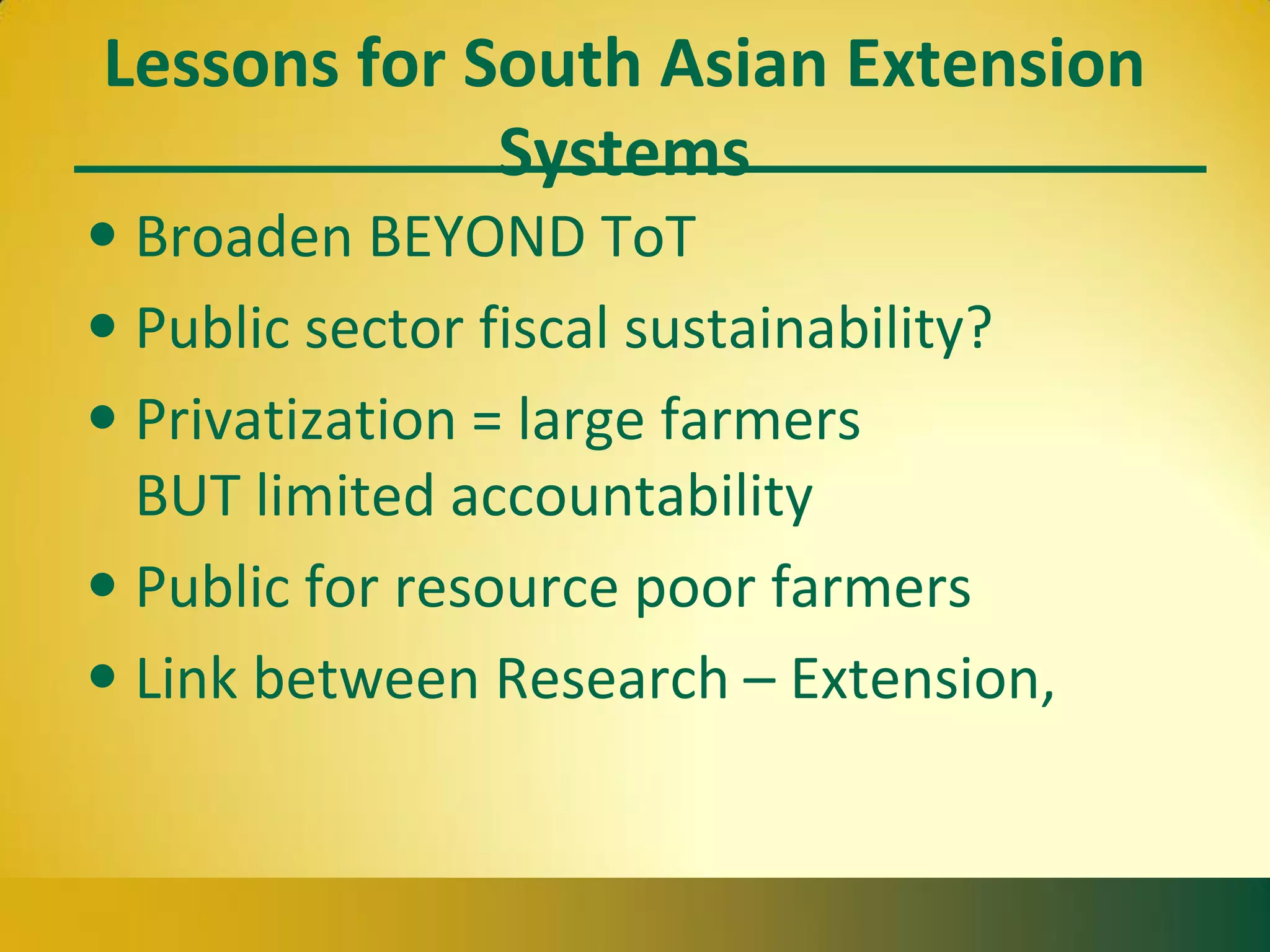
Lessons for South Asian Extension
Systems
• Broaden BEYOND ToT
• Public sector fiscal sustainability?
• Privatization = large farmers
BUT limited accountability
• Public for resource poor farmers
• Link between Research – Extension,
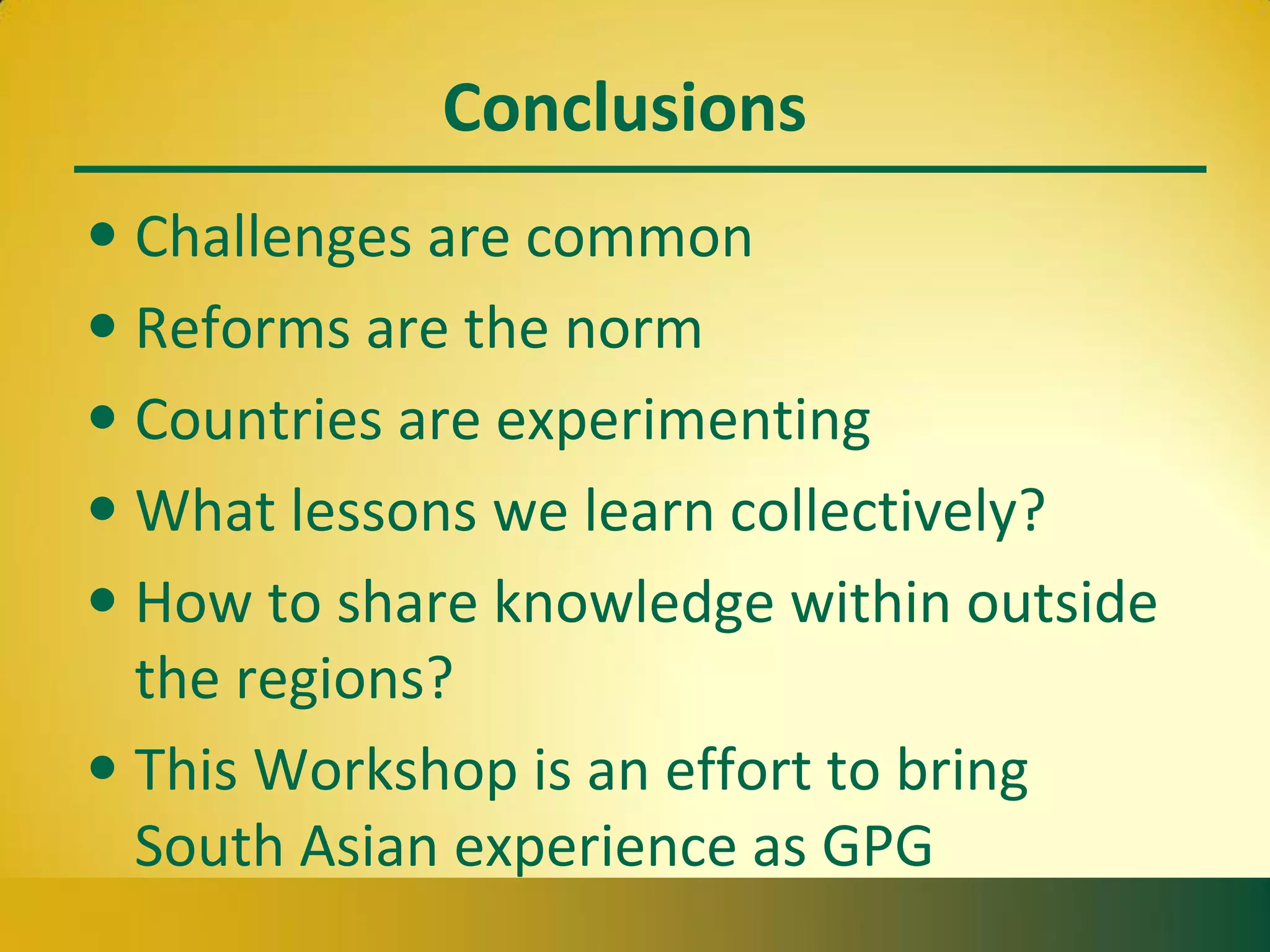
Conclusions
• Challenges are common
• Reforms are the norm
• Countries are experimenting
• What lessons we learn collectively?
• How to share knowledge within outside
the regions?
• This Workshop is an effort to bring
South Asian experience as GPG

IFPRI - Agricultural Extension Reforms in South Asia Workshop - Suresh Babu - Overview of extension reforms in south asia

  • 1.
    INTERNATIONAL FOOD POLICYRESEARCH INSTITUTE Overview of Extension Reforms in South Asia- Historical Trends and Recent Developments Regional Workshop on Extension Reforms in South Asia New Delhi, India. February 17-18, 2015 Suresh Babu and P. K. Joshi
  • 2.
    Presentation Outline 1. Challengesin Extension 2. Strategies 3. Global Trends 4. Lessons for South Asian Extension System 5. Some Conclusions
  • 3.
    Provision and financingof extension • Why reform? • Problems of PUBLIC sector extension: - scale and complexity - dependence on policy environment - weak accountability - weak links between extension and research - difficulty in attributing impact - weak political commitment /support - public duties other than knowledge transfer - fiscal sustainability (Feder et al. 2001) • PUBLIC, PRIVATE, THIRD SECTOR?
  • 4.
    FUNDING DELIVERY Public Private ThirdSector Public Decentralization:  Deconcentration  Devolution  Delegation  Fee-based  FBOs contract staff from public sector Private  Contracting out private service providers (out-sourcing)  Subsidies to producers to hire private provider  Commercialization  Total privatization to private companies  FBOs contract staff from private service providers Third Sector  Contracting to NGO/FBO providers  Advisory services hired by NGO/FBO, farmers pay  FBOs hire own advisory staff and provide free service to members Strategies Sources: Birner et al. (2006), Rivera and Qamar (2003), Rivera (1996).
  • 5.
    Global Trends Examined 1.Decentralization 2. Broadened Extension Function 3. Privatization 4. Participatory/Demand-driven 5. ICT Use
  • 6.
    1. Decentralization • Adminto local level • More accountability • Need to build capacity
  • 7.
    Example: CHINA • Agro-TechnicalExtension Centres (ATEC) • Each level responsible for $$ • Contracts: extension – farmer, FBOs commercial demonstration farms
  • 8.
    2. Broadened ExtensionFunction • PREVIOUSLY: •Transfer of Technology •Cereal crop production • NOW: •Post-harvest: storage, handling, marketing •Facilitation, capacity building •Rural Development – Climate change, nutrition
  • 9.
    Example: U.S CooperativeExtension System • Decline in public funding, awareness and use • Expand beyond agriculture = increase client base and relevance • Rural Development: Family, Health, consumption, sustainability, small businesses
  • 10.
    3. Privatization +other cost recovery options • Fee for service, cost sharing • User pays; poor farmers? Excludability Low High Rivalry Low Public goods -environment, natural resources, non-excludable agricultural information Toll goods -excludable agricultural information High Common-pool goods -modern technologies Private goods - modern technologies Source: (Umali-Deininger, 1997)
  • 11.
    Example: The Netherlands •Fully privatized from 1990: DLV Plant WHY? Difference btw govt policy – farmer interest, reduce cost • More competition, client orientation • BUT remote farmers, minor crops ignored, weakened links • Ministry of Ag: public good programs e.g. Nutrient Management Support Service
  • 12.
    4. Demand-driven /Participatory approaches • Consultative process – communities, ecosystems • Participatory, bottom up • Problem Driven –Water, Nutrition, climate change • = accountability, empowerment • Extension = facilitation, capacity building (takes TIME)
  • 13.
    Example: Landcare AUSTRALIA •4500 community groups, 1 in 3 farms • Address land degradation issues, natural resource management • Partnership: Funds = Central, Action = Community • “Self-help” supported by coordinators
  • 14.
    5. ICT Use •Connecting famers directly • Emerging trend in developing countries • Allows new actors and entities to play their role • Also brings in problems
  • 15.
    Example: JAPAN • Highlyconnected through ICT • Lower transaction cost, increase efficiency • Extension Information Network System (EI-NET) links all levels • National Case Information of Extension Activities Database • Local networks for farmers
  • 16.
    Diverse Strategies -Pluralism Global Extension Trends Australia Netherlands U.S Japan China India Governance structure Decentralization X XXX X XXX XXX Privatization XXX XXX Contracting X Actors Involved Public-Private Partner XXX X Role of Third Sector XXX Producer Orgs X X X X Type of Service Fee-for-service X X Commercial Services X X X Diverse Services XXX X Method Use of ICTs XX XX XXX XXX X X Approach Participatory X ? Reform process National Strategies XXX XXX ? ?
  • 17.
    Summary of Issuesfor extension reforms 1. Governance, Management, and organisation 2. Systematic promoting pluralistic extension 3. Appropriate extension approaches and methods 4. Increasing demand driven nature – empowerment of the unreached farmers 5. Participatory approaches for stakeholder collaboration 6. Increased thematic dimensions for research-extension- client Linkages 7. Organization, policy process, and human capacity Building 8. Effective and appropriate use of ICT 9. Gender considerations
  • 18.
    Lessons for SouthAsian Extension Systems • Broaden BEYOND ToT • Public sector fiscal sustainability? • Privatization = large farmers BUT limited accountability • Public for resource poor farmers • Link between Research – Extension,
  • 19.
    Conclusions • Challenges arecommon • Reforms are the norm • Countries are experimenting • What lessons we learn collectively? • How to share knowledge within outside the regions? • This Workshop is an effort to bring South Asian experience as GPG