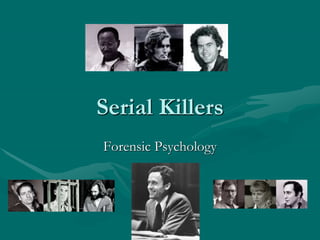
Serial Killers
Forensic Psychology
Forensic Psychology
Where law meets the study of the mind, you’ll find the
Forensic psychiatric/psychological professional.
 Psychiatrist is a medical doctor – medical treatment of the psyche
 Psychologist is not a medical doctor – study of the mind and behavior
 BOTH – mental health professionals – expertise is the mind and the way it
affects behavior and well-being
WHY?
• The law and medical aspects of crime are often at odds.
 Insane or not?
 Competent to stand trial or not?
Role of the Forensic Psychologist
• Assessment of mental state for insanity plea
• Competency to stand trial
• Sentencing recommendations
• Evaluations of the risk of reoffending
• Testimony as an expert witness
• Child custody evaluations
Types of Murderers
1.Mass Murderer
2.Spree Murderer
3.Serial Killer
Types of Murderers
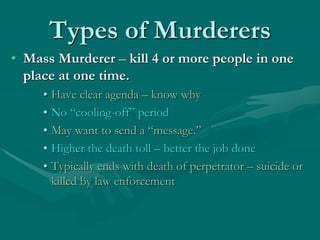
• Mass Murderer – kill 4 or more people in one
place at one time.
• Have clear agenda – know why
• No ā€œcooling-offā€ period
• May want to send a ā€œmessage.ā€
• Higher the death toll – better the job done
• Typically ends with death of perpetrator – suicide or
killed by law enforcement
Some Famous Mass Murderers
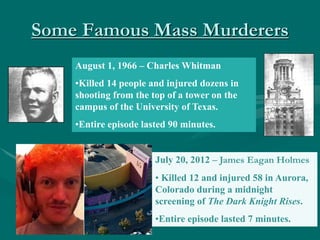
August 1, 1966 – Charles Whitman
•Killed 14 people and injured dozens in
shooting from the top of a tower on the
campus of the University of Texas.
•Entire episode lasted 90 minutes.
July 20, 2012 – James Eagan Holmes
• Killed 12 and injured 58 in Aurora,
Colorado during a midnight
screening of The Dark Knight Rises.
•Entire episode lasted 7 minutes.
Some Famous Mass Murderers
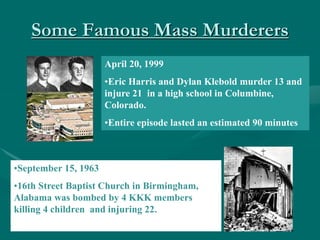
April 20, 1999
•Eric Harris and Dylan Klebold murder 13 and
injure 21 in a high school in Columbine,
Colorado.
•Entire episode lasted an estimated 90 minutes
•September 15, 1963
•16th Street Baptist Church in Birmingham,
Alabama was bombed by 4 KKK members
killing 4 children and injuring 22.
Spree Murderers
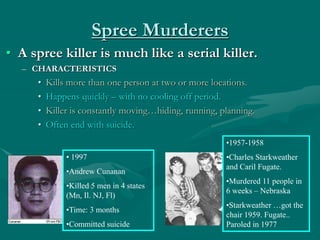
• A spree killer is much like a serial killer.
– CHARACTERISTICS
• Kills more than one person at two or more locations.
• Happens quickly – with no cooling off period.
• Killer is constantly moving…hiding, running, planning.
• Often end with suicide.
• 1997
•Andrew Cunanan
•Killed 5 men in 4 states
(Mn, Il. NJ, Fl)
•Time: 3 months
•Committed suicide
•1957-1958
•Charles Starkweather
and Caril Fugate.
•Murdered 11 people in
6 weeks – Nebraska
•Starkweather …got the
chair 1959. Fugate..
Paroled in 1977
The Serial Killer
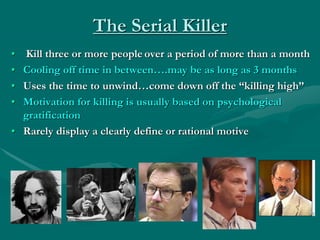
• Kill three or more people over a period of more than a month
• Cooling off time in between….may be as long as 3 months
• Uses the time to unwind…come down off the ā€œkilling highā€
• Motivation for killing is usually based on psychological
gratification
• Rarely display a clearly define or rational motive
WARNING
• This unit can become very disturbing.
• If you need to take a break from the class
material PLEASE let me know.
Criminal Profiling
• Possible solution to battling serial offences
• A behavioral and investigative tool that is intended to
help investigators to accurately predict and profile the
characteristics of unknown criminal subjects or
offenders.
Criminal Profiling
Some Assumptions of the Profiling Process
1. The Crime Scene reflects the personality.
– Manner of death
– Organized or disorganized crime scene
2. Methods of operation remain similar.
- Clues left could be a ā€œsignatureā€ of the killer.
3. The ā€œsignatureā€ will remain the same.
- Unique manner in which a crime is committed.
- Manner, words used, something left at the scene.
4. The criminal’s personality will not change.
- Core personality cannot change.
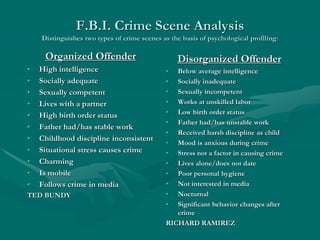
F.B.I. Crime Scene Analysis
Distinguishes two types of crime scenes as the basis of psychological profiling:
Organized Offender
• High intelligence
• Socially adequate
• Sexually competent
• Lives with a partner
• High birth order status
• Father had/has stable work
• Childhood discipline inconsistent
• Situational stress causes crime
• Charming
• Is mobile
• Follows crime in media
TED BUNDY
Disorganized Offender
• Below average intelligence
• Socially inadequate
• Sexually incompetent
• Works at unskilled labor
• Low birth order status
• Father had/has unstable work
• Received harsh discipline as child
• Mood is anxious during crime
• Stress not a factor in causing crime
• Lives alone/does not date
• Poor personal hygiene
• Not interested in media
• Nocturnal
• Significant behavior changes after
crime
RICHARD RAMIREZ
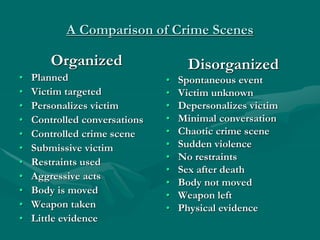
A Comparison of Crime Scenes
Organized
• Planned
• Victim targeted
• Personalizes victim
• Controlled conversations
• Controlled crime scene
• Submissive victim
• Restraints used
• Aggressive acts
• Body is moved
• Weapon taken
• Little evidence
Disorganized
• Spontaneous event
• Victim unknown
• Depersonalizes victim
• Minimal conversation
• Chaotic crime scene
• Sudden violence
• No restraints
• Sex after death
• Body not moved
• Weapon left
• Physical evidence
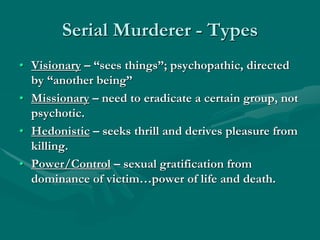
Serial Murderer - Types
• Visionary – ā€œsees thingsā€; psychopathic, directed
by ā€œanother beingā€
• Missionary – need to eradicate a certain group, not
psychotic.
• Hedonistic – seeks thrill and derives pleasure from
killing.
• Power/Control – sexual gratification from
dominance of victim…power of life and death.
What is a serial killer?
What characteristics come to mind?
Misconception #1
• Serial killers are the same as mass murderers
– Serial killers kill several people over a series of days, weeks,
months, or even years.
• Active period and cooling off period
– Mass murderers kill a number of people within a few hours
• Murder in an outburst with no cooling off period
• Ex – Columbine shootings
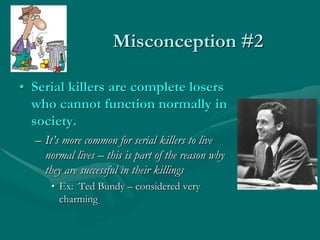
Misconception #2
• Serial killers are complete losers
who cannot function normally in
society.
– It’s more common for serial killers to live
normal lives – this is part of the reason why
they are successful in their killings
• Ex: Ted Bundy – considered very
charming
Common Characteristics of Serial Killers
• White male
• Age 25-35
• Intelligence – ranges from low to very high
• From all walks of life
– May be the married man next door with kids
• OR
– Socially inept/unable to maintain relationship/ loner
• Kill for sex, power, manipulation, domination
and control
Common Characteristics of Victims
• Usually kill within ethnic group
• Age of victims varies greatly (depending on murder)
• Usually no prior contact/hatred for victim
• Victims may be symbolic in some way
Socially Difficult to Accept
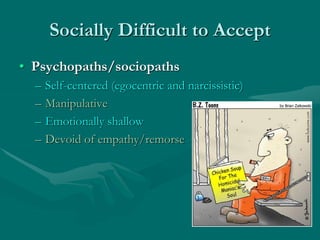
• Psychopaths/sociopaths
– Self-centered (egocentric and narcissistic)
– Manipulative
– Emotionally shallow
– Devoid of empathy/remorse
Fantasy
• All humans fantasize about their dreams and
futures – usually very detailed
• Serial killers have detailed fantasies
– Specific victims
– Repetitive
– Reveals modus operandi (MO – method of operation)/
signature
• Helps Forensic psychiatrists develop profiles of
the killers
Trophies or Souvenirs
• Criminals
– Money, jewels, electronics
– Incriminating evidence (weapon)
• Serial killers
– Take objects with no monetary value
– Holds value to perpetrator
– Use it to relive crime later
• Ex: jewelry, clothing, drivers license, even body parts
Childhood
• Many come from physical, psychological, and sexual
abuse
• Insulate self by creating protective world rich in fantasy
• Fantasy includes sexual and violent characteristics
– Themes commingle until they are inseparable
– Offenders seek victims that fulfill their fantasy
• Ex: Ted Bundy – women with dark hair parted in middle

Serial killer psych

  • 1.
  • 2.
    Forensic Psychology Where lawmeets the study of the mind, you’ll find the Forensic psychiatric/psychological professional.  Psychiatrist is a medical doctor – medical treatment of the psyche  Psychologist is not a medical doctor – study of the mind and behavior  BOTH – mental health professionals – expertise is the mind and the way it affects behavior and well-being WHY? • The law and medical aspects of crime are often at odds.  Insane or not?  Competent to stand trial or not?
  • 3.
    Role of theForensic Psychologist • Assessment of mental state for insanity plea • Competency to stand trial • Sentencing recommendations • Evaluations of the risk of reoffending • Testimony as an expert witness • Child custody evaluations
  • 4.
    Types of Murderers 1.MassMurderer 2.Spree Murderer 3.Serial Killer
  • 5.
    Types of Murderers •Mass Murderer – kill 4 or more people in one place at one time. • Have clear agenda – know why • No ā€œcooling-offā€ period • May want to send a ā€œmessage.ā€ • Higher the death toll – better the job done • Typically ends with death of perpetrator – suicide or killed by law enforcement
  • 6.
    Some Famous MassMurderers August 1, 1966 – Charles Whitman •Killed 14 people and injured dozens in shooting from the top of a tower on the campus of the University of Texas. •Entire episode lasted 90 minutes. July 20, 2012 – James Eagan Holmes • Killed 12 and injured 58 in Aurora, Colorado during a midnight screening of The Dark Knight Rises. •Entire episode lasted 7 minutes.
  • 7.
    Some Famous MassMurderers April 20, 1999 •Eric Harris and Dylan Klebold murder 13 and injure 21 in a high school in Columbine, Colorado. •Entire episode lasted an estimated 90 minutes •September 15, 1963 •16th Street Baptist Church in Birmingham, Alabama was bombed by 4 KKK members killing 4 children and injuring 22.
  • 8.
    Spree Murderers • Aspree killer is much like a serial killer. – CHARACTERISTICS • Kills more than one person at two or more locations. • Happens quickly – with no cooling off period. • Killer is constantly moving…hiding, running, planning. • Often end with suicide. • 1997 •Andrew Cunanan •Killed 5 men in 4 states (Mn, Il. NJ, Fl) •Time: 3 months •Committed suicide •1957-1958 •Charles Starkweather and Caril Fugate. •Murdered 11 people in 6 weeks – Nebraska •Starkweather …got the chair 1959. Fugate.. Paroled in 1977
  • 9.
    The Serial Killer •Kill three or more people over a period of more than a month • Cooling off time in between….may be as long as 3 months • Uses the time to unwind…come down off the ā€œkilling highā€ • Motivation for killing is usually based on psychological gratification • Rarely display a clearly define or rational motive
  • 10.
    WARNING • This unitcan become very disturbing. • If you need to take a break from the class material PLEASE let me know.
  • 11.
    Criminal Profiling • Possiblesolution to battling serial offences • A behavioral and investigative tool that is intended to help investigators to accurately predict and profile the characteristics of unknown criminal subjects or offenders.
  • 12.
    Criminal Profiling Some Assumptionsof the Profiling Process 1. The Crime Scene reflects the personality. – Manner of death – Organized or disorganized crime scene 2. Methods of operation remain similar. - Clues left could be a ā€œsignatureā€ of the killer. 3. The ā€œsignatureā€ will remain the same. - Unique manner in which a crime is committed. - Manner, words used, something left at the scene. 4. The criminal’s personality will not change. - Core personality cannot change.
  • 13.
    F.B.I. Crime SceneAnalysis Distinguishes two types of crime scenes as the basis of psychological profiling: Organized Offender • High intelligence • Socially adequate • Sexually competent • Lives with a partner • High birth order status • Father had/has stable work • Childhood discipline inconsistent • Situational stress causes crime • Charming • Is mobile • Follows crime in media TED BUNDY Disorganized Offender • Below average intelligence • Socially inadequate • Sexually incompetent • Works at unskilled labor • Low birth order status • Father had/has unstable work • Received harsh discipline as child • Mood is anxious during crime • Stress not a factor in causing crime • Lives alone/does not date • Poor personal hygiene • Not interested in media • Nocturnal • Significant behavior changes after crime RICHARD RAMIREZ
  • 14.
    A Comparison ofCrime Scenes Organized • Planned • Victim targeted • Personalizes victim • Controlled conversations • Controlled crime scene • Submissive victim • Restraints used • Aggressive acts • Body is moved • Weapon taken • Little evidence Disorganized • Spontaneous event • Victim unknown • Depersonalizes victim • Minimal conversation • Chaotic crime scene • Sudden violence • No restraints • Sex after death • Body not moved • Weapon left • Physical evidence
  • 15.
    Serial Murderer -Types • Visionary – ā€œsees thingsā€; psychopathic, directed by ā€œanother beingā€ • Missionary – need to eradicate a certain group, not psychotic. • Hedonistic – seeks thrill and derives pleasure from killing. • Power/Control – sexual gratification from dominance of victim…power of life and death.
  • 16.
    What is aserial killer? What characteristics come to mind?
  • 17.
    Misconception #1 • Serialkillers are the same as mass murderers – Serial killers kill several people over a series of days, weeks, months, or even years. • Active period and cooling off period – Mass murderers kill a number of people within a few hours • Murder in an outburst with no cooling off period • Ex – Columbine shootings
  • 18.
    Misconception #2 • Serialkillers are complete losers who cannot function normally in society. – It’s more common for serial killers to live normal lives – this is part of the reason why they are successful in their killings • Ex: Ted Bundy – considered very charming
  • 19.
    Common Characteristics ofSerial Killers • White male • Age 25-35 • Intelligence – ranges from low to very high • From all walks of life – May be the married man next door with kids • OR – Socially inept/unable to maintain relationship/ loner • Kill for sex, power, manipulation, domination and control
  • 20.
    Common Characteristics ofVictims • Usually kill within ethnic group • Age of victims varies greatly (depending on murder) • Usually no prior contact/hatred for victim • Victims may be symbolic in some way
  • 21.
    Socially Difficult toAccept • Psychopaths/sociopaths – Self-centered (egocentric and narcissistic) – Manipulative – Emotionally shallow – Devoid of empathy/remorse
  • 22.
    Fantasy • All humansfantasize about their dreams and futures – usually very detailed • Serial killers have detailed fantasies – Specific victims – Repetitive – Reveals modus operandi (MO – method of operation)/ signature • Helps Forensic psychiatrists develop profiles of the killers
  • 23.
    Trophies or Souvenirs •Criminals – Money, jewels, electronics – Incriminating evidence (weapon) • Serial killers – Take objects with no monetary value – Holds value to perpetrator – Use it to relive crime later • Ex: jewelry, clothing, drivers license, even body parts
  • 24.
    Childhood • Many comefrom physical, psychological, and sexual abuse • Insulate self by creating protective world rich in fantasy • Fantasy includes sexual and violent characteristics – Themes commingle until they are inseparable – Offenders seek victims that fulfill their fantasy • Ex: Ted Bundy – women with dark hair parted in middle