SEQUENCE FUNCTION 
 Sequence is a set of numbers written in a given order. 
 Function whose domain is the set of natural numbers and whose range is a 
subset of the real numbers 
 Terms are the numbers or values in the sequence 
Examples: 
1. 1,2,3,4,5,6,...,n 
2. 2,4,6,8,10,…,n 
3. 5,10,15,20,…,n 
A Sequence Function as a function whose domain is a subset of positive integers. 
Example: 
A ball is dropped from the height of 10 feet. Each time that it bounces, it reaches 
a height that is half of its previous height. We can list the height to which the ball 
bounces in order until it finally comes to rest. 
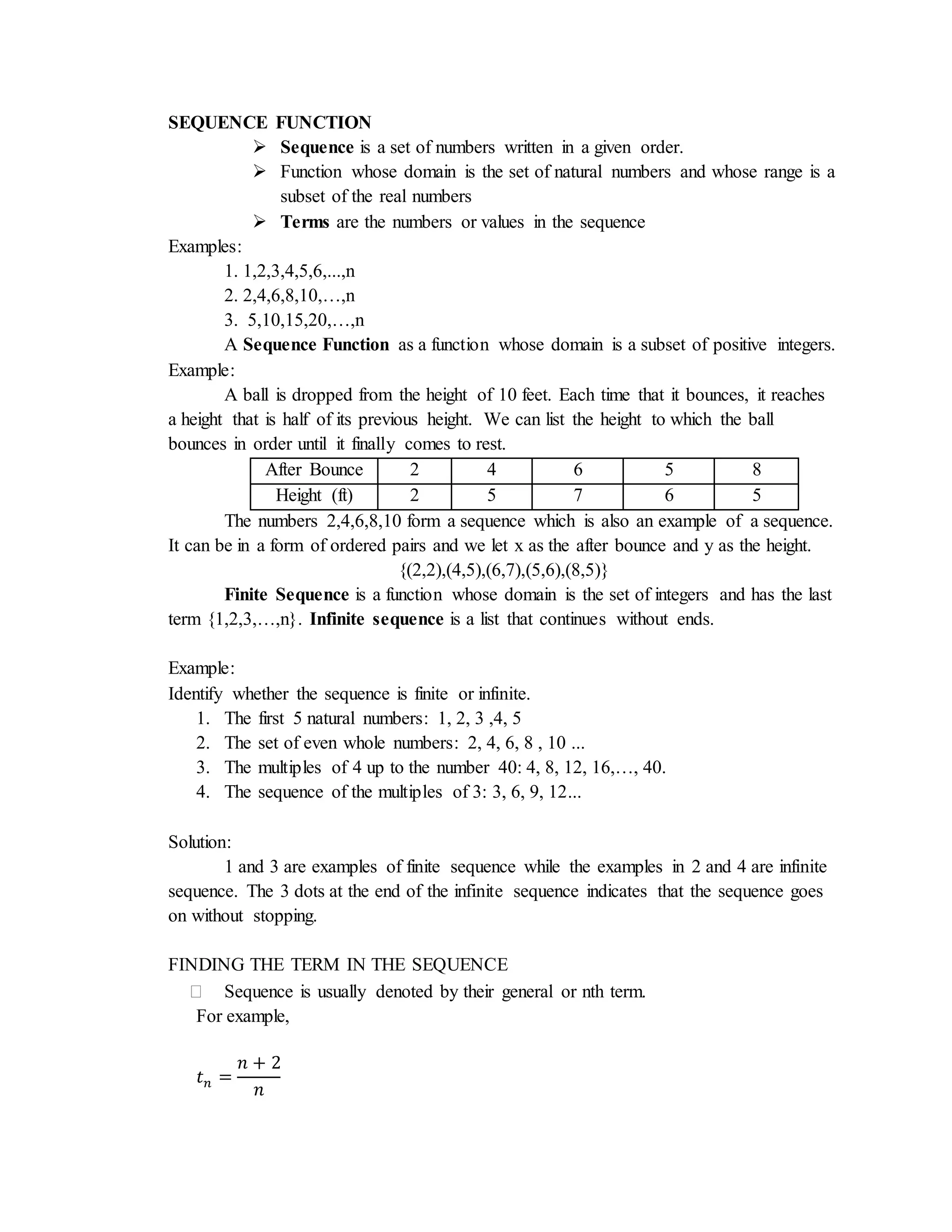
After Bounce 2 4 6 5 8 
Height (ft) 2 5 7 6 5 
The numbers 2,4,6,8,10 form a sequence which is also an example of a sequence. 
It can be in a form of ordered pairs and we let x as the after bounce and y as the height. 
{(2,2),(4,5),(6,7),(5,6),(8,5)} 
Finite Sequence is a function whose domain is the set of integers and has the last 
term {1,2,3,…,n}. Infinite sequence is a list that continues without ends. 
Example: 
Identify whether the sequence is finite or infinite. 
1. The first 5 natural numbers: 1, 2, 3 ,4, 5 
2. The set of even whole numbers: 2, 4, 6, 8 , 10 ... 
3. The multiples of 4 up to the number 40: 4, 8, 12, 16,…, 40. 
4. The sequence of the multiples of 3: 3, 6, 9, 12... 
Solution: 
1 and 3 are examples of finite sequence while the examples in 2 and 4 are infinite 
sequence. The 3 dots at the end of the infinite sequence indicates that the sequence goes 
on without stopping. 
FINDING THE TERM IN THE SEQUENCE 
 Sequence is usually denoted by their general or nth term. 
For example, 
푡푛 = 
푛 + 2 
푛
The equation provides how we will be able to compute for the nth term of the 
sequence. To get the value of a specific term , replace n with the number of the term. 
For example: 
To get the first 3 terms of 푡푛 = 푛+2 
푛 
, replace n with 2,4 and 6. 
Solution: 
푡푛 = 
푛 + 2 
푛 
= 
2 + 2 
2 
= 2 
푡푛 = 
푛 + 2 
푛 
= 
4 + 2 
2 
= 3 
푡푛 = 
푛 + 2 
푛 
= 
6 + 2 
2 
= 4 
The domain of the sequence is the set {2,4,6}. 
The range is denoted as {2,3,4}. 
Example: 
1. Find the first 5 terms of the sequence: 
푡푛 = 2푛 − 3 
The domain is the set {1, 2, 3, 4, 5} 
Substituting this into 푡푛 = 2푛 − 3, we have: 
푡푛 = 2(1) − 3 = -1 
푡푛 = 2(2) − 3 = 1 
푡푛 = 2(3) − 3 = 3 
푡푛 = 2(4) − 3 = 5 
푡푛 = 2(5) − 3 = 7 
The first 5 terms of the sequence 푡푛 = 2푛 − 3 is {-1,1,3,5,7} 
2. Find the first 3 terms of the sequence: 
푡푛 = 푛2 
The domain is {1,2,3} 
Substituting this into 푡푛 = 푛2, we have: 
푡푛 = 12 = 1 
푡푛 = 22 = 4 
푡푛 = 32 = 9
The first 3 terms of the sequence {1,4,9} 
FINDING THE GENERAL TERM 
When given the first few terms of the sequence, we can look at the pattern in order to 
obtain the next terms or a general statement regarding the nth term. 
Example: 
1. Find the next term and describe the pattern. 
1,4,9,16,25… 
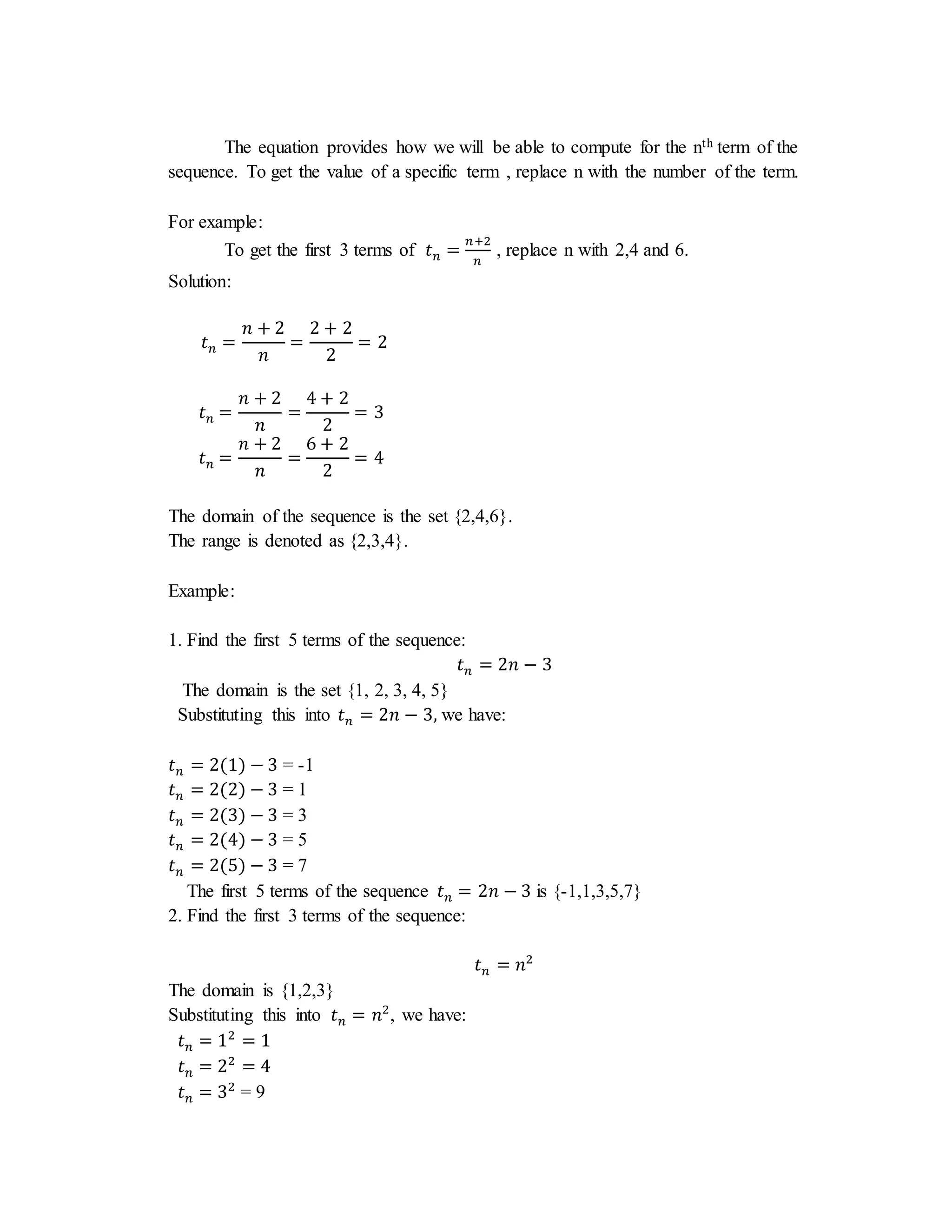
The next term is 36. The terms are all squares. 
1st Term 12= 1 
2nd Term 22= 4 
3rd Term 32= 9 
4th Term 42= 16 
5th Term 52= 25 
6th Term 62= 36 
SERIES 
 Series is the sum of the terms 
t1 + t2 + t3 + t4 +,…, + tn 
Note: The sum of the infinite sequence is an infinite series. A partial sum is the sum of 
the first n terms. A partial sum is also called the sum of finite series, and is denoted as sn , 
where n denotes the number of terms in the sum. 
For example: 
If 4, 7, 10, 13, 16, 19…. Is a sequence, then 4 + 7 + 10 + 13 + 16 +19 is the 
corresponding sum or series 
If only we want to get the sum of only 4 terms in the sequence, it is a partial sum 
written as S4 , which is equal to 4 + 7 + 10 + 13. 
Example: 
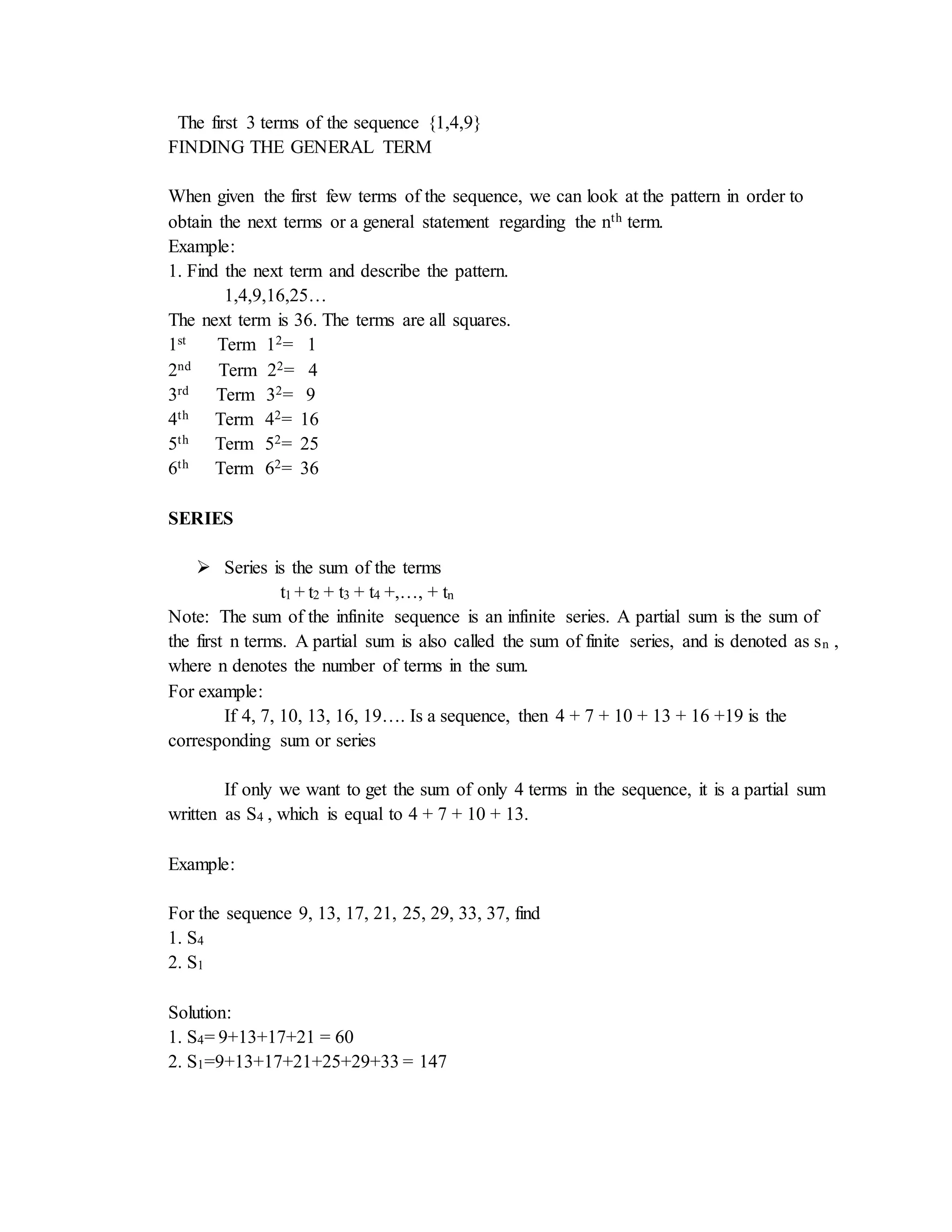
For the sequence 9, 13, 17, 21, 25, 29, 33, 37, find 
1. S4 
2. S1 
Solution: 
1. S4= 9+13+17+21 = 60 
2. S1=9+13+17+21+25+29+33 = 147
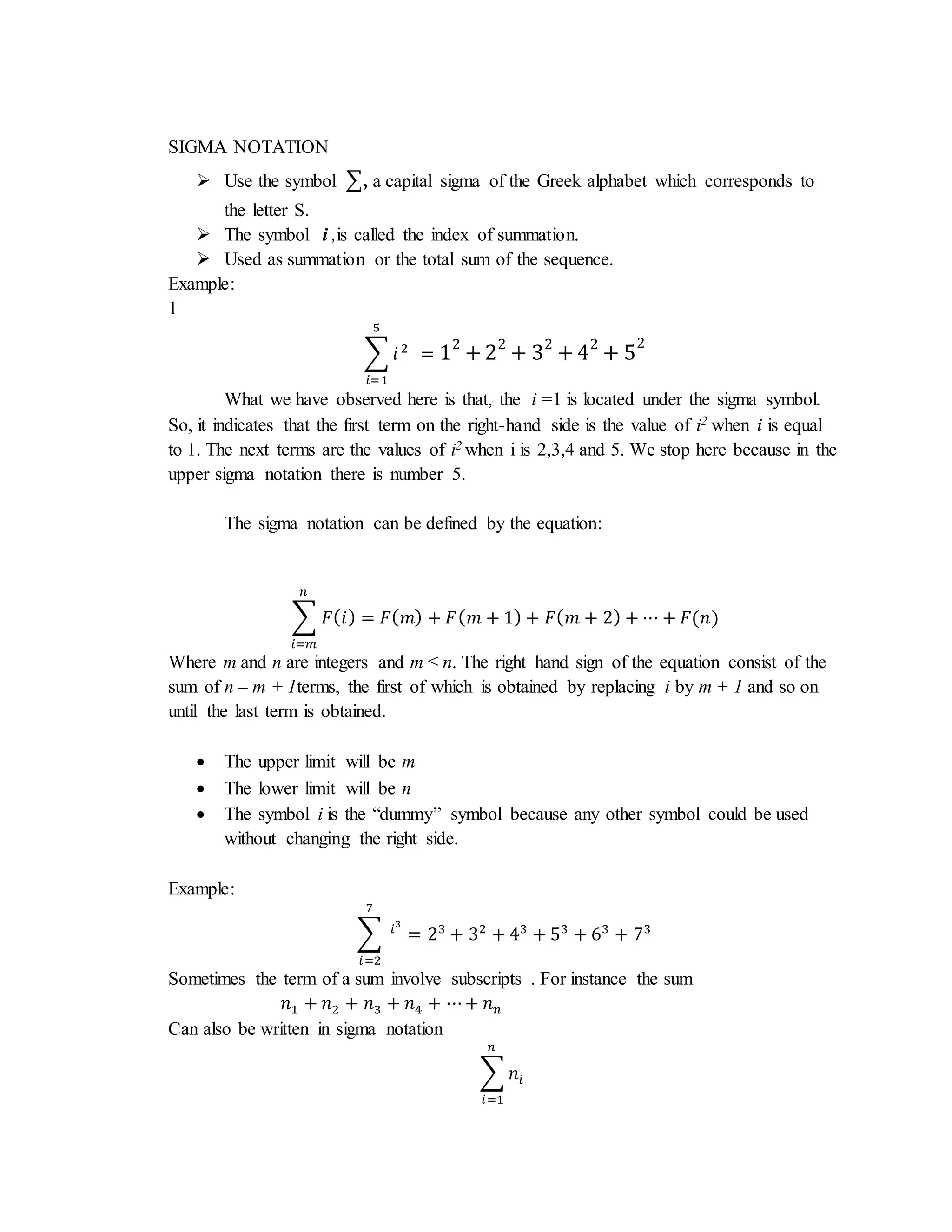
SIGMA NOTATION 
 Use the symbol Σ, a capital sigma of the Greek alphabet which corresponds to 
the letter S. 
 The symbol i ,is called the index of summation. 
 Used as summation or the total sum of the sequence. 
Example: 
1 
5 
Σ 푖 2 
푖=1 
= 12 + 22 + 32 + 42 + 52 
What we have observed here is that, the i =1 is located under the sigma symbol. 
So, it indicates that the first term on the right-hand side is the value of i2 when i is equal 
to 1. The next terms are the values of i2 when i is 2,3,4 and 5. We stop here because in the 
upper sigma notation there is number 5. 
The sigma notation can be defined by the equation: 
푛 
Σ 퐹(푖) = 퐹(푚) + 퐹(푚 + 1) + 퐹(푚 + 2) + ⋯ + 퐹(푛) 
푖=푚 
Where m and n are integers and m ≤ n. The right hand sign of the equation consist of the 
sum of n – m + 1terms, the first of which is obtained by replacing i by m + 1 and so on 
until the last term is obtained. 
 The upper limit will be m 
 The lower limit will be n 
 The symbol i is the “dummy” symbol because any other symbol could be used 
without changing the right side. 
Example: 
7 
Σ 푖3 
푖 =2 
= 23 + 32 + 43 + 53 + 63 + 73 
Sometimes the term of a sum involve subscripts . For instance the sum 
푛1 + 푛2 + 푛3 + 푛4 + ⋯ + 푛푛 
Can also be written in sigma notation 
푛 
Σ 푛푖 
푖 =1
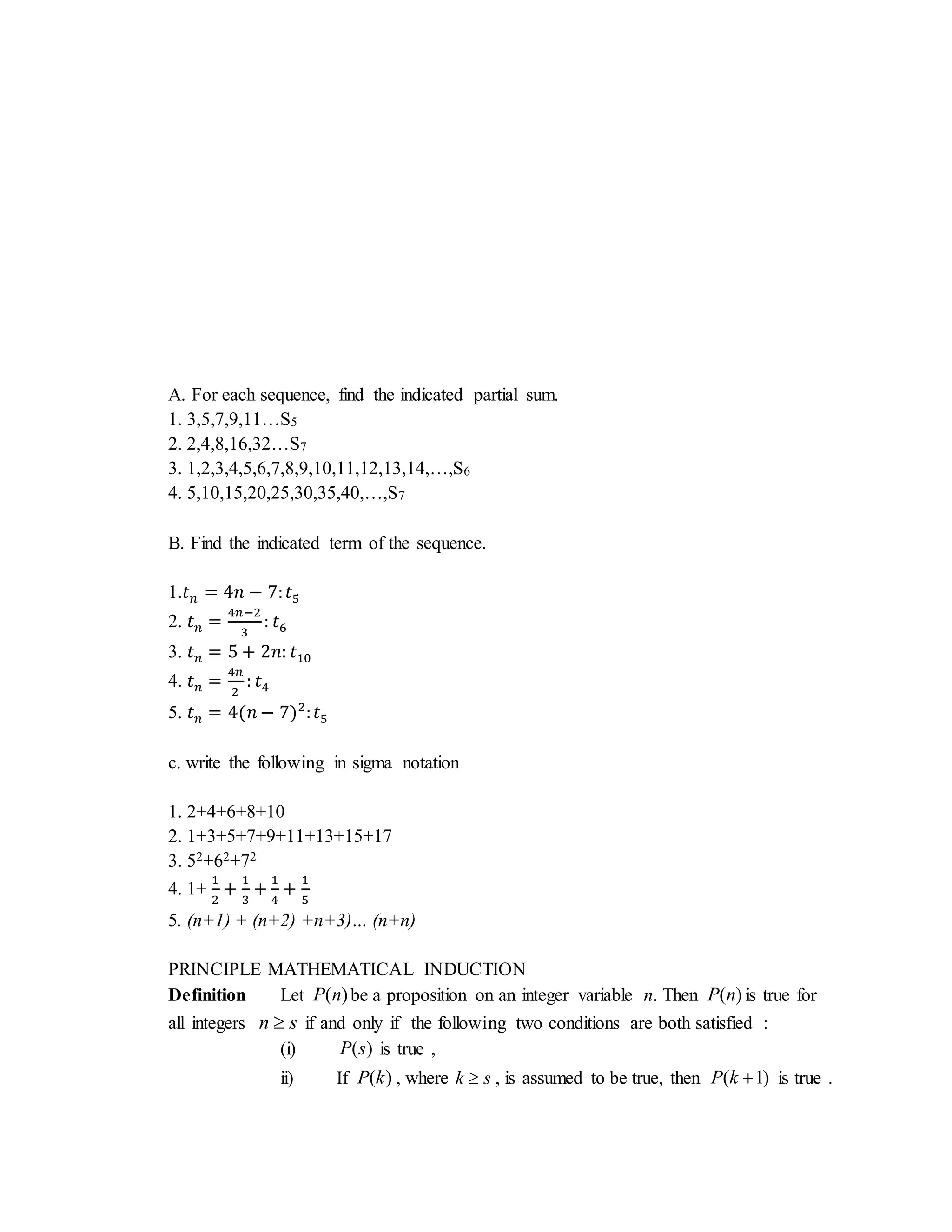
A. For each sequence, find the indicated partial sum. 
1. 3,5,7,9,11…S5 
2. 2,4,8,16,32…S7 
3. 1,2,3,4,5,6,7,8,9,10,11,12,13,14,…,S6 
4. 5,10,15,20,25,30,35,40,…,S7 
B. Find the indicated term of the sequence. 
1.푡푛 = 4푛 − 7: 푡5 
2. 푡푛 = 4푛−2 
3 
: 푡6 
3. 푡푛 = 5 + 2푛: 푡10 
4. 푡푛 = 4푛 
2 
: 푡4 
5. 푡푛 = 4(푛 − 7)2: 푡5 
c. write the following in sigma notation 
1. 2+4+6+8+10 
2. 1+3+5+7+9+11+13+15+17 
3. 52+62+72 
4. 1+ 
1 
2 
+ 1 
3 
+ 1 
4 
+ 1 
5 
5. (n+1) + (n+2) +n+3)… (n+n) 
PRINCIPLE MATHEMATICAL INDUCTION 
Definition Let P(n) be a proposition on an integer variable n. Then P(n) is true for 
all integers n  s if and only if the following two conditions are both satisfied : 
(i) P(s) is true , 
ii) If P(k) , where k  s , is assumed to be true, then P(k 1) is true .
Example: 
We use the mathematical induction to prove that 
1+3+5+7+….+(2n – 1) =n2 
STEP 1. We apply that the formula is true for n = 1. If n = 1 then the formula becomes 
1=12 
1=1 
which is true. 
STEP 2. Show that Pk is true. 
1 + 3 + 5 + 7 + ⋯ + (2푘 − 1) = 푘2 
If the equation 1 is true, then 
1 + 3 + 5 + ⋯ + (2푘 − 1) + [2(푘 + 1) − 1] = (푘 + 1)2 
This is also true. 
Then we add 2k +1 – 1 to the left side of the Equation 1 and its equivalent 2k+1 to the 
right side and we have: 
1 + 3 + 5 + ⋯ + (2푘 − 1) + [2(푘 + 1) − 1] = 푘2 + (2푘 + 1) 
1 + 3 + 5 + ⋯ + (2푘 − 1) + [2(푘 + 1) − 1] = (푘 + 1)2 
Which is Equation 2. 
Example: 
Use mathematical induction to prove that n3 + 3n2 + 2n is divisible by 3 for n  1. 
Basis case: n = 1 n3 + 3n2 + 2n = 13 + 3 ·12 + 2·1 = 1 + 3 + 2 = 6 and 3 | 6. 
Hypothesis: Assume k3 + 3k2 
(i.e. k3 + 3k2 + 2k = 3s for some integer s.) 
Induction step: 
(k + 1) 3 + 3(k + 1)2 + 2(k + 1) = (k3 + 3k2 + 3k + 1) + 3(k2 + 2k + 1) + 2(k + 1) 
= (k3 + 3k2 + 2k) + k + 1 + 3k2 + 6k + 3 + 2k + 2 
= 3s + 3k2 + 9k + 6 hypothesis and algebra 
= 3s + 3(k2 + 3k + 2) factoring 
= 3[s + k2 + 3k + 2] factoring 
Therefore 3 | [(k + 1)3 + 3(k + 1)2 + 2(k + 1)]. 
Therefore, by the principle of mathematical induction, the statement is true for all n. 
Example: 
Use mathematical induction to prove that 2n < n! for n ≥ 4 
Basis: n = 4 lhs 24 = 16 rhs 4! = 24 Since 16 < 24 the basis holds.
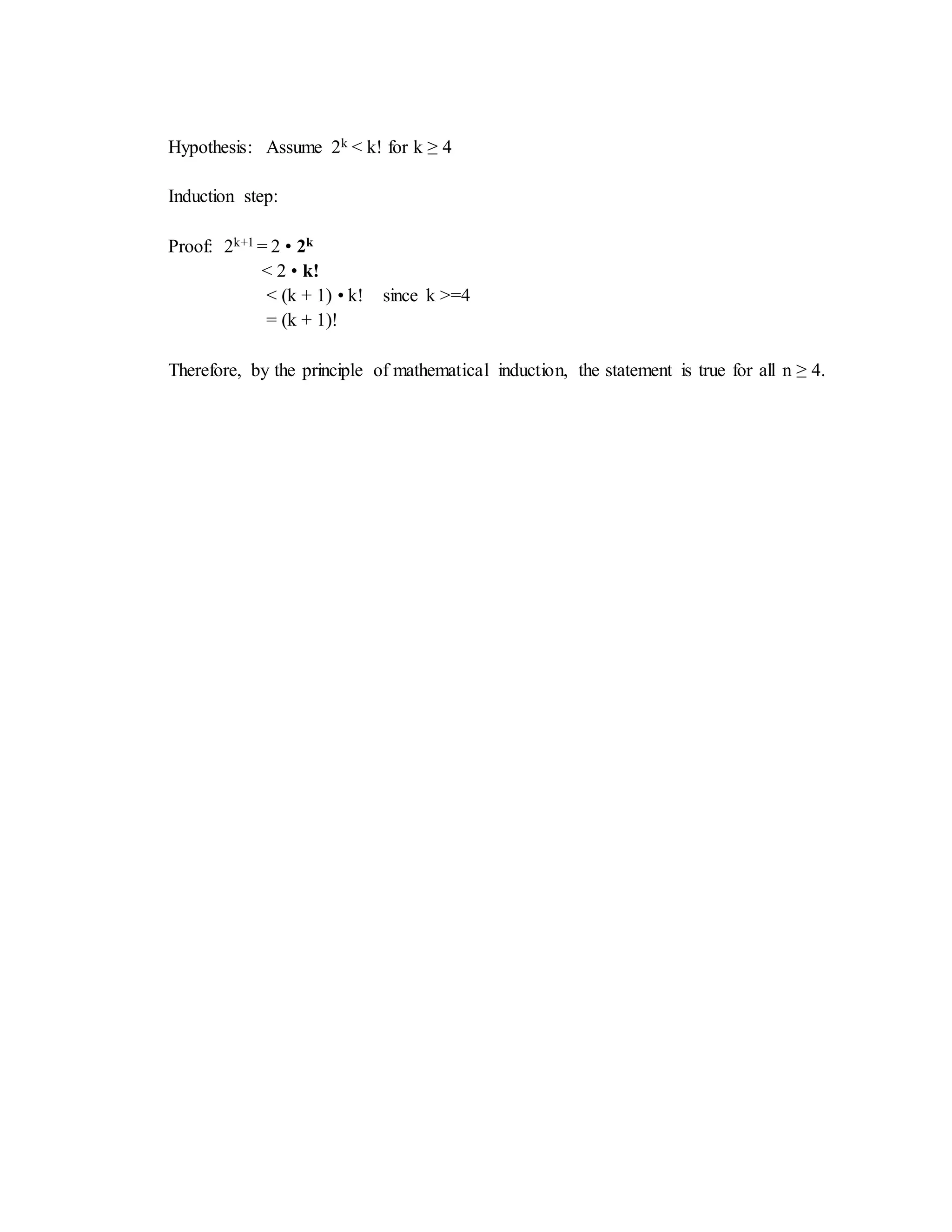
Hypothesis: Assume 2k < k! for k ≥ 4 
Induction step: 
Proof: 2k+1 = 2 • 2k 
< 2 • k! 
< (k + 1) • k! since k >=4 
= (k + 1)! 
Therefore, by the principle of mathematical induction, the statement is true for all n ≥ 4.

Sequence function

  • 1.
    SEQUENCE FUNCTION Sequence is a set of numbers written in a given order.  Function whose domain is the set of natural numbers and whose range is a subset of the real numbers  Terms are the numbers or values in the sequence Examples: 1. 1,2,3,4,5,6,...,n 2. 2,4,6,8,10,…,n 3. 5,10,15,20,…,n A Sequence Function as a function whose domain is a subset of positive integers. Example: A ball is dropped from the height of 10 feet. Each time that it bounces, it reaches a height that is half of its previous height. We can list the height to which the ball bounces in order until it finally comes to rest. After Bounce 2 4 6 5 8 Height (ft) 2 5 7 6 5 The numbers 2,4,6,8,10 form a sequence which is also an example of a sequence. It can be in a form of ordered pairs and we let x as the after bounce and y as the height. {(2,2),(4,5),(6,7),(5,6),(8,5)} Finite Sequence is a function whose domain is the set of integers and has the last term {1,2,3,…,n}. Infinite sequence is a list that continues without ends. Example: Identify whether the sequence is finite or infinite. 1. The first 5 natural numbers: 1, 2, 3 ,4, 5 2. The set of even whole numbers: 2, 4, 6, 8 , 10 ... 3. The multiples of 4 up to the number 40: 4, 8, 12, 16,…, 40. 4. The sequence of the multiples of 3: 3, 6, 9, 12... Solution: 1 and 3 are examples of finite sequence while the examples in 2 and 4 are infinite sequence. The 3 dots at the end of the infinite sequence indicates that the sequence goes on without stopping. FINDING THE TERM IN THE SEQUENCE  Sequence is usually denoted by their general or nth term. For example, 푡푛 = 푛 + 2 푛
  • 2.
    The equation provideshow we will be able to compute for the nth term of the sequence. To get the value of a specific term , replace n with the number of the term. For example: To get the first 3 terms of 푡푛 = 푛+2 푛 , replace n with 2,4 and 6. Solution: 푡푛 = 푛 + 2 푛 = 2 + 2 2 = 2 푡푛 = 푛 + 2 푛 = 4 + 2 2 = 3 푡푛 = 푛 + 2 푛 = 6 + 2 2 = 4 The domain of the sequence is the set {2,4,6}. The range is denoted as {2,3,4}. Example: 1. Find the first 5 terms of the sequence: 푡푛 = 2푛 − 3 The domain is the set {1, 2, 3, 4, 5} Substituting this into 푡푛 = 2푛 − 3, we have: 푡푛 = 2(1) − 3 = -1 푡푛 = 2(2) − 3 = 1 푡푛 = 2(3) − 3 = 3 푡푛 = 2(4) − 3 = 5 푡푛 = 2(5) − 3 = 7 The first 5 terms of the sequence 푡푛 = 2푛 − 3 is {-1,1,3,5,7} 2. Find the first 3 terms of the sequence: 푡푛 = 푛2 The domain is {1,2,3} Substituting this into 푡푛 = 푛2, we have: 푡푛 = 12 = 1 푡푛 = 22 = 4 푡푛 = 32 = 9
  • 3.
    The first 3terms of the sequence {1,4,9} FINDING THE GENERAL TERM When given the first few terms of the sequence, we can look at the pattern in order to obtain the next terms or a general statement regarding the nth term. Example: 1. Find the next term and describe the pattern. 1,4,9,16,25… The next term is 36. The terms are all squares. 1st Term 12= 1 2nd Term 22= 4 3rd Term 32= 9 4th Term 42= 16 5th Term 52= 25 6th Term 62= 36 SERIES  Series is the sum of the terms t1 + t2 + t3 + t4 +,…, + tn Note: The sum of the infinite sequence is an infinite series. A partial sum is the sum of the first n terms. A partial sum is also called the sum of finite series, and is denoted as sn , where n denotes the number of terms in the sum. For example: If 4, 7, 10, 13, 16, 19…. Is a sequence, then 4 + 7 + 10 + 13 + 16 +19 is the corresponding sum or series If only we want to get the sum of only 4 terms in the sequence, it is a partial sum written as S4 , which is equal to 4 + 7 + 10 + 13. Example: For the sequence 9, 13, 17, 21, 25, 29, 33, 37, find 1. S4 2. S1 Solution: 1. S4= 9+13+17+21 = 60 2. S1=9+13+17+21+25+29+33 = 147
  • 4.
    SIGMA NOTATION Use the symbol Σ, a capital sigma of the Greek alphabet which corresponds to the letter S.  The symbol i ,is called the index of summation.  Used as summation or the total sum of the sequence. Example: 1 5 Σ 푖 2 푖=1 = 12 + 22 + 32 + 42 + 52 What we have observed here is that, the i =1 is located under the sigma symbol. So, it indicates that the first term on the right-hand side is the value of i2 when i is equal to 1. The next terms are the values of i2 when i is 2,3,4 and 5. We stop here because in the upper sigma notation there is number 5. The sigma notation can be defined by the equation: 푛 Σ 퐹(푖) = 퐹(푚) + 퐹(푚 + 1) + 퐹(푚 + 2) + ⋯ + 퐹(푛) 푖=푚 Where m and n are integers and m ≤ n. The right hand sign of the equation consist of the sum of n – m + 1terms, the first of which is obtained by replacing i by m + 1 and so on until the last term is obtained.  The upper limit will be m  The lower limit will be n  The symbol i is the “dummy” symbol because any other symbol could be used without changing the right side. Example: 7 Σ 푖3 푖 =2 = 23 + 32 + 43 + 53 + 63 + 73 Sometimes the term of a sum involve subscripts . For instance the sum 푛1 + 푛2 + 푛3 + 푛4 + ⋯ + 푛푛 Can also be written in sigma notation 푛 Σ 푛푖 푖 =1
  • 5.
    A. For eachsequence, find the indicated partial sum. 1. 3,5,7,9,11…S5 2. 2,4,8,16,32…S7 3. 1,2,3,4,5,6,7,8,9,10,11,12,13,14,…,S6 4. 5,10,15,20,25,30,35,40,…,S7 B. Find the indicated term of the sequence. 1.푡푛 = 4푛 − 7: 푡5 2. 푡푛 = 4푛−2 3 : 푡6 3. 푡푛 = 5 + 2푛: 푡10 4. 푡푛 = 4푛 2 : 푡4 5. 푡푛 = 4(푛 − 7)2: 푡5 c. write the following in sigma notation 1. 2+4+6+8+10 2. 1+3+5+7+9+11+13+15+17 3. 52+62+72 4. 1+ 1 2 + 1 3 + 1 4 + 1 5 5. (n+1) + (n+2) +n+3)… (n+n) PRINCIPLE MATHEMATICAL INDUCTION Definition Let P(n) be a proposition on an integer variable n. Then P(n) is true for all integers n  s if and only if the following two conditions are both satisfied : (i) P(s) is true , ii) If P(k) , where k  s , is assumed to be true, then P(k 1) is true .
  • 6.
    Example: We usethe mathematical induction to prove that 1+3+5+7+….+(2n – 1) =n2 STEP 1. We apply that the formula is true for n = 1. If n = 1 then the formula becomes 1=12 1=1 which is true. STEP 2. Show that Pk is true. 1 + 3 + 5 + 7 + ⋯ + (2푘 − 1) = 푘2 If the equation 1 is true, then 1 + 3 + 5 + ⋯ + (2푘 − 1) + [2(푘 + 1) − 1] = (푘 + 1)2 This is also true. Then we add 2k +1 – 1 to the left side of the Equation 1 and its equivalent 2k+1 to the right side and we have: 1 + 3 + 5 + ⋯ + (2푘 − 1) + [2(푘 + 1) − 1] = 푘2 + (2푘 + 1) 1 + 3 + 5 + ⋯ + (2푘 − 1) + [2(푘 + 1) − 1] = (푘 + 1)2 Which is Equation 2. Example: Use mathematical induction to prove that n3 + 3n2 + 2n is divisible by 3 for n  1. Basis case: n = 1 n3 + 3n2 + 2n = 13 + 3 ·12 + 2·1 = 1 + 3 + 2 = 6 and 3 | 6. Hypothesis: Assume k3 + 3k2 (i.e. k3 + 3k2 + 2k = 3s for some integer s.) Induction step: (k + 1) 3 + 3(k + 1)2 + 2(k + 1) = (k3 + 3k2 + 3k + 1) + 3(k2 + 2k + 1) + 2(k + 1) = (k3 + 3k2 + 2k) + k + 1 + 3k2 + 6k + 3 + 2k + 2 = 3s + 3k2 + 9k + 6 hypothesis and algebra = 3s + 3(k2 + 3k + 2) factoring = 3[s + k2 + 3k + 2] factoring Therefore 3 | [(k + 1)3 + 3(k + 1)2 + 2(k + 1)]. Therefore, by the principle of mathematical induction, the statement is true for all n. Example: Use mathematical induction to prove that 2n < n! for n ≥ 4 Basis: n = 4 lhs 24 = 16 rhs 4! = 24 Since 16 < 24 the basis holds.
  • 7.
    Hypothesis: Assume 2k< k! for k ≥ 4 Induction step: Proof: 2k+1 = 2 • 2k < 2 • k! < (k + 1) • k! since k >=4 = (k + 1)! Therefore, by the principle of mathematical induction, the statement is true for all n ≥ 4.