Open Access Publishing :
 Moving from Hype to
       Practice
                  Steven Mandeville-Gamble
  Associate University Librarian for Collections and Scholarly
                        Communication
   Society of Scholarly Publishing Conference, May 27, 2009
Outline
n   How is open access viewed by librarians
n   How is open access publishing being taken up
    by professional librarians in general and
    collection development librarians in particular.
n   Practical issues as librarians move from hype to
    practice
n   Scholarly Communication efforts in Libraries:
    the librarian as publisher
Open Access: Views of the
                   Librarian(s)
n   The library literature and water cooler conversations
    reflect a range of opinions regarding open access
    n   Salvation from the serial crisis
         n   Peter Suber’ article “
                         s         Removing the Barriers to Research: an
             introduction to Open Access for Librarians”(College & Research
             Libraries News, 64 (February 2003) pp. 92-94, 113).
    n   Cautious optimism
    n   Open-minded skepticism
    n   The Doubters
How are Librarians working with
        Open Access Content

n   Some librarians/libraries have suggested
    spending a specific percentage of their
    collections budgets to support open access
    initiatives
    n   E.g. David W. Lewis, Dean of the IUPUI University
        Library and Vice President of Scholarly
        Communication, article “Library Budgets, Open
        Access, and the Future of Scholarly
        Communication”(IUPUI ScholarWorks, 2007. URI:
        http://idea.iupui.edu/dspace/handle/1805/1167)
How are Librarians working with
        Open Access Content

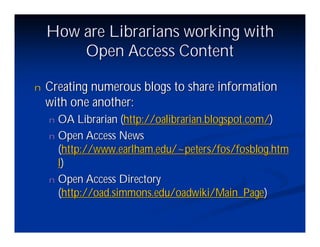
n   Creating numerous blogs to share information
    with one another:
    n OA Librarian (http://oalibrarian.blogspot.com/)
    n Open Access News
      (http://www.earlham.edu/~peters/fos/fosblog.htm
      l)
    n Open Access Directory
      (http://oad.simmons.edu/oadwiki/Main_Page)
How are Librarians working with
        Open Access Content

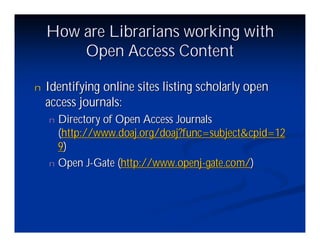
n   Identifying online sites listing scholarly open
    access journals:
    n Directory of Open Access Journals
      (http://www.doaj.org/doaj?func=subject&cpid=12
      9)
    n Open J-Gate (http://www.openj-gate.com/)
How are Librarians working with
        Open Access Content

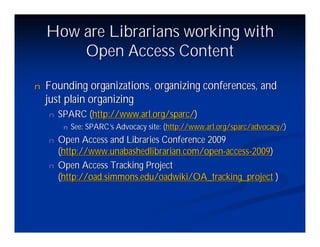
n   Founding organizations, organizing conferences, and
    just plain organizing
    n   SPARC (http://www.arl.org/sparc/)
         n   See: SPARC’ Advocacy site: (http://www.arl.org/sparc/advocacy/)
                       s
    n   Open Access and Libraries Conference 2009
        (http://www.unabashedlibrarian.com/open-access-2009)
    n   Open Access Tracking Project
        (http://oad.simmons.edu/oadwiki/OA_tracking_project )
How are Librarians working with
        Open Access Content

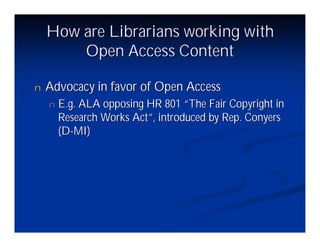
n   Advocacy in favor of Open Access
    n   E.g. ALA opposing HR 801 “ Fair Copyright in
                                   The
        Research Works Act” introduced by Rep. Conyers
                           ,
        (D-MI)
How are Librarians working with
        Open Access Content

n   What are librarians NOT doing?
    n Not cancelling paid subscription journals in favor of
      open access journals
    n Not by-and-large choosing open access journals as
      opposed to paid subscription journals based on open
      access model alone, though there is some pressure to
      do so. (See Stanford’ Faculty Senate Resolution)
                           s
Issues
n   Discovery and selection of content
n   Professional/Academic attitudes towards Open
    Access content
n   Longevity/durability of content
n   Long-term access to content
One Library’ Response to the Issues
           s
n   At GWU, we are evaluating all content, open
    access or otherwise, in terms of its
    scholarly/resource content
    n Working with the Collection Development staff on
      how to identify open access content
    n Working towards methodologies to evaluate OA
      journals in terms of scholarly content
One Library’ Response to the Issues
           s
n   At GWU, we are describing open access content
    in such a way as to be able to make it
    discoverable
    n   Developing automated processes to import and
        create catalog records for items in the DOAJ
One Library’ Response to the Issues
           s
n   We are implementing policies and procedures -
    such as joining the LOCKSS Alliance and
    PORTICO - to make that content available to
    our researchers regardless of what happens to
    the creators of the content.
One Library’ Response to the Issues
           s
n   We are working with the faculty to explain the
    difference between open access and peer review
    n Faculty Senate Committee on Research
    n Faculty Senate Committee on Libraries
One Library’ Response to the Issues
           s
n   We are treating open access content as additive
    to instead of as a replacement for our current
    subscription-based journals
n   Continuing to pay for subscriptions to Open
    Access journals if their for-pay interfaces are
    superior/meet the needs of our researchers
Scholarly Communication and Open
         Access Publishing
n    The role of Scholarly Communication units in
    libraries on the open access landscape varies
    greatly
n   Institutional Repository vs. “Roach Motel”
n   Open Access Publisher vs. “   Boutique
    operations”
Conclusion(s)
n   Libraries and librarians are moving from the hype of open access
    towards implementation/ adoption / accommodation
n   Most are feeling their way as they go and sharing their experience
    with others (Blind leading the blind? Or The one-eyed leading
    the blind?)
n   Not endangering traditional publishers IF those publishers sell
    services not content
n   As Prosser and Ayris have indicated, if libraries shun their roles
    as leaders of the open access movement, we will find ourselves
    sidelined
    n   Prosser, David and Paul Ayris. “ACRL/SPARC Forum explores open
        access models: the future of scholarly publishing”(C&RL News, Vol. 68,
        no. 9 (September 2007))
Conclusion(s)
n   Ultimately, publishers may have to heed the
    admonitions of John H. Graham, President and
    Chief Executive Officer of the American society
    of Association Executives, who exhorted society
    publishers to stop charging for the content and
    instead figure out ways to charge for value-
    added services. (“Fear Factor: Membership retention. How has the
    Electronic Age affected Society membership?”Allen Press Seminar Keynote
    Speech, April 17, 2008)

Seminar4.3

  • 1.
    Open Access Publishing: Moving from Hype to Practice Steven Mandeville-Gamble Associate University Librarian for Collections and Scholarly Communication Society of Scholarly Publishing Conference, May 27, 2009
  • 2.
    Outline n How is open access viewed by librarians n How is open access publishing being taken up by professional librarians in general and collection development librarians in particular. n Practical issues as librarians move from hype to practice n Scholarly Communication efforts in Libraries: the librarian as publisher
  • 3.
    Open Access: Viewsof the Librarian(s) n The library literature and water cooler conversations reflect a range of opinions regarding open access n Salvation from the serial crisis n Peter Suber’ article “ s Removing the Barriers to Research: an introduction to Open Access for Librarians”(College & Research Libraries News, 64 (February 2003) pp. 92-94, 113). n Cautious optimism n Open-minded skepticism n The Doubters
  • 4.
    How are Librariansworking with Open Access Content n Some librarians/libraries have suggested spending a specific percentage of their collections budgets to support open access initiatives n E.g. David W. Lewis, Dean of the IUPUI University Library and Vice President of Scholarly Communication, article “Library Budgets, Open Access, and the Future of Scholarly Communication”(IUPUI ScholarWorks, 2007. URI: http://idea.iupui.edu/dspace/handle/1805/1167)
  • 5.
    How are Librariansworking with Open Access Content n Creating numerous blogs to share information with one another: n OA Librarian (http://oalibrarian.blogspot.com/) n Open Access News (http://www.earlham.edu/~peters/fos/fosblog.htm l) n Open Access Directory (http://oad.simmons.edu/oadwiki/Main_Page)
  • 6.
    How are Librariansworking with Open Access Content n Identifying online sites listing scholarly open access journals: n Directory of Open Access Journals (http://www.doaj.org/doaj?func=subject&cpid=12 9) n Open J-Gate (http://www.openj-gate.com/)
  • 7.
    How are Librariansworking with Open Access Content n Founding organizations, organizing conferences, and just plain organizing n SPARC (http://www.arl.org/sparc/) n See: SPARC’ Advocacy site: (http://www.arl.org/sparc/advocacy/) s n Open Access and Libraries Conference 2009 (http://www.unabashedlibrarian.com/open-access-2009) n Open Access Tracking Project (http://oad.simmons.edu/oadwiki/OA_tracking_project )
  • 8.
    How are Librariansworking with Open Access Content n Advocacy in favor of Open Access n E.g. ALA opposing HR 801 “ Fair Copyright in The Research Works Act” introduced by Rep. Conyers , (D-MI)
  • 9.
    How are Librariansworking with Open Access Content n What are librarians NOT doing? n Not cancelling paid subscription journals in favor of open access journals n Not by-and-large choosing open access journals as opposed to paid subscription journals based on open access model alone, though there is some pressure to do so. (See Stanford’ Faculty Senate Resolution) s
  • 10.
    Issues n Discovery and selection of content n Professional/Academic attitudes towards Open Access content n Longevity/durability of content n Long-term access to content
  • 11.
    One Library’ Responseto the Issues s n At GWU, we are evaluating all content, open access or otherwise, in terms of its scholarly/resource content n Working with the Collection Development staff on how to identify open access content n Working towards methodologies to evaluate OA journals in terms of scholarly content
  • 12.
    One Library’ Responseto the Issues s n At GWU, we are describing open access content in such a way as to be able to make it discoverable n Developing automated processes to import and create catalog records for items in the DOAJ
  • 13.
    One Library’ Responseto the Issues s n We are implementing policies and procedures - such as joining the LOCKSS Alliance and PORTICO - to make that content available to our researchers regardless of what happens to the creators of the content.
  • 14.
    One Library’ Responseto the Issues s n We are working with the faculty to explain the difference between open access and peer review n Faculty Senate Committee on Research n Faculty Senate Committee on Libraries
  • 15.
    One Library’ Responseto the Issues s n We are treating open access content as additive to instead of as a replacement for our current subscription-based journals n Continuing to pay for subscriptions to Open Access journals if their for-pay interfaces are superior/meet the needs of our researchers
  • 16.
    Scholarly Communication andOpen Access Publishing n The role of Scholarly Communication units in libraries on the open access landscape varies greatly n Institutional Repository vs. “Roach Motel” n Open Access Publisher vs. “ Boutique operations”
  • 17.
    Conclusion(s) n Libraries and librarians are moving from the hype of open access towards implementation/ adoption / accommodation n Most are feeling their way as they go and sharing their experience with others (Blind leading the blind? Or The one-eyed leading the blind?) n Not endangering traditional publishers IF those publishers sell services not content n As Prosser and Ayris have indicated, if libraries shun their roles as leaders of the open access movement, we will find ourselves sidelined n Prosser, David and Paul Ayris. “ACRL/SPARC Forum explores open access models: the future of scholarly publishing”(C&RL News, Vol. 68, no. 9 (September 2007))
  • 18.
    Conclusion(s) n Ultimately, publishers may have to heed the admonitions of John H. Graham, President and Chief Executive Officer of the American society of Association Executives, who exhorted society publishers to stop charging for the content and instead figure out ways to charge for value- added services. (“Fear Factor: Membership retention. How has the Electronic Age affected Society membership?”Allen Press Seminar Keynote Speech, April 17, 2008)