Open Access
Lisa Kruesi
Scholarly Publishing and Digitisation Service
June 2013
Session
• Introduction to Open Access (OA)
• Situation at UQ
– eSpace & green OA
• How to find more about OA
• Who to contact at UQ Library for help
Open Access Logo: Art designer at PLoS, modified by Wikipedia users Nina, Beao, and JakobVoss
http://en.wikipedia.org/wiki/Open_access
Open Access (OA) Definition
• OA literature is digital, free of most copyright and licensing
restrictions
• Focus on peer-reviewed scholarly journal articles via Internet
• There are two different ways of obtaining open accessibility to
scientific research results: Green and Gold.
• Open access is also increasingly being provided to data, books
and book chapters, conference papers, theses, working papers
and preprints.
• Open content is similar to OA, but may include the right to modify
the work
• While open access relies on the consent of copyright holders to
share their work, making material open access will not deprive
copyright holders of any rights. Copyright laws still apply.
1. "Open Access." Wikipedia: The Free Encyclopedia. Wikimedia Foundation, Inc. 18 June 2012. Web 3 September 2012. available:
http://en.wikipedia.org/wiki/Open_access
2. Suber, Peter. Open Access. Cambridge, MA: MIT Press, 2012
Open Access (OA) Definition
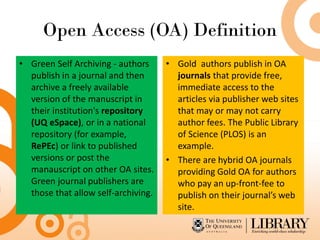
• Green Self Archiving - authors
publish in a journal and then
archive a freely available
version of the manuscript in
their institution's repository
(UQ eSpace), or in a national
repository (for example,
RePEc) or link to published
versions or post the
manauscript on other OA sites.
Green journal publishers are
those that allow self-archiving.
• Gold authors publish in OA
journals that provide free,
immediate access to the
articles via publisher web sites
that may or may not carry
author fees. The Public Library
of Science (PLOS) is an
example.
• There are hybrid OA journals
providing Gold OA for authors
who pay an up-front-fee to
publish on their journal’s web
site.
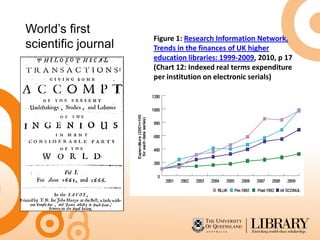
World’s first
scientific journal
Figure 1: Research Information Network.
Trends in the finances of UK higher
education libraries: 1999-2009, 2010, p 17
(Chart 12: Indexed real terms expenditure
per institution on electronic serials)
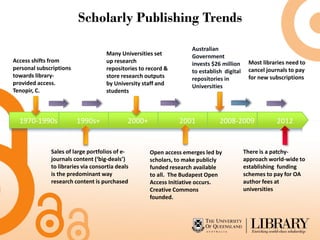
1990s+ 2000+ 2001 2008-20091970-1990s 2012
Access shifts from
personal subscriptions
towards library-
provided access.
Tenopir, C.
Many Universities set
up research
repositories to record &
store research outputs
by University staff and
students
Most libraries need to
cancel journals to pay
for new subscriptions
Sales of large portfolios of e-
journals content (‘big-deals’)
to libraries via consortia deals
is the predominant way
research content is purchased
Open access emerges led by
scholars, to make publicly
funded research available
to all. The Budapest Open
Access Initiative occurs.
Creative Commons
founded.
There is a patchy-
approach world-wide to
establishing funding
schemes to pay for OA
author fees at
universities
Scholarly Publishing Trends
Australian
Government
invests $26 million
to establish digital
repositories in
Universities
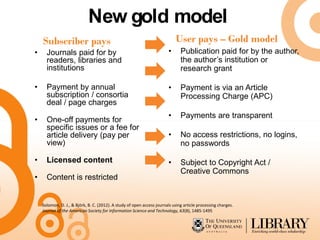
New gold model
Subscriber pays
• Journals paid for by
readers, libraries and
institutions
• Payment by annual
subscription / consortia
deal / page charges
• One-off payments for
specific issues or a fee for
article delivery (pay per
view)
• Licensed content
• Content is restricted
User pays – Gold model
• Publication paid for by the author,
the author’s institution or
research grant
• Payment is via an Article
Processing Charge (APC)
• Payments are transparent
• No access restrictions, no logins,
no passwords
• Subject to Copyright Act /
Creative Commons
Solomon, D. J., & Björk, B. C. (2012). A study of open access journals using article processing charges.
Journal of the American Society for Information Science and Technology, 63(8), 1485-1495
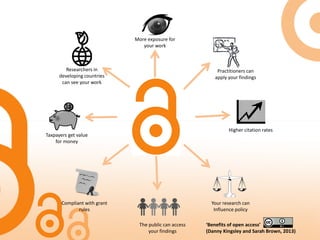
Researchers in
developing countries
can see your work
More exposure for
your work
Practitioners can
apply your findings
Higher citation rates
Your research can
Influence policy
The public can access
your findings
Compliant with grant
rules
Taxpayers get value
for money
‘Benefits of open access’
(Danny Kingsley and Sarah Brown, 2013)
Independent of OA
• Journals can be more open or less open. But
there degree of openness is independent from
their:
*Impact, *Prestige, *Quality of Peer
Review, *Peer Review Methodology
*Sustainability, *Effect on Tenure &
Promotion *Article Quality
Taken from: HowOpenIsIt:http://www.plos.org/wp-
content/uploads/2012/10/OAS_English_web.pdf
Where to publish
Identifying publishing opportunities
• Decide early (before drafting the paper). Look for a journal and then write the
paper
• Look for journals that have published in your discipline area
• Consider journals that have published work you cite
• Audience – who will read your article?
• Prestige – does the journal appear on the ERA journal listings?
• Predatory Publishers List
• Checklist for evaluation
• Access – will you publish in an open access journal?
• Impact – refers to how often a journal’s content is cited by other authors,
thereby giving an indication of the influence of a publication.
• Likelihood of acceptance – top tier v’s less prestigious journals
• Does it cost to publish in the journal?
• More details: Fact Sheet 8 Where to Publish Your Journal Article and the
Open Access Spectrum (OAS) HowOpenIsIt Guide
Open Access – library website
www.library.uq.edu.au/open-access
Addendum
• All OA journals and 70% non-OA journals
allow authors to self archive their peer
reviewed post prints - for the remaining
journals an authors addendum can be used
to vary the terms of a publication agreement
• UQ Addendum on the UQ Library OA website
• NHMRC Addendum
Mandates
• UK Wellcome Trust and the Research
Councils (2006)
• US National Institute of Health (2007)
• Australia National Health and Medical
Research Council (2012)
• ARC (2013)
• European Union (2014)
Australian Research Council
• New policy as of 1 January 2013
– any publications arising from an ARC supported
research project must be deposited into an open
access institutional repository within a twelve (12)
month period from the date of publication.
– http://www.arc.gov.au/applicants/open_access.htm (slide attribution http://www.information-
online.com.au/pdf/Tuesday_Concurrent_4_1445_Callan.pdf )
14
Any publications?
• Yes, all publications – including books
15
Any grant?
• No. The policy relates to Funding Rules
and Agreements released after 1 January
2013. It will not be applied
retrospectively to pre-existing Funding
Rules and Agreements.
(slide attribution http://www.information-online.com.au/pdf/Tuesday_Concurrent_4_1445_Callan.pdf )
Compliance
• If material cannot be included in a repository, then a
justification must be provided in Final Report.
• It can be the author’s accepted manuscript version
(Word doc) after peer review or the publisher’s
formatted/copy-edited version that is deposited.
• If the material is publicly accessible via a publisher’s
website or service such as RePEc, then it is sufficient to
deposit just the metadata in the institutional repository
and link to the OA fulltext.
• The grant identification number must be included when
the material (or metadata) is deposited in an IR.
http://www.nhmrc.gov.au/grants/policy/dissemination-research-findings (Slide attribution:
http://www.information-online.com.au/pdf/Tuesday_Concurrent_4_1445_Callan.pdf)
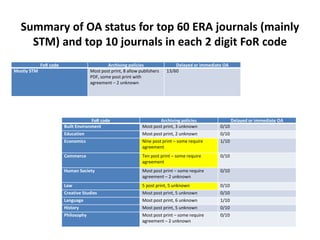
Summary of OA status for top 60 ERA journals (mainly
STM) and top 10 journals in each 2 digit FoR code
FoR code Archiving policies Delayed or immediate OA
Mostly STM Most post print, 8 allow publishers
PDF, some post print with
agreement – 2 unknown
13/60
FoR code Archiving policies Delayed or immediate OA
Built Environment Most post print, 3 unknown 0/10
Education Most post print, 2 unknown 0/10
Economics Nine post print – some require
agreement
1/10
Commerce Ten post print – some require
agreement
0/10
Human Society Most post print – some require
agreement – 2 unknown
0/10
Law 5 post print, 5 unknown 0/10
Creative Studies Most post print, 5 unknown 0/10
Language Most post print, 6 unknown 1/10
History Most post print, 5 unknown 0/10
Philosophy Most post print – some require
agreement – 2 unknown
0/10
UQ Pilot
• An OA pilot will be managed by the UQ Library and the
Office of the DVC(R), working with three UQ Schools or
Institutes, covering different disciplinary areas, over three
months
• The pilot will commence mid-July 2013
• Pilot will seek to:
– Ensure UQ compliance with NHMRC and ARC mandates (already
in effect)
– Encourage self-archiving of researcher publications in eSpace
– Establish efficient workflows and centralised support that
minimises compliance overhead for researchers
– Negotiate UQ-specific agreements with key publishers (e.g.,
Elsevier), to facilitate bulk deposits to eSpace
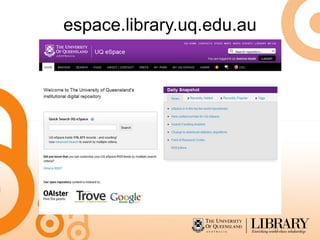
What is UQ eSpace?
• A place to record and showcase UQ research
publications, raising visibility and accessibility
• An institutional repository for:
– open access publications
– other digitised materials such as photographs,
audio, videos, manuscripts and other original works
– UQ Research Higher Degree Theses + some others
• The single authoritative source for the
publication outputs of UQ internal systems such
as Q-Index and UQ Researchers (and those
currently under development)
• Provides data for reporting requirements such as
ERA and HERDC
espace.library.uq.edu.au
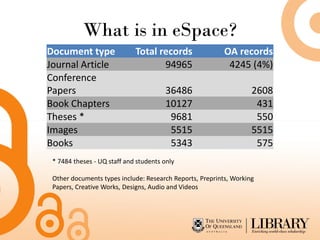
What is in eSpace?
Document type Total records OA records
Journal Article 94965 4245 (4%)
Conference
Papers 36486 2608
Book Chapters 10127 431
Theses * 9681 550
Images 5515 5515
Books 5343 575
* 7484 theses - UQ staff and students only
Other documents types include: Research Reports, Preprints, Working
Papers, Creative Works, Designs, Audio and Videos
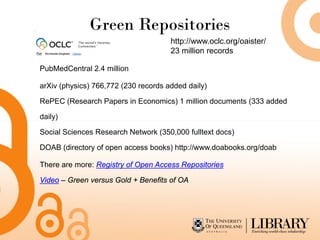
Green Repositories
PubMedCentral 2.4 million
arXiv (physics) 766,772 (230 records added daily)
RePEC (Research Papers in Economics) 1 million documents (333 added
daily)
Social Sciences Research Network (350,000 fulltext docs)
DOAB (directory of open access books) http://www.doabooks.org/doab
There are more: Registry of Open Access Repositories
Video – Green versus Gold + Benefits of OA
http://www.oclc.org/oaister/
23 million records
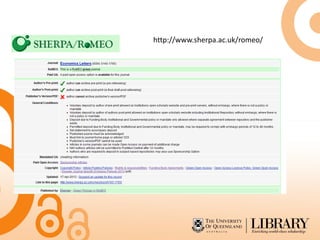
http://www.sherpa.ac.uk/romeo/
Need to know more?
• Prof Matthew Brown’s videos:
Part 1: Importance of Open Access to Discovery
• Series of Scholarly Publishing Videos including Open Access
• Vanity Publishing & Predatory Publishers List – OMICS case
example
• Save the date:
Wednesday 30 October 2013,
Eminent Speaker Forum – Prof Alma Swan,
10-11.00 am lecture
“Is Open Access just another fad?”
• Open Access Week October 21-25, 2013
Who to contact
• Copyright questions
• eSpace questions
• General enquiries
• Lisa Kruesi, Andrew Heath & Helen Morgan
The Future
It is predicted that Gold OA will account for
50 percent of the scholarly journal articles
sometime between 2017 and 2021, and 90
percent of articles as soon as 2020 and
more conservatively by 2025.
Lewis, D. W. (2012) The Inevitability of Open Access, College & Research Libraries, 73(5), 493-506
It won't be easy, and it won't be inexpensive, but
it is only a matter of time.
For the Sake of Inquiry and Knowledge — The Inevitability of Open Access Ann J. Wolpert, M.L.S.
N Engl J Med 2013; 368:785-787February 28, 2013DOI: 10.1056/NEJMp1211410
Take home conclusions
• Encourage green OA by depositing manuscript in
eSpace
• Processes to deposit in UQ eSpace are under
development
• Refer to Sherpa Romeo & Library Catalogue for details
on the embargo period
• We wish to learn from your open access publishing
experience
• Contact us for advice & assistance

Open access talk 25 June 2013

  • 1.
    Open Access Lisa Kruesi ScholarlyPublishing and Digitisation Service June 2013
  • 2.
    Session • Introduction toOpen Access (OA) • Situation at UQ – eSpace & green OA • How to find more about OA • Who to contact at UQ Library for help Open Access Logo: Art designer at PLoS, modified by Wikipedia users Nina, Beao, and JakobVoss http://en.wikipedia.org/wiki/Open_access
  • 3.
    Open Access (OA)Definition • OA literature is digital, free of most copyright and licensing restrictions • Focus on peer-reviewed scholarly journal articles via Internet • There are two different ways of obtaining open accessibility to scientific research results: Green and Gold. • Open access is also increasingly being provided to data, books and book chapters, conference papers, theses, working papers and preprints. • Open content is similar to OA, but may include the right to modify the work • While open access relies on the consent of copyright holders to share their work, making material open access will not deprive copyright holders of any rights. Copyright laws still apply. 1. "Open Access." Wikipedia: The Free Encyclopedia. Wikimedia Foundation, Inc. 18 June 2012. Web 3 September 2012. available: http://en.wikipedia.org/wiki/Open_access 2. Suber, Peter. Open Access. Cambridge, MA: MIT Press, 2012
  • 4.
    Open Access (OA)Definition • Green Self Archiving - authors publish in a journal and then archive a freely available version of the manuscript in their institution's repository (UQ eSpace), or in a national repository (for example, RePEc) or link to published versions or post the manauscript on other OA sites. Green journal publishers are those that allow self-archiving. • Gold authors publish in OA journals that provide free, immediate access to the articles via publisher web sites that may or may not carry author fees. The Public Library of Science (PLOS) is an example. • There are hybrid OA journals providing Gold OA for authors who pay an up-front-fee to publish on their journal’s web site.
  • 5.
    World’s first scientific journal Figure1: Research Information Network. Trends in the finances of UK higher education libraries: 1999-2009, 2010, p 17 (Chart 12: Indexed real terms expenditure per institution on electronic serials)
  • 6.
    1990s+ 2000+ 20012008-20091970-1990s 2012 Access shifts from personal subscriptions towards library- provided access. Tenopir, C. Many Universities set up research repositories to record & store research outputs by University staff and students Most libraries need to cancel journals to pay for new subscriptions Sales of large portfolios of e- journals content (‘big-deals’) to libraries via consortia deals is the predominant way research content is purchased Open access emerges led by scholars, to make publicly funded research available to all. The Budapest Open Access Initiative occurs. Creative Commons founded. There is a patchy- approach world-wide to establishing funding schemes to pay for OA author fees at universities Scholarly Publishing Trends Australian Government invests $26 million to establish digital repositories in Universities
  • 7.
    New gold model Subscriberpays • Journals paid for by readers, libraries and institutions • Payment by annual subscription / consortia deal / page charges • One-off payments for specific issues or a fee for article delivery (pay per view) • Licensed content • Content is restricted User pays – Gold model • Publication paid for by the author, the author’s institution or research grant • Payment is via an Article Processing Charge (APC) • Payments are transparent • No access restrictions, no logins, no passwords • Subject to Copyright Act / Creative Commons Solomon, D. J., & Björk, B. C. (2012). A study of open access journals using article processing charges. Journal of the American Society for Information Science and Technology, 63(8), 1485-1495
  • 8.
    Researchers in developing countries cansee your work More exposure for your work Practitioners can apply your findings Higher citation rates Your research can Influence policy The public can access your findings Compliant with grant rules Taxpayers get value for money ‘Benefits of open access’ (Danny Kingsley and Sarah Brown, 2013)
  • 9.
    Independent of OA •Journals can be more open or less open. But there degree of openness is independent from their: *Impact, *Prestige, *Quality of Peer Review, *Peer Review Methodology *Sustainability, *Effect on Tenure & Promotion *Article Quality Taken from: HowOpenIsIt:http://www.plos.org/wp- content/uploads/2012/10/OAS_English_web.pdf
  • 10.
    Where to publish Identifyingpublishing opportunities • Decide early (before drafting the paper). Look for a journal and then write the paper • Look for journals that have published in your discipline area • Consider journals that have published work you cite • Audience – who will read your article? • Prestige – does the journal appear on the ERA journal listings? • Predatory Publishers List • Checklist for evaluation • Access – will you publish in an open access journal? • Impact – refers to how often a journal’s content is cited by other authors, thereby giving an indication of the influence of a publication. • Likelihood of acceptance – top tier v’s less prestigious journals • Does it cost to publish in the journal? • More details: Fact Sheet 8 Where to Publish Your Journal Article and the Open Access Spectrum (OAS) HowOpenIsIt Guide
  • 11.
    Open Access –library website www.library.uq.edu.au/open-access
  • 12.
    Addendum • All OAjournals and 70% non-OA journals allow authors to self archive their peer reviewed post prints - for the remaining journals an authors addendum can be used to vary the terms of a publication agreement • UQ Addendum on the UQ Library OA website • NHMRC Addendum
  • 13.
    Mandates • UK WellcomeTrust and the Research Councils (2006) • US National Institute of Health (2007) • Australia National Health and Medical Research Council (2012) • ARC (2013) • European Union (2014)
  • 14.
    Australian Research Council •New policy as of 1 January 2013 – any publications arising from an ARC supported research project must be deposited into an open access institutional repository within a twelve (12) month period from the date of publication. – http://www.arc.gov.au/applicants/open_access.htm (slide attribution http://www.information- online.com.au/pdf/Tuesday_Concurrent_4_1445_Callan.pdf ) 14
  • 15.
    Any publications? • Yes,all publications – including books 15 Any grant? • No. The policy relates to Funding Rules and Agreements released after 1 January 2013. It will not be applied retrospectively to pre-existing Funding Rules and Agreements. (slide attribution http://www.information-online.com.au/pdf/Tuesday_Concurrent_4_1445_Callan.pdf )
  • 16.
    Compliance • If materialcannot be included in a repository, then a justification must be provided in Final Report. • It can be the author’s accepted manuscript version (Word doc) after peer review or the publisher’s formatted/copy-edited version that is deposited. • If the material is publicly accessible via a publisher’s website or service such as RePEc, then it is sufficient to deposit just the metadata in the institutional repository and link to the OA fulltext. • The grant identification number must be included when the material (or metadata) is deposited in an IR. http://www.nhmrc.gov.au/grants/policy/dissemination-research-findings (Slide attribution: http://www.information-online.com.au/pdf/Tuesday_Concurrent_4_1445_Callan.pdf)
  • 17.
    Summary of OAstatus for top 60 ERA journals (mainly STM) and top 10 journals in each 2 digit FoR code FoR code Archiving policies Delayed or immediate OA Mostly STM Most post print, 8 allow publishers PDF, some post print with agreement – 2 unknown 13/60 FoR code Archiving policies Delayed or immediate OA Built Environment Most post print, 3 unknown 0/10 Education Most post print, 2 unknown 0/10 Economics Nine post print – some require agreement 1/10 Commerce Ten post print – some require agreement 0/10 Human Society Most post print – some require agreement – 2 unknown 0/10 Law 5 post print, 5 unknown 0/10 Creative Studies Most post print, 5 unknown 0/10 Language Most post print, 6 unknown 1/10 History Most post print, 5 unknown 0/10 Philosophy Most post print – some require agreement – 2 unknown 0/10
  • 18.
    UQ Pilot • AnOA pilot will be managed by the UQ Library and the Office of the DVC(R), working with three UQ Schools or Institutes, covering different disciplinary areas, over three months • The pilot will commence mid-July 2013 • Pilot will seek to: – Ensure UQ compliance with NHMRC and ARC mandates (already in effect) – Encourage self-archiving of researcher publications in eSpace – Establish efficient workflows and centralised support that minimises compliance overhead for researchers – Negotiate UQ-specific agreements with key publishers (e.g., Elsevier), to facilitate bulk deposits to eSpace
  • 19.
    What is UQeSpace? • A place to record and showcase UQ research publications, raising visibility and accessibility • An institutional repository for: – open access publications – other digitised materials such as photographs, audio, videos, manuscripts and other original works – UQ Research Higher Degree Theses + some others • The single authoritative source for the publication outputs of UQ internal systems such as Q-Index and UQ Researchers (and those currently under development) • Provides data for reporting requirements such as ERA and HERDC
  • 20.
  • 21.
    What is ineSpace? Document type Total records OA records Journal Article 94965 4245 (4%) Conference Papers 36486 2608 Book Chapters 10127 431 Theses * 9681 550 Images 5515 5515 Books 5343 575 * 7484 theses - UQ staff and students only Other documents types include: Research Reports, Preprints, Working Papers, Creative Works, Designs, Audio and Videos
  • 22.
    Green Repositories PubMedCentral 2.4million arXiv (physics) 766,772 (230 records added daily) RePEC (Research Papers in Economics) 1 million documents (333 added daily) Social Sciences Research Network (350,000 fulltext docs) DOAB (directory of open access books) http://www.doabooks.org/doab There are more: Registry of Open Access Repositories Video – Green versus Gold + Benefits of OA http://www.oclc.org/oaister/ 23 million records
  • 23.
  • 24.
    Need to knowmore? • Prof Matthew Brown’s videos: Part 1: Importance of Open Access to Discovery • Series of Scholarly Publishing Videos including Open Access • Vanity Publishing & Predatory Publishers List – OMICS case example • Save the date: Wednesday 30 October 2013, Eminent Speaker Forum – Prof Alma Swan, 10-11.00 am lecture “Is Open Access just another fad?” • Open Access Week October 21-25, 2013
  • 25.
    Who to contact •Copyright questions • eSpace questions • General enquiries • Lisa Kruesi, Andrew Heath & Helen Morgan
  • 26.
    The Future It ispredicted that Gold OA will account for 50 percent of the scholarly journal articles sometime between 2017 and 2021, and 90 percent of articles as soon as 2020 and more conservatively by 2025. Lewis, D. W. (2012) The Inevitability of Open Access, College & Research Libraries, 73(5), 493-506 It won't be easy, and it won't be inexpensive, but it is only a matter of time. For the Sake of Inquiry and Knowledge — The Inevitability of Open Access Ann J. Wolpert, M.L.S. N Engl J Med 2013; 368:785-787February 28, 2013DOI: 10.1056/NEJMp1211410
  • 27.
    Take home conclusions •Encourage green OA by depositing manuscript in eSpace • Processes to deposit in UQ eSpace are under development • Refer to Sherpa Romeo & Library Catalogue for details on the embargo period • We wish to learn from your open access publishing experience • Contact us for advice & assistance