SELLING SKILLS


   TRAINING
Teachers open

  the door.

     
 You enter

 by yourself.

 Chinese Proverb
 Chinese Proverb
Customer

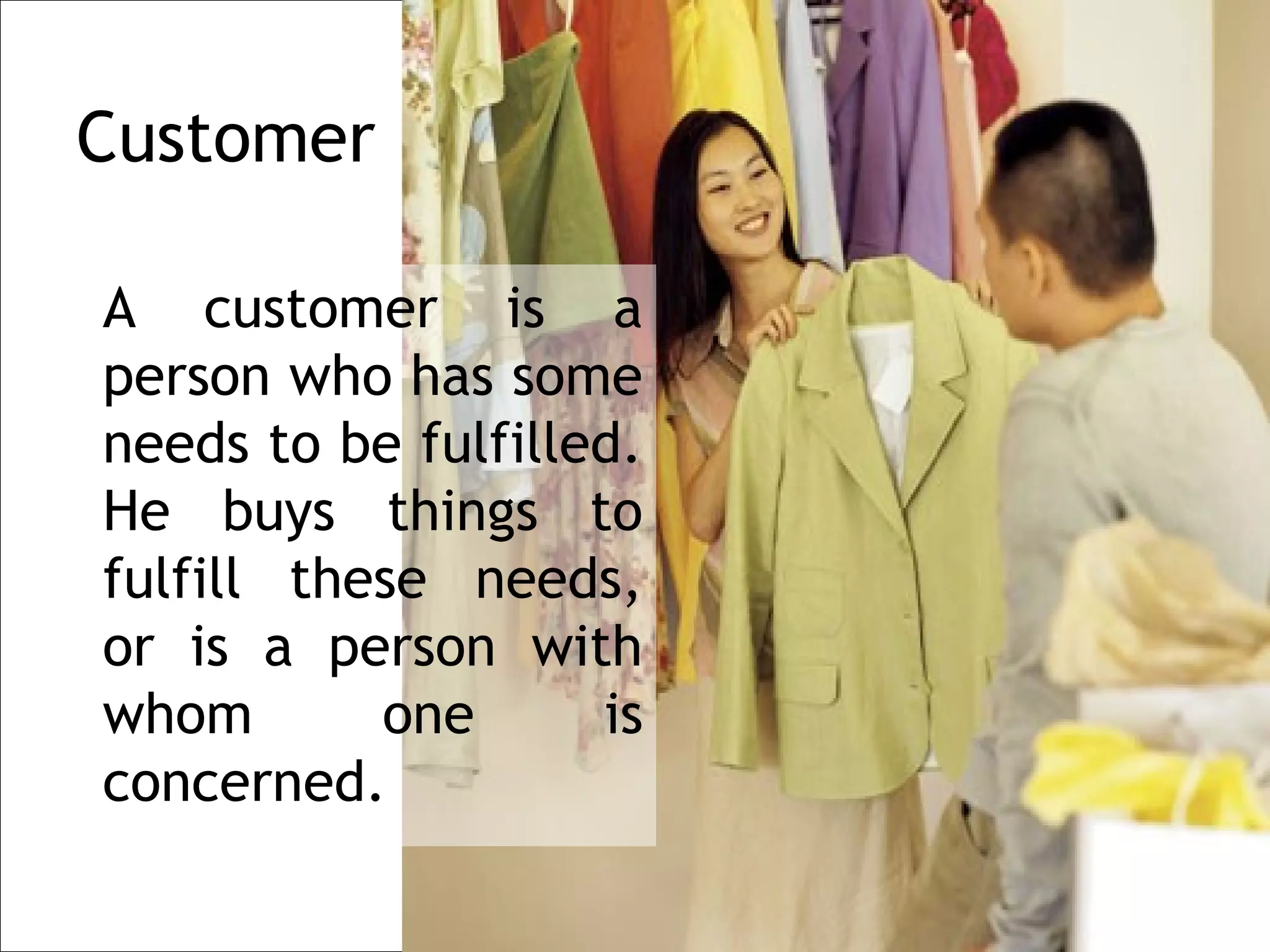
A customer is a
person who has some
needs to be fulfilled.
He buys things to
fulfill these needs,
or is a person with
whom       one      is
concerned.
Product
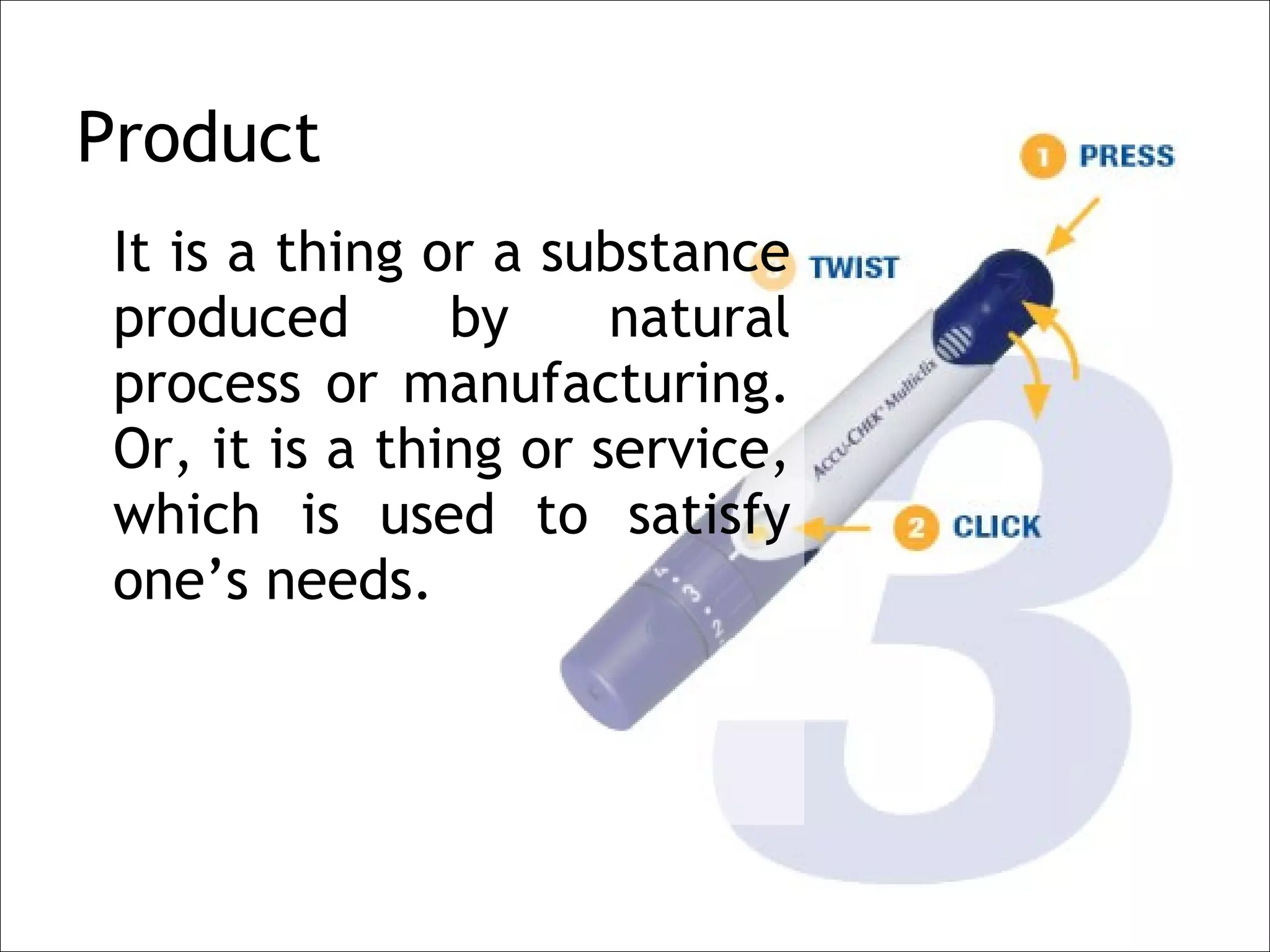
 It is a thing or a substance
 produced       by     natural
 process or manufacturing.
 Or, it is a thing or service,
 which is used to satisfy
 one’s needs.
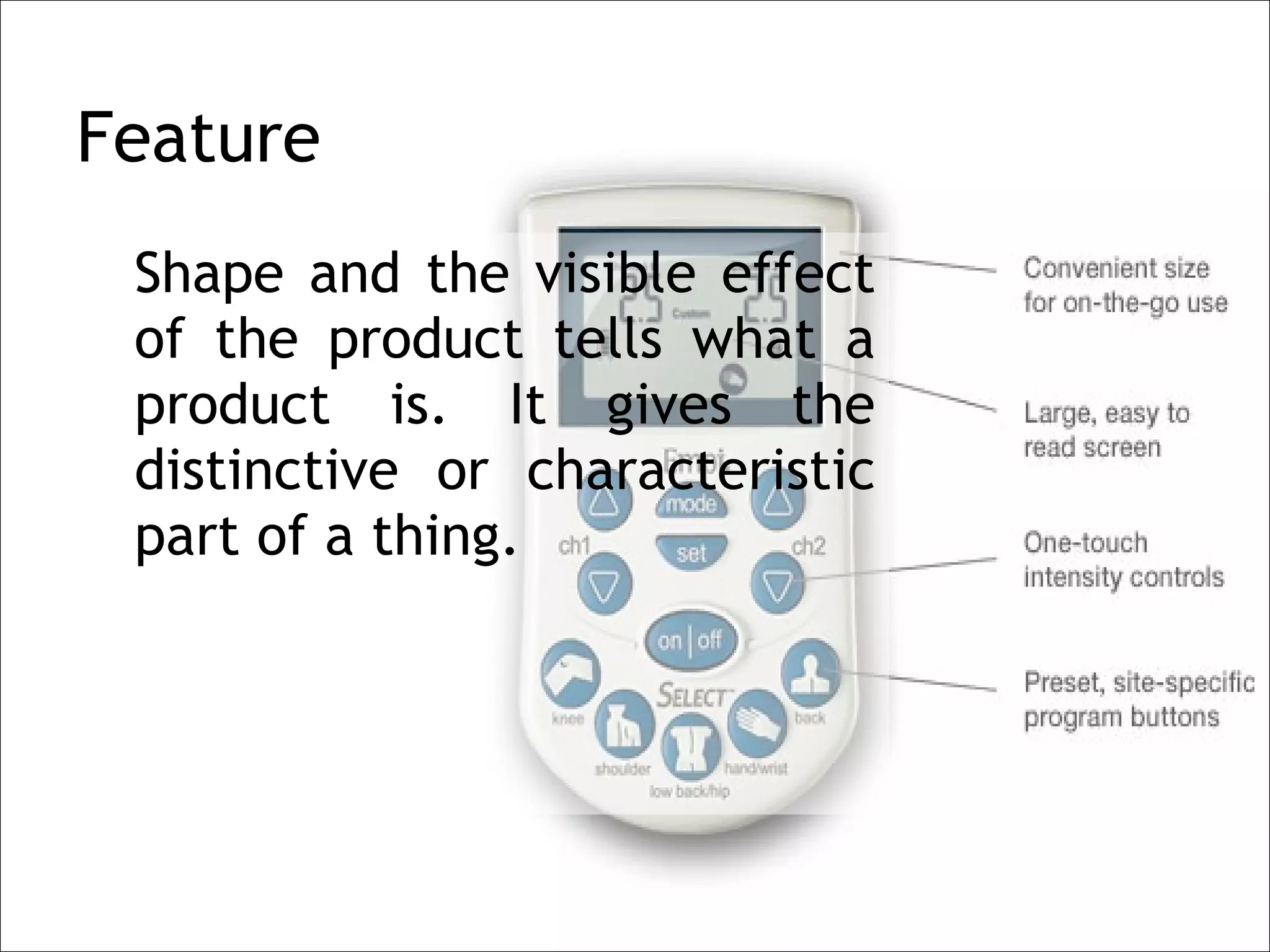
Feature
 Shape and the visible effect
 of the product tells what a
 product is. It gives the
 distinctive or characteristic
 part of a thing.
Benefit

 It is the advantage
 which the product
 provides. What the
 product does
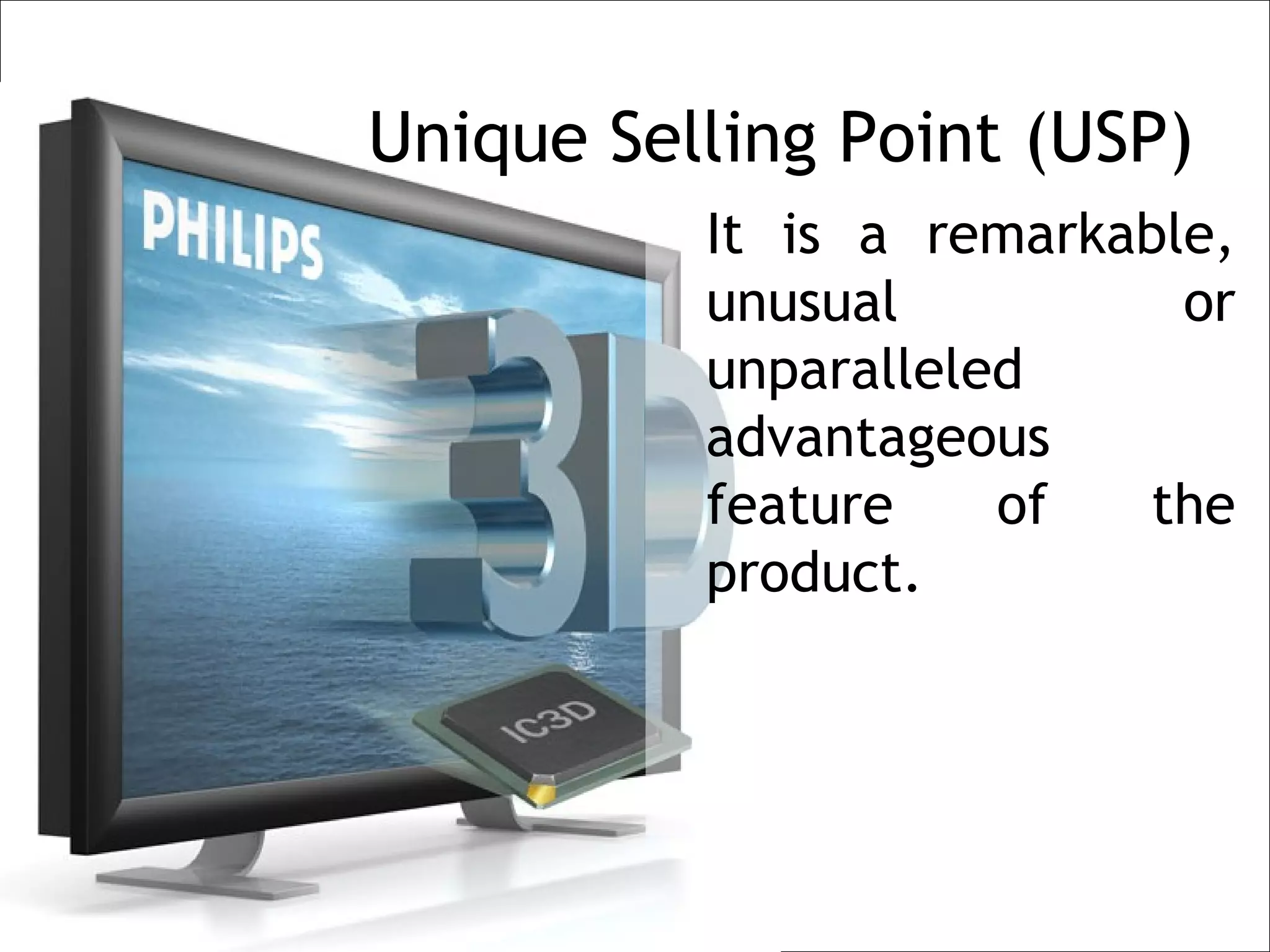
Unique Selling Point (USP)
          It is a remarkable,
          unusual          or
          unparalleled
          advantageous
          feature    of  the
          product.
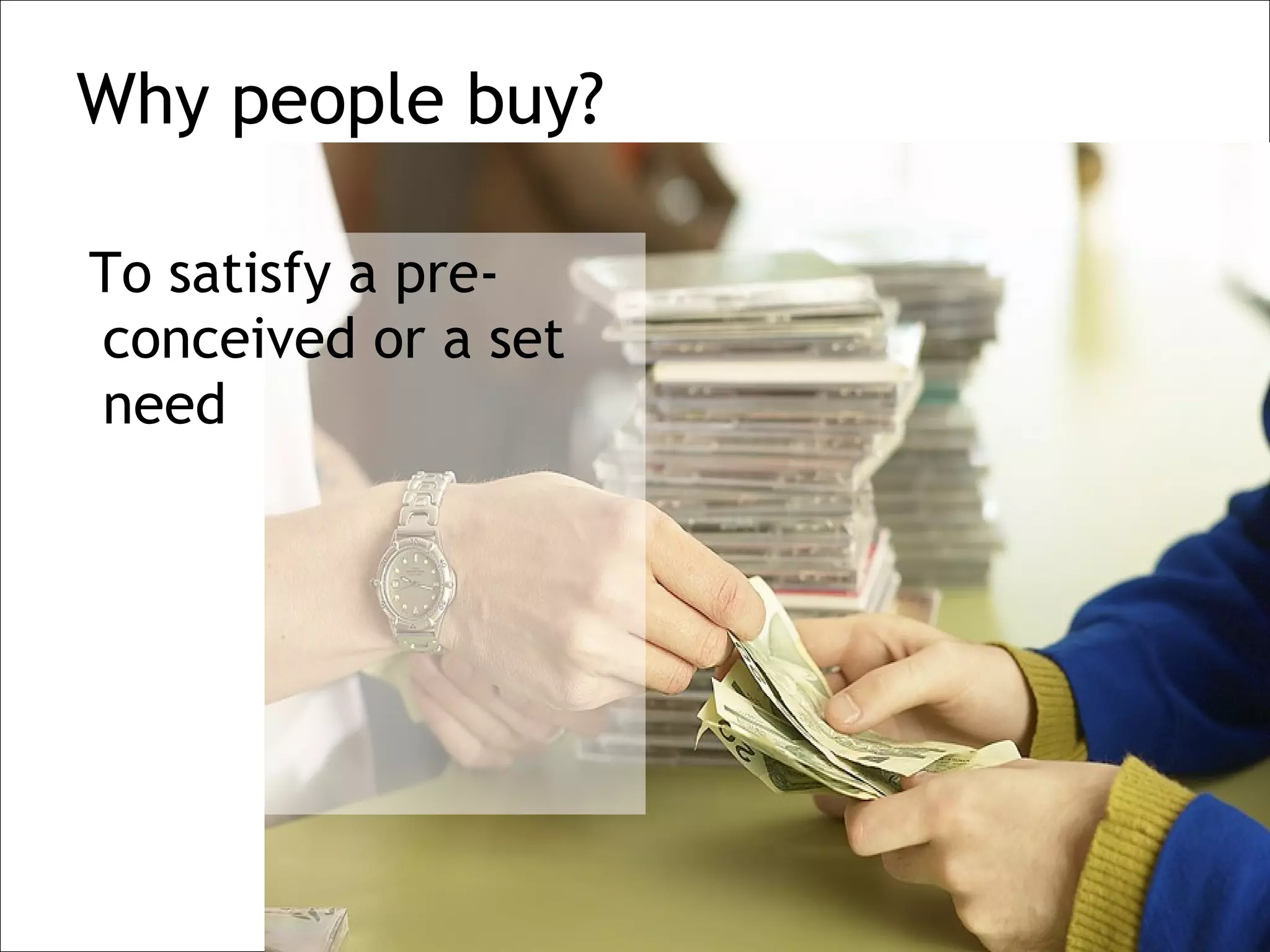
Why people buy?

To satisfy a pre-
conceived or a set
need
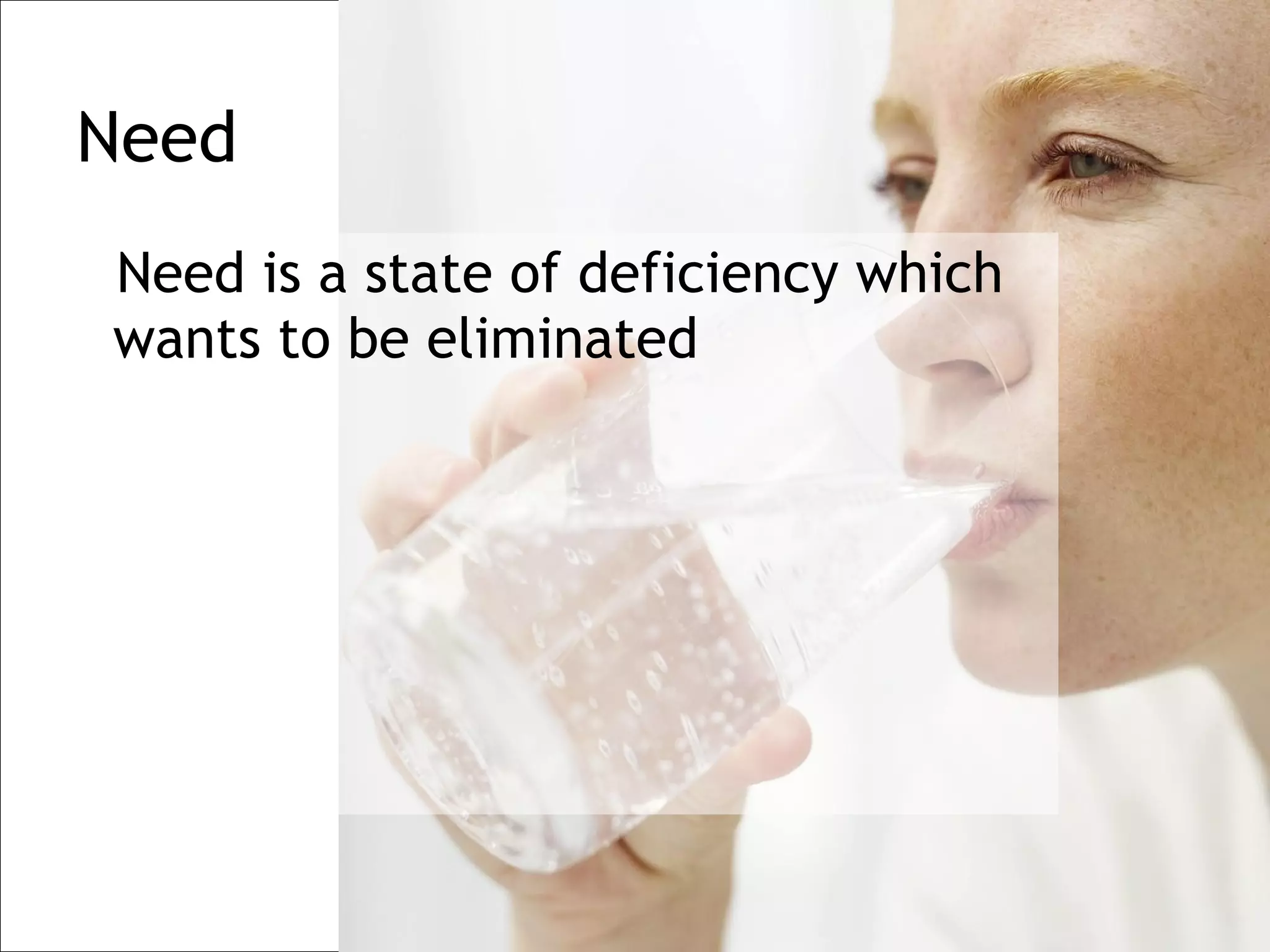
Need
Need is a state of deficiency which
wants to be eliminated
Motive

 Motive is a factor or circumstance
 that induces a person to act in order
 to satisfy the need for a while.
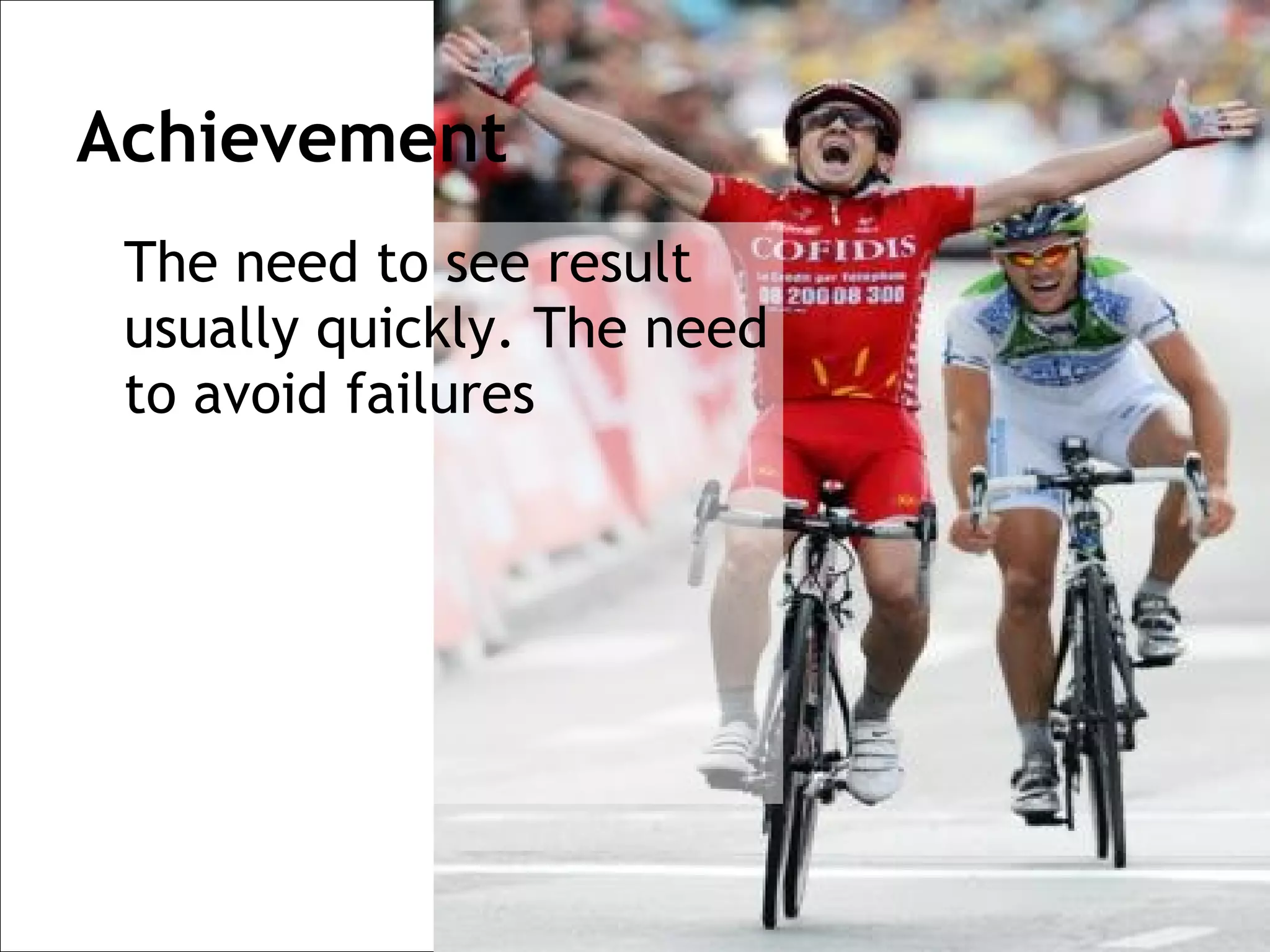
Achievement
 The need to see result
 usually quickly. The need
 to avoid failures
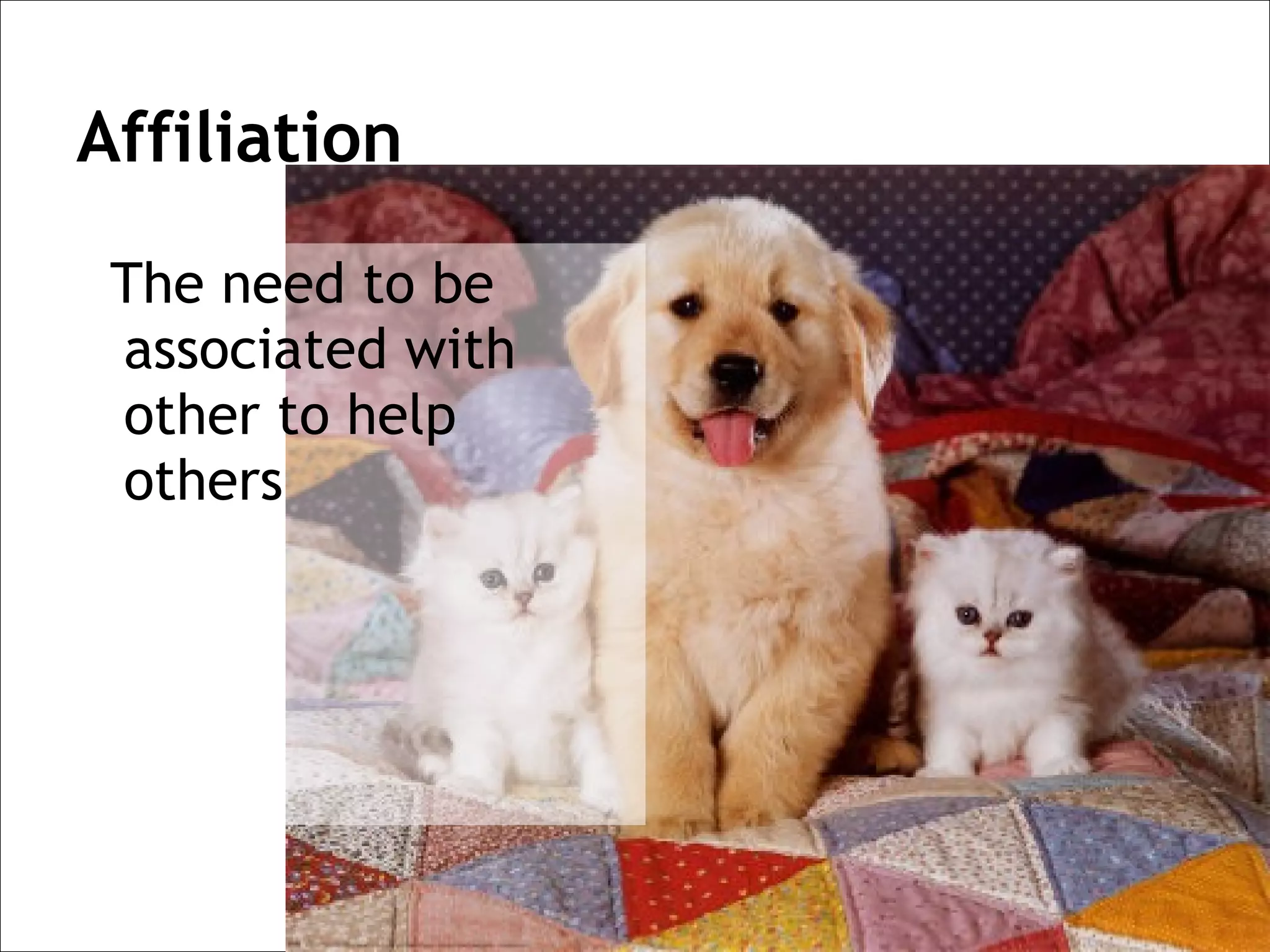
Affiliation

 The need to be
 associated with
 other to help
 others
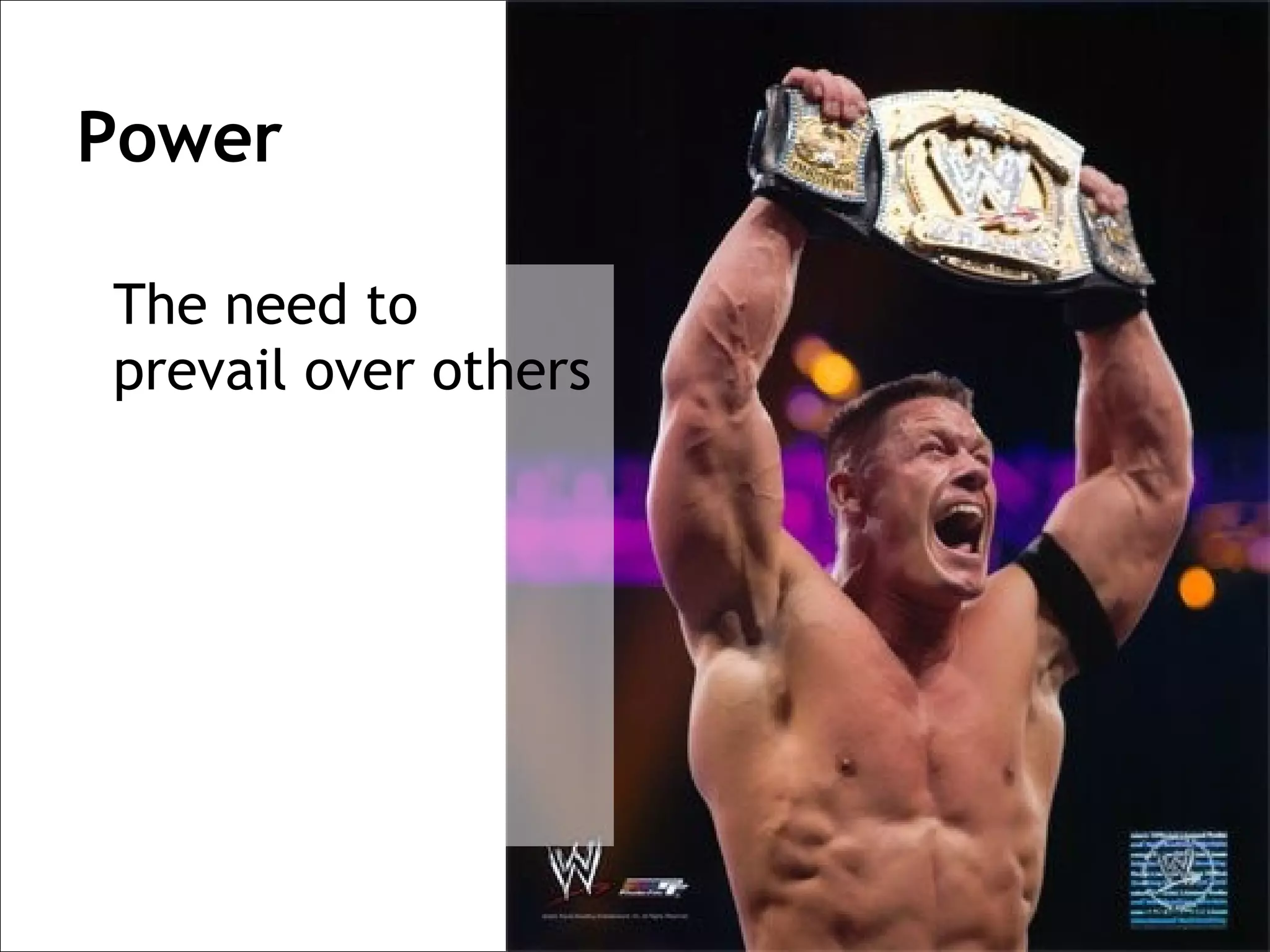
Power

The need to
prevail over others
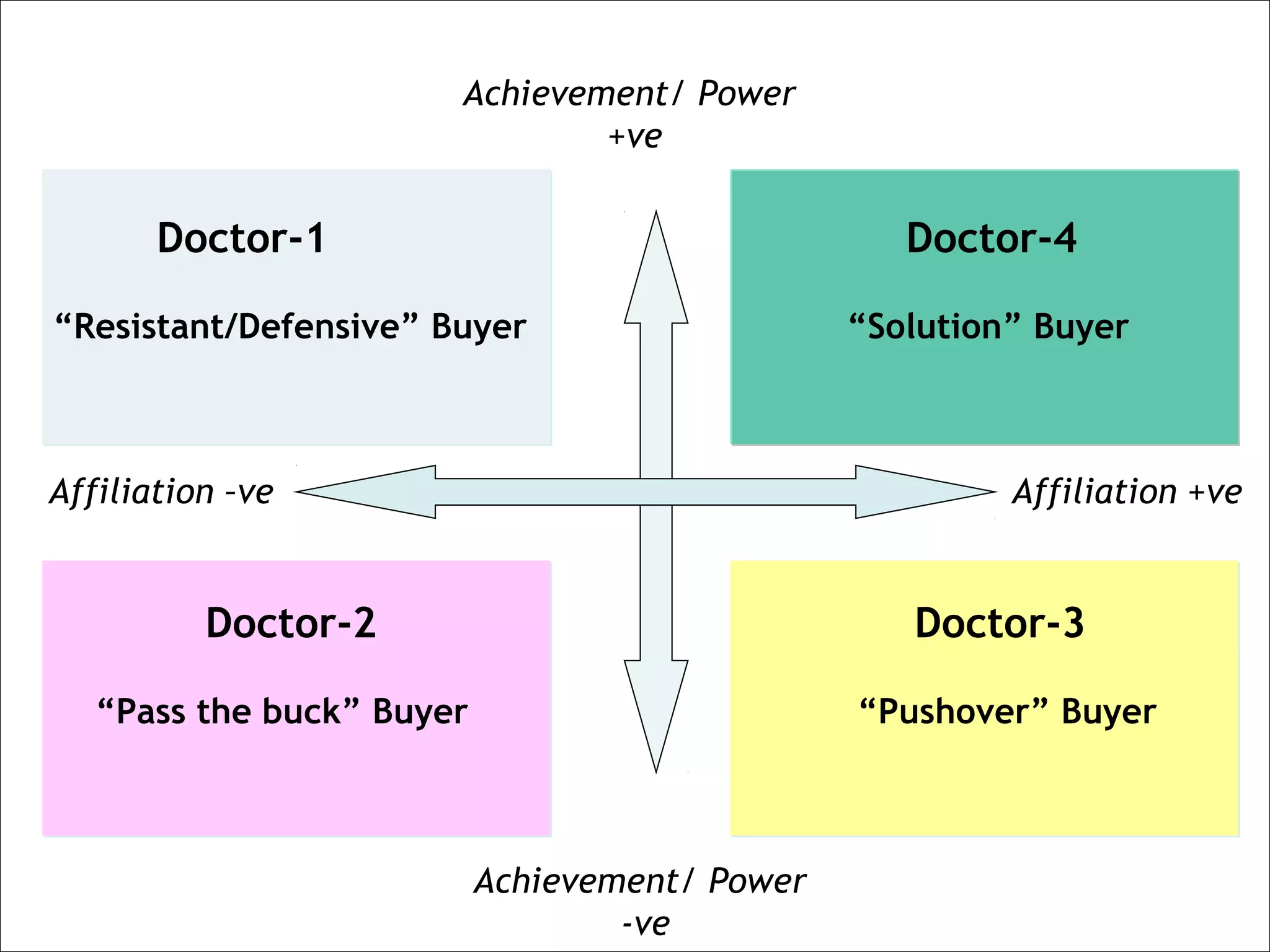
Because achievement and power
are often present together, we can
group these to build a matrix of
buyer motives.
Achievement/ Power
                               +ve
                                 
       Doctor-1                                    Doctor-4
                                     
“Resistant/Defensive” Buyer                     “Solution” Buyer


Affiliation –ve                                          Affiliation +ve

                                     
          Doctor-2                                 Doctor-3
                                     
   “Pass the buck” Buyer                        “Pushover” Buyer


                           Achievement/ Power
                                   -ve
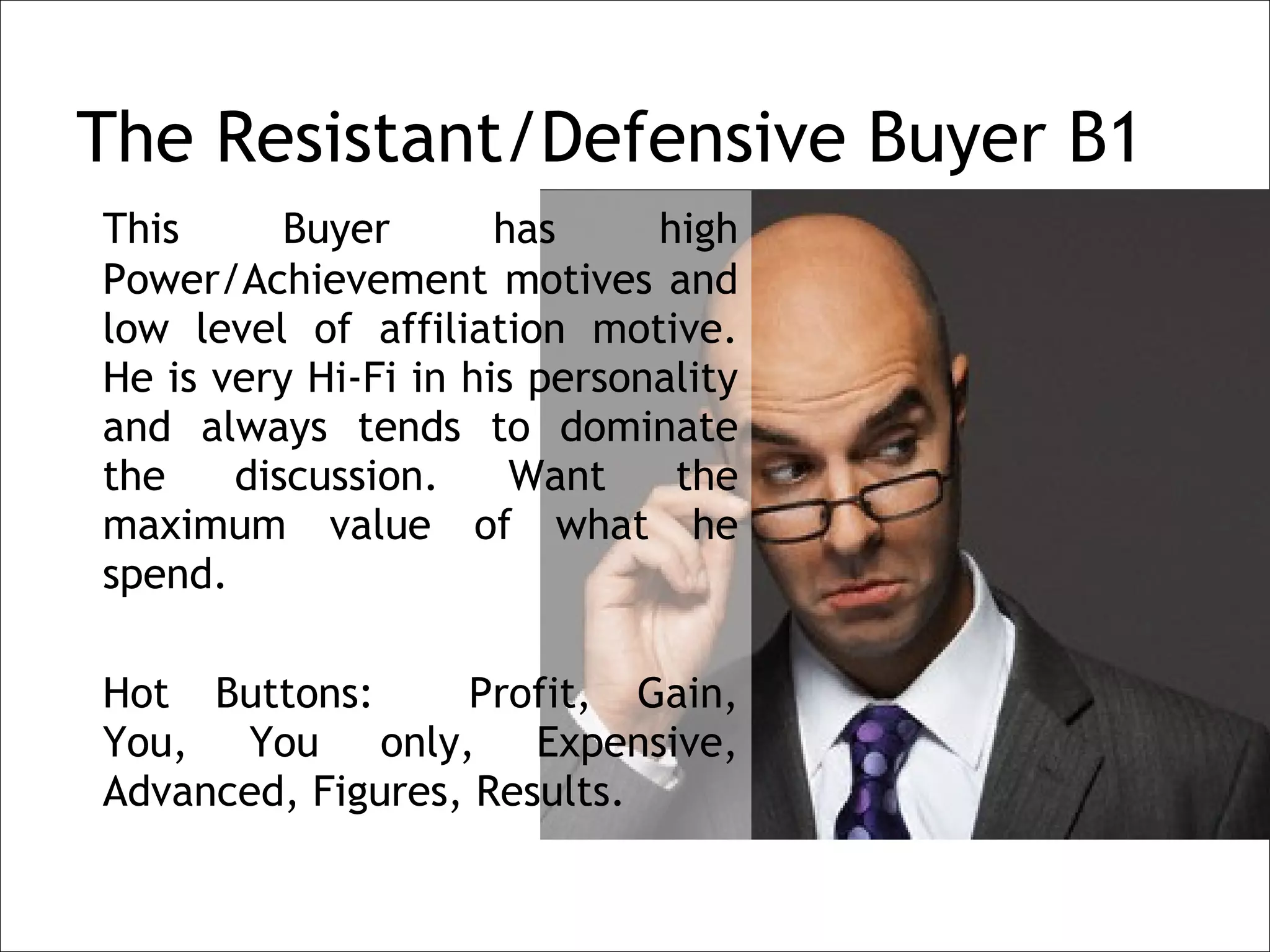
The Resistant/Defensive Buyer B1
    This      Buyer       has     high
    Power/Achievement motives and
    low level of affiliation motive.
    He is very Hi-Fi in his personality
    and always tends to dominate
    the    discussion.     Want    the
    maximum value of what he
    spend.
 
    Hot Buttons:      Profit, Gain,
    You, You only, Expensive,
    Advanced, Figures, Results.
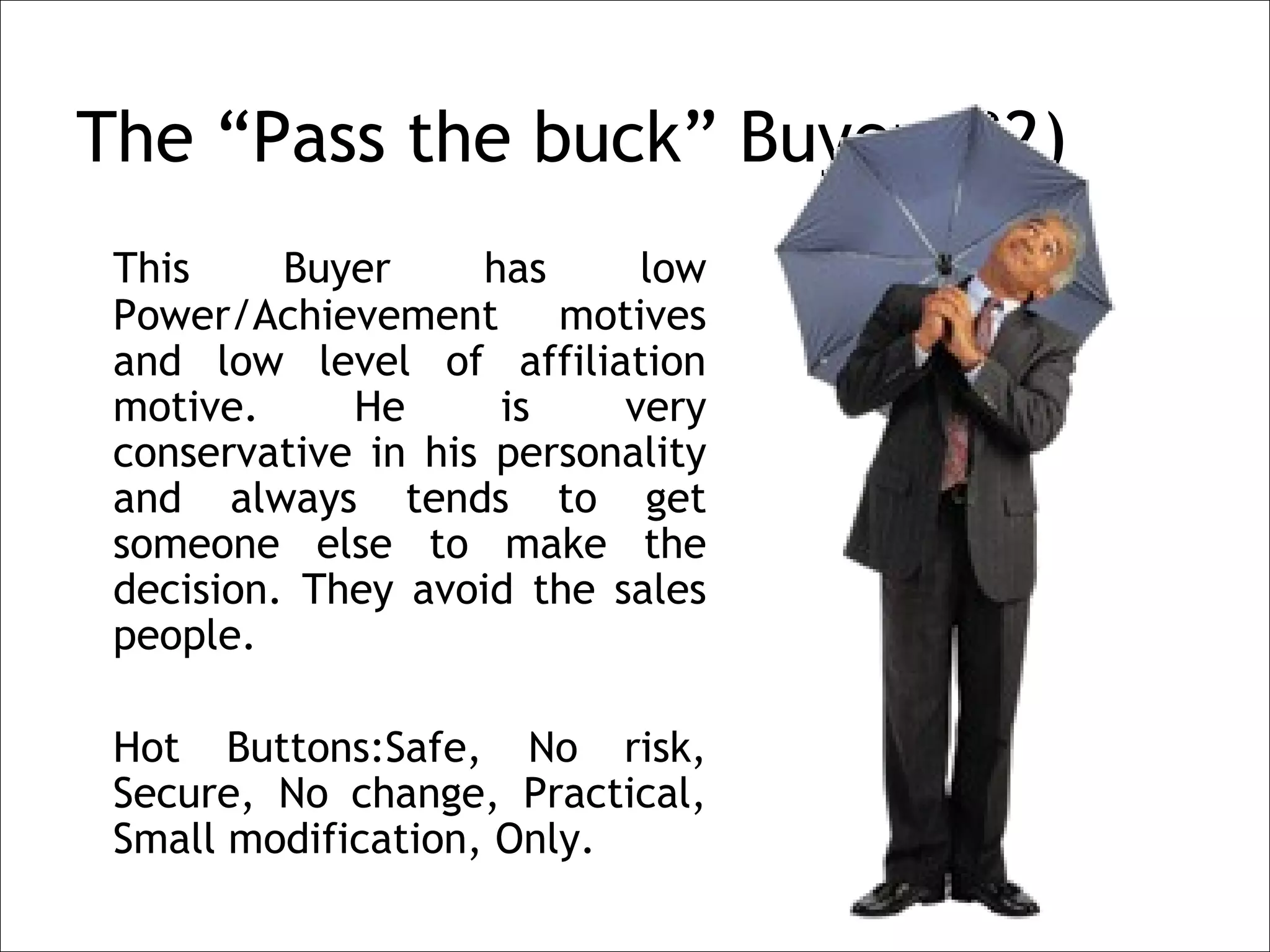
The “Pass the buck” Buyer (B2)
    This     Buyer     has     low
    Power/Achievement motives
    and low level of affiliation
    motive.     He      is    very
    conservative in his personality
    and always tends to get
    someone else to make the
    decision. They avoid the sales
    people.
 
    Hot Buttons:Safe, No risk,
    Secure, No change, Practical,
    Small modification, Only.
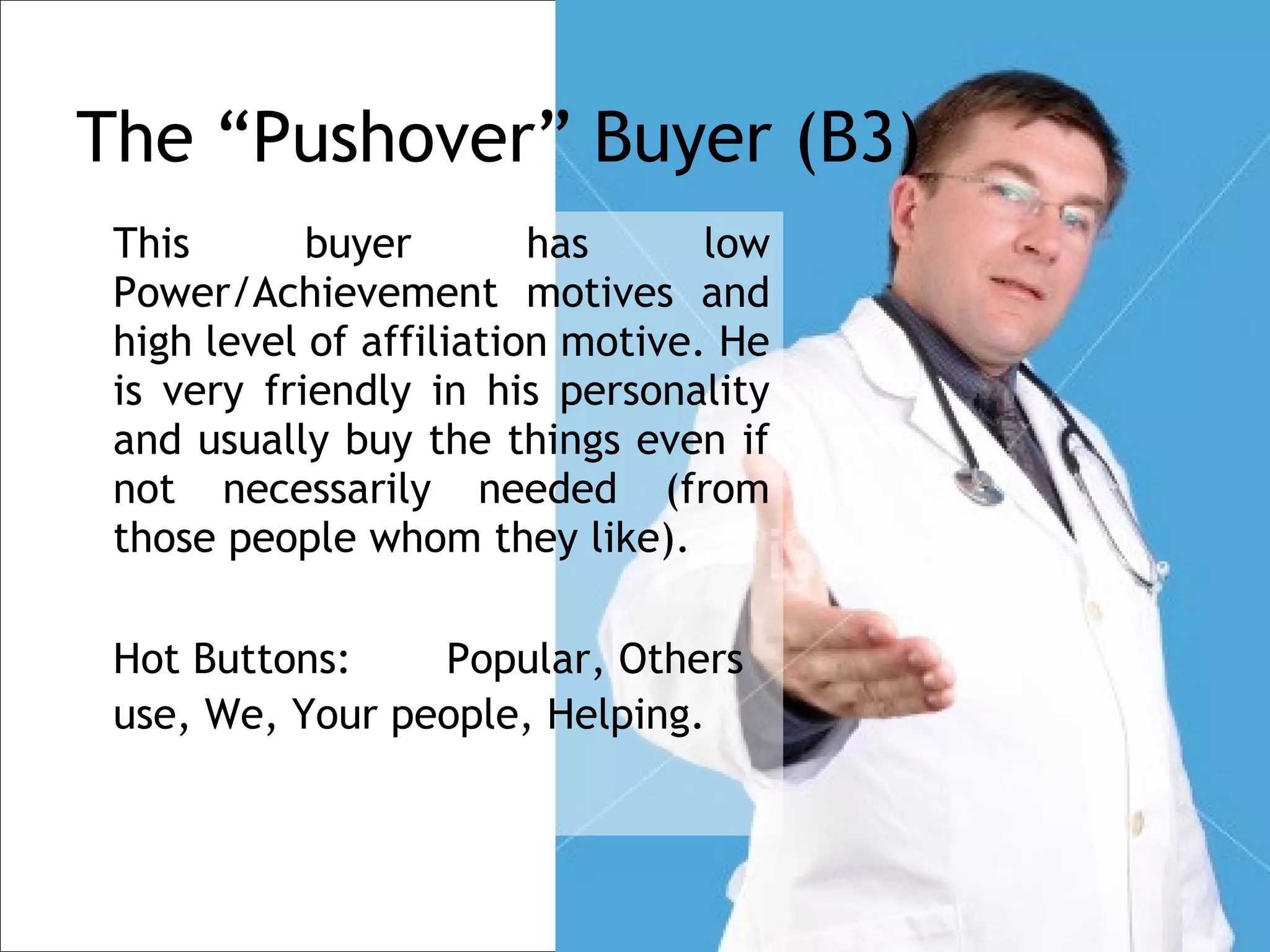
The “Pushover” Buyer (B3)
    This       buyer        has      low
    Power/Achievement motives and
    high level of affiliation motive. He
    is very friendly in his personality
    and usually buy the things even if
    not necessarily needed (from
    those people whom they like).
 
    Hot Buttons:    Popular, Others
    use, We, Your people, Helping.
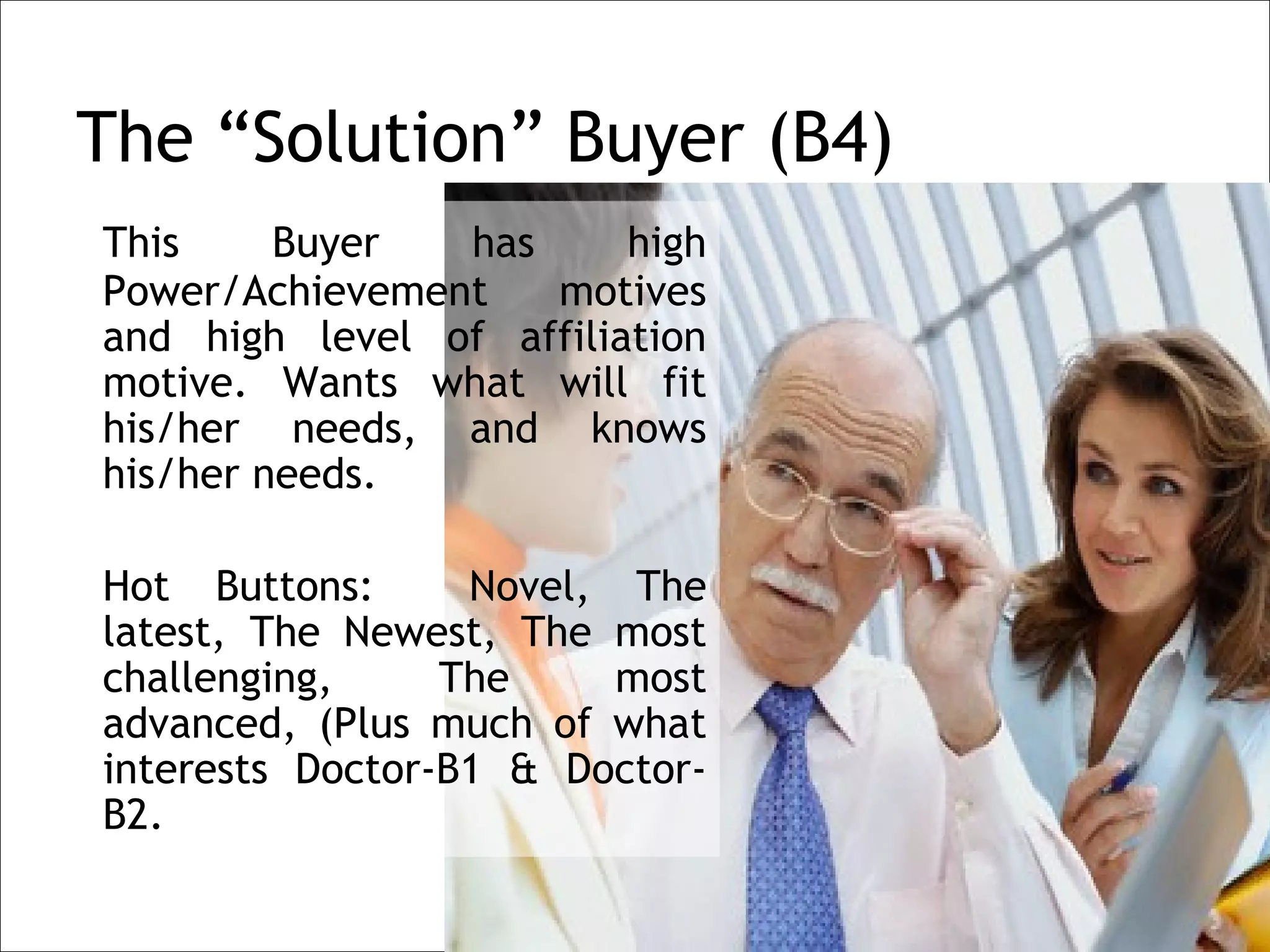
The “Solution” Buyer (B4)
    This     Buyer  has      high
    Power/Achievement   motives
    and high level of affiliation
    motive. Wants what will fit
    his/her needs, and knows
    his/her needs.
 
    Hot Buttons:      Novel, The
    latest, The Newest, The most
    challenging,     The     most
    advanced, (Plus much of what
    interests Doctor-B1 & Doctor-
    B2.
The Selling Procedure


Selling to a doctor is a single act but a long-term procedure.
    You rarely achieve instant success with only one call.
Reason

  Prescription potential can only be developed
   gradually
  Prescription habit of doctors is hard to break.
   The change from the use of one drug to
   another takes time.
  Each call bring the representative closer to
   his/her long-term objective. In practice each
   call achieves part of the objective.
Selling Steps

    Step 1.   PROSPECTING
    Step 2.   PRE-CALL PLANNING
    Step 3.   THE CALL
    Step 4.   RESPONSE HANDLING
    Step 5.   CLOSE
    Step 6:   POST CALL ANALYSIS
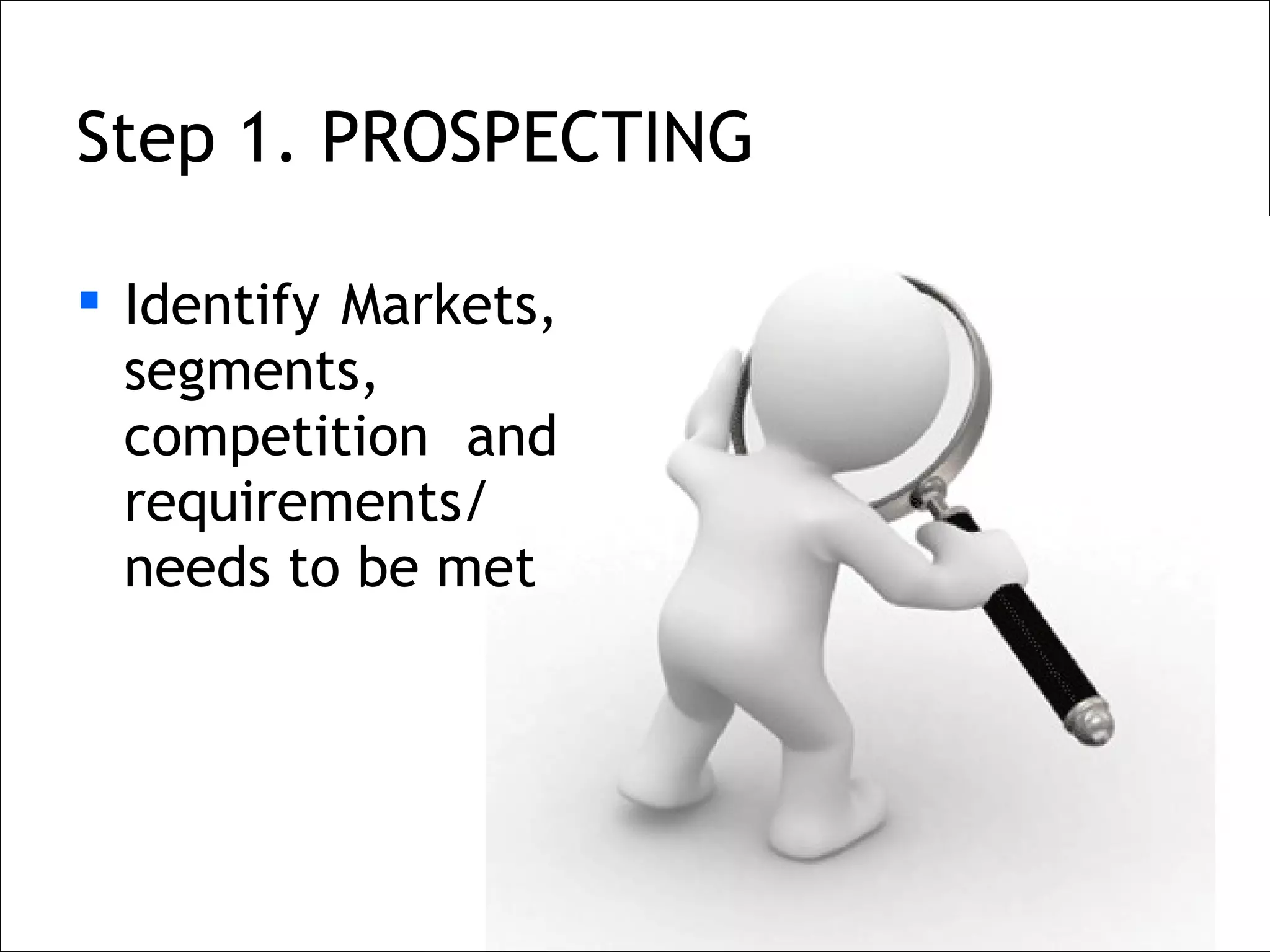
Step 1. PROSPECTING

 Identify Markets,
  segments,
  competition and
  requirements/
  needs to be met
Step 1. PROSPECTING

 To find potential customers, to qualify,
  classify/ categorize them
Step 1. PROSPECTING

 The basis for the strategy for sales call
Step 1. PROSPECTING

 Proper allocation of time and
 frequency of sales call
Step 1. PROSPECTING

 A continuous process, all changes must be
  known at all relevant levels
Step 2. PRE-CALL PLANNING
Set and define call
objectives (what
should be the
result of this call?)
Step 2. PRE-CALL PLANNING

Plan the procedure (How can I achieve the
  result?)
Step 2. PRE-CALL PLANNING

 Prepare the
 documents (What
 do I need for the
 call?)
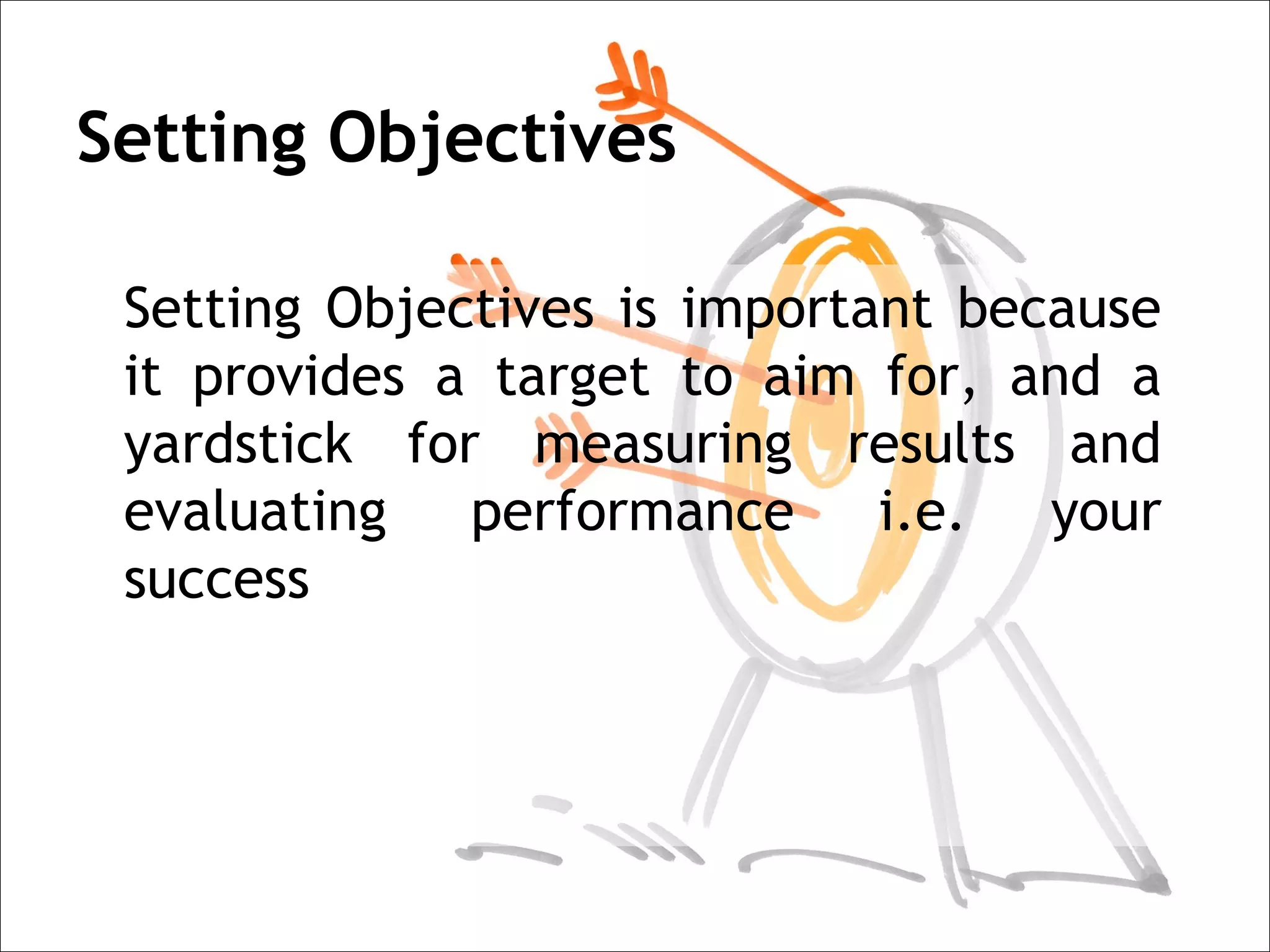
Setting Objectives

 Setting Objectives is important because
 it provides a target to aim for, and a
 yardstick for measuring results and
 evaluating performance i.e. your
 success
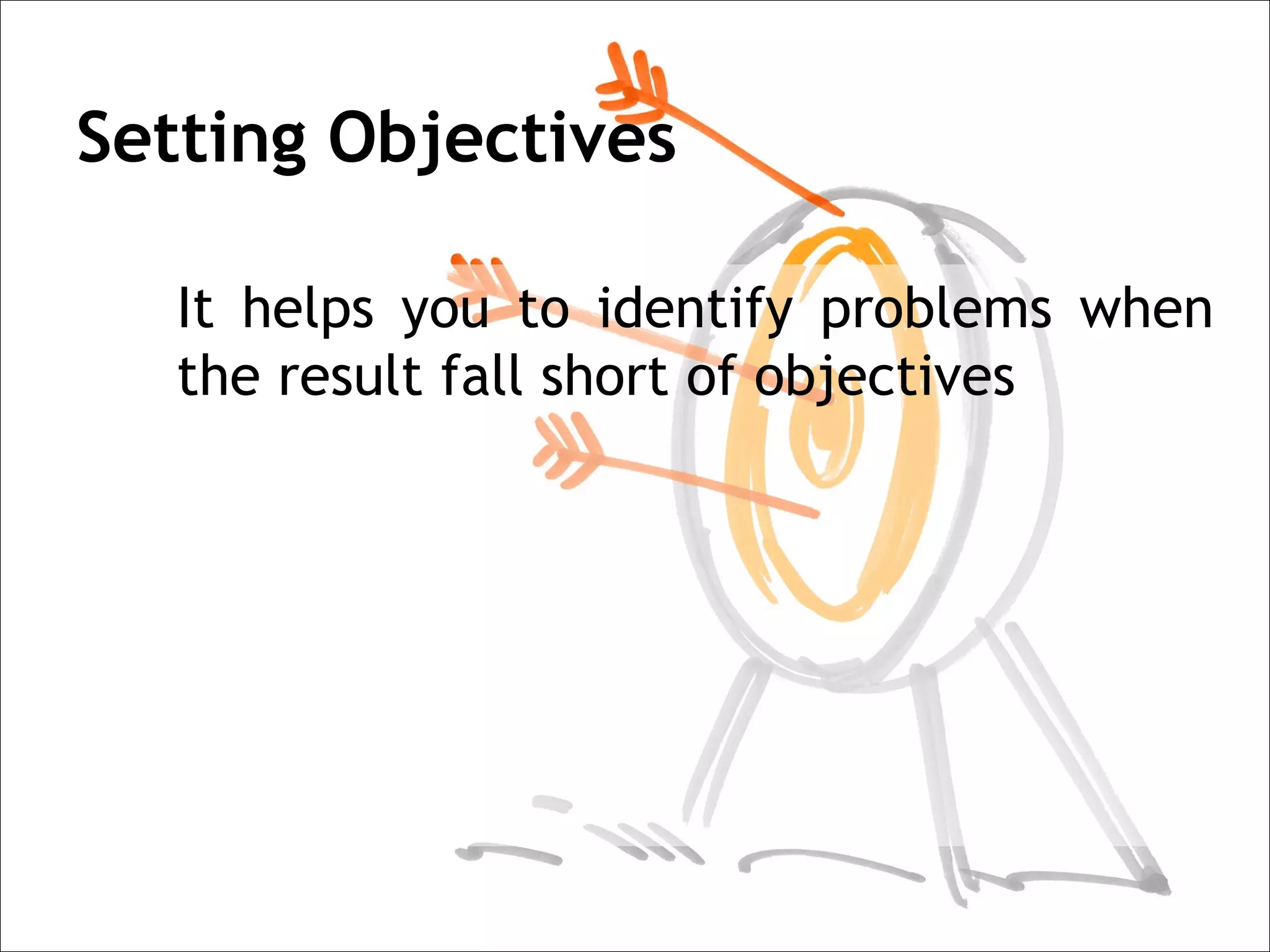
Setting Objectives

   It helps you to identify problems when
   the result fall short of objectives
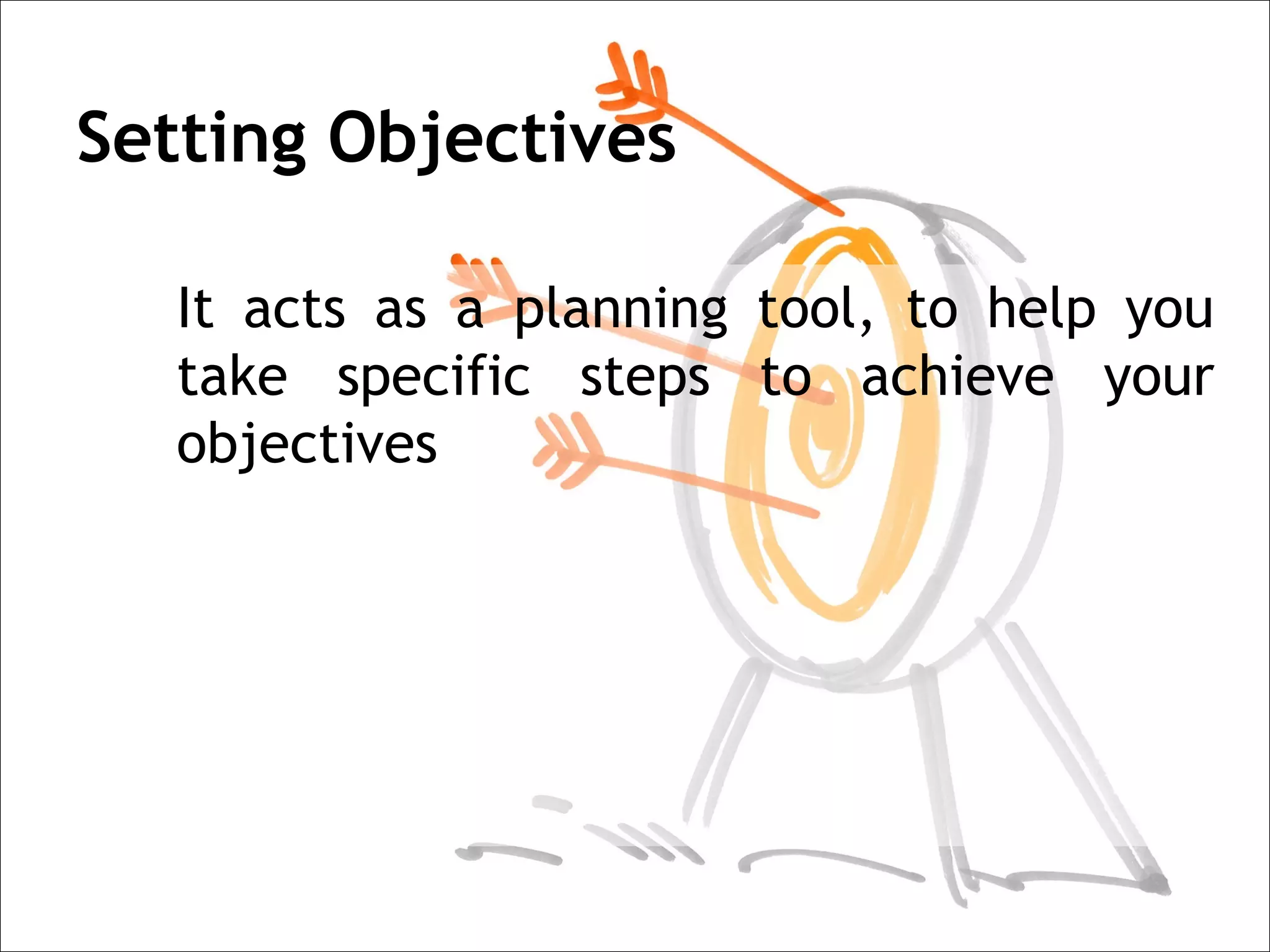
Setting Objectives

   It acts as a planning tool, to help you
   take specific steps to achieve your
   objectives
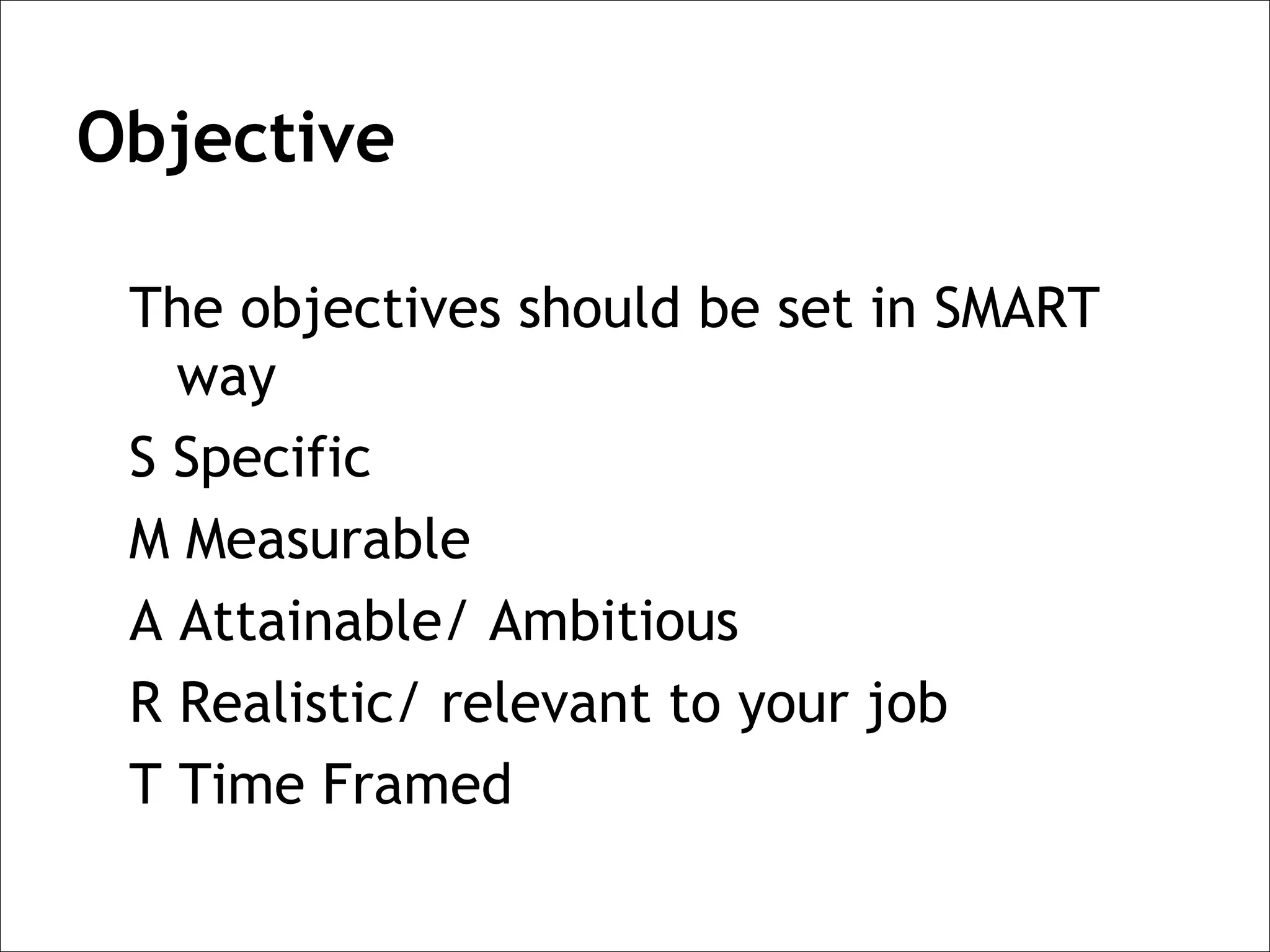
Objective

 The objectives should be set in SMART
   way
 S Specific
 M Measurable
 A Attainable/ Ambitious
 R Realistic/ relevant to your job
 T Time Framed
Planning the Procedure

  How do you want to proceed, what are
  the tools, methods, and techniques we
  must use to reach our objectives. Best
  time to call on Customers/ Doctor.
Prepare the call

 Approach
Prepare the call

   Questions to uncover need/ verify
   assumptions
Prepare the call

Benefits to satisfy needs
Prepare the call

Responses to possible reactions
Prepare the call

 Use of Visual Aids
Prepare the call

 Ways of Closing/ Gaining commitment
Questioning
Open Ended Questions
 What is your experience of
  Ectobal      in    Diabetic
  Neuropathy?
 How do you overcome the
  problem of IUGR?
 In   the    treatment    of
  Obesity, Managing hunger
  pangs is a real problem
  what is your opinion?
Close Ended Questions

  Ask to gain information
  Do obese women have greater risk of
   infertility?
  Does Obesity worsen osteoarthritis?
Step 3. THE CALL
 Approach/ Identify needs: Identifying
 needs by making the doctor talk about
 them
Step 3. THE CALL

 Presentation/ satisfy needs: Satisfying
 needs by introducing appropriate
 benefit
Step 4. RESPONSE HANDLING
Acceptance

  The doctor agrees with the product
   benefit and has no negative feelings
   towards it

  Close
Indifference

  The doctor shows no interest in the
   product because of no perceived needs
   for its benefits

  Use closed questions to uncover
Doubt
 The doctor is interested in a special
  benefit, but doubts whether the product
  can really provide it

 Offer proof
Objection
 The doctor shows an opposition to the
 product

 Many representatives think objections
 are problems and are afraid of them. As
 a result either there is
Objection

  Emotional Reaction: The feel attacked
  and possibly respond with verbal attack
Objection
  Resignation: They give up and accept
  resignation
Objection

 Avoidance: They ignore and do not deal
 with it
Objections however are a reality
    and at times can be very useful
    because they give a lot of
    information regarding the doctor’s
    opinion and feelings.
 
Objection

 Objections are because of two factors

  Misunderstanding:   due   to   lack   of
   information

  Perceived drawback: can not provide a
   benefit- or disapprove a feature
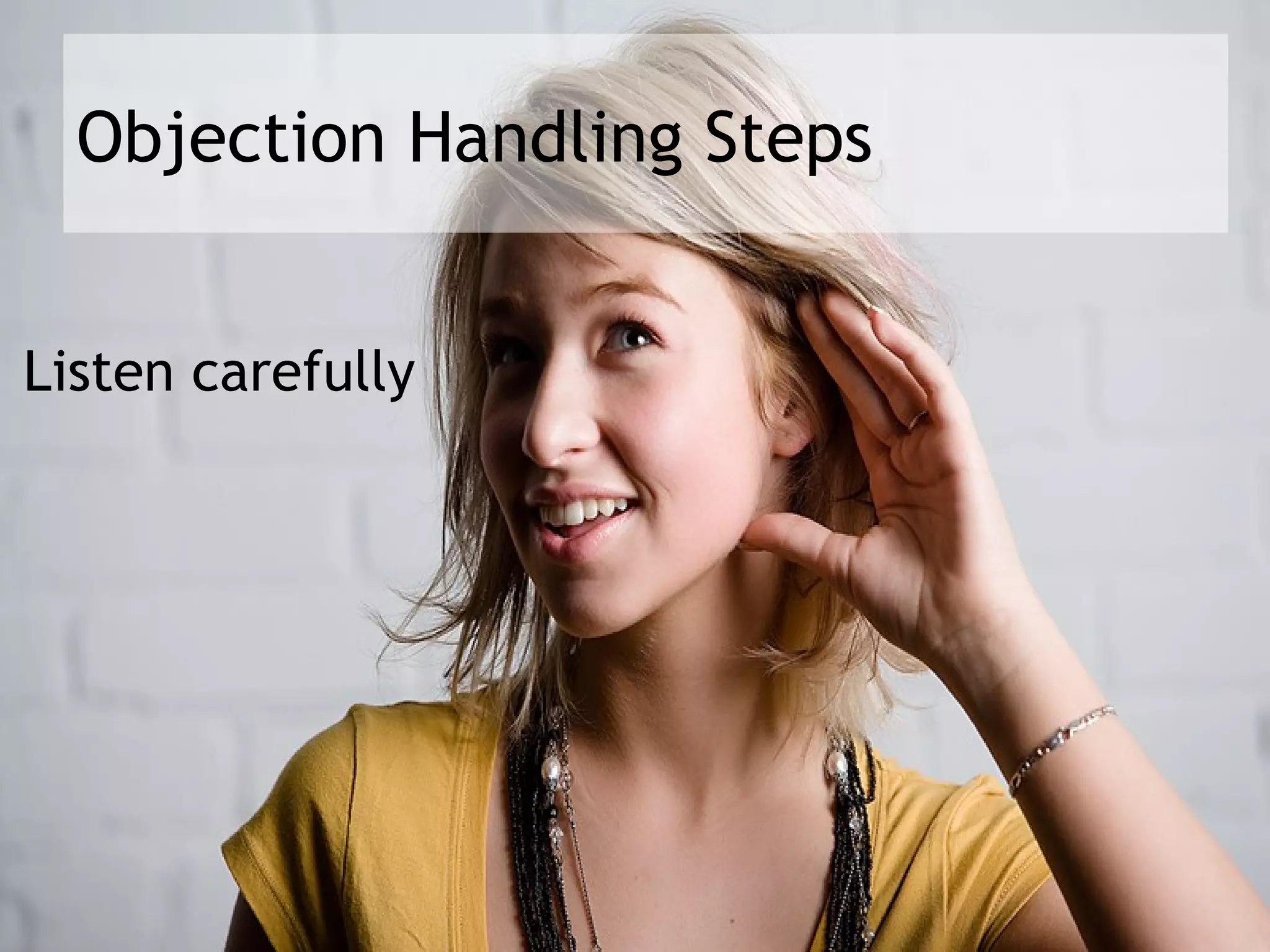
Objection Handling Steps


Listen carefully
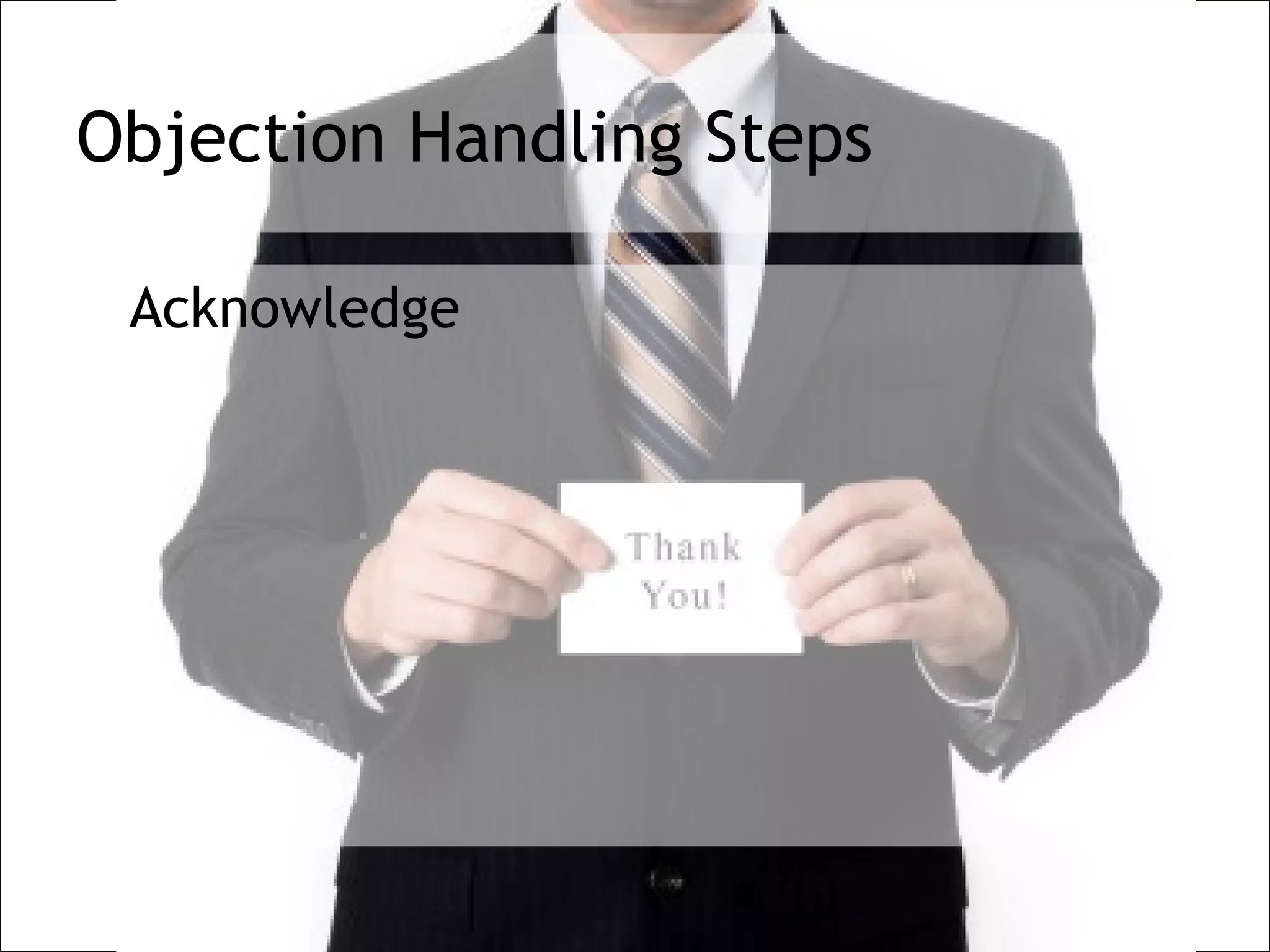
Objection Handling Steps

 Acknowledge
Objection Handling Steps

 Restate the Objection/question
Objection Handling Steps

 Answer
Objection Handling Steps

 Checking question
Objection Handling Steps

 Commitment
It is a challenge for the
representative to use this negative
information    and   change    this
negative attitude into acceptance
and sometimes it leads to a
concrete close.
Step 5. CLOSE

  The final part of the sales call is closing i.e.
  after satisfying needs, ask for prescriptions.
 
When to close
Neither too early nor too late


              GET COMMITMENT
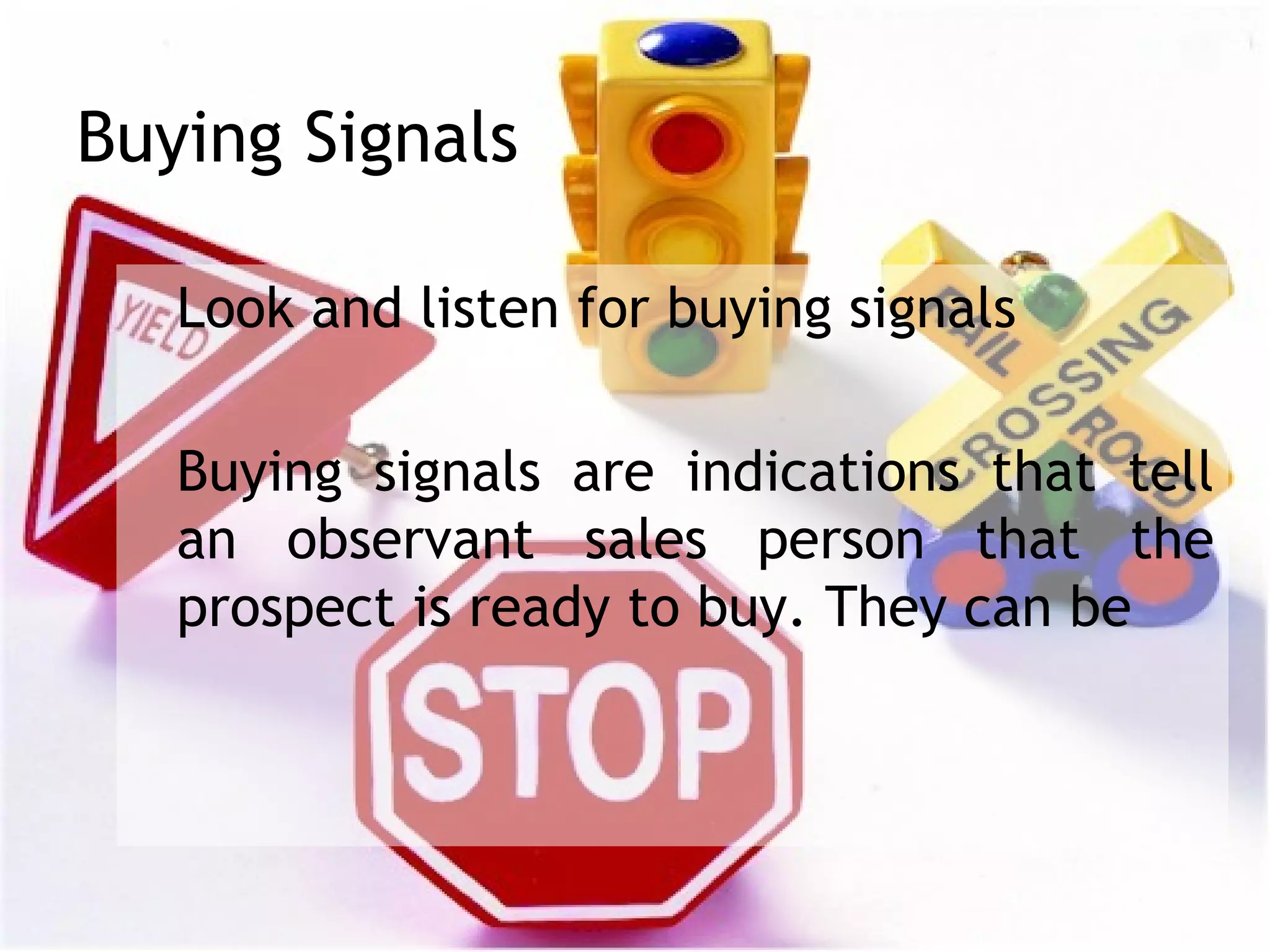
Buying Signals

   Look and listen for buying signals

   Buying signals are indications that tell
   an observant sales person that the
   prospect is ready to buy. They can be
Buying Signals

 Verbal

   The prospect may make comments that
   suggest that he/ she is ready to make a
   commitment. It may a statement or a
   question.
Signals

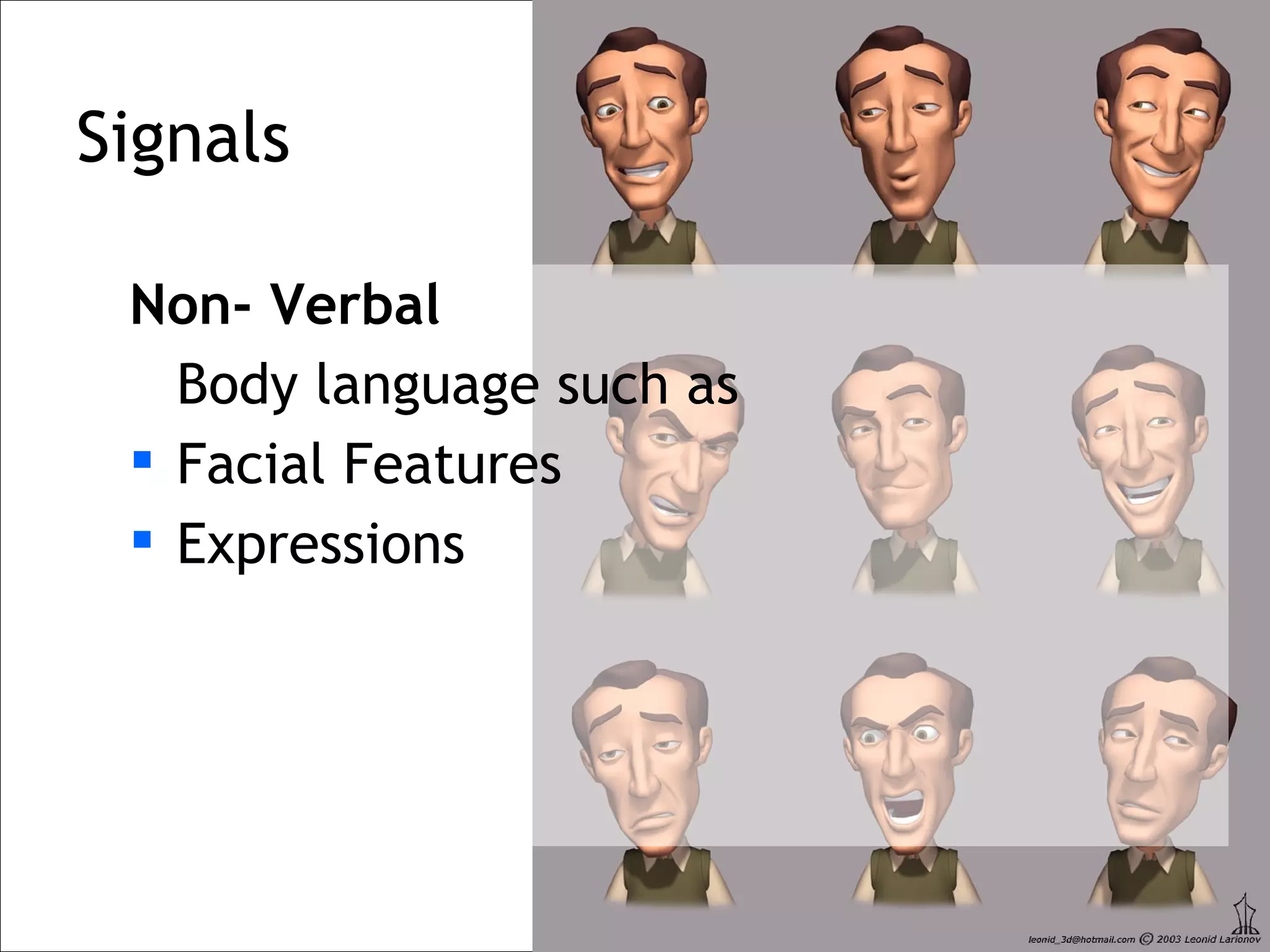
 Non- Verbal
   Body language such as
  Facial Features
  Expressions
Signals

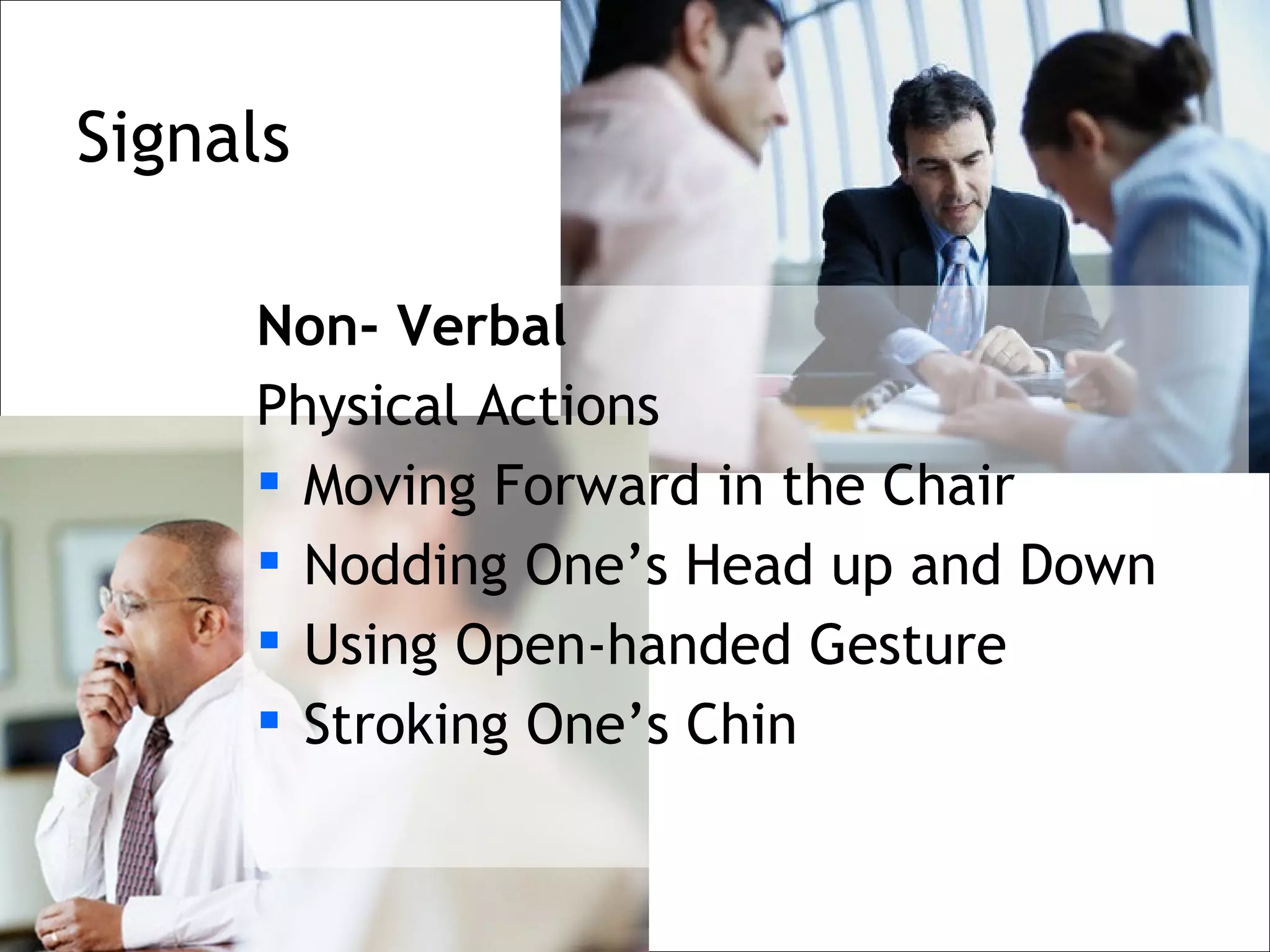
     Non- Verbal
     Physical Actions
      Moving Forward in the Chair
      Nodding One’s Head up and Down
      Using Open-handed Gesture
      Stroking One’s Chin
How to close

Closing is simply asking for Prescriptions
Step 6: POST CALL ANALYSIS

 After the call always review
 Did you follow your plan?
 Were you able to identify and satisfy
  doctor’s need?
 Did you handle objections correctly? If not
  what went wrong?
 Plan your next call

Selling Skills For New Med Reps

  • 1.
  • 2.
    Teachers open the door.  You enter by yourself. Chinese Proverb Chinese Proverb
  • 3.
    Customer A customer isa person who has some needs to be fulfilled. He buys things to fulfill these needs, or is a person with whom one is concerned.
  • 4.
    Product It isa thing or a substance produced by natural process or manufacturing. Or, it is a thing or service, which is used to satisfy one’s needs.
  • 5.
    Feature Shape andthe visible effect of the product tells what a product is. It gives the distinctive or characteristic part of a thing.
  • 6.
    Benefit It isthe advantage which the product provides. What the product does
  • 7.
    Unique Selling Point(USP) It is a remarkable, unusual or unparalleled advantageous feature of the product.
  • 8.
    Why people buy? Tosatisfy a pre- conceived or a set need
  • 9.
    Need Need is astate of deficiency which wants to be eliminated
  • 10.
    Motive Motive isa factor or circumstance that induces a person to act in order to satisfy the need for a while.
  • 11.
    Achievement The needto see result usually quickly. The need to avoid failures
  • 12.
    Affiliation The needto be associated with other to help others
  • 13.
  • 14.
    Because achievement andpower are often present together, we can group these to build a matrix of buyer motives.
  • 15.
    Achievement/ Power +ve   Doctor-1 Doctor-4   “Resistant/Defensive” Buyer “Solution” Buyer Affiliation –ve Affiliation +ve   Doctor-2 Doctor-3   “Pass the buck” Buyer “Pushover” Buyer   Achievement/ Power -ve
  • 16.
    The Resistant/Defensive BuyerB1 This Buyer has high Power/Achievement motives and low level of affiliation motive. He is very Hi-Fi in his personality and always tends to dominate the discussion. Want the maximum value of what he spend.   Hot Buttons: Profit, Gain, You, You only, Expensive, Advanced, Figures, Results.
  • 17.
    The “Pass thebuck” Buyer (B2) This Buyer has low Power/Achievement motives and low level of affiliation motive. He is very conservative in his personality and always tends to get someone else to make the decision. They avoid the sales people.   Hot Buttons:Safe, No risk, Secure, No change, Practical, Small modification, Only.
  • 18.
    The “Pushover” Buyer(B3) This buyer has low Power/Achievement motives and high level of affiliation motive. He is very friendly in his personality and usually buy the things even if not necessarily needed (from those people whom they like).   Hot Buttons: Popular, Others use, We, Your people, Helping.
  • 19.
    The “Solution” Buyer(B4) This Buyer has high Power/Achievement motives and high level of affiliation motive. Wants what will fit his/her needs, and knows his/her needs.   Hot Buttons: Novel, The latest, The Newest, The most challenging, The most advanced, (Plus much of what interests Doctor-B1 & Doctor- B2.
  • 20.
    The Selling Procedure Sellingto a doctor is a single act but a long-term procedure. You rarely achieve instant success with only one call.
  • 21.
    Reason  Prescriptionpotential can only be developed gradually  Prescription habit of doctors is hard to break. The change from the use of one drug to another takes time.  Each call bring the representative closer to his/her long-term objective. In practice each call achieves part of the objective.
  • 22.
    Selling Steps  Step 1. PROSPECTING  Step 2. PRE-CALL PLANNING  Step 3. THE CALL  Step 4. RESPONSE HANDLING  Step 5. CLOSE  Step 6: POST CALL ANALYSIS
  • 23.
    Step 1. PROSPECTING Identify Markets, segments, competition and requirements/ needs to be met
  • 24.
    Step 1. PROSPECTING To find potential customers, to qualify, classify/ categorize them
  • 25.
    Step 1. PROSPECTING The basis for the strategy for sales call
  • 26.
    Step 1. PROSPECTING Proper allocation of time and  frequency of sales call
  • 27.
    Step 1. PROSPECTING A continuous process, all changes must be known at all relevant levels
  • 28.
    Step 2. PRE-CALLPLANNING Set and define call objectives (what should be the result of this call?)
  • 29.
    Step 2. PRE-CALLPLANNING Plan the procedure (How can I achieve the result?)
  • 30.
    Step 2. PRE-CALLPLANNING Prepare the documents (What do I need for the call?)
  • 31.
    Setting Objectives SettingObjectives is important because it provides a target to aim for, and a yardstick for measuring results and evaluating performance i.e. your success
  • 32.
    Setting Objectives It helps you to identify problems when the result fall short of objectives
  • 33.
    Setting Objectives It acts as a planning tool, to help you take specific steps to achieve your objectives
  • 34.
    Objective The objectivesshould be set in SMART way S Specific M Measurable A Attainable/ Ambitious R Realistic/ relevant to your job T Time Framed
  • 35.
    Planning the Procedure How do you want to proceed, what are the tools, methods, and techniques we must use to reach our objectives. Best time to call on Customers/ Doctor.
  • 36.
  • 37.
    Prepare the call Questions to uncover need/ verify assumptions
  • 38.
    Prepare the call Benefitsto satisfy needs
  • 39.
    Prepare the call Responsesto possible reactions
  • 40.
    Prepare the call Use of Visual Aids
  • 41.
    Prepare the call Ways of Closing/ Gaining commitment
  • 42.
  • 43.
    Open Ended Questions What is your experience of Ectobal in Diabetic Neuropathy?  How do you overcome the problem of IUGR?  In the treatment of Obesity, Managing hunger pangs is a real problem what is your opinion?
  • 44.
    Close Ended Questions  Ask to gain information  Do obese women have greater risk of infertility?  Does Obesity worsen osteoarthritis?
  • 45.
    Step 3. THECALL Approach/ Identify needs: Identifying needs by making the doctor talk about them
  • 46.
    Step 3. THECALL Presentation/ satisfy needs: Satisfying needs by introducing appropriate benefit
  • 47.
  • 48.
    Acceptance  Thedoctor agrees with the product benefit and has no negative feelings towards it  Close
  • 49.
    Indifference  Thedoctor shows no interest in the product because of no perceived needs for its benefits  Use closed questions to uncover
  • 50.
    Doubt  The doctoris interested in a special benefit, but doubts whether the product can really provide it  Offer proof
  • 51.
    Objection The doctorshows an opposition to the product Many representatives think objections are problems and are afraid of them. As a result either there is
  • 52.
    Objection EmotionalReaction: The feel attacked and possibly respond with verbal attack
  • 53.
    Objection Resignation:They give up and accept resignation
  • 54.
    Objection Avoidance: Theyignore and do not deal with it
  • 55.
    Objections however area reality and at times can be very useful because they give a lot of information regarding the doctor’s opinion and feelings.  
  • 56.
    Objection Objections arebecause of two factors  Misunderstanding: due to lack of information  Perceived drawback: can not provide a benefit- or disapprove a feature
  • 57.
  • 58.
  • 59.
    Objection Handling Steps Restate the Objection/question
  • 60.
  • 61.
    Objection Handling Steps Checking question
  • 62.
  • 63.
    It is achallenge for the representative to use this negative information and change this negative attitude into acceptance and sometimes it leads to a concrete close.
  • 64.
    Step 5. CLOSE The final part of the sales call is closing i.e. after satisfying needs, ask for prescriptions.   When to close Neither too early nor too late GET COMMITMENT
  • 65.
    Buying Signals Look and listen for buying signals Buying signals are indications that tell an observant sales person that the prospect is ready to buy. They can be
  • 66.
    Buying Signals Verbal The prospect may make comments that suggest that he/ she is ready to make a commitment. It may a statement or a question.
  • 67.
    Signals Non- Verbal Body language such as  Facial Features  Expressions
  • 68.
    Signals Non- Verbal Physical Actions  Moving Forward in the Chair  Nodding One’s Head up and Down  Using Open-handed Gesture  Stroking One’s Chin
  • 69.
    How to close Closingis simply asking for Prescriptions
  • 70.
    Step 6: POSTCALL ANALYSIS  After the call always review  Did you follow your plan?  Were you able to identify and satisfy doctor’s need?  Did you handle objections correctly? If not what went wrong?  Plan your next call