Seminar
SELF COMPACTING CONCRETE
by
D.SARAVANAMURTHY
 Self-Compacting Concrete (SCC) is a modern
concrete technology that allows significant
advantages compared to conventional
concrete.
 Extreme workability, self-compaction without
vibration combined with high concrete quality
allows new and interesting applications for
the competitive users and creative specifiers
of concrete.
 Self-compacting concrete (SCC) is a flowing
concrete mixture that is able to consolidate
under its own weight.
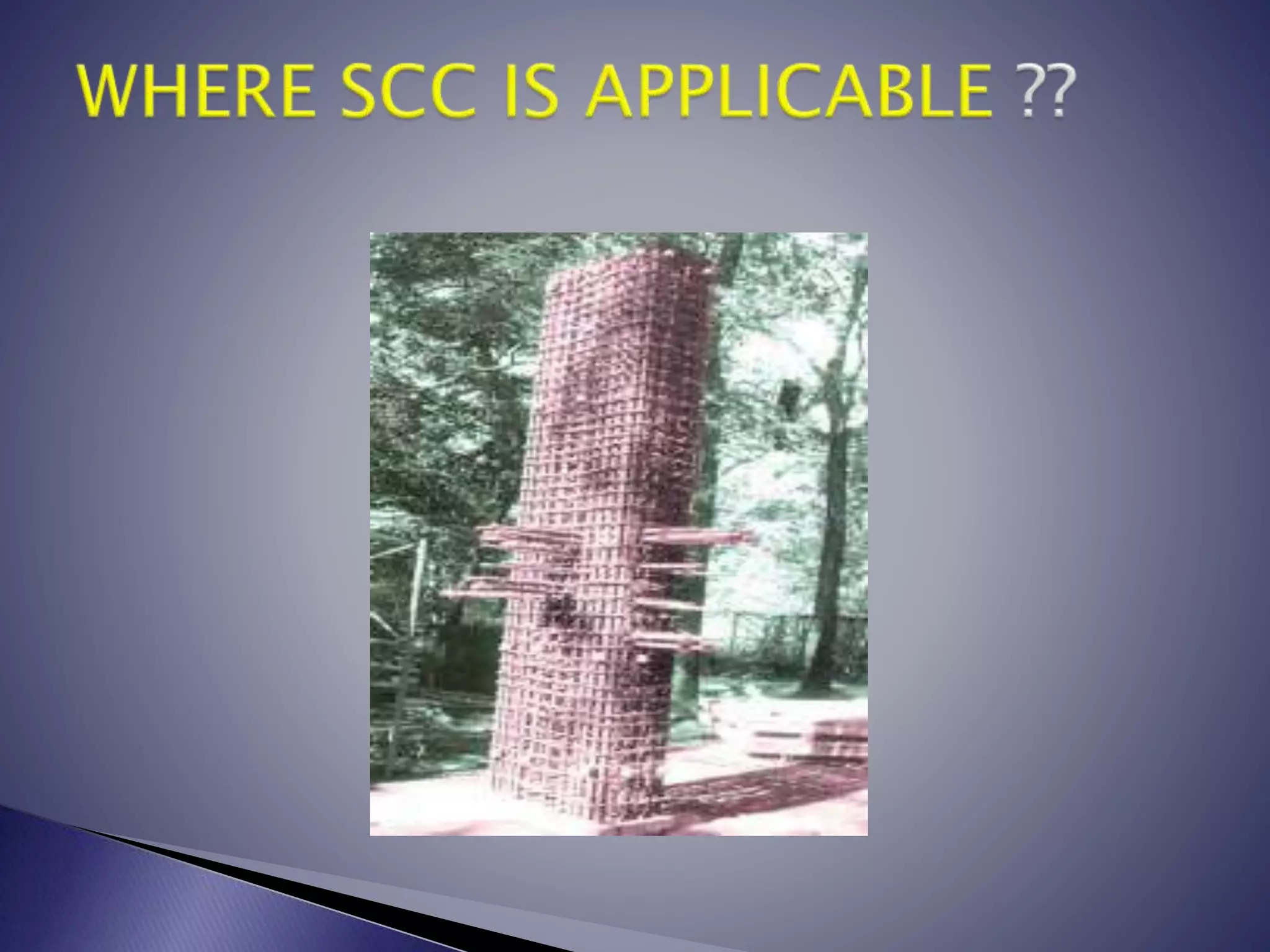
 The highly fluid nature of SCC makes it
suitable for placing in difficult conditions and
in sections with congested reinforcement.
 When the construction industry in Japan
experienced a decline in the availability of
skilled labour in the 1980s, a need was felt
for a concrete that could overcome the
problems of defective workmanship
 When the construction industry in Japan
experienced a decline in the availability of
skilled labour in the 1980s, a need was felt
for a concrete that could overcome the
problems of defective workmanship
 Mixture proportions for SCC differ from those
of ordinary concrete, in that the former has
more powder content and less coarse
aggregate.
 Moreover, SCC incorporates high range water
reducers (HRWR, superplasticisers) in larger
amounts and frequently a viscosity modifying
agent (VMA) in small doses.
 Cement : Ordinary Portland Cement, 43 or 53
grade can be used.
 Aggregates : The maximum size of aggregate
is generally limited to 20 mm. Aggregate of
size 10 to 12mm is desirable for structures
having congested reinforcement.
 Fine aggregates can be natural or
manufactured. The grading must be uniform
throughout the work. The moisture content
or absorption characteristics must be closely
monitored as quality of SCC will be sensitive
to such changes.
 Mixing Water : Water quality must be
established on the same line as that for using
reinforced concrete or prestressed concrete.
 Chemical Admixtures : Superplaseizers are an
essential component of SCC to provide necessary
workability. The new generation superplasticizers
termed poly-carboxylated ethers (PCE) is
particularly useful for SCC.
 Other types may be incorporated as necessary,
such as Viscosity Modifying Agents (VMA) for
stability, air entraining agents (AEA) to improve
freeze-thaw resistance, and retarders for Control
of Setting.
 Aggregates : Aggregate should come from
same source. There should not be much
variations in size, shape and moisture
content.
 Mixing : Any suitable mixer could be used -
Generally, mixing time need to be longer
thanfor conventional concrete. Time of
addition of admixture is important. A system
should beestablished for optimum benefit
during trial itself.
 Placing: Formwork must be in good
conditions to prevent leakage. Though it is
easier to place SCC than ordinary concrete,
the following rules are to be followed to
minimise the risk of segregation.
 limit of vertical free fall distance to 5 meter.
limit the height of pour lifts (layers) to 500
mm
limit of permissible distance of horizontal
flow from point of discharge to 10 meters.
 The concrete composition is now determined and the
superplasticizer
 dosage is finally selected on the bases of tests on
concrete.
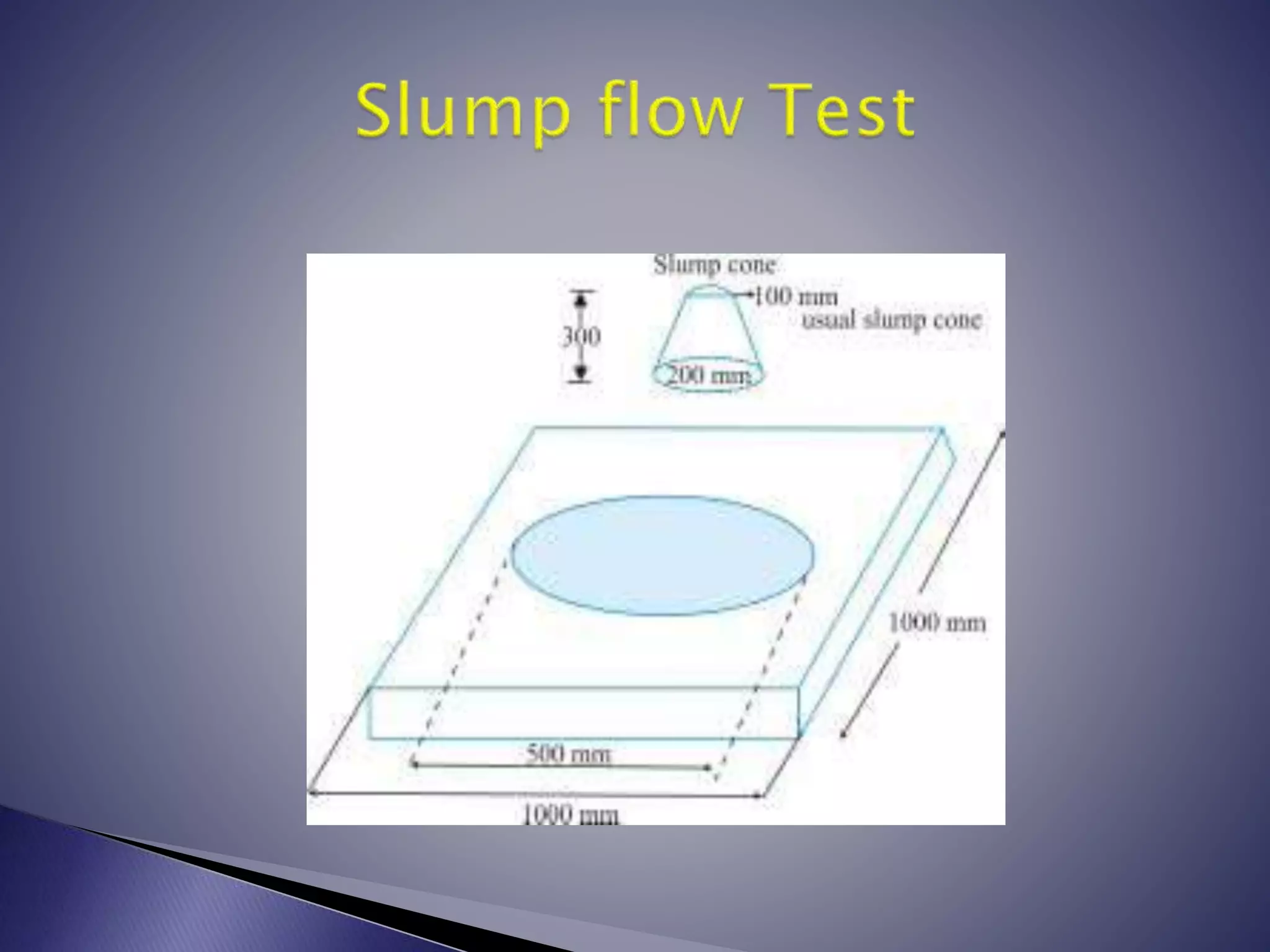
 Slump flow by Abrams cone. 650 to 80 mm
 T50 cm Slump flow 2 to 5 sec
 J-ring 0 – 10 mm
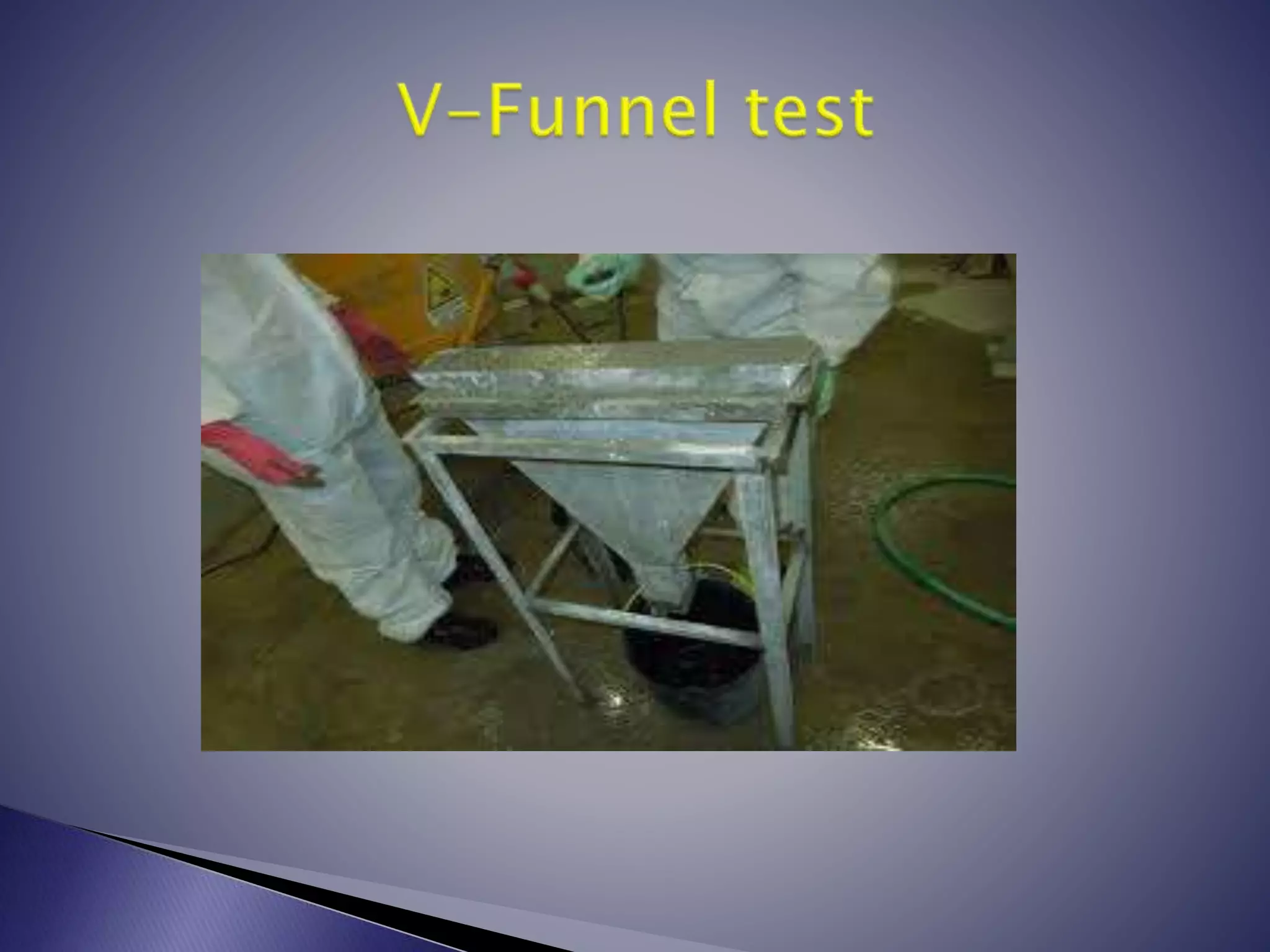
 V-funnel 8 – 12 sec
 V-funnel at T5 minutes +3 sec
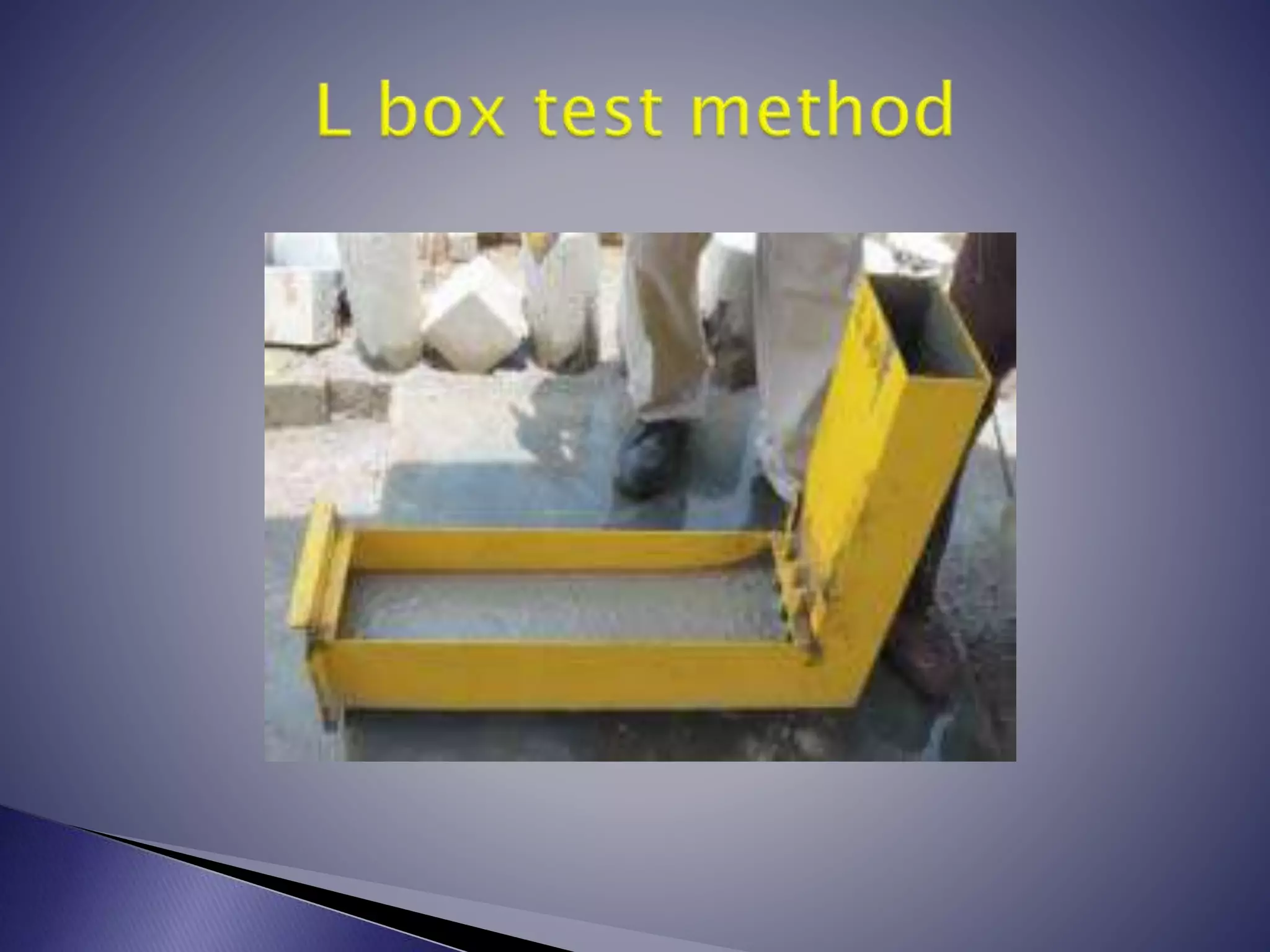
 L-box H2 /H1 = 0.8 to 1.0
 U-box H2 – H1 = 30 mm (Max.)
 Fill-box 90 to 100%
 Screen Stability 0 – 15%
 Orimet 0 – 5 sec
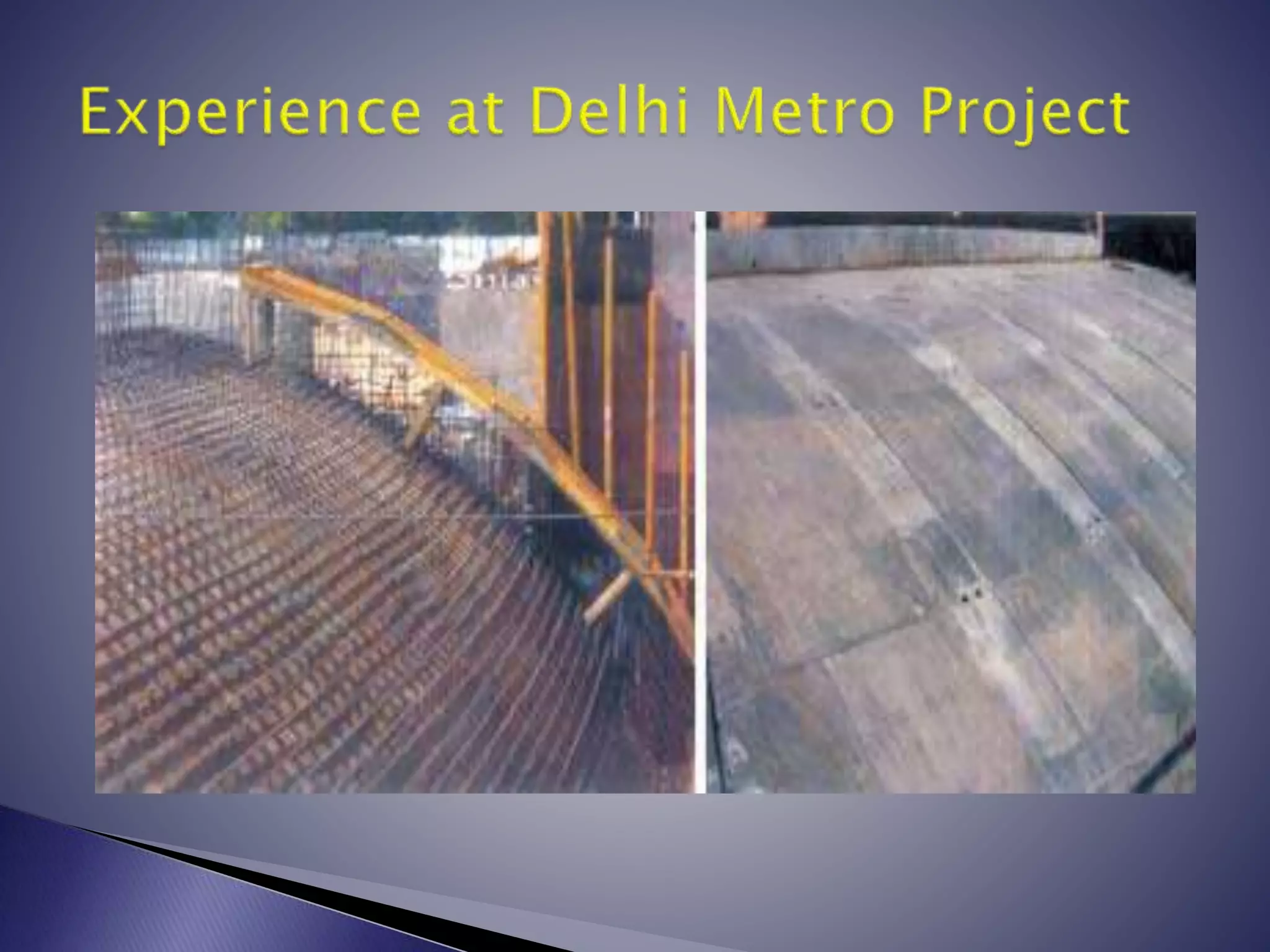
 In India, during the last few years, attempts
were made in the laboratories and in the field
 to develop and use SCC.
 However, large scale uses have been rare.
Some pionering efforts have been made in
Delhi Metro projects in association with L&T
and MBT.
 Faster construction
 Reduction in site manpower
 Better surface finish
 Easier placing
 Improved durability
 Greater freedom in design
 Thinner concrete sections
 Reduced noise level
 Safer working environment
 There is a feeling that cost of SCC is much
higher than that of the corresponding normal
strength or high strength concrete.
 It is seen that the cost of materials of SCC is
about 10 – 15 percent higher.
 If one takes the other components of costs
such as cost of compaction, finishing, etc,
then one would realise that SCC is certainly
not a costly concrete for comparable
strength.
 Self curing self compacting concrete (SCSCC)
can prove as very good alternate for
sustainable concrete with strength almost at
par with immersion method of curing.
 Self-compacting concrete is a recent
development that shows potential for future
applications. It meets the demands placed by
the requirements of speed and quality in
concrete construction.
self compacting concrete.

self compacting concrete.

  • 1.
  • 2.
     Self-Compacting Concrete(SCC) is a modern concrete technology that allows significant advantages compared to conventional concrete.  Extreme workability, self-compaction without vibration combined with high concrete quality allows new and interesting applications for the competitive users and creative specifiers of concrete.
  • 3.
     Self-compacting concrete(SCC) is a flowing concrete mixture that is able to consolidate under its own weight.  The highly fluid nature of SCC makes it suitable for placing in difficult conditions and in sections with congested reinforcement.  When the construction industry in Japan experienced a decline in the availability of skilled labour in the 1980s, a need was felt for a concrete that could overcome the problems of defective workmanship
  • 4.
     When theconstruction industry in Japan experienced a decline in the availability of skilled labour in the 1980s, a need was felt for a concrete that could overcome the problems of defective workmanship
  • 5.
     Mixture proportionsfor SCC differ from those of ordinary concrete, in that the former has more powder content and less coarse aggregate.  Moreover, SCC incorporates high range water reducers (HRWR, superplasticisers) in larger amounts and frequently a viscosity modifying agent (VMA) in small doses.
  • 6.
     Cement :Ordinary Portland Cement, 43 or 53 grade can be used.  Aggregates : The maximum size of aggregate is generally limited to 20 mm. Aggregate of size 10 to 12mm is desirable for structures having congested reinforcement.
  • 7.
     Fine aggregatescan be natural or manufactured. The grading must be uniform throughout the work. The moisture content or absorption characteristics must be closely monitored as quality of SCC will be sensitive to such changes.  Mixing Water : Water quality must be established on the same line as that for using reinforced concrete or prestressed concrete.
  • 8.
     Chemical Admixtures: Superplaseizers are an essential component of SCC to provide necessary workability. The new generation superplasticizers termed poly-carboxylated ethers (PCE) is particularly useful for SCC.  Other types may be incorporated as necessary, such as Viscosity Modifying Agents (VMA) for stability, air entraining agents (AEA) to improve freeze-thaw resistance, and retarders for Control of Setting.
  • 9.
     Aggregates :Aggregate should come from same source. There should not be much variations in size, shape and moisture content.  Mixing : Any suitable mixer could be used - Generally, mixing time need to be longer thanfor conventional concrete. Time of addition of admixture is important. A system should beestablished for optimum benefit during trial itself.
  • 10.
     Placing: Formworkmust be in good conditions to prevent leakage. Though it is easier to place SCC than ordinary concrete, the following rules are to be followed to minimise the risk of segregation.  limit of vertical free fall distance to 5 meter. limit the height of pour lifts (layers) to 500 mm limit of permissible distance of horizontal flow from point of discharge to 10 meters.
  • 11.
     The concretecomposition is now determined and the superplasticizer  dosage is finally selected on the bases of tests on concrete.  Slump flow by Abrams cone. 650 to 80 mm  T50 cm Slump flow 2 to 5 sec  J-ring 0 – 10 mm  V-funnel 8 – 12 sec  V-funnel at T5 minutes +3 sec  L-box H2 /H1 = 0.8 to 1.0  U-box H2 – H1 = 30 mm (Max.)  Fill-box 90 to 100%  Screen Stability 0 – 15%  Orimet 0 – 5 sec
  • 20.
     In India,during the last few years, attempts were made in the laboratories and in the field  to develop and use SCC.  However, large scale uses have been rare. Some pionering efforts have been made in Delhi Metro projects in association with L&T and MBT.
  • 22.
     Faster construction Reduction in site manpower  Better surface finish  Easier placing  Improved durability  Greater freedom in design  Thinner concrete sections  Reduced noise level  Safer working environment
  • 23.
     There isa feeling that cost of SCC is much higher than that of the corresponding normal strength or high strength concrete.  It is seen that the cost of materials of SCC is about 10 – 15 percent higher.  If one takes the other components of costs such as cost of compaction, finishing, etc, then one would realise that SCC is certainly not a costly concrete for comparable strength.
  • 24.
     Self curingself compacting concrete (SCSCC) can prove as very good alternate for sustainable concrete with strength almost at par with immersion method of curing.  Self-compacting concrete is a recent development that shows potential for future applications. It meets the demands placed by the requirements of speed and quality in concrete construction.