SELECTION Presented by:-
Nikita Bansal
Naveen Sharma
Vishal Sharma
SELECTION
Selection is a process in which the candidates are selected by means of
various tests in pre determined numbers ,out of large number of
applicants.
It is a negative process because in this , efforts are done to reduce the
no. of applicants &
Selection is a process
Applicants shortlisted- most suitable candidates selected for the right
job
PROCESS OF SELECTION
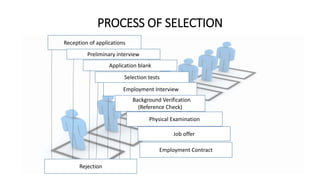
Reception of applications
Employment Interview
+Background Verification
(Reference Check)
Application blank
Preliminary interview
Selection tests
Physical Examination
Rejection
Employment Contract
Job offer
RECEPTION OF APPLICATIONS
• Purpose of pre- screening is to reduce a potentially large candidate
pool to a more manageable number.
• Screening is conducted by HR executives in the companies.
• It is a sorting process.
PRELIMINARY INTERVIEW
• In Preliminary interview, interviewer asks general questions.
• In Preliminary interview the applicant is given the job details
• Interview is taken by HR manager or Senior HR executive to shortlist
the right candidates.
• Communication skills is tested in interview.
• Various other skills like behavioural, Knowledge, English proficiency is
analysed.
APPLICATION BLANK
• Application form is to be filled by candidates which contains basic
data as follows:
• Personal information- name, address , languages speak, parent`s
name
• Educational qualification- how much % you got, which university
• Work experience- job profile, company name, how much salary you
got
• Salary expectations
• References- In order to check the background of the candidates, co.
ask for references.
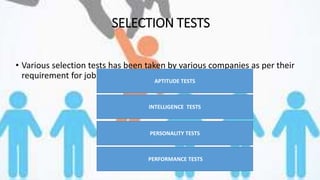
SELECTION TESTS
• Various selection tests has been taken by various companies as per their
requirement for job.
APTITUDE TESTS
PERFORMANCE TESTS
INTELLIGENCE TESTS
PERSONALITY TESTS
CONTD….
• Aptitude tests( decision making skills, mental ability,analysing skills)- these
are the tests which assess the potential & abilty of a candidate. It is a
common test taken by all companies.
• Intelligence Tests(Logical reasoning ability, data interpretation skills, Basic
language skills )- tis test measures the numerical skills& reasoning abilities .
These abilities become important in decision making.
• Personality tests (Emotional ability, interpersonal skills, ability to behave &
work in group)- in this, the emotional ability is tested. This test judges the
ability to work in a team, interpersonal skills, how he handles conflicts &
judge his motivational skills.
• Performance Tests (knowledge skills, speed & accuracy for Job like Typist &
data entry operators)- this test judges & evaluates the acquired knowledge
& experience of the individual ,checks his or her speed or accuracy in
performing a job.
CONTD..
• Simulation Test- It measures the ability of the person to face various
problems while at work.
• Graphology Test- designed to analyse the handwriting of n individual .
It is said that the individual’s hand writing can reveal the degree of
energy, spontaneity, emotional make-up,elements of balance & control
( Example: Big letters- Domination)
• Interest Tests- designed to measures an individual’s activity
preferences. These test will suggest what type of jobs may be satisfying
to the employees. They help them in selecting occupations of their
interest
EMPLOYMENT INTERVIEW
Interviews can be conducted by HR manager or by a panel of interviewers who are experts.
Various questions ask to the candidates to check whether he or she fits to the job perfectly.
Behavioural questions-Asking about past performance to predict future behaviour
Problem solving questions- ask to solve problems, generally related to your field
Personal Questions based on family & education
TYPES OF QUESTIONS THOSE GENERALLY ASK
• Open questions:
• Good for starting (to get candidates to talk)
• Probing questions:
• To get further details to ensure getting all the information needed
• Closed questions:
• To clarify a point of fact
• The reply is a single word or brief sentence
• Hypothetical questions (in situational based interviews): how candidates would respond
in a situation
• Questions about motivation:
• Best achieved by inference: career, achievements, triumphing over disadvantages, spare time
TYPES OF QUESTIONS INTERVIEWER GENERALLY ASKS
• Capability questions:
• To establish, what candidates know, what skills they possess etc.
• Continuity questions:
• To keep the conversation going, to encourage
• Play-back questions: test the interviewer’s understanding
TYPES OF INTERVIEW
REFERENCE & BACKGROUND ANALYSIS
Reference check is done to check the honesty about the candidate &
information provided by the candidate is right or wrong.
• It reveals fraud candidates
• It verifies the accuracy of the information
• Discourages candidates who hide something.
PHYSICAL EXAMINATION
• Candidates has to submit medical certificate issued by medical
professional like doctor. Medical certificate certifies that the
candidate is physically fit to work in a co.
• It includes medical examination or clinical examination of the selected
person in order to know whether he is physically fit or not
• It is a process in which a medical professional investigates the body of
a patient for signs of infectious disease.
JOB OFFER
A job offer is an invitation which is given to the candidate who is
finally selected for the job. The job offer contains the details of your
employment contract like a date by which the appointee must report
on duty, salary & job designation.
Job offer is made through letter of appointment
Two reasons for giving job offer:
• Need a time to obtain relieving certificate from the previous employer
• A new job requires movement to another city which means considerable
preparation & time
EMPLOYMENT CONTRACT
• An employment contract is a written legal document that lays out
binding terms & conditions of employment between an employee &
an employer
employment contract generally covers :
An overview of
Job responsibilities
Reporting relationship
Salary
Benefits
Paid holidays, paid vacation
Paid sick leave, paid time off (PTO)

Selection/Human Resource Management

  • 1.
    SELECTION Presented by:- NikitaBansal Naveen Sharma Vishal Sharma
  • 2.
    SELECTION Selection is aprocess in which the candidates are selected by means of various tests in pre determined numbers ,out of large number of applicants. It is a negative process because in this , efforts are done to reduce the no. of applicants & Selection is a process Applicants shortlisted- most suitable candidates selected for the right job
  • 3.
    PROCESS OF SELECTION Receptionof applications Employment Interview +Background Verification (Reference Check) Application blank Preliminary interview Selection tests Physical Examination Rejection Employment Contract Job offer
  • 4.
    RECEPTION OF APPLICATIONS •Purpose of pre- screening is to reduce a potentially large candidate pool to a more manageable number. • Screening is conducted by HR executives in the companies. • It is a sorting process.
  • 5.
    PRELIMINARY INTERVIEW • InPreliminary interview, interviewer asks general questions. • In Preliminary interview the applicant is given the job details • Interview is taken by HR manager or Senior HR executive to shortlist the right candidates. • Communication skills is tested in interview. • Various other skills like behavioural, Knowledge, English proficiency is analysed.
  • 6.
    APPLICATION BLANK • Applicationform is to be filled by candidates which contains basic data as follows: • Personal information- name, address , languages speak, parent`s name • Educational qualification- how much % you got, which university • Work experience- job profile, company name, how much salary you got • Salary expectations • References- In order to check the background of the candidates, co. ask for references.
  • 7.
    SELECTION TESTS • Variousselection tests has been taken by various companies as per their requirement for job. APTITUDE TESTS PERFORMANCE TESTS INTELLIGENCE TESTS PERSONALITY TESTS
  • 8.
    CONTD…. • Aptitude tests(decision making skills, mental ability,analysing skills)- these are the tests which assess the potential & abilty of a candidate. It is a common test taken by all companies. • Intelligence Tests(Logical reasoning ability, data interpretation skills, Basic language skills )- tis test measures the numerical skills& reasoning abilities . These abilities become important in decision making. • Personality tests (Emotional ability, interpersonal skills, ability to behave & work in group)- in this, the emotional ability is tested. This test judges the ability to work in a team, interpersonal skills, how he handles conflicts & judge his motivational skills. • Performance Tests (knowledge skills, speed & accuracy for Job like Typist & data entry operators)- this test judges & evaluates the acquired knowledge & experience of the individual ,checks his or her speed or accuracy in performing a job.
  • 9.
    CONTD.. • Simulation Test-It measures the ability of the person to face various problems while at work. • Graphology Test- designed to analyse the handwriting of n individual . It is said that the individual’s hand writing can reveal the degree of energy, spontaneity, emotional make-up,elements of balance & control ( Example: Big letters- Domination) • Interest Tests- designed to measures an individual’s activity preferences. These test will suggest what type of jobs may be satisfying to the employees. They help them in selecting occupations of their interest
  • 10.
    EMPLOYMENT INTERVIEW Interviews canbe conducted by HR manager or by a panel of interviewers who are experts. Various questions ask to the candidates to check whether he or she fits to the job perfectly. Behavioural questions-Asking about past performance to predict future behaviour Problem solving questions- ask to solve problems, generally related to your field Personal Questions based on family & education TYPES OF QUESTIONS THOSE GENERALLY ASK • Open questions: • Good for starting (to get candidates to talk) • Probing questions: • To get further details to ensure getting all the information needed • Closed questions: • To clarify a point of fact • The reply is a single word or brief sentence • Hypothetical questions (in situational based interviews): how candidates would respond in a situation • Questions about motivation: • Best achieved by inference: career, achievements, triumphing over disadvantages, spare time TYPES OF QUESTIONS INTERVIEWER GENERALLY ASKS
  • 11.
    • Capability questions: •To establish, what candidates know, what skills they possess etc. • Continuity questions: • To keep the conversation going, to encourage • Play-back questions: test the interviewer’s understanding TYPES OF INTERVIEW
  • 12.
    REFERENCE & BACKGROUNDANALYSIS Reference check is done to check the honesty about the candidate & information provided by the candidate is right or wrong. • It reveals fraud candidates • It verifies the accuracy of the information • Discourages candidates who hide something.
  • 13.
    PHYSICAL EXAMINATION • Candidateshas to submit medical certificate issued by medical professional like doctor. Medical certificate certifies that the candidate is physically fit to work in a co. • It includes medical examination or clinical examination of the selected person in order to know whether he is physically fit or not • It is a process in which a medical professional investigates the body of a patient for signs of infectious disease.
  • 14.
    JOB OFFER A joboffer is an invitation which is given to the candidate who is finally selected for the job. The job offer contains the details of your employment contract like a date by which the appointee must report on duty, salary & job designation. Job offer is made through letter of appointment Two reasons for giving job offer: • Need a time to obtain relieving certificate from the previous employer • A new job requires movement to another city which means considerable preparation & time
  • 15.
    EMPLOYMENT CONTRACT • Anemployment contract is a written legal document that lays out binding terms & conditions of employment between an employee & an employer employment contract generally covers : An overview of Job responsibilities Reporting relationship Salary Benefits Paid holidays, paid vacation Paid sick leave, paid time off (PTO)