Selection , Appointment
Selection
Selection The process of interviewing and evaluating
candidates for a specific job and selecting an individual for
employment based on certain criteria. Employee selection can
range from a very simple process to a very complicated
process depending on the firm hiring and the position.
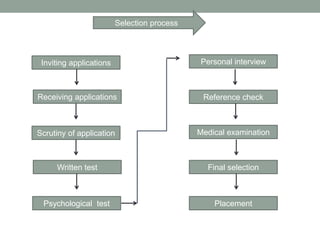
Inviting applications
Receiving applications Reference check
Final selection
Scrutiny of application
PlacementPsychological test
Written test
Medical examination
Personal interview
Selection process
1. Inviting applications:
The prospective candidates from within the organization or outside
the organization are called for applying for the post.
Detailed job description and job specification are provided in the
advertisement for the job. It attracts a large number of candidates
from various areas.
2. Receiving applications:
Detailed applications are collected from the candidates which
provide the necessary information about personal and
professional details of a person. These applications facilitate
analysis and comparison of the candidates.
3. Scrutiny of applications:
As the limit of the period within which the company is supposed
to receive applications ends, the applications are sorted out.
Incomplete applications get rejected; applicants with un-matching
job specifications are also rejected.
4. Written tests:
As the final list of candidates becomes ready after the scrutiny of
applications, the written test is conducted. This test is conducted
for understanding the technical knowledge, attitude and interest
of the candidates.
5. Psychological tests:
These tests are conducted individually and they help for
finding out the individual quality and skill of a person. The
types of psychological tests are aptitude test, intelligence test,
synthetic test and personality test
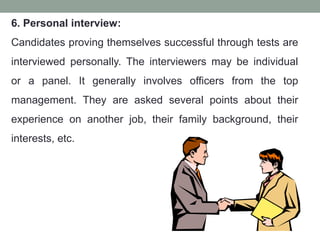
6. Personal interview:
Candidates proving themselves successful through tests are
interviewed personally. The interviewers may be individual
or a panel. It generally involves officers from the top
management. They are asked several points about their
experience on another job, their family background, their
interests, etc.
7. Medical examination:
Physical strength and fitness of a candidate is must
before they takes up the job. In-spite of good
performance in tests and interviews, candidates can be
rejected on the basis of their ill health.
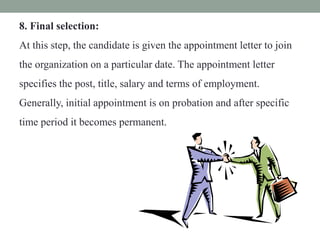
8. Final selection:
At this step, the candidate is given the appointment letter to join
the organization on a particular date. The appointment letter
specifies the post, title, salary and terms of employment.
Generally, initial appointment is on probation and after specific
time period it becomes permanent.
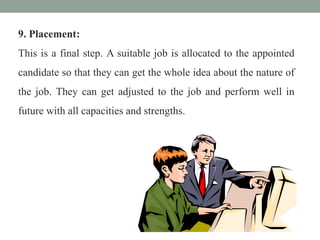
9. Placement:
This is a final step. A suitable job is allocated to the appointed
candidate so that they can get the whole idea about the nature of
the job. They can get adjusted to the job and perform well in
future with all capacities and strengths.
Selection techniques
Interview
An interviews are conducted to test the capabilities of the candidate to
occupy a particular post
Tests
Tests are tools in evaluating the capabilities of an applicant for a
position. For further assessment of candidates knowledge and abilities.
 Salary negotiation
Salary negotiation is a process where one party negotiates the amount of
their pay, income, earnings, commission, salary,
wages, remuneration, raise with another party
Tests
 Intelligence test
 Cognitive ability
 Motor and physical
ability
 Personality test
Interview
 Unstructured Interview. ...
 Stress Interview.
 Behavioral Interview. ...
 Problem Solving or Case
Interview.
 Panel Interview.
Basis Recruitment Selection
Meaning It is an activity of establishing
contact between employers
and applicants.
It is a process of picking up
more competent and suitable
employees.
Objective It encourages large number
of Candidates for a job.
It attempts at rejecting
unsuitable candidates.
Process It is a simple process. It is a complicated process.
Approach It is a positive approach. It is a negative approach.
Sequence It proceeds selection. It follows recruitment.
Time Consuming Less time is required. More time is required.
Difference between Recruitment and Selection
Appointment
Placement into a position indefinitely or for a finite period of
time
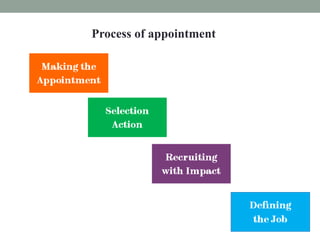
Process of appointment
Selection

Selection

  • 1.
  • 2.
    Selection Selection The processof interviewing and evaluating candidates for a specific job and selecting an individual for employment based on certain criteria. Employee selection can range from a very simple process to a very complicated process depending on the firm hiring and the position.
  • 3.
    Inviting applications Receiving applicationsReference check Final selection Scrutiny of application PlacementPsychological test Written test Medical examination Personal interview Selection process
  • 4.
    1. Inviting applications: Theprospective candidates from within the organization or outside the organization are called for applying for the post. Detailed job description and job specification are provided in the advertisement for the job. It attracts a large number of candidates from various areas.
  • 5.
    2. Receiving applications: Detailedapplications are collected from the candidates which provide the necessary information about personal and professional details of a person. These applications facilitate analysis and comparison of the candidates.
  • 6.
    3. Scrutiny ofapplications: As the limit of the period within which the company is supposed to receive applications ends, the applications are sorted out. Incomplete applications get rejected; applicants with un-matching job specifications are also rejected.
  • 7.
    4. Written tests: Asthe final list of candidates becomes ready after the scrutiny of applications, the written test is conducted. This test is conducted for understanding the technical knowledge, attitude and interest of the candidates.
  • 8.
    5. Psychological tests: Thesetests are conducted individually and they help for finding out the individual quality and skill of a person. The types of psychological tests are aptitude test, intelligence test, synthetic test and personality test
  • 9.
    6. Personal interview: Candidatesproving themselves successful through tests are interviewed personally. The interviewers may be individual or a panel. It generally involves officers from the top management. They are asked several points about their experience on another job, their family background, their interests, etc.
  • 10.
    7. Medical examination: Physicalstrength and fitness of a candidate is must before they takes up the job. In-spite of good performance in tests and interviews, candidates can be rejected on the basis of their ill health.
  • 11.
    8. Final selection: Atthis step, the candidate is given the appointment letter to join the organization on a particular date. The appointment letter specifies the post, title, salary and terms of employment. Generally, initial appointment is on probation and after specific time period it becomes permanent.
  • 12.
    9. Placement: This isa final step. A suitable job is allocated to the appointed candidate so that they can get the whole idea about the nature of the job. They can get adjusted to the job and perform well in future with all capacities and strengths.
  • 13.
    Selection techniques Interview An interviewsare conducted to test the capabilities of the candidate to occupy a particular post Tests Tests are tools in evaluating the capabilities of an applicant for a position. For further assessment of candidates knowledge and abilities.  Salary negotiation Salary negotiation is a process where one party negotiates the amount of their pay, income, earnings, commission, salary, wages, remuneration, raise with another party
  • 14.
    Tests  Intelligence test Cognitive ability  Motor and physical ability  Personality test Interview  Unstructured Interview. ...  Stress Interview.  Behavioral Interview. ...  Problem Solving or Case Interview.  Panel Interview.
  • 15.
    Basis Recruitment Selection MeaningIt is an activity of establishing contact between employers and applicants. It is a process of picking up more competent and suitable employees. Objective It encourages large number of Candidates for a job. It attempts at rejecting unsuitable candidates. Process It is a simple process. It is a complicated process. Approach It is a positive approach. It is a negative approach. Sequence It proceeds selection. It follows recruitment. Time Consuming Less time is required. More time is required. Difference between Recruitment and Selection
  • 16.
    Appointment Placement into aposition indefinitely or for a finite period of time
  • 17.