SECURITY PRINCIPLES
AND SECURITY SERVICES
Introduction to Security
 Definition of Security:
The measures taken to protect systems, data, and networks from unauthorized access, harm, or
misuse.
 Importance of Security:
Ensures confidentiality, integrity, and availability (CIA) of information and systems.
Security Principles
There are three security principles.
❑ Confidentiality
❑Integrity
❑Availability
Confidentiality
Confidentiality is probably the most common aspect of information security.
Example: Industrial Confidential data, Bank
Integrity
Information needs to be changed constantly. Integrity means that changes need to be done
only by authorized entities and through authorized mechanisms.
Example: Bank data should be automatically updated after any transaction.
Availability
The information created and stored by an organization needs to be available to authorized
entities. Information needs to be constantly changed, which means it must be accessible to
authorized entities.
Example: Accessing of information anywhere at any time.
 Standard measures to establish confidentiality include:
 Data encryption: Converts information into unreadable code unless decrypted with the correct key.
 Two-factor authentication (2FA): Requires two identification forms for secure access.
 Biometric verification: Uses unique biological traits (e.g., fingerprints) to confirm identity.
 Security tokens: Digital assets representing ownership or access rights.
 Standard measures to establish integrity include:
 Cryptographic checksums (e.g., MD5, SHA-1, SHA-256): Verify data integrity by producing hash
values.
 File permissions: Control who can modify data.
 Uninterrupted power supplies and data backups: Prevent data loss or corruption.
 Standard measures to establish availability include:
 Data backups: Store data copies on external drives.
 Firewalls: Protect against unauthorized access or attacks.
 Backup power supplies and data redundancy: Maintain accessibility even during failures.
 These principles work together to form the foundation of secure systems.
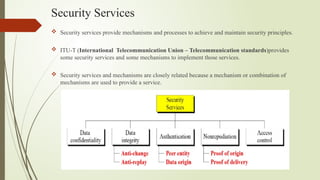
Security Services
 Security services provide mechanisms and processes to achieve and maintain security principles.
 ITU-T (International Telecommunication Union – Telecommunication standards)provides
some security services and some mechanisms to implement those services.
 Security services and mechanisms are closely related because a mechanism or combination of
mechanisms are used to provide a service.
 Confidentiality: information is not made available to unauthorized individual
 Integrity: assurance that the message is unaltered
 Authentication: assures recipient that the message is from the source that it claims to be from.
 Peer entity authentication: Provides for the corroboration of the identity of a peer entity in an
association. Two entities are considered peers if they implement to same protocol in different
systems; e.g., two TCP modules in two communicating systems.
 Data origin authentication: Provides for the corroboration of the source of a data unit. It does not
provide protection against the duplication or modification of data units
 Non-Repudiation: protection against denial of sending or receiving in the communication
 Access Control: controls who can have access to resource under what condition
 Availability: available to authorized entities for 24/7.
THANK YOU

SECURITY PRINCIPLES AND SECURITY SERVICES.pptx

  • 1.
  • 2.
    Introduction to Security Definition of Security: The measures taken to protect systems, data, and networks from unauthorized access, harm, or misuse.  Importance of Security: Ensures confidentiality, integrity, and availability (CIA) of information and systems.
  • 3.
    Security Principles There arethree security principles. ❑ Confidentiality ❑Integrity ❑Availability
  • 4.
    Confidentiality Confidentiality is probablythe most common aspect of information security. Example: Industrial Confidential data, Bank Integrity Information needs to be changed constantly. Integrity means that changes need to be done only by authorized entities and through authorized mechanisms. Example: Bank data should be automatically updated after any transaction.
  • 5.
    Availability The information createdand stored by an organization needs to be available to authorized entities. Information needs to be constantly changed, which means it must be accessible to authorized entities. Example: Accessing of information anywhere at any time.
  • 6.
     Standard measuresto establish confidentiality include:  Data encryption: Converts information into unreadable code unless decrypted with the correct key.  Two-factor authentication (2FA): Requires two identification forms for secure access.  Biometric verification: Uses unique biological traits (e.g., fingerprints) to confirm identity.  Security tokens: Digital assets representing ownership or access rights.  Standard measures to establish integrity include:  Cryptographic checksums (e.g., MD5, SHA-1, SHA-256): Verify data integrity by producing hash values.  File permissions: Control who can modify data.  Uninterrupted power supplies and data backups: Prevent data loss or corruption.
  • 7.
     Standard measuresto establish availability include:  Data backups: Store data copies on external drives.  Firewalls: Protect against unauthorized access or attacks.  Backup power supplies and data redundancy: Maintain accessibility even during failures.  These principles work together to form the foundation of secure systems.
  • 8.
    Security Services  Securityservices provide mechanisms and processes to achieve and maintain security principles.  ITU-T (International Telecommunication Union – Telecommunication standards)provides some security services and some mechanisms to implement those services.  Security services and mechanisms are closely related because a mechanism or combination of mechanisms are used to provide a service.
  • 9.
     Confidentiality: informationis not made available to unauthorized individual  Integrity: assurance that the message is unaltered  Authentication: assures recipient that the message is from the source that it claims to be from.  Peer entity authentication: Provides for the corroboration of the identity of a peer entity in an association. Two entities are considered peers if they implement to same protocol in different systems; e.g., two TCP modules in two communicating systems.  Data origin authentication: Provides for the corroboration of the source of a data unit. It does not provide protection against the duplication or modification of data units  Non-Repudiation: protection against denial of sending or receiving in the communication  Access Control: controls who can have access to resource under what condition  Availability: available to authorized entities for 24/7.
  • 10.