Invention Journal of Research Technology in Engineering & Management (IJRTEM)
ISSN: 2455-3689
www.ijrtem.com Volume 2 Issue 8 ǁ August 2018 ǁ PP 32-37
|Volume 2| Issue 8 | www.ijrtem.com | 32 |
Security and Crime Management in University Libraries in
Nigeria
Suleiman Musa,
Department of library and information science Nasarawa State Polytechnic, Lafia
Nasarawa State. Nigeria
ABSTRACT : Security and prevention of crime in university library is very paramount duties of librarian. The
survival of a library depends to a large extend on how secured its collections are, security of library resources
constitutes serious challenge facing university libraries in Nigeria. The paper, therefore, investigates security and
crime management in university libraries in Nigeria using university of Jos and university of Ilorin libraries. The
study adopted a descriptive survey method. The population of the study comprised 108 library personnel and
16,012 registered library users in two university libraries. While the sample size consisted of all the 108 library
personnel, and 2% of the registered users to make a total of 428 respondents. Questionnaire and interview with
the university librarians of the selected university libraries were the instruments used for data collection. Data
were analysed using frequency distribution and percentages. Results revealed that security breaches included
stealing/theft of library materials, mutilation of library materials, and non-return of borrowed items. It also
showed inadequate funding, selfish interest of the culprits and lack of institutional security policy in the library.
Base on the findings, that staff security training, electronic security system should be introduced and improve
funding of university libraries among others. Recommendation orientation of users and staff should be done from
time to time in university libraries to mention but few.
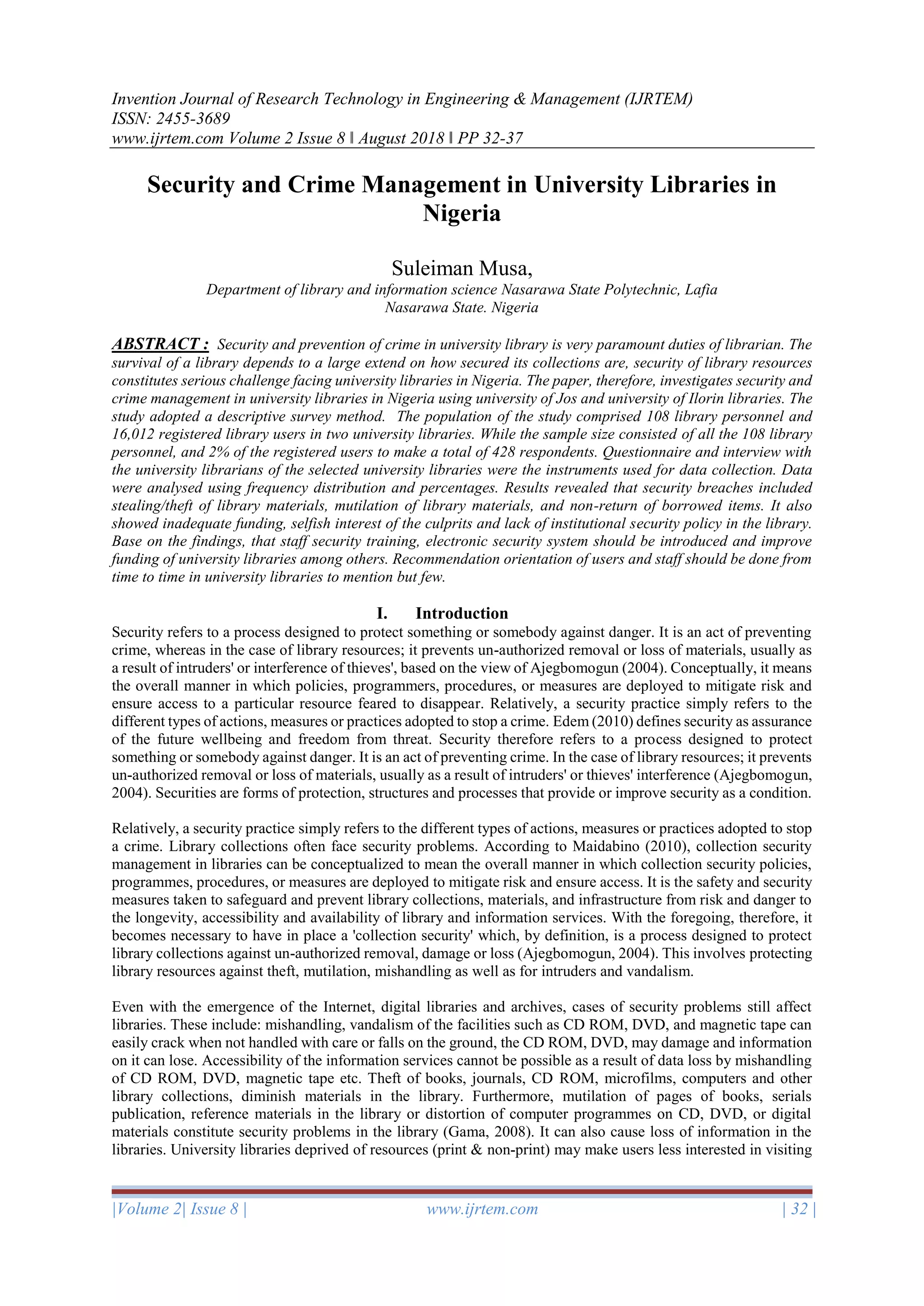
I. Introduction
Security refers to a process designed to protect something or somebody against danger. It is an act of preventing
crime, whereas in the case of library resources; it prevents un-authorized removal or loss of materials, usually as
a result of intruders' or interference of thieves', based on the view of Ajegbomogun (2004). Conceptually, it means
the overall manner in which policies, programmers, procedures, or measures are deployed to mitigate risk and
ensure access to a particular resource feared to disappear. Relatively, a security practice simply refers to the
different types of actions, measures or practices adopted to stop a crime. Edem (2010) defines security as assurance
of the future wellbeing and freedom from threat. Security therefore refers to a process designed to protect
something or somebody against danger. It is an act of preventing crime. In the case of library resources; it prevents
un-authorized removal or loss of materials, usually as a result of intruders' or thieves' interference (Ajegbomogun,
2004). Securities are forms of protection, structures and processes that provide or improve security as a condition.
Relatively, a security practice simply refers to the different types of actions, measures or practices adopted to stop
a crime. Library collections often face security problems. According to Maidabino (2010), collection security
management in libraries can be conceptualized to mean the overall manner in which collection security policies,
programmes, procedures, or measures are deployed to mitigate risk and ensure access. It is the safety and security
measures taken to safeguard and prevent library collections, materials, and infrastructure from risk and danger to
the longevity, accessibility and availability of library and information services. With the foregoing, therefore, it
becomes necessary to have in place a 'collection security' which, by definition, is a process designed to protect
library collections against un-authorized removal, damage or loss (Ajegbomogun, 2004). This involves protecting
library resources against theft, mutilation, mishandling as well as for intruders and vandalism.
Even with the emergence of the Internet, digital libraries and archives, cases of security problems still affect
libraries. These include: mishandling, vandalism of the facilities such as CD ROM, DVD, and magnetic tape can
easily crack when not handled with care or falls on the ground, the CD ROM, DVD, may damage and information
on it can lose. Accessibility of the information services cannot be possible as a result of data loss by mishandling
of CD ROM, DVD, magnetic tape etc. Theft of books, journals, CD ROM, microfilms, computers and other
library collections, diminish materials in the library. Furthermore, mutilation of pages of books, serials
publication, reference materials in the library or distortion of computer programmes on CD, DVD, or digital
materials constitute security problems in the library (Gama, 2008). It can also cause loss of information in the
libraries. University libraries deprived of resources (print & non-print) may make users less interested in visiting
Security and Crime Management in University…
|Volume 2| Issue 8 | www.ijrtem.com | 33 |
the library, and often deprive the librarian of the skills to provide required services to users and the user may
desert the library for not getting material to solve their information needs.
Statement of the Problem: Mutilation of pages of books, serials publication, reference materials in the library or
distortion of computer programmes on CD, DVD, or digital materials constitutes security problems in the library.
It can also cause loss of the information in these libraries. In some university libraries, the use of library materials
is hindered by some security problems like theft and vandalism. These affect the quality of research as researchers
are denied access to some important and relevant materials needed. These crimes, which are committed by some
users, have deprived many users from fully achieving their information needs.
Objective of the Study
1. find out the security problems that are prevalent in UNIJOS and UNILORIN.
2. investigate the causes of these security problems in UNIJOS and UNILORIN libraries.
3. identify the types of collections that are more vulnerable to security in the two university libraries.
4. security measures on crime management in the two University Libraries, in Nigeria.
Literature Review: University libraries are the 'heart' of the learning community, providing facilities and
conducive environment required by students and faculty to teach, learn, carry out research and advance the
frontiers of knowledge (Simmonds, 2001). However, one major challenge that University libraries have been
faced with is security problems, that is, how to secure their collections. The serious issue that has bothered
librarians from earliest times to the present is how to ensure the security of library materials, especially against
theft and mutilation (Akinfolarin, 1992). Wallace (2008) observed that threats to collection security come in many
forms, and range from intentional acts such as book theft, vandalism, or identity theft to dangers which originate
from unintentional factors such as flood, fire and the natural deterioration of collections. Another aspect of library
security management relates to preservation of library collections against environmental, chemical and biological
agents that can cause deterioration of library collections. Akussah (2006) in a study carried out in Ghana
established that the level of deterioration of library collections is very high; hence documents need urgent
treatment. University libraries are prone to various security threats, Salaam and Onifade (2010) observed
that vandalism of library materials has been an age-long problem of libraries. Holt (2007) observed that libraries
are faced with the problem of physical materials theft, data theft and money theft. Other problems include failure
to return overdue information resources, theft of library equipment as well as theft and abuse of personal
belongings of staff and users. 'The goal of library security is to provide a safe environment for objects, people and
places which are held to be of value" (Wallace, 2008). Therefore, there is the need to examine the library security
management in university libraries in order to provide quality services for users of the collections. Although the
dilemma of social inclusion and stock security in today's libraries is not an easily achievable task since the causes
of crime are diverse (Mansfield 2009). Library crime in university libraries is a global problem. Security of library
books has been the subject of much investigation. Ugah (2007) identified theft and mutilation, vandalism, damage
and disasters, over borrowing or delinquent borrowers and purposeful displacing arrangement of materials as some
of the main security issues. The mismanagement and abuse of documentary materials contribute greatly to
physical degradation. These include mutilation, careless handling, excessive photocopying, mis-shelving and
flicking document over (Akussah 2010).
The university libraries are usually established and stocked with necessary information resources for better service
delivery to university community. Therefore, adequate security for the collections of the university library is a
prerequisite for effective service delivery of information to users in the library. Ani (2010) defined Security as the
condition of being protected physically, emotionally, psychologically as well as from other harm, attack, terror
which could be considered as non-desirable. On the other hand, Edem (2010) defined security as assurance of the
future wellbeing and freedom from threat. Library security sometimes is the practice of defending information
and information bearing materials from unauthorized access, use, disclosure, disruption, modification, perusal,
inspection, recording or destruction. It is a general term that can be used for collection security regardless of the
form the data may take (electronic, physical, among others). Collection security implies the need for libraries to
provide, maintain and secure its collection to ensure longevity, accessibility and effective provision of services to
users. Maidabino and Zainab (2011), observed that to achieve this noble objective however, libraries need an
effective strategy to assess the degree of collection security breaches they are facing and establish an acceptable
level of collection security implementation. Security is an important issue in digital library design.
Maharana & Panda (2001) observed that security weaknesses in digital libraries, coupled with attacks or other
types of failures, can lead to confidential information being inappropriately accessed, or loss of integrity of the
data stored. These in turn can have a damaging effect on the trust of publishers or other content providers, can
Security and Crime Management in University…
|Volume 2| Issue 8 | www.ijrtem.com | 34 |
cause embarrassment or even economic loss to digital library owners, and can even lead to disappointment There
are many security requirements to consider because of the variety of different actors working with a digital library.
Each of these actors has different security needs as rightly observed by Akintunde & Anjo (2013) that a digital
library content provider might be concerned with protecting intellectual property rights and the terms of use of
content, while a digital library user might be concerned with reliable access to content stored in the digital library.
Requirements based on these needs sometimes are in conflict, which can make the security architecture of a digital
library even more complex.
Electronic access to traditional library materials is the approach to digital libraries which may be the most obvious.
Nwosu, Ifeka, & Okeke (2013), observed that the challenge of digital information is to make books, journals,
vertical files, indexes, and other (print) materials found in libraries accessible to patrons in an electronic format,
preferably from any location. While the storage of, for example, a book in a computer file is not necessarily
challenging, since, after all, the book probably started out as a computer file, the surrounding issues are
challenging. Making the contents of an electronic library searchable, ensuring that access to materials is gained
only by those to whom access is granted, delivering materials, agreeing on standards for display, search, and
retrieval and so forth are necessary issues to be addressed in order for this approach to digital libraries to come to
pass. Osayande (2011), noted that these issues are largely similar or identical to those for providing access to a
data store - the main differences are that the data store is intended for post-processing, but traditional library
materials are to be used more or less as it is, and traditional library materials are geared more towards the general
public, versus a more specialized user group for the data store.
II. RESEARCH METHOD
The study adopted a descriptive survey design. Two Federal University were purposively selected, University of
Jos and University of Ilorin Kwara State. The population of the study comprised 108 library personnel and 16,012
registered library users in the two federal university Libraries. The sample size consisted of all the 108-library
staff and 2% of the registered users to make a total of 428 respondents. Questionnaire and interview with
University Librarian of the selected University Library were the instruments used for data collection. Data was
analysed using frequency distribution and simple percentages.
Findings and Discussion
The findings of the study are presented and discussed under the following heads:
1. The prevalent security problems in the two university libraries.
2. The causes of security problems in the university libraries.
3. The types of collections that are more vulnerable to security.
4. Solution to crime management in the university libraries in Nigeria.
The prevalent security problems in the two university libraries
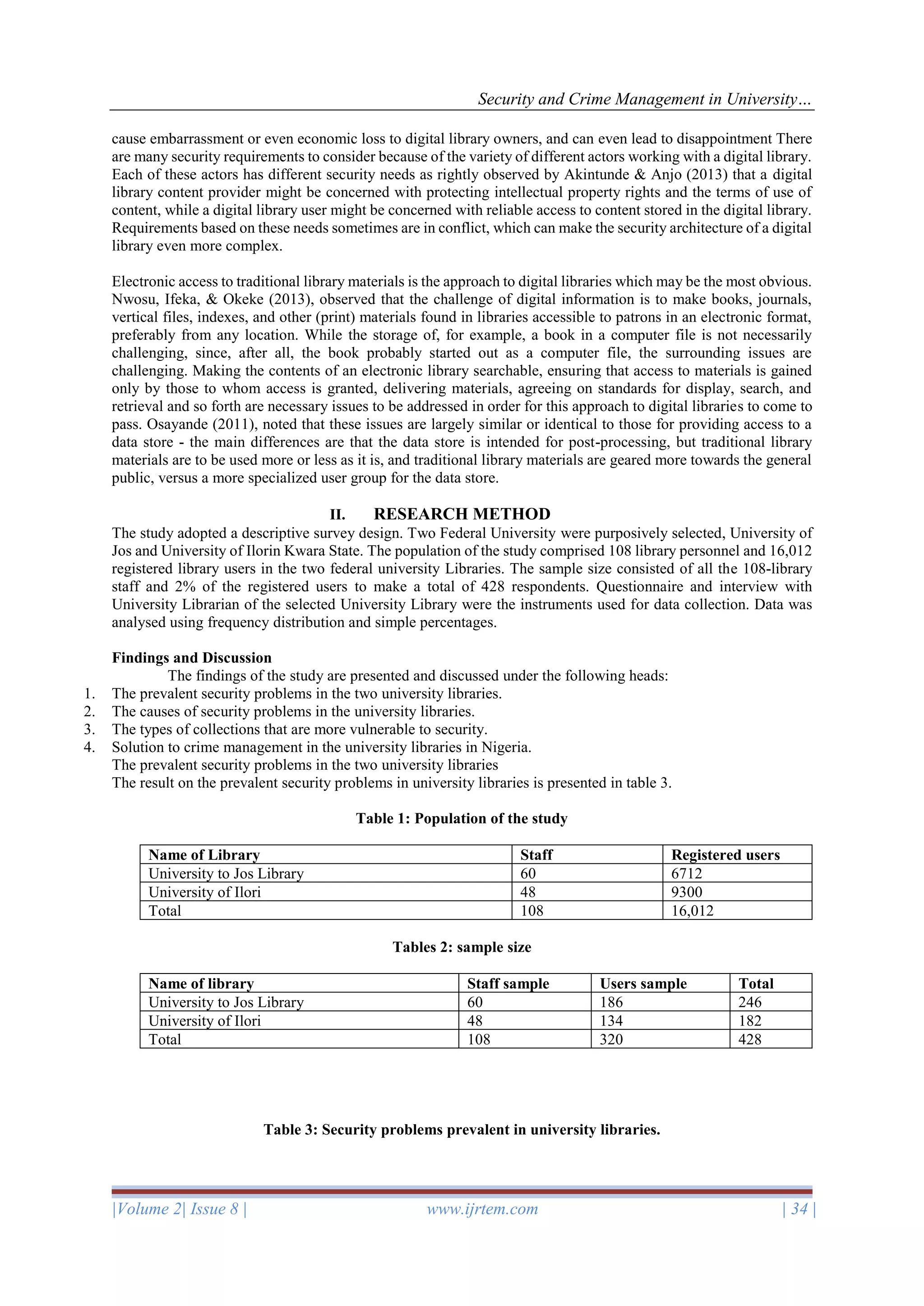
The result on the prevalent security problems in university libraries is presented in table 3.
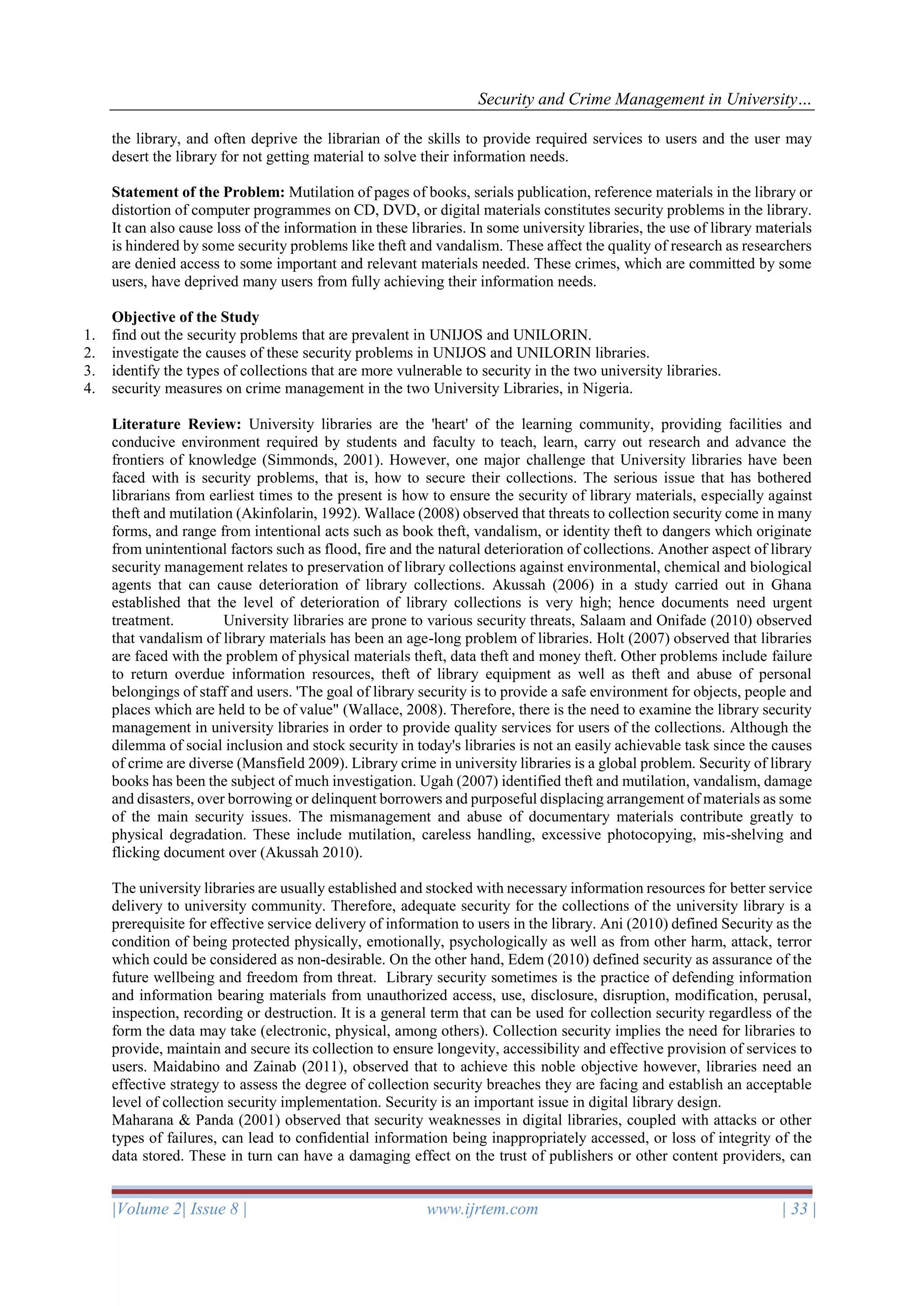
Table 1: Population of the study
Name of Library Staff Registered users
University to Jos Library 60 6712
University of Ilori 48 9300
Total 108 16,012
Tables 2: sample size
Name of library Staff sample Users sample Total
University to Jos Library 60 186 246
University of Ilori 48 134 182
Total 108 320 428
Table 3: Security problems prevalent in university libraries.
Security and Crime Management in University…
|Volume 2| Issue 8 | www.ijrtem.com | 35 |
S/N0 Security Problems Users Staff Overall
1 Hide libraries materials in their clothes 220(69%) 87(81%) 307(72%)
2 Collaboration of library staff 188(58%) 56(52%) 241(56%)
3 Throw them out of the window 244(76%) 94(87%) 338(79%)
4 Fear that one may not find the book on the shelf at the
time of borrowing
180(56%) 77(71%) 257(60%)
5 Insufficient of number of books in high demand 114(36%) 68(63%) 182(43%)
6 Stealing/theft of library materials 272(85%) 105(97%) 377(88%)
7 Defacing of library materials 164(51%) 75(69%) 239(56%)
8 Mutilation of library materials 256(80%) 98(91%) 354(83%)
9 Vandalism of library materials 149(47%) 66(61%) 215(50%)
10 Threats to computer system/network 153(48%) 81(81%) 234(55%)
11 Misuse/mishandling of library materials 210(66%) 102(94%) 312(73%)
12 Non-return of borrowed items 262(82%) 79(73%) 341(80%)
13 Poor cooperation from library security officers 196(61%) 68(63%) 264(62%)
Table3: revealed that stealing/theft of library materials (88%) was the most prevalent security problem in the
university libraries. It is followed by mutilation of library materials (83%) and Non-return of borrowed items
(80%). Other security problems prevalent were throw them out of the window (79%), misuse/mishandling of
library materials (73%), hide library materials in their clothes (72%), poor cooperation from library security
officers (62%), fear that one may not find the book on the shelf at the time of borrowing (60%), collaboration of
library staff as well as defacing of library materials (56%), threats to computer system/network (55%), vandalism
of library materials (50%) and insufficient of number of books in high demand (43%). These findings were in-
line with Abiola and Omolara (2013), Holt (2007) and Forley (2005) identified materials that are vulnerable to
security problems like theft, mutilation, defacing and vandalism in the university libraries include print and non-
print materials, high demand materials such as special collections, rare books and manuscripts.
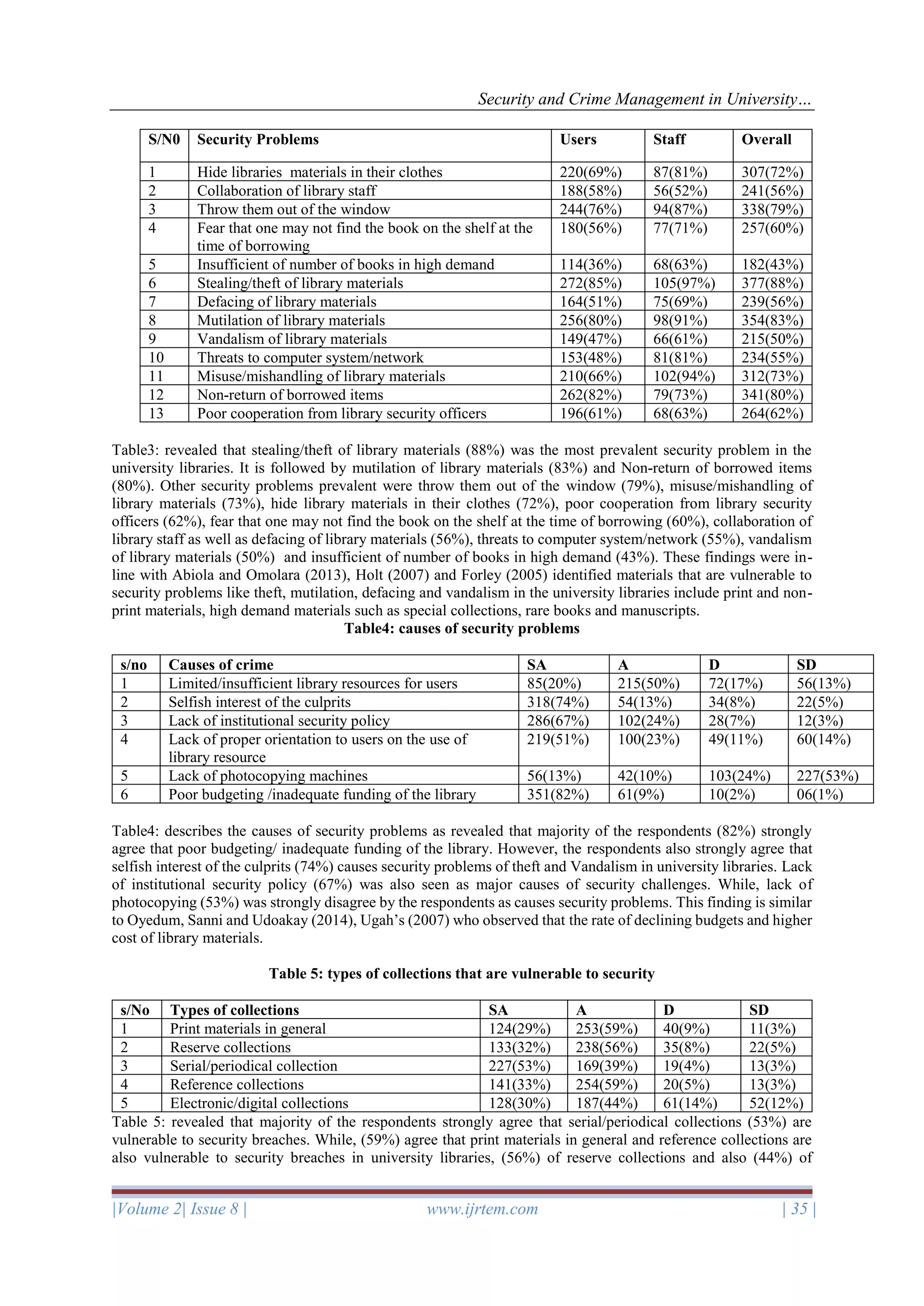
Table4: causes of security problems
s/no Causes of crime SA A D SD
1 Limited/insufficient library resources for users 85(20%) 215(50%) 72(17%) 56(13%)
2 Selfish interest of the culprits 318(74%) 54(13%) 34(8%) 22(5%)
3 Lack of institutional security policy 286(67%) 102(24%) 28(7%) 12(3%)
4 Lack of proper orientation to users on the use of
library resource
219(51%) 100(23%) 49(11%) 60(14%)
5 Lack of photocopying machines 56(13%) 42(10%) 103(24%) 227(53%)
6 Poor budgeting /inadequate funding of the library 351(82%) 61(9%) 10(2%) 06(1%)
Table4: describes the causes of security problems as revealed that majority of the respondents (82%) strongly
agree that poor budgeting/ inadequate funding of the library. However, the respondents also strongly agree that
selfish interest of the culprits (74%) causes security problems of theft and Vandalism in university libraries. Lack
of institutional security policy (67%) was also seen as major causes of security challenges. While, lack of
photocopying (53%) was strongly disagree by the respondents as causes security problems. This finding is similar
to Oyedum, Sanni and Udoakay (2014), Ugah’s (2007) who observed that the rate of declining budgets and higher
cost of library materials.
Table 5: types of collections that are vulnerable to security
s/No Types of collections SA A D SD
1 Print materials in general 124(29%) 253(59%) 40(9%) 11(3%)
2 Reserve collections 133(32%) 238(56%) 35(8%) 22(5%)
3 Serial/periodical collection 227(53%) 169(39%) 19(4%) 13(3%)
4 Reference collections 141(33%) 254(59%) 20(5%) 13(3%)
5 Electronic/digital collections 128(30%) 187(44%) 61(14%) 52(12%)
Table 5: revealed that majority of the respondents strongly agree that serial/periodical collections (53%) are
vulnerable to security breaches. While, (59%) agree that print materials in general and reference collections are
also vulnerable to security breaches in university libraries, (56%) of reserve collections and also (44%) of
Security and Crime Management in University…
|Volume 2| Issue 8 | www.ijrtem.com | 36 |
electronic/digital collections agree by majority of the respondents, that the too face security breaches in the
university libraries.
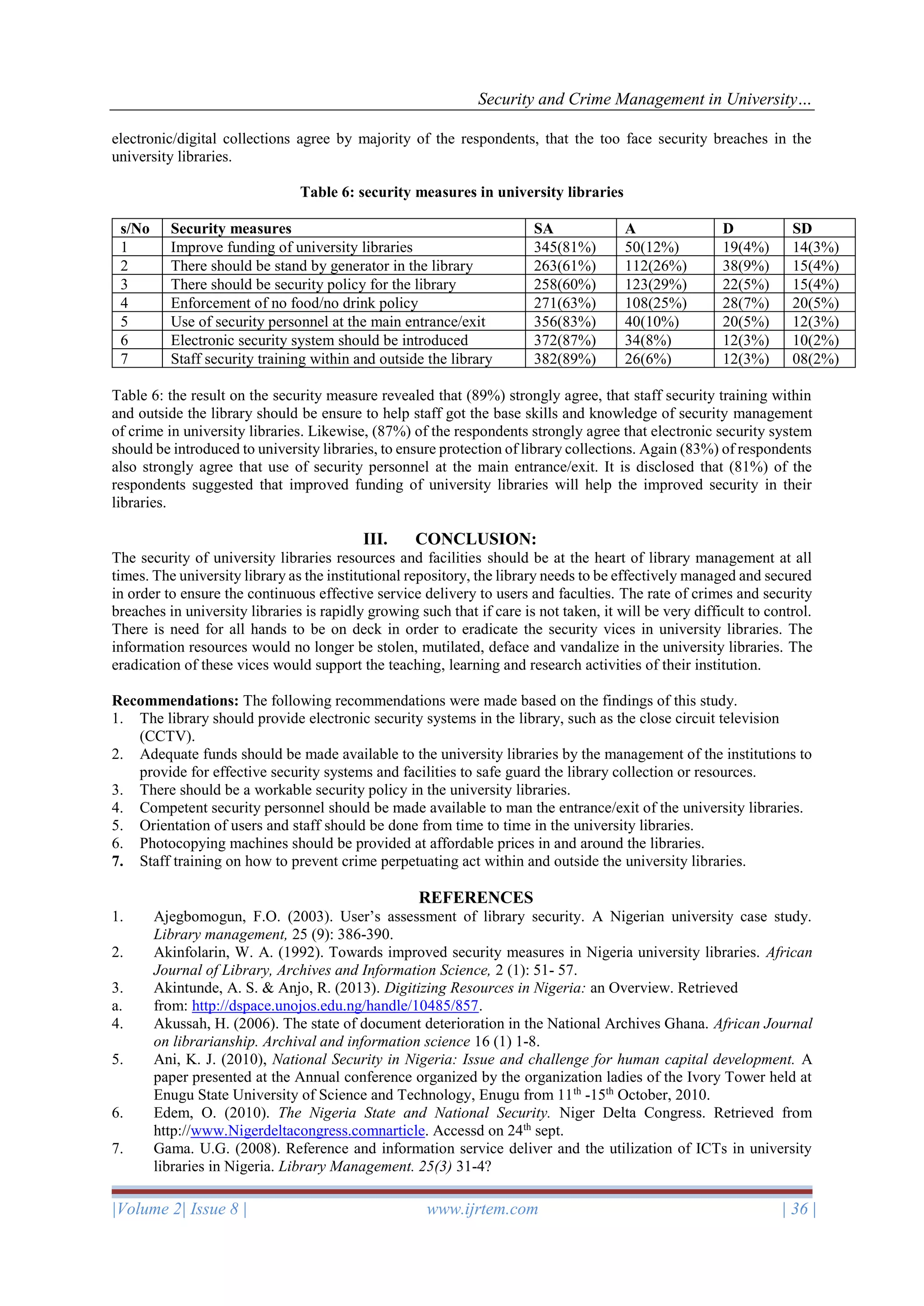
Table 6: security measures in university libraries
s/No Security measures SA A D SD
1 Improve funding of university libraries 345(81%) 50(12%) 19(4%) 14(3%)
2 There should be stand by generator in the library 263(61%) 112(26%) 38(9%) 15(4%)
3 There should be security policy for the library 258(60%) 123(29%) 22(5%) 15(4%)
4 Enforcement of no food/no drink policy 271(63%) 108(25%) 28(7%) 20(5%)
5 Use of security personnel at the main entrance/exit 356(83%) 40(10%) 20(5%) 12(3%)
6 Electronic security system should be introduced 372(87%) 34(8%) 12(3%) 10(2%)
7 Staff security training within and outside the library 382(89%) 26(6%) 12(3%) 08(2%)
Table 6: the result on the security measure revealed that (89%) strongly agree, that staff security training within
and outside the library should be ensure to help staff got the base skills and knowledge of security management
of crime in university libraries. Likewise, (87%) of the respondents strongly agree that electronic security system
should be introduced to university libraries, to ensure protection of library collections. Again (83%) of respondents
also strongly agree that use of security personnel at the main entrance/exit. It is disclosed that (81%) of the
respondents suggested that improved funding of university libraries will help the improved security in their
libraries.
III. CONCLUSION:
The security of university libraries resources and facilities should be at the heart of library management at all
times. The university library as the institutional repository, the library needs to be effectively managed and secured
in order to ensure the continuous effective service delivery to users and faculties. The rate of crimes and security
breaches in university libraries is rapidly growing such that if care is not taken, it will be very difficult to control.
There is need for all hands to be on deck in order to eradicate the security vices in university libraries. The
information resources would no longer be stolen, mutilated, deface and vandalize in the university libraries. The
eradication of these vices would support the teaching, learning and research activities of their institution.
Recommendations: The following recommendations were made based on the findings of this study.
1. The library should provide electronic security systems in the library, such as the close circuit television
(CCTV).
2. Adequate funds should be made available to the university libraries by the management of the institutions to
provide for effective security systems and facilities to safe guard the library collection or resources.
3. There should be a workable security policy in the university libraries.
4. Competent security personnel should be made available to man the entrance/exit of the university libraries.
5. Orientation of users and staff should be done from time to time in the university libraries.
6. Photocopying machines should be provided at affordable prices in and around the libraries.
7. Staff training on how to prevent crime perpetuating act within and outside the university libraries.
REFERENCES
1. Ajegbomogun, F.O. (2003). User’s assessment of library security. A Nigerian university case study.
Library management, 25 (9): 386-390.
2. Akinfolarin, W. A. (1992). Towards improved security measures in Nigeria university libraries. African
Journal of Library, Archives and Information Science, 2 (1): 51- 57.
3. Akintunde, A. S. & Anjo, R. (2013). Digitizing Resources in Nigeria: an Overview. Retrieved
a. from: http://dspace.unojos.edu.ng/handle/10485/857.
4. Akussah, H. (2006). The state of document deterioration in the National Archives Ghana. African Journal
on librarianship. Archival and information science 16 (1) 1-8.
5. Ani, K. J. (2010), National Security in Nigeria: Issue and challenge for human capital development. A
paper presented at the Annual conference organized by the organization ladies of the Ivory Tower held at
Enugu State University of Science and Technology, Enugu from 11th
-15th
October, 2010.
6. Edem, O. (2010). The Nigeria State and National Security. Niger Delta Congress. Retrieved from
http://www.Nigerdeltacongress.comnarticle. Accessd on 24th
sept.
7. Gama. U.G. (2008). Reference and information service deliver and the utilization of ICTs in university
libraries in Nigeria. Library Management. 25(3) 31-4?
Security and Crime Management in University…
|Volume 2| Issue 8 | www.ijrtem.com | 37 |
8. Holt, G.E. (2007). Theft by library staff. The Botton Line of Managing Library Finances. 20(2): 85-93.
9. Maharama, B. and Panda, K. C. (2001). Preservation of digital information in libraries: issues and
strategies. In Naidu, M. K. R. et al. (Eds.). Creation and management of digital resources. Proceedings of
CALIBER – 2001 National conference, 15-16 March. INFLIBNET, Ahmedabad.
10. Maidabino, A. A. (2010). Collection security issue in Malaysign academic libraries; an exploratory
survey. Library philosophy and practice. Retrieved from: http://unilib.uni.edu/LPP/Maidabino.htm.
11. Nwosu, O., Ifeka, E., Okeke, E. F. E. (2013). Challenges of electronic information management in Nigeria
University Libraries: Journal of Humanities and Social Science. 13(2): 75-79. Retrieved from:
www.Iosrjournals.Org. 9th
jan,. 2017.
12. Osayande, O. (2011). Electronic security systems in academic libraries: A case study of three university
libraries in south. West Nigeria. Chinese Librarianship an International Electronic Journal, 32. URL:
http:// www.iclc.us/clieji/c132 Osayande.pdf.
13. Salaam, M .O. & Onifade, (2009). The perceptions and attitude of students in relation to vandalism in
Nimbe Adedipe library, university of agriculture Abeokuta. Library and Archival Security. 24(2), 20-27.
14. Simmonds, P. L. (2001). Usage of academic libraries: The role of service qualify, resources, and used
characteristic. Library philosophy and practice. Retrieved from : http:// findarticles.com/P/articles/mi
ml387 is 449 lai 77811348. 20 may, 2012
15. Mansfield, D. (2009). Reducing Book theff at university libraries. Journal of library and information
research 33 (13): 10-15.
16. Ugah, D. (2007). Evaluating the use of University libraries in Nigeria: A case study of Michael Okpava
University of agriculture. Journal of Information and Knoledge Management. 2(5): 86- 93. Retrieve from:
http 11 www.web pages.uidaho.edul-mohin/ugah? Htm. 15th
feb., 2014.
17. Wallace, S.W. (2008). The perimeter of security policy as the bridge between library security philosophy
and library security practice. A Master’s paper for MS in LS Degree. 1-44.
Suleiman Musa , Security and Crime Management in University Libraries in Nigeria. Invention
Journal of Research Technology in Engineering & Management (IJRTEM), 2(6), 32-37.
Retrieved August 9, 2018, from www.ijrtem.com.

Security and Crime Management in University Libraries in Nigeria

  • 1.
    Invention Journal ofResearch Technology in Engineering & Management (IJRTEM) ISSN: 2455-3689 www.ijrtem.com Volume 2 Issue 8 ǁ August 2018 ǁ PP 32-37 |Volume 2| Issue 8 | www.ijrtem.com | 32 | Security and Crime Management in University Libraries in Nigeria Suleiman Musa, Department of library and information science Nasarawa State Polytechnic, Lafia Nasarawa State. Nigeria ABSTRACT : Security and prevention of crime in university library is very paramount duties of librarian. The survival of a library depends to a large extend on how secured its collections are, security of library resources constitutes serious challenge facing university libraries in Nigeria. The paper, therefore, investigates security and crime management in university libraries in Nigeria using university of Jos and university of Ilorin libraries. The study adopted a descriptive survey method. The population of the study comprised 108 library personnel and 16,012 registered library users in two university libraries. While the sample size consisted of all the 108 library personnel, and 2% of the registered users to make a total of 428 respondents. Questionnaire and interview with the university librarians of the selected university libraries were the instruments used for data collection. Data were analysed using frequency distribution and percentages. Results revealed that security breaches included stealing/theft of library materials, mutilation of library materials, and non-return of borrowed items. It also showed inadequate funding, selfish interest of the culprits and lack of institutional security policy in the library. Base on the findings, that staff security training, electronic security system should be introduced and improve funding of university libraries among others. Recommendation orientation of users and staff should be done from time to time in university libraries to mention but few. I. Introduction Security refers to a process designed to protect something or somebody against danger. It is an act of preventing crime, whereas in the case of library resources; it prevents un-authorized removal or loss of materials, usually as a result of intruders' or interference of thieves', based on the view of Ajegbomogun (2004). Conceptually, it means the overall manner in which policies, programmers, procedures, or measures are deployed to mitigate risk and ensure access to a particular resource feared to disappear. Relatively, a security practice simply refers to the different types of actions, measures or practices adopted to stop a crime. Edem (2010) defines security as assurance of the future wellbeing and freedom from threat. Security therefore refers to a process designed to protect something or somebody against danger. It is an act of preventing crime. In the case of library resources; it prevents un-authorized removal or loss of materials, usually as a result of intruders' or thieves' interference (Ajegbomogun, 2004). Securities are forms of protection, structures and processes that provide or improve security as a condition. Relatively, a security practice simply refers to the different types of actions, measures or practices adopted to stop a crime. Library collections often face security problems. According to Maidabino (2010), collection security management in libraries can be conceptualized to mean the overall manner in which collection security policies, programmes, procedures, or measures are deployed to mitigate risk and ensure access. It is the safety and security measures taken to safeguard and prevent library collections, materials, and infrastructure from risk and danger to the longevity, accessibility and availability of library and information services. With the foregoing, therefore, it becomes necessary to have in place a 'collection security' which, by definition, is a process designed to protect library collections against un-authorized removal, damage or loss (Ajegbomogun, 2004). This involves protecting library resources against theft, mutilation, mishandling as well as for intruders and vandalism. Even with the emergence of the Internet, digital libraries and archives, cases of security problems still affect libraries. These include: mishandling, vandalism of the facilities such as CD ROM, DVD, and magnetic tape can easily crack when not handled with care or falls on the ground, the CD ROM, DVD, may damage and information on it can lose. Accessibility of the information services cannot be possible as a result of data loss by mishandling of CD ROM, DVD, magnetic tape etc. Theft of books, journals, CD ROM, microfilms, computers and other library collections, diminish materials in the library. Furthermore, mutilation of pages of books, serials publication, reference materials in the library or distortion of computer programmes on CD, DVD, or digital materials constitute security problems in the library (Gama, 2008). It can also cause loss of information in the libraries. University libraries deprived of resources (print & non-print) may make users less interested in visiting
  • 2.
    Security and CrimeManagement in University… |Volume 2| Issue 8 | www.ijrtem.com | 33 | the library, and often deprive the librarian of the skills to provide required services to users and the user may desert the library for not getting material to solve their information needs. Statement of the Problem: Mutilation of pages of books, serials publication, reference materials in the library or distortion of computer programmes on CD, DVD, or digital materials constitutes security problems in the library. It can also cause loss of the information in these libraries. In some university libraries, the use of library materials is hindered by some security problems like theft and vandalism. These affect the quality of research as researchers are denied access to some important and relevant materials needed. These crimes, which are committed by some users, have deprived many users from fully achieving their information needs. Objective of the Study 1. find out the security problems that are prevalent in UNIJOS and UNILORIN. 2. investigate the causes of these security problems in UNIJOS and UNILORIN libraries. 3. identify the types of collections that are more vulnerable to security in the two university libraries. 4. security measures on crime management in the two University Libraries, in Nigeria. Literature Review: University libraries are the 'heart' of the learning community, providing facilities and conducive environment required by students and faculty to teach, learn, carry out research and advance the frontiers of knowledge (Simmonds, 2001). However, one major challenge that University libraries have been faced with is security problems, that is, how to secure their collections. The serious issue that has bothered librarians from earliest times to the present is how to ensure the security of library materials, especially against theft and mutilation (Akinfolarin, 1992). Wallace (2008) observed that threats to collection security come in many forms, and range from intentional acts such as book theft, vandalism, or identity theft to dangers which originate from unintentional factors such as flood, fire and the natural deterioration of collections. Another aspect of library security management relates to preservation of library collections against environmental, chemical and biological agents that can cause deterioration of library collections. Akussah (2006) in a study carried out in Ghana established that the level of deterioration of library collections is very high; hence documents need urgent treatment. University libraries are prone to various security threats, Salaam and Onifade (2010) observed that vandalism of library materials has been an age-long problem of libraries. Holt (2007) observed that libraries are faced with the problem of physical materials theft, data theft and money theft. Other problems include failure to return overdue information resources, theft of library equipment as well as theft and abuse of personal belongings of staff and users. 'The goal of library security is to provide a safe environment for objects, people and places which are held to be of value" (Wallace, 2008). Therefore, there is the need to examine the library security management in university libraries in order to provide quality services for users of the collections. Although the dilemma of social inclusion and stock security in today's libraries is not an easily achievable task since the causes of crime are diverse (Mansfield 2009). Library crime in university libraries is a global problem. Security of library books has been the subject of much investigation. Ugah (2007) identified theft and mutilation, vandalism, damage and disasters, over borrowing or delinquent borrowers and purposeful displacing arrangement of materials as some of the main security issues. The mismanagement and abuse of documentary materials contribute greatly to physical degradation. These include mutilation, careless handling, excessive photocopying, mis-shelving and flicking document over (Akussah 2010). The university libraries are usually established and stocked with necessary information resources for better service delivery to university community. Therefore, adequate security for the collections of the university library is a prerequisite for effective service delivery of information to users in the library. Ani (2010) defined Security as the condition of being protected physically, emotionally, psychologically as well as from other harm, attack, terror which could be considered as non-desirable. On the other hand, Edem (2010) defined security as assurance of the future wellbeing and freedom from threat. Library security sometimes is the practice of defending information and information bearing materials from unauthorized access, use, disclosure, disruption, modification, perusal, inspection, recording or destruction. It is a general term that can be used for collection security regardless of the form the data may take (electronic, physical, among others). Collection security implies the need for libraries to provide, maintain and secure its collection to ensure longevity, accessibility and effective provision of services to users. Maidabino and Zainab (2011), observed that to achieve this noble objective however, libraries need an effective strategy to assess the degree of collection security breaches they are facing and establish an acceptable level of collection security implementation. Security is an important issue in digital library design. Maharana & Panda (2001) observed that security weaknesses in digital libraries, coupled with attacks or other types of failures, can lead to confidential information being inappropriately accessed, or loss of integrity of the data stored. These in turn can have a damaging effect on the trust of publishers or other content providers, can
  • 3.
    Security and CrimeManagement in University… |Volume 2| Issue 8 | www.ijrtem.com | 34 | cause embarrassment or even economic loss to digital library owners, and can even lead to disappointment There are many security requirements to consider because of the variety of different actors working with a digital library. Each of these actors has different security needs as rightly observed by Akintunde & Anjo (2013) that a digital library content provider might be concerned with protecting intellectual property rights and the terms of use of content, while a digital library user might be concerned with reliable access to content stored in the digital library. Requirements based on these needs sometimes are in conflict, which can make the security architecture of a digital library even more complex. Electronic access to traditional library materials is the approach to digital libraries which may be the most obvious. Nwosu, Ifeka, & Okeke (2013), observed that the challenge of digital information is to make books, journals, vertical files, indexes, and other (print) materials found in libraries accessible to patrons in an electronic format, preferably from any location. While the storage of, for example, a book in a computer file is not necessarily challenging, since, after all, the book probably started out as a computer file, the surrounding issues are challenging. Making the contents of an electronic library searchable, ensuring that access to materials is gained only by those to whom access is granted, delivering materials, agreeing on standards for display, search, and retrieval and so forth are necessary issues to be addressed in order for this approach to digital libraries to come to pass. Osayande (2011), noted that these issues are largely similar or identical to those for providing access to a data store - the main differences are that the data store is intended for post-processing, but traditional library materials are to be used more or less as it is, and traditional library materials are geared more towards the general public, versus a more specialized user group for the data store. II. RESEARCH METHOD The study adopted a descriptive survey design. Two Federal University were purposively selected, University of Jos and University of Ilorin Kwara State. The population of the study comprised 108 library personnel and 16,012 registered library users in the two federal university Libraries. The sample size consisted of all the 108-library staff and 2% of the registered users to make a total of 428 respondents. Questionnaire and interview with University Librarian of the selected University Library were the instruments used for data collection. Data was analysed using frequency distribution and simple percentages. Findings and Discussion The findings of the study are presented and discussed under the following heads: 1. The prevalent security problems in the two university libraries. 2. The causes of security problems in the university libraries. 3. The types of collections that are more vulnerable to security. 4. Solution to crime management in the university libraries in Nigeria. The prevalent security problems in the two university libraries The result on the prevalent security problems in university libraries is presented in table 3. Table 1: Population of the study Name of Library Staff Registered users University to Jos Library 60 6712 University of Ilori 48 9300 Total 108 16,012 Tables 2: sample size Name of library Staff sample Users sample Total University to Jos Library 60 186 246 University of Ilori 48 134 182 Total 108 320 428 Table 3: Security problems prevalent in university libraries.
  • 4.
    Security and CrimeManagement in University… |Volume 2| Issue 8 | www.ijrtem.com | 35 | S/N0 Security Problems Users Staff Overall 1 Hide libraries materials in their clothes 220(69%) 87(81%) 307(72%) 2 Collaboration of library staff 188(58%) 56(52%) 241(56%) 3 Throw them out of the window 244(76%) 94(87%) 338(79%) 4 Fear that one may not find the book on the shelf at the time of borrowing 180(56%) 77(71%) 257(60%) 5 Insufficient of number of books in high demand 114(36%) 68(63%) 182(43%) 6 Stealing/theft of library materials 272(85%) 105(97%) 377(88%) 7 Defacing of library materials 164(51%) 75(69%) 239(56%) 8 Mutilation of library materials 256(80%) 98(91%) 354(83%) 9 Vandalism of library materials 149(47%) 66(61%) 215(50%) 10 Threats to computer system/network 153(48%) 81(81%) 234(55%) 11 Misuse/mishandling of library materials 210(66%) 102(94%) 312(73%) 12 Non-return of borrowed items 262(82%) 79(73%) 341(80%) 13 Poor cooperation from library security officers 196(61%) 68(63%) 264(62%) Table3: revealed that stealing/theft of library materials (88%) was the most prevalent security problem in the university libraries. It is followed by mutilation of library materials (83%) and Non-return of borrowed items (80%). Other security problems prevalent were throw them out of the window (79%), misuse/mishandling of library materials (73%), hide library materials in their clothes (72%), poor cooperation from library security officers (62%), fear that one may not find the book on the shelf at the time of borrowing (60%), collaboration of library staff as well as defacing of library materials (56%), threats to computer system/network (55%), vandalism of library materials (50%) and insufficient of number of books in high demand (43%). These findings were in- line with Abiola and Omolara (2013), Holt (2007) and Forley (2005) identified materials that are vulnerable to security problems like theft, mutilation, defacing and vandalism in the university libraries include print and non- print materials, high demand materials such as special collections, rare books and manuscripts. Table4: causes of security problems s/no Causes of crime SA A D SD 1 Limited/insufficient library resources for users 85(20%) 215(50%) 72(17%) 56(13%) 2 Selfish interest of the culprits 318(74%) 54(13%) 34(8%) 22(5%) 3 Lack of institutional security policy 286(67%) 102(24%) 28(7%) 12(3%) 4 Lack of proper orientation to users on the use of library resource 219(51%) 100(23%) 49(11%) 60(14%) 5 Lack of photocopying machines 56(13%) 42(10%) 103(24%) 227(53%) 6 Poor budgeting /inadequate funding of the library 351(82%) 61(9%) 10(2%) 06(1%) Table4: describes the causes of security problems as revealed that majority of the respondents (82%) strongly agree that poor budgeting/ inadequate funding of the library. However, the respondents also strongly agree that selfish interest of the culprits (74%) causes security problems of theft and Vandalism in university libraries. Lack of institutional security policy (67%) was also seen as major causes of security challenges. While, lack of photocopying (53%) was strongly disagree by the respondents as causes security problems. This finding is similar to Oyedum, Sanni and Udoakay (2014), Ugah’s (2007) who observed that the rate of declining budgets and higher cost of library materials. Table 5: types of collections that are vulnerable to security s/No Types of collections SA A D SD 1 Print materials in general 124(29%) 253(59%) 40(9%) 11(3%) 2 Reserve collections 133(32%) 238(56%) 35(8%) 22(5%) 3 Serial/periodical collection 227(53%) 169(39%) 19(4%) 13(3%) 4 Reference collections 141(33%) 254(59%) 20(5%) 13(3%) 5 Electronic/digital collections 128(30%) 187(44%) 61(14%) 52(12%) Table 5: revealed that majority of the respondents strongly agree that serial/periodical collections (53%) are vulnerable to security breaches. While, (59%) agree that print materials in general and reference collections are also vulnerable to security breaches in university libraries, (56%) of reserve collections and also (44%) of
  • 5.
    Security and CrimeManagement in University… |Volume 2| Issue 8 | www.ijrtem.com | 36 | electronic/digital collections agree by majority of the respondents, that the too face security breaches in the university libraries. Table 6: security measures in university libraries s/No Security measures SA A D SD 1 Improve funding of university libraries 345(81%) 50(12%) 19(4%) 14(3%) 2 There should be stand by generator in the library 263(61%) 112(26%) 38(9%) 15(4%) 3 There should be security policy for the library 258(60%) 123(29%) 22(5%) 15(4%) 4 Enforcement of no food/no drink policy 271(63%) 108(25%) 28(7%) 20(5%) 5 Use of security personnel at the main entrance/exit 356(83%) 40(10%) 20(5%) 12(3%) 6 Electronic security system should be introduced 372(87%) 34(8%) 12(3%) 10(2%) 7 Staff security training within and outside the library 382(89%) 26(6%) 12(3%) 08(2%) Table 6: the result on the security measure revealed that (89%) strongly agree, that staff security training within and outside the library should be ensure to help staff got the base skills and knowledge of security management of crime in university libraries. Likewise, (87%) of the respondents strongly agree that electronic security system should be introduced to university libraries, to ensure protection of library collections. Again (83%) of respondents also strongly agree that use of security personnel at the main entrance/exit. It is disclosed that (81%) of the respondents suggested that improved funding of university libraries will help the improved security in their libraries. III. CONCLUSION: The security of university libraries resources and facilities should be at the heart of library management at all times. The university library as the institutional repository, the library needs to be effectively managed and secured in order to ensure the continuous effective service delivery to users and faculties. The rate of crimes and security breaches in university libraries is rapidly growing such that if care is not taken, it will be very difficult to control. There is need for all hands to be on deck in order to eradicate the security vices in university libraries. The information resources would no longer be stolen, mutilated, deface and vandalize in the university libraries. The eradication of these vices would support the teaching, learning and research activities of their institution. Recommendations: The following recommendations were made based on the findings of this study. 1. The library should provide electronic security systems in the library, such as the close circuit television (CCTV). 2. Adequate funds should be made available to the university libraries by the management of the institutions to provide for effective security systems and facilities to safe guard the library collection or resources. 3. There should be a workable security policy in the university libraries. 4. Competent security personnel should be made available to man the entrance/exit of the university libraries. 5. Orientation of users and staff should be done from time to time in the university libraries. 6. Photocopying machines should be provided at affordable prices in and around the libraries. 7. Staff training on how to prevent crime perpetuating act within and outside the university libraries. REFERENCES 1. Ajegbomogun, F.O. (2003). User’s assessment of library security. A Nigerian university case study. Library management, 25 (9): 386-390. 2. Akinfolarin, W. A. (1992). Towards improved security measures in Nigeria university libraries. African Journal of Library, Archives and Information Science, 2 (1): 51- 57. 3. Akintunde, A. S. & Anjo, R. (2013). Digitizing Resources in Nigeria: an Overview. Retrieved a. from: http://dspace.unojos.edu.ng/handle/10485/857. 4. Akussah, H. (2006). The state of document deterioration in the National Archives Ghana. African Journal on librarianship. Archival and information science 16 (1) 1-8. 5. Ani, K. J. (2010), National Security in Nigeria: Issue and challenge for human capital development. A paper presented at the Annual conference organized by the organization ladies of the Ivory Tower held at Enugu State University of Science and Technology, Enugu from 11th -15th October, 2010. 6. Edem, O. (2010). The Nigeria State and National Security. Niger Delta Congress. Retrieved from http://www.Nigerdeltacongress.comnarticle. Accessd on 24th sept. 7. Gama. U.G. (2008). Reference and information service deliver and the utilization of ICTs in university libraries in Nigeria. Library Management. 25(3) 31-4?
  • 6.
    Security and CrimeManagement in University… |Volume 2| Issue 8 | www.ijrtem.com | 37 | 8. Holt, G.E. (2007). Theft by library staff. The Botton Line of Managing Library Finances. 20(2): 85-93. 9. Maharama, B. and Panda, K. C. (2001). Preservation of digital information in libraries: issues and strategies. In Naidu, M. K. R. et al. (Eds.). Creation and management of digital resources. Proceedings of CALIBER – 2001 National conference, 15-16 March. INFLIBNET, Ahmedabad. 10. Maidabino, A. A. (2010). Collection security issue in Malaysign academic libraries; an exploratory survey. Library philosophy and practice. Retrieved from: http://unilib.uni.edu/LPP/Maidabino.htm. 11. Nwosu, O., Ifeka, E., Okeke, E. F. E. (2013). Challenges of electronic information management in Nigeria University Libraries: Journal of Humanities and Social Science. 13(2): 75-79. Retrieved from: www.Iosrjournals.Org. 9th jan,. 2017. 12. Osayande, O. (2011). Electronic security systems in academic libraries: A case study of three university libraries in south. West Nigeria. Chinese Librarianship an International Electronic Journal, 32. URL: http:// www.iclc.us/clieji/c132 Osayande.pdf. 13. Salaam, M .O. & Onifade, (2009). The perceptions and attitude of students in relation to vandalism in Nimbe Adedipe library, university of agriculture Abeokuta. Library and Archival Security. 24(2), 20-27. 14. Simmonds, P. L. (2001). Usage of academic libraries: The role of service qualify, resources, and used characteristic. Library philosophy and practice. Retrieved from : http:// findarticles.com/P/articles/mi ml387 is 449 lai 77811348. 20 may, 2012 15. Mansfield, D. (2009). Reducing Book theff at university libraries. Journal of library and information research 33 (13): 10-15. 16. Ugah, D. (2007). Evaluating the use of University libraries in Nigeria: A case study of Michael Okpava University of agriculture. Journal of Information and Knoledge Management. 2(5): 86- 93. Retrieve from: http 11 www.web pages.uidaho.edul-mohin/ugah? Htm. 15th feb., 2014. 17. Wallace, S.W. (2008). The perimeter of security policy as the bridge between library security philosophy and library security practice. A Master’s paper for MS in LS Degree. 1-44. Suleiman Musa , Security and Crime Management in University Libraries in Nigeria. Invention Journal of Research Technology in Engineering & Management (IJRTEM), 2(6), 32-37. Retrieved August 9, 2018, from www.ijrtem.com.