Stock Market Operations
Unit-III: Secondary Market
Importance and Functions, Listing of Securities in Stock
Exchanges; Players in Stock Exchange - Investors, Speculators,
Market Makers, Stock Brokers; Eligibility Criteria; Trading in
Stock Exchange, Stock Exchanges - Bombay Stock Exchange,
National Stock Exchange, Over-the-Counter Exchange of India;
Stock Exchange, Stock Exchanges - Bombay Stock Exchange,
National Stock Exchange, Over-the-Counter Exchange of India;
The SEBI Trading Mechanism - BOLT, NEAT System and Screen
Based System.
Prepared By
Mr. Dayananda Huded M.Com JRF, NET 3 Times, & KSET
Teaching Assistant,
Rani Channamma University, PG Centre, Jamkhandi
E-mail: dayanandcht65@gmail.com
Importance and Functions of SM
 1. Providing Liquidity and Marketability to Existing Securities: The basic
function of a stock exchange is the creation of a continuous market where
securities are bought and sold. It gives investors the chance to disinvest and
reinvest. This provides both liquidity and easy marketability to already existing
securities in the market.
 2. Pricing of Securities: Share prices on a stock exchange are determined by
the forces of demand and supply. A stock exchange is a mechanism of constant
valuation through which the prices of securities are determined.
 3. Safety of Transaction: The membership of a stock exchange is well regulated
and its dealings are well defined according to the existing legal framework. (safe
and fair deal on the market)
 4. Contributes to Economic Growth: Through the process of disinvestment
and reinvestment savings get channelised into their most productive investment
avenues. This leads to capital formation and economic growth.
 5. Spreading of Equity Cult: Ensures wider share ownership by regulating new
issues, better trading practices and taking effective steps in educating the public
about investments.
 6. Providing Scope for Speculation
Listing of Securities in SE
 Meaning: Listing refers to the admission of the securities of a
company on a recognised stock exchange for trading. Listing of
securities is undertaken with the primary objective of providing
marketability, liquidity and transferability of shares.
 To be submitted along with the application for listing:-
 1. Memorandum of Associations, Articles of Association, Prospectus,
Directors’ report, Annual Accounts, Agreement with Underwriters, etc.
 2. Company’s activities, capital structure, distribution of shares,
dividends and bonus shares issued, etc.
 Listing Requirements:
For this purpose companies have been classified into 2 groups:-
 1. Large Cap Companies (minimum issue size of Rs.10 crores and market
capitalization of not less than Rs.25 crores)
 2. Small Cap Companies (minimum issue size of Rs.3 crores and market
capitalization of not less than Rs.5 crores)
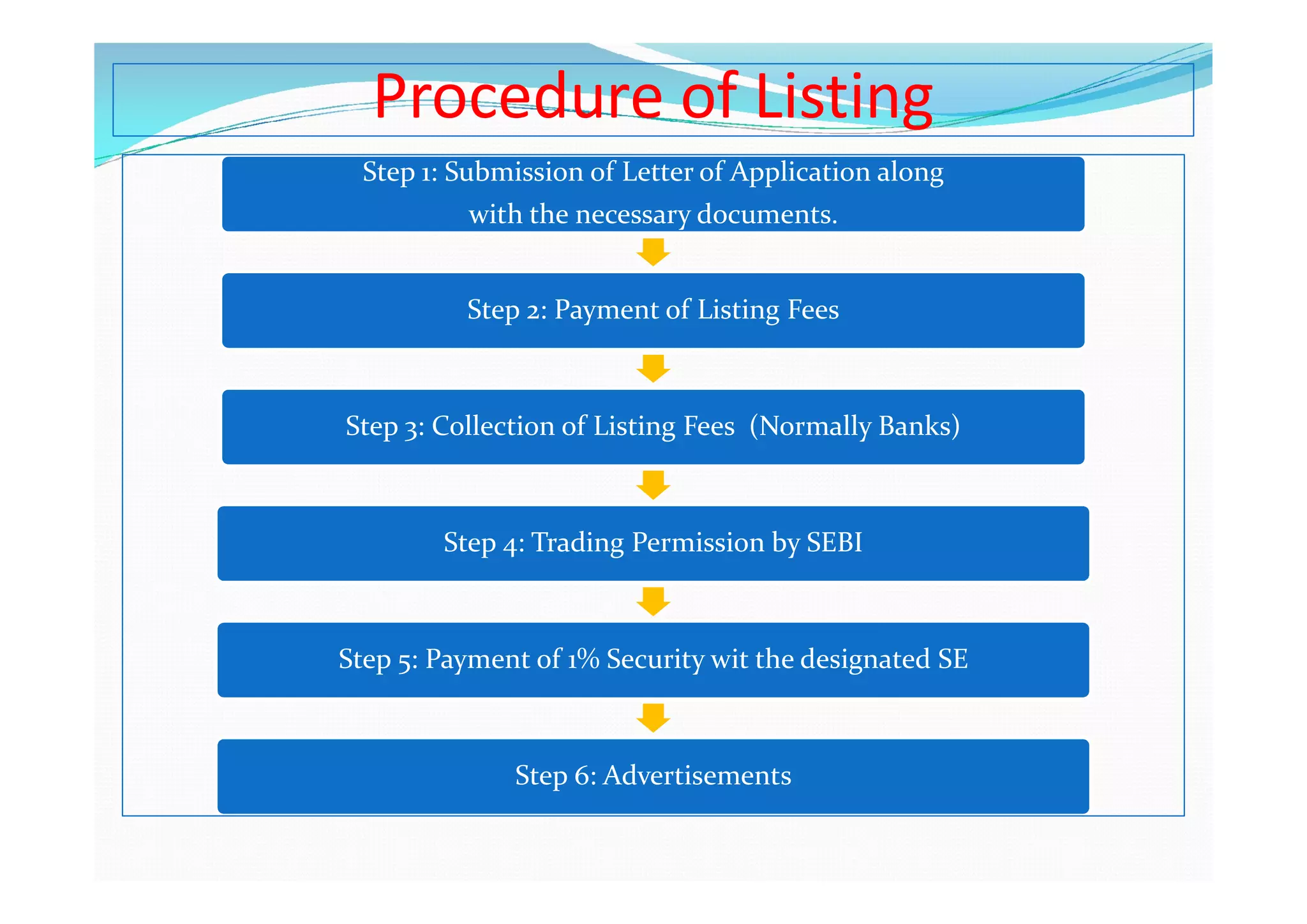
Procedure of Listing
Step 1: Submission of Letter of Application along
with the necessary documents.
Step 2: Payment of Listing Fees
Step 3: Collection of Listing Fees (Normally Banks)
Step 4: Trading Permission by SEBI
Step 5: Payment of 1% Security wit the designated SE
Step 6: Advertisements
Listing Fees
 Schedule of Listing Fees for the Year 2021-22
Particulars Amount (₹)
Initial Listing Fees 20,000
Listing Capital (₹ in Cr.) Annual Listing Fees (in ₹)
Up to 100 ₹ 250,000
Above 100 and up to 200 ₹ 300,000
Above 200 and up to 300 ₹ 375,000
Above 300 and up to 400 ₹ 450,000
Above 400 and up to 500 ₹ 600,000
Above 500 to 1000 Rs. 605,000/- and an additional listing fees of Rs. 3,530/- for every increase of
Rs.5 crores or part thereof above 500 crores in the paid-up share capital
Above 1000 to 2000 Rs. 990,000/- and an additional listing fees of Rs. 3,930/- for every increase of
Rs.5 crores or part thereof above 1,000 crores in the paid-up share capital.
Above 2000 to 3000 Rs. 1,000,000/- and an additional listing fees of Rs. 4,270/- for every increase
of Rs.5 crores or part thereof above 1,000 crores in the paid-up share capital.
Above 3000 Rs. 1,020,000/- and an additional listing fees of Rs. 3910/- for every increase
of Rs.5 crores or part thereof above 1,000 crores in the paid-up share capital.
Players in Stock Exchange
 Investors Speculators
 Market Makers Stock Brokers
 Speculators:
 Speculators are sophisticated investors or traders who
purchase assets for short periods of time and employ
strategies in order to profit from changes in its price.
 Speculators are important to markets because they bring
liquidity and assume market risk.
 A speculator as a man who observes the future and
acts before it occurs.
Types of Speculators
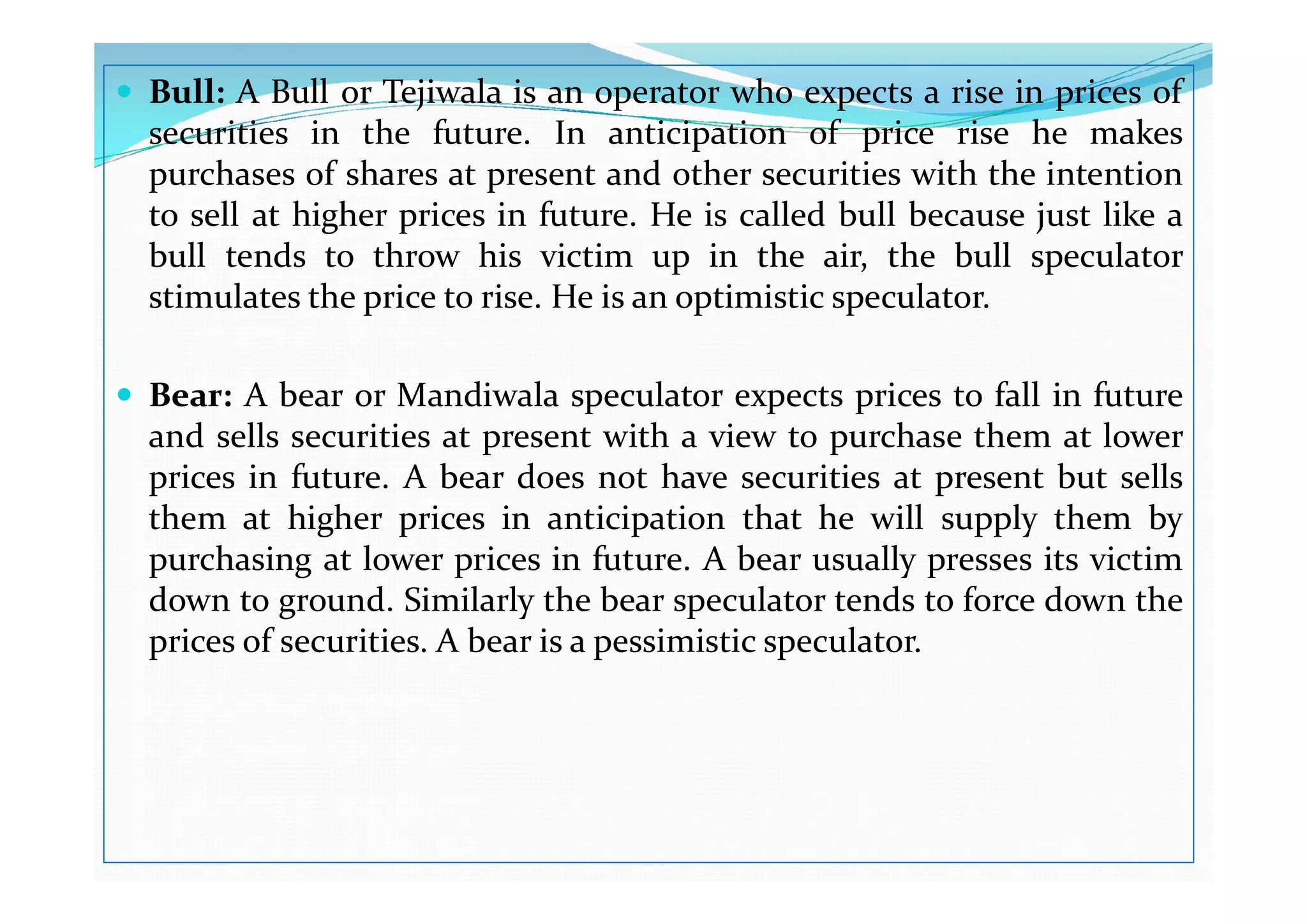
 Bull: A Bull or Tejiwala is an operator who expects a rise in prices of
securities in the future. In anticipation of price rise he makes
purchases of shares at present and other securities with the intention
to sell at higher prices in future. He is called bull because just like a
bull tends to throw his victim up in the air, the bull speculator
stimulates the price to rise. He is an optimistic speculator.
 Bear: A bear or Mandiwala speculator expects prices to fall in future
and sells securities at present with a view to purchase them at lower
prices in future. A bear does not have securities at present but sells
them at higher prices in anticipation that he will supply them by
purchasing at lower prices in future. A bear usually presses its victim
down to ground. Similarly the bear speculator tends to force down the
prices of securities. A bear is a pessimistic speculator.
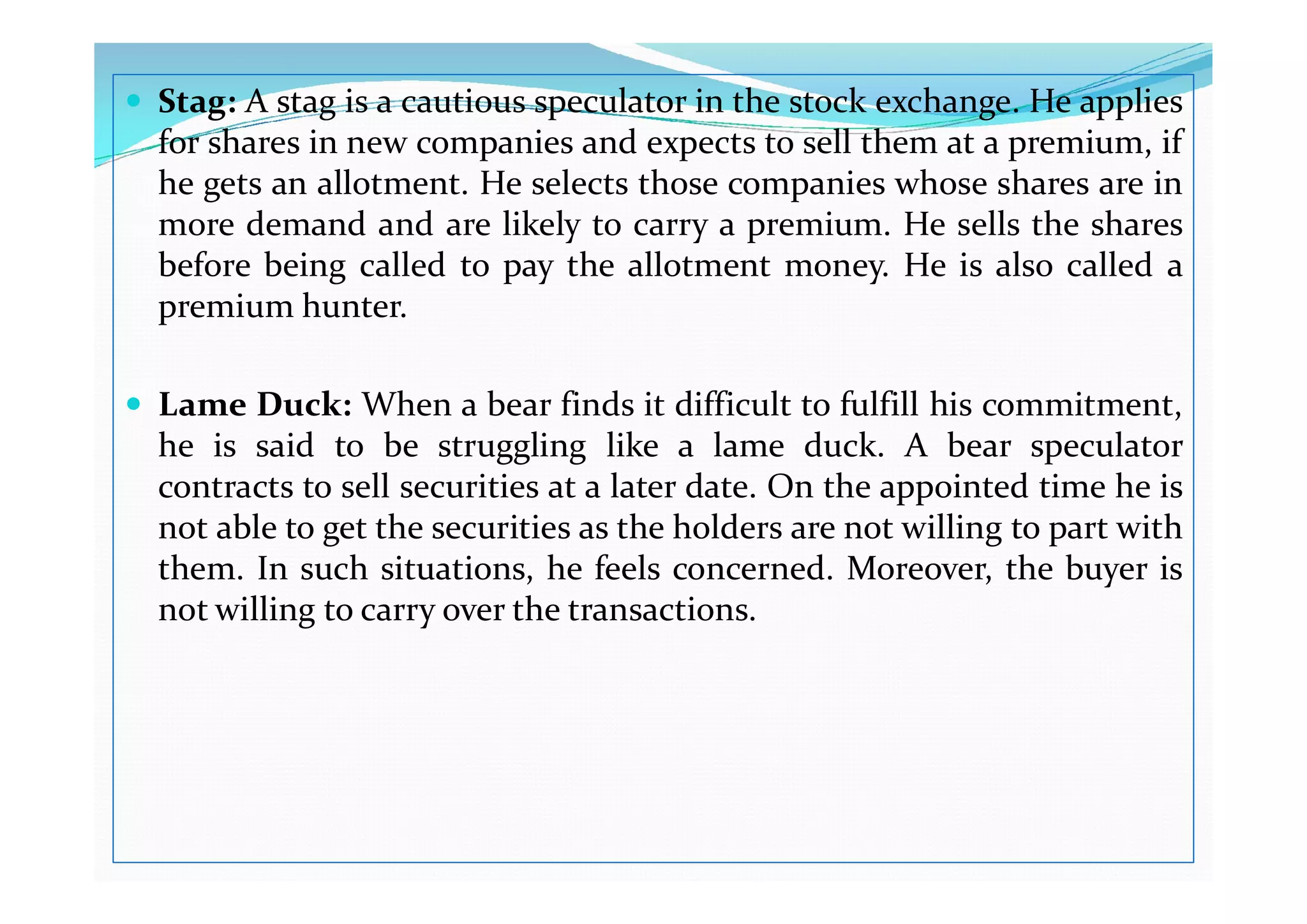
 Stag: A stag is a cautious speculator in the stock exchange. He applies
for shares in new companies and expects to sell them at a premium, if
he gets an allotment. He selects those companies whose shares are in
more demand and are likely to carry a premium. He sells the shares
before being called to pay the allotment money. He is also called a
premium hunter.
 Lame Duck: When a bear finds it difficult to fulfill his commitment,
he is said to be struggling like a lame duck. A bear speculator
contracts to sell securities at a later date. On the appointed time he is
not able to get the securities as the holders are not willing to part with
them. In such situations, he feels concerned. Moreover, the buyer is
not willing to carry over the transactions.
1. For Stock Brokers
 Minimum 21 age
 To become a stockbroker, you must have a bachelor's degree and at
least two years of experience working in a stock brokerage firm.
 To be eligible for his employment, a sub-broker (the prior stage of
being a broker) must have completed the 12th grade. The minimum
age is 21 years old. This is a fully integrated company.
Eligibility Criteria
age is 21 years old. This is a fully integrated company.
 Stock broking jobs aren't the only ones available in this area. The
stock market necessitates the expertise and abilities of specialists
from numerous sectors, ranging from economists who understand the
ins and outs of the market to financial planners who can provide you
with sound stock guidance. You can also work as a financial manager,
an analyst, or a market specialist.
 1. For Brokers:
 Procedure to become Stock Brokers
Step 1: You need to submit a New Membership Application to the Membership Services
Department in NSE/BSE.
Step 2: Once approved by the Membership Services Department, the application is sent to the
Membership Recommendation Committee and Membership Selection Committee.
Step 3: Membership Selection Committee evaluates the application and sends it for approval
to Member Compliance Department.
Step 4: Once approved, the Offer Letter of Provisional Membership is sent to you.
Step 5: You need to submit documents to the SEBI for registration. Once approved SEBI
Certificate is sent to you, and finally, the trading system will be provided.
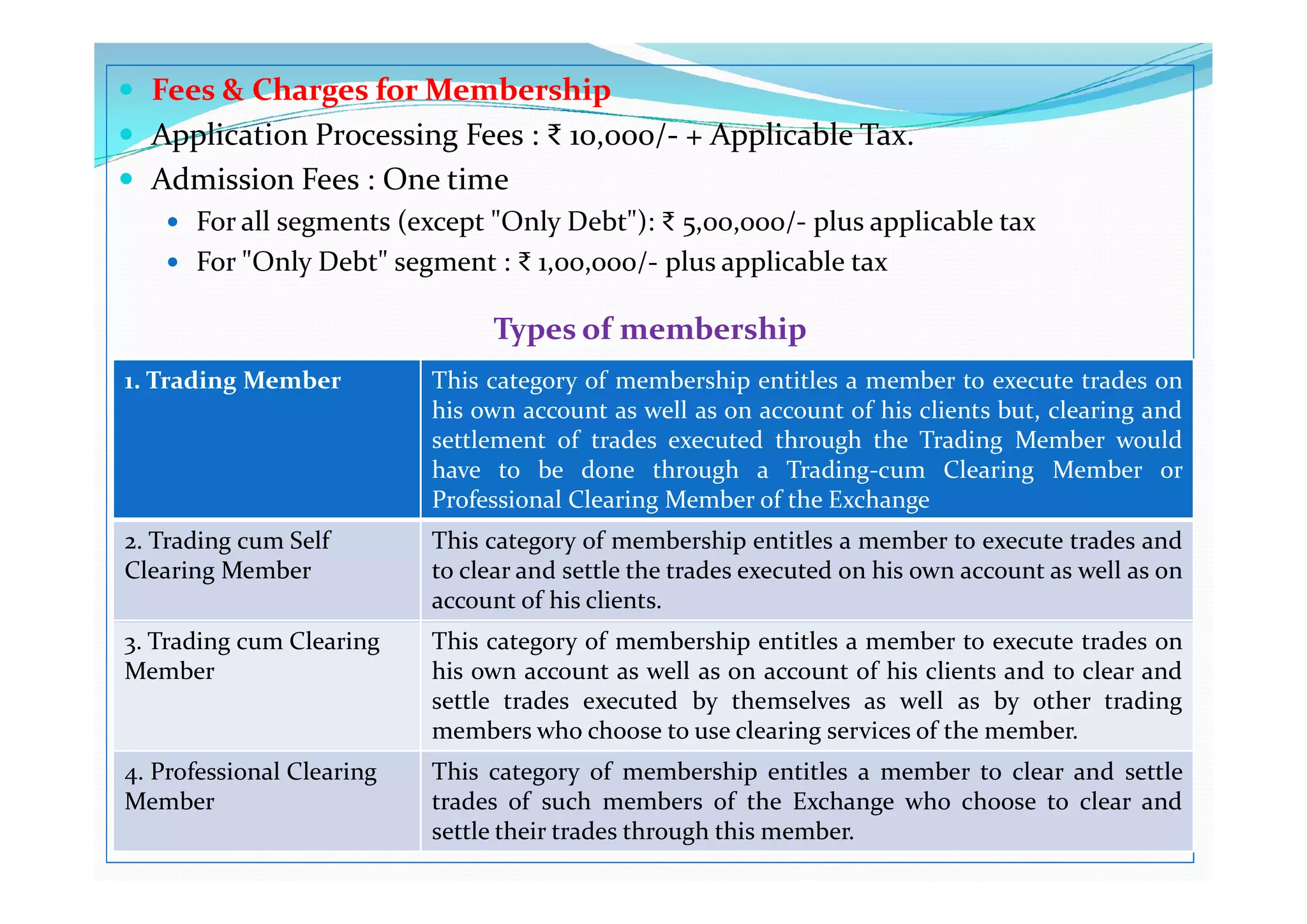
 Fees & Charges for Membership
 Application Processing Fees : ₹ 10,000/- + Applicable Tax.
 Admission Fees : One time
 For all segments (except "Only Debt"): ₹ 5,00,000/- plus applicable tax
 For "Only Debt" segment : ₹ 1,00,000/- plus applicable tax
Types of membership
1. Trading Member This category of membership entitles a member to execute trades on
his own account as well as on account of his clients but, clearing and
settlement of trades executed through the Trading Member would
have to be done through a Trading-cum Clearing Member or
Professional Clearing Member of the Exchange
2. Trading cum Self
Clearing Member
This category of membership entitles a member to execute trades and
to clear and settle the trades executed on his own account as well as on
account of his clients.
3. Trading cum Clearing
Member
This category of membership entitles a member to execute trades on
his own account as well as on account of his clients and to clear and
settle trades executed by themselves as well as by other trading
members who choose to use clearing services of the member.
4. Professional Clearing
Member
This category of membership entitles a member to clear and settle
trades of such members of the Exchange who choose to clear and
settle their trades through this member.
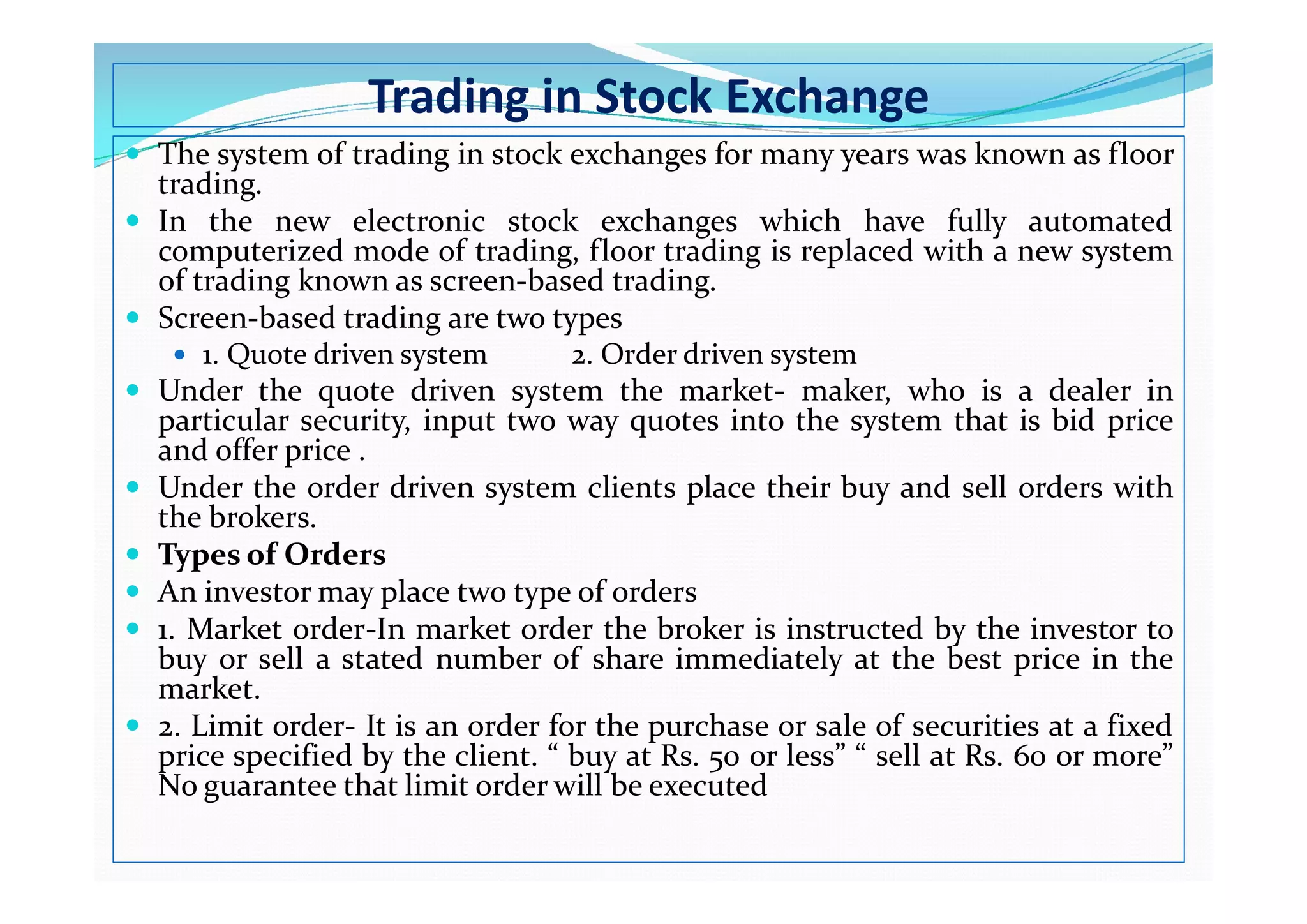
Trading in Stock Exchange
 The system of trading in stock exchanges for many years was known as floor
trading.
 In the new electronic stock exchanges which have fully automated
computerized mode of trading, floor trading is replaced with a new system
of trading known as screen-based trading.
 Screen-based trading are two types
 1. Quote driven system 2. Order driven system
 Under the quote driven system the market- maker, who is a dealer in
particular security, input two way quotes into the system that is bid price
and offer price .
and offer price .
 Under the order driven system clients place their buy and sell orders with
the brokers.
 Types of Orders
 An investor may place two type of orders
 1. Market order-In market order the broker is instructed by the investor to
buy or sell a stated number of share immediately at the best price in the
market.
 2. Limit order- It is an order for the purchase or sale of securities at a fixed
price specified by the client. “ buy at Rs. 50 or less” “ sell at Rs. 60 or more”
No guarantee that limit order will be executed
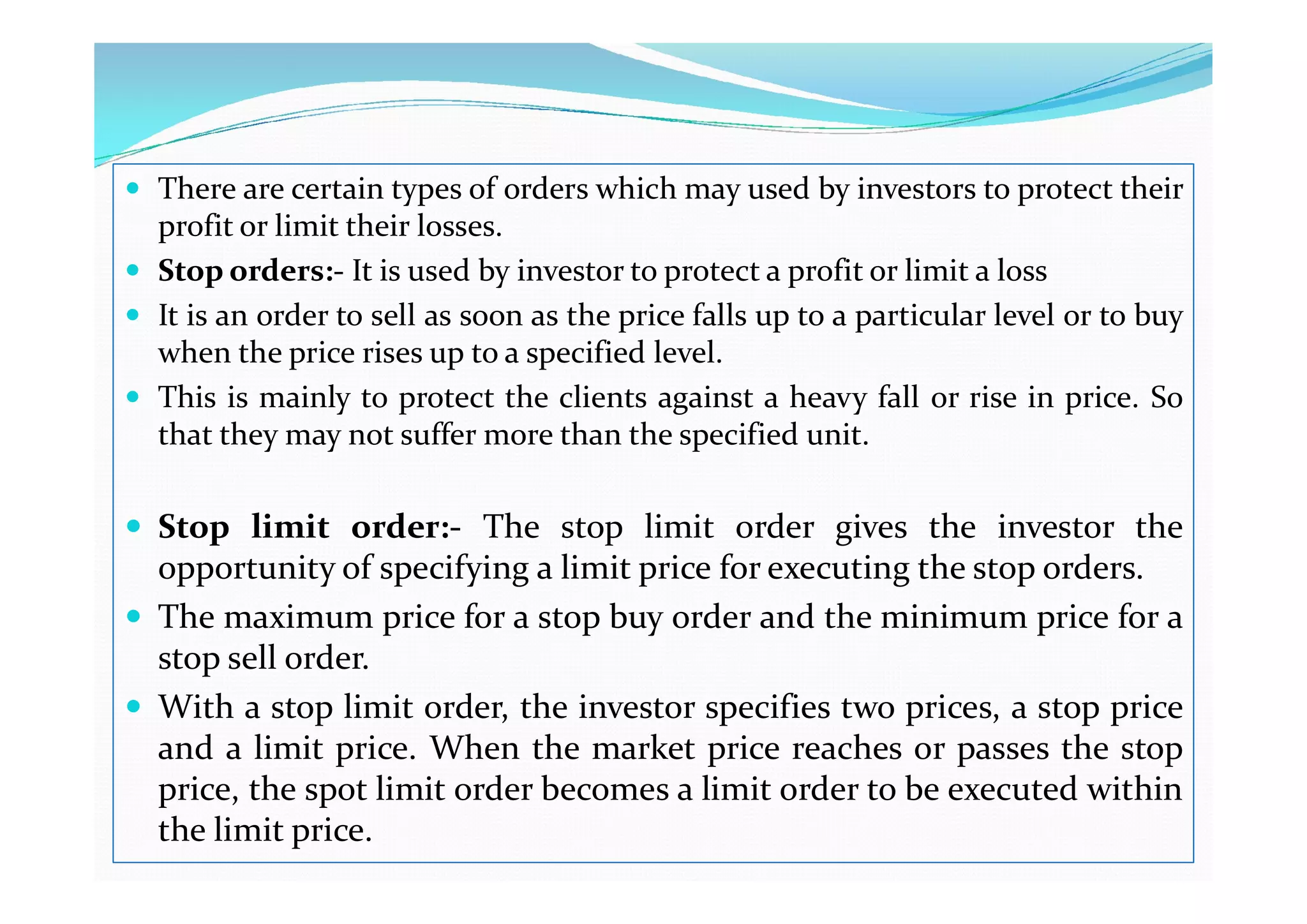
 There are certain types of orders which may used by investors to protect their
profit or limit their losses.
 Stop orders:- It is used by investor to protect a profit or limit a loss
 It is an order to sell as soon as the price falls up to a particular level or to buy
when the price rises up to a specified level.
 This is mainly to protect the clients against a heavy fall or rise in price. So
that they may not suffer more than the specified unit.
 Stop limit order:- The stop limit order gives the investor the
opportunity of specifying a limit price for executing the stop orders.
 The maximum price for a stop buy order and the minimum price for a
stop sell order.
 With a stop limit order, the investor specifies two prices, a stop price
and a limit price. When the market price reaches or passes the stop
price, the spot limit order becomes a limit order to be executed within
the limit price.
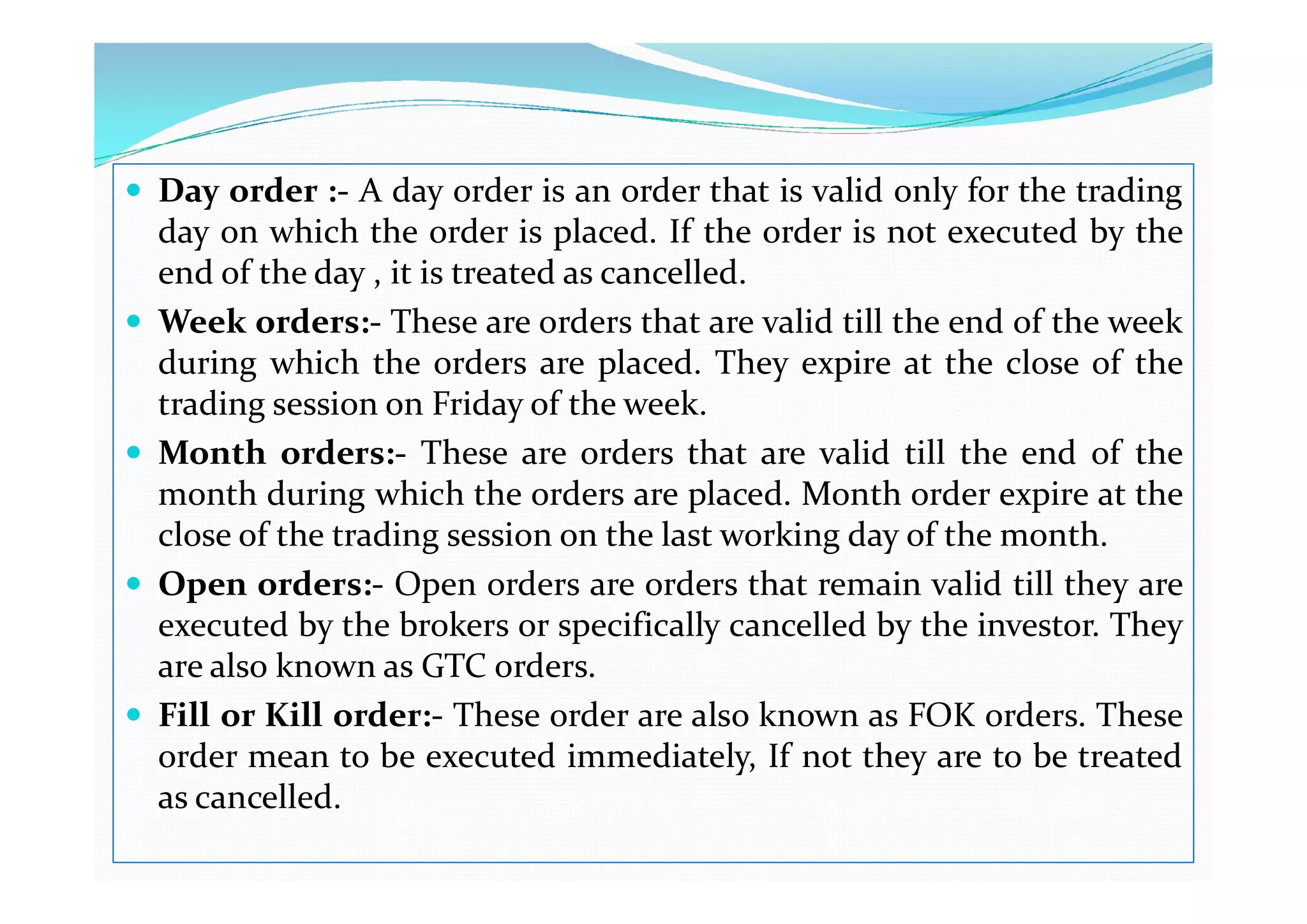
 Day order :- A day order is an order that is valid only for the trading
day on which the order is placed. If the order is not executed by the
end of the day , it is treated as cancelled.
 Week orders:- These are orders that are valid till the end of the week
during which the orders are placed. They expire at the close of the
trading session on Friday of the week.
 Month orders:- These are orders that are valid till the end of the
month during which the orders are placed. Month order expire at the
close of the trading session on the last working day of the month.
 Open orders:- Open orders are orders that remain valid till they are
executed by the brokers or specifically cancelled by the investor. They
are also known as GTC orders.
 Fill or Kill order:- These order are also known as FOK orders. These
order mean to be executed immediately, If not they are to be treated
as cancelled.
 Pre-market Orders:
 NSE started the concept of pre-open session a few months back to minimize the
volatility of securities during the market opening every day. Between 9:00 AM to
9:15 AM is when the pre-market session is conducted on NSE. During the pre-
market session for the first 8 minutes (between 9:00 AM and 9:08 AM) orders are
collected, modified or cancelled. You can place limit orders/market orders. After
9.08 AM to 9.15 AM no new orders can be placed, orders placed are matched and
trades confirmed. So technically you can place orders only for the first 8 minutes
and only on equity segment.
 Post-market Orders:
 Similar to pre-market orders, post-market orders are allowed only for equity
trading. The post-market session or closing session is open from 3:40 PM to 4:00
PM.
 During this session, people can place buy/sell orders in equity (delivery segment
using the CNC product code) at the market price, but do note that even if you
place a market order it will be placed on the exchange at the closing price.
 For example, if the closing price of Reliance at 3:30 PM is Rs. 800, between 3:40
PM and 4:00 PM, you can place market orders to buy/sell Reliance at market
price (will be taken at Rs. 800).
 Post-market session is not very active and you can look at the movement of stocks
by opening the market watch window from 3:40 PM to 4:00 PM.
 AMO: This facility is available on any DP for people who can’t actively
track the markets from 9:15 AM to 3:30 PM.
 You can place orders any time from 3:45 PM to 8:57 AM for NSE &
3:45 to 8:59 AM for BSE (until just before the pre-opening session) for
the equity segment and up to 9:10 AM for F&O.
 So you could plan your trades and place your orders before the market
opens.
 After-market orders can be placed on all the exchange segments.
Please note that if you place any after-market order between 9:15 AM
 Please note that if you place any after-market order between 9:15 AM
and 3:45 PM, they will be rejected.
 AMO is allowed only between 3:45 PM and 8:59 AM for equity and up
to 9:10 AM for F&O.
 For currency derivatives, AMO is allowed from 3.45 PM the previous
day to 8:59 AM only.
 https://zerodha.com/varsity/chapter/clearing-and-settlement-
process/
Stock Exchanges
1. Bombay Stock Exchange
 Founded in 9th July, 1875
 Founder Premchand Roychand
 Key People Vikramjit Sen, Chairman
Sundararaman Ramamurthy, MD and CEO
 Headquarter Mumbai, India
 Number of Listings 5,439 Companies
 BSE is Asia's first and the Fastest Stock Exchange in world with the
speed of 6 micro seconds and one of India's leading exchange groups.
In 2013, BSE upgraded its technology platform to Bolt Plus, which is
based on the business architecture of global giant Deutsche Börse.
 2. National Stock Exchange
 Established in 1992
 Girish Chandra Chaturvedi, Chairperson
 Ashishkumar Chauhan, MD and CEO
 NSE is ranked 4th in the world in cash equities by number of trades as per
the statistics maintained by the World Federation of Exchanges (WFE) for
the calendar year 2021
 First dematerialized electronic exchange in the country.
 Number of Lists 2002 (As of October 2021)
 The exchange was incorporated in 1992 as a tax-paying company and was
recognized as a stock exchange in 1993 under the Securities Contracts
(Regulation) Act, 1956, when P. V. Narasimha Rao was the Prime Minister of
India and Manmohan Singh was the Finance Minister.
 3. Over the Counter Exchange of India
 Founded in 1990 and started its function in the year 1992
 Owner: under the ownership of Ministry of Finance, Government of India.
 Mr. Praveen Mohnot, MD
 It is India's first exchange for small companies, as well as the first screen-
based nationwide stock exchange in India
 OTCEI is promoted by the Unit Trust of India, the Industrial Credit and
Investment Corporation of India, the Industrial Development Bank of India,
the Industrial Finance Corporation of India, and other institutions, and is a
recognised stock exchange under the SCR Act. 1956
 The OTC Exchange Of India was founded in 1990 under the Companies Act
1956 and was recognized by the Securities Contracts Regulation Act, 1956 as a
stock exchange.
SEBI Trading Mechanism
 The trading on stock exchange in INDIA used to take place
through open outcry method without use of information
technology for immediate matching or recording of trades.
 This was time consuming and inefficient.
 This imposed limits on trading volumes and efficiency.
 In order to provide efficiency, liquidity, and transparency
NSE and BSE introduced nation wide online fully
automated “SCREEN BASED TRADING SYSTEM”
 BSE’S screen based trading is known as BOLT - Bombay
Online Trading (Also called as BSE-Online Trading)
 NSE’s screen based trading is known as NEAT - National
Exchange for Automated Trading.
 A Non member is not permitted to enter the hall of stock
exchange and cannot carry on biz transactions personally.
 Following are the Steps involved in the trading on stock
exchange
 Step 1: Finding a Broker
 Step 2: Opening an Account with Broker
 Step 3: Placing the order
 Step 4: Executing the order
 Step 5: Preparation of Contract Notes
 Step 6: Settlement of Contracts
 Types of Orders (Refer Slide No: 13)
Screen Based Trading
 The Screen Based Trading Platform is a piece of computer
software that allows users to place orders for financial products
over a network with a financial intermediary.
 These products include products such as stocks, bonds,
currencies, commodities, and derivatives.
 The first widespread electronic trading platform was NASDAQ.
 The availability of such trading platforms to the public has
encouraged a surge in retail investing.
 These platforms are available on mobile devices
 Both buyer and seller can see the security price
Steps Involved in Screen Based Trading for Buying and Selling of Securities
Step-1
• Selection of Broker
• Approach a registered broker
• Sign a broker client agreement and client registration form
• Provide certain other information and details
• Broker opens a trading account in the name of investor
Step-2
• Opening of a Demat Account
• Go to a DP
• Open a Demat Account or Beneficial Owner
• Open a Bank Account for Cash Transactions
• Placement of Order
• Go to broker
Step-3
• Go to broker
• Place an buy or sell order
• Give clear instructions about number of shares, and the price etc.
• Broker gives order confirmation slip to the investor
Step-4
• Execution of Order
• Broker will go online
• Connect to the main stock exchange
• Match the share and best price available
• Order will be executed electronically
• Broker gives trade confirmation slip to the investor
• Within 24 hours the broker issue a contract note (incl: order no, no of shares bought/sold, date price etc)
Step-5
• Settlement of Order
• Settlement cycle is T+2 days
Advantages of the Screen-based Trading System
 It electronically matches orders on a strict price/time priority and
hence cuts down on time, cost and risk of error, as well as on fraud
resulting in improved operational efficiency.
 It allows faster incorporation of price sensitive information into
prevailing prices, thus increasing the informational efficiency of
markets.
 It enables market participants, irrespective of their geographical
locations, to trade with one another simultaneously, improving the
depth and liquidity of the market.
 It provides full anonymity by accepting orders, big or small, from
members without revealing their identity, thus providing equal
access to everybody.
 It also provides a perfect audit trail, which helps to resolve disputes
by logging in the trade execution process in entirety.
1. BOLT: Bombay Online Trading
 BOLT Plus On Web - BOW is a powerful real time trading
solution provided by BSE Tech Infra Services Pvt Ltd.
 The application is available as a Hosted solution and allows
the user to watch real time market prices and execute orders in
multiple exchanges and markets instantaneously.
 The application is re-designed, engineered accordingly to
provide rich user experience.
 The application is supported by robust Backend engines of
OMS, RMS with horizontal scalability and is capable of
handling higher user connections.
 The Trading Application is available in exe (Desktop) and
Mobile (Android and iOS).
NEAT-NSE’s Screen Based Trading
 NEAT is a screen-based trading system.
 NSE also offers “NEAT Plus” package that provides members trading in
multiple markets on the exchange with a unified trading interface.
 NSE’s scalability allows it to add additional hardware “on-demand” to
support higher trading volumes and hence maintain a high uptime record
and low-latency level for trade orders from terminals.
 NSE conducts periodic testing and capacity enhancements as the number of
NEAT users and trading loads increase.
 Trading data on NEAT is released almost instantaneously to all trading
members on NEAT.
 Now is licensed trading software that offers direct connectivity to our
exchange for trade execution and data feeds through trading terminals, web-
based browsers and mobile devices.
 Now supports trading in all of the products on our cash and derivatives
markets, as well as mutual fund units on our exchange and trading on other
exchanges.
 Members are able to access smart order routing, historical and real-time
intra-day charting and other user friendly tools.
Mechanism of Online Trading
 BSE/NSE has main computer which is connected through
“VERY SMALL APERTURE TERMINAL”(VSAT) installed at
its office.
 The main computer runs on a fault tolerant “STRATUS”
mainframe computer at the exchange. Brokers have
terminals installed at their premises which are connected
through VSATS.
Trading Network
Secondary Market-III

Secondary Market-III

  • 1.
    Stock Market Operations Unit-III:Secondary Market Importance and Functions, Listing of Securities in Stock Exchanges; Players in Stock Exchange - Investors, Speculators, Market Makers, Stock Brokers; Eligibility Criteria; Trading in Stock Exchange, Stock Exchanges - Bombay Stock Exchange, National Stock Exchange, Over-the-Counter Exchange of India; Stock Exchange, Stock Exchanges - Bombay Stock Exchange, National Stock Exchange, Over-the-Counter Exchange of India; The SEBI Trading Mechanism - BOLT, NEAT System and Screen Based System. Prepared By Mr. Dayananda Huded M.Com JRF, NET 3 Times, & KSET Teaching Assistant, Rani Channamma University, PG Centre, Jamkhandi E-mail: dayanandcht65@gmail.com
  • 2.
    Importance and Functionsof SM  1. Providing Liquidity and Marketability to Existing Securities: The basic function of a stock exchange is the creation of a continuous market where securities are bought and sold. It gives investors the chance to disinvest and reinvest. This provides both liquidity and easy marketability to already existing securities in the market.  2. Pricing of Securities: Share prices on a stock exchange are determined by the forces of demand and supply. A stock exchange is a mechanism of constant valuation through which the prices of securities are determined. valuation through which the prices of securities are determined.  3. Safety of Transaction: The membership of a stock exchange is well regulated and its dealings are well defined according to the existing legal framework. (safe and fair deal on the market)  4. Contributes to Economic Growth: Through the process of disinvestment and reinvestment savings get channelised into their most productive investment avenues. This leads to capital formation and economic growth.  5. Spreading of Equity Cult: Ensures wider share ownership by regulating new issues, better trading practices and taking effective steps in educating the public about investments.  6. Providing Scope for Speculation
  • 3.
    Listing of Securitiesin SE  Meaning: Listing refers to the admission of the securities of a company on a recognised stock exchange for trading. Listing of securities is undertaken with the primary objective of providing marketability, liquidity and transferability of shares.  To be submitted along with the application for listing:-  1. Memorandum of Associations, Articles of Association, Prospectus, Directors’ report, Annual Accounts, Agreement with Underwriters, etc. Directors’ report, Annual Accounts, Agreement with Underwriters, etc.  2. Company’s activities, capital structure, distribution of shares, dividends and bonus shares issued, etc.  Listing Requirements: For this purpose companies have been classified into 2 groups:-  1. Large Cap Companies (minimum issue size of Rs.10 crores and market capitalization of not less than Rs.25 crores)  2. Small Cap Companies (minimum issue size of Rs.3 crores and market capitalization of not less than Rs.5 crores)
  • 4.
    Procedure of Listing Step1: Submission of Letter of Application along with the necessary documents. Step 2: Payment of Listing Fees Step 3: Collection of Listing Fees (Normally Banks) Step 4: Trading Permission by SEBI Step 5: Payment of 1% Security wit the designated SE Step 6: Advertisements
  • 5.
    Listing Fees  Scheduleof Listing Fees for the Year 2021-22 Particulars Amount (₹) Initial Listing Fees 20,000 Listing Capital (₹ in Cr.) Annual Listing Fees (in ₹) Up to 100 ₹ 250,000 Above 100 and up to 200 ₹ 300,000 Above 200 and up to 300 ₹ 375,000 Above 300 and up to 400 ₹ 450,000 Above 400 and up to 500 ₹ 600,000 Above 400 and up to 500 ₹ 600,000 Above 500 to 1000 Rs. 605,000/- and an additional listing fees of Rs. 3,530/- for every increase of Rs.5 crores or part thereof above 500 crores in the paid-up share capital Above 1000 to 2000 Rs. 990,000/- and an additional listing fees of Rs. 3,930/- for every increase of Rs.5 crores or part thereof above 1,000 crores in the paid-up share capital. Above 2000 to 3000 Rs. 1,000,000/- and an additional listing fees of Rs. 4,270/- for every increase of Rs.5 crores or part thereof above 1,000 crores in the paid-up share capital. Above 3000 Rs. 1,020,000/- and an additional listing fees of Rs. 3910/- for every increase of Rs.5 crores or part thereof above 1,000 crores in the paid-up share capital.
  • 6.
    Players in StockExchange  Investors Speculators  Market Makers Stock Brokers  Speculators:  Speculators are sophisticated investors or traders who purchase assets for short periods of time and employ strategies in order to profit from changes in its price. strategies in order to profit from changes in its price.  Speculators are important to markets because they bring liquidity and assume market risk.  A speculator as a man who observes the future and acts before it occurs.
  • 7.
  • 8.
     Bull: ABull or Tejiwala is an operator who expects a rise in prices of securities in the future. In anticipation of price rise he makes purchases of shares at present and other securities with the intention to sell at higher prices in future. He is called bull because just like a bull tends to throw his victim up in the air, the bull speculator stimulates the price to rise. He is an optimistic speculator.  Bear: A bear or Mandiwala speculator expects prices to fall in future and sells securities at present with a view to purchase them at lower prices in future. A bear does not have securities at present but sells prices in future. A bear does not have securities at present but sells them at higher prices in anticipation that he will supply them by purchasing at lower prices in future. A bear usually presses its victim down to ground. Similarly the bear speculator tends to force down the prices of securities. A bear is a pessimistic speculator.
  • 9.
     Stag: Astag is a cautious speculator in the stock exchange. He applies for shares in new companies and expects to sell them at a premium, if he gets an allotment. He selects those companies whose shares are in more demand and are likely to carry a premium. He sells the shares before being called to pay the allotment money. He is also called a premium hunter.  Lame Duck: When a bear finds it difficult to fulfill his commitment, he is said to be struggling like a lame duck. A bear speculator he is said to be struggling like a lame duck. A bear speculator contracts to sell securities at a later date. On the appointed time he is not able to get the securities as the holders are not willing to part with them. In such situations, he feels concerned. Moreover, the buyer is not willing to carry over the transactions.
  • 10.
    1. For StockBrokers  Minimum 21 age  To become a stockbroker, you must have a bachelor's degree and at least two years of experience working in a stock brokerage firm.  To be eligible for his employment, a sub-broker (the prior stage of being a broker) must have completed the 12th grade. The minimum age is 21 years old. This is a fully integrated company. Eligibility Criteria age is 21 years old. This is a fully integrated company.  Stock broking jobs aren't the only ones available in this area. The stock market necessitates the expertise and abilities of specialists from numerous sectors, ranging from economists who understand the ins and outs of the market to financial planners who can provide you with sound stock guidance. You can also work as a financial manager, an analyst, or a market specialist.
  • 11.
     1. ForBrokers:  Procedure to become Stock Brokers Step 1: You need to submit a New Membership Application to the Membership Services Department in NSE/BSE. Step 2: Once approved by the Membership Services Department, the application is sent to the Membership Recommendation Committee and Membership Selection Committee. Step 3: Membership Selection Committee evaluates the application and sends it for approval to Member Compliance Department. Step 4: Once approved, the Offer Letter of Provisional Membership is sent to you. Step 5: You need to submit documents to the SEBI for registration. Once approved SEBI Certificate is sent to you, and finally, the trading system will be provided.
  • 12.
     Fees &Charges for Membership  Application Processing Fees : ₹ 10,000/- + Applicable Tax.  Admission Fees : One time  For all segments (except "Only Debt"): ₹ 5,00,000/- plus applicable tax  For "Only Debt" segment : ₹ 1,00,000/- plus applicable tax Types of membership 1. Trading Member This category of membership entitles a member to execute trades on his own account as well as on account of his clients but, clearing and settlement of trades executed through the Trading Member would have to be done through a Trading-cum Clearing Member or have to be done through a Trading-cum Clearing Member or Professional Clearing Member of the Exchange 2. Trading cum Self Clearing Member This category of membership entitles a member to execute trades and to clear and settle the trades executed on his own account as well as on account of his clients. 3. Trading cum Clearing Member This category of membership entitles a member to execute trades on his own account as well as on account of his clients and to clear and settle trades executed by themselves as well as by other trading members who choose to use clearing services of the member. 4. Professional Clearing Member This category of membership entitles a member to clear and settle trades of such members of the Exchange who choose to clear and settle their trades through this member.
  • 13.
    Trading in StockExchange  The system of trading in stock exchanges for many years was known as floor trading.  In the new electronic stock exchanges which have fully automated computerized mode of trading, floor trading is replaced with a new system of trading known as screen-based trading.  Screen-based trading are two types  1. Quote driven system 2. Order driven system  Under the quote driven system the market- maker, who is a dealer in particular security, input two way quotes into the system that is bid price and offer price . and offer price .  Under the order driven system clients place their buy and sell orders with the brokers.  Types of Orders  An investor may place two type of orders  1. Market order-In market order the broker is instructed by the investor to buy or sell a stated number of share immediately at the best price in the market.  2. Limit order- It is an order for the purchase or sale of securities at a fixed price specified by the client. “ buy at Rs. 50 or less” “ sell at Rs. 60 or more” No guarantee that limit order will be executed
  • 14.
     There arecertain types of orders which may used by investors to protect their profit or limit their losses.  Stop orders:- It is used by investor to protect a profit or limit a loss  It is an order to sell as soon as the price falls up to a particular level or to buy when the price rises up to a specified level.  This is mainly to protect the clients against a heavy fall or rise in price. So that they may not suffer more than the specified unit.  Stop limit order:- The stop limit order gives the investor the opportunity of specifying a limit price for executing the stop orders.  The maximum price for a stop buy order and the minimum price for a stop sell order.  With a stop limit order, the investor specifies two prices, a stop price and a limit price. When the market price reaches or passes the stop price, the spot limit order becomes a limit order to be executed within the limit price.
  • 15.
     Day order:- A day order is an order that is valid only for the trading day on which the order is placed. If the order is not executed by the end of the day , it is treated as cancelled.  Week orders:- These are orders that are valid till the end of the week during which the orders are placed. They expire at the close of the trading session on Friday of the week.  Month orders:- These are orders that are valid till the end of the  Month orders:- These are orders that are valid till the end of the month during which the orders are placed. Month order expire at the close of the trading session on the last working day of the month.  Open orders:- Open orders are orders that remain valid till they are executed by the brokers or specifically cancelled by the investor. They are also known as GTC orders.  Fill or Kill order:- These order are also known as FOK orders. These order mean to be executed immediately, If not they are to be treated as cancelled.
  • 16.
     Pre-market Orders: NSE started the concept of pre-open session a few months back to minimize the volatility of securities during the market opening every day. Between 9:00 AM to 9:15 AM is when the pre-market session is conducted on NSE. During the pre- market session for the first 8 minutes (between 9:00 AM and 9:08 AM) orders are collected, modified or cancelled. You can place limit orders/market orders. After 9.08 AM to 9.15 AM no new orders can be placed, orders placed are matched and trades confirmed. So technically you can place orders only for the first 8 minutes and only on equity segment.  Post-market Orders:  Similar to pre-market orders, post-market orders are allowed only for equity  Similar to pre-market orders, post-market orders are allowed only for equity trading. The post-market session or closing session is open from 3:40 PM to 4:00 PM.  During this session, people can place buy/sell orders in equity (delivery segment using the CNC product code) at the market price, but do note that even if you place a market order it will be placed on the exchange at the closing price.  For example, if the closing price of Reliance at 3:30 PM is Rs. 800, between 3:40 PM and 4:00 PM, you can place market orders to buy/sell Reliance at market price (will be taken at Rs. 800).  Post-market session is not very active and you can look at the movement of stocks by opening the market watch window from 3:40 PM to 4:00 PM.
  • 17.
     AMO: Thisfacility is available on any DP for people who can’t actively track the markets from 9:15 AM to 3:30 PM.  You can place orders any time from 3:45 PM to 8:57 AM for NSE & 3:45 to 8:59 AM for BSE (until just before the pre-opening session) for the equity segment and up to 9:10 AM for F&O.  So you could plan your trades and place your orders before the market opens.  After-market orders can be placed on all the exchange segments. Please note that if you place any after-market order between 9:15 AM  Please note that if you place any after-market order between 9:15 AM and 3:45 PM, they will be rejected.  AMO is allowed only between 3:45 PM and 8:59 AM for equity and up to 9:10 AM for F&O.  For currency derivatives, AMO is allowed from 3.45 PM the previous day to 8:59 AM only.  https://zerodha.com/varsity/chapter/clearing-and-settlement- process/
  • 18.
    Stock Exchanges 1. BombayStock Exchange  Founded in 9th July, 1875  Founder Premchand Roychand  Founder Premchand Roychand  Key People Vikramjit Sen, Chairman Sundararaman Ramamurthy, MD and CEO  Headquarter Mumbai, India  Number of Listings 5,439 Companies  BSE is Asia's first and the Fastest Stock Exchange in world with the speed of 6 micro seconds and one of India's leading exchange groups. In 2013, BSE upgraded its technology platform to Bolt Plus, which is based on the business architecture of global giant Deutsche Börse.
  • 19.
     2. NationalStock Exchange  Established in 1992  Girish Chandra Chaturvedi, Chairperson  Ashishkumar Chauhan, MD and CEO  NSE is ranked 4th in the world in cash equities by number of trades as per the statistics maintained by the World Federation of Exchanges (WFE) for the calendar year 2021  First dematerialized electronic exchange in the country.  Number of Lists 2002 (As of October 2021)  The exchange was incorporated in 1992 as a tax-paying company and was recognized as a stock exchange in 1993 under the Securities Contracts (Regulation) Act, 1956, when P. V. Narasimha Rao was the Prime Minister of India and Manmohan Singh was the Finance Minister.
  • 20.
     3. Overthe Counter Exchange of India  Founded in 1990 and started its function in the year 1992  Owner: under the ownership of Ministry of Finance, Government of India.  Mr. Praveen Mohnot, MD  It is India's first exchange for small companies, as well as the first screen- based nationwide stock exchange in India  OTCEI is promoted by the Unit Trust of India, the Industrial Credit and Investment Corporation of India, the Industrial Development Bank of India, the Industrial Finance Corporation of India, and other institutions, and is a the Industrial Finance Corporation of India, and other institutions, and is a recognised stock exchange under the SCR Act. 1956  The OTC Exchange Of India was founded in 1990 under the Companies Act 1956 and was recognized by the Securities Contracts Regulation Act, 1956 as a stock exchange.
  • 21.
    SEBI Trading Mechanism The trading on stock exchange in INDIA used to take place through open outcry method without use of information technology for immediate matching or recording of trades.  This was time consuming and inefficient.  This imposed limits on trading volumes and efficiency.  In order to provide efficiency, liquidity, and transparency NSE and BSE introduced nation wide online fully NSE and BSE introduced nation wide online fully automated “SCREEN BASED TRADING SYSTEM”  BSE’S screen based trading is known as BOLT - Bombay Online Trading (Also called as BSE-Online Trading)  NSE’s screen based trading is known as NEAT - National Exchange for Automated Trading.
  • 22.
     A Nonmember is not permitted to enter the hall of stock exchange and cannot carry on biz transactions personally.  Following are the Steps involved in the trading on stock exchange  Step 1: Finding a Broker  Step 2: Opening an Account with Broker  Step 3: Placing the order  Step 4: Executing the order  Step 5: Preparation of Contract Notes  Step 6: Settlement of Contracts  Types of Orders (Refer Slide No: 13)
  • 23.
    Screen Based Trading The Screen Based Trading Platform is a piece of computer software that allows users to place orders for financial products over a network with a financial intermediary.  These products include products such as stocks, bonds, currencies, commodities, and derivatives.  The first widespread electronic trading platform was NASDAQ.  The availability of such trading platforms to the public has encouraged a surge in retail investing.  These platforms are available on mobile devices  Both buyer and seller can see the security price
  • 24.
    Steps Involved inScreen Based Trading for Buying and Selling of Securities Step-1 • Selection of Broker • Approach a registered broker • Sign a broker client agreement and client registration form • Provide certain other information and details • Broker opens a trading account in the name of investor Step-2 • Opening of a Demat Account • Go to a DP • Open a Demat Account or Beneficial Owner • Open a Bank Account for Cash Transactions • Placement of Order • Go to broker Step-3 • Go to broker • Place an buy or sell order • Give clear instructions about number of shares, and the price etc. • Broker gives order confirmation slip to the investor Step-4 • Execution of Order • Broker will go online • Connect to the main stock exchange • Match the share and best price available • Order will be executed electronically • Broker gives trade confirmation slip to the investor • Within 24 hours the broker issue a contract note (incl: order no, no of shares bought/sold, date price etc) Step-5 • Settlement of Order • Settlement cycle is T+2 days
  • 25.
    Advantages of theScreen-based Trading System  It electronically matches orders on a strict price/time priority and hence cuts down on time, cost and risk of error, as well as on fraud resulting in improved operational efficiency.  It allows faster incorporation of price sensitive information into prevailing prices, thus increasing the informational efficiency of markets.  It enables market participants, irrespective of their geographical locations, to trade with one another simultaneously, improving the locations, to trade with one another simultaneously, improving the depth and liquidity of the market.  It provides full anonymity by accepting orders, big or small, from members without revealing their identity, thus providing equal access to everybody.  It also provides a perfect audit trail, which helps to resolve disputes by logging in the trade execution process in entirety.
  • 26.
    1. BOLT: BombayOnline Trading  BOLT Plus On Web - BOW is a powerful real time trading solution provided by BSE Tech Infra Services Pvt Ltd.  The application is available as a Hosted solution and allows the user to watch real time market prices and execute orders in multiple exchanges and markets instantaneously.  The application is re-designed, engineered accordingly to provide rich user experience. provide rich user experience.  The application is supported by robust Backend engines of OMS, RMS with horizontal scalability and is capable of handling higher user connections.  The Trading Application is available in exe (Desktop) and Mobile (Android and iOS).
  • 27.
    NEAT-NSE’s Screen BasedTrading  NEAT is a screen-based trading system.  NSE also offers “NEAT Plus” package that provides members trading in multiple markets on the exchange with a unified trading interface.  NSE’s scalability allows it to add additional hardware “on-demand” to support higher trading volumes and hence maintain a high uptime record and low-latency level for trade orders from terminals.  NSE conducts periodic testing and capacity enhancements as the number of NEAT users and trading loads increase. NEAT users and trading loads increase.  Trading data on NEAT is released almost instantaneously to all trading members on NEAT.  Now is licensed trading software that offers direct connectivity to our exchange for trade execution and data feeds through trading terminals, web- based browsers and mobile devices.  Now supports trading in all of the products on our cash and derivatives markets, as well as mutual fund units on our exchange and trading on other exchanges.  Members are able to access smart order routing, historical and real-time intra-day charting and other user friendly tools.
  • 28.
    Mechanism of OnlineTrading  BSE/NSE has main computer which is connected through “VERY SMALL APERTURE TERMINAL”(VSAT) installed at its office.  The main computer runs on a fault tolerant “STRATUS”  The main computer runs on a fault tolerant “STRATUS” mainframe computer at the exchange. Brokers have terminals installed at their premises which are connected through VSATS.
  • 29.