what isSearch Engine Optimization (SEO)
b chaitanyareddy
• What is a Search Engine
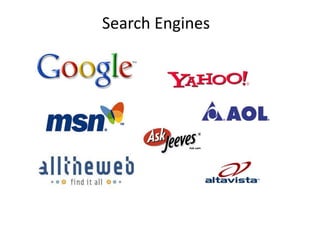
• Examples of popular Search Engines
• Why is Search Engine marketing important?
• A good SEO strategy
• Basic tips for optimization
What is SEO
• Search engine optimization is a methodology of strategies, techniques and
tactics used to increase the amount of visitors to a website by obtaining a
high-ranking placement in the search results page of a search engine
(SERP) -- including Google, Bing, Yahoo and other search engines.
• What is On-Page and Off-page SEO?
• Conceptually, there are two ways of optimization
• On-Page SEO
• On page optimization refers to all measures that can be taken directly
within the website in order to improve its position in the search rankings.
Examples of this include measures to optimize the content or improve the
Meta tags.
• Off page SEO
• Off page SEO refers to techniques that can be used to improve the position
of a web site in the search engine results page (SERPs). Many people
associate off-page SEO with link building but it is not only that.
Search Engines
How Do Search Engines Work
• Spider “crawls” the web to find new documents (web pages, other
documents) typically by following hyperlinks from websites already in their
database
• Search engines indexes the content (text, code) in these documents by adding
it to their databases and then periodically updates this content
• Search engines search their own databases when a user enters in a search to
find related documents (not searching web pages in real-time)
• Search engines rank the resulting documents using an algorithm
(mathematical formula) by assigning various weights and ranking factors
Importants
 80% of consumers find your website by first writing a query into a box on a
search engine (Google, Yahoo, Bing)
 90% choose a site listed on the first page
 85% of all traffic on the internet is referred to by search engines
 The top three organic positions receive 59% percent of user clicks.
 Cost-effective advertising
 Clear and measurable ROI
 Operates under this assumption:
More (relevant) traffic + Good Conversions Rate = More Sales/Leads
A good SEO strategy
• Research desirable keywords and search phrases
( GoogleAdwords,wordtracker)
• Identify search phrases to target
• “Clean” and optimize a website’s HTML code for appropriate
keyword density, title tag optimization, internal linking structure,
headings and subheadings, etc.
• Help in writing copy to appeal to both search engines and actual
website visitors
• Study competitors (competing websites) and search engines
• Implement a quality link building campaign
• Add Quality content
• Constant monitoring of rankings for targeted search terms
Optimization Techniques
• Research keywords related to your business
• Identify competitors, utilize benchmarking techniques and identify
level of competition
• Utilize descriptive title tags for each page
• Ensure that your text is HTML-text and not image text
• Use text links when ever possible
• Use appropriate keywords in your content and internal hyperlinks
(don’t overdo!)
• Obtain inbound links from related websites
• Monitor your search engine rankings and more importantly your
website traffic statistics and sales/leads produced
• Educate yourself about search engine marketing
ThankYou

SearchEngineOptimization(SEO)

  • 1.
    what isSearch EngineOptimization (SEO) b chaitanyareddy
  • 2.
    • What isa Search Engine • Examples of popular Search Engines • Why is Search Engine marketing important? • A good SEO strategy • Basic tips for optimization
  • 3.
    What is SEO •Search engine optimization is a methodology of strategies, techniques and tactics used to increase the amount of visitors to a website by obtaining a high-ranking placement in the search results page of a search engine (SERP) -- including Google, Bing, Yahoo and other search engines. • What is On-Page and Off-page SEO? • Conceptually, there are two ways of optimization • On-Page SEO • On page optimization refers to all measures that can be taken directly within the website in order to improve its position in the search rankings. Examples of this include measures to optimize the content or improve the Meta tags. • Off page SEO • Off page SEO refers to techniques that can be used to improve the position of a web site in the search engine results page (SERPs). Many people associate off-page SEO with link building but it is not only that.
  • 4.
  • 5.
    How Do SearchEngines Work • Spider “crawls” the web to find new documents (web pages, other documents) typically by following hyperlinks from websites already in their database • Search engines indexes the content (text, code) in these documents by adding it to their databases and then periodically updates this content • Search engines search their own databases when a user enters in a search to find related documents (not searching web pages in real-time) • Search engines rank the resulting documents using an algorithm (mathematical formula) by assigning various weights and ranking factors
  • 6.
    Importants  80% ofconsumers find your website by first writing a query into a box on a search engine (Google, Yahoo, Bing)  90% choose a site listed on the first page  85% of all traffic on the internet is referred to by search engines  The top three organic positions receive 59% percent of user clicks.  Cost-effective advertising  Clear and measurable ROI  Operates under this assumption: More (relevant) traffic + Good Conversions Rate = More Sales/Leads
  • 7.
    A good SEOstrategy • Research desirable keywords and search phrases ( GoogleAdwords,wordtracker) • Identify search phrases to target • “Clean” and optimize a website’s HTML code for appropriate keyword density, title tag optimization, internal linking structure, headings and subheadings, etc. • Help in writing copy to appeal to both search engines and actual website visitors • Study competitors (competing websites) and search engines • Implement a quality link building campaign • Add Quality content • Constant monitoring of rankings for targeted search terms
  • 8.
    Optimization Techniques • Researchkeywords related to your business • Identify competitors, utilize benchmarking techniques and identify level of competition • Utilize descriptive title tags for each page • Ensure that your text is HTML-text and not image text • Use text links when ever possible • Use appropriate keywords in your content and internal hyperlinks (don’t overdo!) • Obtain inbound links from related websites • Monitor your search engine rankings and more importantly your website traffic statistics and sales/leads produced • Educate yourself about search engine marketing
  • 9.