Séance
De l’action à l’exposition
Francis Alÿs
http://www.francisalys.com
1- Les déambulations
• Marcher dans la ville pour expérimenter la réalité
et introduire la fiction
* marcher comme pratique artistique
* marcher dans la ville pour expérimenter la réalité et
introduire la fiction
* en suivant des protocoles auto imposés
* dans une attitude non monumentale
*pour introduire des histoires qui se diffusent
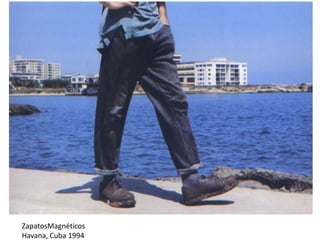
ZapatosMagnéticos
Havana, Cuba 1994
Narcotourism, 1996)
1- Les déambulations
• Marcher dans la ville : interroger la notion
d’œuvre d’art
* une œuvre en mouvement
* éphémères
* dans la ville
* sans public
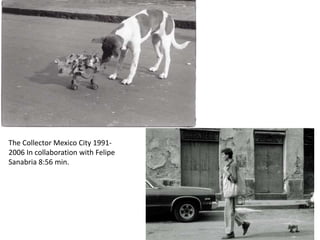
The Collector Mexico City 19912006 In collaboration with Felipe
Sanabria 8:56 min.
Gordon Matta-Clark, ConicalIntersect, 1975
Paradox of Praxis 1
(SometimesMakingSomethingLeads to Nothing) Mexico City 1997 4:59 min.
Paradox of Praxis 1
(SometimesMakingSomethingLeads to Nothing) Mexico City 1997 4:59 min.
Allan Kaprow: FLUIDS, 1967/2005HAUSER & WIRTH ZURICHLimmatstrasse 270CH – 8005 ZurichSwitzerlandPhone 41 (0)44 446 80
50
http://www.hauserwirth.com
Allan Kaprow: FLUIDS, 1967/2005International workshop of the Applied Arts Universities at Art Unlimited BaselJune 13, 2005, from
2 pmTo mark the opening of Art Unlimited in Basle, Allan Kaprow’s Happpening FLUIDS will be reinvented for the first time since
1967 by an international workshop, in co-operation with the Department of Art and Design at Basle’s University of Applied Sciences
and the University Basle.‘Father of Happenings’ Allan Kaprow was born in 1927. Nearly 40 years later, the art form he created
continues to provoke questions about time, community and collective structures. His Happening FLUIDS involved constructing
enclosures with ice blocks at various locations in Pasadena and Los Angeles. Kaprow recruited participants using billboards that
displayed the FLUIDS score:
“During three days, about twenty rectangular enclosures of ice blocks (measuring about 30 feet long, 10 wide and 8 high) are built
throughout the city. Their walls are unbroken. They are left to melt”.
Groups of young people made his work a reality. They stacked blocks of ice, delivered by the Union Ice Company, into rectangular
structures. Over the ensuing days, the ice structures melted. Photographs, film, the billboard score, the artist’s notes and drawings,
letters and press clippings document the ephemeral event.Now FLUIDS will occur for the second time. Ice structures will be built at
three different sites across Basle, including Art Basel’s headquarters building and the roof of the adjacent parking structure. Cooperating in the Happening are the Department of Art and Design at Basle University of Applied Science (Creative Art – Media Art
Department), the art history seminars of Basle University, Basle and Lucerne University Departments of Art and Design, the Federal
Institute of Technology in Zurich and the University of Weimar and Vienna. At the artist’s request, students will spend two days in a
workshop, devising strategies to realize the work. They will determine such particulars as how to co-ordinate delivery of the ice
blocks, secure the necessary equipment and design of the structures. Thus they will create a Basle-specific, contemporary variant of
the Happening, this time without the artist’s direct involvement.
For further information, please contact Laura Bechter at Hauser & Wirth in Zurich.Another project by Hauser & Wirth Zurich London,
appearing at Art Unlimited will be Martin Creed’s set piece Work No. 372, Piano.

For further information, please contact Nicole Keller at Hauser & Wirth, Zurich.HAUSER & WIRTH ZURICHLimmatstrasse 270CH –
8005 ZurichSwitzerlandPhone 41 (0)44 446 80 50
http://www.hauserwirth.com
L'atelier de Pollock par Goodnough
Francis Alÿs in collaboration with Honoré d’O, Duett (1999) Venice
1- Les déambulations
• Tentative de définition : un art contextuel
* un art aux frontières de la performance
* un art contextuel qui « tisse » avec le réel
* inscrit dans la ville mais non « in situ »
* des actions politiques mais non militantes
* un art furtif
Daniel Buren, Les deux plateaux, Travail in situ permanent, 1985 - Juillet 1986
cour d’honneur du Palais-Royal, Paris,
StillfromPatriotic Tales; Mexico City, 1997; video documentation of an action.
In collaboration with Cuauhtémoc Medina and Rafael Ortega.
Total running time: 24 minutes, 40 seconds.
André Cadere sur l'avenue des Gobelins à Paris, pour l'exposition organisée en 1973 par la galerie des Locataires
The Nightwatch (single channel version) London 2004 6:17 min.
Francis Alÿs, Turista, Mexico City,
1994, Photographic documentation
of an action
Courtesy of Francis Alÿs and David
Zwirner, New York, Image: Enrique
Huerta © Francis Alÿs
2- Les objets autour des
déambulations
• Objets indépendants des enregistrements
médiatiques de l’action
(outils/dessins/documents graphiques/
récoltes/traces)
* outils pour la marche
* dessins préparatoires
* documents graphiques
* collecte et traces
2- Les objets autour des
déambulations
• Les enregistrements de l’action
* enregistrements vidéos
* enregistrements photographiques
* une iconographie de l’anonymat
* la question de l’auteur
2- Les objets autour des
déambulations
• Les travaux élaborés avec l’enregistrement des
actions de Francis Alÿs
* enregistrements vidéos
* enregistrements photographiques
* une iconographie de l’anonymat
* la question de l’auteur
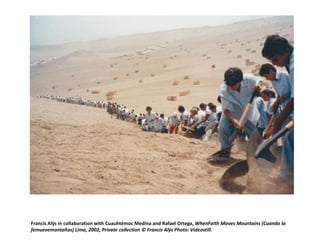
When Faith Moves Mountains (2002)
A Project for GeologicalDisplacement.Aproject by Francis Alÿs, collaboratingwith Rafael Ortega and Cuauhtémoc
Medina. On April 11th 2002, 500 volunteerswerecalled in order to form a line to move a sand dune situated in the surroundings
of the city of Lima. This humancombprogressedpushingforward a certain quantity of sandwithshovels in order to move the dune
fromits original position. The actualdisplacementwas of an infinitesimal proportion, but not itsmetaphoricalresonance. Duration:
15 min The UbuwebExperimentalVideo Project: 23. Francis Alÿs' WhenFaith Moves Mountains (2002)Colin Marshall This is less a
piece of video art on the displacement-by-volunteer of a big Peruvian sand dune than a mini-documentary on the displacementby-volunteer of a big Peruvian sand dune. Though I do find the effort itself fascinating, there isn't much going on here in the form
department. It's footage of the preparation, footage of the process, interviews with participants and shots of the gaunt, none-tooin-place-looking AlØs staring up at the immobile dune that is his rival. Should I stop right here? Is it my place to comment on the
project documented, or should The Ubuweb Experimental Video Project concern itself only with the specifically audiovisual
elements of these pieces, or go further? I suppose I could spill a healthy amount of digital ink on some of When Faith Moves
Mountains' most striking images, but it won't mean much without context. In order to move the dune, Alÿsand his collaborators
recruited 500 locals, many of whom seem to be college students, to don identical t-shirts, form a line and slowly advance across
it, shoveling all the way. The video gives a final dune-displacement distance of 10cm, which is small enough to be plausible.
Provided a close look at the line's actual technique, though, it's still somewhat difficult to believe. But hey, it ain't about literally
getting an enormous pile of sand from one place to another, very similar place; it's about mobilizing the humanity and firing the
will to give it a shot. The "faith" of the title seems ambiguous. This is South America, yes, and I understand a certain amount of
religion goes on there, but direct references to god in the video are few, if there are any at all. (And Alÿs himself is a Belgian, one
of those nationalities that I just can't picture doing anything god-y in this day and age.) The faith could equally be faith in oneself
and one's collaborators to pull off neato art stunts, or, as Tao Lin said, "doing really 'retarded' things in order to relieve boredom,
like buying a large billboard on Houston street and putting a hamster drawing on it." Plus, they also created something that is,
aesthetically speaking, pretty damn cool. At one point, someone mentions the purely geometrical difficulty of getting a line to
move over the surface of a cone, but the striking picture of a thin, white-and-blue (most of the diggers wear jeans) arc gradually
crossing a vast brownness as hazy sand clouds blow across turns out to have been well worth the blood, sweat and
sandpants. This film in Colin Marshall's Ubuweb Experimental Video Project
Francis Alÿs in collaboration with Cuauhtémoc Medina and Rafael Ortega, WhenFaith Moves Mountains (Cuando la
femuevemontañas) Lima, 2002, Private collection © Francis Alÿs Photo: Videostill.
Francis Alÿs, Drawing for WhenFaith Moves Mountains, 2002, 16mm film transferred to DVD; 2 rear-projectionscreens; 1
monitor; DVD projection, Image Size: variable.
Francis Alys, "The Sign Painting Project (1993-97): A Revision,"installationview, at
the Schaulager, Basel
[Bibliographie/webographie]
Louis Aragon, Le Paysan de Paris, Gallimard, 1926
Paul Ardenne, Un art contextuel, Flammarion, Paris 2002
Jean-François Augoyard, Pas à pas. Edition Seuil, 1979
Marc Augé, L’impossible voyage, Rivages, Paris, 1997
Charles Baudelaire, Les Fleurs du Mal, Librairie Générale Française, 1972
Charles Baudelaire, Oeuvres complètes, Gallimard, 1975.
Collectif, Un siècle d’arpenteurs, les figures de la marche, Edition Seuil, Musée Picasso,Antibes.
Catalogue de l’exposition : Francis Alys 2001, Musée Picasso, Antibes.
Walter Benjamin, Paris Capitale du XIXème siècle, Cerf, 1993
André Breton, Nadja, Gallimard, Saint-Amand, 1964
Michel de Certeau, L’invention du quotidien. 1. L’art de faire, Editions Gallimard, 1990
Françoise Choay, L’urbanisme, utopies et réalités. Une anthologie. Editions du Seuil,1965
Françoise Choay, Espacements. L’évolution de l’espace urbain en France. SkiraEditorMilano, 2003
Thierry Davila, Marcher, Créer. Déplacements, flâneries, dérives dans l’art de la fin duXXème siècle, édition Regard, Paris, 2002
Guy Debord, Théorie de la dérive, publié dans Les lèvres nues n°9, décembre 1956 et Internationale Situationniste n°2, décembre
1958
Luc Gwiazdzinski, Gilles Rabin, Si la ville m’était contée…, Eyrolles, Paris 2005
Luc Gwiazdzinski, La ville 24h/24, regards croisés sur la société en continu, Edition del’Aube, 2002Isaac Joseph, Le Passant
considérable. Edition Méridiens-Klincksieck, 1984
David Le Breton, Anthropologie du corps et modernité, Paris, PUF, 1990
David Le Breton, Corps et sociétés. Essai d’anthropologie et de sociologie du corps, Paris,MéridiensKlincksieck, 1985
David Le Breton, L’éloge de la marche, Paris, Métailié, 2000
Le Corbusier, La charte d’Athènes, Editions de Minuit, 1957
Lewis Munford, Le piéton de New York, Edition du Linteau, 2001
Thierry Paquot, Des corps urbains, sensibilités entre béton et bitume, Edition Autrement,2006
Georges Pérec, Espèces d’espaces, Galilée, Paris, 1974
Jean-Michel Place, Stalker, Attraverso i territoriattual i/ A travers les territoires actuels,Jean-Michel Place edition, 2000Jacques Reda,
Le sens de la marche, Gallimard, 1990
Rachel Thomas, Quand le pas fait corps et sens avec l’espace, aspects sensibles et expressifs de la marche en ville, Cybergéo, Revue
européenne de géographie, 2004,n°261
Pierre Sansot, Du bon usage de la lenteur, Le seuil, 1998.
Rebecca Solnit, L’art de marcher, Actes Sud, Arles, 2002

Séance francis alÿs

  • 1.
    Séance De l’action àl’exposition Francis Alÿs
  • 2.
  • 3.
    1- Les déambulations •Marcher dans la ville pour expérimenter la réalité et introduire la fiction * marcher comme pratique artistique * marcher dans la ville pour expérimenter la réalité et introduire la fiction * en suivant des protocoles auto imposés * dans une attitude non monumentale *pour introduire des histoires qui se diffusent
  • 4.
  • 8.
  • 9.
    1- Les déambulations •Marcher dans la ville : interroger la notion d’œuvre d’art * une œuvre en mouvement * éphémères * dans la ville * sans public
  • 11.
    The Collector MexicoCity 19912006 In collaboration with Felipe Sanabria 8:56 min.
  • 12.
  • 13.
    Paradox of Praxis1 (SometimesMakingSomethingLeads to Nothing) Mexico City 1997 4:59 min.
  • 14.
    Paradox of Praxis1 (SometimesMakingSomethingLeads to Nothing) Mexico City 1997 4:59 min.
  • 16.
    Allan Kaprow: FLUIDS,1967/2005HAUSER & WIRTH ZURICHLimmatstrasse 270CH – 8005 ZurichSwitzerlandPhone 41 (0)44 446 80 50
http://www.hauserwirth.com Allan Kaprow: FLUIDS, 1967/2005International workshop of the Applied Arts Universities at Art Unlimited BaselJune 13, 2005, from 2 pmTo mark the opening of Art Unlimited in Basle, Allan Kaprow’s Happpening FLUIDS will be reinvented for the first time since 1967 by an international workshop, in co-operation with the Department of Art and Design at Basle’s University of Applied Sciences and the University Basle.‘Father of Happenings’ Allan Kaprow was born in 1927. Nearly 40 years later, the art form he created continues to provoke questions about time, community and collective structures. His Happening FLUIDS involved constructing enclosures with ice blocks at various locations in Pasadena and Los Angeles. Kaprow recruited participants using billboards that displayed the FLUIDS score: “During three days, about twenty rectangular enclosures of ice blocks (measuring about 30 feet long, 10 wide and 8 high) are built throughout the city. Their walls are unbroken. They are left to melt”. Groups of young people made his work a reality. They stacked blocks of ice, delivered by the Union Ice Company, into rectangular structures. Over the ensuing days, the ice structures melted. Photographs, film, the billboard score, the artist’s notes and drawings, letters and press clippings document the ephemeral event.Now FLUIDS will occur for the second time. Ice structures will be built at three different sites across Basle, including Art Basel’s headquarters building and the roof of the adjacent parking structure. Cooperating in the Happening are the Department of Art and Design at Basle University of Applied Science (Creative Art – Media Art Department), the art history seminars of Basle University, Basle and Lucerne University Departments of Art and Design, the Federal Institute of Technology in Zurich and the University of Weimar and Vienna. At the artist’s request, students will spend two days in a workshop, devising strategies to realize the work. They will determine such particulars as how to co-ordinate delivery of the ice blocks, secure the necessary equipment and design of the structures. Thus they will create a Basle-specific, contemporary variant of the Happening, this time without the artist’s direct involvement. For further information, please contact Laura Bechter at Hauser & Wirth in Zurich.Another project by Hauser & Wirth Zurich London, appearing at Art Unlimited will be Martin Creed’s set piece Work No. 372, Piano. For further information, please contact Nicole Keller at Hauser & Wirth, Zurich.HAUSER & WIRTH ZURICHLimmatstrasse 270CH – 8005 ZurichSwitzerlandPhone 41 (0)44 446 80 50
http://www.hauserwirth.com
  • 17.
    L'atelier de Pollockpar Goodnough
  • 18.
    Francis Alÿs incollaboration with Honoré d’O, Duett (1999) Venice
  • 19.
    1- Les déambulations •Tentative de définition : un art contextuel * un art aux frontières de la performance * un art contextuel qui « tisse » avec le réel * inscrit dans la ville mais non « in situ » * des actions politiques mais non militantes * un art furtif
  • 20.
    Daniel Buren, Lesdeux plateaux, Travail in situ permanent, 1985 - Juillet 1986 cour d’honneur du Palais-Royal, Paris,
  • 21.
    StillfromPatriotic Tales; MexicoCity, 1997; video documentation of an action. In collaboration with Cuauhtémoc Medina and Rafael Ortega. Total running time: 24 minutes, 40 seconds.
  • 22.
    André Cadere surl'avenue des Gobelins à Paris, pour l'exposition organisée en 1973 par la galerie des Locataires
  • 23.
    The Nightwatch (singlechannel version) London 2004 6:17 min.
  • 24.
    The Nightwatch (singlechannel version) London 2004 6:17 min.
  • 25.
    Francis Alÿs, Turista,Mexico City, 1994, Photographic documentation of an action Courtesy of Francis Alÿs and David Zwirner, New York, Image: Enrique Huerta © Francis Alÿs
  • 27.
    2- Les objetsautour des déambulations • Objets indépendants des enregistrements médiatiques de l’action (outils/dessins/documents graphiques/ récoltes/traces) * outils pour la marche * dessins préparatoires * documents graphiques * collecte et traces
  • 28.
    2- Les objetsautour des déambulations • Les enregistrements de l’action * enregistrements vidéos * enregistrements photographiques * une iconographie de l’anonymat * la question de l’auteur
  • 29.
    2- Les objetsautour des déambulations • Les travaux élaborés avec l’enregistrement des actions de Francis Alÿs * enregistrements vidéos * enregistrements photographiques * une iconographie de l’anonymat * la question de l’auteur
  • 30.
    When Faith MovesMountains (2002) A Project for GeologicalDisplacement.Aproject by Francis Alÿs, collaboratingwith Rafael Ortega and Cuauhtémoc Medina. On April 11th 2002, 500 volunteerswerecalled in order to form a line to move a sand dune situated in the surroundings of the city of Lima. This humancombprogressedpushingforward a certain quantity of sandwithshovels in order to move the dune fromits original position. The actualdisplacementwas of an infinitesimal proportion, but not itsmetaphoricalresonance. Duration: 15 min The UbuwebExperimentalVideo Project: 23. Francis Alÿs' WhenFaith Moves Mountains (2002)Colin Marshall This is less a piece of video art on the displacement-by-volunteer of a big Peruvian sand dune than a mini-documentary on the displacementby-volunteer of a big Peruvian sand dune. Though I do find the effort itself fascinating, there isn't much going on here in the form department. It's footage of the preparation, footage of the process, interviews with participants and shots of the gaunt, none-tooin-place-looking AlØs staring up at the immobile dune that is his rival. Should I stop right here? Is it my place to comment on the project documented, or should The Ubuweb Experimental Video Project concern itself only with the specifically audiovisual elements of these pieces, or go further? I suppose I could spill a healthy amount of digital ink on some of When Faith Moves Mountains' most striking images, but it won't mean much without context. In order to move the dune, Alÿsand his collaborators recruited 500 locals, many of whom seem to be college students, to don identical t-shirts, form a line and slowly advance across it, shoveling all the way. The video gives a final dune-displacement distance of 10cm, which is small enough to be plausible. Provided a close look at the line's actual technique, though, it's still somewhat difficult to believe. But hey, it ain't about literally getting an enormous pile of sand from one place to another, very similar place; it's about mobilizing the humanity and firing the will to give it a shot. The "faith" of the title seems ambiguous. This is South America, yes, and I understand a certain amount of religion goes on there, but direct references to god in the video are few, if there are any at all. (And Alÿs himself is a Belgian, one of those nationalities that I just can't picture doing anything god-y in this day and age.) The faith could equally be faith in oneself and one's collaborators to pull off neato art stunts, or, as Tao Lin said, "doing really 'retarded' things in order to relieve boredom, like buying a large billboard on Houston street and putting a hamster drawing on it." Plus, they also created something that is, aesthetically speaking, pretty damn cool. At one point, someone mentions the purely geometrical difficulty of getting a line to move over the surface of a cone, but the striking picture of a thin, white-and-blue (most of the diggers wear jeans) arc gradually crossing a vast brownness as hazy sand clouds blow across turns out to have been well worth the blood, sweat and sandpants. This film in Colin Marshall's Ubuweb Experimental Video Project
  • 31.
    Francis Alÿs incollaboration with Cuauhtémoc Medina and Rafael Ortega, WhenFaith Moves Mountains (Cuando la femuevemontañas) Lima, 2002, Private collection © Francis Alÿs Photo: Videostill.
  • 32.
    Francis Alÿs, Drawingfor WhenFaith Moves Mountains, 2002, 16mm film transferred to DVD; 2 rear-projectionscreens; 1 monitor; DVD projection, Image Size: variable.
  • 33.
    Francis Alys, "TheSign Painting Project (1993-97): A Revision,"installationview, at the Schaulager, Basel
  • 34.
    [Bibliographie/webographie] Louis Aragon, LePaysan de Paris, Gallimard, 1926 Paul Ardenne, Un art contextuel, Flammarion, Paris 2002 Jean-François Augoyard, Pas à pas. Edition Seuil, 1979 Marc Augé, L’impossible voyage, Rivages, Paris, 1997 Charles Baudelaire, Les Fleurs du Mal, Librairie Générale Française, 1972 Charles Baudelaire, Oeuvres complètes, Gallimard, 1975. Collectif, Un siècle d’arpenteurs, les figures de la marche, Edition Seuil, Musée Picasso,Antibes. Catalogue de l’exposition : Francis Alys 2001, Musée Picasso, Antibes. Walter Benjamin, Paris Capitale du XIXème siècle, Cerf, 1993 André Breton, Nadja, Gallimard, Saint-Amand, 1964 Michel de Certeau, L’invention du quotidien. 1. L’art de faire, Editions Gallimard, 1990 Françoise Choay, L’urbanisme, utopies et réalités. Une anthologie. Editions du Seuil,1965 Françoise Choay, Espacements. L’évolution de l’espace urbain en France. SkiraEditorMilano, 2003 Thierry Davila, Marcher, Créer. Déplacements, flâneries, dérives dans l’art de la fin duXXème siècle, édition Regard, Paris, 2002 Guy Debord, Théorie de la dérive, publié dans Les lèvres nues n°9, décembre 1956 et Internationale Situationniste n°2, décembre 1958 Luc Gwiazdzinski, Gilles Rabin, Si la ville m’était contée…, Eyrolles, Paris 2005 Luc Gwiazdzinski, La ville 24h/24, regards croisés sur la société en continu, Edition del’Aube, 2002Isaac Joseph, Le Passant considérable. Edition Méridiens-Klincksieck, 1984 David Le Breton, Anthropologie du corps et modernité, Paris, PUF, 1990 David Le Breton, Corps et sociétés. Essai d’anthropologie et de sociologie du corps, Paris,MéridiensKlincksieck, 1985 David Le Breton, L’éloge de la marche, Paris, Métailié, 2000 Le Corbusier, La charte d’Athènes, Editions de Minuit, 1957 Lewis Munford, Le piéton de New York, Edition du Linteau, 2001 Thierry Paquot, Des corps urbains, sensibilités entre béton et bitume, Edition Autrement,2006 Georges Pérec, Espèces d’espaces, Galilée, Paris, 1974 Jean-Michel Place, Stalker, Attraverso i territoriattual i/ A travers les territoires actuels,Jean-Michel Place edition, 2000Jacques Reda, Le sens de la marche, Gallimard, 1990 Rachel Thomas, Quand le pas fait corps et sens avec l’espace, aspects sensibles et expressifs de la marche en ville, Cybergéo, Revue européenne de géographie, 2004,n°261 Pierre Sansot, Du bon usage de la lenteur, Le seuil, 1998. Rebecca Solnit, L’art de marcher, Actes Sud, Arles, 2002