Presenter Dr Anurag Yadav
Post-graduate, biochemistry
Father Muller Medical college
Dr Anurag yadav,Bio-FMMC1
ELECTROPHORESIS
SDS-PAGE
Dr Anurag yadav,Bio-FMMC2
 Sodium dodecyl sulphate- polyacrylamide gel
electrophoresis.
 Most widely used method for analysing protein
mixture qualitatively.
 Useful for monitoring protein purification – as
separation of protein is based on the size of the
particle.
 Can also be used for determining the relative
molecular mass of a protein.
Dr Anurag yadav,Bio-FMMC3
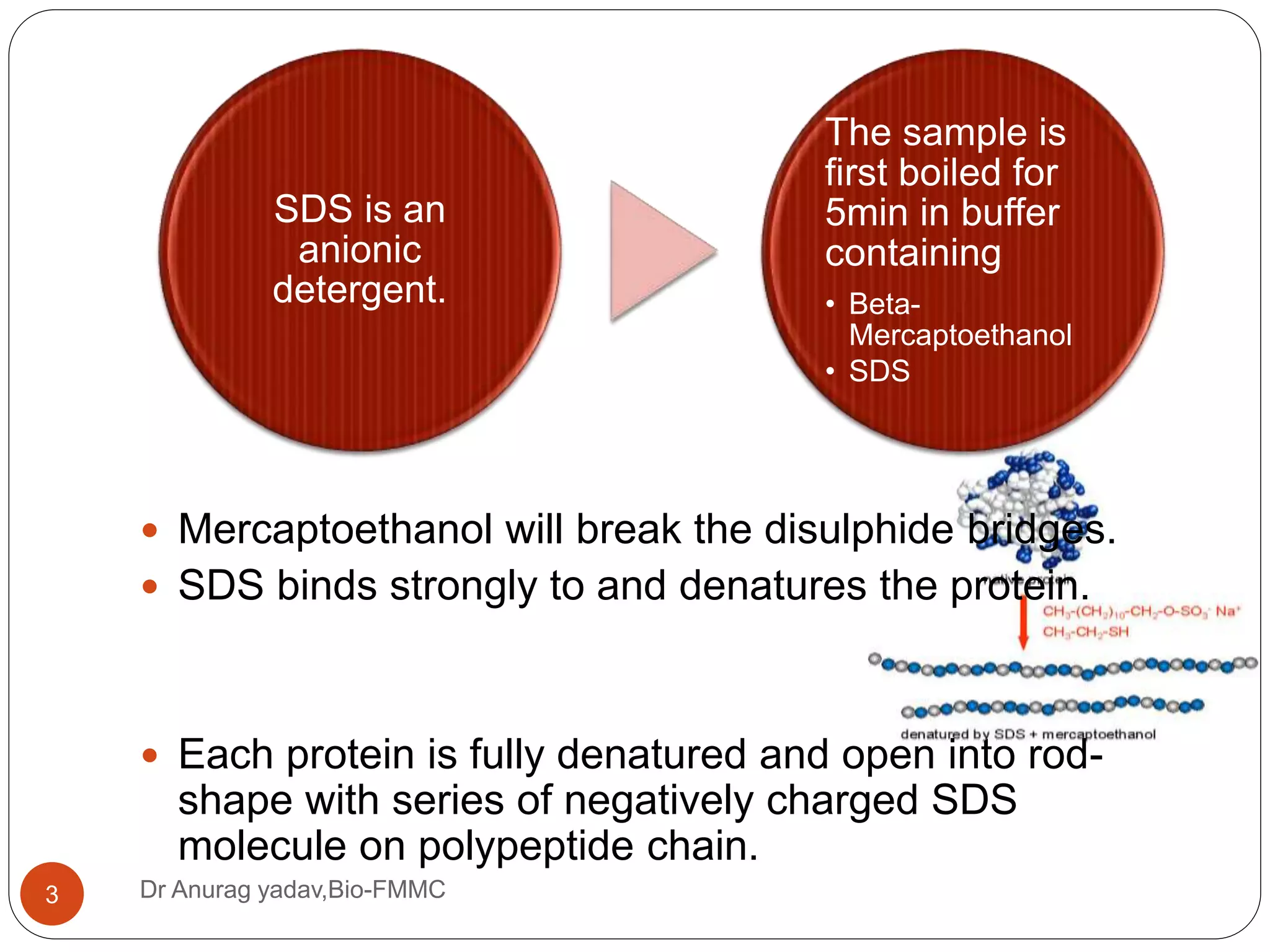
 Mercaptoethanol will break the disulphide bridges.
 SDS binds strongly to and denatures the protein.
 Each protein is fully denatured and open into rod-
shape with series of negatively charged SDS
molecule on polypeptide chain.
SDS is an
anionic
detergent.
The sample is
first boiled for
5min in buffer
containing
• Beta-
Mercaptoethanol
• SDS
Dr Anurag yadav,Bio-FMMC4
 On average, One SDS molecule bind for every
two amino acid residue.
 Hence original native charge is completely
swamped by the negative charge of SDS
molecule.
 Also referred as Discontinuous gel
electrophoresis.
Components
Dr Anurag yadav,Bio-FMMC5
Dr Anurag yadav,Bio-FMMC6
Stacking gel: ordering/arranging and conc the
macromolecule before entering the field of
separation. (4% of acrylamide)
• Purpose is to concentrate protein sample in sharp band
before enters main separating gel.
Running gel: the actual zone of separation of
the particle/molecules based on their mobility.
(15% of acrylamide)
Pore size: routinely used as 3% to 30% which
is of pore size 0.2nm to 0.5nm resp.
Dr Anurag yadav,Bio-FMMC7
Movement of
particle
Dr Anurag yadav,Bio-FMMC8
[Cl] > [protein-SDS] >
[Glycinate]
Dr Anurag yadav,Bio-FMMC9
Dr Anurag yadav,Bio-FMMC10
 In separating gel, protein separate owing to
molecular sieving properties.
 Smaller proteins pass more easily, larger one
retarded by friction.
- Research tool
- Measuring molecular weight
- Peptide mapping
- Protein identification
- Determination of sample purity
- Identifying disulfide bonds
- Separation of proteins and establishing size
- Blotting
- Smaller fragments of DNA
- Separation of nucleic acids
- Major clinical use – ALP separation
APPLICATION:
ADVANTAGES:
- Clear, fairly easy to prepare
- Exhibit reasonable mechanical strength over
acrylamide conc
- Low endosmosis effect
DISADVANTAGES
- Gel preparation and casting- exacting n time-
consuming
- Complete reproducibility of gel preparation not
possible
STAINING:
Fluorescent stains - Ethidium bromide – Nucleic
acids
Silver stain for protein gel (sensitive 50 times dye
based)
Dye based – Coomassie blue – 50ng protein
band
Tracking dyes – BPB> xylene cyanol, Orange G
Dr Anurag yadav,Bio-FMMC14
References
Dr Anurag yadav,Bio-FMMC15
 Keith Wilson- Principles and techniques of
biochemistry and molecular biology.
 Upadhyay- biophysical chemistry.
 Tietz- Text book of clinical chemistry.
 Kaplan- clinical chemistry.
 YouTube and Google images.

SDS-PAGE electrophoresis by Dr. Anurag Yadav

  • 1.
    Presenter Dr AnuragYadav Post-graduate, biochemistry Father Muller Medical college Dr Anurag yadav,Bio-FMMC1 ELECTROPHORESIS
  • 2.
    SDS-PAGE Dr Anurag yadav,Bio-FMMC2 Sodium dodecyl sulphate- polyacrylamide gel electrophoresis.  Most widely used method for analysing protein mixture qualitatively.  Useful for monitoring protein purification – as separation of protein is based on the size of the particle.  Can also be used for determining the relative molecular mass of a protein.
  • 3.
    Dr Anurag yadav,Bio-FMMC3 Mercaptoethanol will break the disulphide bridges.  SDS binds strongly to and denatures the protein.  Each protein is fully denatured and open into rod- shape with series of negatively charged SDS molecule on polypeptide chain. SDS is an anionic detergent. The sample is first boiled for 5min in buffer containing • Beta- Mercaptoethanol • SDS
  • 4.
    Dr Anurag yadav,Bio-FMMC4 On average, One SDS molecule bind for every two amino acid residue.  Hence original native charge is completely swamped by the negative charge of SDS molecule.  Also referred as Discontinuous gel electrophoresis.
  • 5.
  • 6.
    Dr Anurag yadav,Bio-FMMC6 Stackinggel: ordering/arranging and conc the macromolecule before entering the field of separation. (4% of acrylamide) • Purpose is to concentrate protein sample in sharp band before enters main separating gel. Running gel: the actual zone of separation of the particle/molecules based on their mobility. (15% of acrylamide) Pore size: routinely used as 3% to 30% which is of pore size 0.2nm to 0.5nm resp.
  • 7.
  • 8.
    Movement of particle Dr Anuragyadav,Bio-FMMC8 [Cl] > [protein-SDS] > [Glycinate]
  • 9.
  • 10.
    Dr Anurag yadav,Bio-FMMC10 In separating gel, protein separate owing to molecular sieving properties.  Smaller proteins pass more easily, larger one retarded by friction.
  • 11.
    - Research tool -Measuring molecular weight - Peptide mapping - Protein identification - Determination of sample purity - Identifying disulfide bonds - Separation of proteins and establishing size - Blotting - Smaller fragments of DNA - Separation of nucleic acids - Major clinical use – ALP separation APPLICATION:
  • 12.
    ADVANTAGES: - Clear, fairlyeasy to prepare - Exhibit reasonable mechanical strength over acrylamide conc - Low endosmosis effect DISADVANTAGES - Gel preparation and casting- exacting n time- consuming - Complete reproducibility of gel preparation not possible
  • 13.
    STAINING: Fluorescent stains -Ethidium bromide – Nucleic acids Silver stain for protein gel (sensitive 50 times dye based) Dye based – Coomassie blue – 50ng protein band Tracking dyes – BPB> xylene cyanol, Orange G
  • 14.
  • 15.
    References Dr Anurag yadav,Bio-FMMC15 Keith Wilson- Principles and techniques of biochemistry and molecular biology.  Upadhyay- biophysical chemistry.  Tietz- Text book of clinical chemistry.  Kaplan- clinical chemistry.  YouTube and Google images.