Mastering SCIM
by example
Using the SCIM Playground
at https://scim.dev
SCIM is used to share identity
information across boundaries
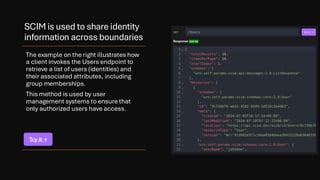
The example on the right illustrates how
a client invokes the Users endpoint to
retrieve a list of users (identities) and
their associated attributes, including
group memberships.
This method is used by user
management systems to ensure that
only authorized users have access.
Try it →
SCIM is used to create users
Remember when service desk
personnel manually onboarded new
employees, entering user information
and assigning permissions?
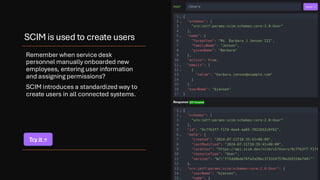
SCIM introduces a standardized way to
create users in all connected systems.
Try it →
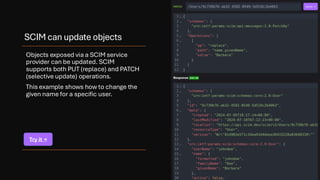
SCIM can update objects
Objects exposed via a SCIM service
provider can be updated. SCIM
supports both PUT (replace) and PATCH
(selective update) operations.
This example shows how to change the
given name for a specific user.
Try it →
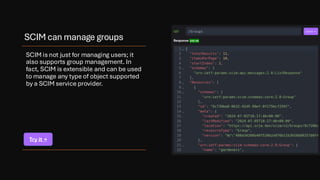
SCIM can manage groups
SCIM is not just for managing users; it
also supports group management. In
fact, SCIM is extensible and can be used
to manage any type of object supported
by a SCIM service provider.
Try it →
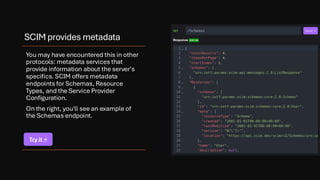
SCIM provides metadata
You may have encountered this in other
protocols: metadata services that
provide information about the server's
specifics. SCIM offers metadata
endpoints for Schemas, Resource
Types, and the Service Provider
Configuration.
On the right, you'll see an example of
the Schemas endpoint.
Try it →
Want to know more?
Visit SCIM playground at
scim.dev

SCIM by example from SCIM Playground.pdf

  • 1.
    Mastering SCIM by example Usingthe SCIM Playground at https://scim.dev
  • 2.
    SCIM is usedto share identity information across boundaries The example on the right illustrates how a client invokes the Users endpoint to retrieve a list of users (identities) and their associated attributes, including group memberships. This method is used by user management systems to ensure that only authorized users have access. Try it →
  • 3.
    SCIM is usedto create users Remember when service desk personnel manually onboarded new employees, entering user information and assigning permissions? SCIM introduces a standardized way to create users in all connected systems. Try it →
  • 4.
    SCIM can updateobjects Objects exposed via a SCIM service provider can be updated. SCIM supports both PUT (replace) and PATCH (selective update) operations. This example shows how to change the given name for a specific user. Try it →
  • 5.
    SCIM can managegroups SCIM is not just for managing users; it also supports group management. In fact, SCIM is extensible and can be used to manage any type of object supported by a SCIM service provider. Try it →
  • 6.
    SCIM provides metadata Youmay have encountered this in other protocols: metadata services that provide information about the server's specifics. SCIM offers metadata endpoints for Schemas, Resource Types, and the Service Provider Configuration. On the right, you'll see an example of the Schemas endpoint. Try it →
  • 7.
    Want to knowmore? Visit SCIM playground at scim.dev