Scientific IntegrityAn overview for Medical Students, Interns and Faculty ResearchersAt Duke UniversityLSIS 5245Shamella Cromartie, North Carolina Central University
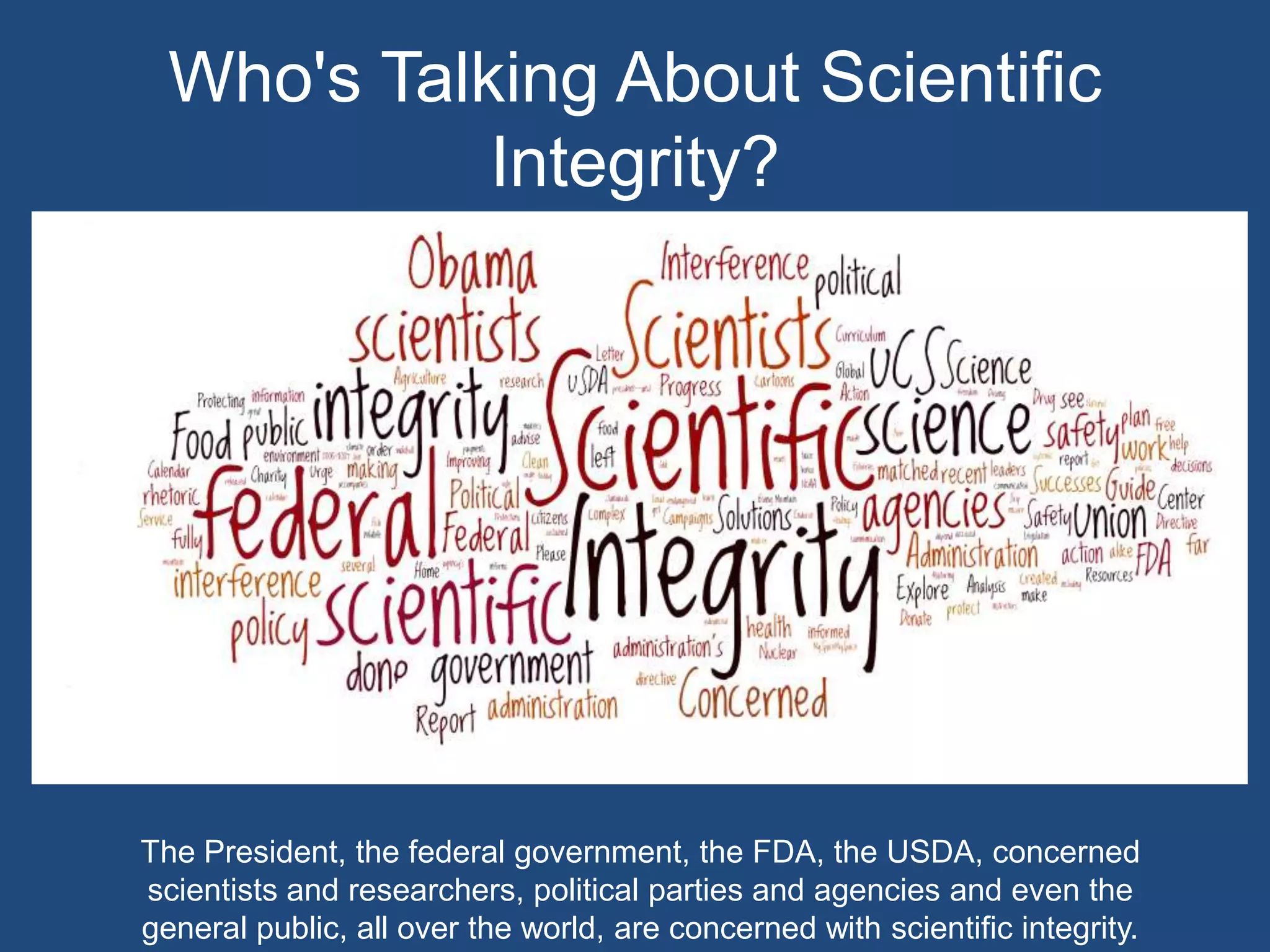
Who's Talking About Scientific Integrity?The President, the federal government, the FDA, the USDA, concerned scientists and researchers, political parties and agencies and even the general public, all over the world, are concerned with scientific integrity.
And what are they saying?The scientific integrity conversation includes issues of public health, global health, public safety, misleading research and its subsequent complications, endangerment and the threat it all poses.
Duke UniversityThe Duke University School of Medicine strives to transform medicine and health, locally and globally, through innovative scientific research and rapid translation of breakthrough discoveries.“One of higher education's essential responsibilities is ensuring the integrity of scientific research.” –Melissa Anderson, 2008
Key Concepts in Scientific IntegrityEthical conduct in science assures the reliability of research results and the safety of research subjects.Ethics in science include: a) standards of methods and process that address research design, procedures, data analysis, interpretation, and reporting; and b) standards of topics and findings that address the use of human and animal subjects in research.Replication, collaboration, and peer review all help to minimize ethical breaches, and identify them when they do occur.
What is the difference?Scientific Integrity:Because of the complexity, variability, and nature of scientific inquiry, the concept of integrity in research can be elusive, and its value cannot be easily assessed or measured.Scientific Misconductis the violation of the standard codes of scholarly conduct and ethical behavior in professional scientific research. BUT
The measure of a man's character is what he would do if he knew he never would be found out.-Thomas Babington Macaulay, 1800 - 1859
What reasons lead to scientific misconduct?Pressure to Produce Cognitive Deficiency Inappropriate Responsibility Difficult Job/Tasks Professional ConflictsStress/Pressure in GeneralSupervisor ExpectationsInsufficient Supervision/Mentoring Non-collegial Work EnvironmentLack of Support SystemSubstandard Lab ProceduresOverworkedInsufficient Time Poor Communication & Coordination
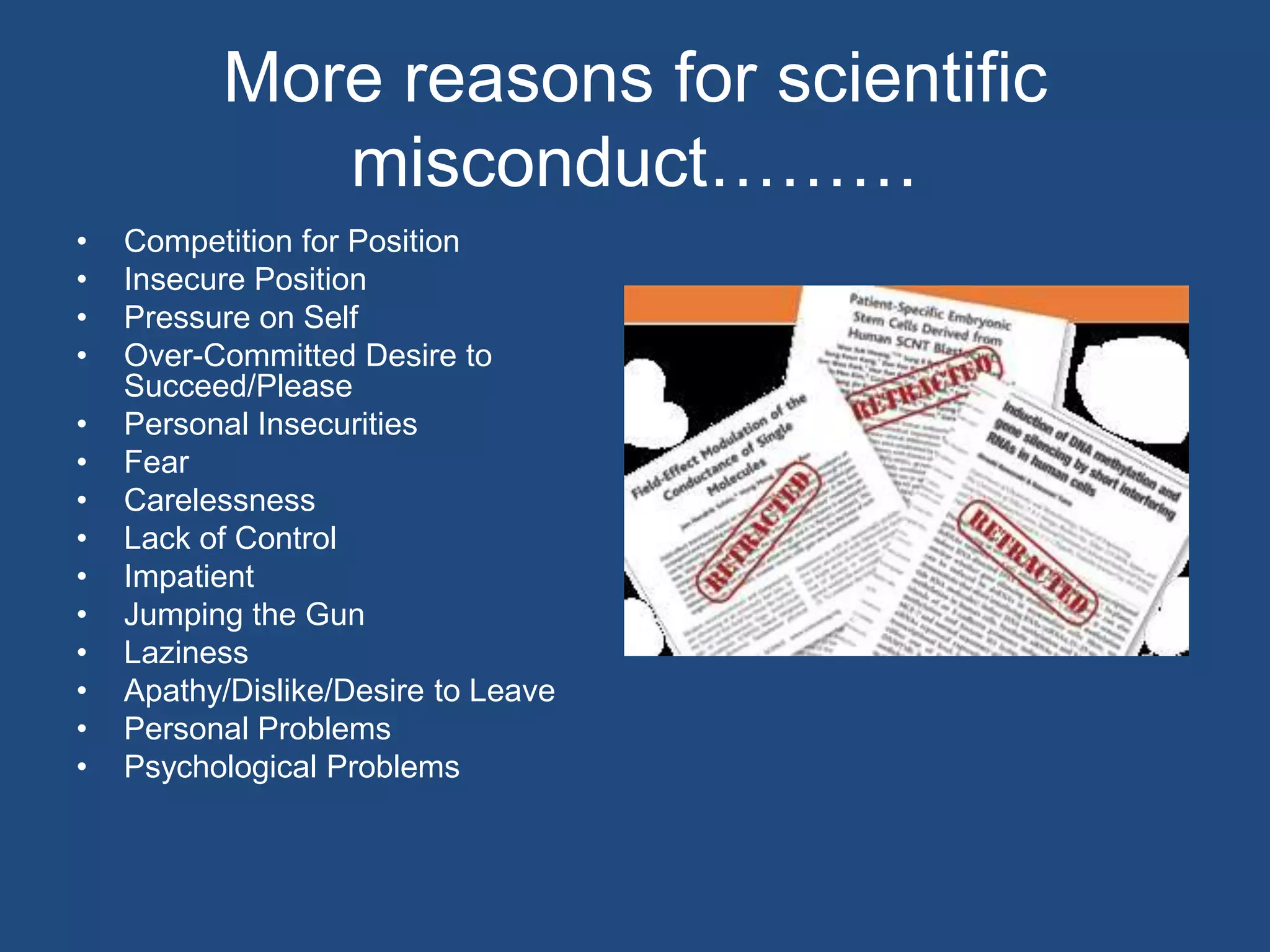
More reasons for scientific misconduct………Competition for PositionInsecure Position Pressure on SelfOver-Committed Desire to Succeed/Please Personal Insecurities Fear CarelessnessLack of Control Impatient Jumping the GunLazinessApathy/Dislike/Desire to LeavePersonal ProblemsPsychological Problems
What Classifies as Scientific Misconduct?Specific acts of scientific misconduct include, but are not limited to, the following:Falsification or Misrepresentation of Data, which includes:reporting experiments, measurements, or statistical analyses never performedmanipulating or altering data or other manifestations of research to achieve a desired resultfalsifying or misrepresenting background information, including biographical data, citation of publications, or status of manuscriptsselective reporting, including the deliberate suppression of conflicting or unwanted dataPhoto ManipulationFrom St. John’s University Preamble and Definition of Scientific Misconduct
Misconduct continued…….PlagiarismThe misrepresentation of the words or ideas of another as one's own. More subtle practices include misleading or inadequate reference citation and duplicate publication of identical data without adequate reference.Abuse of ConfidentialityThe misuse of confidential information or the failure to maintain the confidentiality of such information. This includes the use of ideas and preliminary data gained from (1) access to privileged information through the opportunity for editorial review of manuscripts submitted to journals; and (2) peer review of proposals considered for funding by agency panels or internal committees.Other Practiceswhich seriously deviate from those that are commonly accepted within the scientific community for proposing, conducting, or reporting research, include, but are not limited to, the following:Aiding or facilitating acts of academic dishonesty by others. Violating pertinent federal or University regulations and ethical codes such as those involving the protection and welfare of human subjects and laboratory animals.From St. John’s University Preamble and Definition of Scientific Misconduct
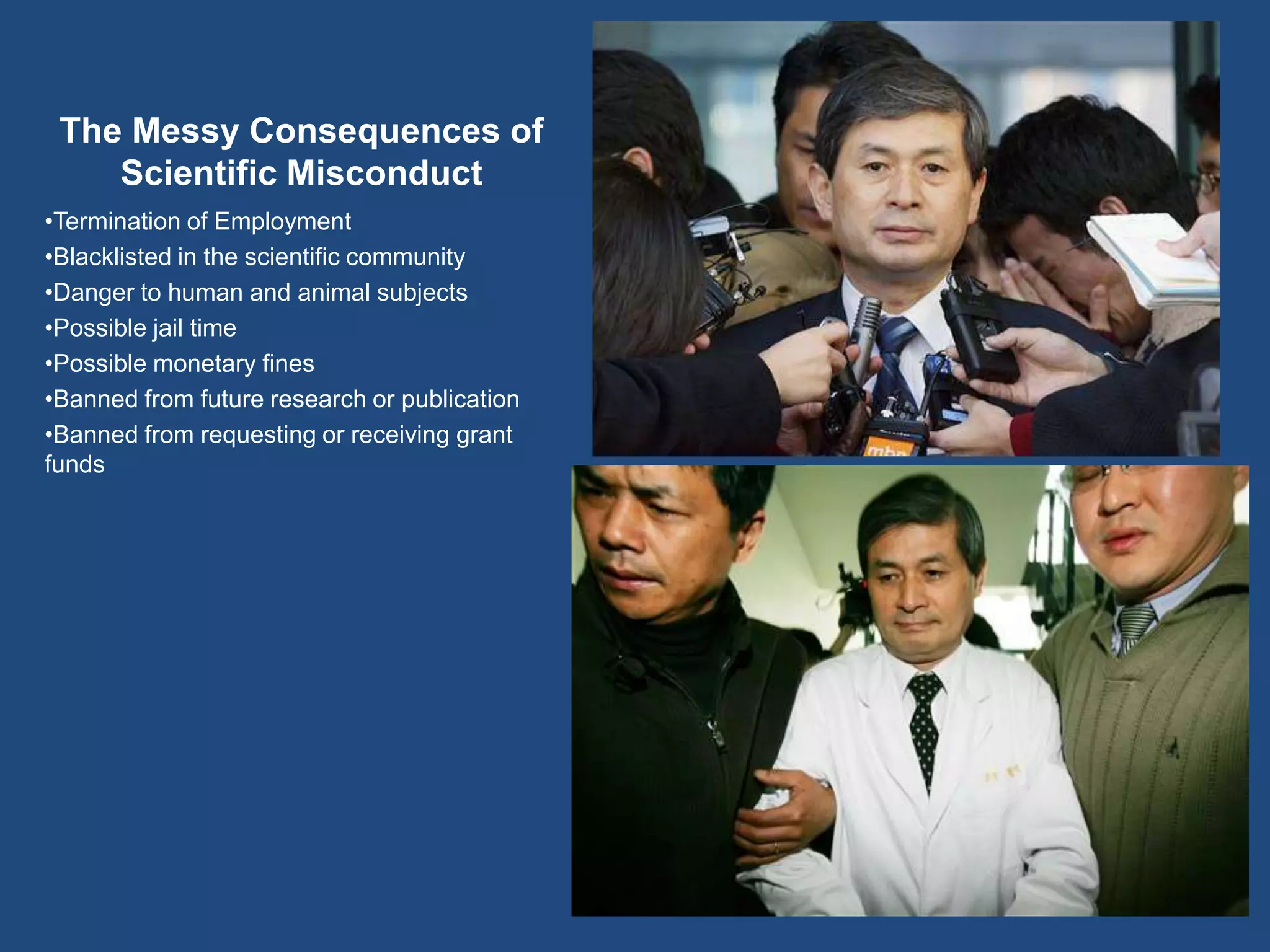
Cases of Scientific MisconductAt the end of 2005, the scientific community was shocked by one of the greatest cases of misconduct in the history of science. Two breakthrough articles about stem cell technology from a Korean laboratory headed by Woo-Suk Hwang, published in Science, appeared to be almost completely fabricated and were therefore retracted.On May 12, 2006, Hwang was indicted on charges of fraud, embezzlement and breach of the country's bioethics law, without physical detention. Prosecutors also brought fraud charges against the three stem cell researchers. He embezzled 2.8 billion won ($3 million) out of some 40 billion won in research funds for personal purposes and the illegal purchase of ova used in his experiments.Scott S. Reuben (born 1958) of East Longmeadow, Massachusetts was Professor of Anesthesiology and Pain Medicine at Baystate Medical Center in Springfield, Massachusetts before being sentenced to prison for health care fraud. Reuben was considered a prolific and influential researcher in pain management, and his purported findings altered the way millions of patients are treated for pain during and after orthopedic surgeries.[1] Reuben has now admitted that he never conducted any of the clinical trials on which his conclusions were based "in what may be considered the longest-running and widest-ranging cases of academic fraud."[2]Scientific American has called Reuben the medical equivalent of Bernie Madoff, the former NASDAQ chairman who was convicted of orchestrating a $65-billion fraud.[1]Source: Wikipedia
The Messy Consequences of Scientific MisconductTermination of Employment
Blacklisted in the scientific community
Danger to human and animal subjects
Possible jail time
Possible monetary fines
Banned from future research or publication

Scientific integrity

  • 1.
    Scientific IntegrityAn overviewfor Medical Students, Interns and Faculty ResearchersAt Duke UniversityLSIS 5245Shamella Cromartie, North Carolina Central University
  • 2.
    Who's Talking AboutScientific Integrity?The President, the federal government, the FDA, the USDA, concerned scientists and researchers, political parties and agencies and even the general public, all over the world, are concerned with scientific integrity.
  • 3.
    And what arethey saying?The scientific integrity conversation includes issues of public health, global health, public safety, misleading research and its subsequent complications, endangerment and the threat it all poses.
  • 4.
    Duke UniversityThe DukeUniversity School of Medicine strives to transform medicine and health, locally and globally, through innovative scientific research and rapid translation of breakthrough discoveries.“One of higher education's essential responsibilities is ensuring the integrity of scientific research.” –Melissa Anderson, 2008
  • 5.
    Key Concepts inScientific IntegrityEthical conduct in science assures the reliability of research results and the safety of research subjects.Ethics in science include: a) standards of methods and process that address research design, procedures, data analysis, interpretation, and reporting; and b) standards of topics and findings that address the use of human and animal subjects in research.Replication, collaboration, and peer review all help to minimize ethical breaches, and identify them when they do occur.
  • 6.
    What is thedifference?Scientific Integrity:Because of the complexity, variability, and nature of scientific inquiry, the concept of integrity in research can be elusive, and its value cannot be easily assessed or measured.Scientific Misconductis the violation of the standard codes of scholarly conduct and ethical behavior in professional scientific research. BUT
  • 7.
    The measure ofa man's character is what he would do if he knew he never would be found out.-Thomas Babington Macaulay, 1800 - 1859
  • 8.
    What reasons leadto scientific misconduct?Pressure to Produce Cognitive Deficiency Inappropriate Responsibility Difficult Job/Tasks Professional ConflictsStress/Pressure in GeneralSupervisor ExpectationsInsufficient Supervision/Mentoring Non-collegial Work EnvironmentLack of Support SystemSubstandard Lab ProceduresOverworkedInsufficient Time Poor Communication & Coordination
  • 9.
    More reasons forscientific misconduct………Competition for PositionInsecure Position Pressure on SelfOver-Committed Desire to Succeed/Please Personal Insecurities Fear CarelessnessLack of Control Impatient Jumping the GunLazinessApathy/Dislike/Desire to LeavePersonal ProblemsPsychological Problems
  • 10.
    What Classifies asScientific Misconduct?Specific acts of scientific misconduct include, but are not limited to, the following:Falsification or Misrepresentation of Data, which includes:reporting experiments, measurements, or statistical analyses never performedmanipulating or altering data or other manifestations of research to achieve a desired resultfalsifying or misrepresenting background information, including biographical data, citation of publications, or status of manuscriptsselective reporting, including the deliberate suppression of conflicting or unwanted dataPhoto ManipulationFrom St. John’s University Preamble and Definition of Scientific Misconduct
  • 11.
    Misconduct continued…….PlagiarismThe misrepresentationof the words or ideas of another as one's own. More subtle practices include misleading or inadequate reference citation and duplicate publication of identical data without adequate reference.Abuse of ConfidentialityThe misuse of confidential information or the failure to maintain the confidentiality of such information. This includes the use of ideas and preliminary data gained from (1) access to privileged information through the opportunity for editorial review of manuscripts submitted to journals; and (2) peer review of proposals considered for funding by agency panels or internal committees.Other Practiceswhich seriously deviate from those that are commonly accepted within the scientific community for proposing, conducting, or reporting research, include, but are not limited to, the following:Aiding or facilitating acts of academic dishonesty by others. Violating pertinent federal or University regulations and ethical codes such as those involving the protection and welfare of human subjects and laboratory animals.From St. John’s University Preamble and Definition of Scientific Misconduct
  • 12.
    Cases of ScientificMisconductAt the end of 2005, the scientific community was shocked by one of the greatest cases of misconduct in the history of science. Two breakthrough articles about stem cell technology from a Korean laboratory headed by Woo-Suk Hwang, published in Science, appeared to be almost completely fabricated and were therefore retracted.On May 12, 2006, Hwang was indicted on charges of fraud, embezzlement and breach of the country's bioethics law, without physical detention. Prosecutors also brought fraud charges against the three stem cell researchers. He embezzled 2.8 billion won ($3 million) out of some 40 billion won in research funds for personal purposes and the illegal purchase of ova used in his experiments.Scott S. Reuben (born 1958) of East Longmeadow, Massachusetts was Professor of Anesthesiology and Pain Medicine at Baystate Medical Center in Springfield, Massachusetts before being sentenced to prison for health care fraud. Reuben was considered a prolific and influential researcher in pain management, and his purported findings altered the way millions of patients are treated for pain during and after orthopedic surgeries.[1] Reuben has now admitted that he never conducted any of the clinical trials on which his conclusions were based "in what may be considered the longest-running and widest-ranging cases of academic fraud."[2]Scientific American has called Reuben the medical equivalent of Bernie Madoff, the former NASDAQ chairman who was convicted of orchestrating a $65-billion fraud.[1]Source: Wikipedia
  • 13.
    The Messy Consequencesof Scientific MisconductTermination of Employment
  • 14.
    Blacklisted in thescientific community
  • 15.
    Danger to humanand animal subjects
  • 16.
  • 17.
  • 18.
    Banned from futureresearch or publication
  • 19.
    Banned from requestingor receiving grant fundsWhy maintain scientific integrity in your research?“Worldwide, most scientific research is conducted in higher education institutions. Funding for science is dependent on the ability of these institutions to support and maintain the legitimacy of the scientific enterprise. As long as the public sees scientific research as beneficial to the common good, support will be forthcoming from government and other sources. In other words, the financial underpinnings of science are derived from public perceptions that scientists act in the public interest.”MELISSA S, Anderson (2008), “Scientific Integrity: Maintaining the Legitimacy of theResearch Enterprise”. Proceedings of the 4th International Barcelona Conference onHigher Education, Vol. 1. Ethics and relevance of scientific knowledge: whatknowledge for what society?. Barcelona: GUNI. Available at http://www.guni-rmies.net.
  • 20.
    Maintain Scientific IntegrityKeepthe best records possible in all scientific experimentationContinuously access the validity of your results through peer review.NO ShortcutsValidate your results through replicationConsult trusted advisors
  • 21.
    Remember!Honest error ordifferences of opinion are not considered research misconduct.Fact: Many allegations of plagiarism involve disputes among former collaborators who participated jointly in the development or conduct of a research project, but who subsequently went their separate ways and made independent use of the jointly developed concepts, methods, descriptive language, or other product of the joint effort. The ownership of the intellectual property in many such situations is seldom clear, and the collaborative history among the scientists often supports a presumption of implied consent to use the products of the collaboration by any of the former collaborators. ---Office of Research Integrity
  • 22.
    Research Misconduct isNot a Joke!Do not commit irreversible damage to your career! Thinking about research misconduct now, will help you avoid it in the future.
  • 23.
    ReferencesAnderson, Melissa.(2008), “ScientificIntegrity: Maintaining the Legitimacy of the Research Enterprise”. Proceedings of the 4th International Barcelona Conference onHigher Education, Vol. 1. Ethics and relevance of scientific knowledge: what knowledge for what society?. Barcelona: GUNI. Available athttp://www.gunirmies.net Office of Research Integrity. http://ori.hhs.gov/St. John’s University Office of Grants and Sponsored Research. Preamble and Definition of Scientific Misconduct. http://www.stjohns.edu/academics/centers/grants/policy/misconduct/i_preamble2.stjWikipedia. 2011.