RESEARCH ETHICS &
SCIENTIFIC MISCONDUCT
(FMOH, MARCH 04, 2015)
Ghaiath Hussein, MBBS, MHSc. (Bioethics),
Doctoral Researcher (UK)
ghaiathme@gmail.com
Outline
• Overview on the Knowledge Management Cycle
and how research fits in it
• Brief historical background on research ethics
• What makes research ethical?
• Definition and examples of scientific misconduct
• How to make your research ethical and avoid
scientific misconduct?
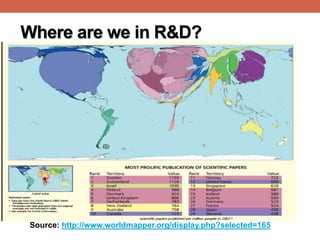
Where are we in R&D?
Source: http://www.worldmapper.org/display.php?selected=165
Where are we in R&D?
Expenditure on R&D as % of
GDP (2013):[1]
• Arab world: 0.5%
• China (2%),
• EU (2.3%),
• USA (2.8%),
• Israel (4%)
Number of researchers (per
1,000,000 population) [2]
• Morocco : 864
• Argentina: 1,236
• Malaysia: 1,643
• Slovenia: 4,255
• Israel: 6,494
Published scientific papers (1996 -2013):[3]
Egypt (42nd): 104,784 Brazil: 529,841
Israel: 247,561 India: 868,719
Turkey: 348,836 USA: 7,846,972
What is Research?
 “Research” is defined as an undertaking intended to
extend knowledge through a disciplined inquiry or
systematic investigation.
 Systematic methodological scientific approach for
basic facts around a certain problem in order to find
solutions based on these facts.
Research on Humans:
The systematic undertaking of activities that involve the
collection of human personal data, measurements,
and/or biological samples for purposes that are not
related to clinical management of a health condition
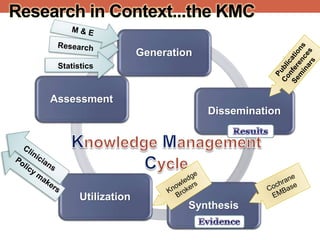
Research in Context...the KMC
Generation
Dissemination
Synthesis
Utilization
Assessment
Statistics
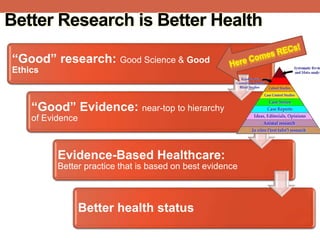
Better Research is Better Health
“Good” research: Good Science & Good
Ethics
“Good” Evidence: near-top to hierarchy
of Evidence
Evidence-Based Healthcare:
Better practice that is based on best evidence
Better health status
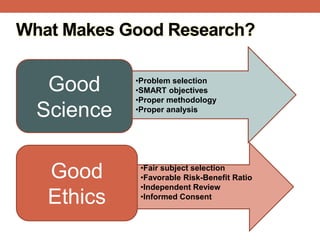
What Makes Good Research?
Good
Science
Good
Ethics
•Problem selection
•SMART objectives
•Proper methodology
•Proper analysis
•Fair subject selection
•Favorable Risk-Benefit Ratio
•Independent Review
•Informed Consent
Criteria of “Good” Science Research
• Systematic: The research developed,
implemented and reported in a systematic
manner.
• Methodological: Adopt & use skillfully the
research methods, materials, approaches in order
to ensure reliability of the results & findings.
• Scientific: The research should be scientifically
sound through utilizing scientific approaches,
tools and techniques.
Criteria for Good Ethics:
What Makes Research Ethical?
1. Social or Scientific Value
2. Scientific Validity
3. Fair Subject Selection
4. Favorable Risk-Benefit Ratio
5. Independent Review
6. Informed Consent
7. Respect for the potential and enrolled
subjects
What’s Research Ethics?
 It is the field of ethics that systematically analyze the ethical
(and legal?) questions raised by research involving human
subjects.
 Its main focus is to ensure that the study participants are
protected and, ultimately,
 that clinical research is conducted in a way that
serves the needs of such participants and of
society as a whole.
It works when and only when it is applied before the
research is conducted
History of Research Ethics
Pre-World War II: Research standards left up to the discretion
of the individual researcher
18th and 19th Centuries
• James Lind “scurvy study in sailors - Salisbury
• Edward Jenner cowpox vaccine test
• 1897 Giuseppe Sanarelli yellow fever test
1900 Walter Reed established several [first ever]
“safeguards”
• Self-experimentation
• Only adults would be enrolled in research
• Written informed consent
• Reimbursement (inducement)
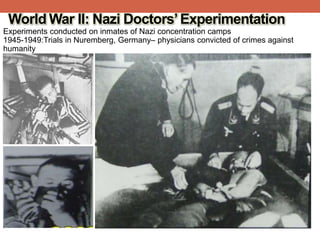
World War II: Nazi Doctors’Experimentation
Experiments conducted on inmates of Nazi concentration camps
1945-1949:Trials in Nuremberg, Germany– physicians convicted of crimes against
humanity
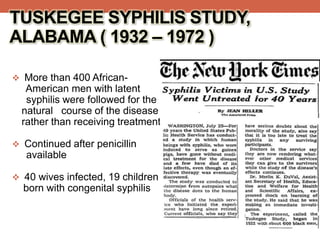
 More than 400 African-
American men with latent
syphilis were followed for the
natural course of the disease
rather than receiving treatment.
 Continued after penicillin
available
 40 wives infected, 19 children
born with congenital syphilis
TUSKEGEE SYPHILIS STUDY,
ALABAMA ( 1932 – 1972 )
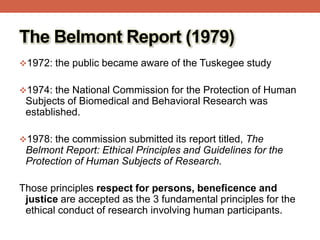
The Belmont Report (1979)
1972: the public became aware of the Tuskegee study
1974: the National Commission for the Protection of Human
Subjects of Biomedical and Behavioral Research was
established.
1978: the commission submitted its report titled, The
Belmont Report: Ethical Principles and Guidelines for the
Protection of Human Subjects of Research.
Those principles respect for persons, beneficence and
justice are accepted as the 3 fundamental principles for the
ethical conduct of research involving human participants.
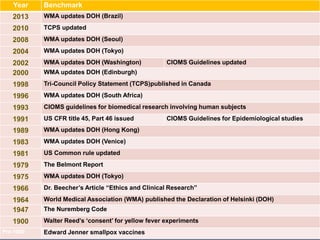
Year Benchmark
2013 WMA updates DOH (Brazil)
2010 TCPS updated
2008 WMA updates DOH (Seoul)
2004 WMA updates DOH (Tokyo)
2002 WMA updates DOH (Washington) CIOMS Guidelines updated
2000 WMA updates DOH (Edinburgh)
1998 Tri-Council Policy Statement (TCPS)published in Canada
1996 WMA updates DOH (South Africa)
1993 CIOMS guidelines for biomedical research involving human subjects
1991 US CFR title 45, Part 46 issued CIOMS Guidelines for Epidemiological studies
1989 WMA updates DOH (Hong Kong)
1983 WMA updates DOH (Venice)
1981 US Common rule updated
1979 The Belmont Report
1975 WMA updates DOH (Tokyo)
1966 Dr. Beecher’s Article “Ethics and Clinical Research”
1964 World Medical Association (WMA) published the Declaration of Helsinki (DOH)
1947 The Nuremberg Code
1900 Walter Reed’s ‘consent’ for yellow fever experiments
Pre-1900 Edward Jenner smallpox vaccines
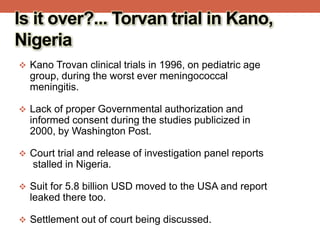
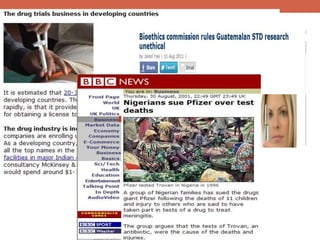
Is it over?... Torvan trial in Kano,
Nigeria
 Kano Trovan clinical trials in 1996, on pediatric age
group, during the worst ever meningococcal
meningitis.
 Lack of proper Governmental authorization and
informed consent during the studies publicized in
2000, by Washington Post.
 Court trial and release of investigation panel reports
stalled in Nigeria.
 Suit for 5.8 billion USD moved to the USA and report
leaked there too.
 Settlement out of court being discussed.
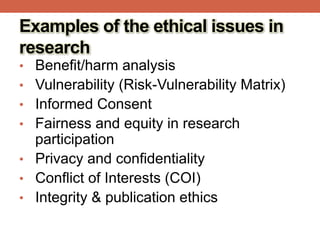
Examples of the ethical issues in
research
• Benefit/harm analysis
• Vulnerability (Risk-Vulnerability Matrix)
• Informed Consent
• Fairness and equity in research
participation
• Privacy and confidentiality
• Conflict of Interests (COI)
• Integrity & publication ethics
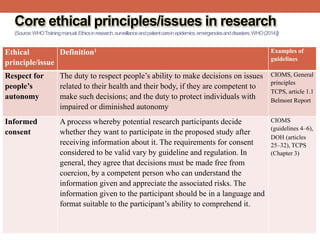
Core ethical principles/issues in research
(Source:WHOTrainingmanual:Ethicsinresearch,surveillanceandpatientcareinepidemics,emergenciesanddisasters,WHO(2014))
Ethical
principle/issue
Definition1 Examples of
guidelines
Respect for
people’s
autonomy
The duty to respect people’s ability to make decisions on issues
related to their health and their body, if they are competent to
make such decisions; and the duty to protect individuals with
impaired or diminished autonomy
CIOMS, General
principles
TCPS, article 1.1
Belmont Report
Informed
consent
A process whereby potential research participants decide
whether they want to participate in the proposed study after
receiving information about it. The requirements for consent
considered to be valid vary by guideline and regulation. In
general, they agree that decisions must be made free from
coercion, by a competent person who can understand the
information given and appreciate the associated risks. The
information given to the participant should be in a language and
format suitable to the participant’s ability to comprehend it.
CIOMS
(guidelines 4–6),
DOH (articles
25–32), TCPS
(Chapter 3)
Ethical
principle/issue
Definition1 Examples of
guidelines
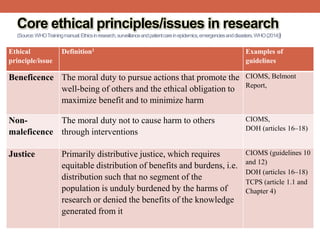
Beneficence The moral duty to pursue actions that promote the
well-being of others and the ethical obligation to
maximize benefit and to minimize harm
CIOMS, Belmont
Report,
Non-
maleficence
The moral duty not to cause harm to others
through interventions
CIOMS,
DOH (articles 16–18)
Justice Primarily distributive justice, which requires
equitable distribution of benefits and burdens, i.e.
distribution such that no segment of the
population is unduly burdened by the harms of
research or denied the benefits of the knowledge
generated from it
CIOMS (guidelines 10
and 12)
DOH (articles 16–18)
TCPS (article 1.1 and
Chapter 4)
Core ethical principles/issues in research
(Source:WHOTrainingmanual:Ethicsinresearch,surveillanceandpatientcareinepidemics,emergenciesanddisasters,WHO(2014))
Ethical
principle/issue
Definition1 Examples of
guidelines
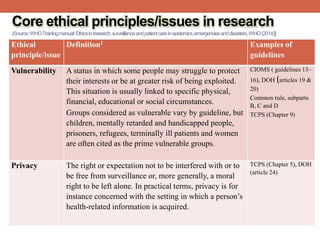
Vulnerability A status in which some people may struggle to protect
their interests or be at greater risk of being exploited.
This situation is usually linked to specific physical,
financial, educational or social circumstances.
Groups considered as vulnerable vary by guideline, but
children, mentally retarded and handicapped people,
prisoners, refugees, terminally ill patients and women
are often cited as the prime vulnerable groups.
CIOMS ( guidelines 13–
16), DOH (articles 19 &
20)
Common rule, subparts
B, C and D
TCPS (Chapter 9)
Privacy The right or expectation not to be interfered with or to
be free from surveillance or, more generally, a moral
right to be left alone. In practical terms, privacy is for
instance concerned with the setting in which a person’s
health-related information is acquired.
TCPS (Chapter 5), DOH
(article 24)
Core ethical principles/issues in research
(Source:WHOTrainingmanual:Ethicsinresearch,surveillanceandpatientcareinepidemics,emergenciesanddisasters,WHO(2014))
Ethical
principle/issue
Definition1 Examples of
guidelines
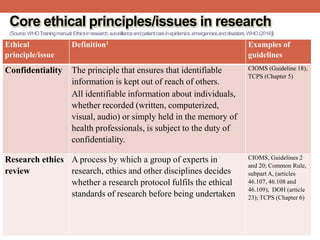
Confidentiality The principle that ensures that identifiable
information is kept out of reach of others.
All identifiable information about individuals,
whether recorded (written, computerized,
visual, audio) or simply held in the memory of
health professionals, is subject to the duty of
confidentiality.
CIOMS (Guideline 18),
TCPS (Chapter 5)
Research ethics
review
A process by which a group of experts in
research, ethics and other disciplines decides
whether a research protocol fulfils the ethical
standards of research before being undertaken
CIOMS, Guidelines 2
and 20; Common Rule,
subpart A, (articles
46.107, 46.108 and
46.109); DOH (article
23); TCPS (Chapter 6)
Core ethical principles/issues in research
(Source:WHOTrainingmanual:Ethicsinresearch,surveillanceandpatientcareinepidemics,emergenciesanddisasters,WHO(2014))
RESEARCH MISCONDUCT
(FFP)
Research Misconduct (FFP)
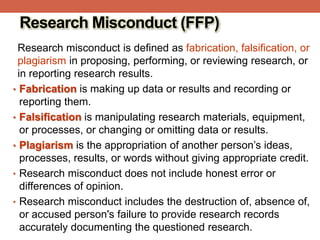
Research misconduct is defined as fabrication, falsification, or
plagiarism in proposing, performing, or reviewing research, or
in reporting research results.
• Fabrication is making up data or results and recording or
reporting them.
• Falsification is manipulating research materials, equipment,
or processes, or changing or omitting data or results.
• Plagiarism is the appropriation of another person’s ideas,
processes, results, or words without giving appropriate credit.
• Research misconduct does not include honest error or
differences of opinion.
• Research misconduct includes the destruction of, absence of,
or accused person's failure to provide research records
accurately documenting the questioned research.
Forms of misconduct
• Falsification
• Obfuscation
• Fabrication
• Plagiarism
• Self-plagiarism
• Ghost writing
• Bare assertions
• Improper authorship
• Misappropriation
• Bibliometric inflation
• Violation of ethical
standards regarding
human and animal
experiments
Source: http://en.wikipedia.org/wiki/Scientific_misconduct
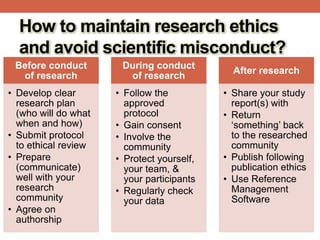
How to maintain research ethics
and avoid scientific misconduct?
Before conduct
of research
• Develop clear
research plan
(who will do what
when and how)
• Submit protocol
to ethical review
• Prepare
(communicate)
well with your
research
community
• Agree on
authorship
During conduct
of research
• Follow the
approved
protocol
• Gain consent
• Involve the
community
• Protect yourself,
your team, &
your participants
• Regularly check
your data
After research
• Share your study
report(s) with
• Return
‘something’ back
to the researched
community
• Publish following
publication ethics
• Use Reference
Management
Software
References
1. World Bank’s interactive website:
http://data.worldbank.org/indicator/GB.XPD.RSDV.GD.ZS
2. World Bank website:
http://data.worldbank.org/indicator/SP.POP.SCIE.RD.P6?ord
er=wbapi_data_value_2011+wbapi_data_value&sort=desc
3. SCImago. (2007). SJR — SCImago Journal & Country
Rank. Retrieved December 09, 2014, from
http://www.scimagojr.com
4. Training manual: Ethics in research, surveillance and
patient care in epidemics, emergencies and disasters.
Geneva, Switzerland: World Health Organization; 2014.
This presentation and more material can be found online:
http://www.slideshare.net/ghaiath
https://www.youtube.com/ghaiathme
• You may also contact me on my email: ghaiathme@gmail.com

Research ethics & scientific misconduct

  • 1.
    RESEARCH ETHICS & SCIENTIFICMISCONDUCT (FMOH, MARCH 04, 2015) Ghaiath Hussein, MBBS, MHSc. (Bioethics), Doctoral Researcher (UK) ghaiathme@gmail.com
  • 2.
    Outline • Overview onthe Knowledge Management Cycle and how research fits in it • Brief historical background on research ethics • What makes research ethical? • Definition and examples of scientific misconduct • How to make your research ethical and avoid scientific misconduct?
  • 3.
    Where are wein R&D? Source: http://www.worldmapper.org/display.php?selected=165
  • 4.
    Where are wein R&D? Expenditure on R&D as % of GDP (2013):[1] • Arab world: 0.5% • China (2%), • EU (2.3%), • USA (2.8%), • Israel (4%) Number of researchers (per 1,000,000 population) [2] • Morocco : 864 • Argentina: 1,236 • Malaysia: 1,643 • Slovenia: 4,255 • Israel: 6,494 Published scientific papers (1996 -2013):[3] Egypt (42nd): 104,784 Brazil: 529,841 Israel: 247,561 India: 868,719 Turkey: 348,836 USA: 7,846,972
  • 5.
    What is Research? “Research” is defined as an undertaking intended to extend knowledge through a disciplined inquiry or systematic investigation.  Systematic methodological scientific approach for basic facts around a certain problem in order to find solutions based on these facts. Research on Humans: The systematic undertaking of activities that involve the collection of human personal data, measurements, and/or biological samples for purposes that are not related to clinical management of a health condition
  • 6.
    Research in Context...theKMC Generation Dissemination Synthesis Utilization Assessment Statistics
  • 7.
    Better Research isBetter Health “Good” research: Good Science & Good Ethics “Good” Evidence: near-top to hierarchy of Evidence Evidence-Based Healthcare: Better practice that is based on best evidence Better health status
  • 8.
    What Makes GoodResearch? Good Science Good Ethics •Problem selection •SMART objectives •Proper methodology •Proper analysis •Fair subject selection •Favorable Risk-Benefit Ratio •Independent Review •Informed Consent
  • 9.
    Criteria of “Good”Science Research • Systematic: The research developed, implemented and reported in a systematic manner. • Methodological: Adopt & use skillfully the research methods, materials, approaches in order to ensure reliability of the results & findings. • Scientific: The research should be scientifically sound through utilizing scientific approaches, tools and techniques.
  • 10.
    Criteria for GoodEthics: What Makes Research Ethical? 1. Social or Scientific Value 2. Scientific Validity 3. Fair Subject Selection 4. Favorable Risk-Benefit Ratio 5. Independent Review 6. Informed Consent 7. Respect for the potential and enrolled subjects
  • 11.
    What’s Research Ethics? It is the field of ethics that systematically analyze the ethical (and legal?) questions raised by research involving human subjects.  Its main focus is to ensure that the study participants are protected and, ultimately,  that clinical research is conducted in a way that serves the needs of such participants and of society as a whole. It works when and only when it is applied before the research is conducted
  • 13.
    History of ResearchEthics Pre-World War II: Research standards left up to the discretion of the individual researcher 18th and 19th Centuries • James Lind “scurvy study in sailors - Salisbury • Edward Jenner cowpox vaccine test • 1897 Giuseppe Sanarelli yellow fever test 1900 Walter Reed established several [first ever] “safeguards” • Self-experimentation • Only adults would be enrolled in research • Written informed consent • Reimbursement (inducement)
  • 14.
    World War II:Nazi Doctors’Experimentation Experiments conducted on inmates of Nazi concentration camps 1945-1949:Trials in Nuremberg, Germany– physicians convicted of crimes against humanity
  • 15.
     More than400 African- American men with latent syphilis were followed for the natural course of the disease rather than receiving treatment.  Continued after penicillin available  40 wives infected, 19 children born with congenital syphilis TUSKEGEE SYPHILIS STUDY, ALABAMA ( 1932 – 1972 )
  • 16.
    The Belmont Report(1979) 1972: the public became aware of the Tuskegee study 1974: the National Commission for the Protection of Human Subjects of Biomedical and Behavioral Research was established. 1978: the commission submitted its report titled, The Belmont Report: Ethical Principles and Guidelines for the Protection of Human Subjects of Research. Those principles respect for persons, beneficence and justice are accepted as the 3 fundamental principles for the ethical conduct of research involving human participants.
  • 17.
    Year Benchmark 2013 WMAupdates DOH (Brazil) 2010 TCPS updated 2008 WMA updates DOH (Seoul) 2004 WMA updates DOH (Tokyo) 2002 WMA updates DOH (Washington) CIOMS Guidelines updated 2000 WMA updates DOH (Edinburgh) 1998 Tri-Council Policy Statement (TCPS)published in Canada 1996 WMA updates DOH (South Africa) 1993 CIOMS guidelines for biomedical research involving human subjects 1991 US CFR title 45, Part 46 issued CIOMS Guidelines for Epidemiological studies 1989 WMA updates DOH (Hong Kong) 1983 WMA updates DOH (Venice) 1981 US Common rule updated 1979 The Belmont Report 1975 WMA updates DOH (Tokyo) 1966 Dr. Beecher’s Article “Ethics and Clinical Research” 1964 World Medical Association (WMA) published the Declaration of Helsinki (DOH) 1947 The Nuremberg Code 1900 Walter Reed’s ‘consent’ for yellow fever experiments Pre-1900 Edward Jenner smallpox vaccines
  • 18.
    Is it over?...Torvan trial in Kano, Nigeria  Kano Trovan clinical trials in 1996, on pediatric age group, during the worst ever meningococcal meningitis.  Lack of proper Governmental authorization and informed consent during the studies publicized in 2000, by Washington Post.  Court trial and release of investigation panel reports stalled in Nigeria.  Suit for 5.8 billion USD moved to the USA and report leaked there too.  Settlement out of court being discussed.
  • 20.
    Examples of theethical issues in research • Benefit/harm analysis • Vulnerability (Risk-Vulnerability Matrix) • Informed Consent • Fairness and equity in research participation • Privacy and confidentiality • Conflict of Interests (COI) • Integrity & publication ethics
  • 21.
    Core ethical principles/issuesin research (Source:WHOTrainingmanual:Ethicsinresearch,surveillanceandpatientcareinepidemics,emergenciesanddisasters,WHO(2014)) Ethical principle/issue Definition1 Examples of guidelines Respect for people’s autonomy The duty to respect people’s ability to make decisions on issues related to their health and their body, if they are competent to make such decisions; and the duty to protect individuals with impaired or diminished autonomy CIOMS, General principles TCPS, article 1.1 Belmont Report Informed consent A process whereby potential research participants decide whether they want to participate in the proposed study after receiving information about it. The requirements for consent considered to be valid vary by guideline and regulation. In general, they agree that decisions must be made free from coercion, by a competent person who can understand the information given and appreciate the associated risks. The information given to the participant should be in a language and format suitable to the participant’s ability to comprehend it. CIOMS (guidelines 4–6), DOH (articles 25–32), TCPS (Chapter 3)
  • 22.
    Ethical principle/issue Definition1 Examples of guidelines BeneficenceThe moral duty to pursue actions that promote the well-being of others and the ethical obligation to maximize benefit and to minimize harm CIOMS, Belmont Report, Non- maleficence The moral duty not to cause harm to others through interventions CIOMS, DOH (articles 16–18) Justice Primarily distributive justice, which requires equitable distribution of benefits and burdens, i.e. distribution such that no segment of the population is unduly burdened by the harms of research or denied the benefits of the knowledge generated from it CIOMS (guidelines 10 and 12) DOH (articles 16–18) TCPS (article 1.1 and Chapter 4) Core ethical principles/issues in research (Source:WHOTrainingmanual:Ethicsinresearch,surveillanceandpatientcareinepidemics,emergenciesanddisasters,WHO(2014))
  • 23.
    Ethical principle/issue Definition1 Examples of guidelines VulnerabilityA status in which some people may struggle to protect their interests or be at greater risk of being exploited. This situation is usually linked to specific physical, financial, educational or social circumstances. Groups considered as vulnerable vary by guideline, but children, mentally retarded and handicapped people, prisoners, refugees, terminally ill patients and women are often cited as the prime vulnerable groups. CIOMS ( guidelines 13– 16), DOH (articles 19 & 20) Common rule, subparts B, C and D TCPS (Chapter 9) Privacy The right or expectation not to be interfered with or to be free from surveillance or, more generally, a moral right to be left alone. In practical terms, privacy is for instance concerned with the setting in which a person’s health-related information is acquired. TCPS (Chapter 5), DOH (article 24) Core ethical principles/issues in research (Source:WHOTrainingmanual:Ethicsinresearch,surveillanceandpatientcareinepidemics,emergenciesanddisasters,WHO(2014))
  • 24.
    Ethical principle/issue Definition1 Examples of guidelines ConfidentialityThe principle that ensures that identifiable information is kept out of reach of others. All identifiable information about individuals, whether recorded (written, computerized, visual, audio) or simply held in the memory of health professionals, is subject to the duty of confidentiality. CIOMS (Guideline 18), TCPS (Chapter 5) Research ethics review A process by which a group of experts in research, ethics and other disciplines decides whether a research protocol fulfils the ethical standards of research before being undertaken CIOMS, Guidelines 2 and 20; Common Rule, subpart A, (articles 46.107, 46.108 and 46.109); DOH (article 23); TCPS (Chapter 6) Core ethical principles/issues in research (Source:WHOTrainingmanual:Ethicsinresearch,surveillanceandpatientcareinepidemics,emergenciesanddisasters,WHO(2014))
  • 25.
  • 26.
    Research Misconduct (FFP) Researchmisconduct is defined as fabrication, falsification, or plagiarism in proposing, performing, or reviewing research, or in reporting research results. • Fabrication is making up data or results and recording or reporting them. • Falsification is manipulating research materials, equipment, or processes, or changing or omitting data or results. • Plagiarism is the appropriation of another person’s ideas, processes, results, or words without giving appropriate credit. • Research misconduct does not include honest error or differences of opinion. • Research misconduct includes the destruction of, absence of, or accused person's failure to provide research records accurately documenting the questioned research.
  • 27.
    Forms of misconduct •Falsification • Obfuscation • Fabrication • Plagiarism • Self-plagiarism • Ghost writing • Bare assertions • Improper authorship • Misappropriation • Bibliometric inflation • Violation of ethical standards regarding human and animal experiments Source: http://en.wikipedia.org/wiki/Scientific_misconduct
  • 28.
    How to maintainresearch ethics and avoid scientific misconduct? Before conduct of research • Develop clear research plan (who will do what when and how) • Submit protocol to ethical review • Prepare (communicate) well with your research community • Agree on authorship During conduct of research • Follow the approved protocol • Gain consent • Involve the community • Protect yourself, your team, & your participants • Regularly check your data After research • Share your study report(s) with • Return ‘something’ back to the researched community • Publish following publication ethics • Use Reference Management Software
  • 29.
    References 1. World Bank’sinteractive website: http://data.worldbank.org/indicator/GB.XPD.RSDV.GD.ZS 2. World Bank website: http://data.worldbank.org/indicator/SP.POP.SCIE.RD.P6?ord er=wbapi_data_value_2011+wbapi_data_value&sort=desc 3. SCImago. (2007). SJR — SCImago Journal & Country Rank. Retrieved December 09, 2014, from http://www.scimagojr.com 4. Training manual: Ethics in research, surveillance and patient care in epidemics, emergencies and disasters. Geneva, Switzerland: World Health Organization; 2014.
  • 30.
    This presentation andmore material can be found online: http://www.slideshare.net/ghaiath https://www.youtube.com/ghaiathme • You may also contact me on my email: ghaiathme@gmail.com

Editor's Notes

  • #17 In 1972, the public became aware of the Tuskegee study, which took place in the southern United States from 1932 to 1972. More than 400 men with latent syphilis were followed for the natural course of the disease rather than receiving treatment. As a result, in 1974 the National Commission for the Protection of Human Subjects of Biomedical and Behavioral Research was established. In 1978, the commission submitted its report titled, The Belmont Report: Ethical Principles and Guidelines for the Protection of Human Subjects of Research. Those principles—respect for persons, beneficence and justice—are accepted as the 3 fundamental principles for the ethical conduct of research involving human participants.
  • #22 1 These definitions are not universal. The author tried to capture the main, or the common, features of each concept. Different guidelines may have different definitions for each of these principles. Moreover, the literature on research ethics has different approaches and definitions. One comprehensive, simple-to-use resource that provides more information on these concepts is the Stanford Encyclopedia of Philosophy (Zalta, 2014). 2 This example is not common to all guidelines, and some commentators may disagree with it.
  • #23 2 This example is not common to all guidelines, and some commentators may disagree with it.
  • #24 1 These definitions are not universal. The author tried to capture the main, or the common, features of each concept. Different guidelines may have different definitions for each of these principles. Moreover, the literature on research ethics has different approaches and definitions. One comprehensive, simple-to-use resource that provides more information on these concepts is the Stanford Encyclopedia of Philosophy (Zalta, 2014). 2 This example is not common to all guidelines, and some commentators may disagree with it.
  • #25 1 These definitions are not universal. The author tried to capture the main, or the common, features of each concept. Different guidelines may have different definitions for each of these principles. Moreover, the literature on research ethics has different approaches and definitions. One comprehensive, simple-to-use resource that provides more information on these concepts is the Stanford Encyclopedia of Philosophy (Zalta, 2014). 2 This example is not common to all guidelines, and some commentators may disagree with it.