Scientific Case ForCreation Bert Thompson
download
https://ebookbell.com/product/scientific-case-for-creation-bert-
thompson-1632368
Explore and download more ebooks at ebookbell.com
2.
Here are somerecommended products that we believe you will be
interested in. You can click the link to download.
The Case For A Creator A Journalist Investigates Scientific Evidence
That Points Toward God Lee Strobel
https://ebookbell.com/product/the-case-for-a-creator-a-journalist-
investigates-scientific-evidence-that-points-toward-god-lee-
strobel-1478612
The Case For A Creator A Journalist Investigates Scientific Evidence
That Points Toward God Lee Strobel
https://ebookbell.com/product/the-case-for-a-creator-a-journalist-
investigates-scientific-evidence-that-points-toward-god-lee-
strobel-5074702
Authoritative Communities The Scientific Case For Nurturing The Whole
Child 1st Edition Kathleen Kovner Kline Md Auth
https://ebookbell.com/product/authoritative-communities-the-
scientific-case-for-nurturing-the-whole-child-1st-edition-kathleen-
kovner-kline-md-auth-4387528
The Esp Enigma The Scientific Case For Psychic Phenomena First Edition
Diane Hennacy Powell
https://ebookbell.com/product/the-esp-enigma-the-scientific-case-for-
psychic-phenomena-first-edition-diane-hennacy-powell-4983054
3.
Making A ScientificCase For Conscious Agency And Free Will 1st
Edition William R Klemm
https://ebookbell.com/product/making-a-scientific-case-for-conscious-
agency-and-free-will-1st-edition-william-r-klemm-5433140
Liberation Biology The Scientific And Moral Case For The Biotech
Revolution Ronald Bailey
https://ebookbell.com/product/liberation-biology-the-scientific-and-
moral-case-for-the-biotech-revolution-ronald-bailey-5563748
The Case For International Sharing Of Scientific Data A Focus On
Developing Countries Proceedings Of A Symposium 1st Edition National
Research Council Policy And Global Affairs Board On Research Data And
Information Board On International Scientific Organizations Committee
On The Case Of International Sharing Of Scientific Data A Focus On
Developing Countries Paul F Uhli
https://ebookbell.com/product/the-case-for-international-sharing-of-
scientific-data-a-focus-on-developing-countries-proceedings-of-a-
symposium-1st-edition-national-research-council-policy-and-global-
affairs-board-on-research-data-and-information-board-on-international-
scientific-organizations-committee-on-the-case-of-international-
sharing-of-scientific-data-a-focus-on-developing-countries-paul-f-
uhli-51874238
The Case For Reason Volume Two A Scientific Enquiry Into Belief
Dabholkar
https://ebookbell.com/product/the-case-for-reason-volume-two-a-
scientific-enquiry-into-belief-dabholkar-12294708
The Case For Reason Volume Two A Scientific Enquiry Into Belief
Dabholkar
https://ebookbell.com/product/the-case-for-reason-volume-two-a-
scientific-enquiry-into-belief-dabholkar-58720620
1
INTRODUCTION
There are twofundamentally different, and diametrically
opposed, explanations for the origin of the Universe, the ori
gin oflifeinthatUniverse,andtheoriginofnewtypesofvary
inglife forms. Each of these explanations is a cosmogony—an
entire world view, or philosophy, of origins and destinies, of
life and meaning.
One of these world views is the concept of evolution. Ac-
cordingtothetheoryofevolution,orasitmaybecalledmore
properly,theevolutionmodel,theUniverseisself-contained.
EverythingintheUniversehascomeintobeingthroughmech
anistic processes without any kind of supernatural interven
tion. This view asserts that the origin and development of the
Universeandallofitssystems(theUniverseitself,livingnon
human organisms, man, etc.) can be explained solely on the
basis of time, chance, and continuing natural processes innate
in the structure of matter and energy.
According to this particular theory, all living things have
arisen from a single-celled organism, which in turn had arisen
from an inanimate, inorganic world. This theory may be cal
led the “General Theory of Evolution,” a name given to it by
G.A. Kerkut, the famous British evolutionist/physiologist who
describeditas“...thetheorythatallthelivingformsintheworld
havearisenfromasinglesourcewhichitselfcamefromanin
organic form” (1960, p. 157).
- 1
11.
The second alternateand opposing world view is the con
cept of creation. According to the theory of creation, or as it
may be called more properly, the creation model, the Uni
verseis not self-contained.EverythingintheUniverse,and
in fact, the Universe itself, has come into being through the
design, purpose, and deliberate acts of a supernatural Creator
Who, using processes that are not continuing as natural pro
cesses in the present, created the Universe, the Earth, and all
life on the Earth, including all basic types of plants and ani
mals, as well as humans.
As various authors—both evolutionists (see Wald, 1979, p.
289)andcreationists(seeWysong,1976,p.5)—haveobserved,
therearetwoandonlytwopossibilitiesregardingorigins.One
or the other of these two philosophies (or models) must be true.
That is to say, all things either can, or cannot, be explained in
terms of ongoing natural processes in a self-contained Uni
verse. If they can, then evolution is true. If they cannot, then
they must be explained, at least in part, by extranatural pro
cesses that can account for a Universe which itself was cre
ated. In their text, What Is Creation Science?, Henry Morris and
Gary Parker commented on this point.
Thefactis,however,thereareonly twopossiblemod
elsoforigins,evolutionorcreation....Eitherthespace/
mass/time universe is eternal, or it is not. If it is, then
evolution is the true explanation of its various com
ponents.Ifitisnot,thenitmusthavebeencreatedby
a Creator. These are the only two possibilities—sim-
ply stated, either it happened by accident (chance)...
or it didn’t (design).... There are only these two pos
sibilities. There may be many evolution submodels...
and various creation submodels..., but there can be
onlytwobasicmodels—evolutionorcreation(1987,p.
190, emp. in orig.).
Varioustermshavebeenusedtodescribethetwoconceptsof
origins—creation versus evolution, design versus chance, the
ism versus naturalism/materialism, etc.—but in the end all of
these phrases are merely different ways of expressing the same
two basic alternatives.
- 2
12.
Some, in anattempt to offer a third alternative, have sug
gested“theisticevolution”(alsoknownas“directedevolution,”
“mitigated evolution,” or “religious evolution”), which postu
latesbothaCreatorandanevolutionaryscenario.Evolution
ists frequently have been known to ask creationists, “Which
creation story do you wish to see taught—Buddhist? Hindu?
Christian?, etc.?” The fact remains, of course, that ultimately
eitherthereisaCreatororthereisnot.Thatquestionwillhave
to be resolved, whether or not one wishes to retreat to a con
cept like theistic evolution. An appeal to theistic evolution as
a possible “third alternative” in the origins controversy will
not answer the basic questions involved. Also, evolutionists
need to be reminded that the cosmogonies of the Buddhists,
Hindus,Taoists,Confucianists,etc.areallbasedonevolution.
Orthodox Jewish, Muslim, and Christian cosmogonies are all
basedoncreation.Anyonewhotakesthetimeandexpendsthe
efforttostudytheseissueslikelywillcometorealizetheillog
ical, contradictory nature of theistic evolution and related con
cepts(seeThompson,1977,1995,2000).Theremaybemany
evolutionary submodels (e.g., different mechanisms, rates, or
sequences) and various creationist submodels (e.g., different
dates, or events of creation), but there still remain only two
basic models—creation and evolution.
Both evolution and creation may be referred to correctly
asscientificmodels,sincebothmaybeusedtoexplainandpre
dictscientificfacts.Obviouslytheonethatdoesthebetterjob
of explaining/predicting is the better scientific model. How
ever,bytheverynatureofhowscienceworks,simplybecause
one model fits the facts better does not prove it true. Rather,
the model that better fits the available scientific data is said to
be the one that has the highest degree of probability of being
true.Knowledgeablescientistsunderstandthis,ofcourse,and
readily accept it, recognizing the limitations of the scientific
method (due to its heavy dependence upon inductive, rather
than strictly deductive, reasoning).
In order to examine properly the two models, they must be
defined in broad, general terms, and then each must be com
pared to the available data in order to examine its effective-
- 3
13.
nessinexplainingandpredictingvariousscientificfacts.What,
then, by wayof summary, do the two different models predict
and/or include? The evolution model includes the evidence
from various fields of science for a gradual emergence of pres
ent life kinds over eons of time, with emergence of complex
anddiversifiedkindsoflifefrom“simpler”kinds,andultimately
fromnonlivingmatter.The creation modelincludestheev
idence from various fields of science for a sudden creation of
complexanddiversifiedkindsoflife,withgapspersistingbe
tweendifferentkinds,andwithgeneticvariationoccurringwith
in each kind. The creation model denies “vertical” evolution
(also called “macroevolution”—the emergence of complex from
simple, and change between kinds), but does not challenge
“horizontal” evolution (also called “microevolution”—the for
mation of species or subspecies within created kinds, or ge
neticvariation).Indefiningtheconceptsofcreationandevo
lution,anexaminationofseveraldifferentaspectsofeachof
the models demonstrates the dichotomy between the two. Put
into chart form, such a comparison would appear as seen in
Table 1 on the next page.
- 4
14.
The creation modelincludes
the scientific evidence and
the related inferences sug-
gesting that:
I. The Universe and the solar
system were created sud-
denly.
II. Life was created suddenly.
III. All present living kinds of
animals and plants have re-
mained fixed since creation,
other than extinctions, and ge-
netic variation in originally cre-
atedkindshasoccurredonly
within narrow limits.
IV. Mutation and natural se-
lectionareinsufficienttohave
broughtabouttheemergence
of present living kinds from a
simple primordial organism.
V. Manandapeshaveasep-
arate ancestry.
VI.The Earth’s geologic fea-
tures appear to have been
fashionedlargelybyrapid,cat-
astrophic processes that af-
fected the Earth on a global
and regional scale (catastro-
phism).
VII. The inception of both the
Earth and living kinds may
have been relatively recent.
Theevolutionmodelincludes
the scientific evidence and
the related inferences sug-
gesting that:
I. The Universe and the solar
system emerged by natural-
istic processes.
II. Life emerged from non-life
via naturalistic processes.
III. All present kinds emerged
fromsimplerearlierkinds,so
that single-celled organisms
evolved first into invertebrates,
then vertebrates, then am-
phibians, then reptiles, then
mammals, then primates (in-
cluding man).
IV. Mutation and natural se-
lection have brought about the
emergence of present com-
plex kinds from a simple pri-
mordial organism.
V. Man and apes emerged
from a common ancestor.
VI.The Earth’s geologic lec-
tures were fashioned largely
by slow, gradual processes,
with infrequent catastrophic
events restricted to a local
scale (uniformitarianism).
VII. The inception of both the
Earthandoflifemusthaveoc-
curred several billion years
ago.
Table1— The two models of origins (afterGish,etal.,1981)
- 5
16.
2
IMPORTANCE OF THE
CREATION/EVOLUTION
CONTROVERSY
Thecreation/evolutionquestionishardlyatrivialissuethat
concernsonly a few scientists on the one hand or a few reli
gionists on the other. In one way or another, the issue perme
atespracticallyeveryfieldofacademicstudyandeveryaspect
of national life. It deals with two opposing world views. Con
sequently,itshouldbeofinteresttoalmosteveryone.Certainly,
few would doubt that in recent years the controversy definitely
hasheightened.Variousstateshavediscussedenacting,orhave
attempted to enact, laws that militate against the teaching of
thescientificevidenceofonlyonetheoryoforigins.Booksare
being written by evolutionists that attack the creationist stance;
books are being written by creationists that attack the evolution
ist stance. National news media have become involved. Sci
ence associations have become involved. Teachers’ associa
tions and political groups have become involved. Far from
diminishing, the controversy seems to be increasing. And both
sides acknowledge that it is not likely to “go away.” As one
evolutionistputitincommentingontheupswingofcreation
ism in America: “The climate of the times suggests that the
problem will be with us for a very long time...” (Moore, 1981,
p.1).Indeed,“theproblem”willbewithusforaverylongtime.
- 7
17.
There was atime when creationists and their arguments
largelywereignoredbymanyinthescientificcommunity.That
hardlyisthecasenow,however.Andthereisgoodreasonwhy
evolutionaryscientistshavebecomealarmedenoughtocon
sider creation a threat.
In 1971, Harvard-trained lawyer Norman Macbeth wrote
abitingrebuttalofevolutiontitledDarwinRetried.Somewhat
later,inapublishedinterviewaboutthebookanditscontents,
heobservedthatevolutionistswere“notrevealingallthedirt
undertherugintheirapproachtothepublic.Thereisafeeling
thattheyoughttokeepbacktheworstsothattheirpublicrep
utation would not suffer and the Creationists wouldn’t get any
ammunition” (1982, 2:22). It is too late, however, because the
evolutionists’publicreputationhassuffered,andthecreation
ists have garnered to themselves additional ammunition, as
is evident from the following.
Inacenter-column,front-pagearticleintheJune15,1979
issue of the Wall Street Journal, there appeared an article by
one of the Journal’s staff writers commenting on how creation
ists, when engaging in debates with evolutionists, “tend to win”
the debates, and that creationism was “making progress.” In
1979, Gallup pollsters conducted a random survey in Amer
ica, inquiring about belief in creation versus evolution. The
poll had been commissioned by Christianity Today magazine,
andwasreportedinitsDecember21,1979issue.Thispollfound
that 51% of Americans believe in the special creation of a lit
eralAdamandEveasthestartingplaceofhumanlife.A1980
Gallup poll showed that over half of the United States popu
lationbelievedinaliteral,speciallycreatedAdamandEveas
the parents of the whole human race. The March 1980 issue
oftheAmericanSchoolBoardJournal(p.52)announcedthat67%
of its readers (most of whom were school board members and
school administrators) favored the teaching of the scientific
evidence for creation in public schools. One of the most au
thoritativepollswasconductedinOctober1981bytheAsso
ciatedPress/NBCNewspollingorganization.Theresultswere
as follows:
- 8
18.
“Only evolution shouldbe taught” 8%
“Only creation should be taught 10%
“Bothcreation&evolutionshouldbetaught” 76%
“Notsurewhichshouldbetaught” 6%
Thus,nationwidenolessthan86%ofthepeopleintheUnited
Statesbelievethatcreationshouldbetaughtinpublicschools.
In August 1982, another Gallup poll was conducted and found
that 44% (i.e., almost half) of the population believed not on
lyincreation,butinarecentcreationoccurringlessthan10,000
years ago (see Morris, 1982b, pp. 12,130,164; also see San Diego
Union, 1982). Glamour magazine conducted a poll of its own,
and reported the results in its August 1982 issue (p. 28). The
magazine found that 74% of its readers favored teaching the
scientific evidence for creation in public schools.
Amazingly,afteralmostadecade(andinsomecasesmore
thanadecade),thesefigureshavechangedverylittle.OnNo
vember 28, 1991, results were released from yet another Gal
lup poll regarding the biblical account of origins. The results
maybesummarizedasfollows.Onorigins:47%believedGod
createdmanwithinthelast10,000years(up3%fromthe1982
pollmentionedabove);40%believedmanevolvedovermil
lions of years, but that God guided the process; 9% believed
manevolvedovermillionsofyearswithoutGod;4%were“oth-
er/don’t know.” On the Bible: 32% believed the Bible to be
theinspiredWordofGodandthatitshouldbetakenliterally;
49% believed the Bible to be the inspired Word of God, but
that it should not always be taken literally; 16% believed the
Bible to be entirely the product of men; 3% were “other/don’t
know” (see Major, 1991a, 11:48; John Morris, 1992, p. d). Two
yearslater,aGalluppollcarriedoutin1993producedalmost
the same results. Of those responding, 47% stated that they
believed in a recent creation of man; 11% expressed their be
lief in a strictly naturalistic form of evolution (see Newport,
1993, p. A-22). Four years after that poll, a 1997 Gallup sur
vey found that 44% of Americans (including 31% who were
college graduates) subscribed to a fairly literal reading of the
Genesis account of creation, while another 39% (53% of whom
- 9
19.
werecollegegraduates)believedGodplayedatleastsomepart
increatingtheUniverse.Only10%(17%collegegraduates)em
braced a purelynaturalistic, evolutionary view (see Bishop,
1998, pp. 39-48; Sheler, 1999, pp. 48-49). The results of a Gal
luppollreleasedinAugust1999werepracticallyidentical:47%
stated that they believed in a recent creation of man; 9% ex
pressedbeliefinstrictlynaturalisticevolution(seeMoore,1999).
In its March 11, 2000 issue, the New York Times ran a story
titled“SurveyFindsSupportisStrongforTeaching2Origin
Theories,” which reported on a poll commissioned by the lib
eral civil rights group, People for the American Way, and con
ducted by the prestigious polling/public research firm, DYG,
of Danbury, Connecticut. According to the report, 79% of the
people polled felt that the scientific evidence for creation should
be included in the curriculum of public schools (see Glanz,
2000, p. A-1).
These results were unexpected by evolutionists, who would
have expected instead a general agreement with evolutionary
theory in light of the many decades of indoctrination in the
schools,textbooks,andnewsmediatotheeffectthatevolution
is a “fact” and that the Earth is billions of years old. Little won
der, then, that many evolutionists are becoming alarmed re
garding the creationist position.
EVOLUTIONARY SCIENTISTS AS
“RELUCTANT CREATIONISTS”?
No doubt the shock that so many today believe in the con
ceptofcreationisdevastatingnewstoevolutionists.Butnow,
asiftoaddsalttoanalreadyopenandbleedingwound,some
intheevolutionarycampare“defecting”aswell.GaryParker,
inthesectionofWhatIsCreationScience? thatheauthored,stated:
Thecaseforcreation,however,isnotbasedonimagi
nation. Creation is based instead on logical infer
encefromourscientific observations,andonsim
ple acknowledgment that everyone, scientists and lay
men alike, recognize that certain kinds of design im
ply creation.... According to creation, living things op
erate in understandable ways that can be described
- 10
20.
in terms ofscientific laws—but these observations in
cludepropertiesoforganizationthatlogicallyimplya
created origin for life.
The creationist, then, recognizes the orderliness that
thevitalistdoesn’tsee.Buthedoesn’tlimithimselfon
ly to those kinds of order that result from time, chance,
and the properties of matter as the evolutionist does.
Creationintroduceslevelsoforderandorganization
thatgreatlyenrichtherangeofexplorablehypothe
sesandturnthestudyoflifeintoascientist’sdream.
If the evidence for the creation of life is as clear as I
sayitis,thenotherscientists,eventhosewhoareevo
lutionists,oughttoseeit—andtheydo(MorrisandPark
er, 1987, p. 47, emp. in orig.).
They do? Even evolutionists? Apparently so. Consider, for
example,thefollowing.OnNovember5,1981,thelateColin
Patterson, who was serving at the time as the senior paleon
tologist at the British Museum of Natural History in London,
andwhowasrecognizedwidelyasoneoftheworld’sforemost
evolutionaryexperts,deliveredanaddresstohisevolutionist
colleaguesattheAmericanMuseumofNaturalHistoryinNew
York. In that speech, Dr. Patterson astonished those assem
bledbystatingthathehadbeen“kickingaround”non-evolu-
tionary, or “anti-evolutionary,” ideas for approximately eigh
teen months. As he described it:
OnemorningIwokeupandsomethinghadhappened
in the night, and it struck me that I had been working
on this stuff for twenty years and there was not one
thingIknewaboutit.That’squiteashocktolearnthat
onecanbemisledsolong.Eithertherewassomething
wrong with me, or there was something wrong with
evolution theory (1981).
Dr.Pattersonsaidheknewtherewasnothingwrongwithhim,
so he started asking various individuals and groups a simple
question: “Can you tell me anything you know about evolu
tion, any one thing that is true? I tried that question on the ge
ology staff at the Field Museum of Natural History, and the
only answer I got was silence.” He then tried the same tactic
withpeopleinattendanceatanevolutionarymorphologysem
inar at the University of Chicago (a very prestigious body of
- 11
21.
evolutionists), and allhe got there, according to his personal
reportoftheevent,“wassilenceforalongtimeandeventually
one person said, ‘I know one thing—it ought not to be taught
inhighschool.’” Hethenremarked,“Itdoesseemthatthelev
el of knowledge about evolution is remarkably shallow. We
knowitoughtnottobetaughtinhighschool,andthat’sallwe
know about it.”
Pattersonwentontosay:“ThenIwokeupandrealizedthat
allmylifeIhadbeendupedintotakingevolutionasrevealed
truth in some way.” But even more important, he termed evo
lution an “anti-theory” that produced “anti-knowledge.” He
also suggested that “the explanatory value of the hypothesis
isnil”andthatevolutiontheoryis“avoidthathasthefunction
of knowledge but conveys none.” To use Patterson’s wording,
“I feel that the effect of hypotheses of common ancestry in
systematicshasnotbeenmerelyboring,notjustalackofknowl
edge,Ithinkithasbeenpositivelyanti-knowledge”(1981).
Dr.Pattersonmadeitclear,asIwishtodohere,thathenev
er had any fondness for the creationist position. Yet he was
willing to label his stance as “anti-evolutionary,” which was
quite a change for a man who had authored several books in
the field he eventually came to believe produces nothing but
“anti-knowledge.”
Colin Patterson was not the only scientist who expressed
suchviews.Formorethantwodecades,thelate,distinguished
British astronomer Sir Fred Hoyle stressed the serious prob
lems,especiallyfromthefieldsofthermodynamics,withthe
ories about the naturalistic origin of life on the Universe. In
1981, Dr. Hoyle wrote:
I don’t know how long it is going to be before astron
omersgenerallyrecognizethatthecombinatorialar
rangementofnotevenoneamongthemanythousands
ofbiopolymersonwhichlifedependscouldhavebeen
arrivedatbynaturalprocesseshereontheEarth.As
tronomerswillhavealittledifficultyinunderstanding
thisbecausetheywillbeassuredbybiologiststhatitis
notso,thebiologistshavingbeenassuredintheirturn
by others that it is not so. The “others” are a group of
- 12
22.
persons who believe,quite openly, in mathematical
miracles. They advocate the belief that tucked away
in nature, outside of normal physics, there is a law
which performs miracles (provided the miracles are
in the aid of biology). This curious situation sits od
dly on a profession that for long has been dedicated
tocomingupwithlogicalexplanationsofbiblicalmir
acles.... It is quite otherwise, however, with the mod
ern miracle workers, who are always to be found liv
inginthetwilightfringesofthermodynamics(1981a,
p. 526).
In fact, Dr. Hoyle went on to remark:
Thelikelihoodofthespontaneousformationoflifefrom
inanimate matter is one to a number with 40,000
noughts after it.... It is big enough to bury Darwin and
thewholetheoryofevolution.Therewasnoprimeval
soup, neither on this planet nor on any other, and if
thebeginningsoflifewerenotrandom,theymustthere
fore have been the product of purposeful intelligence
(1981b, 294:148).
Hethendescribedtheevolutionaryconceptthatdisordergives
risetoorderinaratherpicturesquemanner.Hesaidthat“the
chancethathigherformshaveemergedinthiswayiscompa
rable with the chance that a tornado sweeping through a junk
yard might assemble a Boeing 747 from the materials there
in” (1981b, 294:105). To make his position perfectly clear, he
provided his readers with the following analogy:
10
At all events, anyone with even a nodding acquain
tance with the Rubik cube will concede the near-im-
possibilityofasolutionbeingobtainedbyablindper
son moving the cubic faces at random. Now imagine
50
blind persons each with a scrambled Rubik cube,
andtrytoconceiveofthechanceofthemallsimulta
neously arriving at the solved form. You then have
the chance of arriving by random shuffling at just one
ofthemanybiopolymersonwhichlifedepends.The
notion that not only biopolymers but the operating
programmeofalivingcellcouldbearrivedatbychance
in a primordial organic soup here on the Earth is evi
dently nonsense of a high order (1981a, p. 527, emp.
in orig.).
- 13
23.
Hoyle, and hiscolleague Chandra Wickramasinghe (pro
fessor of astronomy and applied mathematics at University
College, Cardiff, Wales), employed probabilistic statistics (ap
plied to cosmic time, not just geologic time here on Earth) to
investigatethepossibilityofthenaturalisticoriginof life,and
concluded:
Oncewesee,however,thattheprobabilityoflifeorigi
natingatrandomissoutterlyminusculeastomakethe
randomconceptabsurd,itbecomessensibletothink
thatthefavourablepropertiesofphysicsonwhichlife
depends,areineveryrespectdeliberate....Itisthere
fore almost inevitable that our own measure of intel
ligence must reflect in a valid way the higher intel-
ligences...eventotheextremeidealizedlimit ofGod
(1981, pp. 141,144, emp. in orig.).
HoyleandWickramasinghesuggested,however,thatthis“high
erintelligence” does not necessarily have to be, as far as they
areconcerned,whatmostpeoplewouldcall“God,”butabe
ingwithanintelligence“eventothelimitofGod.”Theyopted
instead for a “directed panspermia,” which suggests that life
was “planted” on Earth, through genetic material, by a “higher
intelligence” somewhere in the Universe.
The point I wish to make here is that even scientists who
are not creationists are able to recognize that creation is a le
gitimate scientific conceptwhosemeritsdeservetobecom
paredwiththoseofevolution.Andsomemakestatementsthat
at least lean more toward the scientific respectability of crea
tion than toward that of evolution. For example, a thought-
provoking article by British physicist H.S. Lipson appeared
intheMay1980issueofPhysicsBulletin.Inhisarticle,“APhysi
cist Looks at Evolution,” Dr. Lipson commented first on his
interest in life’s origin, and second on his non-association with
anytypeofcreationtheory,butthennoted:“Infact,evolution
became in a sense a scientific religion; almost all scientists have
accepted it, and many are prepared to ‘bend’ their observa
tions to fit with it.” Dr. Lipson then asked how well evolution
has withstood years of scientific testing, and suggested that “to
my mind, the theory does not stand up at all.”
- 14
24.
Afterreviewingmanyoftheproblems(especiallyfromther
modynamics)thatwouldbeinvolvedinproducingsomething
living from somethingnonliving, he asked: “If living matter
is not, then, caused by the interplay of atoms, natural forces,
and radiation, how has it come into being?” Dr. Lipson dis
missedanysortof“directedevolution”(aBritishtermforwhat
people in America generally refer to as “theistic evolution”),
andconcluded:“Ithink,however,thatwemustgofurtherthan
this and admit that the only acceptable explanation is crea
tion.” Like Hoyle, Wickramasinghe, and Patterson, Dr. Lip-
son is not happy about the conclusion he has been forced to
draw from the evidence. He made that clear when he said: “I
know that this is anathema to physicists, as indeed it is to me,
but we must not reject a theory that we do not like if the ex
perimentalevidencesupportsit”(1980,31:138,emp.inorig.).
Interestingly, just two years before Dr. Lipson penned his
article, Harvard geneticist Richard Lewontin made the follow
ing comment in the September 1978 issue of Scientific Ameri
can, which was devoted in its entirety to a defense of organic
evolution:
Lifeformsaremorethansimplymultipleanddiverse,
however. Organisms fit remarkably well into the ex
ternal world in which they live. They have morphol
ogies, physiologies and behaviors thatappear to have
been carefully and artfully designedtoenableeach
organismtoappropriatetheworldarounditforitsown
life. It was the marvelous fit of organisms to the envi
ronment,muchmorethanthegreatdiversityofforms,
that was the chief evidence of a Supreme Designer
(1978, 239[3]:213, emp. added).
Of course, Dr. Lewontin then went on to try to explain in his
article how nature alone—without any assistance whatsoever
from a “Supreme Designer”—could account for the impres
sive “apparent design” in the world around us.
Three years before Dr. Lipson wrote his article, France’s
preeminentzoologist,Pierre-PaulGrassé(whoseknowledge
of the living world has been called by his colleagues “encyclo
pedic”), authored The Evolution of Living Organisms, in which
he wrote:
- 15
25.
Todayourdutyistodestroythemythofevolution,con
sidered as asimple, understood, and explained phe
nomenon which keeps rapidly unfolding before us.
Biologistsmustbeencouragedtothinkabouttheweak
nesses and extrapolations that theoreticians put for
wardorlaydownasestablishedtruths.Thedeceitis
sometimes unconscious, but not always, since some
people, owing to their sectarianism, purposely over
lookrealityandrefusetoacknowledgetheinadequa
cies and falsity of their beliefs.
Their success among certain biologists, philosophers,
and sociologists notwithstanding, the explanatory
doctrines of biological evolution do not stand up
to an objective, in-depth criticism. They prove to
be either in conflict with reality, or else incapable of
solvingthemajorproblemsinvolved(1977,pp.8,202,
emp. added).
Five years after Lipson’s statements, Michael Denton authored
his classic text, Evolution: A Theory in Crisis, and remarked:
Inthisbook,Ihaveadoptedtheradicalapproach.By
presentingasystematiccritiqueofthecurrentDarwin
ian model, ranging from paleontology to molecular
biology, I have tried to show why I believe that the
problems are too severe and too intractable to offer
anyhopeofresolutionintermsoftheorthodoxframe
work,andthatconsequentlytheconservativeviewis
no longer tenable.
Theintuitivefeelingthatpurechancecouldneverhave
achievedthedegreeofcomplexityandingenuityso
ubiquitous in nature has been a continuing source of
scepticism ever since the publication of Origin; and
throughoutthepastcenturytherehasalways existed
a significant minority of first-rate biologists who have
neverbeenabletobringthemselvestoaccepttheva
lidity of Darwin’s claims. In fact, the number of biol
ogistswhohaveexpressedsomedegreeofdisillusion
ment is practically endless.
Theanti-evolutionthesisarguedinthisbook,theidea
thatlifemightbefundamentallyadiscontinuousphe
nomenon,runscountertothewholethrustofbiolog
icalthought....Putsimply,noonehaseverobservedthe
interconnecting continuum of functional forms link-
- 16
26.
ingallknownpastandpresentspeciesoflife.Thecon
ceptofcontinuityofnaturehasexistedinthemindof
man, never inthe facts of nature (1985, pp. 16,327,
353, emp. in orig).
A year later, when Oxford University’s renowned evolution
ist Richard Dawkins published The Blind Watchmaker, he la-
mented in the preface: “The complexity of living organisms
is matched by the elegant efficiency of their apparent design.
If anyone doesn’t agree that this amount of complex de
sign cries out for an explanation, I give up!” (1986, emp.
added). One year after that, the highly regarded Swedish bi
ologist, Søren Løvtrup, wrote:
After this step-wise elimination, only one possibility
remains: the Darwinian theory of natural selec
tion,whetherornotcoupledwithMendelism,isfalse.
Ihavealreadyshownthattheargumentsadvancedby
the early champions were not very compelling, and
that there are now considerable numbers of empiri
cal facts which do not fit with the theory. Hence, to
all intents and purposes the theory has been fal
sified,sowhyhasitnotbeenabandoned?Ithinkthe
answer to this question is that current evolutionists fol
low Darwin’s example—they refuse to accept falsifying
evidence (1987, p. 352, emp. added).
Again, one year later, American physicist George Green-
stein wrote in his book, The Symbiotic Universe:
Aswesurveyalltheevidence,thethoughtinsistently
arises that some supernatural agency—or, rather, Agen-
cy—mustbeinvolved.Isitpossiblethatsuddenly,with
outintendingto,wehavestumbleduponscientificproof
oftheexistenceofaSupremeBeing?WasitGodwho
stepped in and so providentially crafted the cosmos
for our benefit? (1988, p. 27).
[Greenstein quickly went on to voice his dissent with such a
conclusion, which he considered a “heady prospect” that he
labeled as “illusory” (pp. 27,38).]
These quotations—and in chapter 3 I will provide several
morerecentexamplesalmostidenticaltothem—arenotfrom
creationists.Rather,theyarefromhighlyrespectedevolution-
- 17
27.
istswho arewellknownfortheirvigilantsupportofevolution
arytheory.Yeteventhoughtheauthorsofthesestatementsare
evolutionists,somethinghascausedthemtoseethatevolution
simply isnot an adequate explanation, and that the Universe
andthelifeitcontains“appeartohavebeendesigned”—which
is my reason for quoting them here. I do not mention them to
suggestthattheyarecreationists.Imentionthemtodocument
the fact that there are highly respected, well-known non-cre-
ationist scientists who are beginning to recognize inescapable
evidence of actual (not just “apparent”) design in nature. These
same scientists have expressed serious doubts in regard to evo
lutionary concepts that were supposed to be able to explain
such design, yet obviously have failed to do so. Thus, these
scientists now are willing to call into question those concepts
—onastrictlyscientificbasis—andaskquestionslike,“Havewe
stumbled upon scientific proof of the existence of a Supreme
Being?” Upon observing such an about face, honest inquirers
cannothelpbutacknowledgethepointtheseevolutionarysci
entistsaremaking(evenifunwittingly):onedoesnotgetapaint
ing without a painter, a law without a lawgiver, a poem with
out a poet—or design without a designer!
Infact,afterover120yearsofDarwinism,rapidlygrowing
numbers of scientists have become convinced that the natu
ral laws and processes that we now know are at work in the
Universe absolutely exclude the possibility that the Cosmos
could have created itself, and likewise have become convinced
that the scientific evidence demonstrates that living things could
not,andinfact,didnot,arisefromlowerforms.Suchscientists
havebecomeconvincedthattheconceptofcreationisamuch
more credible explanation of the evidence related to origins.
Iinviteyourattentionasweexamineaportionofthatevidence
in the pages that follow.
- 18
28.
3
PLAUSIBILITYOF THE
CREATIONMODEL
Since inorigin science (under discussion here) theories do
not lend themselves to the principle of falsification as do the
oriesinoperationscience,theymustbeinvestigatedandeval
uatedonthebasisoftheirplausibility.Buthow,then,doesone
go about determining whether an origin-science scenario is
plausible? Very simply, the principles of causality and uni
formity can be employed. By cause we mean the necessary
andsufficientconditionthatalonecanexplaintheoccurrence
ofagivenevent.Byprincipleofuniformitywemeanthatthe
kinds of causes that we observe producing certain effects to
daycanbecountedontohaveproducedsimilareffectsinthe
past. In other words, what we see as an adequate cause in the
present,weassumetohavebeenanadequatecauseinthepast;
whatweseeasaninadequatecauseinthepresent,weassume
to have been an inadequate cause in the past. Evolutionists of
ten have relied on the principles of causality and uniformity
inattemptstoworkoutevolutionaryscenarios.Thaxton,Brad
ley, and Olsen have addressed these points.
Consider, for example, the matter of accounting for
theinformationalmolecule,DNA.Wehaveobserva
tional evidence in the present that intelligent inves
tigators can (and do) build contrivances to channel
energy down nonrandom chemical pathways to bring
- 19
29.
aboutsomecomplexchemicalsynthesis,evengene
building.Maynottheprincipleofuniformitythenbe
used in abroader frame of consideration to suggest
that DNA had an intelligent cause at the beginning?
Usuallytheanswergivenisno.Buttheoretically,atleast,
it would seem the answer should be yes in order to
avoid the charge that the deck is stacked in favor of
naturalism.
We know that in numerous cases, certain effects al
wayshaveintelligentcauses,suchasdictionaries,sculp
tures,machinesandpaintings.Wereasonbyanalogy
thatsimilareffectshaveintelligentcauses.Forexam
ple, after looking up to see “BUY FORD” spelled out
insmokeacrossthesky,weinferthepresenceofasky
writerevenifweheardorsawnoairplane.Wewould
similarly conclude the presence of intelligent activity
were we to come upon an elephant-shaped topiary in
a cedar forest.
In like manner an intelligible communication via ra
dio signal from some distant galaxy would be widely
hailedasevidenceofanintelligentsource.Whythen
doesn’t the message sequence on the DNA molecule
also constitute prima facie evidence for an intelligent
source? After all, DNA information is not just analo
gous to a message sequence such as Morse code, it is
such a message sequence....
We believe that if this question is considered, it will
be seen that most often it is answered in the negative
simplybecauseitisthoughttobeinappropriatetobring
aCreatorintoscience(1984,pp.211-212,emp.inorig.).
Use of the principles of uniformity and causality enhance
thecreationmodel,forthesearecherishedconceptsofscien
tificthinking.AlbertEinsteinoncesaidthatscientistsare“pos
sessed by the sense of universal causation.” Causality confirms
thateverymaterialeffecthasanadequateantecedentcause.
Thebasicquestion,then,isthis:CantheoriginoftheUniverse,
the origin of life, and the origin of new life forms best be ac
counted for on the basis of nonintelligent, random, chance,
accidental processes? Are these adequate causes? Or, are these
phenomena best accounted for on the basis of a Creator (i.e.,
- 20
30.
an adequate cause)capable of producing the complex, ordered,
information-relating processes we see around us?
Whataretheoptions?TheUniverseexists;therefore,itmust
be explained in some fashion. However, there are only three
ways to account for it:(1) It is eternal;(2) It is not eternal; rath
er it created itself from nothing; or (3) It is not eternal, and it
did not create itself from nothing; instead, it was created by
something (or Someone) anterior, and superior, to itself. These
three possibilities merit serious attention.
IS THE UNIVERSE ETERNAL?
The front cover of the June 25, 2001 issue of Time magazine
announced:“HowtheUniverseWillEnd:PeeringDeepInto
Space and Time, Scientists Have Just Solved the Biggest Mys
tery in the Cosmos.” Comforting thought, isn’t it, to know that
the“biggestmysteryintheCosmos”hasbeenfiguredout?But
what, exactly, is that mystery? And why does it merit the front
cover of a major news magazine?
The origin and destiny of the Universe always have been
important topics in the creation/evolution controversy. In the
past, evolutionists went to great extremes to present scenarios
that included an eternal Universe, and they went to the same
extremestoavoidanyscenariothatsuggestedaUniversewith
abeginningorendbecausesuchascenarioposedbothersome
questions. In his book, God and the Astronomers, the eminent
evolutionaryastronomerRobertJastrow,whocurrentlyisserv
ing as the director of the Mount Wilson Observatory, put it
like this:
TheUniverseisthetotalityofallmatter,animateand
inanimate, throughout space and time. If there was a
beginning, what came before? If there is an end, what
will come after? On both scientific and philosophical
grounds,theconceptofaneternalUniverseseemsmore
acceptablethantheconceptofatransientUniversethat
springsintobeingsuddenly,andthenfadesslowlyinto
darkness.
- 21
31.
Astronomerstrynottobeinfluencedbyphilosophical
considerations.However,theideaofaUniversethat
has both abeginning and an end is distasteful to the
scientificmind.Inadesperateefforttoavoidit,some
astronomers have searched for another interpretation
of the measurements that indicate the retreating mo
tion of the galaxies, an interpretation that would not
require the Universe to expand. If the evidence for the
expandingUniversecouldbeexplainedaway,theneed
foramomentofcreationwouldbeeliminated,andthe
conceptoftimewithoutendwouldreturntoscience.
But these attempts have not succeeded, and most as
tronomers have come to the conclusion that they live
in an exploding world (1977, p. 31).
What does Jastrow mean when he says that “these attempts
havenotsucceeded”?Andwhydoevolutionistsprefertoavoid
the question of a Universe with a beginning? In an interview
hegrantedonJune7,1994,Dr.Jastrowelaboratedonthispoint.
Theinterviewer,FredHeeren,askediftherewasanythingfrom
physicsthatcouldexplainhowtheuniversefirstcametobe.
Jastrow lamented:
No, there’s not—this is the most interesting result in all
of science.... As Einstein said, scientists live by their
faith in causation, and the chain of cause and effect.
Everyeffecthasacausethatcanbediscoveredbyra
tional arguments. And this has been a very successful
program, if you will, for unraveling the history of the
universe. But it just fails at the beginning.... So time,
really, going backward, comes to a halt at that point.
Beyond that, that curtain can never be lifted.... And
that is really a blow at the very fundamental premise
thatmotivatesallscientists(asquotedinHeeren,1995,
p. 303).
Seventeen years earlier, in his book, Until the Sun Dies, Jas
trowhaddiscussedthisveryproblem—aUniversewithoutany
adequate explanation for its own existence and, worse still,
without any adequate cause for whatever theory scientists might
setforthinanattempttoelucidatehowitdidoriginate.AsDr.
Jastrow noted:
- 22
32.
Thisgreatsagaofcosmicevolution,towhosetruththe
majority of scientistssubscribe, is the product of an
actofcreationthattookplacetwentybillionyearsago
[accordingtoevolutionaryestimates—BT].Science,un
like the Bible, has no explanation for the occurrence
ofthatextraordinaryevent.TheUniverse,andevery
thing that has happened in it since the beginning of
time, are a grand effect without a known cause. An ef
fectwithoutacause?Thatisnottheworldofscience;
itisworldofwitchcraft,ofwildeventsandthewhims
ofdemons,amedievalworldthatsciencehastriedto
banish. As scientists, what are we to make of this pic
ture? I do not know (1977, p. 21, emp. added).
While Dr. Jastrow may not know how the Universe began,
there are two things that he and his colleagues do know: (1)
the Universe had a definite beginning; and (2) the Universe
will have a definite ending.
Admittedly,themostcomfortablepositionfortheevolution
ististheideathattheUniverseiseternal,becauseitavoidsthe
problem of a beginning or ending and thus the need for any
“first cause” such as a Creator. In his book, Until the Sun Dies,
astronomer Jastrow noted: “The proposal for the creation of
matter out of nothing possesses a strong appeal to the scien
tist, since it permits him to contemplate a Universe without
beginning and without end” (1977, p. 32). Jastrow went on to
remark that evolutionary scientists preferred an eternal Uni
verse “because the notion of a world with a beginning and an
end made them feel so uncomfortable” (p. 33). In God and the
Astronomers, Dr. Jastrow explained why attempts to prove an
eternalUniversehadfailedmiserably.“Nowthreelinesofevi-
dence—the motions of the galaxies, the laws of thermodynam
ics, and the life story of the stars—pointed to one conclusion;
allindicatedthattheUniversehadabeginning”(1978,p.111).
Jastrow—who is considered by many to be one of the greatest
science writers of our age—certainly is no creationist. But as a
scientist who is an astrophysicist, he has written often on the
inescapableconclusionthattheUniversehadabeginning.Con
sider, for example, these statements from his pen:
- 23
33.
Now both theoryand observation pointed to an ex
pandingUniverseandabeginningintime....About
thirtyyearsagosciencesolvedthemysteryofthebirth
anddeathofstars,andacquirednewevidencethatthe
Universe had a beginning (1978, pp. 47,105).
[Sir] Arthur Eddington, the most distinguished Brit
ishastronomerofhisday,wrote,“Ifourviewsareright,
somewhere between the beginning of time and the
present day we must place the winding up of the uni
verse.”Whenthatoccurred,andWhoorwhatwound
up the Universe, were questions that bemused theo
logians, physicists and astronomers, particularly in the
1920’s and 1930’s (1978, pp. 48-49).
Most remarkable of all is the fact that in science, as in
theBible,theWorldbeginswithanactofcreation.That
viewhasnotalwaysbeenheldbyscientists.Onlyasa
result of the most recent discoveries can we say with a
fairdegreeofconfidencethattheworldhasnotexisted
forever;thatitbeganabruptly,withoutapparentcause,
in a blinding event that defies scientific explanation
(1977, p. 19).
The conclusion to be drawn from the scientific data was ines
capable, as Dr. Jastrow himself admitted when he wrote:
The lingering decline predicted by astronomers for
theendoftheworlddiffersfromtheexplosivecondi
tionstheyhavecalculatedforitsbirth,buttheimpact
isthesame:modern science denies an eternal ex
istence to the Universe, either in the past or in the
future (1977, p. 30, emp. added).
In her book, The Fire in the Equations, award-winning science
writer Kitty Ferguson wrote in agreement.
Our late twentieth-century picture of the universe is
dramaticallydifferentfromthepictureourforebears
hadatthebeginningofthecentury.Todayit’scommon
knowledgethatalltheindividualstarsweseewiththe
naked eye are only the stars of our home galaxy, the
MilkyWay,andthattheMilkyWayisonlyoneamong
manybillionsofgalaxies.It’s also common knowl
edge that the universe isn’t eternal but had a be
ginning ten to twenty billion years ago, and that
it is expanding (1994, p. 89, emp. added).
- 24
34.
TheevidenceclearlyindicatesthattheUniversehadabegin
ning. The SecondLaw of Thermodynamics, as Dr. Jastrow has
indicated,showsthistobetrue.HenryMorriscorrectlycom
mented: “The Second Law requires the universe to have had
abeginning”(1974,p.26).Indeed,itdoes.TheUniverseisnot
eternal.
Steady State and Oscillating Universe Theories
One theory that was offered in an attempt to establish the
eternalityoftheUniversewastheSteadyStatemodel,propa
gated by Sir Fred Hoyle and his colleagues. Even before they
offeredthisunusualtheory,however,scientificevidencehad
beendiscoveredwhichindicatedthattheUniversewasexpand
ing. Hoyle set forth the Steady State model to: (a) erase any
possibility of a beginning; (b) bolster the idea of an eternal Uni
verse; and (c) explain why the Universe was expanding. His
ideawasthatatcertainpointsintheUniverse(whichhecalled
“irtrons”),matterwasbeingcreatedspontaneouslyfrom noth
ing.Sincethisnewmatterobviouslyhadto“go”somewhere,
andsinceitisawell-establishedfactofsciencethattwoobjects
cannotoccupythesamespaceatthesametime,itpushedthe
already-existing matter farther into distant space. Dr. Hoyle
asserted that this process of matter continually being created
(the idea even came to be known as the “continuous creation”
theory) avoided a beginning or ending, and simultaneously
accounted for the expansion of the Universe.
Foratime,Hoyle’sSteadyStatehypothesiswasquitepop
ular. Eventually, however, it was discarded for a number of
reasons. Cosmologist John Barrow suggested that the Steady
StatetheoryproposedbyHoyleandhiscolleaguessprang“from
abeliefthattheuniversedidnothaveabeginning....Thespe
cific theory they proposed fell into conflict with observation
long ago...” (1991, p. 46). Indeed, the Steady State theory did
fallinto“conflictwithobservation”foranumberofreasons.
First, valid empirical observations no longer fit the model (see
Gribbin, 1986). Second, new theoretical concepts being pro
posed were at odds with the Steady State model. Third (and
probably most important), the theory violated the First Law
- 25
35.
ofThermodynamics,whichstatesthatneithermatternoren
ergycanbecreatedordestroyedinnature.Jastrowcommented
on this lastpoint when he wrote:
But the creation of matter out of nothing would violate
a cherished concept in science—the principle of the
conservationofmatterandenergy—whichstatesthat
matterandenergycanbeneithercreatednordestroyed.
Mattercanbeconvertedintoenergy,andvice versa,
but the total amount of all matter and energy in the
Universe must remain unchanged forever. It is diffi
culttoacceptatheorythatviolatessuchafirmlyestab
lishedscientificfact.Yettheproposalforthecreation
of matter out of nothing possesses a strong appeal to
thescientist,sinceitpermitshimtocontemplateaUni
versewithoutbeginningandwithoutend(1977,p.32).
The Steady State model, with its creation of matter from noth
ing, could not be reconciled with this basic law of science, and
thus was abandoned.
Slowly but surely, the Big Bang model of the origin of the
Universe eclipsed and eventually replaced the Steady State
theory. It postulated that all the matter/energy in the observ
ableUniversewascondensedintoaparticlemuchsmallerthan
a single proton (the famous “cosmic egg” or “ylem” as it fre
quentlyiscalled).TheBigBangmodel,however,sufferedfrom
at least two major problems. First, it required that whatever
made up the “cosmic egg” be eternal—a concept clearly at odds
with the Second Law of Thermodynamics. John Gribbin, a
highlyregardedevolutionarycosmologist,voicedtheopinion
of many when he wrote: “The biggest problem with the Big
Bang theory of the origin of the Universe is philosophical—
perhapseventheological—whatwastherebeforethebang?”
(1976, pp. 15-16, emp. added).
Second,theexpansionoftheUniversecouldnotgoonfor
ever; it had to end somewhere. These problems suggested to
evolutioniststhattheywerelivinginaUniversethathadabe
ginning, and that also would have an ending. Robert Jastrow
addressed both of these points when he wrote:
- 26
36.
And concurrently therewas a great deal of discussion
aboutthefactthatthesecondlawofthermodynamics,
appliedtotheCosmos,indicatestheUniverseisrun
ning down like a clock. If it is running down, there
must have been a time when it was fully wound up
(1978, pp. 48-49).
It was apparent that matter could not be eternal, because, as
everyone knows (and as every knowledgeable scientist readily
admits), eternal things do not run down. Furthermore, there
was going to be an end at some point in the future. And eter
nal entities do not have either beginnings or endings.
In a desperate effort to avoid any vestige of a beginning or
any hint of an ending, evolutionists invented the Oscillating
Universemodel(alsoknownastheBigBang/BigCrunchmod
el, the Expansion/Collapse model, etc.). Gribbin suggested
that“...thebestwayroundthisinitialdifficultyisprovidedby
a model in which the Universe expands from a singularity, col
lapses back again, and repeats the cycle indefinitely” (1976,
pp. 15-16).
That is to say, there was a Big Bang; but there also will be a
BigCrunch,atwhichtimethematteroftheUniversewillcol
lapse back onto itself. There will be a “bounce,”followed by
anotherBigBang,whichwillbefollowedbyanotherBigCrunch,
and this process will be repeated ad infinitum. In the Big Bang
model,thereisapermanentend;notsointheOscillatingUni
verse model, as Dr. Jastrow explained:
ButmanyastronomersrejectthispictureofadyingUni
verse.TheybelievethattheexpansionoftheUniverse
will not continue forever because gravity, pulling back
on the outward-moving galaxies, must slow their re
treat.Ifthepullofgravityissufficientlystrong,itmay
bring the expansion to a halt at some point in the fu
ture.
Whatwillhappenthen?Theansweristhecruxofthis
theory. The elements of the Universe, held in a bal
ancebetweentheoutwardmomentumoftheprimor
dial explosion and the inward force of gravity, stand
momentarilyatrest;butafterthebriefestinstant,al
ways drawn together by gravity, they commence to
- 27
37.
move toward oneanother. Slowly at first, and then
with increasing momentum, the Universe collapses
undertherelentlesspullofgravity.Soonthegalaxies
of the Cosmos rush toward one another with an in
wardmovementasviolentastheoutwardmovement
of their expansion when the Universe exploded earlier.
After a sufficient time, they come into contact; their
gases mix; their atoms are heated by compression;
and the Universe returns to the heat and chaos from
whichitemergedmanybillionsofyearsago(1978,p.
118).
The description provided by Jastrow is that commonly re
ferred to in the scientific literature as the “Big Crunch.” But
the obvious question after hearing such a scenario is this: Af
ter that, then what? Once again, hear Dr. Jastrow:
No one knows. Some astronomers say the Universe
willnevercomeoutofthiscollapsedstate.Othersspec
ulatethattheUniversewillreboundfromthecollapse
in a new explosion, and experience a new moment of
Creation.Accordingtothisview,ourUniversewillbe
melteddownandremadeinthecaldronofthesecond
Creation.Itwillbecomeanentirelynewworld,inwhich
no trace of the existing Universe remains....
ThistheoryenvisagesaCosmosthatoscillatesforever,
passingthroughaninfinitenumberofmomentsofcre
ation in a never-ending cycle of birth, death and re
birth. It unites the scientific evidence for an explosive
momentofcreationwiththeconceptofaneternalUni
verse. It also has the advantage of being able to an
swerthequestion:Whatprecededtheexplosion?(1978,
pp. 119-120).
This, then, is the essence of the Oscillating Universe theory.
Severalquestionsarise,however.First,ofwhatbenefitwould
such events be? Second, is such a concept scientifically test
able? Third, does current scientific evidence support such an
idea?
Of what benefit would a Big Bang/Big Crunch/Big Bang
scenario be? Theoretically, as I already have noted, the ben
efit to evolutionists is that they do not have to explain a Uni
versewithanabsolutebeginningoranabsoluteending.Acyc-
- 28
38.
licalUniversethatinfinitelyexpandsandcontractsisobviously
much more acceptablethan one that demands explanations
forbothitsoriginanddestiny.Practically,thereisnobenefit
that derives from such a scenario. The late astronomer from
Cornell University, Carl Sagan, noted: “...[I]nformation from
ouruniversewouldnottrickleintothatnextoneand,fromour
vantage point, such an oscillating cosmology is as definitive
anddepressinganendastheexpansionthatneverstops”(1979,
pp. 13-14).
But is the Oscillating Universe model testable scientifically?
Gribbin suggests that it is.
The key factors which determine the ultimate fate of
the Universe are the amount of matter it contains and
therateatwhichitisexpanding....Insimpleterms,the
Universe can only expand forever if it is exploding
faster than the “escape velocity” from itself.... If the
density of matter across the visible Universe we see to
dayissufficienttohalttheexpansionwecanobserve
today, then the Universe has always been exploding
atlessthanitsownescapevelocity,andmusteventu
allybesloweddownsomuchthattheexpansionisfirst
haltedandthenconvertedintocollapse.Ontheother
hand, if the expansion we observe today is proceeding
fast enough to escape from the gravitational clutches
of the matter we observe today, then the Universe is
andalwayswas“open”andwillexpandforever(1981,
p. 313).
Does the scientific evidence support the theory of an “os
cillating,” eternal Universe? In the end, the success or failure
of this theory depends on two things: (1) the amount of mat
ter contained in the Universe, since there must be enough mat
ter for gravity to “pull back” to cause the Big Crunch; and (2)
theamountofgravityavailabletodothe“pulling.”Theamount
of matter required by the theory is one reason why Gribbin
admitted: “This, in a nutshell, is one of the biggest problems
in cosmology today, the puzzle of the so-called missing mass”
(1981, pp. 315-316). Cosmologists, astrophysicists, and astron
omersgenerallyrefertothemissingmassas“darkmatter.”In
their book, Wrinkles in Time, George Smoot and Keay David
son remarked:
- 29
39.
We are thereforeforced to contemplate the fact that
as much as 90 percent of the matter in the universe is
both invisible and quite unknown—perhaps unknow-
able—tous....Aresuchputativeformsofmatterthefan
tasies of desperate men and women, frantically seek
ing solutions to baffling problems? Or are they a le
gitimate sign that with the discovery of dark matter
cosmology finds itself in a terra incognita beyond our
immediate comprehension? (1993, pp. 164,171).
In his June 25, 2001 Time article (which claims to “solve the
biggest mystery in the cosmos”), Michael D. Lemonick dealt
with this “puzzle.”
Astheuniverseexpands,thecombinedgravityfrom
all the matter within it tends to slow that expansion,
muchastheearth’sgravitytriestopullarisingrocket
backtotheground.Ifthepullisstrongenough,theex
pansionwillstopandreverseitself;ifnot,thecosmos
will go on getting bigger, literally forever. Which is it?
One way to find out is to weigh the cosmos—to add up
all the stars and all the galaxies, calculate their gravity
and compare that with the expansion rate of the uni
verse. If the cosmos is moving at escape velocity, no
Big Crunch.
Trouble is, nobody could figure out how much mat
ter thereactuallywas.Thestarsandgalaxieswereeasy;
you could see them. But it was noted as early as the
1930sthatsomethinglurkedouttherebesidestheglow
ing stars and gases that astronomers could see. Galax
iesinclusterswereorbitingoneanothertoofast;they
should, by rights, be flying off into space like unteth
eredchildrenflungfromafast-twirlingmerry-go-round.
Individual galaxies were spinning about their centers
tooquicklytoo;theyshouldlongsincehaveflownapart.
Theonlypossibility:someformofinvisibledarkmat
ter was holding things together, and while you could
infer the mass of dark matter in and around galaxies,
nobody knew if it also filled the dark voids of space,
whereitseffectswouldnotbedetectable(2001,157[25]:
51).
In discussing the Oscillating Universe model, astronomers
speak (as Gribbin did in one of the quotes above) of a “closed”
- 30
40.
oran“open”Universe.IftheUniverseisclosed,theUniverse
willceaseitsexpansion,theBigCrunchcouldoccur(theoret
ically), and anoscillating Universe becomes (again, theoreti
cally) a viable possibility. If the Universe is open, the expan
sion of the Universe will continue (a condition known as the
BigChill)andtheBigCrunchwillnotoccur,makinganoscil
lating Universe impossible. Joseph Silk commented: “The bal
anceofevidencedoespointtoanopenmodeloftheuniverse...”
(1980,p.309,emp.added).Gribbinsaid:“Theconsensusamong
astronomers today is that the universe is open” (1981, p. 316,
emp.added).Jastrowobserved:“Thus,thefactsindicatethat
the universe will expand forever...”(1978,p.123,emp.add
ed).
Evenmorerecentevidenceseemstoindicatethatanoscil
latingUniverseisaphysicalimpossibility(seeChaisson,1992).
Evolutionary cosmologist John Wheeler drew the following
conclusionbasedonthescientificevidenceavailableatthetime:
“With gravitational collapse we come to the end of time. Nev
er out of the equations of general relativity has one been able
to find the slightest argument for a ‘re-expansion’ of a ‘cyclic
universe’ or anything other than an end” (1977, p. 15). Astron
omer Hugh Ross admitted: “Attempts...to use oscillation to
avoidatheisticbeginningfortheuniverseallfail”(1991,p.105).
InanarticlewrittenfortheJanuary19,1998issueof U.S.News
andWorldReport titled“AFewStarryandUniversalTruths,”
Charles Petit stated:
For years, cosmologists have wondered if the universe
is“closed”andwillcollapsetoabigcrunch,or“open,”
with expansion forever in the cards. It now seems
open—in spades. The evidence, while not ironclad,
isplentiful.NetaBahcallofPrincetonUniversityand
her colleagues have found that the distribution of clus
ters ofgalaxies at the perceivable edge of the universe
imply[sic]thattheuniversebackthenwaslighterthan
oftenhadbeenbelieved.Thereappearstobe20per
centasmuchmassaswouldbeneededtostoptheex
pansion and lead the universe to someday collapse
again (124[2]:58, emp. added).
- 31
41.
Apparently, the informationappearing in the June 25, 2001
Time article is “ironclad,” and has dealt the ultimate deathblow
totheideaofeitheraneternaloroscillatingUniverse.Inspeak
ingabouttheoriginoftheUniverse,Lemonickexplained:
That event—the literal birth of time and space some
15 billion years ago—has been understood, at least in
itsbroadestoutlines,sincethe1960s.Butinmorethan
athirdofacentury,thebestmindsinastronomyhave
failedtosolvethemysteryofwhathappensattheother
endoftime.Willthegalaxiescontinuetoflyapartfor
ever, their glow fading until the cosmos is cold and
dark?Orwilltheexpansionslowtoahalt,reversedi
rection,andsend10octillion(10trillionbillion)stars
crashing back together in a final, apocalyptic Big
Crunch,themirrorimageoftheuniverse’sexplosive
birth?Despitedecadesofobservationswiththemost
powerfultelescopesattheirdisposal,astronomerssim
ply haven’t been able to decide.
But a series of remarkable discoveries announced in
quick succession starting this spring has gone a long
waytowardsettlingthequestiononceandforall.Sci
entistswhowerebettingonaBigCrunchlikedtoquote
thepoetRobertFrost:“Somesaytheworldwillendin
fire,/somesayinice./FromwhatI’vetastedofdesire/
I hold with those who favor fire.” Those in the other
camp preferred T.S. Eliot: “This is the way the world
ends./Not with a bang but a whimper.” Now, using
observationsfromtheSloanDigitalSkySurveyinNew
Mexico,theorbitingHubbleSpaceTelescope,themam
mothKeckTelescopeinHawaii,andsensitiveradiode
tectors in Antarctica, the verdict is in: T.S. Eliot wins
(157[25]:49-50).
What,exactly,hascausedthiscurrentfurorinastronomy?
And why are T.S. Eliot and the astronomers who quote him
the “winners”? As Lemonick went on to explain:
If these observations continue to hold up, astrophys
icists can be pretty sure they have assembled the full
parts list for the cosmos at last:5% ordinary matter,
35% exotic dark matter and about 60% dark energy.
Theyalsohaveaprettygoodideaoftheuniverse’sfu
ture.Allthematterputtogetherdoesn’thaveenough
gravity to stop the expansion; beyond that, the anti-
- 32
42.
gravityeffectofdarkenergyisactuallyspeedingupthe
expansion. And becausethe amount of dark energy
will grow as space gets bigger, its effect will only in
crease (157[25]:55).
The simple fact is, the Universe just does not have enough
matter,orenoughgravity,forittocollapsebackuponitselfin
a“BigCrunch.”Itisnot“oscillating.”Itisnoteternal.Ithada
beginning,anditwillhaveanending.AsJastrowobserved:
About thirty years ago science solved the mystery of
thebirthanddeathofstars,andacquirednewevidence
that the Universe had a beginning.... Now both the
ory and observation pointed to an expanding Universe
and a beginning in time” (1978, p. 105).
Six pages later in God and the Astronomers, Jastrow concluded:
“Now three lines of evidence—the motions of the galaxies, the
lawsofthermodynamics,thelifestoryofthestars—pointedto
one conclusion; all indicated that the Universe had a begin
ning” (p. 111).
In1929,SirJamesJeans,writinginhisclassicbookTheUni
verse Around Us, observed: “All this makes it clear that the pres
ent matter of the universe cannot have existed forever.... In
some way matter which had not previously existed, came, or
was brought, into being” (1929, p. 316). Now, over seventy
yearslaterwehavereturnedtothesameconclusion.AsLem
onick put it:
If the latest results do hold up, some of the most im
portant questions in cosmology—how old the universe
is,whatit’smadeofandhowitwillend—willhavebeen
answered,onlyabout70yearsaftertheywerefirstposed.
Bythetimethefinalchapterofcosmichistoryiswrit-
ten—further in the future than our minds can grasp—
humanity, and perhaps even biology, will long since
have vanished (157[25]:56).
The fact that Time magazine devoted an entire cover (and fea
turestorytogowithit)tothetopicof“HowtheUniverseWill
End,” is an inadvertent admission to something that evolution
ists have long tried to avoid—the fact that the Universe had a
beginning, and will have an ending. When one hears Sir James
Jeansalludetothefactthat“insomewaymatterwhichhadnot
- 33
43.
previouslyexisted,came,orwasbrought,intobeing,”theques
tion that immediatelycomes to mind is: Who brought it into
being?
What About the Big Bang?
Whereareyourightnow?Areyousittingdownwithacup
of hot tea, ready to enjoy the few brief moments you can de
vote just to yourself? Where are you? Are you somewhere
otherthaninyourarmchairathome?Orareyouevenathome?
And if you are, in what city? In what state? In what country?
And on what continent?
Astronomicallyspeaking,youareonthethirdplanetfrom
the Sun, in a solar system of numerous other planets, only one
ofwhich—theonewhereyoureside—sustainslife.How?Why?
These are intriguing questions worth pondering.
Throughout the whole of human history, people have con
templated not only their origin, but also their physical place
in the Universe. The question of our ultimate origin weighs
heavilyonthehumanpsyche.Science,tobesure,hasbrought
its theories to bear on the subject. It is some of those theories
that I would like to examine here.
Cosmology is the study of the Cosmos in all its aspects. The
Cosmos, in simplest terms, is the space/mass/time Universe
andallitsarraysofcomplexsystems.Thecosmologist,wheth
er underthistitleor not,has beenaroundconceptuallyforcen
turies.Specifically,intherealmofscience—aslongasthisterm
hasbeendefined—wereadaboutthoseoflongagosuchasEpi
curus, Aristotle, and Copernicus, who sought answers to what
theysawintheheavens.Morerecentlyinscientifichistory,we
have people like Isaac Newton (1642-1727), Johannes Kepler
(1571-1630),WillemdeSitter(1872-1934),AlbertEinstein(1879
1955), Edwin Hubble (1889-1953), Georges Lemaître (1894
1966),AleksandrFriedman(1889-1925),andGeorgeGamow
(1904-1968), each of whom made major contributions to un
derstanding various theories and physical laws.
Nowadays,thescientificcommunityincludesnumerouscon
tributorsofvaryingdegrees.Many viewpoints,however,by
no means implies correct beliefs. So, let us travel together
- 34
44.
downthisroadofcosmologicaldescent—fromthelong-defunct
Cartesian Hypothesis tomodern versions of the Big Bang—
and examine several of these theories in light of the scientific
knowledge now available to us. As we proceed, let us heed
the warning of the late cosmologist Sir Fred Hoyle (1915-2001),
and his colleague, Chandra Wickramasinghe, in their book
EvolutionfromSpace:“Be suspicious of a theory if more and
more hypotheses are needed to support it as new facts be
come available, or as new considerations are brought to
bear” (1981, p. 135, emp. added).
The Evolution of a Theory
Thescienceofcosmology,asweknowittoday,began,not
surprisingly,withalookintothenearestandmostreadilyob
servable astronomical environment—our solar system. Due
to the sizable number of theories regarding the origin of our
solarsystem,Iwillreviewonlythosethatwereofprimaryim
portance in the grand historical panorama.
The Cartesian Hypothesis, set down by the seventeenth-
century French physician, mathematician, and philosopher
René Descartes (1596-1650) in his Principles of Philosophy, pos
tulated that our solar system had formed from a vast system
ofvorticesrunningspontaneously.Outofthesevortices,stars,
comets, and planets emerged, each decaying into the next sub
sequentformationofmatter,respectively.Thisparticularcon
jecture did not sit well with some of Descartes’ contemporar
ies,includingSirIsaacNewton,whomadehisdisdainforDes
cartes’ theory poignantly clear in a letter (penned on Decem
ber 10, 1692) to evangelist Richard Bentley when he wrote:
“TheCartesianhypothesis...canhavenoplaceinmysystem,
andisplainlyerroneous”(asquotedinMunitz,1957,p.212).
Thenextfewhypothesesthatflickeredinhistoryevolved
their conceptual results from an initial rotating cloud of gas
and/ordustknownasanebula.[Originally,theterm“nebula”
was applied to any distant object that appeared “fuzzy and ex
tended”whenviewedthroughatelescope;eventually,nebu
lae were identified as galaxies and star clusters.] Pierre S. La
place (1749-1827), the distinguished French mathematician,
- 35
45.
presented his NebularHypothesis—a variation on the previ
ously held hypotheses by Emanuel Swedenborg (1688-1772)
andImmanuelKant(1724-1804)—totheworldin1796.Laplace
believedthat,asthenebularotated,itcooledandcontracted,
causing a discernible increase in rotational velocity, which e
ventually forced the matter that was located on the rim of the
disc to overcome the gravitational attraction and be ejected
fromthecloud.Theejectedmatterthencoalesced,forminga
planetoutsideofthecontractingnebula.Thisspecificsequence
ofeventscontinueduntilitformedacentralportionofdense,
rotating gases—what we know today as our Sun—and the out
lying,orbitingplanets(seeMulfinger,1967,4[2]:58).However,
after failing a battery of mathematical and physical tests, these
fanciful views ultimately were abandoned for the Planetesimal
Hypothesis.
Heralded by T.C. Chamberlain (1843-1928) and F.R. Moul
ton (1872-1952), the Planetesimal Hypothesis started out with
two initial stars, one of which was our Sun. The secondary star
swept a near-collision path by the Sun, close enough to tear
off two “arms” of matter on opposite sides. Over time, these
arms coalesced to form planetesimals—tiny planets. This hy
pothesisfollowedinthefootstepsofthosethathadprecededit
(as well as a number of those yet to come) by failing to be sci
entificallyaccurate.LymanSpitzerofYaleUniversitydemon
strated these failings: (1) the hot matter ripped from the Sun
wouldnotcoalesce,butinsteadwouldcontinuetoexpand;and
(2) one could not reconcile the angular momentum distribu
tion of the solar system resulting from the interaction of the
two passing stars (see Mulfinger, 4[2]:59-60).
The story of modern cosmology begins in the early parts
ofthetwentiethcentury—atimewhenastronomersviewedthe
Universe as static, eternal, and limited in space to our own
MilkyWayGalaxy.Thoseviewsbegantochangeintheearly
1900swiththeworkoftwoAmericanastronomers—EdwinHub
bleandVestoM.Slipher(1875-1969).Usingoneofthelargest
andmostpowerfultelescopesavailableatthetime,Hubblecon
cluded that the Universe actually was much larger than just our
- 36
46.
galaxy. He determinedthat what were then known as “spiral
nebulae,” occurring millions of light-years away, were not part
of the Milky Way at all, but rather were galaxies in their own
right. [A light-year is the distance that light travels in a vac
uum in one year—approximately 5.88 trillion miles. Distances
expressed in light-years represent the time that light would
take to cross that distance. For example, if an object were two
million light-years away, it would require two million years,
traveling at the speed of light, to traverse that distance.] Then,
in1929,Hubblereportedarelationshipbetweenhisdistance
information and some special analyses of light that had been
carried out by Slipher (see Hubble, 1929).
Redshifts, Blueshifts, and Doppler Effects
Inthedecadespanning1910-1920,Slipher(usinga24-inch,
long-focusrefractortelescope)haddiscoveredthecharacter
istic signature of atomic spectra in various far-flung galaxies.
That discovery then led to another somewhat “unusual” find
ing.Examiningasmallsampleofgalaxies(which,atthetime,
were referred to as nebulae), he observed that the light fre
quencies those galaxies emitted were “shifted” toward the red
portion of the spectrum (the concept of redshift is explained
in detail below), which meant that they were receding from
Earth. In 1913, Slipher reported the radial (or “line of sight”)
velocityoftheAndromedagalaxy,anddiscoveredthatitwas
movingtowardtheSunatarateof300kilometerspersecond
(see Slipher, 1913). This was taken as evidence in favor of the
hypothesis that Andromeda was outside the Milky Way. [The
Andromeda Galaxy is now considered a part of the “Local
Group,” which is an assortment of around thirty nearby gal
axies (including the Milky Way) that is bound together gravi
tationally.]In1914,Slipherreportedradialvelocitiesof13gal
axies,andallbuttwowerevisualizedasredshifts.By1925,Sli
pherhadcompiledalistof41galaxies,andotherastronomers
hadaddedfouradditionalones.Ofthetotalof45,43showed
aredshift,whichmeantthatonlytwoweremovingtowardthe
Earth(seeGribbin,1998,p.76),whilealltheothersweremov
ing away from us.
- 37
47.
These were, byall accounts, extraordinary observations.
Usingafarmoresophisticatedinstrument(specifically,alarger,
short-focustelescopethatwasbettersuitedforthistypeofwork),
Edwin Hubble made the same types of discoveries in the late
1920s after Slipher had turned his attention to other projects.
This“galacticredshift,”Hubblebelieved,wasanexceptionally
stunning cosmic clue—a shard of evidence from far away and
long ago. Why, Hubble wondered, should galactic light be
shifted to the red, rather than the blue, portion of the spec
trum? Why, in fact, should it be shifted at all?
Fromtheverybeginning,astronomershaveattributedthese
shifts to what is known as the “Doppler effect.” Named after
Austrian physicist Christian Johann Doppler (1803-1853) who
discovered the phenomenon in 1842, the Doppler effect re
ferstoaspecificchangeintheobservedfrequencyofanywave
that occurs when the source and the observer are in motion
relativetoeachother;thefrequencyincreaseswhenthesource
and observer approach each other, and decreases when they
move apart.Bywayofsummary,theDopplereffectsayssim
plythatwavelengthsgrowlonger(redshift)asanobjectrecedes
from the viewer; wavelengths grow shorter (blueshift) as an
object approaches the viewer (see Figure 1 on the next page).
[Color actually is immaterial in these terms, since the terms
themselves apply to any electromagnetic radiation, whether
visible or not. “Blue” light simply has a shorter wavelength
than “red” light, so the use of the color-terms is deemed con
venient.]
The light that we observe coming from stars is subject to
the Doppler effect as well, which means that as we move to
ward a star, or as it moves toward us, the star’s light will be
shiftedtowardshorter(blue)wavelengths(viz.,lightthatisemit
ted at a particular frequency is received by us at a higher fre
quency). As we move away from a star, or as it moves away
fromus,itslightwillbeshiftedtowardlonger(red)wavelengths
(viz., light that is emitted at one frequency is received by us at
alowerfrequency).Intheorythen,astar’sDopplermotionis
a combination of both our motion through space (as the ob-
- 38
48.
Figure 1 —Blueshift/Redshift Depiction
server),andthestar’smotion(asweobserveit).Asitturnsout,
“the light from most galaxies exhibits a redshift roughly pro
portional to the galaxies’ distance from us. Most cosmologists
consider this pattern of redshifts to be evidence of cosmic ex
pansion” (Repp, 2003, 39:270).
Awordofcautionisinorderhere.TheDopplereffect,com
binedwiththeconceptsofblueshiftandredshift,canbesome
whatconfusing.Itwouldbeeasytoassumethattheexpansion
of the Universe is due solely to matter “flying through space”
of its own accord. If that were true, then, of course, the Dopp
lereffectwouldexplainwhatishappening.Butthereissome
what more to it than this. Cosmologists, astronomers, and as
trophysicists suggest that the matter in the Universe is actually
“at rest” with respect to the space around it. In other words, it
is not the matter that is necessarily moving; rather, it is space
itself that is doing the expanding. This means that, as space
expands,whatevermatterispresentinthatspacesimplygets
- 39
49.
“carried along forthe ride.” Thus, the particles of matter are
not really moving apart on their own; instead, more space is
appearingbetweentheparticlesastheUniverseexpands,mak
ing the matter appear to move. Perhaps an illustration is ap
propriate here. [Bear with me; as you will see, the distinction
that I am about to make has serious implications.]
Moreoftenthannot,cosmologistsusetheexampleofabal
loontoillustratewhattheyaretryingtodistinguishas“thetrue
nature of the expanding Universe.” Imagine, if you will, that
someone has glued tiny shirt buttons to the surface of the bal
loon,andthencommencestoinflateit.Astheballoonincreases
in size, the buttons will appear to move as they are carried
along by the expansion of the balloon. But the buttons them
selves are not actually moving. They are “at rest” on the bal
loon,yetarebeing“pushedoutward”bytheexpansionofthe
mediumaroundthem(thelatexoftheballoon).Now,cosmol
ogists suggest, compare this example to galaxies in space. The
galaxies themselves can be “at rest” with respect to space, yet
appeartobeflyingapartduetotheexpansionofthemedium
around them—space.
Almost all popular (and even most technical) publications
advocate the view that the redshifts viewed in the expansion
of the Universe are, in fact, attributable solely to the Doppler
effect. But if it is true that the galaxies are actually at rest (al
though, admittedly, being “carried along” in an outward di
rection by the expansion of space itself, with its “embedded”
galaxies), then the redshifts witnessed as a result of the expan
sion are not true Doppler shifts. To be technically correct, per
haps the galactic redshift should be called the “cosmological
redshift.” On occasion, when the “perceived motion” of the
galaxies(asopposedto“realmotion”)isacknowledgedatall,
it sometimes is referred to as “Hubble flow.” One of the few
technical works with which I am familiar that acknowledges
thisfact(andevenprovidesdifferentformulaefortheDoppler
expansion versus the Hubble flow expansion) is Gravitation,
by Misner, Thorne, and Wheeler (1973; see chapter 29).
- 40
50.
Interestingly,asIwasintheprocessofresearchingandwrit
ingthismaterial,mathematicianAndrewReppofHawaiiau
thored a fascinating,up-to-date article on the nature of red
shifts. In his discussion, Dr. Repp correctly noted that there
are several known causes of redshifts (see Repp, 2003). One
of the causes that he listed was the concept of “Hubble flow”
expansionthatIintroducedabove—which(again,interestingly)
he labeled as “cosmological redshift” (39:271). As Repp re
marked, this “expansion redshift” (a synonym for Hubble flow
or cosmological redshift) “is caused by the expansion of space
throughwhichthewaveistraveling,resultinginan‘expansion’
(redshifting)ofthewaveitself....[T]heexpansionredshiftwould
betheresultofthemotionofspaceitself.”Yes,itwould—which
isexactlythepointIwasmakingintheaboveparagraphs.And,
as Repp went on to acknowledge concerning expansion red
shift: “It is the commonly accepted explanation for the red
shifts of the distant galaxies” (39:271). Yes, it is.
But that is not quite the end of the story. There is evidence
to support the idea that the galaxies themselves may, in fact,
actually be moving, rather than simply being “at rest” while
beingcarriedalongbytheexpansionofspace.TheAndrom
edaGalaxy(knownasM31),whichisamongournearestneigh
boring galaxies, presents a light spectrum that is blueshifted.
IftheUniverseisexpanding,howcouldthatbe?Apparently,
the Doppler motion is large enough blueward to negate the
cosmological redshift expansion, thereby allowing us to
view a galaxy that has a blueshift. The implication of this is
that the galaxy itself must be moving.
Whatcouldberesponsibleforthat?Someastronomershave
suggested that such movement may be attributable to the lo
calizedforcesofgravity.Galaxiesareknowntoclumptogether
into clusters that can contain anywhere from a few dozen to a
fewthousandgalaxies.[Clustersofclustersareknownas“super
clusters.”]What holds these structures together? Presumably,
it is gravity. That would imply that the objects composing the
structures have orbits—which produce motion that are indeed
Doppler in nature.
- 41
51.
Andrew Repp expoundedupon the concept I am discuss
ing here, under the title of “gravitational redshift” in his arti
cle reviewing the various causes of redshifts, and specifically
mentionedthat“theexpansionredshiftdiffersfromthegrav
itationalredshift”(39:272).Yes,itdoes.AsDr.Reppcommented,
whereas the expansion redshift is the result of the motion of
space itself, “gravitational redshift is the result of...the effects
of gravity on spacetime” (39:271).
That being true, the light spectrum of any given galaxy will
exhibitshiftsthataretheresultof boththeDopplereffect(due
toactualmotion)andthe“cosmologicalredshift”(expansion
redshift/Hubbleflow—duetoperceivedmotion).Andhow,ex
actly,wouldastronomersdifferentiatebetweenthetwo?They
wouldn’t;observationally,thereisnowaytodoso—whichmeans
thatnoonecansaywithaccuracyhowmuchofeachexists.In
fact,asRepponceagaincorrectlynoted,theBigBangModel
does not allow for “large-scale pattern of gravitational attrac
tion, the mass distribution being assumed homogeneous; hence
itpredictsexpansionredshiftsbutnot(large-scale)gravitational
redshifts” (39:272, parenthetical item in orig.). In point of fact,
however, the commingling of cosmological redshift and grav
itational redshift may well be one of the reasons that the cal
culation of the Hubble constant (discussed below) has been so
problematicovertheyears.AndthisiswhyIstatedearlierthat
the important distinction being discussed in this section has
serious implications (different values for the Hubble constant
result in varying ages for the Universe).
AccordingtothestandardDoppler-effectinterpretationthen,
a redshifted galaxy is one that is traveling farther away from
itsneighbors.Hubble,andhiscolleagueMiltonHumason(1891
1972),plottedthedistanceofagivengalaxyagainstthevelocity
with which it receded. By 1935, they had added another 150
points to the expansion data (see Gribbin, 1998, p. 81). They
believed that the rate at which a galaxy is observed to recede
is directly proportional to its distance from us; that is, the far
therawayagalaxyisfromus,thefasterittravelsawayfromus.
This became known as “Hubble’s Law.” Today, the idea that
- 42
52.
redshiftisproportionaltodistanceisacrucialpartofdistance
measurement in modernastronomy. But that is not all. The
concepts of (a) an expanding Universe, and (b) the accu
racy of redshift measurements,formacriticallyimportant
partofthefoundationofmodernBigBangcosmology.Asmath
ematician David Berlinski put it: “Hubble’s law embodies a
general hypothesis of Big Bang cosmology—namely, that the
universeisexpanding...”(1998,p.34).Onewithouttheother
is not possible. If one falls, both do. I will have more to say on
this important point later.
Hubble and Humason’s work gave cosmologists clues to
thesizeoftheUniverseandthemovementofobjectswithinit.
Butwhileastronomerswerepeeringthroughtheirtelescopes
at the Universe, theoretical physicists were describing that
Universeinnewways.ThefirsttwomodelscamefromAlbert
Einstein and Willem de Sitter in 1917. Although they arrived
at their models independently, both ideas were based on Ein-
stein’s General Theory of Relativity, and both scientists made
adjustments to prevent expansion, even though expansion ap
peareda natural outcome of General Relativity. However, as
knowledge about redshifts became more widespread, expan
sionwasintroducedasamatteroffact.[Redshiftandexpan
sion inevitably became the “twin pillars” upon which much
of modern Big Bang cosmology was built. Interestingly, ex
pansion itself also was built upon two pillars—homogeneity
(matter is spread out uniformly) and isotropy (matter is spread
out evenly in all directions). I will have more to say about all
of this later, as well.] This was the case in 1922 with a set of so
lutions produced by Russian mathematician and physical sci
entist Aleksandr Friedman. Five years later, in 1927, the Bel
gian scholar Georges Lemaître produced a model incorporat
ingaredshift-distancerelationveryclosetothatsuggestedby
Hubble. If the Universe is expanding now, Lemaître calculated,
thentheremusthavebeenatimeinthepastwhentheUniverse
was in a state of contraction. It was in this state that the “pri
mevalatom,”ashecalledit,expandedtoformatoms,stars,and
galaxies. Lemaître had described, in its essential form, what
- 43
53.
is now knownas the Big Bang, and scientists even today speak
frequently of FL (Friedman-Lemaître) cosmology, which as
sumestheexpansionoftheUniverseanditshomogeneity(see
Illingworth and Clark, 2000, p. 94).
The Big Bang Theory
WhileitwascreditedtoLemaîtreinhisobituary,theeven
tualwidespreadacceptanceofthishypothesiswasduemainly
toitsleadingconstituent,Gamow.Eventhoughitprobablyis
notknownwidelytoday,theBigBang—initsoriginal“standard”
form—actuallycamebeforetheadventoftheSteadyStateThe
oryand,ironically,wasgivenitsname(intendedtobederog
atory) by Hoyle as a result of a snide comment he made on a
radio show for which he served as host (Fox, 2002, p. 65). In
this section, I will discuss only the “standard” form of the Big
Bang,leavingthediscussionoftheBigBang’smostrecentvar
iations for later.
Inthebeginningwastheylem...orsothetheoristssay.The
“ylem”—an entirely hypothetical construct—was a primordial
substance 10
14
times the density of water, yet smaller in vol
ume than a single proton. As one writer expressed it:
Astonishingly, scientists now calculate that everything
in this vast universe grew out of a region many billions
of times smaller than a single proton, one of the atom’s
basic particles (Gore, 1983, 163:705).
10
The ylem (a.k.a. the “cosmic egg”) was a “mind-bogglingly
denseatomcontainingtheentireUniverse”(Fox,p.69).[Where,
exactly, the cosmic egg is supposed to have come from, no
one knows; so far, no cosmic chicken has yet been sighted.]
At some point in time, according to Big Bang theorists, the
ylem reached its minimum contraction (at a temperature of
32
Celsius—a 1 followed by 32 zeros!), and suddenly and vi
olentlyexpanded.Withinanhourofthisevent,nucleosynthe
sis began to occur. That is to say, the light atoms we know to
day(e.g.,hydrogen,helium,andlithium)hadbeenmanufac
turedintheintenseheat.AstheUniverseexpandedandcooled,
theatomsstarted“clumping”together,andwithinafewhun
dredmillionyears,thecoalescing“clumps”begantoformstars
- 44
54.
and galaxies (seeFigure 2 on the next page). The heavier ele
ments are assumed to have formed later via nuclear fusion
within the cores of stars.
WhiletheSteadyStateTheoryhadbeenwidelyacceptedfor
morethanadecadeafteritsintroduction,1948alsowasagood
year for the competing Big Bang Theory. The first boost came
fromGeorgeGamowandRalphAlpher(currently,distinguished
professor of physics, Union College, Schenectady, New York).
They applied quantum physics to see how the Big Bang could
make hydrogen and helium (plus minute amounts of lithium)
—the elements thought to form 99% of the visible Universe—
in a process called nucleosynthesis (see Gribbin, 1998, pp. 129
134).However,theirtheorywasunabletoaccountforelements
heavier than helium; these would have to be made elsewhere.
GeoffreyandMargaretBurbidge,WillyFowler,andFredHoyle
obliged—bysuggestingthattheseotherelementsweremanu
factured in stars. To cap it all off, Fowler, Hoyle, and Robert
Wagoner showed that the proportions of certain lighter-weight
elements produced during the Big Bang matched almost ex
actly the proportions thought to exist in the solar system. This
result, published in 1967, convinced many astronomers that
theBigBangwasthecorrectdescriptionoftheUniverse’sor
igin.
A decade later, the Big Bang was in full bloom. Robert Jas
trow of NASA parroted the standard Big Bang refrain when
he commented that, in the beginning, “all matter in the Uni
verse was compressed into an infinitely dense and hot mass”
that exploded. Then, over the many eons that followed, “the
primordial cloud of the Universe expands and cools, stars are
born and die, the sun and earth are formed, and life arises on
the earth” (1977, pp. 2-3). With these statements, he was de
scribing, of course, the essence of the Big Bang Theory, a con
cept that reigns supreme—in one form or another—as the cur
rent evolutionary explanation of the origin of the Universe.
Berlinski assessed the theory’s popularity as follows:
Asfarasmostphysicistsareconcerned,theBigBang
is now a part of the structure of serene indubitability
- 45
42. Th. T.om. yet; (Ff. has ne.) Th. T. slepe; Ff. S. slepte; F. B. slept.
43. S. naught likith vnto me; Th. T. Ff. is not lyke to me; F. B. is
vnlike for to be. 45. Th. darte. 47. Th. howe. 48. Th. amonge. 50.
Th. cuckowe. 51. Th. thought. 52. T. Ff. whider; S. quhider; F. B.
whedir; Th. where. 54. Th. none herde. F. B. T. this; Ff. the; Th. S.
that. 55. S. thridde; T. thridd; Th. F. B. thirde. 56. S. than; rest om.
Th. aspyde. 58. Ff. to; Th. T. vnto; F. B. into; S. in. Th. wodde; F. B.
wode. 59. Th. T. went; F. B. wente. Th. forthe. Th. boldely; Ff. T.
boldly; rest priuely. 60. Th. helde. F. B. S. my; Th. Ff. the; T. me the.
Th. downe. 61. F. B. come; S. cam; Th. T. came (read com). 62. All
in; read inne. S. has in y-ben. 63, 64. B. transposes. 64. F. B. gras;
S. greses; Th. greues; T. Ff. grenes. S. ylike; F. B. al I-like; Th. T. Ff.
lyke. 65. Th. els.
66. Th. sate; downe. 67. Th. sawe; birdes. Th. trippe; T. trip; S. flee;
F. B. crepe. 68. Th. T. Ff. om. had. S. thame rested; rest rested hem.
70. Th. T. om. That. All began; read begonne. Ff. to don hir; Th. T.
for to done. F. B. of Mayes ben her houres (!); S. on mayes vss thair
houres. 72. S. lusty (for lovely). S. straunge; rest om. 73. Ff. lowe. T.
hade; rest had. S. compleyned. 74. Th. voice yfayned. 75. Ff. S. all
(2); rest om. Th. Ff. T. the ful; S. fulle; F. B. a lowde. 76. F. B.
pruned. All made; read maden. 80. Th. Feuerere; T. Feuirȝere; rest
Marche (!). All upon; read on. 81. S. eke; rest om. 83. Th. T. with;
rest to. T. Ff. briddes; S. birdis; Th. byrdes; F. B. foules. S. T. Ff.
armonye; Th. armony; F. B. ermonye. 84. Th. thought. All best (!).
85. Th. myght; yherde. 86. All delyte. S. therof; rest om. Th. wotte;
F. B. note; S. wote; T. wot. F. B. ner (for never). Th. howe. 87. Th.
swowe; Ff. swough; S. slowe (!); B. slow (!). 88. F. B. S. on slepe.
89. Th. swowe; thought. 90. F. B. Ff. That; rest the. F. B. Ff. bridde;
S. T. brid; Th. byrde. Th. Cuckowe.
91. All fast. 92. Th. yuel apayde. 93. Th. Nowe. F. B. vpon (for on).
94. Th. the. 95. Th. nowe. 96. Th. cuckowe. Th. T. thus gan; Ff. now
gan; S. gan to; F. B. gan. 97. Th. B. busshe; Ff. T. bussh; F. busshes
(!); S. beugh. F. B. me beside. 100. Th. T. Ff. om. out. Ff. the greues
of the wode (better). 101. Th. Ah. Ff. S. thenne; T. thanne; rest
57.
then. 102. Th.haste. Ff. S. T. henne; rest hen. 103. F. B. lewde; S.
lewed; T. Ff. loude (!). (The line runs badly.) 104. F. B. om. hast.
105. Th. T. om. that. Th. yuel fyre. Th. S. her; rest him. Th. bren;
rest brenne. 106. Th. nowe; tel. 107. Th. laye. (The line runs badly;
read longë or swowening.) 108. Th. thought; wyst. Th. T. what; rest
al that. 109. Th. sayd. 110. T. hade; rest had. 111. Th. om. And. Th.
T. there (for than). 112. Th. Nowe good. 113. Th. lette. 114. Th. the.
116. F. B. she (for he). Th. the. 118. Th. songe; playne. 119. Th. T.
And though; rest Al-though. Th. crakel; T. crakil; S. crekill; Ff. crake;
F. B. breke hit (!). Th. vayne. 120. Th. doest; S. dois; rest dost. Th.
Ff. S. neuer; T. not; F. B. ner. 122. Th. done; T. S. Ff. do; F. B. om.
Th. the. 123. Th. haste. Th. T. Ff. nyce queynt(e); S. queynt feyned;
F. B. queint. 124. F. B. S. herd the; T. the herd; Th. the herde. Th.
sayne; T. seyn; F. B. seye; S. sing. 125. Th. Howe. F. B. Who myghte
wete what; S. Bot quho mycht vnderstand quhat. 126. Th. Ah; Ff. T.
A; rest O. Th. foole; woste. Th. T. Ff. it; rest that. 128. Th. meane;
fayne. 129. Ff. alle; S. all; rest al. Th. T. Ff. they; rest tho. Th.
yslayne. 130. Th. meanen. S. aȝeines; F. B. ayen; T. again; Th.
agayne. 131. F. B. al tho were dede; Th. T. Ff. that al tho had the
dede. S. And al they I wold also were dede. 132. Th. thynke; T.
think; S. thinkith; Ff. thenke; F. B. thenk. F. B. S. Ff. her lyue in loue.
133. Th. S. who so; rest om. so. Th. T. Ff. place not after wol. 134.
Th. T. F. B. Ff. he is; S. om. he. Th. Ff. T. om. for. 136. Th. Eye;
cuckowe. F. B. insert ywis before this. 137. Th. T. Ff. That euery
wight shal loue or be to-drawe; F. B. That eyther I shal love or elles
be slawe. 139. Th. myne. F. B. neyther; S. nouthir; Th. T. Ff. not.
140. Th. T. Ff. Ne neuer; rest om. neuer. Th. T. on; rest in.
141. Th. S. ben; Ff. T. bene; F. B. lyven (for been). 142. Th. moste
(twice); disease. 143. Th. moste. F. B. S. enduren; Th. Ff. T. endure.
144. So F. B. (with of her for of); Th. T. Ff. And leste felen of
welfare; S. And alderlast have felyng of welefare. 145. S. aȝeynes;
Th. B. ayenst; F. T. ayens. 146. S. Quhat brid quod. Th. arte. 147.
Th. T. Ff. might thou; F. maist thou; B. S. maistow. Th. Ff.
churlnesse; T. clerenes (!); F. B. cherles hert; S. cherlish hert. 148.
58.
Th. seruauntes. 149.Th. none. 152. S. Honestee estate and all
gentilness; Th. T. F. Ff. Al honour and al gentylnesse; B. Al honour
and al gentillesse. 153. Th. ease. 154. Th. Parfyte. F. B. ensured.
155. S. and eke. 156, 157. All but the first words transposed in Th. T.
158. F. B. S. and for; Th. T. Ff. om. and. Th. done. 160. Th. T. Ff.
om. 1st to. 161. F. B. Ff. om. this. F. B. S. al; Th. T. Ff. om. 162. Th.
T. om. bothe. 163. F. B. S. rede I; Th. T. Ff. I rede. Th. that thou.
164. Th. T. Ff. om. Ye. F. B. she; rest he. Th. T. om. god. 165. Th. T.
vnto; F. B. Ff. S. to. F. B. thy (for that).
167. F. B. the sothe; S. full sooth. Th. T. Ff. is the sothe contrayre.
168. F. B. S. Ff. loving; Th. T. loue. Th. folke. 169. Th. folke; F. B. Ff.
om. F. B. hit is; Th. T. om. Th. great. 170. Th. moste (twice). F. B.
he; S. it; Th. T. Ff. om. 171. F. mony an; B. mony a; Th. T. S. Ff.
disease and. 172. Th. So sorowe; rest om. So. Th. many a gret. F. B.
om. greet. 173. Th. Dispyte debate. I supply and. 174. F. Repreve
and; B. Repreff and; S. Repref and; Th. T. Deprauyng. 175. Th. T. B.
Ff. om. 1st and. Th. mischefe. S. pouertee; Ff. pouerte; rest pouert.
176. Th. T. Ff. om. What. Th. dispayre. 177. B. T. oo; S. o; F. oon;
Th. one. Th. fayre. 178. Th. getteth; S. get (better). Th. blysse. 179.
F. B. om. if. F. B. S. Ff. therby. 180. Th. heyre; T. eyre; S. aire; F. B.
crie (!); Ff. heiere. 181. F. B. therfor Nyghtyngale. Th. therefore
holde the nye. 182. Th. Ff. T. S. queynt; F. B. loude. 183. Th. T. Ff.
ferre. F. of (for or). 184. Th. T. S. ben; F. B. be (read been). 185. Th.
Ff. than; F. B. T. then (read thanne); S. om. F. B. shalt thou. 186. Th.
the. 188. Th. T. worse. Th. folde. 189. Th. one; Ff. on; F. B. om. S.
ar; rest is. 190. T. hade (twice); rest had.
191. Th. T. Ff. put evermore after For. Th. seruauntes; F. B. seruant.
192. Ff. T. euel; S. euell; Th. yuel; F. B. om. F. tachches; S. stachis
(!). F. B. him. 193. F. B. him. F. B. as eny; T. right as a; Ff. right as;
Th. right in a. S. be brynnyng as a. Th. fyre. 195. Th. whan; T.
when; Ff. whanne (for whom). F. B. Ff. him; S. he; Th. T. hem. Th.
ioy. 196. F. B. Ye (for Thou). Th. sayd. T. F. B. S. Ff. hold the; Th. be.
Th. styl. 197. F. B. S. Ff. his; Th. T. it is. Th. wyl. 198. F. B. Ff. sithe;
Th. T. tyme; S. tymes. Th. folke; easeth. 199. Th. folke. Th. T. Ff. he
59.
displeaseth; rest om.he. 200. F. B. And (for That). Th. corage; rest
grace. Th. spyl. 201-205. From F. B. Ff. S.; Th. T. omit. 201. Ff. wille;
F. wolde; B. wull; S. wole. 202. F. B. blynde; S. blynd. S. alweye; F.
B. Ff. om. 203. Ff. And whom he hit he not, or whom he failith
(best); F. B. And whan he lyeth he not, ne whan he fayleth; S.
Quhom he hurtith he note, ne quhom he helith (!). 204. So Ff.; F. B.
In; S. Into. Ff. S. his; F. B. this. F. B. selde. 205. F. B. dyuerse. 206.
Th. toke. 207. Th. T. Howe she; F. B. S. om. Howe. Th. T. Ff. om.
herte. 208. Th. sayd. 209. Th. not say one; T. nouȝt sey oo. 210. Th.
that worde; rest om. worde. F. B. on (for out). Th. om. for. 212. Th.
leude; Ff. false; rest fals. T. B. brid; Ff. bridde; Th. byrde; S. bird. F.
B. Ff. to; rest om. 214. Th. helpe; some. 215. Th. cuckowe ben.
216. S. thocht; rest thought (read thoughte). F. B. S. that I; T. Ff. I;
Th. he. 217-219. Th. T. omit. 217. S. gat; F. B. gatte. 218. S. hardily;
F. B. Ff. hertly. 219. Ff. flyeȝ; F. flyed; B. flye; S. gan flee (read fley,
as in 221). 220. Th. om. when. Th. agon; T. S. agone; Ff. goon; F.
gone; B. gon. 221. F. B. fley; Th. flaye; Ff. S. flay; T. flai. 222. Th. T.
om. He. Th. sayd. Th. popyngaye; F. B. papyngay; S. papaIay; Ff.
papeiay. 223. T. hade; rest had. F. B. Ff. thoght me; S. as thocht me
(read thoughte me); Th. me alone (to rime with 217). 224, 225. Th.
T. omit. 225. F. B. Ff. sight away. 226. Th. S. than; F. B. T. then; Ff.
thanne. F. B. T. S. come; Th. Ff. came. 227. F. B. seyde; Th. sayd.
Th. the. 228. Th. haste. F. B. thus; S. for; Th. T. Ff. om. T. rescow;
rest rescowe. 229. Th. one. Ff. I wol avowe; F. B. I avowe; Th. T.
make I nowe. S. And rycht anon to loue I wole allowe. 231. Th.
apayde; T. apaied. 232. F. B. Ff. S. amayed; Th. T. dismayde. 233.
Th. herde. F. B. er; Th. T. Ff. erst. 235. Ff. nexte; rest next. Th.
affrayde; T. affraied. 236. Th. one. 237. S. leue; rest loue (!). Th.
cuckowe ne his; F. B. S. om. ne his. 238. Th. stronge leasyng. 239. F.
B. S. Ff. there (for therto). T. man (for thing). 240. F. B. S. Fro; Th.
T. Ff. For (!). So Ff. F. B. S.; Th. T. and it hath do me moche (T.
myche) wo.
241. F. B. Yee; S. Ya. S. thou schalt vss. Th. T. Ff. om. thou. 242. Ff.
F. B. er; rest or. Th. T. Ff. om. that. 243. F. B. S. fressh flour; Ff. Th.
60.
T. om. flour.S. dayeseye. 245. Th. greatly. B. lisse; F. Ff. lyssen; Th.
T. S. lessen. S. om. thee. 246—end. Lost in S. 247. Th. one. Ff. my;
rest the. 248. Th. the. 249. Th. T. Ff. than; F. B. then (read thanne).
Th. songe. 250. F. B. Ff. hem al. Th. ben; T. bene. 251. Ff. hadde; T.
hade; rest had. 252. Th. Nowe. F. most; B. must; Th. Ff. mote; T.
mot. 254. Ff. mochel; F. B. mekil; T. mykil; Th. moche. Th. the. 255.
So F. B. Ff.; Th. T. As any yet louer he euer sende. 256. Th. T. Ff.
taketh; F. B. toke. Th. leaue. 257. Th. T. Ff. om. he. 259. Th.
cuckowe. 260. Ff. noon; F. B. non; Th. T. not. T. Ff. brid; F. B. bridde;
Th. byrde. 261. F. B. fley; T. fleigh; Ff. fleȝt; Th. flewe. 262. Th.
byrdes; rest briddes. B. the vale; F. the wale; Th. T. Ff. that dale.
263. Th. T. gate; F. B. gat. 264. All put hem after besoughte. Ff.
bysought; rest besoughten (!). 265. Th. T. disease.
266. Ff. Ye wyten; F. B. Ye knowe; Th. T. The cuckowe (!). F. B. fro
yow hidde; Th. T. for to hyde (!). 267. F. B. How that; rest om. that.
Th. T. Ff. fast; F. B. om. Th. chyde; T. chide; F. B. Ff. chidde. 268. Th.
Ff. daye; rest dayes. 269. Th. Ff. praye; rest pray (prey). Ff. alle; rest
al. 270. Th. bride; T. Ff. brid; F. B. bridde. 271. Th. o; rest oon. T. all;
rest al. Th. one; T. oon; F. B. om. 273. Th. om. fewe. Th. byrdes.
274. All soth. Th. cuckowe. 276. T. Ff. lord; rest lorde. 277. T. Ff.
record; rest recorde. 278. Th. cuckowe. 279. Ff. Th. T. om. And. Th.
There. Th. T. yeue; F. yeuen; B. yeuyn; Ff. youe. 280. F. B. make
summe; Th. T. fynally make. 281. Th. without; rest withouten. Th. T.
Ff. om. any. 282. F. B. of; Th. T. Ff. after. 283 Th. T. Ff. a; F. B. the.
Th. fayre. 284. Th. wyndowe. 285. Th. wodestocke; F. B. wodestok.
286. F. B. thanketh. Th. leaue toke. 287. F. B. fleye; Th. T. om. Th. T.
Ff. an; F. B. a. Th. hauthorne; T. hauthorn. All broke. 288. All sate. T.
Ff. song; rest songe. Th. T. that; F. B. the; Ff. a. 289. I supply my.
Th. T. Ff. lyfe; F. B. lyve. After 290, Ff. has Explicit Clanvowe.
XIX. ENVOY TO ALISON.
O lewde book, with thy foole rudenesse,
Sith thou hast neither beautee n'eloquence,
61.
Who hath theecaused, or yeve thee hardinesse
For to appere in my ladyes presence?
5
I am ful siker, thou knowest her benivolence
Ful ágreable to alle hir obeyinge;
For of al goode she is the best livinge.
Allas! that thou ne haddest worthinesse
To shewe to her som plesaunt sentence,
10
Sith that she hath, thorough her gentilesse,
Accepted thee servant to her digne reverence!
O, me repenteth that I n'had science
And leyser als, to make thee more florisshinge;
For of al goode she is the best livinge.
15
Beseche her mekely, with al lowlinesse,
Though I be fer from her [as] in absence,
To thenke on my trouth to her and stedfastnesse,
And to abregge of my sorwe the violence,
Which caused is wherof knoweth your sapience;
20
She lyke among to notifye me her lykinge;
For of al goode she is the best livinge.
Lenvoy.
Aurore of gladnesse, and day of lustinesse,
Lucerne a-night, with hevenly influence
Illumined, rote of beautee and goodnesse,
25
Suspiries which I effunde in silence,
Of grace I beseche, alegge let your wrytinge,
Now of al goode sith ye be best livinge.
62.
Explicit.
From F. (Fairfax16); collated with T. (Tanner 346); and Th. (Thynne,
ed. 1532). 1. F. boke; T. Th. booke. Th. foule. 2. All beaute. 3. All
the (twice). 5. So all. 6. Th. abeyeng (!). 7. F. T. goode; Th. good.
Th. best; F. T. beste. 9. All somme, some. Th. plesaunt; F. plesant.
10. T. thurugh; F. thorgh; Th. through. 11. All the. 12. All ne (before
had). 13. So all (with the for thee). 14. Th. good. Th. best; F. T.
beste. 16. I supply as. 17. T. Th. trouth; F. trouthe. 18. F. abregge;
Th. abrege; T. abrigge. T. sorow; F. sorwes; Th. sorowes. 20. All
amonge. T. Th. notifye; F. notefye. 21. T. Th. al; F. alle. F. T. goode;
Th. good.
Th. Lenuoye; T. The Lenuoye; F. om. 24. Th. T. Illumyned; F.
Enlumyned. F. Rote (with capital). All beaute. F. and of; Th. T. om.
of. 25. F. Suspiries; Th. Suspires. 26. T. beseke. Th. alege. 27. F.
goode; Th. T. good. After 27: Th. Explicit; F. T. om.
XX. THE FLOWER AND THE LEAF.
When that Phebus his chaire of gold so hy
Had whirled up the sterry sky aloft,
And in the Bole was entred certainly;
Whan shoures swete of rain discended †soft,
5
Causing the ground, felë tymes and oft,
Up for to give many an hoolsom air,
And every plain was [eek y-]clothed fair
With newe grene, and maketh smalë floures
To springen here and there in feld and mede;
10
So very good and hoolsom be the shoures
That it reneweth, that was old and deede
In winter-tyme; and out of every seede
63.
Springeth the herbë,so that every wight
Of this sesoun wexeth [ful] glad and light.
15
And I, só glad of the seson swete,
Was happed thus upon a certain night;
As I lay in my bed, sleep ful unmete
Was unto me; but, why that I ne might
Rest, I ne wist; for there nas erthly wight,
20
As I suppose, had more hertës ese
Than I, for I n'ad siknesse nor disese.
Wherfore I mervail gretly of my-selve,
That I so long withouten sleepë lay;
And up I roos, three houres after twelve,
25
About the [very] springing of the day,
And on I put my gere and myn array;
And to a plesaunt grovë I gan passe,
Long or the brightë sonne uprisen was,
In which were okës grete, streight as a lyne,
30
Under the which the gras, so fresh of hew,
Was newly spronge; and an eight foot or nyne
Every tree wel fro his felawe grew,
With braunches brode, laden with leves new,
That sprongen out ayein the sonnë shene,
35
Som very rede, and som a glad light grene;
Which, as me thought, was right a plesaunt sight.
And eek the briddes song[ës] for to here
Would have rejoised any erthly wight.
And I, that couth not yet, in no manere,
64.
40
Here the nightingaleof al the yere,
Ful busily herkned, with herte and ere,
If I her voice perceive coud any-where.
And at the last, a path of litel brede
I found, that gretly had not used be,
45
For it forgrowen was with gras and weede,
That wel unneth a wight [ther] might it see.
Thought I, this path som whider goth, pardè,
And so I folowèd, til it me brought
To right a plesaunt herber, wel y-wrought,
50
That benched was, and [al] with turves new
Freshly turved, wherof the grenë gras
So small, so thik, so short, so fresh of hew,
That most lyk to grene †wol, wot I, it was.
The hegge also, that yede [as] in compas
55
And closed in al the grene herbere,
With sicamour was set and eglantere,
Writhen in-fere so wel and cunningly
That every braunch and leef grew by mesure,
Plain as a bord, of on height, by and by,
60
[That] I sy never thing, I you ensure,
So wel [y-]don; for he that took the cure
It [for] to make, I trow, did al his peyn
To make it passe al tho that men have seyn.
And shapen was this herber, roof and al,
65
As [is] a prety parlour, and also
65.
The hegge asthik as [is] a castle-wal,
That, who that list without to stond or go,
Though he wold al-day pryen to and fro,
He shuld not see if there were any wight
70
Within or no; but oon within wel might
Perceive al tho that yeden there-without
In the feld, that was on every syde
Covered with corn and gras, that, out of dout,
Though oon wold seeken al the world wyde,
75
So rich a feld [ne] coud not be espyed
[Up]on no cost, as of the quantitee,
For of al good thing ther was [greet] plentee.
And I, that al this plesaunt sight [than] sy,
Thought sodainly I felt so sweet an air
80
[Come] of the eglantere, that certainly,
Ther is no hert, I deme, in such despair,
Ne with [no] thoughtës froward and contrair
So overlaid, but it shuld soone have bote,
If it had onës felt this savour sote.
85
And as I stood and cast asyde myn y,
I was ware of the fairest medle-tree
That ever yet in al my lyf I sy,
As full of blossomës as it might be.
Therin a goldfinch leping pretily
90
Fro bough to bough, and, as him list, he eet
Here and there, of buddes and floures sweet.
And to the herber-sydë was joining
66.
This fairë tree,of which I have you told;
And, at the last, the brid began to sing,
95
Whan he had eten what he etë wold,
So passing sweetly, that, by manifold,
It was more plesaunt than I coud devyse;
And whan his song was ended in this wyse,
The nightingale with so mery a note
100
Answéred him, that al the wodë rong
So sodainly, that, as it were a sot,
I stood astonied; so was I with the song
Through ravishèd, that, [un]til late and long
Ne wist I in what place I was, ne where;
105
And †ay, me thought, she song even by myn ere.
Wherfore about I waited busily
On every syde, if I her mightë see;
And, at the last, I gan ful wel aspy
Wher she sat in a fresh green laurer-tree
110
On the further syde, even right by me,
That gave so passing a delicious smel
According to the eglantere ful wel.
Wherof I had so inly greet plesyr
That, as me thought, I surely ravished was
115
Into Paradyse, where my desyr
Was for to be, and no ferther [to] passe
As for that day, and on the sotë gras
I sat me doun; for, as for myn entent,
The birdës song was more convenient,
67.
120
And more plesauntto me, by many fold,
Than mete or drink, or any other thing;
Thereto the herber was so fresh and cold,
The hoolsom savours eek so comforting
That, as I demed, sith the beginning
125
Of the world, was never seen, or than,
So plesaunt a ground of non erthly man.
And as I sat, the briddës herkning thus,
Me thought that I herd voices sodainly,
The most sweetest and most delicious
130
That ever any wight, I trow trewly,
Herde in †his lyf, for [that] the armony
And sweet accord was in so good musyk,
Thát the voice to angels most was lyk.
The Leaf.
At the last, out of a grove even by,
135
That was right goodly and plesaunt to sight,
I sy where there cam singing lustily
A world of ladies; but to tell aright
Their greet beautè, it lyth not in my might,
Ne their array; nevertheless, I shal
140
Tell you a part, though I speke not of al.
†In surcotes whyte, of veluet wel sitting,
They were [y-]clad; and the semes echoon,
As it were a maner garnishing,
Was set with emeraudës, oon and oon,
145
By and by; but many a richë stoon
68.
Was set [up-]onthe purfils, out of dout,
Of colors, sleves, and trainës round about;
As gret[e] perlës, round and orient,
Diamondës fyne and rubies rede,
150
And many another stoon, of which I †want
The namës now; and everich on her hede
A richë fret of gold, which, without drede,
Was ful of statly richë stonës set;
And every lady had a chapëlet
155
On her hede, of [leves] fresh and grene,
So wel [y-]wrought, and so mervéilously,
Thát it was a noble sight to sene;
Some of laurer, and some ful plesauntly
Had chapëlets of woodbind, and sadly
160
Some of agnus-castus ware also
Chápëlets fresh; but there were many tho
That daunced and eek song ful soberly;
But al they yede in maner of compas.
But oon ther yede in-mid the company
165
Sole by her-self; but al folowed the pace
[Which] that she kept, whos hevenly-figured face
So plesaunt was, and her wel-shape persòn,
That of beautè she past hem everichon.
And more richly beseen, by manifold,
170
She was also, in every maner thing;
On her heed, ful plesaunt to behold,
A crowne of gold, rich for any king;
69.
A braunch ofagnus-castus eek bering
In her hand; and, to my sight, trewly,
175
She lady was of [al] the company.
And she began a roundel lustily,
That Sus le foyl de vert moy men call,
Seen, et mon joly cuer endormi;
And than the company answéred all
180
With voice[s] swete entuned and so small,
That me thought it the sweetest melody
That ever I herdë in my lyf, soothly.
And thus they came[n], dauncing and singing,
Into the middes of the mede echone,
185
Before the herber, where I was sitting,
And, god wot, me thought I was wel bigon;
For than I might avyse hem, on by on,
Who fairest was, who coud best dance or sing,
Or who most womanly was in al thing.
190
They had not daunced but a litel throw
When that I herd, not fer of, sodainly
So greet a noise of thundring trumpës blow,
As though it shuld have départed the sky;
And, after that, within a whyle I sy
195
From the same grove, where the ladyes come out,
Of men of armës coming such a rout
As al the men on erth had been assembled
In that place, wel horsed for the nones,
Stering so fast, that al the erth[ë] trembled;
70.
200
But for tospeke of riches and [of] stones,
And men and hors, I trow, the largë wones
Of Prester John, ne al his tresory
Might not unneth have bought the tenth party!
Of their array who-so list herë more,
205
I shal reherse, so as I can, a lyte.
Out of the grove, that I spak of before,
I sy come first, al in their clokes whyte,
A company, that ware, for their delyt,
Chapëlets fresh of okës cereal
210
Newly spronge, and trumpets they were al.
On every trumpe hanging a brood banere
Of fyn tartarium, were ful richly bete;
Every trumpet his lordës armës †bere;
About their nekkës, with gret perlës set,
215
Colers brode; for cost they would not lete,
As it would seme; for their scochones echoon
Were set about with many a precious stoon.
Their hors-harneys was al whyte also;
And after hem next, in on company,
220
Cámë kingës of armës, and no mo,
In clokës of whyte cloth of gold, richly;
Chapelets of greene on their hedes on hy,
The crownës that they on their scochones bere
Were set with perlë, ruby, and saphere,
225
And eek gret diamondës many on;
71.
But al theirhors-harneys and other gere
Was in a sute àccording, everichon,
As ye have herd the foresayd trumpets were;
And, by seeming, they were nothing to lere;
230
And their gyding they did so manerly.
And after hem cam a greet company
Of heraudës and pursevauntës eke
Arrayed in clothës of whyt veluët;
And hardily, they were nothing to seke
235
How they [up]on hem shuld the harneys set;
And every man had on a chapëlet;
Scóchones and eke hors-harneys, indede,
They had in sute of hem that before hem yede.
Next after hem, came in armour bright,
240
Al save their hedes, seemely knightës nyne;
And every clasp and nail, as to my sight,
Of their harneys, were of red gold fyne;
With cloth of gold, and furred with ermyne
Were the trappurës of their stedës strong,
245
Wyde and large, that to the ground did hong;
And every bosse of brydel and peitrel
That they had, was worth, as I would wene,
A thousand pound; and on their hedës, wel
Dressed, were crownës [al] of laurer grene,
250
The best [y-]mad that ever I had seen;
And every knight had after him ryding
Three henshmen, [up]on him awaiting;
72.
Of whiche †thefirst, upon a short tronchoun,
His lordës helme[t] bar, so richly dight,
255
That the worst was worth[y] the raunsoun
Of a[ny] king; the second a sheld bright
Bar at his nekke; the thridde bar upright
A mighty spere, ful sharpe [y-]ground and kene;
And every child ware, of leves grene,
260
A fresh chapelet upon his heres bright;
And clokes whyte, of fyn veluet they ware;
Their stedës trapped and [a]rayed right
Without[en] difference, as their lordës were.
And after hem, on many a fresh co[u]rsere,
265
There came of armed knightës such a rout
That they besprad the largë feld about.
And al they ware[n], after their degrees,
Chapëlets new, made of laurer grene,
Some of oke, and some of other trees;
270
Some in their handës berë boughës shene,
Some of laurer, and some of okës kene,
Some of hawthorn, and some of woodbind,
And many mo, which I had not in mind.
And so they came, their hors freshly stering
275
With bloody sownës of hir trompës loud;
Ther sy I many an uncouth disgysing
In the array of these knightës proud;
And at the last, as evenly as they coud,
They took their places in-middes of the mede,
280
73.
And every knightturned his horse[s] hede
To his felawe, and lightly laid a spere
In the [a]rest, and so justës began
On every part about[en], here and there;
Som brak his spere, som drew down hors and man;
285
About the feld astray the stedës ran;
And, to behold their rule and governaunce,
I you ensure, it was a greet plesaunce.
And so the justës last an houre and more;
But tho that crowned were in laurer grene
290
Wan the pryse; their dintës were so sore
That ther was non ayenst hem might sustene;
And [than] the justing al was left of clene;
And fro their hors the †nine alight anon;
And so did al the remnant everichon.
295
And forth they yede togider, twain and twain,
That to behold, it was a worldly sight,
Toward the ladies on the grenë plain,
That song and daunced, as I sayd now right.
The ladies, as soone as they goodly might,
300
They breke[n] of both the song and dance,
And yede to mete hem, with ful glad semblance.
And every lady took, ful womanly,
Bý the hond a knight, and forth they yede
Unto a fair laurer that stood fast by,
305
With levës lade, the boughës of gret brede;
And to my dome, there never was, indede,
74.
[A] man thathad seen half so fair a tree;
For underneth it there might wel have be
An hundred persons, at their own plesaunce,
310
Shadowed fro the hete of Phebus bright
So that they shuld have felt no [greet] grevaunce
Of rain, ne hail, that hem hurt[ë] might.
The savour eek rejoice would any wight
That had be sick or melancolious,
315
It was so very good and vertuous.
And with gret reverence they †enclyned low
[Un]to the tree, so sote and fair of hew;
And after that, within a litel throw,
†Bigonne they to sing and daunce of-new;
320
Some song of love, some playning of untrew,
Environing the tree that stood upright;
And ever yede a lady and a knight.
The Flower.
And at the last I cast myn eye asyde,
And was ware of a lusty company
325
That came, roming out of the feld wyde,
Hond in hond, a knight and a lady;
The ladies alle in surcotes, that richly
Purfyled were with many a riche stoon;
And every knight of greene ware mantles on,
330
Embrouded wel, so as the surcotes were,
And everich had a chapelet on her hede;
Which did right wel upon the shyning here,
75.
Made of goodlyfloures, whyte and rede.
The knightës eke, that they in hond lede,
335
In sute of hem, ware chapelets everichon;
And hem before went minstrels many on,
As harpës, pypës, lutës, and sautry,
Al in greene; and on their hedës bare
Of dyvers flourës, mad ful craftily,
340
Al in a sute, goodly chapelets they ware;
And so, dauncing, into the mede they fare,
In-mid the which they found a tuft that was
Al oversprad with flourës in compas.
Where[un]to they enclyned everichon
345
With greet reverence, and that ful humblely;
And, at the last[ë], there began anon
A lady for to sing right womanly
A bargaret in praising the daisy;
For, as me thought, among her notës swete,
350
She sayd, 'Si doucë est la Margarete.'
Thén they al answéred her infere,
So passingly wel, and so plesauntly,
Thát it was a blisful noise to here.
But I not [how], it happed sodainly,
355
As, about noon, the sonne so fervently
Wex hoot, that [al] the prety tender floures
Had lost the beautè of hir fresh coloures,
For-shronk with hete; the ladies eek to-brent,
That they ne wist where they hem might bestow.
76.
360
The knightës swelt,for lak of shade ny shent;
And after that, within a litel throw,
The wind began so sturdily to blow,
That down goth al the flourës everichon
So that in al the mede there laft not on,
365
Save suche as socoured were, among the leves,
Fro every storme, that might hem assail,
Growing under hegges and thikke greves;
And after that, there came a storm of hail
And rain in-fere, so that, withouten fail,
370
The ladies ne the knightës n'ade o threed
Drye [up]on hem, so dropping was hir weed.
And when the storm was clene passed away,
Tho [clad] in whyte, that stood under the tree,
They felt[ë] nothing of the grete affray,
375
That they in greene without had in y-be.
To hem they yedë for routh and pitè,
Hem to comfort after their greet disese;
So fain they were the helpless for to ese.
Then was I ware how oon of hem in grene
380
Had on a crown[ë], rich and wel sitting;
Wherfore I demed wel she was a quene,
And tho in greene on her were awaiting.
The ladies then in whyte that were coming
Toward[ës] hem, and the knightës in-fere
385
Began to comfort hem and make hem chere.
77.
The quene inwhyte, that was of grete beautè,
Took by the hond the queen that was in grene,
And said, 'Suster, I have right greet pitè
Of your annoy, and of the troublous tene
390
Wherein ye and your company have been
So long, alas! and, if that it you plese
To go with me, I shal do you the ese
In al the pleisir that I can or may.'
Wherof the tother, humbly as she might,
395
Thanked her; for in right ill aray
She was, with storm and hete, I you behight.
And every lady then, anon-right,
That were in whyte, oon of hem took in grene
By the hond; which when the knightes had seen,
400
In lyke wyse, ech of hem took a knight
Clad in grene, and forth with hem they fare
[Un]to an heggë, where they, anon-right,
To make their justës, [lo!] they would not spare
Boughës to hew down, and eek treës square,
405
Wherewith they made hem stately fyres grete
To dry their clothës that were wringing wete.
And after that, of herbës that there grew,
They made, for blisters of the sonne brenning,
Very good and hoolsom ointments new,
410
Where that they yede, the sick fast anointing;
And after that, they yede about gadring
Plesaunt saladës, which they made hem ete,
For to refresh their greet unkindly hete.
78.
Welcome to ourwebsite – the perfect destination for book lovers and
knowledge seekers. We believe that every book holds a new world,
offering opportunities for learning, discovery, and personal growth.
That’s why we are dedicated to bringing you a diverse collection of
books, ranging from classic literature and specialized publications to
self-development guides and children's books.
More than just a book-buying platform, we strive to be a bridge
connecting you with timeless cultural and intellectual values. With an
elegant, user-friendly interface and a smart search system, you can
quickly find the books that best suit your interests. Additionally,
our special promotions and home delivery services help you save time
and fully enjoy the joy of reading.
Join us on a journey of knowledge exploration, passion nurturing, and
personal growth every day!
ebookbell.com

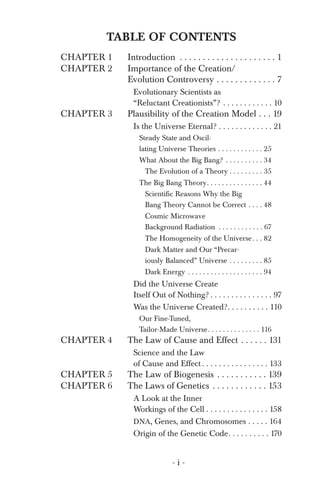
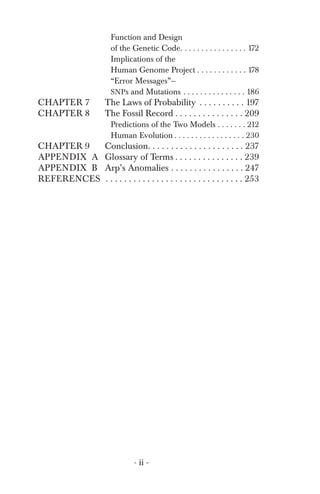
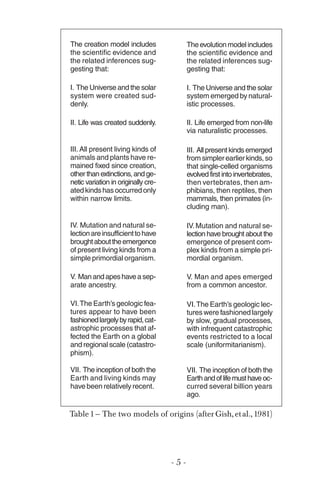

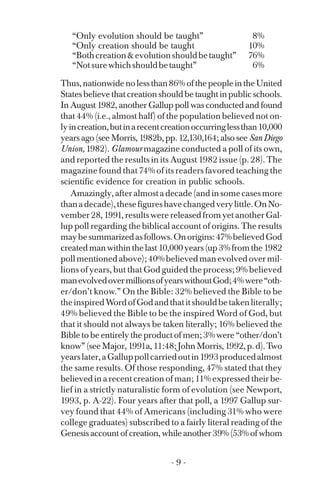
![Afterreviewingmanyoftheproblems(especiallyfromther
modynamics)thatwouldbeinvolvedinproducingsomething
living from something nonliving, he asked: “If living matter
is not, then, caused by the interplay of atoms, natural forces,
and radiation, how has it come into being?” Dr. Lipson dis
missedanysortof“directedevolution”(aBritishtermforwhat
people in America generally refer to as “theistic evolution”),
andconcluded:“Ithink,however,thatwemustgofurtherthan
this and admit that the only acceptable explanation is crea
tion.” Like Hoyle, Wickramasinghe, and Patterson, Dr. Lip-
son is not happy about the conclusion he has been forced to
draw from the evidence. He made that clear when he said: “I
know that this is anathema to physicists, as indeed it is to me,
but we must not reject a theory that we do not like if the ex
perimentalevidencesupportsit”(1980,31:138,emp.inorig.).
Interestingly, just two years before Dr. Lipson penned his
article, Harvard geneticist Richard Lewontin made the follow
ing comment in the September 1978 issue of Scientific Ameri
can, which was devoted in its entirety to a defense of organic
evolution:
Lifeformsaremorethansimplymultipleanddiverse,
however. Organisms fit remarkably well into the ex
ternal world in which they live. They have morphol
ogies, physiologies and behaviors thatappear to have
been carefully and artfully designedtoenableeach
organismtoappropriatetheworldarounditforitsown
life. It was the marvelous fit of organisms to the envi
ronment,muchmorethanthegreatdiversityofforms,
that was the chief evidence of a Supreme Designer
(1978, 239[3]:213, emp. added).
Of course, Dr. Lewontin then went on to try to explain in his
article how nature alone—without any assistance whatsoever
from a “Supreme Designer”—could account for the impres
sive “apparent design” in the world around us.
Three years before Dr. Lipson wrote his article, France’s
preeminentzoologist,Pierre-PaulGrassé(whoseknowledge
of the living world has been called by his colleagues “encyclo
pedic”), authored The Evolution of Living Organisms, in which
he wrote:
- 15 ](https://image.slidesharecdn.com/816184-250524101409-9681938e/85/Scientific-Case-For-Creation-Bert-Thompson-24-320.jpg)
![ingallknownpastandpresentspeciesoflife.Thecon
ceptofcontinuityofnaturehasexistedinthemindof
man, never in the facts of nature (1985, pp. 16,327,
353, emp. in orig).
A year later, when Oxford University’s renowned evolution
ist Richard Dawkins published The Blind Watchmaker, he la-
mented in the preface: “The complexity of living organisms
is matched by the elegant efficiency of their apparent design.
If anyone doesn’t agree that this amount of complex de
sign cries out for an explanation, I give up!” (1986, emp.
added). One year after that, the highly regarded Swedish bi
ologist, Søren Løvtrup, wrote:
After this step-wise elimination, only one possibility
remains: the Darwinian theory of natural selec
tion,whetherornotcoupledwithMendelism,isfalse.
Ihavealreadyshownthattheargumentsadvancedby
the early champions were not very compelling, and
that there are now considerable numbers of empiri
cal facts which do not fit with the theory. Hence, to
all intents and purposes the theory has been fal
sified,sowhyhasitnotbeenabandoned?Ithinkthe
answer to this question is that current evolutionists fol
low Darwin’s example—they refuse to accept falsifying
evidence (1987, p. 352, emp. added).
Again, one year later, American physicist George Green-
stein wrote in his book, The Symbiotic Universe:
Aswesurveyalltheevidence,thethoughtinsistently
arises that some supernatural agency—or, rather, Agen-
cy—mustbeinvolved.Isitpossiblethatsuddenly,with
outintendingto,wehavestumbleduponscientificproof
oftheexistenceofaSupremeBeing?WasitGodwho
stepped in and so providentially crafted the cosmos
for our benefit? (1988, p. 27).
[Greenstein quickly went on to voice his dissent with such a
conclusion, which he considered a “heady prospect” that he
labeled as “illusory” (pp. 27,38).]
These quotations—and in chapter 3 I will provide several
morerecentexamplesalmostidenticaltothem—arenotfrom
creationists.Rather,theyarefromhighlyrespectedevolution-
- 17 ](https://image.slidesharecdn.com/816184-250524101409-9681938e/85/Scientific-Case-For-Creation-Bert-Thompson-26-320.jpg)
![Thisgreatsagaofcosmicevolution,towhosetruththe
majority of scientists subscribe, is the product of an
actofcreationthattookplacetwentybillionyearsago
[accordingtoevolutionaryestimates—BT].Science,un
like the Bible, has no explanation for the occurrence
ofthatextraordinaryevent.TheUniverse,andevery
thing that has happened in it since the beginning of
time, are a grand effect without a known cause. An ef
fectwithoutacause?Thatisnottheworldofscience;
itisworldofwitchcraft,ofwildeventsandthewhims
ofdemons,amedievalworldthatsciencehastriedto
banish. As scientists, what are we to make of this pic
ture? I do not know (1977, p. 21, emp. added).
While Dr. Jastrow may not know how the Universe began,
there are two things that he and his colleagues do know: (1)
the Universe had a definite beginning; and (2) the Universe
will have a definite ending.
Admittedly,themostcomfortablepositionfortheevolution
ististheideathattheUniverseiseternal,becauseitavoidsthe
problem of a beginning or ending and thus the need for any
“first cause” such as a Creator. In his book, Until the Sun Dies,
astronomer Jastrow noted: “The proposal for the creation of
matter out of nothing possesses a strong appeal to the scien
tist, since it permits him to contemplate a Universe without
beginning and without end” (1977, p. 32). Jastrow went on to
remark that evolutionary scientists preferred an eternal Uni
verse “because the notion of a world with a beginning and an
end made them feel so uncomfortable” (p. 33). In God and the
Astronomers, Dr. Jastrow explained why attempts to prove an
eternalUniversehadfailedmiserably.“Nowthreelinesofevi-
dence—the motions of the galaxies, the laws of thermodynam
ics, and the life story of the stars—pointed to one conclusion;
allindicatedthattheUniversehadabeginning”(1978,p.111).
Jastrow—who is considered by many to be one of the greatest
science writers of our age—certainly is no creationist. But as a
scientist who is an astrophysicist, he has written often on the
inescapableconclusionthattheUniversehadabeginning.Con
sider, for example, these statements from his pen:
- 23 ](https://image.slidesharecdn.com/816184-250524101409-9681938e/85/Scientific-Case-For-Creation-Bert-Thompson-32-320.jpg)
![Now both theory and observation pointed to an ex
pandingUniverseandabeginningintime....About
thirtyyearsagosciencesolvedthemysteryofthebirth
anddeathofstars,andacquirednewevidencethatthe
Universe had a beginning (1978, pp. 47,105).
[Sir] Arthur Eddington, the most distinguished Brit
ishastronomerofhisday,wrote,“Ifourviewsareright,
somewhere between the beginning of time and the
present day we must place the winding up of the uni
verse.”Whenthatoccurred,andWhoorwhatwound
up the Universe, were questions that bemused theo
logians, physicists and astronomers, particularly in the
1920’s and 1930’s (1978, pp. 48-49).
Most remarkable of all is the fact that in science, as in
theBible,theWorldbeginswithanactofcreation.That
viewhasnotalwaysbeenheldbyscientists.Onlyasa
result of the most recent discoveries can we say with a
fairdegreeofconfidencethattheworldhasnotexisted
forever;thatitbeganabruptly,withoutapparentcause,
in a blinding event that defies scientific explanation
(1977, p. 19).
The conclusion to be drawn from the scientific data was ines
capable, as Dr. Jastrow himself admitted when he wrote:
The lingering decline predicted by astronomers for
theendoftheworlddiffersfromtheexplosivecondi
tionstheyhavecalculatedforitsbirth,buttheimpact
isthesame:modern science denies an eternal ex
istence to the Universe, either in the past or in the
future (1977, p. 30, emp. added).
In her book, The Fire in the Equations, award-winning science
writer Kitty Ferguson wrote in agreement.
Our late twentieth-century picture of the universe is
dramaticallydifferentfromthepictureourforebears
hadatthebeginningofthecentury.Todayit’scommon
knowledgethatalltheindividualstarsweseewiththe
naked eye are only the stars of our home galaxy, the
MilkyWay,andthattheMilkyWayisonlyoneamong
manybillionsofgalaxies.It’s also common knowl
edge that the universe isn’t eternal but had a be
ginning ten to twenty billion years ago, and that
it is expanding (1994, p. 89, emp. added).
- 24 ](https://image.slidesharecdn.com/816184-250524101409-9681938e/85/Scientific-Case-For-Creation-Bert-Thompson-33-320.jpg)
![licalUniversethatinfinitelyexpandsandcontractsisobviously
much more acceptable than one that demands explanations
forbothitsoriginanddestiny.Practically,thereisnobenefit
that derives from such a scenario. The late astronomer from
Cornell University, Carl Sagan, noted: “...[I]nformation from
ouruniversewouldnottrickleintothatnextoneand,fromour
vantage point, such an oscillating cosmology is as definitive
anddepressinganendastheexpansionthatneverstops”(1979,
pp. 13-14).
But is the Oscillating Universe model testable scientifically?
Gribbin suggests that it is.
The key factors which determine the ultimate fate of
the Universe are the amount of matter it contains and
therateatwhichitisexpanding....Insimpleterms,the
Universe can only expand forever if it is exploding
faster than the “escape velocity” from itself.... If the
density of matter across the visible Universe we see to
dayissufficienttohalttheexpansionwecanobserve
today, then the Universe has always been exploding
atlessthanitsownescapevelocity,andmusteventu
allybesloweddownsomuchthattheexpansionisfirst
haltedandthenconvertedintocollapse.Ontheother
hand, if the expansion we observe today is proceeding
fast enough to escape from the gravitational clutches
of the matter we observe today, then the Universe is
andalwayswas“open”andwillexpandforever(1981,
p. 313).
Does the scientific evidence support the theory of an “os
cillating,” eternal Universe? In the end, the success or failure
of this theory depends on two things: (1) the amount of mat
ter contained in the Universe, since there must be enough mat
ter for gravity to “pull back” to cause the Big Crunch; and (2)
theamountofgravityavailabletodothe“pulling.”Theamount
of matter required by the theory is one reason why Gribbin
admitted: “This, in a nutshell, is one of the biggest problems
in cosmology today, the puzzle of the so-called missing mass”
(1981, pp. 315-316). Cosmologists, astrophysicists, and astron
omersgenerallyrefertothemissingmassas“darkmatter.”In
their book, Wrinkles in Time, George Smoot and Keay David
son remarked:
- 29 ](https://image.slidesharecdn.com/816184-250524101409-9681938e/85/Scientific-Case-For-Creation-Bert-Thompson-38-320.jpg)
![We are therefore forced to contemplate the fact that
as much as 90 percent of the matter in the universe is
both invisible and quite unknown—perhaps unknow-
able—tous....Aresuchputativeformsofmatterthefan
tasies of desperate men and women, frantically seek
ing solutions to baffling problems? Or are they a le
gitimate sign that with the discovery of dark matter
cosmology finds itself in a terra incognita beyond our
immediate comprehension? (1993, pp. 164,171).
In his June 25, 2001 Time article (which claims to “solve the
biggest mystery in the cosmos”), Michael D. Lemonick dealt
with this “puzzle.”
Astheuniverseexpands,thecombinedgravityfrom
all the matter within it tends to slow that expansion,
muchastheearth’sgravitytriestopullarisingrocket
backtotheground.Ifthepullisstrongenough,theex
pansionwillstopandreverseitself;ifnot,thecosmos
will go on getting bigger, literally forever. Which is it?
One way to find out is to weigh the cosmos—to add up
all the stars and all the galaxies, calculate their gravity
and compare that with the expansion rate of the uni
verse. If the cosmos is moving at escape velocity, no
Big Crunch.
Trouble is, nobody could figure out how much mat
ter thereactuallywas.Thestarsandgalaxieswereeasy;
you could see them. But it was noted as early as the
1930sthatsomethinglurkedouttherebesidestheglow
ing stars and gases that astronomers could see. Galax
iesinclusterswereorbitingoneanothertoofast;they
should, by rights, be flying off into space like unteth
eredchildrenflungfromafast-twirlingmerry-go-round.
Individual galaxies were spinning about their centers
tooquicklytoo;theyshouldlongsincehaveflownapart.
Theonlypossibility:someformofinvisibledarkmat
ter was holding things together, and while you could
infer the mass of dark matter in and around galaxies,
nobody knew if it also filled the dark voids of space,
whereitseffectswouldnotbedetectable(2001,157[25]:
51).
In discussing the Oscillating Universe model, astronomers
speak (as Gribbin did in one of the quotes above) of a “closed”
- 30 ](https://image.slidesharecdn.com/816184-250524101409-9681938e/85/Scientific-Case-For-Creation-Bert-Thompson-39-320.jpg)
![oran“open”Universe.IftheUniverseisclosed,theUniverse
willceaseitsexpansion,theBigCrunchcouldoccur(theoret
ically), and an oscillating Universe becomes (again, theoreti
cally) a viable possibility. If the Universe is open, the expan
sion of the Universe will continue (a condition known as the
BigChill)andtheBigCrunchwillnotoccur,makinganoscil
lating Universe impossible. Joseph Silk commented: “The bal
anceofevidencedoespointtoanopenmodeloftheuniverse...”
(1980,p.309,emp.added).Gribbinsaid:“Theconsensusamong
astronomers today is that the universe is open” (1981, p. 316,
emp.added).Jastrowobserved:“Thus,thefactsindicatethat
the universe will expand forever...”(1978,p.123,emp.add
ed).
Evenmorerecentevidenceseemstoindicatethatanoscil
latingUniverseisaphysicalimpossibility(seeChaisson,1992).
Evolutionary cosmologist John Wheeler drew the following
conclusionbasedonthescientificevidenceavailableatthetime:
“With gravitational collapse we come to the end of time. Nev
er out of the equations of general relativity has one been able
to find the slightest argument for a ‘re-expansion’ of a ‘cyclic
universe’ or anything other than an end” (1977, p. 15). Astron
omer Hugh Ross admitted: “Attempts...to use oscillation to
avoidatheisticbeginningfortheuniverseallfail”(1991,p.105).
InanarticlewrittenfortheJanuary19,1998issueof U.S.News
andWorldReport titled“AFewStarryandUniversalTruths,”
Charles Petit stated:
For years, cosmologists have wondered if the universe
is“closed”andwillcollapsetoabigcrunch,or“open,”
with expansion forever in the cards. It now seems
open—in spades. The evidence, while not ironclad,
isplentiful.NetaBahcallofPrincetonUniversityand
her colleagues have found that the distribution of clus
ters ofgalaxies at the perceivable edge of the universe
imply[sic]thattheuniversebackthenwaslighterthan
oftenhadbeenbelieved.Thereappearstobe20per
centasmuchmassaswouldbeneededtostoptheex
pansion and lead the universe to someday collapse
again (124[2]:58, emp. added).
- 31 ](https://image.slidesharecdn.com/816184-250524101409-9681938e/85/Scientific-Case-For-Creation-Bert-Thompson-40-320.jpg)
![Apparently, the information appearing in the June 25, 2001
Time article is “ironclad,” and has dealt the ultimate deathblow
totheideaofeitheraneternaloroscillatingUniverse.Inspeak
ingabouttheoriginoftheUniverse,Lemonickexplained:
That event—the literal birth of time and space some
15 billion years ago—has been understood, at least in
itsbroadestoutlines,sincethe1960s.Butinmorethan
athirdofacentury,thebestmindsinastronomyhave
failedtosolvethemysteryofwhathappensattheother
endoftime.Willthegalaxiescontinuetoflyapartfor
ever, their glow fading until the cosmos is cold and
dark?Orwilltheexpansionslowtoahalt,reversedi
rection,andsend10octillion(10trillionbillion)stars
crashing back together in a final, apocalyptic Big
Crunch,themirrorimageoftheuniverse’sexplosive
birth?Despitedecadesofobservationswiththemost
powerfultelescopesattheirdisposal,astronomerssim
ply haven’t been able to decide.
But a series of remarkable discoveries announced in
quick succession starting this spring has gone a long
waytowardsettlingthequestiononceandforall.Sci
entistswhowerebettingonaBigCrunchlikedtoquote
thepoetRobertFrost:“Somesaytheworldwillendin
fire,/somesayinice./FromwhatI’vetastedofdesire/
I hold with those who favor fire.” Those in the other
camp preferred T.S. Eliot: “This is the way the world
ends./Not with a bang but a whimper.” Now, using
observationsfromtheSloanDigitalSkySurveyinNew
Mexico,theorbitingHubbleSpaceTelescope,themam
mothKeckTelescopeinHawaii,andsensitiveradiode
tectors in Antarctica, the verdict is in: T.S. Eliot wins
(157[25]:49-50).
What,exactly,hascausedthiscurrentfurorinastronomy?
And why are T.S. Eliot and the astronomers who quote him
the “winners”? As Lemonick went on to explain:
If these observations continue to hold up, astrophys
icists can be pretty sure they have assembled the full
parts list for the cosmos at last:5% ordinary matter,
35% exotic dark matter and about 60% dark energy.
Theyalsohaveaprettygoodideaoftheuniverse’sfu
ture.Allthematterputtogetherdoesn’thaveenough
gravity to stop the expansion; beyond that, the anti-
- 32 ](https://image.slidesharecdn.com/816184-250524101409-9681938e/85/Scientific-Case-For-Creation-Bert-Thompson-41-320.jpg)
![gravityeffectofdarkenergyisactuallyspeedingupthe
expansion. And because the amount of dark energy
will grow as space gets bigger, its effect will only in
crease (157[25]:55).
The simple fact is, the Universe just does not have enough
matter,orenoughgravity,forittocollapsebackuponitselfin
a“BigCrunch.”Itisnot“oscillating.”Itisnoteternal.Ithada
beginning,anditwillhaveanending.AsJastrowobserved:
About thirty years ago science solved the mystery of
thebirthanddeathofstars,andacquirednewevidence
that the Universe had a beginning.... Now both the
ory and observation pointed to an expanding Universe
and a beginning in time” (1978, p. 105).
Six pages later in God and the Astronomers, Jastrow concluded:
“Now three lines of evidence—the motions of the galaxies, the
lawsofthermodynamics,thelifestoryofthestars—pointedto
one conclusion; all indicated that the Universe had a begin
ning” (p. 111).
In1929,SirJamesJeans,writinginhisclassicbookTheUni
verse Around Us, observed: “All this makes it clear that the pres
ent matter of the universe cannot have existed forever.... In
some way matter which had not previously existed, came, or
was brought, into being” (1929, p. 316). Now, over seventy
yearslaterwehavereturnedtothesameconclusion.AsLem
onick put it:
If the latest results do hold up, some of the most im
portant questions in cosmology—how old the universe
is,whatit’smadeofandhowitwillend—willhavebeen
answered,onlyabout70yearsaftertheywerefirstposed.
Bythetimethefinalchapterofcosmichistoryiswrit-
ten—further in the future than our minds can grasp—
humanity, and perhaps even biology, will long since
have vanished (157[25]:56).
The fact that Time magazine devoted an entire cover (and fea
turestorytogowithit)tothetopicof“HowtheUniverseWill
End,” is an inadvertent admission to something that evolution
ists have long tried to avoid—the fact that the Universe had a
beginning, and will have an ending. When one hears Sir James
Jeansalludetothefactthat“insomewaymatterwhichhadnot
- 33 ](https://image.slidesharecdn.com/816184-250524101409-9681938e/85/Scientific-Case-For-Creation-Bert-Thompson-42-320.jpg)
![downthisroadofcosmologicaldescent—fromthelong-defunct
Cartesian Hypothesis to modern versions of the Big Bang—
and examine several of these theories in light of the scientific
knowledge now available to us. As we proceed, let us heed
the warning of the late cosmologist Sir Fred Hoyle (1915-2001),
and his colleague, Chandra Wickramasinghe, in their book
EvolutionfromSpace:“Be suspicious of a theory if more and
more hypotheses are needed to support it as new facts be
come available, or as new considerations are brought to
bear” (1981, p. 135, emp. added).
The Evolution of a Theory
Thescienceofcosmology,asweknowittoday,began,not
surprisingly,withalookintothenearestandmostreadilyob
servable astronomical environment—our solar system. Due
to the sizable number of theories regarding the origin of our
solarsystem,Iwillreviewonlythosethatwereofprimaryim
portance in the grand historical panorama.
The Cartesian Hypothesis, set down by the seventeenth-
century French physician, mathematician, and philosopher
René Descartes (1596-1650) in his Principles of Philosophy, pos
tulated that our solar system had formed from a vast system
ofvorticesrunningspontaneously.Outofthesevortices,stars,
comets, and planets emerged, each decaying into the next sub
sequentformationofmatter,respectively.Thisparticularcon
jecture did not sit well with some of Descartes’ contemporar
ies,includingSirIsaacNewton,whomadehisdisdainforDes
cartes’ theory poignantly clear in a letter (penned on Decem
ber 10, 1692) to evangelist Richard Bentley when he wrote:
“TheCartesianhypothesis...canhavenoplaceinmysystem,
andisplainlyerroneous”(asquotedinMunitz,1957,p.212).
Thenextfewhypothesesthatflickeredinhistoryevolved
their conceptual results from an initial rotating cloud of gas
and/ordustknownasanebula.[Originally,theterm“nebula”
was applied to any distant object that appeared “fuzzy and ex
tended”whenviewedthroughatelescope;eventually,nebu
lae were identified as galaxies and star clusters.] Pierre S. La
place (1749-1827), the distinguished French mathematician,
- 35 ](https://image.slidesharecdn.com/816184-250524101409-9681938e/85/Scientific-Case-For-Creation-Bert-Thompson-44-320.jpg)
![presented his Nebular Hypothesis—a variation on the previ
ously held hypotheses by Emanuel Swedenborg (1688-1772)
andImmanuelKant(1724-1804)—totheworldin1796.Laplace
believedthat,asthenebularotated,itcooledandcontracted,
causing a discernible increase in rotational velocity, which e
ventually forced the matter that was located on the rim of the
disc to overcome the gravitational attraction and be ejected
fromthecloud.Theejectedmatterthencoalesced,forminga
planetoutsideofthecontractingnebula.Thisspecificsequence
ofeventscontinueduntilitformedacentralportionofdense,
rotating gases—what we know today as our Sun—and the out
lying,orbitingplanets(seeMulfinger,1967,4[2]:58).However,
after failing a battery of mathematical and physical tests, these
fanciful views ultimately were abandoned for the Planetesimal
Hypothesis.
Heralded by T.C. Chamberlain (1843-1928) and F.R. Moul
ton (1872-1952), the Planetesimal Hypothesis started out with
two initial stars, one of which was our Sun. The secondary star
swept a near-collision path by the Sun, close enough to tear
off two “arms” of matter on opposite sides. Over time, these
arms coalesced to form planetesimals—tiny planets. This hy
pothesisfollowedinthefootstepsofthosethathadprecededit
(as well as a number of those yet to come) by failing to be sci
entificallyaccurate.LymanSpitzerofYaleUniversitydemon
strated these failings: (1) the hot matter ripped from the Sun
wouldnotcoalesce,butinsteadwouldcontinuetoexpand;and
(2) one could not reconcile the angular momentum distribu
tion of the solar system resulting from the interaction of the
two passing stars (see Mulfinger, 4[2]:59-60).
The story of modern cosmology begins in the early parts
ofthetwentiethcentury—atimewhenastronomersviewedthe
Universe as static, eternal, and limited in space to our own
MilkyWayGalaxy.Thoseviewsbegantochangeintheearly
1900swiththeworkoftwoAmericanastronomers—EdwinHub
bleandVestoM.Slipher(1875-1969).Usingoneofthelargest
andmostpowerfultelescopesavailableatthetime,Hubblecon
cluded that the Universe actually was much larger than just our
- 36 ](https://image.slidesharecdn.com/816184-250524101409-9681938e/85/Scientific-Case-For-Creation-Bert-Thompson-45-320.jpg)
![galaxy. He determined that what were then known as “spiral
nebulae,” occurring millions of light-years away, were not part
of the Milky Way at all, but rather were galaxies in their own
right. [A light-year is the distance that light travels in a vac
uum in one year—approximately 5.88 trillion miles. Distances
expressed in light-years represent the time that light would
take to cross that distance. For example, if an object were two
million light-years away, it would require two million years,
traveling at the speed of light, to traverse that distance.] Then,
in1929,Hubblereportedarelationshipbetweenhisdistance
information and some special analyses of light that had been
carried out by Slipher (see Hubble, 1929).
Redshifts, Blueshifts, and Doppler Effects
Inthedecadespanning1910-1920,Slipher(usinga24-inch,
long-focusrefractortelescope)haddiscoveredthecharacter
istic signature of atomic spectra in various far-flung galaxies.
That discovery then led to another somewhat “unusual” find
ing.Examiningasmallsampleofgalaxies(which,atthetime,
were referred to as nebulae), he observed that the light fre
quencies those galaxies emitted were “shifted” toward the red
portion of the spectrum (the concept of redshift is explained
in detail below), which meant that they were receding from
Earth. In 1913, Slipher reported the radial (or “line of sight”)
velocityoftheAndromedagalaxy,anddiscoveredthatitwas
movingtowardtheSunatarateof300kilometerspersecond
(see Slipher, 1913). This was taken as evidence in favor of the
hypothesis that Andromeda was outside the Milky Way. [The
Andromeda Galaxy is now considered a part of the “Local
Group,” which is an assortment of around thirty nearby gal
axies (including the Milky Way) that is bound together gravi
tationally.]In1914,Slipherreportedradialvelocitiesof13gal
axies,andallbuttwowerevisualizedasredshifts.By1925,Sli
pherhadcompiledalistof41galaxies,andotherastronomers
hadaddedfouradditionalones.Ofthetotalof45,43showed
aredshift,whichmeantthatonlytwoweremovingtowardthe
Earth(seeGribbin,1998,p.76),whilealltheothersweremov
ing away from us.
- 37 ](https://image.slidesharecdn.com/816184-250524101409-9681938e/85/Scientific-Case-For-Creation-Bert-Thompson-46-320.jpg)
![These were, by all accounts, extraordinary observations.
Usingafarmoresophisticatedinstrument(specifically,alarger,
short-focustelescopethatwasbettersuitedforthistypeofwork),
Edwin Hubble made the same types of discoveries in the late
1920s after Slipher had turned his attention to other projects.
This“galacticredshift,”Hubblebelieved,wasanexceptionally
stunning cosmic clue—a shard of evidence from far away and
long ago. Why, Hubble wondered, should galactic light be
shifted to the red, rather than the blue, portion of the spec
trum? Why, in fact, should it be shifted at all?
Fromtheverybeginning,astronomershaveattributedthese
shifts to what is known as the “Doppler effect.” Named after
Austrian physicist Christian Johann Doppler (1803-1853) who
discovered the phenomenon in 1842, the Doppler effect re
ferstoaspecificchangeintheobservedfrequencyofanywave
that occurs when the source and the observer are in motion
relativetoeachother;thefrequencyincreaseswhenthesource
and observer approach each other, and decreases when they
move apart.Bywayofsummary,theDopplereffectsayssim
plythatwavelengthsgrowlonger(redshift)asanobjectrecedes
from the viewer; wavelengths grow shorter (blueshift) as an
object approaches the viewer (see Figure 1 on the next page).
[Color actually is immaterial in these terms, since the terms
themselves apply to any electromagnetic radiation, whether
visible or not. “Blue” light simply has a shorter wavelength
than “red” light, so the use of the color-terms is deemed con
venient.]
The light that we observe coming from stars is subject to
the Doppler effect as well, which means that as we move to
ward a star, or as it moves toward us, the star’s light will be
shiftedtowardshorter(blue)wavelengths(viz.,lightthatisemit
ted at a particular frequency is received by us at a higher fre
quency). As we move away from a star, or as it moves away
fromus,itslightwillbeshiftedtowardlonger(red)wavelengths
(viz., light that is emitted at one frequency is received by us at
alowerfrequency).Intheorythen,astar’sDopplermotionis
a combination of both our motion through space (as the ob-
- 38 ](https://image.slidesharecdn.com/816184-250524101409-9681938e/85/Scientific-Case-For-Creation-Bert-Thompson-47-320.jpg)
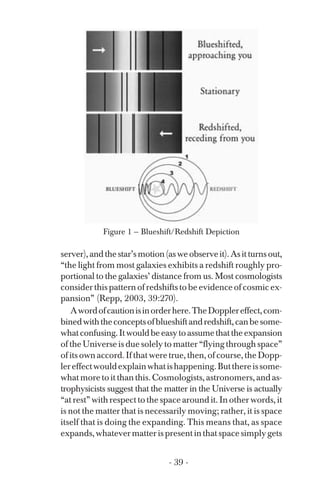
![“carried along for the ride.” Thus, the particles of matter are
not really moving apart on their own; instead, more space is
appearingbetweentheparticlesastheUniverseexpands,mak
ing the matter appear to move. Perhaps an illustration is ap
propriate here. [Bear with me; as you will see, the distinction
that I am about to make has serious implications.]
Moreoftenthannot,cosmologistsusetheexampleofabal
loontoillustratewhattheyaretryingtodistinguishas“thetrue
nature of the expanding Universe.” Imagine, if you will, that
someone has glued tiny shirt buttons to the surface of the bal
loon,andthencommencestoinflateit.Astheballoonincreases
in size, the buttons will appear to move as they are carried
along by the expansion of the balloon. But the buttons them
selves are not actually moving. They are “at rest” on the bal
loon,yetarebeing“pushedoutward”bytheexpansionofthe
mediumaroundthem(thelatexoftheballoon).Now,cosmol
ogists suggest, compare this example to galaxies in space. The
galaxies themselves can be “at rest” with respect to space, yet
appeartobeflyingapartduetotheexpansionofthemedium
around them—space.
Almost all popular (and even most technical) publications
advocate the view that the redshifts viewed in the expansion
of the Universe are, in fact, attributable solely to the Doppler
effect. But if it is true that the galaxies are actually at rest (al
though, admittedly, being “carried along” in an outward di
rection by the expansion of space itself, with its “embedded”
galaxies), then the redshifts witnessed as a result of the expan
sion are not true Doppler shifts. To be technically correct, per
haps the galactic redshift should be called the “cosmological
redshift.” On occasion, when the “perceived motion” of the
galaxies(asopposedto“realmotion”)isacknowledgedatall,
it sometimes is referred to as “Hubble flow.” One of the few
technical works with which I am familiar that acknowledges
thisfact(andevenprovidesdifferentformulaefortheDoppler
expansion versus the Hubble flow expansion) is Gravitation,
by Misner, Thorne, and Wheeler (1973; see chapter 29).
- 40 ](https://image.slidesharecdn.com/816184-250524101409-9681938e/85/Scientific-Case-For-Creation-Bert-Thompson-49-320.jpg)
![Interestingly,asIwasintheprocessofresearchingandwrit
ingthismaterial,mathematicianAndrewReppofHawaiiau
thored a fascinating, up-to-date article on the nature of red
shifts. In his discussion, Dr. Repp correctly noted that there
are several known causes of redshifts (see Repp, 2003). One
of the causes that he listed was the concept of “Hubble flow”
expansionthatIintroducedabove—which(again,interestingly)
he labeled as “cosmological redshift” (39:271). As Repp re
marked, this “expansion redshift” (a synonym for Hubble flow
or cosmological redshift) “is caused by the expansion of space
throughwhichthewaveistraveling,resultinginan‘expansion’
(redshifting)ofthewaveitself....[T]heexpansionredshiftwould
betheresultofthemotionofspaceitself.”Yes,itwould—which
isexactlythepointIwasmakingintheaboveparagraphs.And,
as Repp went on to acknowledge concerning expansion red
shift: “It is the commonly accepted explanation for the red
shifts of the distant galaxies” (39:271). Yes, it is.
But that is not quite the end of the story. There is evidence
to support the idea that the galaxies themselves may, in fact,
actually be moving, rather than simply being “at rest” while
beingcarriedalongbytheexpansionofspace.TheAndrom
edaGalaxy(knownasM31),whichisamongournearestneigh
boring galaxies, presents a light spectrum that is blueshifted.
IftheUniverseisexpanding,howcouldthatbe?Apparently,
the Doppler motion is large enough blueward to negate the
cosmological redshift expansion, thereby allowing us to
view a galaxy that has a blueshift. The implication of this is
that the galaxy itself must be moving.
Whatcouldberesponsibleforthat?Someastronomershave
suggested that such movement may be attributable to the lo
calizedforcesofgravity.Galaxiesareknowntoclumptogether
into clusters that can contain anywhere from a few dozen to a
fewthousandgalaxies.[Clustersofclustersareknownas“super
clusters.”]What holds these structures together? Presumably,
it is gravity. That would imply that the objects composing the
structures have orbits—which produce motion that are indeed
Doppler in nature.
- 41 ](https://image.slidesharecdn.com/816184-250524101409-9681938e/85/Scientific-Case-For-Creation-Bert-Thompson-50-320.jpg)
![redshiftisproportionaltodistanceisacrucialpartofdistance
measurement in modern astronomy. But that is not all. The
concepts of (a) an expanding Universe, and (b) the accu
racy of redshift measurements,formacriticallyimportant
partofthefoundationofmodernBigBangcosmology.Asmath
ematician David Berlinski put it: “Hubble’s law embodies a
general hypothesis of Big Bang cosmology—namely, that the
universeisexpanding...”(1998,p.34).Onewithouttheother
is not possible. If one falls, both do. I will have more to say on
this important point later.
Hubble and Humason’s work gave cosmologists clues to
thesizeoftheUniverseandthemovementofobjectswithinit.
Butwhileastronomerswerepeeringthroughtheirtelescopes
at the Universe, theoretical physicists were describing that
Universeinnewways.ThefirsttwomodelscamefromAlbert
Einstein and Willem de Sitter in 1917. Although they arrived
at their models independently, both ideas were based on Ein-
stein’s General Theory of Relativity, and both scientists made
adjustments to prevent expansion, even though expansion ap
peareda natural outcome of General Relativity. However, as
knowledge about redshifts became more widespread, expan
sionwasintroducedasamatteroffact.[Redshiftandexpan
sion inevitably became the “twin pillars” upon which much
of modern Big Bang cosmology was built. Interestingly, ex
pansion itself also was built upon two pillars—homogeneity
(matter is spread out uniformly) and isotropy (matter is spread
out evenly in all directions). I will have more to say about all
of this later, as well.] This was the case in 1922 with a set of so
lutions produced by Russian mathematician and physical sci
entist Aleksandr Friedman. Five years later, in 1927, the Bel
gian scholar Georges Lemaître produced a model incorporat
ingaredshift-distancerelationveryclosetothatsuggestedby
Hubble. If the Universe is expanding now, Lemaître calculated,
thentheremusthavebeenatimeinthepastwhentheUniverse
was in a state of contraction. It was in this state that the “pri
mevalatom,”ashecalledit,expandedtoformatoms,stars,and
galaxies. Lemaître had described, in its essential form, what
- 43 ](https://image.slidesharecdn.com/816184-250524101409-9681938e/85/Scientific-Case-For-Creation-Bert-Thompson-52-320.jpg)
![is now known as the Big Bang, and scientists even today speak
frequently of FL (Friedman-Lemaître) cosmology, which as
sumestheexpansionoftheUniverseanditshomogeneity(see
Illingworth and Clark, 2000, p. 94).
The Big Bang Theory
WhileitwascreditedtoLemaîtreinhisobituary,theeven
tualwidespreadacceptanceofthishypothesiswasduemainly
toitsleadingconstituent,Gamow.Eventhoughitprobablyis
notknownwidelytoday,theBigBang—initsoriginal“standard”
form—actuallycamebeforetheadventoftheSteadyStateThe
oryand,ironically,wasgivenitsname(intendedtobederog
atory) by Hoyle as a result of a snide comment he made on a
radio show for which he served as host (Fox, 2002, p. 65). In
this section, I will discuss only the “standard” form of the Big
Bang,leavingthediscussionoftheBigBang’smostrecentvar
iations for later.
Inthebeginningwastheylem...orsothetheoristssay.The
“ylem”—an entirely hypothetical construct—was a primordial
substance 10
14
times the density of water, yet smaller in vol
ume than a single proton. As one writer expressed it:
Astonishingly, scientists now calculate that everything
in this vast universe grew out of a region many billions
of times smaller than a single proton, one of the atom’s
basic particles (Gore, 1983, 163:705).
10
The ylem (a.k.a. the “cosmic egg”) was a “mind-bogglingly
denseatomcontainingtheentireUniverse”(Fox,p.69).[Where,
exactly, the cosmic egg is supposed to have come from, no
one knows; so far, no cosmic chicken has yet been sighted.]
At some point in time, according to Big Bang theorists, the
ylem reached its minimum contraction (at a temperature of
32
Celsius—a 1 followed by 32 zeros!), and suddenly and vi
olentlyexpanded.Withinanhourofthisevent,nucleosynthe
sis began to occur. That is to say, the light atoms we know to
day(e.g.,hydrogen,helium,andlithium)hadbeenmanufac
turedintheintenseheat.AstheUniverseexpandedandcooled,
theatomsstarted“clumping”together,andwithinafewhun
dredmillionyears,thecoalescing“clumps”begantoformstars
- 44 ](https://image.slidesharecdn.com/816184-250524101409-9681938e/85/Scientific-Case-For-Creation-Bert-Thompson-53-320.jpg)

![Who hath thee caused, or yeve thee hardinesse
For to appere in my ladyes presence?
5
I am ful siker, thou knowest her benivolence
Ful ágreable to alle hir obeyinge;
For of al goode she is the best livinge.
Allas! that thou ne haddest worthinesse
To shewe to her som plesaunt sentence,
10
Sith that she hath, thorough her gentilesse,
Accepted thee servant to her digne reverence!
O, me repenteth that I n'had science
And leyser als, to make thee more florisshinge;
For of al goode she is the best livinge.
15
Beseche her mekely, with al lowlinesse,
Though I be fer from her [as] in absence,
To thenke on my trouth to her and stedfastnesse,
And to abregge of my sorwe the violence,
Which caused is wherof knoweth your sapience;
20
She lyke among to notifye me her lykinge;
For of al goode she is the best livinge.
Lenvoy.
Aurore of gladnesse, and day of lustinesse,
Lucerne a-night, with hevenly influence
Illumined, rote of beautee and goodnesse,
25
Suspiries which I effunde in silence,
Of grace I beseche, alegge let your wrytinge,
Now of al goode sith ye be best livinge.](https://image.slidesharecdn.com/816184-250524101409-9681938e/85/Scientific-Case-For-Creation-Bert-Thompson-61-320.jpg)
![Explicit.
From F. (Fairfax 16); collated with T. (Tanner 346); and Th. (Thynne,
ed. 1532). 1. F. boke; T. Th. booke. Th. foule. 2. All beaute. 3. All
the (twice). 5. So all. 6. Th. abeyeng (!). 7. F. T. goode; Th. good.
Th. best; F. T. beste. 9. All somme, some. Th. plesaunt; F. plesant.
10. T. thurugh; F. thorgh; Th. through. 11. All the. 12. All ne (before
had). 13. So all (with the for thee). 14. Th. good. Th. best; F. T.
beste. 16. I supply as. 17. T. Th. trouth; F. trouthe. 18. F. abregge;
Th. abrege; T. abrigge. T. sorow; F. sorwes; Th. sorowes. 20. All
amonge. T. Th. notifye; F. notefye. 21. T. Th. al; F. alle. F. T. goode;
Th. good.
Th. Lenuoye; T. The Lenuoye; F. om. 24. Th. T. Illumyned; F.
Enlumyned. F. Rote (with capital). All beaute. F. and of; Th. T. om.
of. 25. F. Suspiries; Th. Suspires. 26. T. beseke. Th. alege. 27. F.
goode; Th. T. good. After 27: Th. Explicit; F. T. om.
XX. THE FLOWER AND THE LEAF.
When that Phebus his chaire of gold so hy
Had whirled up the sterry sky aloft,
And in the Bole was entred certainly;
Whan shoures swete of rain discended †soft,
5
Causing the ground, felë tymes and oft,
Up for to give many an hoolsom air,
And every plain was [eek y-]clothed fair
With newe grene, and maketh smalë floures
To springen here and there in feld and mede;
10
So very good and hoolsom be the shoures
That it reneweth, that was old and deede
In winter-tyme; and out of every seede](https://image.slidesharecdn.com/816184-250524101409-9681938e/85/Scientific-Case-For-Creation-Bert-Thompson-62-320.jpg)
![Springeth the herbë, so that every wight
Of this sesoun wexeth [ful] glad and light.
15
And I, só glad of the seson swete,
Was happed thus upon a certain night;
As I lay in my bed, sleep ful unmete
Was unto me; but, why that I ne might
Rest, I ne wist; for there nas erthly wight,
20
As I suppose, had more hertës ese
Than I, for I n'ad siknesse nor disese.
Wherfore I mervail gretly of my-selve,
That I so long withouten sleepë lay;
And up I roos, three houres after twelve,
25
About the [very] springing of the day,
And on I put my gere and myn array;
And to a plesaunt grovë I gan passe,
Long or the brightë sonne uprisen was,
In which were okës grete, streight as a lyne,
30
Under the which the gras, so fresh of hew,
Was newly spronge; and an eight foot or nyne
Every tree wel fro his felawe grew,
With braunches brode, laden with leves new,
That sprongen out ayein the sonnë shene,
35
Som very rede, and som a glad light grene;
Which, as me thought, was right a plesaunt sight.
And eek the briddes song[ës] for to here
Would have rejoised any erthly wight.
And I, that couth not yet, in no manere,](https://image.slidesharecdn.com/816184-250524101409-9681938e/85/Scientific-Case-For-Creation-Bert-Thompson-63-320.jpg)
![40
Here the nightingale of al the yere,
Ful busily herkned, with herte and ere,
If I her voice perceive coud any-where.
And at the last, a path of litel brede
I found, that gretly had not used be,
45
For it forgrowen was with gras and weede,
That wel unneth a wight [ther] might it see.
Thought I, this path som whider goth, pardè,
And so I folowèd, til it me brought
To right a plesaunt herber, wel y-wrought,
50
That benched was, and [al] with turves new
Freshly turved, wherof the grenë gras
So small, so thik, so short, so fresh of hew,
That most lyk to grene †wol, wot I, it was.
The hegge also, that yede [as] in compas
55
And closed in al the grene herbere,
With sicamour was set and eglantere,
Writhen in-fere so wel and cunningly
That every braunch and leef grew by mesure,
Plain as a bord, of on height, by and by,
60
[That] I sy never thing, I you ensure,
So wel [y-]don; for he that took the cure
It [for] to make, I trow, did al his peyn
To make it passe al tho that men have seyn.
And shapen was this herber, roof and al,
65
As [is] a prety parlour, and also](https://image.slidesharecdn.com/816184-250524101409-9681938e/85/Scientific-Case-For-Creation-Bert-Thompson-64-320.jpg)
![The hegge as thik as [is] a castle-wal,
That, who that list without to stond or go,
Though he wold al-day pryen to and fro,
He shuld not see if there were any wight
70
Within or no; but oon within wel might
Perceive al tho that yeden there-without
In the feld, that was on every syde
Covered with corn and gras, that, out of dout,
Though oon wold seeken al the world wyde,
75
So rich a feld [ne] coud not be espyed
[Up]on no cost, as of the quantitee,
For of al good thing ther was [greet] plentee.
And I, that al this plesaunt sight [than] sy,
Thought sodainly I felt so sweet an air
80
[Come] of the eglantere, that certainly,
Ther is no hert, I deme, in such despair,
Ne with [no] thoughtës froward and contrair
So overlaid, but it shuld soone have bote,
If it had onës felt this savour sote.
85
And as I stood and cast asyde myn y,
I was ware of the fairest medle-tree
That ever yet in al my lyf I sy,
As full of blossomës as it might be.
Therin a goldfinch leping pretily
90
Fro bough to bough, and, as him list, he eet
Here and there, of buddes and floures sweet.
And to the herber-sydë was joining](https://image.slidesharecdn.com/816184-250524101409-9681938e/85/Scientific-Case-For-Creation-Bert-Thompson-65-320.jpg)
![This fairë tree, of which I have you told;
And, at the last, the brid began to sing,
95
Whan he had eten what he etë wold,
So passing sweetly, that, by manifold,
It was more plesaunt than I coud devyse;
And whan his song was ended in this wyse,
The nightingale with so mery a note
100
Answéred him, that al the wodë rong
So sodainly, that, as it were a sot,
I stood astonied; so was I with the song
Through ravishèd, that, [un]til late and long
Ne wist I in what place I was, ne where;
105
And †ay, me thought, she song even by myn ere.
Wherfore about I waited busily
On every syde, if I her mightë see;
And, at the last, I gan ful wel aspy
Wher she sat in a fresh green laurer-tree
110
On the further syde, even right by me,
That gave so passing a delicious smel
According to the eglantere ful wel.
Wherof I had so inly greet plesyr
That, as me thought, I surely ravished was
115
Into Paradyse, where my desyr
Was for to be, and no ferther [to] passe
As for that day, and on the sotë gras
I sat me doun; for, as for myn entent,
The birdës song was more convenient,](https://image.slidesharecdn.com/816184-250524101409-9681938e/85/Scientific-Case-For-Creation-Bert-Thompson-66-320.jpg)
![120
And more plesaunt to me, by many fold,
Than mete or drink, or any other thing;
Thereto the herber was so fresh and cold,
The hoolsom savours eek so comforting
That, as I demed, sith the beginning
125
Of the world, was never seen, or than,
So plesaunt a ground of non erthly man.
And as I sat, the briddës herkning thus,
Me thought that I herd voices sodainly,
The most sweetest and most delicious
130
That ever any wight, I trow trewly,
Herde in †his lyf, for [that] the armony
And sweet accord was in so good musyk,
Thát the voice to angels most was lyk.
The Leaf.
At the last, out of a grove even by,
135
That was right goodly and plesaunt to sight,
I sy where there cam singing lustily
A world of ladies; but to tell aright
Their greet beautè, it lyth not in my might,
Ne their array; nevertheless, I shal
140
Tell you a part, though I speke not of al.
†In surcotes whyte, of veluet wel sitting,
They were [y-]clad; and the semes echoon,
As it were a maner garnishing,
Was set with emeraudës, oon and oon,
145
By and by; but many a richë stoon](https://image.slidesharecdn.com/816184-250524101409-9681938e/85/Scientific-Case-For-Creation-Bert-Thompson-67-320.jpg)
![Was set [up-]on the purfils, out of dout,
Of colors, sleves, and trainës round about;
As gret[e] perlës, round and orient,
Diamondës fyne and rubies rede,
150
And many another stoon, of which I †want
The namës now; and everich on her hede
A richë fret of gold, which, without drede,
Was ful of statly richë stonës set;
And every lady had a chapëlet
155
On her hede, of [leves] fresh and grene,
So wel [y-]wrought, and so mervéilously,
Thát it was a noble sight to sene;
Some of laurer, and some ful plesauntly
Had chapëlets of woodbind, and sadly
160
Some of agnus-castus ware also
Chápëlets fresh; but there were many tho
That daunced and eek song ful soberly;
But al they yede in maner of compas.
But oon ther yede in-mid the company
165
Sole by her-self; but al folowed the pace
[Which] that she kept, whos hevenly-figured face
So plesaunt was, and her wel-shape persòn,
That of beautè she past hem everichon.
And more richly beseen, by manifold,
170
She was also, in every maner thing;
On her heed, ful plesaunt to behold,
A crowne of gold, rich for any king;](https://image.slidesharecdn.com/816184-250524101409-9681938e/85/Scientific-Case-For-Creation-Bert-Thompson-68-320.jpg)
![A braunch of agnus-castus eek bering
In her hand; and, to my sight, trewly,
175
She lady was of [al] the company.
And she began a roundel lustily,
That Sus le foyl de vert moy men call,
Seen, et mon joly cuer endormi;
And than the company answéred all
180
With voice[s] swete entuned and so small,
That me thought it the sweetest melody
That ever I herdë in my lyf, soothly.
And thus they came[n], dauncing and singing,
Into the middes of the mede echone,
185
Before the herber, where I was sitting,
And, god wot, me thought I was wel bigon;
For than I might avyse hem, on by on,
Who fairest was, who coud best dance or sing,
Or who most womanly was in al thing.
190
They had not daunced but a litel throw
When that I herd, not fer of, sodainly
So greet a noise of thundring trumpës blow,
As though it shuld have départed the sky;
And, after that, within a whyle I sy
195
From the same grove, where the ladyes come out,
Of men of armës coming such a rout
As al the men on erth had been assembled
In that place, wel horsed for the nones,
Stering so fast, that al the erth[ë] trembled;](https://image.slidesharecdn.com/816184-250524101409-9681938e/85/Scientific-Case-For-Creation-Bert-Thompson-69-320.jpg)
![200
But for to speke of riches and [of] stones,
And men and hors, I trow, the largë wones
Of Prester John, ne al his tresory
Might not unneth have bought the tenth party!
Of their array who-so list herë more,
205
I shal reherse, so as I can, a lyte.
Out of the grove, that I spak of before,
I sy come first, al in their clokes whyte,
A company, that ware, for their delyt,
Chapëlets fresh of okës cereal
210
Newly spronge, and trumpets they were al.
On every trumpe hanging a brood banere
Of fyn tartarium, were ful richly bete;
Every trumpet his lordës armës †bere;
About their nekkës, with gret perlës set,
215
Colers brode; for cost they would not lete,
As it would seme; for their scochones echoon
Were set about with many a precious stoon.
Their hors-harneys was al whyte also;
And after hem next, in on company,
220
Cámë kingës of armës, and no mo,
In clokës of whyte cloth of gold, richly;
Chapelets of greene on their hedes on hy,
The crownës that they on their scochones bere
Were set with perlë, ruby, and saphere,
225
And eek gret diamondës many on;](https://image.slidesharecdn.com/816184-250524101409-9681938e/85/Scientific-Case-For-Creation-Bert-Thompson-70-320.jpg)
![But al their hors-harneys and other gere
Was in a sute àccording, everichon,
As ye have herd the foresayd trumpets were;
And, by seeming, they were nothing to lere;
230
And their gyding they did so manerly.
And after hem cam a greet company
Of heraudës and pursevauntës eke
Arrayed in clothës of whyt veluët;
And hardily, they were nothing to seke
235
How they [up]on hem shuld the harneys set;
And every man had on a chapëlet;
Scóchones and eke hors-harneys, indede,
They had in sute of hem that before hem yede.
Next after hem, came in armour bright,
240
Al save their hedes, seemely knightës nyne;
And every clasp and nail, as to my sight,
Of their harneys, were of red gold fyne;
With cloth of gold, and furred with ermyne
Were the trappurës of their stedës strong,
245
Wyde and large, that to the ground did hong;
And every bosse of brydel and peitrel
That they had, was worth, as I would wene,
A thousand pound; and on their hedës, wel
Dressed, were crownës [al] of laurer grene,
250
The best [y-]mad that ever I had seen;
And every knight had after him ryding
Three henshmen, [up]on him awaiting;](https://image.slidesharecdn.com/816184-250524101409-9681938e/85/Scientific-Case-For-Creation-Bert-Thompson-71-320.jpg)
![Of whiche †the first, upon a short tronchoun,
His lordës helme[t] bar, so richly dight,
255
That the worst was worth[y] the raunsoun
Of a[ny] king; the second a sheld bright
Bar at his nekke; the thridde bar upright
A mighty spere, ful sharpe [y-]ground and kene;
And every child ware, of leves grene,
260
A fresh chapelet upon his heres bright;
And clokes whyte, of fyn veluet they ware;
Their stedës trapped and [a]rayed right
Without[en] difference, as their lordës were.
And after hem, on many a fresh co[u]rsere,
265
There came of armed knightës such a rout
That they besprad the largë feld about.
And al they ware[n], after their degrees,
Chapëlets new, made of laurer grene,
Some of oke, and some of other trees;
270
Some in their handës berë boughës shene,
Some of laurer, and some of okës kene,
Some of hawthorn, and some of woodbind,
And many mo, which I had not in mind.
And so they came, their hors freshly stering
275
With bloody sownës of hir trompës loud;
Ther sy I many an uncouth disgysing
In the array of these knightës proud;
And at the last, as evenly as they coud,
They took their places in-middes of the mede,
280](https://image.slidesharecdn.com/816184-250524101409-9681938e/85/Scientific-Case-For-Creation-Bert-Thompson-72-320.jpg)
![And every knight turned his horse[s] hede
To his felawe, and lightly laid a spere
In the [a]rest, and so justës began
On every part about[en], here and there;
Som brak his spere, som drew down hors and man;
285
About the feld astray the stedës ran;
And, to behold their rule and governaunce,
I you ensure, it was a greet plesaunce.
And so the justës last an houre and more;
But tho that crowned were in laurer grene
290
Wan the pryse; their dintës were so sore
That ther was non ayenst hem might sustene;
And [than] the justing al was left of clene;
And fro their hors the †nine alight anon;
And so did al the remnant everichon.
295
And forth they yede togider, twain and twain,
That to behold, it was a worldly sight,
Toward the ladies on the grenë plain,
That song and daunced, as I sayd now right.
The ladies, as soone as they goodly might,
300
They breke[n] of both the song and dance,
And yede to mete hem, with ful glad semblance.
And every lady took, ful womanly,
Bý the hond a knight, and forth they yede
Unto a fair laurer that stood fast by,
305
With levës lade, the boughës of gret brede;
And to my dome, there never was, indede,](https://image.slidesharecdn.com/816184-250524101409-9681938e/85/Scientific-Case-For-Creation-Bert-Thompson-73-320.jpg)
![[A] man that had seen half so fair a tree;
For underneth it there might wel have be
An hundred persons, at their own plesaunce,
310
Shadowed fro the hete of Phebus bright
So that they shuld have felt no [greet] grevaunce
Of rain, ne hail, that hem hurt[ë] might.
The savour eek rejoice would any wight
That had be sick or melancolious,
315
It was so very good and vertuous.
And with gret reverence they †enclyned low
[Un]to the tree, so sote and fair of hew;
And after that, within a litel throw,
†Bigonne they to sing and daunce of-new;
320
Some song of love, some playning of untrew,
Environing the tree that stood upright;
And ever yede a lady and a knight.
The Flower.
And at the last I cast myn eye asyde,
And was ware of a lusty company
325
That came, roming out of the feld wyde,
Hond in hond, a knight and a lady;
The ladies alle in surcotes, that richly
Purfyled were with many a riche stoon;
And every knight of greene ware mantles on,
330
Embrouded wel, so as the surcotes were,
And everich had a chapelet on her hede;
Which did right wel upon the shyning here,](https://image.slidesharecdn.com/816184-250524101409-9681938e/85/Scientific-Case-For-Creation-Bert-Thompson-74-320.jpg)
![Made of goodly floures, whyte and rede.
The knightës eke, that they in hond lede,
335
In sute of hem, ware chapelets everichon;
And hem before went minstrels many on,
As harpës, pypës, lutës, and sautry,
Al in greene; and on their hedës bare
Of dyvers flourës, mad ful craftily,
340
Al in a sute, goodly chapelets they ware;
And so, dauncing, into the mede they fare,
In-mid the which they found a tuft that was
Al oversprad with flourës in compas.
Where[un]to they enclyned everichon
345
With greet reverence, and that ful humblely;
And, at the last[ë], there began anon
A lady for to sing right womanly
A bargaret in praising the daisy;
For, as me thought, among her notës swete,
350
She sayd, 'Si doucë est la Margarete.'
Thén they al answéred her infere,
So passingly wel, and so plesauntly,
Thát it was a blisful noise to here.
But I not [how], it happed sodainly,
355
As, about noon, the sonne so fervently
Wex hoot, that [al] the prety tender floures
Had lost the beautè of hir fresh coloures,
For-shronk with hete; the ladies eek to-brent,
That they ne wist where they hem might bestow.](https://image.slidesharecdn.com/816184-250524101409-9681938e/85/Scientific-Case-For-Creation-Bert-Thompson-75-320.jpg)
![360
The knightës swelt, for lak of shade ny shent;
And after that, within a litel throw,
The wind began so sturdily to blow,
That down goth al the flourës everichon
So that in al the mede there laft not on,
365
Save suche as socoured were, among the leves,
Fro every storme, that might hem assail,
Growing under hegges and thikke greves;
And after that, there came a storm of hail
And rain in-fere, so that, withouten fail,
370
The ladies ne the knightës n'ade o threed
Drye [up]on hem, so dropping was hir weed.
And when the storm was clene passed away,
Tho [clad] in whyte, that stood under the tree,
They felt[ë] nothing of the grete affray,
375
That they in greene without had in y-be.
To hem they yedë for routh and pitè,
Hem to comfort after their greet disese;
So fain they were the helpless for to ese.
Then was I ware how oon of hem in grene
380
Had on a crown[ë], rich and wel sitting;
Wherfore I demed wel she was a quene,
And tho in greene on her were awaiting.
The ladies then in whyte that were coming
Toward[ës] hem, and the knightës in-fere
385
Began to comfort hem and make hem chere.](https://image.slidesharecdn.com/816184-250524101409-9681938e/85/Scientific-Case-For-Creation-Bert-Thompson-76-320.jpg)
![The quene in whyte, that was of grete beautè,
Took by the hond the queen that was in grene,
And said, 'Suster, I have right greet pitè
Of your annoy, and of the troublous tene
390
Wherein ye and your company have been
So long, alas! and, if that it you plese
To go with me, I shal do you the ese
In al the pleisir that I can or may.'
Wherof the tother, humbly as she might,
395
Thanked her; for in right ill aray
She was, with storm and hete, I you behight.
And every lady then, anon-right,
That were in whyte, oon of hem took in grene
By the hond; which when the knightes had seen,
400
In lyke wyse, ech of hem took a knight
Clad in grene, and forth with hem they fare
[Un]to an heggë, where they, anon-right,
To make their justës, [lo!] they would not spare
Boughës to hew down, and eek treës square,
405
Wherewith they made hem stately fyres grete
To dry their clothës that were wringing wete.
And after that, of herbës that there grew,
They made, for blisters of the sonne brenning,
Very good and hoolsom ointments new,
410
Where that they yede, the sick fast anointing;
And after that, they yede about gadring
Plesaunt saladës, which they made hem ete,
For to refresh their greet unkindly hete.](https://image.slidesharecdn.com/816184-250524101409-9681938e/85/Scientific-Case-For-Creation-Bert-Thompson-77-320.jpg)