FC PRESENTATION
In respect to
this
presentation,
Science is the
great antidote
to the poison
of enthusiasm
for
superstition.
Science
A superstition is a
false belief based
on ignorance.
Its origin cannot
be traced back to
any particular
race, religion or
geographical
area.
Superstition
Superstition is the belief in supernatural casuality
that one event causes another without any natural process
linking the two events such as astrology, religion, omens,
witchcraft, etc., that contradicts natural science.
Why do you follow Superstitions
?
There are various traditions and beliefs that have been
followed by Hindu Indians since ancient times.
Most of these beliefs, it is argued
nowadays, are superstitions which
people follow blindly for the fear
of being cursed or harmed by
supernatural powers or God.
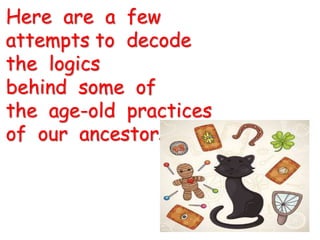
Here are a few
attempts to decode
the logics
behind some of
the age-old practices
of our ancestors
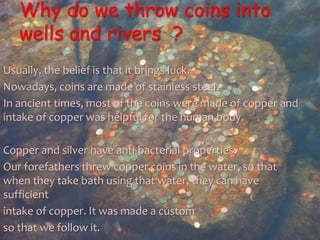
Why do we throw coins into
wells and rivers ?
Usually, the belief is that it brings luck.
Nowadays, coins are made of stainless steel.
In ancient times, most of the coins were made of copper and
intake of copper was helpful for the human body.
Copper and silver have anti-bacterial properties.
Our forefathers threw copper coins in the water, so that
when they take bath using that water, they can have
sufficient
intake of copper. It was made a custom
so that we follow it.
Using ‘Nimbu’ and ‘Mirchi’
to avert Buri Nazar
The nimbu totka which is one of the
most visible 'superstitions' probably
stems from a culture that encouraged
their use because of the qualities of
lemon and chili.
Both are rich in different vitamins and thus our
ancestors probably tried to propagate their usage
through symbols during ceremonies which slowly
turned into a totka.
Bad Eye or Buri Nazar
If a person becomes sick, a superstitious explanation
could be that an evil witch has cast a spell on that person.
The scientific explanation may be that the disease is
caused by a bacterial infection.
The superstitious explanation is not based on fact.
The scientific explanation would be based on actual
medical knowledge, and observation of the sick
person.
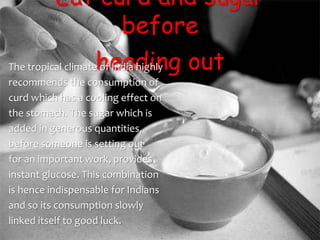
Eat curd and sugar
before
heading outThe tropical climate of India highly
recommends the consumption of
curd which has a cooling effect on
the stomach. The sugar which is
added in generous quantities,
before someone is setting out
for an important work, provides
instant glucose. This combination
is hence indispensable for Indians
and so its consumption slowly
linked itself to good luck.
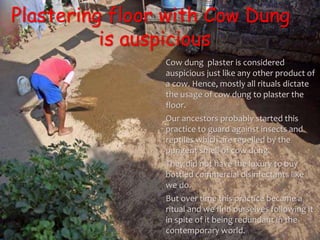
Plastering floor with Cow Dung
is auspicious
Cow dung plaster is considered
auspicious just like any other product of
a cow. Hence, mostly all rituals dictate
the usage of cow dung to plaster the
floor.
Our ancestors probably started this
practice to guard against insects and
reptiles which are repelled by the
pungent smell of cow dung.
They did not have the luxury to buy
bottled commercial disinfectants like
we do.
But over time this practice became a
ritual and we find ourselves following it
in spite of it being redundant in the
contemporary world.
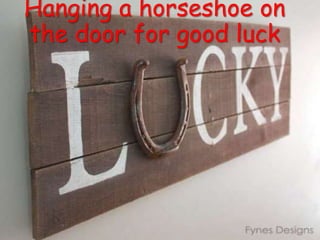
Hanging a horseshoe on
the door for good luck
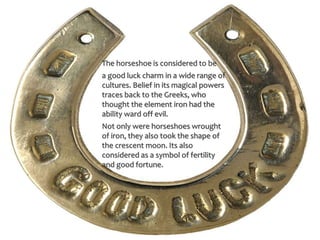
The horseshoe is considered to be
a good luck charm in a wide range of
cultures. Belief in its magical powers
traces back to the Greeks, who
thought the element iron had the
ability ward off evil.
Not only were horseshoes wrought
of iron, they also took the shape of
the crescent moon. Its also
considered as a symbol of fertility
and good fortune.
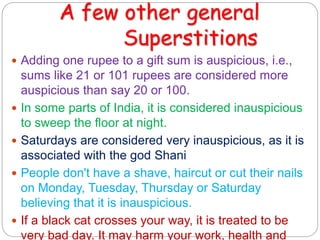
A few other general
Superstitions
 Adding one rupee to a gift sum is auspicious, i.e.,
sums like 21 or 101 rupees are considered more
auspicious than say 20 or 100.
 In some parts of India, it is considered inauspicious
to sweep the floor at night.
 Saturdays are considered very inauspicious, as it is
associated with the god Shani
 People don't have a shave, haircut or cut their nails
on Monday, Tuesday, Thursday or Saturday
believing that it is inauspicious.
 If a black cat crosses your way, it is treated to be
very bad day. It may harm your work, health and
THANKS FOR
BEING PATIENT !
Your Feedbacks / Debates, if any are welcome
!

Science & superstition

  • 1.
  • 2.
    In respect to this presentation, Scienceis the great antidote to the poison of enthusiasm for superstition. Science A superstition is a false belief based on ignorance. Its origin cannot be traced back to any particular race, religion or geographical area. Superstition
  • 3.
    Superstition is thebelief in supernatural casuality that one event causes another without any natural process linking the two events such as astrology, religion, omens, witchcraft, etc., that contradicts natural science.
  • 4.
    Why do youfollow Superstitions ? There are various traditions and beliefs that have been followed by Hindu Indians since ancient times. Most of these beliefs, it is argued nowadays, are superstitions which people follow blindly for the fear of being cursed or harmed by supernatural powers or God.
  • 5.
    Here are afew attempts to decode the logics behind some of the age-old practices of our ancestors
  • 6.
    Why do wethrow coins into wells and rivers ? Usually, the belief is that it brings luck. Nowadays, coins are made of stainless steel. In ancient times, most of the coins were made of copper and intake of copper was helpful for the human body. Copper and silver have anti-bacterial properties. Our forefathers threw copper coins in the water, so that when they take bath using that water, they can have sufficient intake of copper. It was made a custom so that we follow it.
  • 7.
    Using ‘Nimbu’ and‘Mirchi’ to avert Buri Nazar The nimbu totka which is one of the most visible 'superstitions' probably stems from a culture that encouraged their use because of the qualities of lemon and chili. Both are rich in different vitamins and thus our ancestors probably tried to propagate their usage through symbols during ceremonies which slowly turned into a totka.
  • 8.
    Bad Eye orBuri Nazar If a person becomes sick, a superstitious explanation could be that an evil witch has cast a spell on that person. The scientific explanation may be that the disease is caused by a bacterial infection. The superstitious explanation is not based on fact. The scientific explanation would be based on actual medical knowledge, and observation of the sick person.
  • 9.
    Eat curd andsugar before heading outThe tropical climate of India highly recommends the consumption of curd which has a cooling effect on the stomach. The sugar which is added in generous quantities, before someone is setting out for an important work, provides instant glucose. This combination is hence indispensable for Indians and so its consumption slowly linked itself to good luck.
  • 10.
    Plastering floor withCow Dung is auspicious Cow dung plaster is considered auspicious just like any other product of a cow. Hence, mostly all rituals dictate the usage of cow dung to plaster the floor. Our ancestors probably started this practice to guard against insects and reptiles which are repelled by the pungent smell of cow dung. They did not have the luxury to buy bottled commercial disinfectants like we do. But over time this practice became a ritual and we find ourselves following it in spite of it being redundant in the contemporary world.
  • 11.
    Hanging a horseshoeon the door for good luck
  • 12.
    The horseshoe isconsidered to be a good luck charm in a wide range of cultures. Belief in its magical powers traces back to the Greeks, who thought the element iron had the ability ward off evil. Not only were horseshoes wrought of iron, they also took the shape of the crescent moon. Its also considered as a symbol of fertility and good fortune.
  • 13.
    A few othergeneral Superstitions  Adding one rupee to a gift sum is auspicious, i.e., sums like 21 or 101 rupees are considered more auspicious than say 20 or 100.  In some parts of India, it is considered inauspicious to sweep the floor at night.  Saturdays are considered very inauspicious, as it is associated with the god Shani  People don't have a shave, haircut or cut their nails on Monday, Tuesday, Thursday or Saturday believing that it is inauspicious.  If a black cat crosses your way, it is treated to be very bad day. It may harm your work, health and
  • 15.
    THANKS FOR BEING PATIENT! Your Feedbacks / Debates, if any are welcome !