Quantum Mechanical Model of
an Atom
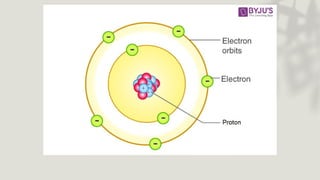
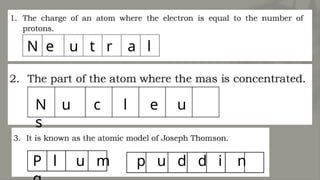
N e u t r a l
N u c l e u
s
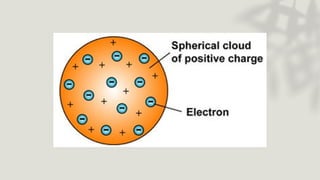
P l u m p u d d i n
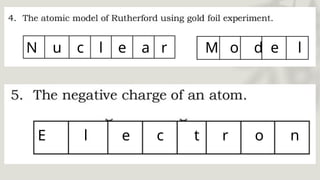
N u c l e a r M o d e l
E l e c t r o n
EXPLANATION
different metallic elements that
releases by different amount of
energy when it absorbed the heat
and that is because of the excited
electrons.
ELECTRONIC STRUCTURE OF MATTER
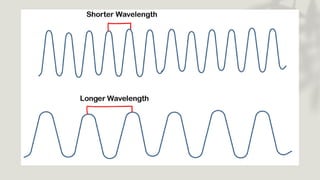
Light is a radiant energy travelling in space through a wave
form. Each radiation is characterized by a wavelength and
amplitude.
The wavelength is the distance between two successive
crests while the amplitude is the height of the wave.
The wavelength determines the amount of energy it carries.
The shorter the wavelength the higher the energy.
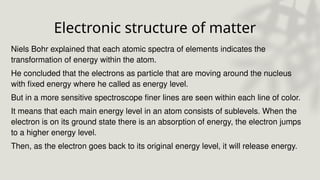
Electronic structure of matter
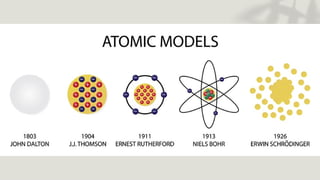
Niels Bohr explained that each atomic spectra of elements indicates the
transformation of energy within the atom.
He concluded that the electrons as particle that are moving around the nucleus
with fixed energy where he called as energy level.
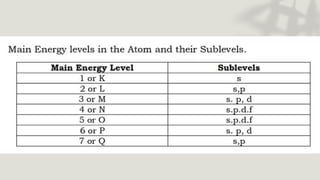
But in a more sensitive spectroscope finer lines are seen within each line of color.
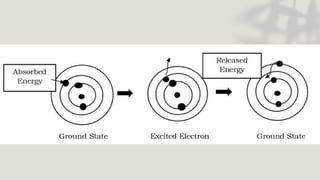
It means that each main energy level in an atom consists of sublevels. When the
electron is on its ground state there is an absorption of energy, the electron jumps
to a higher energy level.
Then, as the electron goes back to its original energy level, it will release energy.
Heisenberg’s Uncertainty Principle
• states that it is not possible to determine the exact location
and velocity of an electron in an orbital at the same time.
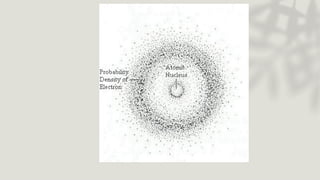
• But there is a probability that the electron will be in a
certain region in an atom which is called as the electron
cloud.
• It is also described as the region composed of negatives
surrounding the nucleus associated with the atomic
orbital.
The Quantum Mechanical Model
introduced by Schrodinger.
This model shows how likely an electron can be found around the
nucleus. It looks like a cloud of negative charges having a certain
geometrical figure.
The Quantum Mechanical Model also gives the information about the
energy of the electron.
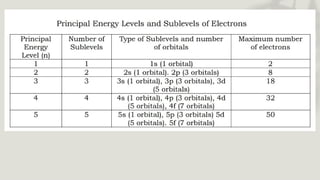
It also describes region of space around the nucleus as consisting of
shells it is also called the principal or main energy levels.
Kinds of Quantum Numbers
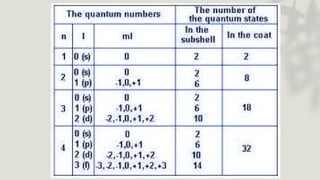
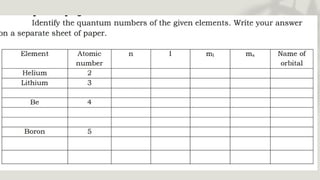
1. Principal quantum number (n) describes the energy level of an
electron in an atom. It can be expressed using the letters of an
alphabet like K, L, M, N, O, P and Q energy level.
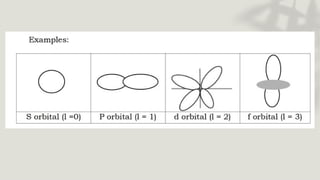
2. Angular Momentum Quantum Number (l) it describes the way on
how the electrons move around the nucleus. It determines the shape
of an orbital.
Kinds of Quantum Numbers
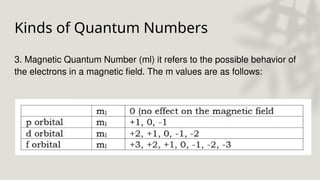
3. Magnetic Quantum Number (ml) it refers to the possible behavior of
the electrons in a magnetic field. The m values are as follows:
Kinds of Quantum Numbers
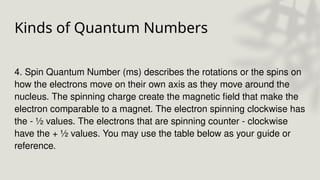
4. Spin Quantum Number (ms) describes the rotations or the spins on
how the electrons move on their own axis as they move around the
nucleus. The spinning charge create the magnetic field that make the
electron comparable to a magnet. The electron spinning clockwise has
the - ½ values. The electrons that are spinning counter - clockwise
have the + ½ values. You may use the table below as your guide or
reference.
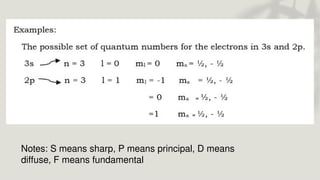
Notes: S means sharp, P means principal, D means
diffuse, F means fundamental
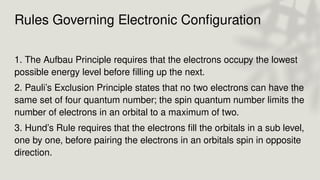
Rules Governing Electronic Configuration
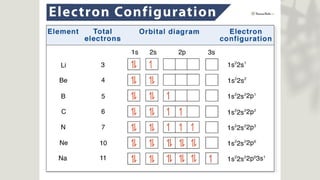
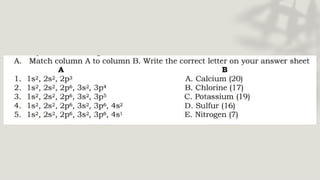
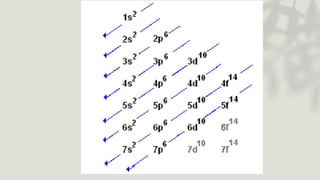
1. The Aufbau Principle requires that the electrons occupy the lowest
possible energy level before filling up the next.
2. Pauli’s Exclusion Principle states that no two electrons can have the
same set of four quantum number; the spin quantum number limits the
number of electrons in an orbital to a maximum of two.
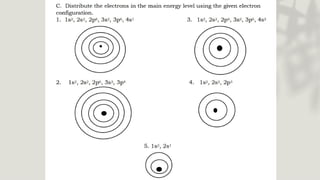
3. Hund’s Rule requires that the electrons fill the orbitals in a sub level,
one by one, before pairing the electrons in an orbitals spin in opposite
direction.
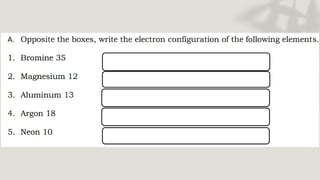
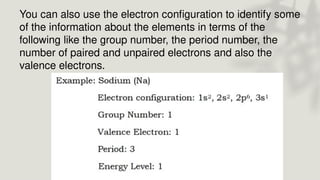
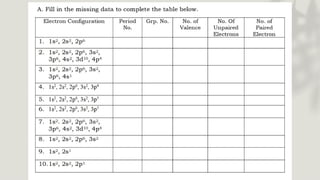
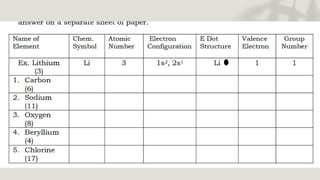
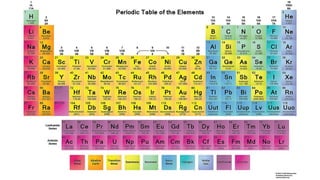
You can also use the electron configuration to identify some
of the information about the elements in terms of the
following like the group number, the period number, the
number of paired and unpaired electrons and also the
valence electrons.
SCIENCE 9 Q2 LESSON 1 - QuantumMechanicalModel.pptx

SCIENCE 9 Q2 LESSON 1 - QuantumMechanicalModel.pptx

  • 1.
  • 2.
    N e ut r a l N u c l e u s P l u m p u d d i n
  • 3.
    N u cl e a r M o d e l E l e c t r o n
  • 6.
    EXPLANATION different metallic elementsthat releases by different amount of energy when it absorbed the heat and that is because of the excited electrons.
  • 7.
    ELECTRONIC STRUCTURE OFMATTER Light is a radiant energy travelling in space through a wave form. Each radiation is characterized by a wavelength and amplitude. The wavelength is the distance between two successive crests while the amplitude is the height of the wave. The wavelength determines the amount of energy it carries. The shorter the wavelength the higher the energy.
  • 11.
    Electronic structure ofmatter Niels Bohr explained that each atomic spectra of elements indicates the transformation of energy within the atom. He concluded that the electrons as particle that are moving around the nucleus with fixed energy where he called as energy level. But in a more sensitive spectroscope finer lines are seen within each line of color. It means that each main energy level in an atom consists of sublevels. When the electron is on its ground state there is an absorption of energy, the electron jumps to a higher energy level. Then, as the electron goes back to its original energy level, it will release energy.
  • 14.
    Heisenberg’s Uncertainty Principle •states that it is not possible to determine the exact location and velocity of an electron in an orbital at the same time. • But there is a probability that the electron will be in a certain region in an atom which is called as the electron cloud. • It is also described as the region composed of negatives surrounding the nucleus associated with the atomic orbital.
  • 15.
    The Quantum MechanicalModel introduced by Schrodinger. This model shows how likely an electron can be found around the nucleus. It looks like a cloud of negative charges having a certain geometrical figure. The Quantum Mechanical Model also gives the information about the energy of the electron. It also describes region of space around the nucleus as consisting of shells it is also called the principal or main energy levels.
  • 17.
    Kinds of QuantumNumbers 1. Principal quantum number (n) describes the energy level of an electron in an atom. It can be expressed using the letters of an alphabet like K, L, M, N, O, P and Q energy level. 2. Angular Momentum Quantum Number (l) it describes the way on how the electrons move around the nucleus. It determines the shape of an orbital.
  • 19.
    Kinds of QuantumNumbers 3. Magnetic Quantum Number (ml) it refers to the possible behavior of the electrons in a magnetic field. The m values are as follows:
  • 20.
    Kinds of QuantumNumbers 4. Spin Quantum Number (ms) describes the rotations or the spins on how the electrons move on their own axis as they move around the nucleus. The spinning charge create the magnetic field that make the electron comparable to a magnet. The electron spinning clockwise has the - ½ values. The electrons that are spinning counter - clockwise have the + ½ values. You may use the table below as your guide or reference.
  • 21.
    Notes: S meanssharp, P means principal, D means diffuse, F means fundamental
  • 24.
    Rules Governing ElectronicConfiguration 1. The Aufbau Principle requires that the electrons occupy the lowest possible energy level before filling up the next. 2. Pauli’s Exclusion Principle states that no two electrons can have the same set of four quantum number; the spin quantum number limits the number of electrons in an orbital to a maximum of two. 3. Hund’s Rule requires that the electrons fill the orbitals in a sub level, one by one, before pairing the electrons in an orbitals spin in opposite direction.
  • 31.
    You can alsouse the electron configuration to identify some of the information about the elements in terms of the following like the group number, the period number, the number of paired and unpaired electrons and also the valence electrons.
Editor's Notes