Good
Morning,
Grade 9!
WELCOME
to
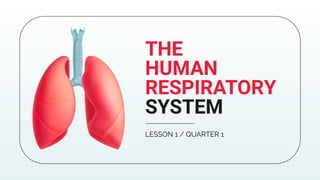
LESSON 1 / QUARTER 1
THE
HUMAN
RESPIRATORY
SYSTEM
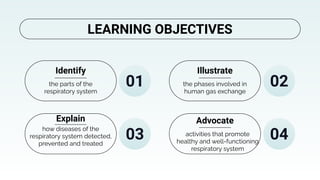
Identify
the parts of the
respiratory system
Illustrate
the phases involved in
human gas exchange
Explain
how diseases of the
respiratory system detected,
prevented and treated
Advocate
activities that promote
healthy and well-functioning
respiratory system
01
03
02
04
LEARNING OBJECTIVES
You cannot see or taste it, yet it is real as
land and water. You can also see its effect
on drifting clouds, quivering leaves, and
pounding waves. It can turn windmills and
blow sailboats across the sea.
What is it?
ANSWER THE RIDDLE:
You cannot see or taste it, yet it is real as
land and water. You can also see its effect
on drifting clouds, quivering leaves, and
pounding waves. It can turn windmills and
blow sailboats across the sea.
What is it?
ANSWER: AIR
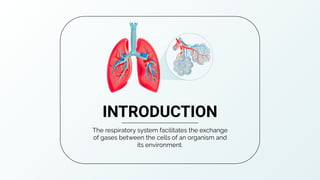
The respiratory system facilitates the exchange
of gases between the cells of an organism and
its environment.
INTRODUCTION
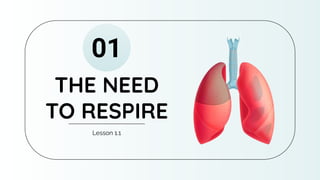
THE NEED
TO RESPIRE
Lesson 1.1
01
How is
breathing
different to
respiration?
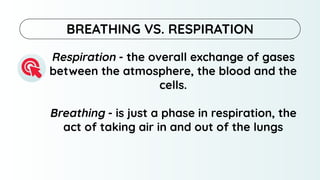
Respiration - the overall exchange of gases
between the atmosphere, the blood and the
cells.
Breathing - is just a phase in respiration, the
act of taking air in and out of the lungs
BREATHING VS. RESPIRATION
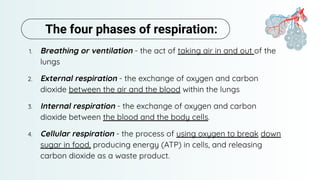
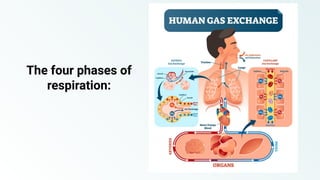
The four phases of respiration:
1. Breathing or ventilation - the act of taking air in and out of the
lungs
2. External respiration - the exchange of oxygen and carbon
dioxide between the air and the blood within the lungs
3. Internal respiration - the exchange of oxygen and carbon
dioxide between the blood and the body cells.
4. Cellular respiration - the process of using oxygen to break down
sugar in food, producing energy (ATP) in cells, and releasing
carbon dioxide as a waste product.
The four phases of
respiration:
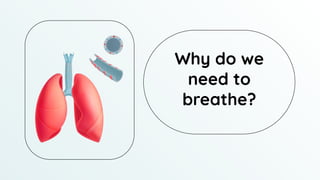
Why do we
need to
breathe?
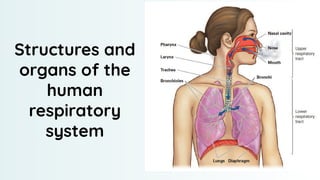
Structures and
organs of the
human
respiratory
system
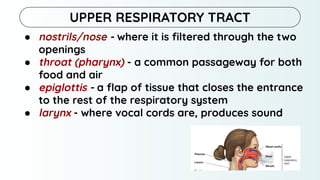
● nostrils/nose - where it is filtered through the two
openings
● throat (pharynx) - a common passageway for both
food and air
● epiglottis - a flap of tissue that closes the entrance
to the rest of the respiratory system
● larynx - where vocal cords are, produces sound
UPPER RESPIRATORY TRACT
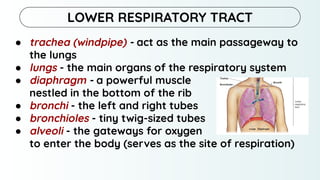
● trachea (windpipe) - act as the main passageway to
the lungs
● lungs - the main organs of the respiratory system
● diaphragm - a powerful muscle
nestled in the bottom of the rib
● bronchi - the left and right tubes
● bronchioles - tiny twig-sized tubes
● alveoli - the gateways for oxygen
to enter the body (serves as the site of respiration)
LOWER RESPIRATORY TRACT
THE
RESPIRATORY
SONG
Verse of the Day
Jesus declared, “ ‘Love the Lord your God
with all your heart and with all your soul
and with all your mind.’
This is the first and greatest commandment.
And the second is like it:
‘Love your neighbor as yourself.’…
– Matthew 22:37-39 (NIV)
Thought of the Day
This verse Jesus spoke about
really brings a whole bunch of rules of
do’s and don’ts and narrows it down
to 2 things. Love God and love
people. If you do this you’ll fulfill all
the rest of the laws.
Images reveal large amounts of data, so
remember: use an image instead of a long
text. Your audience will appreciate it
A PICTURE
ALWAYS
REINFORCES
THE CONCEPT
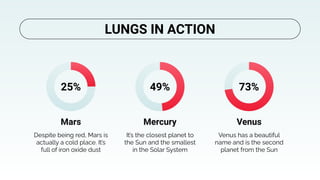
Big numbers catch your audience’s attention
150,000
Venus
Venus has a beautiful
name and is the second
planet from the Sun
Mars
Despite being red, Mars is
actually a cold place. It’s
full of iron oxide dust
Mercury
It’s the closest planet to
the Sun and the smallest
in the Solar System
25% 49% 73%
LUNGS IN ACTION
Jenna Doe
You can speak a bit
about this person here
Timmy Jimmy
You can speak a bit
about this person here
Susan Bones
You can speak a bit
about this person here
OUR TEAM
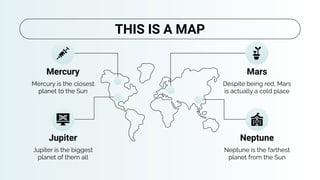
Despite being red, Mars
is actually a cold place
Neptune is the farthest
planet from the Sun
Mars
Neptune
Mercury
Mercury is the closest
planet to the Sun
Jupiter
Jupiter is the biggest
planet of them all
THIS IS A MAP
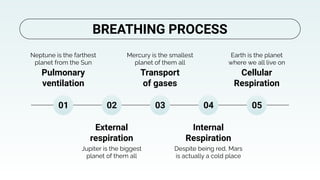
Pulmonary
ventilation
Neptune is the farthest
planet from the Sun
Transport
of gases
Mercury is the smallest
planet of them all
Cellular
Respiration
Earth is the planet
where we all live on
External
respiration
Jupiter is the biggest
planet of them all
Internal
Respiration
Despite being red, Mars
is actually a cold place
01 02 03 04 05
BREATHING PROCESS
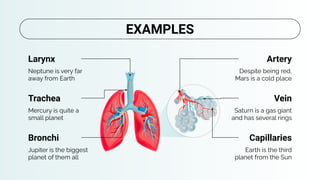
Despite being red,
Mars is a cold place
Earth is the third
planet from the Sun
Artery
Capillaries
Larynx
Neptune is very far
away from Earth
Bronchi
Jupiter is the biggest
planet of them all
Saturn is a gas giant
and has several rings
Vein
Trachea
Mercury is quite a
small planet
EXAMPLES
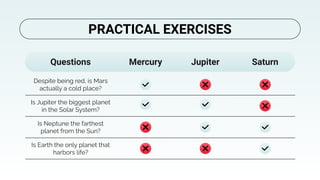
Questions Mercury Jupiter Saturn
Despite being red, is Mars
actually a cold place?
Is Jupiter the biggest planet
in the Solar System?
Is Neptune the farthest
planet from the Sun?
Is Earth the only planet that
harbors life?
PRACTICAL EXERCISES
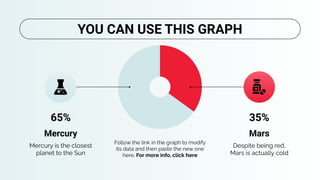
Follow the link in the graph to modify
its data and then paste the new one
here. For more info, click here
Despite being red,
Mars is actually cold
Mars
Mercury
Mercury is the closest
planet to the Sun
65% 35%
YOU CAN USE THIS GRAPH
CREDITS: This presentation template was
created by Slidesgo, and includes icons by
Flaticon and infographics & images by Freepik
Do you have any
questions?
youremail@freepik.com
+91 620 421 838
yourwebsite.com
Please keep this slide for attribution
THANKS!
ICON PACK: BIOLOGY
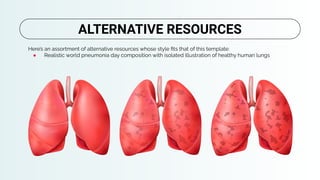
Here’s an assortment of alternative resources whose style fits that of this template:
● Realistic world pneumonia day composition with isolated illustration of healthy human lungs
ALTERNATIVE RESOURCES
Did you like the resources on this template? Get them for free at our other websites:
Photos
● Doctor tending to a patient
● Side view smiley doctor checking a patient
● Medium shot smiley people posing together
● Medium shot doctor holding x-rays
Vectors
● Human anatomy infographic chart
● Human lung anatomy infographics
● Human lung anatomy infochart
Icons
● Icon Pack: Biology
RESOURCES
Science 9 Lesson 1 Respiratory System.pdf

Science 9 Lesson 1 Respiratory System.pdf

  • 1.
  • 2.
    LESSON 1 /QUARTER 1 THE HUMAN RESPIRATORY SYSTEM
  • 3.
    Identify the parts ofthe respiratory system Illustrate the phases involved in human gas exchange Explain how diseases of the respiratory system detected, prevented and treated Advocate activities that promote healthy and well-functioning respiratory system 01 03 02 04 LEARNING OBJECTIVES
  • 4.
    You cannot seeor taste it, yet it is real as land and water. You can also see its effect on drifting clouds, quivering leaves, and pounding waves. It can turn windmills and blow sailboats across the sea. What is it? ANSWER THE RIDDLE:
  • 5.
    You cannot seeor taste it, yet it is real as land and water. You can also see its effect on drifting clouds, quivering leaves, and pounding waves. It can turn windmills and blow sailboats across the sea. What is it? ANSWER: AIR
  • 7.
    The respiratory systemfacilitates the exchange of gases between the cells of an organism and its environment. INTRODUCTION
  • 8.
  • 9.
  • 10.
    Respiration - theoverall exchange of gases between the atmosphere, the blood and the cells. Breathing - is just a phase in respiration, the act of taking air in and out of the lungs BREATHING VS. RESPIRATION
  • 11.
    The four phasesof respiration: 1. Breathing or ventilation - the act of taking air in and out of the lungs 2. External respiration - the exchange of oxygen and carbon dioxide between the air and the blood within the lungs 3. Internal respiration - the exchange of oxygen and carbon dioxide between the blood and the body cells. 4. Cellular respiration - the process of using oxygen to break down sugar in food, producing energy (ATP) in cells, and releasing carbon dioxide as a waste product.
  • 12.
    The four phasesof respiration:
  • 13.
    Why do we needto breathe?
  • 14.
    Structures and organs ofthe human respiratory system
  • 15.
    ● nostrils/nose -where it is filtered through the two openings ● throat (pharynx) - a common passageway for both food and air ● epiglottis - a flap of tissue that closes the entrance to the rest of the respiratory system ● larynx - where vocal cords are, produces sound UPPER RESPIRATORY TRACT
  • 16.
    ● trachea (windpipe)- act as the main passageway to the lungs ● lungs - the main organs of the respiratory system ● diaphragm - a powerful muscle nestled in the bottom of the rib ● bronchi - the left and right tubes ● bronchioles - tiny twig-sized tubes ● alveoli - the gateways for oxygen to enter the body (serves as the site of respiration) LOWER RESPIRATORY TRACT
  • 17.
  • 20.
    Verse of theDay Jesus declared, “ ‘Love the Lord your God with all your heart and with all your soul and with all your mind.’ This is the first and greatest commandment. And the second is like it: ‘Love your neighbor as yourself.’… – Matthew 22:37-39 (NIV)
  • 21.
    Thought of theDay This verse Jesus spoke about really brings a whole bunch of rules of do’s and don’ts and narrows it down to 2 things. Love God and love people. If you do this you’ll fulfill all the rest of the laws.
  • 22.
    Images reveal largeamounts of data, so remember: use an image instead of a long text. Your audience will appreciate it A PICTURE ALWAYS REINFORCES THE CONCEPT
  • 23.
    Big numbers catchyour audience’s attention 150,000
  • 24.
    Venus Venus has abeautiful name and is the second planet from the Sun Mars Despite being red, Mars is actually a cold place. It’s full of iron oxide dust Mercury It’s the closest planet to the Sun and the smallest in the Solar System 25% 49% 73% LUNGS IN ACTION
  • 25.
    Jenna Doe You canspeak a bit about this person here Timmy Jimmy You can speak a bit about this person here Susan Bones You can speak a bit about this person here OUR TEAM
  • 26.
    Despite being red,Mars is actually a cold place Neptune is the farthest planet from the Sun Mars Neptune Mercury Mercury is the closest planet to the Sun Jupiter Jupiter is the biggest planet of them all THIS IS A MAP
  • 27.
    Pulmonary ventilation Neptune is thefarthest planet from the Sun Transport of gases Mercury is the smallest planet of them all Cellular Respiration Earth is the planet where we all live on External respiration Jupiter is the biggest planet of them all Internal Respiration Despite being red, Mars is actually a cold place 01 02 03 04 05 BREATHING PROCESS
  • 28.
    Despite being red, Marsis a cold place Earth is the third planet from the Sun Artery Capillaries Larynx Neptune is very far away from Earth Bronchi Jupiter is the biggest planet of them all Saturn is a gas giant and has several rings Vein Trachea Mercury is quite a small planet EXAMPLES
  • 29.
    Questions Mercury JupiterSaturn Despite being red, is Mars actually a cold place? Is Jupiter the biggest planet in the Solar System? Is Neptune the farthest planet from the Sun? Is Earth the only planet that harbors life? PRACTICAL EXERCISES
  • 30.
    Follow the linkin the graph to modify its data and then paste the new one here. For more info, click here Despite being red, Mars is actually cold Mars Mercury Mercury is the closest planet to the Sun 65% 35% YOU CAN USE THIS GRAPH
  • 31.
    CREDITS: This presentationtemplate was created by Slidesgo, and includes icons by Flaticon and infographics & images by Freepik Do you have any questions? youremail@freepik.com +91 620 421 838 yourwebsite.com Please keep this slide for attribution THANKS!
  • 32.
  • 33.
    Here’s an assortmentof alternative resources whose style fits that of this template: ● Realistic world pneumonia day composition with isolated illustration of healthy human lungs ALTERNATIVE RESOURCES
  • 34.
    Did you likethe resources on this template? Get them for free at our other websites: Photos ● Doctor tending to a patient ● Side view smiley doctor checking a patient ● Medium shot smiley people posing together ● Medium shot doctor holding x-rays Vectors ● Human anatomy infographic chart ● Human lung anatomy infographics ● Human lung anatomy infochart Icons ● Icon Pack: Biology RESOURCES