Schema
The Action and
the Theory.
Focus Points

 Introduction to Upsy Daisy
 The theory of schema
 What are Upsy Daisy’s prevailing schemas
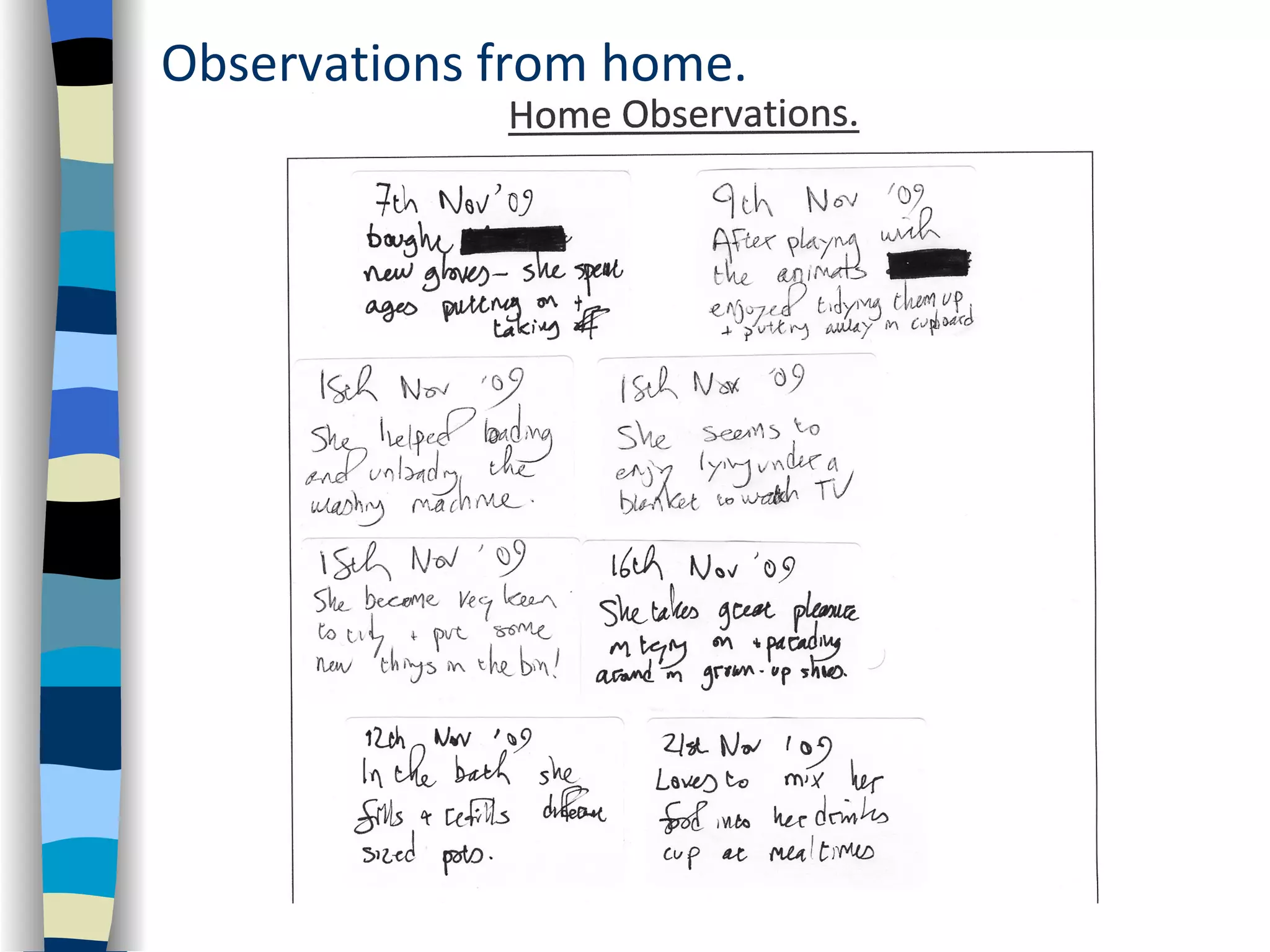
 What is being observed at home
 Next Steps – planning through schema
 Conclusion…….
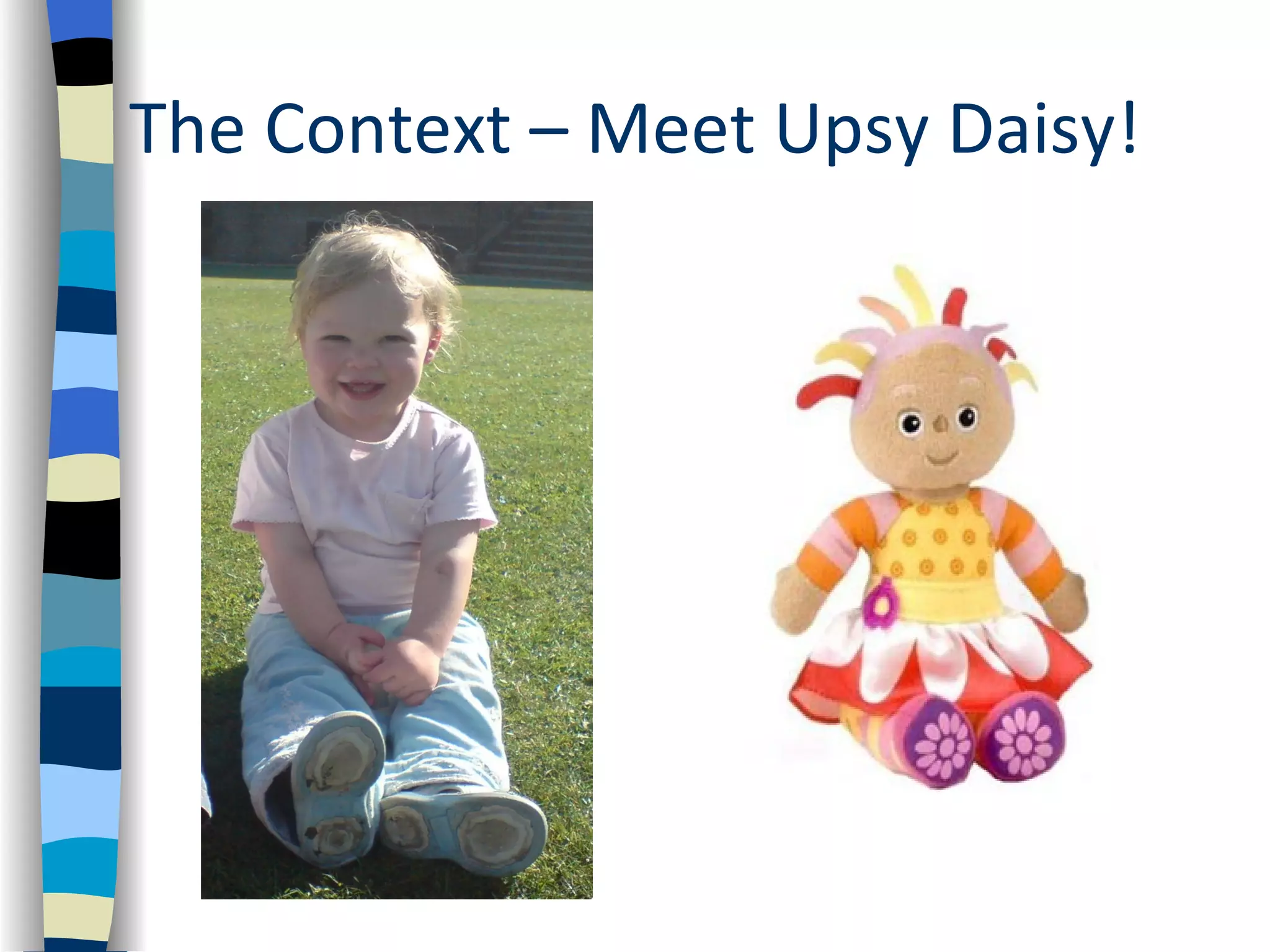
The Context – Meet Upsy Daisy!
The theory of schema.
   Piaget (1896-1980) was interested in cognitive development. He
    believed children go through 4 developmental stages - ‘stage level
    theory’.
   Piaget ‘defined schemas as cognitive structures or mental maps’ He
    believed these function at the four levels of the stage level theory.
   Stage 1.       The sensori-motor stage.
   Level 2.       Symbolic development and Language
                   development.
   Level 3.       Function dependency.
   Level 4.       The development of thought.

(Featherstone 2008:16)
The theory of schema
   Athey carried out research in 1972 about schema based
    on Piaget’s stage level theory.
    ‘A schema, therefore, is a pattern of repeatable behaviour
    which experiences are assimilated and that are gradually
    co-coordinated. Co-ordinations lead to higher-level and
    more powerful schemas’                    (Athey 2008:50)

   Bruce who also carried out research on schemas in the
    1970s says schemas are ‘biological’ and ‘socio-cultural’.
    ‘They are always adjusting and changing in the light of
    experience’. (Bruce 2005:73)
    Bruce also based her work on Piaget’s stage level theory.
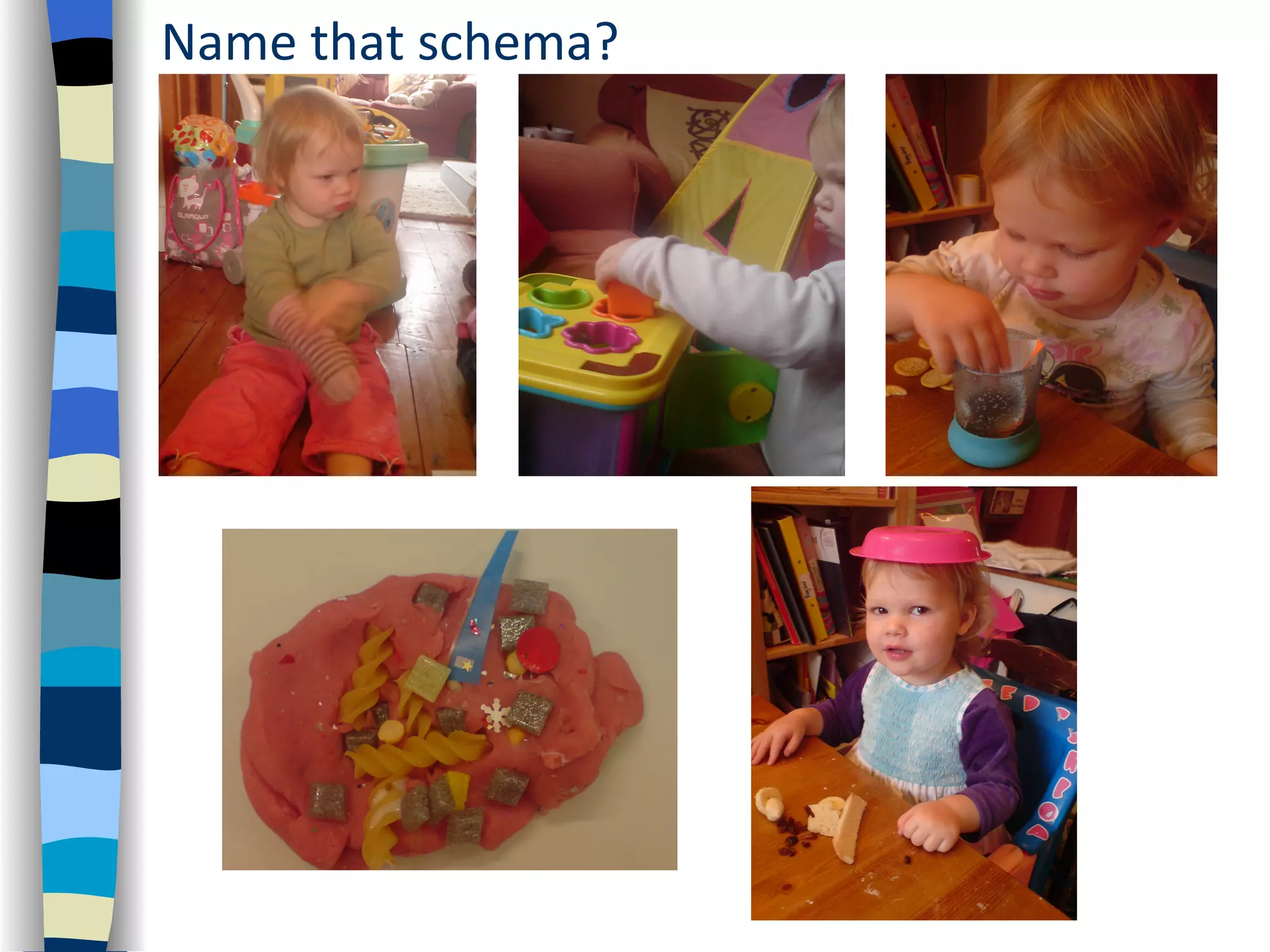
Name that schema?
How do we know its containing
          and enveloping?
   Athey (2008: 139-148) refers to, Putting objects
    inside and outside, wrapping up, covering
    up/over, containers/enclosures.
   Nutbrown (2006:44-50) refers to covering up,
    climbing inside, objects inside containers, filling
    containers.
   Bruce (2005:87 & 49) refers to ‘inside/outside’,
    ‘under’, ‘enclosing’, wrapping up.
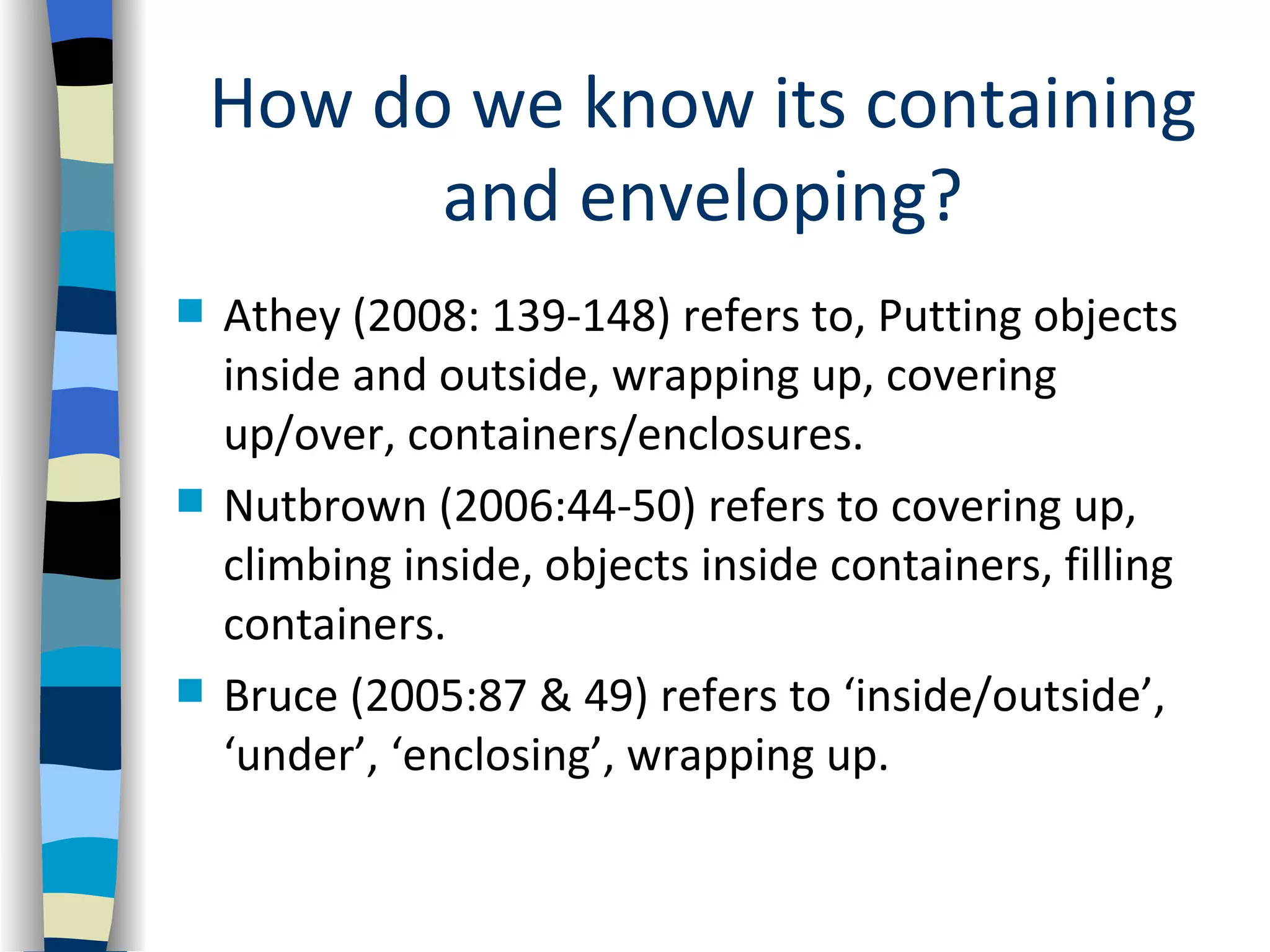
Are the Schema’s observed in other contexts.
Schema Clusters.
 The observations have shown a cluster of containing and enveloping.
  The containing was the dominant schema, the more this was
  repeated in different contexts, so the enveloping evolved.
 Davies and Howe (2007:245) state schemas are often in clusters ‘part
  of whole networks of senses, actions and thinking’.
 Bruce (2002) supports Davies and Howe statement and says that the
  networking develops the child’s learning ‘into more complex forms’.
  This links to Athey’s ideas of more powerful schema’s.
 Schema clusters follow Piaget’s concepts of
         Assimilation
         Accommodation
         Equilibration     (Anning & Edwards 2004:11-12).
Are the schema’s evident at
home?
   Time set aside to discuss the concepts of schema with
    photographs.
   The parent is the child’s first educator – the expert.
        ‘The parents were genuinely respected and
          recognised as experts on their own children…’
                                      (Athey 2008:202)
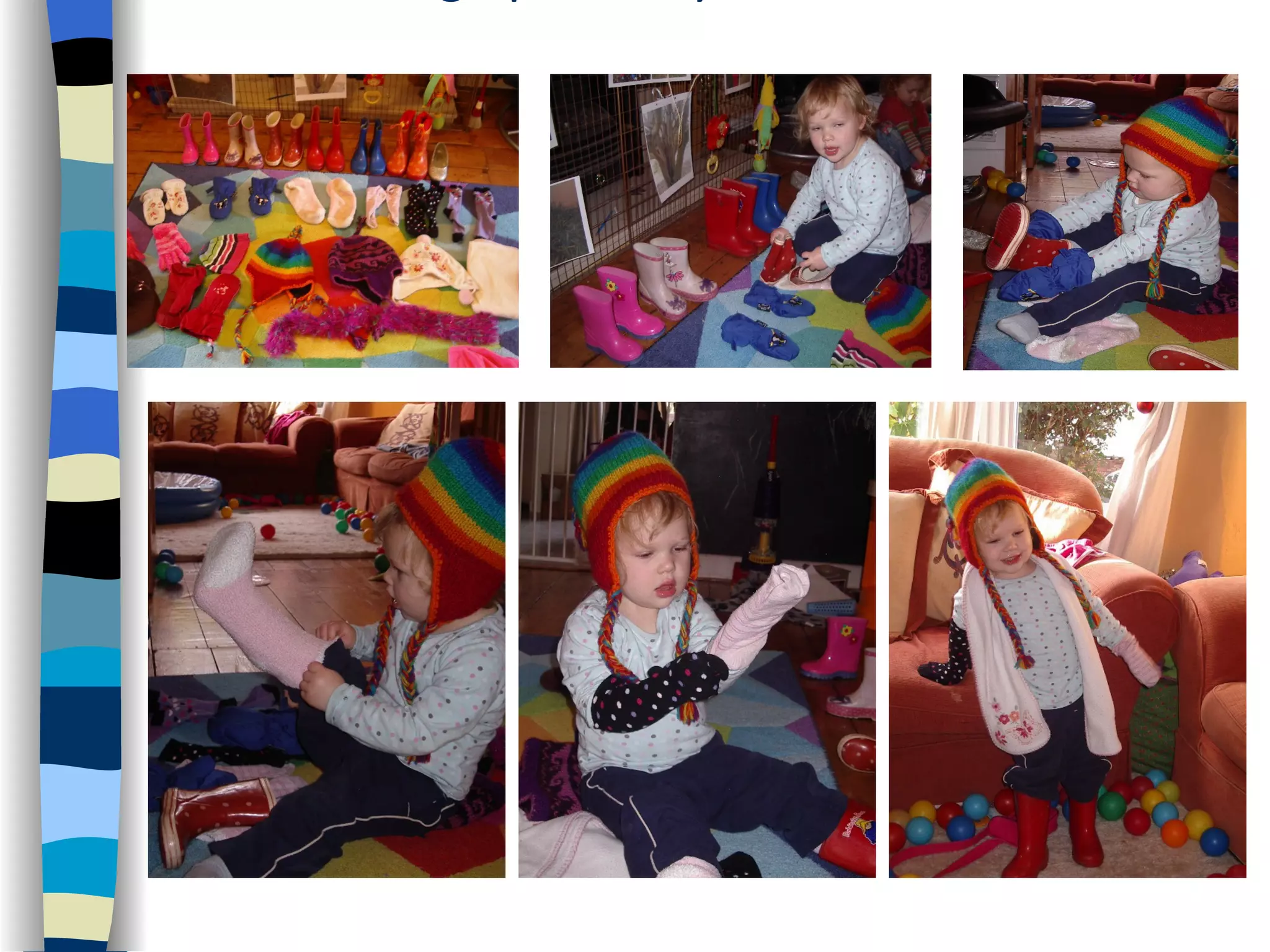
Observations from home.
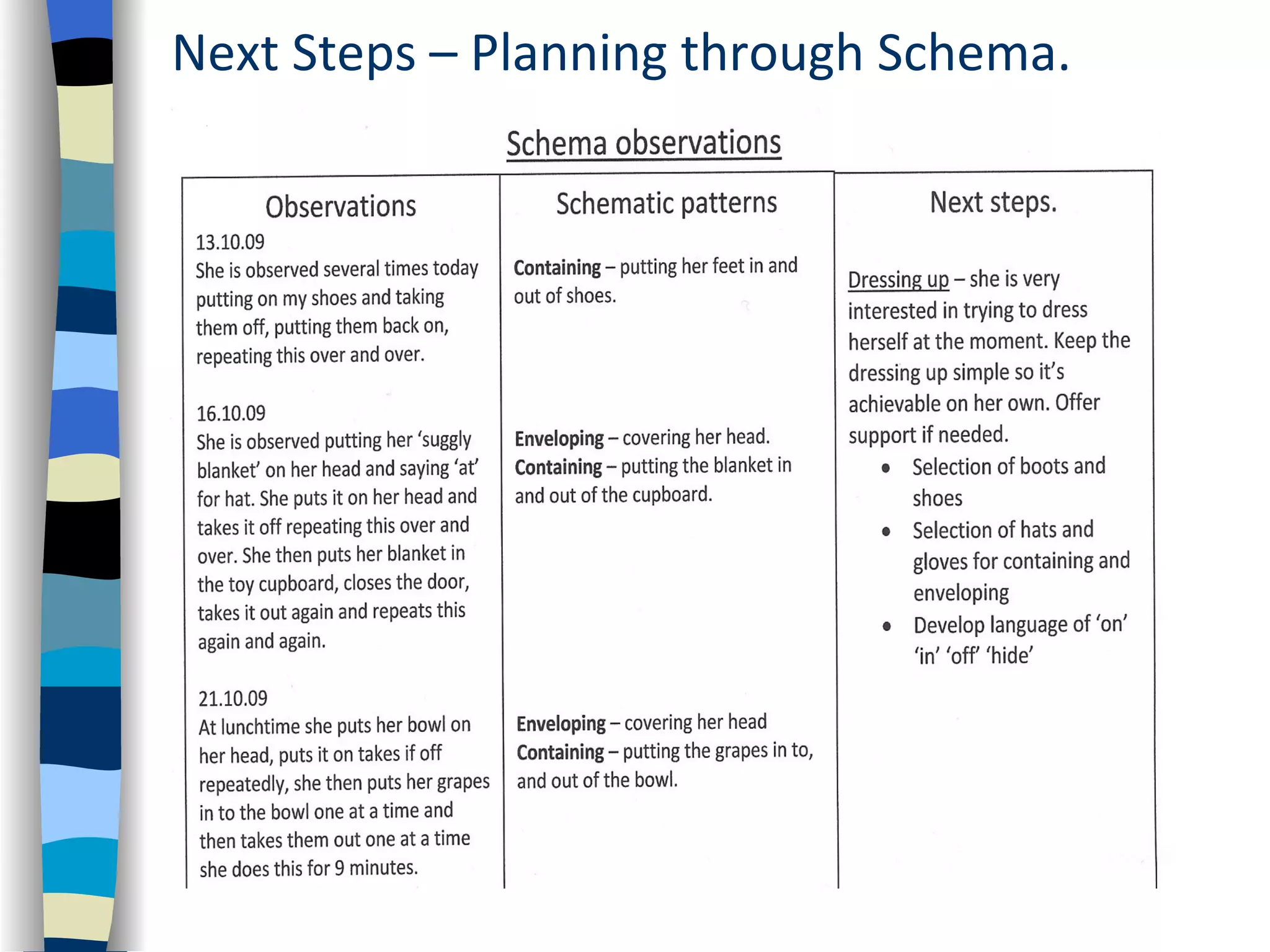
Next Steps – Planning through Schema.
Planning Considerations

   Assessment for learning. Nutbrown (2006:127)
    says the process of assessment ‘illuminates children’s
    thinking and their capabilities’.
   Developing language through schema.
    Linking language to the schema. Nutbrown (2006:72 & 73)
    says ‘action, thinking and language’ are all linked together
    and support schematic play patterns.
Evaluation and reflections of the
activity.
 ‘Upsy Daisy came back to the activity
  on 2 more occasions that day.
 Dressing up items now permanently
  available in a basket, she frequently
  visits the basket.
 Next steps – develop the dressing up to
  dressing dolls.
Evaluation and reflections of the
activity – The theory
   ‘Child involvement scale’ (Bertram & Pascal 1997).
    Dressing up – Level 5 (Sustained intense activity).
    Engaged for approximately 25 minutes.
   ‘Used in conjunction with trying to identify
    schemas it allows adults to observe when a child
    may be most deeply involved in their play…’
    (Whittaker 2007)
   What level is Upsy Daisy functioning at in her
    schematic play patterns? Piaget and Bruce’s stage
    level theory.
To Conclude…..
        ‘Schema theory can be identified as the journey from
          perception to integrating experience and thinking’.
          (Martin 2008).

   Schemas provide insight to children’s learning, for the
    schematic interests to develop there needs to be a rich
    learning environment, experiential play and learning,
    responsive, observant adults to support, guide and gently
    challenge the schematic interests.
   Can we conclude Upsy Daisy’s journey? Bruce and Athey
    would argue no, the observations reflect this.
References
   Anning,A & Edwards, A. (2004) ‘Young Children as Learners.’In Miller, L &
    Devereux, J. Eds. Supporting Children’s Learning in the Early Years.London:
    David Fulton
   Athey, C (2008) Extending Thought in Young Children: A Parent – Teacher
    Partnership. 2nd Edition. London: PCP Publishing.
   Bertram,T. & Pascal, C. (1997) Effective Early Learning Project: Child
    Involvement Scale [online] Available from: http://www.decs.sa.gov.au/
    farnorthandaboriginallands/files/links/link_104984.pdf [accessed 23.12.2009]
   Bruce, T (2002). ‘Brain Power’. Nursery World Magazine. 6 June. [online]
    Available from:
    http://www.nurseryworld.co.uk/news/725619/Brain-Power/
    [accessed 23.12.2009]
   Bruce, T (2005) Early Childhood Education. 3rd Edition. London: Hodder
    Education.
References continued.
   Davies, D & Howe, A ( 2007) ‘What does it mean to be creative’. In:
    Moyles, J. Eds. Early Years Foundations:Meeting the Challenge.
    Maidenhead: Open University. pp 239-252.
   Featherstone, S. ed. (2008) Again Again!: Understanding schemas in
    young children. London: A&C Black.
   Martin, M. (2008) ‘Chris Athey; John Dewey.’ Early Years Educator.
    Volume 10 No 3 July 2008.pp24-26.
   Nutbrown, C (2006) Threads of Thinking: Young Children Learning and
    the Role of Early Education. 3rd Edition.London: SAGE.
   Whittaker,W.(2007) ‘Schemas are a tool through which practitioners
    and parents can interact more effectively with children and enhance
    their learning by using a child’s natural motivation to learn.’ Early
    Years Educator. Volume 9 No 4 August 2007.pp39-44.

Schema presentation

  • 1.
  • 2.
    Focus Points  Introductionto Upsy Daisy  The theory of schema  What are Upsy Daisy’s prevailing schemas  What is being observed at home  Next Steps – planning through schema  Conclusion…….
  • 3.
    The Context –Meet Upsy Daisy!
  • 4.
    The theory ofschema.  Piaget (1896-1980) was interested in cognitive development. He believed children go through 4 developmental stages - ‘stage level theory’.  Piaget ‘defined schemas as cognitive structures or mental maps’ He believed these function at the four levels of the stage level theory.  Stage 1. The sensori-motor stage.  Level 2. Symbolic development and Language development.  Level 3. Function dependency.  Level 4. The development of thought. (Featherstone 2008:16)
  • 5.
    The theory ofschema  Athey carried out research in 1972 about schema based on Piaget’s stage level theory. ‘A schema, therefore, is a pattern of repeatable behaviour which experiences are assimilated and that are gradually co-coordinated. Co-ordinations lead to higher-level and more powerful schemas’ (Athey 2008:50)  Bruce who also carried out research on schemas in the 1970s says schemas are ‘biological’ and ‘socio-cultural’. ‘They are always adjusting and changing in the light of experience’. (Bruce 2005:73) Bruce also based her work on Piaget’s stage level theory.
  • 6.
  • 7.
    How do weknow its containing and enveloping?  Athey (2008: 139-148) refers to, Putting objects inside and outside, wrapping up, covering up/over, containers/enclosures.  Nutbrown (2006:44-50) refers to covering up, climbing inside, objects inside containers, filling containers.  Bruce (2005:87 & 49) refers to ‘inside/outside’, ‘under’, ‘enclosing’, wrapping up.
  • 8.
    Are the Schema’sobserved in other contexts.
  • 9.
    Schema Clusters.  Theobservations have shown a cluster of containing and enveloping. The containing was the dominant schema, the more this was repeated in different contexts, so the enveloping evolved.  Davies and Howe (2007:245) state schemas are often in clusters ‘part of whole networks of senses, actions and thinking’.  Bruce (2002) supports Davies and Howe statement and says that the networking develops the child’s learning ‘into more complex forms’. This links to Athey’s ideas of more powerful schema’s.  Schema clusters follow Piaget’s concepts of Assimilation Accommodation Equilibration (Anning & Edwards 2004:11-12).
  • 10.
    Are the schema’sevident at home?  Time set aside to discuss the concepts of schema with photographs.  The parent is the child’s first educator – the expert. ‘The parents were genuinely respected and recognised as experts on their own children…’ (Athey 2008:202)
  • 11.
  • 12.
    Next Steps –Planning through Schema.
  • 13.
    Planning Considerations  Assessment for learning. Nutbrown (2006:127) says the process of assessment ‘illuminates children’s thinking and their capabilities’.  Developing language through schema. Linking language to the schema. Nutbrown (2006:72 & 73) says ‘action, thinking and language’ are all linked together and support schematic play patterns.
  • 15.
    Evaluation and reflectionsof the activity.  ‘Upsy Daisy came back to the activity on 2 more occasions that day.  Dressing up items now permanently available in a basket, she frequently visits the basket.  Next steps – develop the dressing up to dressing dolls.
  • 16.
    Evaluation and reflectionsof the activity – The theory  ‘Child involvement scale’ (Bertram & Pascal 1997). Dressing up – Level 5 (Sustained intense activity). Engaged for approximately 25 minutes.  ‘Used in conjunction with trying to identify schemas it allows adults to observe when a child may be most deeply involved in their play…’ (Whittaker 2007)  What level is Upsy Daisy functioning at in her schematic play patterns? Piaget and Bruce’s stage level theory.
  • 17.
    To Conclude….. ‘Schema theory can be identified as the journey from perception to integrating experience and thinking’. (Martin 2008).  Schemas provide insight to children’s learning, for the schematic interests to develop there needs to be a rich learning environment, experiential play and learning, responsive, observant adults to support, guide and gently challenge the schematic interests.  Can we conclude Upsy Daisy’s journey? Bruce and Athey would argue no, the observations reflect this.
  • 18.
    References  Anning,A & Edwards, A. (2004) ‘Young Children as Learners.’In Miller, L & Devereux, J. Eds. Supporting Children’s Learning in the Early Years.London: David Fulton  Athey, C (2008) Extending Thought in Young Children: A Parent – Teacher Partnership. 2nd Edition. London: PCP Publishing.  Bertram,T. & Pascal, C. (1997) Effective Early Learning Project: Child Involvement Scale [online] Available from: http://www.decs.sa.gov.au/ farnorthandaboriginallands/files/links/link_104984.pdf [accessed 23.12.2009]  Bruce, T (2002). ‘Brain Power’. Nursery World Magazine. 6 June. [online] Available from: http://www.nurseryworld.co.uk/news/725619/Brain-Power/ [accessed 23.12.2009]  Bruce, T (2005) Early Childhood Education. 3rd Edition. London: Hodder Education.
  • 19.
    References continued.  Davies, D & Howe, A ( 2007) ‘What does it mean to be creative’. In: Moyles, J. Eds. Early Years Foundations:Meeting the Challenge. Maidenhead: Open University. pp 239-252.  Featherstone, S. ed. (2008) Again Again!: Understanding schemas in young children. London: A&C Black.  Martin, M. (2008) ‘Chris Athey; John Dewey.’ Early Years Educator. Volume 10 No 3 July 2008.pp24-26.  Nutbrown, C (2006) Threads of Thinking: Young Children Learning and the Role of Early Education. 3rd Edition.London: SAGE.  Whittaker,W.(2007) ‘Schemas are a tool through which practitioners and parents can interact more effectively with children and enhance their learning by using a child’s natural motivation to learn.’ Early Years Educator. Volume 9 No 4 August 2007.pp39-44.

Editor's Notes

  • #4 Upsy Daisy 2 yrs 2 months Attends childminding 3 days a week since September Chose her because I was starting to notice some schematic interests In her play.
  • #5 Piaget – Stage level theory Sensori – motor = exploring, experiences through the senses, interactions and movement. Symbolic development = One thing stands for another e.g a toy brick being used as an iron Language development = Language develops and begins to support thinking and actions. Function dependency = Cause and effect. Development of thought = Logic, reasoning and prior knowledge to develop thought processes.
  • #6 Athey = Research lasted 5 yrs, carried out observations, defines different schema patterns e.g rotation, trajectory, enclosure, enveloping. Assimilated = buliding up knowledge. Bruce = Biological – what we are born with. Socio-cultural – experiences and opportunities available to develop the schematic interest.
  • #7 We know: Schemas are repeatable patterns of behaviour They change and adjust Athey says children are often very engaged in their activities when developing their schema – deep levels of concentration.
  • #10 Schemas that cluster will co-ordinate together As Athey says co-ordinations develop more complex concepts, ideas and possibilities. This lead to more powerful schema. I would suggest that clusters of schema follow Piaget’s Assimilate, accommodate and equilibration. Assimilate = build up a bank of knowledge. Anning and Edwards say children need lots of assimilation type play to build up their bank of knowledge. As the experiences co-ordinate they will Accommodate = adjust and adapt to the new information and knowledge becomes more complex. Equilibration = the adjustment between the two – the re-organisation of the schema.
  • #13 Written observations, linked to schema. Next steps – main consideration something developmentally appropriate.
  • #14 Assessment for learning = Building on the existing schema, conversations with parents, knowing Upsy Daisy developmental stage – what can she do. These ideas and concepts came under Nutbrown’s ‘respectful approaches to assessment’ P 134 ‘Thread of thinking’. Language development – interested in words such as ‘on’ ‘in’ ‘off’ ‘hide’.
  • #15 What was my role during the activity = Offer support and help if needed. Introduce language – a running commentary of what I see. ‘putting in’, your hand is hiding’, ‘is your hat on’. Bruce talks about the importance of the role of the adult in her research. Adults play a crucial part in supporting and developing a a child’s schema.
  • #17 Stage Level ? Level 1. – Sensori-motor, mainly in the dressing up activity – lots of action, movement and experiences. Level 2 – Language development – she named the items eg hats, gloves and repeated some of my comentary. In other play episodes seeing some symbolic development e.g a bowl for a hat, a book as a blanket to cover bunny. Some function dependency – when she mixes her food in to her drinks.
  • #18 Can we conclude Upsy Daisy’s journey. Bruce and Athey would say ‘no’. Bruce says schemas are always ‘adjusting and changing in light of experience's. Athey says schema’s co-ordinate and co-ordinations lead to higher level and more complex schema. Starting to see the schema’s develop in to trajectory.