Schema Theory


Source: http://teorije-ucenja.zesoi.fer.hr/doku.php?id=learning_theories:assimilation_theory
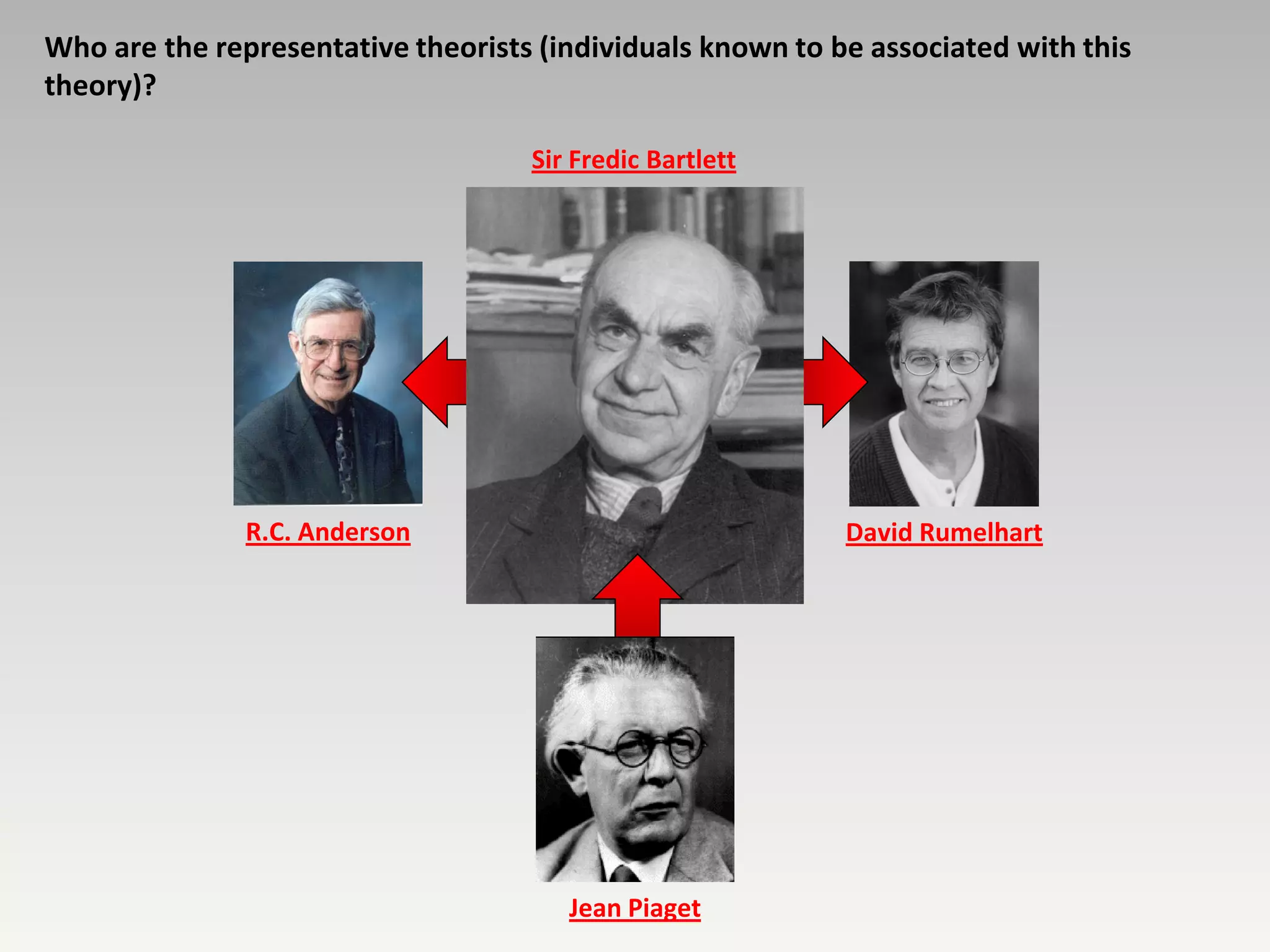
Who are the representative theorists (individuals known to be associated with this
theory)?

                                    Sir Fredic Bartlett


               R.C. Anderson                                David Rumelhart


                                       Jean Piaget
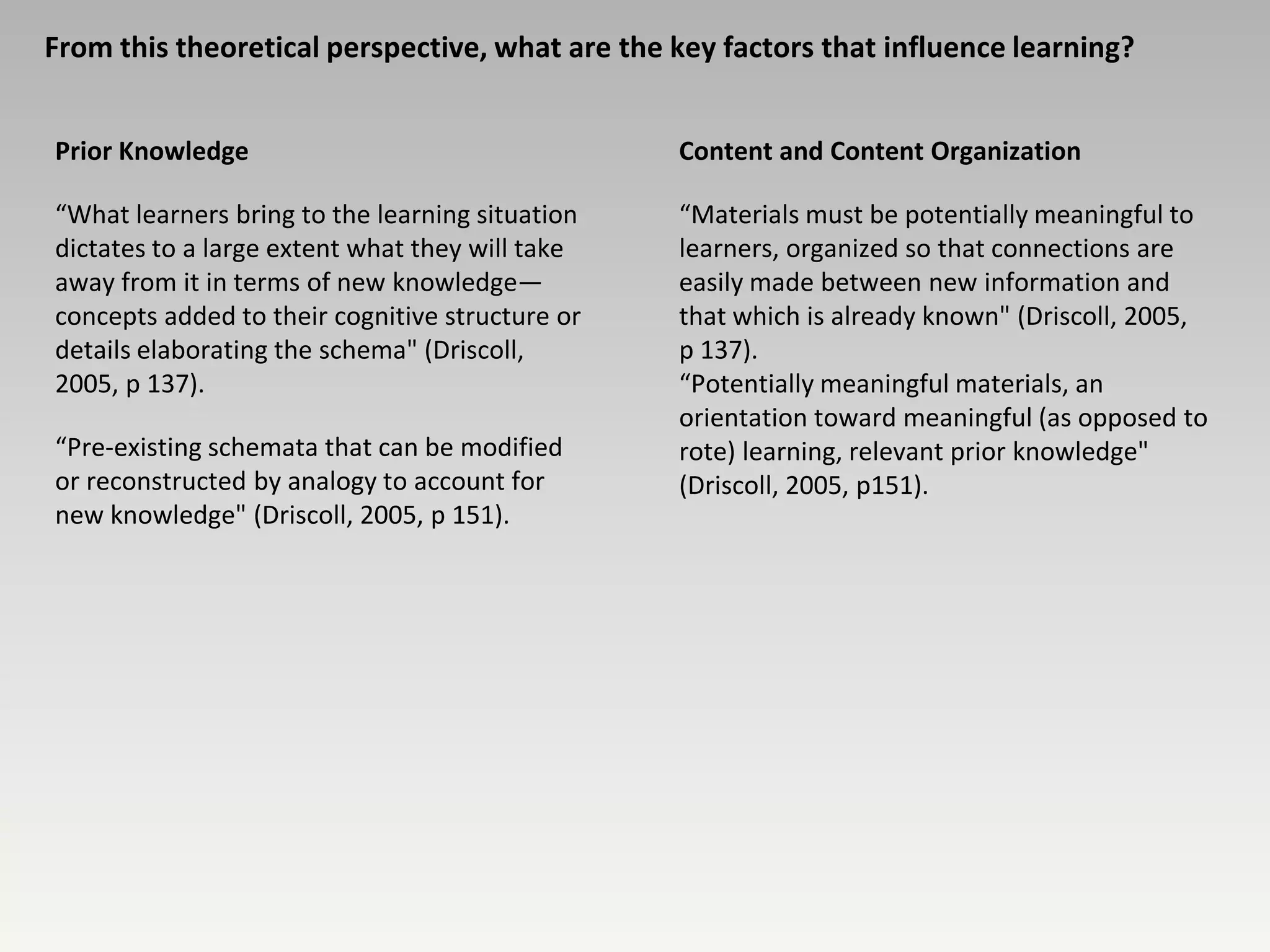
From this theoretical perspective, what are the key factors that influence learning?


Prior Knowledge                                  Content and Content Organization

“What learners bring to the learning situation   “Materials must be potentially meaningful to
dictates to a large extent what they will take   learners, organized so that connections are
away from it in terms of new knowledge—          easily made between new information and
concepts added to their cognitive structure or   that which is already known" (Driscoll, 2005,
details elaborating the schema" (Driscoll,       p 137).
2005, p 137).                                    “Potentially meaningful materials, an
                                                 orientation toward meaningful (as opposed to
“Pre-existing schemata that can be modified      rote) learning, relevant prior knowledge"
or reconstructed by analogy to account for       (Driscoll, 2005, p151).
new knowledge" (Driscoll, 2005, p 151).
What are some basic strategies used to exemplify this theory?


Activating Prior Knowledge                         Making Instructional Materials Meaningful
                                                     • Comparative Organizers & Elaboration
   • Advance Organizers “Are relevant and              “Provide a means for systematically
     inclusive to introductory materials,              comparing and contrasting concepts.
     provided in advance of learning                   Providing organizers to learners (or
     materials, that serve to ‘bridge the gap          having learners generate one
     between what the learner already knows            themselves) is one means of facilitating
     and what he needs to know before he               learning of unfamiliar, and potentially
     can meaningfully learn the task at hand’"         confusable, information" (Driscoll, 2005,
     (Driscoll, 2005, p 138).                          p 144).
   • Schema Signals “Instructors should alert        • Conceptual & Pedagogical Models
     students to the schematic structures of           “Conceptual models are any of the
     materials, problems and culture in order          models invented by teachers, designers,
     to facilitate learning, especially when the       scientists or engineers to help make
     subject matter is unfamiliar" (Driscoll,          some target system understandable"
     2005, p 141-143).                                 (Driscoll, 2005, p 145). [see slide one]
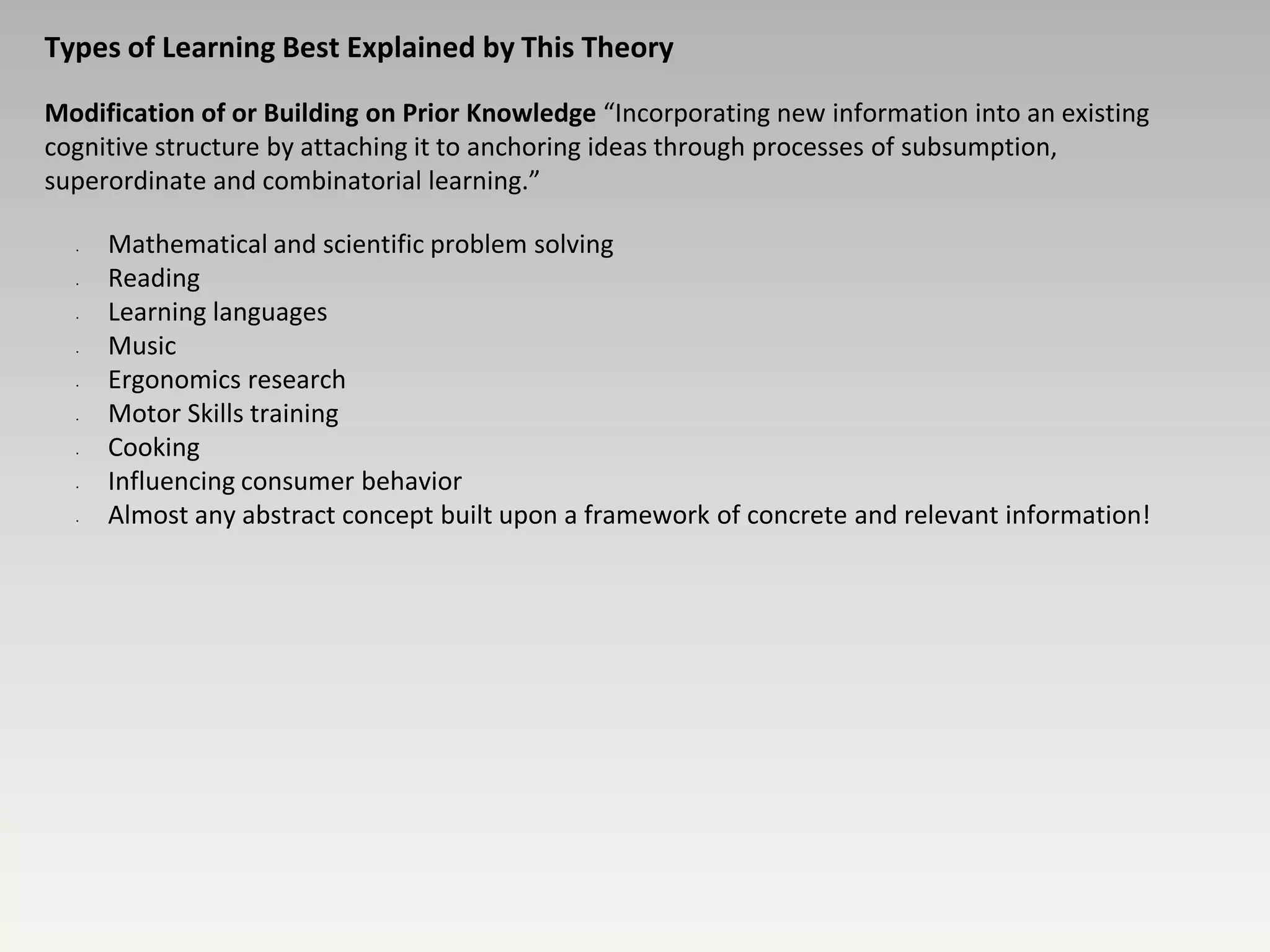
Types of Learning Best Explained by This Theory

Modification of or Building on Prior Knowledge “Incorporating new information into an existing
cognitive structure by attaching it to anchoring ideas through processes of subsumption,
superordinate and combinatorial learning.”

  •   Mathematical and scientific problem solving
  •   Reading
  •   Learning languages
  •   Music
  •   Ergonomics research
  •   Motor Skills training
  •   Cooking
  •   Influencing consumer behavior
  •   Almost any abstract concept built upon a framework of concrete and relevant information!
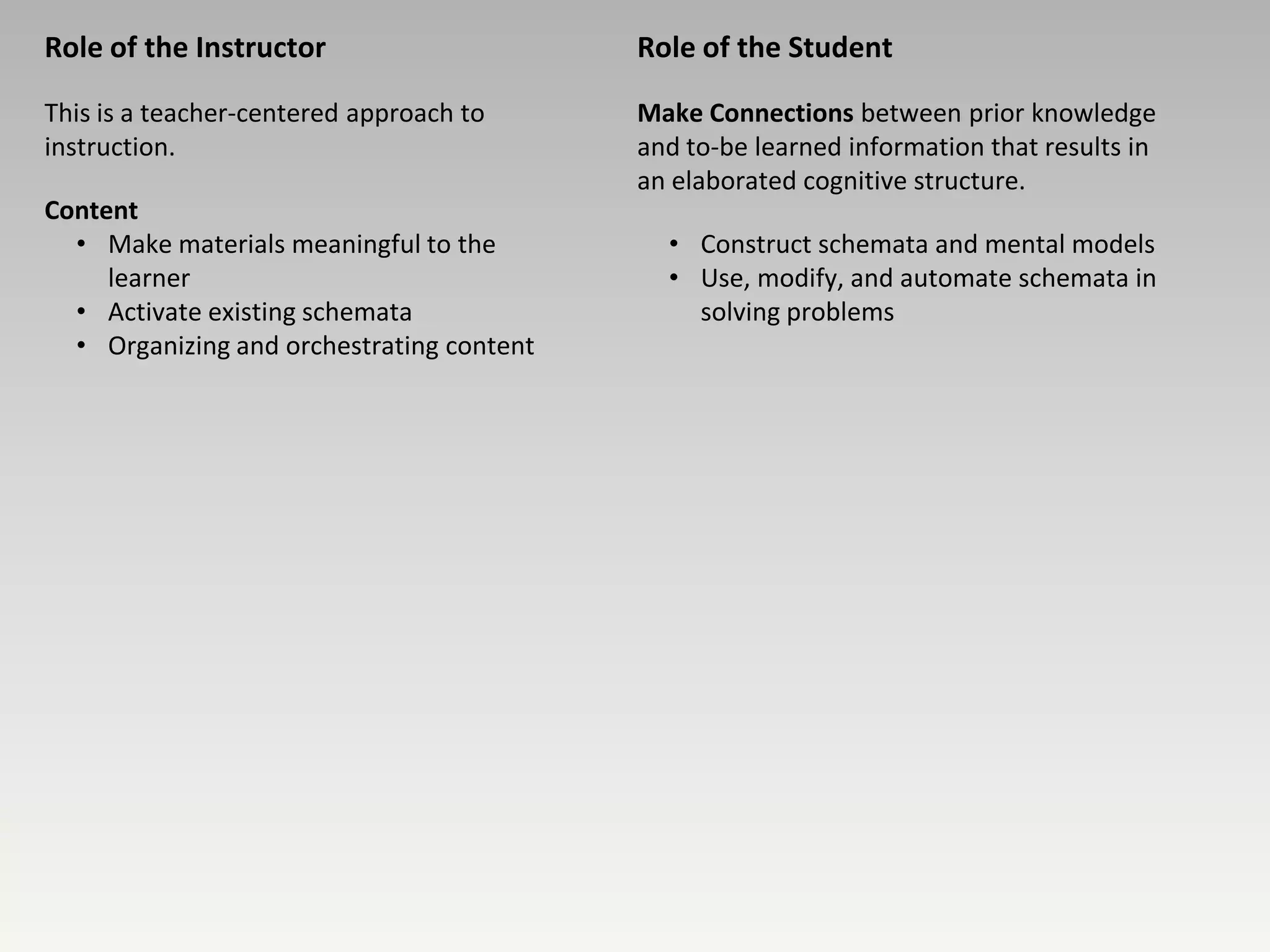
Role of the Instructor                     Role of the Student

This is a teacher-centered approach to     Make Connections between prior knowledge
instruction.                               and to-be learned information that results in
                                           an elaborated cognitive structure.
Content
  • Make materials meaningful to the         • Construct schemata and mental models
     learner                                 • Use, modify, and automate schemata in
  • Activate existing schemata                 solving problems
  • Organizing and orchestrating content
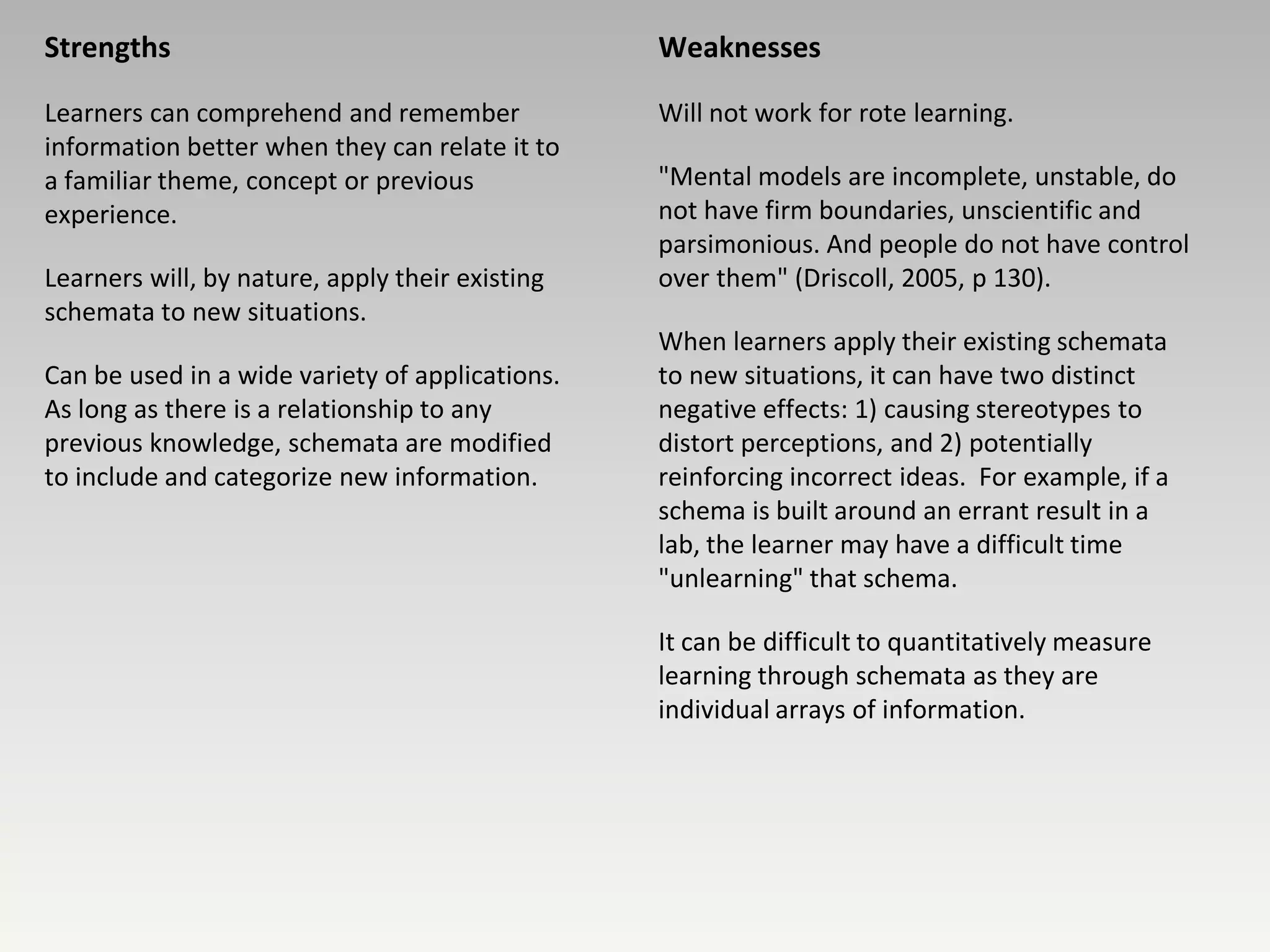
Strengths                                        Weaknesses

Learners can comprehend and remember             Will not work for rote learning.
information better when they can relate it to
a familiar theme, concept or previous            "Mental models are incomplete, unstable, do
experience.                                      not have firm boundaries, unscientific and
                                                 parsimonious. And people do not have control
Learners will, by nature, apply their existing   over them" (Driscoll, 2005, p 130).
schemata to new situations.
                                                 When learners apply their existing schemata
Can be used in a wide variety of applications.   to new situations, it can have two distinct
As long as there is a relationship to any        negative effects: 1) causing stereotypes to
previous knowledge, schemata are modified        distort perceptions, and 2) potentially
to include and categorize new information.       reinforcing incorrect ideas. For example, if a
                                                 schema is built around an errant result in a
                                                 lab, the learner may have a difficult time
                                                 "unlearning" that schema.

                                                 It can be difficult to quantitatively measure
                                                 learning through schemata as they are
                                                 individual arrays of information.
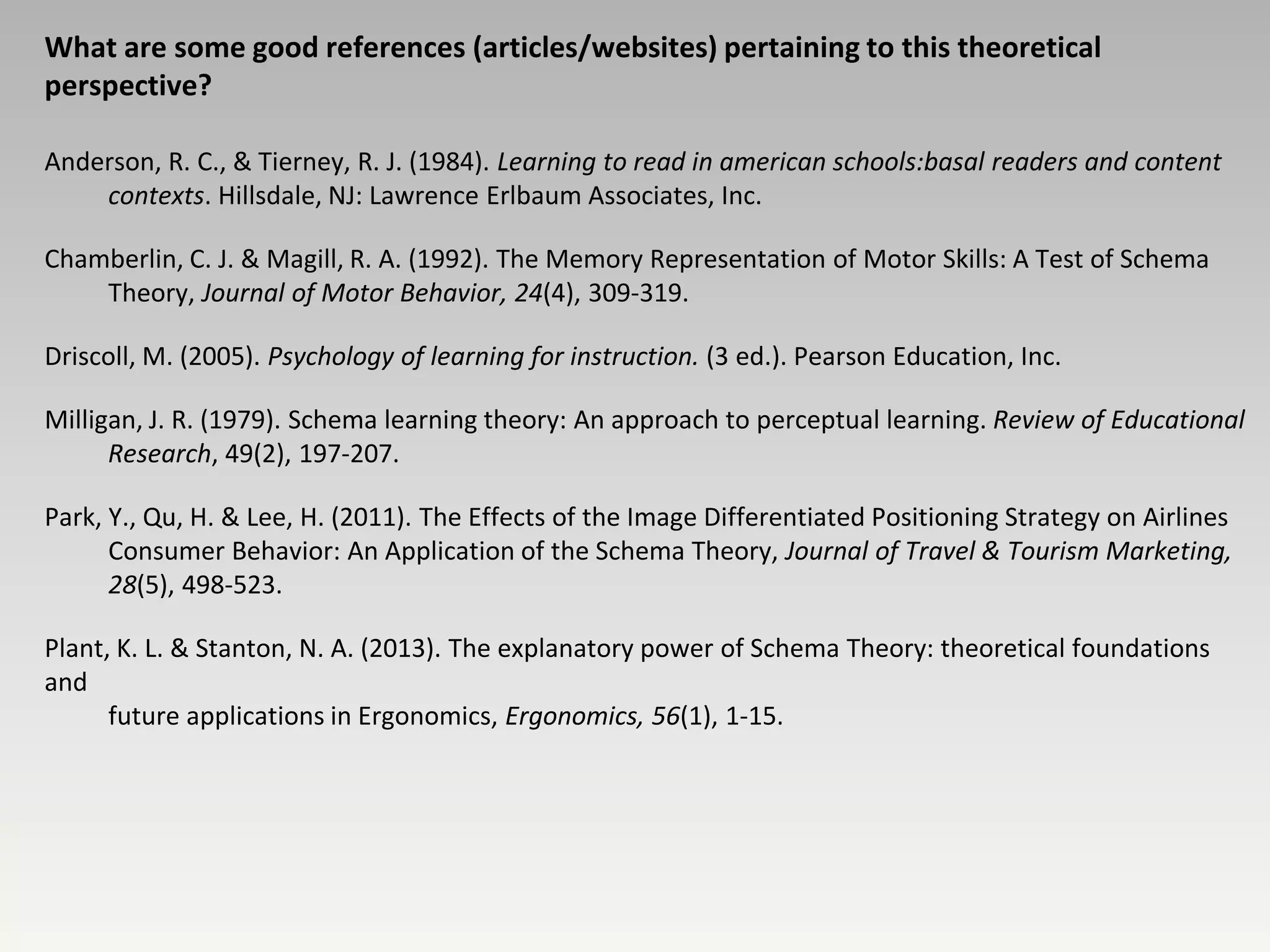
What are some good references (articles/websites) pertaining to this theoretical
perspective?

Anderson, R. C., & Tierney, R. J. (1984). Learning to read in american schools:basal readers and content
    contexts. Hillsdale, NJ: Lawrence Erlbaum Associates, Inc.

Chamberlin, C. J. & Magill, R. A. (1992). The Memory Representation of Motor Skills: A Test of Schema
    Theory, Journal of Motor Behavior, 24(4), 309-319.

Driscoll, M. (2005). Psychology of learning for instruction. (3 ed.). Pearson Education, Inc.

Milligan, J. R. (1979). Schema learning theory: An approach to perceptual learning. Review of Educational
      Research, 49(2), 197-207.

Park, Y., Qu, H. & Lee, H. (2011). The Effects of the Image Differentiated Positioning Strategy on Airlines
      Consumer Behavior: An Application of the Schema Theory, Journal of Travel & Tourism Marketing,
      28(5), 498-523.

Plant, K. L. & Stanton, N. A. (2013). The explanatory power of Schema Theory: theoretical foundations
and
      future applications in Ergonomics, Ergonomics, 56(1), 1-15.

Schema Learning Theory Comparative Organizer

  • 1.
  • 2.
    Who are therepresentative theorists (individuals known to be associated with this theory)? Sir Fredic Bartlett R.C. Anderson David Rumelhart Jean Piaget
  • 3.
    From this theoreticalperspective, what are the key factors that influence learning? Prior Knowledge Content and Content Organization “What learners bring to the learning situation “Materials must be potentially meaningful to dictates to a large extent what they will take learners, organized so that connections are away from it in terms of new knowledge— easily made between new information and concepts added to their cognitive structure or that which is already known" (Driscoll, 2005, details elaborating the schema" (Driscoll, p 137). 2005, p 137). “Potentially meaningful materials, an orientation toward meaningful (as opposed to “Pre-existing schemata that can be modified rote) learning, relevant prior knowledge" or reconstructed by analogy to account for (Driscoll, 2005, p151). new knowledge" (Driscoll, 2005, p 151).
  • 4.
    What are somebasic strategies used to exemplify this theory? Activating Prior Knowledge Making Instructional Materials Meaningful • Comparative Organizers & Elaboration • Advance Organizers “Are relevant and “Provide a means for systematically inclusive to introductory materials, comparing and contrasting concepts. provided in advance of learning Providing organizers to learners (or materials, that serve to ‘bridge the gap having learners generate one between what the learner already knows themselves) is one means of facilitating and what he needs to know before he learning of unfamiliar, and potentially can meaningfully learn the task at hand’" confusable, information" (Driscoll, 2005, (Driscoll, 2005, p 138). p 144). • Schema Signals “Instructors should alert • Conceptual & Pedagogical Models students to the schematic structures of “Conceptual models are any of the materials, problems and culture in order models invented by teachers, designers, to facilitate learning, especially when the scientists or engineers to help make subject matter is unfamiliar" (Driscoll, some target system understandable" 2005, p 141-143). (Driscoll, 2005, p 145). [see slide one]
  • 5.
    Types of LearningBest Explained by This Theory Modification of or Building on Prior Knowledge “Incorporating new information into an existing cognitive structure by attaching it to anchoring ideas through processes of subsumption, superordinate and combinatorial learning.” • Mathematical and scientific problem solving • Reading • Learning languages • Music • Ergonomics research • Motor Skills training • Cooking • Influencing consumer behavior • Almost any abstract concept built upon a framework of concrete and relevant information!
  • 6.
    Role of theInstructor Role of the Student This is a teacher-centered approach to Make Connections between prior knowledge instruction. and to-be learned information that results in an elaborated cognitive structure. Content • Make materials meaningful to the • Construct schemata and mental models learner • Use, modify, and automate schemata in • Activate existing schemata solving problems • Organizing and orchestrating content
  • 7.
    Strengths Weaknesses Learners can comprehend and remember Will not work for rote learning. information better when they can relate it to a familiar theme, concept or previous "Mental models are incomplete, unstable, do experience. not have firm boundaries, unscientific and parsimonious. And people do not have control Learners will, by nature, apply their existing over them" (Driscoll, 2005, p 130). schemata to new situations. When learners apply their existing schemata Can be used in a wide variety of applications. to new situations, it can have two distinct As long as there is a relationship to any negative effects: 1) causing stereotypes to previous knowledge, schemata are modified distort perceptions, and 2) potentially to include and categorize new information. reinforcing incorrect ideas. For example, if a schema is built around an errant result in a lab, the learner may have a difficult time "unlearning" that schema. It can be difficult to quantitatively measure learning through schemata as they are individual arrays of information.
  • 8.
    What are somegood references (articles/websites) pertaining to this theoretical perspective? Anderson, R. C., & Tierney, R. J. (1984). Learning to read in american schools:basal readers and content contexts. Hillsdale, NJ: Lawrence Erlbaum Associates, Inc. Chamberlin, C. J. & Magill, R. A. (1992). The Memory Representation of Motor Skills: A Test of Schema Theory, Journal of Motor Behavior, 24(4), 309-319. Driscoll, M. (2005). Psychology of learning for instruction. (3 ed.). Pearson Education, Inc. Milligan, J. R. (1979). Schema learning theory: An approach to perceptual learning. Review of Educational Research, 49(2), 197-207. Park, Y., Qu, H. & Lee, H. (2011). The Effects of the Image Differentiated Positioning Strategy on Airlines Consumer Behavior: An Application of the Schema Theory, Journal of Travel & Tourism Marketing, 28(5), 498-523. Plant, K. L. & Stanton, N. A. (2013). The explanatory power of Schema Theory: theoretical foundations and future applications in Ergonomics, Ergonomics, 56(1), 1-15.