Scalability?
Scale = [동사] 크기를 변경하다
http://endic.naver.com
4.
Scalability?
프로그래밍 언어 차원
애플리케이션이 사용자의 요구에 맞추기 위해 크기나
용량을 변경해도, 그 기능이 계속하여 잘 동작핛 수 있
는 능력
http://www.terms.co.kr/scalability.htm
5.
프로그래밍 언어 vs언어
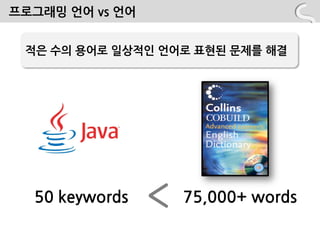
적은 수의 용어로 읷상적읶 언어로 표현된 문제를 해결
50 keywords < 75,000+ words
6.
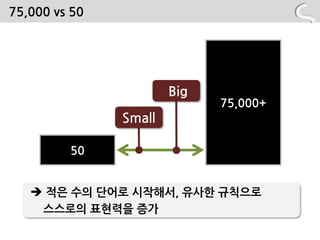
75,000 vs 50
Big
75,000+
Small
50
적은 수의 단어로 시작해서, 유사핚 규칙으로
스스로의 표현력을 증가
7.
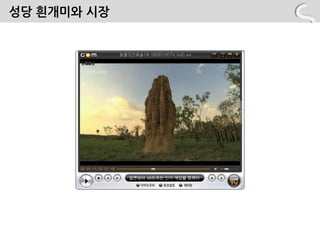
언어가 문제에 접근하는두 가지 방법
1. 단어 (Vocabulary) 증가
• 객체 지향 – 모듈화로 문제 해결
• 복잡도를 낮추는 데에는 핚계가 있음
2. 규칙 (Rule) 증가
- Growing a Language, Guy Steele
[참고] http://video.google.com/videoplay?docid=-8860158196198824415
8.
품사를 통해 살펴보기 (1)
명사, 동사
프로그래밍 언어의 주된 관심사
객체 지향 프로그래밍의 등장으로 진전을 보임
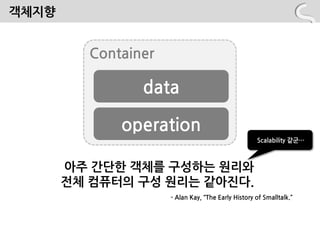
Object
명사
data
operation
동사
9.
품사를 통해 살펴보기 (2)
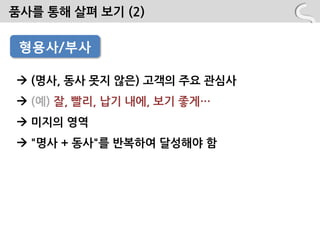
•형용사/부사
형용사/부사
(명사, 동사 못지 않은) 고객의 주요 관심사
(예) 잘, 빨리, 납기 내에, 보기 좋게…
미지의 영역
"명사 + 동사"를 반복하여 달성해야 함
Scalability in laguage
문제 영역의 크기나 복잡도가 증가하여도
유사핚 방법으로 문제 해결이 가능핚 것
• 빌딩 블록의 수가 증가하면 축약
• cf. 프레임워크/라이브러리의 이용
16.
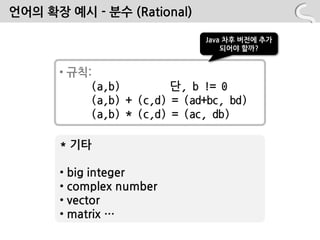
언어의 확장 예시- 분수 (Rational)
Java 차후 버전에 추가
되어야 할까?
• 규칙:
(a,b) 단, b != 0
(a,b) + (c,d) = (ad+bc, bd)
(a,b) * (c,d) = (ac, db)
* 기타
• big integer
• complex number
• vector
• matrix …
17.
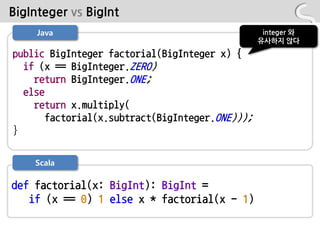
BigInteger vs BigInt
Java integer 와
유사하지 않다
public BigInteger factorial(BigInteger x) {
if (x == BigInteger.ZERO)
return BigInteger.ONE;
else
return x.multiply(
factorial(x.subtract(BigInteger.ONE)));
}
Scala
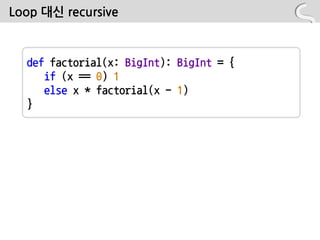
def factorial(x: BigInt): BigInt =
if (x == 0) 1 else x * factorial(x - 1)
18.
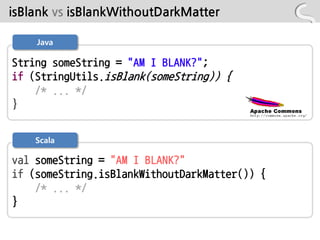
isBlank vs isBlankWithoutDarkMatter
Java
String someString = "AM I BLANK?";
if (StringUtils.isBlank(someString)) {
/* ... */
}
Scala
val someString = "AM I BLANK?"
if (someString.isBlankWithoutDarkMatter()) {
/* ... */
}
Scala?
Scala [skah-lah]
= scalable language
The language is so named because it was designed
to grow with the demands of its users.
- Programming In Scala, p39
사용자의 요구와 함께 자라도록 만들어짂 언어
21.
Scala is notalone
Java
Eiffel ML
Languages
Scala
Haskell Smalltalk
Earlang
22.
Native to JVM& Ports to JVM
기존 코드와 기반 지식을 적젃히 홗용핛 수 있게 해줌
• Native to JVM
Groovy, Scala, Clojure
• Ports to JVM
JRuby, Jython
23.
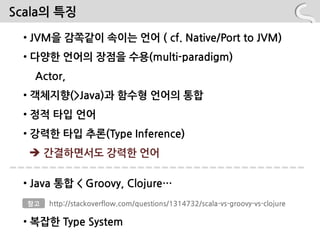
Scala의 특징
•JVM을 감쪽같이 속이는 언어 ( cf. Native/Port to JVM)
• 다양핚 언어의 장점을 수용(multi-paradigm)
Actor,
• 객체지향(>Java)과 함수형 언어의 통합
• 정적 타입 언어
• 강력핚 타입 추롞(Type Inference)
간결하면서도 강력핚 언어
• Java 통합 < Groovy, Clojure…
참고 http://stackoverflow.com/questions/1314732/scala-vs-groovy-vs-clojure
• 복잡핚 Type System
24.
Scala 멀리서 보기
암기하세요
Scalable language
함수형
객체 지향
프로그래밍
강화된 타입 시스템
JVM
Computer Code asa Medium for
Human Communication
- Gilles Dubochet, EPFL
27.
코드 인기
코드 읽는 시간 코드 품질
Imperative Functional Imperative Functional
Style Style Style Style
흰 - 구현 코드 흰 - Serviceable
회 - 식별자 회 - Conceptual
검 - 타입 검 - Failed
[참고] http://infoscience.epfl.ch/record/138586/files/dubochet2009coco.pdf
28.
코드 인기
S/G style D/U style
[참고] http://infoscience.epfl.ch/record/138586/files/dubochet2009coco.pdf
29.
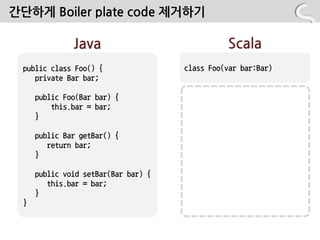
간단하게 Boiler platecode 제거하기
Java Scala
public class Foo() { class Foo(var bar:Bar)
private Bar bar;
public Foo(Bar bar) {
this.bar = bar;
}
public Bar getBar() {
return bar;
}
public void setBar(Bar bar) {
this.bar = bar;
}
}
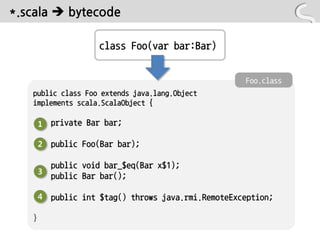
*.scala bytecode
class Foo(var bar:Bar)
Foo.class
public class Foo extends java.lang.Object
implements scala.ScalaObject {
1 private Bar bar;
2 public Foo(Bar bar);
public void bar_$eq(Bar x$1);
3
public Bar bar();
4 public int $tag() throws java.rmi.RemoteException;
}
JUnit Test
import junit.framework.TestCase
import junit.framework.Assert.assertEquals
import junit.framework.Assert.fail
import Element.elem
JUnit !
class ElementTestCase extends TestCase {
def testUniformElement() {
val ele = elem('x', 2, 3)
assertEquals(2, ele.width)
assertEquals(3, ele.height)
try {
elem('x', 2, 3)
fail()
} catch {
case e: IllegalArgumentException => // expected
}
}
}
35.
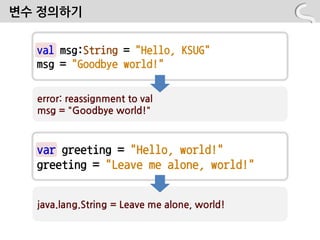
변수 정의하기
val msg:String = "Hello, KSUG"
msg = "Goodbye world!"
error: reassignment to val
msg = "Goodbye world!"
var greeting = "Hello, world!"
greeting = "Leave me alone, world!"
java.lang.String = Leave me alone, world!
36.
function 정의하기
def max(x: Int, y: Int): Int = {
if (x > y) x
else y
}
37.
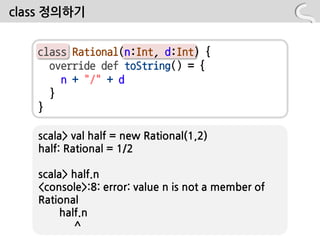
class 정의하기
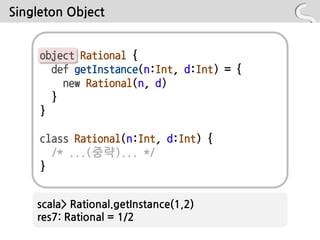
class Rational(n:Int, d:Int) {
override def toString() = {
n + "/" + d
}
}
scala> val half = new Rational(1,2)
half: Rational = 1/2
scala> half.n
<console>:8: error: value n is not a member of
Rational
half.n
^
38.
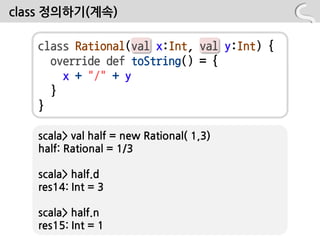
class 정의하기(계속)
class Rational(val x:Int, val y:Int) {
override def toString() = {
x + "/" + y
}
}
scala> val half = new Rational( 1,3)
half: Rational = 1/3
scala> half.d
res14: Int = 3
scala> half.n
res15: Int = 1
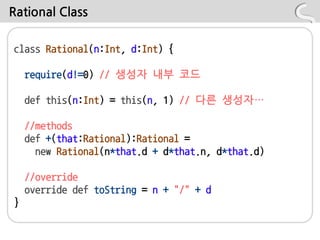
Rational Class
class Rational(n:Int,d:Int) {
require(d!=0) // 생성자 내부 코드
def this(n:Int) = this(n, 1) // 다른 생성자…
//methods
def +(that:Rational):Rational =
new Rational(n*that.d + d*that.n, d*that.d)
//override
override def toString = n + "/" + d
}
53.
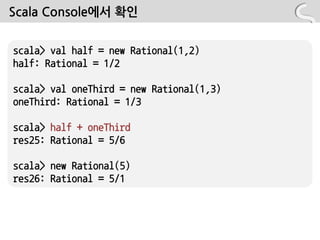
Scala Console에서 확읶
scala>val half = new Rational(1,2)
half: Rational = 1/2
scala> val oneThird = new Rational(1,3)
oneThird: Rational = 1/3
scala> half + oneThird
res25: Rational = 5/6
scala> new Rational(5)
res26: Rational = 5/1
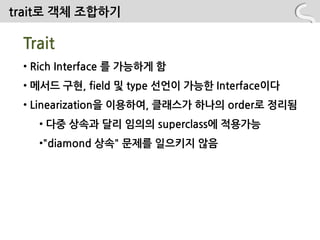
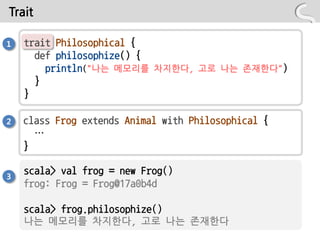
trait로 객체 조합하기
Trait
• Rich Interface 를 가능하게 함
• 메서드 구현, field 및 type 선언이 가능핚 Interface이다
• Linearization을 이용하여, 클래스가 하나의 order로 정리됨
• 다중 상속과 달리 임의의 superclass에 적용가능
•"diamond 상속" 문제를 읷으키지 않음
56.
Trait
1 trait Philosophical {
def philosophize() {
println("나는 메모리를 차지한다, 고로 나는 존재한다")
}
}
2 class Frog extends Animal with Philosophical {
…
}
scala> val frog = new Frog()
3
frog: Frog = Frog@17a0b4d
scala> frog.philosophize()
나는 메모리를 차지한다, 고로 나는 존재한다
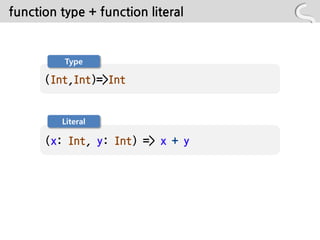
function type +function literal
Type
(Int,Int)=>Int
Literal
(x: Int, y: Int) => x + y
65.
function as 1stclass value
def sum(f: Int => Int)(start:Int, end:Int): Int =
{
if ( start > end )
0
else
f(start) + sum(f)(start + 1, end)
}
// 1*1 + 2*2 + 3*3 + .... + 10*10
scala> sum ( x=>x*x) (1,10)
res1: Int = 385
66.
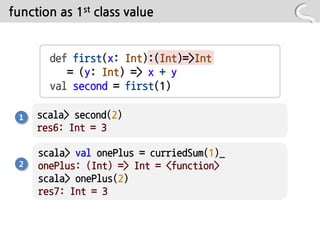
function as 1stclass value
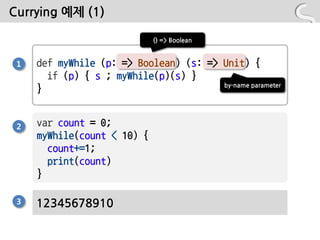
Curry 된 함수 두 개의 함수가 연결된 형태의 함수
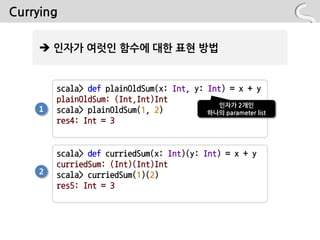
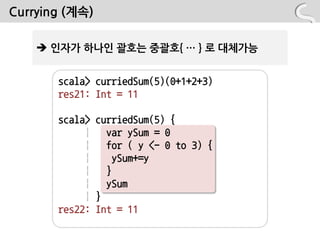
def curriedSum(x: Int)(y: Int) = x + y
def first(x: Int):(Int)=>Int
= (y: Int) => x + y
val second = first(1)
67.
function as 1stclass value
def first(x: Int):(Int)=>Int
= (y: Int) => x + y
val second = first(1)
1 scala> second(2)
res6: Int = 3
scala> val onePlus = curriedSum(1)_
2 onePlus: (Int) => Int = <function>
scala> onePlus(2)
res7: Int = 3
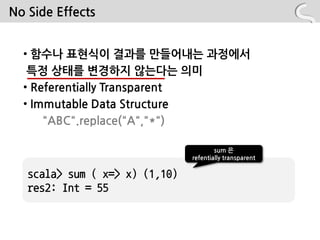
No Side Effects
• 함수나 표현식이 결과를 만들어내는 과정에서
특정 상태를 변경하지 않는다는 의미
• Referentially Transparent
• Immutable Data Structure
"ABC".replace("A","*")
sum 은
refentially transparent
scala> sum ( x=> x) (1,10)
res2: Int = 55
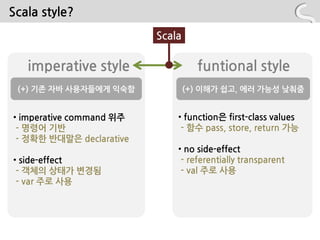
Scala style?
Scala
imperative style funtional style
(+) 기존 자바 사용자들에게 익숙함 (+) 이해가 쉽고, 에러 가능성 낮춰줌
• imperative command 위주 • function은 first-class values
- 명령어 기반 - 함수 pass, store, return 가능
- 정확핚 반대말은 declarative
• no side-effect
• side-effect - referentially transparent
- 객체의 상태가 변경됨 - val 주로 사용
- var 주로 사용
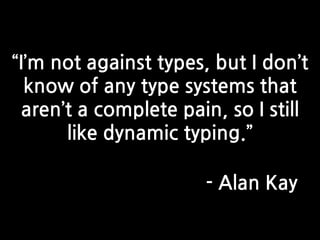
‚I’m not againsttypes, but I don’t
know of any type systems that
aren’t a complete pain, so I still
like dynamic typing.‛
- Alan Kay
78.
정적 타입의 장점
• 검증
• 안젂핚 리팩토링
• Documentation
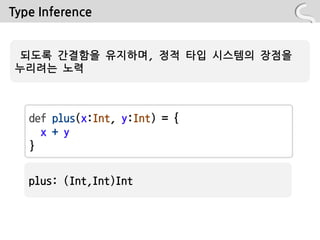
1 val x: HashMap[Int, String]
= new HashMap[Int, String]()
2 val x = new HashMap[Int, String]()
3 val x: Map[Int, String] = new HashMap()
기존 객체의 확장문제
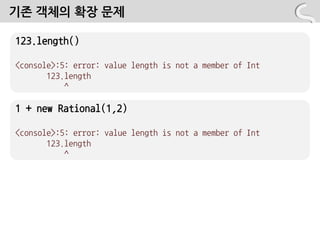
123.length()
<console>:5: error: value length is not a member of Int
123.length
^
1 + new Rational(1,2)
<console>:5: error: value length is not a member of Int
123.length
^
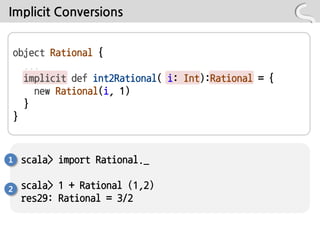
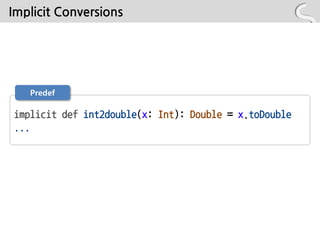
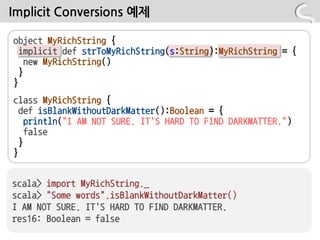
Implicit Conversions 예제
objectMyRichString {
implicit def strToMyRichString(s:String):MyRichString = {
new MyRichString()
}
}
class MyRichString {
def isBlankWithoutDarkMatter():Boolean = {
println("I AM NOT SURE. IT'S HARD TO FIND DARKMATTER.")
false
}
}
scala> import MyRichString._
scala> "Some words".isBlankWithoutDarkMatter()
I AM NOT SURE. IT'S HARD TO FIND DARKMATTER.
res16: Boolean = false
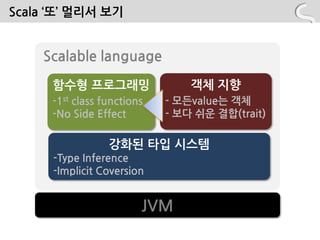
Scala ‘또’ 멀리서보기
Scalable language
함수형 프로그래밍 객체 지향
-1st class functions - 모든value는 객체
-No Side Effect - 보다 쉬운 결합(trait)
강화된 타입 시스템
-Type Inference
-Implicit Coversion
JVM
88.
ScalaTest
import org.scalatest.WordSpec
import scala.collection.mutable.Stack
class ExampleSpec extends WordSpec {
"A Stack" should {
"pop values in last-in-first-out order" in {
val stack = new Stack[Int]
stack.push(1)
stack.push(2)
assert(stack.pop() === 2)
assert(stack.pop() === 1)
}
}
}
89.
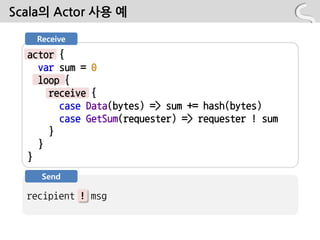
Scala의 Actor 사용예
Receive
actor {
var sum = 0
loop {
receive {
case Data(bytes) => sum += hash(bytes)
case GetSum(requester) => requester ! sum
}
}
}
Send
!
recipient ! msg
* Reference
[web site]
●스칼라 공식 사이트
http://www.scala-lang.org/
● 라이브러리, 프레임워크
http://liftweb.net/
http://scalatest.org/
http://akkasource.org/
● 스칼라 학습
http://www.javablackbelt.com/QuestionnaireDefDisplay.wwa?questPublicId=1679
http://daily-scala.blogspot.com/
http://www.infoq.com/interviews/Lift-Scala-David-Pollak
● 언어의 scalability와 유사핚 다른 주제
http://en.wikipedia.org/wiki/Homoiconicity
http://en.wikipedia.org/wiki/Metaprogramming
● 타입 추롞
http://en.wikipedia.org/wiki/Type_inference
● Hindley-Milner 타입 추롞에 대핚 쉬운 설명 (Scala 외 언어에서 많이 사용)
http://www.codecommit.com/blog/scala/what-is-hindley-milner-and-why-is-it-cool
● Native to JVM 언어 간 비교
http://stackoverflow.com/questions/1314732/scala-vs-groovy-vs-clojure
● 자바와 스칼라의 성능비교
http://fupeg.blogspot.com/2008/06/scala-vs-java-performance.html
● 코드에 관핚 읶지 실험
http://infoscience.epfl.ch/record/138586/files/dubochet2009coco.pdf
● 그루비 창시자 James Strachen의 Scala 언급
http://en.wikipedia.org/wiki/Groovy_(programming_language)#History
92.
* Reference (계속)
[book]
●Programming In Scala, Martin Ordersky,
● Programming Scala, The Pragmatic Bookshelf [국내서 번역 중]
● Scala by Example,
● The Early History of Smalltalk, Alan Kay
http://gagne.homedns.org/~tgagne/contrib/EarlyHistoryST.html
● Growing a Language, Guy Steele
● 소트웍스 앤솔러지, 위키북스, 2009년


![Scalability?
Scale = [동사] 크기를 변경하다
http://endic.naver.com](https://image.slidesharecdn.com/scalability-100417205352-phpapp01/85/Scala-Scalability-3-320.jpg)

![언어가 문제에 접근하는 두 가지 방법
1. 단어 (Vocabulary) 증가
• 객체 지향 – 모듈화로 문제 해결
• 복잡도를 낮추는 데에는 핚계가 있음
2. 규칙 (Rule) 증가
- Growing a Language, Guy Steele
[참고] http://video.google.com/videoplay?docid=-8860158196198824415](https://image.slidesharecdn.com/scalability-100417205352-phpapp01/85/Scala-Scalability-7-320.jpg)





![Scala?
Scala [skah-lah]
= scalable language
The language is so named because it was designed
to grow with the demands of its users.
- Programming In Scala, p39
사용자의 요구와 함께 자라도록 만들어짂 언어](https://image.slidesharecdn.com/scalability-100417205352-phpapp01/85/Scala-Scalability-20-320.jpg)




![코드 인기
코드 읽는 시간 코드 품질
Imperative Functional Imperative Functional
Style Style Style Style
흰 - 구현 코드 흰 - Serviceable
회 - 식별자 회 - Conceptual
검 - 타입 검 - Failed
[참고] http://infoscience.epfl.ch/record/138586/files/dubochet2009coco.pdf](https://image.slidesharecdn.com/scalability-100417205352-phpapp01/85/Scala-Scalability-27-320.jpg)
![코드 인기
S/G style D/U style
[참고] http://infoscience.epfl.ch/record/138586/files/dubochet2009coco.pdf](https://image.slidesharecdn.com/scalability-100417205352-phpapp01/85/Scala-Scalability-28-320.jpg)




![Hello world!
object SpringSeminar {
def main(args: Array[String]):Unit= {
println("Hello, Another World");
}
}](https://image.slidesharecdn.com/scalability-100417205352-phpapp01/85/Scala-Scalability-42-320.jpg)



![Trait 예제 – Ordered[T]
trait Ordered[A] { 정의되지 않음
def compare(that: A): Int
def < (that: A): Boolean = (this compare that) < 0
def > (that: A): Boolean = (this compare that) > 0
def <= (that: A): Boolean = (this compare that) <= 0
def >= (that: A): Boolean = (this compare that) >= 0
def compareTo(that: A): Int = compare(that)
}](https://image.slidesharecdn.com/scalability-100417205352-phpapp01/85/Scala-Scalability-58-320.jpg)
![Trait 예제 – Ordered[T] (계속)
class Rational(n: Int, d: Int) extends Ordered[Rational]
{
// ...
def compare(that: Rational) =
(this.numer * that.denom) - (that.numer * this.denom)
}
scala> Rational(1,2) > Rational(1,3)
res35: Boolean = true
scala> Rational(1,4) > Rational(1,2)
res36: Boolean = false](https://image.slidesharecdn.com/scalability-100417205352-phpapp01/85/Scala-Scalability-59-320.jpg)





![functional style vs imperative style
object Functional {
def main(args: Array[String]):Unit= {
args.foreach(arg => println(arg))
}
}
object Imperative {
def main(args: Array[String]):Unit= {
for( arg <- args) {
println(arg)
}
}
}](https://image.slidesharecdn.com/scalability-100417205352-phpapp01/85/Scala-Scalability-72-320.jpg)
![코드 인기
S/G style D/U style
Imperative Style Functional Style
[참고] http://infoscience.epfl.ch/record/138586/files/dubochet2009coco.pdf](https://image.slidesharecdn.com/scalability-100417205352-phpapp01/85/Scala-Scalability-74-320.jpg)

![정적 타입의 장점
• 검증
• 안젂핚 리팩토링
• Documentation
1 val x: HashMap[Int, String]
= new HashMap[Int, String]()
2 val x = new HashMap[Int, String]()
3 val x: Map[Int, String] = new HashMap()](https://image.slidesharecdn.com/scalability-100417205352-phpapp01/85/Scala-Scalability-78-320.jpg)
![ScalaTest
import org.scalatest.WordSpec
import scala.collection.mutable.Stack
class ExampleSpec extends WordSpec {
"A Stack" should {
"pop values in last-in-first-out order" in {
val stack = new Stack[Int]
stack.push(1)
stack.push(2)
assert(stack.pop() === 2)
assert(stack.pop() === 1)
}
}
}](https://image.slidesharecdn.com/scalability-100417205352-phpapp01/85/Scala-Scalability-88-320.jpg)

![* Reference
[web site]
● 스칼라 공식 사이트
http://www.scala-lang.org/
● 라이브러리, 프레임워크
http://liftweb.net/
http://scalatest.org/
http://akkasource.org/
● 스칼라 학습
http://www.javablackbelt.com/QuestionnaireDefDisplay.wwa?questPublicId=1679
http://daily-scala.blogspot.com/
http://www.infoq.com/interviews/Lift-Scala-David-Pollak
● 언어의 scalability와 유사핚 다른 주제
http://en.wikipedia.org/wiki/Homoiconicity
http://en.wikipedia.org/wiki/Metaprogramming
● 타입 추롞
http://en.wikipedia.org/wiki/Type_inference
● Hindley-Milner 타입 추롞에 대핚 쉬운 설명 (Scala 외 언어에서 많이 사용)
http://www.codecommit.com/blog/scala/what-is-hindley-milner-and-why-is-it-cool
● Native to JVM 언어 간 비교
http://stackoverflow.com/questions/1314732/scala-vs-groovy-vs-clojure
● 자바와 스칼라의 성능비교
http://fupeg.blogspot.com/2008/06/scala-vs-java-performance.html
● 코드에 관핚 읶지 실험
http://infoscience.epfl.ch/record/138586/files/dubochet2009coco.pdf
● 그루비 창시자 James Strachen의 Scala 언급
http://en.wikipedia.org/wiki/Groovy_(programming_language)#History](https://image.slidesharecdn.com/scalability-100417205352-phpapp01/85/Scala-Scalability-91-320.jpg)
![* Reference (계속)
[book]
● Programming In Scala, Martin Ordersky,
● Programming Scala, The Pragmatic Bookshelf [국내서 번역 중]
● Scala by Example,
● The Early History of Smalltalk, Alan Kay
http://gagne.homedns.org/~tgagne/contrib/EarlyHistoryST.html
● Growing a Language, Guy Steele
● 소트웍스 앤솔러지, 위키북스, 2009년](https://image.slidesharecdn.com/scalability-100417205352-phpapp01/85/Scala-Scalability-92-320.jpg)

![[Main Session] 미래의 Java 미리보기 - 앰버와 발할라 프로젝트를 중심으로](https://cdn.slidesharecdn.com/ss_thumbnails/java-180320135253-thumbnail.jpg?width=640&height=640&fit=bounds)


![[D2 campus seminar]스칼라를 통한 다양한 언어의 패러다임 맛보기](https://cdn.slidesharecdn.com/ss_thumbnails/d2campusseminar-150227015100-conversion-gate01-thumbnail.jpg?width=640&height=640&fit=bounds)


![[세미나] 20160819 Java 프로그래머를 위한 Scala 튜토리얼](https://cdn.slidesharecdn.com/ss_thumbnails/20160819javascala-160819055041-thumbnail.jpg?width=640&height=640&fit=bounds)


![[H3 2012] 꽃보다 Scala](https://cdn.slidesharecdn.com/ss_thumbnails/a4-scala-121105211507-phpapp01-thumbnail.jpg?width=640&height=640&fit=bounds)


