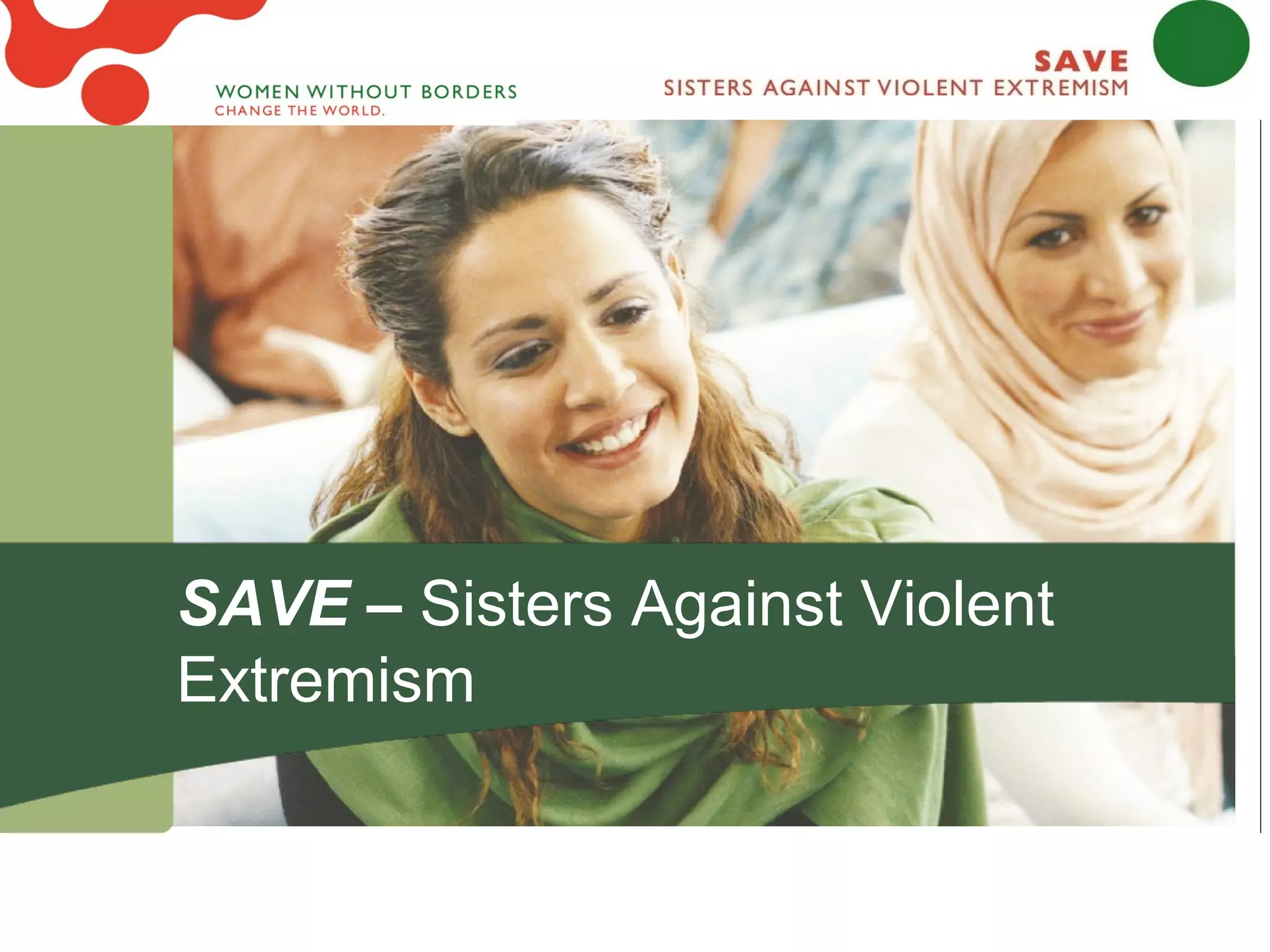
SAVE – Sisters Against Violent
Extremism
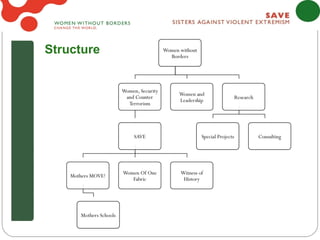
Structure
What is SAVE?
 SAVE is the world‘s first female counterterrorism
    platform.
   SAVE is a Women without Borders initiative.
   SAVE encourages female leadership and action in
    security, counter-terrorism, and peace-building.
   SAVE provides women with the tools to challenge
    extremist thinking and develop alternative strategies
    to combat global terrorism.
   SAVE breaks through barriers of nationalism,
    religion, and ethnicity to form a global network of
    women dedicated to end violent extremism.
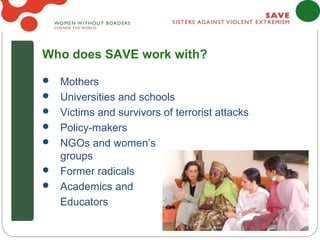
Who does SAVE work with?

 Mothers
 Universities and schools
 Victims and survivors of terrorist attacks
 Policy-makers
 NGOs and women’s
  groups
 Former radicals
 Academics and
  Educators
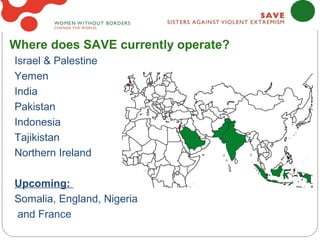
Where does SAVE currently operate?
Israel & Palestine
Yemen
India
Pakistan
Indonesia
Tajikistan
Northern Ireland

Upcoming:
Somalia, England, Nigeria
and France
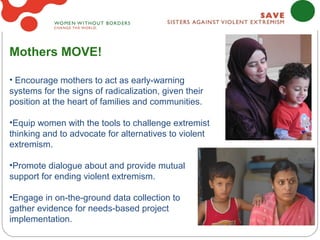
Mothers MOVE!

• Encourage mothers to act as early-warning
systems for the signs of radicalization, given their
position at the heart of families and communities.

•Equip women with the tools to challenge extremist
thinking and to advocate for alternatives to violent
extremism.

•Promote dialogue about and provide mutual
support for ending violent extremism.

•Engage in on-the-ground data collection to
gather evidence for needs-based project
implementation.
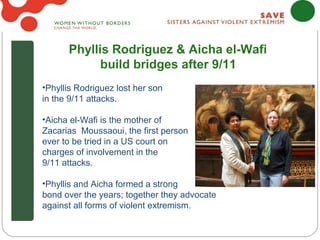
Phyllis Rodriguez & Aicha el-Wafi
            build bridges after 9/11
•Phyllis Rodriguez lost her son
in the 9/11 attacks.

•Aicha el-Wafi is the mother of
Zacarias Moussaoui, the first person
ever to be tried in a US court on
charges of involvement in the
9/11 attacks.

•Phyllis and Aicha formed a strong
bond over the years; together they advocate
against all forms of violent extremism.
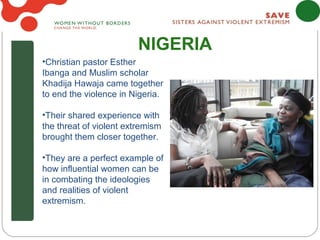
NIGERIA
•Christian pastor Esther
Ibanga and Muslim scholar
Khadija Hawaja came together
to end the violence in Nigeria.

•Their shared experience with
the threat of violent extremism
brought them closer together.

•They are a perfect example of
how influential women can be
in combating the ideologies
and realities of violent
extremism.
.


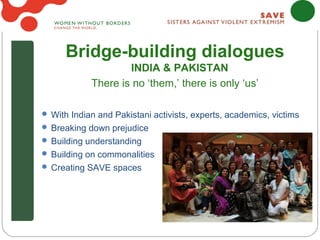
          Bridge-building dialogues
                        INDIA & PAKISTAN
                There is no ‘them,’ there is only ‘us’

     With Indian and Pakistani activists, experts, academics, victims
     Breaking down prejudice
     Building understanding
     Building on commonalities
     Creating SAVE spaces
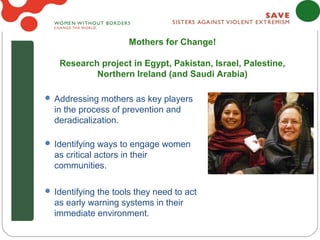
Mothers for Change!

   Research project in Egypt, Pakistan, Israel, Palestine,
           Northern Ireland (and Saudi Arabia)

 Addressing mothers as key players
  in the process of prevention and
  deradicalization.

 Identifying ways to engage women
  as critical actors in their
  communities.

 Identifying the tools they need to act
  as early warning systems in their
  immediate environment.
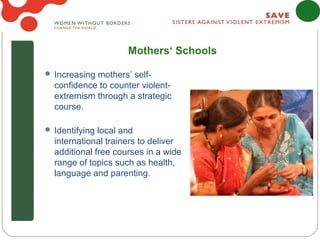
Mothers‘ Schools

 Increasing mothers’ self-
  confidence to counter violent-
  extremism through a strategic
  course.

 Identifying local and
  international trainers to deliver
  additional free courses in a wide
  range of topics such as health,
  language and parenting.
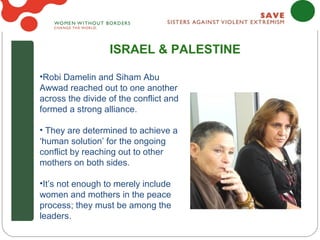
ISRAEL & PALESTINE

•Robi Damelin and Siham Abu
Awwad reached out to one another
across the divide of the conflict and
formed a strong alliance.

• They are determined to achieve a
‘human solution’ for the ongoing
conflict by reaching out to other
mothers on both sides.

•It’s not enough to merely include
women and mothers in the peace
process; they must be among the
leaders.
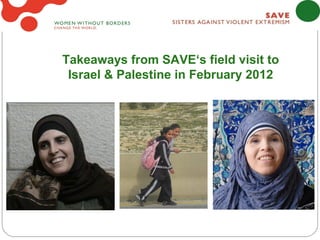
Takeaways from SAVE‘s field visit to
 Israel & Palestine in February 2012
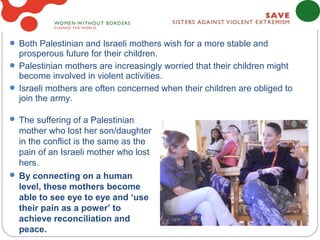
 Both Palestinian and Israeli mothers wish for a more stable and
  prosperous future for their children.
 Palestinian mothers are increasingly worried that their children might
  become involved in violent activities.
 Israeli mothers are often concerned when their children are obliged to
  join the army.

 The suffering of a Palestinian
  mother who lost her son/daughter
  in the conflict is the same as the
  pain of an Israeli mother who lost
  hers.
 By connecting on a human
  level, these mothers become
  able to see eye to eye and ‘use
  their pain as a power’ to
  achieve reconciliation and
  peace.
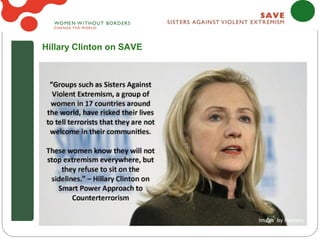
Hillary Clinton on SAVE
Follow SAVE Online!

Website: www.women-without-borders.org

               Blog:
womenwithoutborders-save.blogspot.com

Facebook: Women without Borders Fanpage

         Twitter : @SAVEalerts
Join us!
    Women without Borders/SAVE

 is looking for summer and fall interns

   Send your CV and cover letter to:

office@women-without-borders.org

Save presentation 2012 final

  • 1.
    SAVE – SistersAgainst Violent Extremism
  • 2.
  • 3.
    What is SAVE? SAVE is the world‘s first female counterterrorism platform.  SAVE is a Women without Borders initiative.  SAVE encourages female leadership and action in security, counter-terrorism, and peace-building.  SAVE provides women with the tools to challenge extremist thinking and develop alternative strategies to combat global terrorism.  SAVE breaks through barriers of nationalism, religion, and ethnicity to form a global network of women dedicated to end violent extremism.
  • 4.
    Who does SAVEwork with?  Mothers  Universities and schools  Victims and survivors of terrorist attacks  Policy-makers  NGOs and women’s groups  Former radicals  Academics and Educators
  • 5.
    Where does SAVEcurrently operate? Israel & Palestine Yemen India Pakistan Indonesia Tajikistan Northern Ireland Upcoming: Somalia, England, Nigeria and France
  • 6.
    Mothers MOVE! • Encouragemothers to act as early-warning systems for the signs of radicalization, given their position at the heart of families and communities. •Equip women with the tools to challenge extremist thinking and to advocate for alternatives to violent extremism. •Promote dialogue about and provide mutual support for ending violent extremism. •Engage in on-the-ground data collection to gather evidence for needs-based project implementation.
  • 7.
    Phyllis Rodriguez &Aicha el-Wafi build bridges after 9/11 •Phyllis Rodriguez lost her son in the 9/11 attacks. •Aicha el-Wafi is the mother of Zacarias Moussaoui, the first person ever to be tried in a US court on charges of involvement in the 9/11 attacks. •Phyllis and Aicha formed a strong bond over the years; together they advocate against all forms of violent extremism.
  • 8.
    NIGERIA •Christian pastor Esther Ibangaand Muslim scholar Khadija Hawaja came together to end the violence in Nigeria. •Their shared experience with the threat of violent extremism brought them closer together. •They are a perfect example of how influential women can be in combating the ideologies and realities of violent extremism.
  • 9.
    . Bridge-building dialogues INDIA & PAKISTAN There is no ‘them,’ there is only ‘us’  With Indian and Pakistani activists, experts, academics, victims  Breaking down prejudice  Building understanding  Building on commonalities  Creating SAVE spaces
  • 10.
    Mothers for Change! Research project in Egypt, Pakistan, Israel, Palestine, Northern Ireland (and Saudi Arabia)  Addressing mothers as key players in the process of prevention and deradicalization.  Identifying ways to engage women as critical actors in their communities.  Identifying the tools they need to act as early warning systems in their immediate environment.
  • 11.
    Mothers‘ Schools  Increasingmothers’ self- confidence to counter violent- extremism through a strategic course.  Identifying local and international trainers to deliver additional free courses in a wide range of topics such as health, language and parenting.
  • 12.
    ISRAEL & PALESTINE •RobiDamelin and Siham Abu Awwad reached out to one another across the divide of the conflict and formed a strong alliance. • They are determined to achieve a ‘human solution’ for the ongoing conflict by reaching out to other mothers on both sides. •It’s not enough to merely include women and mothers in the peace process; they must be among the leaders.
  • 13.
    Takeaways from SAVE‘sfield visit to Israel & Palestine in February 2012
  • 14.
     Both Palestinianand Israeli mothers wish for a more stable and prosperous future for their children.  Palestinian mothers are increasingly worried that their children might become involved in violent activities.  Israeli mothers are often concerned when their children are obliged to join the army.  The suffering of a Palestinian mother who lost her son/daughter in the conflict is the same as the pain of an Israeli mother who lost hers.  By connecting on a human level, these mothers become able to see eye to eye and ‘use their pain as a power’ to achieve reconciliation and peace.
  • 15.
  • 16.
    Follow SAVE Online! Website:www.women-without-borders.org Blog: womenwithoutborders-save.blogspot.com Facebook: Women without Borders Fanpage Twitter : @SAVEalerts
  • 17.
    Join us! Women without Borders/SAVE is looking for summer and fall interns Send your CV and cover letter to: office@women-without-borders.org