The SAT
®
Practice
Test #10
Make time to take the practice test.
It is one of the best ways to get ready
for the SAT.
After you have taken the practice test, score it
right away at sat.org/scoring.
THIS PAGE IS INTENTIONALLY LEFT BLANK.
Test begins on the next page.
298
Unauthorized copying or reuse of any part of this page is illegal. CONTINUE
Reading Test
65 MINUTES, 52 QUESTIONS
Turn to Section 1 of your answer sheet to answer the questions in this section.
Each passage or pair of passages below is followed by a number of questions. After reading
each passage or pair, choose the best answer to each question based on what is stated or
implied in the passage or passages and in any accompanying graphics (such as a table or
graph).
Questions 1-10 are based on the following
passage.
This passage is adapted from Mary Helen Stefaniak, The
Cailiffs of Baghdad, Georgia: A Novel. ©2010 by Mary Helen
Stefaniak.
Miss Grace Spivey arrived in Threestep, Georgia,
in August 1938. She stepped off the train wearing a
pair of thick-soled boots suitable for hiking, a navy
blue dress, and a little white tam that rode the waves
Line
5 of her red hair at a gravity-defying angle. August was
a hellish month to step off the train in Georgia,
although it was nothing, she said, compared to the
119 degrees that greeted her when she arrived one
time in Timbuktu, which, she assured us, was a real
10 place in Africa. I believe her remark irritated some of
the people gathered to welcome her on the burned
grass alongside the tracks. When folks are sweating
through their shorts, they don’t like to hear that this
is nothing compared to someplace else. Irritated or
15 not, the majority of those present were inclined to see
the arrival of the new schoolteacher in a positive
light. Hard times were still upon us in 1938, but, like
my momma said, “We weren’t no poorer than we’d
ever been,” and the citizens of Threestep were in the
20 mood for a little excitement.
Miss Spivey looked like just the right person to
give it to them. She was, by almost anyone’s
standards, a woman of the world. She’d gone to
boarding schools since she was six years old; she’d
25 studied French in Paris and drama in London; and
during what she called a “fruitful intermission” in her
formal education, she had traveled extensively in the
Near East and Africa with a friend of her
grandmother’s, one Janet Miller, who was a medical
30 doctor from Nashville, Tennessee. After her travels
with Dr. Miller, Miss Spivey continued her education
by attending Barnard College in New York City. She
told us all that at school the first day. When my little
brother Ralphord asked what did she study at
35 Barnyard College, Miss Spivey explained that
Barnard, which she wrote on the blackboard, was the
sister school of Columbia University, of which, she
expected, we all had heard.
It was there, she told us, in the midst of trying to
40 find her true mission in life, that she wandered one
afternoon into a lecture by the famous John Dewey,
who was talking about his famous book, Democracy
and Education. Professor Dewey was in his seventies
by then, Miss Spivey said, but he still liked to chat
45 with students after a lecture—especially female
students, she added—sometimes over coffee, and see
in their eyes the fire his words could kindle. It was
after this lecture and subsequent coffee that Miss
Spivey had marched to the Teacher’s College and
50 signed up, all aflame. Two years later, she told a
cheery blue-suited woman from the WPA1 that she
wanted to bring democracy and education to the
poorest, darkest, most remote and forgotten corner
of America.
55 They sent her to Threestep, Georgia.
Miss Spivey paused there for questions, avoiding
my brother Ralphord’s eye.
What we really wanted to know about—all
twenty-six of us across seven grade levels in the one
60 room—was the pearly white button hanging on a
1 1
.......................................................................................................................................................................................................
Unauthorized copying or reuse of any part of this page is illegal. CONTINUE
2
299
Unauthorized copying or reuse of any part of this page is illegal. CONTINUE
string in front of the blackboard behind the teacher’s
desk up front. That button on a string was something
new. When Mavis Davis (the only bona fide seventh
grader, at age thirteen) asked what it was for, Miss
65 Spivey gave the string a tug, and to our astonishment,
the whole world—or at least a wrinkled map of
it—unfolded before our eyes. Her predecessor, Miss
Chandler, had never once made use of that map,
which was older than our fathers, and until that
70 moment, not a one of us knew it was there.
Miss Spivey showed us on the map how she and
Dr. Janet Miller had sailed across the Atlantic Ocean
and past the Rock of Gibraltar into the
Mediterranean Sea. Using the end of a ruler, she
75 gently tapped such places as Morocco and Tunis and
Algiers to mark their route along the top of Africa.
They spent twenty hours on the train to Baghdad, she
said, swathed in veils against the sand that crept in
every crack and crevice.
80 “And can you guess what we saw from the train?”
Miss Spivey asked. We could not. “Camels!” she said.
“We saw a whole caravan of camels.” She looked
around the room, waiting for us to be amazed and
delighted at the thought.
85 We all hung there for a minute, thinking hard,
until Mavis Davis spoke up.
“She means like the three kings rode to
Bethlehem,” Mavis said, and she folded her hands
smugly on her seventh-grade desk in the back of the
90 room.
Miss Spivey made a mistake right then. Instead of
beaming upon Mavis the kind of congratulatory
smile that old Miss Chandler would have bestowed
on her for having enlightened the rest of us, Miss
95 Spivey simply said, “That’s right.”
1 The Works Progress Administration (WPA) was a government
agency that hired people for public and cultural development
projects and services.
1
The narrator of the passage can best be described as
A) one of Miss Spivey’s former students.
B) Miss Spivey’s predecessor.
C) an anonymous member of the community.
D) Miss Spivey herself.
2
In the passage, Threestep is mainly presented as a
A) summer retreat for vacationers.
B) small rural town.
C) town that is home to a prominent university.
D) comfortable suburb.
3
It can reasonably be inferred from the passage that
some of the people at the train station regard Miss
Spivey’s comment about the Georgia heat with
A) sympathy, because they assume that she is
experiencing intense heat for the first time.
B) disappointment, because they doubt that she will
stay in Threestep for very long.
C) embarrassment, because they imagine that she is
superior to them.
D) resentment, because they feel that she is
minimizing their discomfort.
4
Which choice provides the best evidence for the
answer to the previous question?
A) Lines 2-5 (“She stepped . . . angle”)
B) Lines 10-14 (“I believe . . . else”)
C) Lines 14-20 (“Irritated . . . excitement”)
D) Lines 23-25 (“She’d gone . . . London”)
5
Miss Spivey most likely uses the phrase “fruitful
intermission” (line 26) to indicate that
A) she benefited from taking time off from her
studies in order to travel.
B) her travels with Janet Miller encouraged her to
start medical school.
C) her early years at boarding school resulted in
unanticipated rewards.
D) what she thought would be a short break from
school lasted several years.
1 1
...............................................................................................................................................................................................................................................................................................................
Unauthorized copying or reuse of any part of this page is illegal. CONTINUE
3
300
Unauthorized copying or reuse of any part of this page is illegal. CONTINUE
6
The interaction between Miss Spivey and Ralphord
serves mainly to
A) suggest that Miss Spivey has an exaggerated view
of what information should be considered
common knowledge.
B) establish a friendly dynamic between the
charming schoolchildren and their indulgent
and doting new instructor.
C) introduce Ralphord as a precocious young
student and Miss Spivey as a dismissive and
disinterested teacher.
D) demonstrate that the children want to amuse
Miss Spivey with their questions.
7
In the third paragraph, what is the narrator most
likely suggesting by describing Miss Spivey as having
“wandered” (line 40) in one situation and “marched”
(line 49) in another situation?
A) Dewey, knowing Miss Spivey wasn’t very
confident in her ability to teach, instilled in her a
sense of determination.
B) Talking with Dewey over coffee made Miss
Spivey realize how excited she was to teach in the
poorest, most remote corner of America.
C) After two years spent studying, Miss Spivey was
anxious to start teaching and be in charge of her
own classroom.
D) Miss Spivey’s initial encounter with Dewey’s
ideas was somewhat accidental but ultimately
motivated her to decisive action.
8
According to the passage, Miss Spivey ended up in
Threestep as a direct result of
A) her friendship with Janet Miller.
B) attending college in New York City.
C) talking with a woman at the WPA.
D) Miss Chandler’s retirement from teaching.
9
In the passage, when Miss Spivey announces that she
had seen camels, the students’ reaction suggests that
they are
A) delighted.
B) fascinated.
C) baffled.
D) worried.
10
Which choice provides the best evidence for the
answer to the previous question?
A) Lines 82-84 (“She looked . . . thought”)
B) Lines 85-86 (“We all . . . up”)
C) Lines 87-90 (“She means . . . room”)
D) Lines 91-95 (“Instead . . . right”)
1 1
...............................................................................................................................................................................................................................................................................................................
Unauthorized copying or reuse of any part of this page is illegal. CONTINUE
4
301
Unauthorized copying or reuse of any part of this page is illegal. CONTINUE
Questions 11-21 are based on the following
passage and supplementary material.
This passage is adapted from David Owen, The Conundrum:
How Scientific Innovation, Increased Efficiency, and Good
Intentions Can Make Our Energy and Climate Problems Worse.
©2011 by David Owen.
Building good transit isn’t a bad idea, but it can
actually backfire if the new trains and buses merely
clear space on highway lanes for those who would
prefer to drive—a group that, historically, has
Line
5 included almost everyone with access to a car. To
have environmental value, new transit has to replace
and eliminate driving on a scale sufficient to cut
energy consumption overall. That means that a new
transit system has to be backed up by something that
10 impels complementary reductions in car use—say,
the physical elimination of traffic lanes or the
conversion of existing roadways into bike or bus
lanes, ideally in combination with higher fuel taxes,
parking fees, and tolls. Needless to say, those ideas
15 are not popular. But they’re necessary, because you
can’t make people drive less, in the long run, by
taking steps that make driving more pleasant,
economical, and productive.
One of the few forces with a proven ability to slow
20 the growth of suburban sprawl has been the
ultimately finite tolerance of commuters for long,
annoying commutes. That tolerance has grown in
recent decades, and not just in the United States, but
it isn’t unlimited, and even people who don’t seem to
25 mind spending half their day in a car eventually
reach a point where, finally, enough is enough. That
means that traffic congestion can have
environmental value, since it lengthens commuting
times and, by doing so, discourages the proliferation
30 of still more energy-hungry subdivisions—unless we
made the congestion go away. If, in a misguided
effort to do something of environmental value,
municipalities take steps that make long-distance car
commuting faster or more convenient—by adding
35 lanes, building bypasses, employing traffic-control
measures that make it possible for existing roads to
accommodate more cars with fewer delays, replacing
tollbooths with radio-based systems that don’t
require drivers even to slow down—we actually make
40 the sprawl problem worse, by indirectly encouraging
people to live still farther from their jobs, stores,
schools, and doctors’ offices, and by forcing
municipalities to further extend road networks,
power grids, water lines, and other civic
45 infrastructure. If you cut commuting time by
10 percent, people who now drive fifty miles each
way to work can justify moving five miles farther out,
because their travel time won’t change. This is how
metropolitan areas metastasize. It’s the history of
50 suburban expansion.
Traffic congestion isn’t an environmental
problem; traffic is. Relieving congestion without
doing anything to reduce the total volume of cars can
only make the real problem worse. Highway
55 engineers have known for a long time that building
new car lanes reduces congestion only temporarily,
because the new lanes foster additional driving—a
phenomenon called induced traffic. Widening roads
makes traffic move faster in the short term, but the
60 improved conditions eventually attract additional
drivers and entice current drivers to drive more, and
congestion reappears, but with more cars—and that
gets people thinking about widening roads again.
Moving drivers out of cars and into other forms of
65 transportation can have the same effect, if existing
traffic lanes are kept in service: road space begets
road use.
One of the arguments that cities inevitably make
in promoting transit plans is that the new system, by
70 relieving automobile congestion, will improve the
lives of those who continue to drive. No one ever
promotes a transit scheme by arguing that it would
make traveling less convenient—even though, from
an environmental perspective, inconvenient travel is
75 a worthy goal.
1 1
.......................................................................................................................................................................................................................................................
Unauthorized copying or reuse of any part of this page is illegal. CONTINUE
5
302
Unauthorized copying or reuse of any part of this page is illegal. CONTINUE
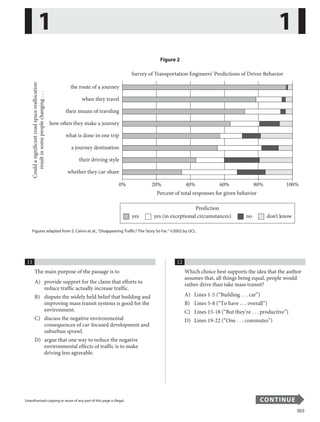
Figure 1
Region
Southampton
city center
Rathausplatz,
Nürnberg
Tower Bridge,
London
New York
highway
Kinnaird Bridge,
Edmonton
Before
alteration
Vehicles per day
on altered road
5,316
24,584
44,242
110,000
1,300
Before
alteration
Vehicles per day on
surrounding roads
26,522
67,284
103,262
540,000
2,130
After
alteration
3,081
0
0
50,000
0
After
alteration
24,101
55,824
111,999
560,000
2,885
Change
in traffic*
–87.5%
–146.6%
–80.3%
–36.4%
–41.9%
Effect of Route Capacity Reduction in Selected Regions
*Change in regional traffic in proportion to traffic previously using the altered road
1 1
Unauthorized copying or reuse of any part of this page is illegal. CONTINUE
6
303
Unauthorized copying or reuse of any part of this page is illegal. CONTINUE
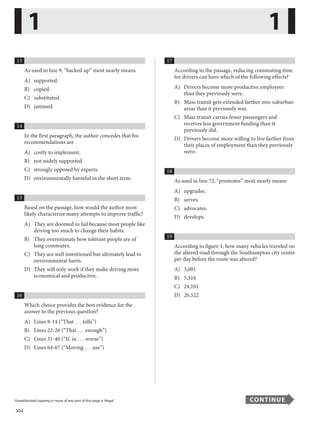
Figure 2
the route of a journey
Could
a
significant
road
space
reallocation
result
in
some
people
changing
.
.
.
when they travel
their means of traveling
how often they make a journey
what is done in one trip
a journey destination
their driving style
whether they car-share
Survey of Transportation Engineers’ Predictions of Driver Behavior
0% 20% 40%
Percent of total responses for given behavior
60% 80% 100%
Prediction
yes yes (in exceptional circumstances) no don’t know
Figures adapted from S. Cairns et al., “Disappearing Traffic? The Story So Far.” ©2002 by UCL.
11
The main purpose of the passage is to
A) provide support for the claim that efforts to
reduce traffic actually increase traffic.
B) dispute the widely held belief that building and
improving mass transit systems is good for the
environment.
C) discuss the negative environmental
consequences of car-focused development and
suburban sprawl.
D) argue that one way to reduce the negative
environmental effects of traffic is to make
driving less agreeable.
12
Which choice best supports the idea that the author
assumes that, all things being equal, people would
rather drive than take mass transit?
A) Lines 1-5 (“Building . . . car”)
B) Lines 5-8 (“To have . . . overall”)
C) Lines 15-18 (“But they’re . . . productive”)
D) Lines 19-22 (“One . . . commutes”)
1 1
...................................................................................................................
Unauthorized copying or reuse of any part of this page is illegal. CONTINUE
7
304
Unauthorized copying or reuse of any part of this page is illegal. CONTINUE
13
As used in line 9, “backed up” most nearly means
A) supported.
B) copied.
C) substituted.
D) jammed.
14
In the first paragraph, the author concedes that his
recommendations are
A) costly to implement.
B) not widely supported.
C) strongly opposed by experts.
D) environmentally harmful in the short term.
15
Based on the passage, how would the author most
likely characterize many attempts to improve traffic?
A) They are doomed to fail because most people like
driving too much to change their habits.
B) They overestimate how tolerant people are of
long commutes.
C) They are well intentioned but ultimately lead to
environmental harm.
D) They will only work if they make driving more
economical and productive.
16
Which choice provides the best evidence for the
answer to the previous question?
A) Lines 8-14 (“That . . . tolls”)
B) Lines 22-26 (“That . . . enough”)
C) Lines 31-40 (“If, in . . . worse”)
D) Lines 64-67 (“Moving . . . use”)
17
According to the passage, reducing commuting time
for drivers can have which of the following effects?
A) Drivers become more productive employees
than they previously were.
B) Mass transit gets extended farther into suburban
areas than it previously was.
C) Mass transit carries fewer passengers and
receives less government funding than it
previously did.
D) Drivers become more willing to live farther from
their places of employment than they previously
were.
18
As used in line 72, “promotes” most nearly means
A) upgrades.
B) serves.
C) advocates.
D) develops.
19
According to figure 1, how many vehicles traveled on
the altered road through the Southampton city center
per day before the route was altered?
A) 3,081
B) 5,316
C) 24,101
D) 26,522
1 1
...............................................................................................................................................................................................................................................................................................................
Unauthorized copying or reuse of any part of this page is illegal. CONTINUE
8
305
Unauthorized copying or reuse of any part of this page is illegal. CONTINUE
20
Do the data in figure 1 support or weaken the
argument of the author of the passage, and why?
A) Support, because the data show that merely
moving drivers out of cars can induce traffic.
B) Support, because the data show that reducing
road capacity can lead to a net reduction in
traffic.
C) Weaken, because the data show that in some
cases road alterations lead to greater traffic on
surrounding roads.
D) Weaken, because the data show that traffic
reductions due to road alterations tend to be
brief.
21
Based on figure 2, the engineers surveyed were most
skeptical of the idea that in the event of a reallocation
of road space, drivers would change
A) when they travel.
B) their means of traveling.
C) how often they make a journey.
D) their driving style.
1 1
...............................................................................................................................................................................................................................................................................................................
Unauthorized copying or reuse of any part of this page is illegal. CONTINUE
9
306
Unauthorized copying or reuse of any part of this page is illegal. CONTINUE
Questions 22-32 are based on the following
passage.
This passage is adapted from Sabrina Richards, “Pleasant to
the Touch.” ©2012 by The Scientist.
In the early 1990s, textbooks acknowledged that
humans had slow-conducting nerves, but asserted
that those nerves only responded to two types of
stimuli: pain and temperature. Sensations of pressure
Line
5 and vibration were believed to travel only along
myelinated, fast-signaling nerve fibers, which also
give information about location. Experiments
blocking nerve fibers supported this notion.
Preventing fast fibers from firing (either by clamping
10 the relevant nerve or by injecting the local anesthetic
lidocaine) seemed to eliminate the sensation of
pressure altogether, but blocking slow fibers only
seemed to reduce sensitivity to warmth or a small
painful shock.
15 Håkan Olausson and his Gothenburg University
colleagues Åke Vallbo and Johan Wessberg
wondered if slow fibers responsive to gentle pressure
might be active in humans as well as in other
mammals. In 1993, they corralled 28 young
20 volunteers and recorded nerve signals while gently
brushing the subjects’ arms with their fingertips.
Using a technique called microneurography, in
which a fine filament is inserted into a single nerve to
capture its electrical impulses, the scientists were able
25 to measure how quickly—or slowly—the nerves
fired. They showed that soft stroking prompted
two different signals, one immediate and one
delayed. The delay, Olausson explains, means that
the signal from a gentle touch on the forearm will
30 reach the brain about a half second later. This delay
identified nerve impulses traveling at speeds
characteristic of slow, unmyelinated fibers—about
1 meter/second—confirming the presence of these
fibers in human hairy skin. (In contrast, fast-
35 conducting fibers, already known to respond to
touch, signal at a rate between 35 and 75 m/s.)
Then, in 1999, the group looked more closely at
the characteristics of the slow fibers. They named
these “low-threshold” nerves “C-tactile,” or CT,
40 fibers, said Olausson, because of their “exquisite
sensitivity” to slow, gentle tactile stimulation, but
unresponsiveness to noxious stimuli like pinpricks.
But why exactly humans might have such fibers,
which respond only to a narrow range of rather
45 subtle stimuli, was initially mystifying. Unlike other
types of sensory nerves, CT fibers could be found
only in hairy human skin—such as the forearm and
thigh. No amount of gentle stroking of hairless skin,
such as the palms and soles of the feet, prompted
50 similar activity signatures. Olausson and his
colleagues decided that these fibers must be
conveying a different dimension of sensory
information than fast-conducting fibers.
Although microneurography can give
55 information about how a single nerve responds to
gentle brushing and pressure, it cannot tease out
what aspect of sensation that fiber relays, says
Olausson. He wanted to know if that same slow
nerve can distinguish where the brush touches the
60 arm, and whether it can discern the difference
between a goat-hair brush and a feather. Most
importantly, could that same fiber convey a pleasant
sensation?
To address the question, Olausson’s group sought
65 out a patient known as G.L. who had an unusual
nerve defect. More than 2 decades earlier, she had
developed numbness across many parts of her body
after taking penicillin to treat a cough and fever.
Testing showed that she had lost responsiveness to
70 pressure, and a nerve biopsy confirmed that G.L.’s
quick-conducting fibers were gone, resulting in an
inability to sense any pokes, prods, or pinpricks
below her nose. But she could still sense warmth,
suggesting that her slow-conducting unmyelinated
75 fibers were intact.
Upon recruiting G.L., Olausson tested her by
brushing her arm gently at the speed of between
2–10 centimeters per second. She had more trouble
distinguishing the direction or pressure of the brush
80 strokes than most subjects, but reported feeling a
pleasant sensation. When the researchers tried
brushing her palm, where CT fibers are not found,
she felt nothing.
Olausson used functional MRI studies to examine
85 which areas of the brain lit up when G.L.’s arm was
gently brushed to activate CT fibers. In normal
subjects, both the somatosensory and insular cortices
were activated, but only the insular cortex [which
processes emotion] was active when researchers
90 brushed G.L.’s arm. This solidified the notion that
CT fibers convey a more emotional quality of touch,
rather than the conscious aspect that helps us
describe what we are sensing. CT fibers, it seemed,
specifically provide pleasurable sensations.
1 1
...............................................................................................................................................................................................................................................................................................................
Unauthorized copying or reuse of any part of this page is illegal. CONTINUE
10
307
Unauthorized copying or reuse of any part of this page is illegal. CONTINUE
22
Based on the passage, textbook authors in the early
1990s would most likely have expected which
condition to result from the blocking of fast fibers?
A) The rate at which other nerve fibers fired would
increase.
B) The test subject would perceive gentle stimuli as
painful.
C) The body would compensate by using slow fibers
to sense pressure.
D) The ability to perceive vibrations would be
impaired.
23
Which choice provides the best evidence for the
answer to the previous question?
A) Lines 1-4 (“In the . . . temperature”)
B) Lines 4-7 (“Sensations . . . location”)
C) Lines 12-14 (“blocking . . . shock”)
D) Lines 34-36 (“In contrast . . . 75 m/s”)
24
As used in line 18, “active” most nearly means
A) present.
B) attentive.
C) movable.
D) restless.
25
As used in line 24, “capture” most nearly means
A) occupy.
B) seize.
C) record.
D) influence.
26
Which conclusion is best supported by the findings
of Olausson’s 1993 experiment?
A) Stimulation at bodily extremities can be sensed
as rapidly as stimulation closer to the brain.
B) The presence of hairs in human skin lessens the
speed with which nerves conduct signals.
C) Gentle pressure is sensed not only by fast fibers
but also by slow fibers.
D) The speed at which a nerve fires is dependent on
the strength of pressure applied to the nerve.
27
Which choice provides the best evidence for the
answer to the previous question?
A) Lines 22-26 (“Using . . . fired”)
B) Lines 26-28 (“They . . . delayed”)
C) Lines 28-30 (“The delay . . . later”)
D) Lines 37-38 (“Then . . . fibers”)
28
The sentence in lines 43-45 (“But . . . mystifying”)
serves mainly to
A) identify factors that Olausson had previously
failed to consider.
B) propose a solution to a dilemma encountered by
Olausson.
C) anticipate a potential criticism of Olausson by
the reader.
D) show a problem from the perspective of
Olausson’s team.
1 1
...............................................................................................................................................................................................................................................................................................................
Unauthorized copying or reuse of any part of this page is illegal. CONTINUE
11
308
Unauthorized copying or reuse of any part of this page is illegal. CONTINUE
29
It can reasonably be inferred that one of the intended
goals of the 1999 experiment was to determine the
A) precise nature of sensations that CT fibers can
convey.
B) relationship between body hair and CT fiber
function.
C) role played by CT fibers in the perception of
pain.
D) effect of microneurography on CT fiber
signaling.
30
The main purpose of the sixth paragraph
(lines 64-75) is to
A) identify those of G.L.’s neurological conditions
that might be relieved by the experiment.
B) contextualize the nerve function of G.L. by
comparing it with that of other adults.
C) detail procedures that G.L. had experienced
during previous experiments.
D) indicate why G.L.’s medical condition was of
value to Olausson’s experiment.
31
According to the passage, G.L. differed from
Olausson’s other test subjects in terms of the
A) number of cortices activated in the brain during
gentle brushing.
B) physical dimensions of the somatosensory
cortex.
C) intensity of nerve signals required to activate the
insular cortex.
D) effect of MRI scanning on the basic function of
brain cortices.
32
According to the passage, humans experience an
emotional aspect of touch when
A) brain cortices are shielded from nerve signals.
B) CT fibers are exposed to a stimulus.
C) nerve fibers that sense pain are suppressed.
D) conscious aspects of sensation are ignored.
1 1
...............................................................................................................................................................................................................................................................................................................
Unauthorized copying or reuse of any part of this page is illegal. CONTINUE
12
309
Unauthorized copying or reuse of any part of this page is illegal. CONTINUE
Questions 33-42 are based on the following
passages.
Passage 1 is adapted from a speech delivered in 1898 by
Albert J. Beveridge, “March of the Flag.” Passage 2 is
adapted from a speech delivered in 1900 by William
Jennings Bryan, “Imperialism.”
Passage 1
Fellow-Citizens: It is a noble land that God has
given us; a land that can feed and clothe the world; a
land whose coast lines would enclose half the
countries of Europe; a land set like a sentinel between
Line
5 the two imperial oceans of the globe; a greater
England with a nobler destiny. It is a mighty people
that He has planted on this soil; a people sprung
from the most masterful blood of history; a people
perpetually revitalized by the virile . . . working-folk
10 of all the earth; a people imperial by virtue of their
power, by right of their institutions, by authority of
their heaven-directed purposes—the propagandists
and not the misers of liberty. It is a glorious history
our God has bestowed upon His chosen people; a
15 history whose keynote was struck by Liberty Bell; a
history heroic with faith in our mission and our
future; a history of statesmen, who flung the
boundaries of the Republic out into unexplored
lands . . . a history of soldiers, who carried the flag
20 across blazing deserts and through the ranks of
hostile mountains, even to the gates of sunset; a
history of a multiplying people, who overran a
continent in half a century . . . a history divinely
logical, in the process of whose tremendous
25 reasoning we find ourselves to-day. . . .
Think of the thousands of Americans who will
pour into Hawaii and Porto Rico when the
Republic’s laws cover those islands with justice and
safety! Think of the tens of thousands of Americans
30 who will invade . . . the Philippines when a liberal
government . . . shall establish order and equity
there! Think of the hundreds of thousands of
Americans who will build a . . . civilization of energy
and industry in Cuba, when a government of law
35 replaces the double reign of anarchy and tyranny!—
think of the prosperous millions that Empress of
Islands will support when, obedient to the law of
political gravitation, her people ask for the highest
honor liberty can bestow, the sacred Order of the
40 Stars and Stripes, the citizenship of the Great
Republic!
Passage 2
If it is right for the United States to hold the
Philippine Islands permanently and imitate
European empires in the government of colonies, the
45 Republican party ought to state its position and
defend it, but it must expect the subject races to
protest against such a policy and to resist to the
extent of their ability.
The Filipinos do not need any encouragement
50 from Americans now living. Our whole history has
been an encouragement not only to the Filipinos, but
to all who are denied a voice in their own
government. If the Republicans are prepared to
censure all who have used language calculated to
55 make the Filipinos hate foreign domination, let them
condemn the speech of Patrick Henry. When he
uttered that passionate appeal, “Give me liberty or
give me death,” he exprest a sentiment which still
echoes in the hearts of men.
60 Let them censure Jefferson; of all the statesmen of
history none have used words so offensive to those
who would hold their fellows in political bondage.
Let them censure Washington, who declared that the
colonists must choose between liberty and slavery.
65 Or, if the statute of limitations has run against
the sins of Henry and Jefferson and Washington, let
them censure Lincoln, whose Gettysburg speech will
be quoted in defense of popular government when
the present advocates of force and conquest are
70 forgotten.
Some one has said that a truth once spoken can
never be recalled. It goes on and on, and no one can
set a limit to its ever-widening influence. But if it
were possible to obliterate every word written or
75 spoken in defense of the principles set forth in the
Declaration of Independence, a war of conquest
would still leave its legacy of perpetual hatred, for it
was God himself who placed in every human heart
the love of liberty. He never made a race of people so
80 low in the scale of civilization or intelligence that it
would welcome a foreign master.
Those who would have this Nation enter upon a
career of empire must consider, not only the effect of
imperialism on the Filipinos, but they must also
85 calculate its effects upon our own nation. We cannot
repudiate the principle of self-government in the
Philippines without weakening that principle here.
1 1
...............................................................................................................................................................................................................................................................................................................
Unauthorized copying or reuse of any part of this page is illegal. CONTINUE
13
310
Unauthorized copying or reuse of any part of this page is illegal. CONTINUE
33
In Passage 1, Beveridge asserts that the resources and
immensity of the United States constitute a
A) safeguard against foreign invasion.
B) replication of conditions in Europe.
C) divine gift to the American people.
D) source of envy for people in other countries.
34
In the second paragraph of Passage 1 (lines 26-41),
the commands given by Beveridge mainly serve to
A) remind the audience of its civic responsibilities.
B) anticipate the benefits of a proposed policy.
C) emphasize the urgency of a national problem.
D) refute arguments that opponents have advanced.
35
As used in line 72, “recalled” most nearly means
A) repeated.
B) retracted.
C) rejected.
D) remembered.
36
It can reasonably be inferred from Passage 2 that
Bryan considers the preference for national
sovereignty over foreign rule to be a
A) reaction to the excesses of imperial governments
in the modern era.
B) sign that the belief in human equality is
widespread.
C) testament to the effects of the foreign policy of
the United States.
D) manifestation of an innate drive in humans
toward self-rule.
37
Which choice provides the best evidence for the
answer to the previous question?
A) Lines 53-56 (“If the . . . Henry”)
B) Lines 72-73 (“It goes . . . influence”)
C) Lines 79-81 (“He never . . . master”)
D) Lines 82-85 (“Those . . . nation”)
38
As used in line 85, “calculate” most nearly means
A) evaluate.
B) design.
C) assume.
D) multiply.
39
In developing their respective arguments, Beveridge
(Passage 1) and Bryan (Passage 2) both express
admiration for the
A) founding and history of the United States.
B) vibrancy and diversity of American culture.
C) worldwide history of struggles for independence.
D) idealism that permeates many aspects of
American society.
1 1
...............................................................................................................................................................................................................................................................................................................
Unauthorized copying or reuse of any part of this page is illegal. CONTINUE
14
311
Unauthorized copying or reuse of any part of this page is illegal. CONTINUE
40
Which choice best describes a central difference
between how Beveridge (Passage 1) and Bryan
(Passage 2) view the concept of liberty as it is realized
in the United States?
A) Beveridge presents it as the direct inheritance of
European colonization, whereas Bryan presents
it as a sharp break from earlier governments in
Europe.
B) Beveridge considers it so exemplary as to justify
conquest of other regions, whereas Bryan warns
that its exemplary quality would be undermined
by imperial expansion.
C) Beveridge argues that it arose organically as the
United States matured, whereas Bryan argues
that it was present from the country’s
beginnings.
D) Beveridge regards it as a model that should be
shared with other countries, whereas Bryan
believes that it is unique to the United States and
could not work elsewhere.
41
It can most reasonably be inferred from Passage 2
that Bryan would criticize the vision of American
governance of island territories that Beveridge
presents in Passage 1 for being
A) unrealistic, since most Americans would be
unwilling to relocate to distant islands.
B) deceptive, since economic domination would be
the true goal of the American government.
C) impractical, since the islanders would insist
upon an equal distribution of resources.
D) naive, since the islanders would object to being
governed by Americans.
42
Which choice from Passage 2 provides the best
evidence for the answer to the previous question?
A) Lines 42-48 (“If it . . . ability”)
B) Lines 49-50 (“The Filipinos . . . living”)
C) Lines 50-53 (“Our . . . government”)
D) Lines 56-59 (“When . . . men”)
1 1
...............................................................................................................................................................................................................................................................................................................
Unauthorized copying or reuse of any part of this page is illegal. CONTINUE
15
312
Unauthorized copying or reuse of any part of this page is illegal. CONTINUE
Questions 43-52 are based on the following
passage and supplementary material.
This passage is adapted from Peter A. Ensminger, Life Under
the Sun. ©2001 by Peter A. Ensminger.
Many millennia before the invention of
herbicides, farmers simply plowed their fields to
control weeds. Even today, plowing can constitute a
valuable part of an integrated weed-management
Line
5 program. Although plowing kills standing weeds,
farmers have long known that it often leads to the
emergence of new weed seedlings in a few weeks.
Ecologists have shown that a farmer’s field can
have 50,000 or more weed seeds per square meter
10 buried beneath the soil surface. Plant physiologists
have shown that seeds buried more than about one
centimeter below the soil surface do not receive
enough light to germinate. Do the blades of a plow,
which can reach more than a foot beneath the soil
15 surface, bring some of these buried seeds to the
surface where their germination is induced by
exposure to sunlight?
Two ecologists, Jonathan Sauer and Gwendolyn
Struik, began to study this question in the 1960s. In a
20 relatively simple experiment, they went to ten
different habitats in Wisconsin during the night and
collected pairs of soil samples. They stirred up the
soil in one sample of each pair in the light and stirred
up the other sample of each pair in the dark. They then
25 exposed all ten pairs to natural sunlight in a
greenhouse. For nine of the ten pairs of soil samples,
weed growth was greater in the samples stirred up in
light. They concluded that soil disturbance gives
weed seeds a “light break,” and this stimulates their
30 germination.
More recently, Karl Hartmann of Erlangen
University in Germany reasoned that when farmers
plowed their fields during the day, the buried weed
seeds are briefly exposed to sunlight as the soil is
35 turned over, and that this stimulates their
germination. Although the light exposures from
plowing may be less than one millisecond, that can
be enough to induce seed germination. Thus the
germination of weed seeds would be minimized if
40 farmers simply plowed their fields during the night,
when the photon fluence rate [the rate at which
photons hit the surface] is below 1015
photons per
square meter per second. Although even under these
conditions hundreds of millions of photons strike
45 each square millimeter of ground each second, this
illumination is below the threshold needed to
stimulate the germination of most seeds.
Hartmann says that he was very skeptical when
he first came up with this idea because he assumed
50 that such a simple method of weed control as
plowing at nighttime must be ineffective or it would
have been discovered long ago. But the subsequent
experiments, first presented at a 1989 scientific
meeting in Freiburg, Germany, clearly demonstrated
55 that the method can be effective.
Hartmann tested his idea by plowing two
agricultural strips near Altershausen, Germany.
The farmer Karl Seydel cultivated one strip, repeated
threefold, at around midday and the other strip
60 at night. No crops were planted in these pilot
experiments, to avoid possible competition with
the emerging weeds. The results were dramatic.
More than 80 percent of the surface of the field
plowed in daylight was covered by weeds, whereas
65 only about 2 percent of the field plowed at night was
covered by weeds.
This method of weed control is currently being
used by several farmers in Germany. Because many
of the same weed species that invade farmers’ fields
70 in Germany also invade fields elsewhere in the world,
this method should be successful elsewhere. In fact,
recent studies at universities in Nebraska, Oregon,
Minnesota, Denmark, Sweden, and Argentina
support this idea.
1 1
...............................................................................................................................................................................................................................................................................................................
Unauthorized copying or reuse of any part of this page is illegal. CONTINUE
16
313
Unauthorized copying or reuse of any part of this page is illegal. CONTINUE
Number of Emerged Seedlings in Soil Samples
One Month after Soil Was Disturbed
Sample Source of soil
Number of emerged
seedlings in soil
disturbed in
light darkness
A deciduous woods 4 0
B deciduous woods 2 1
C deciduous woods 6 2
D conifer plantation 8 3
E conifer plantation 2 1
F tall-grass prairie 5 1
G old pasture 0
H old pasture 2
I muck field 14 2
J muck field 5
2
1
3
Adapted from Jonathan Sauer and Gwendolyn Struik, “A Possible
Ecological Relation between Soil Disturbance, Light-Flash, and Seed
Germination.” ©1964 by Jonathan Sauer and Gwendolyn Struik.
43
According to the passage, exposure to light allows
seeds to
A) begin to develop.
B) absorb necessary nutrients.
C) withstand extreme temperatures.
D) achieve maximum growth.
44
The question in the second paragraph (lines 13-17)
primarily serves to
A) emphasize the provisional nature of the findings
discussed in the passage.
B) introduce the specific research topic addressed in
the passage.
C) suggest the hypothetical impact of the studies
analyzed in the passage.
D) indicate the level of disagreement about the
methods explored in the passage.
45
As used in line 16, “induced” most nearly means
A) lured.
B) established.
C) convinced.
D) stimulated.
46
Which choice best supports the idea that seeds
present in fields plowed at night are exposed to some
amount of light?
A) Lines 31-36 (“More . . . germination”)
B) Lines 36-38 (“Although . . . germination”)
C) Lines 43-47 (“Although . . . seeds”)
D) Lines 48-52 (“Hartmann . . . ago”)
47
The passage suggests that if Seydel had planted wheat
or corn on the two agricultural strips in Hartmann’s
experiment, the percentage of the surface of each
strip covered with weeds would likely have been
A) lower than the percentage that Hartmann found.
B) higher than the percentage that Hartmann had
predicted.
C) nearly impossible for Hartmann to determine.
D) comparable to Hartmann’s original projection.
48
Which choice provides the best evidence for the
answer to the previous question?
A) Lines 56-60 (“Hartmann . . . night”)
B) Lines 60-62 (“No crops . . . weeds”)
C) Line 62 (“The results . . . dramatic”)
D) Lines 63-66 (“More . . . weeds”)
1 1
...............................................................................................................................................................................................................................................................................................................
Unauthorized copying or reuse of any part of this page is illegal. CONTINUE
17
314
Unauthorized copying or reuse of any part of this page is illegal. CONTINUE
49
As used in line 62, “dramatic” most nearly means
A) theatrical.
B) sudden.
C) impressive.
D) emotional.
50
According to the table, in which soil sample
disturbed in darkness did the fewest number of
seedlings emerge?
A) Sample A
B) Sample B
C) Sample C
D) Sample D
51
As presented in the table, which sample produced the
most seedlings when the soil was disturbed in light?
A) Sample G
B) Sample H
C) Sample I
D) Sample J
52
The data presented in the table most directly support
which claim from the passage?
A) Lines 1-3 (“Many . . . weeds”)
B) Lines 8-10 (“Ecologists . . . surface”)
C) Lines 10-13 (“Plant . . . germinate”)
D) Lines 38-43 (“Thus . . . second”)
STOP
If you finish before time is called, you may check your work on this section only.
Do not turn to any other section.
1 1
.....................................................................................................................................................................................................................................................
Unauthorized copying or reuse of any part of this page is illegal. 18
No Test Material On This Page
316
Unauthorized copying or reuse of any part of this page is illegal. CONTINUE
Writing and Language Test
35 MINUTES, 44 QUESTIONS
Turn to Section 2 of your answer sheet to answer the questions in this section.
Each passage below is accompanied by a number of questions. For some questions, you
will consider how the passage might be revised to improve the expression of ideas. For
other questions, you will consider how the passage might be edited to correct errors in
sentence structure, usage, or punctuation. A passage or a question may be accompanied by
one or more graphics (such as a table or graph) that you will consider as you make revising
and editing decisions.
Some questions will direct you to an underlined portion of a passage. Other questions will
direct you to a location in a passage or ask you to think about the passage as a whole.
After reading each passage, choose the answer to each question that most effectively
improves the quality of writing in the passage or that makes the passage conform to the
conventions of standard written English. Many questions include a“NO CHANGE”option.
Choose that option if you think the best choice is to leave the relevant portion of the
passage as it is.
Questions 1-11 are based on the following passage.
How a Cat in a Hat Changed Children’s Education
In a 1954 Life magazine article, author John Hersey
expressed concern that children in the United States were
disengaged from learning how to read. Among other
problems, Hersey noted, the reading material available to
grade-schoolers had a hard time competing with
television, radio, 1 and other media for children’s
attention. One solution he proposed was to make
2 2
...................................................................................................................................
Unauthorized copying or reuse of any part of this page is illegal. CONTINUE
1
A) NO CHANGE
B) and with
C) and also
D) and competing with
20
317
Unauthorized copying or reuse of any part of this page is illegal. CONTINUE
children’s books more 2 interesting, since “an
individual’s sense of wholeness . . . follows, and cannot
precede, a sense of accomplishment.”
The story of The Cat in the Hat’s publication began
when William 3 Spaulding, the director of the
education division at the publishing company
Houghton Mifflin, read Hersey’s article and had an idea.
Spaulding agreed that there was a need for appealing
books for beginning 4 readers. He thought he knew
who should write one. He arranged to have dinner with
Theodor Geisel, who wrote and illustrated children’s
books under the name “Dr. Seuss,” and issued him a
challenge: “Write me a story that first graders can’t put
......................................................................................................
down!”
...........................
2 2
.........................
.....................................................................................................................................................
Unauthorized copying or reuse of any part of this page is illegal. CONTINUE
2
The writer wants to include a quotation by Hersey
that supports the topic of the passage. Which choice
best accomplishes this goal?
A) NO CHANGE
B) interesting, since “learning starts with failure; the
first failure is the beginning of education.”
C) interesting because “journalism allows its readers
to witness history; fiction gives its readers an
opportunity to live it.”
D) interesting with “drawings like those of the
wonderfully imaginative geniuses among
children’s illustrators.”
3
A) NO CHANGE
B) Spaulding the director
C) Spaulding, the director,
D) Spaulding—the director
4
Which choice most effectively combines the
sentences at the underlined portion?
A) readers, and he
B) readers—namely, he
C) readers; and Spaulding
D) readers, and meanwhile he
21
318
Unauthorized copying or reuse of any part of this page is illegal. CONTINUE
Having 5 known Spaulding for many years and
having maintained a professional relationship with him,
Geisel was an experienced writer and illustrator.
6 However, this new project presented him with an
obstacle. Spaulding told Geisel to write his entire book
using a restricted vocabulary from an elementary school
list of 348 words. Geisel started two stories, only to
abandon them when he found that he needed to use
words that were not on the list. On the verge of giving up,
7 Geisel’s story finally hit upon an image that became
its basis: a cat wearing a battered stovepipe hat. His main
character established, Geisel commenced the difficult task
of writing a book with a limited vocabulary. 8 At the
end of a duration nine months long, The Cat in the Hat
was complete.
2 2
...............................................................................................................................................................................................................................................................................................................
Unauthorized copying or reuse of any part of this page is illegal. CONTINUE
5
Which choice best supports the information that
follows in the sentence?
A) NO CHANGE
B) acquired a reputation for perfectionism and for
setting high standards for his work,
C) been interested in politics before breaking into
the genre of children’s literature,
D) published nine children’s books and having
received three nominations for the prestigious
Caldecott Medal,
6
A) NO CHANGE
B) For example,
C) Furthermore,
D) At any rate,
7
A) NO CHANGE
B) an image that Geisel finally hit upon became the
basis of his story:
C) Geisel finally hit upon the image that became the
basis for his story:
D) the story was finally based on an image that
Geisel hit upon:
8
A) NO CHANGE
B) After thirty-six weeks—or nine months—had
passed,
C) After a length of nine months had elapsed,
D) Nine months later,
22
319
Unauthorized copying or reuse of any part of this page is illegal. CONTINUE
The book was a hit. Children were entertained by its
plot about the antics of a mischievous cat and 9 is
captivated by its eye-catching illustrations and
memorable rhythms and rhymes. Its sales inspired
another publishing company, Random House, to
establish a series for early readers called Beginner Books,
which featured works by Geisel and other writers, and
other publishers quickly followed suit. In the years that
10 followed. Many talented writers and illustrators of
children’s books imitated Geisel’s formula of restricted
vocabulary and whimsical artwork. But perhaps the best
proof of The Cat in the Hat’s success is not its influence
on other books but its 11 limited vocabulary and
appealing word choices.
2 2
...............................................................................................................................................................................................................................................................................................................
Unauthorized copying or reuse of any part of this page is illegal. CONTINUE
9
A) NO CHANGE
B) was
C) has been
D) DELETE the underlined portion.
10
A) NO CHANGE
B) followed; many
C) followed, many
D) followed—many
11
The writer wants a conclusion that restates the
main themes of the passage. Which choice best
accomplishes this goal?
A) NO CHANGE
B) impressive worldwide sales that continue to
remain high to this day.
C) enduring ability to delight children and engage
them in learning how to read.
D) important role in the history of illustration in
the twentieth century.
23
320
Unauthorized copying or reuse of any part of this page is illegal. CONTINUE
Questions 12-22 are based on the following passage.
Keep Student Volunteering Voluntary
A growing number of public schools in the
United States require students to complete community
service hours to graduate. Such volunteering, be it
helping at a local animal shelter, 12 when they pick up
litter, or working at a health-care facility, has obvious
benefits for the community it serves and teaches students
important life skills. But critics say that making
volunteerism compulsory misses the point of the act.
13 By its very definition, volunteer work is done
willingly. By requiring students to do community service
in order to graduate, school 14 officials’ are taking away
students’ choice to give up their time for nonprofit
activities, making volunteerism less meaningful and
pleasurable. According to a psychological concept called
the reactance theory, the loss of freedom in choosing an
activity can cause a negative reaction. For instance,
instead of focusing on the good they are doing, students
may become resentful of the demands that compulsory
volunteering places on their schedules.
2 2
...............................................................................................................................................................................................................................................................................................................
Unauthorized copying or reuse of any part of this page is illegal. CONTINUE
12
A) NO CHANGE
B) to pick up litter,
C) litter collection,
D) picking up litter,
13
The writer wants a transition from the previous
paragraph that highlights the criticism of compulsory
volunteering mentioned in the previous paragraph.
Which choice best accomplishes this goal?
A) NO CHANGE
B) Whatever the work may be,
C) For many students,
D) Fortunately for communities in need,
14
A) NO CHANGE
B) officials are taking away students
C) officials are taking away student’s
D) officials are taking away students’
24
321
Unauthorized copying or reuse of any part of this page is illegal. CONTINUE
Proponents of compulsory 15 volunteering who are
in favor of it point out that it allows young people to
garner the benefits that volunteering offers. Students who
volunteer report increased self-esteem, better
relationship-building skills, and 16 increasingly busy
schedules. Some studies have also found that students
who do community service are more likely to volunteer
as adults, and thus 17 effect society positively over the
course of many years.
2 2
...............................................................................................................................................................................................................................................................................................................
Unauthorized copying or reuse of any part of this page is illegal. CONTINUE
15
A) NO CHANGE
B) volunteering, advocating it,
C) volunteering
D) volunteering and its advocates
16
Which choice provides a supporting example that is
most similar to the examples already in the sentence?
A) NO CHANGE
B) a closer connection with their community.
C) less time spent engaging in social activities.
D) little increase in academic achievement.
17
A) NO CHANGE
B) affect
C) effecting
D) affects
25
322
Unauthorized copying or reuse of any part of this page is illegal. CONTINUE
However, most research looks at students who
volunteer in general, not making a distinction between
students who are required to volunteer by their schools
and those who volunteer willingly. One recent study by
Sara E. Helms, assistant professor of economics at
Samford University in Birmingham, Alabama, did focus
specifically on 18 mandatory volunteering. She found
that students who were required to volunteer rushed to
complete their service hours in early high 19 school,
they then did significantly less regular volunteer work in
the twelfth grade 20 than the service hours of those not
required to volunteer. Helms concluded that compulsory
volunteering does not necessarily create lifelong
volunteers.
2 2
...............................................................................................................................................................................................................................................................................................................
Unauthorized copying or reuse of any part of this page is illegal. CONTINUE
18
A) NO CHANGE
B) coercive
C) forcible
D) imperative
19
A) NO CHANGE
B) school; they then,
C) school. They, then
D) school; they then
20
A) NO CHANGE
B) than did students who were
C) than hours worked by students
D) compared with students
26
323
Unauthorized copying or reuse of any part of this page is illegal. CONTINUE
Instead of requiring students to volunteer, schools
21 have to recognize that not all students are equally
well suited to the same activities. Many studies show that
when schools simply tell students about opportunities for
community service and connect them with organizations
that need help, more students volunteer of their own
free will. 22
2 2
...............................................................................................................................................................................................................................................................................................................
Unauthorized copying or reuse of any part of this page is illegal. CONTINUE
21
Which choice most effectively sets up the point made
in the next sentence?
A) NO CHANGE
B) should allow students to spend their time
participating in athletics and other
extracurricular activities.
C) should focus on offering arrangements that
make volunteering an easy and attractive choice.
D) are advised to recognize the limits of their ability
to influence their students.
22
The writer wants a conclusion that states the main
claim of the passage. Which choice best accomplishes
this goal?
A) It is imperative that schools do their part to find
volunteers for the many worthwhile
organizations in the United States.
B) Schools that do this will produce more engaged,
enthusiastic volunteers than schools that require
volunteer work.
C) Studies in the fields of psychology and
economics have revolutionized researchers’
understanding of volunteerism.
D) It is important that students choose charitable
work that suits their interests and values.
27
324
Unauthorized copying or reuse of any part of this page is illegal. CONTINUE
Questions 23-33 are based on the following passage
and supplementary material.
Marsupials Lend a Hand to Science
Marsupials (mammals that carry their young in a
pouch) are a curiosity among biologists because they lack
a corpus callosum, the collection of nerve fibers
connecting the two hemispheres of the brain. In most
other mammals, the left hemisphere of the brain controls
the right side of the body, the right hemisphere controls
the left, and the corpus callosum allows communication
between the hemispheres. Scientists 23 are long
believing that this structure enables complex tasks by
sequestering skilled movement to a single hemisphere
without sacrificing coordination between both sides of
the body; this sequestration would explain handedness,
the tendency to consistently prefer 24 one hand over the
other, in humans. However, a recent finding of
handedness in marsupials suggests that a 25 trait other
than the presence of a corpus callosum 26 links as
handedness: bipedalism.
2 2
...............................................................................................................................................................................................................................................................................................................
Unauthorized copying or reuse of any part of this page is illegal. CONTINUE
23
A) NO CHANGE
B) will long be believing
C) have long believed
D) long believe
24
A) NO CHANGE
B) and favor the use of one hand over the other,
C) one hand over the other that could be chosen,
D) one hand on a regular basis,
25
A) NO CHANGE
B) trait,
C) trait;
D) trait:
26
A) NO CHANGE
B) correlates with
C) correlates from
D) links on
28
325
Unauthorized copying or reuse of any part of this page is illegal. CONTINUE
Researchers at Saint Petersburg State University and
the University of Tasmania observed marsupials walking
on either two legs (bipeds) or four (quadrupeds) and
performing tasks such as bringing food to their mouths.
The scientists employed a mean handedness index;
27 negative scores indicated a left-forelimb preference
and positive scores indicated a right-forelimb preference.
While eating, the eastern gray kangaroo, red-necked
wallaby, red 28 kangaroo and, brush-tailed bettong, all
bipedal marsupials, preferred using their left forelimb, as
revealed by 29 positive mean handedness index values
less than 0.2 for all four species. These results suggest
handedness among these animals.
2 2
...............................................................................................................................................................................................................................................................................................................
Unauthorized copying or reuse of any part of this page is illegal. CONTINUE
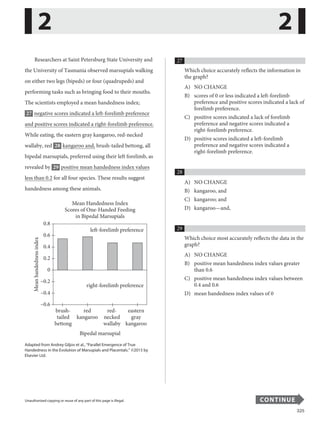
Mean Handedness Index
Scores of One-Handed Feeding
in Bipedal Marsupials
0.8
left-forelimb preference
0.6
index
0.4
handedness
0.2
0
n
a
e
–0.2
right-forelimb preference
M
–0.4
–0.6
brush- red red- eastern
tailed kangaroo necked gray
bettong wallaby kangaroo
Bipedal marsupial
Adapted from Andrey Giljov et al., “Parallel Emergence of True
Handedness in the Evolution of Marsupials and Placentals.” ©2015 by
Elsevier Ltd.
27
Which choice accurately reflects the information in
the graph?
A) NO CHANGE
B) scores of 0 or less indicated a left-forelimb
preference and positive scores indicated a lack of
forelimb preference.
C) positive scores indicated a lack of forelimb
preference and negative scores indicated a
right-forelimb preference.
D) positive scores indicated a left-forelimb
preference and negative scores indicated a
right-forelimb preference.
28
A) NO CHANGE
B) kangaroo, and
C) kangaroo; and
D) kangaroo—and,
29
Which choice most accurately reflects the data in the
graph?
A) NO CHANGE
B) positive mean handedness index values greater
than 0.6
C) positive mean handedness index values between
0.4 and 0.6
D) mean handedness index values of 0
29
326
Unauthorized copying or reuse of any part of this page is illegal. CONTINUE
30 Having four feet, quadrupedal marsupials in the
study did not show a strong preference for the use of one
forelimb. For instance, gray short-tailed opossums and
sugar gliders were assigned mean handedness values very
close to zero—they used their right and left forelimbs
nearly equally. In effect, the study provided no evidence
of handedness among quadrupedal marsupials.
2 2
...............................................................................................................................................................................................................................................................................................................
Unauthorized copying or reuse of any part of this page is illegal. CONTINUE
30
Which choice provides the best transition from the
previous paragraph?
A) NO CHANGE
B) Like most other mammals,
C) In contrast to their bipedal counterparts,
D) While using their forelimbs for eating,
30
327
Unauthorized copying or reuse of any part of this page is illegal. CONTINUE
31 Kangaroos, though, still do not exhibit
handedness to the extent that humans do. As the
researchers noted, the quadrupeds typically live in trees
and employ all four limbs in climbing. The bipeds, on the
other hand, are far less arboreal, leaving their forelimbs
relatively free for tasks in 32 whom handedness may
confer an evolutionary advantage. Why the majority of
marsupials studied preferred their left forelimbs while the
majority of humans prefer their right remains a mystery,
however, 33 as does the mechanism by which, in the
absence of a corpus callosum, the hemispheres of the
marsupial brain communicate.
2 2
...............................................................................................................................................................................................................................................................................................................
Unauthorized copying or reuse of any part of this page is illegal. CONTINUE
31
Which choice presents a main claim of the passage?
A) NO CHANGE
B) For the marsupials in the study, then,
handedness seems to be associated with
bipedalism.
C) There are many things scientists do not
understand about the marsupial brain.
D) Additional studies on this phenomenon will
need to be performed with other mammals.
32
A) NO CHANGE
B) which
C) what
D) whose
33
The writer wants to conclude the passage by recalling
a topic from the first paragraph that requires
additional research. Which choice best accomplishes
this goal?
A) NO CHANGE
B) though researchers should not neglect the sizable
minority of humans who are left handed.
C) and scientists believe that studies like this one
may someday yield insights into the causes of
certain neurological disorders.
D) and an additional study is planned to study
handedness in other animals that stand upright
only some of the time.
31
328
Unauthorized copying or reuse of any part of this page is illegal. CONTINUE
Questions 34-44 are based on the following passage.
An Employee Benefit That Benefits Employers
— 1 —
According to a 2014 report from the Society for
Human Resource Management, 54 percent of surveyed
companies provide tuition assistance to employees
pursuing an undergraduate degree, and 50 percent do so
for employees working toward a graduate degree.
34 Despite these findings, more companies should
consider helping employees pay for education because
doing so helps 35 increase customer satisfaction and
improve the quality of the companies’ business.
2 2
...............................................................................................................................................................................................................................................................................................................
Unauthorized copying or reuse of any part of this page is illegal. CONTINUE
34
Which choice provides the most effective transition
from the previous sentence to the information that
immediately follows in this sentence?
A) NO CHANGE
B) In addition to the 2014 report,
C) Although these levels are impressive,
D) Whether they want to or not,
35
Which choice most effectively establishes the main
idea of the passage?
A) NO CHANGE
B) solve the problem of rising tuition costs
C) strengthen the US economy
D) attract and retain employees
32
329
Unauthorized copying or reuse of any part of this page is illegal. CONTINUE
— 2 —
Tuition-reimbursement programs signal that
employers offer their 36 workers’ opportunities for
personal and professional development. According to
professor of management Peter Cappelli, such
opportunities are appealing to highly motivated and
disciplined individuals and may attract applicants with
these desirable qualities. Many in the business
community concur. Explaining his company’s decision to
expand its tuition-assistance program, John Fox, the
director of dealer training at Fiat Chrysler Automobiles
in the United States, 37 who stressed the importance of
drawing skilled employees to Fiat Chrysler’s car
dealerships: “This is a benefit that can surely bring top
talent to our dealers,” he said.
2 2
...............................................................................................................................................................................................................................................................................................................
Unauthorized copying or reuse of any part of this page is illegal. CONTINUE
36
A) NO CHANGE
B) workers opportunities’
C) workers opportunities
D) worker’s opportunity’s
37
A) NO CHANGE
B) stressed
C) stressing
D) and he stressed
33
330
Unauthorized copying or reuse of any part of this page is illegal. CONTINUE
— 3 —
Paying for tuition also helps businesses retain
38 employees. Retaining employees is important not
only because it ensures a skilled and experienced
workforce but also because it mitigates the considerable
costs of finding, hiring, and training new workers.
Employees whose tuition is reimbursed often stay with
their employer even after they complete their
39 degrees. Because their new qualifications give them
opportunities for advancement within the company. The
career of Valerie Lincoln, an employee at the aerospace
company United Technologies Corporation 40 (UTC)
is a significant success story for her company’s
tuition‑reimbursement program. In eight years at UTC,
Lincoln earned associate and bachelor’s degrees in
business and advanced from an administrative assistant
position to an accounting associate position. This allowed
UTC to retain an employee with a 41 deep knowledge of
her industry and years of valuable experience.
2 2
...............................................................................................................................................................................................................................................................................................................
Unauthorized copying or reuse of any part of this page is illegal. CONTINUE
38
Which choice most effectively combines the
sentences at the underlined portion?
A) employees, and this retention
B) employees, the retaining of whom
C) employees, which
D) employees; that
39
A) NO CHANGE
B) degrees: because
C) degrees because
D) degrees; because
40
A) NO CHANGE
B) (UTC)—
C) (UTC):
D) (UTC),
41
A) NO CHANGE
B) hidden
C) large
D) spacious
34
331
Unauthorized copying or reuse of any part of this page is illegal. CONTINUE
2 2
Unauthorized copying or reuse of any part of this page is illegal.
STOP
If you finish before time is called, you may check your work on this section only.
Do not turn to any other section.
.
.............................................................................................................................................................................................................................................................
35
— 4 —
Tuition reimbursement can be expensive, and many
companies would find it impractical to pay for multiple
degrees for all employees. Businesses have succeeded in
42 minimizing and keeping down costs and ensuring
the relevance of employees’ coursework by offering fixed
amounts of reimbursement each year and stipulating
which subjects workers can study. Even with these
methods, tuition reimbursement may not be appropriate
in all cases, especially if classes are likely 43 to divert
employees’ time and energy from their jobs.
Question 44 asks about the previous passage as a
whole.
42
A) NO CHANGE
B) minimizing costs associated with employees’
coursework
C) being effective at keeping down costs
D) keeping down costs
43
A) NO CHANGE
B) diverted
C) in diverting
D) diversions for
Think about the previous passage as a whole as you
answer question 44.
44
The writer wants to insert the following sentence.
Still, since securing an excellent workforce is
crucial to a business’s success, employers should
give serious thought to investing in
reimbursement programs.
To make the passage most logical, the sentence
should be placed immediately after the last sentence
in paragraph
A) 1.
B) 2.
C) 3.
D) 4.
332
Unauthorized copying or reuse of any part of this page is illegal. CONTINUE
Math Test – No Calculator
25 MINUTES, 20 QUESTIONS
Turn to Section 3 of your answer sheet to answer the questions in this section.
For questions 1-15, solve each problem, choose the best answer from the choices
provided, and fill in the corresponding bubble on your answer sheet. For questions 16-20,
solve the problem and enter your answer in the grid on the answer sheet. Please refer to
the directions before question 16 on how to enter your answers in the grid. You may use
any available space in your test booklet for scratch work.
1. The use of a calculator is not permitted.
2. All variables and expressions used represent real numbers unless otherwise indicated.
3. Figures provided in this test are drawn to scale unless otherwise indicated.
4. All figures lie in a plane unless otherwise indicated.
5. Unless otherwise indicated,the domain of a given function f is the set of all real numbers x for
which f(x) is a real number.
 45°
2x s√2
r c 60° s
h x
w b
30° 45°
b a s
x√3
1
A = 2
pr A = w A = bh c2
= a2
+ b2 Special Right Triangles
2
C = 2pr
h r r h h
h
w r w
 
4 1
V = wh V = r2
h V = r3
p V = 2
p pr h
3 3
The number of degrees of arc in a circle is 360.
The number of radians of arc in a circle is 2p.
The sum of the measures in degrees of the angles of a triangle is 180.
3 3
Unauthorized copying or reuse of any part of this page is illegal. CONTINUE
36
V =
1
3
wh
333
Unauthorized copying or reuse of any part of this page is illegal. CONTINUE
1
2z + 1 = z
What value of z satisfies the equation above?
A) −2
B) −1
C)
1
2
D) 1
2
A television with a price of $300 is to be purchased
with an initial payment of $60 and weekly payments
of $30. Which of the following equations can be used
to find the number of weekly payments, w, required
to complete the purchase, assuming there are no
taxes or fees?
A) 300 = 30w − 60
B) 300 = 30w
C) w
300 = 30 + 60
D) w
300 = 60 − 30
3
Shipping Charges
Merchandise weight
(pounds)
Shipping
charge
5 $16.94
10 $21.89
20 $31.79
40 $51.59
The table above shows shipping charges for an online
retailer that sells sporting goods. There is a linear
relationship between the shipping charge and the
weight of the merchandise. Which function can be
used to determine the total shipping charge f( )
x , in
dollars, for an order with a merchandise weight of
x pounds?
A) f x = 0.99
( ) x
B) f x x
= 0.99 + 11.99
( )
C) f x x
= 3.39
( )
D) f x x
= 3.39 + 16.94
( )
3 3
...............................................................................................................................................................................................................................................................................................................
Unauthorized copying or reuse of any part of this page is illegal. CONTINUE
37
334
Unauthorized copying or reuse of any part of this page is illegal. CONTINUE
4
x
y
O 1 2 3 4 5 6
7
14
21
28
35
42
y = h(x)
The line in the xy-plane above represents the
relationship between the height h x
( ), in feet, and the
base diameter x, in feet, for cylindrical Doric
columns in ancient Greek architecture. How much
greater is the height of a Doric column that has a
base diameter of 5 feet than the height of a Doric
column that has a base diameter of 2 feet?
A) 7 feet
B) 14 feet
C) 21 feet
D) 24 feet
5
9x2
If x > 0, which of the following is equivalent to the
given expression?
A) 3x
B) 3x2
C) 18x
D) 18x4
6
x
x
− 1
− 1
= −2
2
What are all values of x that satisfy the equation
above?
A) −3
B) 0
C) 1
D) −3 and −1
7
x
y
2 4 6
–6 –4 –2
–2
4
2
O
y = f(x)
The graph of y = f x
( ) is shown in the xy-plane.
What is the value of f( )
0 ?
A) 0
B) 2
C) 3
D) 4
3 3
...............................................................................................................................................................................................................................................................................................................
Unauthorized copying or reuse of any part of this page is illegal. CONTINUE
38
335
Unauthorized copying or reuse of any part of this page is illegal. CONTINUE
8
C
D
A
2x°
2x°
x°
B
In the figure above, point B lies on AD. What is the
value of 3x ?
A) 18
B) 36
C) 54
D) 72
9
O
x
y
–2
–4 2 4
–2
–4
2
4

Which of the following is an equation of line  in the
xy-plane above?
A) x y
− = −4
B) x − y = 4
C) x y
+ = −4
D) x y
+ = 4
3 3
...............................................................................................................................................................................................................................................................................................................
Unauthorized copying or reuse of any part of this page is illegal. CONTINUE
39
336
Unauthorized copying or reuse of any part of this page is illegal. CONTINUE
10
O
y
x
k
The graph of y x
= 2 2
+ 10x + 12 is shown. If the
graph crosses the y-axis at the point ( )
0, k , what is the
value of k ?
A) 2
B) 6
C) 10
D) 12
11
A circle in the xy-plane has center ( )
5, 7 and radius 2.
Which of the following is an equation of the circle?
A) x y
− 5 + − 7 = 4
2
2
( ) ( )
B) (x y
+ 5) (
2 2
+ + 7) = 4
C) x y
− 5 + − 7 = 2
2 2
( ) ( )
D) (x y
+ 5) (
2
+ + 7) = 2
2
12
12 13
F
E
B
A
5
C D
In the figure above, triangle ABC is similar to
triangle DEF. What is the value of cos( )
E ?
A)
12
5
B)
12
13
C)
5
12
D)
5
13
3 3
...............................................................................................................................................................................................................................................................................................................
Unauthorized copying or reuse of any part of this page is illegal. CONTINUE
40
337
Unauthorized copying or reuse of any part of this page is illegal. CONTINUE
13
In the xy-plane, the graph of the function
f x
( ) = x2
+ 5x + 4 has two x-intercepts. What is the
distance between the x-intercepts?
A) 1
B) 2
C) 3
D) 4
14
x x
4 = − 3
What are all values of x that satisfy the given
equation?
I. 1
II. 9
A) I only
B) II only
C) I and II
D) Neither I nor II
15
x y
−3 + = 6
ax y
+ 2 = 4
In the system of equations above, a is a constant. For
which of the following values of a does the system
have no solution?
A) −6
B) −3
C) 3
D) 6
3 3
...............................................................................................................................................................................................................................................................................................................
Unauthorized copying or reuse of any part of this page is illegal. CONTINUE
41
338
Unauthorized copying or reuse of any part of this page is illegal. CONTINUE
For questions 16-20, solve the problem and
enter your answer in the grid, as described
below, on the answer sheet.
1. Although not required, it is suggested that
you write your answer in the boxes at the top
of the columns to help you fill in the bubbles
accurately. You will receive credit only if the
bubbles are filled in correctly.
2. Mark no more than one bubble in any column.
3. No question has a negative answer.
4. Some problems may have more than one
correct answer. In such cases, grid only one
answer.
5. Mixed numbers such as 1
2
3 must be gridded
as 3.5 or 7/2. (If 3 1 / 2 is entered into the
grid, it will be interpreted as 31
2
, not 3 1
2
.)
6. Decimal answers: If you obtain a decimal
answer with more digits than the grid can
accommodate, it may be either rounded or
truncated, but it must fill the entire grid.
Answer:
7
12 Answer: 2.5
Fraction
line
7 / 1 2 2 . 5
Grid in
result.
Write
answer in
boxes.
Decimal
point
2 / 3
Acceptable ways to grid are:
2
3
. 6 6 6 . 6 6 7
2 0 1 2 0 1
Answer: 201 – either position is correct
NOTE:
You may start your
answers in any column,
space permitting.
Columns you don’t
need to use should be
left blank.
3 3
Unauthorized copying or reuse of any part of this page is illegal. CONTINUE
42
339
Unauthorized copying or reuse of any part of this page is illegal. CONTINUE
16
T c f
= 5 + 12
A manufacturer shipped units of a certain product to
two locations. The equation above shows the total
shipping cost T, in dollars, for shipping c units to the
closer location and shipping f units to the farther
location. If the total shipping cost was $47,000 and
3000 units were shipped to the farther location, how
many units were shipped to the closer location?
17
2x + 1 = 5
If a and b are the solutions to the equation above,
what is the value of a b
− ?
18
Juan purchased an antique that had a value of $200
at the time of purchase. Each year, the value of the
antique is estimated to increase 10% over its value
the previous year. The estimated value of the antique,
in dollars, 2 years after purchase can be represented
by the expression 200a, where a is a constant. What
is the value of a ?
19
x y
2 + 3 = 1200
x y
3 + 2 = 1300
Based on the system of equations above, what is the
value of 5x y
+ 5 ?
20
STOP
If you finish before time is called, you may check your work on this section only.
Do not turn to any other section.
3 3
.......................................................................................................................................................................................................................................................
Unauthorized copying or reuse of any part of this page is illegal. 43
If u t
+ = 5 and u t
− = 2, what is the value of
(u − −
t u
)( 2 2
t ) ?
340
Unauthorized copying or reuse of any part of this page is illegal. CONTINUE
Math Test – Calculator
55 MINUTES, 38 QUESTIONS
Turn to Section 4 of your answer sheet to answer the questions in this section.
For questions 1-30, solve each problem, choose the best answer from the choices
provided, and fill in the corresponding bubble on your answer sheet. For questions 31-38,
solve the problem and enter your answer in the grid on the answer sheet. Please refer to
the directions before question 31 on how to enter your answers in the grid. You may use
any available space in your test booklet for scratch work.
1. The use of a calculator is permitted.
2. All variables and expressions used represent real numbers unless otherwise indicated.
3. Figures provided in this test are drawn to scale unless otherwise indicated.
4. All figures lie in a plane unless otherwise indicated.
5. Unless otherwise indicated,the domain of a given function f is the set of all real numbers x for
which f(x) is a real number.
r
r
r
r
w
w w
h
h
h h
h
b
c
a
b
A = w
V = wh
A = bh
A = pr2
V = pr2
h
c2
= a2
+ b2 Special Right Triangles
C = 2pr

 
1
2
V = pr3
4
3
V = pr2
h
1
3
30°
60°
45°
45°
2x
x
s
s
x√3
s√2
The number of degrees of arc in a circle is 360.
The number of radians of arc in a circle is 2p.
The sum of the measures in degrees of the angles of a triangle is 180.
4 4
Unauthorized copying or reuse of any part of this page is illegal. CONTINUE
44
V =
1
3
wh
341
Unauthorized copying or reuse of any part of this page is illegal. CONTINUE
1
A helicopter, initially hovering 40 feet above the
ground, begins to gain altitude at a rate of 21 feet per
second. Which of the following functions represents
the helicopter’s altitude above the ground y, in feet,
t seconds after the helicopter begins to gain altitude?
A) y = 40 + 21
B) y = 40 + 21t
C) y = 40 − 21t
D) y = 40t + 21
2
A text messaging plan charges a flat fee of $5 per
month for up to 100 text messages sent plus $0.25 for
each additional text message sent that month. Which
of the following graphs represents the cost, y, of
sending x texts in a month?
A)
O
y
x
5
100
B)
O
y
x
5
100
C)
O
y
x
5
100
D) y
5
x
O 100
4 4
...............................................................................................................................................................................................................................................................................................................
Unauthorized copying or reuse of any part of this page is illegal. CONTINUE
45
342
Unauthorized copying or reuse of any part of this page is illegal. CONTINUE
3
Jake buys a bag of popcorn at a movie theater. He
eats half of the popcorn during the 15 minutes of
previews. After eating half of the popcorn, he stops
eating for the next 30 minutes. Then he gradually
eats the popcorn until he accidentally spills all of the
remaining popcorn. Which of the following graphs
could represent the situation?
A)
30
0 60
Time (minutes)
90
Amount
of
popcorn
in
the
bag
B)
30
0 60
Time (minutes)
90
Amount
of
popcorn
in
the
bag
C)
30
0 60
Time (minutes)
90
Amount
of
popcorn
in
the
bag
D)
30
0 60
Time (minutes)
Amount
of
popcorn
in
the
bag
90
4
If 20 − x = 15, what is the value of 3x ?
A) 5
B) 10
C) 15
D) 35
5
f x
x
=
+ 3
2
( )
For the function f defined above, what is the value of
f( )
−1 ?
A) −2
B) −1
C) 1
D) 2
4 4
...............................................................................................................................................................................................................................................................................................................
Unauthorized copying or reuse of any part of this page is illegal. CONTINUE
46
343
Unauthorized copying or reuse of any part of this page is illegal. CONTINUE
6
Which of the following is equivalent to 2x x
( 2
− 3x) ?
A) x
−4 2
B) x x
3 −
3 2
C) x x
2 − 3
3
D) x
2 − 6
3
x2
7
A retail company has 50 large stores located in
different areas throughout a state. A researcher for
the company believes that employee job satisfaction
varies greatly from store to store. Which of the
following sampling methods is most appropriate to
estimate the proportion of all employees of the
company who are satisfied with their job?
A) Selecting one of the 50 stores at random and
then surveying each employee at that store
B) Selecting 10 employees from each store at
random and then surveying each employee
selected
C) Surveying the 25 highest-paid employees and the
25 lowest-paid employees
D) Creating a website on which employees can
express their opinions and then using the first
50 responses
8
1
0 2 3 4 5 6 7
100
0
200
300
400
500
600
700
800
900
Number of weeks
Total
amount
deposited
(dollars)
Ian
Jeremy
The two graphs above show the total amounts of
money that Ian and Jeremy each have deposited into
their savings accounts for the first seven weeks after
opening their accounts. After they made their initial
deposits, how much more did Ian deposit each week
than Jeremy?
A) $200
B) $100
C) $50
D) $25
9
h x
( ) = 2x
The function h is defined above. What is
h h
( )
5 − ( )
3 ?
A) 2
B) 4
C) 24
D) 28
4 4
...............................................................................................................................................................................................................................................................................................................
Unauthorized copying or reuse of any part of this page is illegal. CONTINUE
47
344
Unauthorized copying or reuse of any part of this page is illegal. CONTINUE
10
A researcher surveyed a random sample of students
from a large university about how often they see
movies. Using the sample data, the researcher
estimated that 23% of the students in the population
saw a movie at least once per month. The margin of
error for this estimation is 4%. Which of the
following is the most appropriate conclusion about
all students at the university, based on the given
estimate and margin of error?
A) It is unlikely that less than 23% of the students
see a movie at least once per month.
B) At least 23%, but no more than 25%, of the
students see a movie at least once per month.
C) The researcher is between 19% and 27% sure
that most students see a movie at least once per
month.
D) It is plausible that the percentage of students
who see a movie at least once per month is
between 19% and 27%.
11
List A 1 2 3 4 5 6
List B 2 3 3 4 4 5
The table above shows two lists of numbers. Which
of the following is a true statement comparing list A
and list B ?
A) The means are the same, and the standard
deviations are different.
B) The means are the same, and the standard
deviations are the same.
C) The means are different, and the standard
deviations are different.
D) The means are different, and the standard
deviations are the same.
12
A book was on sale for 40% off its original price. If
the sale price of the book was $18.00, what was the
original price of the book? (Assume there is no sales
tax.)
A) $7.20
B) $10.80
C) $30.00
D) $45.00
4 4
...............................................................................................................................................................................................................................................................................................................
Unauthorized copying or reuse of any part of this page is illegal. CONTINUE
48
345
Unauthorized copying or reuse of any part of this page is illegal. CONTINUE
Questions 13 and 14 refer to the following
information.
0
0 2 4
Insect Count for
Three Pesticide Treatments
Number
of
insects
6
20
40
60
80
100
120
140
160
Colony A
Colony B
Colony C
Weeks after initial treatment
8
Three colonies of insects were each treated with a
different pesticide over an 8-week period to test the
effectiveness of the three pesticides. Colonies A, B, and C
were treated with Pesticides A, B, and C, respectively.
Each pesticide was applied every 2 weeks to one of the
three colonies over the 8-week period. The bar graph
above shows the insect counts for each of the three
colonies 0, 2, 4, 6, and 8 weeks after the initial treatment.
13
Which of the following colonies showed a decrease in
size every two weeks after the initial treatment with
pesticide?
I. Colony A
II. Colony B
III. Colony C
A) I only
B) III only
C) I and II only
D) I, II, and III
14
Of the following, which is closest to the ratio of the
total number of insects in all three colonies in week 8
to the total number of insects at the time of initial
treatment?
A) 2 to 5
B) 1 to 4
C) 3 to 5
D) 1 to 2
15
A right circular cone has a volume of 24π cubic
inches. If the height of the cone is 2 inches, what
is the radius, in inches, of the base of the cone?
A) 2 3
B) 6
C) 12
D) 36
4 4
...............................................................................................................................................................................................................................................................................................................
Unauthorized copying or reuse of any part of this page is illegal. CONTINUE
49
346
Unauthorized copying or reuse of any part of this page is illegal. CONTINUE
16
In 2015 the populations of City X and City Y were
equal. From 2010 to 2015, the population of City X
increased by 20% and the population of City Y
decreased by 10%. If the population of City X was
120,000 in 2010, what was the population of City Y
in 2010?
A) 60,000
B) 90,000
C) 160,000
D) 240,000
17
The volume of a sphere is given by the formula
4
V = πr3
3
, where r is the radius of the sphere. Which
of the following gives the radius of the sphere in
terms of the volume of the sphere?
A)
π
V
4
3
B)
V
3
π
4
C)
π
V
4
3
3
D)
3V
3
4π
18
Survey Results
Answer Percent
Never 31.3%
Rarely 24.3%
Often 13.5%
Always 30.9%
The table above shows the results of a survey in
which tablet users were asked how often they would
watch video advertisements in order to access
streaming content for free. Based on the table, which
of the following is closest to the probability that a
tablet user answered “Always,” given that the tablet
user did not answer “Never”?
A) 0.31
B) 0.38
C) 0.45
D) 0.69
19
y x a
= − − 3 +
2
( )
In the equation above, a is a constant. The graph of
the equation in the xy-plane is a parabola. Which of
the following is true about the parabola?
A) Its minimum occurs at a
−3,
( ).
B) Its minimum occurs at a
3,
( ).
C) Its maximum occurs at a
−3,
( ).
D) Its maximum occurs at a
3,
( ).
4 4
...............................................................................................................................................................................................................................................................................................................
Unauthorized copying or reuse of any part of this page is illegal. CONTINUE
50
347
Unauthorized copying or reuse of any part of this page is illegal. CONTINUE
20
The maximum value of a data set consisting of
25 positive integers is 84. A new data set consisting
of 26 positive integers is created by including 96 in
the original data set. Which of the following
measures must be 12 greater for the new data set
than for the original data set?
A) The mean
B) The median
C) The range
D) The standard deviation
21
x y x y
0.10 + 0.20 = 0.18 +
( )
Clayton will mix x milliliters of a 10% by mass saline
solution with y milliliters of a 20% by mass saline
solution in order to create an 18% by mass saline
solution. The equation above represents this
situation. If Clayton uses 100 milliliters of the 20% by
mass saline solution, how many milliliters of the 10%
by mass saline solution must he use?
A) 5
B) 25
C) 50
D) 100
22
The first year Eleanor organized a fund-raising event,
she invited 30 people. For each of the next 5 years,
she invited double the number of people she had
invited the previous year. If f n
( ) is the number of
people invited to the fund-raiser n years after
Eleanor began organizing the event, which of the
following statements best describes the function f ?
A) The function f is a decreasing linear function.
B) The function f is an increasing linear function.
C) The function f is a decreasing exponential
function.
D) The function f is an increasing exponential
function.
23
x a a
3 a
5
y 0 a
− a
−2
Some values of x and their corresponding values of y
are shown in the table above, where a is a constant.
If there is a linear relationship between x and y,
which of the following equations represents the
relationship?
A) x y a
+ 2 =
B) x + 2y = 5a
C) 2x − y = −5a
D) x y a
2 − = 7
4 4
...............................................................................................................................................................................................................................................................................................................
Unauthorized copying or reuse of any part of this page is illegal. CONTINUE
51
348
Unauthorized copying or reuse of any part of this page is illegal. CONTINUE
24
Number of registered voters
Number
of
people
who
voted
150
140
130
120
110
100
90
80
70
60
120 140 160 180 200 220 240 260 280 300
The scatterplot above shows the number of registered
voters, x, and the number of people who voted in the
last election, y, for seven districts in a town. A line
of best fit for the data is also shown. Which of the
following could be the equation of the line of best fit?
A) y = −0.5x
B) y x
= 0.5
C) y x
= −2
D) y x
= 2
25
2.4x − 1.5y = 0.3
x y
1.6 + 0.5 = −1.3
...........................
The system of equations above is graphed in the
xy-plane. What is the x-coordinate of the intersection
point ( )
x, y of the system?
A) −0.5
B) −0.25
C) 0.8
D) 1.75
26
Keith modeled the growth over several hundred
years of a tree population by estimating the number
of the trees’ pollen grains per square centimeter that
were deposited each year within layers of a lake’s
sediment. He estimated there were 310 pollen grains
per square centimeter the first year the grains were
deposited, with a 1% annual increase in the number
of grains per square centimeter thereafter. Which of
the following functions models P( )
t , the number of
pollen grains per square centimeter t years after the
first year the grains were deposited?
A) P t = 310t
( )
B) P t = 310 t
1.01
( )
C) P t = 310 0.99 t
( ) ( )
D) P( )
t = 310(1.01)t
4 4
.....................................................................................................................................................................................................................................
...............................................
Unauthorized copying or reuse of any part of this page is illegal. CONTINUE
52
349
Unauthorized copying or reuse of any part of this page is illegal. CONTINUE
27
x x
2
3
9 − 6 − 4 = 9 − 6
( )
Based on the equation above, what is the value
of 3x − 2 ?
A) −4
B) −
4
5
C) −
2
3
D) 4
28
f x x x k
= + 3 −
( ) ( )( )
The function f is defined above. If k is a positive
integer, which of the following could represent the
graph of y f
= ( )
x in the xy-plane?
A)
2
–2
–4 4
x
y
2
–2
4
6
O
B)
2
–2
–4 4
x
y
2
–2
4
6
O
C)
2
–2
–4 4
x
y
–2
2
–4
–6
O
D) y
2
–2
–4 4
x
2
–2
–4
–6
O
4 4
...............................................................................................................................................................................................................................................................................................................
Unauthorized copying or reuse of any part of this page is illegal. CONTINUE
53
350
29
H L
= 1.88 + 32.01
The formula above can be used to approximate the
height H, in inches, of an adult male based on the
length L, in inches, of his femur. What is the
meaning of 1.88 in this context?
A) The approximate femur length, in inches, for a
man with a height of 32.01 inches
B) The approximate increase in a man’s femur
length, in inches, for each increase of
32.01 inches in his height
C) The approximate increase in a man’s femur
length, in inches, for each one-inch increase in
his height
D) The approximate increase in a man’s height, in
inches, for each one-inch increase in his femur
length
30
A
B C
D
In quadrilateral ABCD above, AD BC
 and
CD AB
=
1
2
. What is the measure of angle B ?
A) 150°
B) 135°
C) 120°
D) 90°
4 4
...............................................................................................................................................................................................................................................................................................................
Unauthorized copying or reuse of any part of this page is illegal. CONTINUE
54
00898-020-SAT-Study-Guide-2020-Practice Test 10.indd 350 01/02/2019 8:43 AM
Unauthorized copying or reuse of any part of this page is illegal. CONTINUE
351
Unauthorized copying or reuse of any part of this page is illegal. CONTINUE
For questions 31-38, solve the problem and
enter your answer in the grid, as described
below, on the answer sheet.
1. Although not required, it is suggested that
you write your answer in the boxes at the top
of the columns to help you fill in the bubbles
accurately. You will receive credit only if the
bubbles are filled in correctly.
2. Mark no more than one bubble in any column.
3. No question has a negative answer.
4. Some problems may have more than one
correct answer. In such cases, grid only one
answer.
5. Mixed numbers such as 1
2
3 must be gridded
as 3.5 or 7/2. (If 3 1 / 2 is entered into the
grid, it will be interpreted as 31
2
1
2
3
, not .)
6. Decimal answers: If you obtain a decimal
answer with more digits than the grid can
accommodate, it may be either rounded or
truncated, but it must fill the entire grid.
Answer: 2.5
Fraction
line
7 / 1 2 2 . 5
Grid in
result.
Write
answer in
boxes.
Decimal
point
Answer:
7
12
2 / 3
Acceptable ways to grid are:
2
3
. 6 6 6 . 6 6 7
2 0 1 2 0 1
Answer: 201 – either position is correct
NOTE:
You may start your
answers in any column,
space permitting.
Columns you don’t
need to use should be
left blank.
4 4
Unauthorized copying or reuse of any part of this page is illegal. CONTINUE
55
352
Unauthorized copying or reuse of any part of this page is illegal. CONTINUE
31
Lynne has $8.00 to spend on apples and oranges.
Apples cost $0.65 each, and oranges cost $0.75 each.
If there is no tax on this purchase and she buys
5 apples, what is the maximum number of whole
oranges she can buy?
32
a° c°
b°
Note: Figure not drawn to scale.
In the triangle above, a = 34. What is the value of
b c
+ ?
33
700, 1200, 1600, 2000, x
If the mean of the five numbers above is 1600, what
is the value of x ?
34
The relationship between x and y can be written as
y = mx, where m is a constant. If y = 17 when x a
= ,
what is the value of y when x a
= 2 ?
4 4
...............................................................................................................................................................................................................................................................................................................
Unauthorized copying or reuse of any part of this page is illegal. CONTINUE
56
353
Unauthorized copying or reuse of any part of this page is illegal. CONTINUE
35
a x b x
+ = 4 + 10
( )
In the equation above, a and b are constants. If the
equation has infinitely many solutions for x, what is
the value of b ?
36
In the xy-plane, a line that has the equation y c
= for
some constant c intersects a parabola at exactly one
point. If the parabola has the equation y x
= − 2
+ 5x,
what is the value of c ?
Questions 37 and 38 refer to the following
information.
The peregrine falcon can reach speeds of up to 200 miles
per hour while diving to catch prey, making it the fastest
animal on the planet when in a dive.
37
What is a peregrine falcon’s maximum speed while
diving to catch prey, in feet per second? (Round
your answer to the nearest whole number.
1 mile = 5280 feet)
38
If a peregrine falcon dove at its maximum speed for
half a mile to catch prey, how many seconds would
the dive take? (Round your answer to the nearest
second.)
STOP
If you finish before time is called, you may check your work on this section only.
Do not turn to any other section.
4 4
.................................................................................................................................................................................................................................................
Unauthorized copying or reuse of any part of this page is illegal. 57
No Test Material On This Page
This page represents the back cover of the Practice Test.

sat-practice-test-10-sat-practice-te.pdf

  • 1.
    The SAT ® Practice Test #10 Maketime to take the practice test. It is one of the best ways to get ready for the SAT. After you have taken the practice test, score it right away at sat.org/scoring.
  • 2.
    THIS PAGE ISINTENTIONALLY LEFT BLANK.
  • 3.
    Test begins onthe next page.
  • 4.
    298 Unauthorized copying orreuse of any part of this page is illegal. CONTINUE Reading Test 65 MINUTES, 52 QUESTIONS Turn to Section 1 of your answer sheet to answer the questions in this section. Each passage or pair of passages below is followed by a number of questions. After reading each passage or pair, choose the best answer to each question based on what is stated or implied in the passage or passages and in any accompanying graphics (such as a table or graph). Questions 1-10 are based on the following passage. This passage is adapted from Mary Helen Stefaniak, The Cailiffs of Baghdad, Georgia: A Novel. ©2010 by Mary Helen Stefaniak. Miss Grace Spivey arrived in Threestep, Georgia, in August 1938. She stepped off the train wearing a pair of thick-soled boots suitable for hiking, a navy blue dress, and a little white tam that rode the waves Line 5 of her red hair at a gravity-defying angle. August was a hellish month to step off the train in Georgia, although it was nothing, she said, compared to the 119 degrees that greeted her when she arrived one time in Timbuktu, which, she assured us, was a real 10 place in Africa. I believe her remark irritated some of the people gathered to welcome her on the burned grass alongside the tracks. When folks are sweating through their shorts, they don’t like to hear that this is nothing compared to someplace else. Irritated or 15 not, the majority of those present were inclined to see the arrival of the new schoolteacher in a positive light. Hard times were still upon us in 1938, but, like my momma said, “We weren’t no poorer than we’d ever been,” and the citizens of Threestep were in the 20 mood for a little excitement. Miss Spivey looked like just the right person to give it to them. She was, by almost anyone’s standards, a woman of the world. She’d gone to boarding schools since she was six years old; she’d 25 studied French in Paris and drama in London; and during what she called a “fruitful intermission” in her formal education, she had traveled extensively in the Near East and Africa with a friend of her grandmother’s, one Janet Miller, who was a medical 30 doctor from Nashville, Tennessee. After her travels with Dr. Miller, Miss Spivey continued her education by attending Barnard College in New York City. She told us all that at school the first day. When my little brother Ralphord asked what did she study at 35 Barnyard College, Miss Spivey explained that Barnard, which she wrote on the blackboard, was the sister school of Columbia University, of which, she expected, we all had heard. It was there, she told us, in the midst of trying to 40 find her true mission in life, that she wandered one afternoon into a lecture by the famous John Dewey, who was talking about his famous book, Democracy and Education. Professor Dewey was in his seventies by then, Miss Spivey said, but he still liked to chat 45 with students after a lecture—especially female students, she added—sometimes over coffee, and see in their eyes the fire his words could kindle. It was after this lecture and subsequent coffee that Miss Spivey had marched to the Teacher’s College and 50 signed up, all aflame. Two years later, she told a cheery blue-suited woman from the WPA1 that she wanted to bring democracy and education to the poorest, darkest, most remote and forgotten corner of America. 55 They sent her to Threestep, Georgia. Miss Spivey paused there for questions, avoiding my brother Ralphord’s eye. What we really wanted to know about—all twenty-six of us across seven grade levels in the one 60 room—was the pearly white button hanging on a 1 1 ....................................................................................................................................................................................................... Unauthorized copying or reuse of any part of this page is illegal. CONTINUE 2
  • 5.
    299 Unauthorized copying orreuse of any part of this page is illegal. CONTINUE string in front of the blackboard behind the teacher’s desk up front. That button on a string was something new. When Mavis Davis (the only bona fide seventh grader, at age thirteen) asked what it was for, Miss 65 Spivey gave the string a tug, and to our astonishment, the whole world—or at least a wrinkled map of it—unfolded before our eyes. Her predecessor, Miss Chandler, had never once made use of that map, which was older than our fathers, and until that 70 moment, not a one of us knew it was there. Miss Spivey showed us on the map how she and Dr. Janet Miller had sailed across the Atlantic Ocean and past the Rock of Gibraltar into the Mediterranean Sea. Using the end of a ruler, she 75 gently tapped such places as Morocco and Tunis and Algiers to mark their route along the top of Africa. They spent twenty hours on the train to Baghdad, she said, swathed in veils against the sand that crept in every crack and crevice. 80 “And can you guess what we saw from the train?” Miss Spivey asked. We could not. “Camels!” she said. “We saw a whole caravan of camels.” She looked around the room, waiting for us to be amazed and delighted at the thought. 85 We all hung there for a minute, thinking hard, until Mavis Davis spoke up. “She means like the three kings rode to Bethlehem,” Mavis said, and she folded her hands smugly on her seventh-grade desk in the back of the 90 room. Miss Spivey made a mistake right then. Instead of beaming upon Mavis the kind of congratulatory smile that old Miss Chandler would have bestowed on her for having enlightened the rest of us, Miss 95 Spivey simply said, “That’s right.” 1 The Works Progress Administration (WPA) was a government agency that hired people for public and cultural development projects and services. 1 The narrator of the passage can best be described as A) one of Miss Spivey’s former students. B) Miss Spivey’s predecessor. C) an anonymous member of the community. D) Miss Spivey herself. 2 In the passage, Threestep is mainly presented as a A) summer retreat for vacationers. B) small rural town. C) town that is home to a prominent university. D) comfortable suburb. 3 It can reasonably be inferred from the passage that some of the people at the train station regard Miss Spivey’s comment about the Georgia heat with A) sympathy, because they assume that she is experiencing intense heat for the first time. B) disappointment, because they doubt that she will stay in Threestep for very long. C) embarrassment, because they imagine that she is superior to them. D) resentment, because they feel that she is minimizing their discomfort. 4 Which choice provides the best evidence for the answer to the previous question? A) Lines 2-5 (“She stepped . . . angle”) B) Lines 10-14 (“I believe . . . else”) C) Lines 14-20 (“Irritated . . . excitement”) D) Lines 23-25 (“She’d gone . . . London”) 5 Miss Spivey most likely uses the phrase “fruitful intermission” (line 26) to indicate that A) she benefited from taking time off from her studies in order to travel. B) her travels with Janet Miller encouraged her to start medical school. C) her early years at boarding school resulted in unanticipated rewards. D) what she thought would be a short break from school lasted several years. 1 1 ............................................................................................................................................................................................................................................................................................................... Unauthorized copying or reuse of any part of this page is illegal. CONTINUE 3
  • 6.
    300 Unauthorized copying orreuse of any part of this page is illegal. CONTINUE 6 The interaction between Miss Spivey and Ralphord serves mainly to A) suggest that Miss Spivey has an exaggerated view of what information should be considered common knowledge. B) establish a friendly dynamic between the charming schoolchildren and their indulgent and doting new instructor. C) introduce Ralphord as a precocious young student and Miss Spivey as a dismissive and disinterested teacher. D) demonstrate that the children want to amuse Miss Spivey with their questions. 7 In the third paragraph, what is the narrator most likely suggesting by describing Miss Spivey as having “wandered” (line 40) in one situation and “marched” (line 49) in another situation? A) Dewey, knowing Miss Spivey wasn’t very confident in her ability to teach, instilled in her a sense of determination. B) Talking with Dewey over coffee made Miss Spivey realize how excited she was to teach in the poorest, most remote corner of America. C) After two years spent studying, Miss Spivey was anxious to start teaching and be in charge of her own classroom. D) Miss Spivey’s initial encounter with Dewey’s ideas was somewhat accidental but ultimately motivated her to decisive action. 8 According to the passage, Miss Spivey ended up in Threestep as a direct result of A) her friendship with Janet Miller. B) attending college in New York City. C) talking with a woman at the WPA. D) Miss Chandler’s retirement from teaching. 9 In the passage, when Miss Spivey announces that she had seen camels, the students’ reaction suggests that they are A) delighted. B) fascinated. C) baffled. D) worried. 10 Which choice provides the best evidence for the answer to the previous question? A) Lines 82-84 (“She looked . . . thought”) B) Lines 85-86 (“We all . . . up”) C) Lines 87-90 (“She means . . . room”) D) Lines 91-95 (“Instead . . . right”) 1 1 ............................................................................................................................................................................................................................................................................................................... Unauthorized copying or reuse of any part of this page is illegal. CONTINUE 4
  • 7.
    301 Unauthorized copying orreuse of any part of this page is illegal. CONTINUE Questions 11-21 are based on the following passage and supplementary material. This passage is adapted from David Owen, The Conundrum: How Scientific Innovation, Increased Efficiency, and Good Intentions Can Make Our Energy and Climate Problems Worse. ©2011 by David Owen. Building good transit isn’t a bad idea, but it can actually backfire if the new trains and buses merely clear space on highway lanes for those who would prefer to drive—a group that, historically, has Line 5 included almost everyone with access to a car. To have environmental value, new transit has to replace and eliminate driving on a scale sufficient to cut energy consumption overall. That means that a new transit system has to be backed up by something that 10 impels complementary reductions in car use—say, the physical elimination of traffic lanes or the conversion of existing roadways into bike or bus lanes, ideally in combination with higher fuel taxes, parking fees, and tolls. Needless to say, those ideas 15 are not popular. But they’re necessary, because you can’t make people drive less, in the long run, by taking steps that make driving more pleasant, economical, and productive. One of the few forces with a proven ability to slow 20 the growth of suburban sprawl has been the ultimately finite tolerance of commuters for long, annoying commutes. That tolerance has grown in recent decades, and not just in the United States, but it isn’t unlimited, and even people who don’t seem to 25 mind spending half their day in a car eventually reach a point where, finally, enough is enough. That means that traffic congestion can have environmental value, since it lengthens commuting times and, by doing so, discourages the proliferation 30 of still more energy-hungry subdivisions—unless we made the congestion go away. If, in a misguided effort to do something of environmental value, municipalities take steps that make long-distance car commuting faster or more convenient—by adding 35 lanes, building bypasses, employing traffic-control measures that make it possible for existing roads to accommodate more cars with fewer delays, replacing tollbooths with radio-based systems that don’t require drivers even to slow down—we actually make 40 the sprawl problem worse, by indirectly encouraging people to live still farther from their jobs, stores, schools, and doctors’ offices, and by forcing municipalities to further extend road networks, power grids, water lines, and other civic 45 infrastructure. If you cut commuting time by 10 percent, people who now drive fifty miles each way to work can justify moving five miles farther out, because their travel time won’t change. This is how metropolitan areas metastasize. It’s the history of 50 suburban expansion. Traffic congestion isn’t an environmental problem; traffic is. Relieving congestion without doing anything to reduce the total volume of cars can only make the real problem worse. Highway 55 engineers have known for a long time that building new car lanes reduces congestion only temporarily, because the new lanes foster additional driving—a phenomenon called induced traffic. Widening roads makes traffic move faster in the short term, but the 60 improved conditions eventually attract additional drivers and entice current drivers to drive more, and congestion reappears, but with more cars—and that gets people thinking about widening roads again. Moving drivers out of cars and into other forms of 65 transportation can have the same effect, if existing traffic lanes are kept in service: road space begets road use. One of the arguments that cities inevitably make in promoting transit plans is that the new system, by 70 relieving automobile congestion, will improve the lives of those who continue to drive. No one ever promotes a transit scheme by arguing that it would make traveling less convenient—even though, from an environmental perspective, inconvenient travel is 75 a worthy goal. 1 1 ....................................................................................................................................................................................................................................................... Unauthorized copying or reuse of any part of this page is illegal. CONTINUE 5
  • 8.
    302 Unauthorized copying orreuse of any part of this page is illegal. CONTINUE Figure 1 Region Southampton city center Rathausplatz, Nürnberg Tower Bridge, London New York highway Kinnaird Bridge, Edmonton Before alteration Vehicles per day on altered road 5,316 24,584 44,242 110,000 1,300 Before alteration Vehicles per day on surrounding roads 26,522 67,284 103,262 540,000 2,130 After alteration 3,081 0 0 50,000 0 After alteration 24,101 55,824 111,999 560,000 2,885 Change in traffic* –87.5% –146.6% –80.3% –36.4% –41.9% Effect of Route Capacity Reduction in Selected Regions *Change in regional traffic in proportion to traffic previously using the altered road 1 1 Unauthorized copying or reuse of any part of this page is illegal. CONTINUE 6
  • 9.
    303 Unauthorized copying orreuse of any part of this page is illegal. CONTINUE Figure 2 the route of a journey Could a significant road space reallocation result in some people changing . . . when they travel their means of traveling how often they make a journey what is done in one trip a journey destination their driving style whether they car-share Survey of Transportation Engineers’ Predictions of Driver Behavior 0% 20% 40% Percent of total responses for given behavior 60% 80% 100% Prediction yes yes (in exceptional circumstances) no don’t know Figures adapted from S. Cairns et al., “Disappearing Traffic? The Story So Far.” ©2002 by UCL. 11 The main purpose of the passage is to A) provide support for the claim that efforts to reduce traffic actually increase traffic. B) dispute the widely held belief that building and improving mass transit systems is good for the environment. C) discuss the negative environmental consequences of car-focused development and suburban sprawl. D) argue that one way to reduce the negative environmental effects of traffic is to make driving less agreeable. 12 Which choice best supports the idea that the author assumes that, all things being equal, people would rather drive than take mass transit? A) Lines 1-5 (“Building . . . car”) B) Lines 5-8 (“To have . . . overall”) C) Lines 15-18 (“But they’re . . . productive”) D) Lines 19-22 (“One . . . commutes”) 1 1 ................................................................................................................... Unauthorized copying or reuse of any part of this page is illegal. CONTINUE 7
  • 10.
    304 Unauthorized copying orreuse of any part of this page is illegal. CONTINUE 13 As used in line 9, “backed up” most nearly means A) supported. B) copied. C) substituted. D) jammed. 14 In the first paragraph, the author concedes that his recommendations are A) costly to implement. B) not widely supported. C) strongly opposed by experts. D) environmentally harmful in the short term. 15 Based on the passage, how would the author most likely characterize many attempts to improve traffic? A) They are doomed to fail because most people like driving too much to change their habits. B) They overestimate how tolerant people are of long commutes. C) They are well intentioned but ultimately lead to environmental harm. D) They will only work if they make driving more economical and productive. 16 Which choice provides the best evidence for the answer to the previous question? A) Lines 8-14 (“That . . . tolls”) B) Lines 22-26 (“That . . . enough”) C) Lines 31-40 (“If, in . . . worse”) D) Lines 64-67 (“Moving . . . use”) 17 According to the passage, reducing commuting time for drivers can have which of the following effects? A) Drivers become more productive employees than they previously were. B) Mass transit gets extended farther into suburban areas than it previously was. C) Mass transit carries fewer passengers and receives less government funding than it previously did. D) Drivers become more willing to live farther from their places of employment than they previously were. 18 As used in line 72, “promotes” most nearly means A) upgrades. B) serves. C) advocates. D) develops. 19 According to figure 1, how many vehicles traveled on the altered road through the Southampton city center per day before the route was altered? A) 3,081 B) 5,316 C) 24,101 D) 26,522 1 1 ............................................................................................................................................................................................................................................................................................................... Unauthorized copying or reuse of any part of this page is illegal. CONTINUE 8
  • 11.
    305 Unauthorized copying orreuse of any part of this page is illegal. CONTINUE 20 Do the data in figure 1 support or weaken the argument of the author of the passage, and why? A) Support, because the data show that merely moving drivers out of cars can induce traffic. B) Support, because the data show that reducing road capacity can lead to a net reduction in traffic. C) Weaken, because the data show that in some cases road alterations lead to greater traffic on surrounding roads. D) Weaken, because the data show that traffic reductions due to road alterations tend to be brief. 21 Based on figure 2, the engineers surveyed were most skeptical of the idea that in the event of a reallocation of road space, drivers would change A) when they travel. B) their means of traveling. C) how often they make a journey. D) their driving style. 1 1 ............................................................................................................................................................................................................................................................................................................... Unauthorized copying or reuse of any part of this page is illegal. CONTINUE 9
  • 12.
    306 Unauthorized copying orreuse of any part of this page is illegal. CONTINUE Questions 22-32 are based on the following passage. This passage is adapted from Sabrina Richards, “Pleasant to the Touch.” ©2012 by The Scientist. In the early 1990s, textbooks acknowledged that humans had slow-conducting nerves, but asserted that those nerves only responded to two types of stimuli: pain and temperature. Sensations of pressure Line 5 and vibration were believed to travel only along myelinated, fast-signaling nerve fibers, which also give information about location. Experiments blocking nerve fibers supported this notion. Preventing fast fibers from firing (either by clamping 10 the relevant nerve or by injecting the local anesthetic lidocaine) seemed to eliminate the sensation of pressure altogether, but blocking slow fibers only seemed to reduce sensitivity to warmth or a small painful shock. 15 Håkan Olausson and his Gothenburg University colleagues Åke Vallbo and Johan Wessberg wondered if slow fibers responsive to gentle pressure might be active in humans as well as in other mammals. In 1993, they corralled 28 young 20 volunteers and recorded nerve signals while gently brushing the subjects’ arms with their fingertips. Using a technique called microneurography, in which a fine filament is inserted into a single nerve to capture its electrical impulses, the scientists were able 25 to measure how quickly—or slowly—the nerves fired. They showed that soft stroking prompted two different signals, one immediate and one delayed. The delay, Olausson explains, means that the signal from a gentle touch on the forearm will 30 reach the brain about a half second later. This delay identified nerve impulses traveling at speeds characteristic of slow, unmyelinated fibers—about 1 meter/second—confirming the presence of these fibers in human hairy skin. (In contrast, fast- 35 conducting fibers, already known to respond to touch, signal at a rate between 35 and 75 m/s.) Then, in 1999, the group looked more closely at the characteristics of the slow fibers. They named these “low-threshold” nerves “C-tactile,” or CT, 40 fibers, said Olausson, because of their “exquisite sensitivity” to slow, gentle tactile stimulation, but unresponsiveness to noxious stimuli like pinpricks. But why exactly humans might have such fibers, which respond only to a narrow range of rather 45 subtle stimuli, was initially mystifying. Unlike other types of sensory nerves, CT fibers could be found only in hairy human skin—such as the forearm and thigh. No amount of gentle stroking of hairless skin, such as the palms and soles of the feet, prompted 50 similar activity signatures. Olausson and his colleagues decided that these fibers must be conveying a different dimension of sensory information than fast-conducting fibers. Although microneurography can give 55 information about how a single nerve responds to gentle brushing and pressure, it cannot tease out what aspect of sensation that fiber relays, says Olausson. He wanted to know if that same slow nerve can distinguish where the brush touches the 60 arm, and whether it can discern the difference between a goat-hair brush and a feather. Most importantly, could that same fiber convey a pleasant sensation? To address the question, Olausson’s group sought 65 out a patient known as G.L. who had an unusual nerve defect. More than 2 decades earlier, she had developed numbness across many parts of her body after taking penicillin to treat a cough and fever. Testing showed that she had lost responsiveness to 70 pressure, and a nerve biopsy confirmed that G.L.’s quick-conducting fibers were gone, resulting in an inability to sense any pokes, prods, or pinpricks below her nose. But she could still sense warmth, suggesting that her slow-conducting unmyelinated 75 fibers were intact. Upon recruiting G.L., Olausson tested her by brushing her arm gently at the speed of between 2–10 centimeters per second. She had more trouble distinguishing the direction or pressure of the brush 80 strokes than most subjects, but reported feeling a pleasant sensation. When the researchers tried brushing her palm, where CT fibers are not found, she felt nothing. Olausson used functional MRI studies to examine 85 which areas of the brain lit up when G.L.’s arm was gently brushed to activate CT fibers. In normal subjects, both the somatosensory and insular cortices were activated, but only the insular cortex [which processes emotion] was active when researchers 90 brushed G.L.’s arm. This solidified the notion that CT fibers convey a more emotional quality of touch, rather than the conscious aspect that helps us describe what we are sensing. CT fibers, it seemed, specifically provide pleasurable sensations. 1 1 ............................................................................................................................................................................................................................................................................................................... Unauthorized copying or reuse of any part of this page is illegal. CONTINUE 10
  • 13.
    307 Unauthorized copying orreuse of any part of this page is illegal. CONTINUE 22 Based on the passage, textbook authors in the early 1990s would most likely have expected which condition to result from the blocking of fast fibers? A) The rate at which other nerve fibers fired would increase. B) The test subject would perceive gentle stimuli as painful. C) The body would compensate by using slow fibers to sense pressure. D) The ability to perceive vibrations would be impaired. 23 Which choice provides the best evidence for the answer to the previous question? A) Lines 1-4 (“In the . . . temperature”) B) Lines 4-7 (“Sensations . . . location”) C) Lines 12-14 (“blocking . . . shock”) D) Lines 34-36 (“In contrast . . . 75 m/s”) 24 As used in line 18, “active” most nearly means A) present. B) attentive. C) movable. D) restless. 25 As used in line 24, “capture” most nearly means A) occupy. B) seize. C) record. D) influence. 26 Which conclusion is best supported by the findings of Olausson’s 1993 experiment? A) Stimulation at bodily extremities can be sensed as rapidly as stimulation closer to the brain. B) The presence of hairs in human skin lessens the speed with which nerves conduct signals. C) Gentle pressure is sensed not only by fast fibers but also by slow fibers. D) The speed at which a nerve fires is dependent on the strength of pressure applied to the nerve. 27 Which choice provides the best evidence for the answer to the previous question? A) Lines 22-26 (“Using . . . fired”) B) Lines 26-28 (“They . . . delayed”) C) Lines 28-30 (“The delay . . . later”) D) Lines 37-38 (“Then . . . fibers”) 28 The sentence in lines 43-45 (“But . . . mystifying”) serves mainly to A) identify factors that Olausson had previously failed to consider. B) propose a solution to a dilemma encountered by Olausson. C) anticipate a potential criticism of Olausson by the reader. D) show a problem from the perspective of Olausson’s team. 1 1 ............................................................................................................................................................................................................................................................................................................... Unauthorized copying or reuse of any part of this page is illegal. CONTINUE 11
  • 14.
    308 Unauthorized copying orreuse of any part of this page is illegal. CONTINUE 29 It can reasonably be inferred that one of the intended goals of the 1999 experiment was to determine the A) precise nature of sensations that CT fibers can convey. B) relationship between body hair and CT fiber function. C) role played by CT fibers in the perception of pain. D) effect of microneurography on CT fiber signaling. 30 The main purpose of the sixth paragraph (lines 64-75) is to A) identify those of G.L.’s neurological conditions that might be relieved by the experiment. B) contextualize the nerve function of G.L. by comparing it with that of other adults. C) detail procedures that G.L. had experienced during previous experiments. D) indicate why G.L.’s medical condition was of value to Olausson’s experiment. 31 According to the passage, G.L. differed from Olausson’s other test subjects in terms of the A) number of cortices activated in the brain during gentle brushing. B) physical dimensions of the somatosensory cortex. C) intensity of nerve signals required to activate the insular cortex. D) effect of MRI scanning on the basic function of brain cortices. 32 According to the passage, humans experience an emotional aspect of touch when A) brain cortices are shielded from nerve signals. B) CT fibers are exposed to a stimulus. C) nerve fibers that sense pain are suppressed. D) conscious aspects of sensation are ignored. 1 1 ............................................................................................................................................................................................................................................................................................................... Unauthorized copying or reuse of any part of this page is illegal. CONTINUE 12
  • 15.
    309 Unauthorized copying orreuse of any part of this page is illegal. CONTINUE Questions 33-42 are based on the following passages. Passage 1 is adapted from a speech delivered in 1898 by Albert J. Beveridge, “March of the Flag.” Passage 2 is adapted from a speech delivered in 1900 by William Jennings Bryan, “Imperialism.” Passage 1 Fellow-Citizens: It is a noble land that God has given us; a land that can feed and clothe the world; a land whose coast lines would enclose half the countries of Europe; a land set like a sentinel between Line 5 the two imperial oceans of the globe; a greater England with a nobler destiny. It is a mighty people that He has planted on this soil; a people sprung from the most masterful blood of history; a people perpetually revitalized by the virile . . . working-folk 10 of all the earth; a people imperial by virtue of their power, by right of their institutions, by authority of their heaven-directed purposes—the propagandists and not the misers of liberty. It is a glorious history our God has bestowed upon His chosen people; a 15 history whose keynote was struck by Liberty Bell; a history heroic with faith in our mission and our future; a history of statesmen, who flung the boundaries of the Republic out into unexplored lands . . . a history of soldiers, who carried the flag 20 across blazing deserts and through the ranks of hostile mountains, even to the gates of sunset; a history of a multiplying people, who overran a continent in half a century . . . a history divinely logical, in the process of whose tremendous 25 reasoning we find ourselves to-day. . . . Think of the thousands of Americans who will pour into Hawaii and Porto Rico when the Republic’s laws cover those islands with justice and safety! Think of the tens of thousands of Americans 30 who will invade . . . the Philippines when a liberal government . . . shall establish order and equity there! Think of the hundreds of thousands of Americans who will build a . . . civilization of energy and industry in Cuba, when a government of law 35 replaces the double reign of anarchy and tyranny!— think of the prosperous millions that Empress of Islands will support when, obedient to the law of political gravitation, her people ask for the highest honor liberty can bestow, the sacred Order of the 40 Stars and Stripes, the citizenship of the Great Republic! Passage 2 If it is right for the United States to hold the Philippine Islands permanently and imitate European empires in the government of colonies, the 45 Republican party ought to state its position and defend it, but it must expect the subject races to protest against such a policy and to resist to the extent of their ability. The Filipinos do not need any encouragement 50 from Americans now living. Our whole history has been an encouragement not only to the Filipinos, but to all who are denied a voice in their own government. If the Republicans are prepared to censure all who have used language calculated to 55 make the Filipinos hate foreign domination, let them condemn the speech of Patrick Henry. When he uttered that passionate appeal, “Give me liberty or give me death,” he exprest a sentiment which still echoes in the hearts of men. 60 Let them censure Jefferson; of all the statesmen of history none have used words so offensive to those who would hold their fellows in political bondage. Let them censure Washington, who declared that the colonists must choose between liberty and slavery. 65 Or, if the statute of limitations has run against the sins of Henry and Jefferson and Washington, let them censure Lincoln, whose Gettysburg speech will be quoted in defense of popular government when the present advocates of force and conquest are 70 forgotten. Some one has said that a truth once spoken can never be recalled. It goes on and on, and no one can set a limit to its ever-widening influence. But if it were possible to obliterate every word written or 75 spoken in defense of the principles set forth in the Declaration of Independence, a war of conquest would still leave its legacy of perpetual hatred, for it was God himself who placed in every human heart the love of liberty. He never made a race of people so 80 low in the scale of civilization or intelligence that it would welcome a foreign master. Those who would have this Nation enter upon a career of empire must consider, not only the effect of imperialism on the Filipinos, but they must also 85 calculate its effects upon our own nation. We cannot repudiate the principle of self-government in the Philippines without weakening that principle here. 1 1 ............................................................................................................................................................................................................................................................................................................... Unauthorized copying or reuse of any part of this page is illegal. CONTINUE 13
  • 16.
    310 Unauthorized copying orreuse of any part of this page is illegal. CONTINUE 33 In Passage 1, Beveridge asserts that the resources and immensity of the United States constitute a A) safeguard against foreign invasion. B) replication of conditions in Europe. C) divine gift to the American people. D) source of envy for people in other countries. 34 In the second paragraph of Passage 1 (lines 26-41), the commands given by Beveridge mainly serve to A) remind the audience of its civic responsibilities. B) anticipate the benefits of a proposed policy. C) emphasize the urgency of a national problem. D) refute arguments that opponents have advanced. 35 As used in line 72, “recalled” most nearly means A) repeated. B) retracted. C) rejected. D) remembered. 36 It can reasonably be inferred from Passage 2 that Bryan considers the preference for national sovereignty over foreign rule to be a A) reaction to the excesses of imperial governments in the modern era. B) sign that the belief in human equality is widespread. C) testament to the effects of the foreign policy of the United States. D) manifestation of an innate drive in humans toward self-rule. 37 Which choice provides the best evidence for the answer to the previous question? A) Lines 53-56 (“If the . . . Henry”) B) Lines 72-73 (“It goes . . . influence”) C) Lines 79-81 (“He never . . . master”) D) Lines 82-85 (“Those . . . nation”) 38 As used in line 85, “calculate” most nearly means A) evaluate. B) design. C) assume. D) multiply. 39 In developing their respective arguments, Beveridge (Passage 1) and Bryan (Passage 2) both express admiration for the A) founding and history of the United States. B) vibrancy and diversity of American culture. C) worldwide history of struggles for independence. D) idealism that permeates many aspects of American society. 1 1 ............................................................................................................................................................................................................................................................................................................... Unauthorized copying or reuse of any part of this page is illegal. CONTINUE 14
  • 17.
    311 Unauthorized copying orreuse of any part of this page is illegal. CONTINUE 40 Which choice best describes a central difference between how Beveridge (Passage 1) and Bryan (Passage 2) view the concept of liberty as it is realized in the United States? A) Beveridge presents it as the direct inheritance of European colonization, whereas Bryan presents it as a sharp break from earlier governments in Europe. B) Beveridge considers it so exemplary as to justify conquest of other regions, whereas Bryan warns that its exemplary quality would be undermined by imperial expansion. C) Beveridge argues that it arose organically as the United States matured, whereas Bryan argues that it was present from the country’s beginnings. D) Beveridge regards it as a model that should be shared with other countries, whereas Bryan believes that it is unique to the United States and could not work elsewhere. 41 It can most reasonably be inferred from Passage 2 that Bryan would criticize the vision of American governance of island territories that Beveridge presents in Passage 1 for being A) unrealistic, since most Americans would be unwilling to relocate to distant islands. B) deceptive, since economic domination would be the true goal of the American government. C) impractical, since the islanders would insist upon an equal distribution of resources. D) naive, since the islanders would object to being governed by Americans. 42 Which choice from Passage 2 provides the best evidence for the answer to the previous question? A) Lines 42-48 (“If it . . . ability”) B) Lines 49-50 (“The Filipinos . . . living”) C) Lines 50-53 (“Our . . . government”) D) Lines 56-59 (“When . . . men”) 1 1 ............................................................................................................................................................................................................................................................................................................... Unauthorized copying or reuse of any part of this page is illegal. CONTINUE 15
  • 18.
    312 Unauthorized copying orreuse of any part of this page is illegal. CONTINUE Questions 43-52 are based on the following passage and supplementary material. This passage is adapted from Peter A. Ensminger, Life Under the Sun. ©2001 by Peter A. Ensminger. Many millennia before the invention of herbicides, farmers simply plowed their fields to control weeds. Even today, plowing can constitute a valuable part of an integrated weed-management Line 5 program. Although plowing kills standing weeds, farmers have long known that it often leads to the emergence of new weed seedlings in a few weeks. Ecologists have shown that a farmer’s field can have 50,000 or more weed seeds per square meter 10 buried beneath the soil surface. Plant physiologists have shown that seeds buried more than about one centimeter below the soil surface do not receive enough light to germinate. Do the blades of a plow, which can reach more than a foot beneath the soil 15 surface, bring some of these buried seeds to the surface where their germination is induced by exposure to sunlight? Two ecologists, Jonathan Sauer and Gwendolyn Struik, began to study this question in the 1960s. In a 20 relatively simple experiment, they went to ten different habitats in Wisconsin during the night and collected pairs of soil samples. They stirred up the soil in one sample of each pair in the light and stirred up the other sample of each pair in the dark. They then 25 exposed all ten pairs to natural sunlight in a greenhouse. For nine of the ten pairs of soil samples, weed growth was greater in the samples stirred up in light. They concluded that soil disturbance gives weed seeds a “light break,” and this stimulates their 30 germination. More recently, Karl Hartmann of Erlangen University in Germany reasoned that when farmers plowed their fields during the day, the buried weed seeds are briefly exposed to sunlight as the soil is 35 turned over, and that this stimulates their germination. Although the light exposures from plowing may be less than one millisecond, that can be enough to induce seed germination. Thus the germination of weed seeds would be minimized if 40 farmers simply plowed their fields during the night, when the photon fluence rate [the rate at which photons hit the surface] is below 1015 photons per square meter per second. Although even under these conditions hundreds of millions of photons strike 45 each square millimeter of ground each second, this illumination is below the threshold needed to stimulate the germination of most seeds. Hartmann says that he was very skeptical when he first came up with this idea because he assumed 50 that such a simple method of weed control as plowing at nighttime must be ineffective or it would have been discovered long ago. But the subsequent experiments, first presented at a 1989 scientific meeting in Freiburg, Germany, clearly demonstrated 55 that the method can be effective. Hartmann tested his idea by plowing two agricultural strips near Altershausen, Germany. The farmer Karl Seydel cultivated one strip, repeated threefold, at around midday and the other strip 60 at night. No crops were planted in these pilot experiments, to avoid possible competition with the emerging weeds. The results were dramatic. More than 80 percent of the surface of the field plowed in daylight was covered by weeds, whereas 65 only about 2 percent of the field plowed at night was covered by weeds. This method of weed control is currently being used by several farmers in Germany. Because many of the same weed species that invade farmers’ fields 70 in Germany also invade fields elsewhere in the world, this method should be successful elsewhere. In fact, recent studies at universities in Nebraska, Oregon, Minnesota, Denmark, Sweden, and Argentina support this idea. 1 1 ............................................................................................................................................................................................................................................................................................................... Unauthorized copying or reuse of any part of this page is illegal. CONTINUE 16
  • 19.
    313 Unauthorized copying orreuse of any part of this page is illegal. CONTINUE Number of Emerged Seedlings in Soil Samples One Month after Soil Was Disturbed Sample Source of soil Number of emerged seedlings in soil disturbed in light darkness A deciduous woods 4 0 B deciduous woods 2 1 C deciduous woods 6 2 D conifer plantation 8 3 E conifer plantation 2 1 F tall-grass prairie 5 1 G old pasture 0 H old pasture 2 I muck field 14 2 J muck field 5 2 1 3 Adapted from Jonathan Sauer and Gwendolyn Struik, “A Possible Ecological Relation between Soil Disturbance, Light-Flash, and Seed Germination.” ©1964 by Jonathan Sauer and Gwendolyn Struik. 43 According to the passage, exposure to light allows seeds to A) begin to develop. B) absorb necessary nutrients. C) withstand extreme temperatures. D) achieve maximum growth. 44 The question in the second paragraph (lines 13-17) primarily serves to A) emphasize the provisional nature of the findings discussed in the passage. B) introduce the specific research topic addressed in the passage. C) suggest the hypothetical impact of the studies analyzed in the passage. D) indicate the level of disagreement about the methods explored in the passage. 45 As used in line 16, “induced” most nearly means A) lured. B) established. C) convinced. D) stimulated. 46 Which choice best supports the idea that seeds present in fields plowed at night are exposed to some amount of light? A) Lines 31-36 (“More . . . germination”) B) Lines 36-38 (“Although . . . germination”) C) Lines 43-47 (“Although . . . seeds”) D) Lines 48-52 (“Hartmann . . . ago”) 47 The passage suggests that if Seydel had planted wheat or corn on the two agricultural strips in Hartmann’s experiment, the percentage of the surface of each strip covered with weeds would likely have been A) lower than the percentage that Hartmann found. B) higher than the percentage that Hartmann had predicted. C) nearly impossible for Hartmann to determine. D) comparable to Hartmann’s original projection. 48 Which choice provides the best evidence for the answer to the previous question? A) Lines 56-60 (“Hartmann . . . night”) B) Lines 60-62 (“No crops . . . weeds”) C) Line 62 (“The results . . . dramatic”) D) Lines 63-66 (“More . . . weeds”) 1 1 ............................................................................................................................................................................................................................................................................................................... Unauthorized copying or reuse of any part of this page is illegal. CONTINUE 17
  • 20.
    314 Unauthorized copying orreuse of any part of this page is illegal. CONTINUE 49 As used in line 62, “dramatic” most nearly means A) theatrical. B) sudden. C) impressive. D) emotional. 50 According to the table, in which soil sample disturbed in darkness did the fewest number of seedlings emerge? A) Sample A B) Sample B C) Sample C D) Sample D 51 As presented in the table, which sample produced the most seedlings when the soil was disturbed in light? A) Sample G B) Sample H C) Sample I D) Sample J 52 The data presented in the table most directly support which claim from the passage? A) Lines 1-3 (“Many . . . weeds”) B) Lines 8-10 (“Ecologists . . . surface”) C) Lines 10-13 (“Plant . . . germinate”) D) Lines 38-43 (“Thus . . . second”) STOP If you finish before time is called, you may check your work on this section only. Do not turn to any other section. 1 1 ..................................................................................................................................................................................................................................................... Unauthorized copying or reuse of any part of this page is illegal. 18
  • 21.
    No Test MaterialOn This Page
  • 22.
    316 Unauthorized copying orreuse of any part of this page is illegal. CONTINUE Writing and Language Test 35 MINUTES, 44 QUESTIONS Turn to Section 2 of your answer sheet to answer the questions in this section. Each passage below is accompanied by a number of questions. For some questions, you will consider how the passage might be revised to improve the expression of ideas. For other questions, you will consider how the passage might be edited to correct errors in sentence structure, usage, or punctuation. A passage or a question may be accompanied by one or more graphics (such as a table or graph) that you will consider as you make revising and editing decisions. Some questions will direct you to an underlined portion of a passage. Other questions will direct you to a location in a passage or ask you to think about the passage as a whole. After reading each passage, choose the answer to each question that most effectively improves the quality of writing in the passage or that makes the passage conform to the conventions of standard written English. Many questions include a“NO CHANGE”option. Choose that option if you think the best choice is to leave the relevant portion of the passage as it is. Questions 1-11 are based on the following passage. How a Cat in a Hat Changed Children’s Education In a 1954 Life magazine article, author John Hersey expressed concern that children in the United States were disengaged from learning how to read. Among other problems, Hersey noted, the reading material available to grade-schoolers had a hard time competing with television, radio, 1 and other media for children’s attention. One solution he proposed was to make 2 2 ................................................................................................................................... Unauthorized copying or reuse of any part of this page is illegal. CONTINUE 1 A) NO CHANGE B) and with C) and also D) and competing with 20
  • 23.
    317 Unauthorized copying orreuse of any part of this page is illegal. CONTINUE children’s books more 2 interesting, since “an individual’s sense of wholeness . . . follows, and cannot precede, a sense of accomplishment.” The story of The Cat in the Hat’s publication began when William 3 Spaulding, the director of the education division at the publishing company Houghton Mifflin, read Hersey’s article and had an idea. Spaulding agreed that there was a need for appealing books for beginning 4 readers. He thought he knew who should write one. He arranged to have dinner with Theodor Geisel, who wrote and illustrated children’s books under the name “Dr. Seuss,” and issued him a challenge: “Write me a story that first graders can’t put ...................................................................................................... down!” ........................... 2 2 ......................... ..................................................................................................................................................... Unauthorized copying or reuse of any part of this page is illegal. CONTINUE 2 The writer wants to include a quotation by Hersey that supports the topic of the passage. Which choice best accomplishes this goal? A) NO CHANGE B) interesting, since “learning starts with failure; the first failure is the beginning of education.” C) interesting because “journalism allows its readers to witness history; fiction gives its readers an opportunity to live it.” D) interesting with “drawings like those of the wonderfully imaginative geniuses among children’s illustrators.” 3 A) NO CHANGE B) Spaulding the director C) Spaulding, the director, D) Spaulding—the director 4 Which choice most effectively combines the sentences at the underlined portion? A) readers, and he B) readers—namely, he C) readers; and Spaulding D) readers, and meanwhile he 21
  • 24.
    318 Unauthorized copying orreuse of any part of this page is illegal. CONTINUE Having 5 known Spaulding for many years and having maintained a professional relationship with him, Geisel was an experienced writer and illustrator. 6 However, this new project presented him with an obstacle. Spaulding told Geisel to write his entire book using a restricted vocabulary from an elementary school list of 348 words. Geisel started two stories, only to abandon them when he found that he needed to use words that were not on the list. On the verge of giving up, 7 Geisel’s story finally hit upon an image that became its basis: a cat wearing a battered stovepipe hat. His main character established, Geisel commenced the difficult task of writing a book with a limited vocabulary. 8 At the end of a duration nine months long, The Cat in the Hat was complete. 2 2 ............................................................................................................................................................................................................................................................................................................... Unauthorized copying or reuse of any part of this page is illegal. CONTINUE 5 Which choice best supports the information that follows in the sentence? A) NO CHANGE B) acquired a reputation for perfectionism and for setting high standards for his work, C) been interested in politics before breaking into the genre of children’s literature, D) published nine children’s books and having received three nominations for the prestigious Caldecott Medal, 6 A) NO CHANGE B) For example, C) Furthermore, D) At any rate, 7 A) NO CHANGE B) an image that Geisel finally hit upon became the basis of his story: C) Geisel finally hit upon the image that became the basis for his story: D) the story was finally based on an image that Geisel hit upon: 8 A) NO CHANGE B) After thirty-six weeks—or nine months—had passed, C) After a length of nine months had elapsed, D) Nine months later, 22
  • 25.
    319 Unauthorized copying orreuse of any part of this page is illegal. CONTINUE The book was a hit. Children were entertained by its plot about the antics of a mischievous cat and 9 is captivated by its eye-catching illustrations and memorable rhythms and rhymes. Its sales inspired another publishing company, Random House, to establish a series for early readers called Beginner Books, which featured works by Geisel and other writers, and other publishers quickly followed suit. In the years that 10 followed. Many talented writers and illustrators of children’s books imitated Geisel’s formula of restricted vocabulary and whimsical artwork. But perhaps the best proof of The Cat in the Hat’s success is not its influence on other books but its 11 limited vocabulary and appealing word choices. 2 2 ............................................................................................................................................................................................................................................................................................................... Unauthorized copying or reuse of any part of this page is illegal. CONTINUE 9 A) NO CHANGE B) was C) has been D) DELETE the underlined portion. 10 A) NO CHANGE B) followed; many C) followed, many D) followed—many 11 The writer wants a conclusion that restates the main themes of the passage. Which choice best accomplishes this goal? A) NO CHANGE B) impressive worldwide sales that continue to remain high to this day. C) enduring ability to delight children and engage them in learning how to read. D) important role in the history of illustration in the twentieth century. 23
  • 26.
    320 Unauthorized copying orreuse of any part of this page is illegal. CONTINUE Questions 12-22 are based on the following passage. Keep Student Volunteering Voluntary A growing number of public schools in the United States require students to complete community service hours to graduate. Such volunteering, be it helping at a local animal shelter, 12 when they pick up litter, or working at a health-care facility, has obvious benefits for the community it serves and teaches students important life skills. But critics say that making volunteerism compulsory misses the point of the act. 13 By its very definition, volunteer work is done willingly. By requiring students to do community service in order to graduate, school 14 officials’ are taking away students’ choice to give up their time for nonprofit activities, making volunteerism less meaningful and pleasurable. According to a psychological concept called the reactance theory, the loss of freedom in choosing an activity can cause a negative reaction. For instance, instead of focusing on the good they are doing, students may become resentful of the demands that compulsory volunteering places on their schedules. 2 2 ............................................................................................................................................................................................................................................................................................................... Unauthorized copying or reuse of any part of this page is illegal. CONTINUE 12 A) NO CHANGE B) to pick up litter, C) litter collection, D) picking up litter, 13 The writer wants a transition from the previous paragraph that highlights the criticism of compulsory volunteering mentioned in the previous paragraph. Which choice best accomplishes this goal? A) NO CHANGE B) Whatever the work may be, C) For many students, D) Fortunately for communities in need, 14 A) NO CHANGE B) officials are taking away students C) officials are taking away student’s D) officials are taking away students’ 24
  • 27.
    321 Unauthorized copying orreuse of any part of this page is illegal. CONTINUE Proponents of compulsory 15 volunteering who are in favor of it point out that it allows young people to garner the benefits that volunteering offers. Students who volunteer report increased self-esteem, better relationship-building skills, and 16 increasingly busy schedules. Some studies have also found that students who do community service are more likely to volunteer as adults, and thus 17 effect society positively over the course of many years. 2 2 ............................................................................................................................................................................................................................................................................................................... Unauthorized copying or reuse of any part of this page is illegal. CONTINUE 15 A) NO CHANGE B) volunteering, advocating it, C) volunteering D) volunteering and its advocates 16 Which choice provides a supporting example that is most similar to the examples already in the sentence? A) NO CHANGE B) a closer connection with their community. C) less time spent engaging in social activities. D) little increase in academic achievement. 17 A) NO CHANGE B) affect C) effecting D) affects 25
  • 28.
    322 Unauthorized copying orreuse of any part of this page is illegal. CONTINUE However, most research looks at students who volunteer in general, not making a distinction between students who are required to volunteer by their schools and those who volunteer willingly. One recent study by Sara E. Helms, assistant professor of economics at Samford University in Birmingham, Alabama, did focus specifically on 18 mandatory volunteering. She found that students who were required to volunteer rushed to complete their service hours in early high 19 school, they then did significantly less regular volunteer work in the twelfth grade 20 than the service hours of those not required to volunteer. Helms concluded that compulsory volunteering does not necessarily create lifelong volunteers. 2 2 ............................................................................................................................................................................................................................................................................................................... Unauthorized copying or reuse of any part of this page is illegal. CONTINUE 18 A) NO CHANGE B) coercive C) forcible D) imperative 19 A) NO CHANGE B) school; they then, C) school. They, then D) school; they then 20 A) NO CHANGE B) than did students who were C) than hours worked by students D) compared with students 26
  • 29.
    323 Unauthorized copying orreuse of any part of this page is illegal. CONTINUE Instead of requiring students to volunteer, schools 21 have to recognize that not all students are equally well suited to the same activities. Many studies show that when schools simply tell students about opportunities for community service and connect them with organizations that need help, more students volunteer of their own free will. 22 2 2 ............................................................................................................................................................................................................................................................................................................... Unauthorized copying or reuse of any part of this page is illegal. CONTINUE 21 Which choice most effectively sets up the point made in the next sentence? A) NO CHANGE B) should allow students to spend their time participating in athletics and other extracurricular activities. C) should focus on offering arrangements that make volunteering an easy and attractive choice. D) are advised to recognize the limits of their ability to influence their students. 22 The writer wants a conclusion that states the main claim of the passage. Which choice best accomplishes this goal? A) It is imperative that schools do their part to find volunteers for the many worthwhile organizations in the United States. B) Schools that do this will produce more engaged, enthusiastic volunteers than schools that require volunteer work. C) Studies in the fields of psychology and economics have revolutionized researchers’ understanding of volunteerism. D) It is important that students choose charitable work that suits their interests and values. 27
  • 30.
    324 Unauthorized copying orreuse of any part of this page is illegal. CONTINUE Questions 23-33 are based on the following passage and supplementary material. Marsupials Lend a Hand to Science Marsupials (mammals that carry their young in a pouch) are a curiosity among biologists because they lack a corpus callosum, the collection of nerve fibers connecting the two hemispheres of the brain. In most other mammals, the left hemisphere of the brain controls the right side of the body, the right hemisphere controls the left, and the corpus callosum allows communication between the hemispheres. Scientists 23 are long believing that this structure enables complex tasks by sequestering skilled movement to a single hemisphere without sacrificing coordination between both sides of the body; this sequestration would explain handedness, the tendency to consistently prefer 24 one hand over the other, in humans. However, a recent finding of handedness in marsupials suggests that a 25 trait other than the presence of a corpus callosum 26 links as handedness: bipedalism. 2 2 ............................................................................................................................................................................................................................................................................................................... Unauthorized copying or reuse of any part of this page is illegal. CONTINUE 23 A) NO CHANGE B) will long be believing C) have long believed D) long believe 24 A) NO CHANGE B) and favor the use of one hand over the other, C) one hand over the other that could be chosen, D) one hand on a regular basis, 25 A) NO CHANGE B) trait, C) trait; D) trait: 26 A) NO CHANGE B) correlates with C) correlates from D) links on 28
  • 31.
    325 Unauthorized copying orreuse of any part of this page is illegal. CONTINUE Researchers at Saint Petersburg State University and the University of Tasmania observed marsupials walking on either two legs (bipeds) or four (quadrupeds) and performing tasks such as bringing food to their mouths. The scientists employed a mean handedness index; 27 negative scores indicated a left-forelimb preference and positive scores indicated a right-forelimb preference. While eating, the eastern gray kangaroo, red-necked wallaby, red 28 kangaroo and, brush-tailed bettong, all bipedal marsupials, preferred using their left forelimb, as revealed by 29 positive mean handedness index values less than 0.2 for all four species. These results suggest handedness among these animals. 2 2 ............................................................................................................................................................................................................................................................................................................... Unauthorized copying or reuse of any part of this page is illegal. CONTINUE Mean Handedness Index Scores of One-Handed Feeding in Bipedal Marsupials 0.8 left-forelimb preference 0.6 index 0.4 handedness 0.2 0 n a e –0.2 right-forelimb preference M –0.4 –0.6 brush- red red- eastern tailed kangaroo necked gray bettong wallaby kangaroo Bipedal marsupial Adapted from Andrey Giljov et al., “Parallel Emergence of True Handedness in the Evolution of Marsupials and Placentals.” ©2015 by Elsevier Ltd. 27 Which choice accurately reflects the information in the graph? A) NO CHANGE B) scores of 0 or less indicated a left-forelimb preference and positive scores indicated a lack of forelimb preference. C) positive scores indicated a lack of forelimb preference and negative scores indicated a right-forelimb preference. D) positive scores indicated a left-forelimb preference and negative scores indicated a right-forelimb preference. 28 A) NO CHANGE B) kangaroo, and C) kangaroo; and D) kangaroo—and, 29 Which choice most accurately reflects the data in the graph? A) NO CHANGE B) positive mean handedness index values greater than 0.6 C) positive mean handedness index values between 0.4 and 0.6 D) mean handedness index values of 0 29
  • 32.
    326 Unauthorized copying orreuse of any part of this page is illegal. CONTINUE 30 Having four feet, quadrupedal marsupials in the study did not show a strong preference for the use of one forelimb. For instance, gray short-tailed opossums and sugar gliders were assigned mean handedness values very close to zero—they used their right and left forelimbs nearly equally. In effect, the study provided no evidence of handedness among quadrupedal marsupials. 2 2 ............................................................................................................................................................................................................................................................................................................... Unauthorized copying or reuse of any part of this page is illegal. CONTINUE 30 Which choice provides the best transition from the previous paragraph? A) NO CHANGE B) Like most other mammals, C) In contrast to their bipedal counterparts, D) While using their forelimbs for eating, 30
  • 33.
    327 Unauthorized copying orreuse of any part of this page is illegal. CONTINUE 31 Kangaroos, though, still do not exhibit handedness to the extent that humans do. As the researchers noted, the quadrupeds typically live in trees and employ all four limbs in climbing. The bipeds, on the other hand, are far less arboreal, leaving their forelimbs relatively free for tasks in 32 whom handedness may confer an evolutionary advantage. Why the majority of marsupials studied preferred their left forelimbs while the majority of humans prefer their right remains a mystery, however, 33 as does the mechanism by which, in the absence of a corpus callosum, the hemispheres of the marsupial brain communicate. 2 2 ............................................................................................................................................................................................................................................................................................................... Unauthorized copying or reuse of any part of this page is illegal. CONTINUE 31 Which choice presents a main claim of the passage? A) NO CHANGE B) For the marsupials in the study, then, handedness seems to be associated with bipedalism. C) There are many things scientists do not understand about the marsupial brain. D) Additional studies on this phenomenon will need to be performed with other mammals. 32 A) NO CHANGE B) which C) what D) whose 33 The writer wants to conclude the passage by recalling a topic from the first paragraph that requires additional research. Which choice best accomplishes this goal? A) NO CHANGE B) though researchers should not neglect the sizable minority of humans who are left handed. C) and scientists believe that studies like this one may someday yield insights into the causes of certain neurological disorders. D) and an additional study is planned to study handedness in other animals that stand upright only some of the time. 31
  • 34.
    328 Unauthorized copying orreuse of any part of this page is illegal. CONTINUE Questions 34-44 are based on the following passage. An Employee Benefit That Benefits Employers — 1 — According to a 2014 report from the Society for Human Resource Management, 54 percent of surveyed companies provide tuition assistance to employees pursuing an undergraduate degree, and 50 percent do so for employees working toward a graduate degree. 34 Despite these findings, more companies should consider helping employees pay for education because doing so helps 35 increase customer satisfaction and improve the quality of the companies’ business. 2 2 ............................................................................................................................................................................................................................................................................................................... Unauthorized copying or reuse of any part of this page is illegal. CONTINUE 34 Which choice provides the most effective transition from the previous sentence to the information that immediately follows in this sentence? A) NO CHANGE B) In addition to the 2014 report, C) Although these levels are impressive, D) Whether they want to or not, 35 Which choice most effectively establishes the main idea of the passage? A) NO CHANGE B) solve the problem of rising tuition costs C) strengthen the US economy D) attract and retain employees 32
  • 35.
    329 Unauthorized copying orreuse of any part of this page is illegal. CONTINUE — 2 — Tuition-reimbursement programs signal that employers offer their 36 workers’ opportunities for personal and professional development. According to professor of management Peter Cappelli, such opportunities are appealing to highly motivated and disciplined individuals and may attract applicants with these desirable qualities. Many in the business community concur. Explaining his company’s decision to expand its tuition-assistance program, John Fox, the director of dealer training at Fiat Chrysler Automobiles in the United States, 37 who stressed the importance of drawing skilled employees to Fiat Chrysler’s car dealerships: “This is a benefit that can surely bring top talent to our dealers,” he said. 2 2 ............................................................................................................................................................................................................................................................................................................... Unauthorized copying or reuse of any part of this page is illegal. CONTINUE 36 A) NO CHANGE B) workers opportunities’ C) workers opportunities D) worker’s opportunity’s 37 A) NO CHANGE B) stressed C) stressing D) and he stressed 33
  • 36.
    330 Unauthorized copying orreuse of any part of this page is illegal. CONTINUE — 3 — Paying for tuition also helps businesses retain 38 employees. Retaining employees is important not only because it ensures a skilled and experienced workforce but also because it mitigates the considerable costs of finding, hiring, and training new workers. Employees whose tuition is reimbursed often stay with their employer even after they complete their 39 degrees. Because their new qualifications give them opportunities for advancement within the company. The career of Valerie Lincoln, an employee at the aerospace company United Technologies Corporation 40 (UTC) is a significant success story for her company’s tuition‑reimbursement program. In eight years at UTC, Lincoln earned associate and bachelor’s degrees in business and advanced from an administrative assistant position to an accounting associate position. This allowed UTC to retain an employee with a 41 deep knowledge of her industry and years of valuable experience. 2 2 ............................................................................................................................................................................................................................................................................................................... Unauthorized copying or reuse of any part of this page is illegal. CONTINUE 38 Which choice most effectively combines the sentences at the underlined portion? A) employees, and this retention B) employees, the retaining of whom C) employees, which D) employees; that 39 A) NO CHANGE B) degrees: because C) degrees because D) degrees; because 40 A) NO CHANGE B) (UTC)— C) (UTC): D) (UTC), 41 A) NO CHANGE B) hidden C) large D) spacious 34
  • 37.
    331 Unauthorized copying orreuse of any part of this page is illegal. CONTINUE 2 2 Unauthorized copying or reuse of any part of this page is illegal. STOP If you finish before time is called, you may check your work on this section only. Do not turn to any other section. . ............................................................................................................................................................................................................................................................. 35 — 4 — Tuition reimbursement can be expensive, and many companies would find it impractical to pay for multiple degrees for all employees. Businesses have succeeded in 42 minimizing and keeping down costs and ensuring the relevance of employees’ coursework by offering fixed amounts of reimbursement each year and stipulating which subjects workers can study. Even with these methods, tuition reimbursement may not be appropriate in all cases, especially if classes are likely 43 to divert employees’ time and energy from their jobs. Question 44 asks about the previous passage as a whole. 42 A) NO CHANGE B) minimizing costs associated with employees’ coursework C) being effective at keeping down costs D) keeping down costs 43 A) NO CHANGE B) diverted C) in diverting D) diversions for Think about the previous passage as a whole as you answer question 44. 44 The writer wants to insert the following sentence. Still, since securing an excellent workforce is crucial to a business’s success, employers should give serious thought to investing in reimbursement programs. To make the passage most logical, the sentence should be placed immediately after the last sentence in paragraph A) 1. B) 2. C) 3. D) 4.
  • 38.
    332 Unauthorized copying orreuse of any part of this page is illegal. CONTINUE Math Test – No Calculator 25 MINUTES, 20 QUESTIONS Turn to Section 3 of your answer sheet to answer the questions in this section. For questions 1-15, solve each problem, choose the best answer from the choices provided, and fill in the corresponding bubble on your answer sheet. For questions 16-20, solve the problem and enter your answer in the grid on the answer sheet. Please refer to the directions before question 16 on how to enter your answers in the grid. You may use any available space in your test booklet for scratch work. 1. The use of a calculator is not permitted. 2. All variables and expressions used represent real numbers unless otherwise indicated. 3. Figures provided in this test are drawn to scale unless otherwise indicated. 4. All figures lie in a plane unless otherwise indicated. 5. Unless otherwise indicated,the domain of a given function f is the set of all real numbers x for which f(x) is a real number.  45° 2x s√2 r c 60° s h x w b 30° 45° b a s x√3 1 A = 2 pr A = w A = bh c2 = a2 + b2 Special Right Triangles 2 C = 2pr h r r h h h w r w   4 1 V = wh V = r2 h V = r3 p V = 2 p pr h 3 3 The number of degrees of arc in a circle is 360. The number of radians of arc in a circle is 2p. The sum of the measures in degrees of the angles of a triangle is 180. 3 3 Unauthorized copying or reuse of any part of this page is illegal. CONTINUE 36 V = 1 3 wh
  • 39.
    333 Unauthorized copying orreuse of any part of this page is illegal. CONTINUE 1 2z + 1 = z What value of z satisfies the equation above? A) −2 B) −1 C) 1 2 D) 1 2 A television with a price of $300 is to be purchased with an initial payment of $60 and weekly payments of $30. Which of the following equations can be used to find the number of weekly payments, w, required to complete the purchase, assuming there are no taxes or fees? A) 300 = 30w − 60 B) 300 = 30w C) w 300 = 30 + 60 D) w 300 = 60 − 30 3 Shipping Charges Merchandise weight (pounds) Shipping charge 5 $16.94 10 $21.89 20 $31.79 40 $51.59 The table above shows shipping charges for an online retailer that sells sporting goods. There is a linear relationship between the shipping charge and the weight of the merchandise. Which function can be used to determine the total shipping charge f( ) x , in dollars, for an order with a merchandise weight of x pounds? A) f x = 0.99 ( ) x B) f x x = 0.99 + 11.99 ( ) C) f x x = 3.39 ( ) D) f x x = 3.39 + 16.94 ( ) 3 3 ............................................................................................................................................................................................................................................................................................................... Unauthorized copying or reuse of any part of this page is illegal. CONTINUE 37
  • 40.
    334 Unauthorized copying orreuse of any part of this page is illegal. CONTINUE 4 x y O 1 2 3 4 5 6 7 14 21 28 35 42 y = h(x) The line in the xy-plane above represents the relationship between the height h x ( ), in feet, and the base diameter x, in feet, for cylindrical Doric columns in ancient Greek architecture. How much greater is the height of a Doric column that has a base diameter of 5 feet than the height of a Doric column that has a base diameter of 2 feet? A) 7 feet B) 14 feet C) 21 feet D) 24 feet 5 9x2 If x > 0, which of the following is equivalent to the given expression? A) 3x B) 3x2 C) 18x D) 18x4 6 x x − 1 − 1 = −2 2 What are all values of x that satisfy the equation above? A) −3 B) 0 C) 1 D) −3 and −1 7 x y 2 4 6 –6 –4 –2 –2 4 2 O y = f(x) The graph of y = f x ( ) is shown in the xy-plane. What is the value of f( ) 0 ? A) 0 B) 2 C) 3 D) 4 3 3 ............................................................................................................................................................................................................................................................................................................... Unauthorized copying or reuse of any part of this page is illegal. CONTINUE 38
  • 41.
    335 Unauthorized copying orreuse of any part of this page is illegal. CONTINUE 8 C D A 2x° 2x° x° B In the figure above, point B lies on AD. What is the value of 3x ? A) 18 B) 36 C) 54 D) 72 9 O x y –2 –4 2 4 –2 –4 2 4  Which of the following is an equation of line  in the xy-plane above? A) x y − = −4 B) x − y = 4 C) x y + = −4 D) x y + = 4 3 3 ............................................................................................................................................................................................................................................................................................................... Unauthorized copying or reuse of any part of this page is illegal. CONTINUE 39
  • 42.
    336 Unauthorized copying orreuse of any part of this page is illegal. CONTINUE 10 O y x k The graph of y x = 2 2 + 10x + 12 is shown. If the graph crosses the y-axis at the point ( ) 0, k , what is the value of k ? A) 2 B) 6 C) 10 D) 12 11 A circle in the xy-plane has center ( ) 5, 7 and radius 2. Which of the following is an equation of the circle? A) x y − 5 + − 7 = 4 2 2 ( ) ( ) B) (x y + 5) ( 2 2 + + 7) = 4 C) x y − 5 + − 7 = 2 2 2 ( ) ( ) D) (x y + 5) ( 2 + + 7) = 2 2 12 12 13 F E B A 5 C D In the figure above, triangle ABC is similar to triangle DEF. What is the value of cos( ) E ? A) 12 5 B) 12 13 C) 5 12 D) 5 13 3 3 ............................................................................................................................................................................................................................................................................................................... Unauthorized copying or reuse of any part of this page is illegal. CONTINUE 40
  • 43.
    337 Unauthorized copying orreuse of any part of this page is illegal. CONTINUE 13 In the xy-plane, the graph of the function f x ( ) = x2 + 5x + 4 has two x-intercepts. What is the distance between the x-intercepts? A) 1 B) 2 C) 3 D) 4 14 x x 4 = − 3 What are all values of x that satisfy the given equation? I. 1 II. 9 A) I only B) II only C) I and II D) Neither I nor II 15 x y −3 + = 6 ax y + 2 = 4 In the system of equations above, a is a constant. For which of the following values of a does the system have no solution? A) −6 B) −3 C) 3 D) 6 3 3 ............................................................................................................................................................................................................................................................................................................... Unauthorized copying or reuse of any part of this page is illegal. CONTINUE 41
  • 44.
    338 Unauthorized copying orreuse of any part of this page is illegal. CONTINUE For questions 16-20, solve the problem and enter your answer in the grid, as described below, on the answer sheet. 1. Although not required, it is suggested that you write your answer in the boxes at the top of the columns to help you fill in the bubbles accurately. You will receive credit only if the bubbles are filled in correctly. 2. Mark no more than one bubble in any column. 3. No question has a negative answer. 4. Some problems may have more than one correct answer. In such cases, grid only one answer. 5. Mixed numbers such as 1 2 3 must be gridded as 3.5 or 7/2. (If 3 1 / 2 is entered into the grid, it will be interpreted as 31 2 , not 3 1 2 .) 6. Decimal answers: If you obtain a decimal answer with more digits than the grid can accommodate, it may be either rounded or truncated, but it must fill the entire grid. Answer: 7 12 Answer: 2.5 Fraction line 7 / 1 2 2 . 5 Grid in result. Write answer in boxes. Decimal point 2 / 3 Acceptable ways to grid are: 2 3 . 6 6 6 . 6 6 7 2 0 1 2 0 1 Answer: 201 – either position is correct NOTE: You may start your answers in any column, space permitting. Columns you don’t need to use should be left blank. 3 3 Unauthorized copying or reuse of any part of this page is illegal. CONTINUE 42
  • 45.
    339 Unauthorized copying orreuse of any part of this page is illegal. CONTINUE 16 T c f = 5 + 12 A manufacturer shipped units of a certain product to two locations. The equation above shows the total shipping cost T, in dollars, for shipping c units to the closer location and shipping f units to the farther location. If the total shipping cost was $47,000 and 3000 units were shipped to the farther location, how many units were shipped to the closer location? 17 2x + 1 = 5 If a and b are the solutions to the equation above, what is the value of a b − ? 18 Juan purchased an antique that had a value of $200 at the time of purchase. Each year, the value of the antique is estimated to increase 10% over its value the previous year. The estimated value of the antique, in dollars, 2 years after purchase can be represented by the expression 200a, where a is a constant. What is the value of a ? 19 x y 2 + 3 = 1200 x y 3 + 2 = 1300 Based on the system of equations above, what is the value of 5x y + 5 ? 20 STOP If you finish before time is called, you may check your work on this section only. Do not turn to any other section. 3 3 ....................................................................................................................................................................................................................................................... Unauthorized copying or reuse of any part of this page is illegal. 43 If u t + = 5 and u t − = 2, what is the value of (u − − t u )( 2 2 t ) ?
  • 46.
    340 Unauthorized copying orreuse of any part of this page is illegal. CONTINUE Math Test – Calculator 55 MINUTES, 38 QUESTIONS Turn to Section 4 of your answer sheet to answer the questions in this section. For questions 1-30, solve each problem, choose the best answer from the choices provided, and fill in the corresponding bubble on your answer sheet. For questions 31-38, solve the problem and enter your answer in the grid on the answer sheet. Please refer to the directions before question 31 on how to enter your answers in the grid. You may use any available space in your test booklet for scratch work. 1. The use of a calculator is permitted. 2. All variables and expressions used represent real numbers unless otherwise indicated. 3. Figures provided in this test are drawn to scale unless otherwise indicated. 4. All figures lie in a plane unless otherwise indicated. 5. Unless otherwise indicated,the domain of a given function f is the set of all real numbers x for which f(x) is a real number. r r r r w w w h h h h h b c a b A = w V = wh A = bh A = pr2 V = pr2 h c2 = a2 + b2 Special Right Triangles C = 2pr    1 2 V = pr3 4 3 V = pr2 h 1 3 30° 60° 45° 45° 2x x s s x√3 s√2 The number of degrees of arc in a circle is 360. The number of radians of arc in a circle is 2p. The sum of the measures in degrees of the angles of a triangle is 180. 4 4 Unauthorized copying or reuse of any part of this page is illegal. CONTINUE 44 V = 1 3 wh
  • 47.
    341 Unauthorized copying orreuse of any part of this page is illegal. CONTINUE 1 A helicopter, initially hovering 40 feet above the ground, begins to gain altitude at a rate of 21 feet per second. Which of the following functions represents the helicopter’s altitude above the ground y, in feet, t seconds after the helicopter begins to gain altitude? A) y = 40 + 21 B) y = 40 + 21t C) y = 40 − 21t D) y = 40t + 21 2 A text messaging plan charges a flat fee of $5 per month for up to 100 text messages sent plus $0.25 for each additional text message sent that month. Which of the following graphs represents the cost, y, of sending x texts in a month? A) O y x 5 100 B) O y x 5 100 C) O y x 5 100 D) y 5 x O 100 4 4 ............................................................................................................................................................................................................................................................................................................... Unauthorized copying or reuse of any part of this page is illegal. CONTINUE 45
  • 48.
    342 Unauthorized copying orreuse of any part of this page is illegal. CONTINUE 3 Jake buys a bag of popcorn at a movie theater. He eats half of the popcorn during the 15 minutes of previews. After eating half of the popcorn, he stops eating for the next 30 minutes. Then he gradually eats the popcorn until he accidentally spills all of the remaining popcorn. Which of the following graphs could represent the situation? A) 30 0 60 Time (minutes) 90 Amount of popcorn in the bag B) 30 0 60 Time (minutes) 90 Amount of popcorn in the bag C) 30 0 60 Time (minutes) 90 Amount of popcorn in the bag D) 30 0 60 Time (minutes) Amount of popcorn in the bag 90 4 If 20 − x = 15, what is the value of 3x ? A) 5 B) 10 C) 15 D) 35 5 f x x = + 3 2 ( ) For the function f defined above, what is the value of f( ) −1 ? A) −2 B) −1 C) 1 D) 2 4 4 ............................................................................................................................................................................................................................................................................................................... Unauthorized copying or reuse of any part of this page is illegal. CONTINUE 46
  • 49.
    343 Unauthorized copying orreuse of any part of this page is illegal. CONTINUE 6 Which of the following is equivalent to 2x x ( 2 − 3x) ? A) x −4 2 B) x x 3 − 3 2 C) x x 2 − 3 3 D) x 2 − 6 3 x2 7 A retail company has 50 large stores located in different areas throughout a state. A researcher for the company believes that employee job satisfaction varies greatly from store to store. Which of the following sampling methods is most appropriate to estimate the proportion of all employees of the company who are satisfied with their job? A) Selecting one of the 50 stores at random and then surveying each employee at that store B) Selecting 10 employees from each store at random and then surveying each employee selected C) Surveying the 25 highest-paid employees and the 25 lowest-paid employees D) Creating a website on which employees can express their opinions and then using the first 50 responses 8 1 0 2 3 4 5 6 7 100 0 200 300 400 500 600 700 800 900 Number of weeks Total amount deposited (dollars) Ian Jeremy The two graphs above show the total amounts of money that Ian and Jeremy each have deposited into their savings accounts for the first seven weeks after opening their accounts. After they made their initial deposits, how much more did Ian deposit each week than Jeremy? A) $200 B) $100 C) $50 D) $25 9 h x ( ) = 2x The function h is defined above. What is h h ( ) 5 − ( ) 3 ? A) 2 B) 4 C) 24 D) 28 4 4 ............................................................................................................................................................................................................................................................................................................... Unauthorized copying or reuse of any part of this page is illegal. CONTINUE 47
  • 50.
    344 Unauthorized copying orreuse of any part of this page is illegal. CONTINUE 10 A researcher surveyed a random sample of students from a large university about how often they see movies. Using the sample data, the researcher estimated that 23% of the students in the population saw a movie at least once per month. The margin of error for this estimation is 4%. Which of the following is the most appropriate conclusion about all students at the university, based on the given estimate and margin of error? A) It is unlikely that less than 23% of the students see a movie at least once per month. B) At least 23%, but no more than 25%, of the students see a movie at least once per month. C) The researcher is between 19% and 27% sure that most students see a movie at least once per month. D) It is plausible that the percentage of students who see a movie at least once per month is between 19% and 27%. 11 List A 1 2 3 4 5 6 List B 2 3 3 4 4 5 The table above shows two lists of numbers. Which of the following is a true statement comparing list A and list B ? A) The means are the same, and the standard deviations are different. B) The means are the same, and the standard deviations are the same. C) The means are different, and the standard deviations are different. D) The means are different, and the standard deviations are the same. 12 A book was on sale for 40% off its original price. If the sale price of the book was $18.00, what was the original price of the book? (Assume there is no sales tax.) A) $7.20 B) $10.80 C) $30.00 D) $45.00 4 4 ............................................................................................................................................................................................................................................................................................................... Unauthorized copying or reuse of any part of this page is illegal. CONTINUE 48
  • 51.
    345 Unauthorized copying orreuse of any part of this page is illegal. CONTINUE Questions 13 and 14 refer to the following information. 0 0 2 4 Insect Count for Three Pesticide Treatments Number of insects 6 20 40 60 80 100 120 140 160 Colony A Colony B Colony C Weeks after initial treatment 8 Three colonies of insects were each treated with a different pesticide over an 8-week period to test the effectiveness of the three pesticides. Colonies A, B, and C were treated with Pesticides A, B, and C, respectively. Each pesticide was applied every 2 weeks to one of the three colonies over the 8-week period. The bar graph above shows the insect counts for each of the three colonies 0, 2, 4, 6, and 8 weeks after the initial treatment. 13 Which of the following colonies showed a decrease in size every two weeks after the initial treatment with pesticide? I. Colony A II. Colony B III. Colony C A) I only B) III only C) I and II only D) I, II, and III 14 Of the following, which is closest to the ratio of the total number of insects in all three colonies in week 8 to the total number of insects at the time of initial treatment? A) 2 to 5 B) 1 to 4 C) 3 to 5 D) 1 to 2 15 A right circular cone has a volume of 24π cubic inches. If the height of the cone is 2 inches, what is the radius, in inches, of the base of the cone? A) 2 3 B) 6 C) 12 D) 36 4 4 ............................................................................................................................................................................................................................................................................................................... Unauthorized copying or reuse of any part of this page is illegal. CONTINUE 49
  • 52.
    346 Unauthorized copying orreuse of any part of this page is illegal. CONTINUE 16 In 2015 the populations of City X and City Y were equal. From 2010 to 2015, the population of City X increased by 20% and the population of City Y decreased by 10%. If the population of City X was 120,000 in 2010, what was the population of City Y in 2010? A) 60,000 B) 90,000 C) 160,000 D) 240,000 17 The volume of a sphere is given by the formula 4 V = πr3 3 , where r is the radius of the sphere. Which of the following gives the radius of the sphere in terms of the volume of the sphere? A) π V 4 3 B) V 3 π 4 C) π V 4 3 3 D) 3V 3 4π 18 Survey Results Answer Percent Never 31.3% Rarely 24.3% Often 13.5% Always 30.9% The table above shows the results of a survey in which tablet users were asked how often they would watch video advertisements in order to access streaming content for free. Based on the table, which of the following is closest to the probability that a tablet user answered “Always,” given that the tablet user did not answer “Never”? A) 0.31 B) 0.38 C) 0.45 D) 0.69 19 y x a = − − 3 + 2 ( ) In the equation above, a is a constant. The graph of the equation in the xy-plane is a parabola. Which of the following is true about the parabola? A) Its minimum occurs at a −3, ( ). B) Its minimum occurs at a 3, ( ). C) Its maximum occurs at a −3, ( ). D) Its maximum occurs at a 3, ( ). 4 4 ............................................................................................................................................................................................................................................................................................................... Unauthorized copying or reuse of any part of this page is illegal. CONTINUE 50
  • 53.
    347 Unauthorized copying orreuse of any part of this page is illegal. CONTINUE 20 The maximum value of a data set consisting of 25 positive integers is 84. A new data set consisting of 26 positive integers is created by including 96 in the original data set. Which of the following measures must be 12 greater for the new data set than for the original data set? A) The mean B) The median C) The range D) The standard deviation 21 x y x y 0.10 + 0.20 = 0.18 + ( ) Clayton will mix x milliliters of a 10% by mass saline solution with y milliliters of a 20% by mass saline solution in order to create an 18% by mass saline solution. The equation above represents this situation. If Clayton uses 100 milliliters of the 20% by mass saline solution, how many milliliters of the 10% by mass saline solution must he use? A) 5 B) 25 C) 50 D) 100 22 The first year Eleanor organized a fund-raising event, she invited 30 people. For each of the next 5 years, she invited double the number of people she had invited the previous year. If f n ( ) is the number of people invited to the fund-raiser n years after Eleanor began organizing the event, which of the following statements best describes the function f ? A) The function f is a decreasing linear function. B) The function f is an increasing linear function. C) The function f is a decreasing exponential function. D) The function f is an increasing exponential function. 23 x a a 3 a 5 y 0 a − a −2 Some values of x and their corresponding values of y are shown in the table above, where a is a constant. If there is a linear relationship between x and y, which of the following equations represents the relationship? A) x y a + 2 = B) x + 2y = 5a C) 2x − y = −5a D) x y a 2 − = 7 4 4 ............................................................................................................................................................................................................................................................................................................... Unauthorized copying or reuse of any part of this page is illegal. CONTINUE 51
  • 54.
    348 Unauthorized copying orreuse of any part of this page is illegal. CONTINUE 24 Number of registered voters Number of people who voted 150 140 130 120 110 100 90 80 70 60 120 140 160 180 200 220 240 260 280 300 The scatterplot above shows the number of registered voters, x, and the number of people who voted in the last election, y, for seven districts in a town. A line of best fit for the data is also shown. Which of the following could be the equation of the line of best fit? A) y = −0.5x B) y x = 0.5 C) y x = −2 D) y x = 2 25 2.4x − 1.5y = 0.3 x y 1.6 + 0.5 = −1.3 ........................... The system of equations above is graphed in the xy-plane. What is the x-coordinate of the intersection point ( ) x, y of the system? A) −0.5 B) −0.25 C) 0.8 D) 1.75 26 Keith modeled the growth over several hundred years of a tree population by estimating the number of the trees’ pollen grains per square centimeter that were deposited each year within layers of a lake’s sediment. He estimated there were 310 pollen grains per square centimeter the first year the grains were deposited, with a 1% annual increase in the number of grains per square centimeter thereafter. Which of the following functions models P( ) t , the number of pollen grains per square centimeter t years after the first year the grains were deposited? A) P t = 310t ( ) B) P t = 310 t 1.01 ( ) C) P t = 310 0.99 t ( ) ( ) D) P( ) t = 310(1.01)t 4 4 ..................................................................................................................................................................................................................................... ............................................... Unauthorized copying or reuse of any part of this page is illegal. CONTINUE 52
  • 55.
    349 Unauthorized copying orreuse of any part of this page is illegal. CONTINUE 27 x x 2 3 9 − 6 − 4 = 9 − 6 ( ) Based on the equation above, what is the value of 3x − 2 ? A) −4 B) − 4 5 C) − 2 3 D) 4 28 f x x x k = + 3 − ( ) ( )( ) The function f is defined above. If k is a positive integer, which of the following could represent the graph of y f = ( ) x in the xy-plane? A) 2 –2 –4 4 x y 2 –2 4 6 O B) 2 –2 –4 4 x y 2 –2 4 6 O C) 2 –2 –4 4 x y –2 2 –4 –6 O D) y 2 –2 –4 4 x 2 –2 –4 –6 O 4 4 ............................................................................................................................................................................................................................................................................................................... Unauthorized copying or reuse of any part of this page is illegal. CONTINUE 53
  • 56.
    350 29 H L = 1.88+ 32.01 The formula above can be used to approximate the height H, in inches, of an adult male based on the length L, in inches, of his femur. What is the meaning of 1.88 in this context? A) The approximate femur length, in inches, for a man with a height of 32.01 inches B) The approximate increase in a man’s femur length, in inches, for each increase of 32.01 inches in his height C) The approximate increase in a man’s femur length, in inches, for each one-inch increase in his height D) The approximate increase in a man’s height, in inches, for each one-inch increase in his femur length 30 A B C D In quadrilateral ABCD above, AD BC  and CD AB = 1 2 . What is the measure of angle B ? A) 150° B) 135° C) 120° D) 90° 4 4 ............................................................................................................................................................................................................................................................................................................... Unauthorized copying or reuse of any part of this page is illegal. CONTINUE 54 00898-020-SAT-Study-Guide-2020-Practice Test 10.indd 350 01/02/2019 8:43 AM Unauthorized copying or reuse of any part of this page is illegal. CONTINUE
  • 57.
    351 Unauthorized copying orreuse of any part of this page is illegal. CONTINUE For questions 31-38, solve the problem and enter your answer in the grid, as described below, on the answer sheet. 1. Although not required, it is suggested that you write your answer in the boxes at the top of the columns to help you fill in the bubbles accurately. You will receive credit only if the bubbles are filled in correctly. 2. Mark no more than one bubble in any column. 3. No question has a negative answer. 4. Some problems may have more than one correct answer. In such cases, grid only one answer. 5. Mixed numbers such as 1 2 3 must be gridded as 3.5 or 7/2. (If 3 1 / 2 is entered into the grid, it will be interpreted as 31 2 1 2 3 , not .) 6. Decimal answers: If you obtain a decimal answer with more digits than the grid can accommodate, it may be either rounded or truncated, but it must fill the entire grid. Answer: 2.5 Fraction line 7 / 1 2 2 . 5 Grid in result. Write answer in boxes. Decimal point Answer: 7 12 2 / 3 Acceptable ways to grid are: 2 3 . 6 6 6 . 6 6 7 2 0 1 2 0 1 Answer: 201 – either position is correct NOTE: You may start your answers in any column, space permitting. Columns you don’t need to use should be left blank. 4 4 Unauthorized copying or reuse of any part of this page is illegal. CONTINUE 55
  • 58.
    352 Unauthorized copying orreuse of any part of this page is illegal. CONTINUE 31 Lynne has $8.00 to spend on apples and oranges. Apples cost $0.65 each, and oranges cost $0.75 each. If there is no tax on this purchase and she buys 5 apples, what is the maximum number of whole oranges she can buy? 32 a° c° b° Note: Figure not drawn to scale. In the triangle above, a = 34. What is the value of b c + ? 33 700, 1200, 1600, 2000, x If the mean of the five numbers above is 1600, what is the value of x ? 34 The relationship between x and y can be written as y = mx, where m is a constant. If y = 17 when x a = , what is the value of y when x a = 2 ? 4 4 ............................................................................................................................................................................................................................................................................................................... Unauthorized copying or reuse of any part of this page is illegal. CONTINUE 56
  • 59.
    353 Unauthorized copying orreuse of any part of this page is illegal. CONTINUE 35 a x b x + = 4 + 10 ( ) In the equation above, a and b are constants. If the equation has infinitely many solutions for x, what is the value of b ? 36 In the xy-plane, a line that has the equation y c = for some constant c intersects a parabola at exactly one point. If the parabola has the equation y x = − 2 + 5x, what is the value of c ? Questions 37 and 38 refer to the following information. The peregrine falcon can reach speeds of up to 200 miles per hour while diving to catch prey, making it the fastest animal on the planet when in a dive. 37 What is a peregrine falcon’s maximum speed while diving to catch prey, in feet per second? (Round your answer to the nearest whole number. 1 mile = 5280 feet) 38 If a peregrine falcon dove at its maximum speed for half a mile to catch prey, how many seconds would the dive take? (Round your answer to the nearest second.) STOP If you finish before time is called, you may check your work on this section only. Do not turn to any other section. 4 4 ................................................................................................................................................................................................................................................. Unauthorized copying or reuse of any part of this page is illegal. 57
  • 60.
    No Test MaterialOn This Page
  • 61.
    No Test MaterialOn This Page
  • 62.
    No Test MaterialOn This Page
  • 63.
    No Test MaterialOn This Page
  • 64.
    This page representsthe back cover of the Practice Test.