MARKET RESEARCH REPORT
ON
ONLINE GIFTING SERVICES OF
THE PROFESSIONAL COURIERS
By,
Sathish Jayabalan
Introduction
The Professional Couriers is the biggest courier services in India with 28 years of expertise.
They provide courier services at low cost compared to other players. They have 20 Regional
Offices, over 2485 Offices, over 5000 Collection Centres and over 25,000 destinations, where
delivery is possible, by far, the biggest Courier Network in India. Professional Couriers has
presence in foreign countries and opened its International Hub Operations at Chennai, Delhi,
Kolkata and Mumbai. It also provides services like Air Cargo, Express Service, Surface
Cargo, Logistic Solutions, Pick & Pack, Dawn to Dusk, Mass Mail, Ad & Add, RED ALERT
Service, SURFING Channel and SPECIAL MESSENGER Service. They are planning to
diversify into online shopping/gifting services in the future. Our Market research focuses on
finding the market and opportunity for online gifting services to help Professional couriers
arrive at a decision.
Problem definition
Management Decision Problem
Should Professional courier venture into online shopping/gifting delivery services?
Marketing research problem
Would Professional Couriers be able to cater to online gifting market?
Research Questions
What are the profiles of target customer segments for online gifting?
What are the major reasons for customers to use online gifting services instead of offline?
What key competence should Professional Couriers adopt in order to be successful in the
online gifting services?
Research Design
Population: Shoppers in India. Target population focussed on people who are aware of
online gifting services and have attempted gifting through online services.
Sample: Our sample covered people in and around Navi Mumbai visiting shopping malls as
part of offline/field survey. In online, we tried to cover people from different places across
the country.
Sampling Frame: People who shop at malls, online services and gift shops.
Sampling Unit: Demographics – Shoppers in India; Age – 15 to 60
Sample Size: Offline survey – We covered around 52 responses. Online survey – We were
able to get response from 112 people.
Sample Technique: Cluster/ Area Sampling – Sample considered was mall shoppers, small
gift shop shoppers in commercial areas.
Field Work Plan: We conducted surveys in malls, gift shops and bakeries during weekdays
and weekends, during peak hours and regular hours. We have sent Google forms through
internet. We covered about 52 surveys offline and 112 surveys in online.
Timeline:
Timeline
Activities
January February March
I II III IV I II III IV I II III IV
Project
requirement &
Analysis
Problem
Statement &
Questionnaire
design
Implementation
Data Collection
Data Analysis
Project report
TIME LINE CHART
Work done Work in progress Work planned
Proof: The forms filled by respondents will be submitted along with the name and signature
of the respondents. The excel sheet containing responses from Online Forms responses will
also be attached with the report.
Analysis: We are finding the shopping trends of customers based on shopping preferences
and demographics. The customer’s view about Professional couriers in Online gifting
segment is also analysed.
Questionnaire:
Data Analysis:
Understanding Customer Segments:
Cluster analysis was performed using different questions which will help in profiling the
different types of customers. From the questionnaire, 8 questions were considered for
clustering. They are,
 Where do you buy gifts from?
 What gifts do you buy?
 How much do you spend on gifts online?
 When do you buy gifts online?
 What is your age?
o The age variable was transformed by bucketing it into the following groups:
Less than 21 years of age, 21 – 25 years, 26 – 30 years and More than 30 years
of age
 What is your income?
 What is your occupation?
 What is your marital status?
Using the response for these questions, hierarchical clustering was performed to obtain a
dendogram diagram which provided the starting point for identifying the number of clusters.
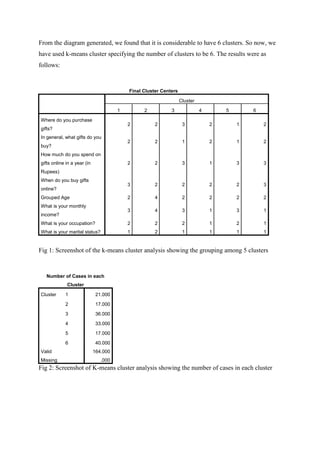
From the diagram generated, we found that it is considerable to have 6 clusters. So now, we
have used k-means cluster specifying the number of clusters to be 6. The results were as
follows:
Final Cluster Centers
Cluster
1 2 3 4 5 6
Where do you purchase
gifts?
2 2 3 2 1 2
In general, what gifts do you
buy?
2 2 1 2 1 2
How much do you spend on
gifts online in a year (in
Rupees)
2 2 3 1 3 3
When do you buy gifts
online?
3 2 2 2 2 3
Grouped Age 2 4 2 2 2 2
What is your monthly
income?
3 4 3 1 3 1
What is your occupation? 2 2 2 1 2 1
What is your marital status? 1 2 1 1 1 1
Fig 1: Screenshot of the k-means cluster analysis showing the grouping among 5 clusters
Number of Cases in each
Cluster
Cluster 1 21.000
2 17.000
3 36.000
4 33.000
5 17.000
6 40.000
Valid 164.000
Missing .000
Fig 2: Screenshot of K-means cluster analysis showing the number of cases in each cluster
Online vs. offline:
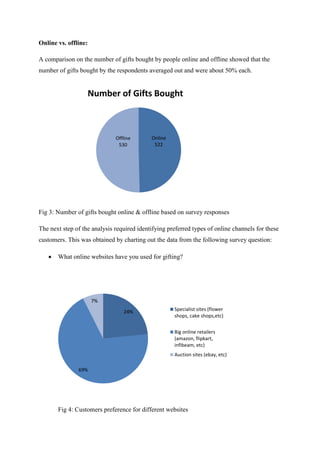
A comparison on the number of gifts bought by people online and offline showed that the
number of gifts bought by the respondents averaged out and were about 50% each.
Fig 3: Number of gifts bought online & offline based on survey responses
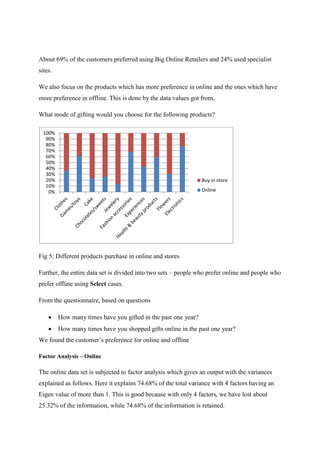
The next step of the analysis required identifying preferred types of online channels for these
customers. This was obtained by charting out the data from the following survey question:
 What online websites have you used for gifting?
Fig 4: Customers preference for different websites
Online
522
Offline
530
Number of Gifts Bought
24%
69%
7%
Specialist sites (flower
shops, cake shops,etc)
Big online retailers
(amazon, flipkart,
infibeam, etc)
Auction sites (ebay, etc)
About 69% of the customers preferred using Big Online Retailers and 24% used specialist
sites.
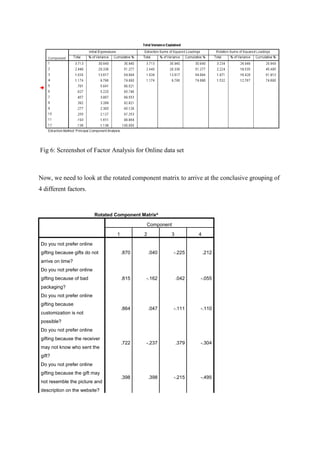
We also focus on the products which has more preference in online and the ones which have
more preference in offline. This is done by the data values got from,
What mode of gifting would you choose for the following products?
Fig 5: Different products purchase in online and stores
Further, the entire data set is divided into two sets – people who prefer online and people who
prefer offline using Select cases.
From the questionnaire, based on questions
 How many times have you gifted in the past one year?
 How many times have you shopped gifts online in the past one year?
We found the customer’s preference for online and offline
Factor Analysis – Online
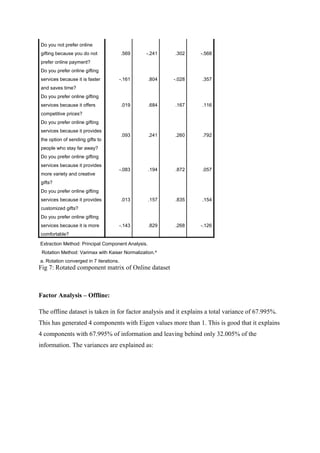
The online data set is subjected to factor analysis which gives an output with the variances
explained as follows. Here it explains 74.68% of the total variance with 4 factors having an
Eigen value of more than 1. This is good because with only 4 factors, we have lost about
25.32% of the information, while 74.68% of the information is retained.
0%
10%
20%
30%
40%
50%
60%
70%
80%
90%
100%
Buy in store
Online
Fig 6: Screenshot of Factor Analysis for Online data set
Now, we need to look at the rotated component matrix to arrive at the conclusive grouping of
4 different factors.
Rotated Component Matrixa
Component
1 2 3 4
Do you not prefer online
gifting because gifts do not
arrive on time?
.870 .040 -.225 .212
Do you not prefer online
gifting because of bad
packaging?
.815 -.162 .042 -.055
Do you not prefer online
gifting because
customization is not
possible?
.864 .047 -.111 -.110
Do you not prefer online
gifting because the receiver
may not know who sent the
gift?
.722 -.237 .379 -.304
Do you not prefer online
gifting because the gift may
not resemble the picture and
description on the website?
.398 .398 -.215 -.495
Do you not prefer online
gifting because you do not
prefer online payment?
.569 -.241 .302 -.568
Do you prefer online gifting
services because it is faster
and saves time?
-.161 .804 -.028 .357
Do you prefer online gifting
services because it offers
competitive prices?
.019 .684 .167 .116
Do you prefer online gifting
services because it provides
the option of sending gifts to
people who stay far away?
.093 .241 .260 .792
Do you prefer online gifting
services because it provides
more variety and creative
gifts?
-.083 .194 .872 .057
Do you prefer online gifting
services because it provides
customized gifts?
.013 .157 .835 .154
Do you prefer online gifting
services because it is more
comfortable?
-.143 .829 .268 -.126
Extraction Method: Principal Component Analysis.
Rotation Method: Varimax with Kaiser Normalization.a
a. Rotation converged in 7 iterations.
Fig 7: Rotated component matrix of Online dataset
Factor Analysis – Offline:
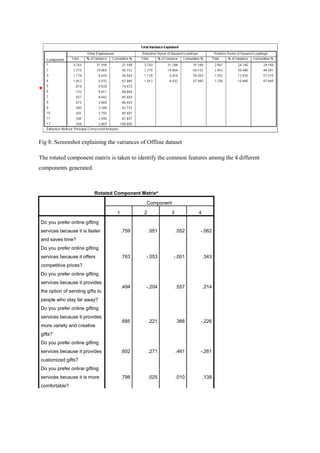
The offline dataset is taken in for factor analysis and it explains a total variance of 67.995%.
This has generated 4 components with Eigen values more than 1. This is good that it explains
4 components with 67.995% of information and leaving behind only 32.005% of the
information. The variances are explained as:
Fig 8: Screenshot explaining the variances of Offline dataset
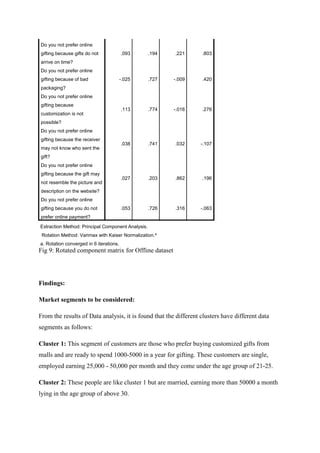
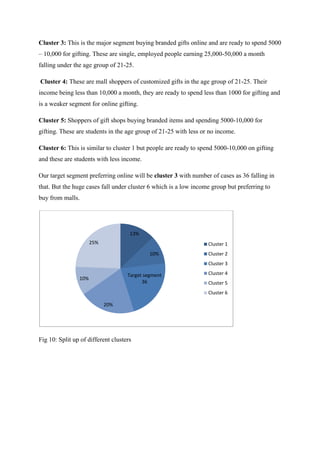
The rotated component matrix is taken to identify the common features among the 4 different
components generated.
Rotated Component Matrixa
Component
1 2 3 4
Do you prefer online gifting
services because it is faster
and saves time?
.759 .051 .052 -.062
Do you prefer online gifting
services because it offers
competitive prices?
.763 -.053 -.001 .343
Do you prefer online gifting
services because it provides
the option of sending gifts to
people who stay far away?
.494 -.204 .557 .214
Do you prefer online gifting
services because it provides
more variety and creative
gifts?
.685 .221 .366 -.226
Do you prefer online gifting
services because it provides
customized gifts?
.602 .271 .461 -.261
Do you prefer online gifting
services because it is more
comfortable?
.798 .025 .010 .139
Do you not prefer online
gifting because gifts do not
arrive on time?
.093 .194 .221 .803
Do you not prefer online
gifting because of bad
packaging?
-.025 .727 -.009 .420
Do you not prefer online
gifting because
customization is not
possible?
.113 .774 -.016 .276
Do you not prefer online
gifting because the receiver
may not know who sent the
gift?
.038 .741 .032 -.107
Do you not prefer online
gifting because the gift may
not resemble the picture and
description on the website?
.027 .203 .862 .196
Do you not prefer online
gifting because you do not
prefer online payment?
.053 .726 .316 -.063
Extraction Method: Principal Component Analysis.
Rotation Method: Varimax with Kaiser Normalization.a
a. Rotation converged in 6 iterations.
Fig 9: Rotated component matrix for Offline dataset
Findings:
Market segments to be considered:
From the results of Data analysis, it is found that the different clusters have different data
segments as follows:
Cluster 1: This segment of customers are those who prefer buying customized gifts from
malls and are ready to spend 1000-5000 in a year for gifting. These customers are single,
employed earning 25,000 - 50,000 per month and they come under the age group of 21-25.
Cluster 2: These people are like cluster 1 but are married, earning more than 50000 a month
lying in the age group of above 30.
Cluster 3: This is the major segment buying branded gifts online and are ready to spend 5000
– 10,000 for gifting. These are single, employed people earning 25,000-50,000 a month
falling under the age group of 21-25.
Cluster 4: These are mall shoppers of customized gifts in the age group of 21-25. Their
income being less than 10,000 a month, they are ready to spend less than 1000 for gifting and
is a weaker segment for online gifting.
Cluster 5: Shoppers of gift shops buying branded items and spending 5000-10,000 for
gifting. These are students in the age group of 21-25 with less or no income.
Cluster 6: This is similar to cluster 1 but people are ready to spend 5000-10,000 on gifting
and these are students with less income.
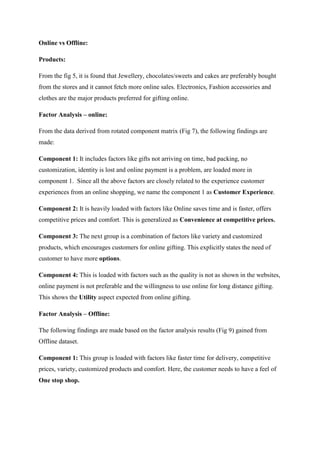
Our target segment preferring online will be cluster 3 with number of cases as 36 falling in
that. But the huge cases fall under cluster 6 which is a low income group but preferring to
buy from malls.
Fig 10: Split up of different clusters
13%
10%
Target segment
36
20%
10%
25% Cluster 1
Cluster 2
Cluster 3
Cluster 4
Cluster 5
Cluster 6
Online vs Offline:
Products:
From the fig 5, it is found that Jewellery, chocolates/sweets and cakes are preferably bought
from the stores and it cannot fetch more online sales. Electronics, Fashion accessories and
clothes are the major products preferred for gifting online.
Factor Analysis – online:
From the data derived from rotated component matrix (Fig 7), the following findings are
made:
Component 1: It includes factors like gifts not arriving on time, bad packing, no
customization, identity is lost and online payment is a problem, are loaded more in
component 1. Since all the above factors are closely related to the experience customer
experiences from an online shopping, we name the component 1 as Customer Experience.
Component 2: It is heavily loaded with factors like Online saves time and is faster, offers
competitive prices and comfort. This is generalized as Convenience at competitive prices.
Component 3: The next group is a combination of factors like variety and customized
products, which encourages customers for online gifting. This explicitly states the need of
customer to have more options.
Component 4: This is loaded with factors such as the quality is not as shown in the websites,
online payment is not preferable and the willingness to use online for long distance gifting.
This shows the Utility aspect expected from online gifting.
Factor Analysis – Offline:
The following findings are made based on the factor analysis results (Fig 9) gained from
Offline dataset.
Component 1: This group is loaded with factors like faster time for delivery, competitive
prices, variety, customized products and comfort. Here, the customer needs to have a feel of
One stop shop.
Component 2: It is loaded heavily with factors like package, customization, identity of
sender and payment mode. Customers want to have these features in online to meet their high
customer experience.
Component 3: It says the customers need online while sending gifts to distant locations and
also expect the quality of the product to be good in online. It is the Utility that the customers
want to experience in online.
Component 4: This is a component which is highly loaded with the fact that online delivery
does not meet the timely delivery of products. Online segment has to pay more attention on
timely delivery of gifts.
Limitations:
Due to time constraints our offline survey is limited in and around Navi Mumbai which does
not bring the diversity in people of different locations. The other limitation in our research is
our online survey got more responses from students which lead to a biased view. This is the
reason why our cluster analysis showed the major segment as Cluster 6.
Conclusion:
Based on the analysis and findings, we would suggest that salaried people in the age group of
21-25 who would prefer using online should be targeted by the Professional Couriers. The
customers who are using online for gifting likes to have a good experience with more options
which is to be focused. To bring in new customers from offline to online, the Professional
couriers must focus on timely delivery which is the main problem faced by those offline
customers. They also like to have a one stop shop kind of environment with all varieties
being presented at same location. By implementing this, the Professional couriers can easily
enter the online market and gain new customers as well.
Recommendation:
Our recommendation to Professional couriers would be to give a good customer experience
to retain existing online customers and timely delivery to shift offline customers particularly
the young segment in the age group of 21-30. As it is a new business for Professional
couriers, they can start with the clothes, fashion accessories which are mostly preferred for
online gifting.

Sathish_Professional

  • 1.
    MARKET RESEARCH REPORT ON ONLINEGIFTING SERVICES OF THE PROFESSIONAL COURIERS By, Sathish Jayabalan
  • 2.
    Introduction The Professional Couriersis the biggest courier services in India with 28 years of expertise. They provide courier services at low cost compared to other players. They have 20 Regional Offices, over 2485 Offices, over 5000 Collection Centres and over 25,000 destinations, where delivery is possible, by far, the biggest Courier Network in India. Professional Couriers has presence in foreign countries and opened its International Hub Operations at Chennai, Delhi, Kolkata and Mumbai. It also provides services like Air Cargo, Express Service, Surface Cargo, Logistic Solutions, Pick & Pack, Dawn to Dusk, Mass Mail, Ad & Add, RED ALERT Service, SURFING Channel and SPECIAL MESSENGER Service. They are planning to diversify into online shopping/gifting services in the future. Our Market research focuses on finding the market and opportunity for online gifting services to help Professional couriers arrive at a decision. Problem definition Management Decision Problem Should Professional courier venture into online shopping/gifting delivery services? Marketing research problem Would Professional Couriers be able to cater to online gifting market? Research Questions What are the profiles of target customer segments for online gifting? What are the major reasons for customers to use online gifting services instead of offline? What key competence should Professional Couriers adopt in order to be successful in the online gifting services? Research Design Population: Shoppers in India. Target population focussed on people who are aware of online gifting services and have attempted gifting through online services.
  • 3.
    Sample: Our samplecovered people in and around Navi Mumbai visiting shopping malls as part of offline/field survey. In online, we tried to cover people from different places across the country. Sampling Frame: People who shop at malls, online services and gift shops. Sampling Unit: Demographics – Shoppers in India; Age – 15 to 60 Sample Size: Offline survey – We covered around 52 responses. Online survey – We were able to get response from 112 people. Sample Technique: Cluster/ Area Sampling – Sample considered was mall shoppers, small gift shop shoppers in commercial areas. Field Work Plan: We conducted surveys in malls, gift shops and bakeries during weekdays and weekends, during peak hours and regular hours. We have sent Google forms through internet. We covered about 52 surveys offline and 112 surveys in online. Timeline: Timeline Activities January February March I II III IV I II III IV I II III IV Project requirement & Analysis Problem Statement & Questionnaire design Implementation Data Collection Data Analysis Project report TIME LINE CHART Work done Work in progress Work planned
  • 4.
    Proof: The formsfilled by respondents will be submitted along with the name and signature of the respondents. The excel sheet containing responses from Online Forms responses will also be attached with the report. Analysis: We are finding the shopping trends of customers based on shopping preferences and demographics. The customer’s view about Professional couriers in Online gifting segment is also analysed. Questionnaire: Data Analysis: Understanding Customer Segments: Cluster analysis was performed using different questions which will help in profiling the different types of customers. From the questionnaire, 8 questions were considered for clustering. They are,  Where do you buy gifts from?  What gifts do you buy?  How much do you spend on gifts online?  When do you buy gifts online?  What is your age? o The age variable was transformed by bucketing it into the following groups: Less than 21 years of age, 21 – 25 years, 26 – 30 years and More than 30 years of age  What is your income?  What is your occupation?  What is your marital status? Using the response for these questions, hierarchical clustering was performed to obtain a dendogram diagram which provided the starting point for identifying the number of clusters.
  • 5.
    From the diagramgenerated, we found that it is considerable to have 6 clusters. So now, we have used k-means cluster specifying the number of clusters to be 6. The results were as follows: Final Cluster Centers Cluster 1 2 3 4 5 6 Where do you purchase gifts? 2 2 3 2 1 2 In general, what gifts do you buy? 2 2 1 2 1 2 How much do you spend on gifts online in a year (in Rupees) 2 2 3 1 3 3 When do you buy gifts online? 3 2 2 2 2 3 Grouped Age 2 4 2 2 2 2 What is your monthly income? 3 4 3 1 3 1 What is your occupation? 2 2 2 1 2 1 What is your marital status? 1 2 1 1 1 1 Fig 1: Screenshot of the k-means cluster analysis showing the grouping among 5 clusters Number of Cases in each Cluster Cluster 1 21.000 2 17.000 3 36.000 4 33.000 5 17.000 6 40.000 Valid 164.000 Missing .000 Fig 2: Screenshot of K-means cluster analysis showing the number of cases in each cluster
  • 6.
    Online vs. offline: Acomparison on the number of gifts bought by people online and offline showed that the number of gifts bought by the respondents averaged out and were about 50% each. Fig 3: Number of gifts bought online & offline based on survey responses The next step of the analysis required identifying preferred types of online channels for these customers. This was obtained by charting out the data from the following survey question:  What online websites have you used for gifting? Fig 4: Customers preference for different websites Online 522 Offline 530 Number of Gifts Bought 24% 69% 7% Specialist sites (flower shops, cake shops,etc) Big online retailers (amazon, flipkart, infibeam, etc) Auction sites (ebay, etc)
  • 7.
    About 69% ofthe customers preferred using Big Online Retailers and 24% used specialist sites. We also focus on the products which has more preference in online and the ones which have more preference in offline. This is done by the data values got from, What mode of gifting would you choose for the following products? Fig 5: Different products purchase in online and stores Further, the entire data set is divided into two sets – people who prefer online and people who prefer offline using Select cases. From the questionnaire, based on questions  How many times have you gifted in the past one year?  How many times have you shopped gifts online in the past one year? We found the customer’s preference for online and offline Factor Analysis – Online The online data set is subjected to factor analysis which gives an output with the variances explained as follows. Here it explains 74.68% of the total variance with 4 factors having an Eigen value of more than 1. This is good because with only 4 factors, we have lost about 25.32% of the information, while 74.68% of the information is retained. 0% 10% 20% 30% 40% 50% 60% 70% 80% 90% 100% Buy in store Online
  • 8.
    Fig 6: Screenshotof Factor Analysis for Online data set Now, we need to look at the rotated component matrix to arrive at the conclusive grouping of 4 different factors. Rotated Component Matrixa Component 1 2 3 4 Do you not prefer online gifting because gifts do not arrive on time? .870 .040 -.225 .212 Do you not prefer online gifting because of bad packaging? .815 -.162 .042 -.055 Do you not prefer online gifting because customization is not possible? .864 .047 -.111 -.110 Do you not prefer online gifting because the receiver may not know who sent the gift? .722 -.237 .379 -.304 Do you not prefer online gifting because the gift may not resemble the picture and description on the website? .398 .398 -.215 -.495
  • 9.
    Do you notprefer online gifting because you do not prefer online payment? .569 -.241 .302 -.568 Do you prefer online gifting services because it is faster and saves time? -.161 .804 -.028 .357 Do you prefer online gifting services because it offers competitive prices? .019 .684 .167 .116 Do you prefer online gifting services because it provides the option of sending gifts to people who stay far away? .093 .241 .260 .792 Do you prefer online gifting services because it provides more variety and creative gifts? -.083 .194 .872 .057 Do you prefer online gifting services because it provides customized gifts? .013 .157 .835 .154 Do you prefer online gifting services because it is more comfortable? -.143 .829 .268 -.126 Extraction Method: Principal Component Analysis. Rotation Method: Varimax with Kaiser Normalization.a a. Rotation converged in 7 iterations. Fig 7: Rotated component matrix of Online dataset Factor Analysis – Offline: The offline dataset is taken in for factor analysis and it explains a total variance of 67.995%. This has generated 4 components with Eigen values more than 1. This is good that it explains 4 components with 67.995% of information and leaving behind only 32.005% of the information. The variances are explained as:
  • 10.
    Fig 8: Screenshotexplaining the variances of Offline dataset The rotated component matrix is taken to identify the common features among the 4 different components generated. Rotated Component Matrixa Component 1 2 3 4 Do you prefer online gifting services because it is faster and saves time? .759 .051 .052 -.062 Do you prefer online gifting services because it offers competitive prices? .763 -.053 -.001 .343 Do you prefer online gifting services because it provides the option of sending gifts to people who stay far away? .494 -.204 .557 .214 Do you prefer online gifting services because it provides more variety and creative gifts? .685 .221 .366 -.226 Do you prefer online gifting services because it provides customized gifts? .602 .271 .461 -.261 Do you prefer online gifting services because it is more comfortable? .798 .025 .010 .139
  • 11.
    Do you notprefer online gifting because gifts do not arrive on time? .093 .194 .221 .803 Do you not prefer online gifting because of bad packaging? -.025 .727 -.009 .420 Do you not prefer online gifting because customization is not possible? .113 .774 -.016 .276 Do you not prefer online gifting because the receiver may not know who sent the gift? .038 .741 .032 -.107 Do you not prefer online gifting because the gift may not resemble the picture and description on the website? .027 .203 .862 .196 Do you not prefer online gifting because you do not prefer online payment? .053 .726 .316 -.063 Extraction Method: Principal Component Analysis. Rotation Method: Varimax with Kaiser Normalization.a a. Rotation converged in 6 iterations. Fig 9: Rotated component matrix for Offline dataset Findings: Market segments to be considered: From the results of Data analysis, it is found that the different clusters have different data segments as follows: Cluster 1: This segment of customers are those who prefer buying customized gifts from malls and are ready to spend 1000-5000 in a year for gifting. These customers are single, employed earning 25,000 - 50,000 per month and they come under the age group of 21-25. Cluster 2: These people are like cluster 1 but are married, earning more than 50000 a month lying in the age group of above 30.
  • 12.
    Cluster 3: Thisis the major segment buying branded gifts online and are ready to spend 5000 – 10,000 for gifting. These are single, employed people earning 25,000-50,000 a month falling under the age group of 21-25. Cluster 4: These are mall shoppers of customized gifts in the age group of 21-25. Their income being less than 10,000 a month, they are ready to spend less than 1000 for gifting and is a weaker segment for online gifting. Cluster 5: Shoppers of gift shops buying branded items and spending 5000-10,000 for gifting. These are students in the age group of 21-25 with less or no income. Cluster 6: This is similar to cluster 1 but people are ready to spend 5000-10,000 on gifting and these are students with less income. Our target segment preferring online will be cluster 3 with number of cases as 36 falling in that. But the huge cases fall under cluster 6 which is a low income group but preferring to buy from malls. Fig 10: Split up of different clusters 13% 10% Target segment 36 20% 10% 25% Cluster 1 Cluster 2 Cluster 3 Cluster 4 Cluster 5 Cluster 6
  • 13.
    Online vs Offline: Products: Fromthe fig 5, it is found that Jewellery, chocolates/sweets and cakes are preferably bought from the stores and it cannot fetch more online sales. Electronics, Fashion accessories and clothes are the major products preferred for gifting online. Factor Analysis – online: From the data derived from rotated component matrix (Fig 7), the following findings are made: Component 1: It includes factors like gifts not arriving on time, bad packing, no customization, identity is lost and online payment is a problem, are loaded more in component 1. Since all the above factors are closely related to the experience customer experiences from an online shopping, we name the component 1 as Customer Experience. Component 2: It is heavily loaded with factors like Online saves time and is faster, offers competitive prices and comfort. This is generalized as Convenience at competitive prices. Component 3: The next group is a combination of factors like variety and customized products, which encourages customers for online gifting. This explicitly states the need of customer to have more options. Component 4: This is loaded with factors such as the quality is not as shown in the websites, online payment is not preferable and the willingness to use online for long distance gifting. This shows the Utility aspect expected from online gifting. Factor Analysis – Offline: The following findings are made based on the factor analysis results (Fig 9) gained from Offline dataset. Component 1: This group is loaded with factors like faster time for delivery, competitive prices, variety, customized products and comfort. Here, the customer needs to have a feel of One stop shop.
  • 14.
    Component 2: Itis loaded heavily with factors like package, customization, identity of sender and payment mode. Customers want to have these features in online to meet their high customer experience. Component 3: It says the customers need online while sending gifts to distant locations and also expect the quality of the product to be good in online. It is the Utility that the customers want to experience in online. Component 4: This is a component which is highly loaded with the fact that online delivery does not meet the timely delivery of products. Online segment has to pay more attention on timely delivery of gifts. Limitations: Due to time constraints our offline survey is limited in and around Navi Mumbai which does not bring the diversity in people of different locations. The other limitation in our research is our online survey got more responses from students which lead to a biased view. This is the reason why our cluster analysis showed the major segment as Cluster 6. Conclusion: Based on the analysis and findings, we would suggest that salaried people in the age group of 21-25 who would prefer using online should be targeted by the Professional Couriers. The customers who are using online for gifting likes to have a good experience with more options which is to be focused. To bring in new customers from offline to online, the Professional couriers must focus on timely delivery which is the main problem faced by those offline customers. They also like to have a one stop shop kind of environment with all varieties being presented at same location. By implementing this, the Professional couriers can easily enter the online market and gain new customers as well. Recommendation: Our recommendation to Professional couriers would be to give a good customer experience to retain existing online customers and timely delivery to shift offline customers particularly the young segment in the age group of 21-30. As it is a new business for Professional
  • 15.
    couriers, they canstart with the clothes, fashion accessories which are mostly preferred for online gifting.