Satellite Communication
05/02/14 RTTC  SATCOM 1
OVERVIEW
OF
SATELLITE COMMUNICATION
AND
SATELITE SYSTEM
Satellite Communication
05/02/14 RTTC  SATCOM 2
Satellite Communication
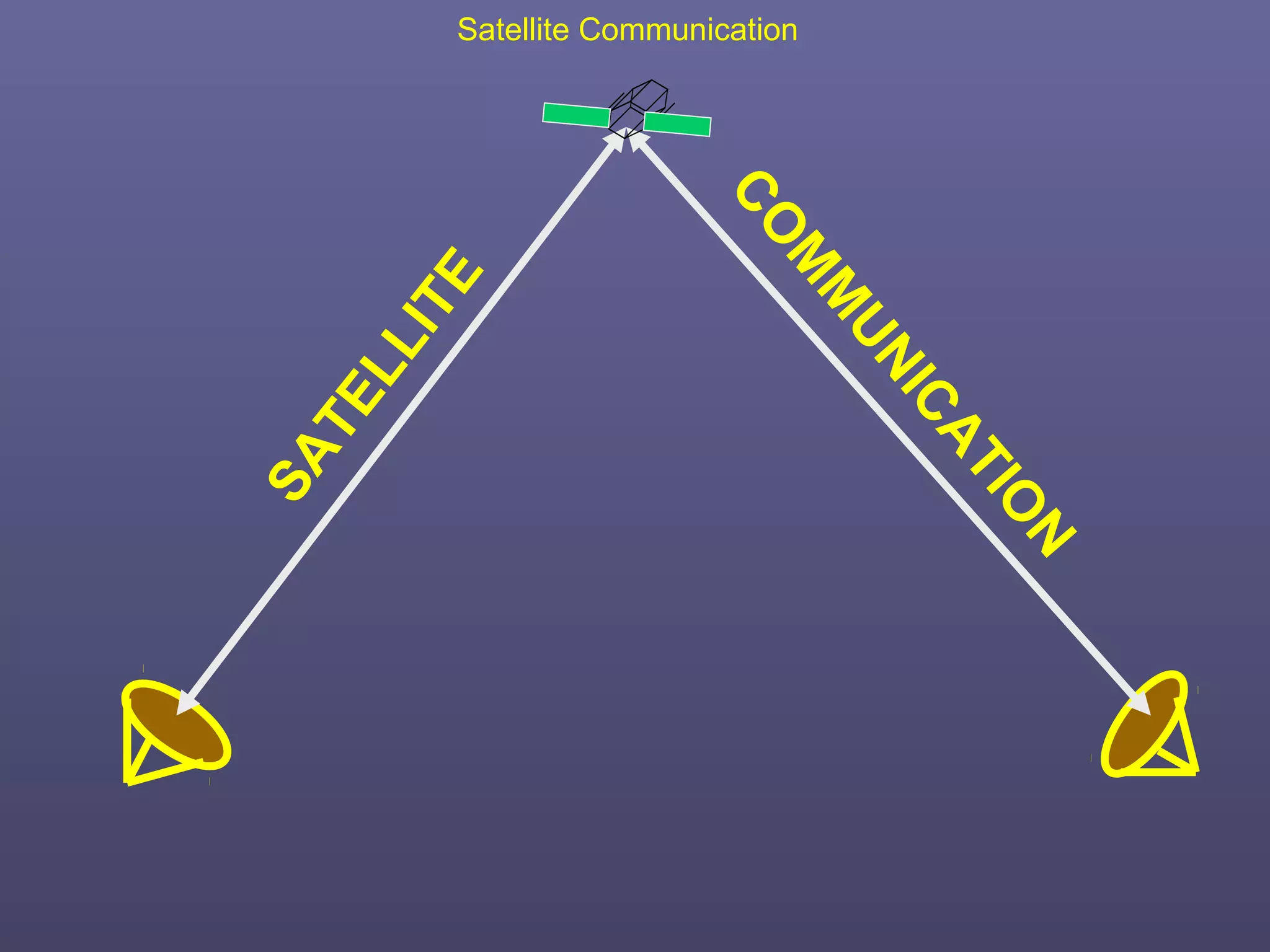
SATELLITE
CO
M
M
UNICATIO
N
Satellite Communication
05/02/14 RTTC  SATCOM 4
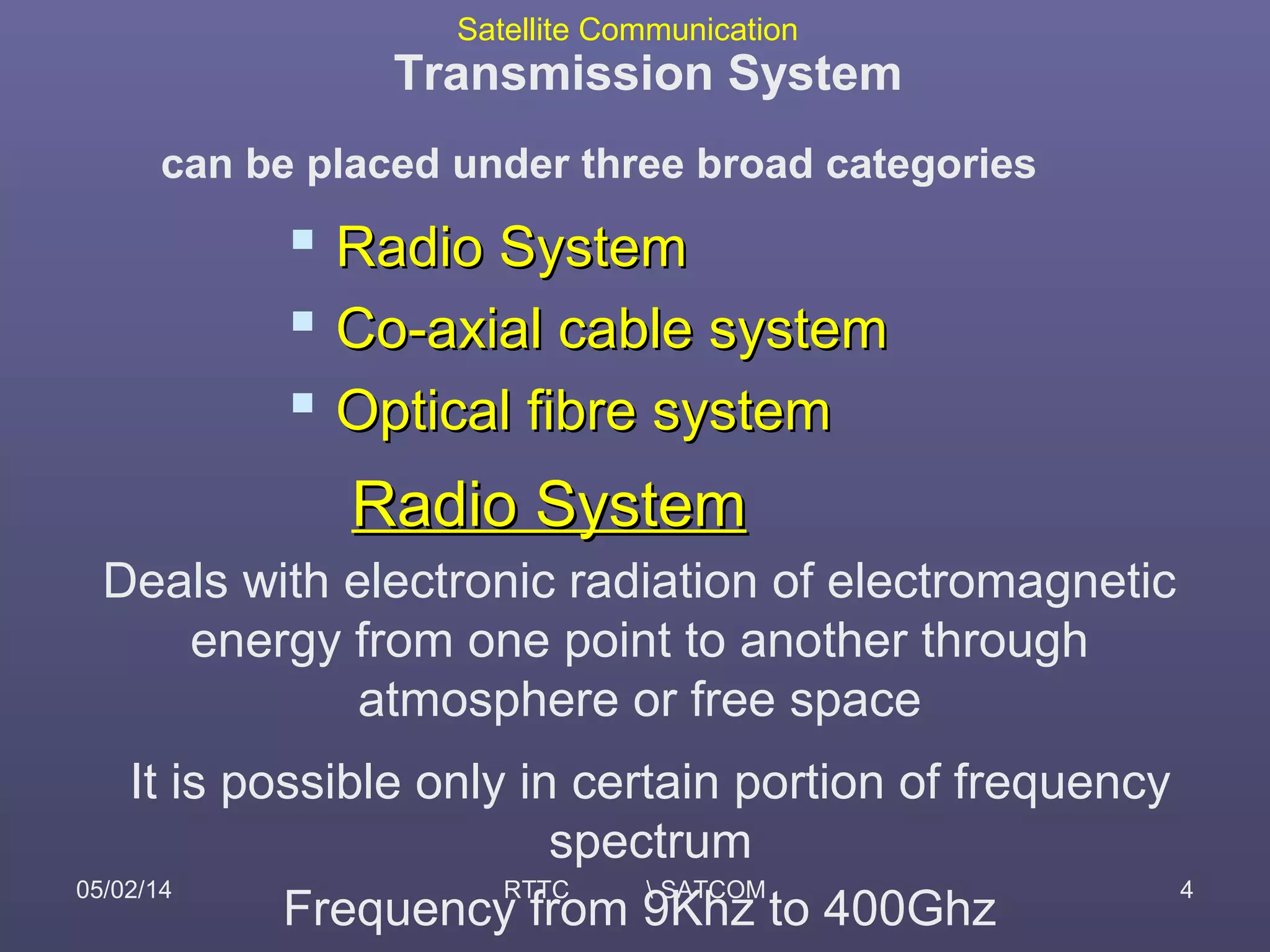
Transmission System
can be placed under three broad categories
 Radio SystemRadio System
 Co-axial cable systemCo-axial cable system
 Optical fibre systemOptical fibre system
Radio SystemRadio System
Deals with electronic radiation of electromagnetic
energy from one point to another through
atmosphere or free space
It is possible only in certain portion of frequency
spectrum
Frequency from 9Khz to 400Ghz
Satellite Communication
05/02/14 RTTC  SATCOM 5
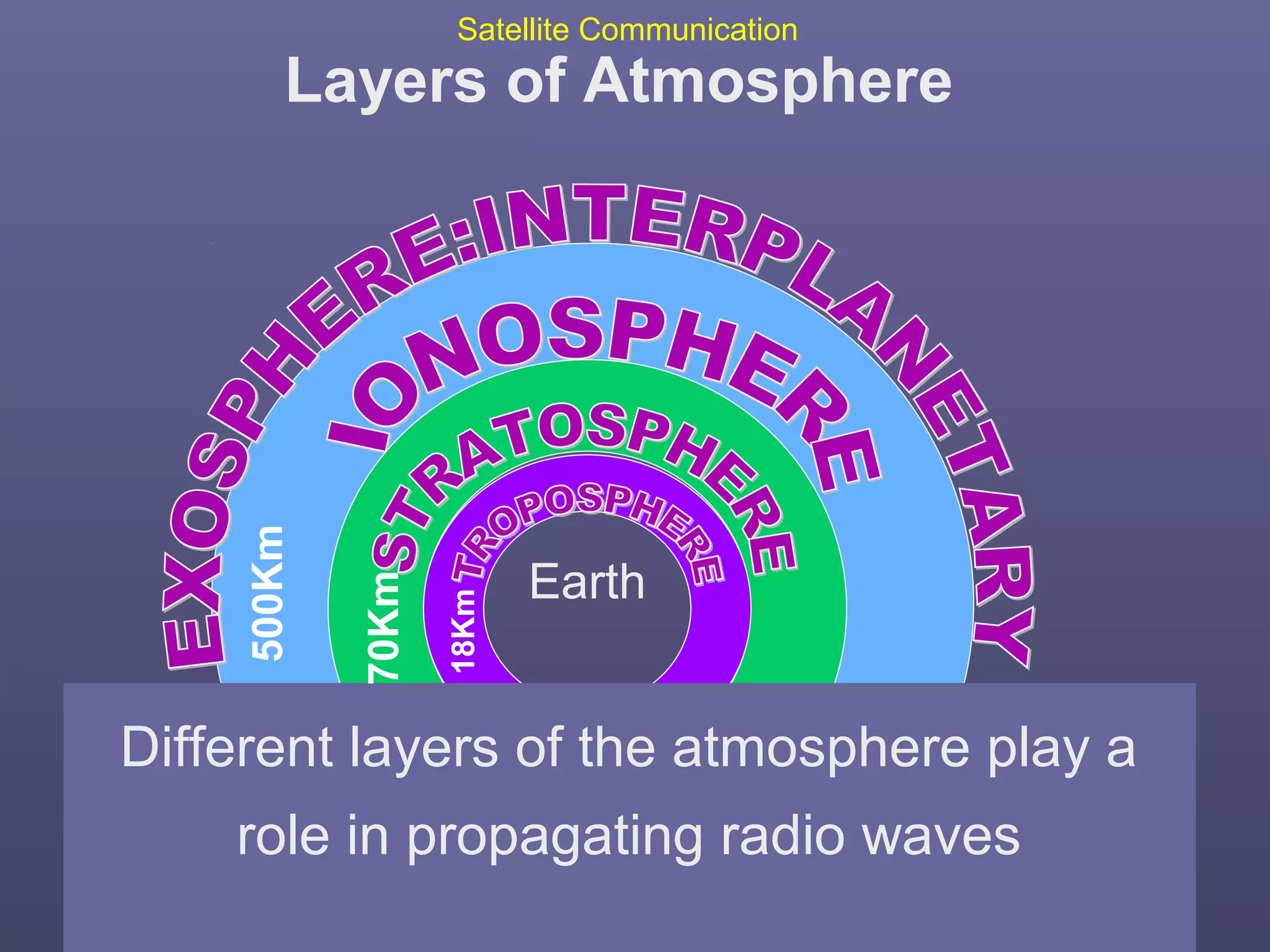
Earth
Layers of Atmosphere
Different layers of the atmosphere play a
role in propagating radio waves
18Km
70Km
500Km
Satellite Communication
05/02/14 RTTC  SATCOM 6
Ionosphere and troposphere are useful
for radio communication in certain
frequency range
Radio communication can be placed
under four categories
Skywave or Ionosphere communicationSkywave or Ionosphere communication
LOS MW CommunicationLOS MW Communication
Troposphere scatter communicationTroposphere scatter communication
Satellite communicationSatellite communication
Satellite Communication
05/02/14 RTTC  SATCOM 7
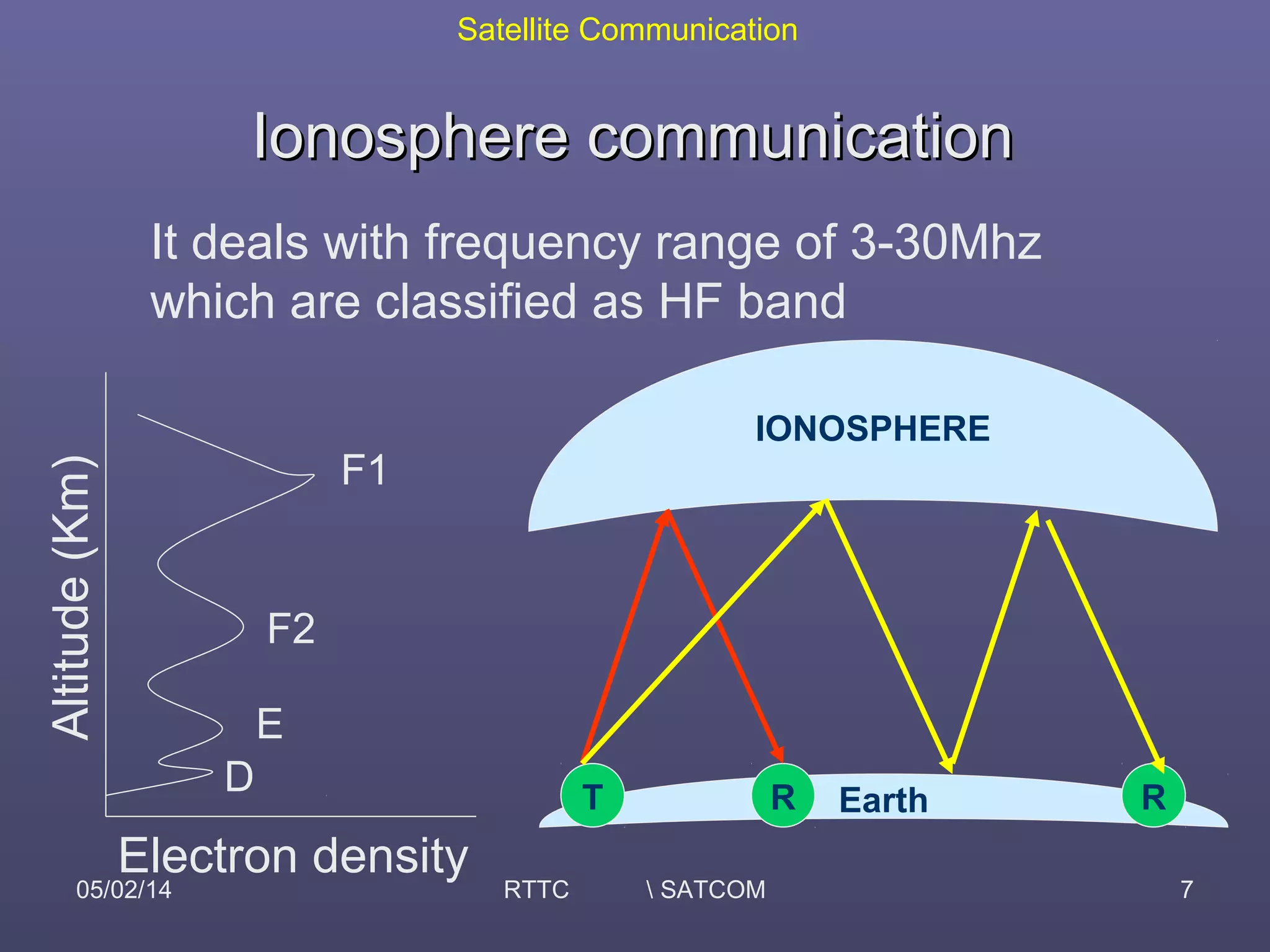
Ionosphere communicationIonosphere communication
It deals with frequency range of 3-30Mhz
which are classified as HF band
Altitude(Km)
Electron density
F1
F2
E
D
IONOSPHERE
EarthT R R
Satellite Communication
05/02/14 RTTC  SATCOM 8
LOS MW CommunicationLOS MW Communication
IS CHARCTERSIED BY
► the useful range of frequencies lie between 150Mhz-
150Ghz
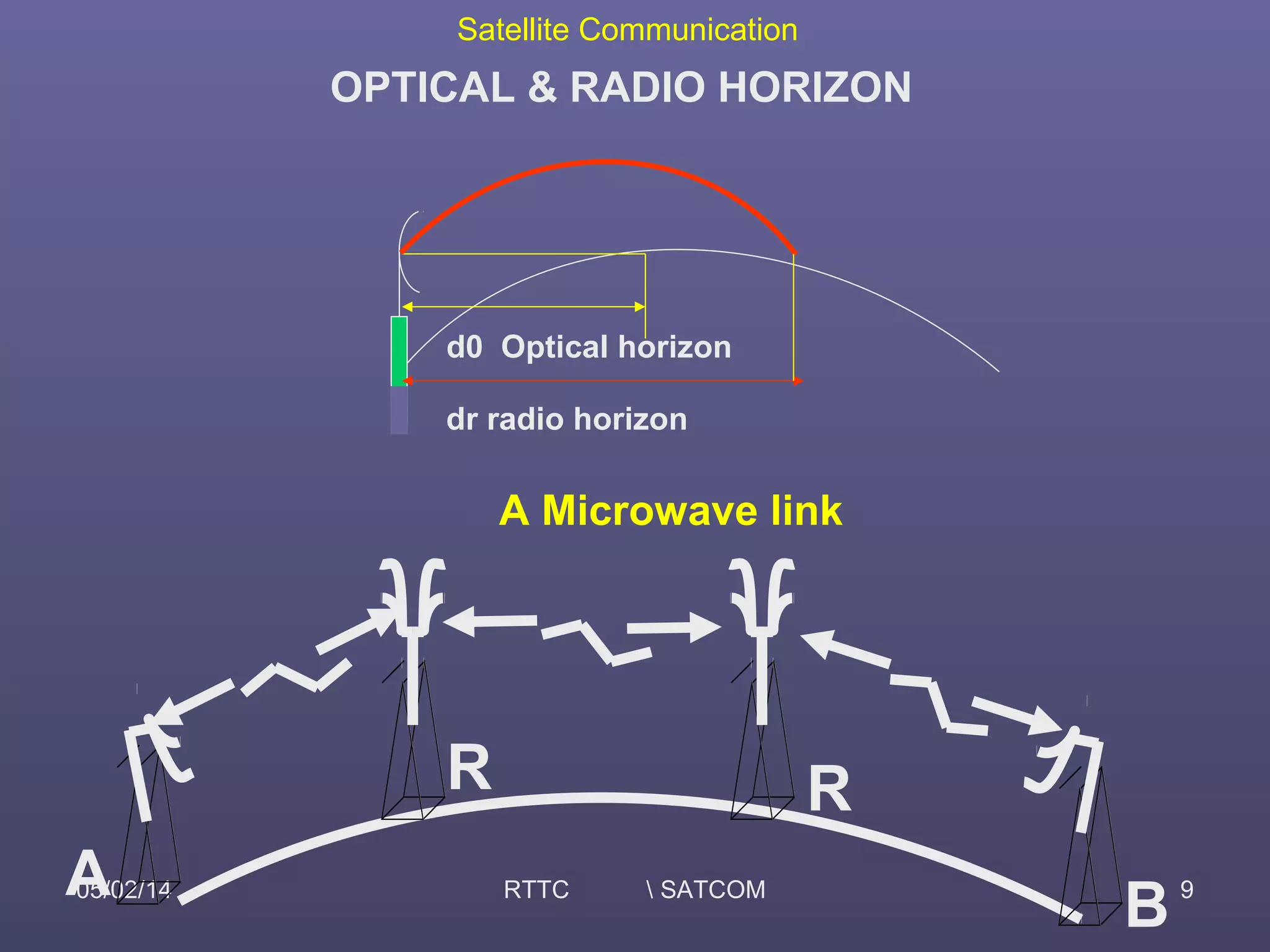
► it is line of sight communication limited by horizon due
to the curvature of the earth
► Signal propagation is affected by free space attenuation
► Frequency / Phase modulation technique are employed
► Spread spectrum or Time sharing techniques are used
Satellite Communication
05/02/14 RTTC  SATCOM 9
d0 Optical horizon
dr radio horizon
OPTICAL & RADIO HORIZON
A Microwave link
A
B
R R
Satellite Communication
05/02/14 RTTC  SATCOM 10
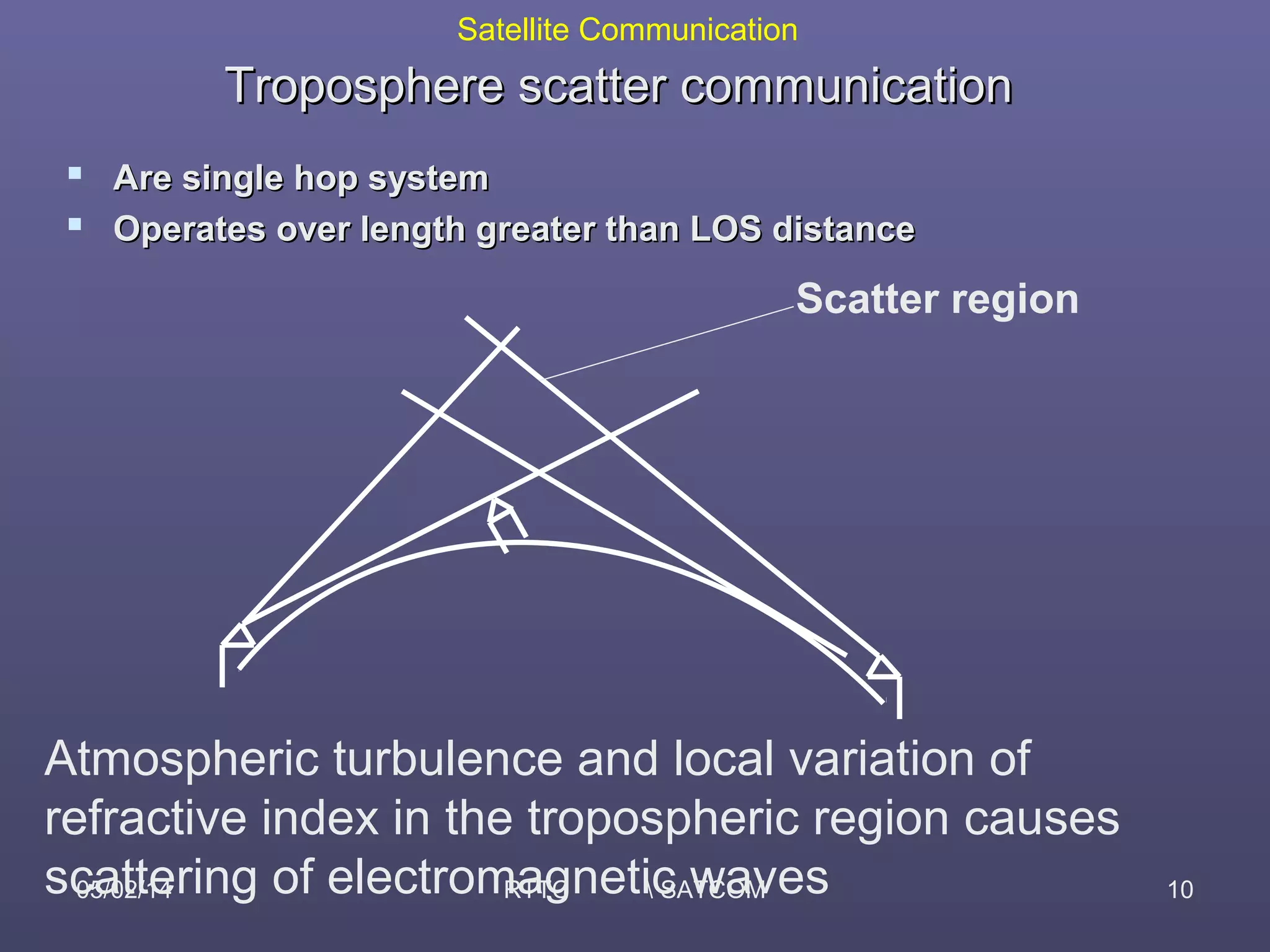
Troposphere scatter communicationTroposphere scatter communication
 Are single hop systemAre single hop system
 Operates over length greater than LOS distanceOperates over length greater than LOS distance
Scatter region
Atmospheric turbulence and local variation of
refractive index in the tropospheric region causes
scattering of electromagnetic waves
Satellite Communication
05/02/14 RTTC  SATCOM 11
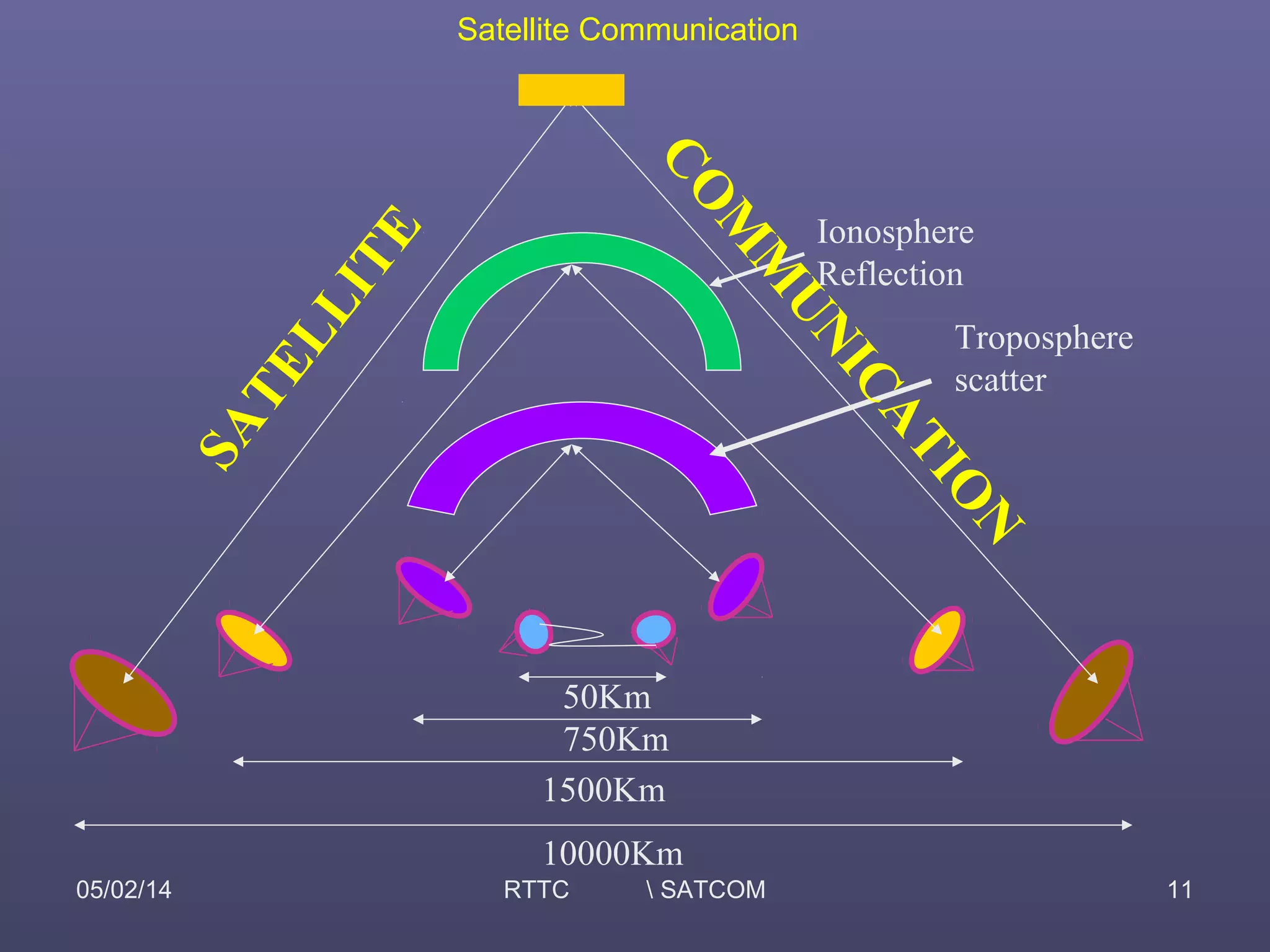
50Km
10000Km
750Km
Troposphere
scatter
1500Km
Ionosphere
Reflection
SATELLITE
CO
M
M
UNICATIO
N
Satellite Communication
05/02/14 RTTC  SATCOM 12
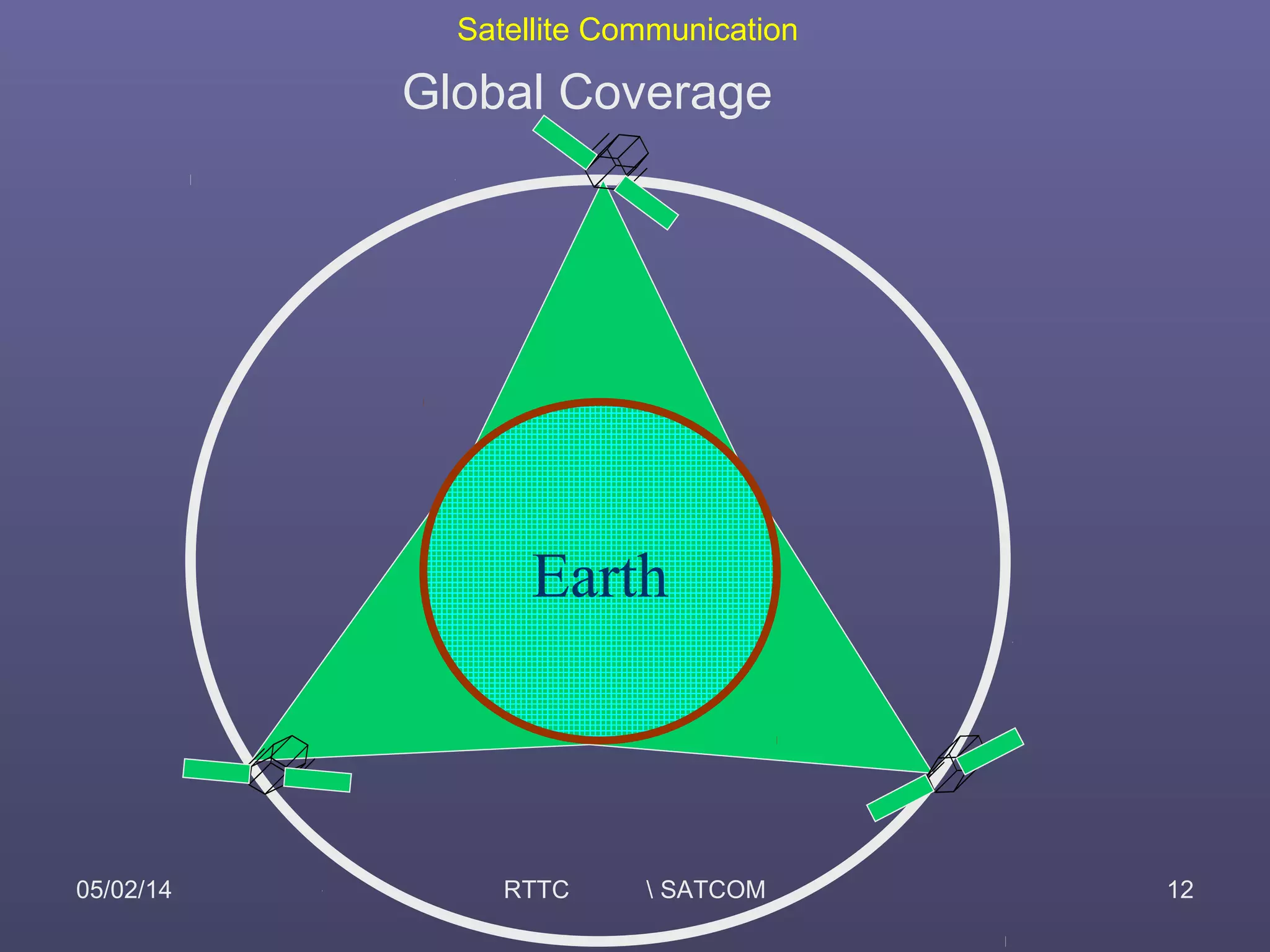
Earth
Global Coverage
Satellite Communication
05/02/14 RTTC  SATCOM 13
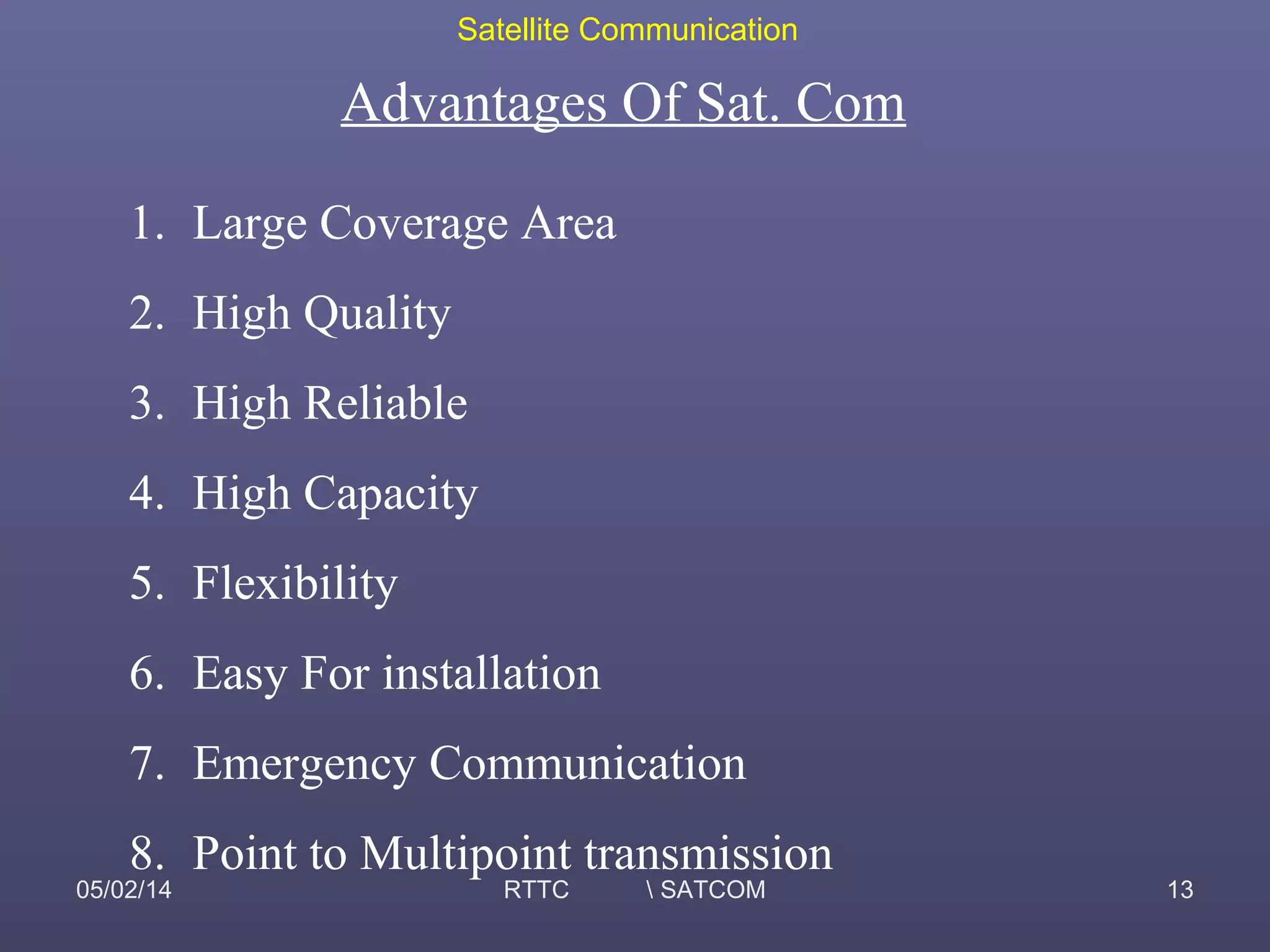
Advantages Of Sat. Com
1. Large Coverage Area
2. High Quality
3. High Reliable
4. High Capacity
5. Flexibility
6. Easy For installation
7. Emergency Communication
8. Point to Multipoint transmission
Satellite Communication
05/02/14 RTTC  SATCOM 14
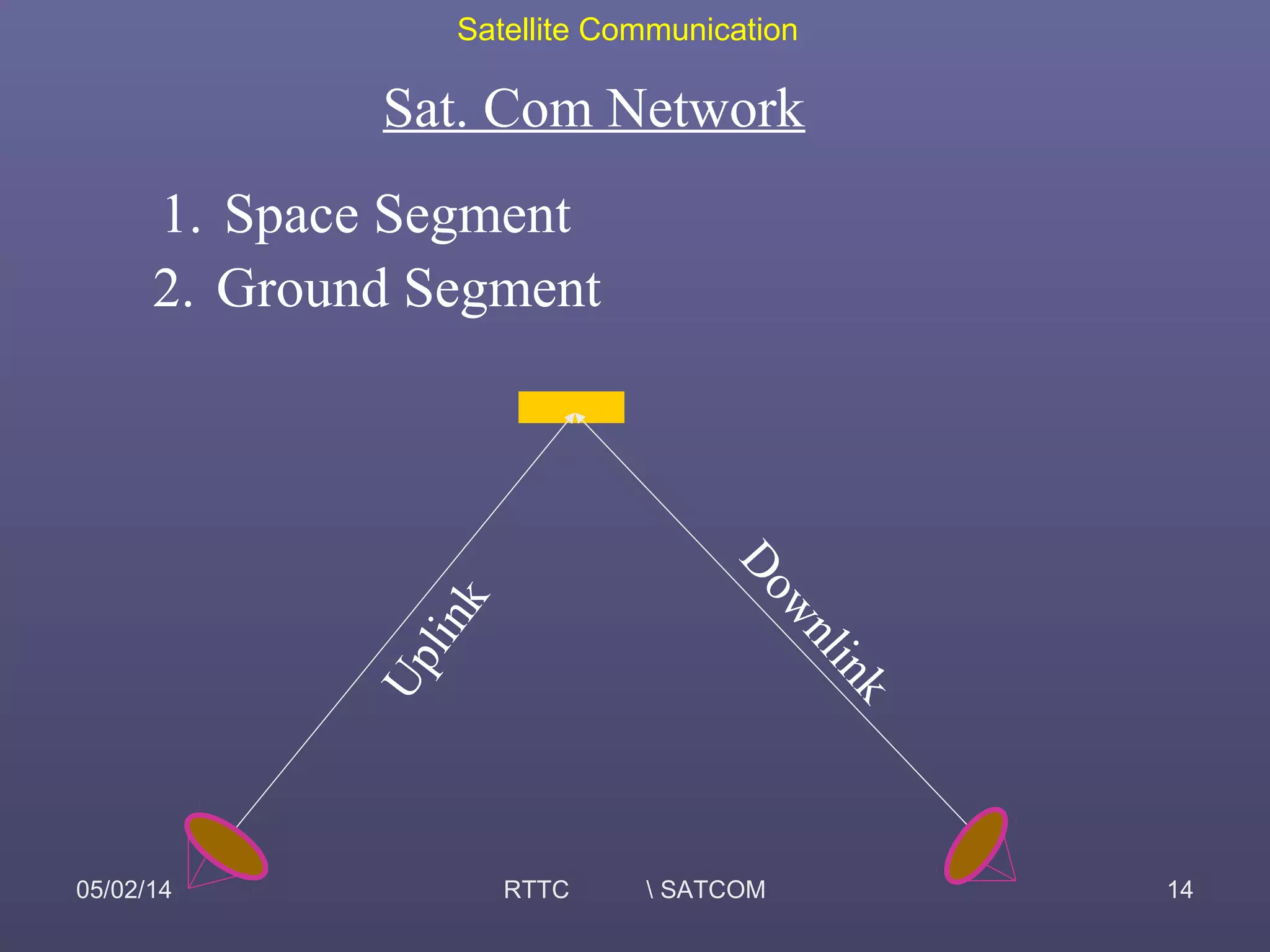
Sat. Com Network
1. Space Segment
Uplink
Downlink
2. Ground Segment
Satellite Communication
05/02/14 RTTC  SATCOM 15
Sat. Com Network
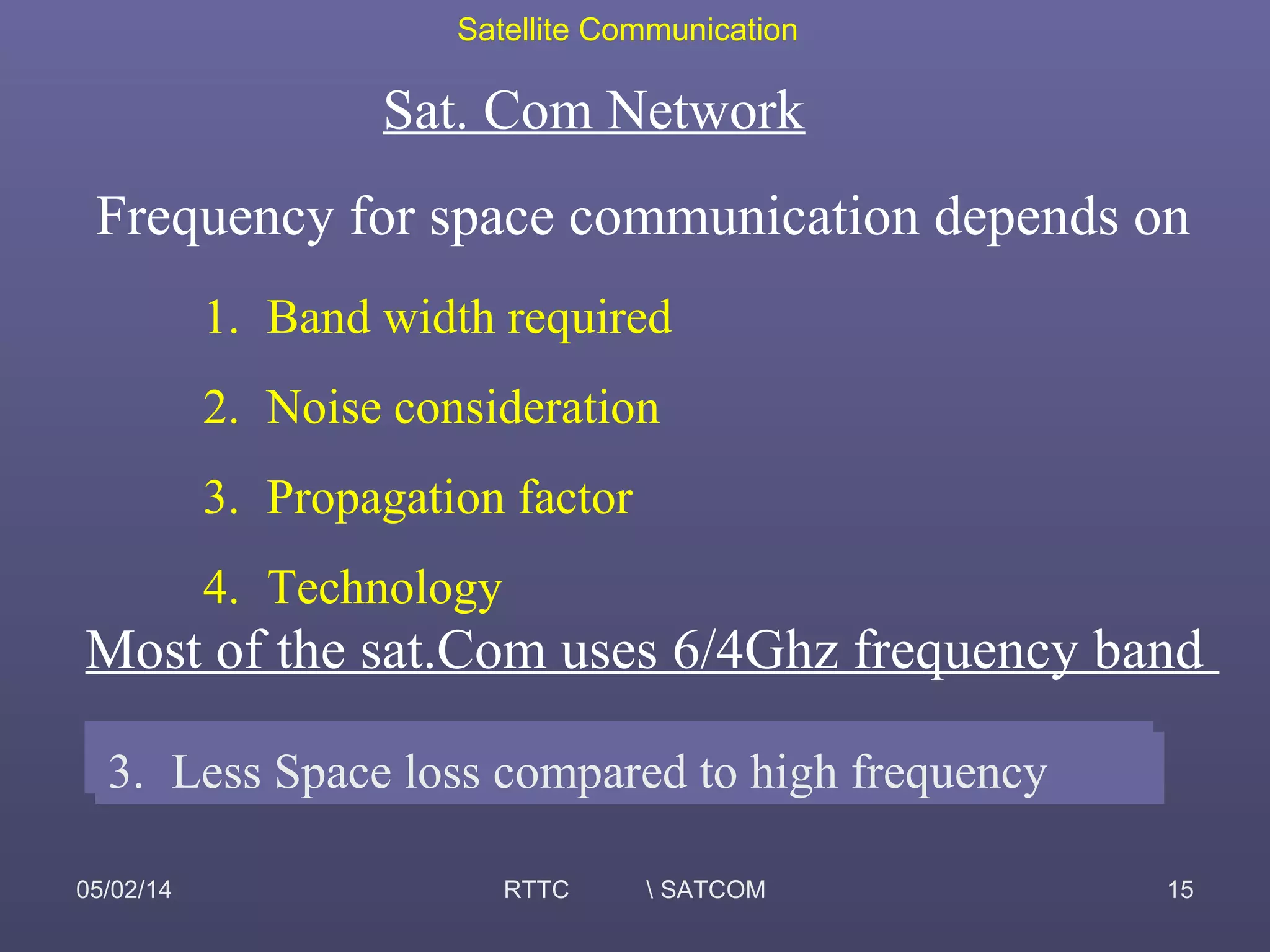
Frequency for space communication depends on
1. Band width required
2. Noise consideration
3. Propagation factor
4. Technology
Most of the sat.Com uses 6/4Ghz frequency band
1. Less Atmospheric Absorption2. Less noise both galactic and manmade3. Less Space loss compared to high frequency
Satellite Communication
05/02/14 RTTC  SATCOM 16
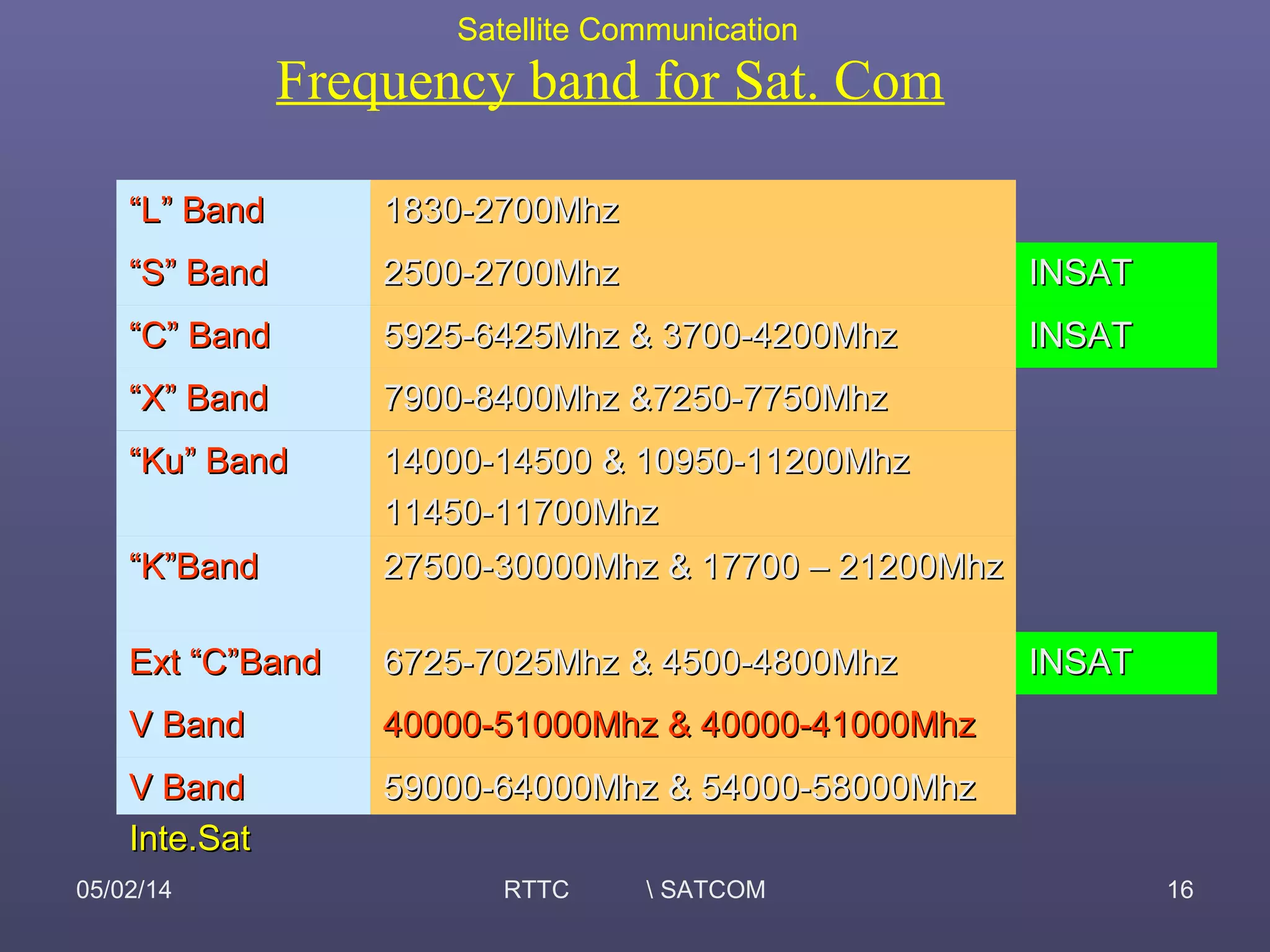
59000-64000Mhz & 54000-58000Mhz59000-64000Mhz & 54000-58000MhzV BandV Band
Inte.SatInte.Sat
40000-51000Mhz & 40000-41000Mhz40000-51000Mhz & 40000-41000MhzV BandV Band
INSATINSAT6725-7025Mhz & 4500-4800Mhz6725-7025Mhz & 4500-4800MhzExt “C”BandExt “C”Band
27500-30000Mhz & 17700 – 21200Mhz27500-30000Mhz & 17700 – 21200Mhz““K”BandK”Band
14000-14500 & 10950-11200Mhz14000-14500 & 10950-11200Mhz
11450-11700Mhz11450-11700Mhz
““Ku” BandKu” Band
7900-8400Mhz &7250-7750Mhz7900-8400Mhz &7250-7750Mhz““X” BandX” Band
INSATINSAT5925-6425Mhz & 3700-4200Mhz5925-6425Mhz & 3700-4200Mhz““C” BandC” Band
INSATINSAT2500-2700Mhz2500-2700Mhz““S” BandS” Band
1830-2700Mhz1830-2700Mhz““L” BandL” Band
Frequency band for Sat. Com
Satellite Communication
05/02/14 RTTC  SATCOM 17
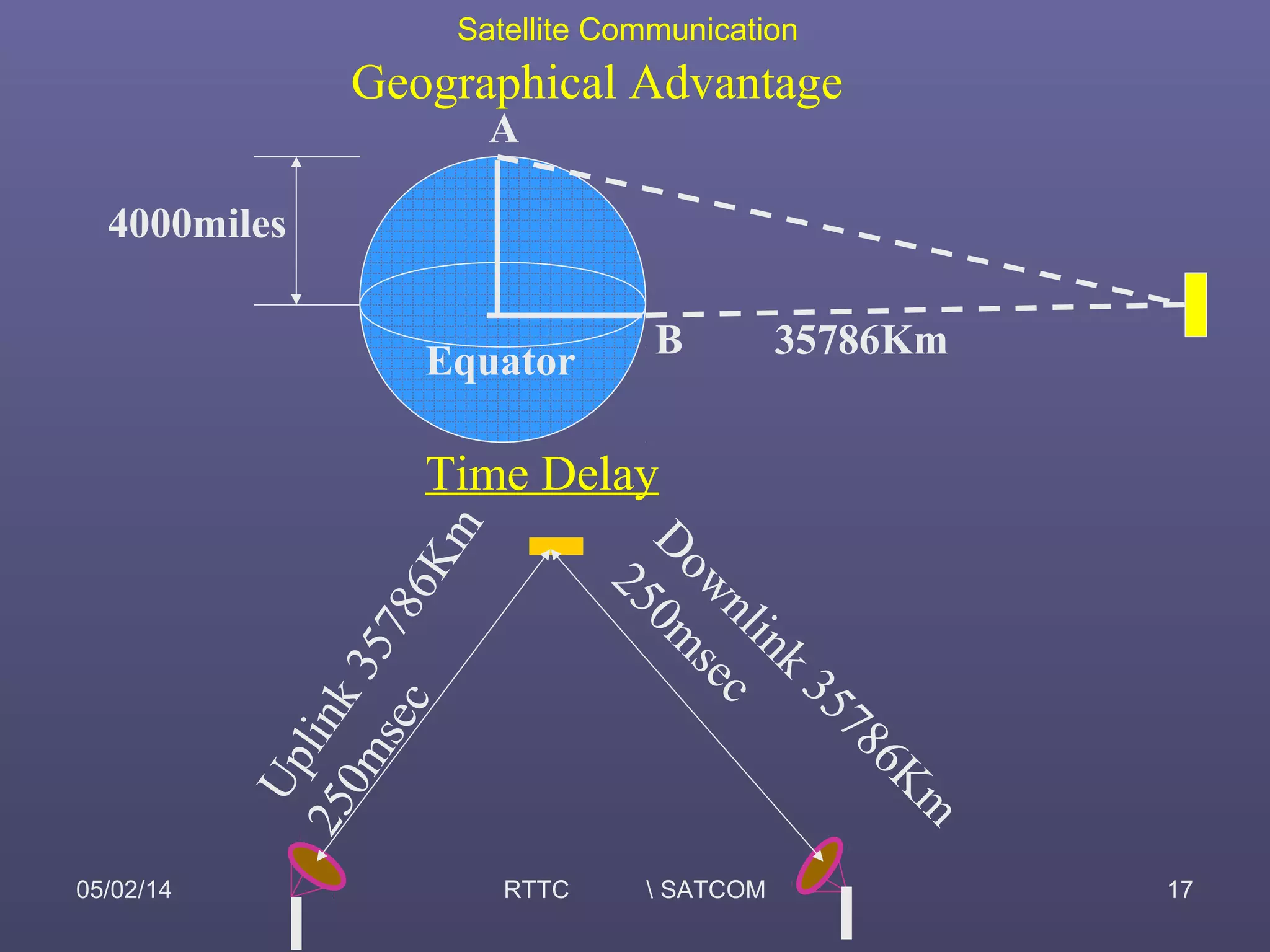
Equator
4000miles
A
35786KmB
Geographical Advantage
Time Delay
Uplink35786Km
250msec
D
ow
nlink
35786K
m
250m
sec
Satellite Communication
05/02/14 RTTC  SATCOM 18
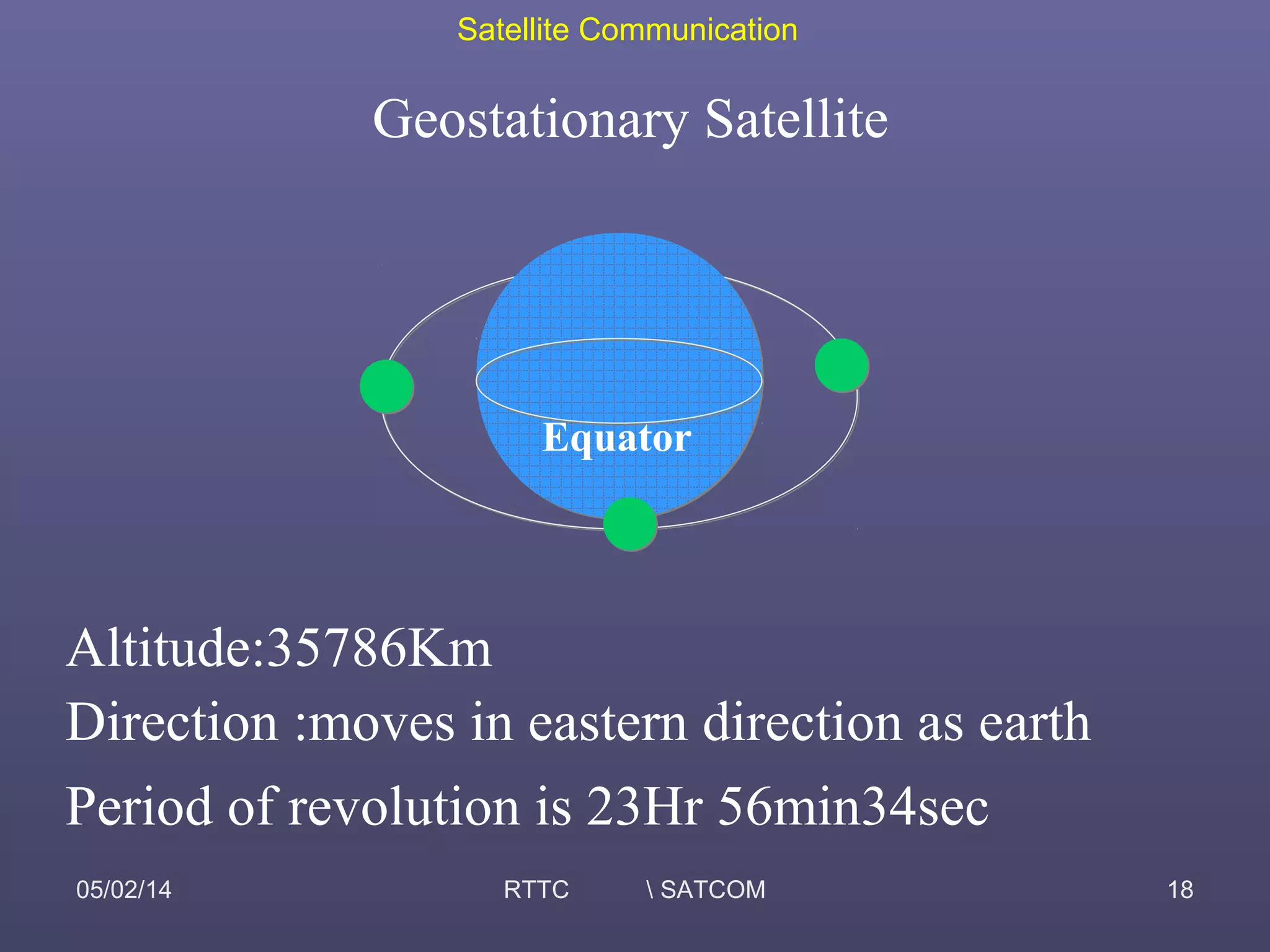
Geostationary Satellite
Altitude:35786Km
Direction :moves in eastern direction as earth
Period of revolution is 23Hr 56min34sec
Equator
Satellite Communication
05/02/14 RTTC  SATCOM 19
Broadcasting mode of operation
Satellite Communication
05/02/14 RTTC  SATCOM 20
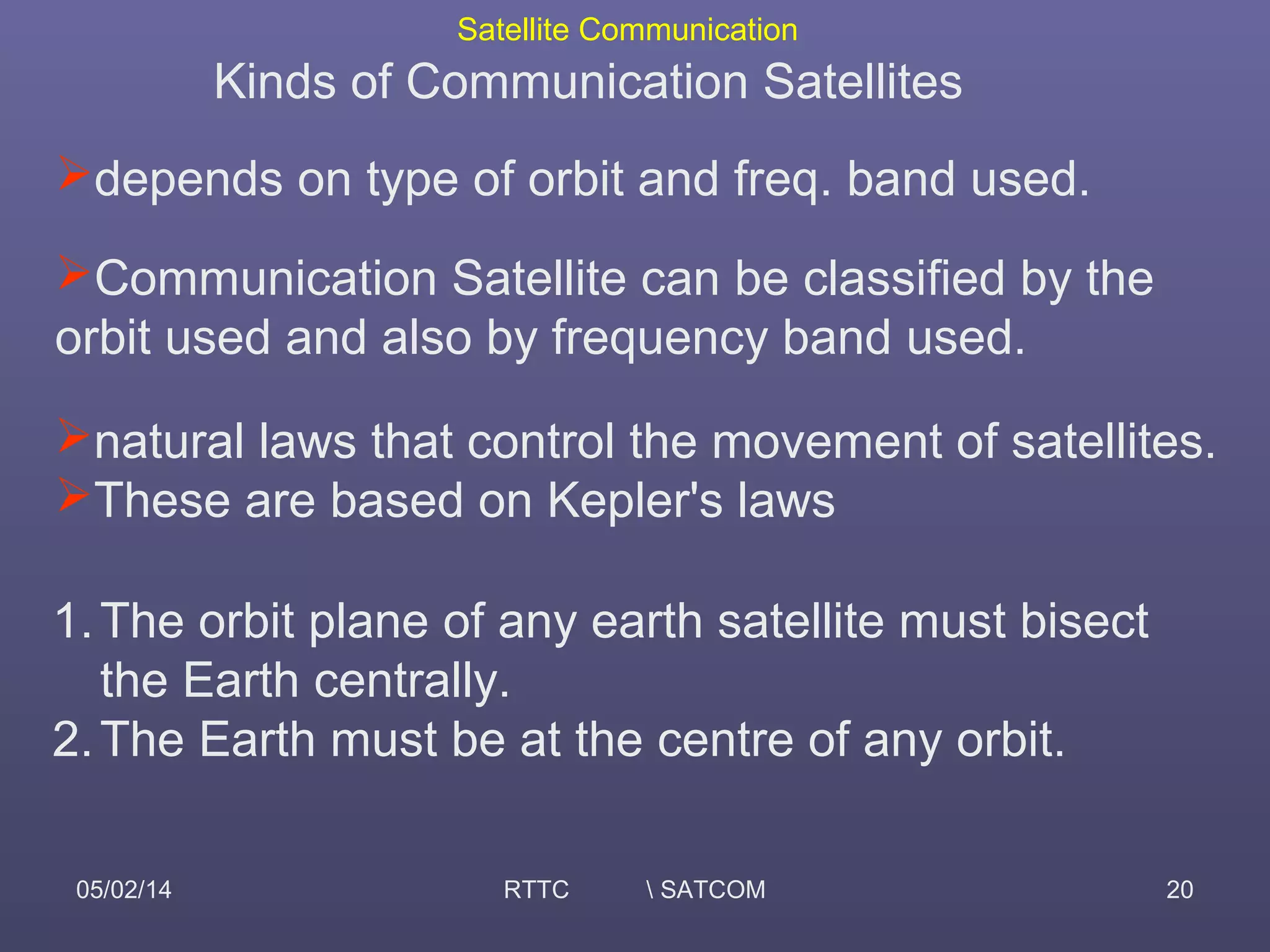
Kinds of Communication Satellites
depends on type of orbit and freq. band used.
Communication Satellite can be classified by the
orbit used and also by frequency band used.
natural laws that control the movement of satellites.
These are based on Kepler's laws
1.The orbit plane of any earth satellite must bisect
the Earth centrally.
2.The Earth must be at the centre of any orbit.
Satellite Communication
05/02/14 RTTC  SATCOM 21
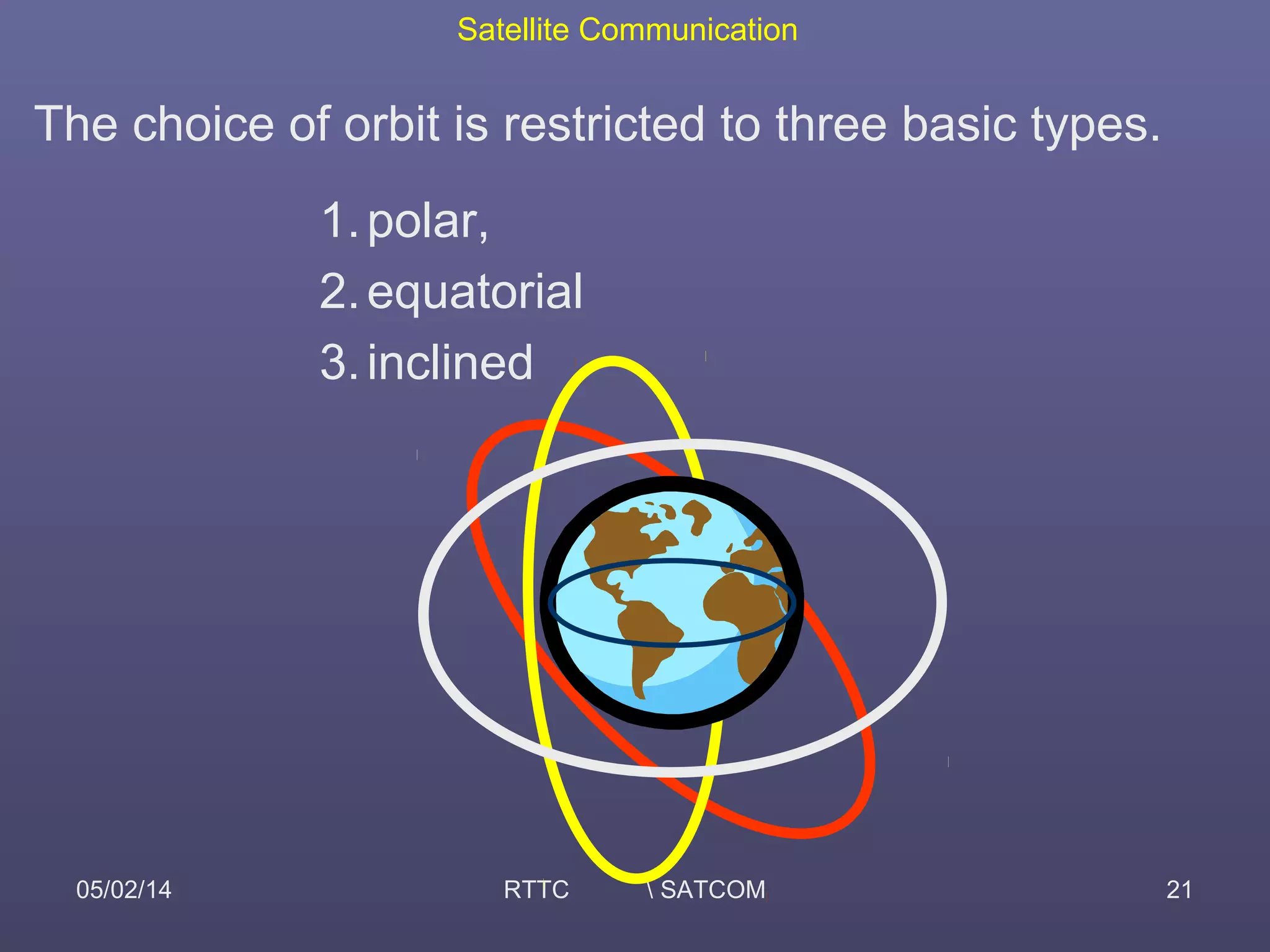
The choice of orbit is restricted to three basic types.
1.polar,
2.equatorial
3.inclined
Satellite Communication
05/02/14 RTTC  SATCOM 22
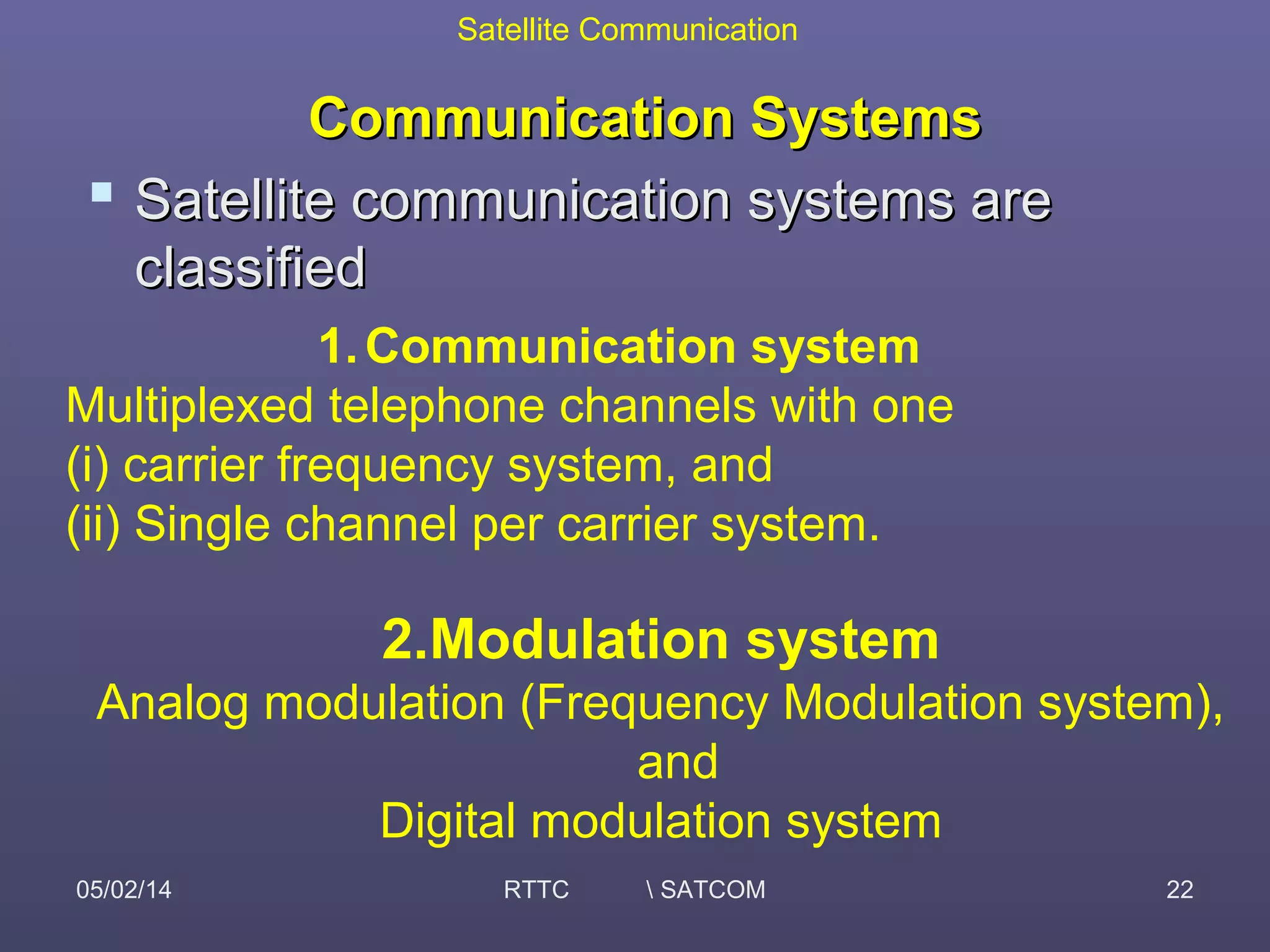
Communication SystemsCommunication Systems
 Satellite communication systems areSatellite communication systems are
classifiedclassified
1.Communication system
Multiplexed telephone channels with one
(i) carrier frequency system, and
(ii) Single channel per carrier system.
2.Modulation system
Analog modulation (Frequency Modulation system),
and
Digital modulation system
Satellite Communication
05/02/14 RTTC  SATCOM 23
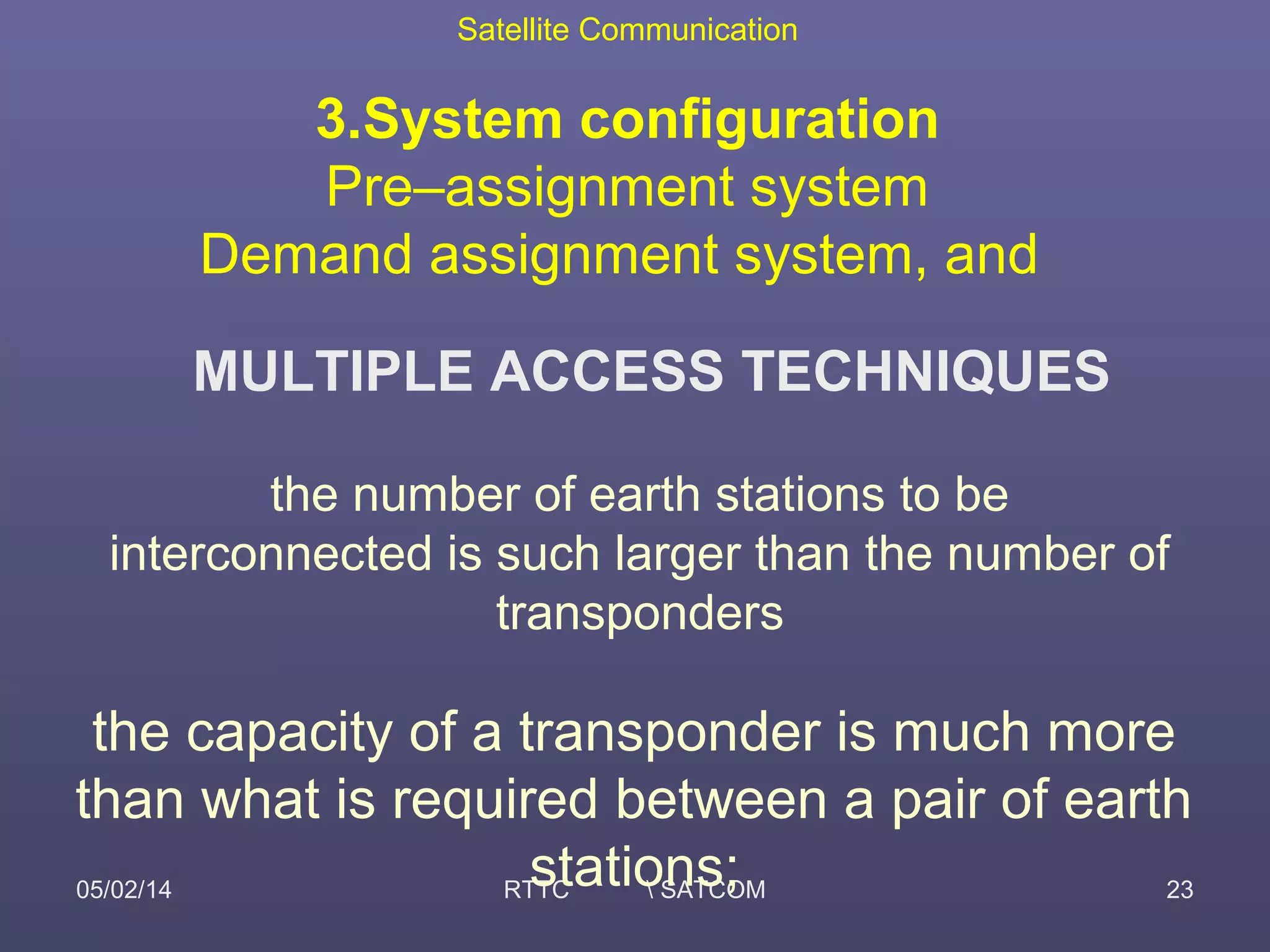
3.System configuration
Pre–assignment system
Demand assignment system, and
MULTIPLE ACCESS TECHNIQUES
the number of earth stations to be
interconnected is such larger than the number of
transponders
the capacity of a transponder is much more
than what is required between a pair of earth
stations;
Satellite Communication
05/02/14 RTTC  SATCOM 24
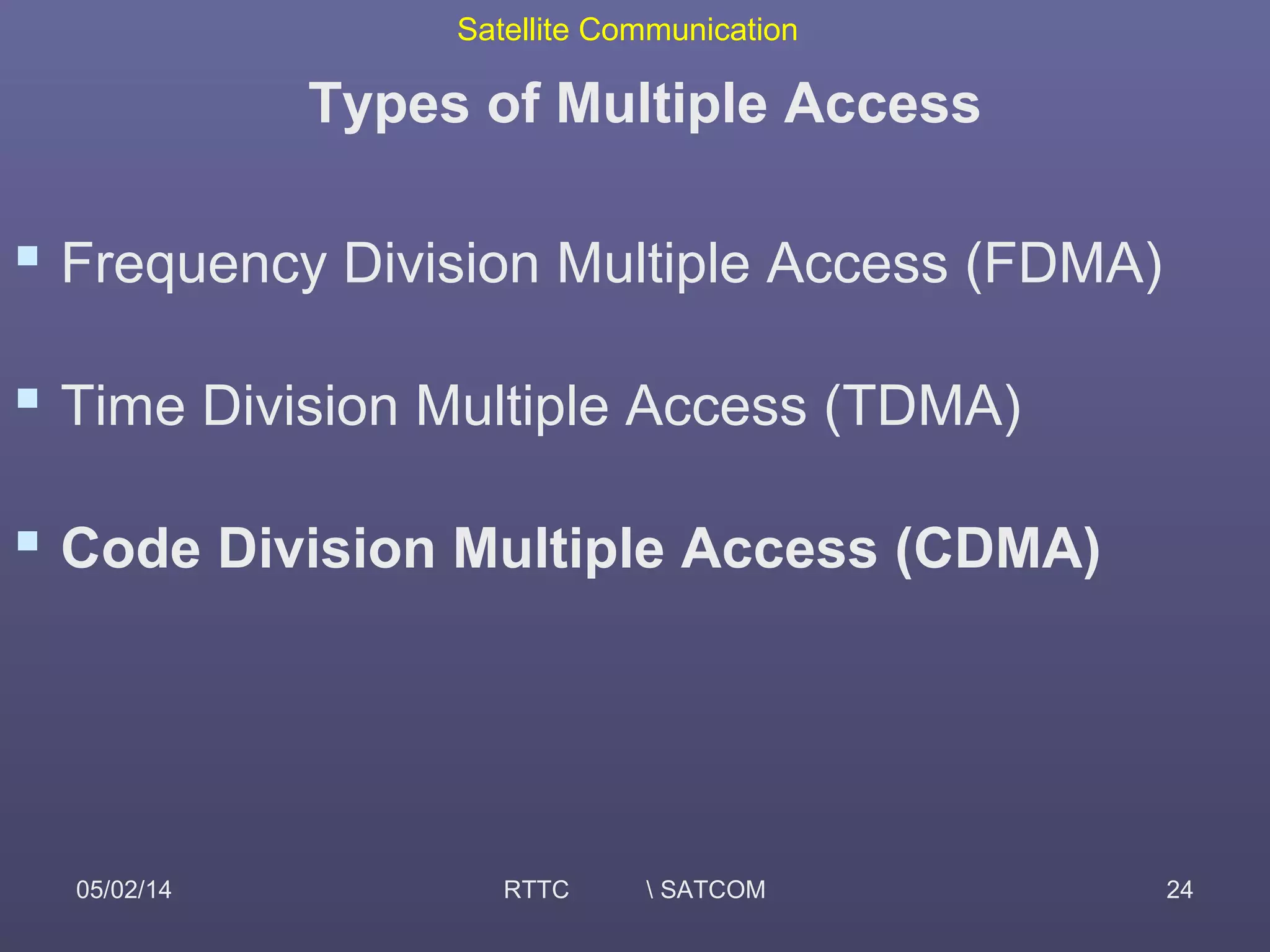
Types of Multiple Access
 Frequency Division Multiple Access (FDMA)
 Time Division Multiple Access (TDMA)
 Code Division Multiple Access (CDMA)
Satellite Communication
05/02/14 RTTC  SATCOM 25
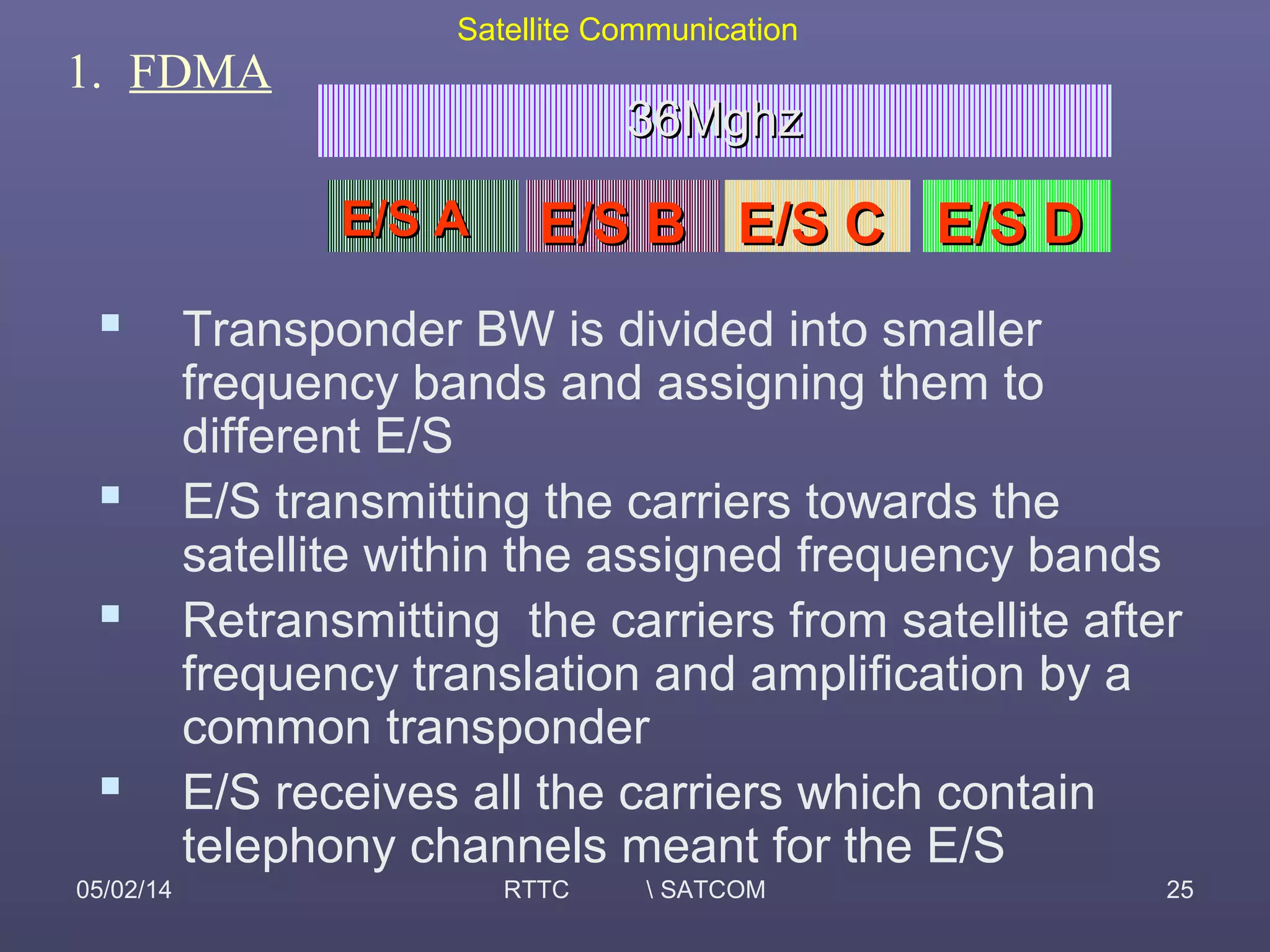
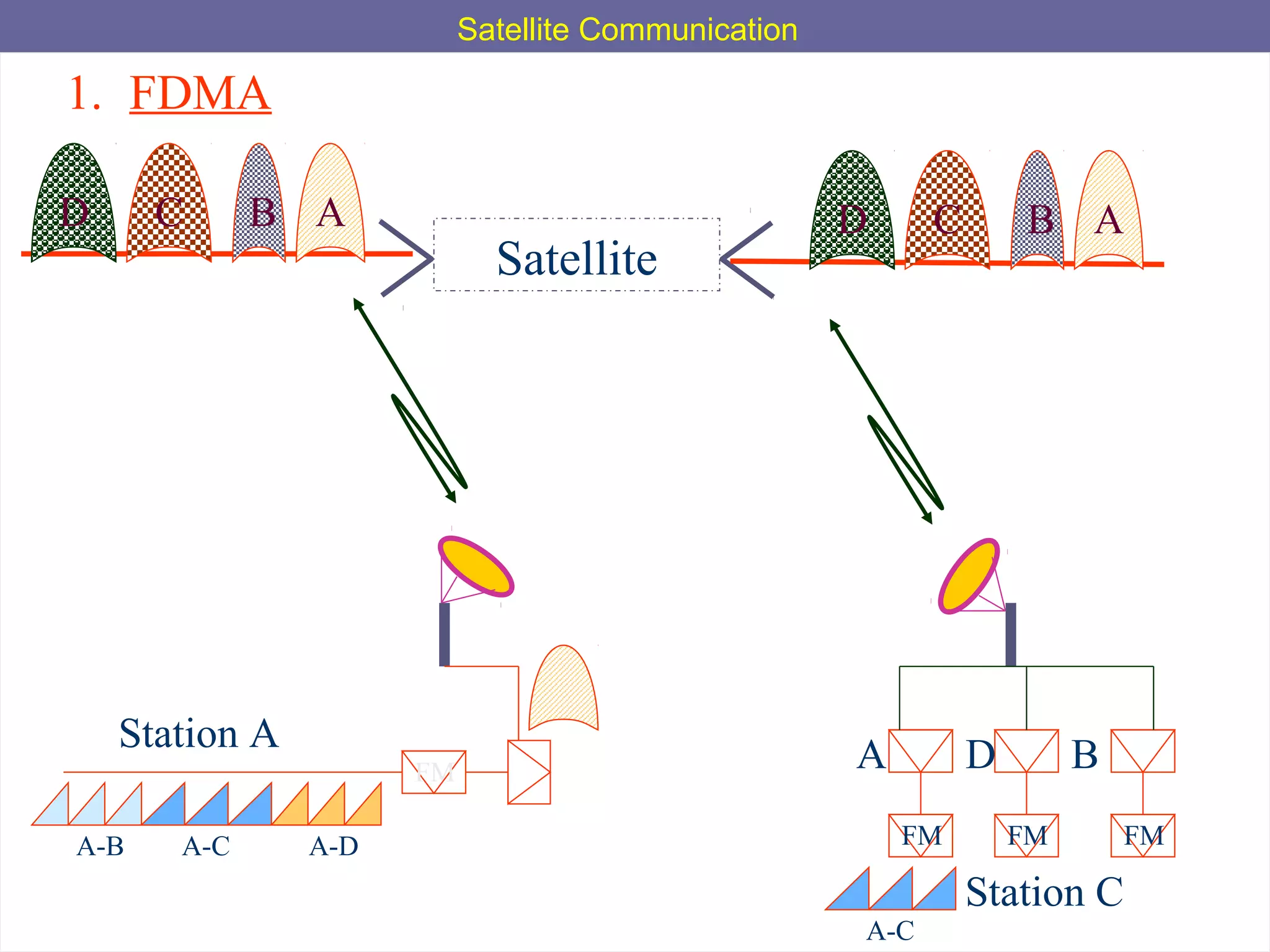
1. FDMA
36Mghz36Mghz
E/S DE/S DE/S CE/S CE/S BE/S BE/S AE/S A
 Transponder BW is divided into smaller
frequency bands and assigning them to
different E/S
 E/S transmitting the carriers towards the
satellite within the assigned frequency bands
 Retransmitting the carriers from satellite after
frequency translation and amplification by a
common transponder
 E/S receives all the carriers which contain
telephony channels meant for the E/S
Satellite Communication
05/02/14 RTTC  SATCOM 26
1. FDMA
A-B A-C A-D
Station A
FM
Satellite
ABCD ABCD
FM FM FM
Station C
DA B
A-C
Satellite Communication
05/02/14 RTTC  SATCOM 27
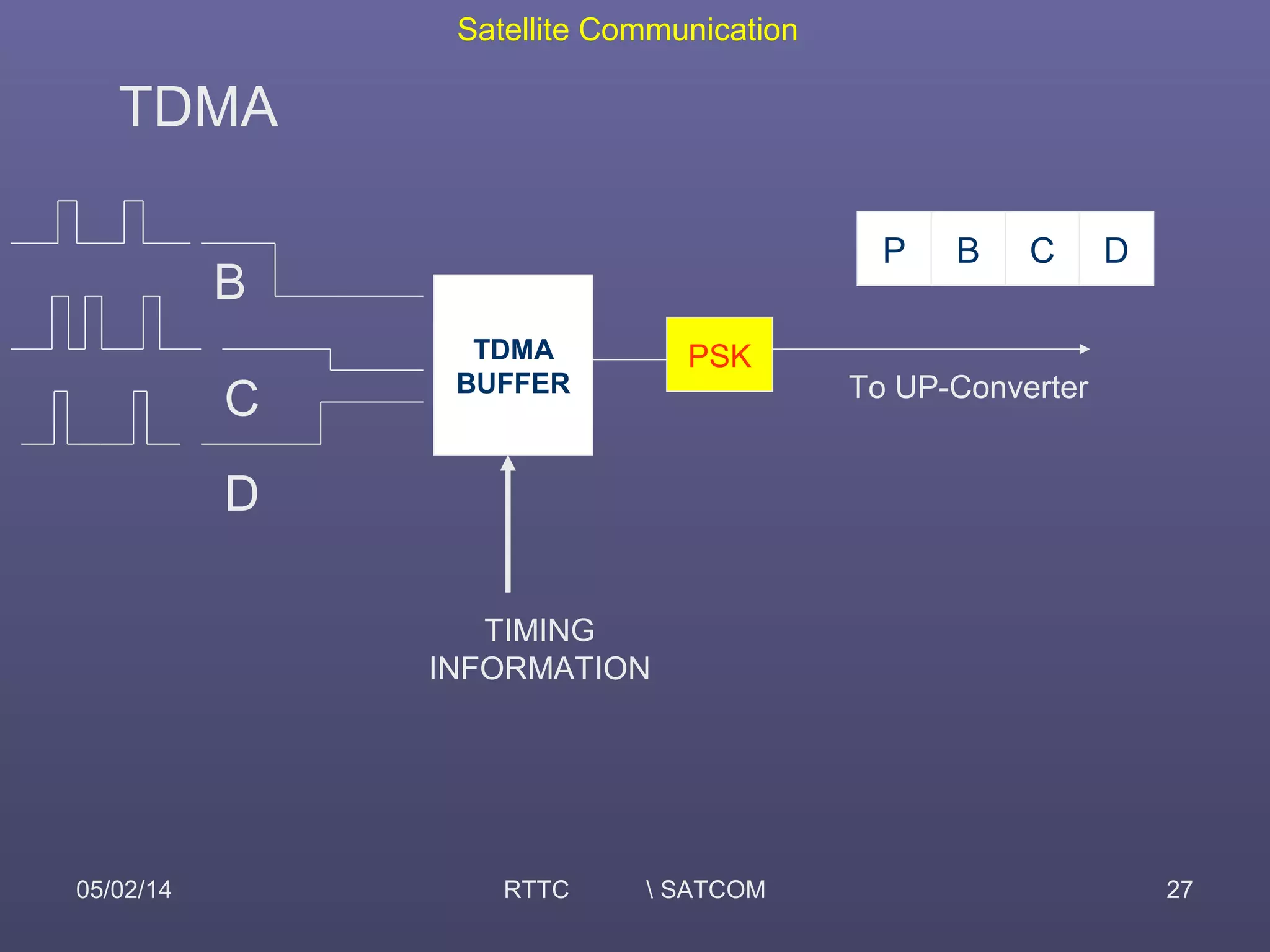
TDMA
P B C D
PSKTDMA
BUFFER
TIMING
INFORMATION
To UP-Converter
B
C
D
Satellite Communication
05/02/14 RTTC  SATCOM 28
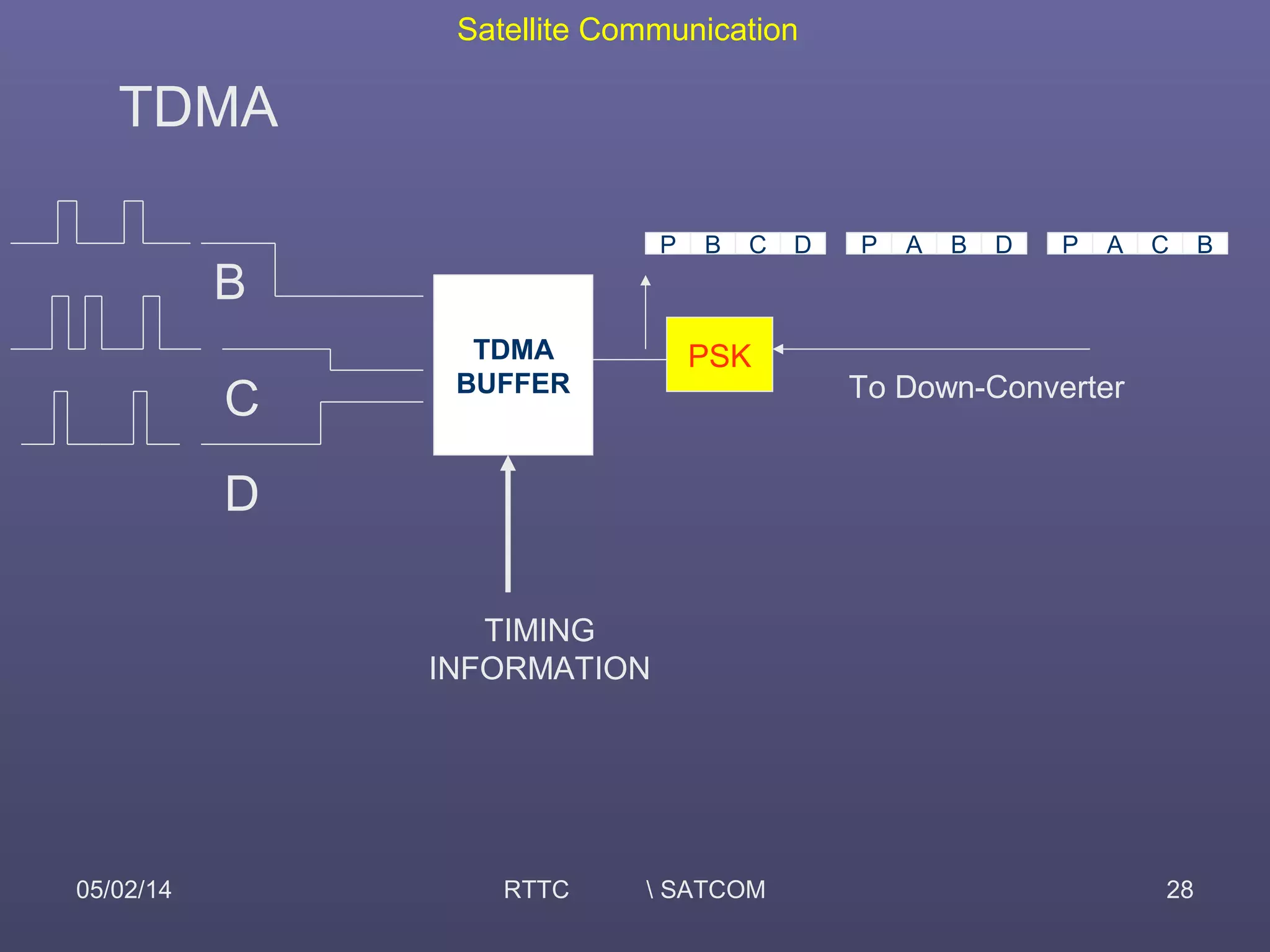
TDMA
P B C D
PSKTDMA
BUFFER
TIMING
INFORMATION
To Down-Converter
B
C
D
P A B D P A C B
Satellite Communication
05/02/14 RTTC  SATCOM 29
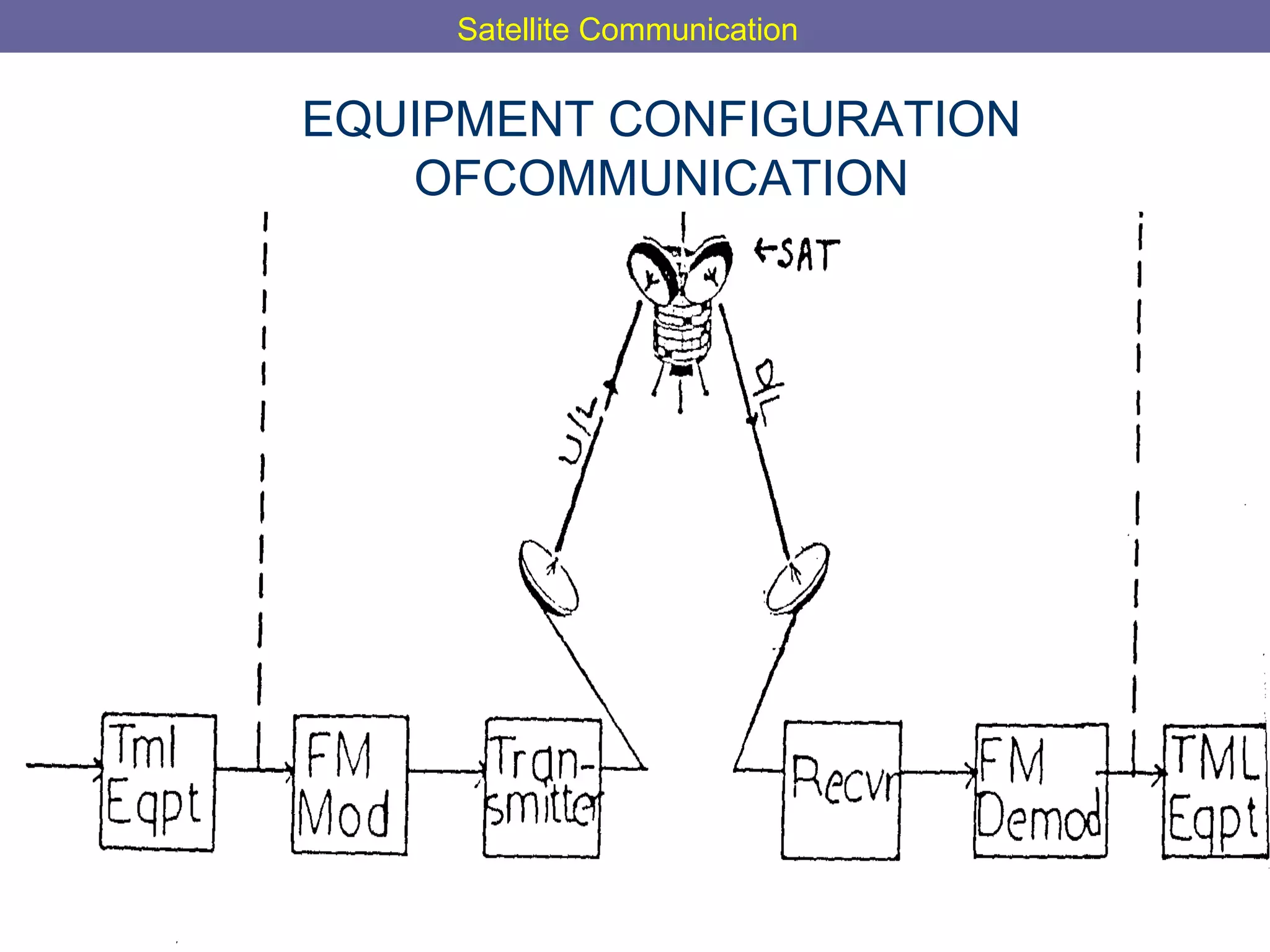
EQUIPMENT CONFIGURATION
OFCOMMUNICATION
Satellite Communication
05/02/14 RTTC  SATCOM 30
SPACE SEGMENT
A satellite consists of essentially two parts
 Communication payload
 Support subsystems
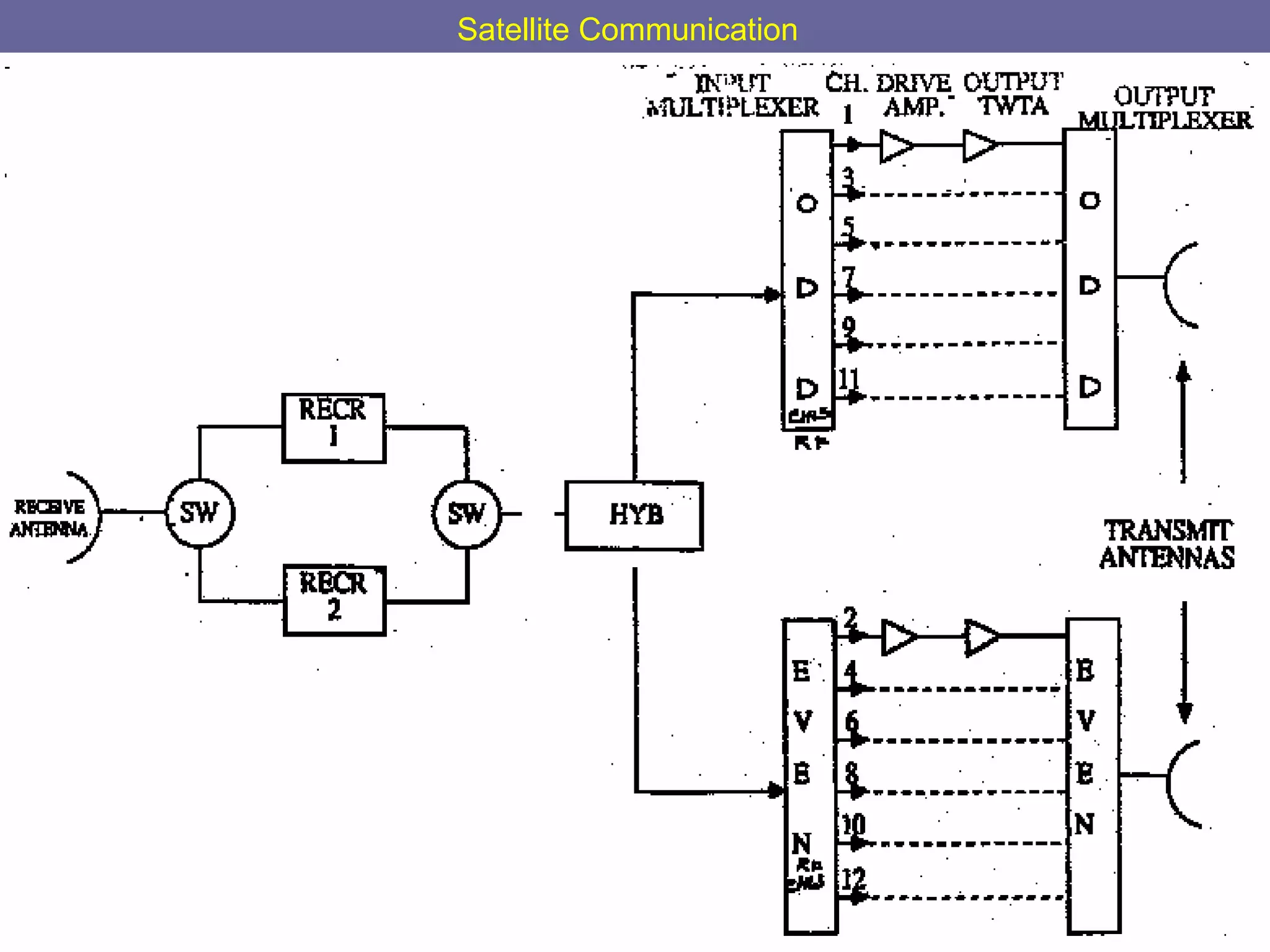
Communication payload for communication
satellites comprises
1.communication transponders
2.transmit/receive antennas.
Satellite Communication
05/02/14 RTTC  SATCOM 31
 Major support subsystems include :
 Structure
 Attitude and orbit control systems
 Electrical power system
 Thermal control system
 Telemetry and Telecommand system
Satellite Communication
05/02/14 RTTC  SATCOM 32

Satellite communication Basics

  • 1.
    Satellite Communication 05/02/14 RTTC SATCOM 1 OVERVIEW OF SATELLITE COMMUNICATION AND SATELITE SYSTEM
  • 2.
  • 3.
  • 4.
    Satellite Communication 05/02/14 RTTC SATCOM 4 Transmission System can be placed under three broad categories  Radio SystemRadio System  Co-axial cable systemCo-axial cable system  Optical fibre systemOptical fibre system Radio SystemRadio System Deals with electronic radiation of electromagnetic energy from one point to another through atmosphere or free space It is possible only in certain portion of frequency spectrum Frequency from 9Khz to 400Ghz
  • 5.
    Satellite Communication 05/02/14 RTTC SATCOM 5 Earth Layers of Atmosphere Different layers of the atmosphere play a role in propagating radio waves 18Km 70Km 500Km
  • 6.
    Satellite Communication 05/02/14 RTTC SATCOM 6 Ionosphere and troposphere are useful for radio communication in certain frequency range Radio communication can be placed under four categories Skywave or Ionosphere communicationSkywave or Ionosphere communication LOS MW CommunicationLOS MW Communication Troposphere scatter communicationTroposphere scatter communication Satellite communicationSatellite communication
  • 7.
    Satellite Communication 05/02/14 RTTC SATCOM 7 Ionosphere communicationIonosphere communication It deals with frequency range of 3-30Mhz which are classified as HF band Altitude(Km) Electron density F1 F2 E D IONOSPHERE EarthT R R
  • 8.
    Satellite Communication 05/02/14 RTTC SATCOM 8 LOS MW CommunicationLOS MW Communication IS CHARCTERSIED BY ► the useful range of frequencies lie between 150Mhz- 150Ghz ► it is line of sight communication limited by horizon due to the curvature of the earth ► Signal propagation is affected by free space attenuation ► Frequency / Phase modulation technique are employed ► Spread spectrum or Time sharing techniques are used
  • 9.
    Satellite Communication 05/02/14 RTTC SATCOM 9 d0 Optical horizon dr radio horizon OPTICAL & RADIO HORIZON A Microwave link A B R R
  • 10.
    Satellite Communication 05/02/14 RTTC SATCOM 10 Troposphere scatter communicationTroposphere scatter communication  Are single hop systemAre single hop system  Operates over length greater than LOS distanceOperates over length greater than LOS distance Scatter region Atmospheric turbulence and local variation of refractive index in the tropospheric region causes scattering of electromagnetic waves
  • 11.
    Satellite Communication 05/02/14 RTTC SATCOM 11 50Km 10000Km 750Km Troposphere scatter 1500Km Ionosphere Reflection SATELLITE CO M M UNICATIO N
  • 12.
    Satellite Communication 05/02/14 RTTC SATCOM 12 Earth Global Coverage
  • 13.
    Satellite Communication 05/02/14 RTTC SATCOM 13 Advantages Of Sat. Com 1. Large Coverage Area 2. High Quality 3. High Reliable 4. High Capacity 5. Flexibility 6. Easy For installation 7. Emergency Communication 8. Point to Multipoint transmission
  • 14.
    Satellite Communication 05/02/14 RTTC SATCOM 14 Sat. Com Network 1. Space Segment Uplink Downlink 2. Ground Segment
  • 15.
    Satellite Communication 05/02/14 RTTC SATCOM 15 Sat. Com Network Frequency for space communication depends on 1. Band width required 2. Noise consideration 3. Propagation factor 4. Technology Most of the sat.Com uses 6/4Ghz frequency band 1. Less Atmospheric Absorption2. Less noise both galactic and manmade3. Less Space loss compared to high frequency
  • 16.
    Satellite Communication 05/02/14 RTTC SATCOM 16 59000-64000Mhz & 54000-58000Mhz59000-64000Mhz & 54000-58000MhzV BandV Band Inte.SatInte.Sat 40000-51000Mhz & 40000-41000Mhz40000-51000Mhz & 40000-41000MhzV BandV Band INSATINSAT6725-7025Mhz & 4500-4800Mhz6725-7025Mhz & 4500-4800MhzExt “C”BandExt “C”Band 27500-30000Mhz & 17700 – 21200Mhz27500-30000Mhz & 17700 – 21200Mhz““K”BandK”Band 14000-14500 & 10950-11200Mhz14000-14500 & 10950-11200Mhz 11450-11700Mhz11450-11700Mhz ““Ku” BandKu” Band 7900-8400Mhz &7250-7750Mhz7900-8400Mhz &7250-7750Mhz““X” BandX” Band INSATINSAT5925-6425Mhz & 3700-4200Mhz5925-6425Mhz & 3700-4200Mhz““C” BandC” Band INSATINSAT2500-2700Mhz2500-2700Mhz““S” BandS” Band 1830-2700Mhz1830-2700Mhz““L” BandL” Band Frequency band for Sat. Com
  • 17.
    Satellite Communication 05/02/14 RTTC SATCOM 17 Equator 4000miles A 35786KmB Geographical Advantage Time Delay Uplink35786Km 250msec D ow nlink 35786K m 250m sec
  • 18.
    Satellite Communication 05/02/14 RTTC SATCOM 18 Geostationary Satellite Altitude:35786Km Direction :moves in eastern direction as earth Period of revolution is 23Hr 56min34sec Equator
  • 19.
    Satellite Communication 05/02/14 RTTC SATCOM 19 Broadcasting mode of operation
  • 20.
    Satellite Communication 05/02/14 RTTC SATCOM 20 Kinds of Communication Satellites depends on type of orbit and freq. band used. Communication Satellite can be classified by the orbit used and also by frequency band used. natural laws that control the movement of satellites. These are based on Kepler's laws 1.The orbit plane of any earth satellite must bisect the Earth centrally. 2.The Earth must be at the centre of any orbit.
  • 21.
    Satellite Communication 05/02/14 RTTC SATCOM 21 The choice of orbit is restricted to three basic types. 1.polar, 2.equatorial 3.inclined
  • 22.
    Satellite Communication 05/02/14 RTTC SATCOM 22 Communication SystemsCommunication Systems  Satellite communication systems areSatellite communication systems are classifiedclassified 1.Communication system Multiplexed telephone channels with one (i) carrier frequency system, and (ii) Single channel per carrier system. 2.Modulation system Analog modulation (Frequency Modulation system), and Digital modulation system
  • 23.
    Satellite Communication 05/02/14 RTTC SATCOM 23 3.System configuration Pre–assignment system Demand assignment system, and MULTIPLE ACCESS TECHNIQUES the number of earth stations to be interconnected is such larger than the number of transponders the capacity of a transponder is much more than what is required between a pair of earth stations;
  • 24.
    Satellite Communication 05/02/14 RTTC SATCOM 24 Types of Multiple Access  Frequency Division Multiple Access (FDMA)  Time Division Multiple Access (TDMA)  Code Division Multiple Access (CDMA)
  • 25.
    Satellite Communication 05/02/14 RTTC SATCOM 25 1. FDMA 36Mghz36Mghz E/S DE/S DE/S CE/S CE/S BE/S BE/S AE/S A  Transponder BW is divided into smaller frequency bands and assigning them to different E/S  E/S transmitting the carriers towards the satellite within the assigned frequency bands  Retransmitting the carriers from satellite after frequency translation and amplification by a common transponder  E/S receives all the carriers which contain telephony channels meant for the E/S
  • 26.
    Satellite Communication 05/02/14 RTTC SATCOM 26 1. FDMA A-B A-C A-D Station A FM Satellite ABCD ABCD FM FM FM Station C DA B A-C
  • 27.
    Satellite Communication 05/02/14 RTTC SATCOM 27 TDMA P B C D PSKTDMA BUFFER TIMING INFORMATION To UP-Converter B C D
  • 28.
    Satellite Communication 05/02/14 RTTC SATCOM 28 TDMA P B C D PSKTDMA BUFFER TIMING INFORMATION To Down-Converter B C D P A B D P A C B
  • 29.
    Satellite Communication 05/02/14 RTTC SATCOM 29 EQUIPMENT CONFIGURATION OFCOMMUNICATION
  • 30.
    Satellite Communication 05/02/14 RTTC SATCOM 30 SPACE SEGMENT A satellite consists of essentially two parts  Communication payload  Support subsystems Communication payload for communication satellites comprises 1.communication transponders 2.transmit/receive antennas.
  • 31.
    Satellite Communication 05/02/14 RTTC SATCOM 31  Major support subsystems include :  Structure  Attitude and orbit control systems  Electrical power system  Thermal control system  Telemetry and Telecommand system
  • 32.