Contents:
What isSAP PI?
What is SAP PO?
Why do We Need SAP PI?
How SAP PI/PO works?
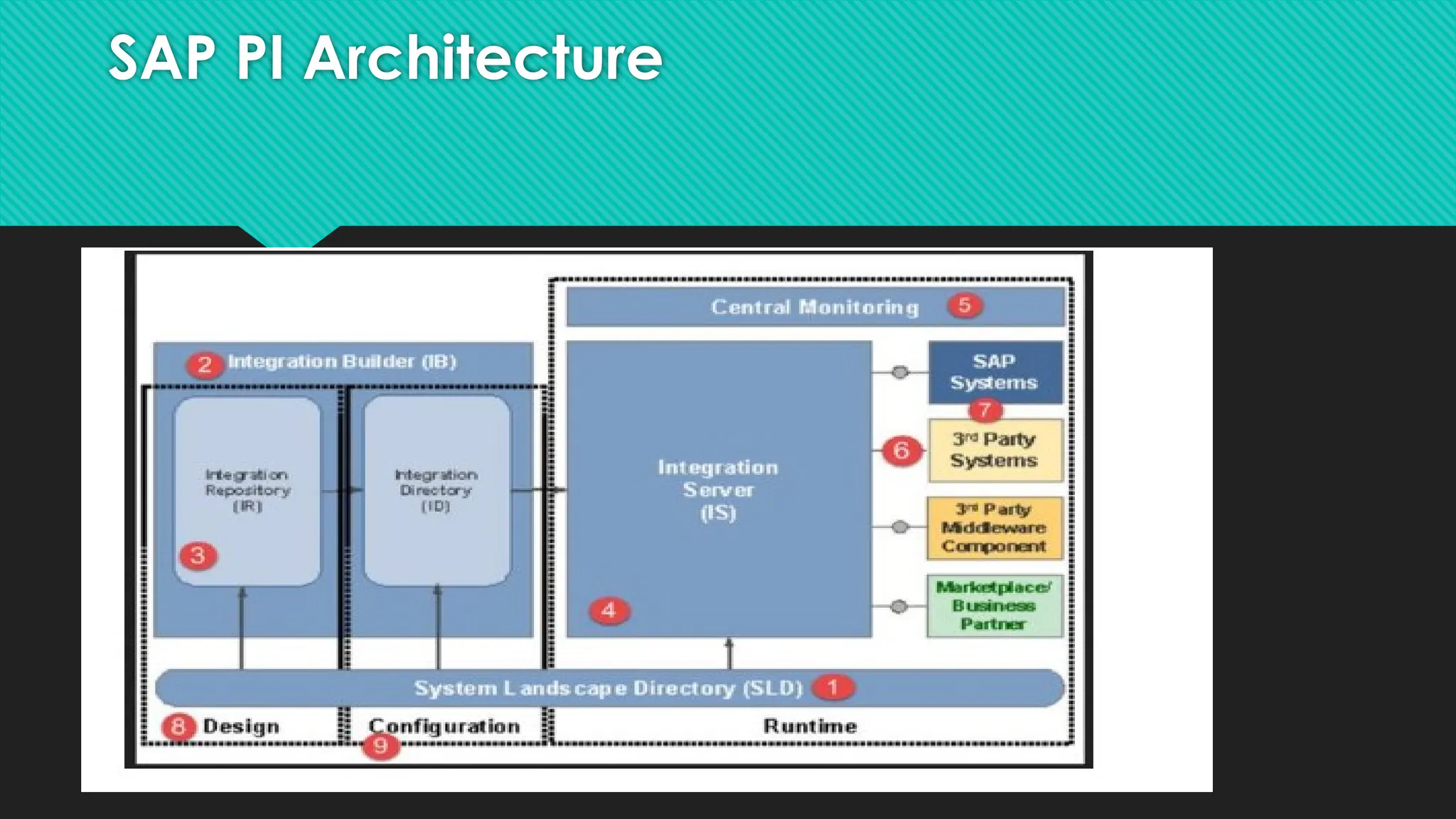
SAP PI Architecture
Advantages
SAP PI Home Page
SLD(System Landscape Directory)
Communication
3.
What is SAPPI?
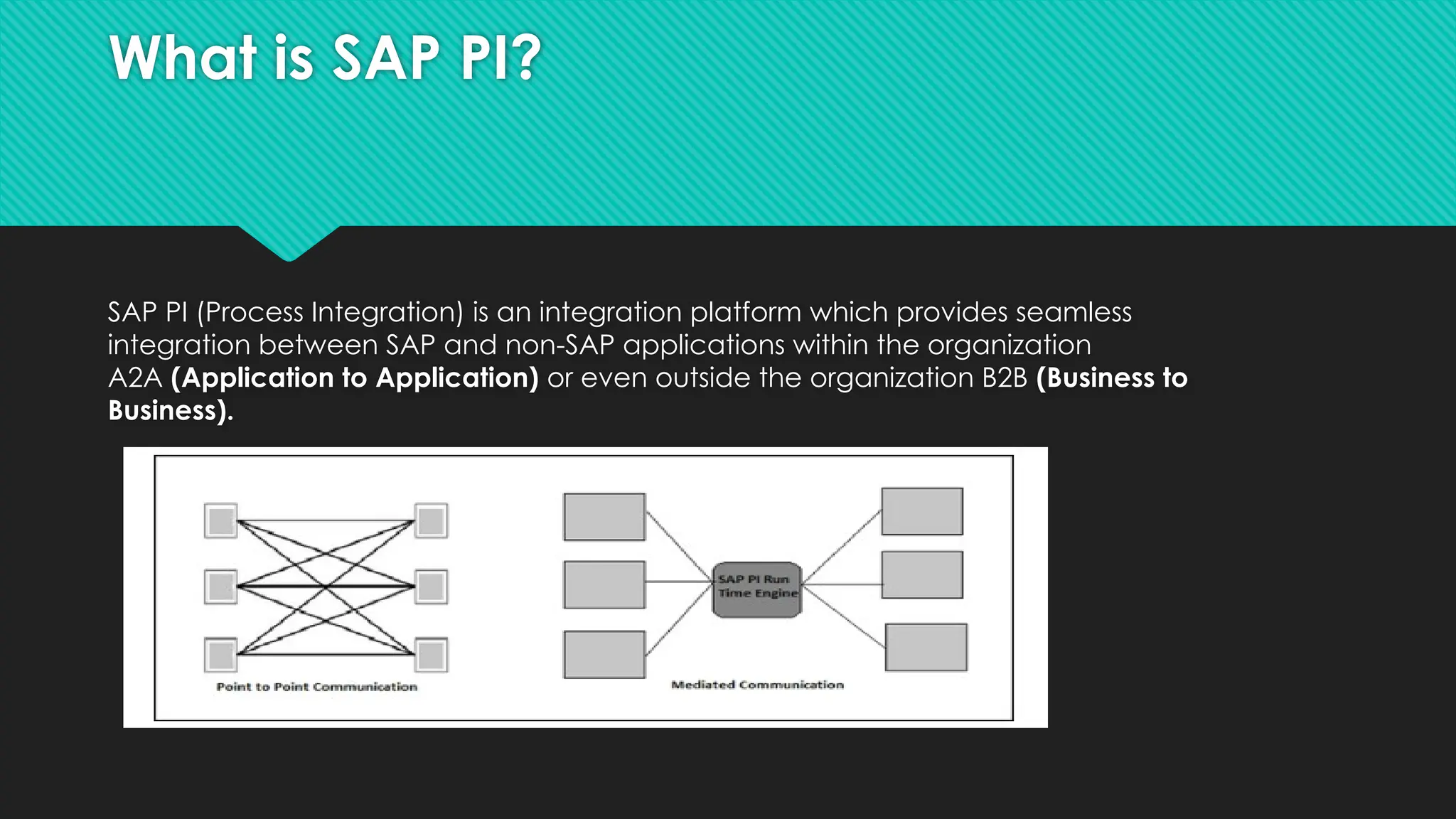
SAP PI (Process Integration) is an integration platform which provides seamless
integration between SAP and non-SAP applications within the organization
A2A (Application to Application) or even outside the organization B2B (Business to
Business).
4.
What is SAPPO?
SAP Process Orchestration is a tool to automate and optimize business processes.
5.
Why do WeNeed SAP PI?
For smooth communication between multiple businesses, Mediated communication or
Integration broker is used
SAP PI adapts this system very well.
It enables interconnection of a different process via a central location known
as Integration Broker, unlike the point to point connection which is more like a spider web.
Mediated communication is based on an integration broker which is executed by
exchanging XML messages.
6.
How SAP PI/POworks?
SAP PI performs three basic functions:
CONNECT
CO-ORDINATE
COMMUNICATE
The various componentsof SAP PI include:
• System Landscape Directory
• Integration Builder
• Integration Repository
• Integration Server
• Central Monitoring
• Adapter Engine
• Message Processing Technique by PI
• Design
• Configuration
• Message Processing
• Message Monitoring
9.
System Landscape Directory:It is a central information provider in a system landscape. SLD
contains two types of information, "Component Information (Installable & Installed) and
Landscape description.“
Integration Builder: It is a tool-set which contains a set of tools for accessing and editing
integration objects
Integration Repository: To develop, design and maintain data types, message structures,
mappings, interfaces, integration processes and integration scenarios independently of system
landscape, integration repository is used.
Integration Server: It is a central processing engine of the PI. All messages are processed using
this server.
Central Monitoring: With the help of this monitoring of PI domain is done, and "workbench" is
the tool that is used for monitoring.
Adapter Engine: It acts as a connector to connect the integration engine to SAP systems and
other systems.
10.
Message Processing Techniqueby PI: To access data from SAP and Non-SAP application this
technique is used. SAP PI uses an intermediate document like IDoc to Flat files to transfer their
data.
Design: Process Integration (PI) uses integration repository to design message structure.
Configuration: Integration Directory (ID) is used to configure technical parameters for objects
created in IR ( Integration Repository).
Message Processing: Once the IDOC is activated in SAP system, PI takes in charge and convert
messages into XML format for its internal processing
Message Monitoring: The messages can be monitored and traced using "Run Time Workbench".
This tool can be useful in monitoring sender and receiver adapters, Outgoing and Incoming
messages, End to End monitoring of complete scenario and error traces.
11.
Advantages
Advantages of SAPPI/PO
In comparison to any other middleware product monitoring in SAP PI is better. It
offers monitoring features like a message, performance, component monitoring
and so on, all of which can be used to track and rectify the errors.
SAP PI supports various SAP components which are required while integrating with
SAP PI
Adapters and mappings are good as compared with any other middleware
product
Asynchronous and Synchronous communication is possible
12.
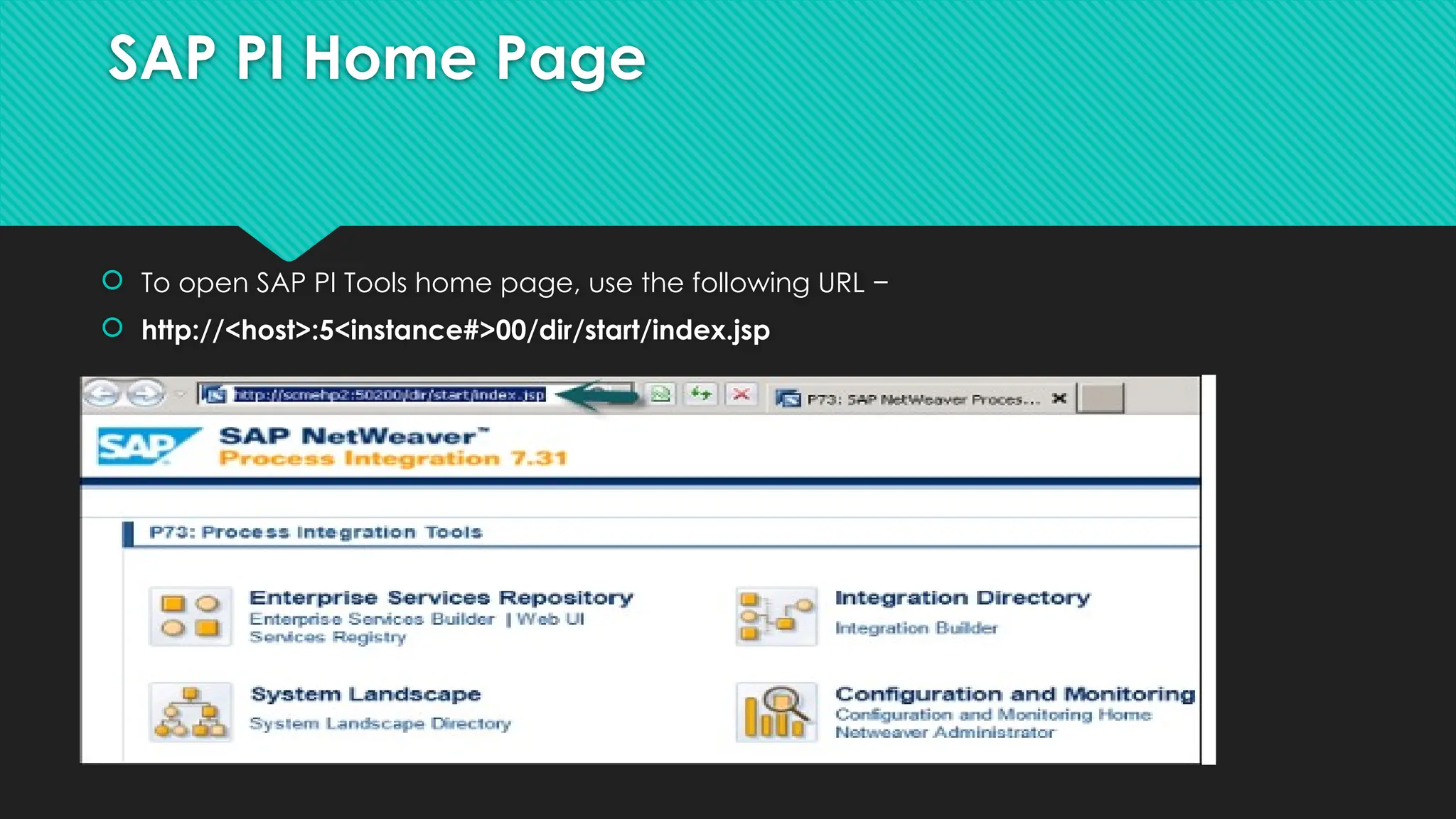
SAP PI HomePage
To open SAP PI Tools home page, use the following URL −
http://<host>:5<instance#>00/dir/start/index.jsp
13.
SAP PI homepage has the following four Java links −
Enterprise Services Repository (ESR)
Integration Directory (ID)
System Landscape (SL)
Configuration and Monitoring (CM)
14.
ESR(Enterprise Service Repository):
In SAP PI, Enterprise Service Repository is used to design and create objects to be used in
the integration scenario. You can design Interface Objects, Mapping Objects and the
different integration processes.
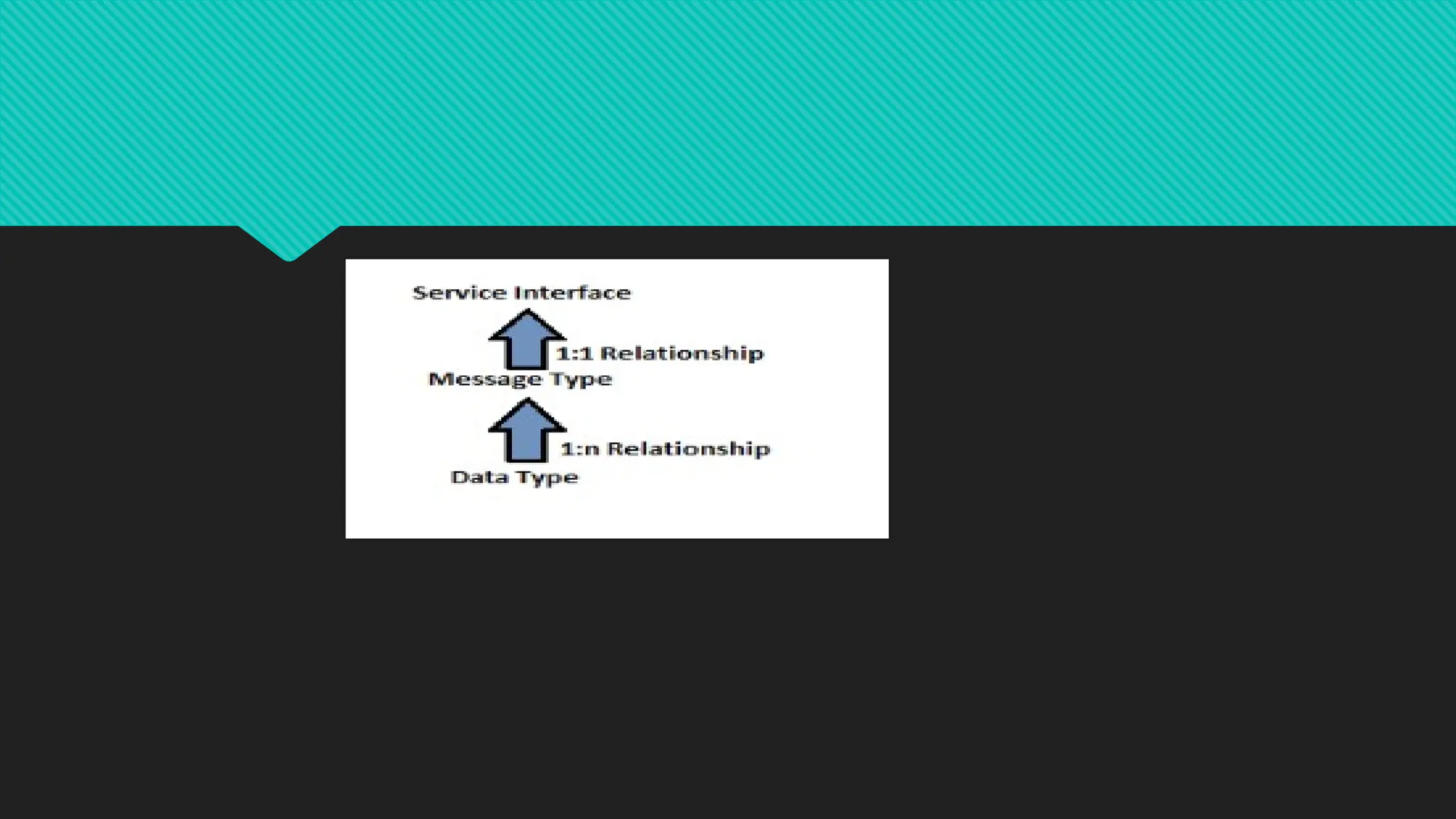
Interface Objects:
The following are the Interface Objects −
Service Interface
Data type
Message type
16.
Integration Directory
IntegrationDirectory is used for the configuration of objects that are created in Enterprise
Service Repository and configuration is executed by the Integration Engine at runtime. To
configure ESR objects, you need to import object — Service and Communication
Channel.
17.
SLD(System Landscape Directory):
The System Landscape Directory contains the information about landscape and software
component versions. A SAP system can be configured to register under this directory.
System Landscape Directory (SLD) manages information about all installable and installed
elements of your system landscape
18.
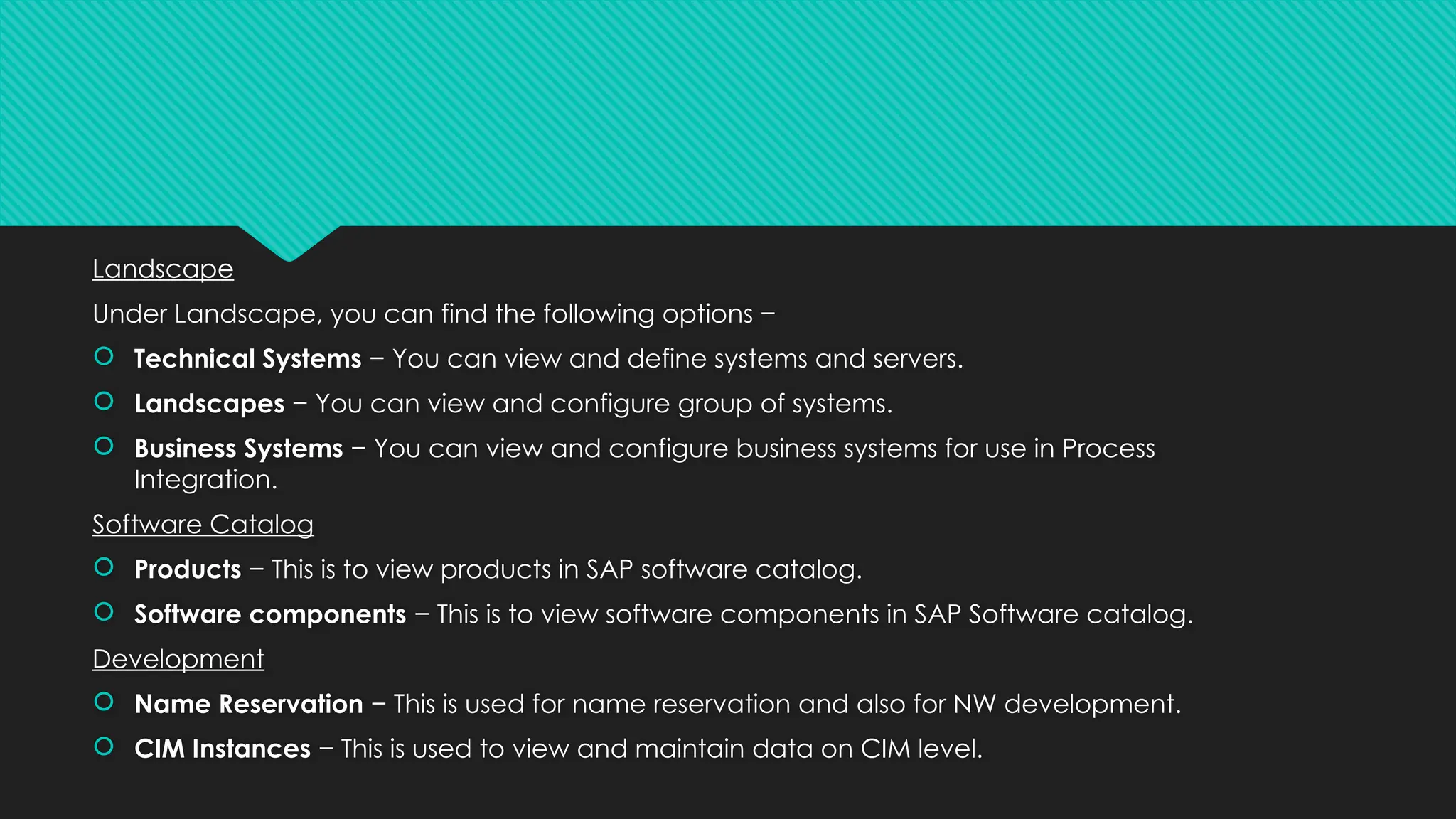
Landscape
Under Landscape, youcan find the following options −
Technical Systems − You can view and define systems and servers.
Landscapes − You can view and configure group of systems.
Business Systems − You can view and configure business systems for use in Process
Integration.
Software Catalog
Products − This is to view products in SAP software catalog.
Software components − This is to view software components in SAP Software catalog.
Development
Name Reservation − This is used for name reservation and also for NW development.
CIM Instances − This is used to view and maintain data on CIM level.
19.
Configuration and Monitoring
The Configuration and Monitoring option on SAP PI tools Home Page allows you to monitor
the functions of the integration engine, CCMS integration and process monitoring
infrastructure in SAP system.









![[WSO2 Integration Summit Nairobi 2019] Role of Integration in an API Driven W...](https://cdn.slidesharecdn.com/ss_thumbnails/wso2integrationsummitnairobi2019roleofintegrationinanapidrivenworld-190517050115-thumbnail.jpg?width=640&height=640&fit=bounds)


