Vol. 1, No. 2, July 2014 
Random Keying Technique for Security in Wireless 
Sensor Networks Based on Memetics 
S.B. Suman1, P.V. Ranjith Kumar2, E. Sandeep Kumar3 
1 Dept. of Computer Science & Engg, M S Ramaiah Institute of Technology, Bangalore, Karnataka, India. 
2 Dept. of Electronics & Communication Engg, M S Ramaiah Institute of Technology, Bangalore, Karnataka, India. 
3 Dept. of Telecommunication Engg, JNN College of Engineering, Shimoga, Karnataka, India. 
Email: sandeepe31@gmail.com 
ABSTRACT 
Wireless Sensor Networks (WSNs) are often prone to risk of security attacks and vulnerabilities. This is because of 
the less human intervention in their operations. Hence, novel security mechanisms and techniques are of a prime 
importance in these types of networks. In this context, we propose a unique security scheme, which coalesce the 
random keying technique with memetics. The application of these kinds of bio-inspired computation in WSNs 
provides robust security in the network with the obtained results supporting the security concerns of the network. 
KEYWORDS 
Random Keying Technique— Memetics— Bio-Inspired Computation. 

c 2014 by Orb Academic Publisher. All rights reserved. 
1. Introduction 
Wireless sensor networks is gaining lot of research interest in 
the present scenario because of its vast and versatile applications. 
These networks are of great requirements in remote monitoring 
and military applications where they exchange sensitive data. 
Security is an area that has been a challenge for the researchers. 
This is due to the versatility and complexity in attacks to which 
these networks are often prone. Hence, in this paper we propose a 
random keying technique merging with the concepts of memetics 
to combat against the spoofing attacks in the network. Spoofing is 
a type of attack where the adversary tries to impinge unwanted or 
false information packets into the network to hamper its normal 
operation. Few researches have been carried out in solving the 
issues of WSNs using memetics. 
Chuan- Kang Ting et al. [1] propose a scheme for improving 
the network lifetime by enabling more coverage using memetic 
algorithm for WSNs. Konstantinos et al. [2] propose a method 
for improving network lifespan using memetic algorithm as an 
improvement on the genetic algorithm, taking into accounts of 
communication parameters and overheads of the sensor nodes. 
Sandeep et al. [3] propose a novel biologically inspired tech-nique 
that uses random keying technique with the concepts of 
artificial immune system for identifying the spoofing attacks in 
the network. Sandeep et al. [4] propose a bio-inspired approach 
for addressing node capture attack, which is a combination of 
artificial neural networks with the game theory as a combat mech-anism 
against malicious attacker. Kashif et al. [5] propose a 
bio-inspired approach that uses Ant Colony Optimization (ACO) 
for routing, and artificial immune system for securing from ab-normalities 
and routing attacks. Rongrong Fu et al. [6] developed 
a bio- inspired security framework that adapts Artificial Immune 
System (AIS) with the fuzzy techniques for detecting anomalies 
in the network. Ranjith et al. [7] proposed a bio-inspired security 
technique, which is based on genetics as counter measure against 
spoofing attacks. 
According our knowledge, very few research works has been 
carried out using memetics in solving issues of WSNs and with 
respect to applications of memetics concept is a novel approach 
towards security. In the proposed work, we use a combination of 
random key distribution scheme with memetic concepts for pro-viding 
robust security for WSNs. The algorithm was simulated in 
MATLAB and the results prove that the method is energy efficient 
compared to the other widely used cryptographic techniques like 
ECC and RSA, while combating against spoofing attacks. 
The rest of the paper is organized as follows: section 2 deals 
with memetics, section 3 with the proposed methodology, section 
4 with radio model, section 5 discusses the attack scenario, section 
6 deals with the simulations, section 7 deals with the results and 
discussions, section 8 with the concluding remarks of the paper 
and finally the paper ends with few references. 
2. Memetics 
Memetics is a theory based on Darwinian evolution, originating 
from the popularization of Richard Dawkins book ‘the selfish 
gene’. A ‘meme’ is same as ‘gene’ and but these are termed as 
‘units of culture’, which are “hosted” in the minds of one or more 
25
International Journal of Computer Science: Theory and Application 
individuals, and which can reproduce itself, thereby jumping from 
mind to mind [8]. The concept of ‘memetics’ has been developed 
as ‘memetic algorithm’, for solving optimization problems. 
2.1 Memetic algorithm 
Memetic algorithms have elements of Metaheuristic and Compu-tational 
Intelligence. Although they have principles of evolution-ary 
algorithms, they may not strictly be considered an evolution-ary 
technique. Using ideas of memes and memetic algorithms 
in optimization may be referred to as memetics computing [9]. 
Ideally, memetic algorithms embrace the duality of genetic and 
cultural evolution, allowing the transmission, selection, inheri-tance, 
and variation of memes as well as genes. The memetic 
algorithm can simply be considered as the improvement over the 
genetic algorithm in the notion that, the genes are transferred 
directly to the individual but the memes are processed locally 
and then transferred. Hence, adding local search to the genetic 
algorithm results in memetic algorithm. 
The algorithm is given below: 
1. Start: Randomly generate a population of N chromosomes. 
2. Fitness: Calculate the fitness of all chromosomes. 
3. Create a new population: 
– Selection: According to the selection criteria, select two 
chromosomes from the population that are best chromo-somes. 
– Crossover: Perform crossover on the two chromosomes 
selected. 
– Local search: search for the best chromosomes. 
– Mutation: Perform mutation on the chromosomes ob-tained 
with small probability. 
4. Replace: Replace the current population with the new 
population. 
5. Test: Test whether the termination condition is satisfied. If 
so, stop. If not, go to Step 2. 
This algorithm is modified for providing security in the WSNs. 
3. Proposed Methodology 
This section deals with the method introduced in the regard of 
providing security in the network. 
3.1 Random Key range distribution 
3.1.1 At the Base Station (BS) - Set up phase 
i - Set the range with in which the keys have to be selected. 
The keys (integer numbers) between these ranges are the 
initial set of populations (memes). Let this be (A;B). 
ii - From the range (A;B) a random set of keys will be se-lected 
for scaling down the range, this indicates the optimal 
set of the keys, which participate in the further process. Let 
this be (X;Y), where X is the lower limit and Y is the upper 
limit. 
iii - Within (X;Y), randomly two numbers will be picked, and 
sent to the Cluster Head (CH). Step iii is repeated until all 
the CHs receive two random numbers from the BS. Let the 
number received at the CHs be (p;q), where, p is the lower 
limit and q is the upper limit. 
3.1.2 At the Cluster Heads 
The received range from the BS will be sent all the member nodes 
of its cluster. This is (p;q), which is dealt in the previous section. 
3.2 Steady phase communication 
1. Ordinary member node, if it wants to communicate with 
its CH, it randomly picks two numbers from within the 
range (p;q). The numbers (keys) in the range (p;q) is the 
pool of population of memes. The chosen numbers in this 
pool indicates the best locally picked memes for the further 
processes. Let this be (m;n). 
2. These memes are allowed to crossover with each other. The 
procedure of the crossover is dealt in the later sections of 
the paper. 
3. The crossovered numbers (memes) are now checked for 
fittest candidate, for the further mutation process. The re-sult 
of crossover will be two numbers, let this be (k;h) and 
out of two, one candidate is picked based on the presence 
of number of ones. The candidate is now allowed for mu-tation, 
whose process is explained in the further sections 
of this paper, the other number is kept as it is without any 
change. Let the picked candidate be h, and the result of the 
mutation be v, the result after the process is (k;v). 
4. (m;n) is placed in the header and (k;v) is substituted as the 
trailer and the packet is sent to the CH. 
5. The process is repeated by all the ordinary nodes in a net-work 
that wants to communicate with the CH. The respec-tive 
CHs wait until it receives the data from all the ordinary 
nodes and again follows same procedure as in step 1 to step 
4 and places header and trailer information in the packet 
and sends to the BS. 
3.3 Crossover 
Let the range received by the higher hierarchy node be (p;q). 
Select two numbers randomly and let this be (m;n). The step 
involved is given below: 
1. Initially, calculate intermediate number, 
E = (m+1)+(n1); (1) 
2. Find the smallest multiple of 3 between the range (m;E), 
let this be x, else use m. 3 is an example this can also be 
made random, and depends on the robustness required. 
3. Find (x%8), which gives the point at which (m;n) has to be 
crossovered. Here 8 is chosen since the size of keys chosen 
for communication is 8 bits. The example is shown below. 
26
International Journal of Computer Science: Theory and Application 
Ex : 
(p;q) = (12;70); 
(m;n) = (15;56); 
E = (15+1)+(561) = 71; 
The smallest multiple between (15, 71) is x= 15; 
4. (15%8) = 6; hence 6 is the crossover point. The bits from 
6th position to the 8th position of (m;n) is crossovered with 
one another. 
m = 15 = 00001111 
n = 56 = 00111000 
After crossover! 00101111!47 
!00011000!24 
The result of crossover is (m;n) = (47;24). 
3.4 Mutation 
The two bytes obtained after the crossover is checked for number 
of 1’s individually and the key with the highest number of ones 
is chosen as the best candidate for mutation. From the example 
dealt in the crossover section, the best candidate chosen is 47 
because it has more number of 1’s in it. 
The mutation is carried out in such a way that all the bits in 
the number are complemented. 
Ex : 
47!00011111 
11100000!223 
The packet is put with (15, 56) as the header and (47, 223) as 
the trailer information and sent to the higher hierarchical sensor 
node. 
3.5 Verification at the CH for the packet sent by ordi-nary 
node or verification at the BS for the packet 
sent by CH 
1. Start 
2. Receive the packet 
3. Extract header 
4. Check header, whether it is in the range that was sent by 
itself. Let the received header be m, n and trailer be k, 
v. 
/*(p;q) range received by the higher hierarchy node*/ 
if (m  p and n  q) then 
/* packet cleared stage-1*/ 
(g;h) = Crossover (m;n); 
/*h1 and h2 are results of crossover*/ 
Select the best candidate for mutation. Let this be x. 
(g1;h1)= Mutation (x); 
if (g1 == k and h1 == v) then 
/* packet cleared stage-2*/ 
else 
/* packet is malicious*/ 
end 
else 
/* packet is malicious*/ 
end 
5. Stop 
3.6 Packet Description 
i. Packet sent from BS to CH/ CH to its member nodes 
MAC p q 
where, MAC! address of the intended CH node and p, q! 
keys randomly picked. 
ii. Packet sent from ordinary node to CH/ CH to BS 
This packet consists of the details regarding randomly picked 
keys by the node and the trailer. 
m n CRITICAL INFO k v 
where, m;n!keys randomly picked by the node for communi-cation 
with its CH and g1, h1 are the trailers after crossover and 
mutation, CRITICAL INFO ! consists of various fields includ-ing, 
preamble, sync bits, destination address, type, group identity, 
length of message, counter for message sent, source address, error 
checking bits and payload. 
4. Radio Model 
The proposed methodology uses a classical radio model [10]. The 
sensor node is a transceiver. Hence, this radio model gives the 
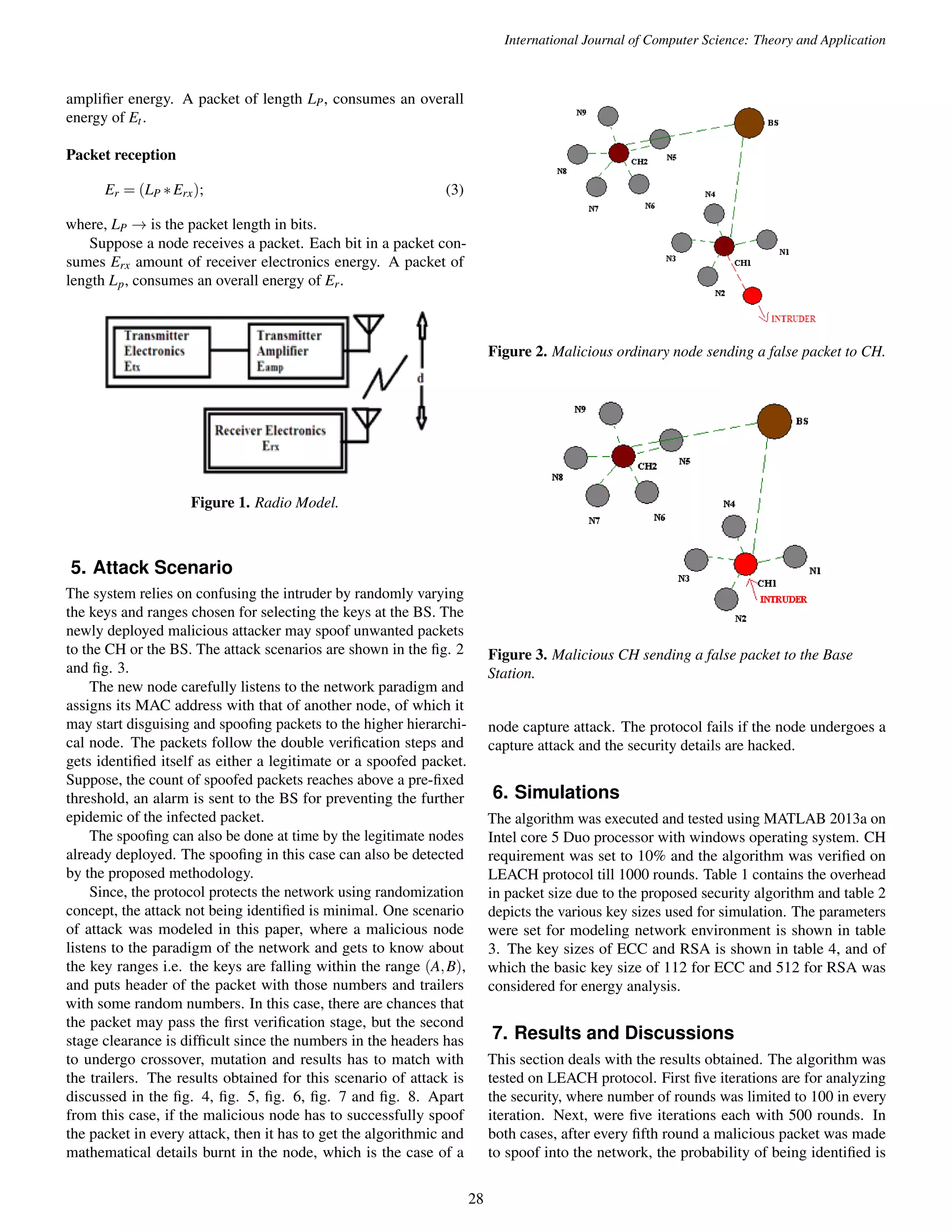
energy consumed for the transmission and reception. The block 
diagram representation is shown in fig. 1. The radio model con-sists 
of transmitter and receiver equivalent of the nodes separated 
by the distance‘d’. Where Etx, Erx are the energy consumed in 
the transmitter and the receiver electronics. Eamp is the energy 
consumed in the transmitter amplifier in general, and it depends 
on the type of propagation model chosen either free space or 
multipath with the acceptable bit error rate. We consider Ef s for 
free space propagation and Emp for multipath propagation as the 
energy consumed in the amplifier circuitry. The transmitter and 
the receiver electronics depends on digital coding, modulation, 
filtering and spreading of data. Additional to this there is an ag-gregation 
energy consumption of Eagg per bit if the node is cluster 
head. 
4.1 Energy Consumption 
This section describes the energy consumed for communication. 
Packet transmission 
Et = (LP Etx)+(LP Eamp  dn); (2) 
where, LP ! is the packet length in bits, and n ! is the path 
loss component which is 2 for free space and 4 for multipath 
propagation. 
Suppose a node transmits a packet. Each bit in a packet consumes 
Etx amount of transmitter electronics energy, Eamp amount of 
27
International Journal of Computer Science: Theory and Application 
amplifier energy. A packet of length LP, consumes an overall 
energy of Et . 
Packet reception 
Er = (LP Erx); (3) 
where, LP ! is the packet length in bits. 
Suppose a node receives a packet. Each bit in a packet con-sumes 
Erx amount of receiver electronics energy. A packet of 
length Lp, consumes an overall energy of Er. 
Figure 1. Radio Model. 
5. Attack Scenario 
The system relies on confusing the intruder by randomly varying 
the keys and ranges chosen for selecting the keys at the BS. The 
newly deployed malicious attacker may spoof unwanted packets 
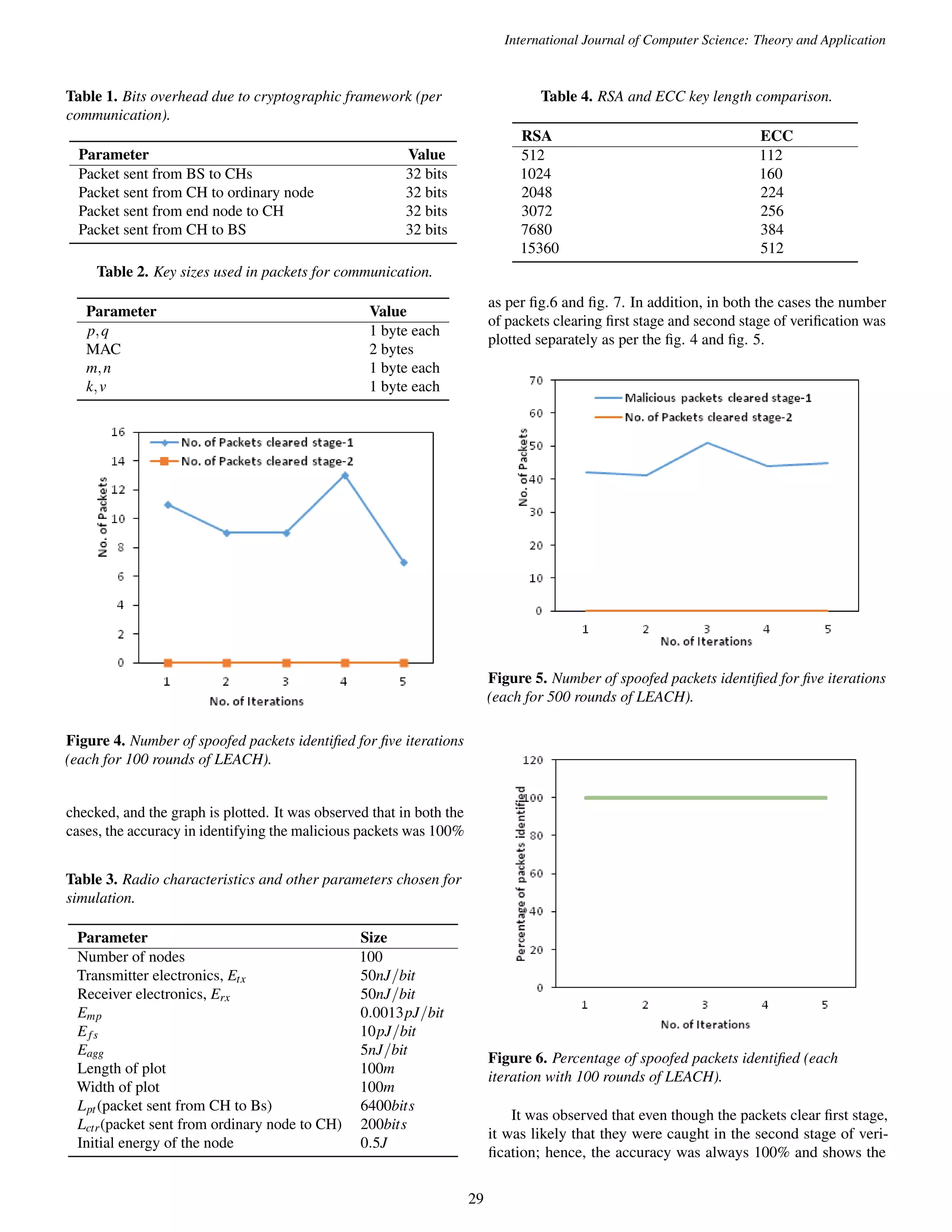
to the CH or the BS. The attack scenarios are shown in the fig. 2 
and fig. 3. 
The new node carefully listens to the network paradigm and 
assigns its MAC address with that of another node, of which it 
may start disguising and spoofing packets to the higher hierarchi-cal 
node. The packets follow the double verification steps and 
gets identified itself as either a legitimate or a spoofed packet. 
Suppose, the count of spoofed packets reaches above a pre-fixed 
threshold, an alarm is sent to the BS for preventing the further 
epidemic of the infected packet. 
The spoofing can also be done at time by the legitimate nodes 
already deployed. The spoofing in this case can also be detected 
by the proposed methodology. 
Since, the protocol protects the network using randomization 
concept, the attack not being identified is minimal. One scenario 
of attack was modeled in this paper, where a malicious node 
listens to the paradigm of the network and gets to know about 
the key ranges i.e. the keys are falling within the range (A;B), 
and puts header of the packet with those numbers and trailers 
with some random numbers. In this case, there are chances that 
the packet may pass the first verification stage, but the second 
stage clearance is difficult since the numbers in the headers has 
to undergo crossover, mutation and results has to match with 
the trailers. The results obtained for this scenario of attack is 
discussed in the fig. 4, fig. 5, fig. 6, fig. 7 and fig. 8. Apart 
from this case, if the malicious node has to successfully spoof 
the packet in every attack, then it has to get the algorithmic and 
mathematical details burnt in the node, which is the case of a 
Figure 2. Malicious ordinary node sending a false packet to CH. 
Figure 3. Malicious CH sending a false packet to the Base 
Station. 
node capture attack. The protocol fails if the node undergoes a 
capture attack and the security details are hacked. 
6. Simulations 
The algorithm was executed and tested using MATLAB 2013a on 
Intel core 5 Duo processor with windows operating system. CH 
requirement was set to 10% and the algorithm was verified on 
LEACH protocol till 1000 rounds. Table 1 contains the overhead 
in packet size due to the proposed security algorithm and table 2 
depicts the various key sizes used for simulation. The parameters 
were set for modeling network environment is shown in table 
3. The key sizes of ECC and RSA is shown in table 4, and of 
which the basic key size of 112 for ECC and 512 for RSA was 
considered for energy analysis. 
7. Results and Discussions 
This section deals with the results obtained. The algorithm was 
tested on LEACH protocol. First five iterations are for analyzing 
the security, where number of rounds was limited to 100 in every 
iteration. Next, were five iterations each with 500 rounds. In 
both cases, after every fifth round a malicious packet was made 
to spoof into the network, the probability of being identified is 
28
International Journal of Computer Science: Theory and Application 
Table 1. Bits overhead due to cryptographic framework (per 
communication). 
Parameter Value 
Packet sent from BS to CHs 32 bits 
Packet sent from CH to ordinary node 32 bits 
Packet sent from end node to CH 32 bits 
Packet sent from CH to BS 32 bits 
Table 2. Key sizes used in packets for communication. 
Parameter Value 
p;q 1 byte each 
MAC 2 bytes 
m;n 1 byte each 
k;v 1 byte each 
Figure 4. Number of spoofed packets identified for five iterations 
(each for 100 rounds of LEACH). 
checked, and the graph is plotted. It was observed that in both the 
cases, the accuracy in identifying the malicious packets was 100% 
Table 3. Radio characteristics and other parameters chosen for 
simulation. 
Parameter Size 
Number of nodes 100 
Transmitter electronics, Etx 50nJ=bit 
Receiver electronics, Erx 50nJ=bit 
Emp 0:0013pJ=bit 
Ef s 10pJ=bit 
Eagg 5nJ=bit 
Length of plot 100m 
Width of plot 100m 
Lpt(packet sent from CH to Bs) 6400bits 
Lctr(packet sent from ordinary node to CH) 200bits 
Initial energy of the node 0:5J 
Table 4. RSA and ECC key length comparison. 
RSA ECC 
512 112 
1024 160 
2048 224 
3072 256 
7680 384 
15360 512 
as per fig.6 and fig. 7. In addition, in both the cases the number 
of packets clearing first stage and second stage of verification was 
plotted separately as per the fig. 4 and fig. 5. 
Figure 5. Number of spoofed packets identified for five iterations 
(each for 500 rounds of LEACH). 
Figure 6. Percentage of spoofed packets identified (each 
iteration with 100 rounds of LEACH). 
It was observed that even though the packets clear first stage, 
it was likely that they were caught in the second stage of veri-fication; 
hence, the accuracy was always 100% and shows the 
29
International Journal of Computer Science: Theory and Application 
Figure 7. Percentage of spoofed packets identified (each 
iteration with 500 rounds of LEACH). 
Figure 8. Additional Energy consumed for 100 rounds between 
various cryptographic techniques. 
robustness of the protocol in identifying the spoofed packets. The 
energy consumption analysis of our scheme with the existing 
cryptographic schemes like ECC and RSA was done for 100 
rounds of LEACH for 10% of CH requirement, and the overhead 
in the energy consumption is plotted in fig. 8. 
It was observed that the modeled memetics based algorithm 
(MA) is more energy efficient than the other widely used keying 
techniques and the results prove that the technique is robust in 
providing security in the network. 
8. Conclusions 
Security in WSNs has always been a difficult task in WSN to 
address. In this context, memetics based random keying approach 
is one of the contribution. It was observed a 100% accuracy in 
identifying the spoofed packets, since every packet has to undergo 
a double verification stage to get through into the network. In 
addition, the energy overhead calibration due to the use of the 
technique gives a promising result compared to other techniques. 
The developed algorithm uses confusion strategy in combination 
with memetics for identifying the spoofed packets. The obtained 
results prove that the algorithm can be implemented in the future 
networks with an ease. 
References 
[1] TING, Chuan-Kang et LIAO, Chien-Chih. A memetic algo-rithm 
for extending wireless sensor network lifetime. Infor-mation 
Sciences, 2010, vol. 180, no 24, p. 4818-4833. 
[2] FERENTINOS, Konstantinos P. et TSILIGIRIDIS, Theodore 
A. A memetic algorithm for optimal dynamic design of wire-less 
sensor networks. Computer Communications, 2010, vol. 
33, no 2, p. 250-258. 
[3] KUMAR, E. Sandeep, KUSUMA, S.M., KUMAR, B.P. Vi-jaya, 
A Random Key Distribution based Artificial Immune 
System for Security in Wireless Sensor Networks, Proc. 
of IEEE International Students’ Conference on Electron-ics, 
Electrical and Computer Science (SCEECS)-2014, 1-2 
March, MANIT, Bhopal, Madhya Pradesh. 
[4] KUMAR, E. Sandeep, KUSUMA, S.M., KUMAR, B.P. Vi-jaya, 
An Intelligent Defense Mechanism for Security inWire-less 
Sensor Networks, Proc. of IEEE International Confer-ence 
on Communications and Signal Processing (ICCSP) - 
2014, 3-5 April, APEC, Melmaruvattur, Tamil Nadu. 
[5] SALEEM, Kashif, FISAL, Norsheila, HAFIZAH, Sharifah, 
et al. An intelligent information security mechanism for the 
network layer of WSN: BIOSARP. In : Computational Intel-ligence 
in Security for Information Systems. Springer Berlin 
Heidelberg, 2011. p. 118-126. 
[6] FU, Rongrong, ZHENG, Kangfeng, LU, Tianliang, et al. 
Biologically Inspired Anomaly Detection for Hierarchical 
Wireless Sensor Networks. Journal of Networks, 2012, vol. 
7, no 8, p. 1214-1219. 
[7] V RANJITHKUMAR, P., P NEMAGOUD, Sandeep, KU-MAR 
E, Sandeep, et al. A Novel Security Framework based 
on Genetics for Clustered Wireless Sensor Networks. Inter-national 
Journal of Computer Applications, 2014, vol. 96, 
no 5, p. 8-13. 
[8] Concepts of memetics from, Memetics-http:// 
en.wikipedia.org/wiki/Memetics 
[9] Concepts of memetics from site nature- inspired algorithms: 
http://www.cleveralgorithms.com/natureinspired/physical/ 
memetic algorithm.html 
[10] HEINZELMAN, Wendi Rabiner, CHANDRAKASAN, 
Anantha, et BALAKRISHNAN, Hari. Energy-efficient com-munication 
protocol for wireless microsensor networks. In 
: System Sciences, 2000. Proceedings of the 33rd Annual 
Hawaii International Conference on. IEEE, 2000. p. 10 pp. 
vol. 2. 
30

Random Keying Technique for Security in Wireless Sensor Networks Based on Memetics, International Journal of Computer Science: Theory and Application

  • 1.
    Vol. 1, No.2, July 2014 Random Keying Technique for Security in Wireless Sensor Networks Based on Memetics S.B. Suman1, P.V. Ranjith Kumar2, E. Sandeep Kumar3 1 Dept. of Computer Science & Engg, M S Ramaiah Institute of Technology, Bangalore, Karnataka, India. 2 Dept. of Electronics & Communication Engg, M S Ramaiah Institute of Technology, Bangalore, Karnataka, India. 3 Dept. of Telecommunication Engg, JNN College of Engineering, Shimoga, Karnataka, India. Email: sandeepe31@gmail.com ABSTRACT Wireless Sensor Networks (WSNs) are often prone to risk of security attacks and vulnerabilities. This is because of the less human intervention in their operations. Hence, novel security mechanisms and techniques are of a prime importance in these types of networks. In this context, we propose a unique security scheme, which coalesce the random keying technique with memetics. The application of these kinds of bio-inspired computation in WSNs provides robust security in the network with the obtained results supporting the security concerns of the network. KEYWORDS Random Keying Technique— Memetics— Bio-Inspired Computation. c 2014 by Orb Academic Publisher. All rights reserved. 1. Introduction Wireless sensor networks is gaining lot of research interest in the present scenario because of its vast and versatile applications. These networks are of great requirements in remote monitoring and military applications where they exchange sensitive data. Security is an area that has been a challenge for the researchers. This is due to the versatility and complexity in attacks to which these networks are often prone. Hence, in this paper we propose a random keying technique merging with the concepts of memetics to combat against the spoofing attacks in the network. Spoofing is a type of attack where the adversary tries to impinge unwanted or false information packets into the network to hamper its normal operation. Few researches have been carried out in solving the issues of WSNs using memetics. Chuan- Kang Ting et al. [1] propose a scheme for improving the network lifetime by enabling more coverage using memetic algorithm for WSNs. Konstantinos et al. [2] propose a method for improving network lifespan using memetic algorithm as an improvement on the genetic algorithm, taking into accounts of communication parameters and overheads of the sensor nodes. Sandeep et al. [3] propose a novel biologically inspired tech-nique that uses random keying technique with the concepts of artificial immune system for identifying the spoofing attacks in the network. Sandeep et al. [4] propose a bio-inspired approach for addressing node capture attack, which is a combination of artificial neural networks with the game theory as a combat mech-anism against malicious attacker. Kashif et al. [5] propose a bio-inspired approach that uses Ant Colony Optimization (ACO) for routing, and artificial immune system for securing from ab-normalities and routing attacks. Rongrong Fu et al. [6] developed a bio- inspired security framework that adapts Artificial Immune System (AIS) with the fuzzy techniques for detecting anomalies in the network. Ranjith et al. [7] proposed a bio-inspired security technique, which is based on genetics as counter measure against spoofing attacks. According our knowledge, very few research works has been carried out using memetics in solving issues of WSNs and with respect to applications of memetics concept is a novel approach towards security. In the proposed work, we use a combination of random key distribution scheme with memetic concepts for pro-viding robust security for WSNs. The algorithm was simulated in MATLAB and the results prove that the method is energy efficient compared to the other widely used cryptographic techniques like ECC and RSA, while combating against spoofing attacks. The rest of the paper is organized as follows: section 2 deals with memetics, section 3 with the proposed methodology, section 4 with radio model, section 5 discusses the attack scenario, section 6 deals with the simulations, section 7 deals with the results and discussions, section 8 with the concluding remarks of the paper and finally the paper ends with few references. 2. Memetics Memetics is a theory based on Darwinian evolution, originating from the popularization of Richard Dawkins book ‘the selfish gene’. A ‘meme’ is same as ‘gene’ and but these are termed as ‘units of culture’, which are “hosted” in the minds of one or more 25
  • 2.
    International Journal ofComputer Science: Theory and Application individuals, and which can reproduce itself, thereby jumping from mind to mind [8]. The concept of ‘memetics’ has been developed as ‘memetic algorithm’, for solving optimization problems. 2.1 Memetic algorithm Memetic algorithms have elements of Metaheuristic and Compu-tational Intelligence. Although they have principles of evolution-ary algorithms, they may not strictly be considered an evolution-ary technique. Using ideas of memes and memetic algorithms in optimization may be referred to as memetics computing [9]. Ideally, memetic algorithms embrace the duality of genetic and cultural evolution, allowing the transmission, selection, inheri-tance, and variation of memes as well as genes. The memetic algorithm can simply be considered as the improvement over the genetic algorithm in the notion that, the genes are transferred directly to the individual but the memes are processed locally and then transferred. Hence, adding local search to the genetic algorithm results in memetic algorithm. The algorithm is given below: 1. Start: Randomly generate a population of N chromosomes. 2. Fitness: Calculate the fitness of all chromosomes. 3. Create a new population: – Selection: According to the selection criteria, select two chromosomes from the population that are best chromo-somes. – Crossover: Perform crossover on the two chromosomes selected. – Local search: search for the best chromosomes. – Mutation: Perform mutation on the chromosomes ob-tained with small probability. 4. Replace: Replace the current population with the new population. 5. Test: Test whether the termination condition is satisfied. If so, stop. If not, go to Step 2. This algorithm is modified for providing security in the WSNs. 3. Proposed Methodology This section deals with the method introduced in the regard of providing security in the network. 3.1 Random Key range distribution 3.1.1 At the Base Station (BS) - Set up phase i - Set the range with in which the keys have to be selected. The keys (integer numbers) between these ranges are the initial set of populations (memes). Let this be (A;B). ii - From the range (A;B) a random set of keys will be se-lected for scaling down the range, this indicates the optimal set of the keys, which participate in the further process. Let this be (X;Y), where X is the lower limit and Y is the upper limit. iii - Within (X;Y), randomly two numbers will be picked, and sent to the Cluster Head (CH). Step iii is repeated until all the CHs receive two random numbers from the BS. Let the number received at the CHs be (p;q), where, p is the lower limit and q is the upper limit. 3.1.2 At the Cluster Heads The received range from the BS will be sent all the member nodes of its cluster. This is (p;q), which is dealt in the previous section. 3.2 Steady phase communication 1. Ordinary member node, if it wants to communicate with its CH, it randomly picks two numbers from within the range (p;q). The numbers (keys) in the range (p;q) is the pool of population of memes. The chosen numbers in this pool indicates the best locally picked memes for the further processes. Let this be (m;n). 2. These memes are allowed to crossover with each other. The procedure of the crossover is dealt in the later sections of the paper. 3. The crossovered numbers (memes) are now checked for fittest candidate, for the further mutation process. The re-sult of crossover will be two numbers, let this be (k;h) and out of two, one candidate is picked based on the presence of number of ones. The candidate is now allowed for mu-tation, whose process is explained in the further sections of this paper, the other number is kept as it is without any change. Let the picked candidate be h, and the result of the mutation be v, the result after the process is (k;v). 4. (m;n) is placed in the header and (k;v) is substituted as the trailer and the packet is sent to the CH. 5. The process is repeated by all the ordinary nodes in a net-work that wants to communicate with the CH. The respec-tive CHs wait until it receives the data from all the ordinary nodes and again follows same procedure as in step 1 to step 4 and places header and trailer information in the packet and sends to the BS. 3.3 Crossover Let the range received by the higher hierarchy node be (p;q). Select two numbers randomly and let this be (m;n). The step involved is given below: 1. Initially, calculate intermediate number, E = (m+1)+(n1); (1) 2. Find the smallest multiple of 3 between the range (m;E), let this be x, else use m. 3 is an example this can also be made random, and depends on the robustness required. 3. Find (x%8), which gives the point at which (m;n) has to be crossovered. Here 8 is chosen since the size of keys chosen for communication is 8 bits. The example is shown below. 26
  • 3.
    International Journal ofComputer Science: Theory and Application Ex : (p;q) = (12;70); (m;n) = (15;56); E = (15+1)+(561) = 71; The smallest multiple between (15, 71) is x= 15; 4. (15%8) = 6; hence 6 is the crossover point. The bits from 6th position to the 8th position of (m;n) is crossovered with one another. m = 15 = 00001111 n = 56 = 00111000 After crossover! 00101111!47 !00011000!24 The result of crossover is (m;n) = (47;24). 3.4 Mutation The two bytes obtained after the crossover is checked for number of 1’s individually and the key with the highest number of ones is chosen as the best candidate for mutation. From the example dealt in the crossover section, the best candidate chosen is 47 because it has more number of 1’s in it. The mutation is carried out in such a way that all the bits in the number are complemented. Ex : 47!00011111 11100000!223 The packet is put with (15, 56) as the header and (47, 223) as the trailer information and sent to the higher hierarchical sensor node. 3.5 Verification at the CH for the packet sent by ordi-nary node or verification at the BS for the packet sent by CH 1. Start 2. Receive the packet 3. Extract header 4. Check header, whether it is in the range that was sent by itself. Let the received header be m, n and trailer be k, v. /*(p;q) range received by the higher hierarchy node*/ if (m p and n q) then /* packet cleared stage-1*/ (g;h) = Crossover (m;n); /*h1 and h2 are results of crossover*/ Select the best candidate for mutation. Let this be x. (g1;h1)= Mutation (x); if (g1 == k and h1 == v) then /* packet cleared stage-2*/ else /* packet is malicious*/ end else /* packet is malicious*/ end 5. Stop 3.6 Packet Description i. Packet sent from BS to CH/ CH to its member nodes MAC p q where, MAC! address of the intended CH node and p, q! keys randomly picked. ii. Packet sent from ordinary node to CH/ CH to BS This packet consists of the details regarding randomly picked keys by the node and the trailer. m n CRITICAL INFO k v where, m;n!keys randomly picked by the node for communi-cation with its CH and g1, h1 are the trailers after crossover and mutation, CRITICAL INFO ! consists of various fields includ-ing, preamble, sync bits, destination address, type, group identity, length of message, counter for message sent, source address, error checking bits and payload. 4. Radio Model The proposed methodology uses a classical radio model [10]. The sensor node is a transceiver. Hence, this radio model gives the energy consumed for the transmission and reception. The block diagram representation is shown in fig. 1. The radio model con-sists of transmitter and receiver equivalent of the nodes separated by the distance‘d’. Where Etx, Erx are the energy consumed in the transmitter and the receiver electronics. Eamp is the energy consumed in the transmitter amplifier in general, and it depends on the type of propagation model chosen either free space or multipath with the acceptable bit error rate. We consider Ef s for free space propagation and Emp for multipath propagation as the energy consumed in the amplifier circuitry. The transmitter and the receiver electronics depends on digital coding, modulation, filtering and spreading of data. Additional to this there is an ag-gregation energy consumption of Eagg per bit if the node is cluster head. 4.1 Energy Consumption This section describes the energy consumed for communication. Packet transmission Et = (LP Etx)+(LP Eamp dn); (2) where, LP ! is the packet length in bits, and n ! is the path loss component which is 2 for free space and 4 for multipath propagation. Suppose a node transmits a packet. Each bit in a packet consumes Etx amount of transmitter electronics energy, Eamp amount of 27
  • 4.
    International Journal ofComputer Science: Theory and Application amplifier energy. A packet of length LP, consumes an overall energy of Et . Packet reception Er = (LP Erx); (3) where, LP ! is the packet length in bits. Suppose a node receives a packet. Each bit in a packet con-sumes Erx amount of receiver electronics energy. A packet of length Lp, consumes an overall energy of Er. Figure 1. Radio Model. 5. Attack Scenario The system relies on confusing the intruder by randomly varying the keys and ranges chosen for selecting the keys at the BS. The newly deployed malicious attacker may spoof unwanted packets to the CH or the BS. The attack scenarios are shown in the fig. 2 and fig. 3. The new node carefully listens to the network paradigm and assigns its MAC address with that of another node, of which it may start disguising and spoofing packets to the higher hierarchi-cal node. The packets follow the double verification steps and gets identified itself as either a legitimate or a spoofed packet. Suppose, the count of spoofed packets reaches above a pre-fixed threshold, an alarm is sent to the BS for preventing the further epidemic of the infected packet. The spoofing can also be done at time by the legitimate nodes already deployed. The spoofing in this case can also be detected by the proposed methodology. Since, the protocol protects the network using randomization concept, the attack not being identified is minimal. One scenario of attack was modeled in this paper, where a malicious node listens to the paradigm of the network and gets to know about the key ranges i.e. the keys are falling within the range (A;B), and puts header of the packet with those numbers and trailers with some random numbers. In this case, there are chances that the packet may pass the first verification stage, but the second stage clearance is difficult since the numbers in the headers has to undergo crossover, mutation and results has to match with the trailers. The results obtained for this scenario of attack is discussed in the fig. 4, fig. 5, fig. 6, fig. 7 and fig. 8. Apart from this case, if the malicious node has to successfully spoof the packet in every attack, then it has to get the algorithmic and mathematical details burnt in the node, which is the case of a Figure 2. Malicious ordinary node sending a false packet to CH. Figure 3. Malicious CH sending a false packet to the Base Station. node capture attack. The protocol fails if the node undergoes a capture attack and the security details are hacked. 6. Simulations The algorithm was executed and tested using MATLAB 2013a on Intel core 5 Duo processor with windows operating system. CH requirement was set to 10% and the algorithm was verified on LEACH protocol till 1000 rounds. Table 1 contains the overhead in packet size due to the proposed security algorithm and table 2 depicts the various key sizes used for simulation. The parameters were set for modeling network environment is shown in table 3. The key sizes of ECC and RSA is shown in table 4, and of which the basic key size of 112 for ECC and 512 for RSA was considered for energy analysis. 7. Results and Discussions This section deals with the results obtained. The algorithm was tested on LEACH protocol. First five iterations are for analyzing the security, where number of rounds was limited to 100 in every iteration. Next, were five iterations each with 500 rounds. In both cases, after every fifth round a malicious packet was made to spoof into the network, the probability of being identified is 28
  • 5.
    International Journal ofComputer Science: Theory and Application Table 1. Bits overhead due to cryptographic framework (per communication). Parameter Value Packet sent from BS to CHs 32 bits Packet sent from CH to ordinary node 32 bits Packet sent from end node to CH 32 bits Packet sent from CH to BS 32 bits Table 2. Key sizes used in packets for communication. Parameter Value p;q 1 byte each MAC 2 bytes m;n 1 byte each k;v 1 byte each Figure 4. Number of spoofed packets identified for five iterations (each for 100 rounds of LEACH). checked, and the graph is plotted. It was observed that in both the cases, the accuracy in identifying the malicious packets was 100% Table 3. Radio characteristics and other parameters chosen for simulation. Parameter Size Number of nodes 100 Transmitter electronics, Etx 50nJ=bit Receiver electronics, Erx 50nJ=bit Emp 0:0013pJ=bit Ef s 10pJ=bit Eagg 5nJ=bit Length of plot 100m Width of plot 100m Lpt(packet sent from CH to Bs) 6400bits Lctr(packet sent from ordinary node to CH) 200bits Initial energy of the node 0:5J Table 4. RSA and ECC key length comparison. RSA ECC 512 112 1024 160 2048 224 3072 256 7680 384 15360 512 as per fig.6 and fig. 7. In addition, in both the cases the number of packets clearing first stage and second stage of verification was plotted separately as per the fig. 4 and fig. 5. Figure 5. Number of spoofed packets identified for five iterations (each for 500 rounds of LEACH). Figure 6. Percentage of spoofed packets identified (each iteration with 100 rounds of LEACH). It was observed that even though the packets clear first stage, it was likely that they were caught in the second stage of veri-fication; hence, the accuracy was always 100% and shows the 29
  • 6.
    International Journal ofComputer Science: Theory and Application Figure 7. Percentage of spoofed packets identified (each iteration with 500 rounds of LEACH). Figure 8. Additional Energy consumed for 100 rounds between various cryptographic techniques. robustness of the protocol in identifying the spoofed packets. The energy consumption analysis of our scheme with the existing cryptographic schemes like ECC and RSA was done for 100 rounds of LEACH for 10% of CH requirement, and the overhead in the energy consumption is plotted in fig. 8. It was observed that the modeled memetics based algorithm (MA) is more energy efficient than the other widely used keying techniques and the results prove that the technique is robust in providing security in the network. 8. Conclusions Security in WSNs has always been a difficult task in WSN to address. In this context, memetics based random keying approach is one of the contribution. It was observed a 100% accuracy in identifying the spoofed packets, since every packet has to undergo a double verification stage to get through into the network. In addition, the energy overhead calibration due to the use of the technique gives a promising result compared to other techniques. The developed algorithm uses confusion strategy in combination with memetics for identifying the spoofed packets. The obtained results prove that the algorithm can be implemented in the future networks with an ease. References [1] TING, Chuan-Kang et LIAO, Chien-Chih. A memetic algo-rithm for extending wireless sensor network lifetime. Infor-mation Sciences, 2010, vol. 180, no 24, p. 4818-4833. [2] FERENTINOS, Konstantinos P. et TSILIGIRIDIS, Theodore A. A memetic algorithm for optimal dynamic design of wire-less sensor networks. Computer Communications, 2010, vol. 33, no 2, p. 250-258. [3] KUMAR, E. Sandeep, KUSUMA, S.M., KUMAR, B.P. Vi-jaya, A Random Key Distribution based Artificial Immune System for Security in Wireless Sensor Networks, Proc. of IEEE International Students’ Conference on Electron-ics, Electrical and Computer Science (SCEECS)-2014, 1-2 March, MANIT, Bhopal, Madhya Pradesh. [4] KUMAR, E. Sandeep, KUSUMA, S.M., KUMAR, B.P. Vi-jaya, An Intelligent Defense Mechanism for Security inWire-less Sensor Networks, Proc. of IEEE International Confer-ence on Communications and Signal Processing (ICCSP) - 2014, 3-5 April, APEC, Melmaruvattur, Tamil Nadu. [5] SALEEM, Kashif, FISAL, Norsheila, HAFIZAH, Sharifah, et al. An intelligent information security mechanism for the network layer of WSN: BIOSARP. In : Computational Intel-ligence in Security for Information Systems. Springer Berlin Heidelberg, 2011. p. 118-126. [6] FU, Rongrong, ZHENG, Kangfeng, LU, Tianliang, et al. Biologically Inspired Anomaly Detection for Hierarchical Wireless Sensor Networks. Journal of Networks, 2012, vol. 7, no 8, p. 1214-1219. [7] V RANJITHKUMAR, P., P NEMAGOUD, Sandeep, KU-MAR E, Sandeep, et al. A Novel Security Framework based on Genetics for Clustered Wireless Sensor Networks. Inter-national Journal of Computer Applications, 2014, vol. 96, no 5, p. 8-13. [8] Concepts of memetics from, Memetics-http:// en.wikipedia.org/wiki/Memetics [9] Concepts of memetics from site nature- inspired algorithms: http://www.cleveralgorithms.com/natureinspired/physical/ memetic algorithm.html [10] HEINZELMAN, Wendi Rabiner, CHANDRAKASAN, Anantha, et BALAKRISHNAN, Hari. Energy-efficient com-munication protocol for wireless microsensor networks. In : System Sciences, 2000. Proceedings of the 33rd Annual Hawaii International Conference on. IEEE, 2000. p. 10 pp. vol. 2. 30