T E N E M E N T L I F E
1 9 0 0 S V S 2 0 0 0 S
S A M Y M A H F A R
• When you think of the Lower East Side, you conjure up
images of the nightlife, the old architecture, and the scene
that has thrived in this neighborhood for 50 years.
• However, the Lower East Side was an immigration enclave
for millions of people and life wasn’t always so easy in the
LES.
• SMA is taking these historic tenement buildings from the mid
1800s and reimagining them to suit the LES of today.
• Here are some pictures and information about what these
buildings were meant to be.
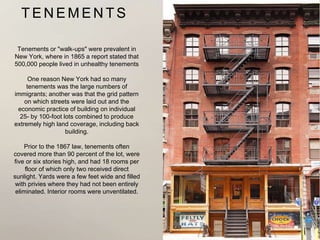
T E N E M E N T S
Tenements or "walk-ups" were prevalent in
New York, where in 1865 a report stated that
500,000 people lived in unhealthy tenements
One reason New York had so many
tenements was the large numbers of
immigrants; another was that the grid pattern
on which streets were laid out and the
economic practice of building on individual
25- by 100-foot lots combined to produce
extremely high land coverage, including back
building.
Prior to the 1867 law, tenements often
covered more than 90 percent of the lot, were
five or six stories high, and had 18 rooms per
floor of which only two received direct
sunlight. Yards were a few feet wide and filled
with privies where they had not been entirely
eliminated. Interior rooms were unventilated.
7 5 - 8 3 O R C H A R D S T R E E T
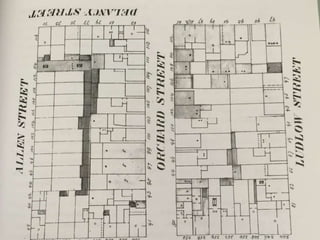
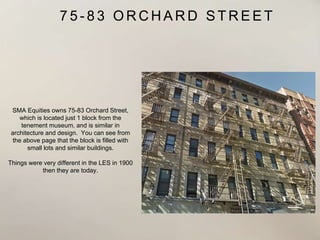
SMA Equities owns 75-83 Orchard Street,
which is located just 1 block from the
tenement museum, and is similar in
architecture and design. You can see from
the above page that the block is filled with
small lots and similar buildings.
Things were very different in the LES in 1900
then they are today.
7 5 - 8 3 O R C H A R D S T R E E T
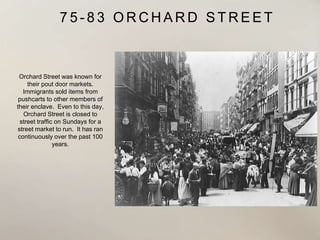
Orchard Street was known for
their pout door markets.
Immigrants sold items from
pushcarts to other members of
their enclave. Even to this day,
Orchard Street is closed to
street traffic on Sundays for a
street market to run. It has ran
continuously over the past 100
years.
7 5 - 8 3 O R C H A R D S T R E E T
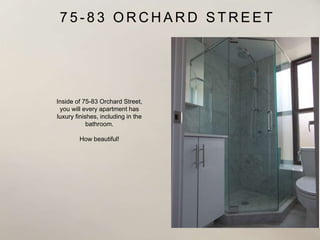
Inside of 75-83 Orchard Street,
you will every apartment has
luxury finishes, including in the
bathroom.
How beautiful!
7 5 - 8 3 O R C H A R D S T R E E T
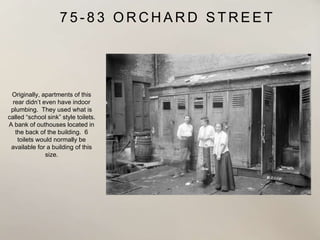
Originally, apartments of this
rear didn’t even have indoor
plumbing. They used what is
called “school sink” style toilets.
A bank of outhouses located in
the back of the building. 6
toilets would normally be
available for a building of this
size.
7 5 - 8 3 O R C H A R D S T R E E T
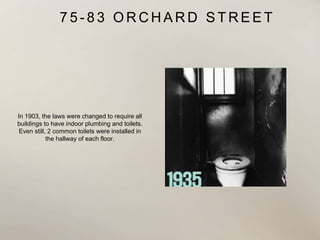
In 1903, the laws were changed to require all
buildings to have indoor plumbing and toilets.
Even still, 2 common toilets were installed in
the hallway of each floor.
7 5 - 8 3 O R C H A R D S T R E E T
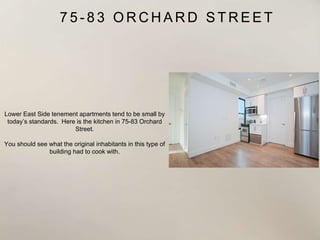
Lower East Side tenement apartments tend to be small by
today’s standards. Here is the kitchen in 75-83 Orchard
Street.
You should see what the original inhabitants in this type of
building had to cook with.
7 5 - 8 3 O R C H A R D S T R E E T
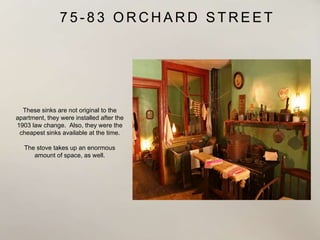
These sinks are not original to the
apartment, they were installed after the
1903 law change. Also, they were the
cheapest sinks available at the time.
The stove takes up an enormous
amount of space, as well.
7 5 - 8 3 O R C H A R D S T R E E T
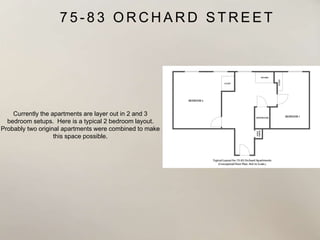
Currently the apartments are layer out in 2 and 3
bedroom setups. Here is a typical 2 bedroom layout.
Probably two original apartments were combined to make
this space possible.
7 5 - 8 3 O R C H A R D S T R E E T
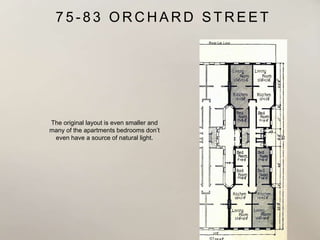
The original layout is even smaller and
many of the apartments bedrooms don’t
even have a source of natural light.
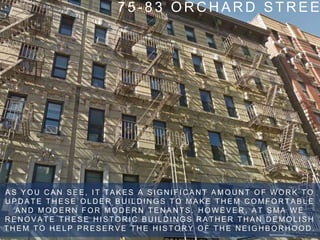
7 5 - 8 3 O R C H A R D S T R E E
A S Y O U C A N S E E , I T T A K E S A S I G N I F I C A N T A M O U N T O F W O R K T O
U P D A T E T H E S E O L D E R B U I L D I N G S T O M A K E T H E M C O M F O R T A B L E
A N D M O D E R N F O R M O D E R N T E N A N T S . H O W E V E R , A T S M A W E
R E N O V A T E T H E S E H I S T O R I C B U I L D I N G S R A T H E R T H A N D E M O L I S H
T H E M T O H E L P P R E S E R V E T H E H I S T O R Y O F T H E N E I G H B O R H O O D .

Samy Mahfar - Tenements 1900s vs 2000s

  • 1.
    T E NE M E N T L I F E 1 9 0 0 S V S 2 0 0 0 S S A M Y M A H F A R
  • 2.
    • When youthink of the Lower East Side, you conjure up images of the nightlife, the old architecture, and the scene that has thrived in this neighborhood for 50 years. • However, the Lower East Side was an immigration enclave for millions of people and life wasn’t always so easy in the LES. • SMA is taking these historic tenement buildings from the mid 1800s and reimagining them to suit the LES of today. • Here are some pictures and information about what these buildings were meant to be.
  • 3.
    T E NE M E N T S Tenements or "walk-ups" were prevalent in New York, where in 1865 a report stated that 500,000 people lived in unhealthy tenements One reason New York had so many tenements was the large numbers of immigrants; another was that the grid pattern on which streets were laid out and the economic practice of building on individual 25- by 100-foot lots combined to produce extremely high land coverage, including back building. Prior to the 1867 law, tenements often covered more than 90 percent of the lot, were five or six stories high, and had 18 rooms per floor of which only two received direct sunlight. Yards were a few feet wide and filled with privies where they had not been entirely eliminated. Interior rooms were unventilated.
  • 5.
    7 5 -8 3 O R C H A R D S T R E E T SMA Equities owns 75-83 Orchard Street, which is located just 1 block from the tenement museum, and is similar in architecture and design. You can see from the above page that the block is filled with small lots and similar buildings. Things were very different in the LES in 1900 then they are today.
  • 6.
    7 5 -8 3 O R C H A R D S T R E E T Orchard Street was known for their pout door markets. Immigrants sold items from pushcarts to other members of their enclave. Even to this day, Orchard Street is closed to street traffic on Sundays for a street market to run. It has ran continuously over the past 100 years.
  • 7.
    7 5 -8 3 O R C H A R D S T R E E T Inside of 75-83 Orchard Street, you will every apartment has luxury finishes, including in the bathroom. How beautiful!
  • 8.
    7 5 -8 3 O R C H A R D S T R E E T Originally, apartments of this rear didn’t even have indoor plumbing. They used what is called “school sink” style toilets. A bank of outhouses located in the back of the building. 6 toilets would normally be available for a building of this size.
  • 9.
    7 5 -8 3 O R C H A R D S T R E E T In 1903, the laws were changed to require all buildings to have indoor plumbing and toilets. Even still, 2 common toilets were installed in the hallway of each floor.
  • 10.
    7 5 -8 3 O R C H A R D S T R E E T Lower East Side tenement apartments tend to be small by today’s standards. Here is the kitchen in 75-83 Orchard Street. You should see what the original inhabitants in this type of building had to cook with.
  • 11.
    7 5 -8 3 O R C H A R D S T R E E T These sinks are not original to the apartment, they were installed after the 1903 law change. Also, they were the cheapest sinks available at the time. The stove takes up an enormous amount of space, as well.
  • 12.
    7 5 -8 3 O R C H A R D S T R E E T Currently the apartments are layer out in 2 and 3 bedroom setups. Here is a typical 2 bedroom layout. Probably two original apartments were combined to make this space possible.
  • 13.
    7 5 -8 3 O R C H A R D S T R E E T The original layout is even smaller and many of the apartments bedrooms don’t even have a source of natural light.
  • 14.
    7 5 -8 3 O R C H A R D S T R E E A S Y O U C A N S E E , I T T A K E S A S I G N I F I C A N T A M O U N T O F W O R K T O U P D A T E T H E S E O L D E R B U I L D I N G S T O M A K E T H E M C O M F O R T A B L E A N D M O D E R N F O R M O D E R N T E N A N T S . H O W E V E R , A T S M A W E R E N O V A T E T H E S E H I S T O R I C B U I L D I N G S R A T H E R T H A N D E M O L I S H T H E M T O H E L P P R E S E R V E T H E H I S T O R Y O F T H E N E I G H B O R H O O D .