Congregational Information MeetingTuesday, February 16, 2010 7:00 PMJohnson County Public LibraryWhite River Branch
Overview of Tonight’s PresentationWhy form a new Congregation?What is the Mission?What Is Unique About Saint Boniface Church?What Defines the Congregation’s Beliefs?How Does the Congregation Worship?With Whom is the Congregation Affiliated?What Can I Honestly Expect from the Congregation?Open Floor for Questions and Answers
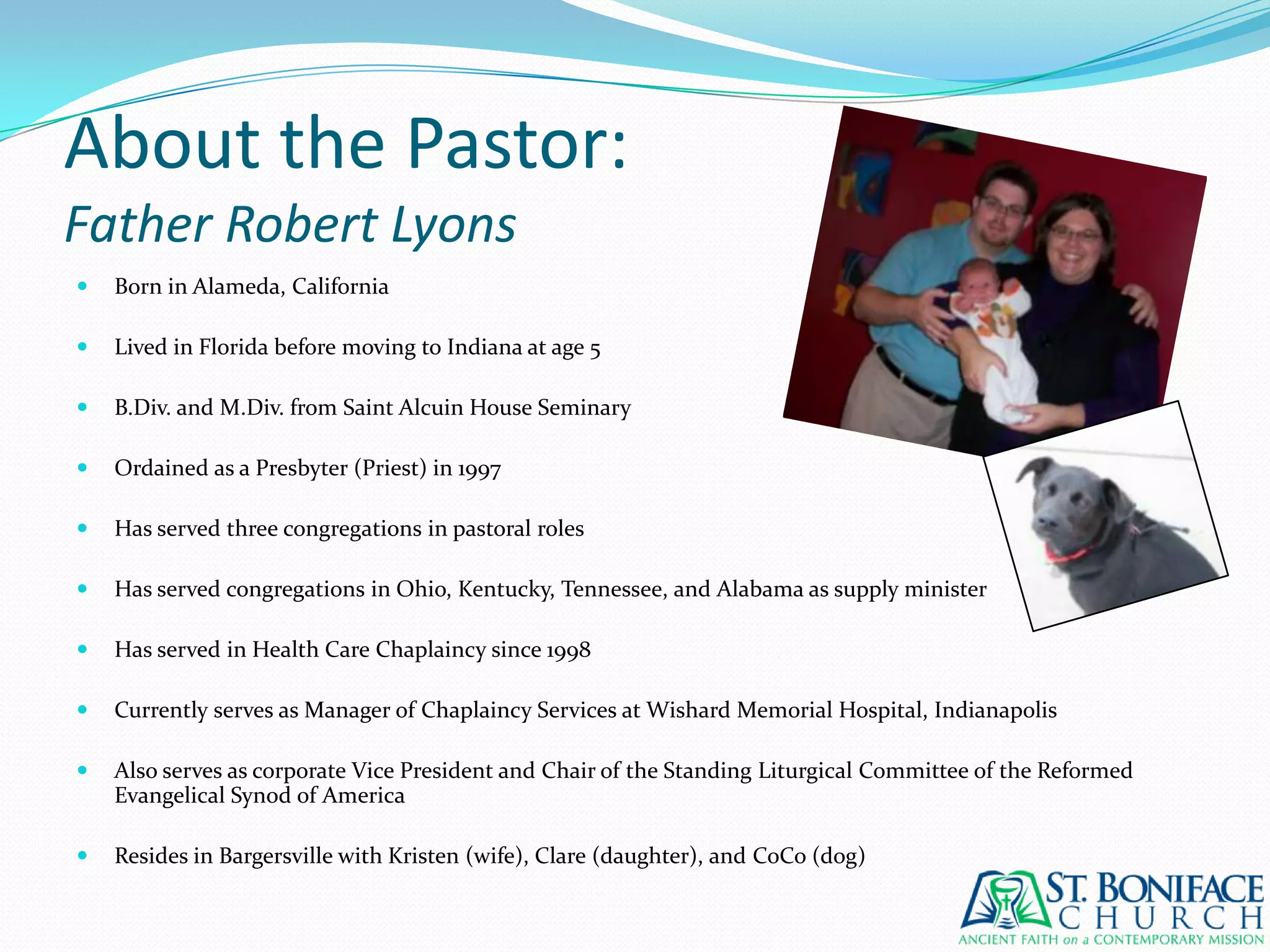
About the Pastor:Father Robert LyonsBorn in Alameda, CaliforniaLived in Florida before moving to Indiana at age 5B.Div. and M.Div. from Saint Alcuin House SeminaryOrdained as a Presbyter (Priest) in 1997Has served three congregations in pastoral rolesHas served congregations in Ohio, Kentucky, Tennessee, and Alabama as supply ministerHas served in Health Care Chaplaincy since 1998Currently serves as Manager of Chaplaincy Services at Wishard Memorial Hospital, IndianapolisAlso serves as corporate Vice President and Chair of the Standing Liturgical Committee of the Reformed Evangelical Synod of AmericaResides in Bargersville with Kristen (wife), Clare (daughter), and CoCo (dog)
Why Form a New Congregation?If even a quarter of the un-churched decided to go to Church this Sunday, there wouldn’t be any room for them in the pews.To preserve the traditions of the past while engaging in contemporary mission.To provide a congregation for Johnson County and Indianapolis’ south side that blends together the many positive contributions of various denominations and Christian traditions while remaining faithful, ultimately, to the Word of God.
What is the Mission?Saint Boniface Churchis dedicated to taking a standfor the Gospel of Jesus Christin the midst of a societywhich desperately needshis redeeming mercy and love.We will carry out our missionby forming new believersand strengthening existing believersthrough worship, catechesis,fellowship, and community action– all of which serve to remake usin the image of Jesus Christ.
What is Unique AboutSaint Boniface Church?Our model of developing believers begins with family units. We actively seek to bring together the best of various Christian traditions while, at the same time, remaining faithful to the most ancient practices of the Church.We believe that pure doctrine is important, but we also believe that pure doctrine is useless if we do not love one another. We are committed to expressing that love in our families, among our congregants, and in the community-at-large.
What Defines theCongregation’s BeliefsAs a member congregation of the Reformed Evangelical Synod of America, our congregations beliefs are defined by:The Holy BibleThe Apostles’, Nicene, and Athanasian CreedsOther Historically Significant Doctrinal StatementsThe Articles of Religion of the SynodThe Book of Common Prayer of the Synod
The Apostles’ CreedI believe in God,the Father almighty,creator of heaven and earth.I believe in Jesus Christ,his only Son, our Lord.He was conceived by the Holy Spirit,and born of the Virgin Mary.He suffered under Pontius Pilate,was crucified, died, and was buried.He descended to the dead.On the third day he rose again.He ascended into heaven,and is seated at the right hand of the Father.He will come to judge the living and the dead.I believe in the Holy Spirit,the holy catholic Church,the communion of saints,the forgiveness of sins,the resurrection of the body,and the life everlasting. Amen.
How Does theCongregation WorshipOur Sunday worship follows an ancient path rooted in the Bible and the traditions of the earliest Church:In the introduction, we confess our sins and are assured of God’s pardon in Christ. We also baptize new believers at this point in the service.The second part of the service focuses on the proclamation and preaching of the Word from the Bible.Worship culminates in the celebration of the Lord’s Supper.This is the ancient path of Christian worship, practiced since Biblical times. While embracing these traditions, it is our desire to include appropriate and theologically sound modern elements (music, preaching styles, etc.) into the service in a way that edifies the believers who have gathered.
With Whom is theCongregation Affiliated?Saint Boniface Church is affiliated with the Reformed Evangelical Synod of America, a small denomination which formed to bring together Christians of various backgrounds to celebrate and live out their faith in Christ by sharing the best of our mutual traditions with one another.Among the traditions represented by members of the RESA are:Roman Catholics, Anglicans/Episcopalians,Methodists, Eastern Orthodox, Oriental Orthodox,Independent Christians, Lutherans,Baptists, Reformed/Presbyterian,and others…Our hope is that we will ‘get out of the way’ and allow God to bring us together for his glory – ultimately uniting around what God tells us in his holy Word.You can learn more about the denomination at www.resynod.org
What Can I Honestly Expectfrom this Congregation?We are a newly-forming congregation. As such, we do not have:A buildingMusiciansA nurseryPower Point presentationsGobs of peopleEvery congregation begins somewhere.
What Can I Honestly Expectfrom this Congregation?Here is where we begin:A fidelity to the Gospel of Jesus ChristA burning desire to see entire families brought to or restored to a deeper relationship with GodA powerful connection to Christ and his apostles through the Bible and the Sacraments of the ChurchA pastor with an overriding passion to form believers for service, proclamation, and even suffering – all in the name of ChristCould we begin with you?
Questions and Answers
For Further InformationTelephone317-560-4665E-Mailrobert.lyons@resynod.orgWebsitehttp://www.sbcjc.org

Saint Boniface Informational Meeting Slideshow

  • 1.
    Congregational Information MeetingTuesday,February 16, 2010 7:00 PMJohnson County Public LibraryWhite River Branch
  • 3.
    Overview of Tonight’sPresentationWhy form a new Congregation?What is the Mission?What Is Unique About Saint Boniface Church?What Defines the Congregation’s Beliefs?How Does the Congregation Worship?With Whom is the Congregation Affiliated?What Can I Honestly Expect from the Congregation?Open Floor for Questions and Answers
  • 4.
    About the Pastor:FatherRobert LyonsBorn in Alameda, CaliforniaLived in Florida before moving to Indiana at age 5B.Div. and M.Div. from Saint Alcuin House SeminaryOrdained as a Presbyter (Priest) in 1997Has served three congregations in pastoral rolesHas served congregations in Ohio, Kentucky, Tennessee, and Alabama as supply ministerHas served in Health Care Chaplaincy since 1998Currently serves as Manager of Chaplaincy Services at Wishard Memorial Hospital, IndianapolisAlso serves as corporate Vice President and Chair of the Standing Liturgical Committee of the Reformed Evangelical Synod of AmericaResides in Bargersville with Kristen (wife), Clare (daughter), and CoCo (dog)
  • 5.
    Why Form aNew Congregation?If even a quarter of the un-churched decided to go to Church this Sunday, there wouldn’t be any room for them in the pews.To preserve the traditions of the past while engaging in contemporary mission.To provide a congregation for Johnson County and Indianapolis’ south side that blends together the many positive contributions of various denominations and Christian traditions while remaining faithful, ultimately, to the Word of God.
  • 6.
    What is theMission?Saint Boniface Churchis dedicated to taking a standfor the Gospel of Jesus Christin the midst of a societywhich desperately needshis redeeming mercy and love.We will carry out our missionby forming new believersand strengthening existing believersthrough worship, catechesis,fellowship, and community action– all of which serve to remake usin the image of Jesus Christ.
  • 7.
    What is UniqueAboutSaint Boniface Church?Our model of developing believers begins with family units. We actively seek to bring together the best of various Christian traditions while, at the same time, remaining faithful to the most ancient practices of the Church.We believe that pure doctrine is important, but we also believe that pure doctrine is useless if we do not love one another. We are committed to expressing that love in our families, among our congregants, and in the community-at-large.
  • 8.
    What Defines theCongregation’sBeliefsAs a member congregation of the Reformed Evangelical Synod of America, our congregations beliefs are defined by:The Holy BibleThe Apostles’, Nicene, and Athanasian CreedsOther Historically Significant Doctrinal StatementsThe Articles of Religion of the SynodThe Book of Common Prayer of the Synod
  • 9.
    The Apostles’ CreedIbelieve in God,the Father almighty,creator of heaven and earth.I believe in Jesus Christ,his only Son, our Lord.He was conceived by the Holy Spirit,and born of the Virgin Mary.He suffered under Pontius Pilate,was crucified, died, and was buried.He descended to the dead.On the third day he rose again.He ascended into heaven,and is seated at the right hand of the Father.He will come to judge the living and the dead.I believe in the Holy Spirit,the holy catholic Church,the communion of saints,the forgiveness of sins,the resurrection of the body,and the life everlasting. Amen.
  • 10.
    How Does theCongregationWorshipOur Sunday worship follows an ancient path rooted in the Bible and the traditions of the earliest Church:In the introduction, we confess our sins and are assured of God’s pardon in Christ. We also baptize new believers at this point in the service.The second part of the service focuses on the proclamation and preaching of the Word from the Bible.Worship culminates in the celebration of the Lord’s Supper.This is the ancient path of Christian worship, practiced since Biblical times. While embracing these traditions, it is our desire to include appropriate and theologically sound modern elements (music, preaching styles, etc.) into the service in a way that edifies the believers who have gathered.
  • 11.
    With Whom istheCongregation Affiliated?Saint Boniface Church is affiliated with the Reformed Evangelical Synod of America, a small denomination which formed to bring together Christians of various backgrounds to celebrate and live out their faith in Christ by sharing the best of our mutual traditions with one another.Among the traditions represented by members of the RESA are:Roman Catholics, Anglicans/Episcopalians,Methodists, Eastern Orthodox, Oriental Orthodox,Independent Christians, Lutherans,Baptists, Reformed/Presbyterian,and others…Our hope is that we will ‘get out of the way’ and allow God to bring us together for his glory – ultimately uniting around what God tells us in his holy Word.You can learn more about the denomination at www.resynod.org
  • 12.
    What Can IHonestly Expectfrom this Congregation?We are a newly-forming congregation. As such, we do not have:A buildingMusiciansA nurseryPower Point presentationsGobs of peopleEvery congregation begins somewhere.
  • 13.
    What Can IHonestly Expectfrom this Congregation?Here is where we begin:A fidelity to the Gospel of Jesus ChristA burning desire to see entire families brought to or restored to a deeper relationship with GodA powerful connection to Christ and his apostles through the Bible and the Sacraments of the ChurchA pastor with an overriding passion to form believers for service, proclamation, and even suffering – all in the name of ChristCould we begin with you?
  • 14.
  • 15.

Editor's Notes

  • #6 A quick Google search will show you that there are at least a hundred different Christian churches within a thirty minute drive of Franklin, the county seat of Johnson County. With over a hundred different congregations to choose from, why form a new Church? This is a good question, and we hope that we have an excellent answer to it. The first, and most important reason, is that nearly thirty-three percent of American adults in a recent Barna Group survey identified themselves as un-churched. If this is a truly representative sampling of American practice of Christianity, then the population of un-churched individuals in the United States is nearly 100 million. That is a staggering number. If even a quarter of those 100 million were to decide to go to Church this Sunday, there wouldn’t be enough room for them in all the Churches in the land. There is a distinct need for new Churches that have a sense of urgency about making disciples for Jesus Christ in an age which is rapidly becoming accurately described as post-Christian.  The second reason for forming a new congregation is because of the rapid change in the climate of American Christianity in the first decade of this new millennium. To be sure, the changes we have seen in the past decade are rooted in a larger trend which dates back several centuries, but we now live in an era where the Scriptures themselves no longer hold the authority they once did, and where the Church has become conformed to the needs of the people instead of conforming people to the Gospel of Jesus Christ. This results in a religious faith which is as much humanism as anything else – doing good to others on account of the commands of Jesus Christ. While doing good to our neighbors is of vital importance to Christians, it is not the reason (or, at least not the sole reason) for churches to exist. We believe that the Church exists as a place where those suffering under the burdens and trials of this sin-scarred world can go to find refuge, rejuvenation, and relief. We believe that in our worship God connects with us and lifts our hearts into his presence so that our worldly lives may be transformed by his grace. We believe that the Church is the family of God made manifest, in which believers are concerned for one another and build one another up in the Good News of Jesus Christ.  To be sure, there are dozens of God-pleasing Churches that you could choose to attend in our area, all of which live out what we just described as being reasons for being a part of a Church. So what makes Saint Boniface Church different from the others? First, our intention is to be a church which is rooted in the ancient, living Christian tradition. This is a tradition that goes back to the New Testament, and which is expressed in wonderful ways throughout Christian history. In particular, we value the witness of the earliest leaders of the Church, the apostles and their successors, while at the same time valuing the godly insights of leaders of every era of Christian history. The value of this historical connection is found in our ability to stand firm on the basics of the Christian faith together with countless other faithful ones over nearly two thousand years of history. Second, while serving the needy and underprivileged is deeply important to us, we believe that the chief aim of the Church is to bring sinners to a saving knowledge of Jesus Christ. The Church, therefore, becomes a hospital of sorts, providing spiritual medicine through the preaching of the Word, and the celebration of the Sacraments. These two elements – Word and Sacrament – empower us to go forth in the name of Christ to carry out the work that God has given us to do. Third, we believe that while worship must be compelling and heartfelt, it must also be God-centered. When we confess our sins, we are acknowledging that only God can forgive and renew us. When we hear his Word, we recognize that he is the author and finisher of our faith. When we partake of the Lord’s Supper, we show forth our reliance upon him as the source of all our needs. We worship God because he deserves it, and God blesses us in our worship because we need him so deeply and completely. We believe that, for those seeking a similar experience, our congregation can become a vibrant, outgoing, God-centered assembly of believers who rejoice their Christian identity, and who reach out to others with the compassion of our all-holy God.The Barna Group. “Unchurched Population Nears 100 Million in the U.S.” Barna.org. March 19, 2007. Web. Retrieved December 18, 2009
  • #8 A quick Google search will show you that there are at least a hundred different Christian churches within a thirty minute drive of Franklin, the county seat of Johnson County. With over a hundred different congregations to choose from, why form a new Church? This is a good question, and we hope that we have an excellent answer to it. The first, and most important reason, is that nearly thirty-three percent of American adults in a recent Barna Group survey identified themselves as un-churched. If this is a truly representative sampling of American practice of Christianity, then the population of un-churched individuals in the United States is nearly 100 million. That is a staggering number. If even a quarter of those 100 million were to decide to go to Church this Sunday, there wouldn’t be enough room for them in all the Churches in the land. There is a distinct need for new Churches that have a sense of urgency about making disciples for Jesus Christ in an age which is rapidly becoming accurately described as post-Christian.  The second reason for forming a new congregation is because of the rapid change in the climate of American Christianity in the first decade of this new millennium. To be sure, the changes we have seen in the past decade are rooted in a larger trend which dates back several centuries, but we now live in an era where the Scriptures themselves no longer hold the authority they once did, and where the Church has become conformed to the needs of the people instead of conforming people to the Gospel of Jesus Christ. This results in a religious faith which is as much humanism as anything else – doing good to others on account of the commands of Jesus Christ. While doing good to our neighbors is of vital importance to Christians, it is not the reason (or, at least not the sole reason) for churches to exist. We believe that the Church exists as a place where those suffering under the burdens and trials of this sin-scarred world can go to find refuge, rejuvenation, and relief. We believe that in our worship God connects with us and lifts our hearts into his presence so that our worldly lives may be transformed by his grace. We believe that the Church is the family of God made manifest, in which believers are concerned for one another and build one another up in the Good News of Jesus Christ.  To be sure, there are dozens of God-pleasing Churches that you could choose to attend in our area, all of which live out what we just described as being reasons for being a part of a Church. So what makes Saint Boniface Church different from the others? First, our intention is to be a church which is rooted in the ancient, living Christian tradition. This is a tradition that goes back to the New Testament, and which is expressed in wonderful ways throughout Christian history. In particular, we value the witness of the earliest leaders of the Church, the apostles and their successors, while at the same time valuing the godly insights of leaders of every era of Christian history. The value of this historical connection is found in our ability to stand firm on the basics of the Christian faith together with countless other faithful ones over nearly two thousand years of history. Second, while serving the needy and underprivileged is deeply important to us, we believe that the chief aim of the Church is to bring sinners to a saving knowledge of Jesus Christ. The Church, therefore, becomes a hospital of sorts, providing spiritual medicine through the preaching of the Word, and the celebration of the Sacraments. These two elements – Word and Sacrament – empower us to go forth in the name of Christ to carry out the work that God has given us to do. Third, we believe that while worship must be compelling and heartfelt, it must also be God-centered. When we confess our sins, we are acknowledging that only God can forgive and renew us. When we hear his Word, we recognize that he is the author and finisher of our faith. When we partake of the Lord’s Supper, we show forth our reliance upon him as the source of all our needs. We worship God because he deserves it, and God blesses us in our worship because we need him so deeply and completely. We believe that, for those seeking a similar experience, our congregation can become a vibrant, outgoing, God-centered assembly of believers who rejoice their Christian identity, and who reach out to others with the compassion of our all-holy God.The Barna Group. “Unchurched Population Nears 100 Million in the U.S.” Barna.org. March 19, 2007. Web. Retrieved December 18, 2009