PATIENT safety
Dareen Ali AL-subeiai 19000 200
Ghoyum Al-mould 19000 184
Suzan AL-Otibe 18000 035
Nursing leadership & management
INTRODUCTION
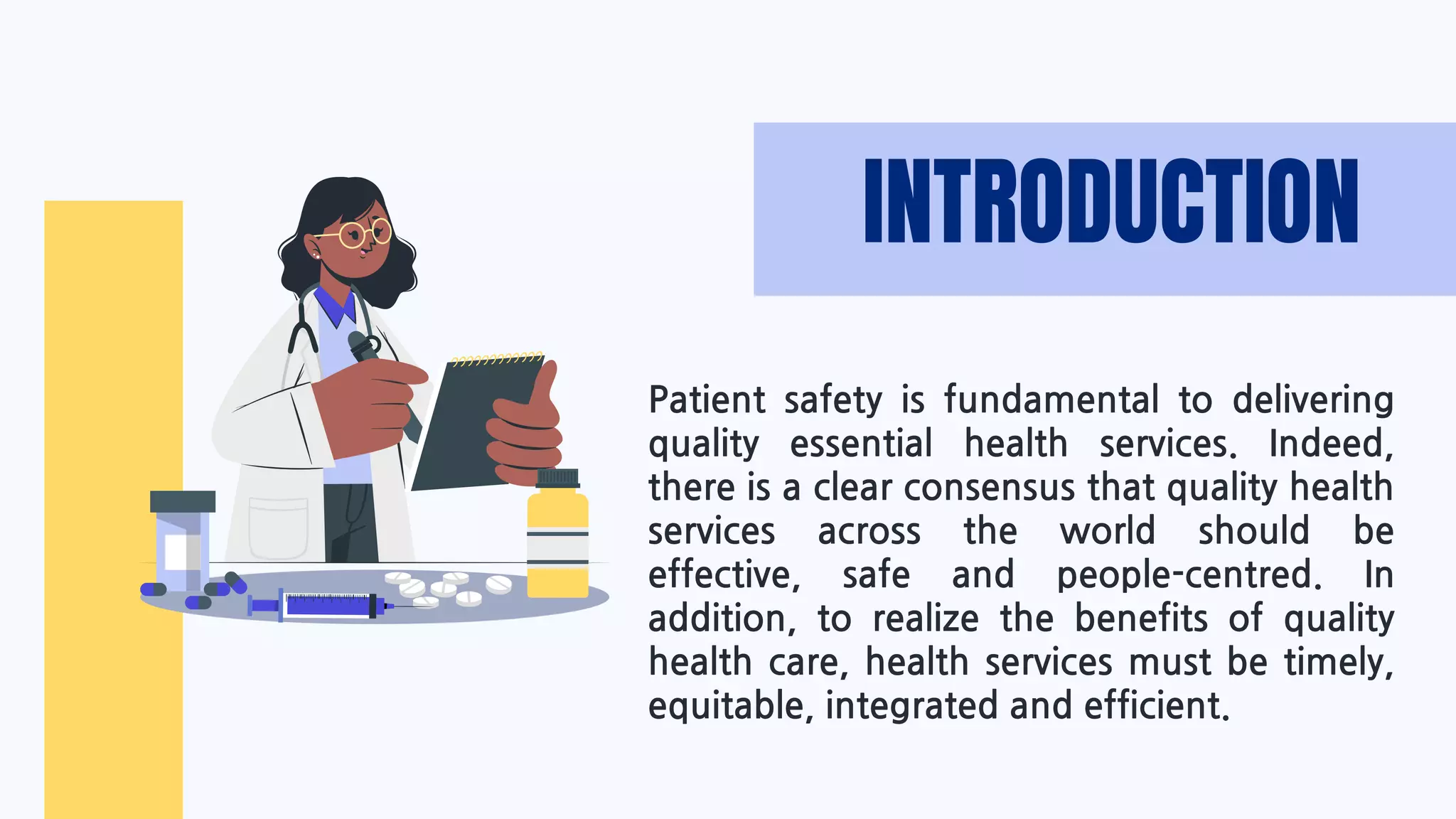
Patient safety is fundamental to delivering
quality essential health services. Indeed,
there is a clear consensus that quality health
services across the world should be
effective, safe and people-centred. In
addition, to realize the benefits of quality
health care, health services must be timely,
equitable, integrated and efficient.
What is PATIENT
SAFETY???
what is PATIENT
safety ???
Patient Safety is a health care discipline that emerged with
the evolving complexity in health care systems and the
resulting rise of patient harm in health care facilities. It aims
to prevent and reduce risks, errors and harm that occur to
patients during provision of health care. A cornerstone of
the discipline is continuous improvement based on learning
from errors and adverse events.
01
WHAT IS SAFETY
Sense the error
Act to prevent it
Follow Safety
Guidelines
Enquire into
accidents/Deaths
Take appropriate
remedial measure
Your responsibility
Significance of Patient Safety
the primary benefits of patient
safety efforts is that they yield
higher standards of clinical care
01
Patient safety programs
help minimize preventable
infections or injuries.
03
help reduce drug errors,
which can occur at prescribing
and dispensing stages
02
patient safety protocols to keep
patients from injuring
themselves during rehabilitation
Even during brief walks around
a hospital floor
04
Providing High-
Quality Care
Preventing Risk
Medication Errors
Patient Injuries
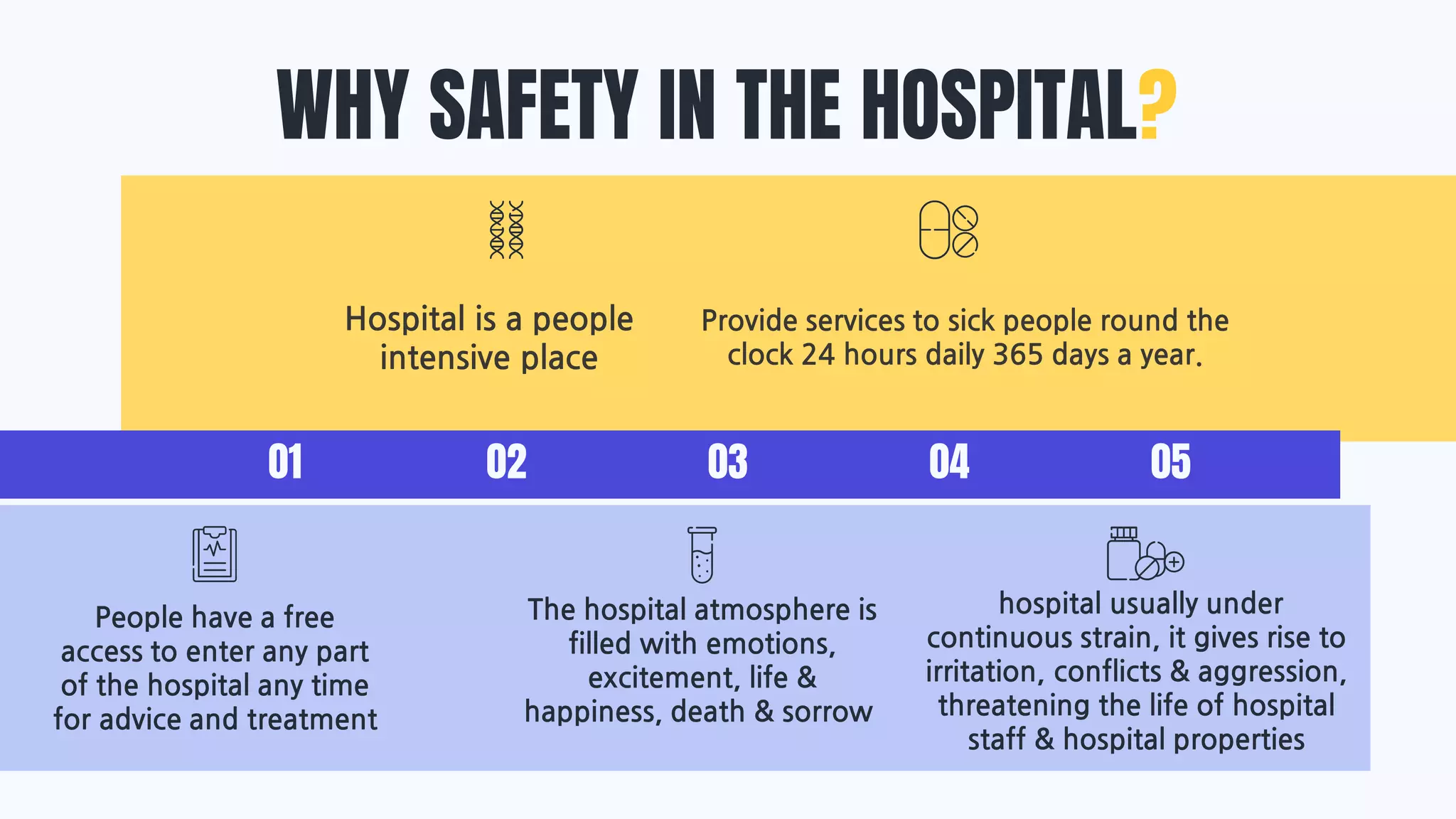
WHY SAFETY IN THE HOSPITAL?
01 02 03 04 05
The hospital atmosphere is
filled with emotions,
excitement, life &
happiness, death & sorrow
People have a free
access to enter any part
of the hospital any time
for advice and treatment
hospital usually under
continuous strain, it gives rise to
irritation, conflicts & aggression,
threatening the life of hospital
staff & hospital properties
Hospital is a people
intensive place
Provide services to sick people round the
clock 24 hours daily 365 days a year.
Goal 1
Improve the accuracy of
patient identification..
Goal 2
Improve the effectiveness
of communication among
caregivers
Goal 3
Improve the safety of
using medications.
National Patient Safety Goals 2015
Goal 4
Improve the safety of
clinical alarm systems
Goal 5
Reduce the risk of
health care-associated
infections
Goal 6
Reduce the risk of
patient harm resulting
from falls
Goal 7
Prevent health care associated
pressure ulcers
Goal 8
The organization identifies
safety risk inherent to the
patient population
National Patient Safety Goals 2015
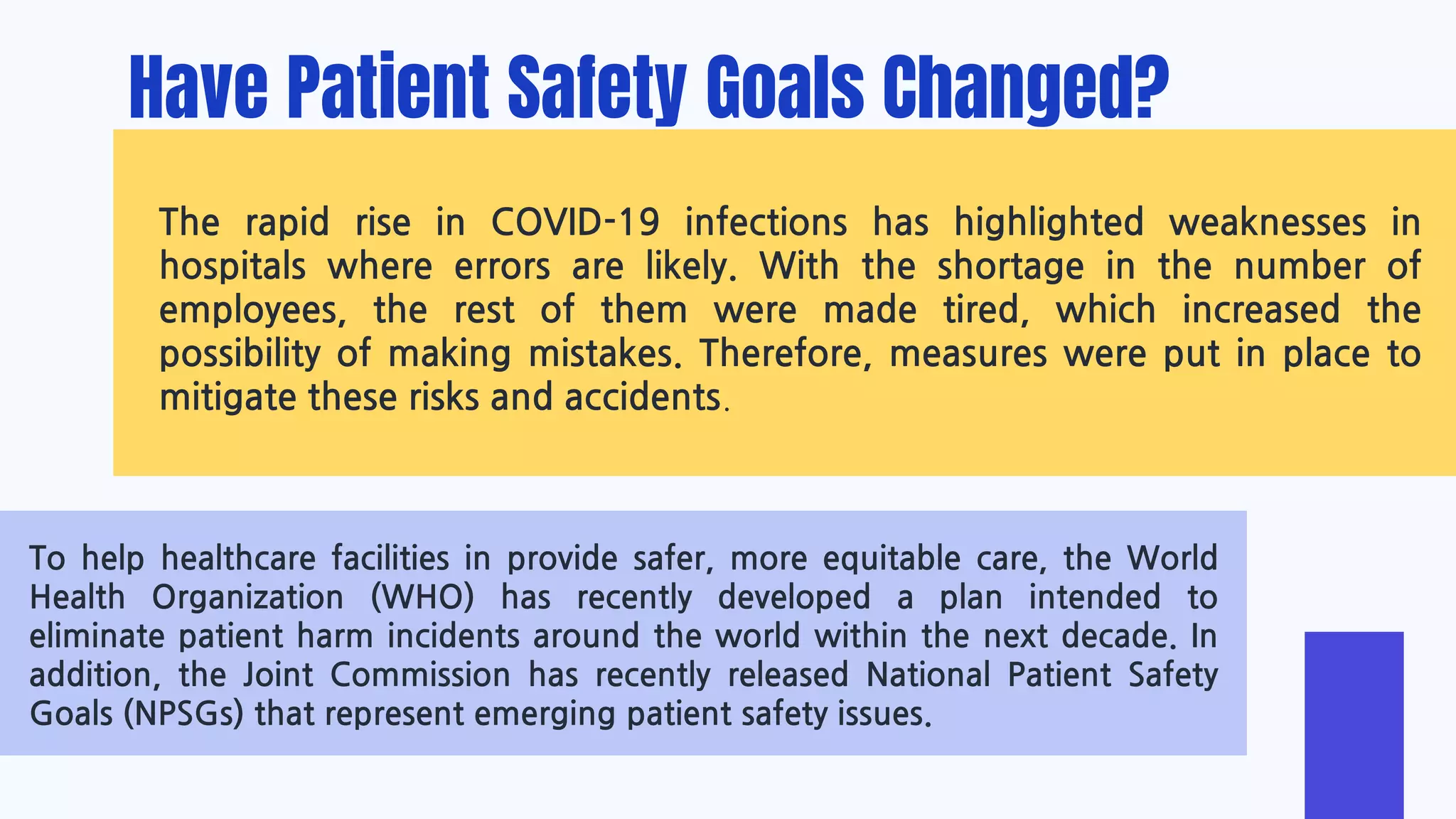
Have Patient Safety Goals Changed?
The rapid rise in COVID-19 infections has highlighted weaknesses in
hospitals where errors are likely. With the shortage in the number of
employees, the rest of them were made tired, which increased the
possibility of making mistakes. Therefore, measures were put in place to
mitigate these risks and accidents.
To help healthcare facilities in provide safer, more equitable care, the World
Health Organization (WHO) has recently developed a plan intended to
eliminate patient harm incidents around the world within the next decade. In
addition, the Joint Commission has recently released National Patient Safety
Goals (NPSGs) that represent emerging patient safety issues.
Identify patients
correctly
Improve staff
communication
Prevent infection
Use medicines
safely
Use alarms
safely
Identify
patient
safety risks.
Prevent
mistakes in
surgery.
National Patient Safety Goals 2019
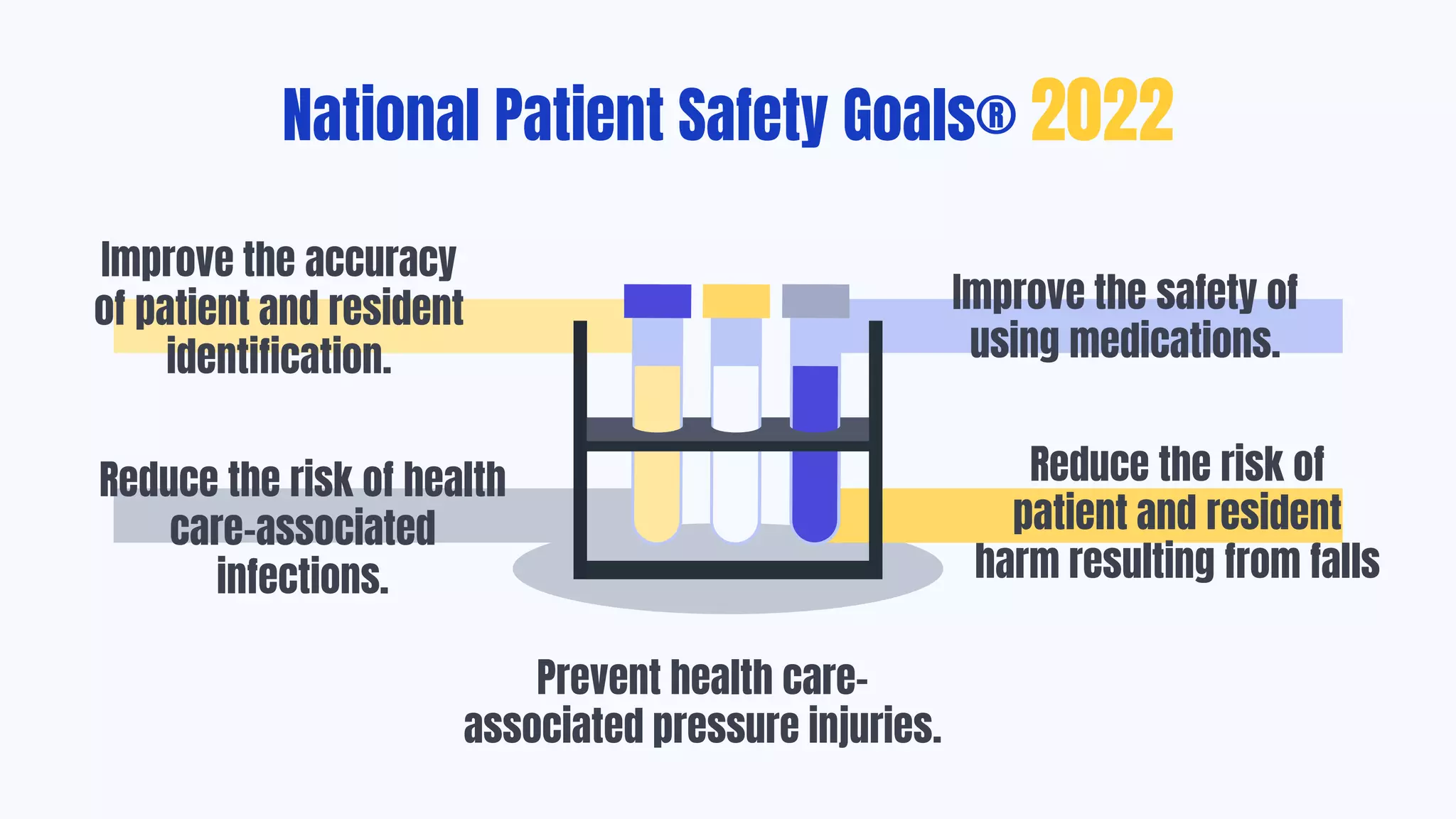
National Patient Safety Goals® 2022
Improve the accuracy
of patient and resident
identification.
Reduce the risk of health
care–associated
infections.
Improve the safety of
using medications.
Reduce the risk of
patient and resident
harm resulting from falls
Prevent health care–
associated pressure injuries.
CREDITS: This presentation template was created by
Slidesgo, including icons by Flaticon, infographics &
images by Freepik and illustrations by Storyset.
SUMMARY
Patient safety is the cornerstone of high-quality health care. Much of the
work defining patient safety and practices that prevent harm have focused
on negative outcomes of care, such as mortality and morbidity. Nurses are
critical to the surveillance and coordination that reduce such adverse
outcomes. Much work remains to be done in evaluating the impact of
nursing care on positive quality indicators, such as appropriate self-care
and other measures of improved health status.
THANK
YOU.
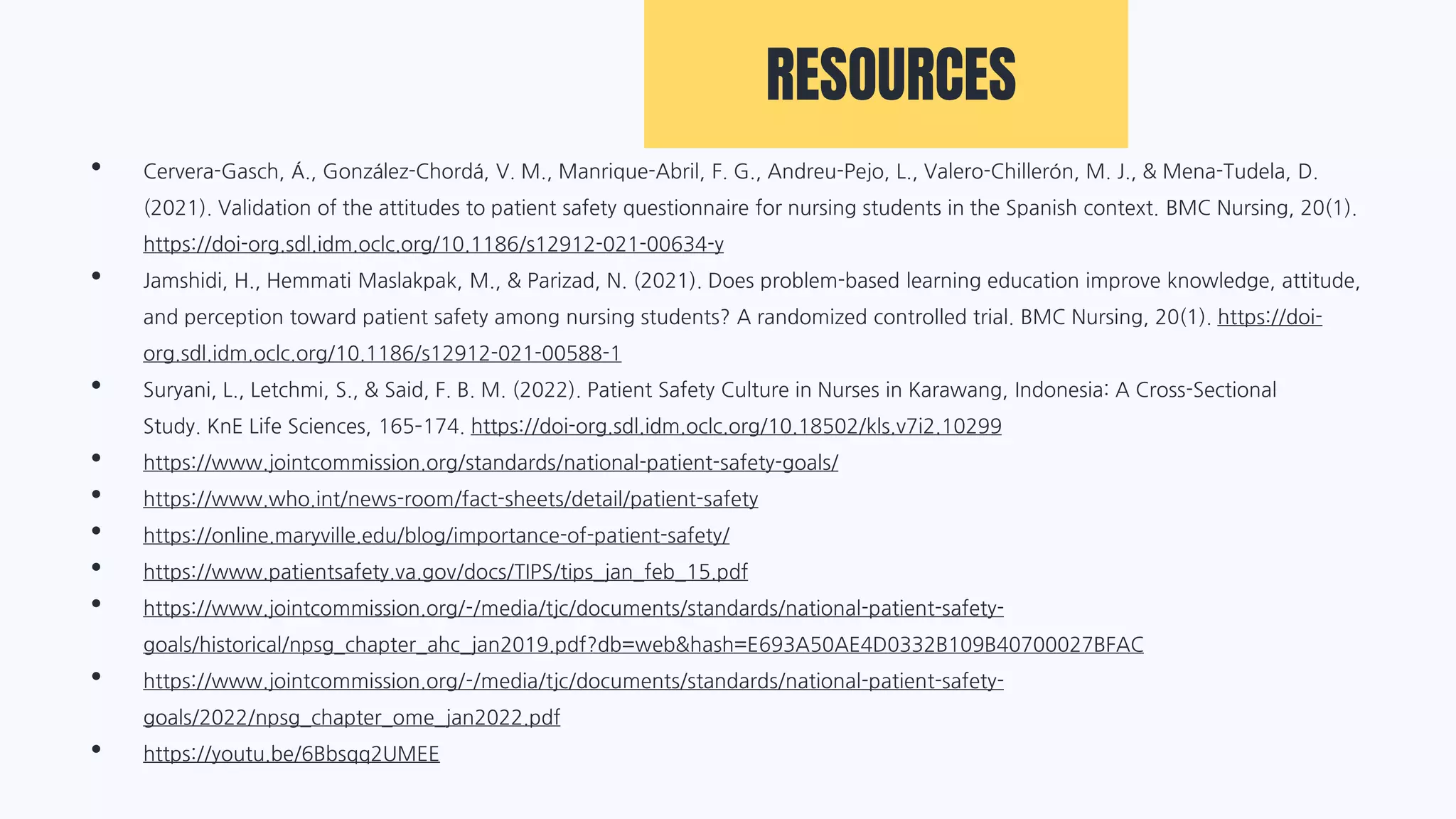
RESOURCES
• Cervera-Gasch, Á., González-Chordá, V. M., Manrique-Abril, F. G., Andreu-Pejo, L., Valero-Chillerón, M. J., & Mena-Tudela, D.
(2021). Validation of the attitudes to patient safety questionnaire for nursing students in the Spanish context. BMC Nursing, 20(1).
https://doi-org.sdl.idm.oclc.org/10.1186/s12912-021-00634-y
• Jamshidi, H., Hemmati Maslakpak, M., & Parizad, N. (2021). Does problem-based learning education improve knowledge, attitude,
and perception toward patient safety among nursing students? A randomized controlled trial. BMC Nursing, 20(1). https://doi-
org.sdl.idm.oclc.org/10.1186/s12912-021-00588-1
• Suryani, L., Letchmi, S., & Said, F. B. M. (2022). Patient Safety Culture in Nurses in Karawang, Indonesia: A Cross-Sectional
Study. KnE Life Sciences, 165–174. https://doi-org.sdl.idm.oclc.org/10.18502/kls.v7i2.10299
• https://www.jointcommission.org/standards/national-patient-safety-goals/
• https://www.who.int/news-room/fact-sheets/detail/patient-safety
• https://online.maryville.edu/blog/importance-of-patient-safety/
• https://www.patientsafety.va.gov/docs/TIPS/tips_jan_feb_15.pdf
• https://www.jointcommission.org/-/media/tjc/documents/standards/national-patient-safety-
goals/historical/npsg_chapter_ahc_jan2019.pdf?db=web&hash=E693A50AE4D0332B109B40700027BFAC
• https://www.jointcommission.org/-/media/tjc/documents/standards/national-patient-safety-
goals/2022/npsg_chapter_ome_jan2022.pdf
• https://youtu.be/6Bbsqq2UMEE

safety.pdf

  • 1.
    PATIENT safety Dareen AliAL-subeiai 19000 200 Ghoyum Al-mould 19000 184 Suzan AL-Otibe 18000 035 Nursing leadership & management
  • 2.
    INTRODUCTION Patient safety isfundamental to delivering quality essential health services. Indeed, there is a clear consensus that quality health services across the world should be effective, safe and people-centred. In addition, to realize the benefits of quality health care, health services must be timely, equitable, integrated and efficient.
  • 3.
  • 4.
    what is PATIENT safety??? Patient Safety is a health care discipline that emerged with the evolving complexity in health care systems and the resulting rise of patient harm in health care facilities. It aims to prevent and reduce risks, errors and harm that occur to patients during provision of health care. A cornerstone of the discipline is continuous improvement based on learning from errors and adverse events. 01
  • 5.
    WHAT IS SAFETY Sensethe error Act to prevent it Follow Safety Guidelines Enquire into accidents/Deaths Take appropriate remedial measure Your responsibility
  • 6.
    Significance of PatientSafety the primary benefits of patient safety efforts is that they yield higher standards of clinical care 01 Patient safety programs help minimize preventable infections or injuries. 03 help reduce drug errors, which can occur at prescribing and dispensing stages 02 patient safety protocols to keep patients from injuring themselves during rehabilitation Even during brief walks around a hospital floor 04 Providing High- Quality Care Preventing Risk Medication Errors Patient Injuries
  • 7.
    WHY SAFETY INTHE HOSPITAL? 01 02 03 04 05 The hospital atmosphere is filled with emotions, excitement, life & happiness, death & sorrow People have a free access to enter any part of the hospital any time for advice and treatment hospital usually under continuous strain, it gives rise to irritation, conflicts & aggression, threatening the life of hospital staff & hospital properties Hospital is a people intensive place Provide services to sick people round the clock 24 hours daily 365 days a year.
  • 8.
    Goal 1 Improve theaccuracy of patient identification.. Goal 2 Improve the effectiveness of communication among caregivers Goal 3 Improve the safety of using medications. National Patient Safety Goals 2015 Goal 4 Improve the safety of clinical alarm systems Goal 5 Reduce the risk of health care-associated infections Goal 6 Reduce the risk of patient harm resulting from falls
  • 9.
    Goal 7 Prevent healthcare associated pressure ulcers Goal 8 The organization identifies safety risk inherent to the patient population National Patient Safety Goals 2015
  • 10.
    Have Patient SafetyGoals Changed? The rapid rise in COVID-19 infections has highlighted weaknesses in hospitals where errors are likely. With the shortage in the number of employees, the rest of them were made tired, which increased the possibility of making mistakes. Therefore, measures were put in place to mitigate these risks and accidents. To help healthcare facilities in provide safer, more equitable care, the World Health Organization (WHO) has recently developed a plan intended to eliminate patient harm incidents around the world within the next decade. In addition, the Joint Commission has recently released National Patient Safety Goals (NPSGs) that represent emerging patient safety issues.
  • 11.
    Identify patients correctly Improve staff communication Preventinfection Use medicines safely Use alarms safely Identify patient safety risks. Prevent mistakes in surgery. National Patient Safety Goals 2019
  • 12.
    National Patient SafetyGoals® 2022 Improve the accuracy of patient and resident identification. Reduce the risk of health care–associated infections. Improve the safety of using medications. Reduce the risk of patient and resident harm resulting from falls Prevent health care– associated pressure injuries.
  • 13.
    CREDITS: This presentationtemplate was created by Slidesgo, including icons by Flaticon, infographics & images by Freepik and illustrations by Storyset. SUMMARY Patient safety is the cornerstone of high-quality health care. Much of the work defining patient safety and practices that prevent harm have focused on negative outcomes of care, such as mortality and morbidity. Nurses are critical to the surveillance and coordination that reduce such adverse outcomes. Much work remains to be done in evaluating the impact of nursing care on positive quality indicators, such as appropriate self-care and other measures of improved health status.
  • 14.
  • 15.
    RESOURCES • Cervera-Gasch, Á.,González-Chordá, V. M., Manrique-Abril, F. G., Andreu-Pejo, L., Valero-Chillerón, M. J., & Mena-Tudela, D. (2021). Validation of the attitudes to patient safety questionnaire for nursing students in the Spanish context. BMC Nursing, 20(1). https://doi-org.sdl.idm.oclc.org/10.1186/s12912-021-00634-y • Jamshidi, H., Hemmati Maslakpak, M., & Parizad, N. (2021). Does problem-based learning education improve knowledge, attitude, and perception toward patient safety among nursing students? A randomized controlled trial. BMC Nursing, 20(1). https://doi- org.sdl.idm.oclc.org/10.1186/s12912-021-00588-1 • Suryani, L., Letchmi, S., & Said, F. B. M. (2022). Patient Safety Culture in Nurses in Karawang, Indonesia: A Cross-Sectional Study. KnE Life Sciences, 165–174. https://doi-org.sdl.idm.oclc.org/10.18502/kls.v7i2.10299 • https://www.jointcommission.org/standards/national-patient-safety-goals/ • https://www.who.int/news-room/fact-sheets/detail/patient-safety • https://online.maryville.edu/blog/importance-of-patient-safety/ • https://www.patientsafety.va.gov/docs/TIPS/tips_jan_feb_15.pdf • https://www.jointcommission.org/-/media/tjc/documents/standards/national-patient-safety- goals/historical/npsg_chapter_ahc_jan2019.pdf?db=web&hash=E693A50AE4D0332B109B40700027BFAC • https://www.jointcommission.org/-/media/tjc/documents/standards/national-patient-safety- goals/2022/npsg_chapter_ome_jan2022.pdf • https://youtu.be/6Bbsqq2UMEE