• A person who gives treatment for the one suffering from a
disease or an accident, to improve his condition is called
an” aides” and the medical treatment given as aid is called
“ first aid”
• If an accident happens in the workplace, you cannot be a
helpless witness, since simply standing by can potentially
worsens the situation. This is why it’s important to have at
least a basic knowledge of first aid.
• At its most basic, first aid is the initial assistance given to a
victim of injury or illness. Comprised of relatively simple
techniques that can be performed with rudimentary
equipment, first aid is usually carried out by a layperson
until professional medical assistance arrives.
Philosophy of First Aid
• In the pre-hospital setting, the key
contributors to survival and recovery from
illness and injury are prompt and effective
maintenance of the body’s primary functions:
1. Airway
2. Breathing
3. Circulation
4. Bleeding control (life threatening)
Principles of emergency care:
• Collect the detailed history of accident either from the
victim or from anyone who has witnessed the accident.
• The victim’s injury should be examined thoroughly,
taking note of every symptom, to know the correct
diagnosis.
• By the help of the diagnosis, treat the victim until the
doctor arrives or shift the victim to the hospital and aid
the patient during transport.
• Call the doctors or shift the victim to the hospital as soon
as possible, so that the patience can recover soon from
doctor’s treatment instead of prolonging the first aid.
FIRST AID IN EMERGENCIES
Asphyxia
• Definition : Asphyxia means one of the
respiratory problems where lungs do not
get sufficient supply of air from
breathing.
• Signs/Symptoms: Blue discoloration of
face, tongue, and lips; gasping; inability
to speak; unconsciousness.
Management:
• Remove the causality from the affected situation
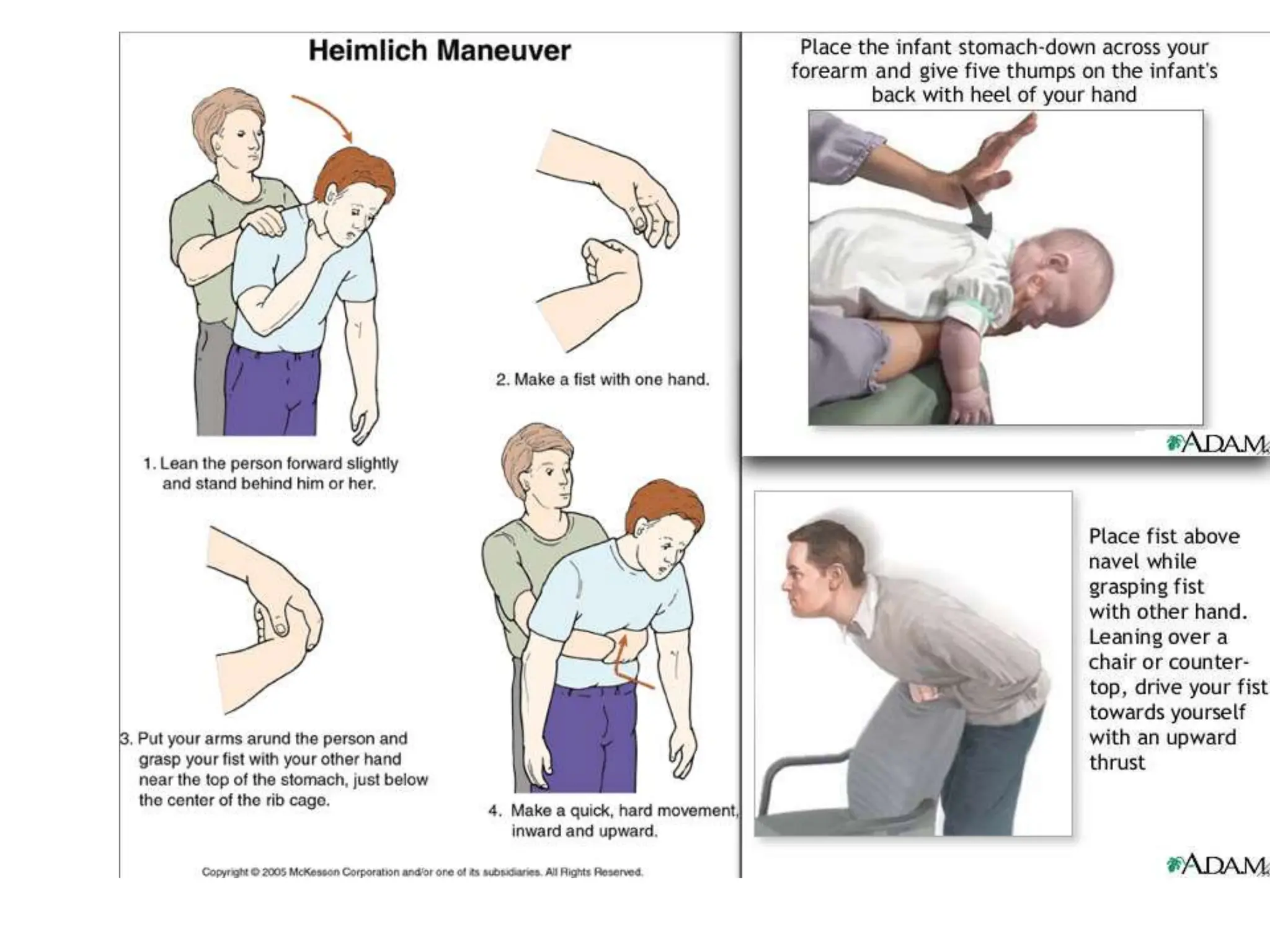
• First try the Heimlich maneuver, grasping the victim from behind
with hands linked in front and compressing the abdomen just below
the ribs.
• Encourage victim to cough up foreign objects in throat; as a last
resort, rap victim between shoulder blades to dislodge object.
• For asphyxia caused by gas or fumes, remove victim to a clear
atmosphere; use artificial respiration.
• Open the airway and begin to give mouth to mouth ventilation
immediately
• Place the patient in a recovery position
• Apply water over the face, make the patient to drink a sip of water
• Sent the causality to hospital.
Drowning:
• Drowning: Drowning is the result of complete
immersion of the nose and mouth in water (or
any other liquid). Water enters the windpipe
and lungs, clogging the lungs completely.
Management: The aim of first aid is to drain out water (or other
matter) from lungs and to give artificial respiration.
• Act quickly. Remove seaweeds and mud from the nose and throat.
Start artificial ventilation immediately. This is possible even when
the casualty is in water.
• Turn the victim face down with head to one side and arms stretched
beyond his head. Infants or children could be help upside down for a
short period.
• Raise the middle part of the body with your hands round the belly.
This is to cause water to drain out of the lungs.
• Give artificial respiration until breathing comes back to normal. This
may have to go on for as long as two hours.
• Remove wet clothing.
• Keep the body warm, cover with blankets.
• When victim becomes conscious, give hot drinks viz coffee or tea.
• Do not allow him to sit up.
Suffocation by Poisonous Gases:
Definition: suffocation occurs when no air enters the rooms and to the nose and the
room is a confined space where all the oxygen is used up like caves, holes and
wells without water.
1. Carbon Monoxide (lighter than air): This gas is present in car-exhaust
fumes, in household coal gas: during incomplete combustion of charcoal
stoves and in coal mines.
Management:
• The first aid treatment consists in removing the person from the area, applying
artificial respiration and giving pure oxygen, if available.
• Ensure circulation of fresh air before entering the room by opening the doors and
windows.
• Before entering the enclosed space take two or three deep breaths and hold your
breath as long as you can.
• Crawl along the floor (as the gas is lighter than air)
• Remove the casualty as quickly as possible to fresh air.
• Loosen his clothes at neck and waist and give artificial respiration, if asphyxiated.
Suffocation by Poisonous Gases:
2. Carbon-dioxide and other (heavier than air): This gas is
found in coal mines, deep unused wells and sewers. Various
other gases such as leaking refrigerator gases; compressed
gases used for cooking and lighting may also cause
suffocation.
Management
• Observe all the precautions mentioned above.
• Enter in an upright position (as the gas is heavier than air and
collects near the floor)
• Remove the casualty as quickly as possible to fresh air.
• Wherever ventilation is not possible and deadly poisonous gas
is suspected, use a gas mask to protect yourself.
Suffocation by Poisonous Gases:
3. Suffocation by smoke
• Management:
• Protect yourself by a towel or a cloth
(preferably wet) over your mouth and nose.
• Keep low and remove the casualty as quickly
as possible away from the area.
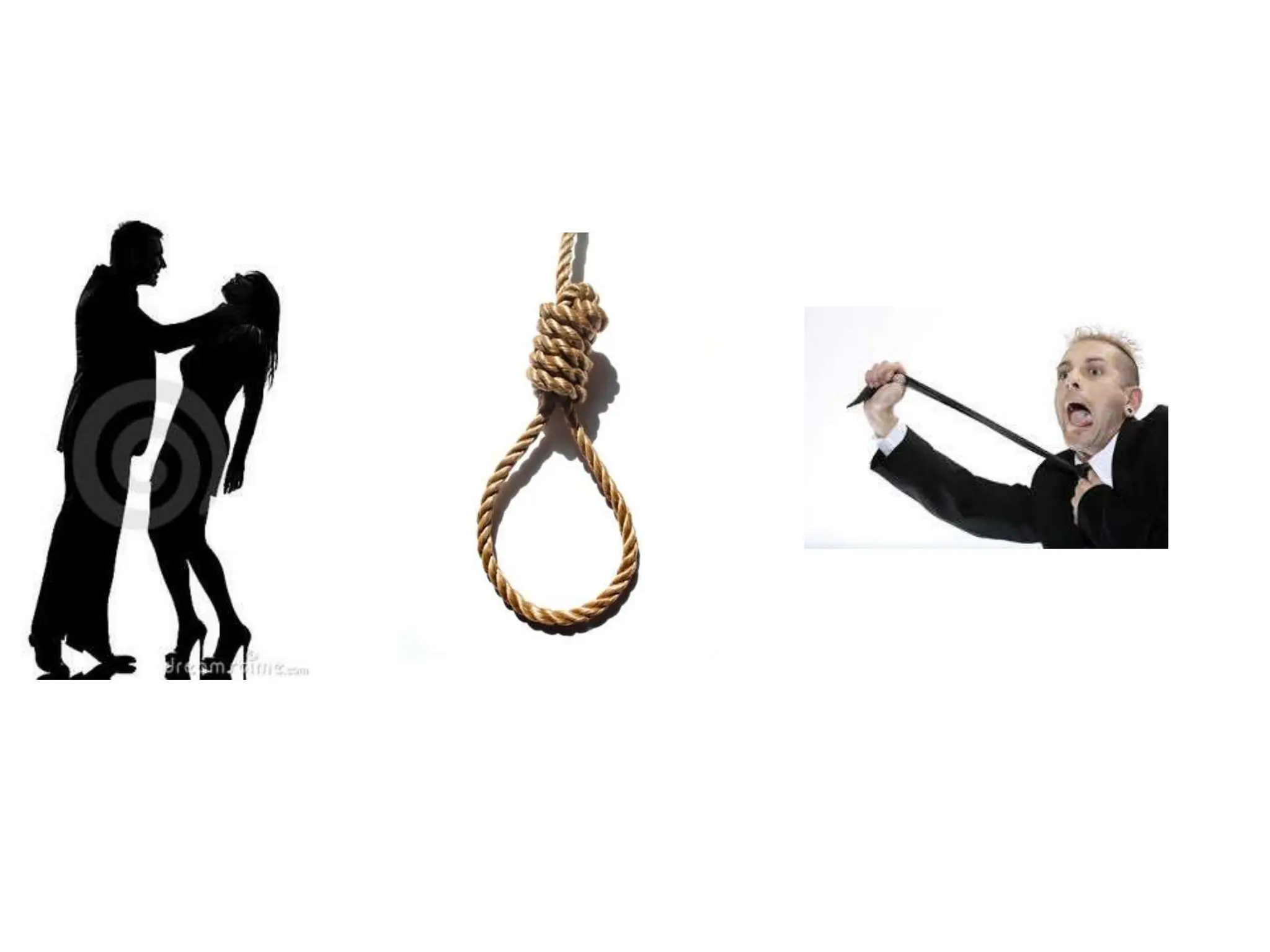
Hanging, strangulation, and throttling:
• Hanging, strangulation, and throttling:If pressure is
exerted on the outside of the neck, the airway is squeezed
and the flow of air to the lungs is cut off. The three main
reasons or causes why this could happen are:
• Hanging= suspension of the body by a noose around the
neck
• Strangling= constriction around the neck
• Throttling = squeezing the throat.
Hanging and strangulation may occur accidentally for
example, by tie or clothing caught in machinery. Ranging
(ring) may also cause a broken neck, so the casualty must be
handled carefully.
Hanging, strangulation, and
throttling:
• Signs/symptoms:
• There may be a constricting article around the
neck.
• Marks around the casualty’s neck where a
constriction has been removed.
• Uneven breathing, impaired consciousness;
grey-blue skin (cyanosis).
• Congestion of the face, with prominent veins
and possible; tiny red spots on the face or on
the whites of the eyes.
Hanging, strangulation, and throttling:
Management:
• Immediately remove any constriction from around the
casualty’s neck, Support the body while you do so if it is
still hanging
• Do not move the casualty unnecessarily in case of spinal
injury
• Do not destroy or interfere with any material, such as
knotted rope, that police may need as evidence.
• Lay the casualty on the floor. Open the airway and check
breathing.
• If she is not breathing be prepared to resuscitate
• If she is breathing, place her in the recovery position
Shock:
Fainting
• Definition: This is very similar to shock except it is a temporary
condition.
• Causes: It usually occurs because of a temporary decrease of blood
flow to the brain, which can be caused by not eating properly, standing
up too fast, or low blood pressure.
• Signs/Symptoms: The casualty feels faint, or collapses.
• Management:
• If they feel faint have them lie down which will help with circulation.
• If they faint they will usually wake up in a few seconds. Encourage the
person to stay lying down for a few minutes until they feel better. If
they do not wake up within one minute, or they became injured during
the fall then activate the ambulance, and treat any injuries.
• Notes: If someone has fainted, even if they feel fine afterwards, they
should still go see their doctor to rule out any major problem.
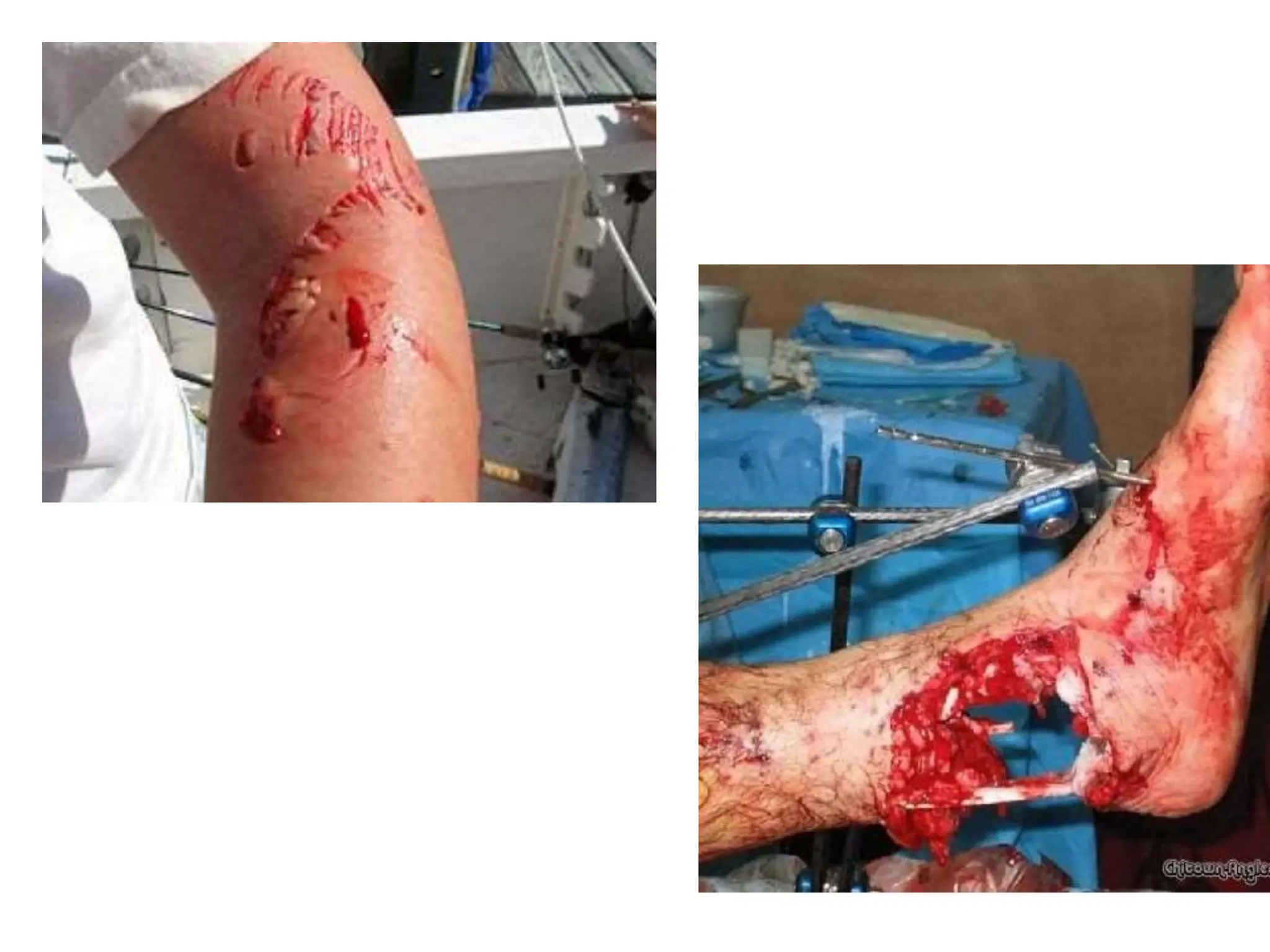
Wound:
Wound:
Management:
• Help the person to remain calm. If the cut is large or bleeding heavily, have them lie
down.
• If the wound is on an arm or leg, raise the limb above the heart to slow bleeding.
• Remove obvious debris from the wound, such as sticks or grass.
• If the object is embedded in the body, do NOT remove it.
• If the cut is small, wash it out with soap and water.
• Do NOT clean a large wound.
• After putting on clean latex gloves apply firm pressure to the wound with a folded
cloth or bandage for about 10 minutes.
• Do not remove the bandage to look at the wound during this time, as it may begin
bleeding again.
• If blood soaks through, add another cloth or bandage and continue holding pressure
on the cut for an additional 10 minutes.
• When bleeding has stopped, tape a clean bandage over the cut.
Wound
Seek medical care for a cut or wound if:
• It’s jagged or deep, or if it is a puncture
wound.
• it’s on the face
• it’s the result of an animal bite
• there is dirt that won’t come out after
washing
• the bleeding will not stop
Hemorrhage/Bleeding:
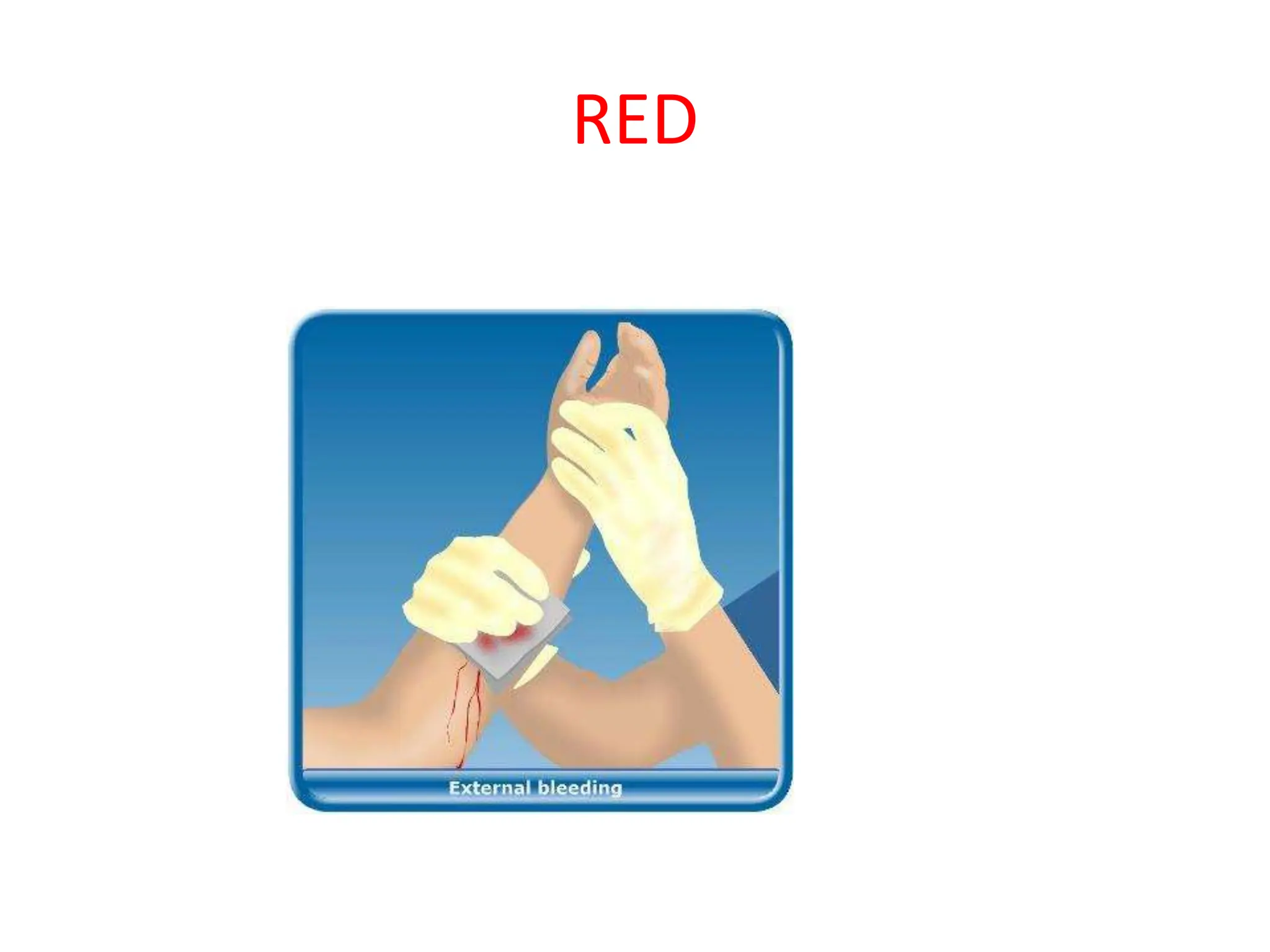
External bleeding: This is where the blood vessels and the skin
are cut and blood is escaping the body.
Causes:
• Damage to the skin caused by trauma.
• Can be a laceration (clean cut), abrasion, or avulsion (with skin still
hanging).
Management:
• If it’s a minor bleed allow some bleeding to take place as this will
help clean the wound.
• Then wash with warm water and soap, apply a dressing to keep it
clean, change the dressing every few hours, and monitor for signs of
infection.
Management conti—”
• If the bleeding is severe then apply the RED principle:
• Rest: make sure the person is resting so as to decrease the heart rate
and blood pressure.
• Elevate: raise the injured limb above the heart to slow down the
bleeding.
• Direct Pressure: put pressure directly over the wound to help control
bleeding, tie the dressing in place. But, do not make the dressing too
tight so as to restrict blood flow. Do not remove the dressing.
• Pressure Points: Applying pressure over the pressure points pressing
over the underlying bone pressure points on the arms (brachial
pressure point) on the groin (femoral pressure point).
• Applying a tourniquet: A standard tourniquet is a piece of web
belting about 36" long with a buckle device to hold it tightly in place
when applied. This is used to stop bleeding. Care to be taken not to
cutoff the circulation.
• Get medical help.
RED
Hemorrhage/Bleeding:
Internal bleeding: This is where the blood vessels are
broken but the skin is not, so the person is bleeding
under the skin. Injured organs will result in internal
bleeding.
Causes: Usually physical trauma, being hit, falling. Very
common in car accidents.
Signs/Symptoms:
• Bruising, pain
• Tenderness
• Mechanism of the injury (what happened).
• There may be blood in their spit, vomit, or urine.
Internal bleeding conti:
Management:
• If it’s a minor bruise on the arm or leg then rest the injured part,
apply an ice pack for a few minutes, and watch for signs that it is not
healing.
• If it’s severe internal bleeding in the core of the body then active the
ambulance, make sure the person is resting, treat for shock, apply an
ice pack, but do NOT put pressure over the wound.
Notes:
• Internal bleeding is not always obvious, but can be life threatening.
• Infection can occur with any wound whether internal or external. If
you suspect an infection then seek medical help immediately, as it
can become life threatening.
• Watch out for warning signs such as; the wound is not healing or is
getting bigger, discoloration, fluid discharge, and increased pain.
• Amputation (e.g. a finger): treat the injured
body part as you would any other cut. Then
take the amputated body part and place it in a
clean plastic bag. Take that first bag and place
it in a second plastic bag containing ice. Make
sure it goes to the hospital with the person, as
they can sometimes reattach the body part.
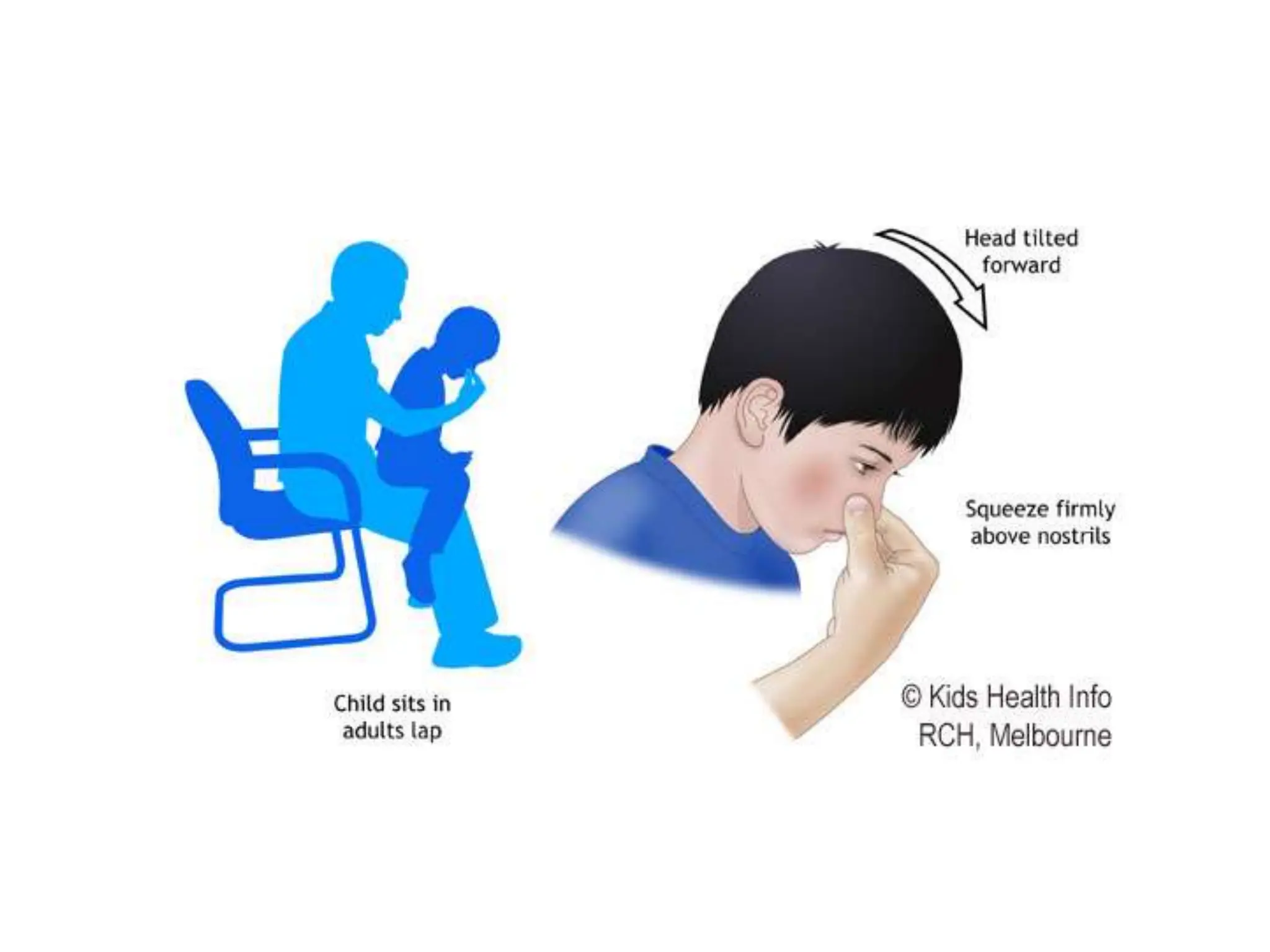
Nose bleeds/epistaxis:
• Have the person rest, have them pinch their
nose just below the bone, and lean slightly
forward.
• If the bleeding is severe, if it does not stop in
about 10-15 minutes, or if there was an injury
to the head or face, medical attention is
needed.
• Do not have the person lean their head back,
as all this does is have them swallow their
blood, which is not desired.
Broken bones and fractures
• Definition: A break or crack in a bone is called a fracture.
• In most cases the damage to the bone will be under the skin,
which is called a closed fracture,
• But sometimes bits of the bone can puncture through the
skin to become an open fracture.
• In both cases you'll need to treat the casualty for shock.
• Even if you can't see any blood, the break might have caused
some internal bleeding.
• To break a fully grown bone, a huge amount of force is
needed
• But bones that are still growing are supple and can split, crack
or bend quite easily, a bit like a twig.
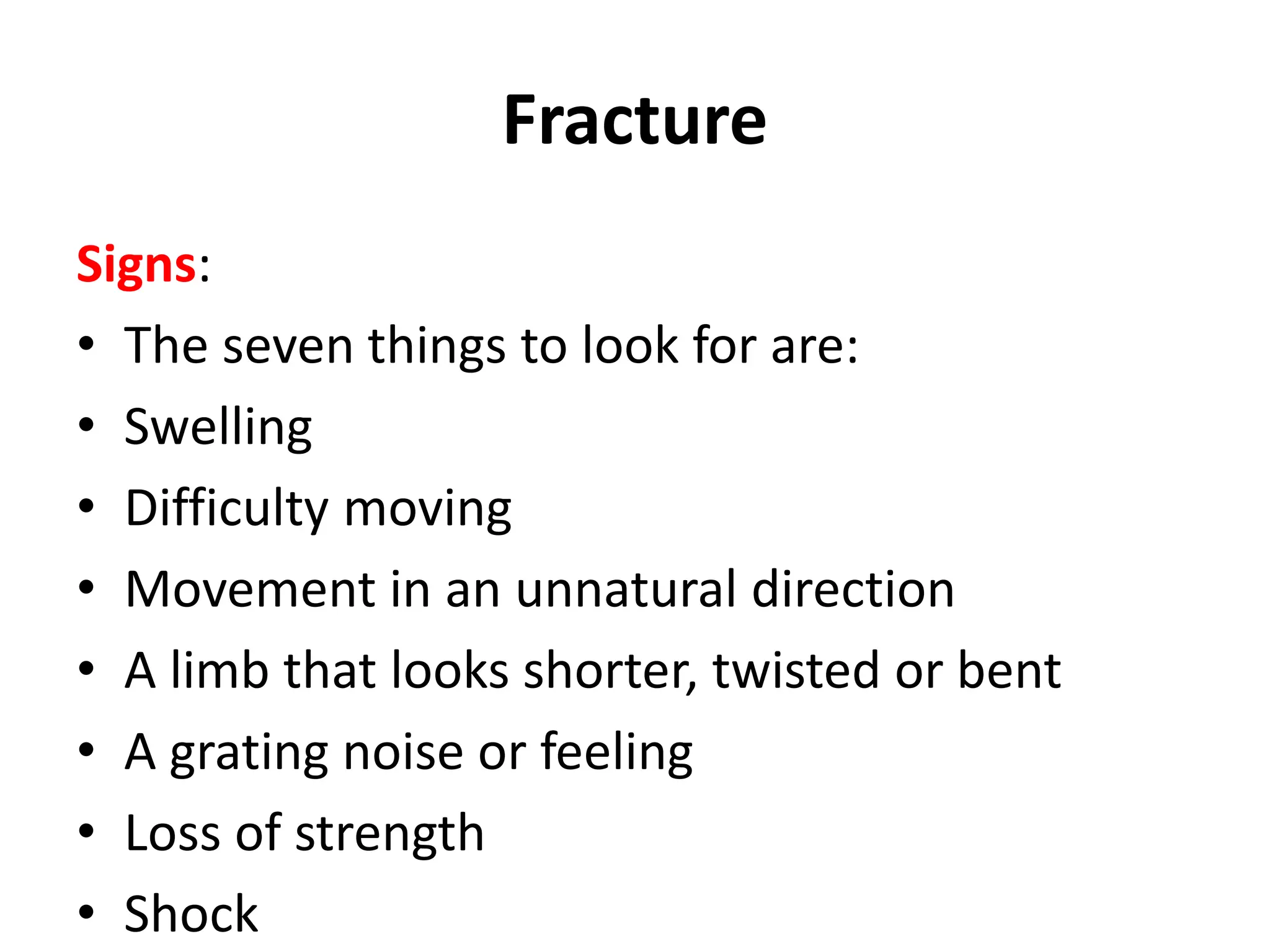
Fracture
Signs:
• The seven things to look for are:
• Swelling
• Difficulty moving
• Movement in an unnatural direction
• A limb that looks shorter, twisted or bent
• A grating noise or feeling
• Loss of strength
• Shock
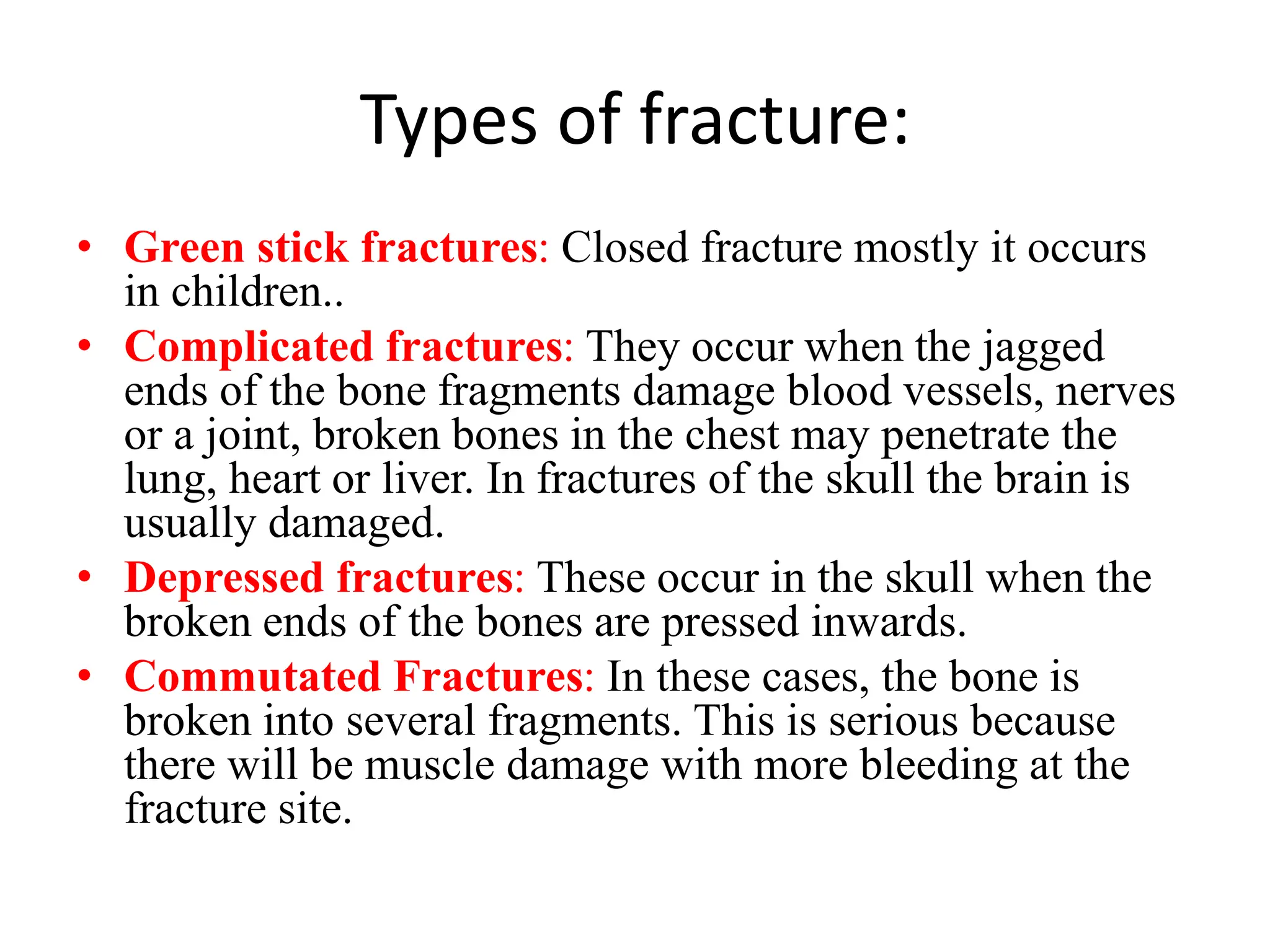
Types of fracture:
• Green stick fractures: Closed fracture mostly it occurs
in children..
• Complicated fractures: They occur when the jagged
ends of the bone fragments damage blood vessels, nerves
or a joint, broken bones in the chest may penetrate the
lung, heart or liver. In fractures of the skull the brain is
usually damaged.
• Depressed fractures: These occur in the skull when the
broken ends of the bones are pressed inwards.
• Commutated Fractures: In these cases, the bone is
broken into several fragments. This is serious because
there will be muscle damage with more bleeding at the
fracture site.
Types of fracture:
• Impacted Fractures: After a heavy fall, the
fracture may be impacted by the force, (eg.) Spinal
injury falling from tree.
• Pathological Fractures: These occur when the
bone is weakened by loss of calcium, infection or
cancer. Minimal cause a break in such cases. In old
age the bones are more brittle, and may break
spontaneously due to calcium loss which is part of
the ageing process.
• Stress Fractures: Stress caused by repeated minor
trauma as in athletic training. Involved in strenuous
Management:
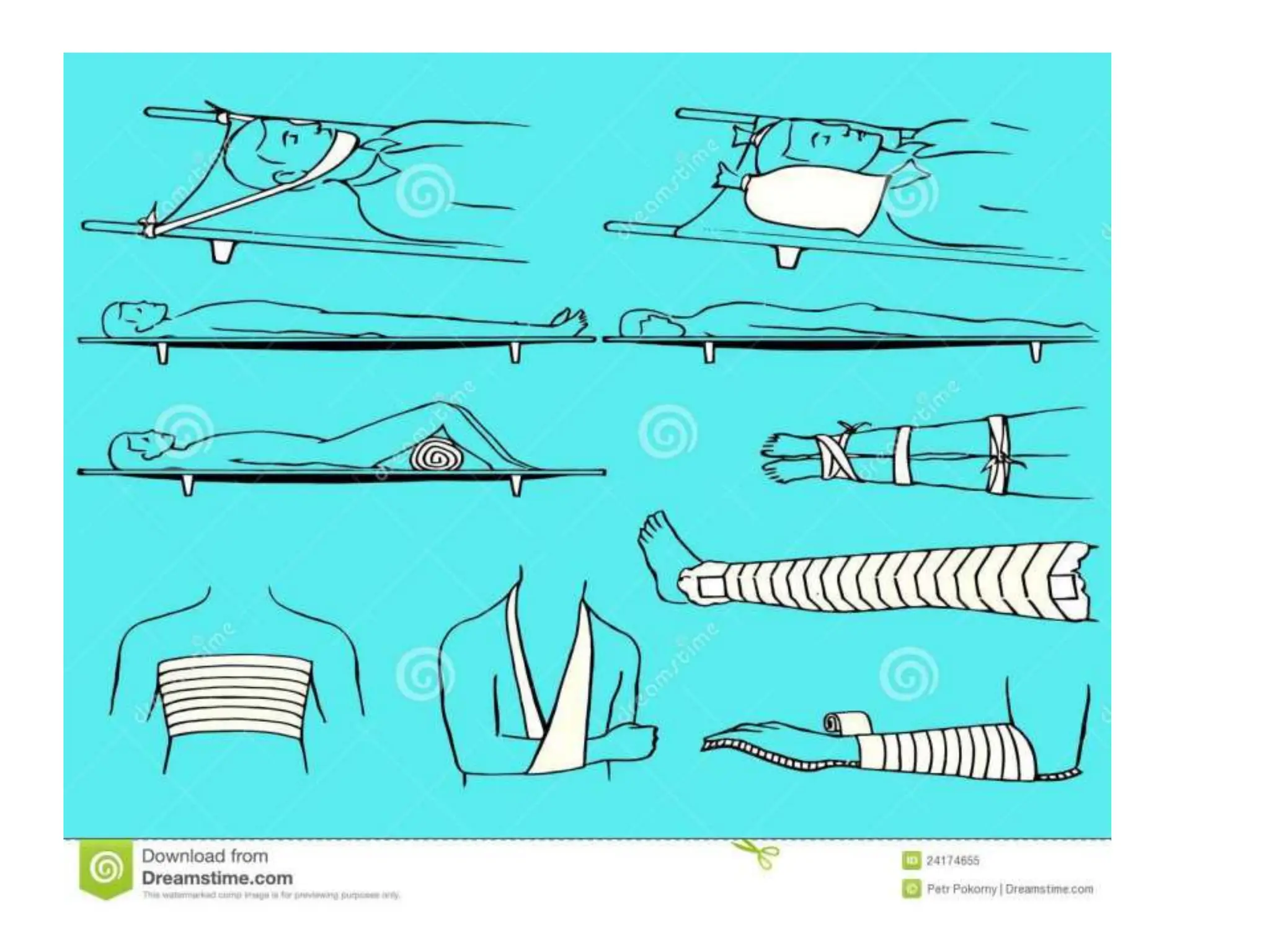
• If it is an open fracture, cover the wound with a sterile dressing and
secure it with a bandage. Apply pressure around the wound to
control any bleeding.
• Support the injured body part to stop it from moving. This should
ease any pain and prevent any further damage.
• Once you’ve done this, call medical help. While waiting for help to
arrive, don’t move them unless they’re in immediate danger.
• Protect the injured area by using bandages to secure it to an
uninjured part of the body to stop it from moving. For example,
fractures on the arm can be secured with a sling, and a leg with a
fracture can be tied to the uninjured leg.
• Keep checking the casualty for signs of shock. This does not mean
emotional shock, but is a life-threatening condition, often caused
by losing blood.
• If they lose responsiveness at any point, open their airway, check
their breathing and prepare to treat someone who’s become
unresponsive.
•
Splints:
• The main purpose of a splint is to keep an injured body part
immobilized (e.g. a broken leg).
• It should only be done if paramedics are going to take a long time
arriving, or if you have to move the person.
• Never move or try to realign the injured body part. Always splint in
the position found.
There are three main types of splints:
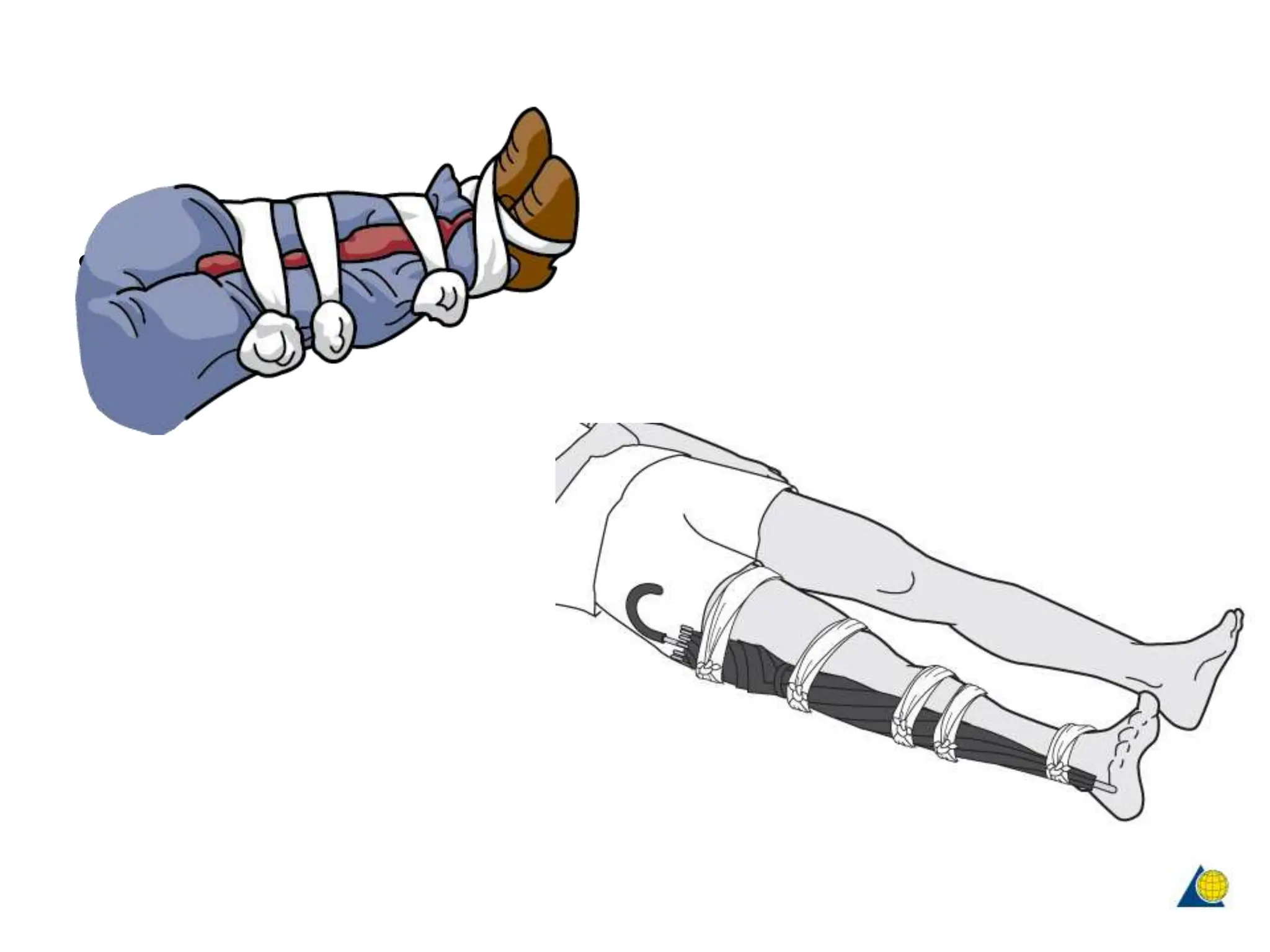
• 1. Anatomical: this means using a non-injured body part to
immobilize an injured body part. E.g. to splint a broken left lower leg
you would tie both legs together so the good leg provides support
to the injured leg.
• 2. Soft: this means using something like a thick sweat shirt, a jacket,
a towel, or a blanket to wrap around and immobilize. This kind of
splint works very well with hand or ankle/foot injuries.
• 3. Rigid: this refers to using a firm object, such as a piece of wood,
to immobilize. There are many types of rigid splints you can
purchase or you can use whatever you see around you e.g.
magazines, newspapers, umbrellas, etc.
Injuries to the soft tissues:
• Definition:
– This is an injury to a bone, a joint, a ligament, or a
tendon.
– Joint injuries usually involve a dislocation.
– This is where the bone has popped out of its
socket.
– This may be accompanied with a fracture, a
strain, or a sprain.
– It may pop back in it may not.
– Either way seek medical help.
Injuries to the soft tissues:
– Tendons are strong tissues that connect a muscle onto a
bone.
– When a tendon tears it is called a strain.
– When they become torn they take a very long time to
heal, many times never as good as before, and
sometimes surgery is required to reattach them.
– When a ligament is torn it is called a sprain.
– Ligaments connect a bone to another bone.
– These are found around the joints.
– Ligaments are very strong, but, as with tendons, when
they tear they take a long time to heal, never as good as
before, and sometimes surgery is required.
Injuries to the soft tissues:
• Causes:
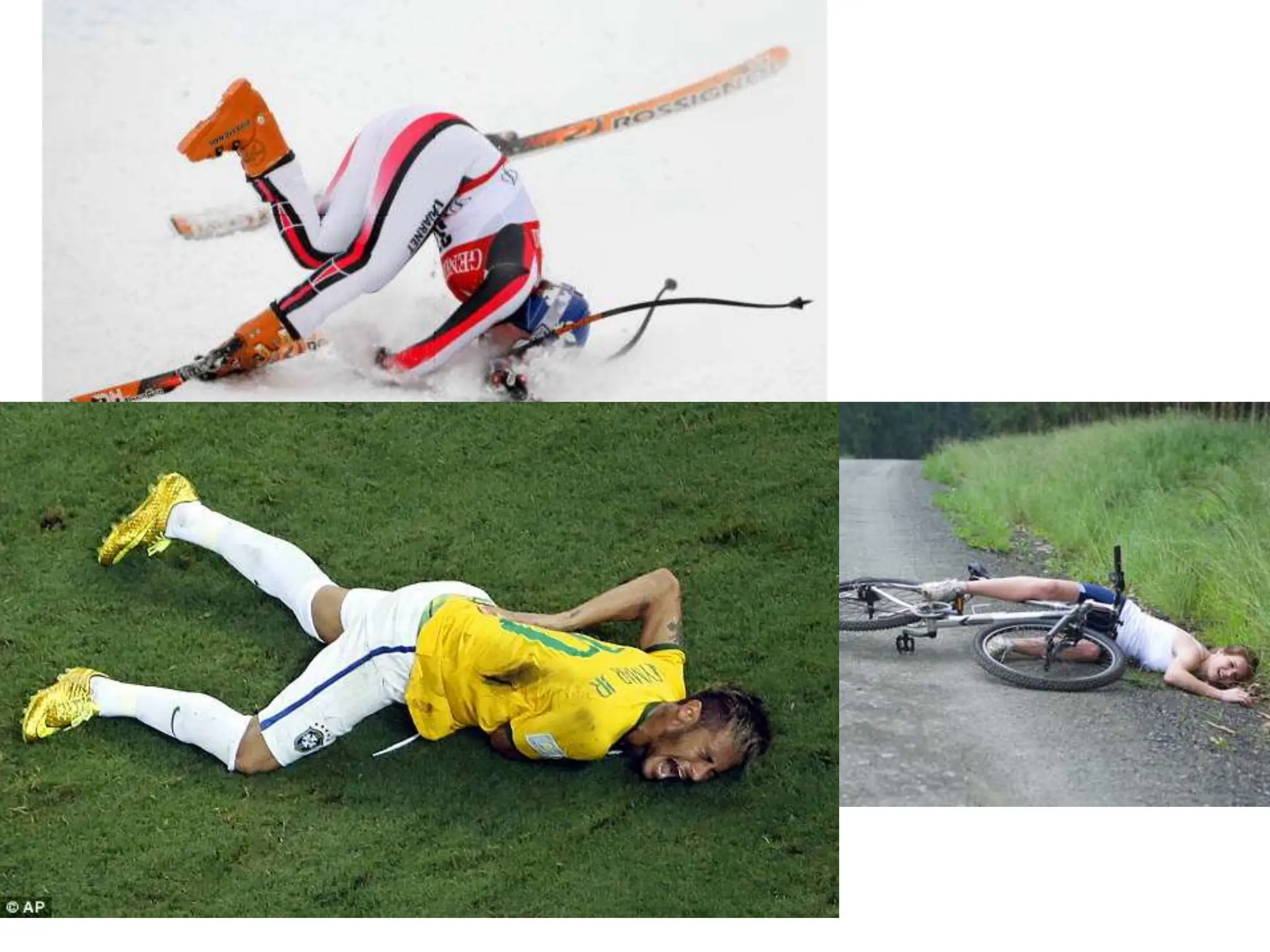
– Any kind of force that is greater than what the
tissue can withhold will cause such an injury.
Some common activities include falling, twisting,
getting hit, etc.
• Prevention:
– Use safety equipment and wear it properly.
– Use seat belts and car seats.
– Keep joints and bones strong through weight
bearing physical activities.
Injuries to the soft tissues:
Signs/Symptoms:
• A ‘snapping’ noise.
• Pain.
• Deformity.
• Inability to move.
• Swelling.
• Bruising.
Injuries to the soft tissues::
Management:
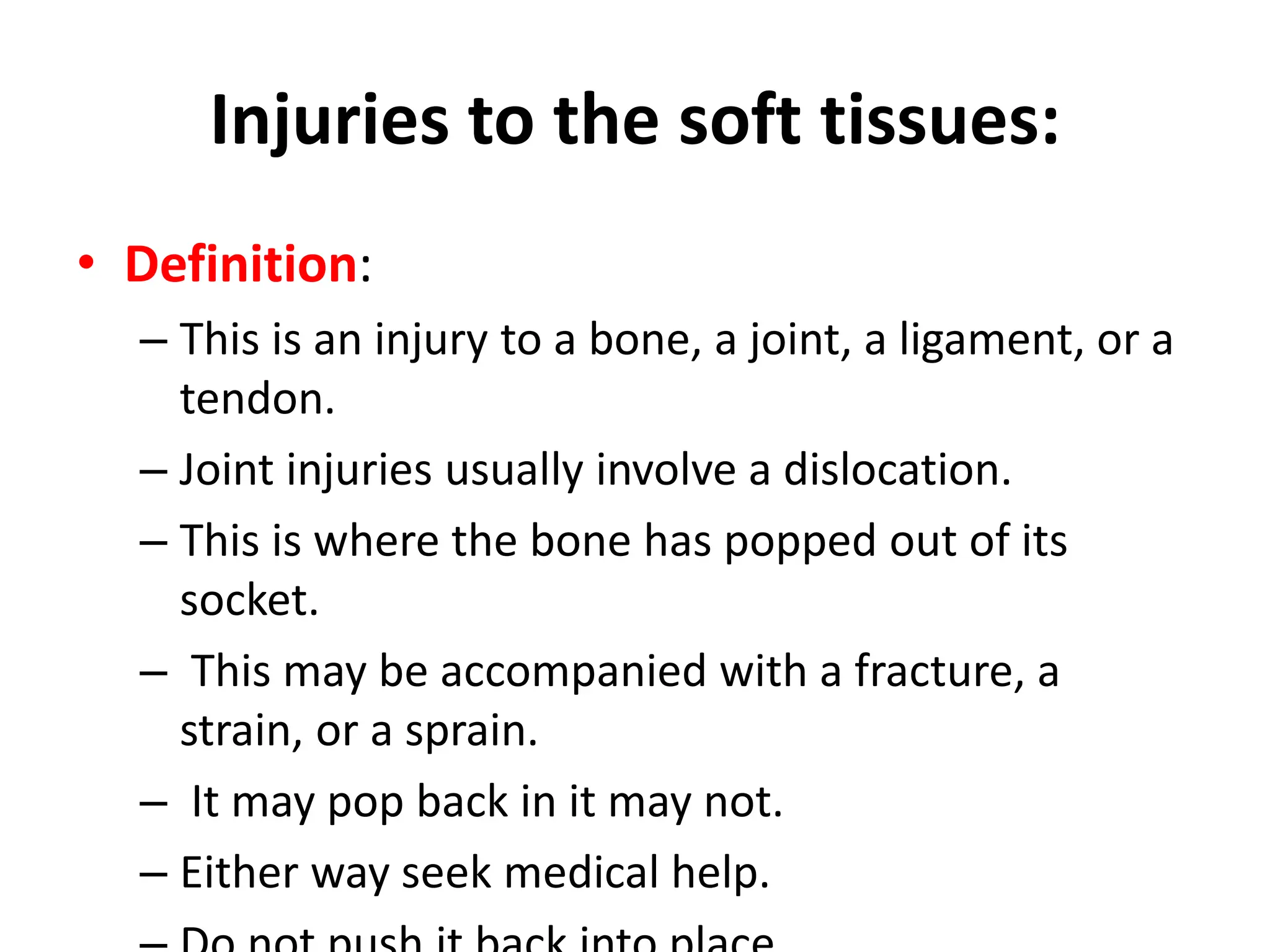
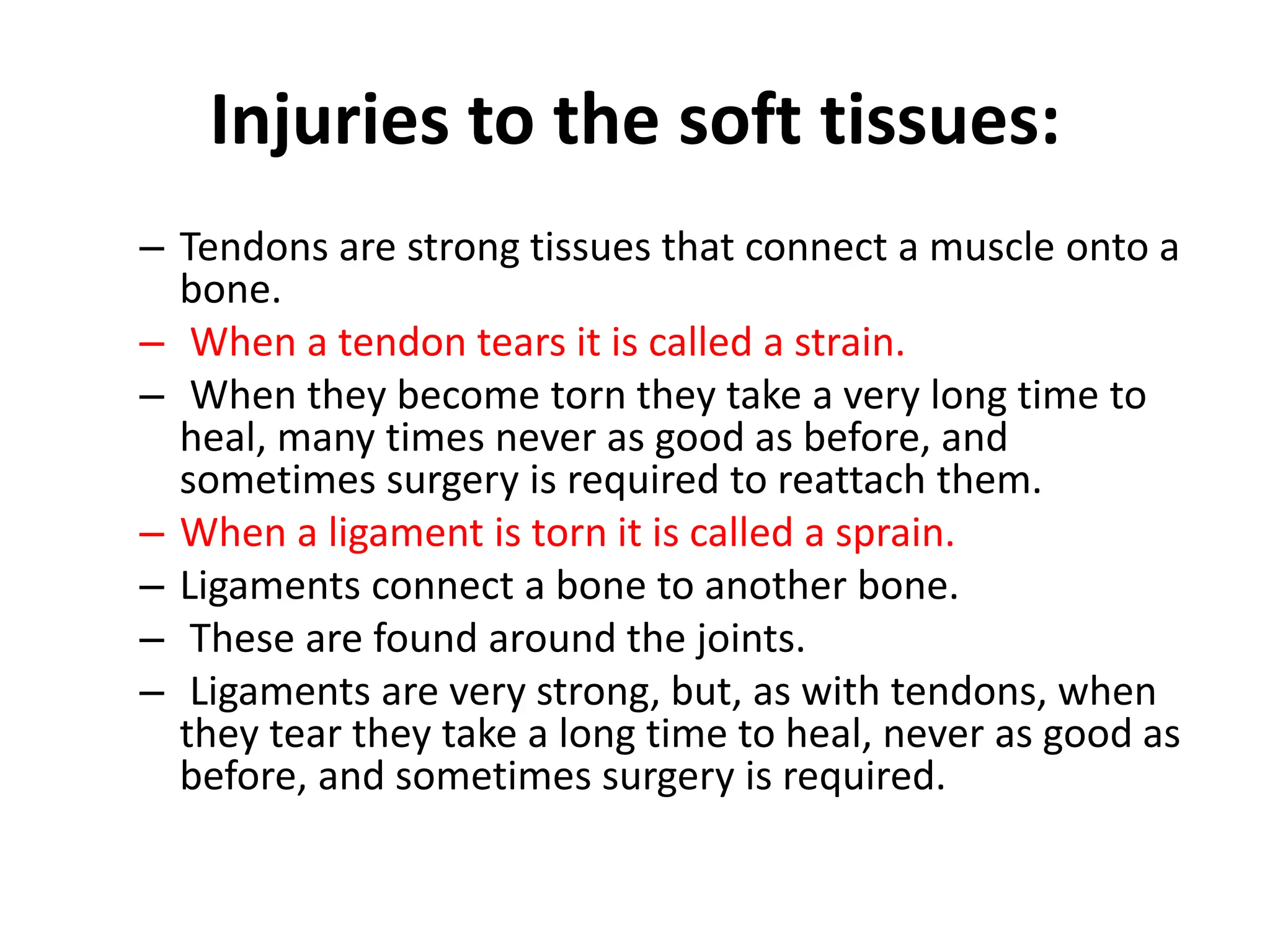
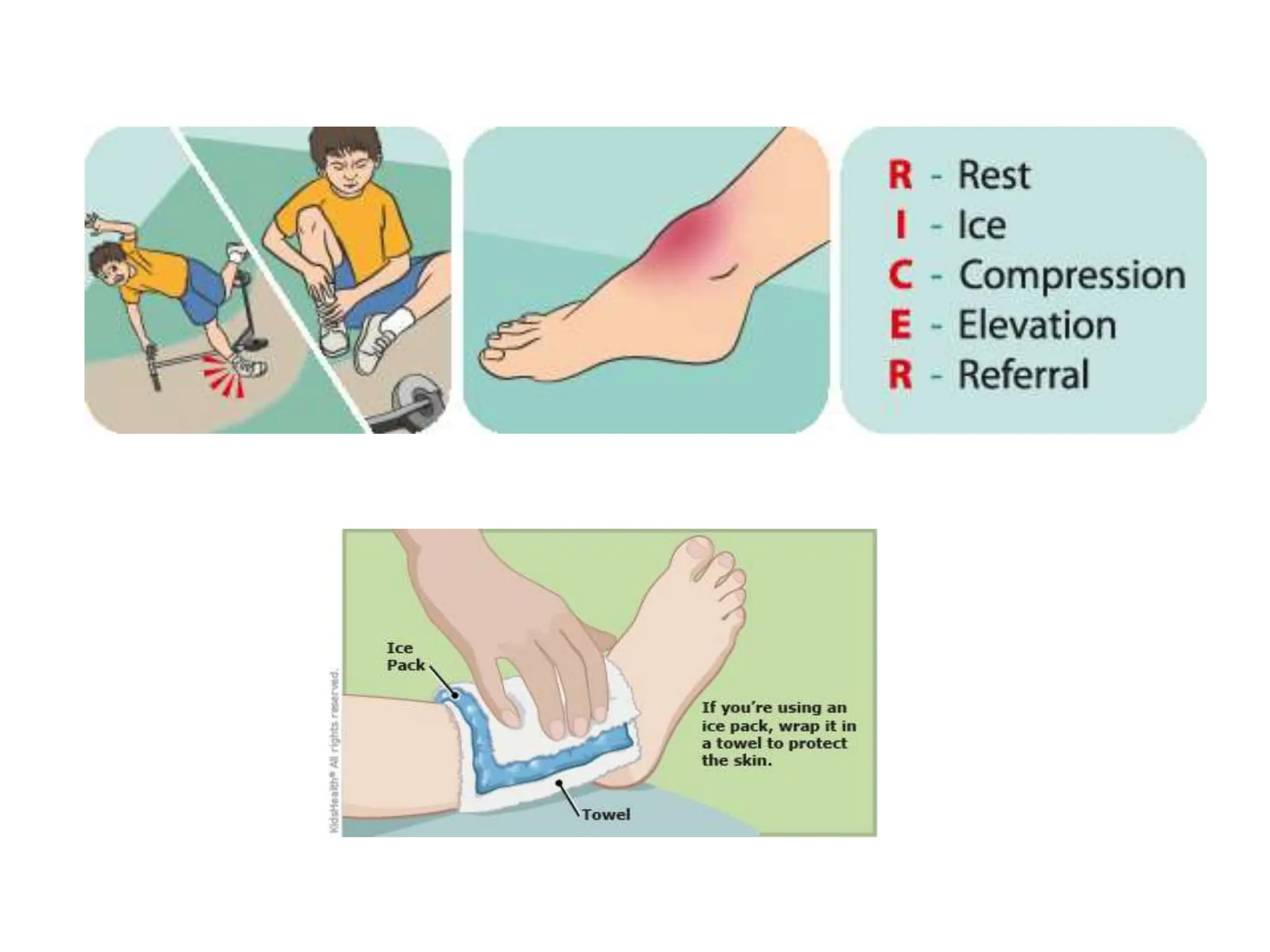
– Apply the RICE principle.
• Rest the injured body part and the entire casualty.
• Immobilize the injured body part.
• Cold compress over the injury to reduce swelling.
• Elevate the injured body part if it can be done without causing
further injury.
– Seek medical help.
– Do not rub or move the injured body part.
– If there is a protruding bone then bleeding will need to be
taken care of by applying indirect pressure.
– Never straighten or realign an injured body part.
• Notes: Bone fractures, if set properly, will heal fully in a few
weeks and will be stronger than before. This happens because
the area builds up with more calcification than before.
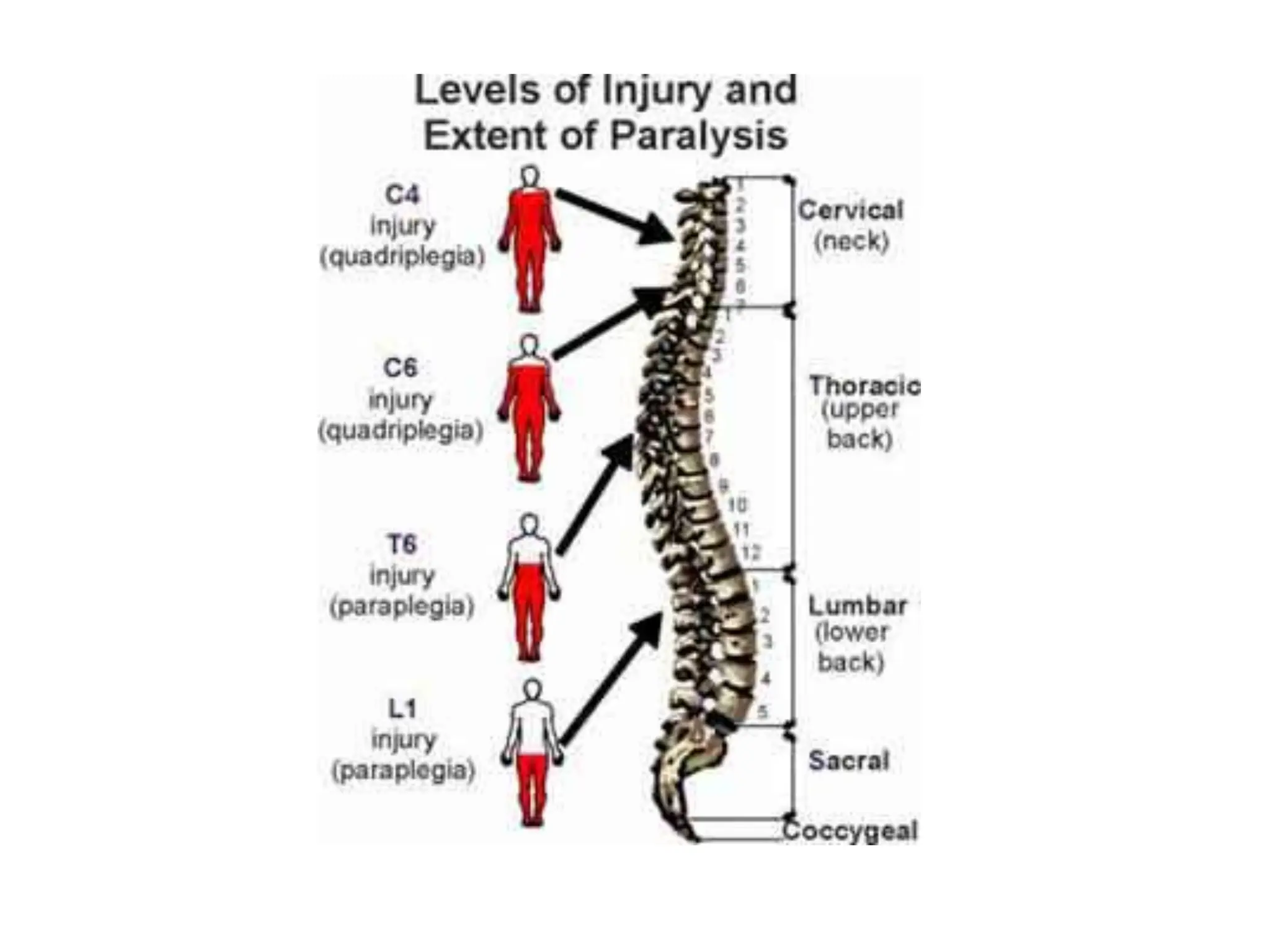
Spinal Injuries:
Definition: • An injury to the muscles, bones, or nerves
associated with the spine. The higher up on the spine it
is the more serious the injury will be.
Causes:
• Very common in vehicle accidents
• Diving in shallow water
• Cycling accidents
• Any impact, direct or indirect, to these body parts.
• Sport accidents such as hockey and football, etc.
Spinal injury
Signs/symptoms:
– Mechanism of injury (how it occurred).
– Pain, numbness, or paralysis.
– Bleeding, swelling, or bruising around the head, ears, or
nose.
– Unconsciousness.
Prevention:
• Wear safety equipment and wear it properly.
• Know the safety rules of sports played.
• Use seat belts and car seats.
• Avoid alcohol intake when doing physical activity as it
impairs sound judgment.
Spinal injury
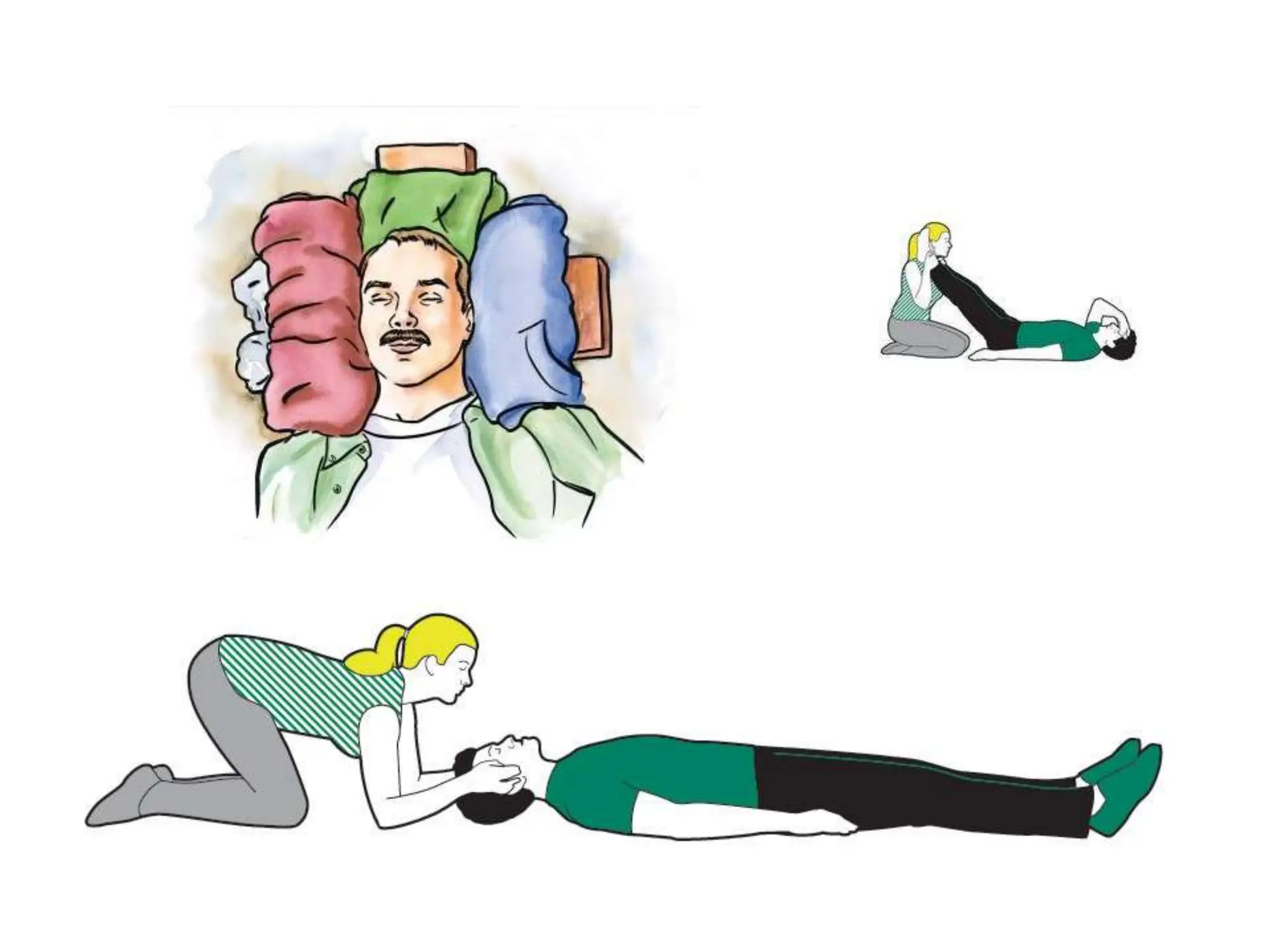
Management:
• Make sure the person doesn’t move then get
help.
• Hold them still. You need to and explain to them
that they may have a serious injury and should
not move.
• If they are unconscious do the CPR steps. Airway
and breathing take priority.
• Notes: Any time there is a spinal injury you
should also suspect a concussion, and visa versa.
Concussion
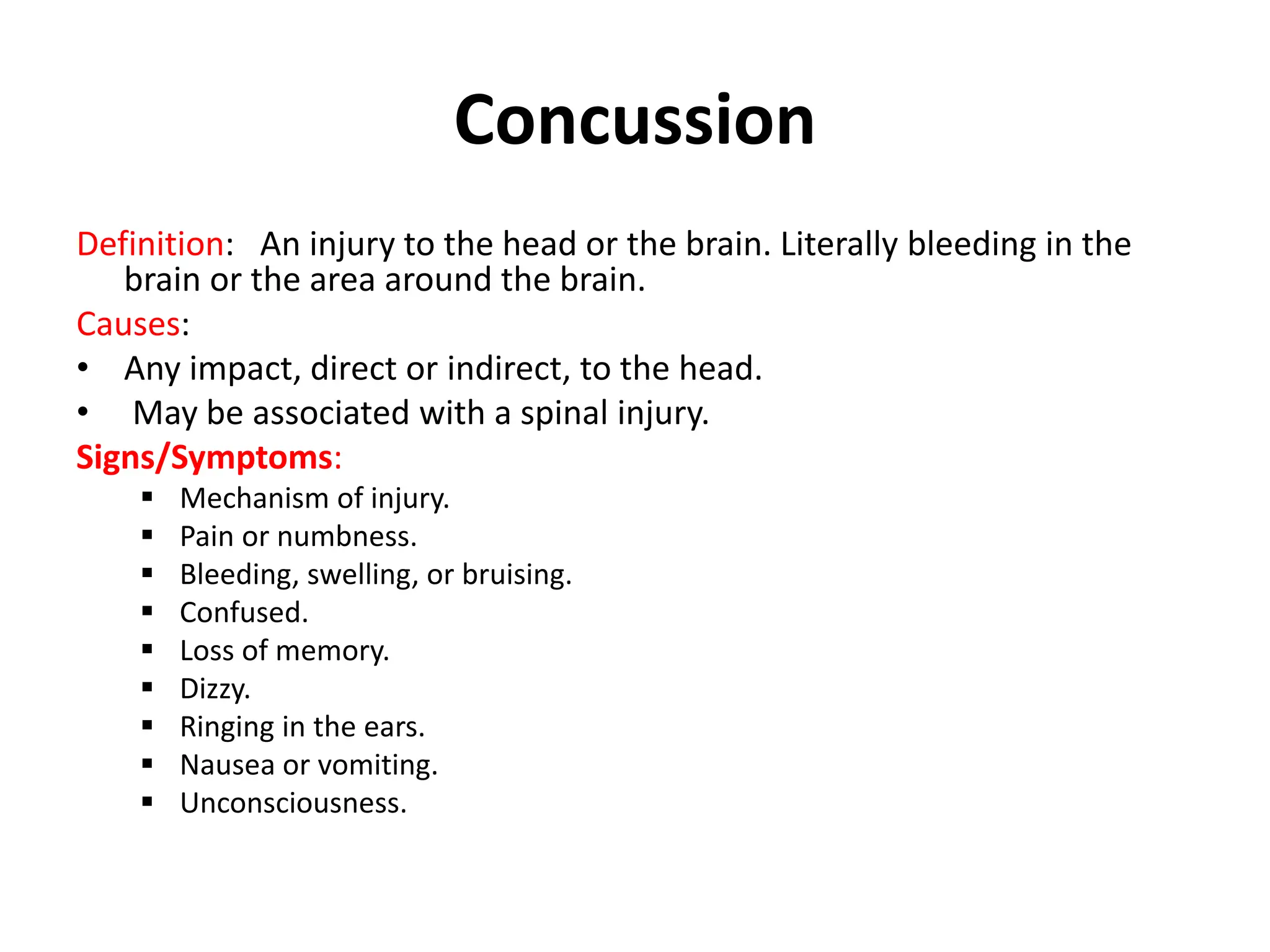
Definition: An injury to the head or the brain. Literally bleeding in the
brain or the area around the brain.
Causes:
• Any impact, direct or indirect, to the head.
• May be associated with a spinal injury.
Signs/Symptoms:
 Mechanism of injury.
 Pain or numbness.
 Bleeding, swelling, or bruising.
 Confused.
 Loss of memory.
 Dizzy.
 Ringing in the ears.
 Nausea or vomiting.
 Unconsciousness.
Concussion
Prevention:
– Wear safety equipment and wear it properly.
– Know the safety rules of sports played.
– Use seat belts and car seats.
– Avoid alcohol intake when doing physical activity as it impairs sound
judgment.
Management:
• Make sure the person doesn’t move.
• Hold them still and explain to them that they should not move.
• Activate the ambulance right away.
• If they are unconscious do the CPR steps but open the airway with a
modified jaw thrusts, as opposed to a head tilt.
Concussion
• Notes:
– Any time there is a spinal injury you should also suspect a concussion,
and visa versa.
– Anyone with a suspected concussion should seek medical help as
soon as possible.
– If they have become unconscious from the concussion then activate
the ambulance right away.
– Many athletes will not admit to having had a concussion because then
they cannot play anymore. Unfortunately that is why the condition
becomes worse.
– Concussions are very life threatening.
– There is a condition called Baby Shaken Syndrome, where babies are
injured by violent shaking.
• Never shake a baby – on purpose, by accident, or when angry.
• Never throw them up in the air – no matter how much they enjoy it.
Seizures
Definition: Seizures are neurological disorders where the signals in
the brain become mixed up.
Causes:
• The most common cause is from the medical condition called
epilepsy.
• However, they can also be caused by concussions
• Allergic reactions,
• Brain tumors,
• High fever in children.
Prevention:
• If someone has epilepsy they may have medication to take which
will reduce the chance of seizures.
• Other causes are hard to prevent because nothing is suspected of
being wrong until the seizure.
Seizure
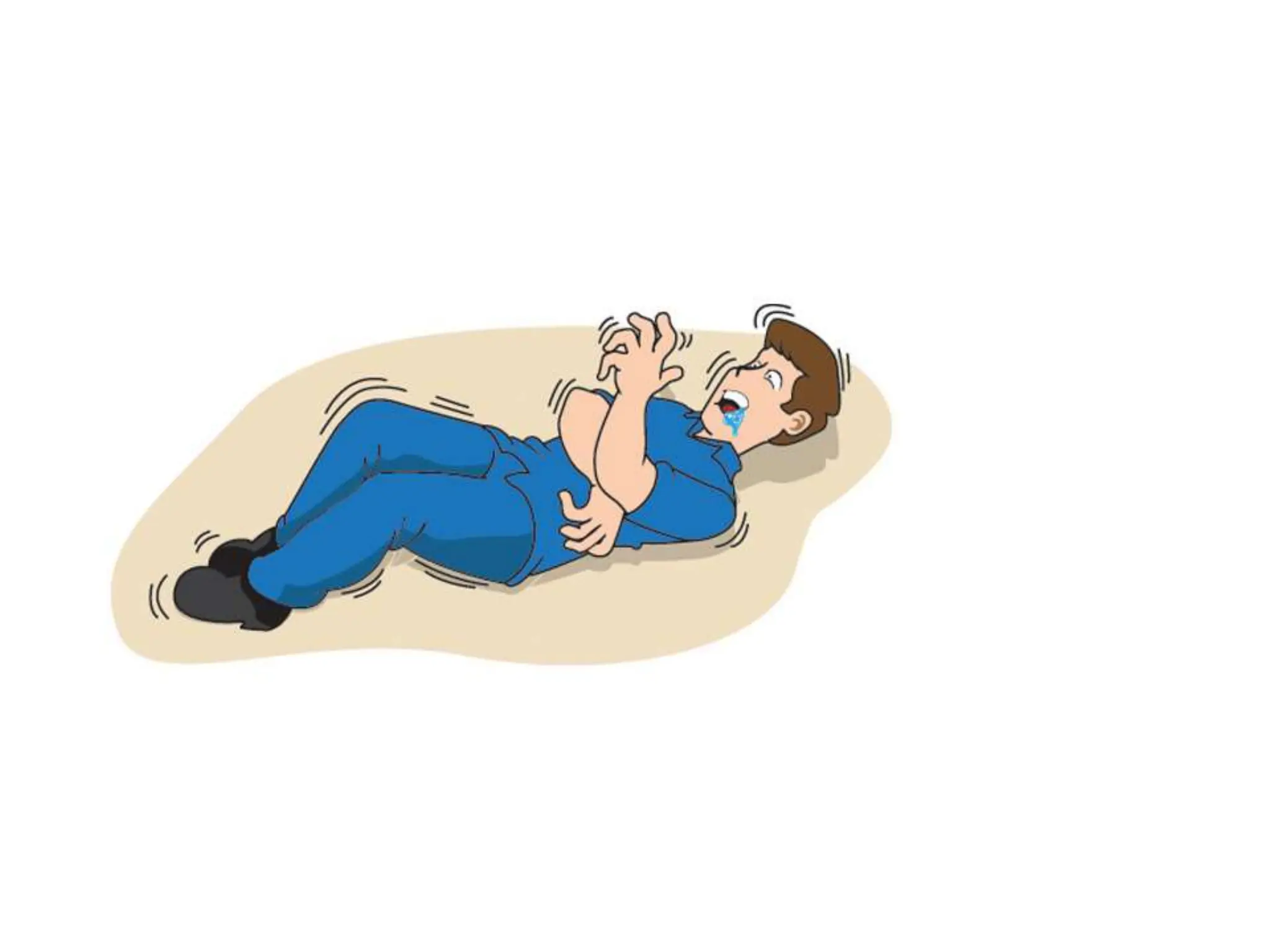
Management for Generalized Convulsive Seizures:
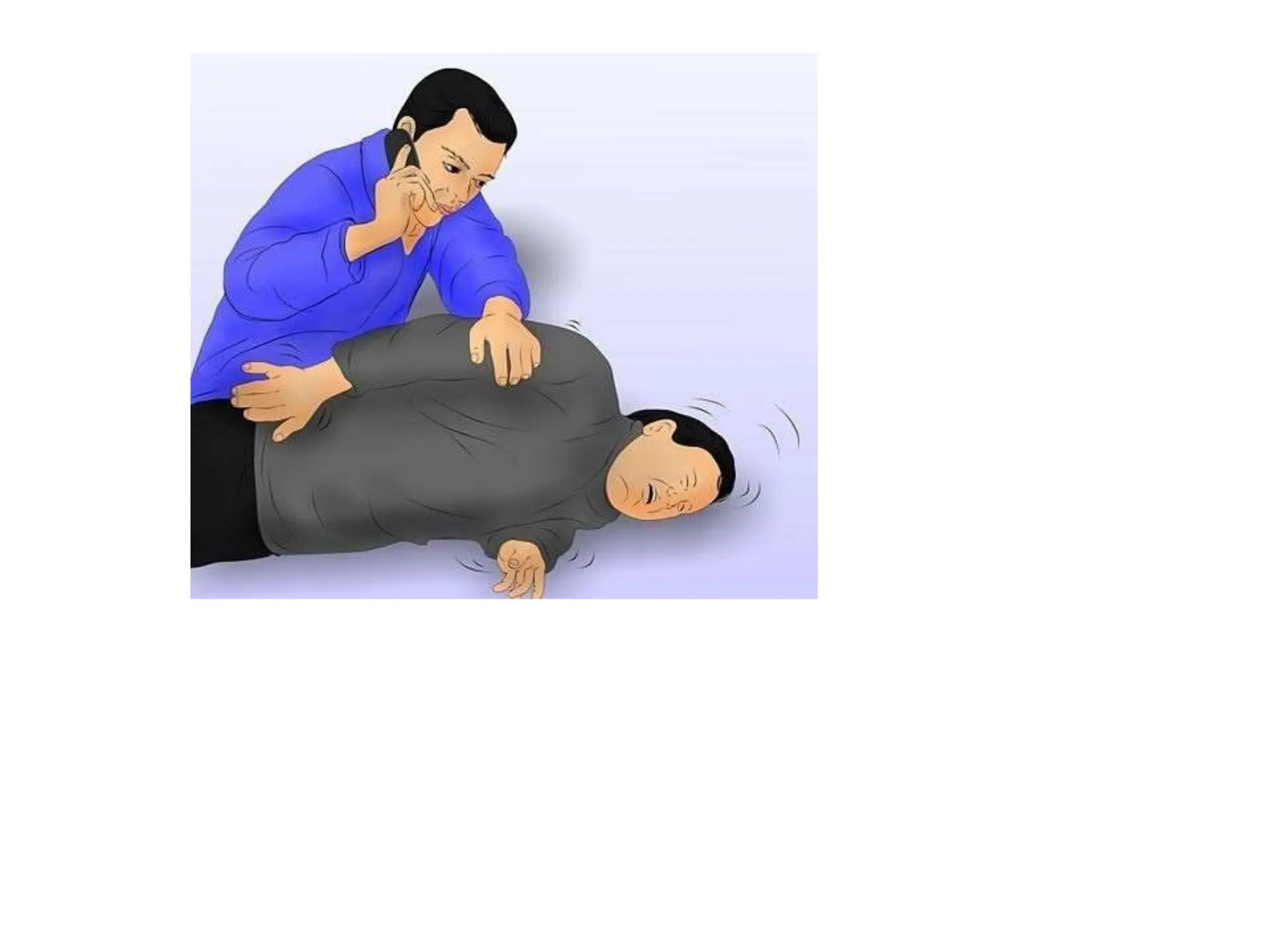
• Keep calm; let the seizure take its course. Do not try to stop the seizure or
revive the person.
• Protect person from further injury by moving hard or sharp objects away,
but do not interfere with the person’s movements. Place something soft and
small, such as a sweater, under their head, and loosen tight clothing around
the neck.
• Do not force anything in the person’s mouth. This could cause teeth and
jaw damage, or choking. The person will not swallow their tongue during a
seizure.
• Roll the person on their side as soon as possible, to allow saliva or other
fluids to drain away, helping to clear the airway. Do not be frightened if a
person having a seizure stops breathing momentarily. •
• If a seizure goes on longer than 5 minutes, repeats without full recovery, or
the person becomes injured, then call for medical assistance.
Seizure:
Management for Partial Non-Convulsive Seizures (e.g. like
sleep walking):
• Stay with the person, let the seizure take its course. Do not
try to stop the seizure or revive the person. The person will
be unaware of his or her actions, and may or may not hear
you.
• Gently guide the person away from danger, move
dangerous objects out of the way.
• Partial seizures may spread to other areas of the brain. Do
not be alarmed if a convulsive seizure follows.
• Notes: Always be comforting, be gentle, and reassure the
person, as it may take some time for them to become re-
oriented.
Hypothermia
• Definition: A drop in the core body temperature,
even as little as 1 to 2 degrees Celsius, from the
normal of 37 degrees Celsius. Sometimes this can
happen within minutes, other times it takes a while
to take place. It is sometimes accompanied by
frost bite.
• Causes & Prevention:
– Exposure to the cold.
– Not being dressed properly.
– Damp weather or being wet.
– Being tired or dehydrated.
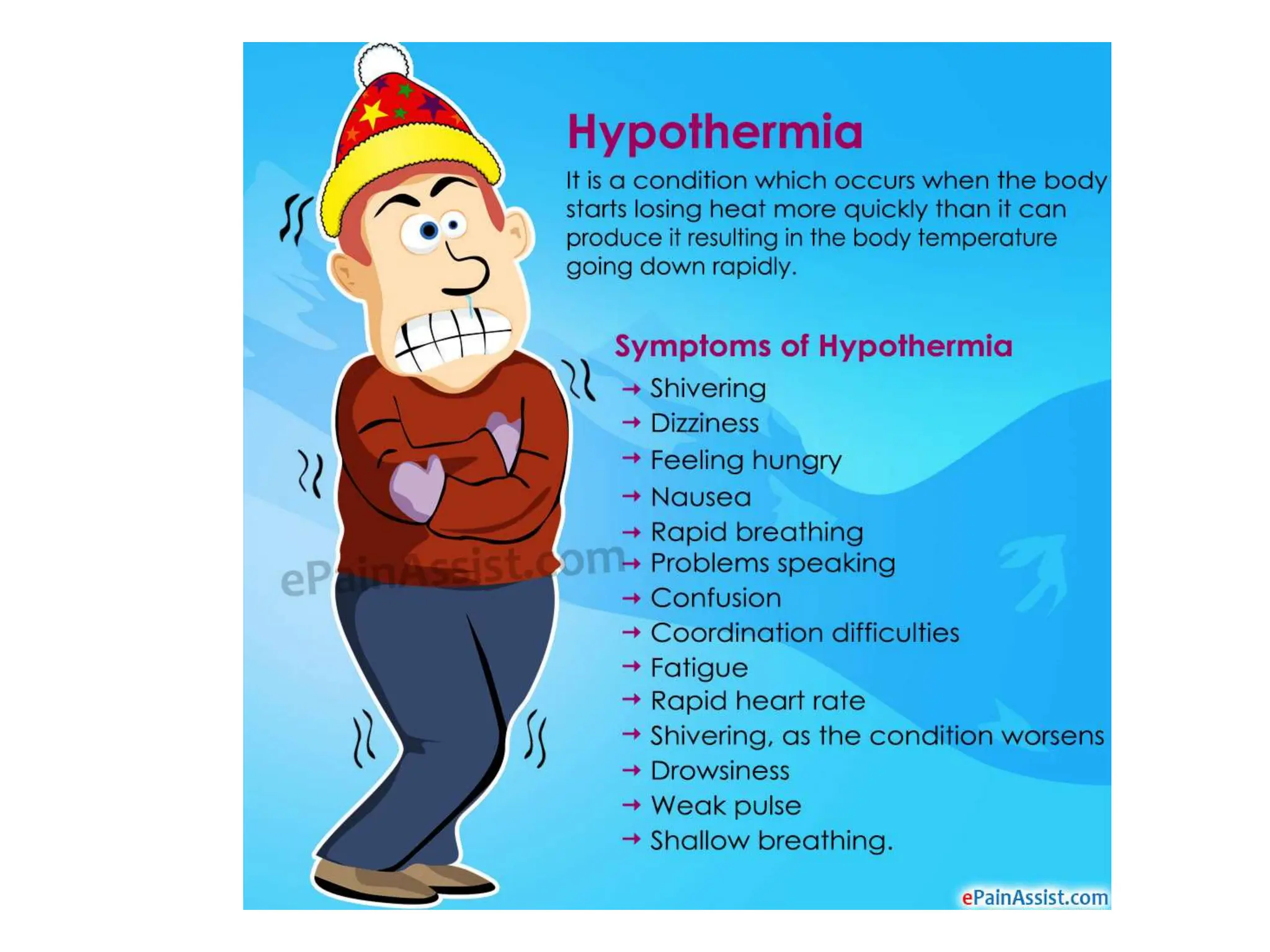
• Signs/Symptoms:
– Feeling cold.
– Shivering, which will stop as the condition worsens.
– Becoming confused and disoriented.
– Slow pulse and breathing rates, and eventually
unconsciousness.
• Management:
• Get medical help.
• Get them inside near a heat source.
• Remove wet clothing and replace with dry clothing.
• If conscious give them warm fluids to drink –
slowly.
• Avoid alcohol, caffeine, and carbonated drinks.
Frost Bite
• Definition: A freezing of a body part, such as
the hand, foot, face, etc. Superficial is the
surface of the skin, whereas deep frost bite
affects the underlying tissues. Sometimes this is
accompanied by hypothermia.
• Causes & Prevention:
• Exposure to cold, wind, wet conditions.
• Not wearing protective clothing.
• Signs/Symptoms:
– Cold feeling.
– Numbness.
– Inability to use the body part.
– Tingling, then pain.
– As it gets worse all sensation will disappear.
– The skin will first appear white or yellowish. If the
tissue dies it will become black charred color.
• Management:
– For deep frost bite get medical help.
– Warm up the body part slowly and gradually by wrapping it
in warm clothing and/or submersing it in luke warm water –
not hot water as it will burn the skin.
• Notes:
• If there is a chance of the body part refreezing then it
might be better to get medical help first before allowing
it to warm up.
• Do not rub or force the body part to bend, this will cause
more damage.
Heat Emergencies (Hyperthermia)
• Definition: A situation where the body’s temperature
increases. Perspiration is the body’s main method of
regulating its temperature. As sweat evaporates off the skin
heat is taken with it, as a result cooling down the body. If
this method is impaired, or it can not keep up, the body will
quickly over heat.
• Causes & Prevention:
– Exercising in hot humid and/or polluted weather and becoming
dehydrated.
– Drinking alcohol, caffeinated, or carbonated drinks (contributes
to dehydration).
– Over using saunas, whirlpools, and warm environments such as
gyms, and aerobic classes.
• There are 3 levels of heat emergencies:
Cramp
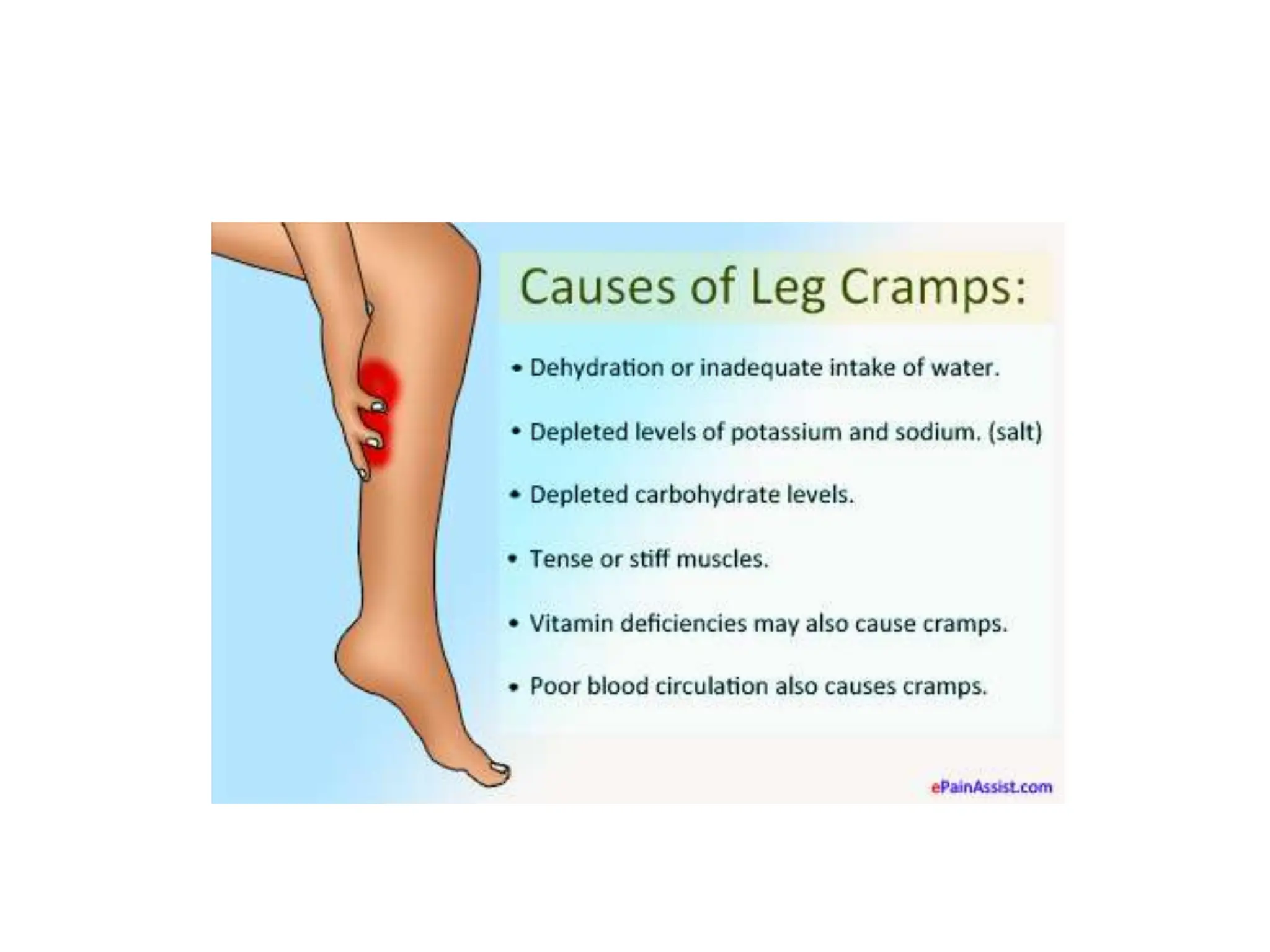
1. Cramps : Painful muscular involuntary contraction
A muscle cramp is a strong, painful contraction or
tightening of a muscle that comes on suddenly and
lasts from a few seconds to several minutes. It often
occurs in the legs. A muscle cramp is also called a
charley horse. Nighttime leg cramps are usually
sudden spasms, or tightening, of muscles in the calf.
s/s:
. -Sweating or moist skin. -Tired, irritable, and thirsty.
Treatment:
Removing them from the heat. -Gently
stretch/massage affected area.
• Slowly rehydrate with water, juice, or sport
drinks. Rest for a couple of hours.
• Avoid alcohol, caffeinated and/or carbonated
drinks.
Exhaustion
2. Exhaustion :
Heat exhaustion is a heat-related illness that can
occur after you've been exposed to high
temperatures, and it often is accompanied by
dehydration. There are two types of heat
exhaustion: Water depletion. Signs include
excessive thirst, weakness, headache, and loss of
consciousness. Salt depletion.
s/s
• -Sweating. -Tired. -Irritable. -Thirsty. -Lethargic. -
Slight headache. -Nausea. -Dizzy/weak. -May have
slightly elevated body temperature.
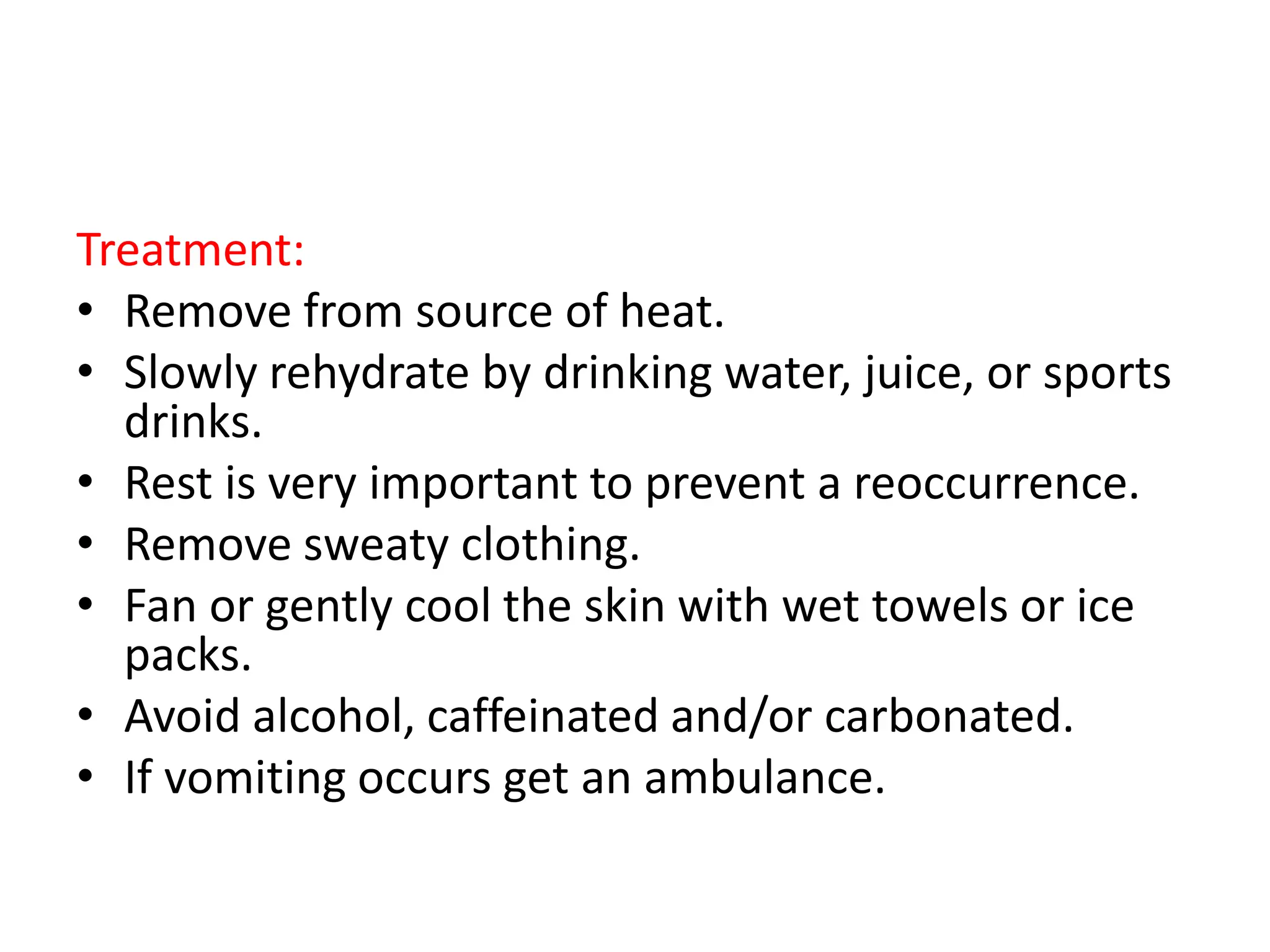
Treatment:
• Remove from source of heat.
• Slowly rehydrate by drinking water, juice, or sports
drinks.
• Rest is very important to prevent a reoccurrence.
• Remove sweaty clothing.
• Fan or gently cool the skin with wet towels or ice
packs.
• Avoid alcohol, caffeinated and/or carbonated.
• If vomiting occurs get an ambulance.
Stroke
3. Stroke (most serious) :
Heatstroke is a condition caused by your body overheating,
usually as a result of prolonged exposure to or physical
exertion in high temperatures. This most serious form
of heat injury, heatstroke can occur if your body
temperature rises to 104 F (40 C) or
higher. Heatstroke requires emergency treatment.
s/s
• -Elevated body temperature.
• -Very tired/weak.
• -Sweating may stop - this is not a good sign.
• -Severe headache.
• -Red hot dry skin.
• -Rapid, weak pulse becoming irregular, rapid breathing, or
reduced/absent vital signs (consciousness, breathing,
pulse).
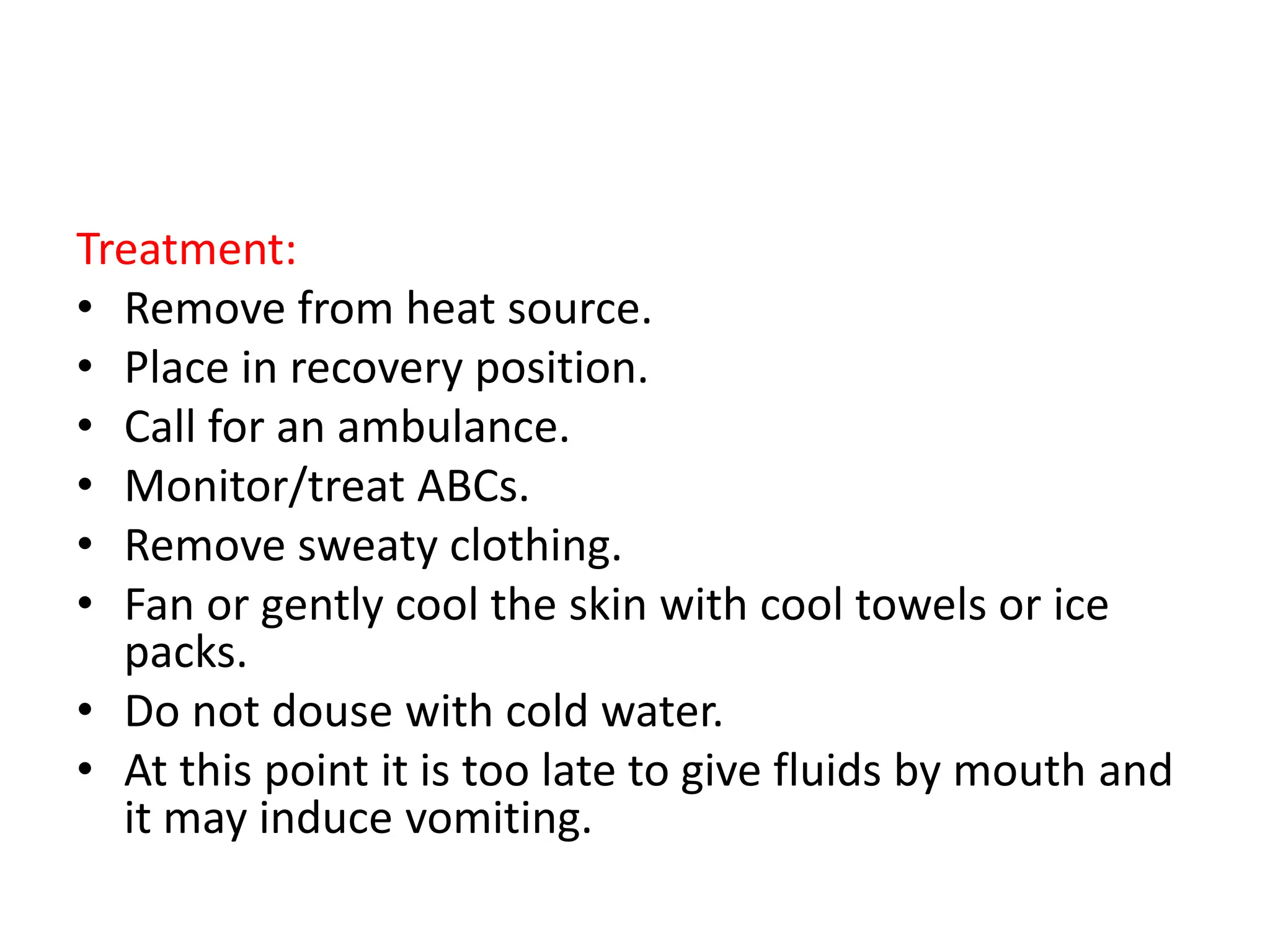
Treatment:
• Remove from heat source.
• Place in recovery position.
• Call for an ambulance.
• Monitor/treat ABCs.
• Remove sweaty clothing.
• Fan or gently cool the skin with cool towels or ice
packs.
• Do not douse with cold water.
• At this point it is too late to give fluids by mouth and
it may induce vomiting.
Stroke
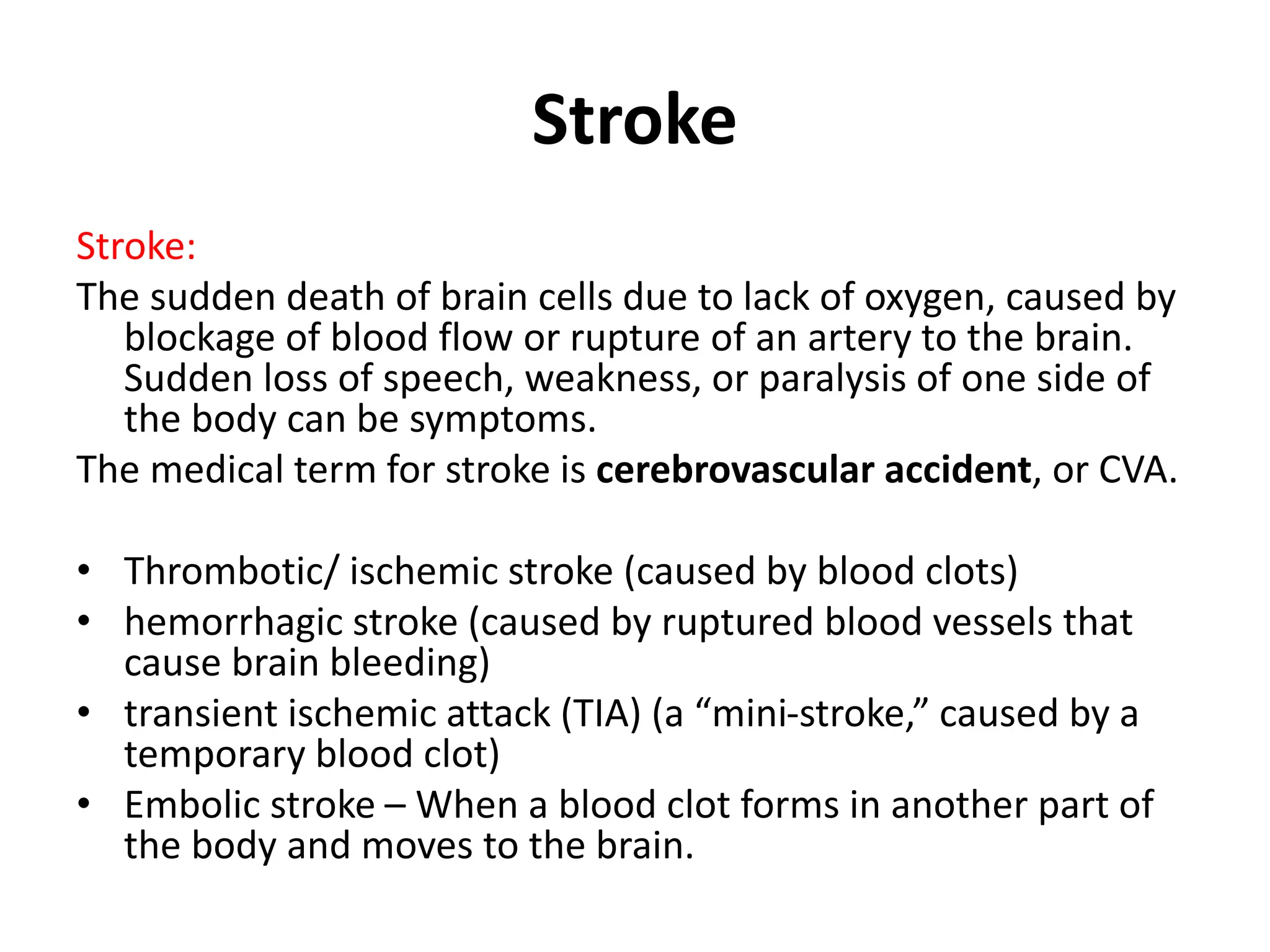
Stroke:
The sudden death of brain cells due to lack of oxygen, caused by
blockage of blood flow or rupture of an artery to the brain.
Sudden loss of speech, weakness, or paralysis of one side of
the body can be symptoms.
The medical term for stroke is cerebrovascular accident, or CVA.
• Thrombotic/ ischemic stroke (caused by blood clots)
• hemorrhagic stroke (caused by ruptured blood vessels that
cause brain bleeding)
• transient ischemic attack (TIA) (a “mini-stroke,” caused by a
temporary blood clot)
• Embolic stroke – When a blood clot forms in another part of
the body and moves to the brain.
Signs/symptoms:
• Numbness, tingling, paralysis on one side of
the body, extremities, hands, and feet.
• Slurred speech, not making sense.
• Trouble understanding you.
• Uneven pupils.
• Nausea or vomiting.
• Decreased level of consciousness.
Management:
– Help them get in a comfortable position on their side, make sure they are
resting.
– Activate the ambulance.
– Reassure them that help is on the way.
– Keep them warm with a blanket.
– Do not give them anything to eat or drink.
Notes: It is extremely common for people to ignore the warning signs of a
stroke. Unfortunately, this is one reason why so many people die from
this disease – because they don’t get help soon enough. As a first
responder, it is your job to activate the ambulance as soon as possible.
Sometimes a stroke is called Cerebral Vascular Accident (CVA). Mini
stroke is a condition where the casualty experiences similar warning
signs as that of a stroke, but these warning signs go away on their own.
This is a warning sign that a serious stroke may occur and the person
needs medical help immediately. This condition is sometimes called
Transient Ischemic Attack (TIA).
Burns
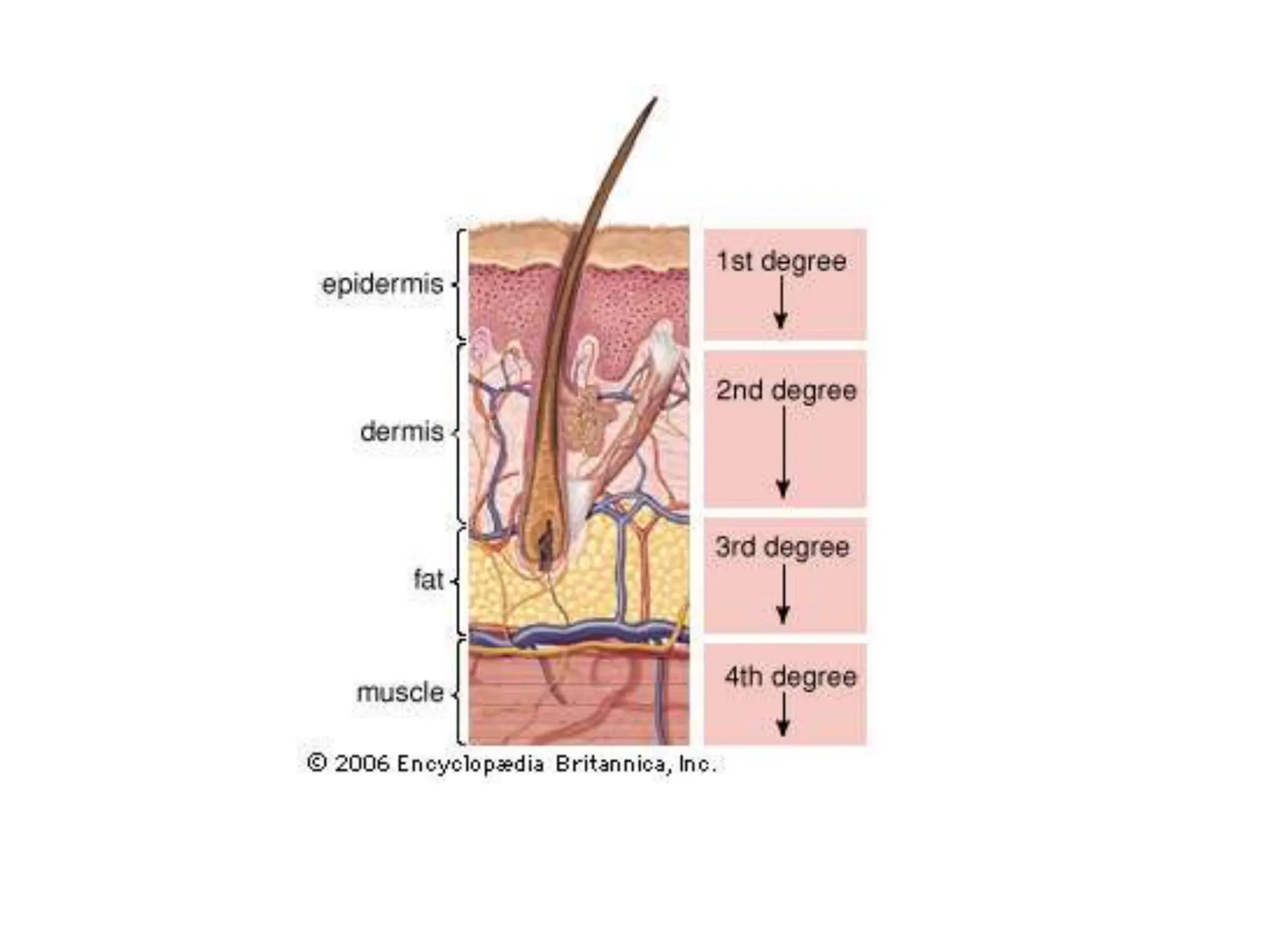
Definition: A burn is damage to the skin or underlying tissue caused by
heat. There are 3 levels of severity; 1st (Superficial), 2nd (Partial
thickness), 3rd (Full thickness).
Causes: There are 5 main sources of burns;
• Electricity,
• Radiation (sun),
• Thermal (something hot),
• Chemical,
• Friction
Prevention:
• Use safety rules.
• Use safety equipment when working with chemicals.
• Hire professionals for work dealing with e.g. electricity.
• Avoid sun exposure.
• Keep hot objects away from children.
Management:
• For 1st and 2nd degree burns you should cool the area
immediately with gently running cold water for about 10-15
minutes, or until it has cooled off. Do not break any blisters
as this will make the wound worse.
• For 3rd degree burns do not put anything on the burn, seek
medical help immediately and treat for shock. 3rd degree is
extremely life threatening even when a small body part is
affected. If there is clothing on the burn do not remove it as
this may also remove skin. There is a very high risk of
infection from this kind of burn.
Notes:
• As with all other emergencies make sure the area is safe for you
first. Watch out for live wires, hot objects, chemical spills, etc.
• The severity of a burn can also be increased depending on; Which
part of the body is affected, e.g. face, and neck.
• The amount of the body that is burnt, e.g. only fingertip or entire
arm.
• With electrical burns check for an exit wound as well as treating for
the entrance wound.
• With chemical burns flush the area with lots of water to get it off
the casualty’s skin.
• Never apply ointments, butter, or other home remedies on burns,
as this may make the burn worse, keep the heat trapped in, or
cause an infection.
Emergency Child Birth
• Definition: Emergency child birth is defined as a
situation where the expecting mother-to-be can
not reach medical facilities in time and needs to
give birth on the spot.
• Causes: Being away from medical facilities is the
most common cause for this situation. Also, not
having transportation.
• Signs/Symptoms: If the mother says, “the baby
is coming,” or the baby’s head is showing, or the
contractions are less than two minutes apart,
then it is time to deliver the baby on the spot.
Management:
– Make sure the ambulance has been called.
– Make the mother comfortable on her back. Remove any necessary clothing but keep her covered to protect
her privacy. Put some clean towels under her.
– As a rescuer all you have to do is support the baby as it comes out. Hold the head as it is heavy compared to
the rest of the baby.
– As soon as you can see the baby’s throat make sure the umbilical cord is not wrapped around it. If it is use
your finger to loosen it and pass it over the head. This is easy to do.
– Once the baby comes out wrap it in a clean towel.
– Clean its mouth and nose.
– If it is not breathing massage its back and tickly its feet. This should help stimulate the breathing
mechanism.
– If it is still not breathing begin rescue breathing and CPR.
– Never hold the baby upside down and slap it. This is a TV thing, and if you should drop the baby you’ll be in
trouble.
– If the baby is fine give it to the mother to hold.
– The other end of the umbilical cord will be attached to the placenta which will still be inside the mother. Do
not pull, it will come out on its own in a few minutes in another set of contractions.
– Do not cut the cord. Simply wrap the placenta in a towel and keep with the baby.
– Never put the placenta lower than the baby as blood may drain from the baby back into the placenta. If you
wish you may tie something around the umbilical cord a few centimeters away from the baby and from the
placenta. But do not cut it.
– If the baby begins to come out feet first it is a complication but there is nothing you can do. Instruct the
mother not to push. Do not try to push the baby back in. Simply support it any way it comes out.
Heart Attack
• Definition: When something goes wrong with the heart’s electrical
system, or when an artery in the heart muscle ruptures or becomes
blocked. Regardless, the heart is no longer able to circulate blood
effectively, including to its own tissues. As a result, the heart may stop
working.
• Signs/Symptoms:
• Pain/tightness/numbness in the shoulders, arms, neck, back, chest.
• Bluish, pale skin.
• Rapid but weak pulse.
• Shallow rapid breathing.
• Nausea or vomiting.
• Unconsciousness.
• These warning signs may come and go, and maybe severe or mild.
Even if the warning signs go away this person may still be having a
heart attack and still needs immediate help.
• Management:
• Help them get in a comfortable position, make sure they are resting.
• Activate the ambulance.
• Reassure them that help is on the way.
• Check for medical history of a similar problem, as they may have medication
(but only assist, do not administer medication).
• If they have Angina (see following page).
• If they wish, they may take one Bayer Aspirin, as this may prevent further
damage to the heart muscle. Note, if they have asthma they may be allergic to
aspirin – ask first!
• Do not give them anything to eat or drink.
• Stay with them all the time and comfort them.
• Notes: It is extremely common for people to ignore the warning signs of a
heart attack. Unfortunately, this is one reason why so many people die from
this disease – because they don’t get help soon enough. As a first aider it is
your job to activate the ambulance as soon as possible.
Angina
• Definition:Angina is a serious medical condition, diagnosed by a
cardiologist, where the coronary arteries are partially blocked. As a
result, when under stress, the heart is not able to get enough blood
and cannot work properly.
• Sign/Symptoms: The most common warning sign is pain, but it can
also include any of the other warning signs for heart attack.
• If the casualty says they have angina they should also have
medication with them. You can help them take it (e.g. get the
bottle, open the bottle, put the pill in their hand) but they must do
the actual administering.
• Management: This medication is called nitroglycerine. It is designed
to cause blood vessel dilation, which means it causes the blood
vessels to relax so they expand. As a result, more blood can flow
through.
• Viagra does not cure heart disease. It does not dissolve blood clots,
it simply enlarges blood vessels temporarily.
• Nitroglycerine comes in 4 forms:
– Pill: which they must place under their tongue for quick
absorption. If they swallow the pill it will take much longer
to be absorbed.
– Spray: like a puffer, which they spray into their mouth.
– Paste: which they put on their skin.
– Patch: which they wear all day.
• The most they should take is 3 doses, 3 minutes apart
each. If after 10 minutes they do not feel better, or
they become worse at any time then it means the
medication is not working and this person needs
advance medical help immediately.
Cardiopulmonary resuscitation:
• Airway:
• Place them on their back, carefully so as to not cause any injury.
• Open their airway by tilting their head back and lifting their chin upwards. This will
remove the tongue from blocking the airway.
• Keep the airway open.
• Breathing:
• Check for Breathing by looking, listening, and feeling for air (10 seconds).
• If they are breathing then monitor and put them in the recovery position until the
paramedics arrive.
• If they are not breathing give them 2 breaths, allowing the air to come out in
between.
• If the air goes in then go to “Circulation.”
• If the air does not go in, re-position the head-tilt/chin-lift a bit further back and
try blowing again. Be careful not to injure their neck.
• If the air still does not go in then go to “Circulation” but check the mouth for the
food after doing CPR.
• Circulation:
– Start CPR if needed (compressions and breaths).
– It is 30 compressions to 2 breaths. Continue until
paramedics arrive or until something changes with the
person (reassess at this point).
– If the air was not going in make sure you check the
mouth, to see if the food came out, after each set of
compressions. If you see the object in their mouth
take it out and reassess breathing.
– Under this category, we are also concerned with
shock and severe bleeding.
• About compressions:
– Adult: use both hands. Compress 4-5 cm deep.
– Child: use one hand. Compress almost half way down.
– Infant: use two fingers. Compress almost halfway down.
– Fast and smooth.
– Do not stop unless something changes.
– Ribs may break, keep going.
– If they vomit roll them onto their side, clean their mouth, continue.
• Two-Rescuer CPR: In a situation where there are 2 trained first
aiders, and they work well together, one rescuer can perform the
compressions while the other rescuer gives the breaths. All the
steps are the same, nothing changes. This is a bit more sufficient
and less tiring for the rescuers. If the rescuer doing the
compressions becomes tired they can switch positions.
Poisoning:
• Definition: A poison is a substance which
enters the body and can cause illness or
death. It may act within a matter of seconds
(e.g. carbon monoxide) or a matter of years
(e.g. car pollution). There are four basic ways
in which poison can enter the body; by
swallowing, breathing, injecting, or absorbing.
Any of these methods can be life threatening.
Many times children are the innocent
casualties.
Ingested Poisons:
• Examples can include bad food, household cleaners, perfumes, nail
polish remover, etc.
• If the person is having trouble breathing, is convulsing, is unconscious,
or is in pain, call the ambulance immediately.
• If the person appears to be fine but you want to make sure call your
doctor or local hospital.
• For your area this number can be found at the front of your local
telephone directory. In order for them to help you they need to know
what the person took, how much, their age and weight, and their
present condition. They will either tell you to seek medical help
immediately, give them something to drink, or to monitor them to
make sure they don’t get worse.
• Make sure you do not induce vomiting unless you are told to do so by
a physician as some substances are corrosive and may burn on the way
up.
• Also, do not give anything to drink unless instructed by a physician as
some substances may react more with liquids.
• Always keep cleaners and chemicals high up so children can not access
them.
Breathed/Inhaled Poisons:
• This can include fumes from household cleaners, industrial
products, smoke, etc.
• Fresh air is the immediate first aid treatment.
• But first make sure you are not putting yourself in danger. Seek
medical help for the person immediately.
• Never mix cleaners unless it specifies on the container. Never
use chemicals in poorly ventilated areas.
• Be aware of carbon monoxide as it can not be smelled, has no
taste, and can not be seen. It can be produced by any engine
(e.g. house furnace, car), or even a fireplace with poor
ventilation.
• Every home should have a carbon monoxide detector. If the
detector begins to sound you need to leave the house
immediately and call the fire department from the neighbor’s
house.
• Carbon monoxide poisoning makes you feel sleepy and drowsy
and can have an effect in a matter of minutes so you aren’t
aware of what is happening.
Injected Poisons:
• Some examples include needles, broken glass,
mosquitoes, spider bites, bee stings, etc.
• As soon as possible remove the object from
the skin. Clean the area thoroughly with soap
and water.
• If an allergic reaction occurs, or you believe
there is a risk of infection, seek medical help.
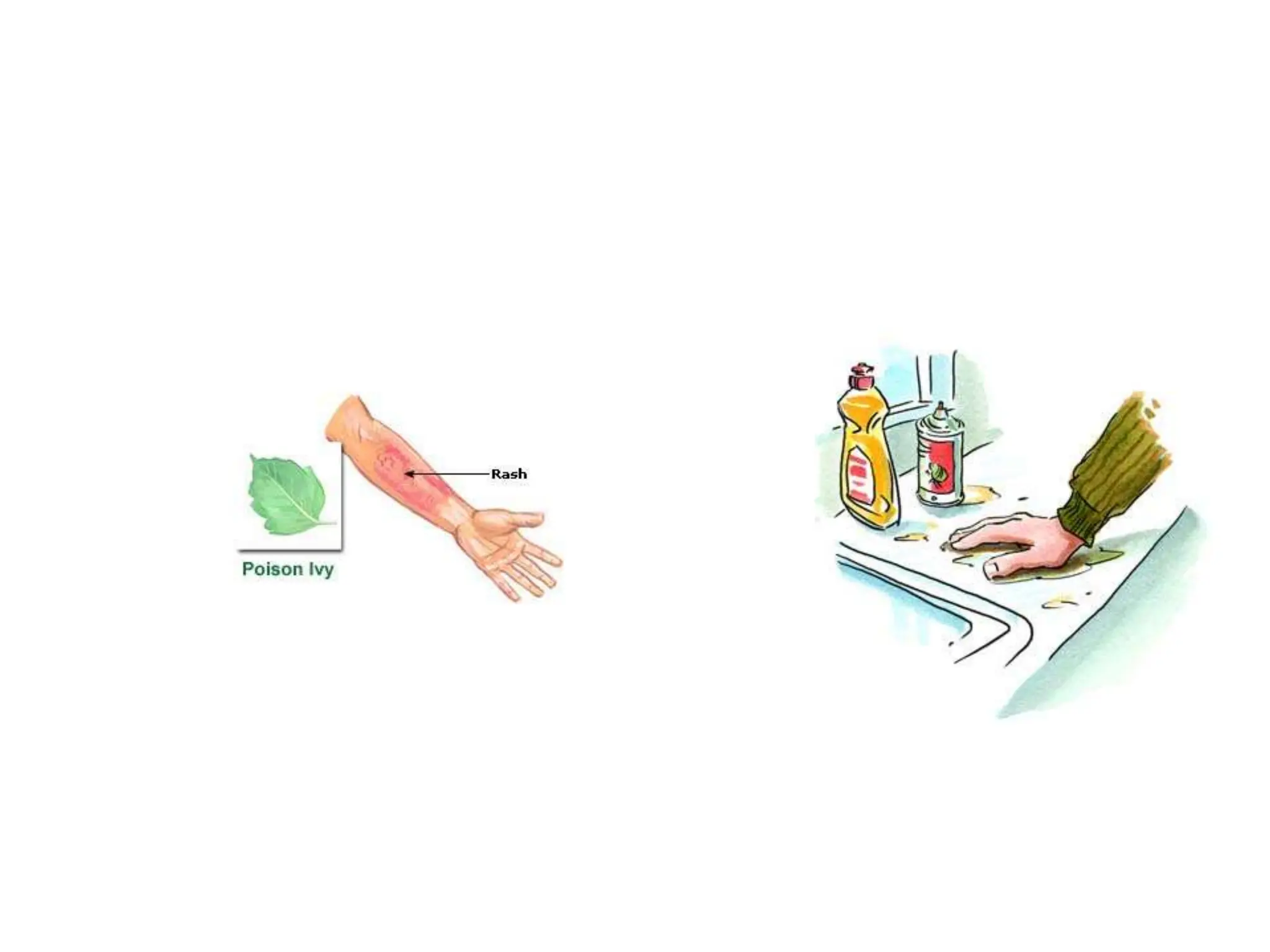
Absorbed Poisons:
• These are poisons which enter the body through the
skin, but do not cause a puncture. Some examples
are household cleaners, industrial products,
poisonous plants, etc.
• Remove the substance as soon as possible by using
large amounts of running water.
• Do your best not to contaminate other body parts.
• There are some chemicals that will react more with
water, but if you leave them on the skin they will
react anyway with skin moisture.
• Seek medical help. If you work with chemicals make
sure you know how to do the job safely and always
use safety equipment.
• Common household poisons that can harm
babies and children:
• Nail polish and nail polish remover.
• Lipstick and lip gloss.
• Mascara.
• Medication including: Panadol, Tylenol, Aspirin.
• Vitamins or other supplements.
• Cleaning supplies: e.g. bleach.
• Aerosols and other insect repellents.
• Poisons used for insect and pest control.
• Soaps: dishes, hands, clothes, etc.
• Smoke from smoking.
Bites and stings:
Signs/Symptoms: Wound (animal or human bite) or swelling and
pain (insect sting).
Treatment:
• For animal and human bites, cleanse wound with soap and
water and apply iodine containing antiseptic; submit animal
for rabies test.
• Prevent exertion and taking of stimulants by victim. For insect
stings apply cortisone ointments, soothing lotions, or cool
compress.
• Persons who are allergic to insect stings should carry
adrenaline with them at all times.
Snake bite: Not all snakes are poisonous, but if you get bitten by a
poisonous one you better rush to medical help immediately.
Because snake anti-venom depends on the type of snake that
caused the bite, if you can, try and remember the color and
pattern of the snake so they can identify it and give you the
correct anti-venom.
Treatment:
• Have the person rest with the bitten body part lower than the
heart.
• For poisonous snakebite, cooling the site of the wound with ice
will slow down absorption of poisons; antivenin treatment is
required only for a small number of reptile bites.
• Seek medical help as soon as possible.
• If the person becomes unconscious begin the Primary Survey.
Prevention:
• If you will be in an area where there may be snakes;
• Wear high boots that cover your calves.
• Make noise with your feet as you walk to scare off any snakes.
• If there are trees look on the branches as you walk.
• Check ahead of time what types of snakes might be in the area. So if a bite
does occur you can notify the hospital what kind of snake it was.
• Check ahead of time with local hospitals to see if they do have snake anti-
venom.
Notes:
• Unless you want poison in your mouth do NOT cut the bite site and suck the
blood out.
• Do not try to catch the snake it will bite again.
• There are many snake bite kits on the market, all designed to suck the poison
out.
• This may work somewhat, but, blood flows very quickly and the poison may
spread very quickly.
• Do NOT tie a tourniquet to try and stop the blood from flowing. This may
cause death to the limb from lack of blood flow.
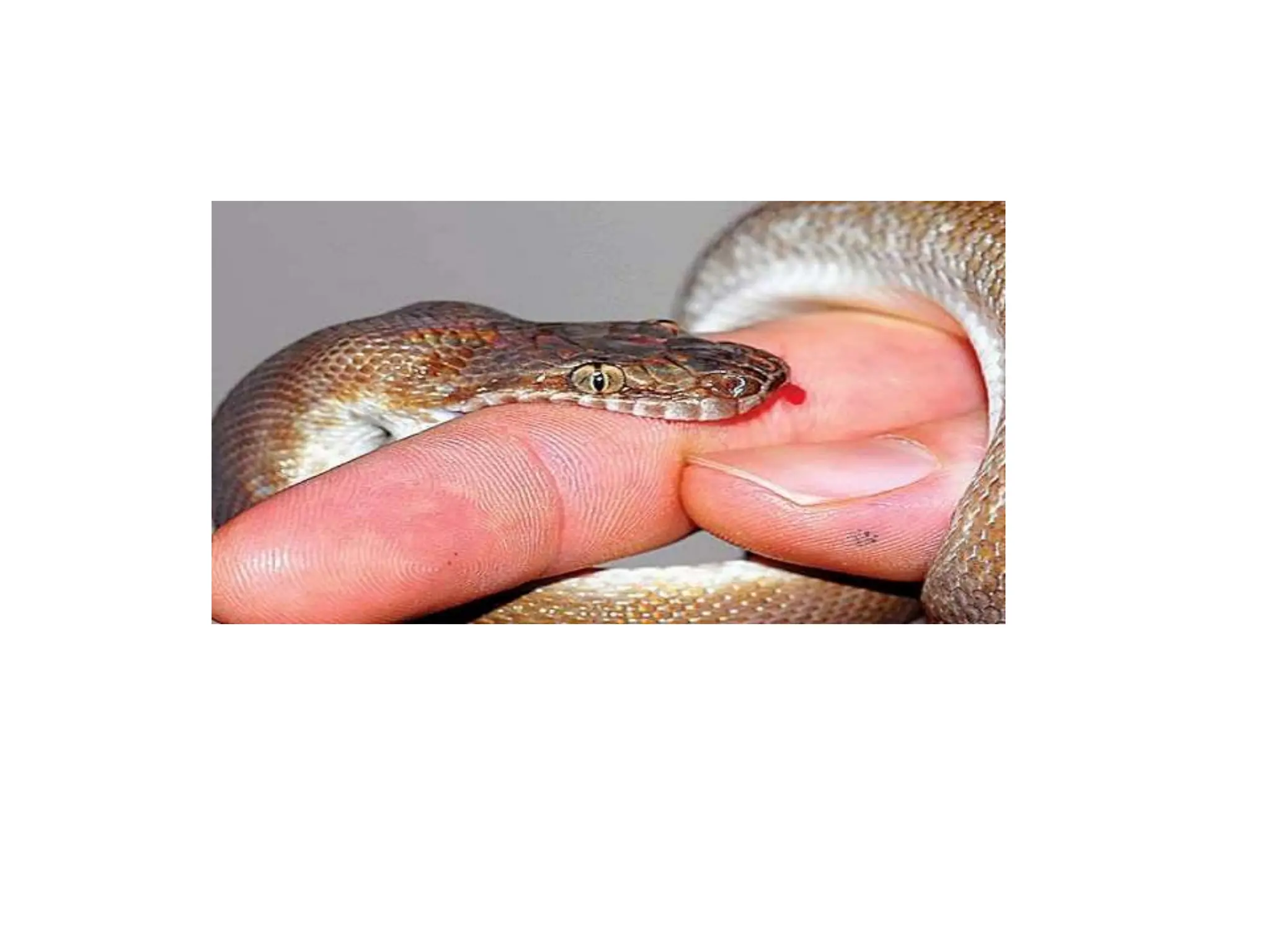
Insect bite: These are tiny insect-like bugs that live in the woods
and can easily fall on you as you walk by. They are very small,
you don’t feel them, and they are very hard to see. They
burrow slightly under the first layer of the skin and stay there.
The biggest problem is that many times they carry diseases
such as Rocky Mountain Fever, or Lyme disease.
Signs/Symptoms:
• Red, itchy hives.
• Swelling.
• Numbness or pain in muscles and joints.
• Flu-like symptoms.
• Heart palpitations.
• Death can occur from untreated diseases from ticks.
Treatment:
• If possible consult a physician for tick removals, as tearing it may
contribute to the spread of a virus or bacteria.
• Remove the tick using tweezers. Make sure you get all of it.
• Remove from the head and make sure the entire tick is removed
fully intact.
• Do NOT tear or crush the tick.
• Do NOT use a match or any kind of fluid to remove the tick.
• Wash the area with soap and water.
• Seek medical help (family doctor) to obtain anti-biotics.
Prevention:
• When doing outdoor activities wear long sleeve clothing, a cap,
and long pants.
• After the activity take a few minutes and examine self or each
other for ticks, they usually end up on the scalp, shoulders, or
upper back.
Scorpion bites: Generally scorpion can be seen in the moist dark
places and in rainy season. Though the scorpions are not
seriously poisonous but sometimes persons can become
unconscious
Signs & Symptoms:
• Severe burning
• Intolerable increasing pain in the bitten area
• Giddiness
• Vomiting
• Unconsciousness
Management:
• Patient should make to lie comfortably and soothing cream
applied.
• If the patient is unconsciousness, send him to doctor or
hospital
• If a big blister is seen after 6-12 hours and it burst by itself, do
the dressing with antibiotic cream
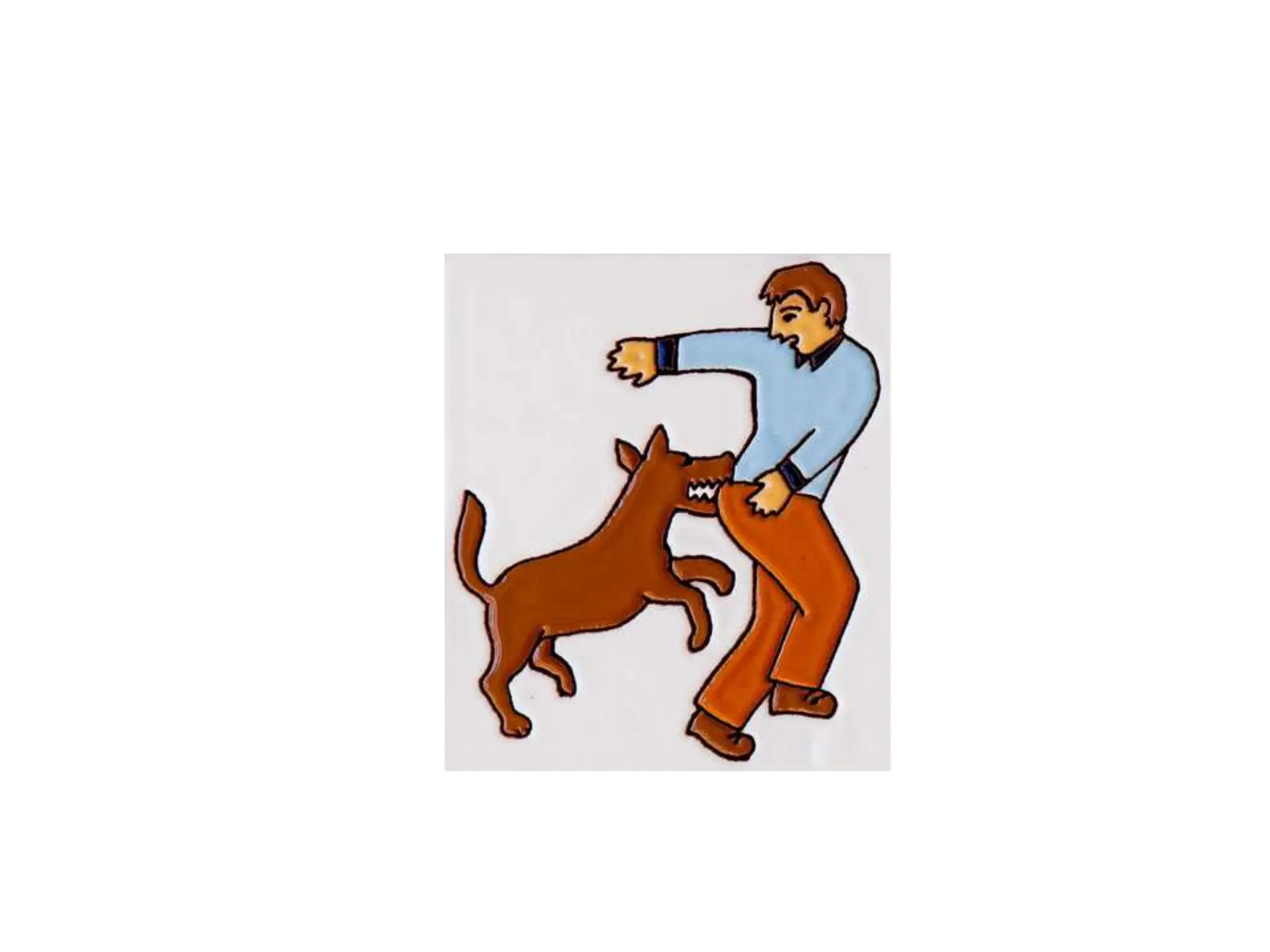
Dog Bite: A rabid animal is aggressive, drooling saliva, must be approached with care.
The mostserious infection risk is rabies, a potentially fatal viral infection of the
nervous system. The virus is carried in the saliva of the infected animal. Tetanus is
also a potential risk following any animal bite. The dog should be watched for 10
days. If the dog is healthy after this period then there is no danger of rabies.
Symptoms:
• Headache, nausea, vomiting, fever.
• Restlessness, confusion.
• Difficulty in swallowing.
• Foul smelling of the mouth.
• Hydrophobia
• Difficultyin drinking water.
• Aerophobia
• Respiratory paralysis.
Management:
• Thorough washing of the bitten area and wash the wound with soap and
water (Detergent solution) for 5-10minutes.
• Dress the wound with clean sterile gauze or cloth. Apply antibiotic cream
• Shift the causality immediately to the hospital
• The dog should be kept under observation for 10 days
Cat bite: Cats keep roaming around the houses
but if they are disturbed and touched they
becomeVIOLENT and can attack. It causes two
types of wounds
• 1. On biting with teeth 2. Scratches by the
nails
• Management:
• Wash the wound and apply the dressing
properly.
Rat bite: Rats are harm to the human being in
different ways.
• The flea found on their body spread a
dangerous disease called plague.
• Sometimes they scrap the palm of the hand or
foot of sleeping person
Signs and symptoms: Fever
Management:
• Wound should be washed and dressed
properly
• Patient should be sent to the hospital
Ticks and Mites bites:Tick is a small insect like bed bug. It is
about half or one centimeter long. It has a terrible capacity to
stick to the body and keep sucking the blood during this
period it spreads germs of certain diseasesin the body by
which tuloramie, Rocky Mountain spotted fever.
Signs & Symptoms: Typhus Fever
Management:
• The tick or mite has bitten and it is sticked should be
immediately removed.
• Should be pulled force fully
• Apply burning cigarettes on the dorsal surface.
• Apply oil turpentine or kerosene to remove the tick or mite.
• The wound should be washed with soap and water
• Apply antibiotic cream
• Apply bandage
Spider bite:
• There are 2 types of spider. 1. Black spider 2. Tarantula
• Black spider is more poisonous. Tarantula is big, hairy and less poisonous.
Signs and Symptoms:
• Redness
• Severe pain
• Local swelling
• Stomach cramps
• Muscle hardness
• The face, legs and hands looks swollen
• Breathlessness and shock
Management:
• Patient should be made to lie in a comfortable position
• Should be covered with blanket or bed sheet
• A cloth or rope should be tight at a distance from the bitten area. So, the blood is
not absorbedin other parts of the body.
• If the patient is conscious, give coffee or tea to drink.
• Bitten area should be clean and bandage
• Sent him to the hospital.
Leech bite:
• Leech is generally found in tanks, rivers, moist
and muddy places. It sucks quite a large
amount of blood.
Management:
• Apply a burning stick or cigarette on the dorsal
surface.
• Wash the wound and apply bandage.
Fish stings:
• Two breeds of thorny fish viz sting ray fish and
jelly fish and generally harm to the humans by
stinging.
Signs & Symptoms: Severe pain
Management:
• The sting should be take it out by scratching the
skin.
• Wash the wound and do the dressing
• Apply cold bandages of ammonia and water to
get relieve from the burning sensation
• If the pain is severe, get the medical aid.
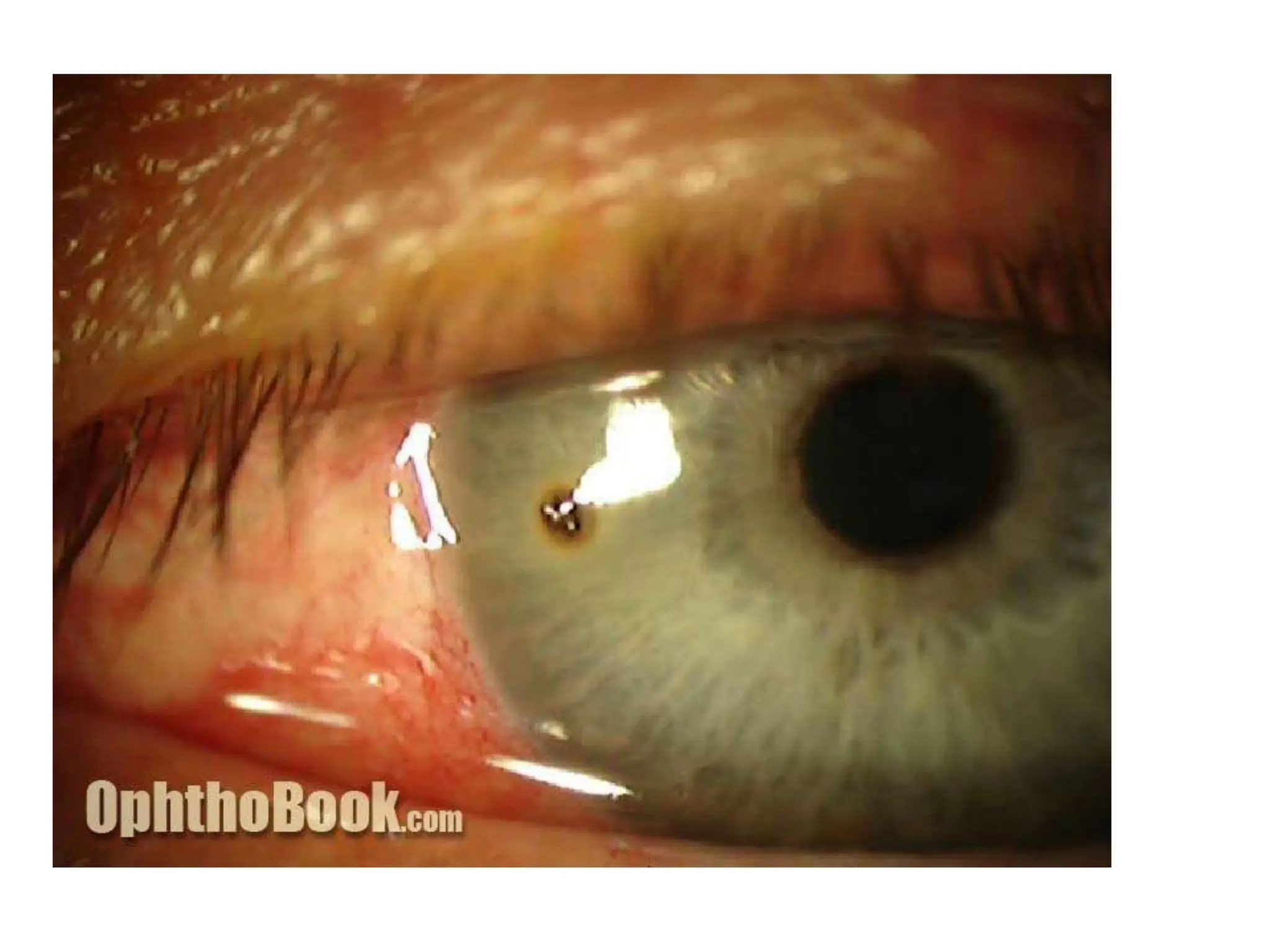
Foreign body in eyes:
• Foreign body in the eyes may be dust, small particles of wound, stone,
coal, glass or an insect.
Signs/Symptoms: Pain, redness, burning, tears.
Management:
• Pull down lower lid and remove unembedded object with clean tissue
if it lies on the inner surface of lower lid.
• If object has not been located, pull upper lid forward and down over
lower lid.
• Object can be removed from surface of upper eyelid by turning lid back
over a swab stick or similar object and lifting off the foreign body with
a clean tissue.
• Finally, flush the eye with water.
• If object is suspected to be embedded, apply a dry, protective dressing
over eye, and call physician or take patient to hospital emergency
room.
• Keep victim from rubbing the eye. For chemical burns, flood eyes with
water.
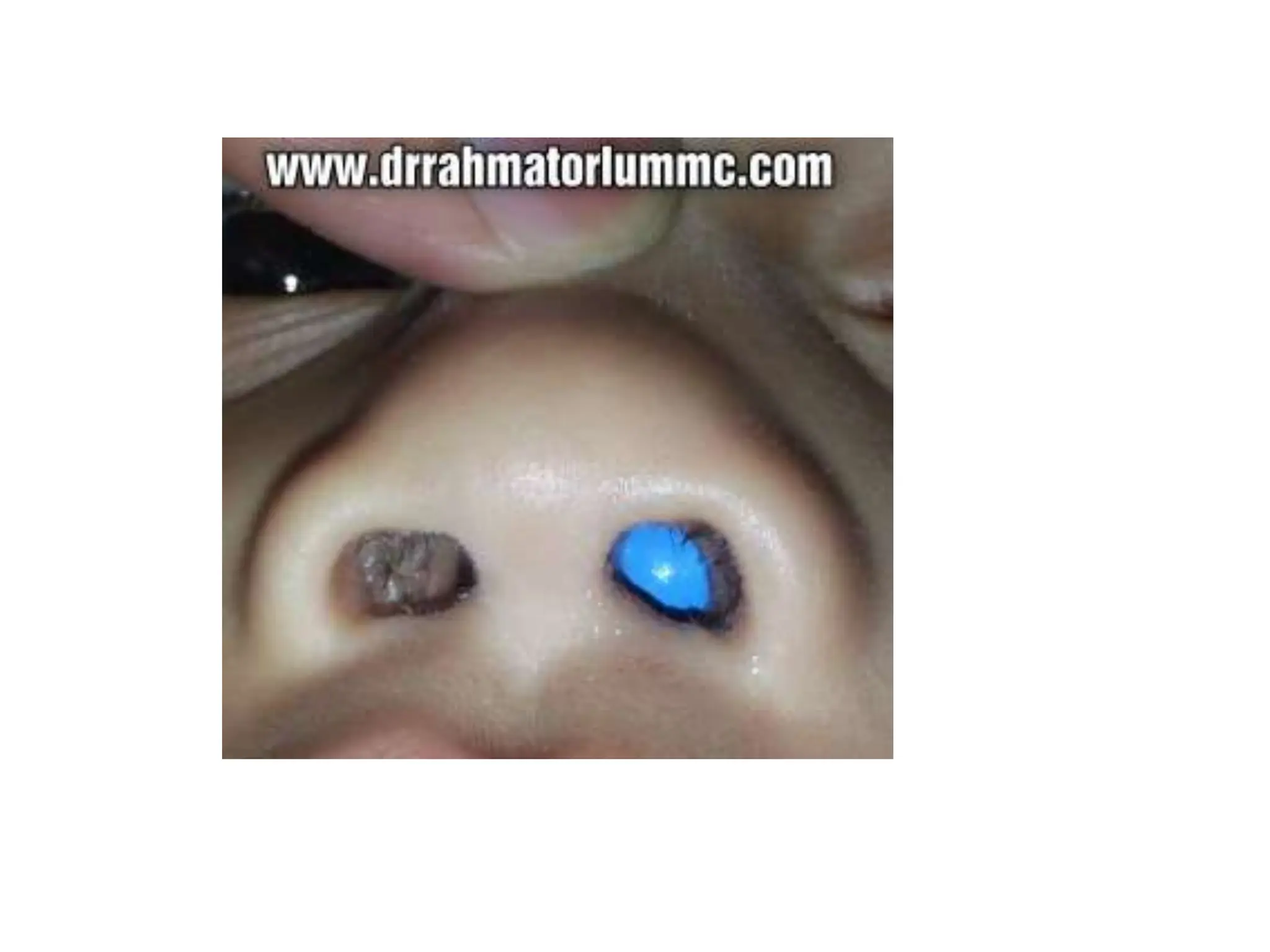
Foreign body in the nose:
• Usually peas, beans, piece of pencil are put into the nose by
children.
Signs/Symptoms: uncomfortable, complains of pain, inability
to breath
Management:
• Make the victim to sit
• Ask the victim to breathe through mouth to prevent foreign
body to aspirate in to respiratory tract from nose.
• Make the patient sneeze by passing the end of a piece of
thread in the opposite nostril.
• Do not attempt to remove it with a pin or a hook.
• Seek medical help
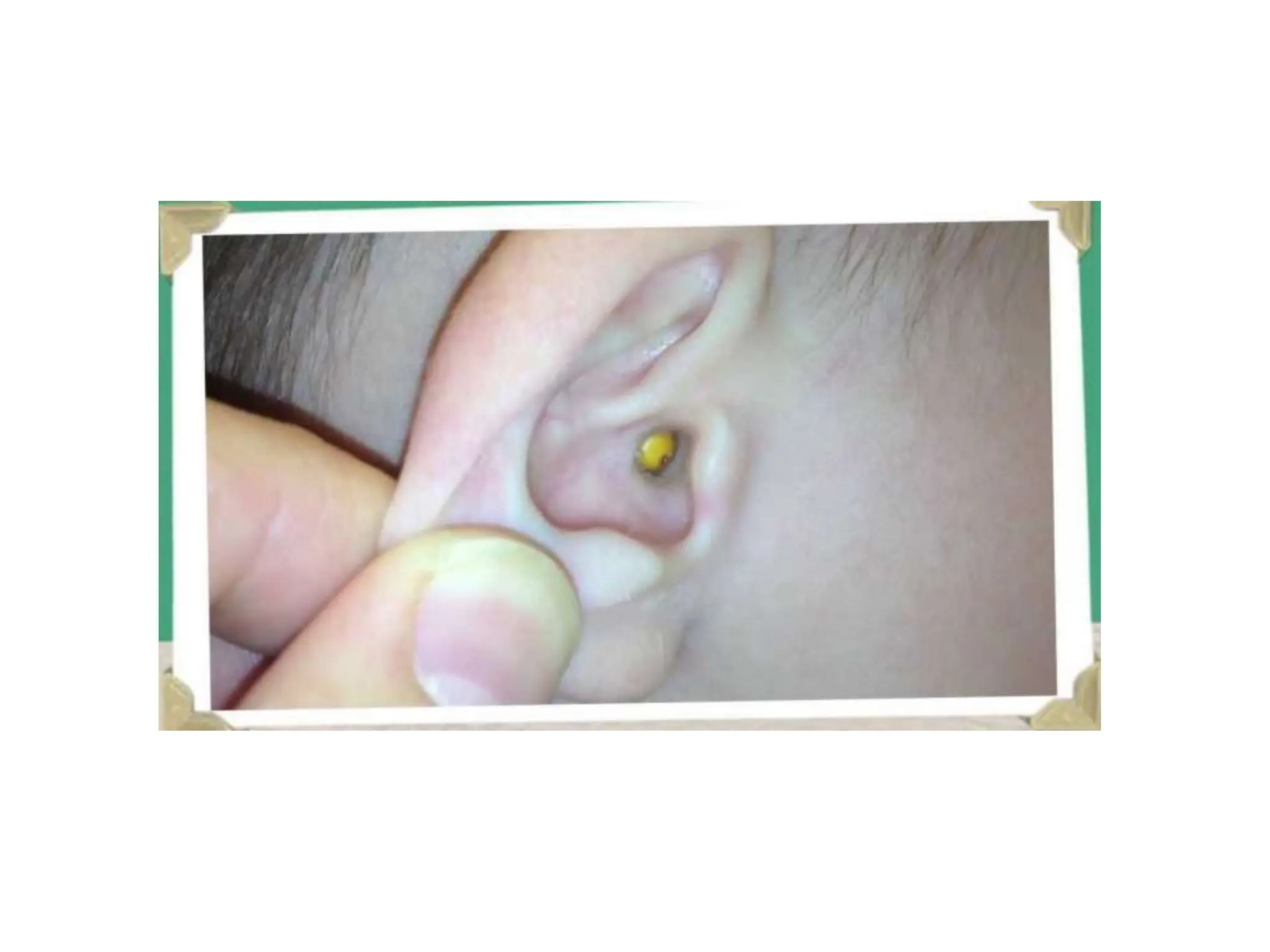
Foreign body in the ears:
• Peas, beans, piece of slate pencil can be pushed by
children during play.Sometime insect also can be
present.
Signs/symptoms: pain blocked ear, ringing in the ear
Management:
• Put warm oil in the ear to float out an insect.
• Do not attempt to remove any other form of foreign
body as the tympanic membrane may be damaged
during such attempts.
• Take the patient to a doctor.
Foreign bodies in the skin:
• Small foreign bodies (wood splinters, shards of glass) usually
cause minorpuncture wounds with little or no bleeding. If
foreign bodies deeply embedded in a wound is not be removed
by a first aided, it may cause further injury.
Splinters: Small splinters of wood, metal or glass in the skin
particularly of the hands, feet and knees are common injuries. It
should be drawn out by using tweezers.
Management:
– Clean area around the splinter with soap and water
– Sterilize a pair or tweezers by passing them through a flame
– Grasp the splinter as close to the skin as possible
– Squeeze the wound to encourage a little bleeding
– Apply an adhesive dressing “plaster”
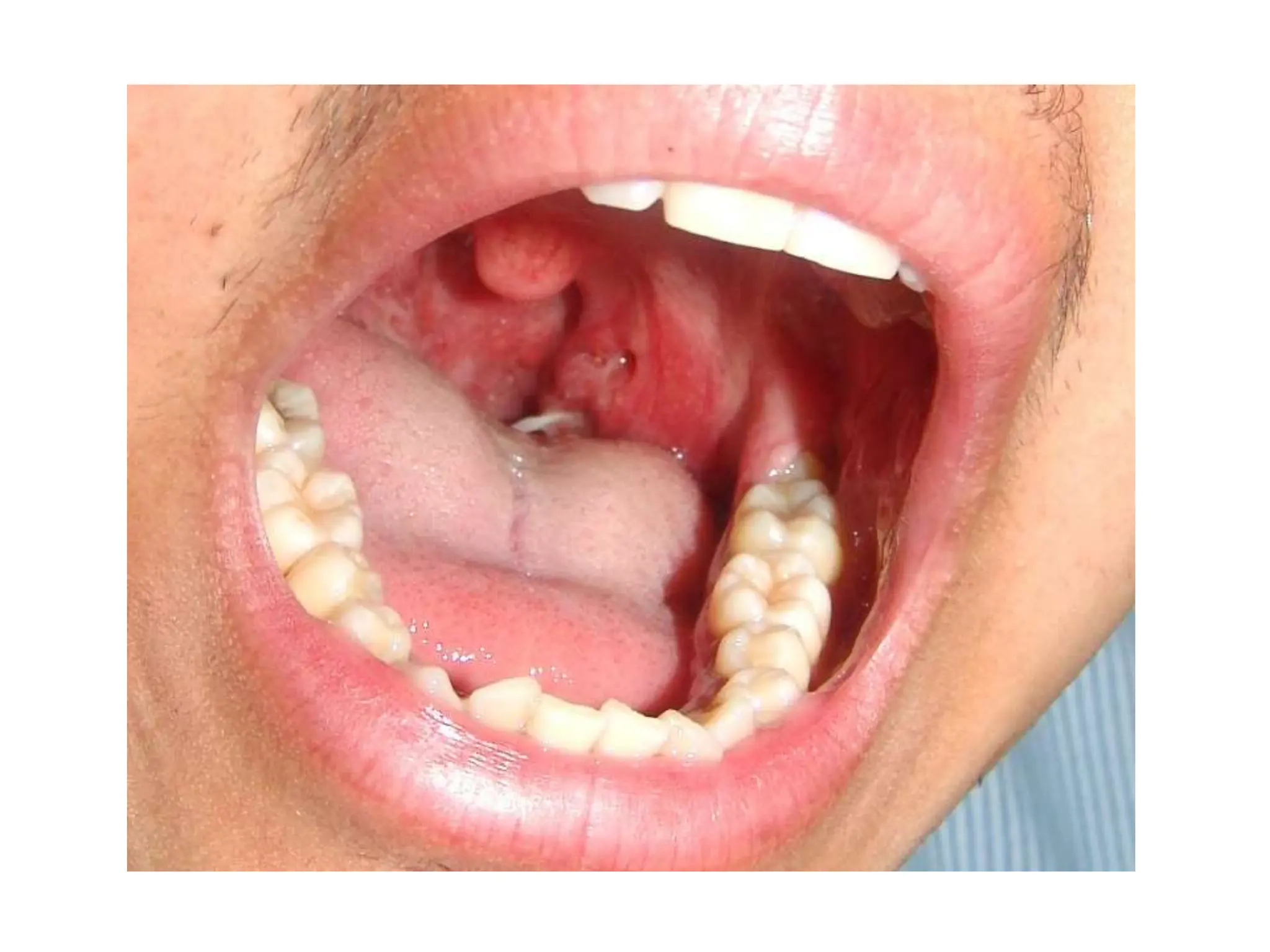
Foreign body in throat (Chocking)
Choking (Asphyxia due to obstruction in wind pipe): This is most common with
children. A marble, a seeds, coin, weed or a button may get stuck in the air
passage. In adults too, food may go down the wrong way and cause choking.
Signs/Symptoms: difficulty in breathing, talking, and swallowing.
Treatment:
Steps to Unconscious Choking
– Ask them if they are choking.
– Ask them if you can help.
– Step behind them and do abdominal thrusts (chest thrusts if they are big or
pregnant).
– Continue until the food comes out or until they become unconscious.
– If the food comes out make them comfortable and activate ambulance if they
need it.
– If they become unconscious;
– Carefully lay them on the ground.
– Get someone to call for an ambulance.
– Perform a tongue-jaw-lift.
– Check the mouth for the food.
Airway: Open, and maintain, their airway by tilting their head back and lifting their
chin upwards.
Breathing:
– Check for Breathing by looking, listening, and feeling for air (10 seconds).
– If they are not breathing give them 2 breaths, allowing the air to come out in
between.
– If the air does not go in, re-position the head-tilt/chin-lift a bit further back
and try blowing again. Be careful not to injure their neck.
– If the air still does not go in,
– Start CPR 30 compressions.
– After 30 compressions perform a tongue-jaw-lift and check the mouth for the
foreign object.
– Remove the object if you see it.
– Give them 2 breaths.
– Go to step 3.
– Repeat steps 5 to 10 until air goes in. Once air goes in then go to Circulation
below.
Circulation:
– Start CPR; 30 compressions to 2 breaths.
– Continue until paramedics arrive or until something changes with the person
(reassess at this point).
Steps to Conscious Choking Adult / Child
– Ask “are you choking?”
– Ask “can I help you?”
– Step behind them and do abdominal thrusts (chest thrusts
if they are big or pregnant).
– Continue until the food comes out or until they become
unconscious.
– If the food comes out make them comfortable and activate
ambulance if they need it.
– If they become unconscious;
• Lay them down.
• Call for an ambulance.
• Check their mouth for the food.
• Follow the steps for Unconscious Choking (above).
• Notes:
– The thrusts need to be quick and forceful. And if unsuccessful,
the force needs to be increased.
– If they are visibly pregnant, or you can’t get your arms around
their abdomen then you must do chest thrusts on the breast
bone.
– If they are considerable shorter than you, such as a child, kneel
down behind them and do the exact same thing.
– Never pick up a child to put them on a table or a chair simply
because you don’t want to kneel down.
– After wards, this person should go see a doctor to make sure
there was no internal damage done during the procedure.
– If the victim swallowed a sharp object, e.g. safety pin, nail, false
teeth etc. get the doctor immediately. If delay is inevitable, give
a cotton- wool sandwich, i.e. a layer of cotton wool between
bread when given, coat the sharp object and make it harmless.
– Do not give purgatives
– Examine stools next day for the foreign body
Conscious Choking Infant:
– Lay them on your arm face down and give 5 back blows.
– Turn them over face up and give 5 chest compressions.
– Continue until the food comes out or until they become
unconscious.
– If the food comes out make them comfortable and get
medical help if they need it.
– If they become unconscious;
• Lay them down.
• Activate ambulance.
• Check their mouth for the food.
• Follow the 3 Cs explained above.
Note:
• Hold the baby securely so that they don’t slip
and fall.
• Once the food comes out take the baby to a
doctor to check for any injuries that may have
occurred from the rescue attempts.
• Never shake a baby upside down to try and
remove a choking object.
• Always support the head, as they do not have
developed neck muscles yet.
Head/tilt-chin/lift:
• This is done in order to lift the tongue off the
throat so as to open the airway. It is done by
placing one hand on the forehead and pushing
the head back, and by placing one finger on the
underside of the chin and lifting the chin
upwards.
• If you suspect a neck injury then you should
open the airway using the modified jaw thrust,
without the head tilt.
Tongue-jaw lift:
• This is done when you want to see if there is food inside
an unconscious person’s mouth.
• It is done by opening their mouth and grabbing their
tongue (like a tongue depressor) with your thumb. Now
you can see inside their mouth.
• If you see an object use your other hand to pull it out.
• Never put any foreign objects, e.g. tweezers, inside their
mouth to pull out the object.
• If the object is liquid or hard to get out, turn the person
on their side and try scooping it out from this position.
• Reference:
• Marian Aldana . The Importance of First Aid.
Seton blog. June 10, 2013.
• Maheshawari L. Essentials of first aid for nurses”
Jaypee publication. 2012.
• Swapan N.W. Mala,G. “First aid and emergency
care” Kumar publishing house.3rd edition. 2013.
• First aid kit “American red cross”
• The Columbia Electronic Encyclopedia, 6th ed.
2012, Columbia University Press.
• Firstaid.cpr.net.

SAFE W2.pptxxxxxxxxxxxxxxxxxxxxxxxxxxxxx

  • 1.
    • A personwho gives treatment for the one suffering from a disease or an accident, to improve his condition is called an” aides” and the medical treatment given as aid is called “ first aid” • If an accident happens in the workplace, you cannot be a helpless witness, since simply standing by can potentially worsens the situation. This is why it’s important to have at least a basic knowledge of first aid. • At its most basic, first aid is the initial assistance given to a victim of injury or illness. Comprised of relatively simple techniques that can be performed with rudimentary equipment, first aid is usually carried out by a layperson until professional medical assistance arrives.
  • 2.
    Philosophy of FirstAid • In the pre-hospital setting, the key contributors to survival and recovery from illness and injury are prompt and effective maintenance of the body’s primary functions: 1. Airway 2. Breathing 3. Circulation 4. Bleeding control (life threatening)
  • 3.
    Principles of emergencycare: • Collect the detailed history of accident either from the victim or from anyone who has witnessed the accident. • The victim’s injury should be examined thoroughly, taking note of every symptom, to know the correct diagnosis. • By the help of the diagnosis, treat the victim until the doctor arrives or shift the victim to the hospital and aid the patient during transport. • Call the doctors or shift the victim to the hospital as soon as possible, so that the patience can recover soon from doctor’s treatment instead of prolonging the first aid.
  • 4.
    FIRST AID INEMERGENCIES
  • 5.
    Asphyxia • Definition :Asphyxia means one of the respiratory problems where lungs do not get sufficient supply of air from breathing. • Signs/Symptoms: Blue discoloration of face, tongue, and lips; gasping; inability to speak; unconsciousness.
  • 6.
    Management: • Remove thecausality from the affected situation • First try the Heimlich maneuver, grasping the victim from behind with hands linked in front and compressing the abdomen just below the ribs. • Encourage victim to cough up foreign objects in throat; as a last resort, rap victim between shoulder blades to dislodge object. • For asphyxia caused by gas or fumes, remove victim to a clear atmosphere; use artificial respiration. • Open the airway and begin to give mouth to mouth ventilation immediately • Place the patient in a recovery position • Apply water over the face, make the patient to drink a sip of water • Sent the causality to hospital.
  • 9.
    Drowning: • Drowning: Drowningis the result of complete immersion of the nose and mouth in water (or any other liquid). Water enters the windpipe and lungs, clogging the lungs completely.
  • 10.
    Management: The aimof first aid is to drain out water (or other matter) from lungs and to give artificial respiration. • Act quickly. Remove seaweeds and mud from the nose and throat. Start artificial ventilation immediately. This is possible even when the casualty is in water. • Turn the victim face down with head to one side and arms stretched beyond his head. Infants or children could be help upside down for a short period. • Raise the middle part of the body with your hands round the belly. This is to cause water to drain out of the lungs. • Give artificial respiration until breathing comes back to normal. This may have to go on for as long as two hours. • Remove wet clothing. • Keep the body warm, cover with blankets. • When victim becomes conscious, give hot drinks viz coffee or tea. • Do not allow him to sit up.
  • 11.
    Suffocation by PoisonousGases: Definition: suffocation occurs when no air enters the rooms and to the nose and the room is a confined space where all the oxygen is used up like caves, holes and wells without water. 1. Carbon Monoxide (lighter than air): This gas is present in car-exhaust fumes, in household coal gas: during incomplete combustion of charcoal stoves and in coal mines. Management: • The first aid treatment consists in removing the person from the area, applying artificial respiration and giving pure oxygen, if available. • Ensure circulation of fresh air before entering the room by opening the doors and windows. • Before entering the enclosed space take two or three deep breaths and hold your breath as long as you can. • Crawl along the floor (as the gas is lighter than air) • Remove the casualty as quickly as possible to fresh air. • Loosen his clothes at neck and waist and give artificial respiration, if asphyxiated.
  • 12.
    Suffocation by PoisonousGases: 2. Carbon-dioxide and other (heavier than air): This gas is found in coal mines, deep unused wells and sewers. Various other gases such as leaking refrigerator gases; compressed gases used for cooking and lighting may also cause suffocation. Management • Observe all the precautions mentioned above. • Enter in an upright position (as the gas is heavier than air and collects near the floor) • Remove the casualty as quickly as possible to fresh air. • Wherever ventilation is not possible and deadly poisonous gas is suspected, use a gas mask to protect yourself.
  • 14.
    Suffocation by PoisonousGases: 3. Suffocation by smoke • Management: • Protect yourself by a towel or a cloth (preferably wet) over your mouth and nose. • Keep low and remove the casualty as quickly as possible away from the area.
  • 15.
    Hanging, strangulation, andthrottling: • Hanging, strangulation, and throttling:If pressure is exerted on the outside of the neck, the airway is squeezed and the flow of air to the lungs is cut off. The three main reasons or causes why this could happen are: • Hanging= suspension of the body by a noose around the neck • Strangling= constriction around the neck • Throttling = squeezing the throat. Hanging and strangulation may occur accidentally for example, by tie or clothing caught in machinery. Ranging (ring) may also cause a broken neck, so the casualty must be handled carefully.
  • 16.
    Hanging, strangulation, and throttling: •Signs/symptoms: • There may be a constricting article around the neck. • Marks around the casualty’s neck where a constriction has been removed. • Uneven breathing, impaired consciousness; grey-blue skin (cyanosis). • Congestion of the face, with prominent veins and possible; tiny red spots on the face or on the whites of the eyes.
  • 17.
    Hanging, strangulation, andthrottling: Management: • Immediately remove any constriction from around the casualty’s neck, Support the body while you do so if it is still hanging • Do not move the casualty unnecessarily in case of spinal injury • Do not destroy or interfere with any material, such as knotted rope, that police may need as evidence. • Lay the casualty on the floor. Open the airway and check breathing. • If she is not breathing be prepared to resuscitate • If she is breathing, place her in the recovery position
  • 18.
  • 20.
    Fainting • Definition: Thisis very similar to shock except it is a temporary condition. • Causes: It usually occurs because of a temporary decrease of blood flow to the brain, which can be caused by not eating properly, standing up too fast, or low blood pressure. • Signs/Symptoms: The casualty feels faint, or collapses. • Management: • If they feel faint have them lie down which will help with circulation. • If they faint they will usually wake up in a few seconds. Encourage the person to stay lying down for a few minutes until they feel better. If they do not wake up within one minute, or they became injured during the fall then activate the ambulance, and treat any injuries. • Notes: If someone has fainted, even if they feel fine afterwards, they should still go see their doctor to rule out any major problem.
  • 22.
  • 23.
    Wound: Management: • Help theperson to remain calm. If the cut is large or bleeding heavily, have them lie down. • If the wound is on an arm or leg, raise the limb above the heart to slow bleeding. • Remove obvious debris from the wound, such as sticks or grass. • If the object is embedded in the body, do NOT remove it. • If the cut is small, wash it out with soap and water. • Do NOT clean a large wound. • After putting on clean latex gloves apply firm pressure to the wound with a folded cloth or bandage for about 10 minutes. • Do not remove the bandage to look at the wound during this time, as it may begin bleeding again. • If blood soaks through, add another cloth or bandage and continue holding pressure on the cut for an additional 10 minutes. • When bleeding has stopped, tape a clean bandage over the cut.
  • 24.
    Wound Seek medical carefor a cut or wound if: • It’s jagged or deep, or if it is a puncture wound. • it’s on the face • it’s the result of an animal bite • there is dirt that won’t come out after washing • the bleeding will not stop
  • 25.
    Hemorrhage/Bleeding: External bleeding: Thisis where the blood vessels and the skin are cut and blood is escaping the body. Causes: • Damage to the skin caused by trauma. • Can be a laceration (clean cut), abrasion, or avulsion (with skin still hanging). Management: • If it’s a minor bleed allow some bleeding to take place as this will help clean the wound. • Then wash with warm water and soap, apply a dressing to keep it clean, change the dressing every few hours, and monitor for signs of infection.
  • 26.
    Management conti—” • Ifthe bleeding is severe then apply the RED principle: • Rest: make sure the person is resting so as to decrease the heart rate and blood pressure. • Elevate: raise the injured limb above the heart to slow down the bleeding. • Direct Pressure: put pressure directly over the wound to help control bleeding, tie the dressing in place. But, do not make the dressing too tight so as to restrict blood flow. Do not remove the dressing. • Pressure Points: Applying pressure over the pressure points pressing over the underlying bone pressure points on the arms (brachial pressure point) on the groin (femoral pressure point). • Applying a tourniquet: A standard tourniquet is a piece of web belting about 36" long with a buckle device to hold it tightly in place when applied. This is used to stop bleeding. Care to be taken not to cutoff the circulation. • Get medical help.
  • 27.
  • 28.
    Hemorrhage/Bleeding: Internal bleeding: Thisis where the blood vessels are broken but the skin is not, so the person is bleeding under the skin. Injured organs will result in internal bleeding. Causes: Usually physical trauma, being hit, falling. Very common in car accidents. Signs/Symptoms: • Bruising, pain • Tenderness • Mechanism of the injury (what happened). • There may be blood in their spit, vomit, or urine.
  • 29.
    Internal bleeding conti: Management: •If it’s a minor bruise on the arm or leg then rest the injured part, apply an ice pack for a few minutes, and watch for signs that it is not healing. • If it’s severe internal bleeding in the core of the body then active the ambulance, make sure the person is resting, treat for shock, apply an ice pack, but do NOT put pressure over the wound. Notes: • Internal bleeding is not always obvious, but can be life threatening. • Infection can occur with any wound whether internal or external. If you suspect an infection then seek medical help immediately, as it can become life threatening. • Watch out for warning signs such as; the wound is not healing or is getting bigger, discoloration, fluid discharge, and increased pain.
  • 30.
    • Amputation (e.g.a finger): treat the injured body part as you would any other cut. Then take the amputated body part and place it in a clean plastic bag. Take that first bag and place it in a second plastic bag containing ice. Make sure it goes to the hospital with the person, as they can sometimes reattach the body part.
  • 31.
    Nose bleeds/epistaxis: • Havethe person rest, have them pinch their nose just below the bone, and lean slightly forward. • If the bleeding is severe, if it does not stop in about 10-15 minutes, or if there was an injury to the head or face, medical attention is needed. • Do not have the person lean their head back, as all this does is have them swallow their blood, which is not desired.
  • 33.
    Broken bones andfractures • Definition: A break or crack in a bone is called a fracture. • In most cases the damage to the bone will be under the skin, which is called a closed fracture, • But sometimes bits of the bone can puncture through the skin to become an open fracture. • In both cases you'll need to treat the casualty for shock. • Even if you can't see any blood, the break might have caused some internal bleeding. • To break a fully grown bone, a huge amount of force is needed • But bones that are still growing are supple and can split, crack or bend quite easily, a bit like a twig.
  • 34.
    Fracture Signs: • The seventhings to look for are: • Swelling • Difficulty moving • Movement in an unnatural direction • A limb that looks shorter, twisted or bent • A grating noise or feeling • Loss of strength • Shock
  • 35.
    Types of fracture: •Green stick fractures: Closed fracture mostly it occurs in children.. • Complicated fractures: They occur when the jagged ends of the bone fragments damage blood vessels, nerves or a joint, broken bones in the chest may penetrate the lung, heart or liver. In fractures of the skull the brain is usually damaged. • Depressed fractures: These occur in the skull when the broken ends of the bones are pressed inwards. • Commutated Fractures: In these cases, the bone is broken into several fragments. This is serious because there will be muscle damage with more bleeding at the fracture site.
  • 39.
    Types of fracture: •Impacted Fractures: After a heavy fall, the fracture may be impacted by the force, (eg.) Spinal injury falling from tree. • Pathological Fractures: These occur when the bone is weakened by loss of calcium, infection or cancer. Minimal cause a break in such cases. In old age the bones are more brittle, and may break spontaneously due to calcium loss which is part of the ageing process. • Stress Fractures: Stress caused by repeated minor trauma as in athletic training. Involved in strenuous
  • 40.
    Management: • If itis an open fracture, cover the wound with a sterile dressing and secure it with a bandage. Apply pressure around the wound to control any bleeding. • Support the injured body part to stop it from moving. This should ease any pain and prevent any further damage. • Once you’ve done this, call medical help. While waiting for help to arrive, don’t move them unless they’re in immediate danger. • Protect the injured area by using bandages to secure it to an uninjured part of the body to stop it from moving. For example, fractures on the arm can be secured with a sling, and a leg with a fracture can be tied to the uninjured leg. • Keep checking the casualty for signs of shock. This does not mean emotional shock, but is a life-threatening condition, often caused by losing blood. • If they lose responsiveness at any point, open their airway, check their breathing and prepare to treat someone who’s become unresponsive.
  • 42.
  • 43.
    Splints: • The mainpurpose of a splint is to keep an injured body part immobilized (e.g. a broken leg). • It should only be done if paramedics are going to take a long time arriving, or if you have to move the person. • Never move or try to realign the injured body part. Always splint in the position found. There are three main types of splints: • 1. Anatomical: this means using a non-injured body part to immobilize an injured body part. E.g. to splint a broken left lower leg you would tie both legs together so the good leg provides support to the injured leg. • 2. Soft: this means using something like a thick sweat shirt, a jacket, a towel, or a blanket to wrap around and immobilize. This kind of splint works very well with hand or ankle/foot injuries. • 3. Rigid: this refers to using a firm object, such as a piece of wood, to immobilize. There are many types of rigid splints you can purchase or you can use whatever you see around you e.g. magazines, newspapers, umbrellas, etc.
  • 45.
    Injuries to thesoft tissues: • Definition: – This is an injury to a bone, a joint, a ligament, or a tendon. – Joint injuries usually involve a dislocation. – This is where the bone has popped out of its socket. – This may be accompanied with a fracture, a strain, or a sprain. – It may pop back in it may not. – Either way seek medical help.
  • 46.
    Injuries to thesoft tissues: – Tendons are strong tissues that connect a muscle onto a bone. – When a tendon tears it is called a strain. – When they become torn they take a very long time to heal, many times never as good as before, and sometimes surgery is required to reattach them. – When a ligament is torn it is called a sprain. – Ligaments connect a bone to another bone. – These are found around the joints. – Ligaments are very strong, but, as with tendons, when they tear they take a long time to heal, never as good as before, and sometimes surgery is required.
  • 47.
    Injuries to thesoft tissues: • Causes: – Any kind of force that is greater than what the tissue can withhold will cause such an injury. Some common activities include falling, twisting, getting hit, etc. • Prevention: – Use safety equipment and wear it properly. – Use seat belts and car seats. – Keep joints and bones strong through weight bearing physical activities.
  • 48.
    Injuries to thesoft tissues: Signs/Symptoms: • A ‘snapping’ noise. • Pain. • Deformity. • Inability to move. • Swelling. • Bruising.
  • 49.
    Injuries to thesoft tissues:: Management: – Apply the RICE principle. • Rest the injured body part and the entire casualty. • Immobilize the injured body part. • Cold compress over the injury to reduce swelling. • Elevate the injured body part if it can be done without causing further injury. – Seek medical help. – Do not rub or move the injured body part. – If there is a protruding bone then bleeding will need to be taken care of by applying indirect pressure. – Never straighten or realign an injured body part. • Notes: Bone fractures, if set properly, will heal fully in a few weeks and will be stronger than before. This happens because the area builds up with more calcification than before.
  • 52.
    Spinal Injuries: Definition: •An injury to the muscles, bones, or nerves associated with the spine. The higher up on the spine it is the more serious the injury will be. Causes: • Very common in vehicle accidents • Diving in shallow water • Cycling accidents • Any impact, direct or indirect, to these body parts. • Sport accidents such as hockey and football, etc.
  • 53.
    Spinal injury Signs/symptoms: – Mechanismof injury (how it occurred). – Pain, numbness, or paralysis. – Bleeding, swelling, or bruising around the head, ears, or nose. – Unconsciousness. Prevention: • Wear safety equipment and wear it properly. • Know the safety rules of sports played. • Use seat belts and car seats. • Avoid alcohol intake when doing physical activity as it impairs sound judgment.
  • 55.
    Spinal injury Management: • Makesure the person doesn’t move then get help. • Hold them still. You need to and explain to them that they may have a serious injury and should not move. • If they are unconscious do the CPR steps. Airway and breathing take priority. • Notes: Any time there is a spinal injury you should also suspect a concussion, and visa versa.
  • 57.
    Concussion Definition: An injuryto the head or the brain. Literally bleeding in the brain or the area around the brain. Causes: • Any impact, direct or indirect, to the head. • May be associated with a spinal injury. Signs/Symptoms:  Mechanism of injury.  Pain or numbness.  Bleeding, swelling, or bruising.  Confused.  Loss of memory.  Dizzy.  Ringing in the ears.  Nausea or vomiting.  Unconsciousness.
  • 58.
    Concussion Prevention: – Wear safetyequipment and wear it properly. – Know the safety rules of sports played. – Use seat belts and car seats. – Avoid alcohol intake when doing physical activity as it impairs sound judgment. Management: • Make sure the person doesn’t move. • Hold them still and explain to them that they should not move. • Activate the ambulance right away. • If they are unconscious do the CPR steps but open the airway with a modified jaw thrusts, as opposed to a head tilt.
  • 60.
    Concussion • Notes: – Anytime there is a spinal injury you should also suspect a concussion, and visa versa. – Anyone with a suspected concussion should seek medical help as soon as possible. – If they have become unconscious from the concussion then activate the ambulance right away. – Many athletes will not admit to having had a concussion because then they cannot play anymore. Unfortunately that is why the condition becomes worse. – Concussions are very life threatening. – There is a condition called Baby Shaken Syndrome, where babies are injured by violent shaking. • Never shake a baby – on purpose, by accident, or when angry. • Never throw them up in the air – no matter how much they enjoy it.
  • 61.
    Seizures Definition: Seizures areneurological disorders where the signals in the brain become mixed up. Causes: • The most common cause is from the medical condition called epilepsy. • However, they can also be caused by concussions • Allergic reactions, • Brain tumors, • High fever in children. Prevention: • If someone has epilepsy they may have medication to take which will reduce the chance of seizures. • Other causes are hard to prevent because nothing is suspected of being wrong until the seizure.
  • 63.
    Seizure Management for GeneralizedConvulsive Seizures: • Keep calm; let the seizure take its course. Do not try to stop the seizure or revive the person. • Protect person from further injury by moving hard or sharp objects away, but do not interfere with the person’s movements. Place something soft and small, such as a sweater, under their head, and loosen tight clothing around the neck. • Do not force anything in the person’s mouth. This could cause teeth and jaw damage, or choking. The person will not swallow their tongue during a seizure. • Roll the person on their side as soon as possible, to allow saliva or other fluids to drain away, helping to clear the airway. Do not be frightened if a person having a seizure stops breathing momentarily. • • If a seizure goes on longer than 5 minutes, repeats without full recovery, or the person becomes injured, then call for medical assistance.
  • 64.
    Seizure: Management for PartialNon-Convulsive Seizures (e.g. like sleep walking): • Stay with the person, let the seizure take its course. Do not try to stop the seizure or revive the person. The person will be unaware of his or her actions, and may or may not hear you. • Gently guide the person away from danger, move dangerous objects out of the way. • Partial seizures may spread to other areas of the brain. Do not be alarmed if a convulsive seizure follows. • Notes: Always be comforting, be gentle, and reassure the person, as it may take some time for them to become re- oriented.
  • 66.
    Hypothermia • Definition: Adrop in the core body temperature, even as little as 1 to 2 degrees Celsius, from the normal of 37 degrees Celsius. Sometimes this can happen within minutes, other times it takes a while to take place. It is sometimes accompanied by frost bite. • Causes & Prevention: – Exposure to the cold. – Not being dressed properly. – Damp weather or being wet. – Being tired or dehydrated.
  • 67.
    • Signs/Symptoms: – Feelingcold. – Shivering, which will stop as the condition worsens. – Becoming confused and disoriented. – Slow pulse and breathing rates, and eventually unconsciousness. • Management: • Get medical help. • Get them inside near a heat source. • Remove wet clothing and replace with dry clothing. • If conscious give them warm fluids to drink – slowly. • Avoid alcohol, caffeine, and carbonated drinks.
  • 69.
    Frost Bite • Definition:A freezing of a body part, such as the hand, foot, face, etc. Superficial is the surface of the skin, whereas deep frost bite affects the underlying tissues. Sometimes this is accompanied by hypothermia. • Causes & Prevention: • Exposure to cold, wind, wet conditions. • Not wearing protective clothing.
  • 70.
    • Signs/Symptoms: – Coldfeeling. – Numbness. – Inability to use the body part. – Tingling, then pain. – As it gets worse all sensation will disappear. – The skin will first appear white or yellowish. If the tissue dies it will become black charred color.
  • 71.
    • Management: – Fordeep frost bite get medical help. – Warm up the body part slowly and gradually by wrapping it in warm clothing and/or submersing it in luke warm water – not hot water as it will burn the skin. • Notes: • If there is a chance of the body part refreezing then it might be better to get medical help first before allowing it to warm up. • Do not rub or force the body part to bend, this will cause more damage.
  • 74.
    Heat Emergencies (Hyperthermia) •Definition: A situation where the body’s temperature increases. Perspiration is the body’s main method of regulating its temperature. As sweat evaporates off the skin heat is taken with it, as a result cooling down the body. If this method is impaired, or it can not keep up, the body will quickly over heat. • Causes & Prevention: – Exercising in hot humid and/or polluted weather and becoming dehydrated. – Drinking alcohol, caffeinated, or carbonated drinks (contributes to dehydration). – Over using saunas, whirlpools, and warm environments such as gyms, and aerobic classes. • There are 3 levels of heat emergencies:
  • 75.
  • 76.
    1. Cramps :Painful muscular involuntary contraction A muscle cramp is a strong, painful contraction or tightening of a muscle that comes on suddenly and lasts from a few seconds to several minutes. It often occurs in the legs. A muscle cramp is also called a charley horse. Nighttime leg cramps are usually sudden spasms, or tightening, of muscles in the calf. s/s: . -Sweating or moist skin. -Tired, irritable, and thirsty.
  • 78.
    Treatment: Removing them fromthe heat. -Gently stretch/massage affected area. • Slowly rehydrate with water, juice, or sport drinks. Rest for a couple of hours. • Avoid alcohol, caffeinated and/or carbonated drinks.
  • 79.
  • 80.
    2. Exhaustion : Heatexhaustion is a heat-related illness that can occur after you've been exposed to high temperatures, and it often is accompanied by dehydration. There are two types of heat exhaustion: Water depletion. Signs include excessive thirst, weakness, headache, and loss of consciousness. Salt depletion. s/s • -Sweating. -Tired. -Irritable. -Thirsty. -Lethargic. - Slight headache. -Nausea. -Dizzy/weak. -May have slightly elevated body temperature.
  • 81.
    Treatment: • Remove fromsource of heat. • Slowly rehydrate by drinking water, juice, or sports drinks. • Rest is very important to prevent a reoccurrence. • Remove sweaty clothing. • Fan or gently cool the skin with wet towels or ice packs. • Avoid alcohol, caffeinated and/or carbonated. • If vomiting occurs get an ambulance.
  • 82.
  • 83.
    3. Stroke (mostserious) : Heatstroke is a condition caused by your body overheating, usually as a result of prolonged exposure to or physical exertion in high temperatures. This most serious form of heat injury, heatstroke can occur if your body temperature rises to 104 F (40 C) or higher. Heatstroke requires emergency treatment. s/s • -Elevated body temperature. • -Very tired/weak. • -Sweating may stop - this is not a good sign. • -Severe headache. • -Red hot dry skin. • -Rapid, weak pulse becoming irregular, rapid breathing, or reduced/absent vital signs (consciousness, breathing, pulse).
  • 84.
    Treatment: • Remove fromheat source. • Place in recovery position. • Call for an ambulance. • Monitor/treat ABCs. • Remove sweaty clothing. • Fan or gently cool the skin with cool towels or ice packs. • Do not douse with cold water. • At this point it is too late to give fluids by mouth and it may induce vomiting.
  • 85.
    Stroke Stroke: The sudden deathof brain cells due to lack of oxygen, caused by blockage of blood flow or rupture of an artery to the brain. Sudden loss of speech, weakness, or paralysis of one side of the body can be symptoms. The medical term for stroke is cerebrovascular accident, or CVA. • Thrombotic/ ischemic stroke (caused by blood clots) • hemorrhagic stroke (caused by ruptured blood vessels that cause brain bleeding) • transient ischemic attack (TIA) (a “mini-stroke,” caused by a temporary blood clot) • Embolic stroke – When a blood clot forms in another part of the body and moves to the brain.
  • 86.
    Signs/symptoms: • Numbness, tingling,paralysis on one side of the body, extremities, hands, and feet. • Slurred speech, not making sense. • Trouble understanding you. • Uneven pupils. • Nausea or vomiting. • Decreased level of consciousness.
  • 87.
    Management: – Help themget in a comfortable position on their side, make sure they are resting. – Activate the ambulance. – Reassure them that help is on the way. – Keep them warm with a blanket. – Do not give them anything to eat or drink. Notes: It is extremely common for people to ignore the warning signs of a stroke. Unfortunately, this is one reason why so many people die from this disease – because they don’t get help soon enough. As a first responder, it is your job to activate the ambulance as soon as possible. Sometimes a stroke is called Cerebral Vascular Accident (CVA). Mini stroke is a condition where the casualty experiences similar warning signs as that of a stroke, but these warning signs go away on their own. This is a warning sign that a serious stroke may occur and the person needs medical help immediately. This condition is sometimes called Transient Ischemic Attack (TIA).
  • 88.
    Burns Definition: A burnis damage to the skin or underlying tissue caused by heat. There are 3 levels of severity; 1st (Superficial), 2nd (Partial thickness), 3rd (Full thickness). Causes: There are 5 main sources of burns; • Electricity, • Radiation (sun), • Thermal (something hot), • Chemical, • Friction Prevention: • Use safety rules. • Use safety equipment when working with chemicals. • Hire professionals for work dealing with e.g. electricity. • Avoid sun exposure. • Keep hot objects away from children.
  • 90.
    Management: • For 1stand 2nd degree burns you should cool the area immediately with gently running cold water for about 10-15 minutes, or until it has cooled off. Do not break any blisters as this will make the wound worse. • For 3rd degree burns do not put anything on the burn, seek medical help immediately and treat for shock. 3rd degree is extremely life threatening even when a small body part is affected. If there is clothing on the burn do not remove it as this may also remove skin. There is a very high risk of infection from this kind of burn.
  • 92.
    Notes: • As withall other emergencies make sure the area is safe for you first. Watch out for live wires, hot objects, chemical spills, etc. • The severity of a burn can also be increased depending on; Which part of the body is affected, e.g. face, and neck. • The amount of the body that is burnt, e.g. only fingertip or entire arm. • With electrical burns check for an exit wound as well as treating for the entrance wound. • With chemical burns flush the area with lots of water to get it off the casualty’s skin. • Never apply ointments, butter, or other home remedies on burns, as this may make the burn worse, keep the heat trapped in, or cause an infection.
  • 93.
    Emergency Child Birth •Definition: Emergency child birth is defined as a situation where the expecting mother-to-be can not reach medical facilities in time and needs to give birth on the spot. • Causes: Being away from medical facilities is the most common cause for this situation. Also, not having transportation. • Signs/Symptoms: If the mother says, “the baby is coming,” or the baby’s head is showing, or the contractions are less than two minutes apart, then it is time to deliver the baby on the spot.
  • 94.
    Management: – Make surethe ambulance has been called. – Make the mother comfortable on her back. Remove any necessary clothing but keep her covered to protect her privacy. Put some clean towels under her. – As a rescuer all you have to do is support the baby as it comes out. Hold the head as it is heavy compared to the rest of the baby. – As soon as you can see the baby’s throat make sure the umbilical cord is not wrapped around it. If it is use your finger to loosen it and pass it over the head. This is easy to do. – Once the baby comes out wrap it in a clean towel. – Clean its mouth and nose. – If it is not breathing massage its back and tickly its feet. This should help stimulate the breathing mechanism. – If it is still not breathing begin rescue breathing and CPR. – Never hold the baby upside down and slap it. This is a TV thing, and if you should drop the baby you’ll be in trouble. – If the baby is fine give it to the mother to hold. – The other end of the umbilical cord will be attached to the placenta which will still be inside the mother. Do not pull, it will come out on its own in a few minutes in another set of contractions. – Do not cut the cord. Simply wrap the placenta in a towel and keep with the baby. – Never put the placenta lower than the baby as blood may drain from the baby back into the placenta. If you wish you may tie something around the umbilical cord a few centimeters away from the baby and from the placenta. But do not cut it. – If the baby begins to come out feet first it is a complication but there is nothing you can do. Instruct the mother not to push. Do not try to push the baby back in. Simply support it any way it comes out.
  • 95.
    Heart Attack • Definition:When something goes wrong with the heart’s electrical system, or when an artery in the heart muscle ruptures or becomes blocked. Regardless, the heart is no longer able to circulate blood effectively, including to its own tissues. As a result, the heart may stop working. • Signs/Symptoms: • Pain/tightness/numbness in the shoulders, arms, neck, back, chest. • Bluish, pale skin. • Rapid but weak pulse. • Shallow rapid breathing. • Nausea or vomiting. • Unconsciousness. • These warning signs may come and go, and maybe severe or mild. Even if the warning signs go away this person may still be having a heart attack and still needs immediate help.
  • 96.
    • Management: • Helpthem get in a comfortable position, make sure they are resting. • Activate the ambulance. • Reassure them that help is on the way. • Check for medical history of a similar problem, as they may have medication (but only assist, do not administer medication). • If they have Angina (see following page). • If they wish, they may take one Bayer Aspirin, as this may prevent further damage to the heart muscle. Note, if they have asthma they may be allergic to aspirin – ask first! • Do not give them anything to eat or drink. • Stay with them all the time and comfort them. • Notes: It is extremely common for people to ignore the warning signs of a heart attack. Unfortunately, this is one reason why so many people die from this disease – because they don’t get help soon enough. As a first aider it is your job to activate the ambulance as soon as possible.
  • 97.
    Angina • Definition:Angina isa serious medical condition, diagnosed by a cardiologist, where the coronary arteries are partially blocked. As a result, when under stress, the heart is not able to get enough blood and cannot work properly. • Sign/Symptoms: The most common warning sign is pain, but it can also include any of the other warning signs for heart attack. • If the casualty says they have angina they should also have medication with them. You can help them take it (e.g. get the bottle, open the bottle, put the pill in their hand) but they must do the actual administering. • Management: This medication is called nitroglycerine. It is designed to cause blood vessel dilation, which means it causes the blood vessels to relax so they expand. As a result, more blood can flow through. • Viagra does not cure heart disease. It does not dissolve blood clots, it simply enlarges blood vessels temporarily.
  • 98.
    • Nitroglycerine comesin 4 forms: – Pill: which they must place under their tongue for quick absorption. If they swallow the pill it will take much longer to be absorbed. – Spray: like a puffer, which they spray into their mouth. – Paste: which they put on their skin. – Patch: which they wear all day. • The most they should take is 3 doses, 3 minutes apart each. If after 10 minutes they do not feel better, or they become worse at any time then it means the medication is not working and this person needs advance medical help immediately.
  • 99.
    Cardiopulmonary resuscitation: • Airway: •Place them on their back, carefully so as to not cause any injury. • Open their airway by tilting their head back and lifting their chin upwards. This will remove the tongue from blocking the airway. • Keep the airway open. • Breathing: • Check for Breathing by looking, listening, and feeling for air (10 seconds). • If they are breathing then monitor and put them in the recovery position until the paramedics arrive. • If they are not breathing give them 2 breaths, allowing the air to come out in between. • If the air goes in then go to “Circulation.” • If the air does not go in, re-position the head-tilt/chin-lift a bit further back and try blowing again. Be careful not to injure their neck. • If the air still does not go in then go to “Circulation” but check the mouth for the food after doing CPR.
  • 100.
    • Circulation: – StartCPR if needed (compressions and breaths). – It is 30 compressions to 2 breaths. Continue until paramedics arrive or until something changes with the person (reassess at this point). – If the air was not going in make sure you check the mouth, to see if the food came out, after each set of compressions. If you see the object in their mouth take it out and reassess breathing. – Under this category, we are also concerned with shock and severe bleeding.
  • 101.
    • About compressions: –Adult: use both hands. Compress 4-5 cm deep. – Child: use one hand. Compress almost half way down. – Infant: use two fingers. Compress almost halfway down. – Fast and smooth. – Do not stop unless something changes. – Ribs may break, keep going. – If they vomit roll them onto their side, clean their mouth, continue. • Two-Rescuer CPR: In a situation where there are 2 trained first aiders, and they work well together, one rescuer can perform the compressions while the other rescuer gives the breaths. All the steps are the same, nothing changes. This is a bit more sufficient and less tiring for the rescuers. If the rescuer doing the compressions becomes tired they can switch positions.
  • 102.
    Poisoning: • Definition: Apoison is a substance which enters the body and can cause illness or death. It may act within a matter of seconds (e.g. carbon monoxide) or a matter of years (e.g. car pollution). There are four basic ways in which poison can enter the body; by swallowing, breathing, injecting, or absorbing. Any of these methods can be life threatening. Many times children are the innocent casualties.
  • 105.
    Ingested Poisons: • Examplescan include bad food, household cleaners, perfumes, nail polish remover, etc. • If the person is having trouble breathing, is convulsing, is unconscious, or is in pain, call the ambulance immediately. • If the person appears to be fine but you want to make sure call your doctor or local hospital. • For your area this number can be found at the front of your local telephone directory. In order for them to help you they need to know what the person took, how much, their age and weight, and their present condition. They will either tell you to seek medical help immediately, give them something to drink, or to monitor them to make sure they don’t get worse. • Make sure you do not induce vomiting unless you are told to do so by a physician as some substances are corrosive and may burn on the way up. • Also, do not give anything to drink unless instructed by a physician as some substances may react more with liquids. • Always keep cleaners and chemicals high up so children can not access them.
  • 107.
    Breathed/Inhaled Poisons: • Thiscan include fumes from household cleaners, industrial products, smoke, etc. • Fresh air is the immediate first aid treatment. • But first make sure you are not putting yourself in danger. Seek medical help for the person immediately. • Never mix cleaners unless it specifies on the container. Never use chemicals in poorly ventilated areas. • Be aware of carbon monoxide as it can not be smelled, has no taste, and can not be seen. It can be produced by any engine (e.g. house furnace, car), or even a fireplace with poor ventilation. • Every home should have a carbon monoxide detector. If the detector begins to sound you need to leave the house immediately and call the fire department from the neighbor’s house. • Carbon monoxide poisoning makes you feel sleepy and drowsy and can have an effect in a matter of minutes so you aren’t aware of what is happening.
  • 109.
    Injected Poisons: • Someexamples include needles, broken glass, mosquitoes, spider bites, bee stings, etc. • As soon as possible remove the object from the skin. Clean the area thoroughly with soap and water. • If an allergic reaction occurs, or you believe there is a risk of infection, seek medical help.
  • 111.
    Absorbed Poisons: • Theseare poisons which enter the body through the skin, but do not cause a puncture. Some examples are household cleaners, industrial products, poisonous plants, etc. • Remove the substance as soon as possible by using large amounts of running water. • Do your best not to contaminate other body parts. • There are some chemicals that will react more with water, but if you leave them on the skin they will react anyway with skin moisture. • Seek medical help. If you work with chemicals make sure you know how to do the job safely and always use safety equipment.
  • 112.
    • Common householdpoisons that can harm babies and children: • Nail polish and nail polish remover. • Lipstick and lip gloss. • Mascara. • Medication including: Panadol, Tylenol, Aspirin. • Vitamins or other supplements. • Cleaning supplies: e.g. bleach. • Aerosols and other insect repellents. • Poisons used for insect and pest control. • Soaps: dishes, hands, clothes, etc. • Smoke from smoking.
  • 114.
    Bites and stings: Signs/Symptoms:Wound (animal or human bite) or swelling and pain (insect sting). Treatment: • For animal and human bites, cleanse wound with soap and water and apply iodine containing antiseptic; submit animal for rabies test. • Prevent exertion and taking of stimulants by victim. For insect stings apply cortisone ointments, soothing lotions, or cool compress. • Persons who are allergic to insect stings should carry adrenaline with them at all times.
  • 116.
    Snake bite: Notall snakes are poisonous, but if you get bitten by a poisonous one you better rush to medical help immediately. Because snake anti-venom depends on the type of snake that caused the bite, if you can, try and remember the color and pattern of the snake so they can identify it and give you the correct anti-venom. Treatment: • Have the person rest with the bitten body part lower than the heart. • For poisonous snakebite, cooling the site of the wound with ice will slow down absorption of poisons; antivenin treatment is required only for a small number of reptile bites. • Seek medical help as soon as possible. • If the person becomes unconscious begin the Primary Survey.
  • 117.
    Prevention: • If youwill be in an area where there may be snakes; • Wear high boots that cover your calves. • Make noise with your feet as you walk to scare off any snakes. • If there are trees look on the branches as you walk. • Check ahead of time what types of snakes might be in the area. So if a bite does occur you can notify the hospital what kind of snake it was. • Check ahead of time with local hospitals to see if they do have snake anti- venom. Notes: • Unless you want poison in your mouth do NOT cut the bite site and suck the blood out. • Do not try to catch the snake it will bite again. • There are many snake bite kits on the market, all designed to suck the poison out. • This may work somewhat, but, blood flows very quickly and the poison may spread very quickly. • Do NOT tie a tourniquet to try and stop the blood from flowing. This may cause death to the limb from lack of blood flow.
  • 119.
    Insect bite: Theseare tiny insect-like bugs that live in the woods and can easily fall on you as you walk by. They are very small, you don’t feel them, and they are very hard to see. They burrow slightly under the first layer of the skin and stay there. The biggest problem is that many times they carry diseases such as Rocky Mountain Fever, or Lyme disease. Signs/Symptoms: • Red, itchy hives. • Swelling. • Numbness or pain in muscles and joints. • Flu-like symptoms. • Heart palpitations. • Death can occur from untreated diseases from ticks.
  • 120.
    Treatment: • If possibleconsult a physician for tick removals, as tearing it may contribute to the spread of a virus or bacteria. • Remove the tick using tweezers. Make sure you get all of it. • Remove from the head and make sure the entire tick is removed fully intact. • Do NOT tear or crush the tick. • Do NOT use a match or any kind of fluid to remove the tick. • Wash the area with soap and water. • Seek medical help (family doctor) to obtain anti-biotics. Prevention: • When doing outdoor activities wear long sleeve clothing, a cap, and long pants. • After the activity take a few minutes and examine self or each other for ticks, they usually end up on the scalp, shoulders, or upper back.
  • 122.
    Scorpion bites: Generallyscorpion can be seen in the moist dark places and in rainy season. Though the scorpions are not seriously poisonous but sometimes persons can become unconscious Signs & Symptoms: • Severe burning • Intolerable increasing pain in the bitten area • Giddiness • Vomiting • Unconsciousness Management: • Patient should make to lie comfortably and soothing cream applied. • If the patient is unconsciousness, send him to doctor or hospital • If a big blister is seen after 6-12 hours and it burst by itself, do the dressing with antibiotic cream
  • 123.
    Dog Bite: Arabid animal is aggressive, drooling saliva, must be approached with care. The mostserious infection risk is rabies, a potentially fatal viral infection of the nervous system. The virus is carried in the saliva of the infected animal. Tetanus is also a potential risk following any animal bite. The dog should be watched for 10 days. If the dog is healthy after this period then there is no danger of rabies. Symptoms: • Headache, nausea, vomiting, fever. • Restlessness, confusion. • Difficulty in swallowing. • Foul smelling of the mouth. • Hydrophobia • Difficultyin drinking water. • Aerophobia • Respiratory paralysis.
  • 124.
    Management: • Thorough washingof the bitten area and wash the wound with soap and water (Detergent solution) for 5-10minutes. • Dress the wound with clean sterile gauze or cloth. Apply antibiotic cream • Shift the causality immediately to the hospital • The dog should be kept under observation for 10 days
  • 126.
    Cat bite: Catskeep roaming around the houses but if they are disturbed and touched they becomeVIOLENT and can attack. It causes two types of wounds • 1. On biting with teeth 2. Scratches by the nails • Management: • Wash the wound and apply the dressing properly.
  • 128.
    Rat bite: Ratsare harm to the human being in different ways. • The flea found on their body spread a dangerous disease called plague. • Sometimes they scrap the palm of the hand or foot of sleeping person Signs and symptoms: Fever Management: • Wound should be washed and dressed properly • Patient should be sent to the hospital
  • 130.
    Ticks and Mitesbites:Tick is a small insect like bed bug. It is about half or one centimeter long. It has a terrible capacity to stick to the body and keep sucking the blood during this period it spreads germs of certain diseasesin the body by which tuloramie, Rocky Mountain spotted fever. Signs & Symptoms: Typhus Fever Management: • The tick or mite has bitten and it is sticked should be immediately removed. • Should be pulled force fully • Apply burning cigarettes on the dorsal surface. • Apply oil turpentine or kerosene to remove the tick or mite. • The wound should be washed with soap and water • Apply antibiotic cream • Apply bandage
  • 132.
    Spider bite: • Thereare 2 types of spider. 1. Black spider 2. Tarantula • Black spider is more poisonous. Tarantula is big, hairy and less poisonous. Signs and Symptoms: • Redness • Severe pain • Local swelling • Stomach cramps • Muscle hardness • The face, legs and hands looks swollen • Breathlessness and shock Management: • Patient should be made to lie in a comfortable position • Should be covered with blanket or bed sheet • A cloth or rope should be tight at a distance from the bitten area. So, the blood is not absorbedin other parts of the body. • If the patient is conscious, give coffee or tea to drink. • Bitten area should be clean and bandage • Sent him to the hospital.
  • 134.
    Leech bite: • Leechis generally found in tanks, rivers, moist and muddy places. It sucks quite a large amount of blood. Management: • Apply a burning stick or cigarette on the dorsal surface. • Wash the wound and apply bandage.
  • 136.
    Fish stings: • Twobreeds of thorny fish viz sting ray fish and jelly fish and generally harm to the humans by stinging. Signs & Symptoms: Severe pain Management: • The sting should be take it out by scratching the skin. • Wash the wound and do the dressing • Apply cold bandages of ammonia and water to get relieve from the burning sensation • If the pain is severe, get the medical aid.
  • 139.
    Foreign body ineyes: • Foreign body in the eyes may be dust, small particles of wound, stone, coal, glass or an insect. Signs/Symptoms: Pain, redness, burning, tears. Management: • Pull down lower lid and remove unembedded object with clean tissue if it lies on the inner surface of lower lid. • If object has not been located, pull upper lid forward and down over lower lid. • Object can be removed from surface of upper eyelid by turning lid back over a swab stick or similar object and lifting off the foreign body with a clean tissue. • Finally, flush the eye with water. • If object is suspected to be embedded, apply a dry, protective dressing over eye, and call physician or take patient to hospital emergency room. • Keep victim from rubbing the eye. For chemical burns, flood eyes with water.
  • 141.
    Foreign body inthe nose: • Usually peas, beans, piece of pencil are put into the nose by children. Signs/Symptoms: uncomfortable, complains of pain, inability to breath Management: • Make the victim to sit • Ask the victim to breathe through mouth to prevent foreign body to aspirate in to respiratory tract from nose. • Make the patient sneeze by passing the end of a piece of thread in the opposite nostril. • Do not attempt to remove it with a pin or a hook. • Seek medical help
  • 143.
    Foreign body inthe ears: • Peas, beans, piece of slate pencil can be pushed by children during play.Sometime insect also can be present. Signs/symptoms: pain blocked ear, ringing in the ear Management: • Put warm oil in the ear to float out an insect. • Do not attempt to remove any other form of foreign body as the tympanic membrane may be damaged during such attempts. • Take the patient to a doctor.
  • 145.
    Foreign bodies inthe skin: • Small foreign bodies (wood splinters, shards of glass) usually cause minorpuncture wounds with little or no bleeding. If foreign bodies deeply embedded in a wound is not be removed by a first aided, it may cause further injury. Splinters: Small splinters of wood, metal or glass in the skin particularly of the hands, feet and knees are common injuries. It should be drawn out by using tweezers. Management: – Clean area around the splinter with soap and water – Sterilize a pair or tweezers by passing them through a flame – Grasp the splinter as close to the skin as possible – Squeeze the wound to encourage a little bleeding – Apply an adhesive dressing “plaster”
  • 147.
    Foreign body inthroat (Chocking) Choking (Asphyxia due to obstruction in wind pipe): This is most common with children. A marble, a seeds, coin, weed or a button may get stuck in the air passage. In adults too, food may go down the wrong way and cause choking. Signs/Symptoms: difficulty in breathing, talking, and swallowing. Treatment: Steps to Unconscious Choking – Ask them if they are choking. – Ask them if you can help. – Step behind them and do abdominal thrusts (chest thrusts if they are big or pregnant). – Continue until the food comes out or until they become unconscious. – If the food comes out make them comfortable and activate ambulance if they need it. – If they become unconscious; – Carefully lay them on the ground. – Get someone to call for an ambulance. – Perform a tongue-jaw-lift. – Check the mouth for the food.
  • 148.
    Airway: Open, andmaintain, their airway by tilting their head back and lifting their chin upwards. Breathing: – Check for Breathing by looking, listening, and feeling for air (10 seconds). – If they are not breathing give them 2 breaths, allowing the air to come out in between. – If the air does not go in, re-position the head-tilt/chin-lift a bit further back and try blowing again. Be careful not to injure their neck. – If the air still does not go in, – Start CPR 30 compressions. – After 30 compressions perform a tongue-jaw-lift and check the mouth for the foreign object. – Remove the object if you see it. – Give them 2 breaths. – Go to step 3. – Repeat steps 5 to 10 until air goes in. Once air goes in then go to Circulation below. Circulation: – Start CPR; 30 compressions to 2 breaths. – Continue until paramedics arrive or until something changes with the person (reassess at this point).
  • 149.
    Steps to ConsciousChoking Adult / Child – Ask “are you choking?” – Ask “can I help you?” – Step behind them and do abdominal thrusts (chest thrusts if they are big or pregnant). – Continue until the food comes out or until they become unconscious. – If the food comes out make them comfortable and activate ambulance if they need it. – If they become unconscious; • Lay them down. • Call for an ambulance. • Check their mouth for the food. • Follow the steps for Unconscious Choking (above).
  • 151.
    • Notes: – Thethrusts need to be quick and forceful. And if unsuccessful, the force needs to be increased. – If they are visibly pregnant, or you can’t get your arms around their abdomen then you must do chest thrusts on the breast bone. – If they are considerable shorter than you, such as a child, kneel down behind them and do the exact same thing. – Never pick up a child to put them on a table or a chair simply because you don’t want to kneel down. – After wards, this person should go see a doctor to make sure there was no internal damage done during the procedure. – If the victim swallowed a sharp object, e.g. safety pin, nail, false teeth etc. get the doctor immediately. If delay is inevitable, give a cotton- wool sandwich, i.e. a layer of cotton wool between bread when given, coat the sharp object and make it harmless. – Do not give purgatives – Examine stools next day for the foreign body
  • 152.
    Conscious Choking Infant: –Lay them on your arm face down and give 5 back blows. – Turn them over face up and give 5 chest compressions. – Continue until the food comes out or until they become unconscious. – If the food comes out make them comfortable and get medical help if they need it. – If they become unconscious; • Lay them down. • Activate ambulance. • Check their mouth for the food. • Follow the 3 Cs explained above.
  • 154.
    Note: • Hold thebaby securely so that they don’t slip and fall. • Once the food comes out take the baby to a doctor to check for any injuries that may have occurred from the rescue attempts. • Never shake a baby upside down to try and remove a choking object. • Always support the head, as they do not have developed neck muscles yet.
  • 155.
    Head/tilt-chin/lift: • This isdone in order to lift the tongue off the throat so as to open the airway. It is done by placing one hand on the forehead and pushing the head back, and by placing one finger on the underside of the chin and lifting the chin upwards. • If you suspect a neck injury then you should open the airway using the modified jaw thrust, without the head tilt.
  • 158.
    Tongue-jaw lift: • Thisis done when you want to see if there is food inside an unconscious person’s mouth. • It is done by opening their mouth and grabbing their tongue (like a tongue depressor) with your thumb. Now you can see inside their mouth. • If you see an object use your other hand to pull it out. • Never put any foreign objects, e.g. tweezers, inside their mouth to pull out the object. • If the object is liquid or hard to get out, turn the person on their side and try scooping it out from this position.
  • 160.
    • Reference: • MarianAldana . The Importance of First Aid. Seton blog. June 10, 2013. • Maheshawari L. Essentials of first aid for nurses” Jaypee publication. 2012. • Swapan N.W. Mala,G. “First aid and emergency care” Kumar publishing house.3rd edition. 2013. • First aid kit “American red cross” • The Columbia Electronic Encyclopedia, 6th ed. 2012, Columbia University Press. • Firstaid.cpr.net.