Radiologic and dosimetric
data from Center for
Radiation Protection
Knowledge (CRPK)
crpk.ornl.gov
Radionuclide parameters
from Risk Assessment
Information System (RAIS)
rais.ornl.gov
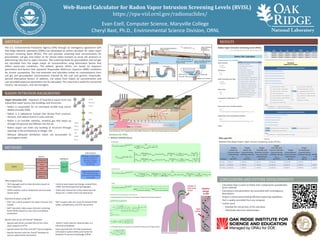
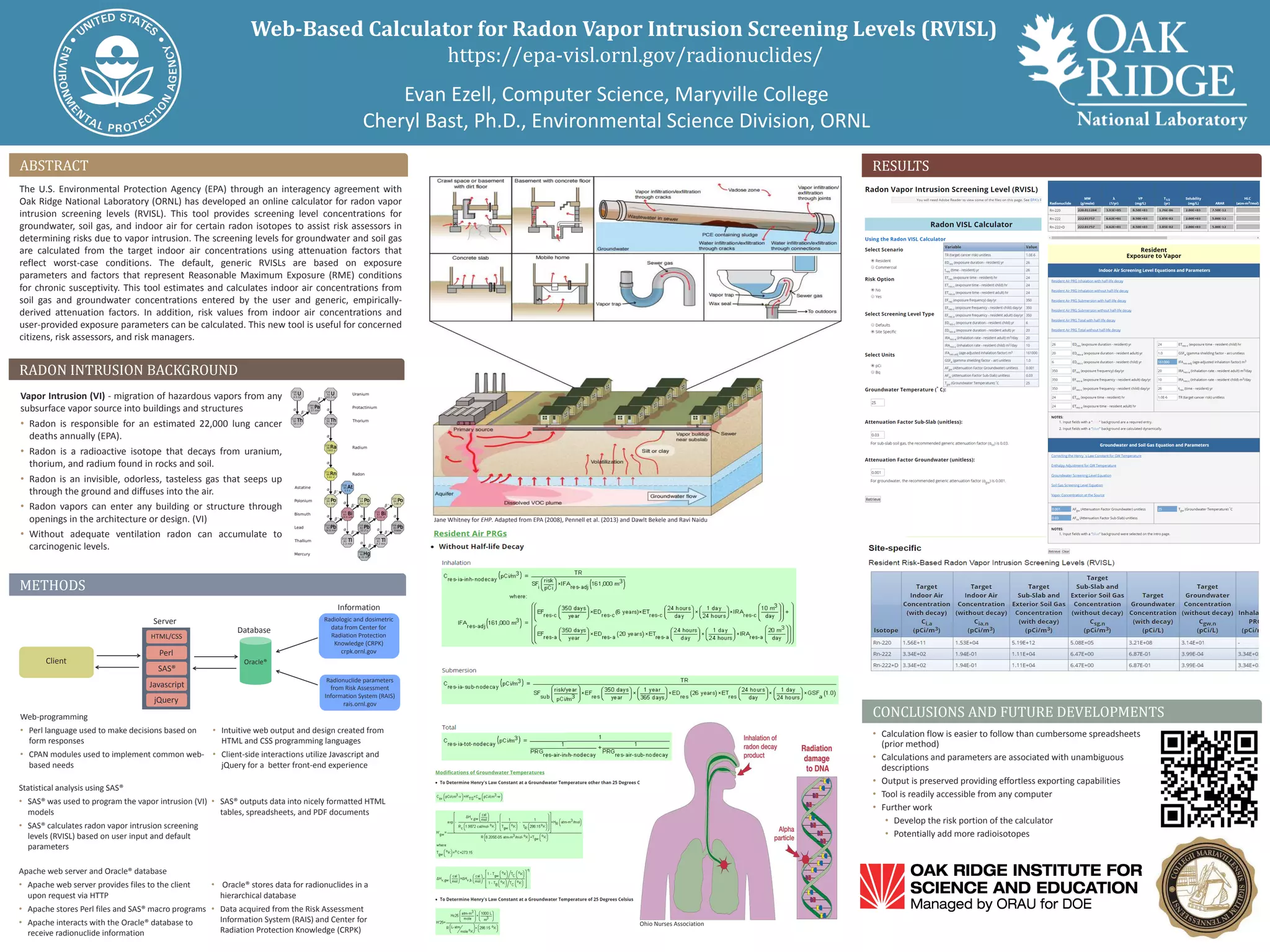
Web-Based Calculator for Radon Vapor Intrusion Screening Levels (RVISL)
ABSTRACT
The U.S. Environmental Protection Agency (EPA) through an interagency agreement with
Oak Ridge National Laboratory (ORNL) has developed an online calculator for radon vapor
intrusion screening levels (RVISL). This tool provides screening level concentrations for
groundwater, soil gas, and indoor air for certain radon isotopes to assist risk assessors in
determining risks due to vapor intrusion. The screening levels for groundwater and soil gas
are calculated from the target indoor air concentrations using attenuation factors that
reflect worst-case conditions. The default, generic RVISLs are based on exposure
parameters and factors that represent Reasonable Maximum Exposure (RME) conditions
for chronic susceptivity. This tool estimates and calculates indoor air concentrations from
soil gas and groundwater concentrations entered by the user and generic, empirically-
derived attenuation factors. In addition, risk values from indoor air concentrations and
user-provided exposure parameters can be calculated. This new tool is useful for concerned
citizens, risk assessors, and risk managers.
RADON INTRUSION BACKGROUND
Vapor Intrusion (VI) - migration of hazardous vapors from any
subsurface vapor source into buildings and structures
• Radon is responsible for an estimated 22,000 lung cancer
deaths annually (EPA).
• Radon is a radioactive isotope that decays from uranium,
thorium, and radium found in rocks and soil.
• Radon is an invisible, odorless, tasteless gas that seeps up
through the ground and diffuses into the air.
• Radon vapors can enter any building or structure through
openings in the architecture or design. (VI)
• Without adequate ventilation radon can accumulate to
carcinogenic levels.
METHODS
RESULTS
CONCLUSIONS AND FUTURE DEVELOPMENTS
• Calculation flow is easier to follow than cumbersome spreadsheets
(prior method)
• Calculations and parameters are associated with unambiguous
descriptions
• Output is preserved providing effortless exporting capabilities
• Tool is readily accessible from any computer
• Further work
• Develop the risk portion of the calculator
• Potentially add more radioisotopes
https://epa-visl.ornl.gov/radionuclides/
Jane Whitney for EHP. Adapted from EPA (2008), Pennell et al. (2013) and Dawlt Bekele and Ravi Naidu
Web-programming
• Perl language used to make decisions based on
form responses
• CPAN modules used to implement common web-
based needs
• Intuitive web output and design created from
HTML and CSS programming languages
• Client-side interactions utilize Javascript and
jQuery for a better front-end experience
Statistical analysis using SAS®
• SAS® was used to program the vapor intrusion (VI)
models
• SAS® calculates radon vapor intrusion screening
levels (RVISL) based on user input and default
parameters
• SAS® outputs data into nicely formatted HTML
tables, spreadsheets, and PDF documents
Apache web server and Oracle® database
• Apache web server provides files to the client
upon request via HTTP
• Apache stores Perl files and SAS® macro programs
• Apache interacts with the Oracle® database to
receive radionuclide information
• Oracle® stores data for radionuclides in a
hierarchical database
• Data acquired from the Risk Assessment
Information System (RAIS) and Center for
Radiation Protection Knowledge (CRPK)
Client
Server
Database
Information
Ohio Nurses Association
Perl
Javascript
jQuery
SAS®
HTML/CSS
Oracle®
Evan Ezell, Computer Science, Maryville College
Cheryl Bast, Ph.D., Environmental Science Division, ORNL

RVISL_poster_final

  • 1.
    Radiologic and dosimetric datafrom Center for Radiation Protection Knowledge (CRPK) crpk.ornl.gov Radionuclide parameters from Risk Assessment Information System (RAIS) rais.ornl.gov Web-Based Calculator for Radon Vapor Intrusion Screening Levels (RVISL) ABSTRACT The U.S. Environmental Protection Agency (EPA) through an interagency agreement with Oak Ridge National Laboratory (ORNL) has developed an online calculator for radon vapor intrusion screening levels (RVISL). This tool provides screening level concentrations for groundwater, soil gas, and indoor air for certain radon isotopes to assist risk assessors in determining risks due to vapor intrusion. The screening levels for groundwater and soil gas are calculated from the target indoor air concentrations using attenuation factors that reflect worst-case conditions. The default, generic RVISLs are based on exposure parameters and factors that represent Reasonable Maximum Exposure (RME) conditions for chronic susceptivity. This tool estimates and calculates indoor air concentrations from soil gas and groundwater concentrations entered by the user and generic, empirically- derived attenuation factors. In addition, risk values from indoor air concentrations and user-provided exposure parameters can be calculated. This new tool is useful for concerned citizens, risk assessors, and risk managers. RADON INTRUSION BACKGROUND Vapor Intrusion (VI) - migration of hazardous vapors from any subsurface vapor source into buildings and structures • Radon is responsible for an estimated 22,000 lung cancer deaths annually (EPA). • Radon is a radioactive isotope that decays from uranium, thorium, and radium found in rocks and soil. • Radon is an invisible, odorless, tasteless gas that seeps up through the ground and diffuses into the air. • Radon vapors can enter any building or structure through openings in the architecture or design. (VI) • Without adequate ventilation radon can accumulate to carcinogenic levels. METHODS RESULTS CONCLUSIONS AND FUTURE DEVELOPMENTS • Calculation flow is easier to follow than cumbersome spreadsheets (prior method) • Calculations and parameters are associated with unambiguous descriptions • Output is preserved providing effortless exporting capabilities • Tool is readily accessible from any computer • Further work • Develop the risk portion of the calculator • Potentially add more radioisotopes https://epa-visl.ornl.gov/radionuclides/ Jane Whitney for EHP. Adapted from EPA (2008), Pennell et al. (2013) and Dawlt Bekele and Ravi Naidu Web-programming • Perl language used to make decisions based on form responses • CPAN modules used to implement common web- based needs • Intuitive web output and design created from HTML and CSS programming languages • Client-side interactions utilize Javascript and jQuery for a better front-end experience Statistical analysis using SAS® • SAS® was used to program the vapor intrusion (VI) models • SAS® calculates radon vapor intrusion screening levels (RVISL) based on user input and default parameters • SAS® outputs data into nicely formatted HTML tables, spreadsheets, and PDF documents Apache web server and Oracle® database • Apache web server provides files to the client upon request via HTTP • Apache stores Perl files and SAS® macro programs • Apache interacts with the Oracle® database to receive radionuclide information • Oracle® stores data for radionuclides in a hierarchical database • Data acquired from the Risk Assessment Information System (RAIS) and Center for Radiation Protection Knowledge (CRPK) Client Server Database Information Ohio Nurses Association Perl Javascript jQuery SAS® HTML/CSS Oracle® Evan Ezell, Computer Science, Maryville College Cheryl Bast, Ph.D., Environmental Science Division, ORNL