Ruby for C#-ers
       Thomas Lundström, Softhouse

Scandinavian Developer Conference, Göteborg
               March 17, 2010
Agenda
• What is Ruby?
• How does the
  language work?
• IronRuby specifics
• Where to apply
  IronRuby?
                      http://www.flickr.com/photos/puntodevista/84796578/
Agenda
• What is Ruby?
• How does the
  language work?
• IronRuby specifics
• Where to apply
  IronRuby?
                      http://www.flickr.com/photos/puntodevista/84796578/
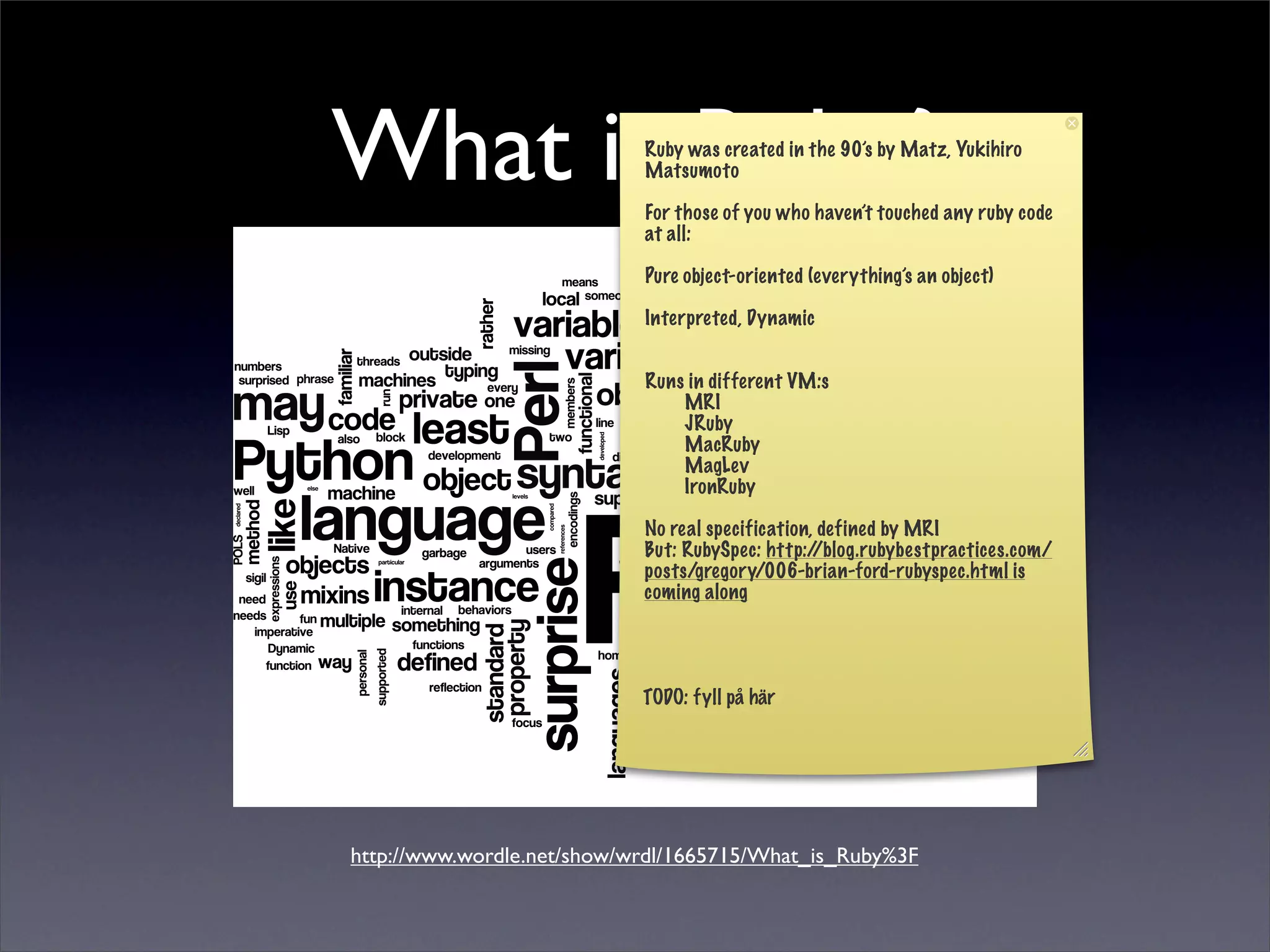
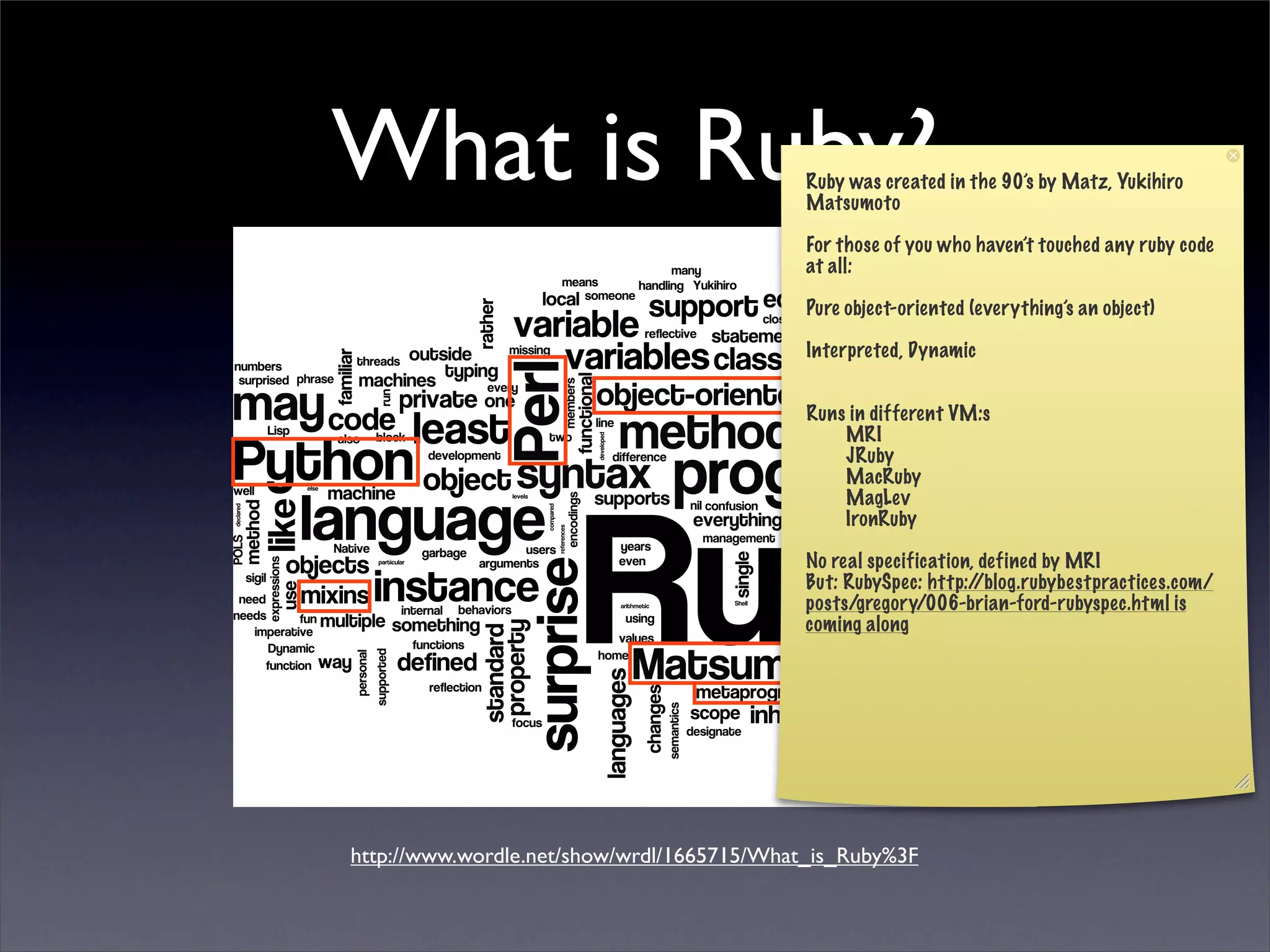
What is Ruby?               Ruby was created in the 90’s by Matz, Yukihiro
                            Matsumoto

                            For those of you who haven’t touched any ruby code
                            at all:

                            Pure object-oriented (everything’s an object)

                            Interpreted, Dynamic


                            Runs in different VM:s
                                MRI
                                JRuby
                                MacRuby
                                MagLev
                                IronRuby

                            No real specification, defined by MRI
                            But: RubySpec: http:/ /blog.rubybestpractices.com/
                            posts/gregory/006-brian-ford-rubyspec.html is
                            coming along


                            TODO: fyll på här


http://www.wordle.net/show/wrdl/1665715/What_is_Ruby%3F
What is Ruby?                               Ruby was created in the 90’s by Matz, Yukihiro
                                            Matsumoto

                                            For those of you who haven’t touched any ruby code
                                            at all:

                                            Pure object-oriented (everything’s an object)

                                            Interpreted, Dynamic


                                            Runs in different VM:s
                                                MRI
                                                JRuby
                                                MacRuby
                                                MagLev
                                                IronRuby

                                            No real specification, defined by MRI
                                            But: RubySpec: http:/ /blog.rubybestpractices.com/
                                            posts/gregory/006-brian-ford-rubyspec.html is
                                            coming along


http://www.wordle.net/show/wrdl/1665715/What_is_Ruby%3F
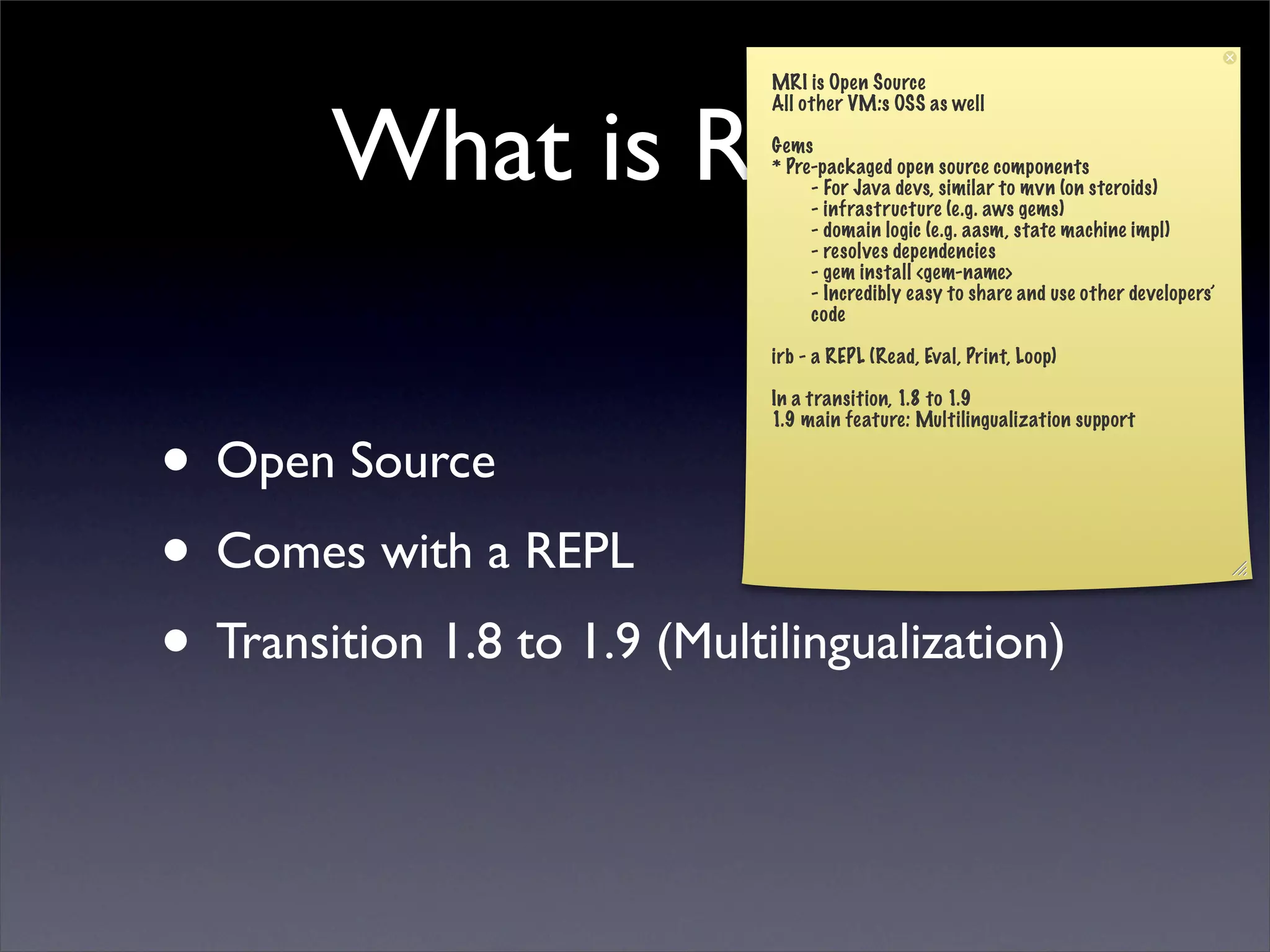
MRI is Open Source


        What is Ruby?
                              All other VM:s OSS as well

                              Gems
                              * Pre-packaged open source components
                                   - For Java devs, similar to mvn (on steroids)
                                   - infrastructure (e.g. aws gems)
                                   - domain logic (e.g. aasm, state machine impl)
                                   - resolves dependencies
                                   - gem install <gem-name>
                                   - Incredibly easy to share and use other developers’
                                   code

                              irb - a REPL (Read, Eval, Print, Loop)

                              In a transition, 1.8 to 1.9


• Open Source
                              1.9 main feature: Multilingualization support


• Comes with a REPL
• Transition 1.8 to 1.9 (Multilingualization)
Agenda
• What is Ruby?
• How does the
  language work?
• IronRuby specifics
• Where to apply
  IronRuby?
                      http://www.flickr.com/photos/puntodevista/84796578/
Hello world   Demo: “ir.exe 001_HelloWorld.rb”

                       Take-away:
                       1. You don’t have to use

                       public void main(string [] args) {
                            //code
                       }

                       2. You don’t have to use parenthesizes if the interpreter understands
                       your code
                       puts(“Hello World”)


• puts “Hello World”
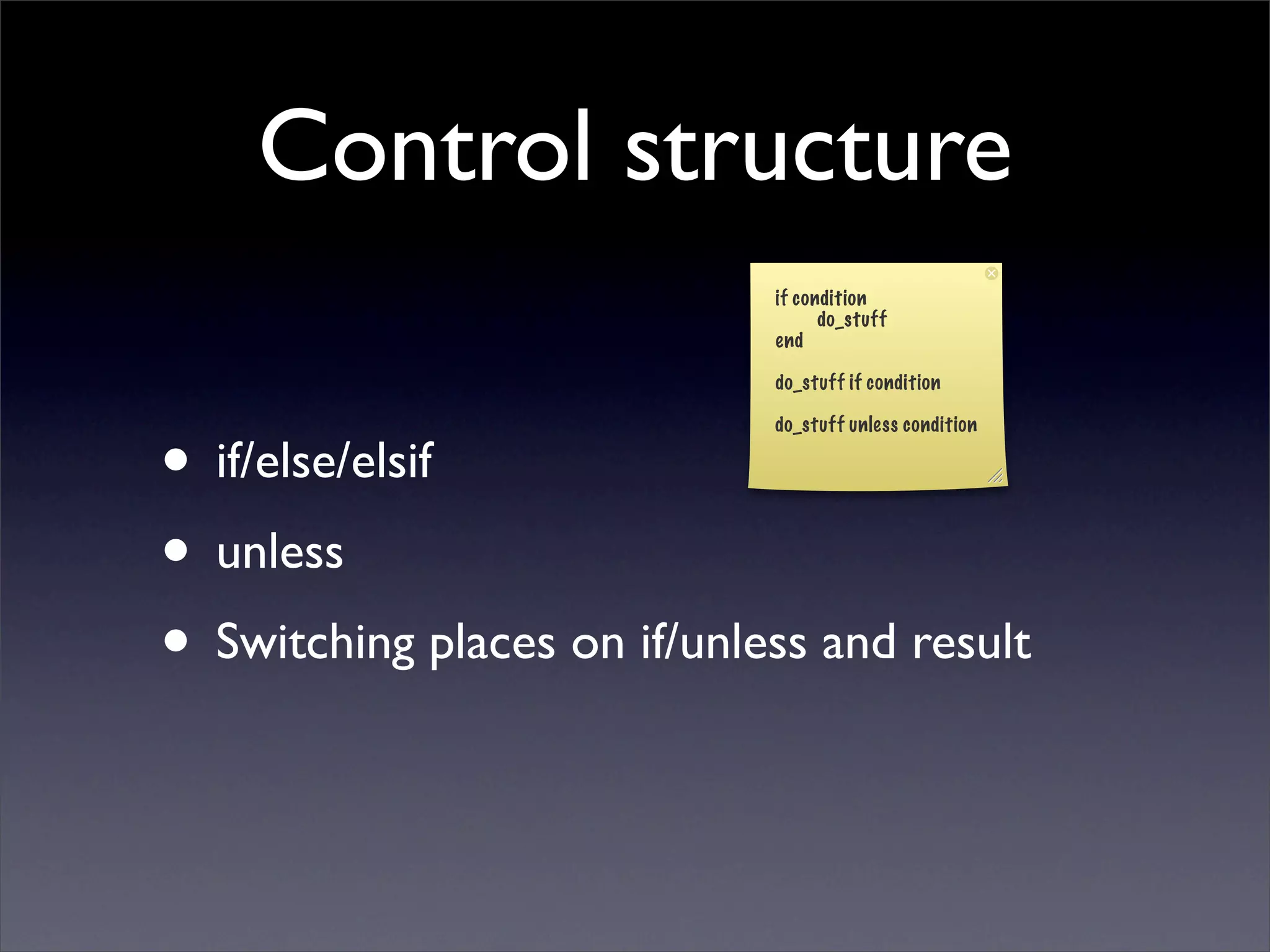
Control structure
                             if condition
                                   do_stuff
                             end

                             do_stuff if condition


• if/else/elsif
                             do_stuff unless condition


• unless
• Switching places on if/unless and result
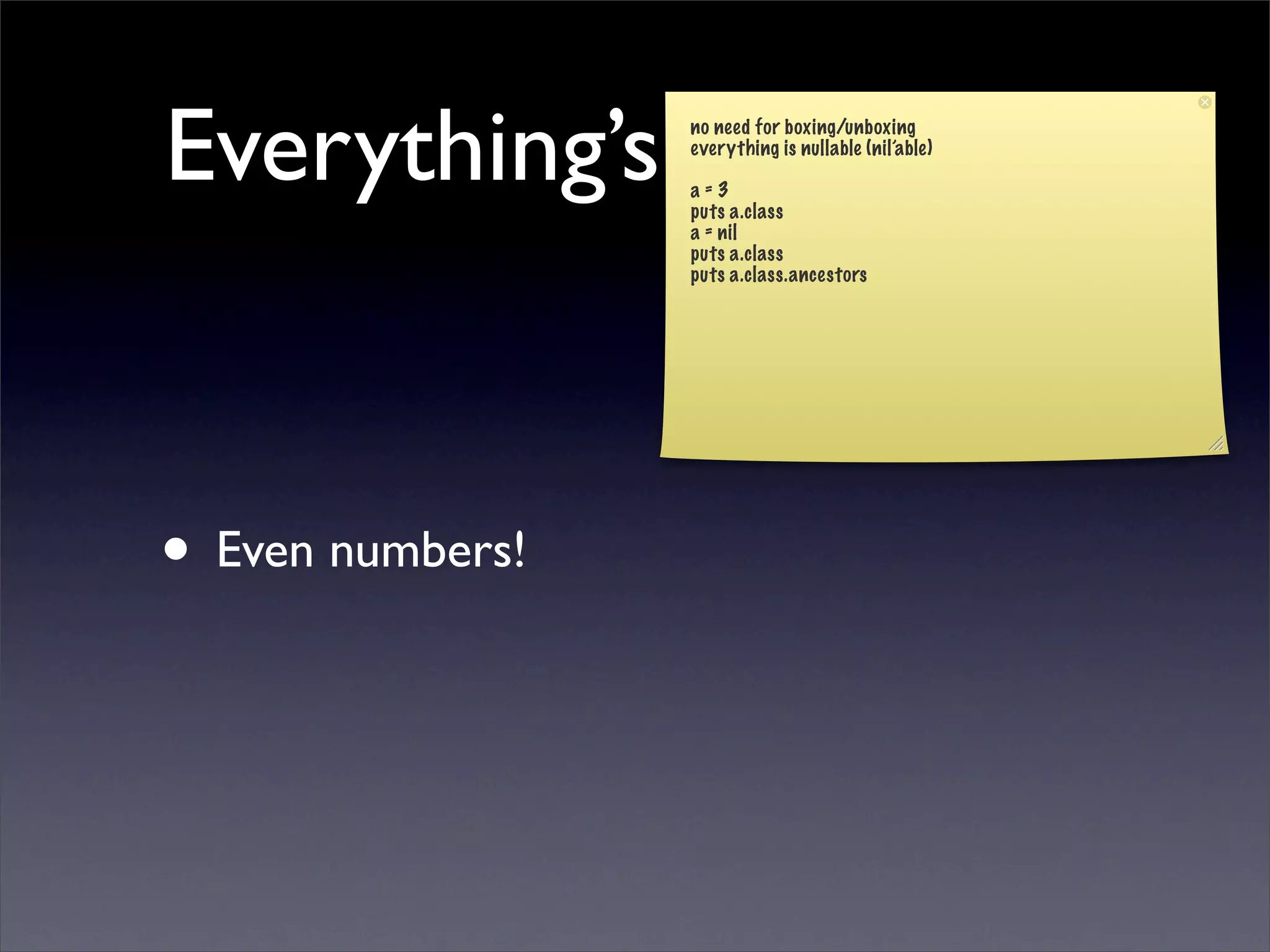
Everything’s an Object
                  no need for boxing/unboxing
                  everything is nullable (nil’able)

                  a=3
                  puts a.class
                  a = nil
                  puts a.class
                  puts a.class.ancestors


• Even numbers!
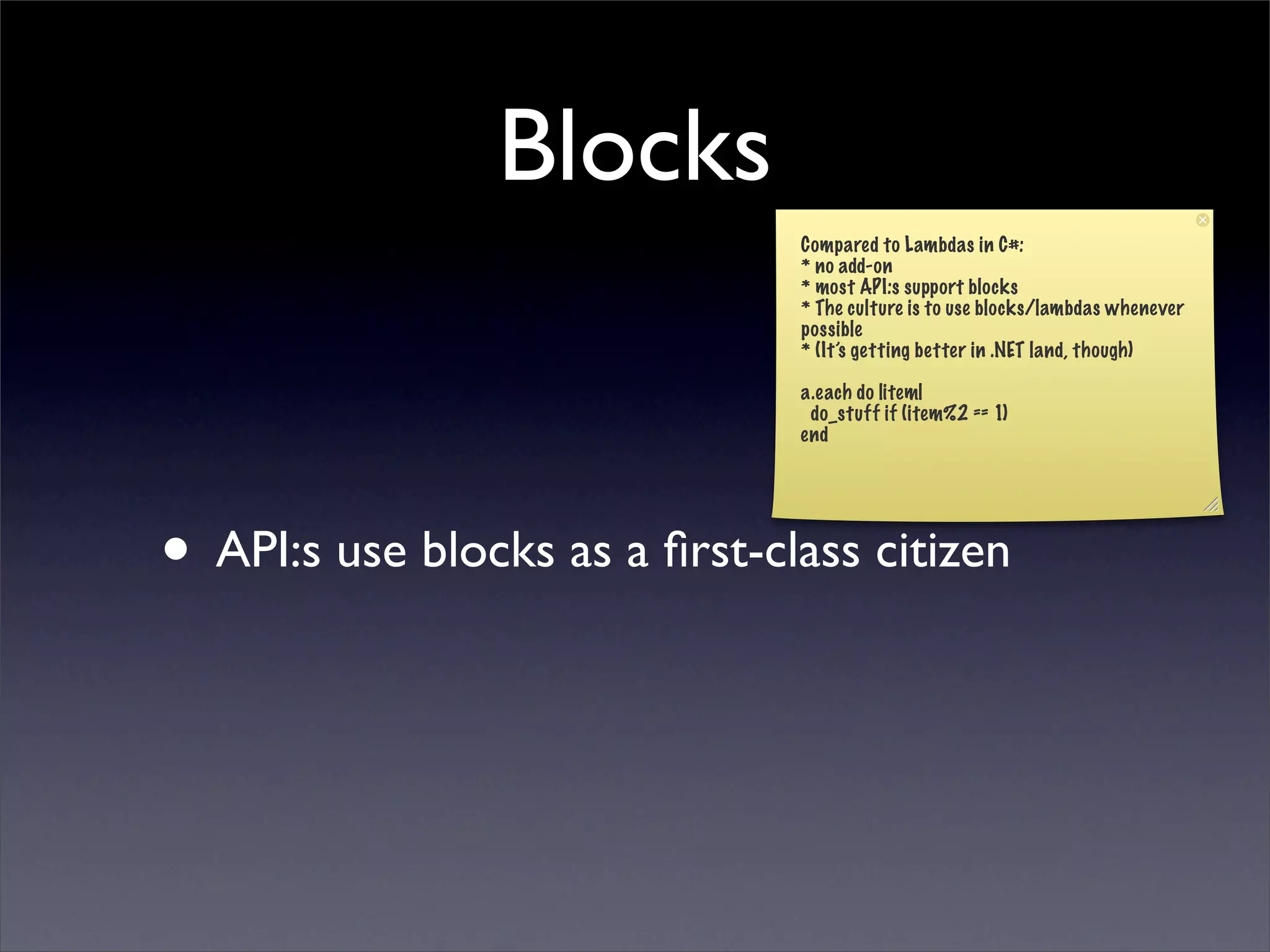
Blocks
                               Compared to Lambdas in C#:
                               * no add-on
                               * most API:s support blocks
                               * The culture is to use blocks/lambdas whenever
                               possible
                               * (It’s getting better in .NET land, though)

                               a.each do |item|
                                do_stuff if (item%2 == 1)
                               end


• API:s use blocks as a first-class citizen
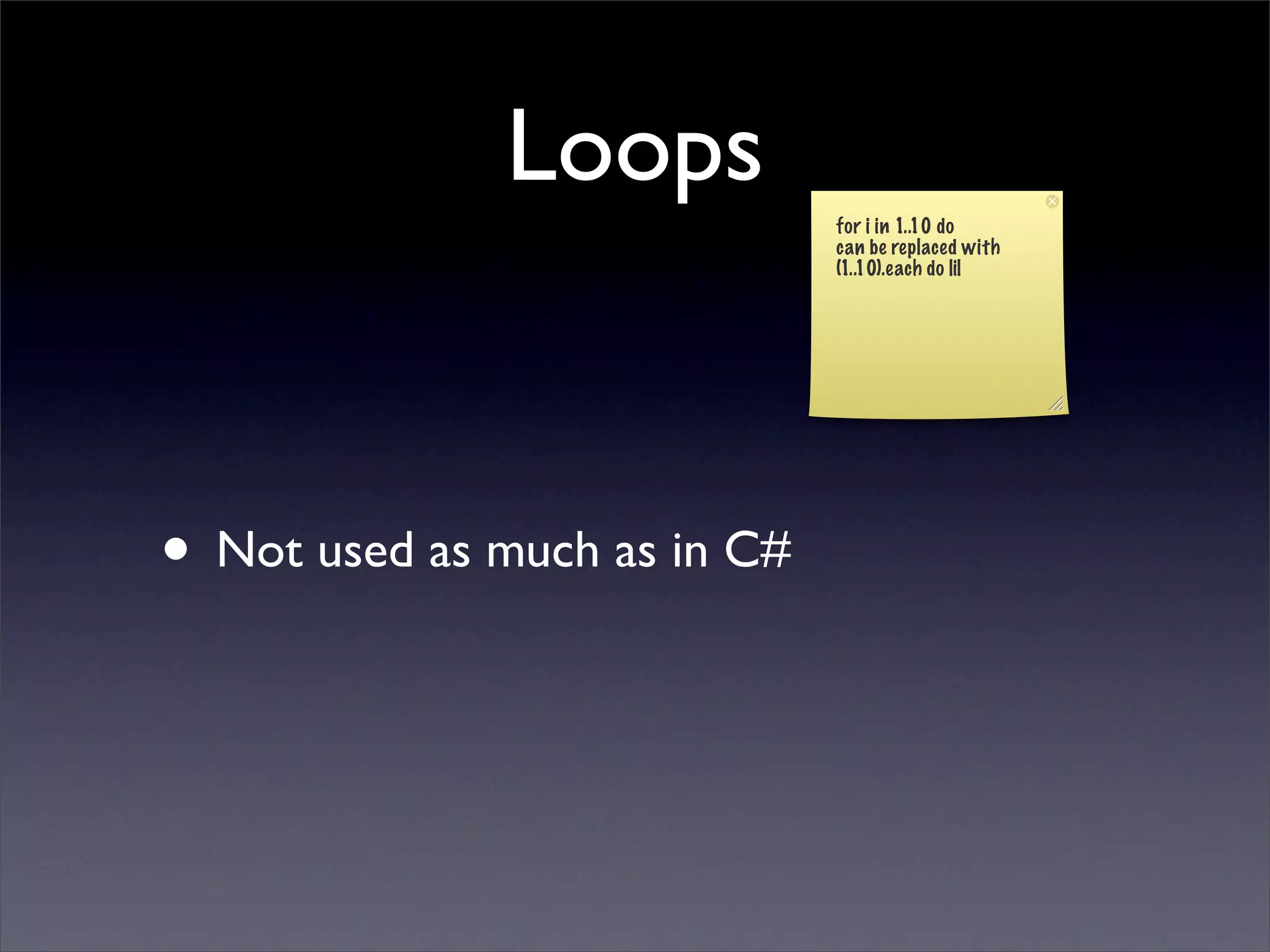
Loops
                              for i in 1..10 do
                              can be replaced with
                              (1..10).each do |i|


• Not used as much as in C#
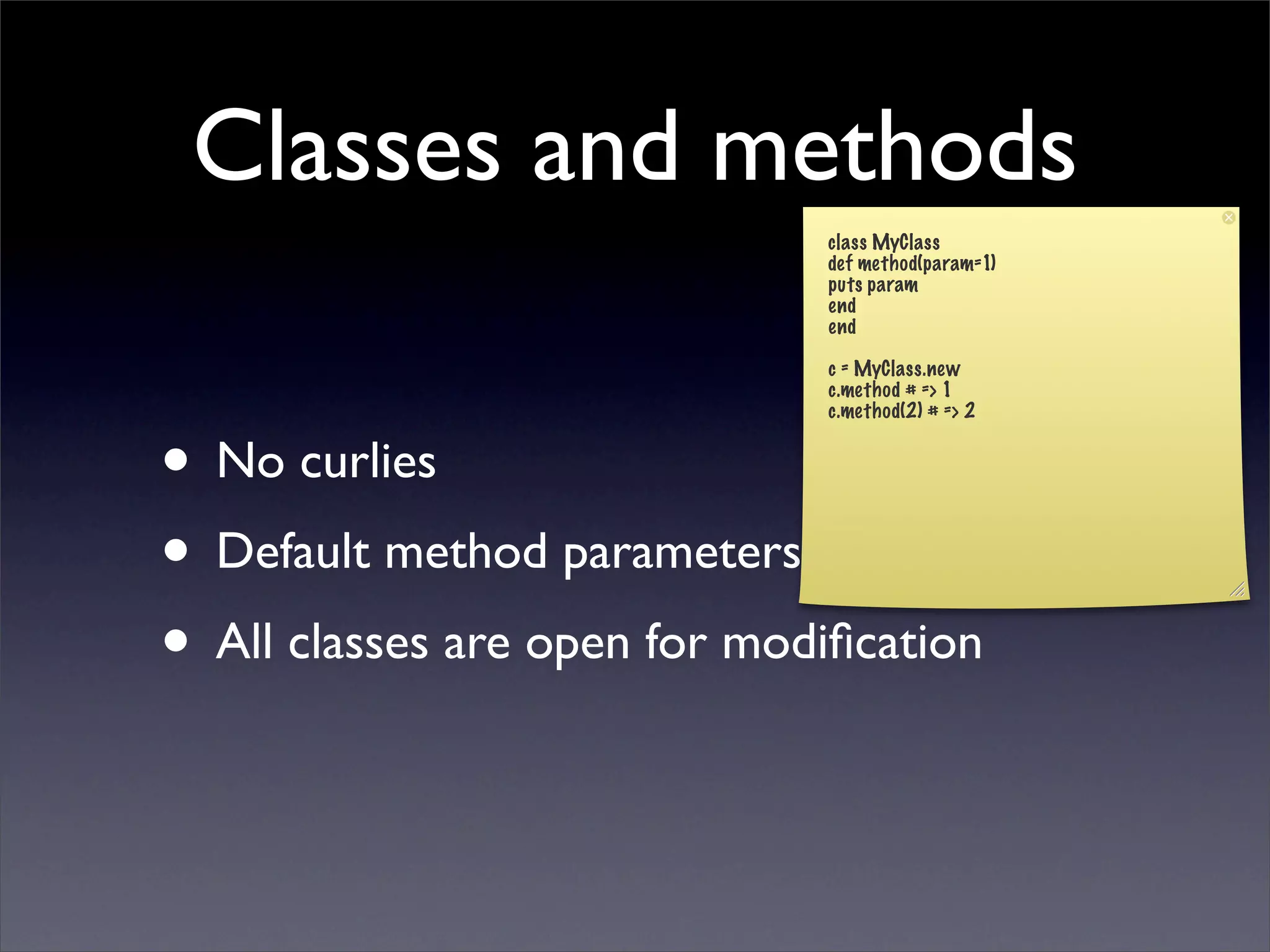
Classes and methods
                              class MyClass
                              def method(param=1)
                              puts param
                              end
                              end

                              c = MyClass.new
                              c.method # => 1
                              c.method(2) # => 2


• No curlies
• Default method parameters
• All classes are open for modification
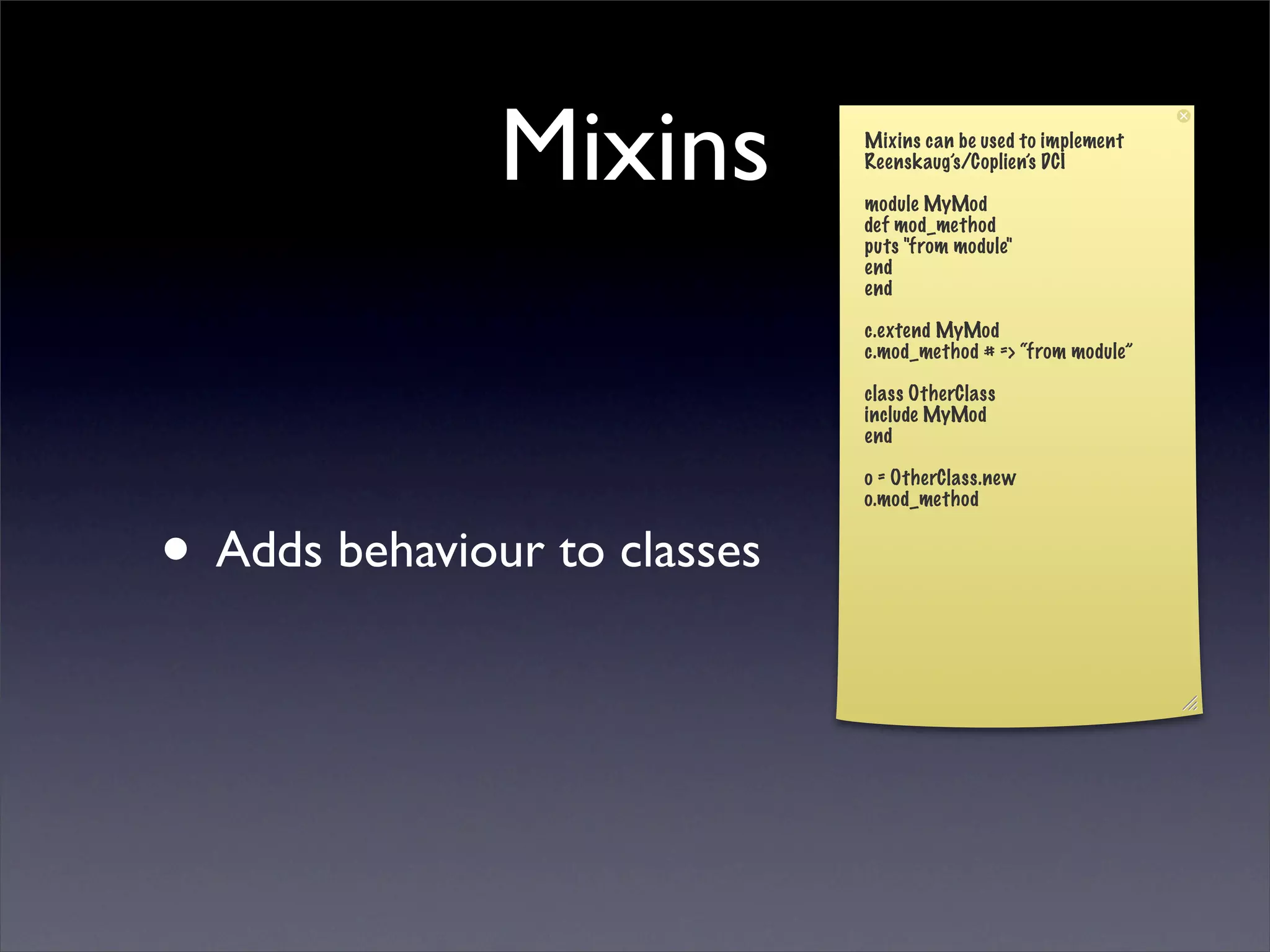
Mixins         Mixins can be used to implement
                              Reenskaug’s/Coplien’s DCI

                              module MyMod
                              def mod_method
                              puts "from module"
                              end
                              end

                              c.extend MyMod
                              c.mod_method # => “from module”

                              class OtherClass
                              include MyMod
                              end

                              o = OtherClass.new
                              o.mod_method


• Adds behaviour to classes
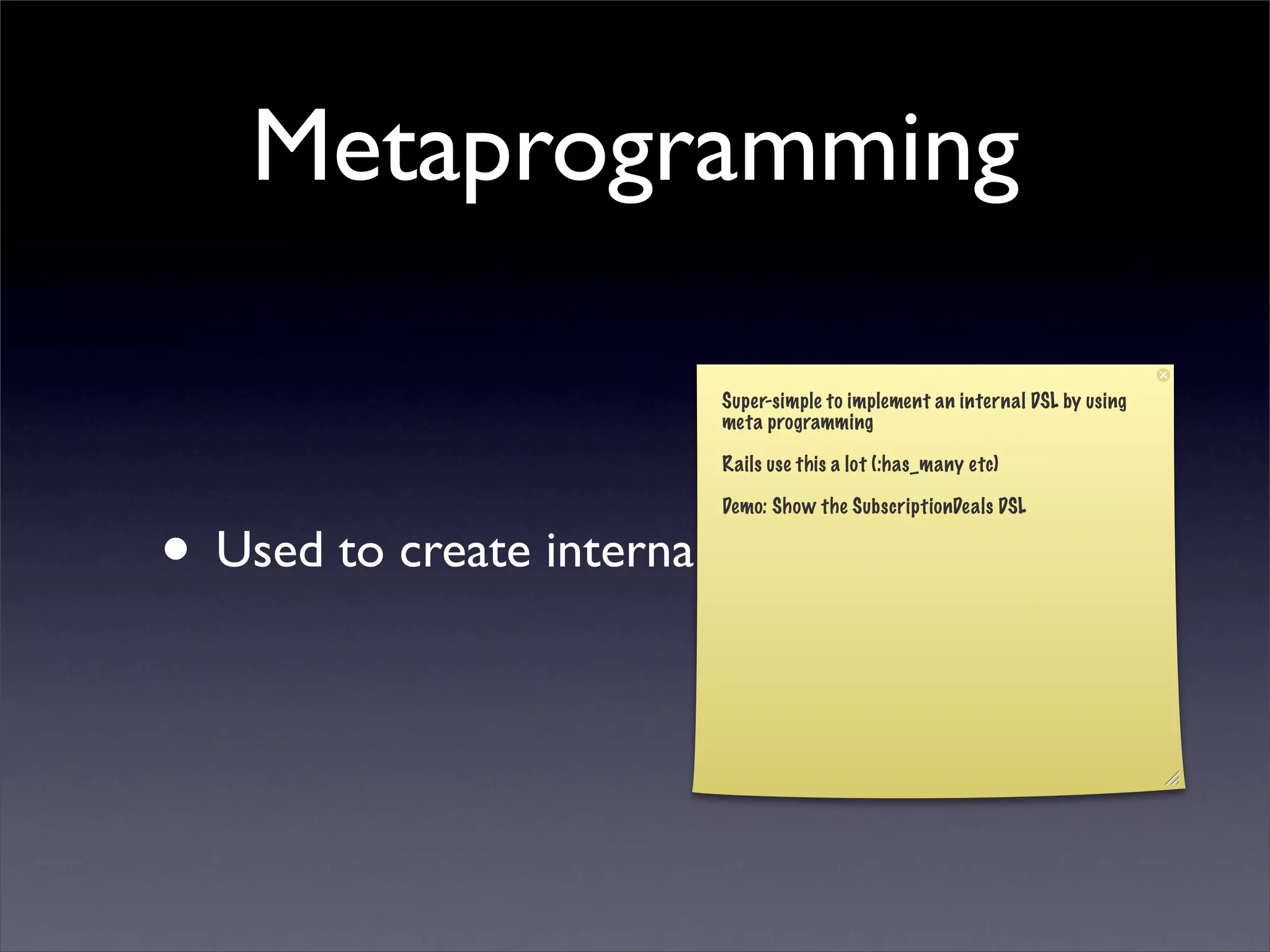
Metaprogramming

                         Super-simple to implement an internal DSL by using
                         meta programming

                         Rails use this a lot (:has_many etc)

                         Demo: Show the SubscriptionDeals DSL


• Used to create internal DSL:s
Agenda
• What is Ruby?
• How does the
  language work?
• IronRuby specifics
• Where to apply
  IronRuby?
                      http://www.flickr.com/photos/puntodevista/84796578/
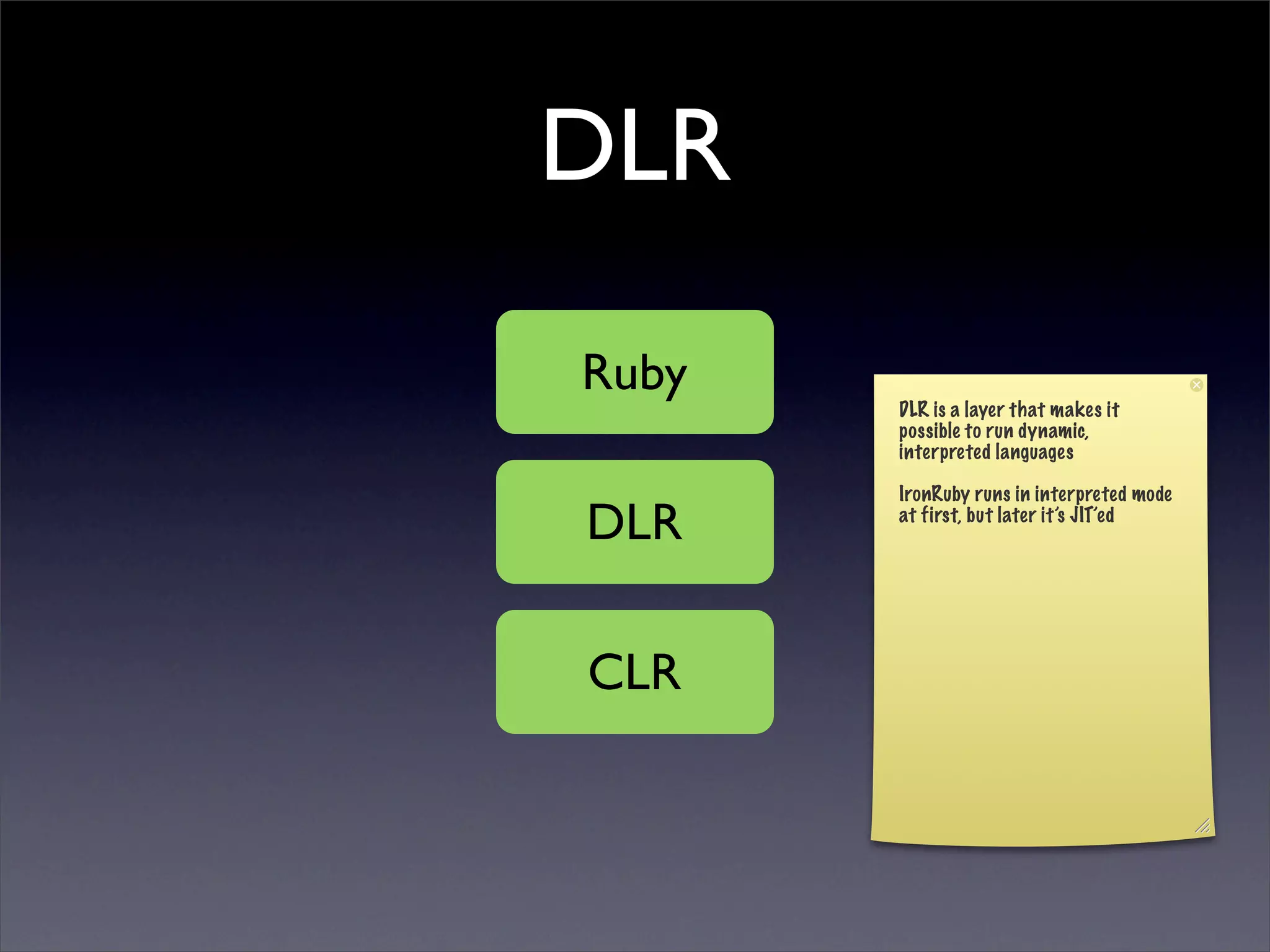
DLR

Ruby
       DLR is a layer that makes it
       possible to run dynamic,
       interpreted languages

       IronRuby runs in interpreted mode
DLR    at first, but later it’s JIT’ed


CLR
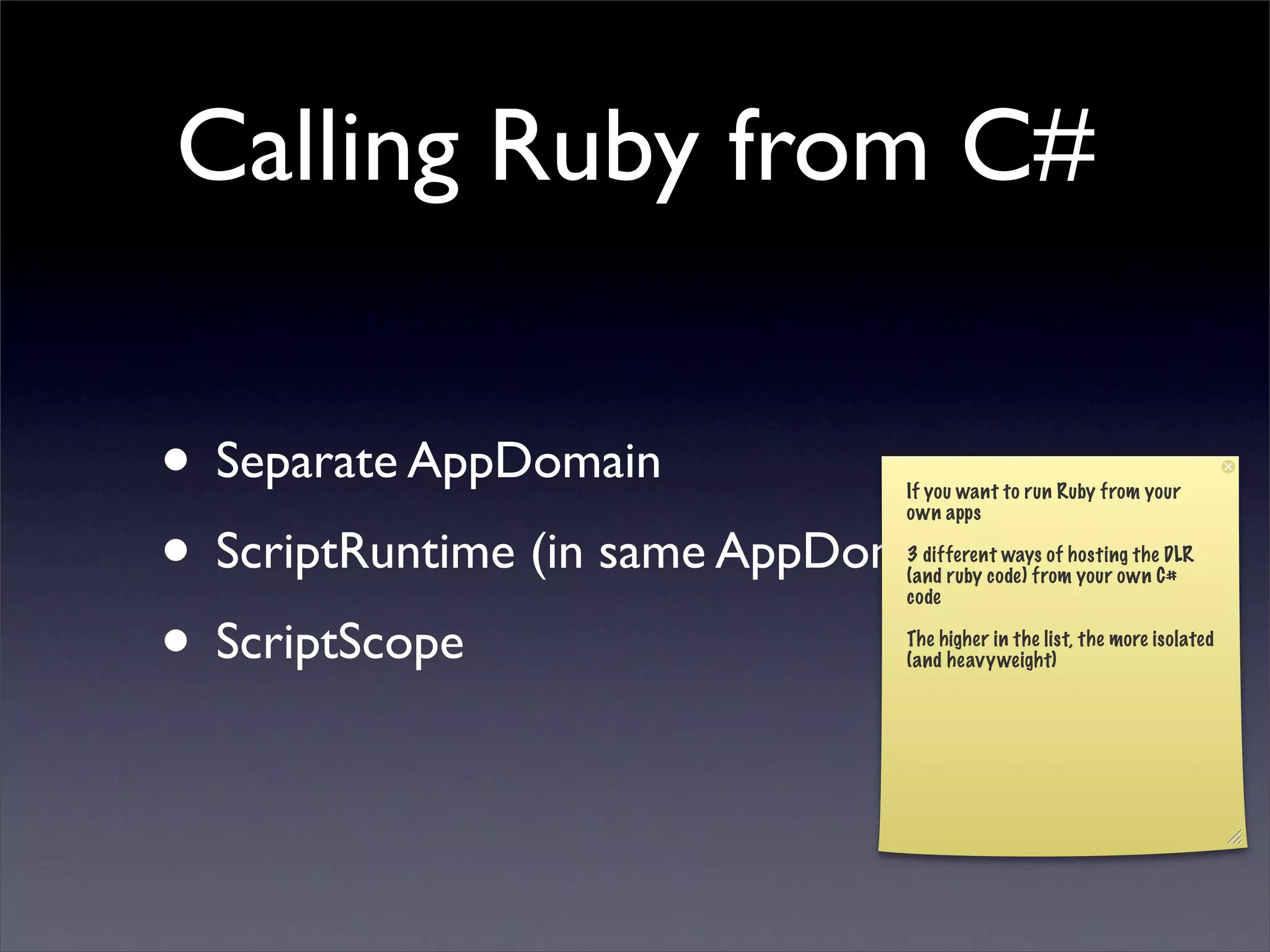
Calling Ruby from C#

• Separate AppDomain           If you want to run Ruby from your


• ScriptRuntime (in same AppDomain)
                               own apps

                               3 different ways of hosting the DLR
                               (and ruby code) from your own C#
                               code


• ScriptScope                  The higher in the list, the more isolated
                               (and heavyweight)
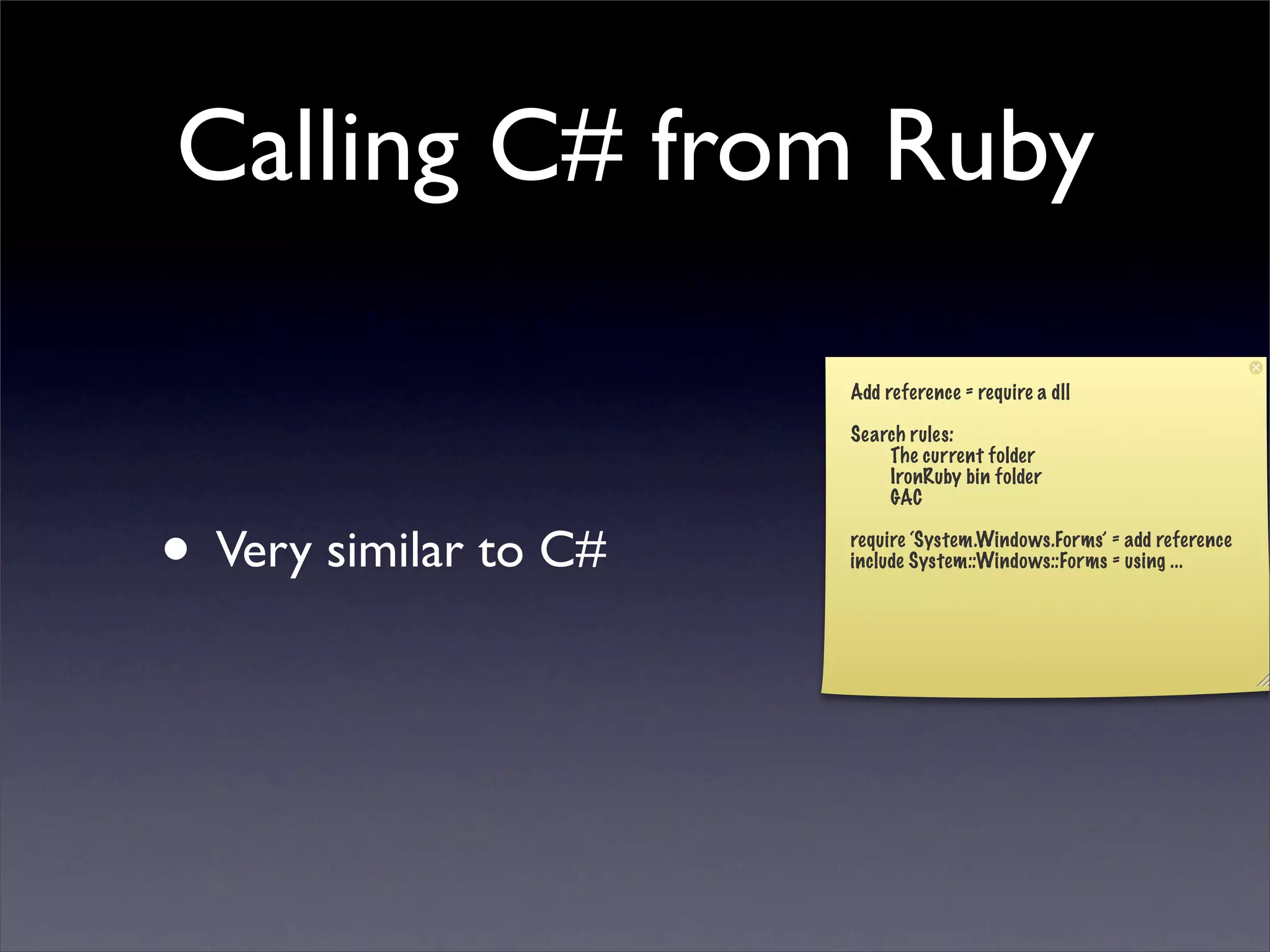
Calling C# from Ruby

                       Add reference = require a dll

                       Search rules:
                           The current folder
                           IronRuby bin folder
                           GAC


• Very similar to C#   require ‘System.Windows.Forms’ = add reference
                       include System::Windows::Forms = using ...
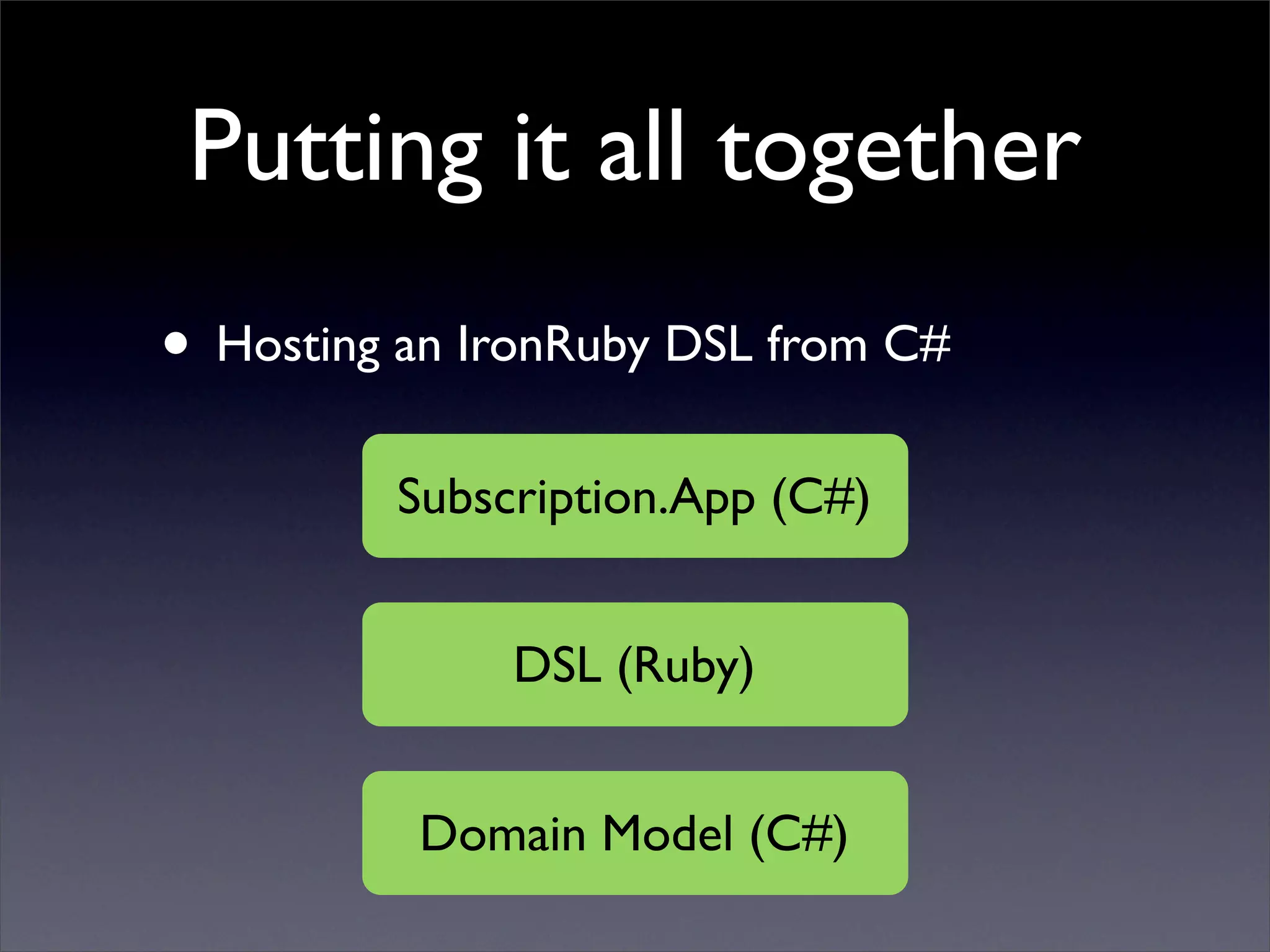
Putting it all together
• Hosting an IronRuby DSL from C#
         Subscription.App (C#)


              DSL (Ruby)


          Domain Model (C#)
Agenda
• What is Ruby?
• How does the
  language work?
• IronRuby specifics
• Where to apply
  IronRuby?
                      http://www.flickr.com/photos/puntodevista/84796578/
Web
                            Ruby on Rails
                            - the big reason ruby is so popular

                            For light-weight web solutions (some json etc): Sinatra


http://rubyonrails.org/                       http://www.sinatrarb.com
DSL:s
                            Using ruby in a subset of
                            the product

                            -if reqs often change and
                            we can’t wait for a re-
                            deploy e.g. rules engine
                            for a stock-trading app


• Internal DSL:s + Ruby = a treat
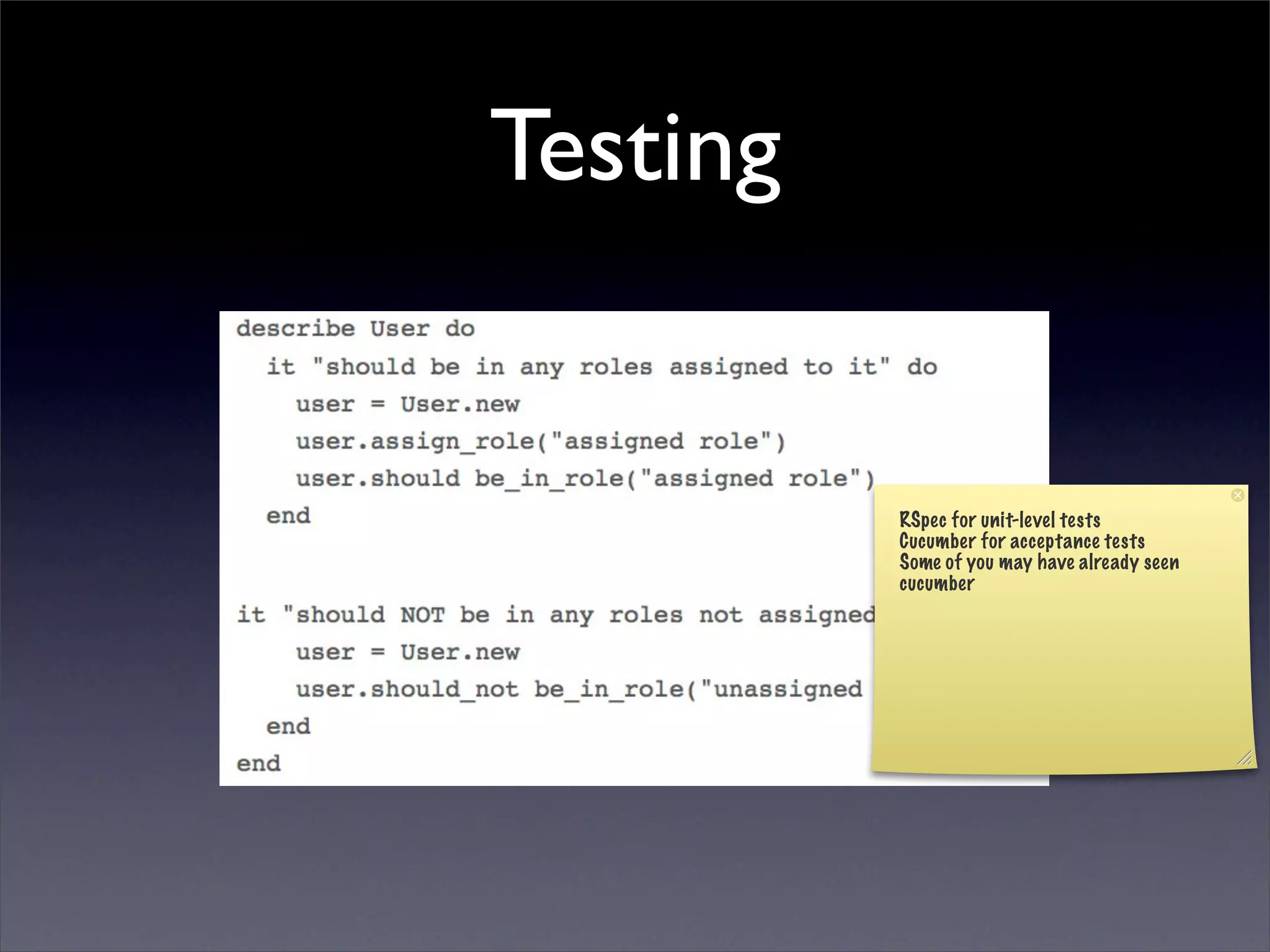
Testing


          RSpec for unit-level tests
          Cucumber for acceptance tests
          Some of you may have already seen
          cucumber
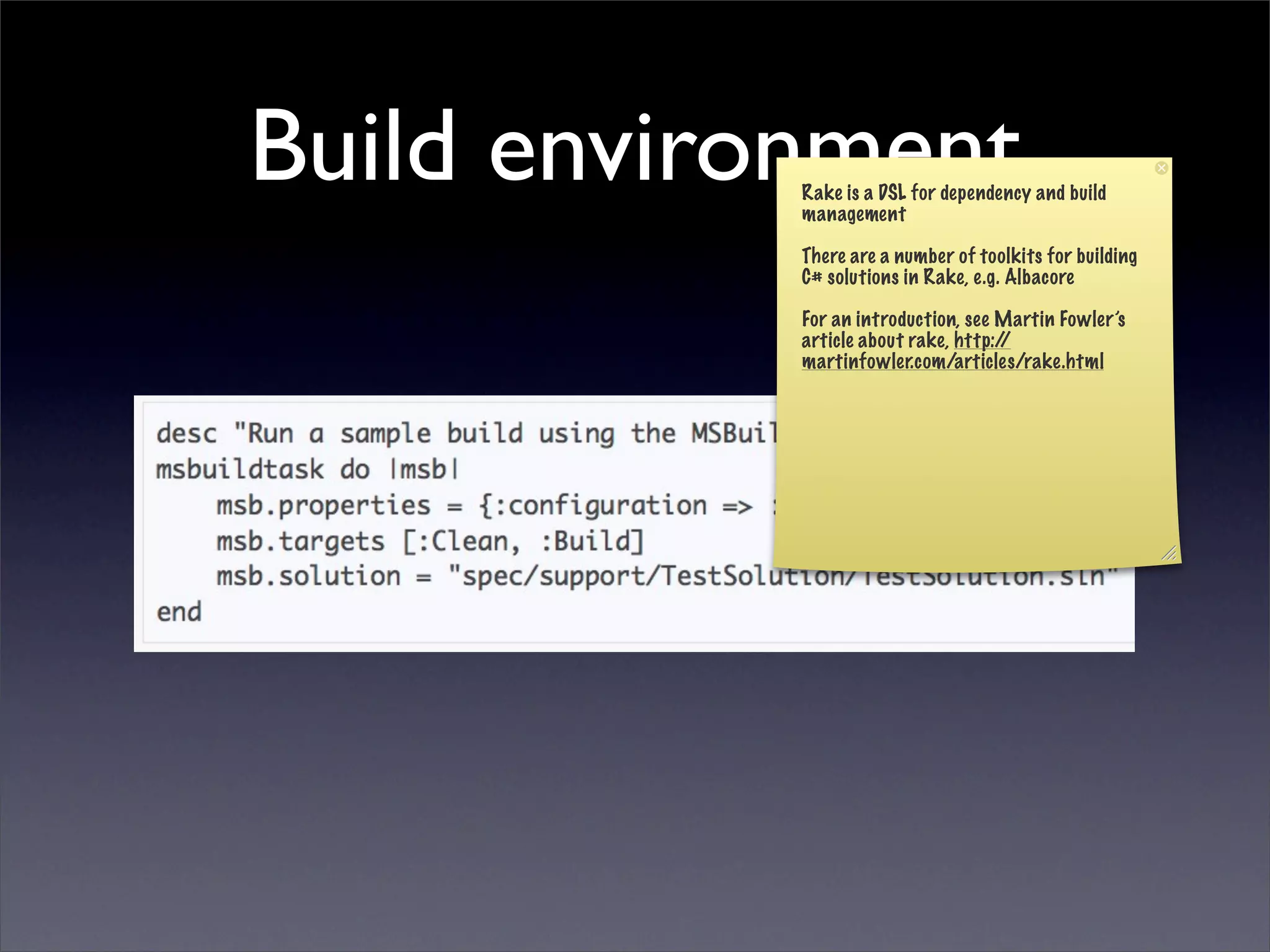
Build environment
            Rake is a DSL for dependency and build
            management

            There are a number of toolkits for building
            C# solutions in Rake, e.g. Albacore

            For an introduction, see Martin Fowler’s
            article about rake, http://
            martinfowler.com/articles/rake.html
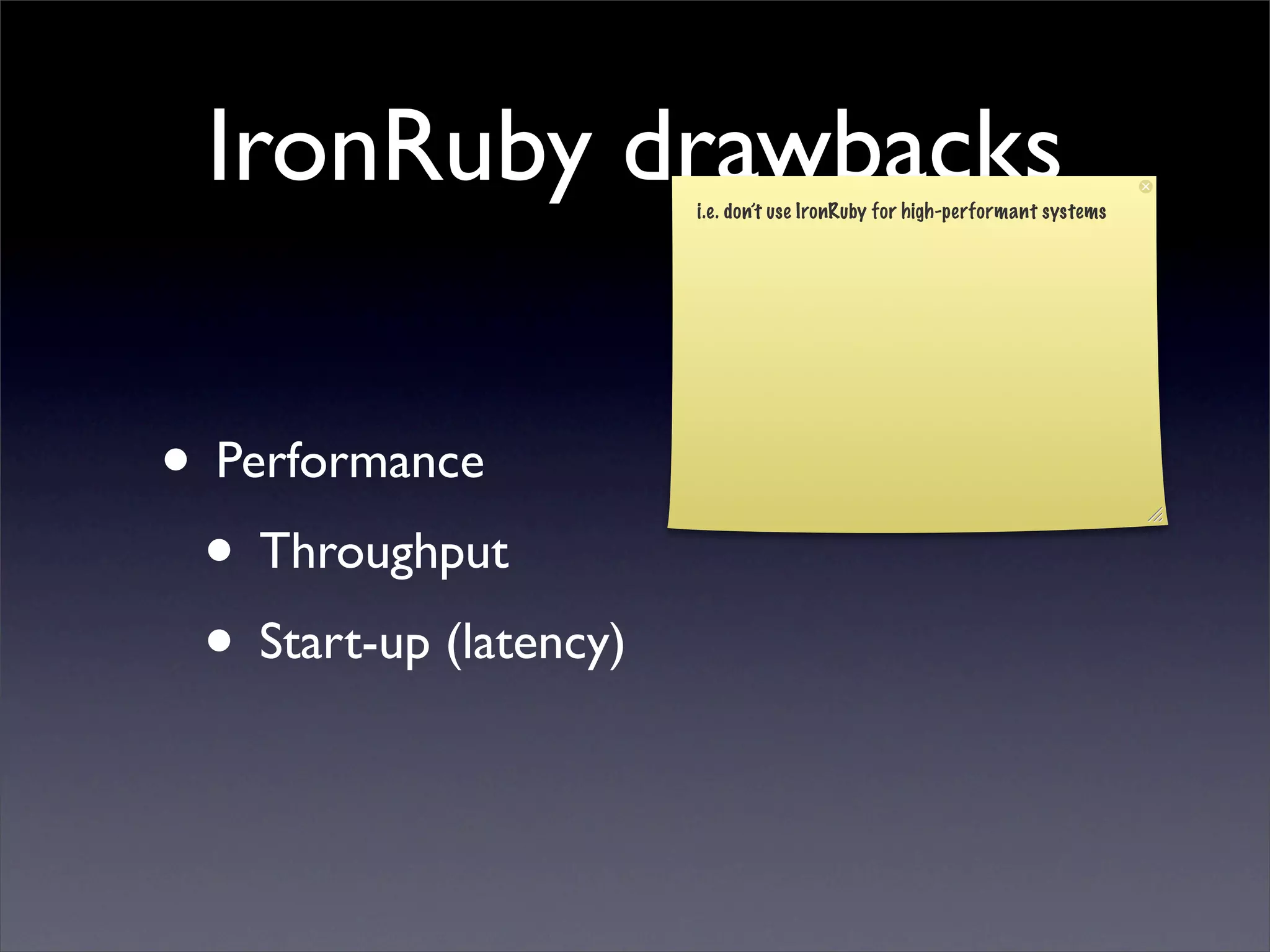
IronRuby drawbacks    i.e. don’t use IronRuby for high-performant systems


• Performance
 • Throughput
 • Start-up (latency)
Thanks!

• Thomas Lundström, Softhouse
• thomas.lundstrom@softhouse.se
• Twitter: @thomaslundstrom
• http://blog.thomaslundstrom.com

Ruby for C#-ers (ScanDevConf 2010)

  • 1.
    Ruby for C#-ers Thomas Lundström, Softhouse Scandinavian Developer Conference, Göteborg March 17, 2010
  • 2.
    Agenda • What isRuby? • How does the language work? • IronRuby specifics • Where to apply IronRuby? http://www.flickr.com/photos/puntodevista/84796578/
  • 3.
    Agenda • What isRuby? • How does the language work? • IronRuby specifics • Where to apply IronRuby? http://www.flickr.com/photos/puntodevista/84796578/
  • 4.
    What is Ruby? Ruby was created in the 90’s by Matz, Yukihiro Matsumoto For those of you who haven’t touched any ruby code at all: Pure object-oriented (everything’s an object) Interpreted, Dynamic Runs in different VM:s MRI JRuby MacRuby MagLev IronRuby No real specification, defined by MRI But: RubySpec: http:/ /blog.rubybestpractices.com/ posts/gregory/006-brian-ford-rubyspec.html is coming along TODO: fyll på här http://www.wordle.net/show/wrdl/1665715/What_is_Ruby%3F
  • 5.
    What is Ruby? Ruby was created in the 90’s by Matz, Yukihiro Matsumoto For those of you who haven’t touched any ruby code at all: Pure object-oriented (everything’s an object) Interpreted, Dynamic Runs in different VM:s MRI JRuby MacRuby MagLev IronRuby No real specification, defined by MRI But: RubySpec: http:/ /blog.rubybestpractices.com/ posts/gregory/006-brian-ford-rubyspec.html is coming along http://www.wordle.net/show/wrdl/1665715/What_is_Ruby%3F
  • 6.
    MRI is OpenSource What is Ruby? All other VM:s OSS as well Gems * Pre-packaged open source components - For Java devs, similar to mvn (on steroids) - infrastructure (e.g. aws gems) - domain logic (e.g. aasm, state machine impl) - resolves dependencies - gem install <gem-name> - Incredibly easy to share and use other developers’ code irb - a REPL (Read, Eval, Print, Loop) In a transition, 1.8 to 1.9 • Open Source 1.9 main feature: Multilingualization support • Comes with a REPL • Transition 1.8 to 1.9 (Multilingualization)
  • 7.
    Agenda • What isRuby? • How does the language work? • IronRuby specifics • Where to apply IronRuby? http://www.flickr.com/photos/puntodevista/84796578/
  • 8.
    Hello world Demo: “ir.exe 001_HelloWorld.rb” Take-away: 1. You don’t have to use public void main(string [] args) { //code } 2. You don’t have to use parenthesizes if the interpreter understands your code puts(“Hello World”) • puts “Hello World”
  • 9.
    Control structure if condition do_stuff end do_stuff if condition • if/else/elsif do_stuff unless condition • unless • Switching places on if/unless and result
  • 10.
    Everything’s an Object no need for boxing/unboxing everything is nullable (nil’able) a=3 puts a.class a = nil puts a.class puts a.class.ancestors • Even numbers!
  • 11.
    Blocks Compared to Lambdas in C#: * no add-on * most API:s support blocks * The culture is to use blocks/lambdas whenever possible * (It’s getting better in .NET land, though) a.each do |item| do_stuff if (item%2 == 1) end • API:s use blocks as a first-class citizen
  • 12.
    Loops for i in 1..10 do can be replaced with (1..10).each do |i| • Not used as much as in C#
  • 13.
    Classes and methods class MyClass def method(param=1) puts param end end c = MyClass.new c.method # => 1 c.method(2) # => 2 • No curlies • Default method parameters • All classes are open for modification
  • 14.
    Mixins Mixins can be used to implement Reenskaug’s/Coplien’s DCI module MyMod def mod_method puts "from module" end end c.extend MyMod c.mod_method # => “from module” class OtherClass include MyMod end o = OtherClass.new o.mod_method • Adds behaviour to classes
  • 15.
    Metaprogramming Super-simple to implement an internal DSL by using meta programming Rails use this a lot (:has_many etc) Demo: Show the SubscriptionDeals DSL • Used to create internal DSL:s
  • 16.
    Agenda • What isRuby? • How does the language work? • IronRuby specifics • Where to apply IronRuby? http://www.flickr.com/photos/puntodevista/84796578/
  • 17.
    DLR Ruby DLR is a layer that makes it possible to run dynamic, interpreted languages IronRuby runs in interpreted mode DLR at first, but later it’s JIT’ed CLR
  • 18.
    Calling Ruby fromC# • Separate AppDomain If you want to run Ruby from your • ScriptRuntime (in same AppDomain) own apps 3 different ways of hosting the DLR (and ruby code) from your own C# code • ScriptScope The higher in the list, the more isolated (and heavyweight)
  • 19.
    Calling C# fromRuby Add reference = require a dll Search rules: The current folder IronRuby bin folder GAC • Very similar to C# require ‘System.Windows.Forms’ = add reference include System::Windows::Forms = using ...
  • 20.
    Putting it alltogether • Hosting an IronRuby DSL from C# Subscription.App (C#) DSL (Ruby) Domain Model (C#)
  • 21.
    Agenda • What isRuby? • How does the language work? • IronRuby specifics • Where to apply IronRuby? http://www.flickr.com/photos/puntodevista/84796578/
  • 22.
    Web Ruby on Rails - the big reason ruby is so popular For light-weight web solutions (some json etc): Sinatra http://rubyonrails.org/ http://www.sinatrarb.com
  • 23.
    DSL:s Using ruby in a subset of the product -if reqs often change and we can’t wait for a re- deploy e.g. rules engine for a stock-trading app • Internal DSL:s + Ruby = a treat
  • 24.
    Testing RSpec for unit-level tests Cucumber for acceptance tests Some of you may have already seen cucumber
  • 25.
    Build environment Rake is a DSL for dependency and build management There are a number of toolkits for building C# solutions in Rake, e.g. Albacore For an introduction, see Martin Fowler’s article about rake, http:// martinfowler.com/articles/rake.html
  • 26.
    IronRuby drawbacks i.e. don’t use IronRuby for high-performant systems • Performance • Throughput • Start-up (latency)
  • 27.
    Thanks! • Thomas Lundström,Softhouse • thomas.lundstrom@softhouse.se • Twitter: @thomaslundstrom • http://blog.thomaslundstrom.com