Root Cause & Radical Debate powerpoint presentation
1.
Radical Means Root:Winning Root Cause
Debates
Becca Traber, NSD 2023
https://bit.ly/2UIdUga
2.
Structure of thisTalk
● Going deep into what is a root cause, why we talk about root causes, and
some intellectual history that is going to seem pointless to you.
● I promise you that it isn’t.
● The second-half of the talk is about using the lessons of the first half to
help move the root cause debates you’re having beyond the chicken and
the egg problem, and help you start to think systematically about
winning them against every type of K argument and in every situation.
3.
Why do weassume that the root cause is important?
What makes us think that the cause of the thing has any relevance to how we
go about fixing it?
This is intuitive, but why is it intuitive and where does the strong trend in
critical literature come from?
Also, why do we even think there is a root cause?
The Root Causeis not...
● … the first cause.
● … the biggest cause.
● … the most recent cause.
The root cause is something very specific -- it’s the most foundational cause. It’s a special type of
cause. It’s the cause that radicals have to be concerned with. It’s the cause where you can pull up
the whole mess “by the root” and get rid of it.
It’s the cause upon which you can’t ask “why” anymore, the cause that can’t be removed from
within the system or explained by anything else in the system. It’s the cause that can’t be
explained.
6.
The history ofall hitherto existing society is the
history of class struggles.
- Marx & Engels, Manifesto of the Communist
Party
MARX!
7.
Marx is Why
Marxis why we think the root cause is important.
Marx is why we think there is a singular root cause.
Understanding why Marx thinks that can give us important guidelines for
how to win these debates.
Dialectical
So actually it’sHegel’s fault.
● The “dialectic” comes from Plato, and for him it was a “method of
questioning opinions in search of higher truth.”
● But Marx’s dialectic is from Hegel.
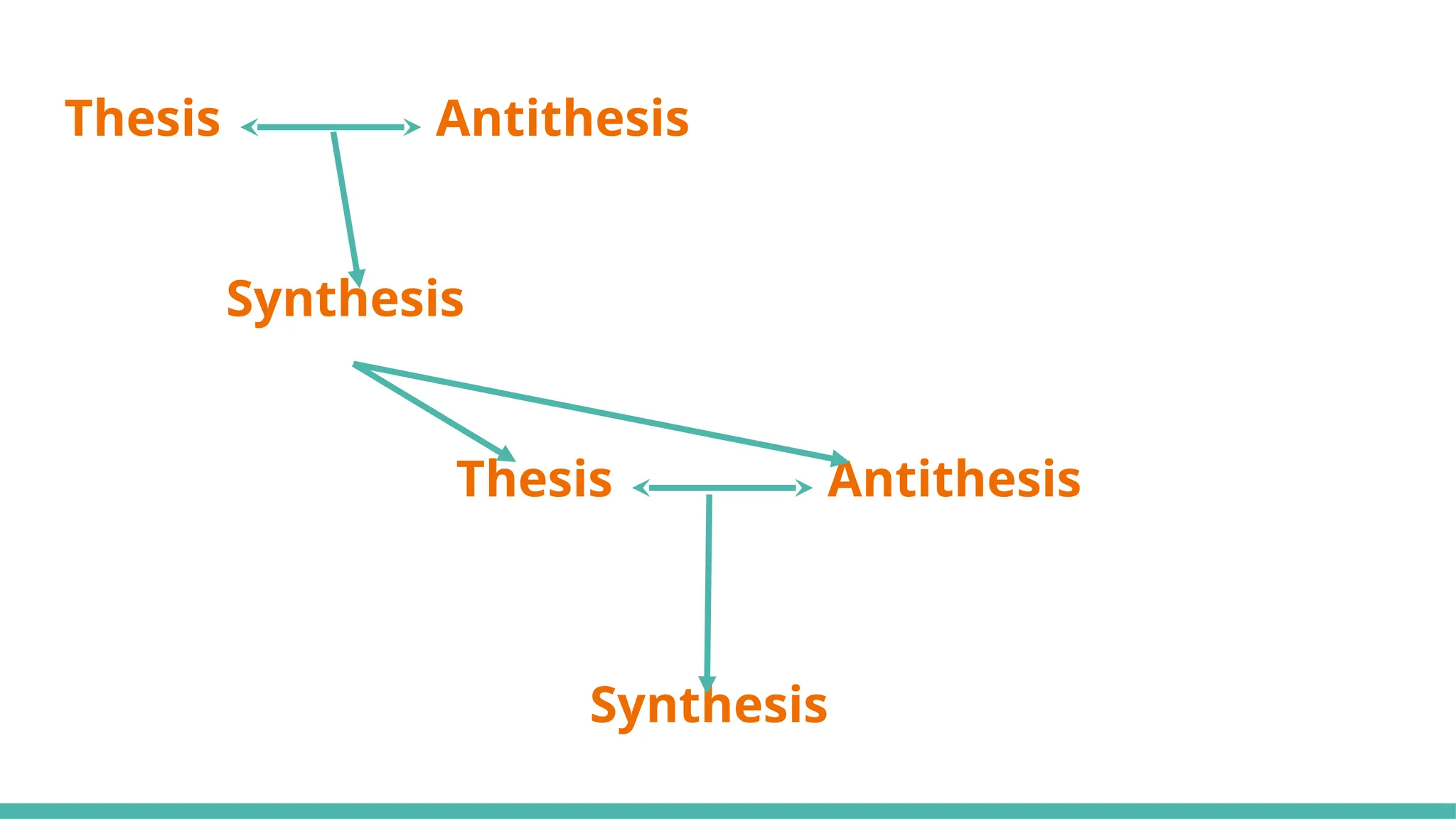
● Dialectical thinking is a logic of change through contradiction.
● The means of change is within the system, not outside the system.
● And, for both Marx and Hegel, the dialectic unfolds through history.
Materialism
Why Dialectics?
● Hegelwas trying to show that reason unfolds through history by itself,
without direct observation from human beings -- that the same dialectical
logic exists both in our own thought and in the world itself.
● And why is it dialectical? It is a theory of change that doesn’t need anyone
to do the changing. It is a theory of movement that doesn’t need anyone
to push.
● This is hugely important when we think about the way it is used in modern
ideas of the K -- we don’t want to say people chose to establish this
structures, we want to say that the structures are moving themselves.
Dialectical
● But Hegelthought the change in history was the same as the way that
reason developed-- it was about ideas, and contradictions in ideas.
● Marx thinks change happens because of contradictions in material things.
● Matter is the level upon which explanation makes sense.
● Ideas are the result of a particular material structure.
Materialism
The Economy ExplainsAll
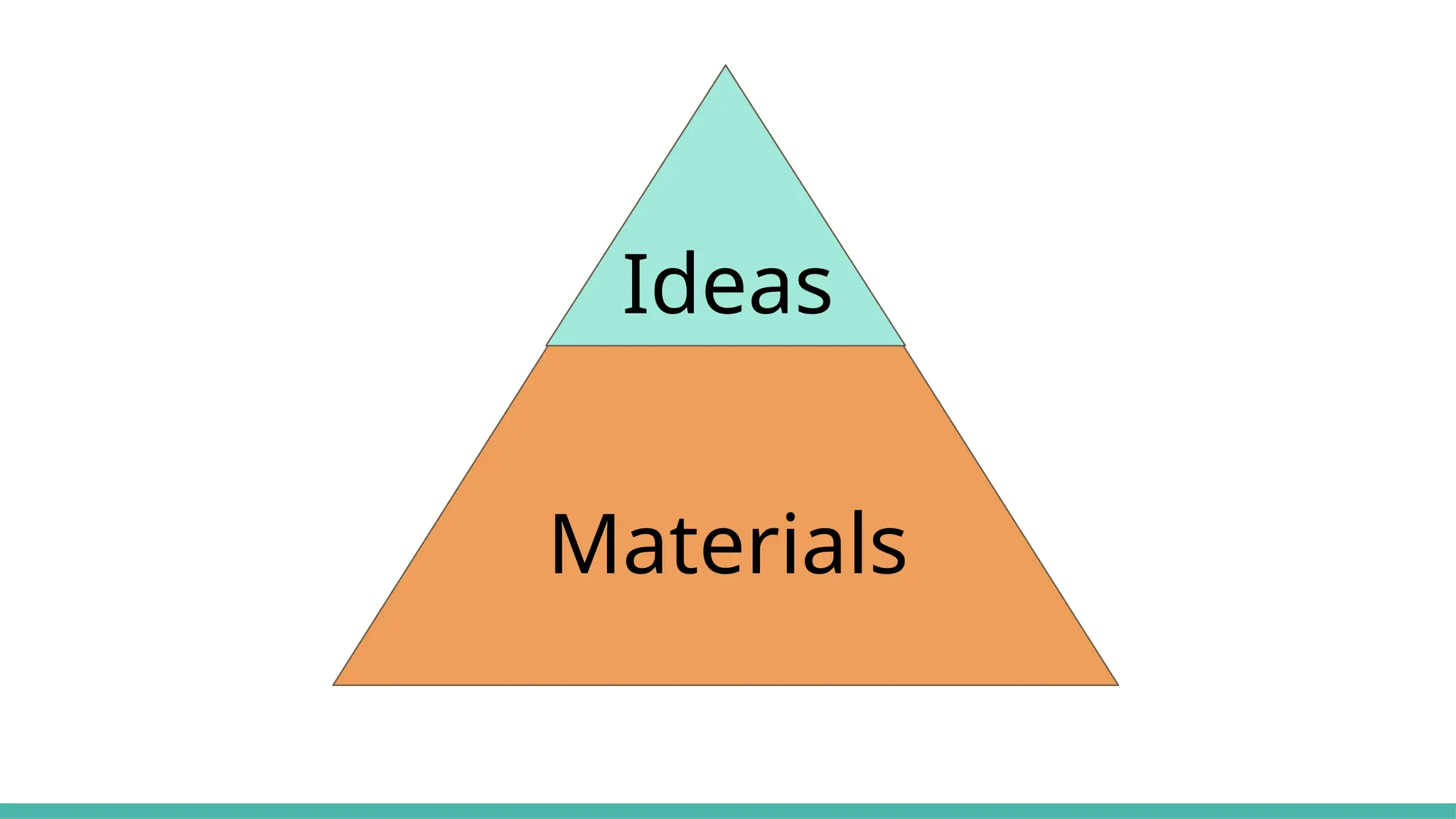
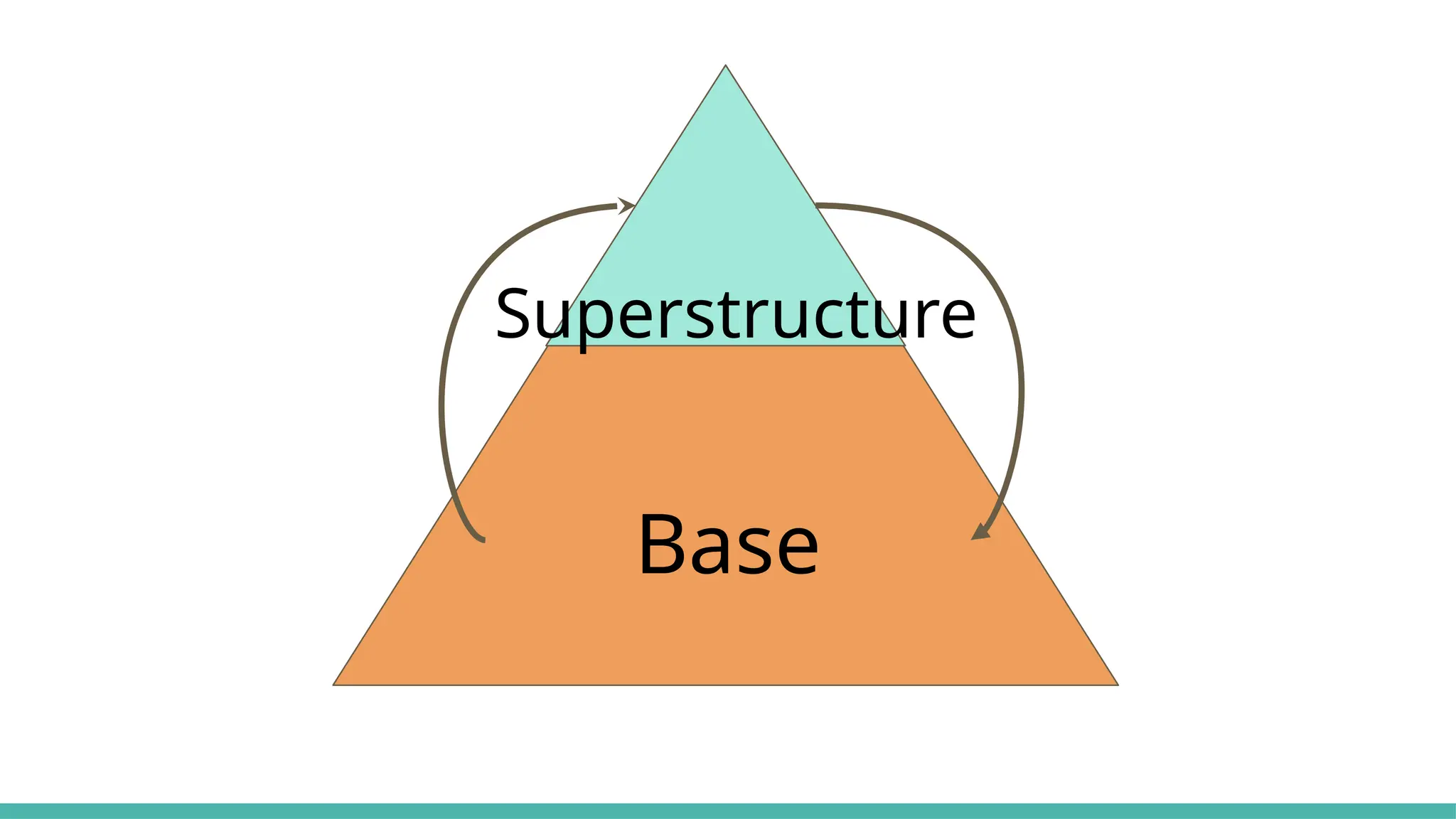
For Marx, history is entirely explained by the economy. The base is the
economic structure of society/class, and the superstructure is everything
else. You all know this -- the part that I’m hopefully adding is this:
● This is dependent on an idea of history unfolding through contradiction
of a single thing.
● Without that, there’s no reason to make the clear separation between
“base and superstructure.”
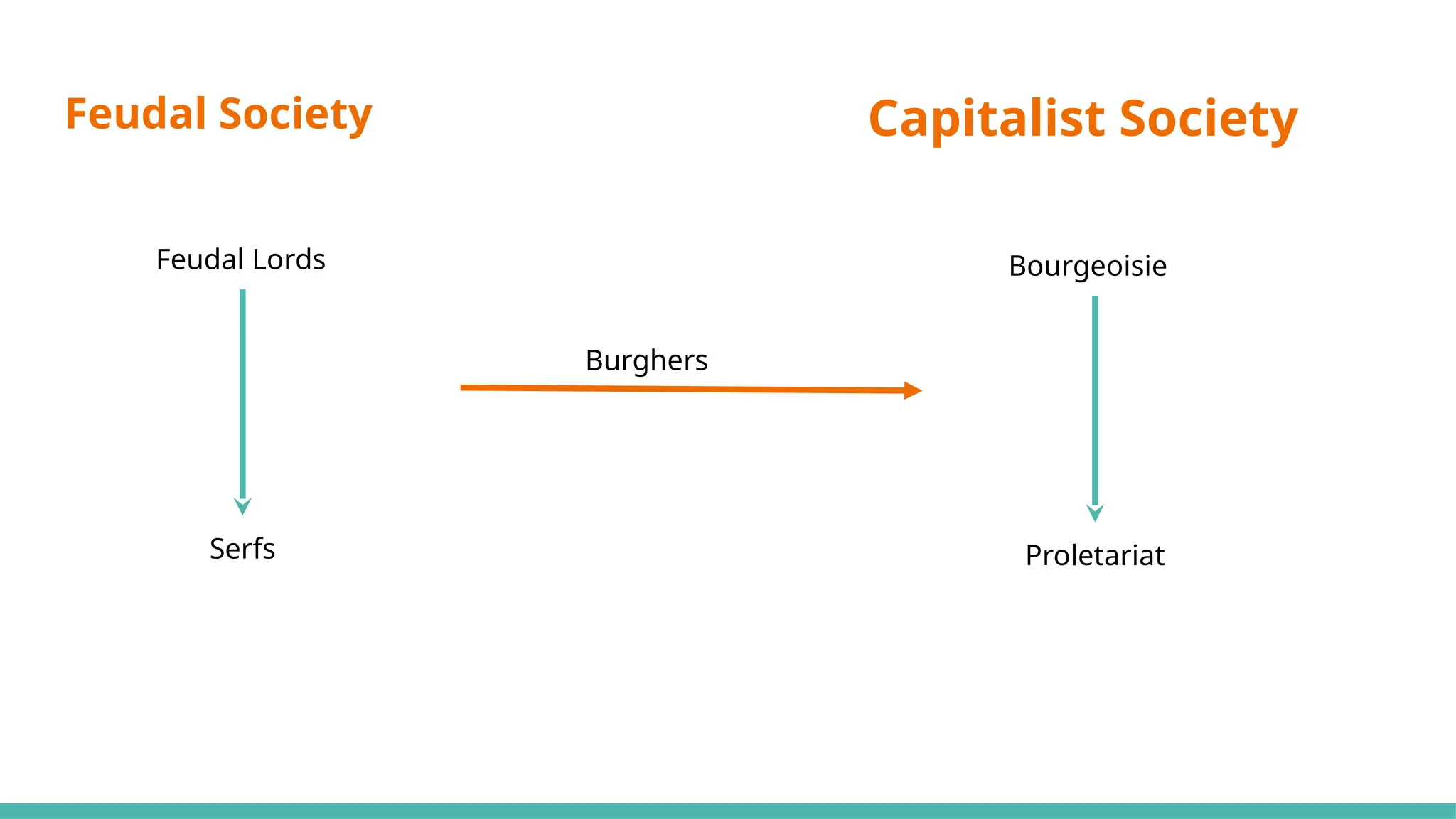
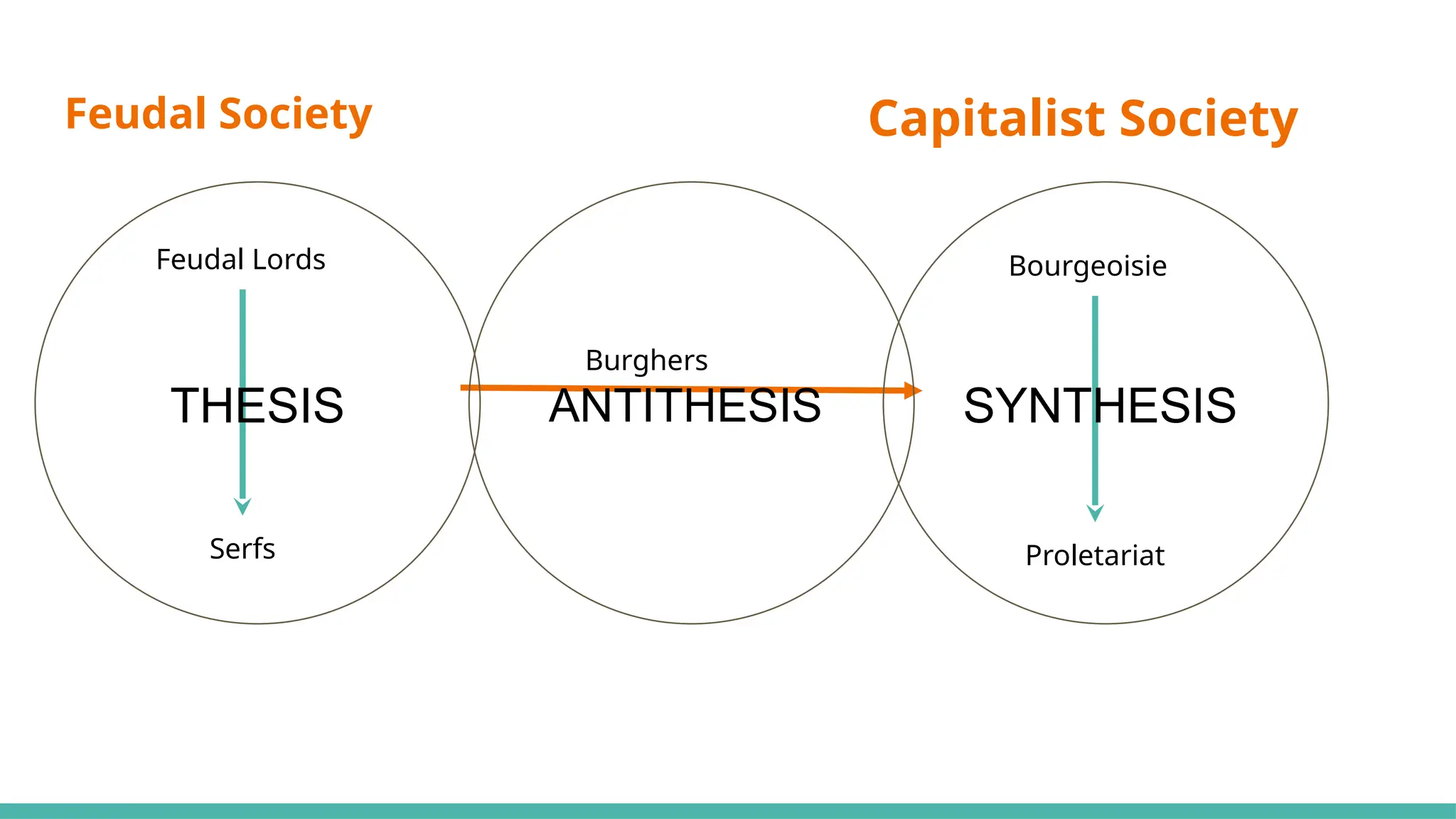
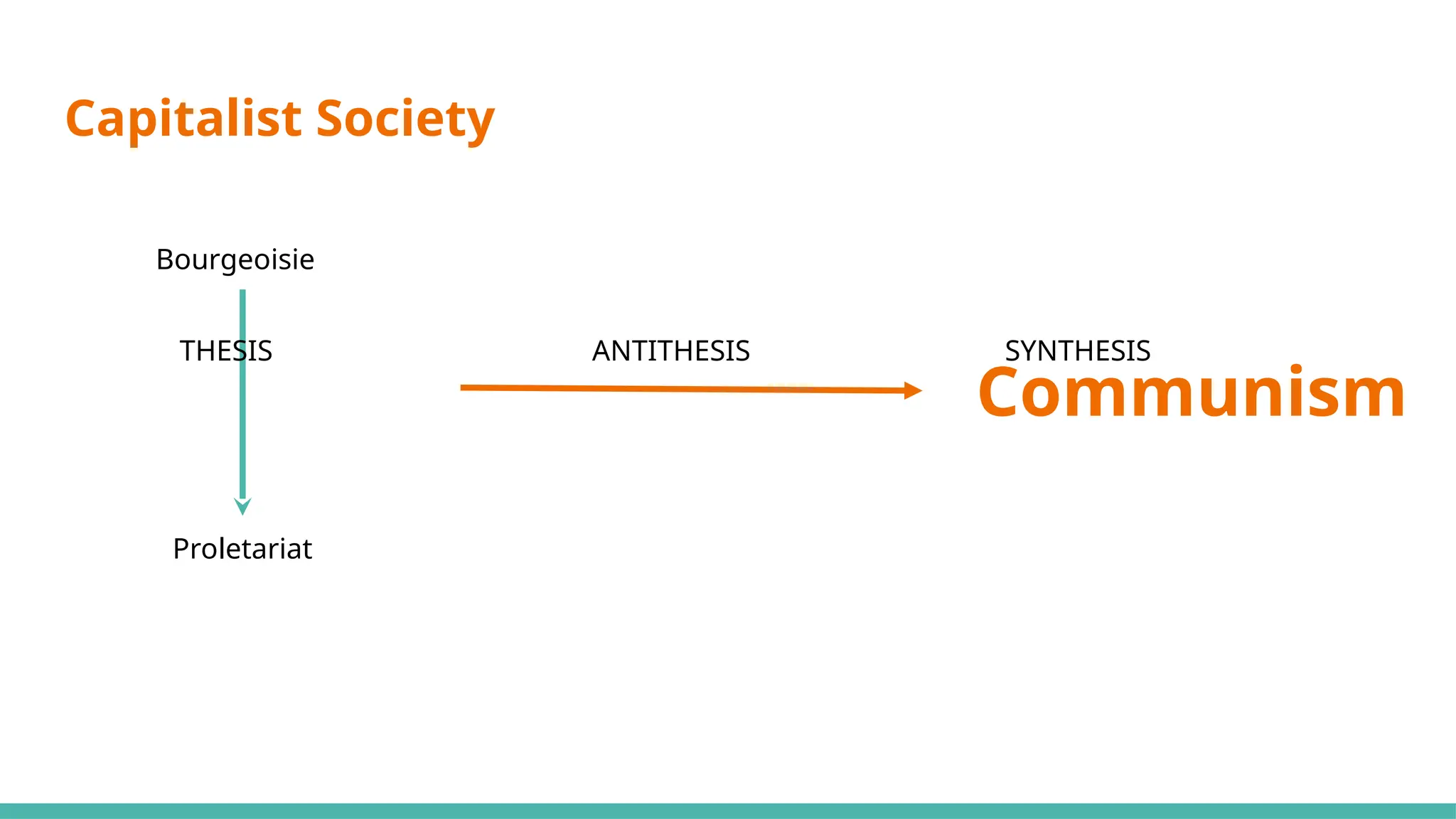
● The same mechanism that lead from feudal society to capitalism will be
the only route to get from capitalism to communism.
Communism is theEnd of History
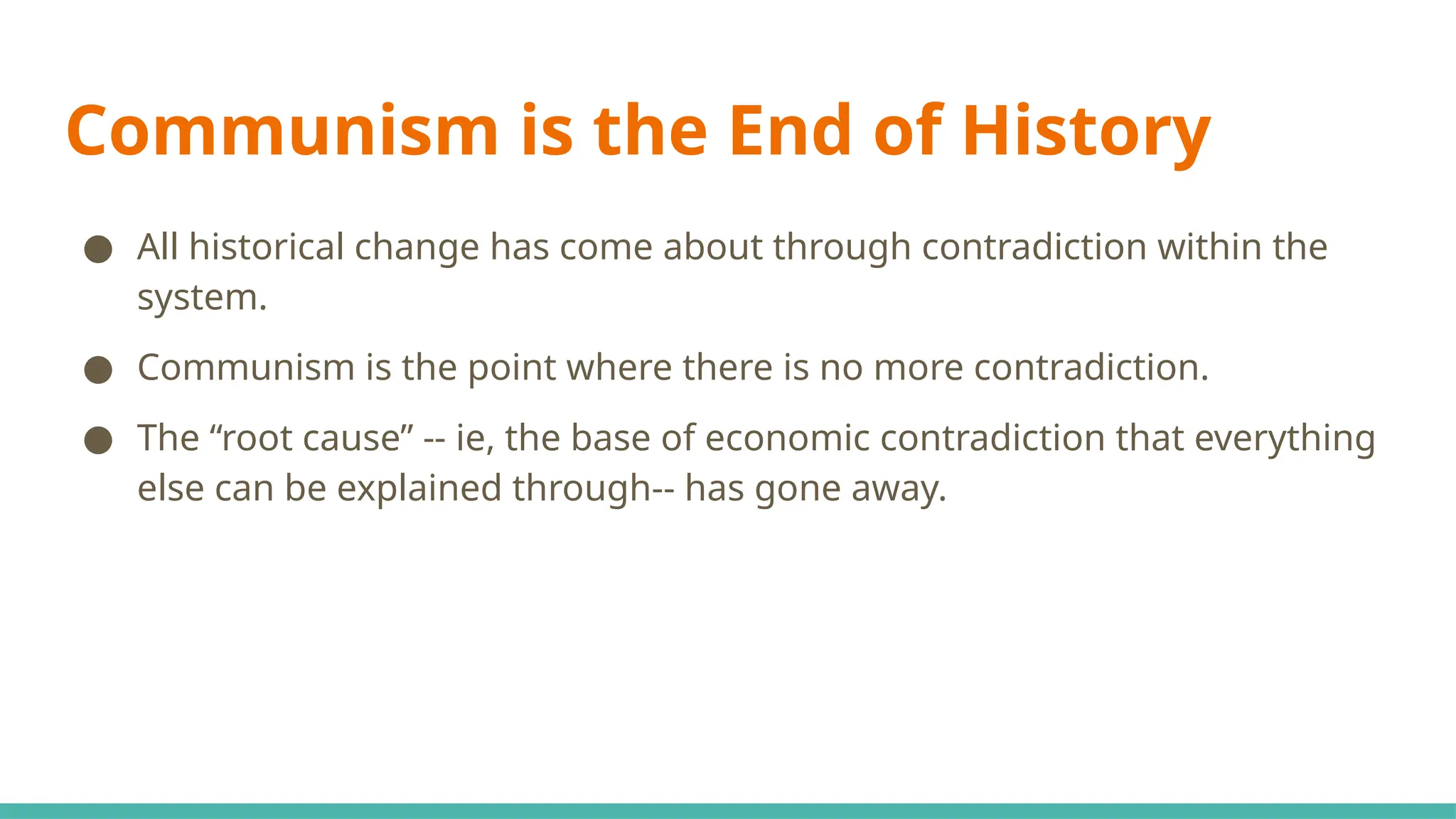
● All historical change has come about through contradiction within the
system.
● Communism is the point where there is no more contradiction.
● The “root cause” -- ie, the base of economic contradiction that everything
else can be explained through-- has gone away.
21.
Marxism and theroot cause
Determining the root cause for Marx is important because explanation and
change are linked.
Things only change through movement in the basic economic structure.
When a Marxist says “capitalism is the root cause” they are saying both that
capitalism is the basic reason through which something happens and also:
that the only way to change anything about our present world would be to
change the basic economic structure of capitalism.
22.
The Structure ofthe Argument
Again, Marx’s argument is dialectical materialism.
It has both the philosophical project which explains that history has a particular
structure: the dialectic and the historical work to explain why this particular thing
is the base and not anything else.
You need both in order to make a fully valid root cause claim.
Some authors (Althusser, for instance) talk about this as an idealism, in that it
relies on an ontology (understood as a conception of the essential nature of the
world) and a teleology (understood as a conception of the inevitable progression
of history.
23.
Materialism
An important questionin thinking about root cause is where the historical
information comes from.
● Is it a science/normal historical study?
● Or is it derived from present practice or understanding in some way?
For most root-caused based theories, the history part of the post-
structuralism is not entirely separate from ideological thinking.
24.
Practice, which, forMarxism, is the source and criterion of all truth, and ‘envelops’ the epistemological question, does not provide a de
jure foundation for the materialist thesis in the idealist sense of the term. The fact of practice points back, not to an originary legitimation [droit
originaire], but to its own real genesis. It is here that materialism is radically counterposed to all transcendental philosophies. No-one, perhaps, has
put this better than Engels, in connection with the problem of the definition of life: ‘From a scientific standpoint all definitions are of little
value. In order to gain an exhaustive knowledge of what life is, we should have to go through all the forms in which it appears,
from the lowest to the highest. ..’ [Anti-Dühring, p. 1041. The same holds for practice. It is not the immediacy of an act or structure, but its
own real genesis. Inseparable from human practice (broadly conceived: social production, daily social practice, class struggle) in
its contemporaneous forms, scientific practice, which is the most abstract refinement of practice, can be defined only in terms of
its real evolution, that is, its history. That is why Lenin also declares that the answer to the Fundamental epistemological
question’ is simultaneously provided by human practice and by the history of knowledge (Materialism and Empirio-Criticism, pp. 89,
122-4, 143, 147, 217, 239, etc.).
This history defines ‘the limits ... revealed by practice’ with respect to the ‘objective truth we are capable of attaining’ (ibid., p.
177). Mao Zedong, for example, shows (in ‘On Practice’) that the knowledge a given period is in a position to produce is always subject to
the determinate forms of existing practice (bound up, above all, with the existing social mode of production, i.e, with the dominant mode of the
transformation of nature). But within these historical limits, the truths acquired through practice are absolute (there is no truth
outside them). It is this dialectic of the historical conditions of knowledge which Lenin worked out in his frequently misunderstood theory of relative
and absolute truth.
‘The “essence” of things’, writes Lenin, ‘or “substance” is also relative; it expresses only the degree of profundity of
man’s knowledge of objects: and while yesterday the profundity of this knowledge did not go beyond the atom, and
today does not go beyond the electron and ether, dialectical materialism insists on the temporary, relative,
approximate character of all these milestones in the knowledge of nature gained by the progressing science of man.
The electron is as inexhaustible as the atom, nature is infinite but it infinitely exists (Lenin’s emphasis) (ibid., p. 250). -Althusser
25.
Materialism Implies…
1. Arejection of all ‘idealist crotchets.’ – Philosophy is not useful as pure interpretation.
2. “Criticism of all scientific dogmatism, which drags along behind it, like its shadow,
the idealist exploitation of science and its ‘crises’....
3. The rejection of all abstract formalism. Materialism reminds every science of its real
source: the world men transform. No science can, whether in its history or its
object, grasp its own origins within itself or constitute itself as a closed world,
exhaustively defined by internal rules. Materialism refers every science and every
activity to the reality they depend on, even if this dependence is masked by a great
many abstract mediations: mathematics as well as logic, aesthetics as well as
ethics and politics.
26.
Tasks of any“root cause” or “theory of power”
1. What is the structure of history?
2. What is the content of history?
3. Where does that structure come from and how do we find out the
history?
All three of these elements have different ramifications for clash in debates.
27.
Afro-pessimism
In debate, otherthan Marxist Ks, Afro-pessimist approaches have the best
reason to talk about true root causes.
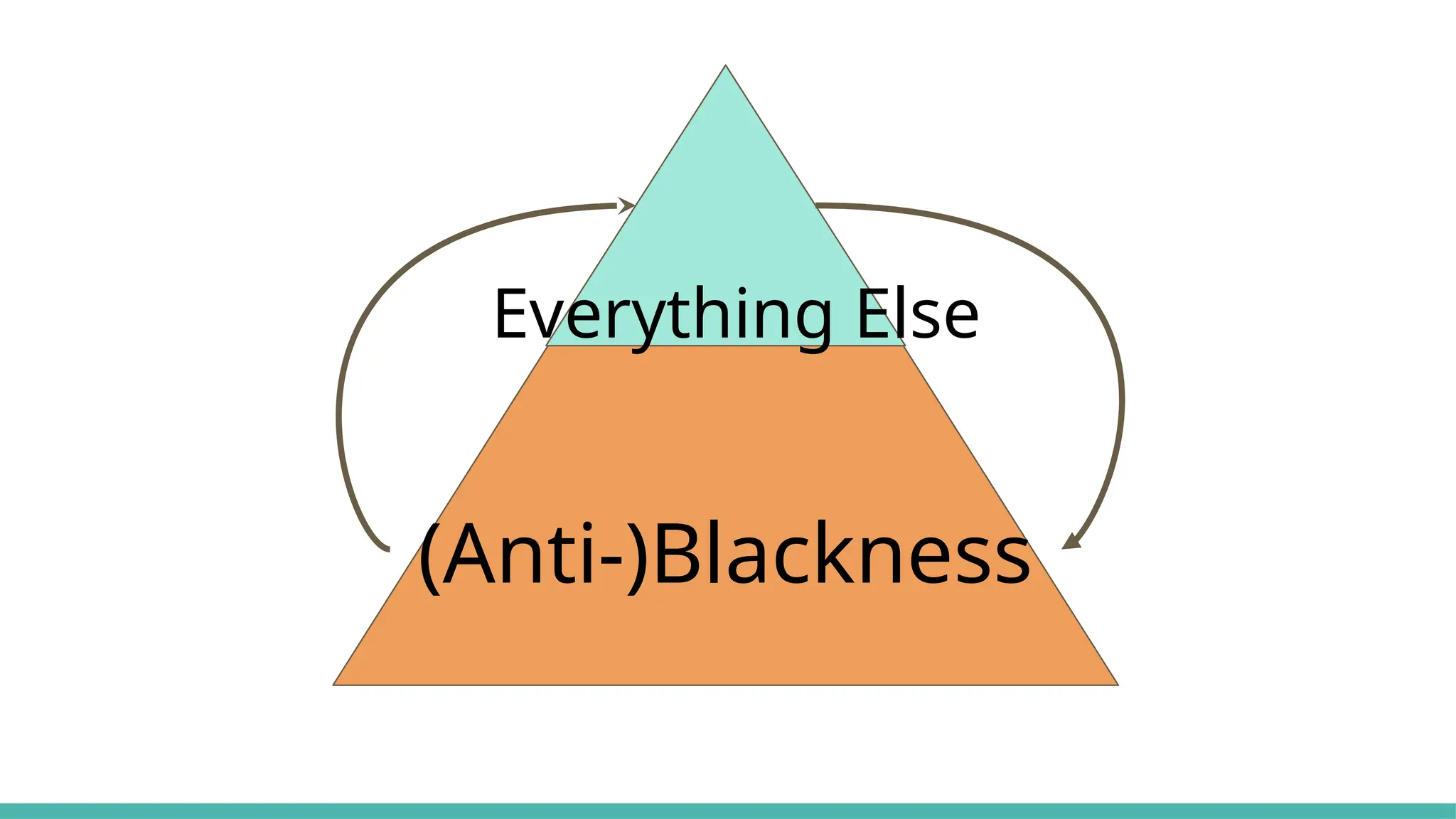
Everything is explained by relation to (anti-)Blackness. All other things, all
other ways of thinking about change, all other ideas, are epi-phenomenal to
(anti-)Blackness.
(Anti-)Blackness is the reason about which you can’t ask why anymore--why
are the police violent? Anti-Blackness. Why does Kant think reason defines
the subject? Anti-Blackness.
Structuralism
Afro-pessimism and Marxismhave unusually parallel structures, but they are both instances
of a larger category: structuralist theories.
Structuralist theories are those that think that the entirety of social life can be understood
through a single structure, and because of that, there is a single perspective through which
the whole thing can be understood.
This is opposed to post-structuralist theories, which are theories which talk about multiple,
intersecting structures and how structures are always characterized by moments of opening
or failure.
Hold this thought, we’ll come back to it.
(Also: this is a much better way to think of this type of thing than “ontology.”)
30.
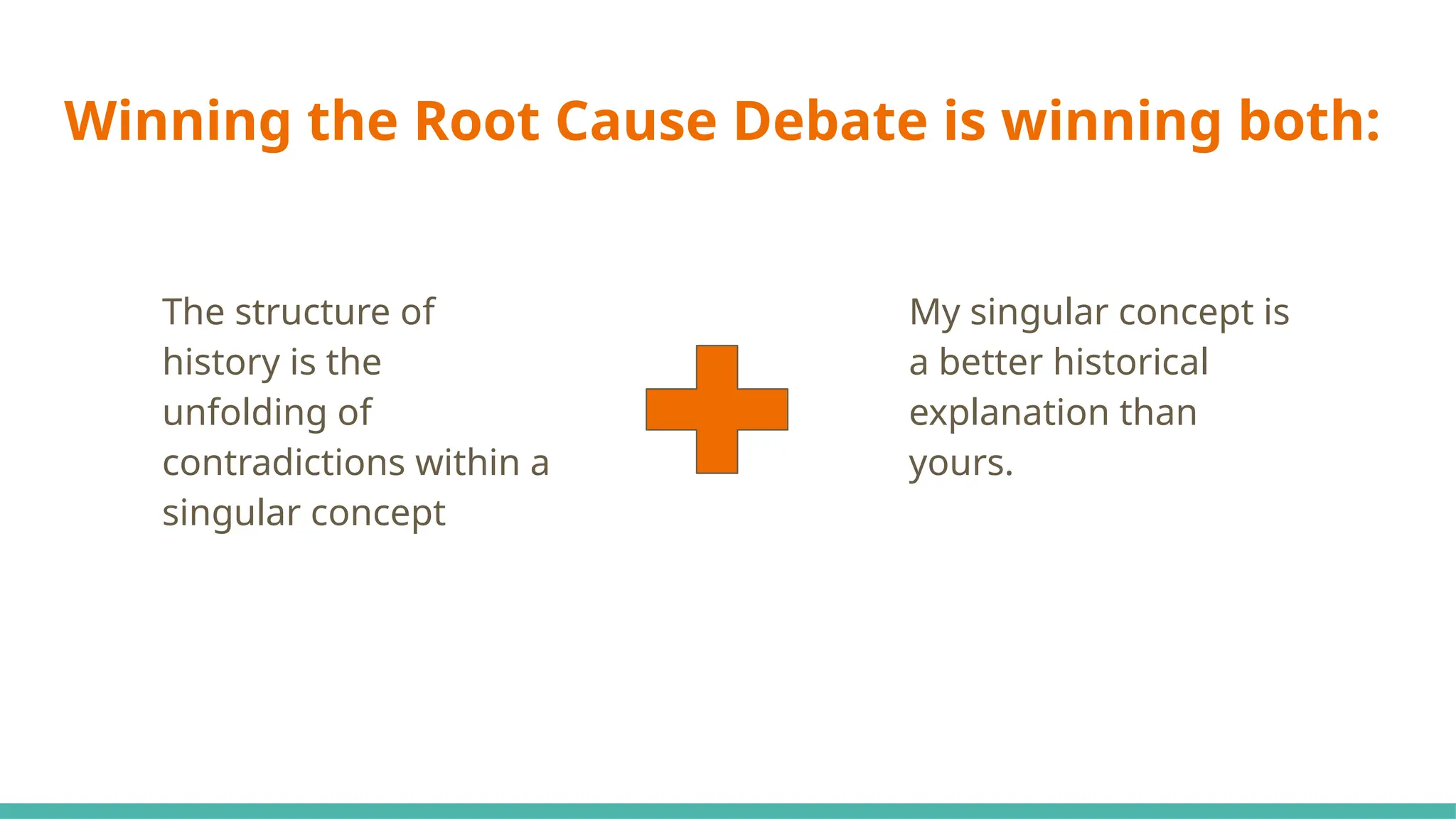
Winning the RootCause Debate is winning both:
The structure of
history is the
unfolding of
contradictions within a
singular concept
My singular concept is
a better historical
explanation than
yours.
31.
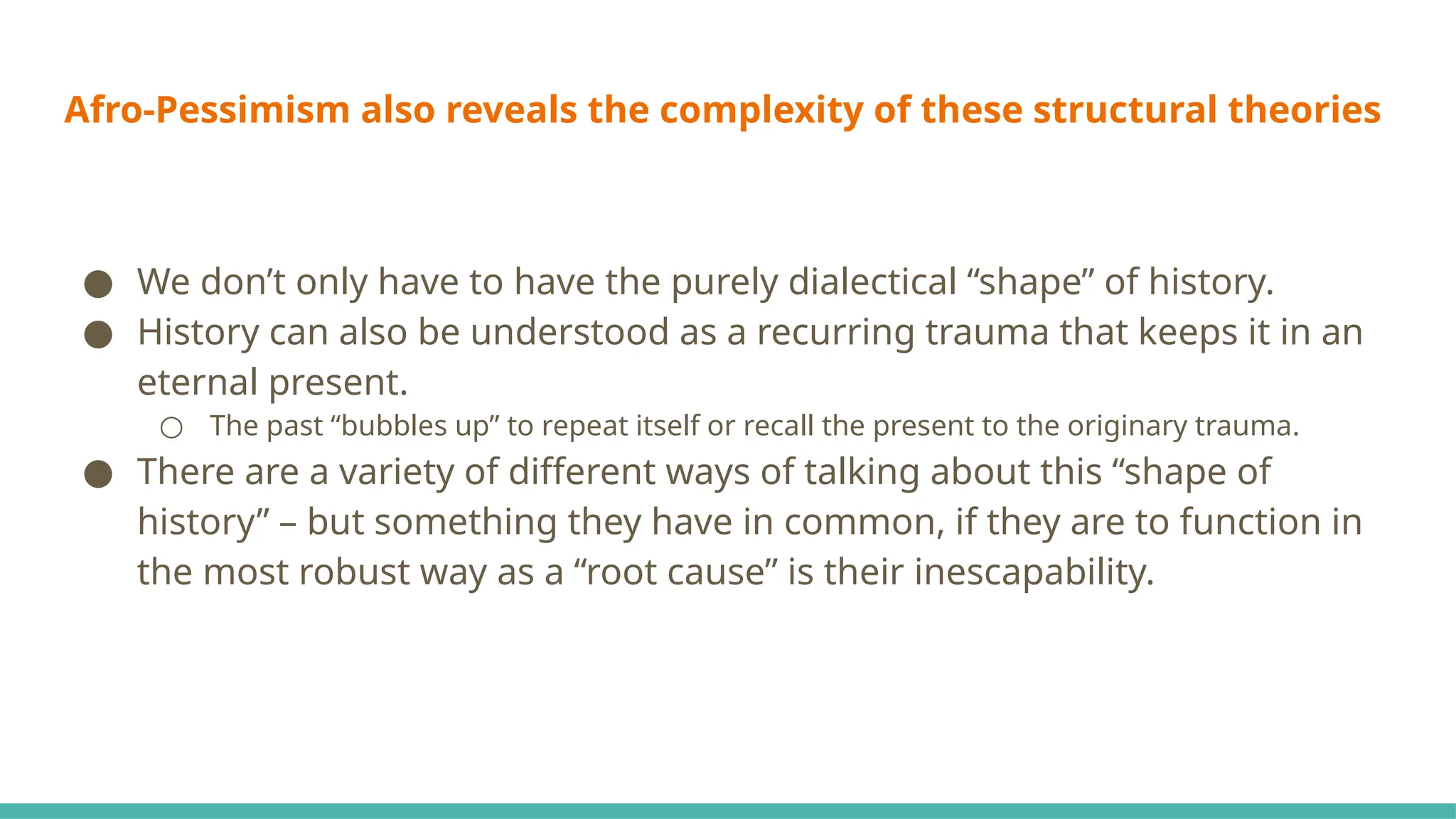
Afro-Pessimism also revealsthe complexity of these structural theories
● We don’t only have to have the purely dialectical “shape” of history.
● History can also be understood as a recurring trauma that keeps it in an
eternal present.
○ The past “bubbles up” to repeat itself or recall the present to the originary trauma.
● There are a variety of different ways of talking about this “shape of
history” – but something they have in common, if they are to function in
the most robust way as a “root cause” is their inescapability.
32.
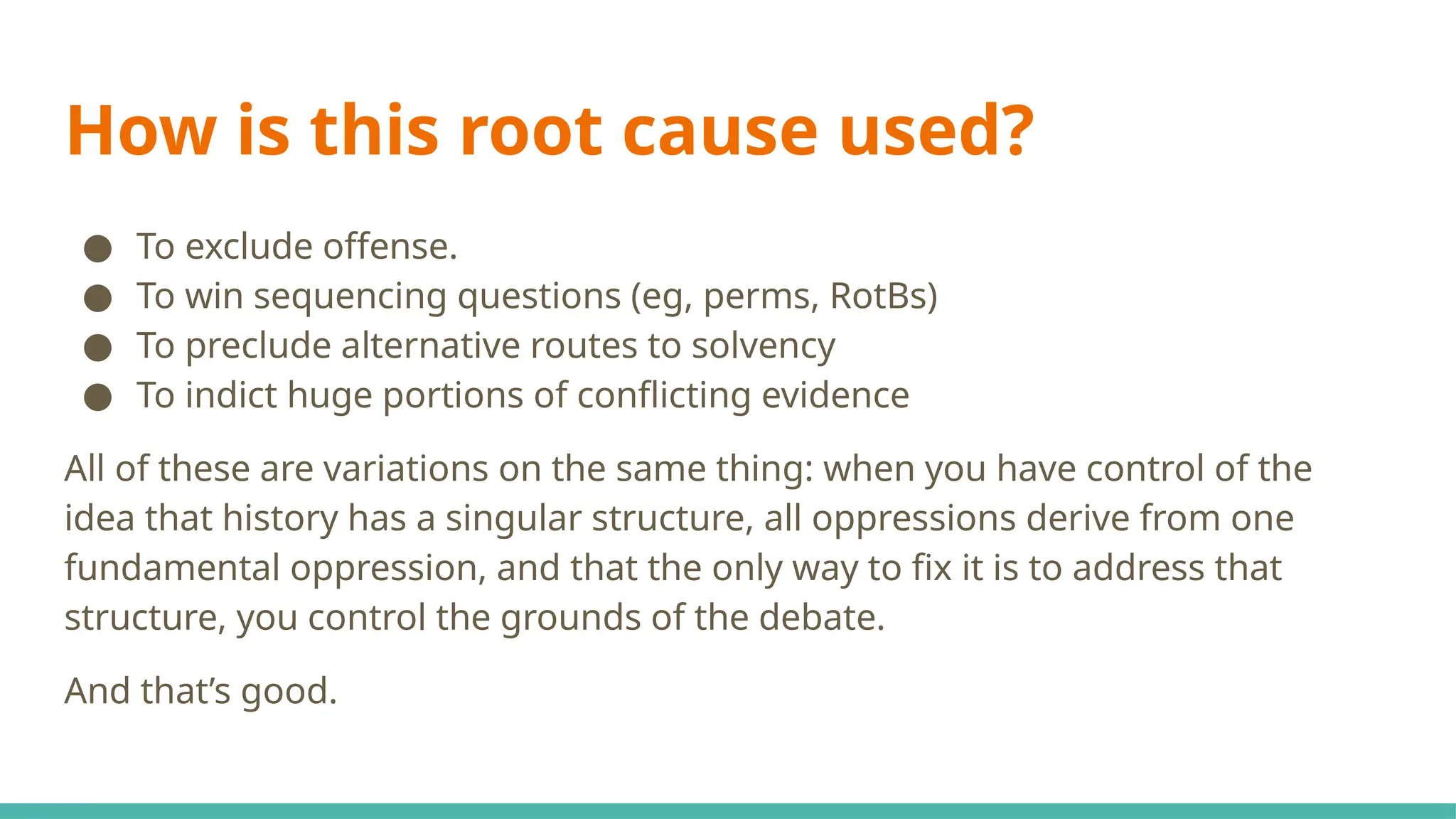
How is thisroot cause used?
● To exclude offense.
● To win sequencing questions (eg, perms, RotBs)
● To preclude alternative routes to solvency
● To indict huge portions of conflicting evidence
All of these are variations on the same thing: when you have control of the
idea that history has a singular structure, all oppressions derive from one
fundamental oppression, and that the only way to fix it is to address that
structure, you control the grounds of the debate.
And that’s good.
33.
Root Cause Debatesin Practice
The way this plays out depends largely on the type of theory at hand.
a) Structuralist v Structuralist
b) Structuralist v Post-Structuralist.
c) Structuralist v Pragmatist.
34.
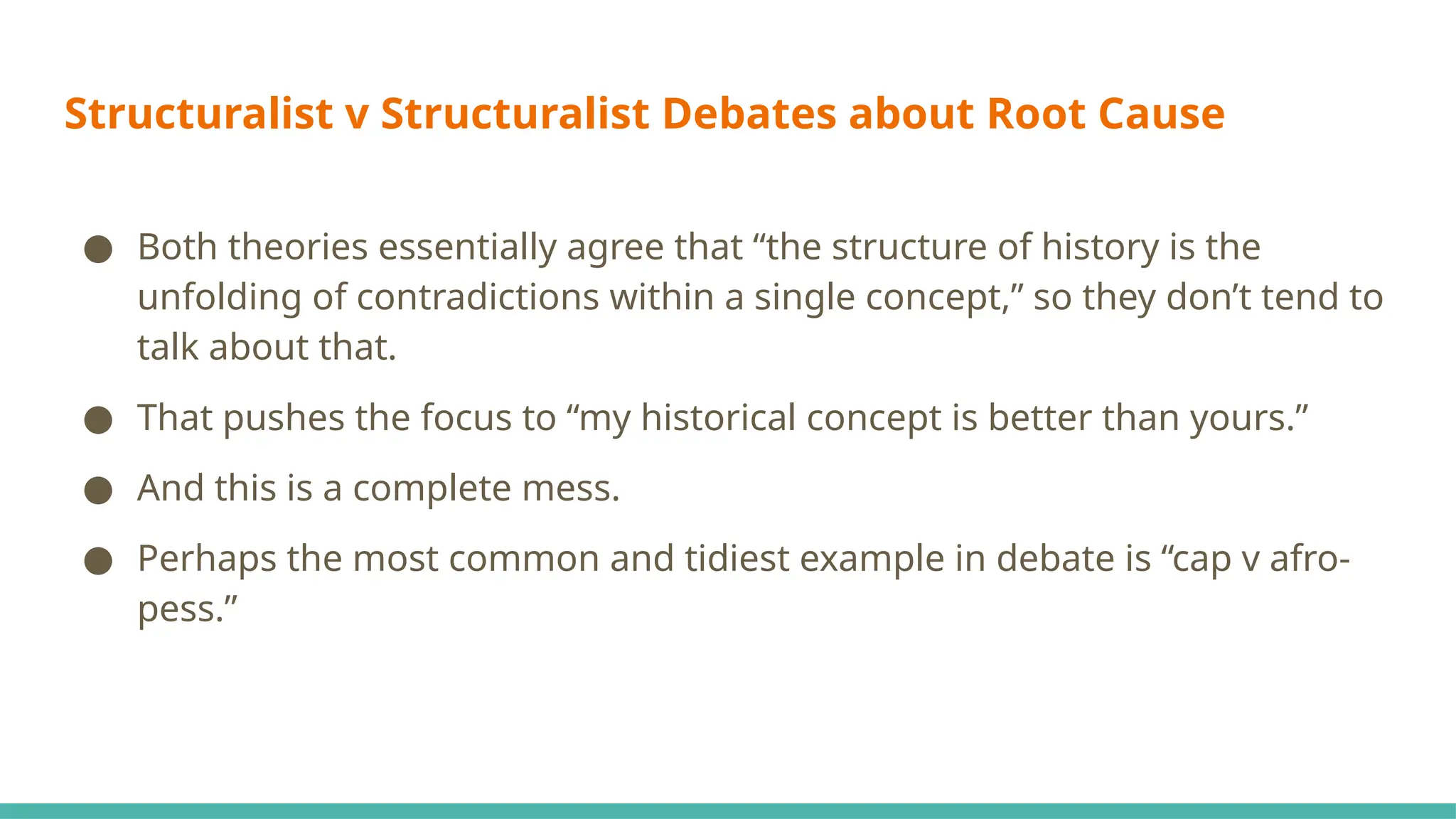
Structuralist v StructuralistDebates about Root Cause
● Both theories essentially agree that “the structure of history is the
unfolding of contradictions within a single concept,” so they don’t tend to
talk about that.
● That pushes the focus to “my historical concept is better than yours.”
● And this is a complete mess.
● Perhaps the most common and tidiest example in debate is “cap v afro-
pess.”
35.
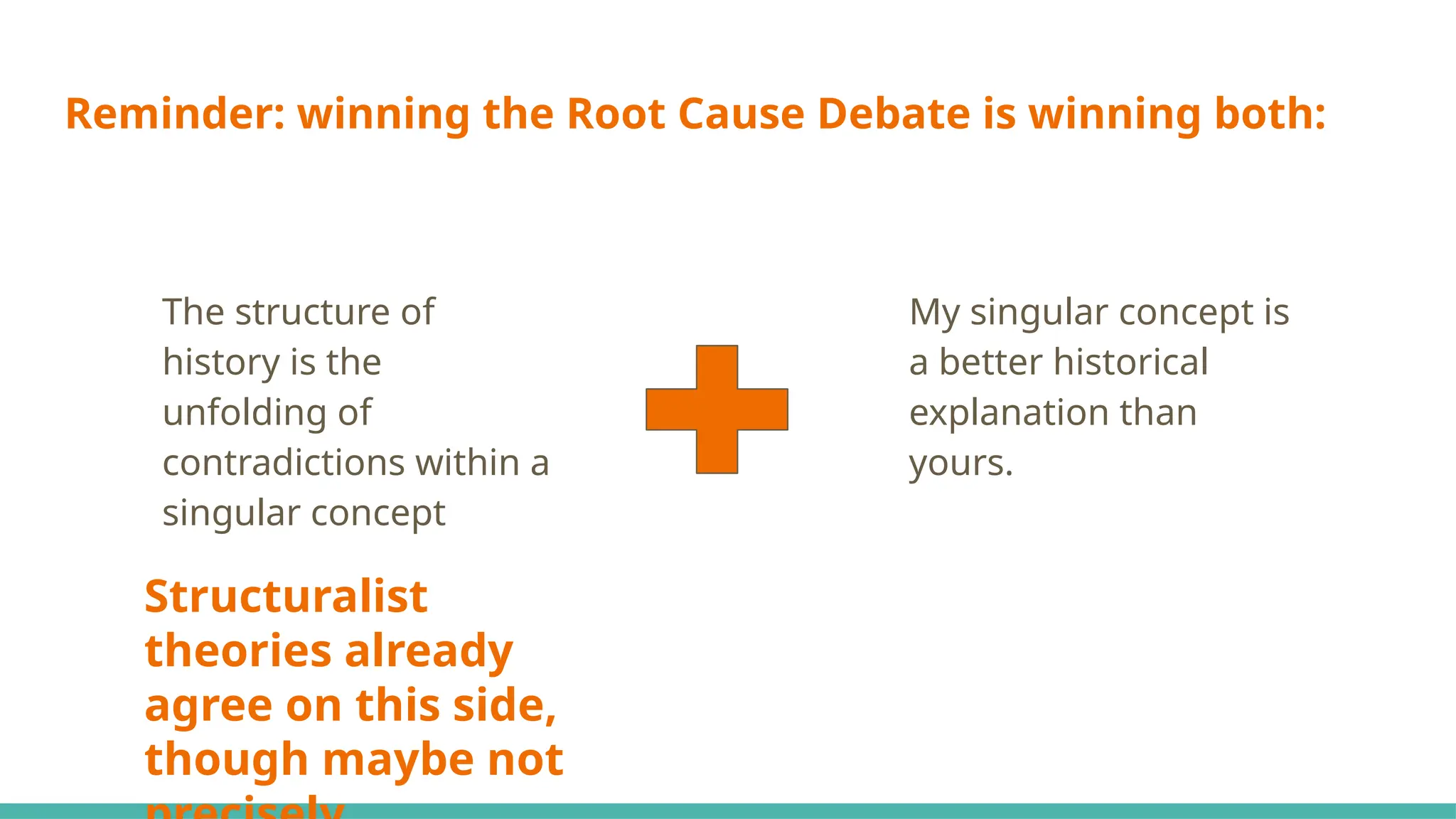
Reminder: winning theRoot Cause Debate is winning both:
The structure of
history is the
unfolding of
contradictions within a
singular concept
My singular concept is
a better historical
explanation than
yours.
Structuralist
theories already
agree on this side,
though maybe not
36.
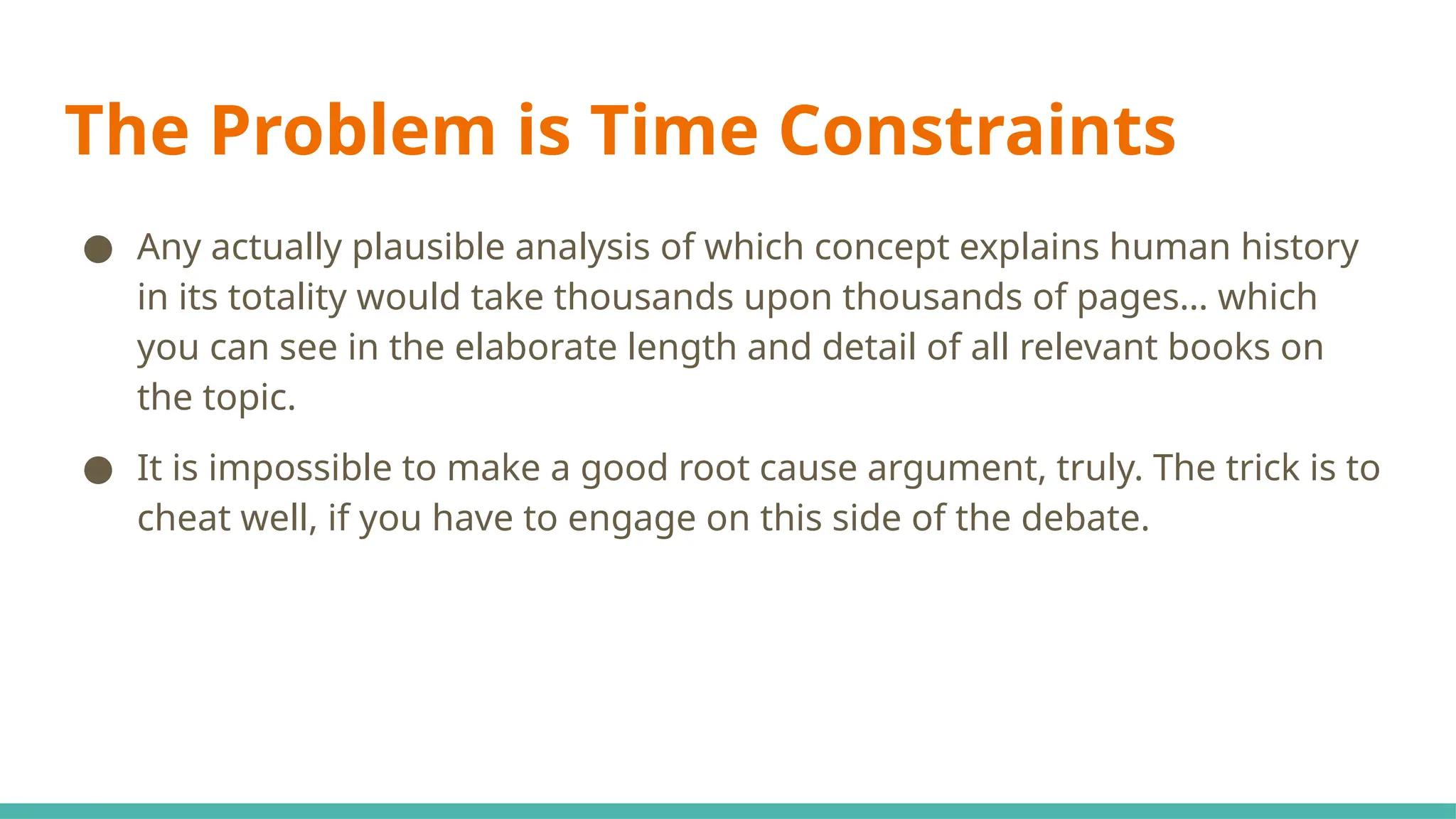
The Problem isTime Constraints
● Any actually plausible analysis of which concept explains human history
in its totality would take thousands upon thousands of pages… which
you can see in the elaborate length and detail of all relevant books on
the topic.
● It is impossible to make a good root cause argument, truly. The trick is to
cheat well, if you have to engage on this side of the debate.
37.
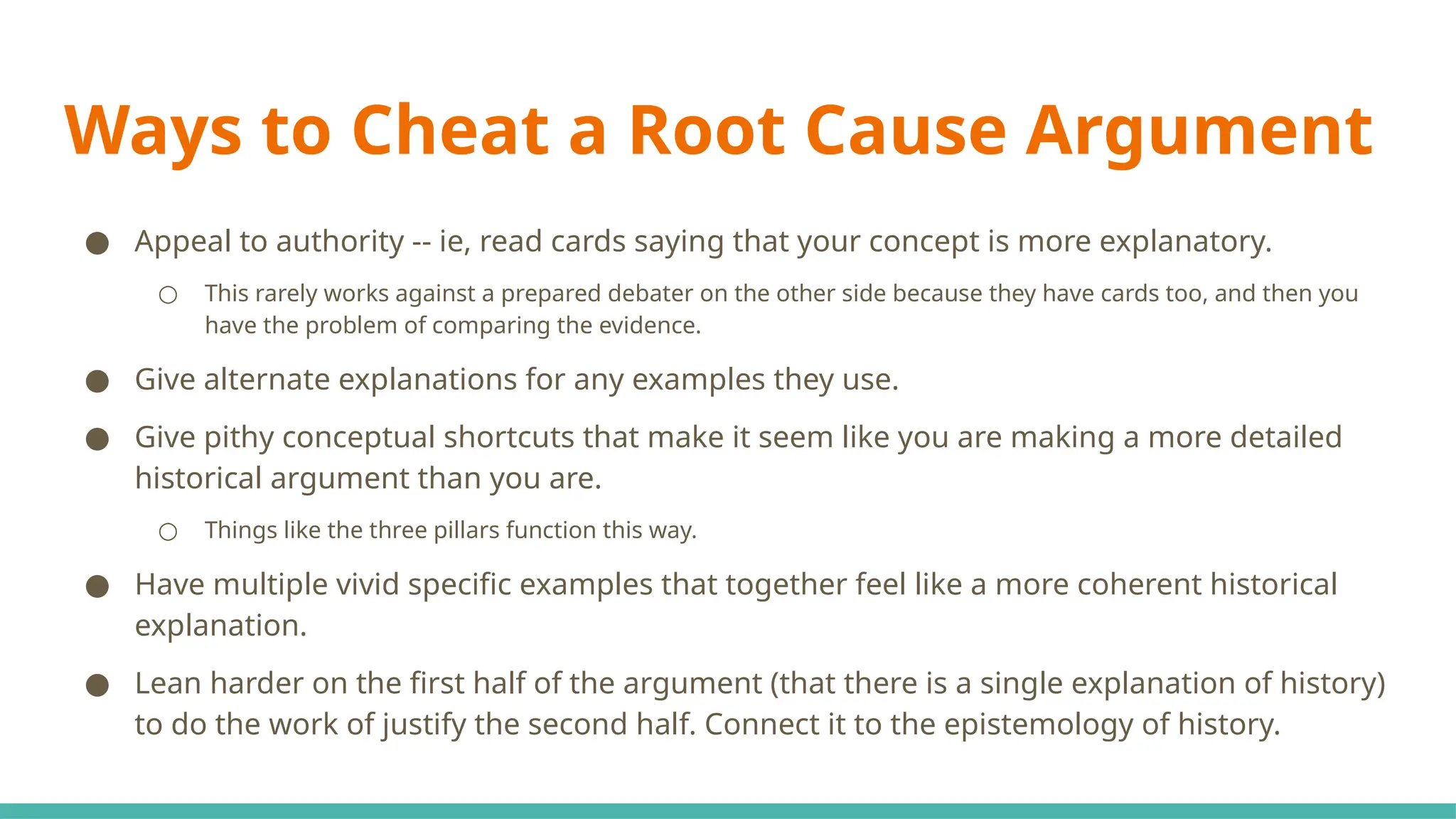
Ways to Cheata Root Cause Argument
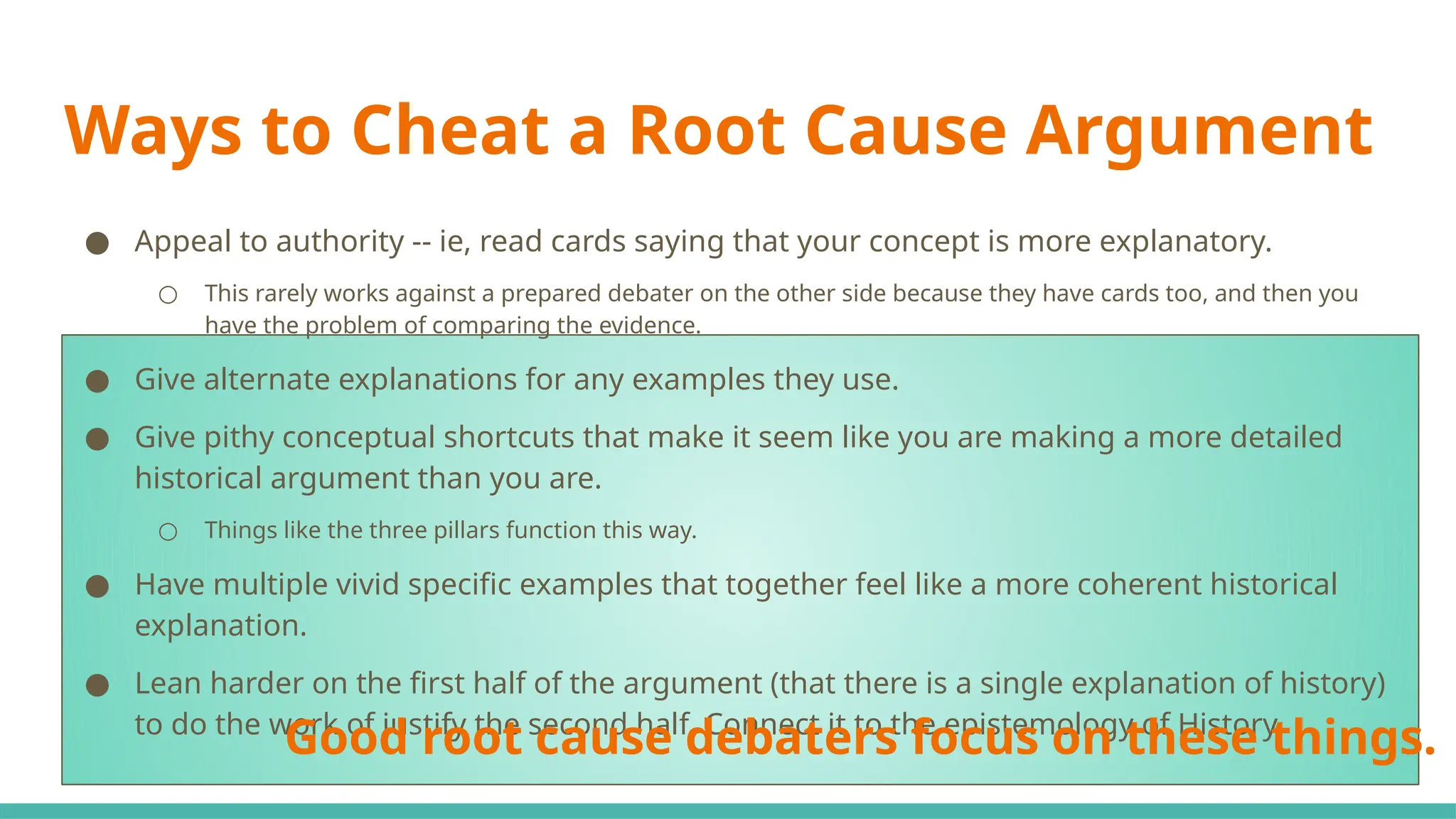
● Appeal to authority -- ie, read cards saying that your concept is more explanatory.
○ This rarely works against a prepared debater on the other side because they have cards too, and then you
have the problem of comparing the evidence.
● Give alternate explanations for any examples they use.
● Give pithy conceptual shortcuts that make it seem like you are making a more detailed
historical argument than you are.
○ Things like the three pillars function this way.
● Have multiple vivid specific examples that together feel like a more coherent historical
explanation.
● Lean harder on the first half of the argument (that there is a single explanation of history)
to do the work of justify the second half. Connect it to the epistemology of history.
38.
Ways to Cheata Root Cause Argument
● Appeal to authority -- ie, read cards saying that your concept is more explanatory.
○ This rarely works against a prepared debater on the other side because they have cards too, and then you
have the problem of comparing the evidence.
● Give alternate explanations for any examples they use.
● Give pithy conceptual shortcuts that make it seem like you are making a more detailed
historical argument than you are.
○ Things like the three pillars function this way.
● Have multiple vivid specific examples that together feel like a more coherent historical
explanation.
● Lean harder on the first half of the argument (that there is a single explanation of history)
to do the work of justify the second half. Connect it to the epistemology of History.
Good root cause debaters focus on these things.
39.
Cap K Construction,in contrast
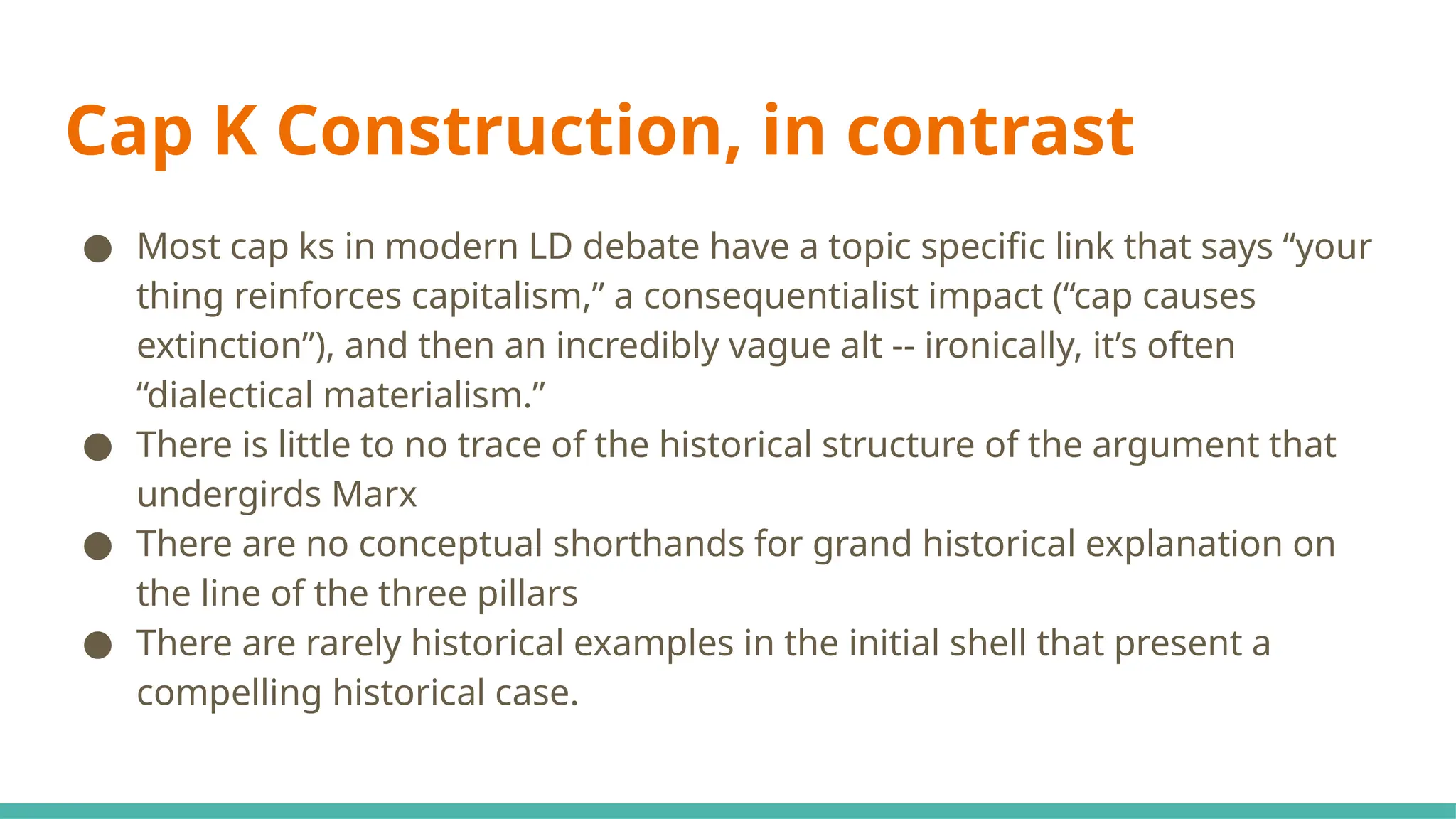
● Most cap ks in modern LD debate have a topic specific link that says “your
thing reinforces capitalism,” a consequentialist impact (“cap causes
extinction”), and then an incredibly vague alt -- ironically, it’s often
“dialectical materialism.”
● There is little to no trace of the historical structure of the argument that
undergirds Marx
● There are no conceptual shorthands for grand historical explanation on
the line of the three pillars
● There are rarely historical examples in the initial shell that present a
compelling historical case.
40.
Cap v APin the Squo
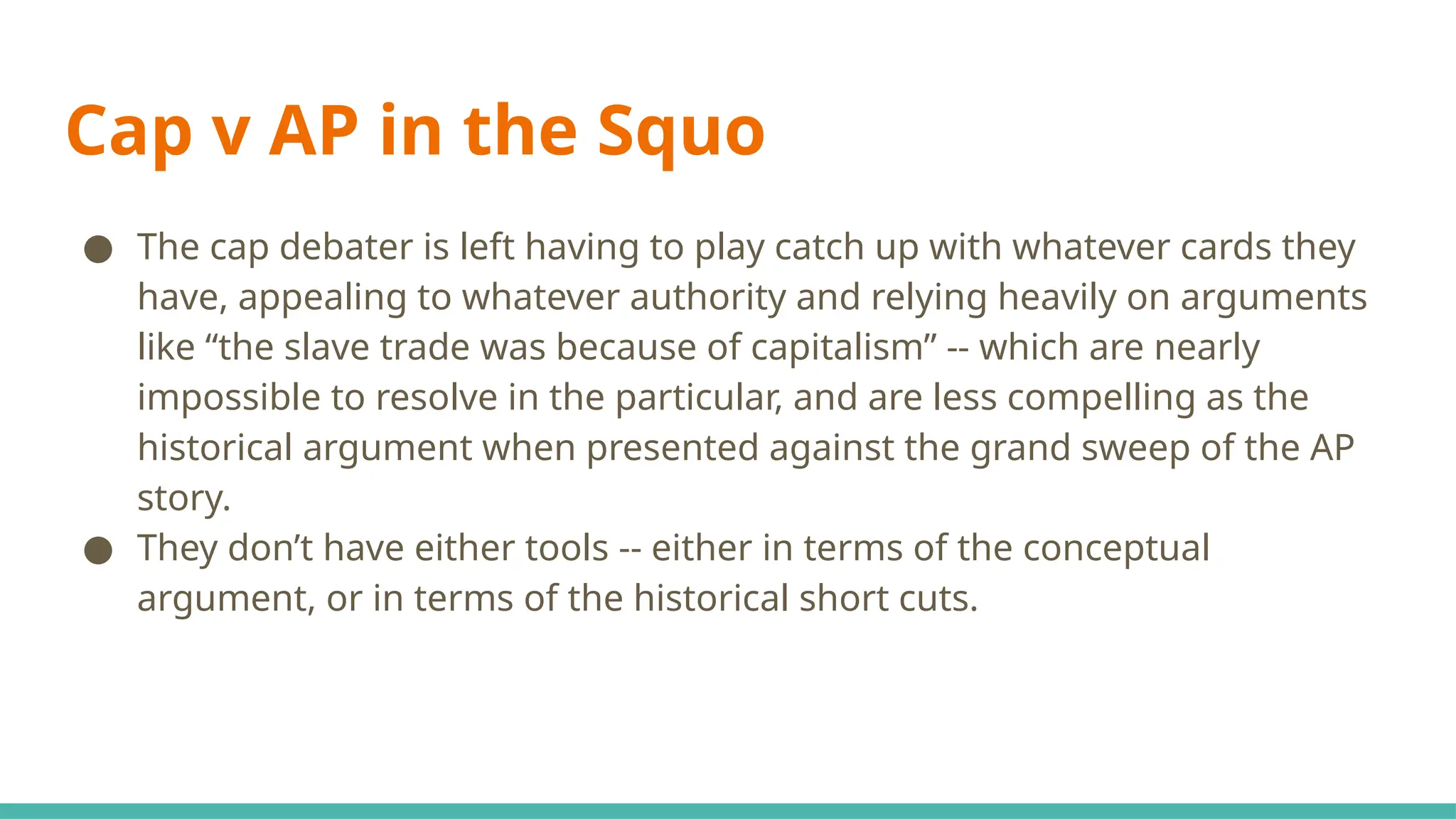
● The cap debater is left having to play catch up with whatever cards they
have, appealing to whatever authority and relying heavily on arguments
like “the slave trade was because of capitalism” -- which are nearly
impossible to resolve in the particular, and are less compelling as the
historical argument when presented against the grand sweep of the AP
story.
● They don’t have either tools -- either in terms of the conceptual
argument, or in terms of the historical short cuts.
41.
Not just capand AP
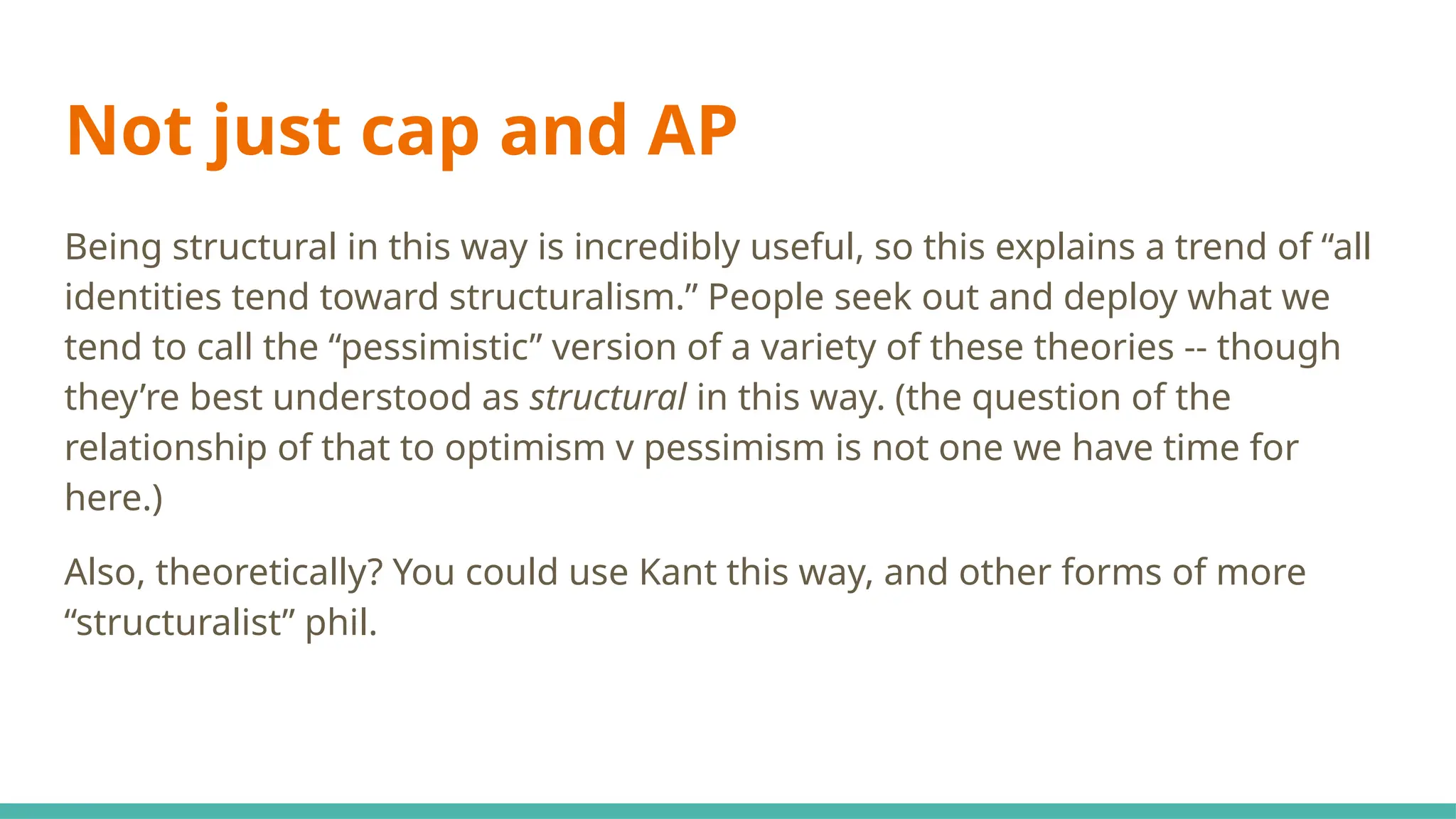
Being structural in this way is incredibly useful, so this explains a trend of “all
identities tend toward structuralism.” People seek out and deploy what we
tend to call the “pessimistic” version of a variety of these theories -- though
they’re best understood as structural in this way. (the question of the
relationship of that to optimism v pessimism is not one we have time for
here.)
Also, theoretically? You could use Kant this way, and other forms of more
“structuralist” phil.
42.
“High Theory” Structuralisms
●Lacan and Baudrillard are two good examples of high theory structuralist
theories.
● Lacan is a little different, because he’s not particularly historical. His “root
cause” is not about the course of history: instead, it is about the structure
of the human mind.
● Baudrillard is often the cap-adjacent theorist that best interacts on this
level, because he has a variety of easy historical shorthands that serve
similar functions as things like the three pillars do in debate rounds (the
hyperreal, the simulation, etc.)
43.
Winning Structuralist vStructuralist Root Cause Debates, summary.
● Have compelling historical examples and create/deploy concepts
describing historical trends.
● Have a strong command of history so you can give alternative causes to
anything that your opponent claims -- this is more valuable than having
your own explanations, because they’ve already implicitly/explicitly
argued the sufficiency of that example.
● Have enough theoretical backdrop on why history is structural (dialectical
materialism, libidinal economy, structure of signification etc) that you can
deploy that against opponents.
44.
Structuralist v Post-StructuralistRoot Cause Debates
In these debates, the post-structuralists think that there is no singular historical
concept that explains all of history. And, for debate purposes, they definitely don’t
think [x structuralist position] is one of them. This is not always a fully developed K
– this often manifests in one off cards or method ks.
In theory, given what we’ve discussed about the artifice behind the structuralist
warranting of their position, this should be easy to win.
If the structuralist has to prove that there is a singular concept… and that their fave
concept is the one, theoretically the post-structuralist can win using either.
Doesn’t often work that way.
45.
How does structuralismget away with it?
Heavily structural theories often get away with having almost none of the basic
structural argument in their cases/ks. Think of how rarely people go deep into the
warrants of Wilderson’s libidinal economy or Marx’s view of history.
Why does this work? Why can’t a neg just get up and be like “there’s no real
evidence history works like this at all, there’s a million things going on in history,
and to prove that nothing but [x] matters is a super high burden.”
One reason is that, because they’re strategic, we’re very used to the structuralism
by this point--trust me, AP had to have a lot of this stuff ten years ago.
But...
46.
The Power ofHistory
The successful structural debater knows an enormous amount about their
topic area. They are able to tell a compelling historical narrative, and most
debaters don’t know enough specifics to poke holes in it.
Also: humans like stories. A historical narrative sticks in your head much
more clearly than an anti-narrative. We see faces in everything, we see stories
in everything, everything is a pattern--it’s actually very hard to answer a
pattern with a pure defense of “non-pattern.”
47.
Structuralist beats Post-Structuralistin 2 Ways
● Deploying the structuralist backdrop (libidinal economy, dialectical
materialism, etc…) to make what is often called the “ontology” level of the
argument.
● But also: telling an excellent and compelling historical story, with a
plethora of specifics, that the disorganized “identity is fluid” type
response can’t cope with.
48.
Post-Structuralists Need toFind Post-Structural Root Cause Stories
● This can happen in a straightforward way, like a Deleuzian arguing the
staticization of identity explains all other forms of oppression, or by
adopting some of the historicized conventions:
○ You can tell a story of the way that we try to force stories to make sense -- tell a historical
story about the moments where people struggled to make facts fit narrative.
● And in the same way, it isn’t enough for the post-structuralist to just
reassert their theory of the subject. They have to do the same exact
things to get ahead on the root cause debate:
49.
Generate Offense againstthe historical impulse
Where did this desire to make history make sense come from and what work does
it do?
Who does it work for? Who does it leave out? What does it make us think and
feel?
For instance, Black queer scholar Stephen Best writes that the work of the archive
in Black studies often returns again and again to history in a way that situates the
possibility of redemption in some authentic past–even as it denies it’ll ever return.
Instead of looking for patterns, we should look for plot-holes.
50.
Winning Post-Structuralist vStructuralist Root Cause Debates
● Have compelling historical examples and create/deploy concepts describing
historical trends.
● Have a strong command of history so you can give alternative causes to
anything that your opponent claims -- this is more valuable than having your
own explanations, because they’ve already implicitly/explicitly argued the
sufficiency of that example.
● Have enough theoretical backdrop on history is structural that you can deploy
that against opponents.
● Additionally: provide offense against structuralist theories/explanations of
history. Especially focus on how that history is created and maintained.
51.
Structuralist v PragmatistRoot Cause Debates
This is a weird category, but I’m defining “pragmatist” as those who don’t care
about history.
The obvious people to put here are the utilitarians -- who care how it broke, I
have good arguments about how to fix it. But some varieties of modern anti-
capitalist authors also fit here; my favorite is Jodi Dean.
For them, there needs to be a hard-nosed push on the idea that the solution
need not depend on the cause, root or otherwise.
52.
Pragmatist Stories
● Therecan be some elements borrowed from more structuralist accounts -- think of
the soft-left aff that sneaks in some arguments about why anti-Blackness is causal
across history.
● But most of the story needs to be forward looking, and instead of specific examples
explaining historical moments, there should be specific examples of activist and
political practice.
● In order to gain offense, there needs to be a proactive account about how the type
of politics implied by the structuralist is incompatible with effectively moving away
from oppression.
● Instead of telling a story about the past, you’re telling a story about the future.
53.
Pragmatist compared toPost-Structuralist
Unlike the post-structuralist, the pragmatist doesn’t have to win that the historical
narrative of the structuralist is false. They have to win that it doesn’t matter.
They have to prove that the root cause doesn’t matter in terms of the solution, but
they don’t have to prove that it’s a wrong way to think about history.
Specifically, for instance: Dean might have to prove that the “libidinal structure of
anti-Blackness” doesn’t determine the best strategy to change anti-Blackness, but
she doesn’t have to prove that anti-Blackness isn’t the most coherent way to explain
history.
A post-structuralist mostly has to prove both.
54.
The Structure ofRoot Cause Claims
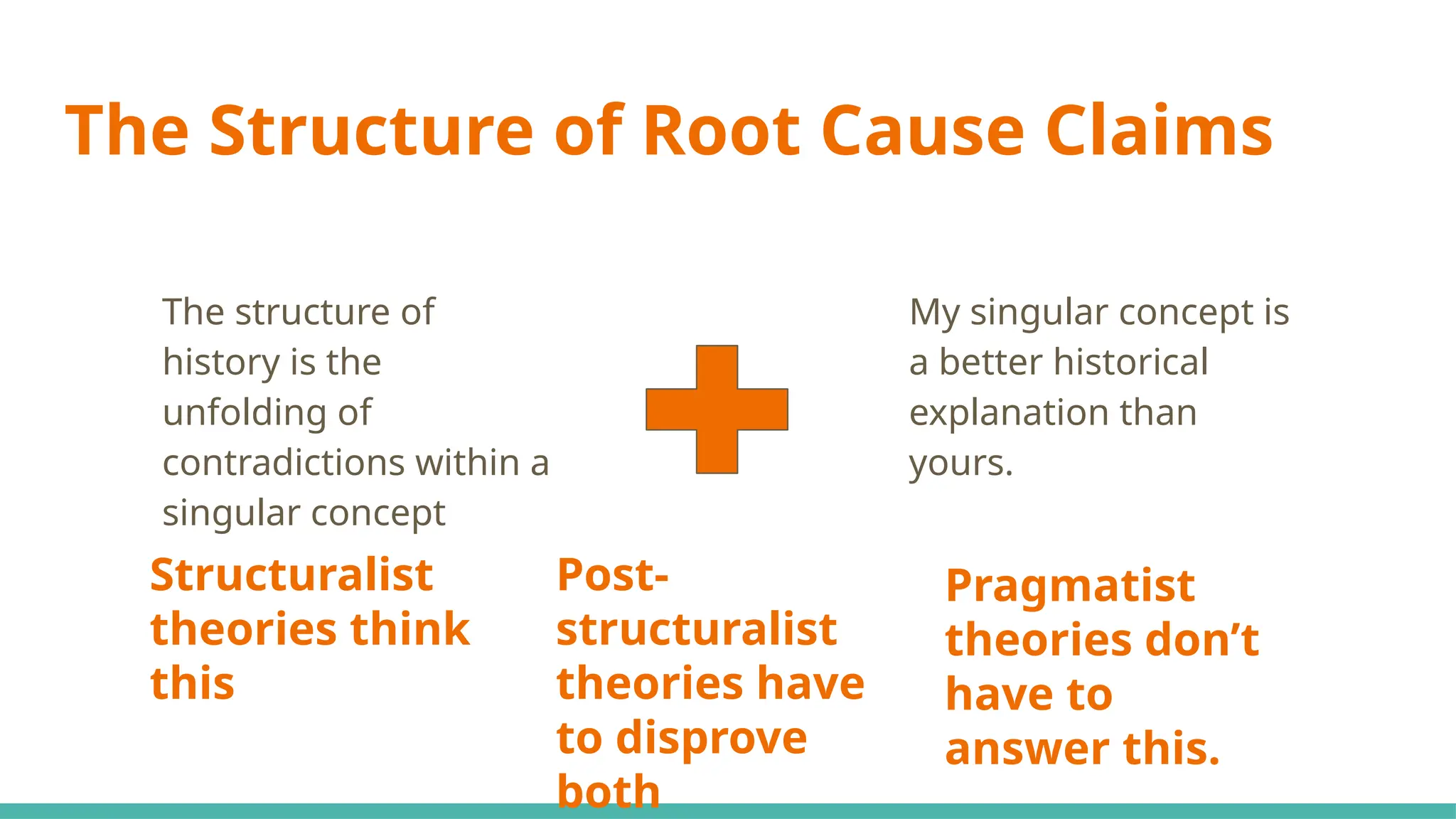
The structure of
history is the
unfolding of
contradictions within a
singular concept
My singular concept is
a better historical
explanation than
yours.
Structuralist
theories think
this
Post-
structuralist
theories have
to disprove
both
Pragmatist
theories don’t
have to
answer this.
55.
What All StylesCan Learn From the Pragmatist
● Tell a story about the future, as well as the past.
● Sometimes the root cause doesn’t matter, and if your opponent is getting
a lot of strategic utility out of claiming it, it is often to your benefit not to
contest their root cause story, but to explicitly say: “the root cause of the
problem doesn’t matter, the solution does.”
○ Be careful, though: serious work is needed to explain for why the past doesn’t imply the
future, and the post-structuralist work can be useful here.
● Who cares about who broke it? I want to know how to fix it.
56.
Opportunities to ImprovePragmatist Stories
● Make larger epistemological claims about how history should function.
● Explicitly foreground praxis as a way of understanding history–don’t just
go for policymaking good for the future, make the argument that political
engagement is also the only way to understand the past.
● Use the contradiction or exception in the story not just to defensively
answer the root cause, but to highlight the dangers of root cause.
● Focus on places where the historical pattern broke and in that experiment,
something good happened – pragmatists too often rely on incrementalist
accounts, when that is ironically the most similar to the “root cause” type
story.
57.
Things to Remember
●Root cause claims are combinations of general claims about how history works
with specific arguments about what explains history.
● Because of the limitations of debate, the only way to win the specific accounts of
history is to focus on giving a vivid and concrete historical narrative, and having
sufficient command of the facts to explain away your opponent’s specifics.
● Even though both parts of a root cause claim are logically distinct, the power of
one will often strengthen the power of the other. You can’t just answer one.
● Telling a story about the future is most effective when you explicitly argue that
root causes don’t matter.



![Practice, which, for Marxism, is the source and criterion of all truth, and ‘envelops’ the epistemological question, does not provide a de
jure foundation for the materialist thesis in the idealist sense of the term. The fact of practice points back, not to an originary legitimation [droit
originaire], but to its own real genesis. It is here that materialism is radically counterposed to all transcendental philosophies. No-one, perhaps, has
put this better than Engels, in connection with the problem of the definition of life: ‘From a scientific standpoint all definitions are of little
value. In order to gain an exhaustive knowledge of what life is, we should have to go through all the forms in which it appears,
from the lowest to the highest. ..’ [Anti-Dühring, p. 1041. The same holds for practice. It is not the immediacy of an act or structure, but its
own real genesis. Inseparable from human practice (broadly conceived: social production, daily social practice, class struggle) in
its contemporaneous forms, scientific practice, which is the most abstract refinement of practice, can be defined only in terms of
its real evolution, that is, its history. That is why Lenin also declares that the answer to the Fundamental epistemological
question’ is simultaneously provided by human practice and by the history of knowledge (Materialism and Empirio-Criticism, pp. 89,
122-4, 143, 147, 217, 239, etc.).
This history defines ‘the limits ... revealed by practice’ with respect to the ‘objective truth we are capable of attaining’ (ibid., p.
177). Mao Zedong, for example, shows (in ‘On Practice’) that the knowledge a given period is in a position to produce is always subject to
the determinate forms of existing practice (bound up, above all, with the existing social mode of production, i.e, with the dominant mode of the
transformation of nature). But within these historical limits, the truths acquired through practice are absolute (there is no truth
outside them). It is this dialectic of the historical conditions of knowledge which Lenin worked out in his frequently misunderstood theory of relative
and absolute truth.
‘The “essence” of things’, writes Lenin, ‘or “substance” is also relative; it expresses only the degree of profundity of
man’s knowledge of objects: and while yesterday the profundity of this knowledge did not go beyond the atom, and
today does not go beyond the electron and ether, dialectical materialism insists on the temporary, relative,
approximate character of all these milestones in the knowledge of nature gained by the progressing science of man.
The electron is as inexhaustible as the atom, nature is infinite but it infinitely exists (Lenin’s emphasis) (ibid., p. 250). -Althusser](https://image.slidesharecdn.com/rootcauseradicaldebate-250708165919-616a0b03/75/Root-Cause-Radical-Debate-powerpoint-presentation-24-2048.jpg)
![Structuralist v Post-Structuralist Root Cause Debates
In these debates, the post-structuralists think that there is no singular historical
concept that explains all of history. And, for debate purposes, they definitely don’t
think [x structuralist position] is one of them. This is not always a fully developed K
– this often manifests in one off cards or method ks.
In theory, given what we’ve discussed about the artifice behind the structuralist
warranting of their position, this should be easy to win.
If the structuralist has to prove that there is a singular concept… and that their fave
concept is the one, theoretically the post-structuralist can win using either.
Doesn’t often work that way.](https://image.slidesharecdn.com/rootcauseradicaldebate-250708165919-616a0b03/75/Root-Cause-Radical-Debate-powerpoint-presentation-44-2048.jpg)
![How does structuralism get away with it?
Heavily structural theories often get away with having almost none of the basic
structural argument in their cases/ks. Think of how rarely people go deep into the
warrants of Wilderson’s libidinal economy or Marx’s view of history.
Why does this work? Why can’t a neg just get up and be like “there’s no real
evidence history works like this at all, there’s a million things going on in history,
and to prove that nothing but [x] matters is a super high burden.”
One reason is that, because they’re strategic, we’re very used to the structuralism
by this point--trust me, AP had to have a lot of this stuff ten years ago.
But...](https://image.slidesharecdn.com/rootcauseradicaldebate-250708165919-616a0b03/75/Root-Cause-Radical-Debate-powerpoint-presentation-45-2048.jpg)